
Tag: scaling business

  • Part-time Marketing Director UK: Why Recruitment is the Wrong Move in 2026

    Part-time Marketing Director UK: Why Recruitment is the Wrong Move in 2026

    Your recruitment agency is selling you a ghost. Posting a job advert for a part-time marketing director uk in 2026 is no longer a talent search; it’s a strategic liability. You want a growth engine. Instead, you’re likely to get a “dinosaur” who treats AI like a passing fad and leaves your marketing department feeling messier than they found it.

    It’s a common frustration. You know your brand needs senior accountability, but the thought of another three-month hiring cycle followed by “day one” sick pay rights and the weight of new employment legislation is exhausting. You need momentum, not more HR baggage. You need a roadmap that actually works, delivered by someone who’s seen the chaos before and knows exactly how to fix it.

    This article explains why traditional recruitment is the wrong move for your scaling business this year. We’ll explore how to bypass the job boards, avoid the “fire and rehire” traps of the new legal landscape, and install senior leadership that focuses on strategic velocity rather than just clocking hours.

    Key Takeaways

    • Stop viewing senior leadership as a recruitment task; it’s a strategic intervention that job boards simply cannot deliver.
    • Understand why searching for a part-time marketing director uk often leads to expensive “messy marketing” rather than a coherent growth engine.
    • Evaluate the “plug-and-play” advantages of a Fractional CMO over the HR baggage and legal complexities of traditional part-time employment.
    • Identify the essential AI-driven skillsets required in 2026 to ensure your marketing systems are scalable and future-proof.
    • Learn how to interview for strategic authority and “battle-hardened” experience to avoid hiring tactical specialists who lack a commercial roadmap.

    Stop Browsing Job Boards: The Problem with Part-time Recruitment

    Stop scrolling through recruitment sites. It’s a distraction you can’t afford. If you’re a CEO focused on scaling, spending forty hours reviewing CVs for a part-time marketing director uk is a strategic failure. You’re looking for a growth engine, but job boards only give you “active” seekers. These are often professionals between roles or those who haven’t adapted to the high-velocity fractional market. You don’t need someone looking for a job; you need someone who solves problems.

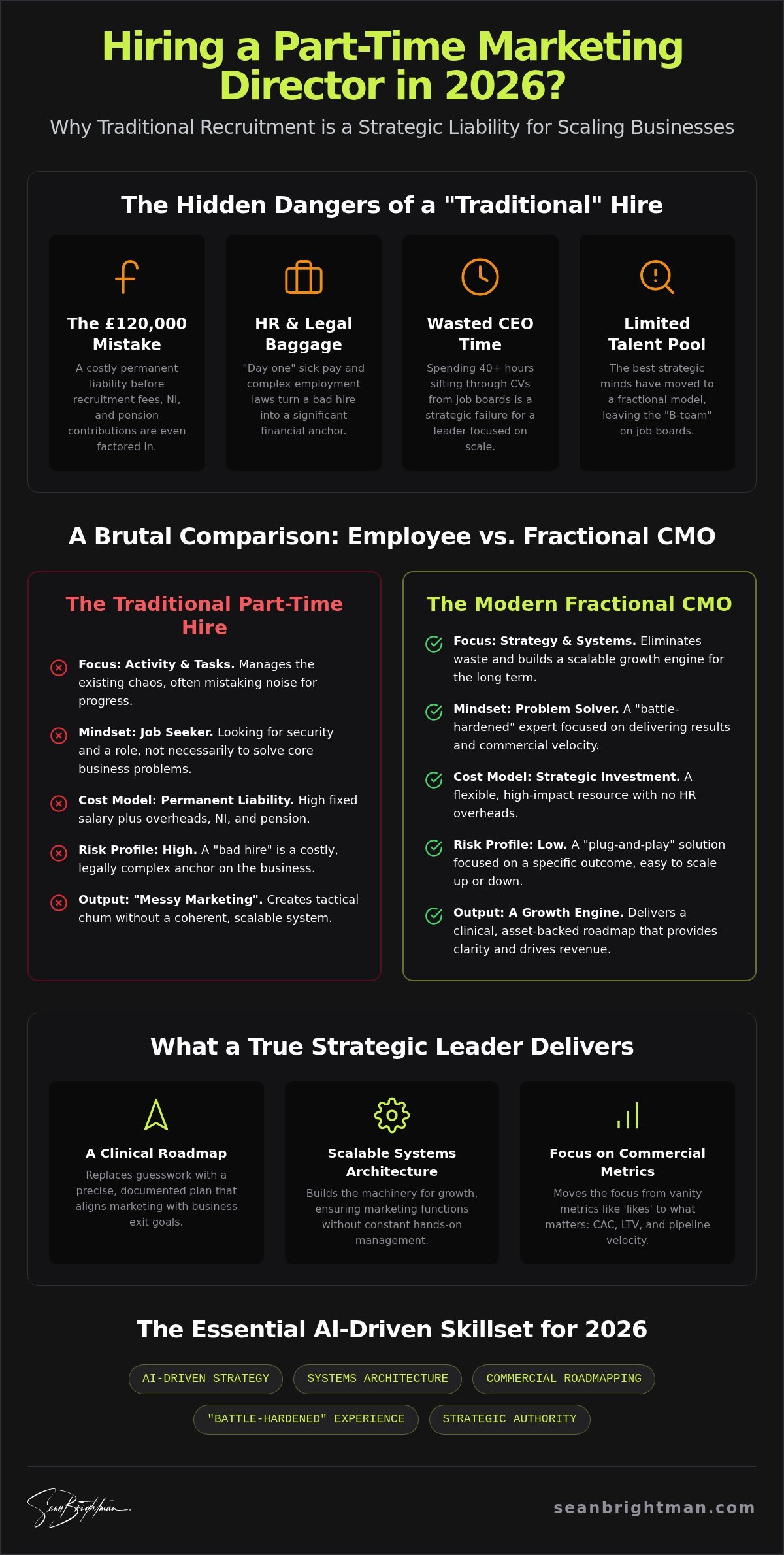
    Hiring a permanent senior leader in the current climate is often a £120,000 mistake. That’s before you factor in recruitment fees that vanish the moment a candidate leaves. In 2026, UK employment law has shifted significantly. With “day one” paternity and sick pay rights now the standard, the risk of a “bad hire” is no longer just a nuisance; it’s a financial anchor. You’re buying a permanent liability for what usually results in “part-focused” output. Traditional employment models simply don’t incentivise the ruthless efficiency a scaling brand requires.

    The HR Headache of Part-time Employment

    Senior talent doesn’t want a two-day-a-week employment contract anymore. The heavyweights, the ones who understand what a senior marketing leader actually does, have already moved to a fractional or advisory model. If you try to force a strategic mind onto a standard payroll, you’ll likely end up with the “B-team”. You’ll pay for pension contributions, National Insurance, and office overheads without getting the high-impact velocity of a true expert. The best people in the market now value their autonomy. They want to deliver results and move on to the next challenge, not sit in your weekly internal meetings.

    The Difference Between a Manager and a Director

    Most CVs you’ll find via traditional recruitment are senior managers in disguise. They are excellent at organising tasks and managing social media schedules. They are often terrible at building scalable growth engines. A manager asks what needs doing today; a director builds the system so the work gets done without them. In a post-AI landscape, you need a builder. You need someone who can audit your messy marketing and replace it with a clinical, results-oriented roadmap. Don’t hire someone to manage the chaos. Hire someone with the “battle-hardened” perspective to eliminate it.

    Strategy vs Activity: What a Senior Marketing Leader Actually Does

    Activity is a trap. Most businesses suffering from “Messy Marketing” mistake noise for progress. They post on social media. They tinker with PPC budgets. They launch newsletters that nobody reads. This is tactical churn, not growth. A true part-time marketing director uk doesn’t join your team to “do” more marketing. They join to stop the waste. They build a scalable growth engine that functions like a mechanical system. Every pound spent on brand positioning must work twice as hard before you touch an ad platform. It requires a “get-your-hands-dirty” attitude combined with high-level strategic authority.

    Accountability in senior leadership isn’t about hours logged. It’s about commercial velocity. If you follow the traditional route described in The Problem with Part-time Recruitment, you often hire a manager who tracks tasks. A director provides a clinical roadmap. They measure success through customer acquisition cost (CAC), lifetime value (LTV), and pipeline speed. They provide clarity. Your team stops guessing. They start executing with tactical precision and a “battle-hardened” perspective that prioritises revenue over vanity.

    Building the Marketing Systems Architecture

    Tools are not a strategy. Buying a CRM or an AI suite won’t fix a broken business model. Your leadership must distinguish between the machinery and the output. This requires a strategic brand roadmapping plan that defines your market position with surgical accuracy. This isn’t just about next month’s leads. It’s about aligning your entire marketing operation with your long-term business exit goals. If your systems aren’t asset-backed and documented, they aren’t scalable. They are just a collection of expensive habits.

    Driving Team Accountability

    A senior leader bridges the gap between commercial goals and execution. Whether you use internal staff or external agencies, they need a strategist to hold them to account. A part-time marketing director uk moves the focus away from vanity metrics. They ignore “likes” and “impressions”. They focus on commercial reality. They ensure your agencies aren’t just marking their own homework, but are actually moving the needle on your bottom line. If your current marketing feels like a black hole, a Fractional CMO can provide the necessary external pressure to drive order and results.

    Fractional CMO vs Part-time Employee: A Brutal Comparison

    Recruitment is slow. Fractional is fast. When you hire a part-time marketing director uk as an employee, you’re buying a person. When you hire a Fractional CMO, you’re buying a result. It is the difference between owning a car and hiring a chauffeur. One requires maintenance, insurance, and long-term commitment. The other just gets you where you need to go. You don’t need a resident; you need an intervention.

    This shift represents the revolution in 2026 for UK scale-ups. Fractional experts eliminate the onboarding lag. They don’t spend three months “learning the culture” or finding the printer. They audit. They strategise. They execute. They bring a “plug-and-play” efficiency that makes traditional part-time employment look archaic. You get senior leadership on a tactical basis, not a residency basis.

    The Cost-Benefit Analysis

    Look at the numbers, not the sentiment. An employee costs significantly more than their base salary. You pay National Insurance. You pay pension contributions. You pay for holiday leave and the 2026 “day one” sick pay rights that have transformed the UK labour market. A fractional hire is a commercial expense, not an HR liability. It is a predictable line item on a balance sheet, not a variable risk.

    You get fifteen years of senior experience condensed into one high-impact day a week. It is about buying brains, not hours. You avoid the “sunk cost” of a bad senior hire because there is no notice period friction. If the strategy isn’t delivering, you pivot immediately. You aren’t stuck with a “dinosaur” who doesn’t understand modern systems; you have a partner whose value is proven every single month.

    Flexibility and Strategic Velocity

    Business needs change. A permanent part-time marketing director uk is a fixed cost in a fluid market. Fractional models allow you to scale up or down based on your actual requirements. You might need heavy lifting during a product launch and lighter oversight during steady growth. The marketing advisory retainer provides this exact strategic velocity. It keeps you moving without the drag of a full-time contract.

    This model works because of the “outside-in” perspective. Internal hires often inherit the same blind spots as the CEO. An external director sees the friction in your sales funnel that you’ve become used to. They are building The AI-Powered Growth Engine across multiple sectors, bringing that cross-pollinated expertise to your boardroom. They aren’t there to make friends or navigate office politics. They are there to provide order, accountability, and a clear path to revenue.
    Part-time Marketing Director UK: Why Recruitment is the Wrong Move in 2026

    The AI-Powered Growth Engine: Why 2026 Requires a Different Skillset

    Content is no longer the king. Efficiency is. In 2026, the market is saturated with generic, AI-generated noise. If your part-time marketing director uk is still focused on increasing content volume, they are leading you into a graveyard. You don’t need more posts. You need smarter systems. You need an AI consulting expert who understands how to build integrated growth engines that deliver output density without the bloat. This isn’t about playing with tools; it’s about mechanical precision.

    Most CEOs are suffering from tool fatigue. They have a dozen subscriptions and zero results. A strategic leader cuts through this mess. They replace fragmented apps with a unified AI-powered architecture. This shifts the focus from “doing” to “architecting.” It increases marketing velocity whilst keeping your overheads lean. You buy results, not hours. You buy a system that works whilst you sleep, not a manager who needs a lunch break.

    Implementing AI Growth Engines

    AI goes far beyond ChatGPT prompts. A battle-hardened director uses AI to automate lead generation and extract customer insights with surgical accuracy. They don’t just “use” AI; they embed it into your business DNA. This allows you to reduce headcount costs whilst dramatically increasing your marketing output. It is about leverage. One senior strategist with a properly tuned AI engine can outperform an entire department of tactical generalists. This is how you scale in 2026 without the traditional HR friction.

    Future-Proofing Your Marketing Operations

    Technical integration is the new battleground. This is why a marketing operations consultant is no longer optional. You need to build a tech stack that scales with your revenue, not your headcount. The goal is a “plug-and-play” infrastructure that remains robust as you grow. However, technology is only half the battle. Your director must also ensure your brand remains authentically human. In an automated world, personality is your only moat. Use AI for the machinery, but keep the soul of the business intact.

    Ready to stop the tactical churn? Build a scalable growth engine today with Fractional CMO and AI consulting.

    Finding Your Strategic Partner: Beyond the CV

    Degrees don’t drive revenue. Qualifications don’t build systems. If you’re hiring a part-time marketing director uk based on a ten-year tenure at a legacy firm, you’re likely buying yesterday’s solutions. Strategic depth isn’t found in a list of responsibilities; it’s found in the ability to dismantle a broken process and replace it with a high-velocity engine. You need a partner who understands the visceral reality of the 2026 UK market, not someone who relies on outdated playbooks from a pre-AI era.

    Look for a “battle-hardened” perspective. This means finding a leader who has navigated the chaos of scaling and come out with a clinical, results-oriented methodology. Your ideal partner shouldn’t just agree with your vision. They should challenge your status quo. If they aren’t pushing back on your current tactical churn, they aren’t providing leadership; they’re just providing a temporary reprieve from your workload. A true director brings order to internal complexity by being an external force for accountability.

    The “90-day win” is your litmus test. In the first thirty days, you don’t want “activity.” You want a comprehensive audit and a clinical roadmap. By day sixty, you should see the implementation of core systems and AI-driven efficiencies. By day ninety, the department should move with commercial velocity. If you’re still talking about “brand awareness” without a clear link to your bottom line after three months, you’ve hired a manager, not a strategist.

    The Advisory Model: Leadership Without Ceremony

    Sean Brightman doesn’t operate like a traditional recruitment agency. He provides direction, not just placement. The focus is on fixing messy marketing through a “get-your-hands-dirty” advisory approach. This moves the needle away from the traditional boss/employee dynamic toward a high-impact strategic partnership. You aren’t managing a subordinate; you’re engaging an expert who holds you and your team to a higher standard of execution.

    The Advisory Retainer is the specific tool designed for this level of strategic velocity. It strips away the ceremony of corporate consulting and replaces it with direct, blunt honesty. It ensures that the CEO has a sharp-minded partner to navigate complex commercial decisions without the HR baggage of a permanent hire. It’s about plug-and-play leadership that scales with your ambition.

    Next Steps: Securing Your Growth Engine

    Transitioning from a messy, unaccountable department to a structured growth engine starts with a single decision. You must stop browsing job boards and start investing in a roadmap. The first step is always a strategic roadmapping session. This isn’t a casual chat; it’s a tactical intervention to define your market position and identify the friction points in your current funnel. It is time to move from “part-focused” output to a scalable, asset-backed marketing operation.

    Ready to build a growth engine that delivers results, not just hours? Book a strategy session with Sean Brightman.

    Time to Stop Recruiting and Start Scaling

    Traditional hiring is a financial anchor. In 2026, searching for a part-time marketing director uk through a recruitment agency is a strategic error that buys you liability rather than velocity. You don’t need another seat filled in your office. You need a high-impact growth engine that converts strategy into revenue without the friction of permanent employment contracts or “day one” sick pay rights.

    Success requires a shift from activity to architecture. Sean Brightman is a specialist in AI-powered growth engines and a published author on marketing strategy. He provides the senior leadership you need with zero recruitment fees and a clinical focus on results. It is about strategic intervention, not administrative management. You get a battle-hardened expert who builds the machinery of your business whilst you focus on the big picture.

    Stop browsing job boards and start building a scalable future. It is time to replace your messy marketing with a roadmap that actually delivers. Build your growth engine with Sean Brightman. Your brand is ready for the next level; make sure your leadership is too.

    Frequently Asked Questions

    What is the difference between a part-time marketing director and a Fractional CMO?

    A part-time marketing director is often a traditional employee on a reduced-hours contract. A Fractional CMO is a strategic partner who joins on a “plug-and-play” basis. One brings HR baggage and a “manager” mindset; the other brings senior leadership and an “architect” mindset. Fractional CMOs focus on outcomes rather than hours. They provide strategic intervention without the notice periods or pension contributions associated with traditional employment in the UK.

    How much does a part-time marketing director cost in the UK in 2026?

    The total cost of ownership for an employee is far higher than a base salary. You must factor in National Insurance, pension contributions, and the 2026 “day one” sick pay rights. Whilst specific day rates vary based on experience and sector, a fractional model typically represents a significant saving compared to a full-time director’s total package. You pay for strategic velocity, not just a body in a chair.

    Do I need a part-time marketing director if I already have an agency?

    Yes, because agencies need direction and accountability. An agency executes; a director strategises. Without a senior leader, agencies often “mark their own homework” and focus on tactical churn rather than commercial reality. A director ensures your agency is aligned with your business exit goals. They bridge the gap between your commercial ambition and the agency’s technical output, preventing expensive “messy marketing” that wastes your budget.

    How many days a week does a part-time marketing director usually work?

    Most engagements range from one to two days a week. However, the focus should be on strategic velocity, not time spent. A high-impact leader can deliver more value in four hours of clinical roadmapping than a senior manager can in forty hours of task management. The goal is to build a growth engine that runs without constant supervision, allowing you to scale without increasing your permanent headcount.

    Can a part-time marketing director help with my business exit strategy?

    Absolutely. A senior leader builds asset-backed marketing systems that increase business valuation. Buyers want to see a scalable growth engine, not a department dependent on the CEO’s intuition. By documenting processes and implementing AI-powered insights, a director makes your marketing operations transferable. They move the business away from person-dependent chaos toward a structured, mechanical system that proves long-term commercial viability to potential investors or buyers.

    What should be the first priority for a new part-time marketing hire?

    The first priority for a part-time marketing director uk is a comprehensive audit and strategic roadmapping session. They must identify friction points in your current sales funnel before spending a penny on ads. This involves stripping away “messy marketing” and defining a clinical path to revenue. You need a roadmap that aligns brand positioning with commercial goals, ensuring every future tactical move is an investment, not a gamble.

    Is it better to hire a part-time director or a full-time marketing manager?

    It depends on whether you need a builder or a maintainer. A manager organises tasks; a director builds systems. Hiring a full-time manager to fix a broken strategy is a common mistake. You end up with “part-focused” output and no roadmap. A part-time director provides the senior authority to fix the architecture first. Once the growth engine is built, you can then decide on the tactical headcount needed.

    How does a part-time marketing director integrate AI into my business?

    They move you from tool fatigue to integrated AI growth engines. Instead of just using ChatGPT for content, a director implements AI consulting strategies to automate lead generation and customer insights. They build a tech stack that scales with your business velocity, not your staff numbers. The focus is on increasing output density whilst keeping the brand authentically human, ensuring your marketing operations are future-proofed for the 2026 landscape.

  • The Marketing Advisory Retainer: A CEO’s Guide to Strategic Velocity

    The Marketing Advisory Retainer: A CEO’s Guide to Strategic Velocity

    Most CEOs are the biggest bottleneck in their own marketing department. You’re likely tired of babysitting agencies that under-deliver whilst you struggle to find a clear path forward. Securing a marketing advisory retainer is the quickest way to stop the bleed. It gives you the senior leadership you need to own the results without the £150,000 overhead of a full-time hire.

    You want a scalable growth engine, not another project to manage. We agree that your time is better spent on high-level strategy than on chasing campaign updates. This guide promises to show you how to install a “plug-and-play” leader who brings absolute accountability to your team.

    We’ll break down the mechanics of strategic velocity, from AI-powered efficiency to building an exit-ready marketing roadmap. It’s time to cut the fluff and start focusing on tactical precision. You’ll learn how to move from confusion to a clear, high-impact system that allows you to optimise your resources and scale with confidence.

    Key Takeaways

    • Break the “busy-ness trap” by identifying why high agency activity often fails to deliver tangible ROI for your business.
    • Secure senior leadership through a marketing advisory retainer to gain strategic direction without the £150k overhead of a full-time hire.
    • Distinguish between “the brain” and “the hands” to ensure your marketing is driven by high-level strategy, not just mindless execution.
    • Implement a clear diagnostic roadmap that prioritises pipeline velocity and lead quality over vanity metrics that do not move the needle.
    • Leverage AI-powered efficiency to build a scalable, exit-ready growth engine that removes the CEO as the primary bottleneck for decisions.

    The Marketing Busy-ness Trap: Why Your Current Strategy is Stalling

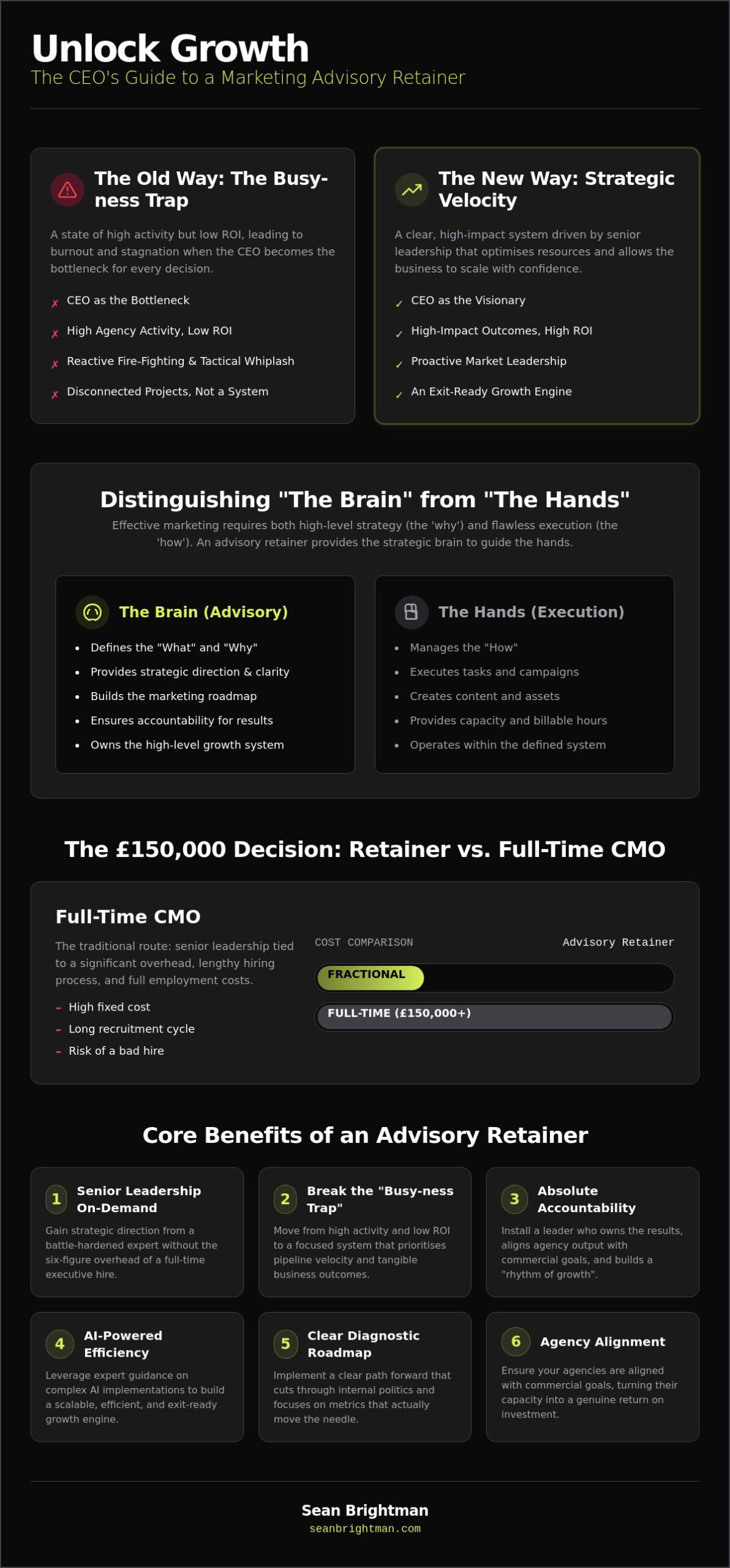
    You’re busy. Your team is busy. Your agencies are definitely busy. Yet, the numbers aren’t moving. This is the marketing busy-ness trap. It’s a state of high activity and low ROI that eventually leads to CEO burnout. You feel like you’re babysitting every campaign. You’ve become the bottleneck. When every decision, from a headline change to a budget shift, has to cross your desk, growth stops. You become the single point of failure.

    A marketing advisory retainer isn’t about adding more tasks to your list. It’s about removing the friction. Most businesses confuse “doing things” with “achieving outcomes.” Sending three emails a week is activity. Increasing your pipeline velocity by 20% is an outcome. If your marketing feels like a series of disconnected projects, you’re just burning cash to keep the lights on. You need a system, not a to-do list.

    The Agency Execution Gap

    Agencies are built to execute. They sell capacity, not necessarily growth. Because they lack your internal context, they often operate in a vacuum. This creates “tactical whiplash” where you jump from one trend to another because an account manager suggested it. You need a bridge. Agencies are incentivised to spend your budget, not necessarily grow your business. They thrive on billable hours, which often leads to a focus on volume over value.

    A strategic advisor doesn’t just manage the agency; they align the agency’s output with your commercial goals. They ensure the Retainer agreement you signed with your providers actually produces a return, rather than just filling a timesheet. This partnership ensures that every pound spent on execution is backed by a senior-level “why.” It moves your team from reactive fire-fighting to proactive market leadership.

    The High Cost of Senior Vacancy

    Hiring a junior marketer to “do social media” won’t fix a broken positioning strategy. Junior hires lack the battle-hardened perspective to challenge the status quo or navigate complex AI implementations. When no one owns the high-level strategy, the business drifts. There is a hidden drain on your resources when you have no one “owning” the marketing roadmap. This isn’t just about missing targets; it’s about the cost of standing still.

    Securing a marketing advisory retainer provides the senior leadership required to fix these structural issues. Without this oversight, you pay a heavy price in missed opportunities. The vacancy tax is the lost revenue from delayed strategic decisions and missed market opportunities. You don’t need more hands on deck. You need a better captain.

    What is a Marketing Advisory Retainer (and What it is Not)?

    A marketing advisory retainer is not a commodity purchase of billable hours. It’s an “outsourced brain” for your business. Unlike an agency that sells capacity, an advisor sells clarity. It’s a high-leverage partnership designed to provide ongoing strategic direction, oversight, and absolute accountability. You aren’t paying for someone to manage your LinkedIn posts; you’re paying for someone to ensure those posts actually contribute to your exit strategy. This is the brain, not the hands. This is the architect, not the bricklayer.

    The distinction is simple. Execution is about “how.” Advisory is about “what” and “why.” If your team is busy running in the wrong direction, they’re just getting lost faster. An advisory retainer fixes the compass. It focuses on three core pillars: brand positioning, systems architecture, and team leadership. This model prioritises long-term, sustainable growth over short-term “hacks” that leave your brand hollow. It’s about building a machine that works, even when you aren’t in the room.

    Direction, Not Just Execution

    Most internal teams are too close to the coalface. They can’t see the systemic issues because they’re part of them. An advisor provides an outside-in perspective that cuts through internal politics and identifies the real bottlenecks. They set the “North Star” for the entire marketing department, ensuring every penny spent on execution is working toward a singular goal. This is why the choice between a B2B Marketing Advisor vs Agency: Why Strategy Trumps Execution in 2026 is becoming the standard for scale-ups looking for strategic velocity.

    The Accountability Framework

    Strategy without execution is just a hallucination. A marketing advisory retainer ensures that the roadmap actually gets built. It creates a “rhythm of growth” for the entire business. This isn’t a one-off report that gathers dust on a shelf. It involves monthly reviews, tactical pivots based on live data, and holding both internal teams and external agencies to a higher standard. If you’re ready to stop guessing and start scaling, you can review my advisory services to see how this framework fits your specific business model. It’s about creating a culture of performance where results are the only metric that matters.

    Advisory Retainer vs. Full-Time CMO: The £120k Decision

    Hiring a full-time CMO is a high-stakes gamble. In the UK, a top-tier marketing leader expects a base salary north of £150,000. By the time you factor in National Insurance, pension contributions, and bonuses, that figure climbs toward £200,000. That’s a heavy anchor for a growing business. You’re paying for a full-time presence when you might only need part-time brilliance. It’s a resource allocation error that kills cash flow.

    The marketing advisory retainer flips this script. It gives you access to battle-hardened expertise at a fraction of the cost. You aren’t buying a body in a chair; you’re buying the results that person produces. It’s the difference between owning a jet and booking a private flight. You get the speed without the maintenance fees. You secure senior-level thinking without the C-suite baggage or the equity dilution. For growing businesses, accessing senior marketing leadership on demand delivers the same executive-level impact without the permanent overhead that strangles cash flow.

    Recruitment is slow. Finding, vetting, and hiring a C-suite executive can take six months. An advisor can be integrated into your business in less than a week. Risk mitigation is the hidden benefit here. Pivoting an advisory relationship is simple. Firing a full-time director is a legal and cultural nightmare. One is a flexible partnership; the other is a permanent commitment that’s difficult to unwind if the fit isn’t perfect.

    When to Go Fractional

    If your revenue is between £2m and £15m, you likely have a complexity problem, not a capacity problem. You need a leader to build the systems, not just manage the people. A fractional leader prepares your business for a future full-time hire by cleaning up the mess first. They install the growth engine so the next person just has to drive. Learn why it’s time to Stop Hiring Full-Time CMOs: The Fractional Revolution in 2026.

    The Efficiency of Senior Oversight

    Four days of high-level strategy will always outperform twenty days of junior execution. A senior advisor has seen your specific problems before. They don’t need to “learn” your industry; they just need to apply proven frameworks to your data. It’s plug-and-play leadership. Strategic ROI is the value generated per hour of senior-level decision-making. If one hour of a marketing advisory retainer prevents a £50,000 mistake in your ad spend, the relationship has already paid for itself ten times over.

    The Marketing Advisory Retainer: A CEO’s Guide to Strategic Velocity

    How to Structure Your Marketing Retainer for Maximum ROI

    A marketing advisory retainer is a strategic investment, not a recurring expense. To extract maximum ROI, you must treat the engagement like an engineering project. This starts with a Roadmap. Every retainer must begin with a diagnostic phase. If an advisor tries to prescribe a solution before they’ve performed surgery on your data, walk away. You need a clear baseline of your current performance before you can attempt to accelerate it.

    Define the metrics that actually move the needle. Stop looking at impressions. Start looking at lead quality and pipeline velocity. These are the clinical indicators of a healthy business. A high-level advisor focuses on brand equity because it lowers your customer acquisition cost over time. It’s about building a permanent asset, not just renting a temporary audience. You want a growth engine, not a series of expensive experiments. Establishing a clear strategic marketing direction is what separates businesses that scale predictably from those that remain trapped in a cycle of high spend and low visibility.

    Communication must be clinical and efficient. Establish a rhythm that respects your time. Weekly tactical syncs keep the momentum high. Monthly strategic deep-dives ensure the “North Star” hasn’t drifted. This cadence creates a heartbeat for your marketing team. It provides the absolute accountability that most internal departments lack when left to their own devices.

    The ultimate goal is a self-sustaining system. A truly effective advisor builds the machinery so they can eventually step back. They document the processes, install the AI-powered workflows, and train the team. If they aren’t planning their own exit strategy, they aren’t an advisor; they’re just an expensive contractor. You are paying for a solution, not a dependency.

    Due Diligence: Questions to Ask

    Don’t be polite. Be thorough. You need to know exactly what you’re buying before you commit. Ask about the specific growth engines they have built for businesses at your revenue stage. Enquire how they bake AI into the marketing stack to reduce manual labour and increase output. Ensure they prioritise brand positioning as the foundation for lead generation, rather than just chasing the latest tactical trend.

    The “Red Flags” of Poor Retainers

    The market is full of pretenders. Spot them early. Vague reporting is the first sign of trouble. If your monthly report is a list of “vanity metrics” like likes, shares, or impressions, you’re being sold a lie. These numbers don’t pay the bills. Lack of direct access is another warning sign. If you’re sold a senior lead but end up talking to a junior account manager, the value has vanished. You’re paying for expertise you aren’t receiving.

    Ready to stop the guesswork and start scaling? Book a roadmapping session to define your strategic velocity and build a marketing engine that actually delivers.

    The Sean Brightman Approach: Strategy, AI, and Accountability

    Sean Brightman isn’t a theorist who hands over a 50-page slide deck and disappears. He’s a battle-hardened operator for UK scale-ups who understands that strategy without execution is a waste of capital. His methodology is clinical and designed for speed: Roadmapping, Systems Architecture, and then Ongoing Advisory. This isn’t about maintaining the status quo. It’s about building a marketing engine that makes your business “Exit-Ready.” Investors don’t buy activity; they buy predictable, scalable systems that don’t depend on the CEO’s daily input.

    A marketing advisory retainer with Sean provides the senior-level friction needed to stop bad ideas before they cost you six figures. It’s about installing absolute accountability into your department. Most businesses have a collection of tools and people. Sean turns them into a machine. This approach prioritises enterprise value by ensuring your marketing is a functional component of your business growth, not a disconnected cost centre.

    AI-Powered Growth Engines

    AI isn’t just a tool in Sean’s arsenal; it’s a fundamental shift in how he organises marketing operations. He uses AI roadmapping to automate the mundane and supercharge the strategic. This eliminates manual friction and allows your team to focus on high-leverage tasks that move the needle. By acting as a Marketing Operations Consultant: Building a Scalable Growth Engine for 2026, Sean ensures your tech stack is an asset that drives efficiency rather than a burden that drains resources.

    Your Next Step: From Chaos to Clarity

    You don’t have to accept messy marketing as the cost of doing business. You don’t have to be the bottleneck for every decision. The solution is a 90-day strategic sprint to reset your direction and install the systems you’ve been missing. It’s a concentrated burst of senior-level energy that replaces confusion with clarity and activity with outcomes. You can secure the strategic velocity your business deserves without the overhead of a traditional hire.

    Ready to stop the bleed and start scaling? Book a discovery call to discuss your Marketing Advisory Retainer and find out how to turn your marketing department into a high-performance growth engine.

    Claim Your Strategic Velocity

    Your marketing department should be a predictable machine, not a source of constant frustration. We have established that high activity without senior oversight is a “busy-ness trap” that simply drains your budget. You now understand the massive cost difference between a permanent hire and a high-leverage partnership. By choosing a marketing advisory retainer, you install the “outsourced brain” required to navigate AI implementation and brand positioning with tactical precision.

    Sean Brightman brings battle-hardened experience as a Fractional CMO for UK scale-ups. As a published author on marketing strategy and an expert in AI-powered growth engines, he replaces chaos with a clinical roadmap. It’s time to remove yourself as the bottleneck. Build an exit-ready business that thrives on systems, not individual effort. The path from confusion to clarity starts with a single decision. Stop babysitting agencies and start leading a scalable growth engine today.

    Secure your senior marketing leadership with an Advisory Retainer

    Frequently Asked Questions

    What is the difference between a marketing consultant and an advisory retainer?

    A consultant typically solves a specific, project-based problem whilst a marketing advisory retainer provides ongoing strategic leadership and oversight. Consultants deliver a report and leave. Advisors stay to ensure the strategy is executed, the team is held accountable, and the growth engine actually produces results. It’s the difference between a one-off repair and a permanent system upgrade.

    How long is a typical marketing advisory retainer agreement?

    Most agreements run for six to twelve months to allow enough time for strategic changes to compound and show measurable ROI. This timeframe allows for a full diagnostic phase, the installation of new systems, and the optimisation of your growth engine. It’s a medium-term partnership designed to prepare your business for a future exit or a permanent C-suite hire.

    Do I need a marketing advisor if I already have a marketing agency?

    Yes, because agencies are built to execute tasks, not necessarily to own your commercial strategy. An advisor acts as the bridge between your business goals and the agency’s tactical output. They provide the “outside-in” perspective needed to hold agencies accountable and ensure they are moving the needle, not just filling timesheets with low-impact activity.

    What results can I expect in the first 90 days of an advisory retainer?

    You can expect a completed diagnostic roadmap and the immediate identification of wasted marketing spend. Within the first three months, we install the core systems architecture and define clear, outcome-based KPIs. You will move from a state of marketing chaos to having a clinical, data-driven understanding of your pipeline velocity and lead quality.

    Can an advisory retainer help with AI implementation in my marketing team?

    AI implementation is a fundamental part of a modern marketing advisory retainer. We don’t just suggest tools; we re-engineer your marketing operations to automate mundane tasks and supercharge strategic output. This reduces manual friction and allows your team to focus on high-leverage activities that directly contribute to your brand equity and revenue growth.

    Is a marketing advisory retainer suitable for small businesses or just scale-ups?

    Scale-ups with revenue between £2m and £15m see the highest ROI because they face complexity that smaller firms haven’t encountered. Small businesses often need “hands” for basic execution. Scale-ups need a “brain” to organise their resources, manage multiple agencies, and build the scalable systems required for a significant market expansion or eventual sale.

    How does an advisory retainer improve my marketing team’s accountability?

    Accountability improves through the installation of objective, outcome-based metrics that remove emotional bias from performance reviews. We establish a clinical communication rhythm, including monthly deep-dives and weekly tactical syncs. This ensures that every team member and agency knows exactly what they are responsible for and how their performance is being measured against commercial goals.

    What happens if I need more execution support than the retainer provides?

    Your advisor will help you source, vet, and manage the right agencies or internal staff to handle the extra workload. The advisor remains the architect who designs the system, whilst the execution support provides the “hands” to build it. This ensures that even as you scale your execution, the strategic integrity of your marketing remains intact.