
Tag: small business marketing

  • DIY Marketing Strategy or Professional Help: Which Fits Your Budget

    DIY Marketing Strategy or Professional Help: Which Fits Your Budget

    The DIY marketing strategy vs professional help decision is about more than cost. DIY can keep spending down and give you creative control, but it takes consistent time and clear ownership. Professional support adds an investment, while helping align marketing with business goals. The right fit depends on the time and skills you can commit, and whether your activities are building towards sustainable growth.

    It’s tempting to treat marketing as a series of separate tasks: post on social media, send an email, update the website. But activity without direction can become disjointed. A packed marketing schedule is no proof that your work is reaching the right people or supporting the business.

    This guide compares DIY, professional support and approaches that combine the two, including their costs, time demands and strategic foundations. You’ll see when doing it yourself makes sense, when outside expertise can help, and how to choose an approach that supports the business you want to build.

    Key Takeaways

    • Choose DIY when you have the time and marketing skills to keep activity consistent and aligned with business goals.
    • Compare the cost of outside support with the time you spend on marketing and the work that time could otherwise support.
    • Build a strategy around clear goals, a defined audience and ways to track progress, not a list of disconnected tactics.
    • When your marketing lacks direction, roadmapping or strategic advice can help establish a stronger foundation for growth.

    Why do I Need a Professional Marketing Strategy?

    Professional help may make sense when marketing takes time away from running the business or the results don’t match the effort. The decision comes down to focus, control and whether your marketing can support growth.

    Professional help for small businesses

    An external marketer can connect separate activities to business goals and bring a fresh perspective to opportunities you may overlook. This can suit a small business that needs a consistent message across channels, especially when marketing already feels like a second job. Unlike DIY, professional input brings an outside view; unlike a specialist focused on one channel, strategic support can align several activities.

    Control with an outside marketer

    Working with an external marketer means sharing decisions and giving them time to understand your business, audience and industry. You can retain control by agreeing priorities, reviewing the proposed message and setting approval points before work proceeds. DIY gives you more immediate creative autonomy, while outside support can make the process more efficient when roles and decisions are clear from the start.

    Scaling with professional help

    As a business grows, the marketing that helped attract early customers may not support its next stage. A professional can shape a strategy around changing goals, audiences and capacity, then align marketing activity with those priorities. This differs from adding tactics one at a time: the aim is a connected approach that can adapt as the business expands, rather than simply increasing output.

    For local visibility, claim and fully optimise your Google Business Profile. Add photos, offers and customer reviews, then use local keywords in its description. This gives nearby searchers useful information and connects your profile with the places and services your business targets.

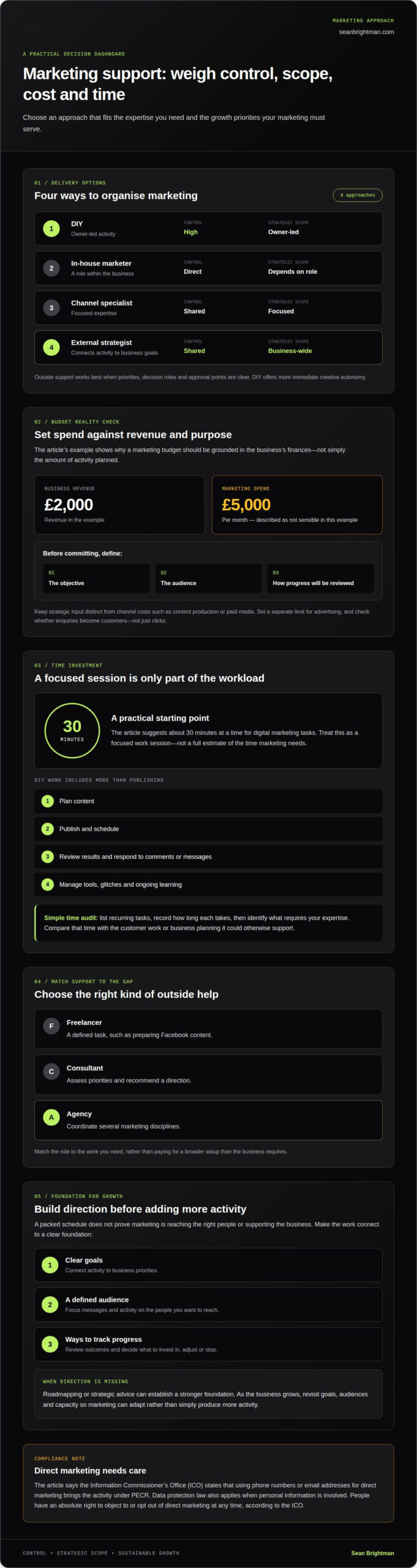
    Option Control Strategic scope
    DIY High Owner-led
    In-house marketer Direct Depends on role
    Channel specialist Shared Focused
    External strategist Shared Business-wide

    Choose the approach based on the expertise you need, the control you want and the growth priorities your marketing must serve.

    Marketing budgets and realistic spending

    Set the budget against business revenue, cash flow and a clear marketing goal. Spending must support the audience you want to reach, not just fund activity. A business bringing in £2,000 in revenue would not sensibly spend £5,000 per month on marketing. Start with a defined objective, then decide which activity deserves investment.

    Professional support makes most sense when the work has a clear purpose and the budget can sustain it. Agree what the spend covers, which outcomes matter and how you’ll review progress. Separate strategic input from channel costs, such as content production or paid media, so trade-offs are visible before you commit.

    DIY can suit a start-up with limited funds, provided someone has time to learn and manage the work. List essential tools, such as email, analytics and design software, and keep only those that serve a specific task. Review subscriptions regularly. If a tool doesn’t help you reach your audience, track leads or make better decisions, it may be dead weight.

    Set a separate limit for paid advertising and define the test before you launch. Choose a campaign objective and audience, then review whether enquiries become customers, not just clicks. Without those checks, weak targeting or unclear messaging can drain the budget. A larger media spend is not proof of success.

    DIY also carries compliance risks. According to the Information Commissioner’s Office (ICO), using phone numbers or email addresses for direct marketing brings the activity under PECR; data protection law also applies when personal information is involved. People have an absolute right to object to or opt out of direct marketing at any time, according to the ICO.

    For a tighter connection between budget and business goals, explore marketing strategy guidance. A practical plan helps decide what to invest in, what to measure and what to stop.
    DIY Marketing Strategy or Professional Help: Which Fits Your Budget

    Time freed up by professional marketing support

    DIY marketing takes more than the time spent publishing. Owners also plan content, review results, respond to comments and handle tools or glitches. A practical starting point is about 30 minutes at a time for digital marketing tasks. Treat that as a focused work session, not a full estimate of the time your marketing needs.

    Choose support based on the work you need. A freelancer can handle a defined task, such as preparing Facebook content; a consultant can assess priorities and recommend a direction; an agency can coordinate several marketing disciplines. Match the role to the gap, rather than paying for a broader setup than your business needs.

    Courses, webinars and industry blogs can help you build useful marketing skills. But training takes time, and applying what you learn across SEO, content, email and social media adds ongoing work. For example, a business owner who creates posts, schedules them and answers messages needs to protect time for each step to stay consistent.

    Compare those hours with what you could earn or accomplish in the same time. If a week of marketing tasks displaces customer work or business planning, outside support may free you to focus on running the business. Start with a simple audit: list recurring tasks, record how long each takes, then identify what requires your expertise.

    Technical website support becomes relevant when glitches, broken tracking or content updates repeatedly interrupt marketing work. Separate technical fixes from strategy: a website specialist handles site issues, while a marketer focuses on how channels support business goals. If Google Analytics tracking fails, for instance, fixing it restores the data you need to assess marketing activity.

    Before choosing training or external support, identify the bottleneck: is it learning, planning, execution or technical maintenance? That answer shows what to delegate and what to keep in-house.

    Marketing strategy as a foundation for sustainable growth

    Sustainable growth needs more than a steady stream of digital activity. A written strategy connects business goals to the audience, message and actions most likely to support them. New business owners can create and track that strategy themselves before outsourcing becomes practical. The key is to make deliberate choices, rather than simply follow whichever channel feels easiest.

    Start by recording the business objective, the people you need to reach and the message they should remember. Then choose marketing activity that supports those decisions. For example, an accountant targeting small firms could publish useful tax guidance instead of posting unrelated updates across social media. Each activity should have a clear purpose and a way to assess progress.

    • Set a goal, such as generating qualified enquiries.
    • Define the target audience and the problem your offer solves.
    • Choose a measure, such as leads or conversions, before launching activity.

    That sequence turns a strategy into a plan. Share the written plan with the people responsible for delivery, then track its progress. Google Analytics can help assess digital activity, while email and social media metrics show how audiences respond. Use lead and conversion data to adjust your approach. A rising follower count alone doesn’t show whether marketing is helping the business grow.

    Keep the strategy behind each campaign visible to the team. If a post, email or website update cannot be linked to a goal, question its place in the plan. This gives you a clearer basis for deciding what to continue, change or stop. It also makes growth less dependent on one person’s memory or last-minute ideas.

    A confident strategy doesn’t require outsourcing every task. It requires clear priorities, shared direction and evidence that activity is moving towards business goals. Build a roadmap for sustainable growth when the next stage needs a sharper direction.

    Sean Brightman

    Sean Brightman can help you make the choice between DIY marketing and professional support a clearer business decision. If your activity lacks direction, Roadmapping can set priorities and connect marketing decisions to growth goals. For ongoing strategic input as priorities shift, an Advisory Retainer provides continued guidance. AI Consulting can also help you assess how AI fits your marketing approach.

    Professional help isn’t automatically the right move. If you have the time, skills and a clear plan, continuing in-house may suit your business. If you’re unsure what to prioritise or how to build a sustainable approach, Sean Brightman can help you work through the decision. Contact Sean Brightman to discuss your marketing strategy.

    Make your next marketing move deliberate

    Don’t let the DIY marketing strategy vs professional help decision become another unfinished task. Choose one practical next step: clarify the growth decision in front of you, identify what’s blocking progress, and decide whether you have the capacity to solve it internally. That turns uncertainty into a decision you can act on.

    If you want an experienced perspective, Sean Brightman offers Fractional CMO support, AI Consulting and Roadmapping. Each brings strategic thinking to questions about direction, priorities and how AI fits your business. The right starting point depends on the challenge you’re trying to solve, not on adding marketing activity for its own sake.

    Take the next step with a clear question and the business goal behind it. Discuss your marketing options with Sean Brightman, and move forward with a direction that fits your business.

    Frequently Asked Questions

    Final Verdict: DIY or Hire a Pro?

    Choose DIY if you can make marketing decisions and carry them through without neglecting core business work. Seek professional help when you need strategic judgement or skills that aren’t available in-house. The DIY marketing strategy vs professional help decision should reflect your time, capabilities and growth priorities. You can keep customer knowledge and approvals internal while bringing in outside expertise for a specific challenge.

    But What About the Budget?

    Build your budget around business capacity, not an arbitrary industry benchmark. Separate spending into strategy, tools, content and paid promotion, then decide what each part should achieve. For example, a business testing a new offer could set a contained budget to reach its intended audience, then review qualified enquiries before committing further funds. This makes each investment easier to assess.

    What are DIY Solutions Costing Your Business?

    DIY costs more than subscriptions. Include staff time, training and corrections when work misses the mark. If a founder spends an afternoon editing a campaign instead of preparing a client proposal, account for the displaced work. Review recurring software charges and unfinished projects too. A modest monthly fee can still be poor value if nobody uses the tool effectively.

    When does a DIY approach work?

    DIY works when the business understands its customers, has someone to own the work and can maintain a clear direction. A specialist retailer, for instance, might turn customer questions into useful product guides. First-hand insight can make that content distinctive. Keep the workload manageable, assign responsibility for publishing and check that each activity supports a business priority.

    Which Option Delivers Real Results Faster?

    Professional support can speed up decisions, while paid campaigns can provide feedback sooner than organic search. A significant increase in organic traffic from SEO may take three to six months. The DIY marketing strategy vs professional help comparison should focus on meaningful progress, not speed alone. Track relevant enquiries or completed purchases, rather than impressions or clicks without business value.

    What marketing tasks can a small business manage in-house?

    Small businesses can often manage tasks rooted in direct customer knowledge: collecting testimonials, answering common questions, drafting email updates and sharing genuine behind-the-scenes details. A team member can also record which enquiries lead to sales, giving future decisions a firmer basis. Assign one person to publishing and follow-up so useful ideas don’t disappear during busy working days.

  • How to Build an AI Marketing Stack for a Small Business

    How to Build an AI Marketing Stack for a Small Business

    More AI tools won’t fix a disconnected marketing system. A practical AI marketing stack connects five layers: AI models, content and creative tools, first-party data and CRM, automation, and measurement. Knowing how to build an AI marketing stack means choosing the smallest setup that supports your business goals and lets information move between those layers.

    A marketing tech stack is the set of tools your business uses to plan, create, deliver and measure marketing. The challenge isn’t finding another platform. It’s choosing tools that work together, suit your team’s capacity and solve real bottlenecks.

    This guide explains how to build an AI marketing stack for a UK small business, including how to connect analytics, SEO, content, paid media and CRM. Learn how to audit your existing tools, spot gaps and add automation where it makes a practical difference. No bloated tool list. No AI for its own sake. Just a workable system built around your priorities.

    Key Takeaways

    • Start with a business goal and a bottleneck, then choose tools that solve it rather than adding AI for its own sake.
    • Keep customer data, measurement and core workflows under your control so you can change tools without losing the system.
    • Connect your CRM, analytics and content workflows so useful signals can move between them without manual hand-offs.
    • Automate repetitive tasks first, keep human oversight in place and measure whether the change improves your marketing work.

    Marketing automation and campaign orchestration

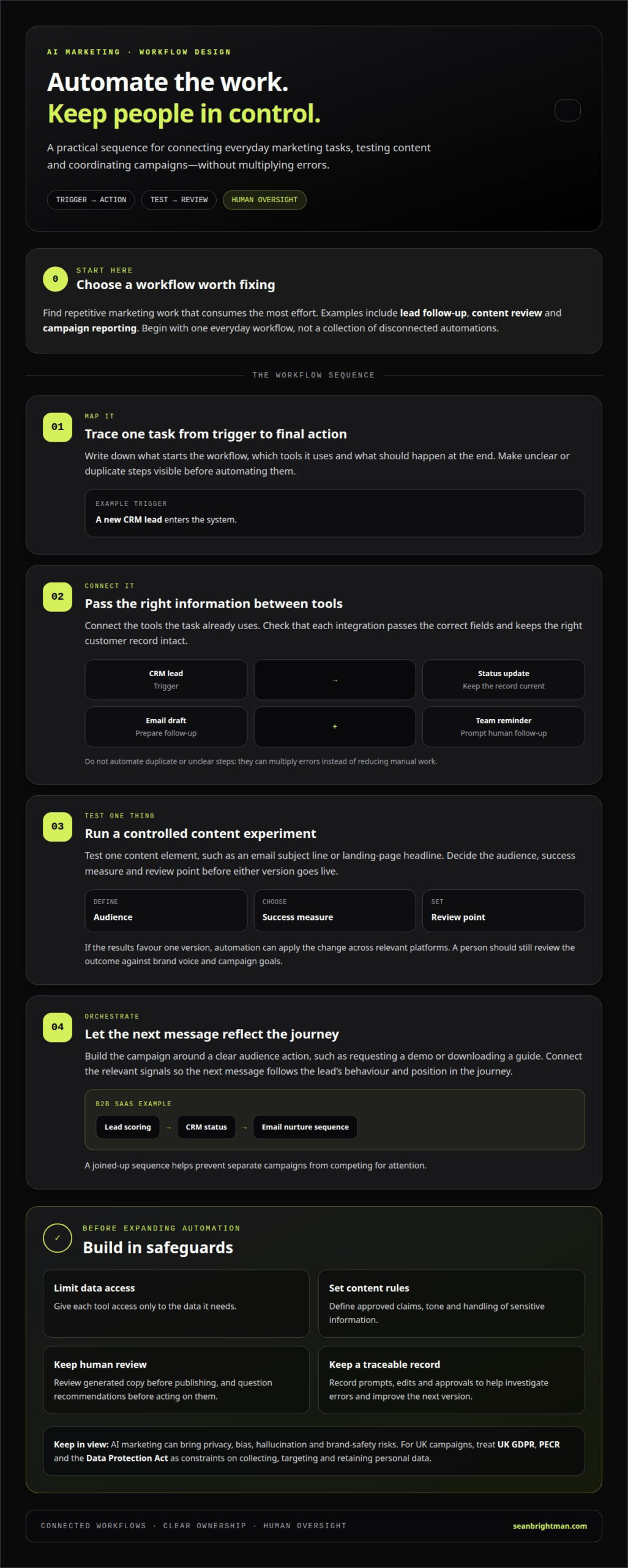
    Start by identifying the repetitive marketing workflows that consume the most effort, such as lead follow-up, content review and campaign reporting. AI marketing also brings privacy, bias, hallucination and brand-safety risks, so maintain human oversight and clear rules for data access and generated content.

    1. Automate workflows and integrate tools

      Map one everyday workflow from trigger to final action, then connect the tools it already uses. For example, a new CRM lead could trigger a status update, an email draft and a reminder for a team member. Check that each integration passes the right fields and preserves the correct customer record. Don’t automate duplicate or unclear steps: they multiply errors instead of reducing manual work.

    2. Automate content experimentation

      Set up a controlled test for one content element, such as an email subject line or landing-page headline. Define the audience, success measure and review point before launching either version. If the results show a stronger version, automation can apply the change across relevant platforms. Keep a person responsible for reviewing the outcome, so a short-term lift doesn’t override brand voice or campaign goals.

    3. Build campaign orchestration around a clear audience action, such as requesting a demo or downloading a guide. A B2B SaaS team, for example, can connect lead scoring, CRM status and a multi-step email nurture sequence. Set the next message according to the lead’s behaviour and position in the journey. This creates a joined-up workflow, rather than separate campaigns competing for attention.
    4. Build safeguards into the workflow before expanding automation. Give each tool access only to the data it needs, and set rules for approved claims, tone and sensitive information. Require human review before publishing AI-generated copy or acting on a questionable recommendation. Keep a record of prompts, edits and approvals. This traceable foundation makes it easier to investigate errors and improve the next version.

    What is a marketing tech stack?

    A marketing tech stack connects customer data, software and workflows so teams can make informed decisions. For UK campaigns, treat UK GDPR, PECR and the Data Protection Act as constraints on collecting, targeting and retaining personal data.

    1. Own core data and workflows

      Keep customer records, measurement definitions and campaign workflows under your control, while renting the tools that process them. Store agreed fields such as consent status, lead stage and product category somewhere your team can export them. Document how a lead moves from first interaction to sales hand-off. Avoid building that logic solely inside one vendor, where changing tools could break the process.

    2. Centralise marketing intelligence

      Connect your CRM, website analytics, email and commerce data using shared identifiers. For a retailer, standardise product names, attributes and categories before asking AI to draft descriptions. Disconnected systems can feed different specifications into each channel, creating inconsistent copy and targeting. Include access controls, privacy rules and human review. Keep prompts, generated versions and approvals traceable.

    3. Enrich and validate data

      Validate sales records before using them for scoring or audience selection. Combine relevant firmographic details with first-party actions, such as a demo request or repeat visits, and show sales teams where each signal came from. Set rules for required fields, duplicate records and outdated contact details. Review bounce patterns and rejected updates as signs of data decay; refresh or suppress weak records before they distort campaign decisions.

    4. Define who owns each data field and workflow, then record that responsibility in a shared process document. For example, marketing can manage campaign tags while sales owns lead-stage updates. Set a review path for AI-generated recommendations and content, with a named person responsible for approval. These controls promote consistent data use and help teams trace decisions back to their inputs.

    How to Build an AI Marketing Stack for a Small Business

    Connecting analytics, SEO, content, paid media and CRM

    Connect each channel to a shared campaign strategy, from search discovery through CRM conversion. Measure whether AI improves the work, not just how much content it generates.

    1. Build content creation and publishing workflows

      Map a content workflow from keyword research to publishing, then give each tool a clear function. For example, analytics can identify pages losing organic traffic, while an AI assistant drafts an updated outline. Use a content management system to manage review and publication. For product content, provide approved attributes and facts, then check every claim before publishing. Don’t let automation bypass editorial approval or duplicate existing pages.

    2. Use CRM signals for targeting

      Connect CRM stages and customer actions to content and paid-media decisions. A prospect who requests a product demonstration needs different follow-up from someone who only reads a guide. Use those signals to shape audience segments, campaign exclusions and relevant content. Check that each channel receives the correct status and consent information. Don’t treat a single click as proof of purchase intent.

    3. Scale personalised content

      Start with one useful variation, such as adapting an email introduction for existing customers and new prospects. Use approved audience attributes to guide generation while keeping the central offer and brand voice consistent. Review examples across email, landing pages and paid channels before extending the workflow. Check that personalisation reflects real customer context, not assumptions drawn from incomplete data.

    4. Measure ROI and performance

      Set a baseline before adding AI, then track time recovered, output per employee and campaign performance. Compare similar campaigns or run controlled tests to isolate AI’s contribution. Changing several variables at once makes results hard to interpret. Review analytics alongside CRM outcomes, not clicks alone. If production speeds up but qualified enquiries don’t improve, adjust the workflow or targeting before scaling.

    Choosing a small-business AI marketing stack

    Choose tools around a business goal, not a vendor’s feature list. A lean stack should connect the marketing team’s core work without adding needless manual steps. Start by identifying the outcome your business needs most to work out how to build an AI marketing stack.

    1. Assess goals, data maturity and use cases

      Write down the outcome first, such as improving qualified enquiries or publishing product updates faster. Then trace the data and steps behind the task. If contact records lack consistent stages, fix the source data before adding AI scoring. Match each proposed tool to a specific use case, owner and success measure. Don’t buy software to solve a workflow nobody has mapped.

    2. Compare AI marketing platforms

      Compare features, integrations, ease of use and UK pricing against the same workflow. Consider how well each platform fits your existing workflow and whether staff can use it easily. Compare subscription tiers, user limits and usage-based charges in pounds. Include the cost of integrations and overlapping functions, not just the headline subscription.

    3. Keep the tool count tight. Four to six tools can cover core stack layers when native integrations connect them. If two platforms overlap substantially, consider whether one can be removed or whether each has a distinct role. Choose a primary large language model for routine marketing tasks, and add another only to address a clear capability gap. Before purchase, name the person who will use each tool weekly.
    4. Run a small pilot before a wider rollout. Give the marketing team one defined task, such as drafting an email from approved product details. Track time saved, output quality and whether the result supports the original goal. Set a review date and decide what would justify keeping the platform. If the pilot creates extra corrections or fails to connect with existing systems, fix the workflow before expanding. Build an AI marketing stack around evidence, not assumptions.

    Turn your priorities into a practical AI marketing stack roadmap before committing to more software.

    Sean Brightman

    Sean Brightman helps turn marketing priorities into a clear AI strategy and practical stack roadmap. If your tools feel disconnected or you’re unsure which use case should come first, AI Consulting can clarify the decisions and shape a focused plan. Roadmapping can structure the next steps, from identifying workflow priorities to planning how tools fit together. For ongoing strategic input as your stack develops, an Advisory Retainer provides continuing guidance.

    Seek support when tool choices are slowing progress, data and workflows aren’t connecting, or your team needs clearer direction. You don’t need a bigger stack by default. You need a system built around the work that matters. Contact Sean Brightman to discuss your AI marketing stack.

    Make your next stack decision count

    Your marketing stack should evolve with your business, not become another system nobody wants to maintain. Treat each new tool as a decision about how your team works: what changes, who owns it and how you’ll know it helps. That discipline keeps technology in service of the strategy, rather than letting a growing tool list dictate it.

    The practical question is how to build an AI marketing stack that can adapt as your priorities change. Start with the next constraint holding marketing back, then choose a focused improvement your team can put into practice. If you want help turning that decision into a workable direction, contact Sean Brightman to discuss your stack.

    Build deliberately, learn from each change and keep moving forward.

    Frequently Asked Questions

    How do I know if my current stack has too many tools?

    Look for tools with no active owner, overlapping functions or data staff copy manually between systems. A platform sitting unused during a typical campaign adds admin, not capability. More than 25 marketing tools can signal fragmentation rather than strength. The sharper test is whether each tool has a defined job, a regular user and an output that informs a decision.

    What Is a MarTech Stack?

    A MarTech stack is the connected set of marketing technology a business uses to plan and run customer communications. For example, a website form can pass an enquiry into a CRM, trigger a follow-up and record the eventual sale in analytics. The value comes from smooth hand-offs, not from collecting software under one label.

    What is an AI marketing stack and what core components does it need?

    An AI marketing stack adds AI capabilities to the connected systems that support planning, execution and measurement. Its core layers are models; content and creative tools; first-party data and CRM; automation; and measurement. A small firm might use a model to draft a campaign, CRM context to tailor it, automation to route it, and analytics to assess the response. Human judgement still sets direction and approval.

    Which AI marketing platforms and tools are best for CRM, content, analytics, advertising and automation?

    No single platform is best across CRM, content, analytics, paid media and automation. Choose by task: can it connect to your current records, give the team usable controls and export its data? Compare UK prices in pounds, including user tiers, usage limits and add-on integrations. A product that excels at content generation may still be a poor fit for CRM workflows.

    How can you integrate AI marketing tools with a CRM, website, analytics and existing data sources?

    Connect tools by matching shared fields, such as email address, campaign source and lead stage, then map which system owns each field. Use an API integration where available; otherwise, a connector can bridge systems. Test with a sample record and confirm that updates flow both ways only where intended. This catches duplicate contacts and overwritten CRM values before they affect live campaigns.

    What customer data and analytics infrastructure is needed for an AI marketing stack?

    Build around first-party records your business can use appropriately, with clear identifiers, source labels and consent status. Capture useful events such as form submissions, purchases or email engagement, then align their names across the website, CRM and analytics. Add role-based access, retention rules and a process for correcting inaccurate records. AI outputs depend on the data and controls behind them.