
Tag: Startup Growth

  • UK Tech Startup Marketing Consultant: 2026 Buying Guide

    UK Tech Startup Marketing Consultant: 2026 Buying Guide

    A long list of marketing services won’t fix a startup’s growth problem. Choosing a marketing consultant for tech startups uk means looking beyond the menu to the decisions they can help you make: what to prioritise, how marketing supports business goals and who will keep the plan accountable.

    If your activity feels fragmented, you’re right to want more than another batch of tactics. But you may not need a full-time marketing executive either. The right support depends on your stage, your team and whether you need a clear strategy, senior leadership or help maintaining momentum.

    This guide will help you identify the support that fits, assess a consultant’s approach and scope an engagement around real business priorities. You’ll also see how strategic roadmapping can turn competing ideas into a focused plan, and how Fractional CMO leadership or an advisory retainer can provide senior direction without a full-time hire. The test isn’t how many services someone lists. It’s whether they can bring focus and accountability to your growth.

    Key Takeaways

    • Assess a marketing consultant for commercial understanding, strategic judgement and fit with your team.
    • Match the support to the gap: specialist advice for a defined question, an agency for execution, or a Fractional CMO for senior marketing leadership.
    • Before engaging a consultant, define the business problem, the decisions you need help with, the scope and the points for reviewing progress.
    • Share clear context on your customers, product, current marketing and team capacity to make recommendations more practical.
    • Compare options by the decisions they can own, then consider whether roadmapping or ongoing advisory support best suits your needs.

    When does a UK tech startup need a marketing consultant?

    Marketing is happening, but it isn’t adding up. Product launches, content and channel activity run in parallel, priorities shift every few weeks, and nobody senior owns the decisions behind them. That’s a reason to diagnose the problem before adding more activity.

    A marketing consultant examines what the business needs and brings focused expertise to address it. That might mean sharpening positioning, setting priorities or improving how the marketing team works. The role should connect Marketing strategy to commercial objectives, not simply produce a list of tactics.

    Be clear about the type of help involved. Some consultants provide strategic advice; others may also work hands-on in particular channels. A startup with a clear plan but limited delivery capacity may need execution support, whilst a team unsure which audience or market to prioritise needs direction first.

    What problems should a marketing consultant for a tech startup solve?

    Start with the business constraint, not the channel. Is the challenge that the product’s value is hard to explain, the target audience is unclear, the team lacks relevant expertise, or marketing operations are too fragmented to support a consistent plan? Each points to a different gap.

    For example, if a SaaS team publishes regularly but can’t explain how that work supports its commercial goals, more content may not be the answer. The priority could be clearer positioning, audience focus or a better way to choose and review marketing activity.

    • Which marketing decisions are stuck or repeatedly revisited?
    • Who owns those decisions, and who will act on them?
    • What can the internal team deliver with its current skills and capacity?

    The answers help define whether you need specialist advice, channel execution or an experienced person to guide the overall direction.

    When is external senior marketing direction a better fit than a full-time hire?

    External senior direction can make sense when marketing decisions carry real weight, but the business isn’t ready to create a permanent executive role. Perhaps the founder is still setting priorities, a small team needs a clearer framework, or several activities need to come under one accountable plan. The right moment depends on the business’s objectives and capabilities, not a fixed funding stage, headcount or revenue figure.

    A Fractional CMO provides part-time senior marketing leadership. It brings strategic direction and accountability without a full-time CMO. Sean’s Fractional CMO work can help establish priorities and marketing systems. Strategic roadmapping offers a structured plan when the immediate need is clarity. Choose the support that matches the gap, not the most impressive-sounding title.

    How to assess a marketing consultant’s fit for a technology startup

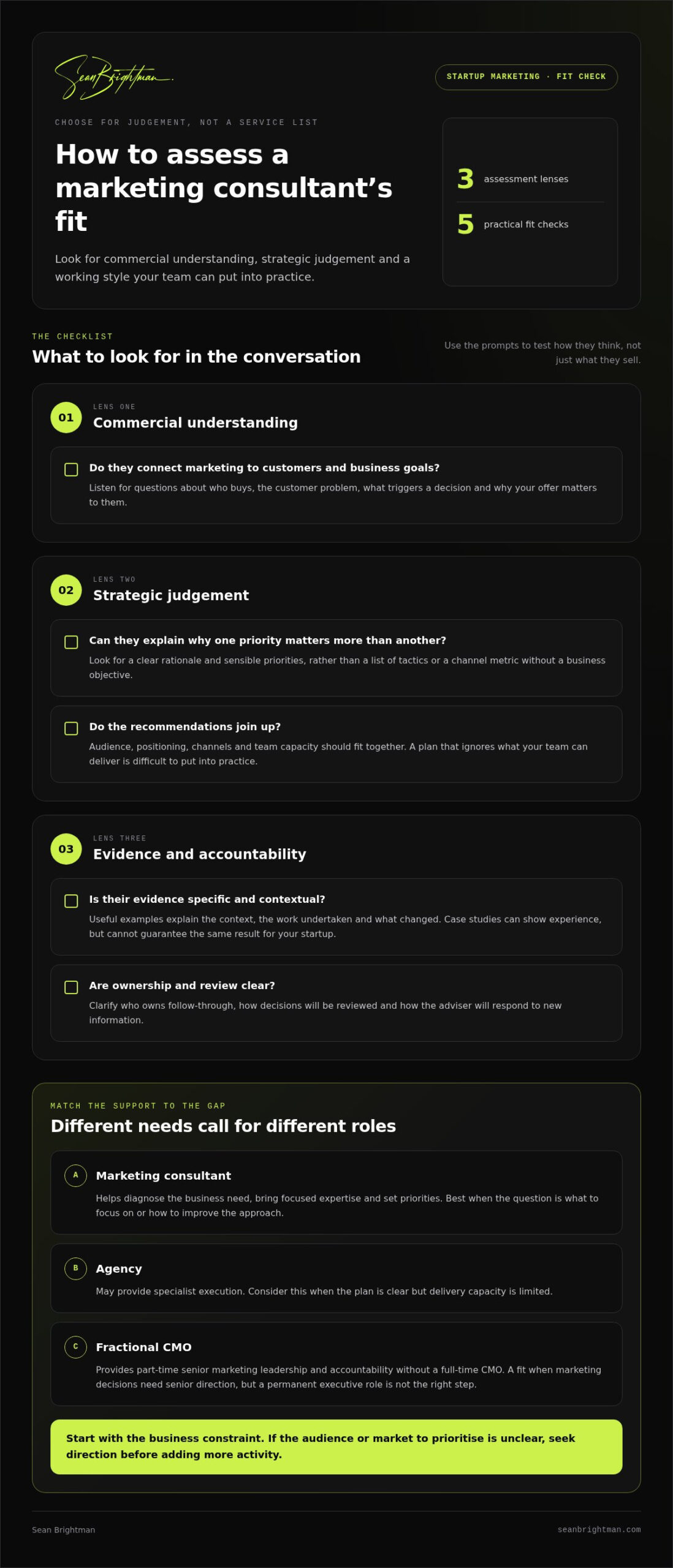
    A polished service page tells you what a consultant sells, not how they think. To assess a marketing consultant for tech startups uk, look for three things: commercial understanding, strategic judgement and a working style your team can put into practice.

    Can they make the product matter to buyers?

    Technology can be complex, but buyers still need a clear reason to care. A strong adviser should look beyond product features, understand the customer problem and connect that insight to positioning and marketing priorities. Listen for questions about who buys, what triggers a decision and what makes your offer relevant, not just which channels you want to use.

    Then test whether the recommendations join up. If they propose a new audience, can they explain how the positioning should speak to it, which channels could reach it and what the team needs to deliver? A strategy that ignores internal capacity is a plan on paper, not a workable direction.

    Do the evidence and accountability stand up?

    Ask for relevant examples and the thinking behind them. Useful evidence explains the context, the work undertaken and what changed. A channel metric without a business objective or starting point proves little. Case studies can show experience, but they can’t guarantee the same result for your startup.

    Look for recommendations with a clear rationale, sensible priorities and measures tied to business objectives. Clarify how decisions will be reviewed, who owns follow-through and how the adviser will respond to new information. For more prompts to shape an assessment, see how to hire a marketing consultant.

    Use this checklist to compare advisers:

    • Commercial understanding: Do they connect marketing priorities to customer needs and business goals?
    • Strategic judgement: Can they explain why one priority matters more than another?
    • Joined-up thinking: Do positioning, audience, channels and team capacity fit together?
    • Relevant evidence: Are examples specific and contextual, without promising identical results?
    • Working style: Are decision ownership, review and accountability clear?

    If you’re looking for senior direction grounded in strategy, positioning and accountability, explore Sean Brightman’s marketing approach to see how that support could fit your startup.

    Marketing consultant, agency or Fractional CMO: which fits your startup?

    These roles can overlap, but they solve different problems. A consultant helps diagnose and prioritise. An agency may provide specialist execution. A Fractional CMO takes on senior marketing leadership part-time. The right choice depends on whether your gap is direction, delivery or ongoing ownership.

    Role Primary responsibility Best-fit need Typical working relationship
    Independent consultant Diagnose needs, challenge assumptions and recommend priorities A defined strategic question or need for specialist advice Project-based or ongoing advice, depending on the brief
    Specialist agency Deliver agreed work within its area of expertise Internal direction is clear, but the team needs specialist delivery capacity Scoped work or a continuing delivery relationship
    Fractional CMO Provide part-time senior leadership and guide marketing direction Decisions, priorities and accountability need ongoing senior ownership Part-time leadership, often supported by continued advisory

    These are working models, not rigid rules. Some consultants also support implementation; some agencies contribute strategic thinking. Get specific about responsibilities: who sets priorities, who makes decisions and who carries out the work? A marketing consultant for tech startups uk may sharpen the plan, but that doesn’t automatically mean they’ll deliver every channel activity.

    What does a consultant do that a marketing agency may not?

    A consultant-led engagement often starts with diagnosis: understand the business problem, identify what’s getting in the way and decide what deserves attention first. An agency engagement may instead centre on specialist delivery, such as a defined channel programme. There’s no universal model, so compare the actual scope, not the label.

    For a technology startup, recommendations should fit the product, buyers and operating capacity. Academic research on tech startup marketing can add useful context, but a research finding or marketing system is not a strategy by itself. It must serve the startup’s objectives.

    When does a startup need a Fractional CMO rather than a one-off adviser?

    A roadmapping engagement can suit a defined need: align priorities and leave with a structured plan. But if the business needs senior input as decisions unfold, a one-off document may not be enough. A Fractional CMO provides ongoing, part-time leadership; an advisory retainer can add continued direction and accountability. Choose the model based on how much ownership the work needs after the initial recommendations.

    Sean Brightman’s Fractional CMO and roadmapping support offers distinct routes to strategic direction, from a structured plan to ongoing senior guidance.
    UK Tech Startup Marketing Consultant: 2026 Buying Guide

    How to scope a marketing consulting engagement before you commit

    A useful engagement starts with a business problem, not a shopping list of tactics. Before you bring in a marketing consultant for tech startups uk, get clear on what needs to change, which decisions are stuck and what your team can realistically take forward. This gives the work a solid brief and keeps it tied to business priorities.

    What should a startup include in a marketing consulting brief?

    Share enough context to make the advice specific: your business objective, target customers, product and current positioning. Add a concise picture of current marketing activity, who is responsible for it and the constraints that matter, such as limited team capacity or competing priorities. Keep the brief centred on the questions leadership needs answered. Don’t prescribe a channel or solution before understanding the underlying problem.

    Then scope the work in four steps:

    • Define the business problem. State what isn’t working or what decision the business needs to make. For example, are you struggling to explain the product’s value, or unsure which customer group to prioritise?
    • Clarify the decisions. Identify what the consultant should help leadership decide, such as positioning, priority audiences or where to focus existing resources.
    • Agree the scope. Set out the work, deliverables, responsibilities and what sits outside the engagement. A strategic recommendation isn’t automatically hands-on channel delivery.
    • Set review points. Agree when you’ll assess progress, discuss new information and decide whether priorities need to change.

    What should the roadmap and review rhythm make clear?

    A useful roadmap turns decisions into an ordered plan. It should show which actions matter most, what needs to happen first, who owns each next step and where the team must make a decision. Priorities should reflect available capacity. A plan that assumes work your team can’t deliver won’t help. Agree how you’ll review progress without treating any commercial outcome as guaranteed.

    That’s the difference between a strategic deliverable and a document full of recommendations. A long list can look thorough whilst leaving the founder to work out what comes first. A practical roadmap makes choices visible, highlights dependencies and gives the team a basis for review. If you need guidance after the initial plan, clarify how ongoing advice and accountability will work.

    For structured direction tailored to your priorities, Explore strategic marketing support with Sean.

    Choose a consultant who brings senior direction, not another layer of noise

    Don’t choose by the length of the service list. Choose by the decisions your startup needs someone to own. If the problem is unclear positioning, scattered priorities or no senior marketing lead, another channel tactic may only add activity. You need direction that connects the work to business goals and gives your team a clear way forward.

    That’s the test for a marketing consultant for tech startups uk: can they help you decide what matters, why it matters and how the business will act on it? The right engagement depends on the gap. A defined need for clarity may call for a roadmap. A need for continued senior input calls for ongoing leadership and accountability.

    How does Sean Brightman support tech startups with strategic marketing?

    Sean Brightman offers several ways to bring senior strategic direction into a business. Fractional CMO support provides part-time leadership focused on marketing strategy and direction. Strategic roadmapping turns competing priorities into a structured plan. An advisory retainer provides continued guidance as decisions and priorities evolve.

    AI consulting can also help when the question is how to make marketing more efficient. The aim is a practical application tied to the business’s needs, not adopting another tool without a clear purpose. Each form of support addresses a different requirement; the value lies in matching the work to the decision in front of you.

    What is the clearest next step for a founder?

    Name the constraint. Is your team struggling to explain the product’s value, choose a priority audience, focus its marketing activity or make effective use of its capacity? Write down the decision you need to make and what’s preventing progress. That gives a strategic conversation or roadmap a concrete starting point.

    If you’re comparing models of senior marketing leadership, read about the Fractional CMO approach. Then decide whether you need a defined plan or a senior partner to provide direction over time. A strategy document can clarify priorities, while ongoing leadership helps keep decisions connected as the business moves forward.

    Ready to focus your next marketing decision? Talk to Sean about the right marketing direction for your startup.

    Give your startup’s marketing a clearer direction

    The right marketing consultant for tech startups uk isn’t simply the one with the longest list of services. Choose based on the decisions you need help making, whether that means sharpening your strategy, building a practical roadmap or securing ongoing senior leadership.

    Be clear about the gap before you commit. A defined strategic challenge may call for roadmapping; continued direction and accountability may suit an advisory retainer or Fractional CMO support. A useful plan connects business priorities to what your team can actually deliver.

    Sean Brightman provides part-time senior marketing leadership through his Fractional CMO service, alongside strategic roadmapping and advisory retainers. He’s also the author of a published book on strategic marketing methodology. Each offers a different way to bring focus to marketing decisions.

    Start by naming the decision or growth constraint holding your marketing back. Then use it to shape a focused conversation about the support that fits. Talk to Sean about the right marketing direction for your startup.

    Frequently Asked Questions

    What does a marketing consultant do for a tech startup?

    A marketing consultant diagnoses where marketing needs focus and provides expertise to address it. For a tech startup, that might mean clarifying the product’s value, identifying priority customers, setting strategic priorities or improving marketing systems. The scope varies: some consultants advise on strategy, whilst others also deliver specific work. Agree which decisions and deliverables the engagement covers, and who will put recommendations into action.

    How do I choose a marketing consultant for a tech startup in the UK?

    Choose a marketing consultant for tech startups UK based on their ability to connect commercial goals, customer needs and practical priorities. Look for clear reasoning, relevant evidence and recommendations that match your team’s capacity. Ask how they’d approach your specific challenge and how progress would be reviewed. Be wary of broad promises without context. The strongest fit is someone who can explain what matters first and why.

    Is a marketing consultant the same as a marketing agency?

    No. A consultant typically diagnoses a problem, advises on priorities or provides strategic guidance. An agency often focuses on delivering specialist marketing work, although its scope can vary. Neither label guarantees a particular way of working. Clarify who will set direction, make decisions and carry out each task. A startup may need one type of support or a combination, depending on whether its main gap is strategy, leadership or execution.

    When should a startup hire a Fractional CMO?

    Consider a Fractional CMO when the business needs experienced marketing leadership and ongoing direction, but a full-time CMO isn’t the right fit. A Fractional CMO provides senior leadership on a part-time basis, helping guide strategy, positioning, priorities and accountability. It can suit a team facing important marketing decisions without a senior owner. The trigger is the leadership gap, not a particular funding stage, headcount or revenue level.

    What should a marketing strategy roadmap for a startup include?

    A useful roadmap should connect business objectives to marketing priorities and show what happens next. It can set out the audience and positioning to focus on, the main strategic priorities, dependencies, owners and decision points. It should reflect the team’s capacity, so the plan is workable rather than a wish list. Agree how progress will be reviewed and how priorities can be adjusted as the business learns.

    Can a marketing consultant help with AI strategy?

    Yes. AI consulting can help a startup identify practical ways to apply AI to marketing efficiency and output. Start with a business need, such as reducing repetitive work or improving a marketing process, then assess whether AI is appropriate. Tool adoption alone isn’t a strategy. The work should connect the proposed use to clear objectives, suitable inputs and the team’s ability to integrate it into existing marketing systems.

    How much does a marketing consultant for a tech startup cost?

    The cost depends on the consultant’s experience, the work required and the engagement model. A defined roadmapping project, occasional strategic advice and ongoing senior leadership involve different scopes, so there isn’t one figure that applies to every startup. Set out the decisions you need help with, the expected deliverables and the level of continuing support. That gives you a clearer basis for understanding and comparing proposals.

    What happens if my startup needs both strategy and marketing execution?

    Separate the responsibilities, then make sure they connect. A consultant or Fractional CMO can help set strategic direction, whilst execution may sit with your internal team or a specialist agency, depending on your needs. Agree who owns priorities, delivery and review so recommendations don’t stall between teams. Sean Brightman’s strategic leadership focuses on direction and accountability, not advertising or campaign execution.

  • Marketing Strategy for Tech Companies: Building Engines, Not Just Ads

    Marketing Strategy for Tech Companies: Building Engines, Not Just Ads

    Most founders think they have a marketing strategy for tech companies, but they’re usually just funding a very expensive hobby for their agencies. You’ve likely felt the sting of a marketing department that operates as a black box. You’ve got the tools. The team is busy. The invoices are paid. Yet, the needle stays static. It’s exhausting to watch capital disappear into disconnected tactics whilst the core business remains stagnant and dependent on your constant oversight.

    It’s time to stop chasing “hacks” and start engineering. A proper strategy isn’t a to-do list. It’s a mechanical system designed to produce revenue. This article provides a clear, actionable roadmap to build a growth engine that functions without constant founder intervention. We’ll explore how to replace manual overhead with AI-powered efficiency and turn your marketing from a cost centre into a high-impact asset that builds genuine, exit-ready value.

    Key Takeaways

    • Stop burning cash on disconnected tactics. Learn how to build a marketing strategy for tech companies that functions as a predictable revenue engine rather than a “black box” expense.
    • Fix your positioning to cut through the noise. Discover how to architect a marketing stack that actually communicates with your CRM to provide full accountability for every pound spent.
    • Integrate AI into your core operations to drive genuine efficiency. Learn how to move beyond basic prompts and use intelligence to scale your output without increasing your headcount.
    • Stop the “busy work” and start engineering growth. Follow a 90-day roadmap designed to stabilise messy departments and build the long-term value required for a successful exit.
    • Access senior-level expertise without the £150k overhead. Understand why fractional leadership is the most capital-efficient way to install high-impact strategy in a scaling tech business.

    The Tech Marketing Strategy Trap: Why Most Scale-ups Fail

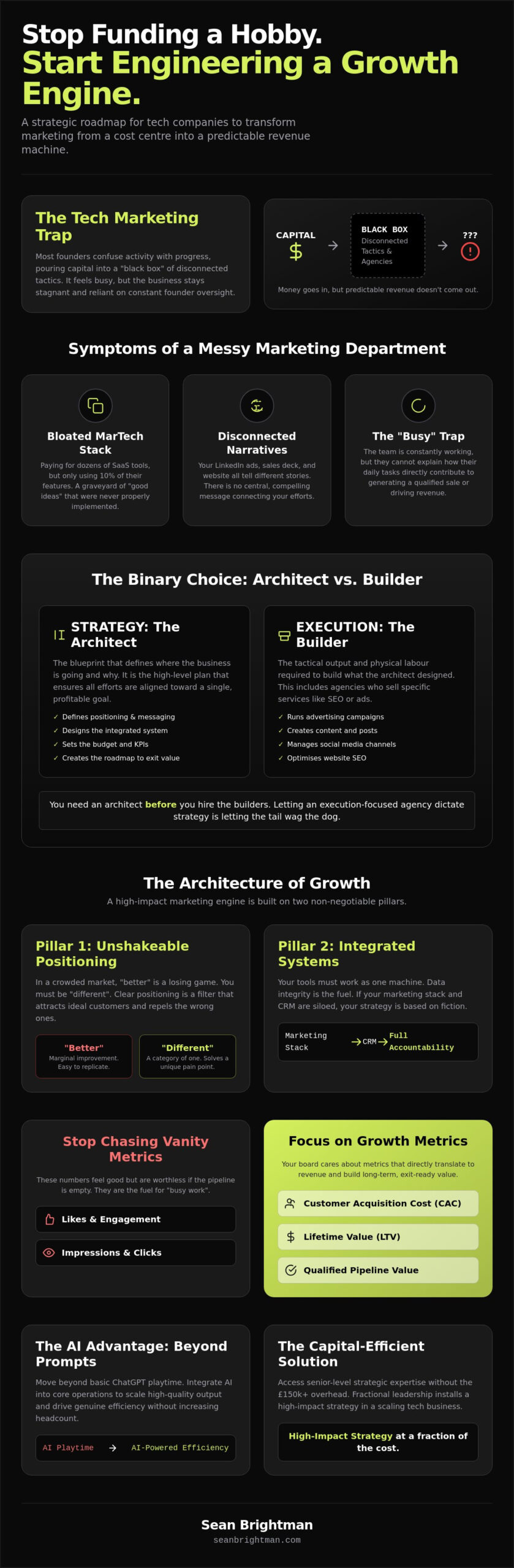
    Marketing strategy for tech companies is rarely what founders think it is. It isn’t a calendar full of social media posts or a weekly newsletter that nobody reads. It’s a functional system. Most scale-ups fail because they confuse activity with progress. They mistake noise for momentum. If your marketing feels like a “black box” where you put money in and hope for the best, you don’t have a strategy. You have a gamble.

    A real strategy is a machine. It takes capital and attention as input and produces predictable revenue as output. When you lack this mechanical foundation, you fall into the “Tactic Trap”. This is the expensive habit of hiring an agency to “do SEO” or run ads before you’ve nailed your positioning. You end up paying for traffic to a destination that doesn’t convert. It’s like hiring bricklayers to build a house when you haven’t even seen the blueprints. You’ll end up with a very expensive pile of bricks in the wrong place.

    This leads directly to the founder’s dilemma. You started this company to build a product and disrupt a market. Now you’re stuck in the weeds. You’re approving ad copy at 11 PM whilst the actual growth engine stalls. You’re doing the work because there is no system to handle it for you. To fix this, we must kill the obsession with vanity metrics. Clicks are cheap. Likes are worthless. Your board doesn’t care about your “engagement rate” if the pipeline is empty. High-impact marketing strategy for tech companies focuses on growth metrics: Customer Acquisition Cost (CAC), Lifetime Value (LTV), and qualified pipeline.

    Symptoms of a Messy Marketing Department

    You know the department is broken when the symptoms become impossible to ignore. It usually looks like this:

    • Bloated MarTech: You’re paying for dozens of SaaS tools but only using 10% of their features. The stack is a graveyard of “good ideas” that never got implemented.
    • Disconnected Narratives: Your LinkedIn ads say one thing, your sales deck says another, and your website says something entirely different. There’s no central story.
    • The “Busy” Trap: The team is working 50-hour weeks on tasks, but they cannot explain how those tasks actually drive a sale.

    Strategy vs. Execution: The Binary Choice

    You need an architect before you hire the builders. Most agencies are builders; they want to sell you more bricks. If you let an execution-focused agency dictate your high-level digital marketing strategies, you’re letting the tail wag the dog. They will always suggest the tactics they happen to sell, regardless of whether those tactics fit your roadmap.

    Strategic direction is the blueprint that defines where the business is going, whilst tactical output is the physical labour required to get there. Working with a dedicated marketing strategy consultant ensures that blueprint is built around your specific growth objectives, not the service menu of whoever you hired last.

    The Architecture of Growth: Positioning and Systems

    A high-impact marketing strategy for tech companies is built on two pillars: positioning and systems. Without these, you are just throwing money at platforms and hoping for a miracle. Most scale-ups treat their marketing stack like a toy box. They buy the latest AI tool or CRM because it’s trendy; not because it fits the architecture. This creates a fragmented mess where data is siloed and accountability is non-existent. You don’t need more tools. You need a machine where every component serves a specific, documented purpose.

    Data integrity is the fuel for this machine. If your marketing stack doesn’t talk to your CRM in real-time, your strategy is based on fiction. You cannot optimise what you cannot measure. Your reporting should tell you exactly where your next £1 of profit is coming from. If it doesn’t, you aren’t running a department; you’re running a series of expensive experiments. Building a “plug-and-play” model allows you to scale without adding more chaos. It means that when you double your budget, you double your output, not your headaches.

    Brand Positioning for Tech: Standing Out amongst Giants

    In the crowded B2B SaaS landscape, sounding “better” is a losing game. “Better” is a marginal improvement that competitors can easily replicate. “Different” is a category of one. If your messaging uses the same buzzwords as the market leader, you are invisible. You must identify a Unique Value Proposition that solves a visceral pain point your competitors ignore. Clear positioning acts as a filter. It attracts the right leads and repels the wrong ones, which drastically reduces your cost of customer acquisition. If you want to move from guesswork to precision, a structured marketing roadmap is the first step to defining your space.

    Marketing Operations: The Engine Room

    Marketing operations is where strategy meets reality. It’s about designing workflows that remove friction between marketing and sales. Automation should be used to maintain a lean, high-output team, not just to spam prospects. We use systems to handle the repetitive heavy lifting so your talent can focus on high-level creativity and strategic shifts. This isn’t just about efficiency. It’s about valuation. Investors don’t buy “talented teams” that might leave next month. They buy documented, scalable systems that produce predictable results. This is how you build for a successful exit. You build an engine that works whilst you sleep.

    AI Marketing Strategy: Moving Beyond ChatGPT Playtime

    Most tech leaders are still in the “playtime” phase of AI adoption. They use it to churn out generic copy that sounds like every other B2B SaaS company on LinkedIn. This isn’t strategy. It’s noise. A sophisticated marketing strategy for tech companies treats AI as an operational lever, not just a content generator. It’s about building intelligence into your infrastructure, not just adding another tool to the pile. You need a system that thinks, not just a chatbot that types.

    The goal is efficiency, not just more volume. If you use AI to produce ten times more mediocre content, you haven’t won; you’ve just made your brand ten times more annoying. A real growth engine uses AI to do more with the same headcount. It’s the difference between scaling your overhead and scaling your impact. You move from “playing with tools” to “executing strategy” when AI starts handling the heavy lifting of data analysis, lead scoring, and workflow automation. This allows your team to focus on the high-level shifts that actually move the needle.

    Risk management is the part most founders ignore until it’s too late. As of June 2026, anticipated UK regulatory frameworks will mandate clear disclosure for synthetic performers. If you’re using AI likenesses in your video ads, you’re now in a regulated environment. You must address data privacy and brand voice protection before you automate your outreach. A single hallucinated claim or a data breach in your automated pipeline can wipe out years of brand equity. Strategy is about moving fast, but it’s also about building the guardrails to ensure you don’t fly off the track.

    The Practical Application of AI Consulting

    Success starts with mapping your current marketing processes to identify AI-ready bottlenecks. We don’t just “add AI” to a mess; we fix the mess first. This involves implementing AI-powered lead scoring that talks directly to your CRM, ensuring your sales team only touches the hottest prospects. By building a custom AI growth engine, you create a competitive moat that others cannot easily replicate with off-the-shelf software. It’s about proprietary workflows, not just subscription logins.

    Future-proofing Your Tech Brand

    AI is a survival requirement for 2026. With 80% of marketing professionals already using AI and automation, those who resist are effectively choosing to operate with higher overhead and slower response times. You must keep the “human in the loop” to maintain brand authenticity, using people for strategic oversight whilst the machines handle the execution. The ROI of AI-driven marketing efficiency is the radical compression of the time between lead capture and revenue realisation.

    Marketing Strategy for Tech Companies: Building Engines, Not Just Ads

    The Strategic Roadmap: Engineering Your Path to Exit

    Marketing strategy for tech companies is often treated as a short-term survival tactic. This is a mistake. If your objective is a high-multiple exit, your marketing department must be an asset that adds to the company’s valuation. Investors don’t buy a collection of “busy” employees. They buy a documented, repeatable revenue machine. They want to see that your growth is a result of a system, not founder-led heroics or luck.

    Success requires a North Star that aligns with your specific niche. For a B2B SaaS firm, this might be a specific Net Revenue Retention (NRR) target or a CAC payback period of under 12 months. For a deep-tech hardware firm, it might be market penetration in a key geographic territory. If your marketing team doesn’t know these numbers, they are just guessing. They are spending your capital on activity that doesn’t build equity. Strategic marketing for CEOs means transforming this guesswork into a documented, scalable system that turns your marketing function from a cost centre into a predictable revenue engine.

    Phase 1: The Audit and Alignment

    The first 30 days of a 90-day sprint are about stopping the bleeding. You must uncover the hidden waste in your current marketing spend. With growth-stage tech companies often spending between £2,300 and £15,000 per month on ads alone, the potential for inefficiency is massive. This phase aligns your marketing efforts with overall business goals and sales targets. If you want a clear path forward, you need a Marketing strategy roadmap that defines exactly how you will win.

    Phase 2: Building the Infrastructure

    Once you’ve stopped the waste, you build the infrastructure. This means hiring the right people or agencies to fill tactical gaps. You don’t need a full-time SEO specialist if you only need 10 hours of work a month. You need a “Marketing Playbook” that defines your operational standard. This document ensures that if a team member leaves, the machine keeps running. It establishes the reporting cadence that keeps the team accountable to the KPIs the CEO actually cares about: pipeline value, customer acquisition cost, and lifetime value.

    Where should you put your next £10k? Don’t default to more ads. Put it into the systems that increase your conversion rate or the AI workflows that reduce your cost per lead. If your foundation is weak, more traffic just means more waste. If you’re ready to stop the chaos and start engineering growth, it’s time to build a scalable marketing engine that drives real value.

    Fractional Leadership: High-Impact Strategy Without the Overhead

    Hiring a full-time CMO too early is a £150k mistake that kills your runway. For a growth-stage firm, that capital is better spent on the engine itself, not just the driver. Most founders reach a point where their marketing feels stuck, but they don’t need a permanent executive with a massive benefits package. They need a navigator. They need someone who has seen the “messy department” before and knows exactly how to rewire it for scale.

    There is a fundamental difference between an agency and a Fractional CMO. An agency is a vendor; they sell you tasks. They don’t own your marketing strategy for tech companies. They own their own profit margins. A Fractional CMO is a partner who owns the growth roadmap and holds those agencies accountable. This model provides the senior-level direction you need whilst your existing team or external partners handle the tactical execution. It’s about high-impact strategy without the corporate bloat.

    An advisory retainer provides the CEO with a much-needed external perspective. When you’re inside the business, you’re too close to the problems. You can’t see the “clog” in the engine because you’re part of the plumbing. An external expert finds the blockage in days, not months. This ongoing accountability ensures that the strategic roadmap we discussed in the previous section actually gets executed, rather than sitting in a folder gathering digital dust.

    When to Hire a Fractional CMO

    You hit the “Scale-up Wall” when your current marketing manager has reached their limit. They are great at execution, but they lack the strategic depth to architect a global growth engine. This often happens when you need to transition from founder-led sales to a marketing-led system. If you are preparing for a funding round or a business exit, you need a battle-hardened strategist who can prove to investors that your revenue is predictable and your systems are documented. Understanding the difference between a marketing strategy consultant focused on growth engines versus traditional planning is critical before you make that hire.

    The Sean Brightman Approach: Senior Leadership on Demand

    I provide direct, battle-hardened expertise without the corporate fluff or ego. This is a plug-and-play solution for UK tech companies that need order brought to internal complexity. My role is to design the machine and ensure it runs at peak efficiency, leaving your team to focus on the day-to-day output. If you’re tired of marketing that feels like a black box, it’s time to take control. Book a strategic roadmapping session to fix your marketing machine today and start building genuine, exit-ready value.

    Engineering Your Exit: From Tactical Chaos to a Scalable Growth Engine

    Marketing strategy for tech companies isn’t about finding a silver bullet. It’s about building a machine that functions independently of founder heroics. We’ve explored how to escape the tactic trap, architect a system that talks to your CRM, and leverage AI for genuine operational efficiency. You don’t need more busy work. You need a documented infrastructure that turns capital into predictable revenue.

    Stop funding a black box and start building an asset. As a published author on marketing strategy and a battle-hardened Fractional CMO for high-growth UK tech brands, Sean Brightman specialises in building AI-powered growth engines that fix the mess. He provides the senior-level direction required to get your department under control and ready for a high-multiple exit. You’ve built the product. Now it’s time to build the engine that sells it.

    Stop playing with tools and start growing – Work with Sean Brightman

    Frequently Asked Questions

    What is the difference between a marketing strategy and a marketing plan?

    A strategy is the architecture of your growth; a plan is the construction schedule. Strategy defines your positioning, your unique value, and how you will win the market. The plan is simply the list of tasks and deadlines required to execute that strategy. You don’t need a plan to fail, but you certainly need a strategy to win.

    How much does a marketing strategy for a tech company typically cost?

    The real cost is the waste currently sitting in your budget. Growth-stage companies often spend between £2,300 and £15,000 per month on Google Ads alone. A proper marketing strategy for tech companies ensures that every pound spent is an investment in an asset, not just a recurring expense. It’s about reallocating existing waste into high-impact systems.

    Why do most tech companies fail at marketing despite having a great product?

    Great products don’t sell themselves. Tech founders often fall in love with their features whilst ignoring the market’s visceral pain. They focus on technical superiority instead of psychological positioning. If you can’t explain why you’re different in ten seconds, your product’s quality is irrelevant to a prospect who is already overwhelmed with noise.

    How long does it take to see results from a new marketing strategy?

    You should see stabilisation within the first 90 days. This is the period where we stop the bleeding, fix broken tracking, and align the team. Real, scalable growth usually takes six to twelve months to fully manifest. It’s a flywheel effect. The initial effort to build a marketing strategy for tech companies is high, but the momentum eventually becomes self-sustaining.

    Can I use AI to build my entire marketing strategy?

    AI cannot build a strategy, but it can certainly accelerate one. It is excellent for data analysis, lead scoring, and content scaling. However, it lacks the human intuition required to understand your board’s exit goals or your competitor’s hidden weaknesses. Use AI as the engine’s lubricant, not the architect who designed the machine.

    What is a Fractional CMO and why would a tech scale-up need one?

    A Fractional CMO is a senior executive who provides high-level direction on a part-time basis. You get the expertise of a battle-hardened leader without the £150k plus salary and permanent overhead. They are there to install the growth engine and create accountability, allowing the founder to step out of the marketing weeds and back into the CEO role.

    Should I hire a marketing agency or a marketing strategy consultant?

    Hire a consultant to build the blueprint and an agency to lay the bricks. Agencies are execution machines. If you hire them without an external strategy, they will simply sell you the tactics they happen to specialise in. A strategist remains objective and ensures every tactical output actually serves the long-term business goals.

    How do I know if my current marketing department is “messy”?

    Your department is messy if your marketing stack doesn’t talk to your CRM in real-time. It’s messy if your team is “busy” with tasks but the pipeline remains flat. If you cannot track a lead from the first anonymous click to the final paid invoice, your system is broken. Order requires total visibility and clinical accountability.