
Buying more marketing days won’t fix a business where nobody owns the decisions. If “fractional cmo uk” is on your shortlist, start with the problem you need solved, not the number of days you can buy.
Marketing may already be in motion, yet priorities still clash. Your team, agencies and leadership may be pulling in different directions, while a full-time executive feels like too big a commitment. That’s a good reason to consider fractional leadership, but only if the role has clear authority to set direction and keep people accountable. Otherwise, you’re adding another voice to the noise.
This guide gives you a practical framework for deciding whether a fractional CMO fits your business’s stage and needs. You’ll see which strategic decisions the role should own, how to distinguish leadership from advice or delivery, and how to define a workable scope. We’ll also look at how strategic roadmapping can set priorities and how ongoing advisory support can maintain direction and accountability. The test is simple: choose by decision ownership, not days purchased.
Key Takeaways
- Spot the signs that your business needs senior marketing direction, not simply more activity.
- Use a fractional cmo uk framework to clarify which strategic decisions and accountabilities the role should own.
- Compare fractional leadership with a full-time CMO, an agency or a project-based consultant by the support and responsibility each provides.
- Prepare for a focused first working session with your business goals, current marketing activity, team structure and constraints.
- Understand when strategic roadmapping or ongoing advisory support may suit your needs better than a broader fractional CMO engagement.
Fractional CMO UK: When does your business need senior marketing leadership?
More marketing activity won’t solve a leadership problem. If campaigns keep launching but priorities shift, teams duplicate work or nobody can explain how marketing supports business goals, adding another pair of hands may create more motion without progress.
A fractional CMO provides senior marketing leadership on a part-time or advisory basis. The role is to bring strategic focus, connect marketing choices to commercial objectives and make ownership clearer. The What is a Fractional Executive? overview gives useful context for a model that brings experienced executive input into a business without making the role a standard full-time position. For a wider look at why businesses are considering this approach, see the fractional revolution.
What marketing problems point to a leadership gap?
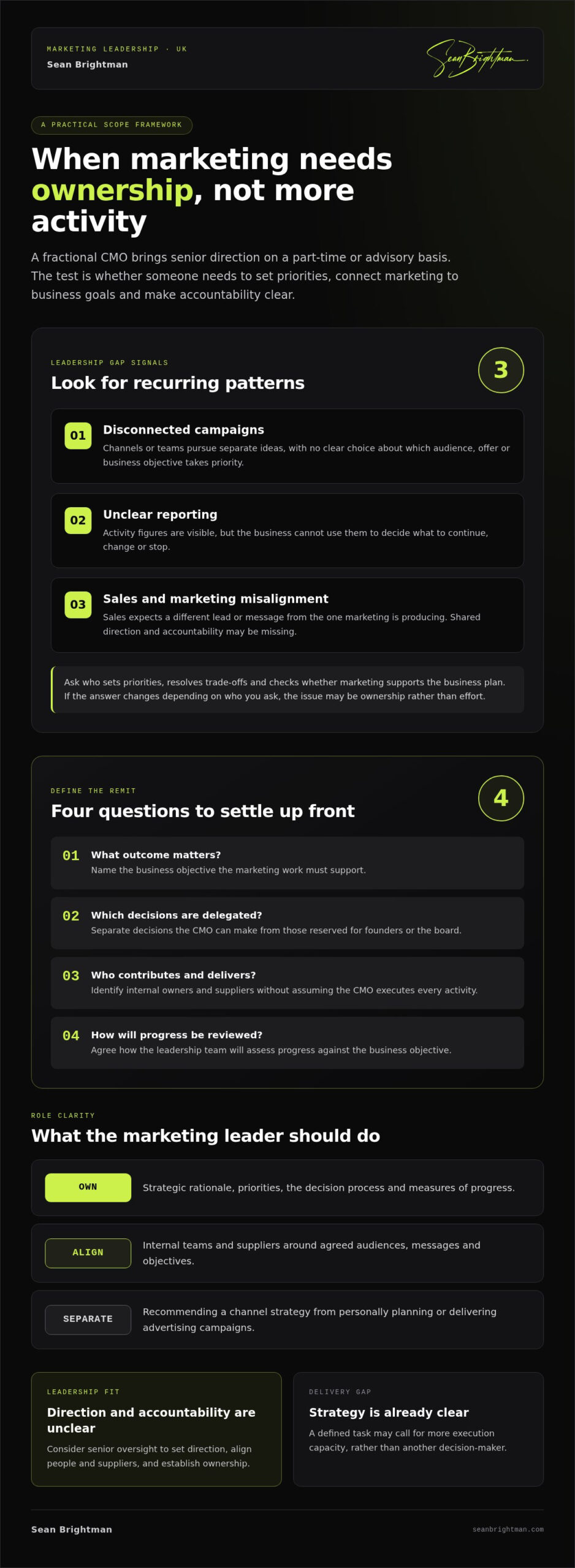
Look for recurring problems, not one disappointing campaign. A leadership gap often shows up in planning, measurement and team coordination:
- Disconnected campaigns: Different channels or teams pursue separate ideas, with no clear decision about which audience, offer or business objective takes priority.
- Unclear reporting: The business sees activity figures but can’t use them to decide what to continue, change or stop. Without agreed measures and context, reports raise more questions than they answer.
- Sales and marketing misalignment: Sales may expect a different type of lead or message from the one marketing is producing. The issue is often missing shared direction and accountability, not simply poor communication.
Ask who sets priorities, resolves trade-offs and checks whether marketing supports the business plan. If the answer changes depending on who you ask, the problem may be ownership rather than effort.
When is fractional leadership a stronger fit than another hire?
Consider fractional leadership when you need someone to decide what marketing should focus on before adding capacity to deliver more work. A new delivery role can help execute a defined task, but it won’t necessarily resolve conflicting priorities, unclear positioning or the absence of a decision-maker.
The fit isn’t dictated by a standard revenue figure, headcount or growth stage. Start with the change required. Do you need senior oversight to set direction, align existing people and suppliers, and establish accountability? Or is the strategy already clear, with a specific delivery gap to fill? The first points towards leadership; the second may call for more execution capacity.
For businesses weighing up a fractional cmo uk engagement, define the decisions this person needs to own and the people they’ll work with. If the core challenge is still unclear, strategic roadmapping can help set priorities before you decide what ongoing leadership should look like.
What should a fractional CMO UK engagement actually own?
A fractional CMO should own marketing direction, not simply attend meetings or add opinions. That means setting strategy, sharpening positioning, choosing priorities and ensuring those choices support the business’s objectives. If the company aims to enter a new market, for example, the marketing plan should specify which audience to target and what needs to change to reach them.
Define the remit before work begins. Spell out which decisions the CMO can make, which need founder or board approval, who they’ll work with and what outputs the business expects. These might include an agreed strategy, a prioritised roadmap, clear measures of progress and regular recommendations informed by evidence. Shape the scope around the challenge, not a generic package.
Which decisions belong with a fractional marketing leader?
Set ownership around the choices that shape the whole function: strategic priorities, positioning, resource trade-offs and how progress is assessed. The CMO can align employees and suppliers around those decisions, then raise risks or blockers for leadership to resolve. This creates accountability without making every task the CMO’s responsibility.
- Own: the strategic rationale, priorities, decision process and measures of progress.
- Align: internal teams and suppliers around agreed audiences, messages and objectives.
- Separate: recommending a channel strategy from personally planning or delivering advertising campaigns.
Leadership is not recruitment. The role should clarify how marketing work fits together, not become a route to placing a full-time executive.
How should the role work with founders and marketing teams?
Give the fractional CMO access to the people who can make decisions. Agree who owns marketing priorities, who leads day-to-day work and where approval sits. A marketing manager should gain direction and support, not have their responsibilities silently removed. Set a communication rhythm that suits the decisions ahead, along with a clear route for escalation when priorities conflict or approval stalls.
Connect each marketing choice to a business objective, then agree how the leadership team will review progress. A useful scope answers four questions:
- What outcome matters? Name the business objective the marketing work must support.
- Which decisions are delegated? Separate decisions the CMO can make from those reserved for founders or the board.
- Who contributes and delivers? Identify internal owners and suppliers without assuming the CMO executes every activity.
- What evidence prompts a review? Choose measures that help leaders decide whether to continue, change or stop an approach.
This clarity matters in the UK business environment, where commercial conditions and trade priorities can shape a company’s plans. The Department for Business and Trade provides the wider UK Business and Trade Landscape; the marketing remit should translate your own business objectives into specific choices and accountabilities.
A fractional cmo uk engagement works best when authority matches responsibility. If you’re defining that scope, explore Sean Brightman’s fractional CMO support for senior strategic direction without making the role a full-time executive post.
How to compare fractional CMO options in the UK
Don’t compare options by how impressive the title sounds or how many days are on offer. Compare the problem each is designed to solve: ongoing leadership, execution capacity or a defined piece of strategic work. The right choice depends on who needs to set direction, who must deliver the work and where decisions are getting stuck.
| Option | Strategic ownership | Decision access | Team support | Delivery responsibility |
|---|---|---|---|---|
| Fractional CMO | Leads marketing direction and priorities on a part-time basis | Needs access to relevant leaders to make or shape decisions | Can guide an existing team and coordinate suppliers | Owns leadership and accountability, not necessarily execution |
| Full-time CMO | Leads the marketing function as an ongoing executive role | Typically works closely with senior leadership | Can build and lead internal marketing capability | Sets direction and oversees the function’s work |
| Agency | Usually works to an agreed strategy or brief | Decisions depend on the client-agency arrangement | Brings delivery capability for its agreed services | Delivers that work rather than owning the whole marketing function |
| Project-based consultant | Provides advice or expertise for a defined project | Works with the people needed for that assignment | Can inform or support the team during the project | Produces agreed recommendations or project outputs |
Fractional CMO, agency or consultant: what changes?
An agency can deliver agreed services, while a CMO leads marketing direction and joins up the moving parts. A project consultant can investigate a specific challenge, such as positioning, and recommend a way forward. That work may be valuable, but it doesn’t automatically create ongoing ownership of priorities or stakeholder coordination.
A fractional CMO provides leadership without being a full-time executive hire. They can set direction, support the internal team and align suppliers around shared priorities. They may recommend a channel strategy, but that’s different from personally planning and delivering advertising campaigns. Choose according to the gap, not a belief that one model is always better.
What evidence shows the working relationship will fit?
Look for a clear explanation of what the engagement owns and how recommendations turn into action. Ask how decisions will be made, who needs to be involved, how progress will be reviewed and what happens when priorities conflict. Strong answers connect strategic thinking to practical next steps. Vague promises of “support” don’t tell you who is accountable.
Start the discussion with the business challenge, current constraints and the decisions you need help making. Don’t begin by buying a preset number of days. That conversation will show whether you need embedded senior leadership, defined project advice or delivery capacity. A fractional cmo uk engagement should make sense because of the decisions it can own, not simply because the arrangement sounds flexible.
If you need ongoing strategic guidance rather than broader leadership, an advisory retainer can be a useful option to consider when defining the scope.
How to set up a fractional CMO engagement for useful progress
A fractional cmo uk engagement needs a clear starting point. Before activity ramps up, agree the business challenge, the decisions that need attention and who will own the next steps. That turns senior input into a working plan, not another stream of meetings.
Use a simple sequence to get the engagement moving:
- Define the challenge. State the business objective and the marketing issue that may be holding it back.
- Choose priorities. Agree what matters now, what can wait and what evidence will help you judge progress.
- Assign ownership. Name the people responsible for decisions, delivery and removing blockers.
- Review and adjust. Set review points to assess progress, resolve trade-offs and record any changes to priorities.
What should happen before the first working session?
Bring the material that shows how the business is operating today: objectives, existing strategy, current marketing activity and available performance information. Add a simple view of the team structure, suppliers and practical constraints, such as limited internal capacity or decisions that need leadership approval.
Identify the decision-makers and the people responsible for current marketing work. Then write down the decisions leaders need help making now. For example, which audience to prioritise, whether to keep investing in an existing activity, or how marketing should support a business objective. A focused agenda makes it easier to separate urgent choices from background noise.
How do roadmapping and advisory support connect?
Roadmapping turns diagnosis into direction. It should translate the business challenge into prioritised actions, clarify dependencies and name the person responsible for each next step. A strategy session can establish that structure; strategic brand roadmapping offers further guidance on building a plan around growth priorities.
Ongoing advisory support can help leaders maintain focus as the plan meets real-world constraints. Use review conversations to test assumptions, make decisions and keep ownership visible. The aim isn’t to preserve a roadmap unchanged. It’s to keep the work aligned as evidence and business needs develop.
How can a business judge whether the engagement is working?
Review progress against the priorities and decisions agreed at the outset, not the number of meetings held or marketing tasks completed. Ask whether important choices have been made, owners understand their responsibilities and the work is moving towards the intended business objective.
If priorities change, revisit the scope rather than letting extra requests accumulate unnoticed. Record what changed, why it changed, who owns the revised actions and what will be reviewed next. This creates a useful record of decisions and keeps accountability clear.
Ready to turn a marketing challenge into a focused plan? Explore Sean Brightman’s fractional CMO support.
Work with Sean Brightman as your fractional CMO in the UK
Senior marketing leadership should bring direction to the work already happening, not add another layer of activity. Sean Brightman provides fractional CMO support for businesses that need clearer priorities, stronger positioning or more accountability across marketing. The starting point is the business’s decision needs: what must change, who needs to be involved and where senior guidance will make a difference.
When does Sean’s strategic approach make sense?
Consider this approach if marketing priorities keep shifting, your positioning no longer reflects the business, or campaigns and teams feel disconnected. Sean brings senior strategic oversight to help founders and marketing teams assess their options and agree a direction. Shape the engagement around the decisions the business needs to make, not a preset list of activities.
There are distinct ways to work together, depending on the need:
- Fractional CMO support provides senior marketing leadership, strategic direction and accountability as part of the business’s ongoing work.
- A one-off strategic roadmap can establish priorities and a clearer plan when the main need is direction rather than continuing leadership.
- An advisory retainer provides ongoing strategic guidance and accountability as leaders work through priorities and decisions.
These are different scopes, not interchangeable labels. A business that needs a strategic reset may begin with roadmapping. If it needs continued leadership to keep the plan moving and align marketing with business goals, fractional CMO support may be a better fit. Advisory support suits leaders who need an ongoing strategic sounding board and direction without a broader leadership remit.
AI consulting can support a defined marketing priority, such as improving marketing efficiency or strengthening growth systems. Give it a clear role in the plan rather than treating it as a separate experiment without a business reason.
What is the practical next step?
Bring a short, honest picture of the business: its objectives, current marketing setup, people involved and the challenge creating the most friction. Be specific about the decisions you’re wrestling with. For example, you may need to clarify positioning, decide which priorities deserve focus or understand why activity isn’t connecting to commercial goals.
That context helps establish whether fractional leadership or a one-off roadmap better matches the need. You don’t need to arrive with a polished brief. Start with the situation as it is, then define the right scope around the work and decisions ahead.
If your business needs senior marketing direction, discuss your marketing leadership challenge with Sean Brightman and explore whether fractional CMO support is the right next step.
Turn your marketing challenge into a clear next move
The right fractional cmo uk decision starts with one honest question: which marketing decision is holding the business back? Get specific about what needs to change, and the right level of senior support becomes easier to identify.
Sean Brightman offers fractional CMO leadership, strategic roadmapping and ongoing advisory support to help businesses bring direction and accountability to marketing. His published book provides an additional resource for thinking through marketing strategy. Connect your current challenge to the kind of support that can address it rather than committing to activity before the need is clear.
Share the business context, what’s happening in marketing now and the decision you need to make. Explore your next step with Sean and start shaping a more focused way forward.
Frequently Asked Questions
Is a fractional CMO worth it for a UK business?
A fractional CMO can be worth it when senior marketing decisions are slowing progress and a full-time executive role isn’t the right fit. Judge the value against a real business challenge, not a promise of instant growth. For example, if leadership can’t agree which customer segment to prioritise, clearer strategic ownership may help the team focus. The case is weaker if the business lacks capacity to act on decisions or hasn’t identified what needs to change.
Can a fractional CMO work with an existing marketing agency?
Yes. A fractional CMO can give an agency a sharper brief by clarifying the audience, business objective and intended role of its work. For example, if an agency manages content, agree who approves the message, who handles feedback and how performance will be discussed. The CMO can provide strategic oversight while the agency delivers its agreed services. Put those responsibilities in writing so requests don’t arrive from several leaders with competing priorities.
How much time does a fractional CMO spend with a business?
There’s no universal schedule; involvement should match the decisions and coordination the business needs. A business with an established team and clear processes may need less day-to-day input than one facing a major positioning decision involving several stakeholders. Agree how often to review priorities, which meetings require the CMO’s involvement and how leaders can raise urgent decisions. For fractional CMO UK support, define the scope around these needs rather than treating days booked as a measure of value.
Is a fractional CMO the same as a marketing consultant?
No, not necessarily. A consultant might be brought in to analyse a specific issue, such as why a product launch missed its intended audience, then deliver recommendations. A fractional CMO may have a broader leadership remit, helping the business make ongoing marketing choices and supporting the people responsible for acting on them. Titles alone won’t settle the distinction. Check the agreed scope for decision rights, expected outputs and who remains accountable after advice is delivered.
Can a fractional CMO help a business use AI in marketing?
Yes, if AI addresses a defined marketing need rather than becoming a project for its own sake. For instance, a business might investigate whether AI could reduce manual work in a repeatable content process or support a specific growth system. Start by describing the task, its current owner and what improvement would matter. Then decide who will assess the approach and how you’ll judge whether it helps before changing tools or workflows.
What happens if our marketing priorities change during an engagement?
Revisit the plan and agree what the change means for current work. A new product launch or a shift in business focus may make an existing task less urgent, but don’t leave the change in informal conversations. Record which activity will pause, continue or move up the list, who owns the revised actions and when the decision will be reviewed. This keeps the engagement responsive without making every new request an automatic priority.