
Your dashboard isn’t a marketing culture. It’s a screen full of numbers until the team uses them to make better decisions. Building a data-driven marketing culture means turning reports into shared habits: what to measure, who owns it and what to do next.
If your team debates which metrics matter, or leaders worry that data will overrule experience, the problem isn’t a lack of charts. It’s a lack of agreement on how evidence and judgement work together. Data should sharpen good marketing decisions, not replace them or reduce success to short-term results.
This practical guide will help you choose useful measures, assign clear accountability and build a repeatable rhythm for deciding, acting and learning. You’ll see how to turn results into the next move, keep teams aligned and make better-informed growth choices without losing sight of long-term value. The aim isn’t more reporting. It’s decisions your team can explain, own and improve.
Key Takeaways
- Start with a real marketing decision, then gather only the evidence that can help you make it.
- Separate business outcomes, customer behaviour and activity measures so you don’t treat every metric as equally useful.
- Make building a data-driven marketing culture practical by agreeing who owns each measure, what it means and how decisions are recorded.
- Review what happened after each action, then use the learning to shape the next decision.
- Senior marketing leadership can keep priorities and accountability aligned without taking over every analysis or replacing professional judgement.
What building a data-driven marketing culture actually means
A marketing report can tell you how many people clicked, watched or enquired, yet leave the team unsure what to change next. That’s the gap between collecting information and using it to steer the work.
A data-driven marketing culture is a shared way of using relevant evidence to make, explain and learn from marketing decisions. It’s an operating behaviour, not a software purchase. An analytics platform or polished dashboard can make information easier to access, but neither creates agreement about what matters, who interprets it or what action follows.
That behaviour sits within data-driven marketing within digital marketing, but it isn’t confined to digital channels or the people who manage analytics. It depends on teams using evidence consistently to make the choices already in front of them.
How data-informed marketing decisions differ from reporting
A report describes what happened. A decision uses that evidence to choose what happens next. Instead of reviewing figures for their own sake, start with a live choice the team needs to make.
For example, a team reviewing an email campaign might decide whether to keep its current subject line or test a different one in the next send. The report shows relevant response measures. The decision comes from interpreting those measures in context, then choosing what to do, not from assuming one result explains everything.
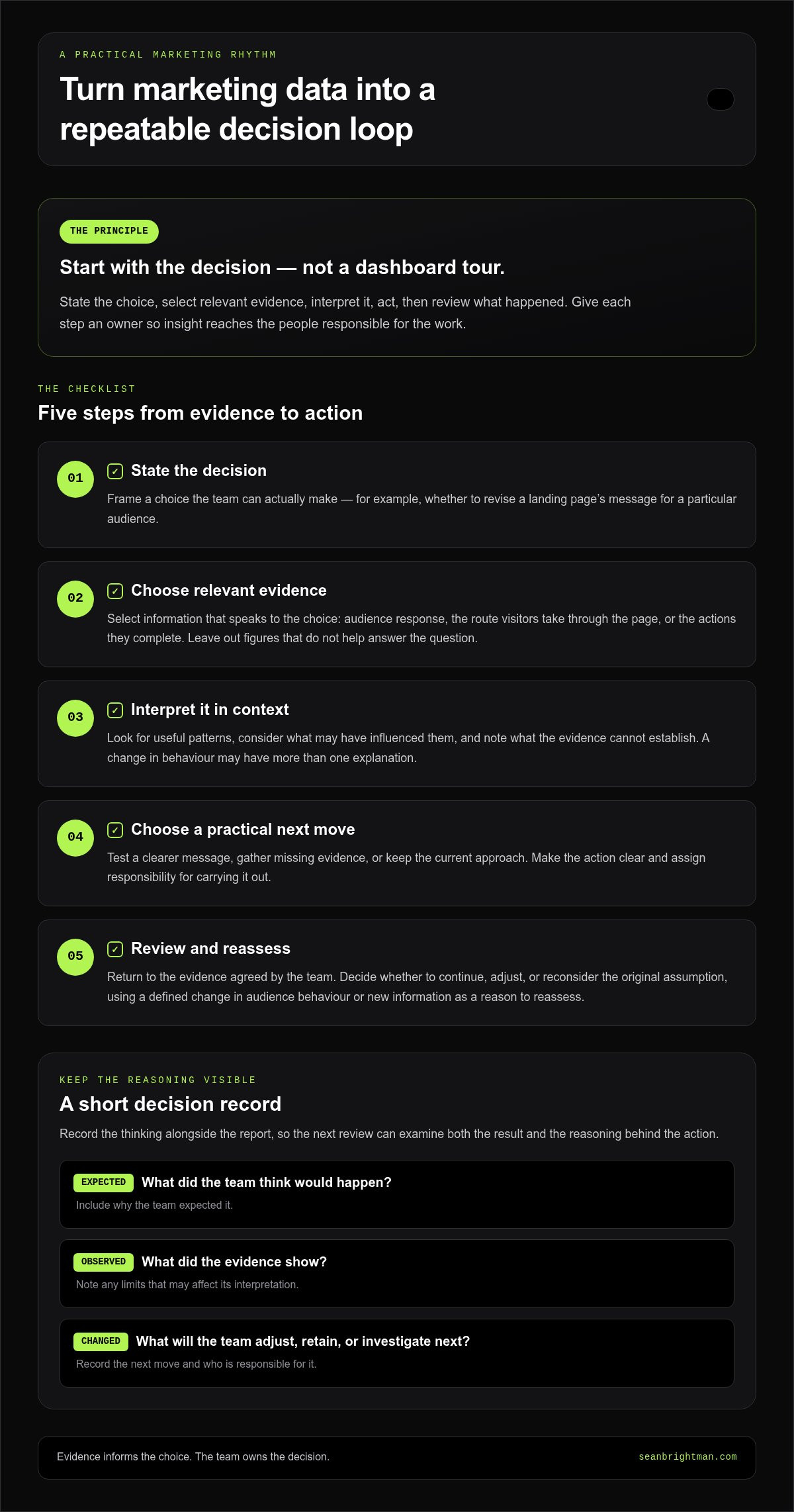
Keep a short decision record alongside the report:
- Expected: What did the team think would happen, and why?
- Observed: What did the evidence show, and what limits might affect its interpretation?
- Changed: What will the team adjust, retain or investigate next?
This makes the reasoning visible and gives the next review something useful to examine: not just the latest figures, but the thinking behind the action.
Why culture matters as much as data access
Evidence only helps when people trust what it means. If one team counts a lead when someone fills in a form and another counts it only after qualification, the same label describes different things. Agreeing definitions removes that friction. Be clear, too, about where information comes from and what it can and can’t tell you.
Experience still matters. A marketer may recognise a seasonal shift, a change in customer concerns or a brand risk that a chart doesn’t capture. Bring that judgement into the discussion, test it against reliable evidence and state assumptions openly. Data should challenge instinct when the evidence points elsewhere, while experience can prompt better questions when the numbers lack context.
Responsibility can’t sit with an analyst alone. Analysts can help make evidence usable, campaign owners understand the work, channel specialists see operational context, and marketing leaders connect choices to priorities. Building a data-driven marketing culture means these roles share responsibility for interpreting evidence and acting on it. The analyst supplies insight; the team owns the decision.
How marketing teams turn data into everyday decisions
Data becomes useful when it changes a choice the team needs to make. Start with the decision, not a dashboard tour. Are you deciding which audience to prioritise, whether to adjust a landing page, or which channel deserves more attention? A clear question keeps the work focused and stops the team collecting figures simply because they’re available.
State the choice, select relevant evidence, interpret it, act, then review what happened. That’s the repeatable loop behind building a data-driven marketing culture. Give each step an owner, so insight doesn’t get stranded between a report and the people responsible for the work.
- State the decision. Frame a choice the team can actually make, such as whether to revise a landing page’s message for a particular audience.
- Choose relevant evidence. Select information that speaks to that choice, such as audience response, the route visitors take through the page or the actions they complete.
- Interpret it. Look for useful patterns, check the context and note what the evidence can’t establish. A change in behaviour may have more than one explanation.
- Act. Choose a practical next move, such as testing a clearer message, gathering missing evidence or keeping the current approach.
- Review. Revisit the decision using the evidence agreed by the team. Decide whether to continue, adjust or reconsider the original assumption.
Start with the decision, then choose the evidence
Don’t open with “What can we measure?” Ask “What do we need to decide?” first. If the choice concerns audience response, examine evidence that reflects how that audience engages. If it concerns conversion behaviour, look at the steps people take towards the desired action. If it concerns channel performance, focus on evidence connected to the channel’s role in the plan.
Some figures may be interesting without helping answer the question. Leave them out of that discussion. A focused evidence set makes it easier to explain why the team chose an action and what new information might change its view.
Build a review rhythm that leads to action
Use a consistent review conversation: what changed, why does it matter, and what happens next? Record the decision, who is responsible for carrying it out and what evidence would trigger a reassessment. That trigger might be a defined change in audience behaviour or new information that challenges the original assumption, rather than an arbitrary reporting deadline.
Keep the record where the team can use it during planning, not buried in presentation notes. Clear operating routines make it easier to connect decisions with delivery, as explored in this guide to marketing operations and scalable growth systems. Senior marketing leadership can help keep priorities and ownership aligned without taking over every analysis.
Which marketing metrics deserve attention, and which create noise?
A metric earns its place when it helps answer a real marketing question. The right measure depends on the decision: a team considering a change to its enquiry journey needs different evidence from one reviewing brand awareness. There’s no universal scorecard, and more numbers don’t automatically mean better judgement.
Choose measures that connect marketing activity to an outcome
Start with the business or customer outcome the decision is meant to support. Then choose a measure that helps the team understand progress towards it. A leading indicator, such as visitors reaching an important page, can inform what to investigate next, but it doesn’t guarantee that enquiries or sales will follow. Agree the measure’s definition and owner before using it, so everyone knows what is counted and who checks its meaning.
Use the comparison below as a prompt, not a ready-made scorecard. Select only measures that fit the decision in front of you.
Decision-useful measure | What it can indicate | Common misinterpretation
Business outcome: qualified enquiries | Whether marketing is attracting potential customers who meet agreed criteria. | Treating every enquiry as equally valuable, or assuming marketing alone caused the change.
Customer behaviour: progression through an enquiry journey | Where people continue, pause or leave as they move towards an action. | Assuming a drop-off proves the page or step is the cause without checking context.
Activity: email clicks | Whether recipients are engaging with a particular link or message. | Treating clicks as proof of sales, customer intent or overall campaign success.
Business outcomes show what the organisation ultimately cares about. Customer behaviour helps explain what people do along the way. Activity measures describe what a campaign or channel produced. Each can be useful when the team understands how it connects to the decision. That connection is central to building a data-driven marketing culture.
Spot vanity metrics, weak data and misleading comparisons
A large audience or a busy campaign report can look impressive and still leave the business question unanswered. Reach may show exposure, for example, but not whether the people reached are relevant to the objective. Don’t dismiss activity measures; give them a supporting role rather than treating them as the final verdict.
Before acting, check whether tracking is consistent, whether important context is missing and whether the measure’s definition has changed. A comparison across campaigns can mislead if one uses a different audience, time period or counting method. Record these limits and pause if the evidence isn’t reliable enough to support the decision.
Trustworthy measurement also depends on responsible data use. Collect and use information for a clear purpose, respect people’s privacy choices, and limit access to what’s needed. Data-led marketing doesn’t mean obeying every metric or sidelining experienced judgement. It means weighing sound evidence alongside context, customer understanding and professional expertise.
How to make data-driven marketing practical for your team
Don’t start by rebuilding your reporting or buying another tool. Start with one recurring marketing decision the team already faces, such as which content topic to prioritise or whether to change a landing page. Use the evidence you have. The first goal is to make the reasoning and follow-up visible, not to create a perfect measurement system.
Run a focused pilot around one marketing question
Choose a live question that matters and can be informed by available evidence. Before acting, write down the assumption behind the current approach, what evidence the team will review, who owns the decision and what options are on the table. This keeps the exercise grounded in a real choice, rather than turning it into an open-ended search for patterns.
Use a simple starting checklist:
- Question: What choice does the team need to make?
- Assumption: What do you currently expect, and why?
- Evidence: Which available information can help assess that expectation?
- Owner: Who makes the call, and who carries out the agreed action?
- Record: What did you decide, and what would lead you to revisit it?
Keep definitions consistent. If one person uses “qualified enquiry” to mean a completed form and another means a prospect that meets agreed criteria, the team can’t compare conclusions reliably. Write down what selected measures mean before expanding the reporting set. That small piece of housekeeping can prevent a larger argument later.
Not every pilot will produce a clear answer. The evidence may be incomplete, mixed or too limited to distinguish between possible explanations. Record that honestly. The learning might be to gather better evidence, narrow the question or hold the current approach while uncertainty remains. Building a data-driven marketing culture means improving how the team reasons, not forcing a confident conclusion from weak signals.
Make accountability safe enough for honest learning
An unexpected result is information, not proof that someone failed. Ask what the evidence changes, what assumptions need revisiting and what the team should do next. Keep the conversation focused on the decision and the conditions around it. Blame makes people hide uncertainty; clear ownership makes it easier to surface what needs attention.
After the discussion, capture the decision, its owner, the action and what would prompt a reassessment. Keep the record easy to find and return to it during planning. This turns accountability into follow-through, rather than a search for someone to fault.
If the team needs help turning priorities into an organised plan, Roadmapping provides a clear structure without making more reporting the goal. For hands-on support aligning priorities, decisions and accountability, explore senior marketing leadership support.
How senior marketing leadership can sustain a data-driven culture
A few useful decisions don’t create a lasting culture on their own. Teams need leadership that keeps evidence connected to the work: the positioning the business wants to own, the priorities worth backing and the campaigns that bring those priorities to life. Without that direction, different teams can use the same data to argue for conflicting actions.
Building a data-driven marketing culture is ongoing management practice, not a transformation completed by installing a tool. Senior leaders set the conditions for it to work: agree what key terms mean, connect measures to priorities, clarify who makes which decisions and make follow-through part of normal planning. They don’t need to interpret every chart. They need to ensure the right people can use credible evidence and understand how their decisions fit together.
Where a senior marketing lead adds direction
A senior marketing lead links what the evidence suggests to what the business is trying to achieve. If customer responses challenge an assumption in the positioning, leadership can decide whether to investigate further or adjust the message. If campaign activity pulls in several directions, leadership can bring the team back to agreed priorities. The analysis stays with the people closest to the channel and customer; the leader makes sure the work adds up.
Accountability should make ownership and follow-through clear, not pressure people to defend every result. A campaign owner can explain the decision, the evidence used and what they’ll do next. A leader can test the reasoning, surface trade-offs and help resolve clashes between priorities. That’s a more useful standard than judging the team on whether every result matched expectations.
For businesses that need experienced direction without handing over every marketing decision, Fractional CMO support provides senior marketing leadership alongside the team.
Turn insight into a roadmap the team can run
Once priorities are clear, the team needs a practical way to translate them into work. A roadmap can rank actions by impact, show how decisions connect and give people a manageable view of what needs attention. It should help the team act on evidence, not become another document that competes with the work.
Sean Brightman’s Roadmapping includes a 90-day action roadmap, sharpened positioning and messaging, and priorities ranked by impact. The roadmap is yours to run, with or without Sean. It gives the team structure for action while leaving room to learn and adapt as evidence develops.
Start with one recurring decision: agree what it means, who owns it and how the team will review what follows. If you want senior marketing direction to help turn that habit into clearer priorities and action, Plug in a senior marketing brain. Skip the full-time hire.
Make the next decision your starting point
Don’t wait for perfect data or a grand culture-change plan. Choose one upcoming marketing decision and make the reasoning behind it visible to the people who’ll act on it. That small shift gives your team a practical starting point for building a data-driven marketing culture, without turning experience into an afterthought.
If keeping that habit alive needs clearer direction, Fractional CMO support brings senior marketing leadership, decision-making and accountability into the work. When the team needs a sharper route from insight to action, Roadmapping sets out a 90-day action roadmap, sharpened positioning and messaging, and priorities ranked by impact.
Plug in a senior marketing brain. Skip the full-time hire.
Start with one decision. Learn from what happens. Then build the next habit from there. Your team can make progress without having every answer in advance.
Frequently Asked Questions
What is a data-driven marketing culture?
It’s a way of working where teams use relevant evidence to shape marketing choices and learn from what follows. Evidence might include customer feedback, campaign responses or sales conversations, not just figures from an analytics platform. For example, a pattern in customer questions could prompt a team to clarify its website messaging. The key is using information to improve decisions, not collecting it for its own sake.
How do you build a data-driven culture in a marketing team?
Make data use part of ordinary planning, rather than a separate analytics project. Give the team a shared place to note key terms, decisions and unresolved questions. In a campaign planning session, ask what evidence supports the audience choice and what would make the team reconsider it. New starters should learn these habits too, so the approach survives team changes instead of depending on one person.
Can a small business build a data-driven marketing culture without specialist software?
Yes. A small team can begin with a spreadsheet, existing sales records and customer conversations. Track a few clearly defined measures that relate to current priorities, and note where each figure comes from. For example, a business could review the reasons prospects give for postponing a purchase alongside enquiry records. Specialist tools may help as needs grow, but they can’t replace clear questions or consistent recording.
Which metrics should a marketing team use to make better decisions?
Choose measures that fit the decision, rather than copying another organisation’s dashboard. A team improving repeat business might examine returning-customer behaviour and feedback about the experience. A team building awareness may need evidence about relevant audience reach, not just total impressions. Check that each measure has a stable definition and an identified source. If the team can’t explain how a metric informs its choice, it probably doesn’t belong in that discussion.
How do you encourage a team to trust marketing data?
Make the source and limitations of important figures easy to see. If a sales report and a campaign platform show different enquiry totals, investigate how each counts an enquiry before drawing conclusions. Let team members question a measure without treating that as resistance. Trust grows when discrepancies are resolved openly, corrections are recorded and people can see how evidence influenced a real decision.
Does data-driven marketing mean replacing judgement with analytics?
No. Analytics can show patterns, but it can’t automatically explain every cause or account for every business consideration. If a campaign’s response shifts during a major change in the market, experienced marketers can add context the report doesn’t contain. Use judgement to question assumptions and interpret what the numbers can’t show. Then make the reasoning explicit, so the team can distinguish evidence from opinion and revisit either when circumstances change.
How should a business handle privacy when using customer data for marketing?
Use customer information responsibly: be clear about why it’s collected, limit it to what the business needs, protect access and avoid keeping it indefinitely without a reason. In the UK, marketing data use must take account of applicable data protection and electronic marketing rules, including the UK GDPR and Privacy and Electronic Communications Regulations. Build privacy checks into campaign planning, and seek specialist advice where the right approach depends on the data or activity.