
Tag: Tech Marketing

  • Marketing Growth Models for Tech Companies: How to Choose in 2026

    Marketing Growth Models for Tech Companies: How to Choose in 2026

    The growth model that looks fastest at another tech company could be the wrong one for yours. The right marketing growth models for tech companies depend on how your customers buy, how quickly they realise value and what your business economics can sustain.

    If you’re unsure whether product-led, sales-led or marketing-led growth fits, you’re not alone. The labels can make the choice seem simpler than it is. Copying a competitor’s playbook won’t help if your buyers behave differently or your marketing activity isn’t tied to acquisition, retention and revenue.

    This guide compares the strengths and limits of the main growth models, so you can choose based on customer behaviour and unit economics, not fashion or guesswork.

    You’ll also learn how to test your assumptions, track whether the model is working and turn the evidence into practical priorities. The goal isn’t to choose a label and stick with it. It’s to build a growth system that fits your product, buyers and business.

    Key Takeaways

    • See how product-led, sales-led, marketing-led and partner-led growth differ, and which conditions favour each model.
    • Use buyer complexity, time to value and customer behaviour to judge which marketing growth models for tech companies fit your offer.
    • Check activation, retention and expansion before assuming a self-serve product can carry growth.
    • Test your preferred model with a defined segment, a clear hypothesis and one primary outcome before scaling investment.
    • Align marketing, product, sales and customer success around shared measures and a regular review rhythm.

    What marketing growth models for tech companies actually describe

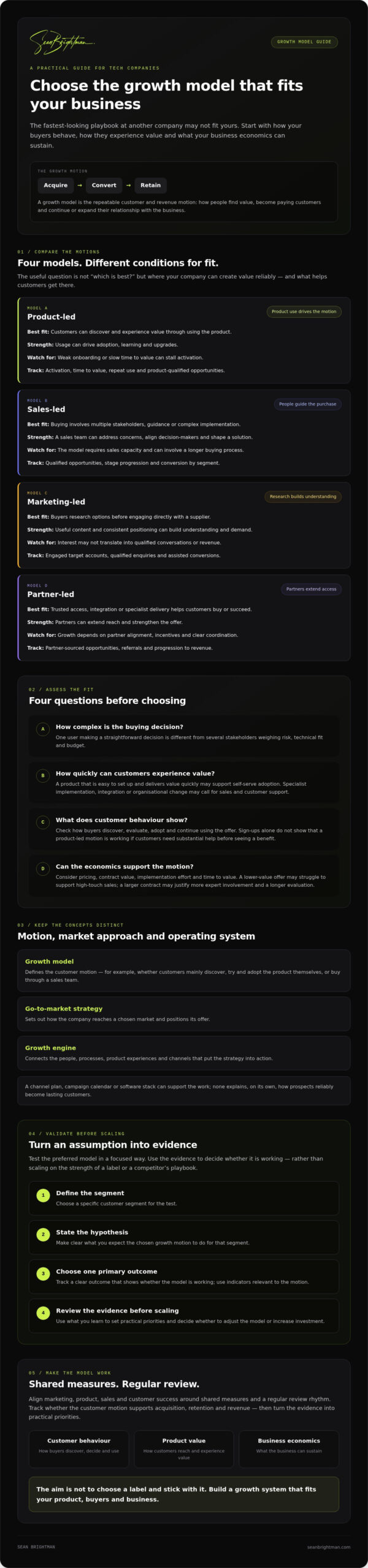
    A growth model is the repeatable way a company acquires, converts and retains customers. It describes how customers experience value, become paying users and continue using or expanding their relationship with the business.

    A growth model is the repeatable customer and revenue motion; a marketing strategy is the set of choices that helps make that motion work. A channel plan names where you’ll show up. A campaign calendar schedules activity. A software stack supports the work. None of these, on its own, explains how the company will reliably turn prospects into lasting customers.

    Growth model, go-to-market strategy and growth engine: what is different?

    The growth model defines the motion: for example, whether customers mainly discover, try and adopt a product themselves, or buy through a sales team. The go-to-market strategy sets out how the company reaches a chosen market and positions its offer. The growth engine is the connected set of people, processes, product experiences and channels that puts the strategy into action.

    Consider a software company aiming for self-serve adoption. Customers need to understand and experience value without a lengthy sales process. The company might target a specific business segment, then connect useful content, a low-friction product journey and follow-up based on user behaviour. Growth hacking also puts experimentation and scalable growth at the centre, but experiments still need to support a coherent model.

    Why one company’s successful playbook may fail at another

    A familiar playbook isn’t proof of fit. A product that’s easy to set up and delivers value quickly may support self-serve adoption. A platform that requires specialist implementation, integration or organisational change may need sales and customer support to guide the buyer. The buying group matters too: one user making a simple decision is different from several stakeholders weighing risk, technical fit and budget.

    Pricing and contract value affect the economics. A lower-value offer may struggle to support a high-touch sales process, while a larger contract may justify more expert involvement and a longer evaluation. Implementation effort and time to value matter just as much. If customers need substantial help before seeing a benefit, sign-ups alone won’t show that a product-led motion is working.

    That’s why marketing growth models for tech companies should be chosen using evidence about customer behaviour, product value and business economics, not copied from a fashionable success story. Compare the models on consistent terms, then test which one fits.

    Compare the main marketing growth models for tech companies

    Each model puts a different part of the customer journey in the driving seat. The useful question isn’t “which is best?” but “where can your company create value reliably, and what must it do to help customers get there?”

    Model Best-fit conditions Strengths Constraints Leading indicators
    Product-led Customers can discover and experience value through product use. Usage can drive adoption, learning and upgrades. Weak onboarding or slow time to value can stall activation. Activation, time to value, repeat use and product-qualified opportunities.
    Sales-led Buying involves multiple stakeholders, guidance or complex implementation. People can address concerns, align decision-makers and shape a solution. Requires sales capacity and can involve a longer buying process. Qualified opportunities, stage progression and conversion by segment.
    Marketing-led Buyers research options before engaging directly with a supplier. Useful content and consistent positioning can build understanding and demand. Interest may not translate into qualified conversations or revenue. Engaged target accounts, qualified enquiries and assisted conversions.
    Partner-led Trusted access, integration or specialist delivery helps customers buy or succeed. Partners can extend reach and strengthen the offer. Growth depends on partner alignment, incentives and clear coordination. Partner-sourced opportunities, referrals and progression to revenue.

    Product-led and sales-led growth: where each motion earns its place

    Product-led growth makes sense when people can explore the product, understand its value and make progress without extensive one-to-one guidance. That doesn’t rule out sales. A self-serve route can support straightforward needs, while sales steps in when account complexity, user activity or implementation requirements call for human support.

    Sales-led growth earns its place when buyers need help building a case, involving stakeholders or managing technical change. Set clear hand-off rules: define which behaviours or requirements trigger human support, who owns the next step and how product activity informs the conversation.

    Marketing-led and partner-led growth: two routes beyond direct product adoption

    Marketing-led growth suits buyers who compare approaches and gather information before speaking with sales. Marketing helps them understand the problem, assess options and see how the offer is relevant. Partner-led growth relies on another organisation’s trusted relationships, complementary product or specialist delivery to reach or serve customers. The route needs to fit the company’s market and offer, not just a promising channel.

    Hybrid models can work, but “everyone owns growth” often means nobody owns the hand-off. Name the owner for each stage, agree what qualifies a lead or partner opportunity, and track whether it progresses. For help turning a model choice into sequenced priorities and accountable decisions, strategic marketing roadmapping can provide a useful framework.

    How to assess which tech company growth model fits

    Choose the model that matches how customers make decisions and reach value, not the one that sounds easiest to scale. Start with the buying process: who feels the problem, who evaluates the product, who approves the spend, and how long does a decision take? Then identify what customers need to use the product successfully. A simple tool may need clear onboarding; a product tied to existing systems may need technical guidance or implementation support.

    Software doesn’t automatically mean product-led growth. If buyers need internal approval, specialist advice or help proving the business case, a self-serve journey may not support the entire sale. Product-led elements can still help with discovery or evaluation, but the growth motion should reflect the actual purchase and adoption process.

    Use customer behaviour to test the fit

    Map the customer journey from first discovery through evaluation, purchase, activation and expansion. Use customer interviews, sales conversations and product data to find where people pause, ask for help or drop out. Then identify what could unblock them: a person, a partner, a more useful product experience or educational content.

    Let observed buying behaviour choose the growth model, not the model you wish customers would follow. Compare patterns across the segments you serve. One group may adopt independently, while another needs guided evaluation. Different paths can work, provided the hand-offs are deliberate.

    Use growth metrics without mistaking activity for progress

    Connect each acquisition measure to what happens next. Website visits or enquiries show activity; qualified pipeline, conversion, retention and expansion indicate whether that activity contributes to commercial progress. Track early signals, such as product activation or qualified meetings, alongside later outcomes, such as closed revenue and customer retention.

    • Leading indicators: target-account engagement, completed onboarding, activation, qualified opportunities and progression through the buying process.
    • Commercial outcomes: acquisition cost, conversion, retention, expansion and revenue.

    Use your own data to compare customer acquisition cost (CAC), customer lifetime value (LTV) and payback. Before comparing models, agree what each measure includes: which acquisition costs count, how you calculate customer value, and whether payback means the time until gross profit or another defined contribution measure covers CAC. Keep the period, segment and attribution rules consistent. If the underlying data is incomplete, label assumptions rather than presenting estimates as facts.

    This gives you a practical fit test for marketing growth models for tech companies: follow customer behaviour, then check whether the economics support repeating that motion.
    Marketing Growth Models for Tech Companies: How to Choose in 2026

    How to validate a marketing growth model before scaling it

    Don’t make a company-wide bet on an untested assumption. Run a bounded test to see whether a specific growth motion works for a defined group of customers. Before you start, choose one primary outcome, supporting indicators and the evidence that would make you continue, adjust or stop.

    Design a test that answers one growth question

    Keep the test narrow. Choose a customer segment, offer and acquisition or activation motion, then record the baseline and write down your assumptions. Changing several things at once makes the results difficult to interpret.

    1. Set a hypothesis. State what you expect to happen, for whom and why. For example: “A guided product demonstration will help operations teams in this segment reach activation more often than the current self-serve onboarding.”
    2. Select a segment. Focus on customers with a shared need or buying context, rather than mixing very different accounts in one test.
    3. Run a bounded test. Limit its scope and agree the review point in advance. Track the primary outcome, such as activation or qualified opportunities, alongside useful indicators such as completion rates, drop-off points or requests for help.
    4. Review the evidence. Compare results with the baseline and your decision criteria. Continue if the evidence supports the hypothesis, adjust if it points to a fixable barrier, or stop if the motion doesn’t appear to fit.

    For example, when testing a sales-assisted path, define which customer signals trigger sales involvement and track whether those prospects progress. Don’t treat more meetings as success unless they lead to stronger qualification or commercial outcomes.

    Reliable tests depend on clear processes for recording activity, assigning ownership and reviewing results. See marketing operations and scalable growth systems for more on building that operating discipline.

    Turn test results into a practical roadmap

    A test is useful only if it changes what the team does next. Turn the findings into a short plan: name the priority, assign an owner, identify dependencies and set a review point. If the evidence is mixed, record what remains uncertain and design the next test to resolve it. Strategic brand roadmapping can help sequence those choices into a clear direction.

    Still unsure which motion the evidence supports? Discuss a growth roadmap with Sean to turn the decision into priorities and accountable next steps.

    Build the leadership and systems to make the chosen model work

    A growth model won’t run itself. Marketing, product, sales and customer success need shared definitions of progress, clear ownership and reliable hand-offs. Otherwise, one team celebrates sign-ups while another sees stalled activation or customers who never reach value.

    Give the growth model clear owners and decision rights

    Name an owner for each stage: acquisition, conversion, activation, retention and expansion. Clarify who acts when a prospect becomes a sales opportunity, when product usage signals a need for support, or when a customer is ready to grow their account. Agree what each hand-off includes and how the receiving team confirms it’s complete.

    Separate strategic accountability from execution. A leader sets direction, priorities and measures; internal teams or providers carry out assigned work. AI can support workflows such as analysis, personalisation or content development, but it can’t decide which growth model fits the business or take responsibility for the outcome. People still need to check the evidence and own the decisions.

    Set a regular review cadence. Bring together leading indicators, customer evidence and commercial outcomes. Ask what’s changing, where customers are getting stuck and whether the priorities still make sense. Change the plan when the evidence changes, not simply because a new tactic looks appealing.

    Know when to bring in senior marketing direction

    Watch for warning signs: teams are pursuing conflicting priorities, positioning shifts between channels, or marketing measures don’t connect to pipeline, retention or revenue. These are leadership and alignment problems, not simply requests for more activity.

    Fractional CMO support can provide senior marketing direction on a part-time basis, with strategic oversight rather than full-time placement or advertising execution. If the main need is to establish direction and sequence priorities, roadmapping can create a structured plan. If the business needs continued guidance and accountability, an advisory retainer may be a better fit. The marketing advisory retainer offers more context on ongoing strategic direction.

    For marketing growth models for tech companies, the operating system matters as much as the choice of model. Clear ownership, shared measures and regular decisions turn strategy into coordinated work. If you’re weighing up the next step, explore Fractional CMO, roadmapping and advisory support with Sean.

    Choose your model, then prove it in practice

    The strongest marketing growth models for tech companies aren’t borrowed from a competitor. They fit how your customers buy, experience value and continue using your product. Product-led, sales-led, marketing-led and partner-led motions each have a place, and a hybrid can work when ownership and hand-offs are clear.

    Start with customer behaviour and your own unit economics. Then test one focused hypothesis, define what success looks like and decide in advance whether to continue, adjust or stop. A burst of activity isn’t proof of growth. Look for progress through the customer journey and towards commercial outcomes.

    Make the model workable with shared measures, clear decision rights and regular reviews. If your team needs senior direction, Fractional CMO support offers part-time marketing leadership. Strategic roadmapping can turn direction into a structured plan, while ongoing advisory provides continued guidance and accountability.

    Talk through your growth model with Sean to identify practical next steps. You don’t need to copy someone else’s playbook; you can build a model that fits your business and improve it with evidence.

    Frequently Asked Questions

    What is a marketing growth model for a tech company?

    A marketing growth model describes the repeatable way a tech company attracts, converts and retains customers. It shows how customers discover the offer, decide to buy, reach value and continue using or expanding their use of it. It’s different from a channel plan or campaign calendar: those organise marketing activity, while the growth model explains how that activity connects to customer behaviour and business growth.

    Which growth model is best for a B2B SaaS company?

    There’s no single best model for every B2B SaaS company. Product-led growth may fit when customers can try the software and experience value without much assistance. Sales-led growth may fit complex purchases involving several decision-makers, technical evaluation or implementation support. Marketing-led and partner-led motions can also play key roles. Assess how your target buyers evaluate and adopt the product, then test the motion against customer and commercial evidence.

    Is product-led growth right for every tech company?

    No. Product-led growth depends on customers being able to discover, adopt and realise value through the product itself. If onboarding is difficult, implementation is substantial or buyers need guidance to build internal agreement, a self-serve path may not be enough. Software companies can still use product-led elements, such as a self-serve trial, alongside sales support. Check activation, time to value, retention and expansion before making product-led growth the primary motion.

    How do you choose between sales-led and product-led growth?

    Choose based on what buyers need to make a decision and succeed after purchase. Product-led growth is more plausible when users can experience value independently and adoption doesn’t require extensive support. Sales-led growth may suit purchases with multiple stakeholders, detailed evaluation or complex implementation. Map the journey from discovery to activation, then identify where customers ask for help or stall. You can support self-serve users with sales by setting clear qualification and hand-off rules.

    Can a tech company use more than one growth model?

    Yes. A company could combine self-serve product adoption for simpler needs with sales support for larger or more complex accounts. Marketing may create demand across both routes, while partners help reach customers or support implementation. The risk is confusion, not variety. Set clear ownership, shared definitions and hand-off rules so teams know who acts next, which customer fits each route and how each motion contributes to acquisition, retention or revenue.

    How should an early-stage tech company measure its growth model?

    Start with a small set of measures tied to the model you’re testing. Track a leading indicator, such as qualified enquiries, onboarding completion or product activation, alongside outcomes such as conversion, retention and expansion. Record a baseline, define each metric consistently and review a specific customer segment. Don’t treat traffic or sign-ups alone as proof of progress. Set decision criteria in advance, then continue, adjust or stop based on the evidence.

  • Marketing Strategy for Tech Companies: Building Engines, Not Just Ads

    Marketing Strategy for Tech Companies: Building Engines, Not Just Ads

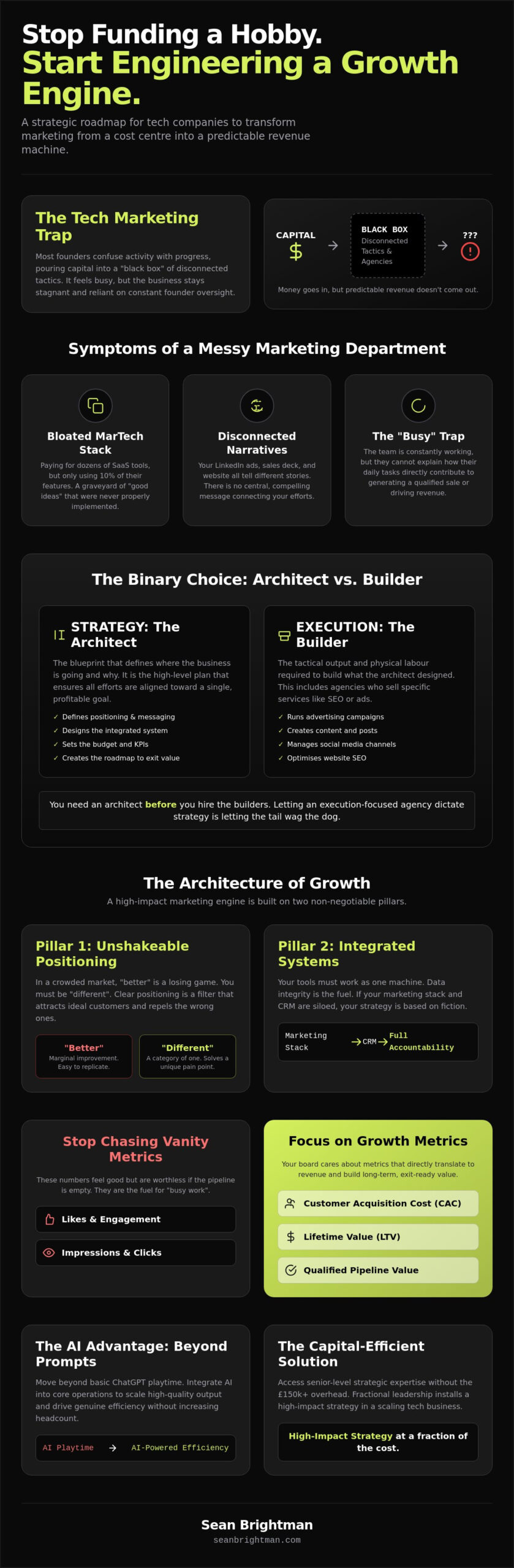
    Most founders think they have a marketing strategy for tech companies, but they’re usually just funding a very expensive hobby for their agencies. You’ve likely felt the sting of a marketing department that operates as a black box. You’ve got the tools. The team is busy. The invoices are paid. Yet, the needle stays static. It’s exhausting to watch capital disappear into disconnected tactics whilst the core business remains stagnant and dependent on your constant oversight.

    It’s time to stop chasing “hacks” and start engineering. A proper strategy isn’t a to-do list. It’s a mechanical system designed to produce revenue. This article provides a clear, actionable roadmap to build a growth engine that functions without constant founder intervention. We’ll explore how to replace manual overhead with AI-powered efficiency and turn your marketing from a cost centre into a high-impact asset that builds genuine, exit-ready value.

    Key Takeaways

    • Stop burning cash on disconnected tactics. Learn how to build a marketing strategy for tech companies that functions as a predictable revenue engine rather than a “black box” expense.
    • Fix your positioning to cut through the noise. Discover how to architect a marketing stack that actually communicates with your CRM to provide full accountability for every pound spent.
    • Integrate AI into your core operations to drive genuine efficiency. Learn how to move beyond basic prompts and use intelligence to scale your output without increasing your headcount.
    • Stop the “busy work” and start engineering growth. Follow a 90-day roadmap designed to stabilise messy departments and build the long-term value required for a successful exit.
    • Access senior-level expertise without the £150k overhead. Understand why fractional leadership is the most capital-efficient way to install high-impact strategy in a scaling tech business.

    The Tech Marketing Strategy Trap: Why Most Scale-ups Fail

    Marketing strategy for tech companies is rarely what founders think it is. It isn’t a calendar full of social media posts or a weekly newsletter that nobody reads. It’s a functional system. Most scale-ups fail because they confuse activity with progress. They mistake noise for momentum. If your marketing feels like a “black box” where you put money in and hope for the best, you don’t have a strategy. You have a gamble.

    A real strategy is a machine. It takes capital and attention as input and produces predictable revenue as output. When you lack this mechanical foundation, you fall into the “Tactic Trap”. This is the expensive habit of hiring an agency to “do SEO” or run ads before you’ve nailed your positioning. You end up paying for traffic to a destination that doesn’t convert. It’s like hiring bricklayers to build a house when you haven’t even seen the blueprints. You’ll end up with a very expensive pile of bricks in the wrong place.

    This leads directly to the founder’s dilemma. You started this company to build a product and disrupt a market. Now you’re stuck in the weeds. You’re approving ad copy at 11 PM whilst the actual growth engine stalls. You’re doing the work because there is no system to handle it for you. To fix this, we must kill the obsession with vanity metrics. Clicks are cheap. Likes are worthless. Your board doesn’t care about your “engagement rate” if the pipeline is empty. High-impact marketing strategy for tech companies focuses on growth metrics: Customer Acquisition Cost (CAC), Lifetime Value (LTV), and qualified pipeline.

    Symptoms of a Messy Marketing Department

    You know the department is broken when the symptoms become impossible to ignore. It usually looks like this:

    • Bloated MarTech: You’re paying for dozens of SaaS tools but only using 10% of their features. The stack is a graveyard of “good ideas” that never got implemented.
    • Disconnected Narratives: Your LinkedIn ads say one thing, your sales deck says another, and your website says something entirely different. There’s no central story.
    • The “Busy” Trap: The team is working 50-hour weeks on tasks, but they cannot explain how those tasks actually drive a sale.

    Strategy vs. Execution: The Binary Choice

    You need an architect before you hire the builders. Most agencies are builders; they want to sell you more bricks. If you let an execution-focused agency dictate your high-level digital marketing strategies, you’re letting the tail wag the dog. They will always suggest the tactics they happen to sell, regardless of whether those tactics fit your roadmap.

    Strategic direction is the blueprint that defines where the business is going, whilst tactical output is the physical labour required to get there. Working with a dedicated marketing strategy consultant ensures that blueprint is built around your specific growth objectives, not the service menu of whoever you hired last.

    The Architecture of Growth: Positioning and Systems

    A high-impact marketing strategy for tech companies is built on two pillars: positioning and systems. Without these, you are just throwing money at platforms and hoping for a miracle. Most scale-ups treat their marketing stack like a toy box. They buy the latest AI tool or CRM because it’s trendy; not because it fits the architecture. This creates a fragmented mess where data is siloed and accountability is non-existent. You don’t need more tools. You need a machine where every component serves a specific, documented purpose.

    Data integrity is the fuel for this machine. If your marketing stack doesn’t talk to your CRM in real-time, your strategy is based on fiction. You cannot optimise what you cannot measure. Your reporting should tell you exactly where your next £1 of profit is coming from. If it doesn’t, you aren’t running a department; you’re running a series of expensive experiments. Building a “plug-and-play” model allows you to scale without adding more chaos. It means that when you double your budget, you double your output, not your headaches.

    Brand Positioning for Tech: Standing Out amongst Giants

    In the crowded B2B SaaS landscape, sounding “better” is a losing game. “Better” is a marginal improvement that competitors can easily replicate. “Different” is a category of one. If your messaging uses the same buzzwords as the market leader, you are invisible. You must identify a Unique Value Proposition that solves a visceral pain point your competitors ignore. Clear positioning acts as a filter. It attracts the right leads and repels the wrong ones, which drastically reduces your cost of customer acquisition. If you want to move from guesswork to precision, a structured marketing roadmap is the first step to defining your space.

    Marketing Operations: The Engine Room

    Marketing operations is where strategy meets reality. It’s about designing workflows that remove friction between marketing and sales. Automation should be used to maintain a lean, high-output team, not just to spam prospects. We use systems to handle the repetitive heavy lifting so your talent can focus on high-level creativity and strategic shifts. This isn’t just about efficiency. It’s about valuation. Investors don’t buy “talented teams” that might leave next month. They buy documented, scalable systems that produce predictable results. This is how you build for a successful exit. You build an engine that works whilst you sleep.

    AI Marketing Strategy: Moving Beyond ChatGPT Playtime

    Most tech leaders are still in the “playtime” phase of AI adoption. They use it to churn out generic copy that sounds like every other B2B SaaS company on LinkedIn. This isn’t strategy. It’s noise. A sophisticated marketing strategy for tech companies treats AI as an operational lever, not just a content generator. It’s about building intelligence into your infrastructure, not just adding another tool to the pile. You need a system that thinks, not just a chatbot that types.

    The goal is efficiency, not just more volume. If you use AI to produce ten times more mediocre content, you haven’t won; you’ve just made your brand ten times more annoying. A real growth engine uses AI to do more with the same headcount. It’s the difference between scaling your overhead and scaling your impact. You move from “playing with tools” to “executing strategy” when AI starts handling the heavy lifting of data analysis, lead scoring, and workflow automation. This allows your team to focus on the high-level shifts that actually move the needle.

    Risk management is the part most founders ignore until it’s too late. As of June 2026, anticipated UK regulatory frameworks will mandate clear disclosure for synthetic performers. If you’re using AI likenesses in your video ads, you’re now in a regulated environment. You must address data privacy and brand voice protection before you automate your outreach. A single hallucinated claim or a data breach in your automated pipeline can wipe out years of brand equity. Strategy is about moving fast, but it’s also about building the guardrails to ensure you don’t fly off the track.

    The Practical Application of AI Consulting

    Success starts with mapping your current marketing processes to identify AI-ready bottlenecks. We don’t just “add AI” to a mess; we fix the mess first. This involves implementing AI-powered lead scoring that talks directly to your CRM, ensuring your sales team only touches the hottest prospects. By building a custom AI growth engine, you create a competitive moat that others cannot easily replicate with off-the-shelf software. It’s about proprietary workflows, not just subscription logins.

    Future-proofing Your Tech Brand

    AI is a survival requirement for 2026. With 80% of marketing professionals already using AI and automation, those who resist are effectively choosing to operate with higher overhead and slower response times. You must keep the “human in the loop” to maintain brand authenticity, using people for strategic oversight whilst the machines handle the execution. The ROI of AI-driven marketing efficiency is the radical compression of the time between lead capture and revenue realisation.

    Marketing Strategy for Tech Companies: Building Engines, Not Just Ads

    The Strategic Roadmap: Engineering Your Path to Exit

    Marketing strategy for tech companies is often treated as a short-term survival tactic. This is a mistake. If your objective is a high-multiple exit, your marketing department must be an asset that adds to the company’s valuation. Investors don’t buy a collection of “busy” employees. They buy a documented, repeatable revenue machine. They want to see that your growth is a result of a system, not founder-led heroics or luck.

    Success requires a North Star that aligns with your specific niche. For a B2B SaaS firm, this might be a specific Net Revenue Retention (NRR) target or a CAC payback period of under 12 months. For a deep-tech hardware firm, it might be market penetration in a key geographic territory. If your marketing team doesn’t know these numbers, they are just guessing. They are spending your capital on activity that doesn’t build equity. Strategic marketing for CEOs means transforming this guesswork into a documented, scalable system that turns your marketing function from a cost centre into a predictable revenue engine.

    Phase 1: The Audit and Alignment

    The first 30 days of a 90-day sprint are about stopping the bleeding. You must uncover the hidden waste in your current marketing spend. With growth-stage tech companies often spending between £2,300 and £15,000 per month on ads alone, the potential for inefficiency is massive. This phase aligns your marketing efforts with overall business goals and sales targets. If you want a clear path forward, you need a Marketing strategy roadmap that defines exactly how you will win.

    Phase 2: Building the Infrastructure

    Once you’ve stopped the waste, you build the infrastructure. This means hiring the right people or agencies to fill tactical gaps. You don’t need a full-time SEO specialist if you only need 10 hours of work a month. You need a “Marketing Playbook” that defines your operational standard. This document ensures that if a team member leaves, the machine keeps running. It establishes the reporting cadence that keeps the team accountable to the KPIs the CEO actually cares about: pipeline value, customer acquisition cost, and lifetime value.

    Where should you put your next £10k? Don’t default to more ads. Put it into the systems that increase your conversion rate or the AI workflows that reduce your cost per lead. If your foundation is weak, more traffic just means more waste. If you’re ready to stop the chaos and start engineering growth, it’s time to build a scalable marketing engine that drives real value.

    Fractional Leadership: High-Impact Strategy Without the Overhead

    Hiring a full-time CMO too early is a £150k mistake that kills your runway. For a growth-stage firm, that capital is better spent on the engine itself, not just the driver. Most founders reach a point where their marketing feels stuck, but they don’t need a permanent executive with a massive benefits package. They need a navigator. They need someone who has seen the “messy department” before and knows exactly how to rewire it for scale.

    There is a fundamental difference between an agency and a Fractional CMO. An agency is a vendor; they sell you tasks. They don’t own your marketing strategy for tech companies. They own their own profit margins. A Fractional CMO is a partner who owns the growth roadmap and holds those agencies accountable. This model provides the senior-level direction you need whilst your existing team or external partners handle the tactical execution. It’s about high-impact strategy without the corporate bloat.

    An advisory retainer provides the CEO with a much-needed external perspective. When you’re inside the business, you’re too close to the problems. You can’t see the “clog” in the engine because you’re part of the plumbing. An external expert finds the blockage in days, not months. This ongoing accountability ensures that the strategic roadmap we discussed in the previous section actually gets executed, rather than sitting in a folder gathering digital dust.

    When to Hire a Fractional CMO

    You hit the “Scale-up Wall” when your current marketing manager has reached their limit. They are great at execution, but they lack the strategic depth to architect a global growth engine. This often happens when you need to transition from founder-led sales to a marketing-led system. If you are preparing for a funding round or a business exit, you need a battle-hardened strategist who can prove to investors that your revenue is predictable and your systems are documented. Understanding the difference between a marketing strategy consultant focused on growth engines versus traditional planning is critical before you make that hire.

    The Sean Brightman Approach: Senior Leadership on Demand

    I provide direct, battle-hardened expertise without the corporate fluff or ego. This is a plug-and-play solution for UK tech companies that need order brought to internal complexity. My role is to design the machine and ensure it runs at peak efficiency, leaving your team to focus on the day-to-day output. If you’re tired of marketing that feels like a black box, it’s time to take control. Book a strategic roadmapping session to fix your marketing machine today and start building genuine, exit-ready value.

    Engineering Your Exit: From Tactical Chaos to a Scalable Growth Engine

    Marketing strategy for tech companies isn’t about finding a silver bullet. It’s about building a machine that functions independently of founder heroics. We’ve explored how to escape the tactic trap, architect a system that talks to your CRM, and leverage AI for genuine operational efficiency. You don’t need more busy work. You need a documented infrastructure that turns capital into predictable revenue.

    Stop funding a black box and start building an asset. As a published author on marketing strategy and a battle-hardened Fractional CMO for high-growth UK tech brands, Sean Brightman specialises in building AI-powered growth engines that fix the mess. He provides the senior-level direction required to get your department under control and ready for a high-multiple exit. You’ve built the product. Now it’s time to build the engine that sells it.

    Stop playing with tools and start growing – Work with Sean Brightman

    Frequently Asked Questions

    What is the difference between a marketing strategy and a marketing plan?

    A strategy is the architecture of your growth; a plan is the construction schedule. Strategy defines your positioning, your unique value, and how you will win the market. The plan is simply the list of tasks and deadlines required to execute that strategy. You don’t need a plan to fail, but you certainly need a strategy to win.

    How much does a marketing strategy for a tech company typically cost?

    The real cost is the waste currently sitting in your budget. Growth-stage companies often spend between £2,300 and £15,000 per month on Google Ads alone. A proper marketing strategy for tech companies ensures that every pound spent is an investment in an asset, not just a recurring expense. It’s about reallocating existing waste into high-impact systems.

    Why do most tech companies fail at marketing despite having a great product?

    Great products don’t sell themselves. Tech founders often fall in love with their features whilst ignoring the market’s visceral pain. They focus on technical superiority instead of psychological positioning. If you can’t explain why you’re different in ten seconds, your product’s quality is irrelevant to a prospect who is already overwhelmed with noise.

    How long does it take to see results from a new marketing strategy?

    You should see stabilisation within the first 90 days. This is the period where we stop the bleeding, fix broken tracking, and align the team. Real, scalable growth usually takes six to twelve months to fully manifest. It’s a flywheel effect. The initial effort to build a marketing strategy for tech companies is high, but the momentum eventually becomes self-sustaining.

    Can I use AI to build my entire marketing strategy?

    AI cannot build a strategy, but it can certainly accelerate one. It is excellent for data analysis, lead scoring, and content scaling. However, it lacks the human intuition required to understand your board’s exit goals or your competitor’s hidden weaknesses. Use AI as the engine’s lubricant, not the architect who designed the machine.

    What is a Fractional CMO and why would a tech scale-up need one?

    A Fractional CMO is a senior executive who provides high-level direction on a part-time basis. You get the expertise of a battle-hardened leader without the £150k plus salary and permanent overhead. They are there to install the growth engine and create accountability, allowing the founder to step out of the marketing weeds and back into the CEO role.

    Should I hire a marketing agency or a marketing strategy consultant?

    Hire a consultant to build the blueprint and an agency to lay the bricks. Agencies are execution machines. If you hire them without an external strategy, they will simply sell you the tactics they happen to specialise in. A strategist remains objective and ensures every tactical output actually serves the long-term business goals.

    How do I know if my current marketing department is “messy”?

    Your department is messy if your marketing stack doesn’t talk to your CRM in real-time. It’s messy if your team is “busy” with tasks but the pipeline remains flat. If you cannot track a lead from the first anonymous click to the final paid invoice, your system is broken. Order requires total visibility and clinical accountability.