Blog

  • B2B Brand Positioning Framework: Build a Position That Sticks

    B2B Brand Positioning Framework: Build a Position That Sticks

    A positioning statement that lives in a slide deck isn’t a strategy. It’s wallpaper. A practical b2b brand positioning framework should help your business make sharper choices, not just describe itself more elegantly.

    If your company sounds interchangeable with competitors, or marketing and sales give different answers about who you serve and why you’re different, the issue isn’t a shortage of clever copy. It’s a lack of shared decisions. If positioning work hasn’t changed what your team says or does, the document hasn’t done its job.

    This framework connects four essentials: your market, your buyer, your difference and the proof that makes your claims credible. Use them to shape a clear position, then turn it into practical guidance for messaging, offers, website content and customer journeys. The goal isn’t a statement that sounds impressive in a workshop. It’s a position your team can apply consistently, test in the market and use to decide what comes next.

    Key Takeaways

    • Use a b2b brand positioning framework to connect your buyer, their problem, the alternatives they consider, your difference and the evidence behind it.
    • Separate positioning from visual identity, campaign messaging and feature lists so each has a clear purpose.
    • Prioritise buyers without assuming you must reject every other opportunity. Make your differentiation specific, relevant and supportable.
    • Build and test your position through practical steps that produce decisions and useful artefacts, not another document to file away.
    • Turn the strategy into consistent choices for messaging, offers, website content and customer journeys.

    What a B2B brand positioning framework should actually clarify

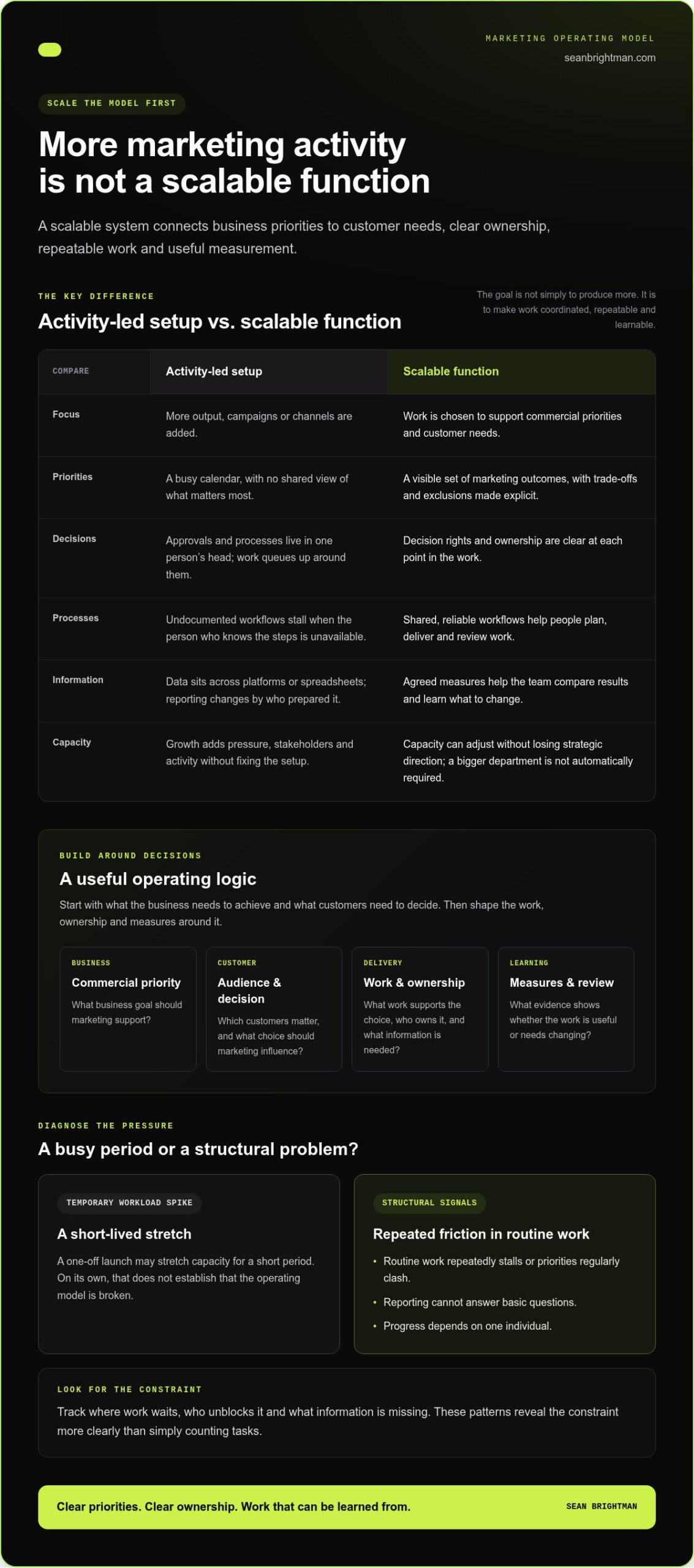
    Positioning is the place your business deliberately earns in a buyer’s mind. It’s based on who you serve, the problem you solve and why your approach is worth considering. It isn’t a slogan chosen in a workshop. It’s a strategic choice about the buyers you prioritise and the difference you can credibly defend.

    That distinction matters because positioning is often confused with the things people can see. A logo and colour palette belong to visual identity. A campaign line is messaging. A feature list describes what a product does. Each can express or support a position, but none defines it. The core principles of brand positioning centre on how buyers perceive an offer in relation to alternatives. In practice, that perception needs to be grounded in evidence, not just a clever claim.

    Positioning is the strategic choice of who you serve and why you’re meaningfully different; messaging is how you express that choice to buyers. Keep that distinction in view. It stops teams treating new copy as a substitute for hard decisions.

    Positioning strategy versus messaging: where is the difference?

    Positioning sits beneath the words. It clarifies the audience, the need you address and why a buyer might choose you over doing nothing or taking another route. Messaging translates those choices into language buyers can understand and remember.

    Imagine a hypothetical B2B software firm serving finance teams. “Make work simpler” could be polished copy, but it doesn’t say which finance teams matter, what friction the product addresses or what makes its approach distinct. If those choices are unclear, sharper headlines won’t fix the strategy. And if the difference has no evidence behind it, confident wording only makes the gap more obvious.

    What does a strong B2B position help a business decide?

    A useful b2b brand positioning framework turns strategy into decisions people can apply. It helps leaders choose which buyers to prioritise and which problems deserve attention. That focus can guide:

    • Offers: which services or product options best address the priority buyer’s problem.
    • Customer journey: what a buyer needs to understand, compare and trust at each stage.
    • Website structure: which pages, proof points and calls to action deserve prominence.
    • Sales conversations: which needs to explore and which claims the team can support.

    These decisions create useful trade-offs. A company that prioritises established firms with complex reporting needs may shape its offer and website differently from one targeting small teams seeking a quick, simple tool. Neither choice is automatically right. The point is to make the choice explicit, then align activity around it.

    Positioning is a guide, not a growth guarantee. It can make decisions more coherent, but it can’t promise demand, remove competitors or prove a claim on its own. Its practical value is a shared basis for marketing, sales and leadership to decide what to say, build and prioritise next.

    The five connected choices inside a B2B brand positioning framework

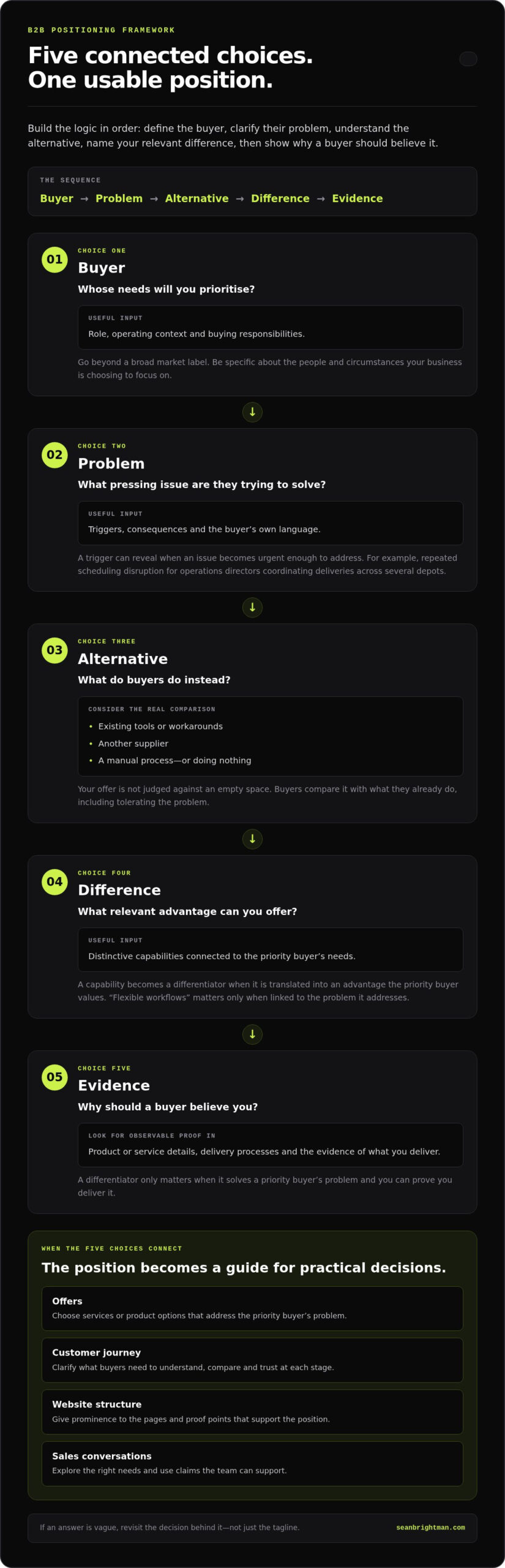
    A useful b2b brand positioning framework is a sequence of connected decisions, not five prompts answered in separate workshop rooms. Start with the buyer. Define their problem, the alternative they use, the difference you can offer and the evidence that makes that difference believable. Each answer sets the boundaries for the next.

    Use this table to build the logic in order. If an answer is vague, don’t paper over it with a sharper tagline. Revisit the decision behind it.

    Choice Key question Useful input
    Buyer Whose needs will we prioritise? Role, operating context and buying responsibilities
    Problem What pressing issue are they trying to solve? Triggers, consequences and buyer language
    Alternative What do they do instead? Existing tools, workarounds, competitors or inaction
    Difference What relevant advantage can we offer? Distinctive capabilities connected to buyer needs
    Evidence Why should a buyer believe us? Observable product, service or delivery proof

    Start with the buyer, problem and alternative

    “Mid-sized businesses” is a market description, not a usable buyer choice. Get specific about the role, context and problem. For example, a hypothetical logistics software provider might prioritise operations directors at firms coordinating deliveries across several depots. A trigger, such as repeated scheduling disruption, helps show when the issue becomes urgent enough to address.

    Then name the alternative honestly. Buyers might use spreadsheets, rely on a manual process, choose another supplier or tolerate the problem. Your offer isn’t judged against an empty space. It’s compared with what the buyer already does, including doing nothing.

    Make the difference credible with evidence

    A capability is something your organisation can do. A differentiator is that capability translated into an advantage a priority buyer values. “Flexible workflows” means little until you explain which buyer problem that flexibility addresses. A differentiator only matters when it solves a priority buyer’s problem and you can prove you deliver it.

    Look for evidence in product or service details, delivery processes and the experience buyers actually receive. Test the logic against buyer interviews, sales conversations and customer feedback. The Harvard Business School’s brand positioning framework also highlights the role of target audiences, competitive context and reasons to believe in shaping a positioning statement. Treat those reasons as a test, not decoration.

    Finally, read the five choices together. If the evidence doesn’t support the difference, revise the claim. If the alternative isn’t what buyers actually use, revisit the problem. For support turning these decisions into practical brand and marketing priorities, explore brand strategy support.

    B2B positioning objections: differentiation without narrowing too far

    “If we focus, won’t we lose customers?” It’s a fair concern, but focus doesn’t mean refusing every buyer outside a chosen segment. It means deciding who your position is built for first, based on where your offer fits and where you can support your value with evidence. Other buyers may still choose you. They simply don’t dictate every message, offer or priority.

    A useful b2b brand positioning framework helps you make that choice without pretending the market is smaller than it is. Treat your primary audience as a strategic priority, not a fence around the whole business. Compare the value of focus with the risk of over-narrowing:

    • Useful focus: gives marketing and sales a clear buyer, need and reason to lead with your offer. It makes decisions easier to test and refine.
    • Unnecessary narrowing: defines the audience so tightly that the position depends on a narrow label rather than a shared need, or excludes buyers who have the same problem and fit the offer.

    How focused should a B2B brand position be?

    Prioritise buyers whose needs match what you can deliver and demonstrate. Test that fit against actual buying conversations, customer feedback and the commercial realities of serving that audience. Can buyers recognise the problem? Does it matter enough to prompt action? Can your offer address it credibly? If the answers are weak, the focus may look neat on paper but be useless in practice.

    Keep the primary positioning audience distinct from every possible future customer. Your position should make today’s choices clearer, not forecast every market you might enter later. Focus can evolve as buyer needs, capabilities and evidence change.

    How to avoid claims that sound like every competitor

    “Best-in-class”, “innovative” and “customer-focused” aren’t differentiators by themselves. They’re claims. AI isn’t automatically distinctive either. Explain what a capability changes for a particular buyer, then point to observable evidence that supports the claim. A faster process, for instance, matters only if speed addresses a real buyer need and you can show how your delivery makes it possible.

    Compare alternatives using capabilities buyers care about, not insults or assumptions about competitors. Another supplier may solve the same problem differently; an internal workaround or inaction may be the real alternative. Strategic approaches to brand differentiation can help prompt options, but a strategy label doesn’t prove your position fits your buyers.

    Competitive maps can clarify perceptions when they use attributes buyers care about and reliable input from the market. They can show how buyers see options across dimensions such as specialist support or ease of adoption. But a neat chart can create false precision if the axes are chosen for convenience, the evidence is thin or the differences don’t affect buyer choices. Use the map to ask better questions, not to declare a winner.
    B2B Brand Positioning Framework: Build a Position That Sticks

    How to build, test and activate your B2B positioning framework

    A positioning framework earns its keep when it changes what the team does. Build it in stages. Each stage should leave you with a decision or working artefact, not just workshop notes. This process takes the five connected choices from discovery to buyer testing, then into the places where buyers meet your business.

    From buyer research to a testable positioning statement

    Collect evidence before polishing language. Bring together customer feedback, sales conversations and the knowledge of people who deliver the offer. Look for repeated buyer terms, triggers and objections. Internal opinions can point to useful questions, but they’re no substitute for buyer language.

    1. Set the audience and research question. Agree which buyer group you’re investigating and what you need to learn about its needs, alternatives and decision triggers. Artefact: a short research brief with the audience and questions to explore.
    2. Gather and sort the evidence. Review relevant buyer conversations and feedback alongside internal delivery knowledge. Separate observed facts from assumptions. Artefact: a findings summary showing recurring needs, alternatives and proof you can substantiate.
    3. Draft the positioning statement. Write a concise working statement that names the priority audience, its problem, the alternative and your credible difference. Treat it as a hypothesis, not finished copy. Artefact: one draft statement with supporting evidence for its central claim.
    4. Test it with target buyers. Ask buyers to explain what they think the offer is, who it’s for and what makes it distinct. Check whether they recognise the problem and whether the claimed difference matters. Avoid leading questions that invite polite agreement. Artefact: a test log capturing confusion, relevance and credibility.

    Put the position to work across the business

    Validation isn’t a vote on which phrase sounds nicest. Use what buyers understand, recognise and believe to refine the underlying choices. If buyers understand the offer but don’t value the difference, revisit the evidence or claim before rollout.

    1. Activate and assign ownership. Translate the position into homepage hierarchy, sales language, offer explanations and internal guidance. Give each customer-facing update a named owner and a clear next action. Artefact: an activation plan that records touchpoint, owner and status.

    To connect positioning decisions to ranked priorities and a practical action plan, use this strategic brand roadmapping guide. For repeatable execution across teams and touchpoints, the marketing operations growth engine guide explores how to build the operating rhythm around the work.

    Include a review point so the team can revisit buyer feedback, sales objections and changes to the offer. A b2b brand positioning framework should remain useful as the business learns, not become a statement no one is allowed to question. If you want strategic support turning positioning into action, explore brand strategy support.

    Make B2B brand positioning a working strategy, not a workshop document

    A positioning document is useful only if it changes decisions after the workshop ends. If leaders can’t agree which buyers matter, marketing and sales describe the offer differently, or agreed changes never reach the website and sales materials, the strategy is stuck. More copy won’t fix it. The team needs clearer choices, ownership and a route from strategy to action.

    A b2b brand positioning framework should guide decisions about positioning, messaging, offers, customer journeys and website strategy. Brand Strategist support can connect these parts, so the position shapes how the business communicates and what it prioritises. This is strategic direction focused on aligning choices and putting them to work.

    When is outside strategic direction useful?

    An external perspective can challenge assumptions that have become hard to question internally. It can help the team separate buyer evidence from familiar opinions, resolve conflicting descriptions of the offer and focus on what needs to happen next. The value is practical: clearer direction, priorities ranked by impact and accountability for moving decisions into action, without promising a particular commercial result.

    Look for a pattern, not one awkward meeting. If the same positioning debate keeps returning, teams are making different promises or activation has stalled because no one owns the next move, strategic support can bring the work back into focus. The aim isn’t another polished deck. It’s a shared basis for decisions people can act on.

    Choose a clear next step for your positioning work

    If the central choices need sharpening and the team needs a usable plan, Roadmapping is a focused next step. It’s a one-off strategy session that sharpens positioning and messaging, then ranks priorities by impact in a 90-day action roadmap. The roadmap is yours to run, giving the team a clear sequence rather than a vague instruction to “get aligned”.

    If positioning decisions need continued direction and accountability as the business acts on them, ongoing strategic leadership through Fractional CMO or Advisory CMO support may be a better fit. Choose the level of support around the work ahead: one focused roadmap, or ongoing guidance to keep decisions and priorities moving.

    For a practical way to connect positioning choices to ranked actions, use this strategic brand roadmapping guide. As the team turns strategy into repeatable activity, the marketing operations growth engine guide offers a useful perspective on execution.

    If your position needs to move from discussion into decisions your team can use, explore strategic support with Sean Brightman.

    Turn the position into your next business decision

    Your position shouldn’t sit outside the work. Use it to decide what to strengthen, what to stop saying and where the team should focus next. A b2b brand positioning framework becomes valuable when it helps people make those calls with confidence, even as the business changes.

    That takes more than a statement. Brand Strategist support connects positioning with messaging, offers, customer journeys and website strategy, so those choices carry through to how buyers experience the business. If the challenge is deciding what to act on first, Roadmapping sharpens positioning and messaging, then ranks priorities by impact in a 90-day action roadmap.

    You don’t need to solve every question at once. Start with the decision currently slowing the team down, then build from there. Explore strategic support with Sean Brightman and take the next step towards a position your team can put to work.

    Frequently Asked Questions

    Is B2B brand positioning the same as a value proposition?

    No. A value proposition explains the value a buyer can expect from a particular offer; positioning establishes the wider context that makes that value distinctive and relevant. For example, a data consultancy’s value proposition might focus on helping finance teams bring reporting data together. Its position would also clarify which finance teams it prioritises and how its approach stands apart from their other options. The value proposition supports the position, but doesn’t replace it.

    Can a B2B company have more than one brand position?

    It can tailor its emphasis for different audiences or offers, but several competing positions under one brand can confuse buyers and staff. Keep a clear central idea, then adapt examples, proof and language for distinct buying situations. A cybersecurity firm, for instance, might speak differently to a technical lead and a finance director whilst staying consistent about the problem it solves. Create separate positions only when the audiences or offers genuinely require different strategic choices.

    How do you test whether B2B positioning is clear to buyers?

    Show the draft to buyers who fit your intended audience, without explaining what you mean first. Ask them to describe the offer in their own words, say who they think it is for and identify what stands out. Then explore whether that distinction matters to their work and what evidence they would need to trust it. Note misunderstandings and recurring questions. If buyers interpret the offer differently from your team, revise the underlying choices before polishing the wording.

    Should a B2B positioning statement mention competitors?

    Usually, no. A statement should make the buyer, need and relevant difference clear without becoming a rival comparison or naming a competitor that may change. However, the thinking behind the statement should account for alternatives, including other suppliers, internal workarounds and doing nothing. Mention a competitor in outward-facing copy only if the comparison is accurate, useful to the buyer and supported by evidence. Otherwise, describe the distinction in terms of what your business does.

    How often should a business revisit its brand positioning?

    Revisit it when there’s a meaningful reason, not simply because a calendar reminder says so. Triggers might include a major change to the offer, a new audience, repeated buyer confusion or evidence that the claimed distinction no longer reflects delivery. Keep a record of the assumptions behind the position and review them against sales conversations and customer feedback. If those inputs still support the choices, maintain the direction and refine execution rather than starting over.

    What is the difference between B2B positioning and a positioning map?

    B2B positioning is the strategic choice a business makes about the place it wants to earn with priority buyers. A positioning map is a visual tool that plots perceived options against selected attributes, such as specialist depth and ease of implementation. The map can help a team explore buyer perceptions, but it isn’t the strategy itself. Its value depends on using attributes buyers care about and evidence that reflects their views, rather than assumptions.

  • UK Go-to-market Consultant: Build a route to growth

    UK Go-to-market Consultant: Build a route to growth

    A strong offer can still stall if nobody agrees who it’s for, why customers should choose it or how it will reach them. A go-to-market strategy consultant UK businesses work with should connect those decisions and give the team a route to follow, not just another launch checklist.

    The frustration is familiar: marketing, sales and leadership are all moving, but not necessarily towards the same customer or outcome. The execution gap is real. In a 2026 HBR Analytic Services study, 83% of B2B leaders called go-to-market strategy critical to business success, yet only 38% described their execution as very effective.

    You need more than a polished strategy document. You need clear choices your team can act on. This article explains what a go-to-market strategy should connect, how to assess strategic support and how to turn decisions into practical next steps.

    We’ll look at how to prioritise customers and market opportunity, align positioning with routes to market, and give teams clear ownership. You’ll also see how Sean Brightman’s Roadmapping turns strategic decisions into a ranked 90-day action plan, and how ongoing CMO support can keep execution on track.

    Key Takeaways

    • A go-to-market strategy connects the customer, market opportunity, positioning, offer, route to market and team ownership.
    • Use customer needs and market context to shape a value proposition people understand, rather than leaving research in a separate document.
    • When assessing a go-to-market strategy consultant uk businesses can work with, look for clear decisions, accountable ownership and practical next steps.
    • Separate strategic choices from the tasks, channels and campaigns that put them into action.
    • Match the support to the job: a focused strategy session, ongoing advice or embedded senior marketing leadership.

    What does a UK go-to-market strategy consultant do?

    A go-to-market strategy connects an offer to the customers most likely to value it, then sets out how the business will reach, convert and serve them. A consultant helps clarify those choices, test the assumptions behind them and turn the direction into work people own.

    That’s broader than choosing a launch date or listing marketing channels. A campaign is an activity. A channel is a route. A go-to-market strategy explains why the business is prioritising particular customers, what it will offer them, how it will stand apart and how the team will deliver the plan.

    The links between those decisions matter. If an offer is positioned around speed, for example, the route to market and customer experience need to support that promise. If they don’t, the strategy can expose the mismatch before the business spends time pushing the wrong message through the wrong channel.

    Which business problems can go-to-market consulting address?

    The symptoms vary. Customer priorities may be unclear, positioning may have become diluted, or marketing and sales may be describing the offer differently. A business can be busy with content, campaigns and sales conversations yet lack a shared route from offer to customer. The first step is to identify whether unclear decisions are holding progress back.

    A consultant can surface the assumptions beneath the activity. Which customer group has the strongest need? What problem does the offer solve for them? What evidence supports that choice? The answers help leaders decide what to focus on, what to stop prioritising and where teams need a consistent message.

    For a business searching for a go-to-market strategy consultant uk companies can work with, useful support should result in decisions and ownership, not just a deck of recommendations. The aim is a route that’s clear and usable by the people responsible for putting it into practice.

    Is a go-to-market strategy only for launching a new product?

    No. The same thinking can help when a business introduces a new offer, repositions an existing one or changes how it reaches customers. The work depends on the challenge. A new offer may need clear customer and channel choices; repositioning may call for a sharper value proposition and consistent messaging across the customer journey.

    Start with the decision the business needs to make, not a fixed launch checklist. Is the audience changing? Has the offer evolved? Is the current route failing to connect with intended customers? Those questions help define the work and keep it focused. For a deeper look at aligning brand direction with growth priorities, explore this strategic brand roadmapping guide.

    Whatever the trigger, the consultant’s job is to connect strategic choices to practical ownership. That means making clear what the business is choosing, why it’s choosing it and what the team needs to do next. Not more activity for its own sake, but a route people can follow.

    The go-to-market decisions that must work together

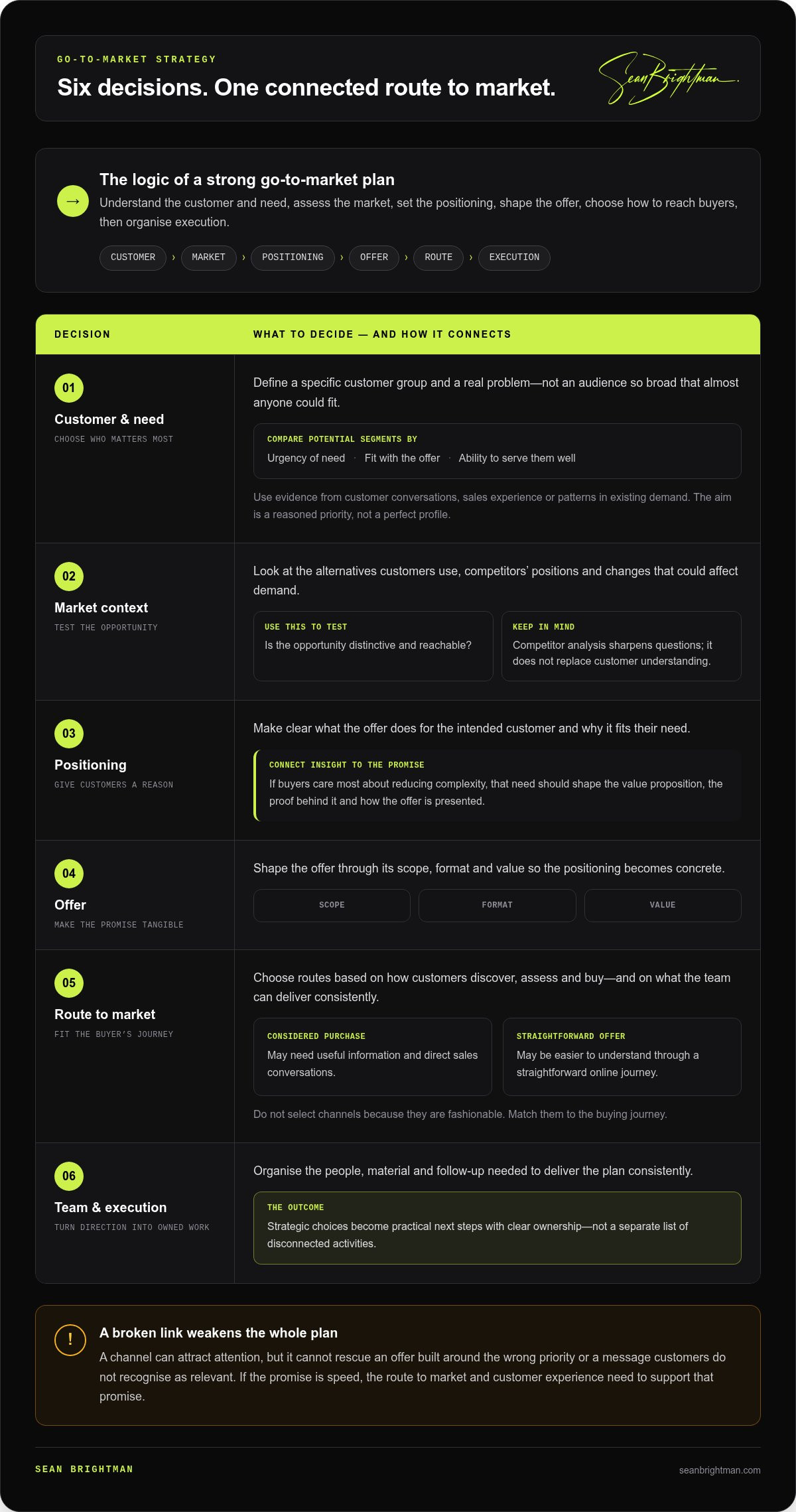
    Go-to-market planning isn’t a pile of separate choices. Each decision should sharpen the next: understand the customer and their need, assess the market, set the positioning, shape the offer, choose how to reach buyers, then organise execution.

    A go-to-market strategy works when every choice reinforces the next, from the customer’s need to the team’s delivery. If one link breaks, the rest lose force. A channel can attract attention, but it won’t rescue an offer built around the wrong priority or a message customers don’t recognise as relevant.

    How should a business define its target customer and market?

    Start with a specific customer group and a real problem, not an audience so broad that almost anyone could fit. Compare potential segments by the urgency of their need, their fit with the offer and the business’s ability to serve them well. Evidence might come from customer conversations, sales experience or patterns in existing demand. The aim is a reasoned priority, not a perfect profile.

    Then add market context. Look at the alternatives customers use, competitors’ positions and changes that could affect demand. This helps test whether the opportunity is distinctive and reachable. Competitor analysis can’t tell you what customers value in your offer, though. Use it to sharpen questions, not replace customer understanding.

    Customer insight should shape the value proposition itself. If buyers care most about reducing complexity, that need should influence the promise, the proof that supports it and the way the offer is presented. Research belongs in the decision, not in a separate document that nobody uses.

    How do positioning, offer and channels connect?

    Positioning gives the intended customer a clear reason to pay attention: what the offer does for them and why it fits their need. The offer makes that promise concrete through its scope, format and value. If the positioning promises simplicity but the buying process feels complicated, the experience contradicts the message.

    Choose routes to market by looking at how customers discover, assess and buy, alongside what your team can deliver consistently. A considered purchase may need useful information and direct sales conversations; another offer may be easier to understand through a straightforward online journey. Don’t select channels because they’re fashionable. Match them to the buying journey, then make sure the right people, material and follow-up are in place.

    For a go-to-market strategy consultant uk businesses engage, the test is whether these choices form one usable system, rather than disconnected recommendations. The marketing operations growth-engine guide explores how execution systems support that joined-up direction.

    When customer insight, positioning and delivery need to be aligned, Sean Brightman’s strategic support can help turn those choices into a practical direction for the team.

    How to assess a UK go-to-market strategy consultant

    Start with the gap, not the job title. Do you need a focused set of strategic decisions, a sounding board to keep priorities on track, or senior marketing leadership working alongside your team? The right support depends on what’s missing. A go-to-market strategy consultant uk businesses engage should make the work, decisions and ownership clear before activity begins.

    What should a useful GTM strategy deliver?

    Look for a clear customer focus, positioning choices, route-to-market logic and a short list of priorities. Recommendations should help leadership decide where to focus and give marketing and sales a direction they can act on. A long document isn’t proof of quality. Neither is a channel inventory. Ask whether the work explains why a choice makes sense and what the team should do with it.

    Useful support also makes ownership visible. Who will lead each priority? What needs a decision from leadership, and what can the team execute? A strategy that stops at recommendations leaves the hard work of translation to your people. The output should connect direction to practical next steps, while making clear who is responsible for carrying them out.

    Consultant, agency or internal team: which role fits the gap?

    A consultant brings strategic direction and helps resolve questions of alignment, positioning and priority. An agency service is generally focused on delivering agreed marketing activity; an internal team carries out work within the business. These roles can complement one another, but they solve different problems. More campaign activity won’t fix a leadership gap or a lack of agreement about who the business needs to reach.

    Use this simple comparison to identify the type of support that fits your current need:

    Business need Type of support Typical output Involvement
    Decisions are unclear, but the team can execute once aligned Defined strategy session Priorities and an actionable direction Focused, one-off input
    The team needs regular challenge and accountability Ongoing advice Reviewed priorities and continued guidance Regular strategic involvement
    Leadership, team direction and marketing activity need to work together Embedded senior marketing leadership Strategy connected to team direction and execution Ongoing involvement within the business

    Match the scope to the real bottleneck. If the team knows what to do but lacks capacity, strategic advice alone won’t provide that capacity. If people are active but pulling in different directions, adding more production may simply create more disconnected activity. A distinct Fractional CMO strategy guide explains how ongoing senior marketing leadership differs from a defined strategy engagement.

    Sean Brightman’s Roadmapping provides a focused strategy session with a 90-day action roadmap and priorities ranked by impact. For teams that need continuing direction and accountability, Sean Brightman’s strategic support provides ongoing strategic involvement.

    UK Go-to-market Consultant: Build a route to growth

    Turn go-to-market strategy into a practical, accountable plan

    A strategy only earns its keep when it changes what the business decides and does. Turn the direction into a plan that separates the choices to make from the work that follows, then give each priority a clear owner. Otherwise, even a sharp strategy can dissolve into a list of activity nobody is responsible for delivering.

    Use this sequence to move from the commercial problem to coordinated action:

    1. Agree the commercial problem. State what needs to change, such as reaching a more suitable customer group or making the value of an offer clearer. Keep the problem specific enough to guide decisions.
    2. Prioritise customers. Choose which group to focus on using evidence about their needs, fit with the offer and your ability to serve them. Record the assumptions behind that choice.
    3. Sharpen the offer. Make clear what you’re offering, what customer need it addresses and why it’s relevant to the chosen group.
    4. Choose the route. Select routes to market that fit how those customers find, assess and buy, as well as the team’s ability to deliver the experience.
    5. Assign ownership. Name who will lead each decision and follow through on the work. Make dependencies visible so one team’s activity supports the next step, rather than running in isolation.

    An actionable go-to-market plan is a set of connected decisions with owners, not an unowned list of tactics.

    How do you prioritise go-to-market actions?

    Rank proposed actions by how directly they support the chosen customer, offer and route to market. A sales message, for instance, should reflect the positioning; the channel should give that message a credible way to reach buyers. If an action can’t be tied to one of those choices, challenge its place in the plan.

    Map dependencies before work starts. If sales needs clearer offer language before using new materials, agree the language first. If a channel requires a customer journey the team can’t yet support, address that gap before adding more activity. This keeps execution connected without imposing arbitrary deadlines or promising a particular result.

    How can leadership keep teams aligned after the strategy is set?

    Alignment needs active ownership, not a launch meeting followed by silence. Leadership should own the major choices; marketing and sales should know who is responsible for turning them into coordinated work. Set regular review points to compare the plan with relevant business evidence, hear what teams are learning and revisit assumptions that no longer hold.

    Use those reviews to make decisions: keep a priority, refine it or stop it. That’s more useful than reporting activity without agreeing what it means. If the business needs continuing strategic direction and accountability, an ongoing marketing advisory retainer provides a structure for regular review and priority setting.

    For help turning go-to-market choices into owned next steps, explore Sean Brightman’s Roadmapping support.

    How Sean Brightman can support your go-to-market direction

    Sean Brightman’s work connects the decisions that shape a go-to-market direction: positioning, messaging, offers, customer journeys and marketing leadership. The right level of support depends on the gap. You might need a focused session to settle priorities, regular strategic input to keep a team aligned, or embedded leadership that connects strategy with delivery.

    For businesses considering a go-to-market strategy consultant uk, the useful question is not simply what advice you’ll receive. It’s what decisions the work will clarify, what the team can act on and how much ongoing direction the business needs.

    When is Roadmapping the right starting point?

    Roadmapping suits leaders who need sharper positioning, clearer priorities and a practical plan, without committing to ongoing leadership. It’s a one-off strategy session that includes sharpened positioning and messaging, priorities ranked by impact, and a 90-day action roadmap. The roadmap is yours to run, with or without Sean.

    The one-off price is £2,997 – £4,997. The value is in getting the key choices out of discussion and into a ranked plan the team can use. That gives leaders a clear basis for deciding what to act on, what to defer and where more support may be useful.

    When might ongoing marketing leadership make more sense?

    If the team needs a recurring strategic sounding board, Advisory CMO includes monthly strategy and review sessions, priority setting, async access and accountability. It gives leaders a structure for reviewing decisions and keeping priorities visible as the work progresses. The price is £1,200 / month.

    Where the business needs more embedded senior direction, Fractional CMO engagements cover strategy, team direction, campaign planning, agency management and growth-system design. Engagement levels range from ½ day to 8 days per month, at £700 – £8,400 / month. This is a different level of involvement from a one-off roadmap or advisory support.

    Each option addresses a different need: a defined plan, continued advice or leadership integrated with the team. Sean’s role is to connect go-to-market choices to practical marketing direction, with the scope shaped around the business challenge rather than a generic checklist.

    If you’re weighing up the right starting point, discuss your go-to-market challenge with Sean. Bring the decision that’s stuck, the customers you’re trying to reach and the gap you need to solve. From there, you can explore which level of strategic support fits.

    Make your next growth decision count

    Your next move doesn’t need to be another campaign. Start with the decision that would make the biggest difference if it were clearer: which customer to pursue, how to explain the offer, or what the team needs to own. A go-to-market strategy consultant uk businesses work with should help turn that uncertainty into a useful conversation and a direction your people can act on.

    Sean Brightman’s work is reflected in testimonials from Matthew Harvey of Cowen Landscapes, Bianca Grassi of Gen Digital, and Viv Groskop, Author & Podcaster. The right support starts with your challenge, not a pre-set answer. Bring the assumption you want to test or the decision your team can’t settle, and use that as the starting point for deciding what comes next.

    Talk through your go-to-market challenge with Sean. You don’t need every answer before you start. A clearer next decision is a strong place to begin.

    Frequently Asked Questions

    What does a go-to-market strategy consultant do?

    A go-to-market strategy consultant uk businesses engage helps leaders resolve commercial choices that teams can’t settle alone. For example, if sales hears prospects repeatedly misunderstand a service, a consultant can help determine whether the issue sits with the audience, offer or explanation. They can also challenge assumptions before they become costly commitments. Start with the decision to make, then define what input and output will help move it forward.

    When should a business hire a go-to-market strategy consultant?

    Consider strategic support when an unresolved commercial decision is slowing progress or creating friction between teams. You might have several customer groups competing for attention, or sales may be adapting the offer differently in each conversation. Write down what’s uncertain and what evidence you already have. That gives the work a clear starting point and helps identify whether strategic input, additional delivery capacity or stronger internal ownership is the real need.

    Is a go-to-market strategy consultant the same as a marketing agency?

    No. A consultant’s central role is to bring strategic judgement to decisions and priorities; an agency may be engaged to deliver agreed work, such as a campaign or channel activity. The distinction matters if your team is already producing plenty but lacks agreement on what to prioritise. In that case, more production may add noise. If direction is settled but delivery capacity is limited, execution support may be the more relevant gap.

    What should a go-to-market strategy include?

    It should show how the business will connect a customer need to a relevant offer and a workable way to reach buyers. In practice, that means explaining the reasoning behind choices, not just naming a target audience or listing channels. For example, a plan should make clear why a particular customer group matters and how the offer answers its need. It should also identify where teams may need to adjust if new evidence challenges an assumption.

    How do you know whether a go-to-market strategy is working?

    Look for evidence that the plan is changing decisions and improving coordination, not simply generating activity. Check whether sales conversations reflect the agreed offer, whether marketing priorities still fit the chosen customer and whether teams can explain their responsibilities. Then review relevant business evidence against the goals leadership set. If the evidence points to a mismatch, investigate and adapt rather than assuming a particular outcome was guaranteed.

    Can a go-to-market consultant help with an existing product, not just a launch?

    Yes. An existing offer may need a focused adjustment rather than a full relaunch. For instance, customer feedback might show that buyers value a different part of the service than the business currently emphasises. A consultant can help assess what that means for messaging, customer priorities or the buying journey. Keep the work centred on the specific issue, so the business doesn’t reopen decisions that remain sound.

  • Compare marketing automation platforms by features

    Compare marketing automation platforms by features

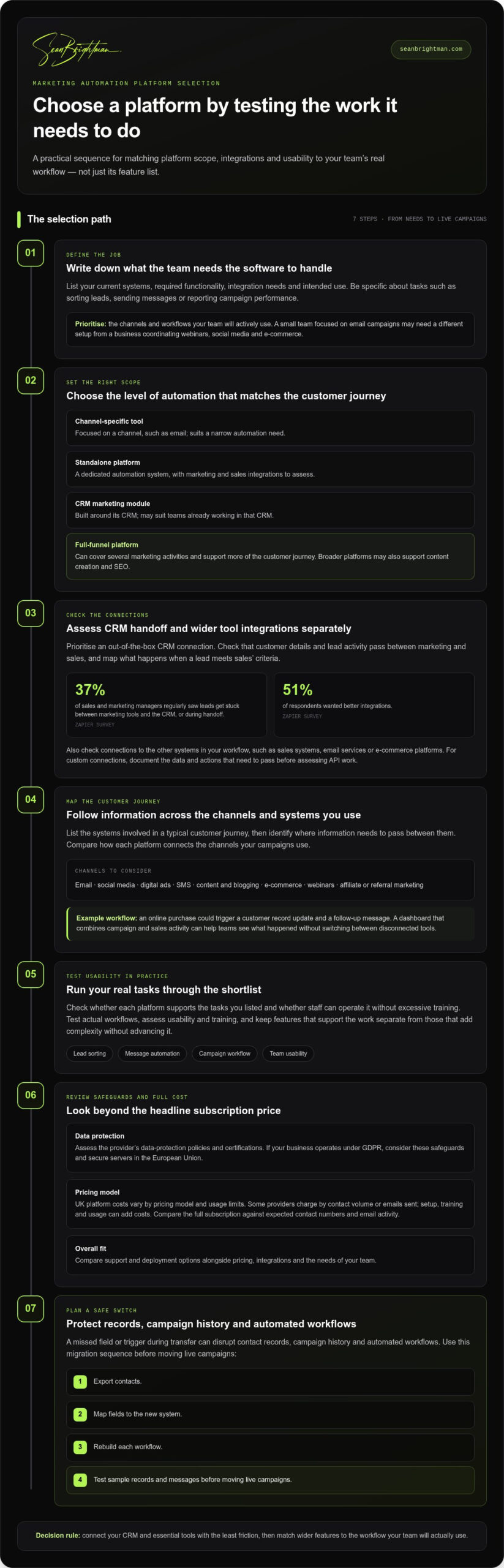
    The platform with the longest feature list isn’t automatically the best fit. To work out how to choose a marketing automation platform, start with the job it needs to do: assess funnel coverage, customer profiles, email and SMS tools, and connections to your existing systems. Choose one that supports your workflow without adding complexity you won’t use.

    It’s easy to focus on campaign features and overlook what happens behind the scenes. Automation only helps when customer information moves cleanly between marketing and sales, and people still need to guide leads towards a decision.

    This comparison explains what marketing automation tools do and how their capabilities differ, from channel-specific tools to full-funnel platforms. It covers integrations, data consolidation, email and SMS automation, usability and room to grow, helping you compare options against real needs rather than a flashy feature list.

    Key Takeaways

    • Match the platform’s scope to the work you need done, from channel-specific campaigns to full-funnel automation.
    • Prioritise a clean CRM connection so customer information and leads can move between marketing and sales.
    • Compare how each option brings customer data together to support useful, joined-up profiles.
    • Look beyond email and SMS sending: assess how each platform handles workflows, integrations and future growth.
    • Use your team’s needs and intended use to narrow the shortlist, not the size of a platform’s feature list.

    What are marketing automation tools?

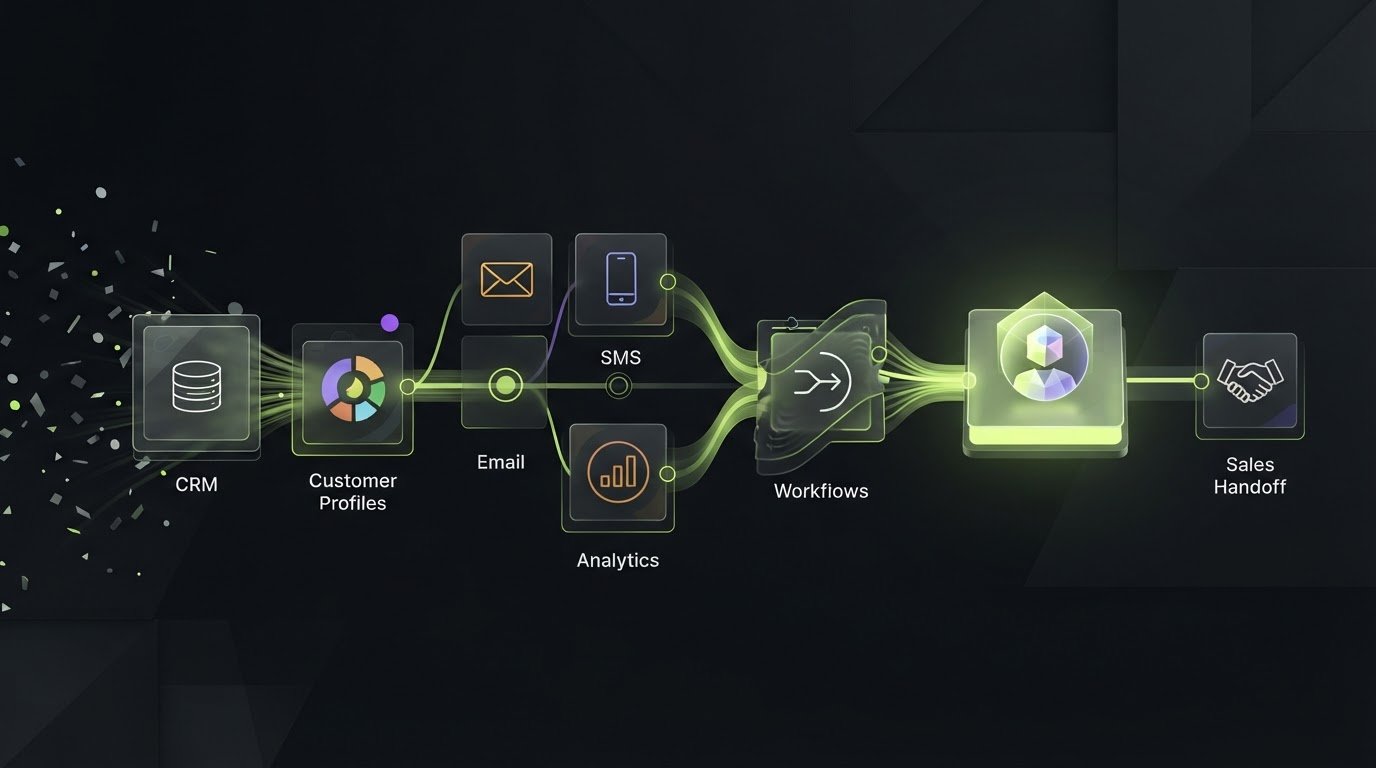
    Marketing automation tools run repeatable campaigns, messages and lead-nurture steps. They range from standalone platforms to marketing modules within CRM systems. Compare how each connects your tools and moves leads towards sales.

    CRM integration and sales alignment

    A CRM integration passes lead activity and customer details between marketing and sales, helping both teams work from shared information. A Zapier survey found that 37% of sales and marketing managers regularly saw leads get stuck between marketing tools and the CRM, or during the handoff. Prioritise an out-of-the-box connection with your CRM, then map what happens when a lead meets your sales team’s criteria.

    Marketing automation can improve coordination, but it doesn’t replace people nurturing leads or converting them. A salesperson needs to see which campaign prompted a response, while marketing needs a clear signal when sales takes over. Compare the quality of this handoff, not just whether CRM integration appears on a feature list.

    Marketing and sales tool integrations

    Broader integrations connect campaigns with the tools your teams already use, such as sales systems, email services or e-commerce platforms. This differs from CRM alignment: the CRM connection supports the lead handoff, whilst other integrations let campaign data and actions move across the wider workflow. In a Zapier survey, 51% of respondents wanted better integrations.

    List the systems involved in a typical customer journey, then identify where information needs to pass between them. An online purchase, for example, could trigger a customer record update and a follow-up message. A dashboard combining campaign and sales activity can help teams see what happened without switching between disconnected tools.

    Option CRM integration Connected tools Best fit
    Standalone platform Often central to evaluation Marketing and sales integrations Teams needing a dedicated automation system
    CRM marketing module Built around its CRM Often tied to the CRM ecosystem Teams already working in that CRM
    Channel-specific tool Connection needs assessing Focused on a channel, such as email Teams with a narrow automation need
    Full-funnel platform Supports broader coordination Can cover several marketing activities Teams managing more of the customer journey

    Choose the option that connects your CRM and essential tools with the least friction, then match its wider features to your workflow.

    UK platform costs vary by pricing model and usage limits. Some providers charge by contact volume or emails sent, while setup, training and usage can add costs. Compare the full subscription against expected contact numbers and email activity, not just the headline rate.

    Switching can disrupt contact records, campaign history and automated workflows if a field or trigger is missed during transfer. Export contacts, map fields to the new system, rebuild each workflow, then test sample records and messages before moving live campaigns.

    For connections beyond standard integrations, assess API access. An API can let your organisation link the platform with another app later. Before comparing custom integration work, document the data and actions that need to pass between systems.

    Marketing automation features

    Compare what each platform automates, which channels it covers, and how its features support your customer journey. Software your team can use in its actual workflow matters more than a long feature list.

    Automation across marketing channels

    Channel-specific tools focus on tasks such as creating and sending marketing emails. Middle- or bottom-funnel platforms focus on capturing leads and sending messages, while full-funnel platforms may also support content creation and SEO to build interest. The key difference is scope: a platform may serve one channel or connect activity across the journey.

    Map the channels your campaigns use, then compare how each marketing automation tool links them. Automation may span email, social media, digital ads, SMS, content, blogging, e-commerce, webinars and affiliate or referral marketing. An e-commerce workflow, for example, might connect an online interaction with a follow-up message. Prioritise channels your team will actively use.

    Features matched to business needs

    Match features to your existing systems, required functionality, integration needs and intended use. A small team focused on email campaigns may need a different setup from a business coordinating webinars, social media and e-commerce. Compare platforms against those tasks instead of treating every available feature as essential.

    Write down the tasks you want software to handle, such as sorting leads, sending messages or reporting campaign performance. Check whether the platform supports them and whether staff can operate it without excessive training. This practical test separates useful functionality from features that add complexity without advancing your workflow.

    For a small business in the UK, prioritise essential channels, manageable workflows and features suited to the team’s intended use. A focused tool may fit narrower needs, while broader platforms offer more funnel coverage and room to scale.

    Assess the provider’s data-protection policies and certifications, and consider secure servers in the European Union. Businesses operating under GDPR should review these safeguards when comparing platforms.

    Shortlist platforms by documenting your current systems, required features, integration needs and intended use. Test the shortlist against real workflows, assess usability and training, then compare support, deployment options and pricing before choosing.

    Finally, test how reporting connects activity to outcomes. Campaign reporting can help teams assess performance, while A/B testing compares two options to identify which better suits the audience. Check whether the platform can scale as users, communications and business activity grow. A feature that works for one campaign should also fit the wider operation.

    Customer data consolidation and 360-degree profiles

    A useful 360-degree profile brings sales and marketing information together, giving teams a clearer view of customer activity. In 2026, the best platform for your business is the one that unifies the data you use and supports the work your teams need to do.

    Unified sales and marketing data

    Look for a platform that brings customer details and interactions from sales and marketing together. A profile might combine email engagement, campaign responses and sales notes, giving teams a view across channels. What matters is how clearly the platform connects those records, not simply how many fields it can store.

    Test a practical journey: a prospect opens an email, visits a product page and speaks with sales. Check whether the profile connects those interactions and gives each team relevant context. For a commerce business, viewing purchase activity alongside marketing engagement can help teams understand how a customer reached a decision.

    Compare analytics and profile tools by asking what teams can do with the unified view. Can marketers segment audiences by engagement? Can sales see which emails or campaigns are relevant to a conversation? A platform that consolidates data but leaves teams unable to act on it offers storage, not a useful customer view.

    Platform support

    Customer support helps teams resolve platform issues and learn its features. Compare available channels, such as telephone, email and support tickets, and find out whether experts can help with technical problems. Support won’t build a customer profile, but it can help staff use the platform and troubleshoot a broken workflow.

    Training matters too. Check whether corporate training comes with the subscription or can be added, and consider how much guidance staff need to manage segments, emails and analytics. A platform with extensive features may require more learning than a focused tool. Match the support model to your team’s experience and planned work.

    Customer reviews and testimonials can offer evidence about how a platform performs in practice. Look for feedback relevant to your team’s size, use case and required integrations. A review about email campaigns may reveal little about consolidating sales and commerce data, so assess feedback against your specific requirements.

    Look for recurring details in reviews, not isolated praise or criticism. Repeated reports of confusing analytics or slow support, for example, may flag issues relevant to your evaluation. Balance reviews with product demonstrations and a trial using sample records. Check how the platform handles duplicate contacts, missing fields and changes to customer details.

    Use the same comparison for every shortlisted platform: profile completeness, data sources, analytics, support channels, training and customer feedback. Ask staff from sales and marketing to assess the same sample journey, then record where each platform gives them useful context. This makes differences visible without mistaking a polished dashboard for a complete customer view.

    Choose the platform that turns connected customer information into useful context for both teams, with support and training suited to the work ahead.

    Compare marketing automation platforms by features

    Email and SMS automation

    Email automation can create and send marketing emails, while SMS adds another channel to the customer journey. Compare what each platform can coordinate instead of treating message volume as the whole job.

    Deliverability and spam risks

    Deliverability is whether an email reaches its intended inbox. Unsolicited emails may be treated as spam, damaging the sending IP address’s reputation and future deliverability. Audience selection and message relevance are therefore operational requirements, not optional refinements. Check how a platform handles contact permissions, audience segments and suppression lists before building automated sends.

    Test a real workflow before launch. Preview a purchase follow-up, for example, confirm the intended audience and inspect the message on different devices. Templates can speed up campaign creation, but still need accurate content and a relevant recipient list. Review sending and engagement reports after a campaign, then adjust the workflow if results show a mismatch.

    Consent requirements

    UK GDPR and PECR affect how businesses manage personal data and electronic marketing. Build automation around clear records of contact permissions and preferences, and ensure workflows respect changes such as an opt-out. This is separate from deliverability: an email reaching an inbox doesn’t establish that the recipient should receive it.

    Before activating a sequence, map where contact details came from, which preferences apply, and how suppression updates reach each channel. Keep those records connected to the relevant contact so a later email or SMS doesn’t ignore a changed preference. The platform should support your processes; automation doesn’t replace them.

    Email-only platforms focus on creating and sending email campaigns. Multichannel tools can coordinate activity across email and SMS, with broader options potentially including social media, digital advertising and e-commerce. Compare these features against your actual customer journey. A small team may need dependable email templates, while an enterprise operation may need to coordinate messages across several teams and channels.

    For SMS, assess whether the platform supports your intended workflows and connects message activity to customer records. If WhatsApp matters to your strategy, assess it as a separate capability rather than assuming an email-and-SMS tool includes it. Map a service update or purchase follow-up, for example, and identify which channel should carry each message.

    Use a practical comparison before choosing:

    • Channel coverage: Match email, SMS and any required WhatsApp activity to your planned campaigns.
    • Workflow control: Trace how a contact enters, progresses through and exits an automated sequence.
    • Templates: Assess whether staff can adapt templates to the message and audience.
    • Reporting: Check whether engagement data helps you improve later campaigns.

    Choose email-only automation for a focused email requirement. Choose multichannel functionality when your customer journey genuinely needs coordinated messages across channels.

    Marketing automation platform capabilities

    Capabilities determine whether marketing automation software fits your operating model, not just your campaign plans. Compare workflow control, reporting, API access, scalability and pricing against the work your team needs to run.

    A practical answer to how to choose a marketing automation platform starts with the tasks that need coordination. A campaign workflow might segment contacts, send a message and record engagement for later analysis. Check whether staff can adjust each step or whether routine changes require technical help. Advanced controls add value only when your team can use them.

    Reporting should help you assess campaign performance and make decisions. Check which activity the platform tracks, how it presents results, and whether teams can use the insights to refine segmentation. A/B testing can compare two options, such as different messages, to identify which better suits the audience.

    Test those capabilities with a realistic workflow before choosing. Build a campaign for a defined audience, compare two message versions, then review the reporting. This can reveal practical limits in configuration and analysis that a feature checklist misses.

    API access is another capability worth assessing. It may let you link the platform with another app in the future, even if that connection isn’t part of your current setup. Identify the apps and data your organisation may need to connect, then assess whether the platform’s API supports that direction.

    Scalability means the platform can handle growth in users, communications and business activity. Consider whether its features can support additional users, more complex workflows and changing campaign demands. A platform built around today’s narrow requirements may become a constraint if the organisation expands its channels or operating needs.

    Pricing depends on how the provider charges and what the subscription includes. Some charge by contact numbers or emails sent; others may add setup, training or usage fees. Compare the full cost structure with expected usage, and check whether introductory rates change after the initial period.

    • Workflow control: Can the team build and adjust the automation it needs?
    • Reporting: Does the output support decisions about campaigns and audiences?
    • API access: Can the platform link with another app as requirements change?
    • Scalability: Can the features keep pace with greater activity?
    • Pricing: Which usage limits and additional charges affect the subscription?

    If you’re deciding how to choose a marketing automation platform, score each shortlisted option against these criteria using the same test workflow. Record where staff need training, where reporting falls short, and which costs change with usage. This turns a broad feature comparison into a practical decision based on your requirements.

    If you need to turn platform requirements into a clear implementation roadmap, map your automation priorities.

    Sean Brightman: AI Consulting

    Sean Brightman’s AI Consulting can help assess where practical AI systems belong in your marketing operations and where they don’t. Turn to it when platform options are clear but AI priorities or next steps still aren’t.

    Roadmapping can organise those decisions into a practical sequence, connecting your objectives with the capabilities and workflows you need to build. An Advisory Retainer provides ongoing strategic input as your plans develop. The focus is informed choices, not adding technology for its own sake.

    If you’re weighing AI opportunities alongside your platform decision, visit seanbrightman.com to explore the next step.

    Make your next move count

    Turn your shortlist into a decision your team can act on. Agree what success should look like, who owns each workflow, and which trade-offs matter most. Then set a review point to assess whether the platform supports your marketing operation as it develops.

    That’s the practical test behind how to choose a marketing automation platform: choose with a clear operating plan, not feature envy. If the decision also raises questions about marketing leadership, AI use or priorities, match the support to the problem. Sean Brightman offers Fractional CMO support, AI Consulting and Roadmapping for these distinct needs.

    Bring the decision, the constraints and the next move into focus. Contact Sean Brightman to discuss what your organisation needs next.

    A considered choice gives your team a stronger base to build on. Take the next step with clarity and keep moving.

    Frequently Asked Questions

    Customer support: Are there real experts ready to help, or does support feel like a lottery?

    Reliable support means access to people who can diagnose platform issues, not just a library of help articles. Compare available channels, such as telephone, email and support tickets, and find out how technical issues reach a specialist. During evaluation, describe a realistic problem, such as a failed contact sync, and assess whether the response gives you a clear next step. Compare training options for the staff who’ll own the system too.

    What features should a marketing automation platform include?

    Choose features around the work you need to run. Core capabilities may include campaign workflows, audience segmentation, email automation, reporting and CRM connections. Add SMS, e-commerce triggers, A/B testing or API access where they solve a defined need. For example, a subscription business might prioritise renewal reminders and clear campaign reporting, while a small team focused on email may value straightforward templates and simple audience controls over advanced functions.

    How do you assess integrations with a CRM, e-commerce platform, and analytics tools?

    Trace a sample customer journey across your systems. Follow a test purchase from your e-commerce platform into the customer record, then see whether campaign activity and analytics reflect that event. Look for duplicate records, missing fields or delays in the information appearing. Repeat the exercise with a lead passed from marketing to sales. This practical test shows whether integrations support the decisions and tasks your teams rely on.

    How easy is each platform to use, and what onboarding and customer support are available?

    Ask the people who’ll operate the system to complete a familiar task, such as editing an email template or changing a workflow step. Note where they need help, then compare onboarding materials, training and support channels. A clear interface matters, as does the effort required to teach new staff. Include time for learning and administration in your comparison, alongside the platform’s features and subscription terms.

    How much do marketing automation platforms cost in the UK, including contact and email limits?

    UK costs vary by provider and usage. Some charge by contact volume or emails sent, while setup, training or usage fees may add to the subscription. Compare the full cost with expected contact numbers and email activity, not just the headline rate.

  • Building a Data-Driven Marketing Culture: A Practical Guide

    Building a Data-Driven Marketing Culture: A Practical Guide

    Your dashboard isn’t a marketing culture. It’s a screen full of numbers until the team uses them to make better decisions. Building a data-driven marketing culture means turning reports into shared habits: what to measure, who owns it and what to do next.

    If your team debates which metrics matter, or leaders worry that data will overrule experience, the problem isn’t a lack of charts. It’s a lack of agreement on how evidence and judgement work together. Data should sharpen good marketing decisions, not replace them or reduce success to short-term results.

    This practical guide will help you choose useful measures, assign clear accountability and build a repeatable rhythm for deciding, acting and learning. You’ll see how to turn results into the next move, keep teams aligned and make better-informed growth choices without losing sight of long-term value. The aim isn’t more reporting. It’s decisions your team can explain, own and improve.

    Key Takeaways

    • Start with a real marketing decision, then gather only the evidence that can help you make it.
    • Separate business outcomes, customer behaviour and activity measures so you don’t treat every metric as equally useful.
    • Make building a data-driven marketing culture practical by agreeing who owns each measure, what it means and how decisions are recorded.
    • Review what happened after each action, then use the learning to shape the next decision.
    • Senior marketing leadership can keep priorities and accountability aligned without taking over every analysis or replacing professional judgement.

    What building a data-driven marketing culture actually means

    A marketing report can tell you how many people clicked, watched or enquired, yet leave the team unsure what to change next. That’s the gap between collecting information and using it to steer the work.

    A data-driven marketing culture is a shared way of using relevant evidence to make, explain and learn from marketing decisions. It’s an operating behaviour, not a software purchase. An analytics platform or polished dashboard can make information easier to access, but neither creates agreement about what matters, who interprets it or what action follows.

    That behaviour sits within data-driven marketing within digital marketing, but it isn’t confined to digital channels or the people who manage analytics. It depends on teams using evidence consistently to make the choices already in front of them.

    How data-informed marketing decisions differ from reporting

    A report describes what happened. A decision uses that evidence to choose what happens next. Instead of reviewing figures for their own sake, start with a live choice the team needs to make.

    For example, a team reviewing an email campaign might decide whether to keep its current subject line or test a different one in the next send. The report shows relevant response measures. The decision comes from interpreting those measures in context, then choosing what to do, not from assuming one result explains everything.

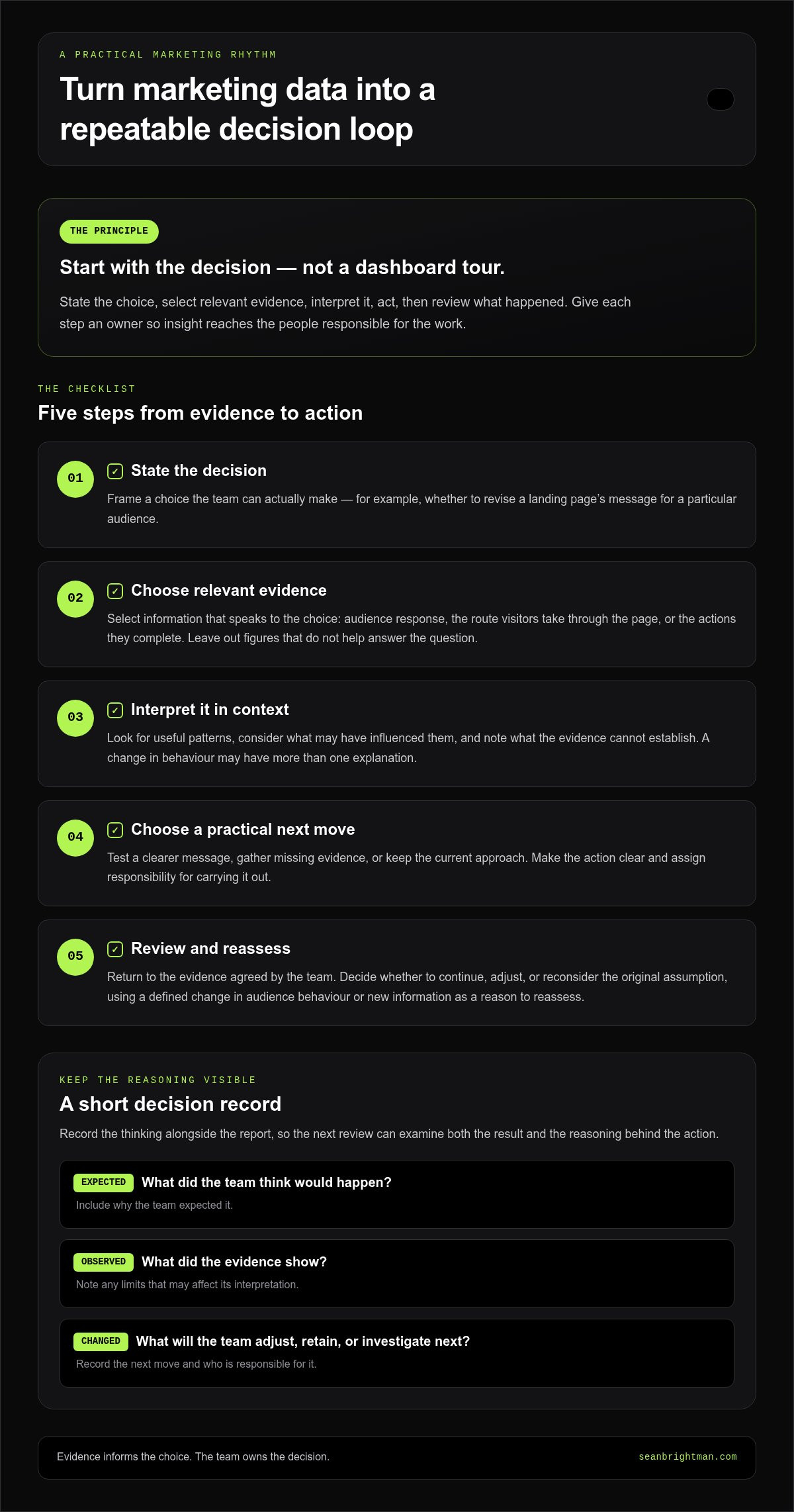
    Keep a short decision record alongside the report:

    • Expected: What did the team think would happen, and why?
    • Observed: What did the evidence show, and what limits might affect its interpretation?
    • Changed: What will the team adjust, retain or investigate next?

    This makes the reasoning visible and gives the next review something useful to examine: not just the latest figures, but the thinking behind the action.

    Why culture matters as much as data access

    Evidence only helps when people trust what it means. If one team counts a lead when someone fills in a form and another counts it only after qualification, the same label describes different things. Agreeing definitions removes that friction. Be clear, too, about where information comes from and what it can and can’t tell you.

    Experience still matters. A marketer may recognise a seasonal shift, a change in customer concerns or a brand risk that a chart doesn’t capture. Bring that judgement into the discussion, test it against reliable evidence and state assumptions openly. Data should challenge instinct when the evidence points elsewhere, while experience can prompt better questions when the numbers lack context.

    Responsibility can’t sit with an analyst alone. Analysts can help make evidence usable, campaign owners understand the work, channel specialists see operational context, and marketing leaders connect choices to priorities. Building a data-driven marketing culture means these roles share responsibility for interpreting evidence and acting on it. The analyst supplies insight; the team owns the decision.

    How marketing teams turn data into everyday decisions

    Data becomes useful when it changes a choice the team needs to make. Start with the decision, not a dashboard tour. Are you deciding which audience to prioritise, whether to adjust a landing page, or which channel deserves more attention? A clear question keeps the work focused and stops the team collecting figures simply because they’re available.

    State the choice, select relevant evidence, interpret it, act, then review what happened. That’s the repeatable loop behind building a data-driven marketing culture. Give each step an owner, so insight doesn’t get stranded between a report and the people responsible for the work.

    1. State the decision. Frame a choice the team can actually make, such as whether to revise a landing page’s message for a particular audience.
    2. Choose relevant evidence. Select information that speaks to that choice, such as audience response, the route visitors take through the page or the actions they complete.
    3. Interpret it. Look for useful patterns, check the context and note what the evidence can’t establish. A change in behaviour may have more than one explanation.
    4. Act. Choose a practical next move, such as testing a clearer message, gathering missing evidence or keeping the current approach.
    5. Review. Revisit the decision using the evidence agreed by the team. Decide whether to continue, adjust or reconsider the original assumption.

    Start with the decision, then choose the evidence

    Don’t open with “What can we measure?” Ask “What do we need to decide?” first. If the choice concerns audience response, examine evidence that reflects how that audience engages. If it concerns conversion behaviour, look at the steps people take towards the desired action. If it concerns channel performance, focus on evidence connected to the channel’s role in the plan.

    Some figures may be interesting without helping answer the question. Leave them out of that discussion. A focused evidence set makes it easier to explain why the team chose an action and what new information might change its view.

    Build a review rhythm that leads to action

    Use a consistent review conversation: what changed, why does it matter, and what happens next? Record the decision, who is responsible for carrying it out and what evidence would trigger a reassessment. That trigger might be a defined change in audience behaviour or new information that challenges the original assumption, rather than an arbitrary reporting deadline.

    Keep the record where the team can use it during planning, not buried in presentation notes. Clear operating routines make it easier to connect decisions with delivery, as explored in this guide to marketing operations and scalable growth systems. Senior marketing leadership can help keep priorities and ownership aligned without taking over every analysis.

    Which marketing metrics deserve attention, and which create noise?

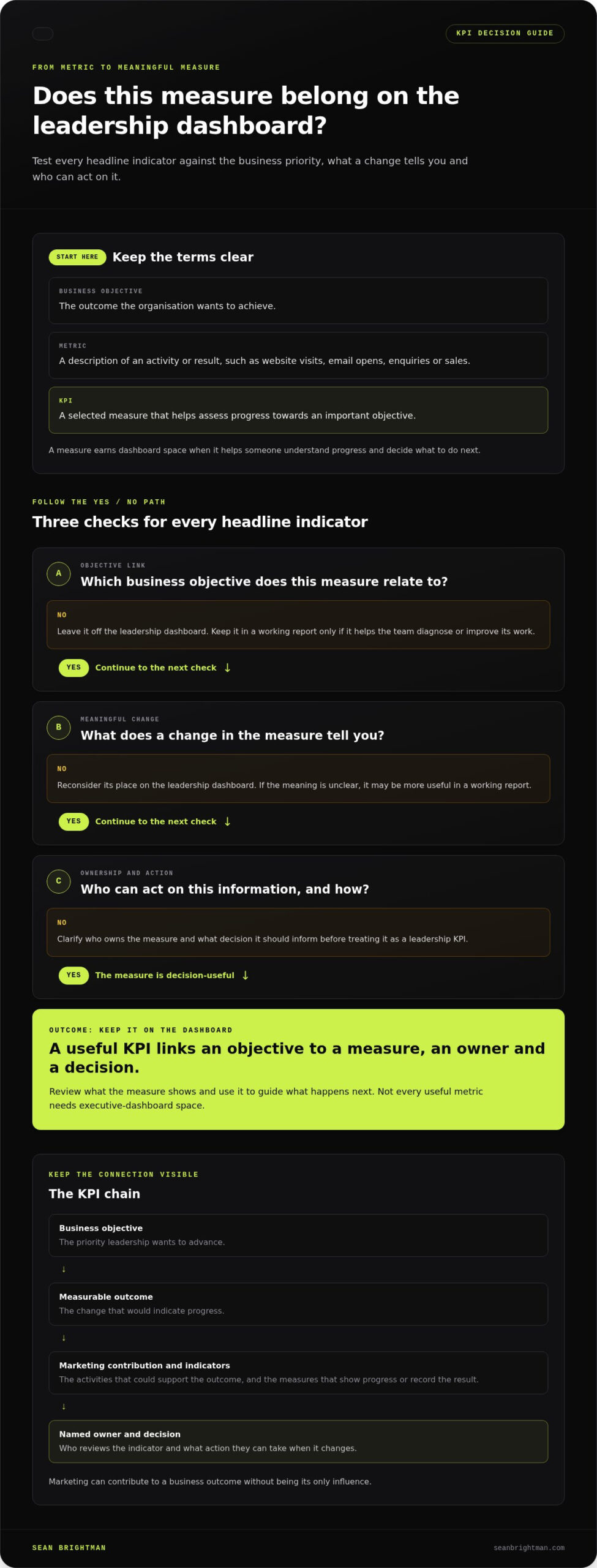
    A metric earns its place when it helps answer a real marketing question. The right measure depends on the decision: a team considering a change to its enquiry journey needs different evidence from one reviewing brand awareness. There’s no universal scorecard, and more numbers don’t automatically mean better judgement.

    Choose measures that connect marketing activity to an outcome

    Start with the business or customer outcome the decision is meant to support. Then choose a measure that helps the team understand progress towards it. A leading indicator, such as visitors reaching an important page, can inform what to investigate next, but it doesn’t guarantee that enquiries or sales will follow. Agree the measure’s definition and owner before using it, so everyone knows what is counted and who checks its meaning.

    Use the comparison below as a prompt, not a ready-made scorecard. Select only measures that fit the decision in front of you.

    Decision-useful measure | What it can indicate | Common misinterpretation

    Business outcome: qualified enquiries | Whether marketing is attracting potential customers who meet agreed criteria. | Treating every enquiry as equally valuable, or assuming marketing alone caused the change.

    Customer behaviour: progression through an enquiry journey | Where people continue, pause or leave as they move towards an action. | Assuming a drop-off proves the page or step is the cause without checking context.

    Activity: email clicks | Whether recipients are engaging with a particular link or message. | Treating clicks as proof of sales, customer intent or overall campaign success.

    Business outcomes show what the organisation ultimately cares about. Customer behaviour helps explain what people do along the way. Activity measures describe what a campaign or channel produced. Each can be useful when the team understands how it connects to the decision. That connection is central to building a data-driven marketing culture.

    Spot vanity metrics, weak data and misleading comparisons

    A large audience or a busy campaign report can look impressive and still leave the business question unanswered. Reach may show exposure, for example, but not whether the people reached are relevant to the objective. Don’t dismiss activity measures; give them a supporting role rather than treating them as the final verdict.

    Before acting, check whether tracking is consistent, whether important context is missing and whether the measure’s definition has changed. A comparison across campaigns can mislead if one uses a different audience, time period or counting method. Record these limits and pause if the evidence isn’t reliable enough to support the decision.

    Trustworthy measurement also depends on responsible data use. Collect and use information for a clear purpose, respect people’s privacy choices, and limit access to what’s needed. Data-led marketing doesn’t mean obeying every metric or sidelining experienced judgement. It means weighing sound evidence alongside context, customer understanding and professional expertise.

    Building a Data-Driven Marketing Culture: A Practical Guide

    How to make data-driven marketing practical for your team

    Don’t start by rebuilding your reporting or buying another tool. Start with one recurring marketing decision the team already faces, such as which content topic to prioritise or whether to change a landing page. Use the evidence you have. The first goal is to make the reasoning and follow-up visible, not to create a perfect measurement system.

    Run a focused pilot around one marketing question

    Choose a live question that matters and can be informed by available evidence. Before acting, write down the assumption behind the current approach, what evidence the team will review, who owns the decision and what options are on the table. This keeps the exercise grounded in a real choice, rather than turning it into an open-ended search for patterns.

    Use a simple starting checklist:

    • Question: What choice does the team need to make?
    • Assumption: What do you currently expect, and why?
    • Evidence: Which available information can help assess that expectation?
    • Owner: Who makes the call, and who carries out the agreed action?
    • Record: What did you decide, and what would lead you to revisit it?

    Keep definitions consistent. If one person uses “qualified enquiry” to mean a completed form and another means a prospect that meets agreed criteria, the team can’t compare conclusions reliably. Write down what selected measures mean before expanding the reporting set. That small piece of housekeeping can prevent a larger argument later.

    Not every pilot will produce a clear answer. The evidence may be incomplete, mixed or too limited to distinguish between possible explanations. Record that honestly. The learning might be to gather better evidence, narrow the question or hold the current approach while uncertainty remains. Building a data-driven marketing culture means improving how the team reasons, not forcing a confident conclusion from weak signals.

    Make accountability safe enough for honest learning

    An unexpected result is information, not proof that someone failed. Ask what the evidence changes, what assumptions need revisiting and what the team should do next. Keep the conversation focused on the decision and the conditions around it. Blame makes people hide uncertainty; clear ownership makes it easier to surface what needs attention.

    After the discussion, capture the decision, its owner, the action and what would prompt a reassessment. Keep the record easy to find and return to it during planning. This turns accountability into follow-through, rather than a search for someone to fault.

    If the team needs help turning priorities into an organised plan, Roadmapping provides a clear structure without making more reporting the goal. For hands-on support aligning priorities, decisions and accountability, explore senior marketing leadership support.

    How senior marketing leadership can sustain a data-driven culture

    A few useful decisions don’t create a lasting culture on their own. Teams need leadership that keeps evidence connected to the work: the positioning the business wants to own, the priorities worth backing and the campaigns that bring those priorities to life. Without that direction, different teams can use the same data to argue for conflicting actions.

    Building a data-driven marketing culture is ongoing management practice, not a transformation completed by installing a tool. Senior leaders set the conditions for it to work: agree what key terms mean, connect measures to priorities, clarify who makes which decisions and make follow-through part of normal planning. They don’t need to interpret every chart. They need to ensure the right people can use credible evidence and understand how their decisions fit together.

    Where a senior marketing lead adds direction

    A senior marketing lead links what the evidence suggests to what the business is trying to achieve. If customer responses challenge an assumption in the positioning, leadership can decide whether to investigate further or adjust the message. If campaign activity pulls in several directions, leadership can bring the team back to agreed priorities. The analysis stays with the people closest to the channel and customer; the leader makes sure the work adds up.

    Accountability should make ownership and follow-through clear, not pressure people to defend every result. A campaign owner can explain the decision, the evidence used and what they’ll do next. A leader can test the reasoning, surface trade-offs and help resolve clashes between priorities. That’s a more useful standard than judging the team on whether every result matched expectations.

    For businesses that need experienced direction without handing over every marketing decision, Fractional CMO support provides senior marketing leadership alongside the team.

    Turn insight into a roadmap the team can run

    Once priorities are clear, the team needs a practical way to translate them into work. A roadmap can rank actions by impact, show how decisions connect and give people a manageable view of what needs attention. It should help the team act on evidence, not become another document that competes with the work.

    Sean Brightman’s Roadmapping includes a 90-day action roadmap, sharpened positioning and messaging, and priorities ranked by impact. The roadmap is yours to run, with or without Sean. It gives the team structure for action while leaving room to learn and adapt as evidence develops.

    Start with one recurring decision: agree what it means, who owns it and how the team will review what follows. If you want senior marketing direction to help turn that habit into clearer priorities and action, Plug in a senior marketing brain. Skip the full-time hire.

    Make the next decision your starting point

    Don’t wait for perfect data or a grand culture-change plan. Choose one upcoming marketing decision and make the reasoning behind it visible to the people who’ll act on it. That small shift gives your team a practical starting point for building a data-driven marketing culture, without turning experience into an afterthought.

    If keeping that habit alive needs clearer direction, Fractional CMO support brings senior marketing leadership, decision-making and accountability into the work. When the team needs a sharper route from insight to action, Roadmapping sets out a 90-day action roadmap, sharpened positioning and messaging, and priorities ranked by impact.

    Plug in a senior marketing brain. Skip the full-time hire.

    Start with one decision. Learn from what happens. Then build the next habit from there. Your team can make progress without having every answer in advance.

    Frequently Asked Questions

    What is a data-driven marketing culture?

    It’s a way of working where teams use relevant evidence to shape marketing choices and learn from what follows. Evidence might include customer feedback, campaign responses or sales conversations, not just figures from an analytics platform. For example, a pattern in customer questions could prompt a team to clarify its website messaging. The key is using information to improve decisions, not collecting it for its own sake.

    How do you build a data-driven culture in a marketing team?

    Make data use part of ordinary planning, rather than a separate analytics project. Give the team a shared place to note key terms, decisions and unresolved questions. In a campaign planning session, ask what evidence supports the audience choice and what would make the team reconsider it. New starters should learn these habits too, so the approach survives team changes instead of depending on one person.

    Can a small business build a data-driven marketing culture without specialist software?

    Yes. A small team can begin with a spreadsheet, existing sales records and customer conversations. Track a few clearly defined measures that relate to current priorities, and note where each figure comes from. For example, a business could review the reasons prospects give for postponing a purchase alongside enquiry records. Specialist tools may help as needs grow, but they can’t replace clear questions or consistent recording.

    Which metrics should a marketing team use to make better decisions?

    Choose measures that fit the decision, rather than copying another organisation’s dashboard. A team improving repeat business might examine returning-customer behaviour and feedback about the experience. A team building awareness may need evidence about relevant audience reach, not just total impressions. Check that each measure has a stable definition and an identified source. If the team can’t explain how a metric informs its choice, it probably doesn’t belong in that discussion.

    How do you encourage a team to trust marketing data?

    Make the source and limitations of important figures easy to see. If a sales report and a campaign platform show different enquiry totals, investigate how each counts an enquiry before drawing conclusions. Let team members question a measure without treating that as resistance. Trust grows when discrepancies are resolved openly, corrections are recorded and people can see how evidence influenced a real decision.

    Does data-driven marketing mean replacing judgement with analytics?

    No. Analytics can show patterns, but it can’t automatically explain every cause or account for every business consideration. If a campaign’s response shifts during a major change in the market, experienced marketers can add context the report doesn’t contain. Use judgement to question assumptions and interpret what the numbers can’t show. Then make the reasoning explicit, so the team can distinguish evidence from opinion and revisit either when circumstances change.

    How should a business handle privacy when using customer data for marketing?

    Use customer information responsibly: be clear about why it’s collected, limit it to what the business needs, protect access and avoid keeping it indefinitely without a reason. In the UK, marketing data use must take account of applicable data protection and electronic marketing rules, including the UK GDPR and Privacy and Electronic Communications Regulations. Build privacy checks into campaign planning, and seek specialist advice where the right approach depends on the data or activity.

  • Developing Marketing KPIs That Matter: A Practical Guide

    Developing Marketing KPIs That Matter: A Practical Guide

    A dashboard full of clicks, impressions and engagement can still leave one question unanswered: is marketing helping the business grow? Developing marketing kpis that matter starts with that question, not with another metric to squeeze onto a report. The goal is to connect activity to a commercial outcome leaders care about.

    If your reporting feels busy but doesn’t help leadership or finance make decisions, the problem isn’t a lack of data. It’s a lack of focus, clear ownership and agreed follow-up. Marketing needs measures the whole business can understand, not a separate language of its own.

    This guide shows you how to build a lean KPI system around business priorities. You’ll learn to choose useful indicators, assign an owner to each one and link every measure to a decision and review. The result is reporting that does more than describe what happened. It helps your team see what’s working, what needs attention and what to do next.

    Key Takeaways

    • Developing marketing kpis that matter means starting with a business priority, then tracing how marketing can contribute to it.
    • Build a clear KPI chain from goal to measurable outcome, so each metric has a reason to exist.
    • Choose indicators that help someone make a decision. If a metric can’t inform action or link to an objective, leave it out.
    • Give every KPI a shared definition, accountable owner and trusted data source to make reporting useful across teams.
    • Set regular reviews to act on what the measures show, then refine the system when priorities or evidence change.

    Developing marketing KPIs that matter starts with the business problem

    A dashboard can show that website visits rose, email engagement improved and social posts reached more people. Yet leaders may still be asking the same question: what did marketing contribute to the business? The gap isn’t necessarily missing data. It’s often a missing connection between the numbers being reported and the commercial problem the business needs to solve.

    Start with the objective. Is the business trying to grow qualified pipeline, improve customer retention or enter a new market? Until that priority is clear, choosing KPIs is guesswork. A Key Performance Indicator (KPI) is a measure used to assess progress towards an important objective, but its value depends on how it informs action.

    A decision-useful KPI measures progress towards a business objective and helps its owner decide what to do next.

    How to tell a KPI from a metric

    A metric describes an activity or result: website visits, email opens, enquiries or sales. A KPI is a measure selected because it helps assess progress against a priority. A business objective is the outcome the organisation wants to achieve. These terms connect, but they aren’t interchangeable. And not every useful metric needs a place on an executive dashboard.

    Illustrative example: A business wants to increase qualified sales opportunities. Website visits may help the marketing team understand audience interest, but visits alone don’t show whether the objective is advancing. The number of qualified opportunities generated through marketing could be a KPI, if the business has agreed what counts as qualified and can use the result to adjust its plans.

    The test is practical. If the measure changes, could someone make a sensible decision in response? For example, a team might investigate whether a source is bringing in relevant prospects, or shift effort towards activity more closely connected to the objective. The figures here illustrate the logic; they aren’t performance benchmarks.

    Signs your marketing measures have lost their purpose

    Some dashboards are museum pieces. They carry measures from an old campaign, channel or reporting habit, even though the strategy has moved on. Others reward what’s easy to count. Engagement figures can look encouraging whilst leaders remain unable to answer whether marketing is supporting pipeline, revenue or another agreed priority.

    That doesn’t make engagement or channel metrics useless. They can help teams diagnose performance and improve execution. The problem starts when these measures take up leadership attention without explaining what they mean for the objective, or what decision should follow.

    Run this quick test on every headline indicator:

    • Which business objective does it relate to?
    • What does a change in the measure tell you?
    • Who can act on that information, and how?

    If the answers are vague, the measure may belong in a working report rather than the leadership dashboard. Developing marketing kpis that matter means keeping the measures that sharpen decisions, not simply carrying forward every number the team can collect.

    Build a marketing KPI chain from business goal to measurable outcome

    A KPI shouldn’t start with the data your tools happen to collect. It should start with a business priority, then trace a credible route from that priority to marketing’s contribution, the measure someone owns and the decision it informs. That chain stops reporting from becoming a disconnected list of numbers.

    Use this sequence to build it:

    1. Clarify the business goal. Name the priority leadership wants to advance, such as growing revenue from a particular market.
    2. Define the outcome. Specify what change would indicate progress, such as more revenue from that market or a stronger pipeline of suitable opportunities.
    3. Identify marketing’s contribution. Map the activities that could support the outcome, without treating marketing as the only influence on it.
    4. Choose indicators. Select measures that show progress or record the final result, and make their relationship to the goal explicit.
    5. Assign ownership and a decision. Name who reviews each indicator and what action they can take when it changes.

    A useful KPI chain runs from business objective to measurable outcome, through a named owner, to a decision that can change the work.

    Translate a business objective into marketing outcomes

    Start with leadership’s priority, then ask what needs to change for the business to move towards it. If the aim is growth in a new market, the desired outcome might be a stronger flow of relevant enquiries or sales opportunities from that market. Those are outcomes to assess, not activities to count.

    Next, map how marketing could contribute: for example, by improving awareness with the intended audience or supporting demand generation. Keep the distinction clear. A campaign, event or content programme is an activity; reach and responses are possible indicators; the commercial outcome is the result the business cares about. Sales capacity, pricing and market conditions can also affect that result, so don’t claim marketing controls it alone.

    Pair early signals with final outcomes

    Some outcomes take time to show up. Leading indicators can offer earlier signals that a plan is gaining traction. For a new-market push, these might include engagement from the intended audience or relevant enquiries. They help teams spot patterns and decide whether to investigate or adjust, but they don’t prove that a final business result will follow.

    Lagging indicators record outcomes after they happen, such as revenue or pipeline created. They show what the business achieved, but rarely explain the cause on their own. Read leading and lagging measures together: if early signals shift but the outcome doesn’t, investigate other influences before changing course. The relationship is evidence to examine, not a causal claim to assume.

    This is where developing marketing kpis that matter becomes an operating discipline, not a dashboard exercise. If leadership needs help turning priorities into a workable measurement and accountability system, senior marketing roadmapping and advisory can bring structure to the decisions.

    Choose marketing KPIs that guide decisions, not vanity reporting

    A measure isn’t a KPI just because it appears on a dashboard. It earns that place when it connects to a current objective and helps someone decide what to do. A crowded report can hide the signal. A short, well-chosen set of measures makes priorities easier to see and follow up.

    Use this comparison to test candidate measures before promoting them into leadership reporting. The examples are illustrative, not benchmarks.

    Candidate measure Objective served Decision enabled Owner Data source
    Qualified opportunities from a target segment Develop demand in that segment Review targeting or the offer if the flow changes Marketing lead CRM, with an agreed qualification definition
    Email click-through rate Improve engagement with a priority audience Test the message or call to action Email manager Email platform
    Customer satisfaction after onboarding Improve the early customer experience Investigate friction in onboarding Customer experience lead Post-onboarding survey

    Apply a practical test to each candidate KPI

    Before including a measure, check three things: does it connect to a current objective, can the team define and source it consistently, and would a change prompt a different action? If the answer to the last question is no, it may be useful for analysis but doesn’t need to be a headline KPI. If nobody owns it, it’s unlikely to trigger follow-up.

    A vanity metric isn’t inherently worthless. It becomes vanity reporting when it’s presented as proof of progress without a clear link to an objective or a decision. Reach, impressions and clicks can help diagnose channel activity. On their own, they don’t establish commercial contribution. Keep them in working reports when they help a team improve execution; leave them out of senior reporting if they add no decision value.

    Balance commercial and customer indicators

    Choose categories to fit the objective, not to complete a checklist. Business measures might include revenue contribution, return on investment (ROI), return on ad spend (ROAS), customer acquisition cost (CAC) or customer lifetime value (CLV). Engagement measures can help assess whether an audience is responding; satisfaction measures can reveal how customers experience the relationship. Each belongs only when it helps answer a relevant question.

    Channel figures need context. A change in ROAS, for example, may reflect spend, conversion value, attribution settings or changes elsewhere in the customer journey. Don’t leap from a channel result to a strategic conclusion without examining what the measure includes and what it leaves out.

    There’s no universal KPI count for every team. Choose enough to cover the priorities that matter, but not so many that ownership and follow-up disappear in the noise. In developing marketing kpis that matter, relevance beats volume: retain indicators with clear definitions, usable evidence and a decision attached.

    Developing Marketing KPIs That Matter: A Practical Guide

    Make marketing KPI measurement reliable, owned and actionable

    A KPI can look precise and still mislead. If marketing and finance define “qualified lead” differently, their reports may show different results while both teams believe they’re right. Reliable measurement starts with shared rules, a trusted source and a person responsible for interpreting what the number means.

    Measurement creates value only when someone can interpret the evidence and act on it.

    Set definitions, sources and ownership before reporting

    Write each KPI definition in plain English before it goes into a report. Record what the measure includes, what it excludes, the period it covers and any filters applied. For example, define what makes an enquiry “qualified” and whether the count includes only new opportunities. Shared rules let teams compare like with like, rather than debate whose calculation is correct.

    Then document the source and name an accountable owner. The source might be a CRM, analytics platform or customer survey; the owner is responsible for checking the measure and raising questions, not necessarily doing every task that affects it. If data is missing, duplicated or shaped by attribution limits, flag that context alongside the result. Don’t dress uncertainty up as certainty.

    A lightweight KPI record can capture:

    • The objective and plain-English definition
    • What is included, excluded and counted, and over what period
    • The source, accountable owner and relevant data limitations
    • Who uses the measure and what decisions it may inform

    This simple record gives new team members a shared reference and makes changes easier to spot. If a definition or source changes, note when and why. Otherwise, a shift in the reported figure could reflect a new counting method rather than a change in performance.

    Turn KPI reviews into decisions and follow-up

    Set the review rhythm to match how quickly the measure changes and when a decision is needed. A fast-moving campaign may need closer attention than a longer-term commercial outcome. Don’t review a figure more often than the data can support, and don’t wait so long that a useful adjustment arrives too late.

    Make the meeting about interpretation, not dashboard presentation. For each KPI, ask what moved, what might explain it, what the movement means for the objective and what action follows. Separate observed facts from possible explanations. A change may coincide with a campaign, but that alone doesn’t prove the campaign caused it.

    Finish by recording the decision, the person responsible and when the team will revisit the action. If there’s no decision to make, note why the indicator remains under observation. This turns reporting into a working loop: evidence, interpretation, action, follow-up. It also helps leaders see where accountability sits without confusing ownership of a measure with sole control of the outcome.

    Developing marketing kpis that matter requires this discipline beyond the dashboard: clear definitions, honest context and follow-through. If you want strategic support to turn measurement into a workable system, explore strategic marketing support.

    Put a useful KPI system into practice with clear marketing leadership

    A KPI framework only earns its keep when the team uses it. Put it into operation with a clear rollout, then adjust it as priorities and evidence change. A new growth target may require different indicators; a change in data quality may mean an existing measure needs a fresh definition. Keep the system stable enough to compare progress, but never so rigid that it stops reflecting the business.

    Use this sequence to get it working:

    1. Agree the priority. Make sure leaders and marketing are working towards the same business objective.
    2. Map the KPI chain. Connect the objective to the outcome, relevant marketing contribution and indicators.
    3. Assign owners. Make responsibility for each measure and its follow-up explicit.
    4. Establish reviews. Set a rhythm for interpreting changes and agreeing actions.
    5. Refine the system. Remove measures that no longer inform decisions and investigate gaps in the evidence.

    Leadership matters at every step. Senior marketing direction can align priorities, clarify accountability and keep measurement connected to decisions. It can’t guarantee a commercial result, particularly where other teams and market conditions influence the outcome. Its job is to make the plan coherent and the next action clear.

    Choose support that matches the work to be done

    For a focused reset, Roadmapping is a one-off strategic engagement that produces a 90-day action roadmap the business can run. Advisory CMO provides ongoing strategic direction through monthly strategy and review sessions, priority setting, async access and accountability. Fractional CMO support offers senior leadership across strategy, team direction, campaign planning and growth-system design. The right fit depends on whether the business needs a defined plan, continuing guidance or broader leadership involvement.

    Keep the KPI system connected to the wider growth engine

    Measures won’t fix disconnected operations by themselves. Connect them to the way work moves across marketing: who owns each activity, how teams share information and which decisions leaders need to make. A clear marketing operations and scalable growth system helps keep reporting tied to execution, rather than leaving the dashboard as a separate exercise.

    Ongoing direction can also help keep priorities, reviews and responsibilities aligned as the business develops. A marketing advisory retainer can provide a continuing structure for that strategic oversight.

    Developing marketing kpis that matter isn’t a one-off dashboard project. It’s a working system of priorities, evidence, ownership and decisions. If you’re ready to put that system under clear senior direction, plug in a senior marketing brain.

    Make your next KPI decision count

    The next step doesn’t need to be a complete reporting overhaul. Pick one business priority and use it to pressure-test the measures your team already tracks. Keep what supports a decision. Retire what only fills space. Then use the next review to see whether the information helped someone act with greater clarity.

    That’s how developing marketing kpis that matter becomes part of how the business works, rather than another project that fades after a dashboard update. The system should evolve as priorities shift and better evidence emerges. Stay curious, challenge assumptions and keep the measures connected to real choices.

    If you want experienced strategic support to turn measurement into clearer direction and accountability, plug in a senior marketing brain. Start with the decision you need to make. Build the measurement around it, and give your team a stronger basis for moving forward.

    Frequently Asked Questions

    Can a marketing KPI be shared between marketing and sales?

    Yes. A shared KPI can align marketing and sales around an outcome both teams influence, such as progressing suitable enquiries into sales opportunities. Agree what counts and which system provides the figures, then spell out each team’s part. Marketing might review whether enquiries match the agreed profile; sales might examine how promptly and consistently they’re followed up. Shared accountability should encourage collaboration, not leave either team unsure who owns the next action.

    What happens if a marketing KPI improves but revenue does not?

    Treat the gap as a reason to investigate, not as proof that either measure is pointless. Check whether revenue may follow the indicator later, whether the audience is commercially relevant and where prospects are dropping out. Review sales follow-up and make sure both figures use stable definitions. Then decide whether the indicator still helps assess the intended objective. Two measures moving differently, or together, don’t by themselves establish what caused the change.

    Can brand awareness be measured with marketing KPIs?

    Yes, provided the measure reflects the awareness goal. If the aim is to reach a defined audience, survey responses about brand recognition may be more informative than total impressions alone. Use the same question, audience and method across reviews so changes can be interpreted fairly. Where possible, compare awareness evidence with later signals such as branded enquiries. Keep the distinction clear: visibility can indicate exposure, but it doesn’t prove preference, purchase intent or revenue.

    How do you set marketing KPI targets without reliable historical data?

    Start by recording what you can measure now and where the evidence is incomplete. In developing marketing kpis that matter, an initial target can be provisional: tie it to the business priority, write down the assumptions and set a point to review it. For example, a team entering a new market might use early campaign results to establish a working baseline. Label estimates clearly, then revise them as consistent evidence builds. Don’t present a first estimate as an established benchmark.

    Should every marketing channel have its own KPI?

    No. Give a channel its own KPI only if it has a defined role and the measure helps guide a decision. If a webinar supports consideration, registrations from the intended audience may be more useful than a general view count. A separate channel report can still help the people managing that work, but it needn’t become an executive KPI. Start with the business question, then use channel figures as supporting evidence where they add insight.

    Can a small business develop useful marketing KPIs without a large analytics team?

    Yes. A small business can begin with information it already handles, such as enquiries recorded in a spreadsheet or sales tracked in its existing system. Choose measures the team can update consistently, rather than building a complex dashboard first. For example, agree how to record an enquiry’s source and what makes it relevant. Give someone responsibility for maintaining that record, then use it to inform a specific decision. Simple, dependable evidence beats elaborate reporting nobody can sustain.

  • How to Build a Scalable Marketing Function in 2026

    How to Build a Scalable Marketing Function in 2026

    What if the fastest way to scale marketing is to stop adding more activity? If your work feels reactive, results depend on one person, or every new priority creates another process to manage, you’re not alone. Learning how to build a scalable marketing function starts with fixing the operating model, not piling on headcount, tools or campaigns.

    It’s tempting to hire, outsource or automate your way out of the pressure. But without a clear link between marketing and commercial priorities, those choices can add cost and complexity without solving the real problem. You need a system that gives the team direction, clear ownership and room to grow.

    This article sets out how to build that system. You’ll learn how to connect marketing priorities to business goals and customer needs, define responsibilities and repeatable processes, and choose useful measures of performance. We’ll also look at how to decide what to systemise, hire or outsource next, so capability grows at the pace the business needs. Scale the model first. Then scale the work.

    Key Takeaways

    • See the warning signs that your marketing function is under strain, from fragmented data to unclear ownership.
    • Connect commercial priorities and customer decisions to the work your marketing team needs to do.
    • Learn how to build a scalable marketing function by matching strategic leadership, team capacity and specialist support to the work required.
    • Use a practical sequence to diagnose bottlenecks, assign owners, document workflows and review evidence.
    • Turn your operating-model diagnosis into a prioritised roadmap, then use clear measures to refine it.

    Why a marketing function breaks when the business starts to scale

    A marketing function is the connected strategy, people, processes, systems and measurement that turn customer understanding into coordinated marketing work. It’s not just the campaigns a team runs or the channels it uses. It’s the structure that helps people decide what to do, who owns it and how to learn from the results.

    At an earlier stage, a founder or generalist might set priorities, write the brief, approve the work and report the outcome. Growth brings more audiences, activity and stakeholders. If the decisions and processes still live in one person’s head, work queues up around them. A campaign might launch, but no one can easily explain how it connects to a business priority or what the team should repeat.

    That’s the difference between more marketing and a marketing function. More activity means producing more output. A functioning system makes the work repeatable and learnable: teams can use shared priorities, clear ownership and agreed measures to plan and review it. The aim isn’t to remove judgement. It’s to stop every task depending on improvised decisions.

    Unclear priorities often show up as a busy calendar with no shared view of what matters most. Data may sit across separate platforms or spreadsheets, while reporting changes depending on who prepared it. Results become hard to compare, and knowledge disappears when one person is unavailable. These are connected symptoms. Fragmented information weakens decisions, while unclear decision rights make the work harder to coordinate.

    What makes a marketing function scalable?

    A scalable function can adjust its capacity without losing strategic direction. It understands which customers matter, what decisions marketing needs to influence and who owns the work at each point. Processes connect those choices to delivery, while measurement helps the team see what’s useful and what needs changing. Understanding Marketing Strategy helps explain why coordinated actions should serve wider business goals, rather than becoming a disconnected list of tasks.

    Scalability doesn’t automatically mean a bigger department. It means the work can be supported by the right mix of people and processes as needs change. A small team with clear ownership and reliable workflows may be more adaptable than a larger one where every decision gets stuck.

    How growth exposes weaknesses in the current setup

    Informal approvals work until several people need a decision at once. Undocumented workflows create the same bottleneck: only the person who knows the steps can move the work forward. Disconnected campaigns also make performance difficult to interpret, because the team lacks a consistent way to link activity, customer response and commercial priorities.

    Separate a temporary workload spike from a structural problem. A one-off launch may stretch capacity for a short period. If routine work repeatedly stalls, priorities regularly clash, reporting can’t answer basic questions or progress relies on one individual, the underlying setup needs attention. Track where work waits, who unblocks it and what information is missing. Those patterns reveal the constraint more clearly than simply counting tasks.

    Design the marketing operating model around strategy and customers

    Build the model around the decisions the business needs to make, not the channels it happens to use. Start with commercial priorities, the audiences that matter and the customer choices marketing needs to influence. Then decide what work supports those choices, who owns it and what information they need. That sequence keeps the operating model anchored to purpose rather than tool selection.

    For example, if the priority is to increase repeat purchases, ask which customers are most likely to return, what might prompt their next purchase and how the business will recognise that behaviour. The answers shape the work. A new campaign or platform is only relevant if it helps address the priority.

    Turn business goals into focused marketing priorities

    Translate broad business objectives into a short set of marketing outcomes. “Grow revenue” needs more definition. Is the focus on reaching a particular audience, improving the quality of enquiries, helping customers understand a complex offer, or encouraging existing customers to return? Choose outcomes that marketing can influence and connect them to a commercial goal.

    Then make the trade-offs explicit. Record which audiences, propositions and customer barriers come first, and what won’t be prioritised for now. These exclusions protect focus when requests compete. They also give the team a practical test: if a proposed task doesn’t support an agreed outcome or a necessary customer need, it shouldn’t automatically displace planned work.

    A useful operating model makes those choices visible. The marketing operations growth engine explores how systems can support coordinated work, but systems should follow strategy. Buying a new tool before agreeing priorities and ownership risks adding another place for activity to fragment.

    Map customer journeys to ownership and processes

    Trace how customers discover the business, assess whether it fits their needs and decide whether to choose it. At each stage, note the question they need answered, the marketing work that can help and the information required to make a useful next decision. Keep the map grounded in actual customer behaviour, rather than building an elaborate diagram just to make the process look complete.

    • Discover: Who owns reaching the relevant audience, and what evidence shows the message is reaching them?
    • Assess: Who keeps the proposition and supporting information clear, accurate and useful?
    • Choose: How does marketing hand over relevant context, and how will the team learn what helped or hindered the decision?

    Assign an owner to each important decision and handover, even if one person holds several responsibilities. Specify what information passes between people, where it lives and what happens when a decision is delayed. A strategic brand roadmap can connect positioning to planned work, so customer-facing activity reinforces a coherent direction rather than pulling in competing directions.

    Set a simple planning rhythm before adding more tools. Review priorities, upcoming work, capacity and evidence together, then capture decisions and changes in one shared place. Sean Brightman provides senior marketing guidance to help businesses turn strategy into clear ownership and a workable plan. Read more about senior marketing guidance.

    Choose the right mix of leadership, team capacity and specialist support

    Don’t treat every marketing gap as a hiring problem. First identify what’s missing: strategic direction, ongoing delivery capacity or a specific specialist skill. These needs call for different solutions. A channel specialist can deliver defined work, but shouldn’t be expected to set the company’s overall marketing direction. A senior leader can set priorities and create accountability, but won’t automatically provide the hands-on capacity to deliver every task.

    A scalable function doesn’t need to start with a large permanent team. It needs clear ownership of the work, whether that ownership sits with an employee, a specialist partner or a fractional leader. The right mix can change as priorities and workload change, provided decisions remain connected to the business and someone internally stays accountable.

    When does the business need a dedicated hire?

    Consider an internal hire when a clearly defined body of work needs steady attention and close connection to the business. That might involve managing ongoing customer communications, coordinating activity across teams or maintaining essential marketing knowledge that changes as the organisation learns. An employee can build institutional knowledge, work closely with colleagues and provide continuity when priorities shift.

    Look beyond a busy period. Ask whether the work is sustained, whether it needs daily collaboration, and whether its responsibilities can be clearly described. If the need is a short-term specialist task or an unresolved strategy problem, adding a permanent role may solve the wrong constraint. Don’t use a revenue milestone or assumed team size as a universal hiring trigger. The work itself should make the case.

    When can fractional leadership or specialist support help?

    Fractional leadership can provide senior direction without a full-time CMO hire. Sean Brightman’s Fractional CMO service helps businesses clarify priorities, shape the operating model and create accountability for putting decisions into practice. This addresses a leadership need, not necessarily a shortage of hands to execute campaigns. The Fractional CMO model offers more detail on this form of part-time senior leadership.

    Specialist support fits a different gap. Use it when a defined requirement needs particular expertise or delivery capacity that the existing team doesn’t have. Specify the task, expected output, internal owner and how the work will connect with wider priorities. Clear boundaries stop specialist input becoming another disconnected activity.

    External leadership can guide and challenge the work, but it shouldn’t remove internal decision ownership. Someone inside the business must set commercial priorities, provide customer and product context, make decisions and coordinate handovers. Without that counterpart, recommendations can stall or delivery can drift.

    To decide what to add, write down the constraint and match it to the type of support it needs:

    • Unclear direction: establish senior strategic leadership before adding more delivery activity.
    • Recurring workload: assess whether steady internal ownership is needed.
    • Defined skills gap: bring in specialist support for a specific capability or piece of work.
    • Several connected gaps: clarify priorities and ownership first, then build the right mix around them.

    That’s the practical answer to how to build a scalable marketing function: add capacity to a defined need, not to a vague sense that the team should be bigger. Sean Brightman’s roadmapping sessions and advisory retainers help businesses decide what to build internally and where external leadership fits. Learn more about senior marketing leadership support.

    How to Build a Scalable Marketing Function in 2026

    Build the function in stages, then measure whether it is working

    Don’t try to rebuild everything at once. A useful operating plan starts with the constraint causing the most friction, puts a small change into practice and checks what happens. This gives the team evidence to improve the model before expanding it. It’s a practical way to approach how to build a scalable marketing function without creating more process than the work needs.

    Work through the stages in order:

    1. Diagnose constraints. Find where work stalls, decisions wait, information gets lost or results are difficult to interpret. Look for the cause, not just the visible backlog.
    2. Choose priorities. Select a small number of outcomes the business needs marketing to support. Be clear about what sits outside the plan for now.
    3. Assign owners. Name who is accountable for each outcome, decision and handover. An owner can involve others, but accountability shouldn’t disappear between teams.
    4. Document workflows. Record the steps people need to repeat, the inputs they need and where decisions are made. Keep documentation usable, not ceremonial.
    5. Review evidence. Check whether the process supports the intended outcome. Keep what works, adjust what creates friction and stop work that no longer serves the priority.

    Keep the first plan deliberately small. Choose one meaningful workflow or customer journey, agree what you expect to learn and give the people doing the work a way to flag problems. Set the review rhythm to match the pace of decisions and activity. A team managing fast-moving work may need frequent check-ins; a longer-term initiative may need less frequent reviews. The cadence is a management choice, not a universal rule.

    What should a marketing function measure?

    Choose measures that connect to an objective and help someone make a decision. Activity counts, such as emails sent or content published, show what the team did. On their own, they don’t show whether customers responded or a commercial outcome changed. Pair useful leading indicators, such as qualified enquiries or progress between customer stages, with relevant outcomes, such as sales or repeat business. Use attribution carefully: a metric can show an association or a trend, but one number rarely proves that a single marketing activity caused the result.

    How can AI and automation support the operating model?

    Start with repeatable tasks that consume effort or create avoidable inconsistency, such as preparing routine summaries, organising information or moving work between agreed steps. Check whether technology genuinely reduces friction before adding it to the process. Keep a named person responsible for quality, judgement and customer-facing decisions. Sean Brightman’s AI consulting focuses on practical ways to apply AI to marketing needs and improve efficiency and output, rather than collecting tools without a clear job for them.

    Sean Brightman also provides strategic roadmapping to help businesses decide what to test, measure and improve. Build your marketing roadmap with senior guidance.

    Get strategic direction to turn the marketing function into a growth engine

    A scalable marketing function doesn’t come from adding more activity and hoping the pieces fit. It comes from understanding where work gets stuck, choosing priorities tied to customer and business needs, assigning ownership, and building processes the team can learn from. Then review the evidence and adjust the model.

    That sequence helps reveal what the business needs next. Is the main constraint unclear positioning, competing priorities, an unowned handover or a lack of delivery capacity? Each calls for a different response. Senior strategic guidance can help leaders diagnose the real issue and agree what to tackle first, before they invest in another hire, process or platform.

    What a strategic roadmap should make clear

    A useful roadmap turns strategic choices into an actionable order of work. It should connect positioning and customer needs to clear priorities, show what needs to happen first, name owners and surface decisions that need leadership attention. It should also distinguish committed work from ideas that can wait. That gives the team direction without pretending every detail can be fixed in advance.

    Keep the roadmap adaptable. As the team learns from customer responses and delivery, priorities may need to change. The point isn’t to defend a static plan. It’s to make changes deliberately, based on evidence and business priorities, rather than allowing every new request to reset the work.

    Before approving an initiative, leaders can use the roadmap to ask:

    • Which business priority and customer need does this support?
    • Who owns the decision, delivery and handover?
    • What needs to happen first, and what can wait?
    • What evidence would prompt us to continue, change or stop?

    How ongoing advisory supports implementation

    A plan needs oversight as well as delivery. Sean Brightman’s monthly advisory retainer provides ongoing direction and accountability while the team does the work, helping leaders resolve competing priorities and revisit decisions when new evidence emerges. It complements internal ownership; it doesn’t replace the people responsible for execution or the business decisions behind it.

    That’s where the practical answer to how to build a scalable marketing function becomes clearer: establish direction, turn it into a prioritised roadmap, assign ownership, then improve the model as you learn. Roadmapping creates structured direction for longer-term marketing and brand work. Advisory support helps maintain focus and accountability during implementation. Neither guarantees a particular business result. Both can help leaders make the next decision with greater clarity.

    If you need clarity before expanding marketing capacity, discuss strategic marketing support and work out what the function needs next.

    Make your next marketing decision deliberate

    Growth will keep changing what the business needs from marketing. The useful question isn’t whether to build a bigger team by default. It’s whether the next investment solves the constraint that matters now and leaves the function better equipped to adapt later. That’s the practical mindset behind how to build a scalable marketing function.

    You don’t need a perfect blueprint before taking action. You need enough direction to make the next move, learn from it and adjust without rebuilding everything from scratch. Start by naming the decision you’re delaying, the trade-off behind it and what would help you move forward with confidence. That turns a broad ambition to “scale marketing” into a real leadership choice.

    Senior marketing support can help bring that perspective. Sean Brightman provides Fractional CMO services for part-time senior leadership, roadmapping for structured direction on longer-term marketing and brand work, and advisory retainers for ongoing direction and accountability. The right support should strengthen your team’s ability to act, not add another layer of activity.

    Choose a next step that fits the challenge in front of you. Build a clearer marketing operating model with strategic support, and give your team a stronger foundation for what comes next.

    Frequently Asked Questions

    What is a scalable marketing function?

    A scalable marketing function is a way of organising marketing so the business can adjust its capacity without losing sight of its goals or customers. For example, if a new customer need emerges, the team can decide whether to change existing work, bring in a specialist or build an internal capability. The useful test is whether people know who makes that decision and how the business will judge its value.

    How do you build a marketing function from scratch?

    Start by choosing a business goal and defining the marketing contribution that could support it. If the goal is to reach a new audience, for instance, identify what you need to learn about that audience before committing to a campaign. Agree who can approve changes, then set a simple way to capture customer feedback and review decisions. This gives you a working foundation before you invest in a larger structure. That’s how to build a scalable marketing function without copying another company’s chart.

    When should a business hire its first marketing employee?

    Hire when there’s sustained work that needs a clear internal owner and you can describe what that person will be responsible for. Draft the role around outcomes and recurring decisions, not a long wish list of channels. For example, if customer insight, planning and campaign coordination are all needed, decide which responsibilities genuinely belong together. If priorities are still changing weekly, clarify the direction first so the hire has a workable remit.

    Can a small business build a scalable marketing function without a large team?

    Yes. A small business can build a scalable function by keeping its priorities focused and making responsibilities clear, even when one person handles several areas. Use external specialists for discrete needs, such as a defined piece of research or technical work, while keeping key customer and commercial decisions close to the business. Review workload and results before expanding capacity. The goal is a setup that can adapt, not a large team for appearance’s sake.

    Which marketing function should be built first: strategy, team or systems?

    Set strategy first, because it gives people and systems a purpose. You don’t need a lengthy document: agree the customer group, business outcome and main decision marketing should influence. Then identify who needs to act and what information they need. For example, don’t automate a lead handover until you’ve agreed what makes a lead relevant and who follows up. This prevents technology from making an unclear process harder to change.

    How can you tell whether a marketing function is ready to scale?

    Look for evidence that current constraints are understood and that the proposed change addresses one of them. If work repeatedly waits for one person’s approval, for example, adding delivery capacity may not help until decision authority is clearer. Note what currently gets delayed, what a change should improve and what evidence you’ll review afterwards. Readiness isn’t a universal headcount or revenue threshold; it’s knowing what you’re changing and why.

    What is the difference between a marketing function and a marketing department?

    A marketing department is an organisational unit; a marketing function is the capability needed to plan, coordinate and learn from marketing work. In a smaller organisation, customer insight might come from sales, a business leader might set priorities and an external specialist might deliver a defined task. Those people can contribute to one function without belonging to one department. What matters is that responsibilities and decisions connect, rather than falling between teams.

  • How AI Will Change Marketing Leadership in 2026

    How AI Will Change Marketing Leadership in 2026

    Understanding how AI will change marketing leadership starts with a simple point: AI won’t make marketing leadership less human. It will make weak leadership harder to hide.

    The question is no longer whether AI belongs in marketing. It’s how it changes the job, shifting leaders from overseeing campaigns to designing growth systems that connect data, people and automation to business priorities.

    Marketing teams already feel the pressure to prove results, move faster and adopt new tools without letting automation erode judgement, creativity or customer trust. More tools won’t solve that problem. Clear ownership will.

    This article explains how the leadership mandate is changing, which decisions still need human judgement, and how to prepare teams and systems for responsible, measurable adoption. You’ll see where AI can support execution, where leaders must set direction and guardrails, and why a strong operating plan starts with business priorities, not technology.

    For marketing leaders, the task isn’t to chase every new capability. It’s to build a system where AI sharpens the work and accountability stays human.

    Key Takeaways

    • See how AI will change marketing leadership, shifting leaders towards designing accountable systems tied to business value.
    • Connect AI initiatives to business priorities, clear ownership and the capabilities your team needs.
    • Use risk, data quality, reversibility and human review to decide which marketing tasks are suitable for automation.
    • Start with a defined business problem, then diagnose the work, choose a use case, set guardrails and review the evidence.
    • Build the judgement and oversight needed to make AI useful without handing strategic responsibility to the technology.

    How AI will change marketing leadership: from campaigns to business value

    More AI capability doesn’t automatically produce better marketing. A team can analyse data faster, draft more content and automate routine tasks, yet still focus on the wrong audience or business priority. That’s the leadership tension behind how AI will change marketing leadership: the challenge isn’t simply adding technology, but ensuring the work contributes to outcomes the organisation values.

    AI use means applying tools to existing tasks; AI-led operating change means redesigning how insight, decisions and execution connect, with clear ownership and measures of business value.

    That distinction changes the remit. An AI-enabled marketing leader sets direction, assigns responsibility and decides how to assess whether the work supports commercial priorities. Rather than supervising campaign output in isolation, they build a connected, accountable growth system. Customer insight informs choices; teams or automated workflows act on those choices; results inform what happens next. The leader remains accountable for the direction of travel.

    AI can support different parts of marketing, from analysing information to generating content. The Artificial Intelligence in Marketing overview describes a range of these applications. But a list of possible uses isn’t an operating plan. Leaders need to decide where a capability belongs in the organisation’s decision-making and how its contribution will be assessed.

    What changes when AI enters the marketing function?

    Analysis and production can move faster, changing the workflow without proving strategic impact. Leaders still need to connect customer insight to commercial priorities, then decide what action should follow. For example, an illustrative retailer might use AI to summarise customer feedback. A leader must then judge whether the insight supports a change in messaging, channel focus or the offer itself. The tool surfaces information; human judgement sets its direction and use.

    Why more AI tools do not automatically create better leadership

    Tool access is only one part of the operating model. Teams also need suitable data, clear ownership of outputs and agreed decision rights: who can act on a recommendation, who reviews it and who is answerable for the result. Without those arrangements, separate experiments can create more activity without answering the central question: which business priority should marketing address first?

    Make the shift concrete by tracing one decision from start to finish. Identify the business priority, the customer insight that informs it, the person responsible for choosing a response and the measure that will show whether the response helped. Then examine where AI can support that chain and where human review must remain. This turns adoption into an accountable management choice, not a race to accumulate tools.

    Progress isn’t measured by how much AI a team uses. It’s measured by whether the organisation can make better-connected marketing decisions, act with clear responsibility and learn from the evidence.

    The marketing leader’s new mandate: connect AI to decisions and growth

    AI changes the marketing leader’s remit from approving activity to setting the conditions for sound decisions. That means translating business priorities into workflows, assigning responsibility for each step and building the skills people need to use AI well. The work is practical: decide what matters, determine where AI can help and make sure the team can explain its choices.

    The marketing leader owns the direction, accountability and measurement of AI-enabled marketing, even when a system contributes to the work.

    That mandate has four connected parts:

    • Business priorities: Choose the customer or commercial challenge marketing should address.
    • Workflow design: Decide where AI supports research, planning or execution, and where people need to review or intervene.
    • Accountability: Name who approves decisions, monitors outputs and acts when results miss the mark.
    • Capability building: Equip the team to question AI-generated recommendations, interpret evidence and apply sound judgement.

    These choices can’t sit inside marketing alone. The wider leadership team needs shared definitions of value and risk. If executives expect growth while marketing measures output, the plan is already misaligned. Agree what success means, which risks the organisation will accept and who owns decisions across functions before a workflow becomes business as usual.

    Which decisions should marketing leaders own?

    AI can produce recommendations, but it can’t take responsibility for the organisation’s priorities or promises. Marketing leaders should retain ownership of strategic focus, customer commitments, resource allocation and acceptable risk. Make that ownership visible with a simple decision map: marketing sets the marketing direction; sales contributes customer and pipeline context; data teams clarify evidence and limitations; executive leaders align priorities and risk appetite.

    For each decision, record who recommends, who decides and who must be consulted. This stops a model’s output from quietly becoming an instruction. It also clarifies handovers: teams know when they can act, when they need review and where to raise a concern. Roles will vary between organisations, but responsibility should never be left implicit.

    How should leaders measure progress beyond output?

    Faster production and higher content volume describe activity, not necessarily value. Before changing a workflow, agree a baseline and the outcome the experiment is meant to influence. Depending on the business goal, that might mean examining customer response, qualified demand, conversion quality or what the team learns about a particular audience. There’s no universal benchmark; choose measures that reflect the organisation’s priorities.

    Review the evidence as a chain, not as a single headline number. Did the workflow change the decision? Did the decision improve the intended customer or commercial outcome? What did the team learn, and what needs adjusting? Keep measures proportionate and decide how results will be reviewed before the work starts. This gives marketing and executives a shared basis for deciding whether to continue, change or stop an AI-supported approach.

    Leaders shaping this mandate can use strategic marketing and AI guidance to turn priorities into a practical roadmap.

    AI and human judgement: what to automate in marketing

    Marketing leaders don’t have to choose between automating everything and resisting automation altogether. The useful question is narrower: which parts of the work can AI support without losing the context, care and accountability behind a good decision? That distinction is central to how AI will change marketing leadership. AI may speed up a task, but speed alone doesn’t make the task safe or the result sound.

    AI can generate recommendations; a named human must own the marketing decision and its consequences.

    Assess a task against four practical factors before automating it:

    • Risk: Could an error mislead customers, damage trust or create a serious business consequence?
    • Data quality: Is the information relevant, reliable and suitable for the task?
    • Reversibility: Can the action be reviewed or undone before lasting harm occurs?
    • Human review: Is someone able to check the output with enough expertise and context?
    Marketing work AI can assist with Human responsibility
    Research synthesis Grouping feedback or summarising material Checking sources, gaps and audience context
    Content drafting Producing a first draft or alternate wording Setting the message, checking accuracy and shaping brand voice
    Performance analysis Surfacing patterns or possible explanations Testing whether the interpretation fits the commercial context

    Where can AI support marketing work?

    Research synthesis, first-draft content and analysis can be useful support tasks when the organisation has suitable information, tools and a workable review process. Treat the output as material to assess, not finished work. Check facts and sources, audience fit, brand voice and missing context. For example, an AI-generated summary of customer comments may help a team spot themes, but people should check that the summary reflects the comments fairly before acting on it.

    Where must human judgement remain accountable?

    People must own positioning, customer promises, ethical trade-offs and high-impact brand decisions. These choices depend on what the organisation stands for, what it can deliver and how customers may interpret its actions. A named owner matters: if an AI-supported decision causes harm, responsibility can’t be passed to the tool. Creativity also means more than producing fresh words. It involves choosing a relevant direction, exercising taste and knowing what may resonate with a particular audience.

    That doesn’t make whole roles or disciplines obsolete. It changes how people spend their time and where they apply expertise. Leaders can begin with lower-risk, reversible tasks that have clear review, then adjust oversight as risk rises. Keep a person responsible for approval, and make it possible to pause or correct the process when outputs are inaccurate or out of step with the brand. That’s how AI supports the team without replacing its judgement.

    How AI Will Change Marketing Leadership in 2026

    How marketing leaders can prepare for AI: a practical readiness sequence

    AI readiness doesn’t start with choosing a tool. It starts with a real business problem and a clear view of how work gets done now. That’s the practical response to how AI will change marketing leadership: turn interest into a controlled learning process, with an owner, a review method and a reason to continue or stop.

    Use this sequence to make the first experiment useful, rather than novel for novelty’s sake:

    1. Diagnose the work. Map a recurring marketing decision or workflow from the initial need to the final action. Note where delays, duplication, uncertainty or avoidable effort appear. Check what evidence is available and where the process carries risk. Don’t assume automation is the answer; the diagnosis may point to a workflow problem that needs clearer roles or better information instead.
    2. Prioritise one use case. Choose a bounded task linked to a defined business problem. State what the experiment should help the team learn, who owns it and what would count as useful evidence. Keep the scope small enough to review properly. A tool being available is not a reason to use it.
    3. Set guardrails. Before testing, decide who reviews outputs, what information can be used, how errors or unexpected results will be raised, and who can pause the workflow. Make sure everyone involved understands their responsibilities. Human review should be part of the process, not a last-minute check added after something goes wrong.
    4. Review the evidence. Compare results with an agreed baseline. Record what changed, what didn’t, and any limitations or unintended effects. Decide whether to adapt, stop or extend the test. Scale only when the evidence supports it and ownership, review and measurement can remain clear.

    Start with the work, not the latest AI tool

    Map recurring decisions and handovers first. A workflow might involve research, approval and a customer-facing response, with friction at several points. Identify where time or quality suffers, what information teams rely on and who makes each call. Then select one contained opportunity and name an owner. This grounds the experiment in actual work, without assuming automation is necessary or that existing data is suitable.

    Build guardrails and learn from evidence

    Agree review responsibilities, information-handling expectations and escalation routes before the test begins. Set a baseline and choose measures that reflect the problem, not just the volume or speed of output. Record surprises and limitations alongside results. A useful test can show that a workflow needs changing or that AI isn’t the right fit. Either way, make the decision from evidence, not enthusiasm.

    A joined-up plan can help connect an experiment to wider marketing priorities. Explore AI consulting for a more joined-up approach. For strategic support turning priorities into an actionable roadmap, discuss a practical AI roadmap.

    The future marketing leader builds the system, not just the campaign

    AI changes the system a marketing leader must design, not the need for leadership. Someone still has to decide which customer problems matter, how the organisation responds and whether the work supports its goals. Decisions, data and execution may now move through AI-supported workflows. Leaders need to make those connections deliberate, visible and accountable.

    That’s the practical answer to how AI will change marketing leadership: the role calls for commercial judgement, technical curiosity and clear responsibility for human oversight. Leaders don’t need to build every system. They do need enough understanding to ask what it uses, where it may fail, how its output will be checked and who owns the resulting decision.

    What capabilities will future marketing leaders need?

    Four capabilities matter: commercial judgement to connect activity to business priorities; workflow thinking to understand how decisions pass between people and systems; data literacy to question evidence and its limitations; and clear communication to explain choices across teams. Technical curiosity helps leaders challenge assumptions and spot risks. It doesn’t require them to become engineers or master every new tool.

    These capabilities work together. A commercially grounded leader can ask whether an AI-supported process addresses the right problem. Workflow thinking reveals where handovers or approvals need attention. Data literacy helps the team avoid treating a model’s confident output as proof. Clear communication makes responsibilities and expectations understandable to colleagues beyond marketing.

    Where the operating design needs deeper treatment, marketing operations and scalable growth systems offer a useful next lens. The focus isn’t technology for its own sake. It’s how the organisation joins up priorities, processes and people so marketing can work coherently.

    How can senior leadership support the transition?

    Marketing cannot set the full direction in isolation. Senior leaders need to align on the business priorities AI should support, the decisions marketing can make and the risks that require wider oversight. This gives teams a shared reference point when trade-offs arise. A fractional CMO leadership model can bring senior strategic direction to those conversations and help connect marketing choices with wider organisational priorities.

    If priorities, ownership or implementation remain fragmented, strategic AI guidance can help bring the moving parts into focus. Responsible experimentation still needs direction, named owners and regular review. Keep those elements in place, and AI can become part of a purposeful marketing system rather than a collection of disconnected tasks.

    Explore strategic AI and marketing leadership support to bring greater clarity to your next steps.

    Make your next AI decision a deliberate one

    The next step isn’t to predict every change AI might bring. Choose one decision or workflow where clearer direction could make a difference, then give someone responsibility for guiding and reviewing it. That’s the practical edge in understanding how AI will change marketing leadership: progress comes from thoughtful choices, not trying to keep pace with every new tool.

    If priorities or implementation feel fragmented, senior support can help turn intent into a workable plan. Fractional CMO services provide part-time senior marketing leadership, while AI consulting and roadmapping focus on practical strategy and implementation.

    You don’t need a perfect blueprint before you begin. Start with a clear business priority, bring the right people into the decision and learn from the work as it develops. Explore strategic AI and marketing leadership support and take a confident next step.

    Frequently Asked Questions

    How will AI change the role of a marketing leader?

    AI will push marketing leaders to shape how insight becomes action across the organisation, rather than focus mainly on campaign delivery. They’ll need to decide which customer signals deserve attention, how teams respond and where AI fits into that process. For example, if analysis points to a change in customer needs, a leader must help turn that finding into a clear marketing choice, not just circulate a report.

    Will AI replace marketing leaders?

    No. AI can help with analysis and production, but it can’t own a company’s priorities or answer for its decisions. The leadership challenge is to redesign work so technology supports people rather than obscuring who decides. A marketing leader who can explain why a recommendation fits the strategy, what assumptions it relies on and who approves the next action remains central to guiding change.

    What skills will marketing leaders need in 2026?

    Marketing leaders will need commercial judgement, data literacy and enough understanding of AI to assess where its outputs may be useful or misleading. They’ll also need to map workflows and explain decisions clearly to colleagues. In practice, that means asking what information shaped a recommendation, what it leaves out and how the team will test it before using it in customer-facing work.

    How should a marketing team start using AI?

    Start with a specific point of friction, such as the time a team spends sorting recurring customer questions, rather than a general aim to “use AI”. Define what a helpful result would look like and who will assess it. Then test whether the output is accurate and useful in the team’s actual context. Keep notes on errors and limitations so the next decision reflects what the test revealed.

    Can AI make marketing more creative?

    AI can help a team generate options, but creative leadership is about choosing what deserves to exist. A draft may offer several ways to describe a product, for instance, but a marketer must judge which message is distinctive, credible and right for the intended audience. The tool can widen the starting point; people provide the taste, cultural understanding and strategic direction that make an idea meaningful.

    What is the biggest risk of using AI in marketing?

    A major risk is allowing a plausible-sounding output to reach customers without enough scrutiny. A generated claim might be inaccurate, overstate what a business can deliver or clash with the brand’s position. Reduce that risk by matching review to the potential impact: check factual claims closely, route sensitive decisions to an appropriate person and keep a record of why important outputs were approved.

    How can a CEO prepare the marketing function for AI?

    A CEO can give marketing a clear business question to solve and make space for other teams to contribute relevant insight. For example, a discussion involving marketing, sales and data colleagues can clarify whether the priority is improving customer understanding, supporting a launch or addressing a gap in the customer journey. That shared direction helps teams assess AI proposals against organisational needs rather than tool availability.

    Does AI mean marketing teams will need fewer people?

    Not automatically. The effect on team size depends on which tasks change, what work the organisation chooses to prioritise and what quality standards it needs to maintain. Before making structural decisions, map the work people actually do, including review, coordination and customer understanding. Then assess whether AI changes the workload or shifts effort towards higher-value responsibilities. That gives leaders a stronger basis for planning team capability.

  • Common AI Implementation Challenges: What Goes Wrong and How to Fix It in 2026

    Common AI Implementation Challenges: What Goes Wrong and How to Fix It in 2026

    Only 41% of AI projects make it from prototype to deployment, according to Gartner. The problem often isn’t the technology. It’s the gap between a promising experiment and the leadership, workflows and controls needed to make it useful. Common AI implementation challenges often start in this gap.

    If your pilot sits outside commercial priorities, relies on messy data or leaves teams unsure how to use it, buying another tool won’t fix the blockage. These challenges can create risk, rework and wasted spend before AI delivers a measurable result.

    A stalled initiative is a signal to diagnose the system, not rush into another investment. This guide will help you identify the root cause, prioritise practical fixes and decide what needs to be in place before scaling.

    We’ll break down the real barriers, from unclear ownership and governance to skills gaps and workflows that haven’t changed. You’ll also see how to connect AI adoption to measurable business and marketing outcomes, so experiments have a clear route to value.

    Key Takeaways

    • Turn common AI implementation challenges into specific questions about goals, workflows, data and ownership, so you can find the actual blocker.
    • Prioritise issues by business impact, risk, dependencies and how readily your team can address them.
    • Before testing a use case, set a baseline, define a measurable outcome, assign an accountable owner and plan for human review.
    • Evaluate a pilot against its intended outcome before deciding whether to adjust, stop or expand it.
    • Use strategic roadmapping to connect AI use cases with marketing priorities, workflow changes and accountable owners.

    Common AI implementation challenges: why promising initiatives stall

    An AI demonstration can look impressive: a prompt produces a polished campaign draft, a chatbot answers a sample query, or an assistant summarises a report in seconds. Then everyday work starts. The output needs checking, staff return to familiar tools, and nobody can say whether the experiment improved a business result. The gap isn’t mysterious. A convincing demo proves a task can be done. It doesn’t prove the task fits the workflow or creates dependable value.

    That distinction sits at the heart of common AI implementation challenges. Implementation means embedding AI into real decisions and routines, with clear responsibility for how people use and assess it. Buying access to a tool, connecting a model or completing a pilot is only a starting point. The process around the technology has to change too.

    Experimentation asks, “Can this work?” Operational implementation asks, “Does it reliably improve a defined business outcome as part of everyday work?”

    What does successful AI implementation actually mean?

    Success needs three things: a specific business outcome, an accountable owner and routine use by the people whose work is meant to improve. For a marketing team, that might mean reducing avoidable drafting effort whilst maintaining agreed quality, rather than simply generating more copy. The measure should reflect the intended benefit, not just how often someone opens the tool.

    A model can perform well in a controlled test and still fail in practice. The process may lack suitable review, staff may not trust the output, or the tool may not fit how work moves between colleagues. Technical performance matters, but so do adoption, usefulness and safeguards. Clear human oversight also helps teams consider AI safety in the context of their use case.

    Which warning signs appear before an AI initiative stalls?

    Look for patterns in the work, not just status updates. An initiative may appear active whilst the conditions for real adoption are missing:

    • The pilot has no route beyond its test group. If nobody with decision-making authority is sponsoring the next step, or the use case doesn’t connect to a business priority, the pilot may be exploration without a path to operational use.
    • Staff keep doing the task manually. Repeatedly copying outputs into other systems, rewriting results or bypassing the tool can signal poor workflow fit, low confidence or training that hasn’t addressed the actual task.
    • Ownership is blurred. If no one is responsible for quality, decisions or follow-up, issues linger and teams may redo work to compensate.
    • Rework cancels out the apparent efficiency. Fast first drafts mean little if checking, correcting and coordinating take longer than the original process.
    • Reporting focuses on activity. Prompts submitted, content generated or pilot users enrolled show usage, not business impact. Compare results with a baseline and the outcome the initiative was meant to change.

    These signs are diagnostic clues, not proof that AI itself is the wrong choice. Trace each one back to its cause: priorities, process design, ownership, confidence or measurement. That gives you a sharper starting point than adding another tool or declaring the pilot a success because it produced a polished demo.

    The root causes behind common AI implementation challenges

    Teams often choose a tool before agreeing what needs to improve. A request to “use AI in marketing” sounds like a plan, but it doesn’t define the problem, the intended outcome or who will own the result. Without those decisions, tool selection becomes guesswork. The team may build a capable solution that answers the wrong question.

    Data can expose the same gap. Useful outputs depend on information that’s relevant, accessible and managed with care. If customer records are incomplete, definitions differ between teams, or nobody owns updates, the output may be inconsistent. Staff then lose confidence, even if the underlying model performs as expected. Access matters too: information that can’t be used appropriately in the workflow can’t support the intended task.

    Data, governance and security: the foundations teams overlook

    Before a use case moves into routine work, decide which data it needs, who is responsible for its quality and who can access it. Set practical rules for handling sensitive information, reviewing outputs and escalating errors. For a marketing workflow, that could mean defining which source material staff may use and requiring human checks before AI-assisted content is shared.

    In the UK, organisations using personal data need to consider their responsibilities under UK GDPR. The Information Commissioner’s Office (ICO) publishes guidance on data protection and AI. The appropriate steps depend on the use case, so this is an operational prompt, not legal advice. Clear governance gives people a usable framework; vague warnings often leave them guessing.

    People, leadership and workflow integration

    Leadership sponsorship must translate into decisions: which problem matters, what teams should prioritise, who owns the workflow and how success will be assessed. Without that direction, departments can run disconnected experiments or wait for approval whilst the initiative loses momentum. Research into AI’s impact on work and organizations reflects why implementation needs attention to organisational conditions as well as the technology.

    Low adoption isn’t automatically a sign that employees are unwilling to change. Staff may lack practice with the specific task, know the output needs too much correction, or be unsure where human judgement is essential. Generic tool demonstrations won’t resolve those issues. Role-specific learning should show people how AI fits their work, what to check and when to take over.

    AI readiness is a leadership and operating-model challenge: leaders must align priorities, data, responsibilities and workflows before teams can use AI with confidence.

    That alignment matters because the causes compound. An unclear objective leads to a poor use case; weak ownership leaves data and review rules unresolved; awkward workflow design creates workarounds; and workarounds make benefits harder to measure. Redesign the task around both AI assistance and human judgement, then equip the people doing it. Strategic AI roadmapping can help teams connect those decisions to marketing priorities before they scale.

    How to diagnose and prioritise AI implementation challenges

    Don’t label every setback a tool failure. Start with what people can observe, then test the cause. Is the output unreliable, is usage low, or has the pilot stopped moving? Each symptom points towards different questions. This approach turns common AI implementation challenges from a broad list into a diagnosis your team can act on.

    Use the comparison below as a first pass. A symptom is a clue, not a verdict. Check the process before changing technology.

    Match the symptom to the implementation blocker

    Symptom: outputs vary in quality.
    Likely blockers: unsuitable or inconsistent data, a task that’s too broad, or unclear review requirements.
    Ask: Does the system have relevant source material? Have we defined what a useful answer looks like, and who checks it?

    Symptom: people rarely use the tool.
    Likely blockers: the tool doesn’t fit the workflow, leaders haven’t made its purpose clear, or staff lack confidence with the specific task.
    Ask: Where does the tool sit in the existing process? What makes people return to the old method?

    Symptom: a pilot has stopped progressing.
    Likely blockers: success criteria were never set, no one owns the next decision, or expansion depends on assumptions that haven’t been tested.
    Ask: What evidence would justify continuing, who decides, and what must change before wider use?

    These questions help separate a genuine tool limitation from a data, workflow, ownership or adoption problem. If a process is unclear or the desired outcome keeps shifting, AI may not be the right fix. Clarify the task first. A tool can speed up a sound process, but it won’t decide what the process should achieve.

    Decide what to fix first

    Once you’ve identified possible blockers, rank them against four factors: business impact, risk, dependency and your ability to address them. A useful order is:

    1. Set aside use cases with no meaningful outcome. If the team can’t explain what should improve, stop or redesign the idea before spending more effort on it.
    2. Resolve critical risks and ownership gaps. Privacy, security and accountability concerns are gates to wider use, not details to tidy up after scaling.
    3. Fix dependencies that block other work. For example, resolve access to reliable source information before comparing output quality across teams.
    4. Address adoption issues with a clear route to change. Improve workflow fit, role-specific guidance or leadership decisions where those are holding up useful progress.

    When priorities compete, favour the blocker that affects the most important outcome, creates the greatest risk or prevents several other fixes. Keep the decision visible: record the symptom, evidence, owner and next action. That makes it harder for an initiative to drift back into activity without progress.

    Common AI Implementation Challenges: What Goes Wrong and How to Fix It in 2026

    A practical sequence for overcoming AI implementation challenges

    Don’t start by rolling a tool out across the business. Start with one real problem and a test that can show whether AI helps. A disciplined sequence gives the team clear evidence, limits avoidable risk and makes the next decision straightforward: continue, change the use case, pause or scale.

    Design a pilot around a real business problem

    Choose a bounded, recurring task with a clear user and business consequence. Before testing, record the current baseline, define the outcome you want to improve and agree what unacceptable output looks like. Assign a business owner who can make decisions, involve the people who will use the workflow, and set out when a human must review or override AI output.

    For example, a marketing team might test AI assistance on a defined part of content preparation, not “transform marketing” all at once. The task, quality bar and review responsibility should be clear before the pilot begins.

    Move from pilot to responsible adoption

    Run the test in the workflow it’s meant to support, then compare results with the baseline. Review output quality, actual usage, friction in the process and any risks, not just whether the tool produced an answer. If the evidence points to a training, governance or process issue, fix that before exposing more people or work to the use case.

    1. Select the problem. Name the recurring task, its users and the business outcome it affects. If there’s no meaningful outcome, don’t build a pilot around it.
    2. Set the baseline and measures. Record how the task works now, then choose an outcome measure that reflects the intended benefit. Track activity separately; usage alone isn’t proof of value.
    3. Assign ownership and controls. Name the person accountable for the result. Agree who reviews outputs, what errors require escalation and how the team will handle sensitive or unsuitable results.
    4. Test with the intended users. Keep the pilot focused. Give participants task-specific guidance and capture where the tool helps, creates extra work or fails to fit the process.
    5. Evaluate against the baseline. Use a simple scorecard covering value, adoption, quality, risk and workflow fit. Note evidence and unresolved issues for each measure.
    6. Make a decision, then act. Continue if the test shows useful, repeatable value with accountable oversight. Change the use case if the task or measure was wrong. Pause if risks or dependencies remain unresolved. Scale only when the evidence supports wider use.

    Keep the scorecard practical. For value, compare the intended business outcome with the baseline. For adoption, check whether intended users rely on the workflow. For quality, assess outputs against the agreed standard. For risk, record outstanding concerns and controls. For workflow fit, identify workarounds and extra steps. A weak score is a signal to investigate, not a reason to hide the result.

    AI roadmapping can help connect these pilot decisions to business priorities and a measured path to expansion. Plan your AI adoption roadmap before committing to wider rollout.

    Turn AI implementation into a managed growth system

    A pilot can show whether a use case has potential. A managed growth system makes sure the right use cases get selected, owned and reviewed as business needs change. That takes strategic direction, not a growing catalogue of tools. Connect each initiative to a marketing priority, the workflow it affects, the people responsible and a business outcome worth tracking.

    Connect AI use cases to marketing and business priorities

    Start with the constraint, not the technology. Is the team struggling to keep customer communications consistent, or spending too much effort on repetitive work that limits higher-value activity? Define the business or customer-facing need first. Then assess possible uses by strategic relevance, feasibility and measurable value. A use case that looks impressive but doesn’t address a real priority belongs lower on the roadmap.

    This is how teams move beyond disconnected experiments. A roadmap can show which decisions need to come first, what depends on reliable information or a redesigned workflow, and how each use case supports wider marketing aims. For the broader strategic context, explore this AI consulting guide.

    Build the leadership and operating rhythm to keep progress on track

    Priorities need a regular review, not a one-off launch meeting. Set points to assess adoption, outcomes, risks and shifts in business needs. Record who owns each decision and what happens if the use case stops delivering value. This rhythm keeps teams accountable and helps leaders adjust direction before an underperforming initiative gathers more effort behind it.

    Marketing leadership can connect business priorities to the people doing the work, clarify ownership and keep measures visible. It works alongside specialist technical teams, aligning technical work with a defined purpose and ensuring business and technical colleagues agree on scope, dependencies and review.

    That coordination sits alongside sound marketing operations: roles, processes and hand-offs need to support the intended outcome. As priorities evolve, strategic brand roadmapping can help keep AI activity connected to how the business wants to grow and communicate.

    Common AI implementation challenges rarely sit in one place. They emerge when priorities, workflows and accountability pull in different directions. Strategic roadmapping and ongoing advisory support bring those decisions together, maintain direction and keep marketing teams focused on measurable outcomes.

    If your AI plans need a clearer connection to growth priorities, explore strategic AI guidance to help shape the next decisions.

    Make your next AI decision count

    The real test of common AI implementation challenges isn’t whether you can remove every obstacle. It’s whether your next decision makes the work clearer, safer and more valuable. Treat each use case as a learning loop: what it changes, what your team learns and where that insight should shape the next priority.

    That shift turns AI from a string of disconnected projects into a capability the business can strengthen over time. AI consulting focused on AI-powered growth engines, supported by strategic roadmapping and ongoing advisory, can help leaders keep that direction tied to business priorities and team accountability.

    If you’re ready to give your AI plans a clearer strategic path, explore strategic AI consulting and roadmapping.

    You don’t need to scale everything. You need a purposeful next step, and the confidence to build from what you learn.

    Frequently Asked Questions

    What are the most common AI implementation challenges?

    Common AI implementation challenges include unclear business goals, unsuitable or inaccessible data, weak governance, skills gaps, low adoption and poor workflow fit. They can overlap: for example, inconsistent customer records may produce unreliable campaign suggestions, whilst no named owner leaves the team unsure who should correct them. Trace the problem from the visible result back through the task, information and decisions behind it before blaming the tool.

    Why do AI implementation projects fail?

    Projects often lose momentum because teams choose technology before agreeing which business problem it should solve. Without an owner, usable information or a measure of success, a pilot can generate activity but no clear decision about what comes next. For instance, a team might produce AI-assisted content but never define who approves it or whether it improves the publishing process. The missing link is often the operating plan, not the demonstration.

    How can a business overcome AI implementation challenges?

    Start with one task that causes a clear business issue, such as repeated manual sorting of incoming enquiries. Map who handles it now, what information they need and where a person must make a judgement. Then test a limited change with the people doing the work. Their feedback can reveal whether the obstacle is data, training or process design, and help you adjust before extending the approach to other tasks.

    What happens if a business scales an AI pilot too early?

    Early expansion can multiply the pilot’s weaknesses. If a sales team adopts an unreliable lead summary across several teams, for instance, staff may act on poor information and spend time correcting it. Wider use also makes it harder to pinpoint whether the cause is the source data, the task design or inconsistent review. Set a decision gate before expansion and require evidence of dependable outputs, appropriate oversight and genuine user uptake.

    Can small businesses implement AI successfully?

    Yes. A small business can focus on one frequent, low-complexity task rather than launching a broad programme. For example, it could trial AI to organise meeting notes, with a colleague checking important actions before they enter a project plan. Keep the test manageable, agree what information can be used and review whether it saves effort without adding corrections. A small, well-understood use case can give the business useful evidence for its next decision.

    How do you measure the ROI of AI implementation?

    Measure a business outcome against the process before AI was introduced. If the aim is to reduce time spent preparing reports, record the time involved beforehand and compare it with the time needed after adoption, including checking and correction. Also consider quality, staff uptake and any extra oversight effort. The right measure depends on the task; counting prompts or generated documents alone says little about whether the business gained value.

    Is AI implementation mainly a technology challenge?

    No. Technology is one part of the work, alongside leadership, information quality, governance, skills and process design. A tool may work as intended but still create little value if nobody has decided how its output enters a customer-facing decision. Involve the people accountable for the business outcome and those who will use the process. Their input helps distinguish a technical fault from an unclear task or a workflow that needs redesign.

  • Marketing Budget Allocation Best Practices: Build a Budget That Works

    Marketing Budget Allocation Best Practices: Build a Budget That Works

    What if your marketing budget is funding familiar channels rather than the business priorities that matter now? That’s a common trap. The best marketing budget allocation best practices don’t start with inherited percentages or last year’s channel mix. They start with what the business needs to achieve.

    When investment is scattered without a clear reason, it’s difficult to show leadership what’s working, what’s producing useful evidence and what should change. If every channel has a case for staying, deciding what to protect, pause or test can become guesswork.

    This guide gives you a practical way to connect business goals to marketing investment, choose an allocation approach and review results without treating the first plan as permanent. It explains how a framework such as 70-20-10 can prompt a balance between proven activity, emerging opportunities and experiments, and how evidence can shape the next move. A clear roadmap turns priorities into direction, helping you explain decisions and put each pound to work with purpose.

    Key Takeaways

    • Use marketing budget allocation best practices to tie spend to business priorities, not last year’s channel mix.
    • Start with the outcomes you need, then map each priority to an audience, customer journey need and intended commercial contribution.
    • Compare top-down, objective-led and evidence-led allocation methods by their speed, flexibility and evidence requirements.
    • Turn your chosen approach into a plan that names an owner, intended outcome, evidence source and review point for each investment.
    • Use strategic leadership to resolve trade-offs and keep allocation decisions aligned as priorities, evidence and capacity change.

    Why marketing budget allocation best practices start with business priorities

    A budget can be fully spent and still fail to support the business. Often, the issue isn’t the size of the pot. It’s that channel, campaign and capability decisions were made before anyone agreed what marketing needs to achieve.

    Marketing budget allocation is the decision about where, when and why marketing resources should support business priorities, guided by evidence about what the business needs and what its activity can deliver. That’s the difference between assigning money and making a strategic choice. Strong marketing budget allocation best practices connect each investment to a priority, while leaving room to learn and adjust.

    What a marketing budget allocation decision actually covers

    Separate the overall budget envelope from the choices made within it. The envelope sets the total resources available. Allocation determines how those resources are divided across work and when they’ll be committed.

    That work may include media, campaign development, people’s time, tools, research or external strategic support. A plan that funds activity but ignores the capacity to deliver it is incomplete. So is one that buys tools without defining how they support a business outcome.

    Accounting categories answer, “Where was the money recorded?” Strategic allocation answers, “Why are we investing here, and what should this help the business achieve?” Both views matter, but they’re not interchangeable.

    Why fixed percentages rarely make the decision for you

    Revenue-based benchmarks can provide context, not a ready-made answer. Gartner’s May 2026 survey of large enterprises reported marketing budgets at 7.8% of company revenue. The January 2026 CMO Survey, from Duke University, Deloitte and the American Marketing Association, reported 9.0% across a broader mix of company sizes. Different samples produce different benchmarks. Neither tells an individual business how to divide its budget.

    Context changes the decision. A business building awareness may need a different mix from one focused on converting existing demand. A long sales cycle affects when evidence appears. Margins affect how much acquisition cost the business can sustain. Existing capability matters too: a team with strong customer data may be ready to use it, while another may need to build the foundations first.

    • Growth stage: Is the immediate need to establish demand, enter a market or improve conversion?
    • Sales cycle and margins: How long can the business wait for results, and what contribution makes an investment viable?
    • Capacity: Can the team deliver and measure the work, or does another priority need attention first?

    Don’t let a percentage make the case for you. Use it to prompt sharper questions about goals, economics and capability, then build the allocation around the answers. More spend doesn’t automatically mean stronger marketing. If the strategy is unclear or the team can’t execute, a larger budget may simply fund more activity without producing better evidence or outcomes.

    Build a marketing budget allocation framework around outcomes and constraints

    A useful framework stops channel preferences from getting ahead of the work. Start with the result the business needs, then decide what marketing can influence, what resources it will take and how you’ll judge progress. That sequence makes marketing budget allocation best practices practical, not just a set of principles.

    Set allocation criteria from strategic goals before choosing channels. If someone proposes a channel before the priority and intended contribution are clear, it’s a tactic looking for a reason.

    Turn business goals into ranked marketing priorities

    Translate broad ambitions into outcomes marketing can influence. “Grow the business” is too vague to guide investment. “Increase qualified enquiries from a specific customer group” gives the team a clearer audience, journey need and commercial contribution to plan around. Use this framework to work through the decision:

    1. Name the business outcome. Define the change the business needs, such as entering a market, improving retention or supporting a product launch. Be precise about what marketing can influence, rather than claiming ownership of every commercial result.
    2. Rank the priorities. Assess each by strategic importance, timing and confidence in the supporting evidence. A time-sensitive launch with clear customer demand may take precedence over an interesting opportunity with little evidence behind it.
    3. Map the audience and journey need. Identify who needs to act and what they need at this stage: awareness, reassurance, comparison or a reason to return. This keeps the plan tied to a customer need, not a channel trend.
    4. State the intended contribution. Describe how marketing should help, such as generating suitable enquiries or supporting repeat purchase. Choose a measure that reflects that contribution, while recognising that marketing may not control the final sale.
    5. Separate commitments from tests. Protect essential activity that supports current priorities, then identify experiments and lower-priority opportunities. Each test needs a clear learning question and a limit on the resources it can consume.

    Account for capacity, timing and measurement limits

    A priority belongs in the plan only if the business can support it. Check the people, expertise, systems and time required before committing resources. If the team can’t follow up enquiries, for example, adding demand-generation activity may create more work without addressing the bottleneck.

    Timing matters too. A short review window may show early engagement but not the effect of a long sales cycle. Before judging performance, set expectations for what evidence should appear and when. Otherwise, a promising investment could be cut too early, or a weak one could continue without a clear reason.

    • Capacity: Who will own delivery, follow-up and analysis?
    • Cash flow: When will the investment be needed, and can spending be staged?
    • Measurement: What data is available, and where are the gaps?

    Record assumptions as well as measures. If attribution is incomplete, say so and use the strongest available evidence alongside customer and sales-team feedback. A strategic roadmap can turn these priorities and constraints into a structured direction. Strategic marketing roadmapping brings the decisions into one plan that can be reviewed as evidence develops.

    Compare marketing budget allocation methods before choosing a channel mix

    No single allocation method fits every business. The right choice depends on the decision you need to make, the evidence you have and how quickly you need to act. Treat the method as a tool, not a rulebook. You can combine approaches: set a leadership boundary, allocate against objectives, then adjust when the evidence supports a change.

    Top-down, objective-led and evidence-led allocation

    Use this comparison to choose a sensible starting point. None is a universal winner.

    Approach How it works Trade-offs and best fit
    Top-down Leadership sets the total budget or boundaries first, often in line with business plans and financial capacity. Fast and useful when time or cash flow demands a clear limit. It can be rigid if the figure arrives without marketing priorities or delivery capacity.
    Objective-led Start with defined business priorities, then identify the activity and resources needed to support them. Connects investment to intent and works when goals are clear. It takes planning, and estimates may need revising if costs or capacity change.
    Evidence-led Use reliable performance information to guide continued investment, cuts or tests. Supports responsive decisions when measurement is credible. It’s less useful with incomplete data, short histories or long customer journeys where outcomes take time to appear.

    In practice, leadership can set a responsible envelope, objective-led planning can define what the investment must accomplish, and performance evidence can inform later adjustments. Don’t let that last step overrule everything else: a channel with immediate measurable returns isn’t automatically the right choice if it doesn’t serve the priority.

    Choose channels because they fit the audience’s behaviour and the business objective, not because they’re fashionable or prominent in a competitor’s plan. Ask where the audience looks for information, what would help them move forward and whether your team can deliver consistently there. If the answers don’t support a channel, its popularity is irrelevant.

    Balance short-term demand with longer-term brand and capability

    Immediate-response activity can help capture existing demand. Longer-term brand-building can make the business more familiar and relevant before a customer is ready to act. Capability investments, such as improving customer insight or measurement, may not generate an instant return, but can make future decisions better informed. Cutting everything that lacks an immediate result can leave the business with little foundation for sustained growth.

    The right balance depends on the sales cycle, audience and maturity of the business. A short buying journey may allow faster feedback; a complex decision may need sustained communication before a commercial outcome is visible. Consider:

    • How quickly the business needs demand and when revenue can reasonably follow.
    • Whether the audience already knows the offer or needs confidence and context first.
    • Which activities have repeatable evidence, and which deserve a controlled test.
    • What capability gaps could weaken current or future investment.

    A 70-20-10 split can be a useful prompt to discuss how much resource goes to proven activity, emerging opportunities and experiments. Treat it as a starting point for that discussion, not a formula to apply regardless of your goals, evidence or capacity. Keep proven activity accountable, give tests a defined learning question, and assess longer-term investment against milestones suited to its purpose. The strongest marketing budget allocation best practices make the mix explainable, testable and responsive to the business, not to a fashionable formula.

    Marketing Budget Allocation Best Practices: Build a Budget That Works

    Put marketing budget allocation best practices into a reviewable plan

    A budget plan shouldn’t be a spreadsheet of channel names and figures. It should show why each investment exists, who owns it and what evidence will inform the next decision. That turns allocation from an annual guessing exercise into a process the team can manage.

    Document assumptions and decision ownership

    Build the plan in sequence. Keep it simple enough for a lean team to maintain, but specific enough that someone else can understand the reasoning behind each decision.

    1. Record the investment and its purpose. Name the activity, the business priority it supports and the outcome it is intended to influence.
    2. State the assumptions. Note what you believe about the audience, customer behaviour, timing or likely contribution. Distinguish what’s known from what’s still an expectation.
    3. Assign responsibility. Name the person accountable for delivery, who reviews the evidence and who can approve a material change. One person can hold several roles, but decision rights must be clear.
    4. Set the evidence source and review point. Choose the data or feedback that can inform the decision, then schedule a review that gives the activity enough time to produce a meaningful signal.
    5. Define the decision conditions. Agree what would justify protecting the investment, adjusting its approach or stopping it. Tie those conditions to the activity’s purpose, not a single unexpected result.

    For example, if an investment is intended to improve consideration, early reach alone won’t prove it’s working. Record what further evidence would indicate progress, such as stronger engagement from the intended audience or useful feedback from sales conversations. If the team can’t collect that evidence, make the measurement gap visible rather than presenting an assumption as a result.

    A compact budget view can keep financial commitments clear without elaborate software. Show three figures for each priority: planned spend, the amount assigned in the plan; committed spend, what is already contractually or operationally committed; and available flexibility, what remains uncommitted and can still move. Keep the view in pounds and update it when commitments change.

    Set review signals without overreacting to early results

    Match the signal to the job. A response-focused activity might be judged on qualified enquiries, while a longer-term brand investment needs indicators suited to awareness and consideration. Conversion delays, seasonal patterns and incomplete attribution can all distort short-term readings. Record these limits upfront.

    At each planned review, compare actual evidence with the original purpose and assumptions. Maintain investment when the evidence remains consistent with the intended outcome. Adjust when a change could address a specific weakness. Reallocate or stop when the rationale no longer holds, or the opportunity cost is stronger elsewhere. Don’t confuse movement in a dashboard with a reason to act.

    If your priorities, ownership and review decisions need a clearer through-line, discuss your strategic direction with Sean. A structured roadmap can keep investment aligned as the evidence changes.

    Make budget allocation accountable with strategic leadership

    A well-researched plan can still stall when priorities compete. One team wants to protect activity that’s producing leads. Another wants to invest in a new opportunity. Capacity is tight, and the evidence isn’t conclusive. Strategic leadership makes the trade-off explicit: which priority matters most, what the business can support and what evidence would change the decision.

    When a business needs strategic oversight

    Look for these warning signs:

    • Several teams claim the same budget, but no one owns the decision.
    • Spend continues because it’s familiar, not because its purpose is clear.
    • Budgets are repeatedly reset before the team can assess results properly.
    • Marketing priorities shift, but investment and accountability don’t follow.

    Senior guidance can connect business objectives to allocation choices, clarify who makes the call and keep reviews focused on evidence rather than internal preferences. It can also help distinguish a genuine change in business direction from a reaction to one disappointing result. Where the issue extends beyond allocation into disconnected processes or unclear responsibilities, the marketing operations growth engine offers a useful lens on the wider operating model.

    Strategic oversight doesn’t mean removing decisions from the team. It means giving people a clear framework for making them, with someone accountable for resolving conflicts and explaining why investment moves. This creates continuity: a decision made during planning still has an owner when priorities or evidence change.

    Turn allocation decisions into sustained strategic direction

    A roadmap makes the logic visible beyond the spreadsheet. It connects priorities to the intended direction, shows how investment supports that direction and gives the team a reference point when new requests compete for resources. A strategic brand roadmap can organise that direction while keeping the reasoning behind choices clear enough to revisit.

    Strategic oversight also needs a rhythm. At each review, leadership can ask: has the business priority changed? Is the activity producing the evidence expected at this stage? Does the team have the capacity to continue? If the answers point to a change, document the reason and its implications for other commitments. If not, give the plan time to work.

    Sean’s Fractional CMO leadership provides senior marketing direction on a part-time basis, while an ongoing marketing advisory retainer supports direction and accountability over time. This is strategic guidance, not advertising execution. The aim is to keep priorities, investment decisions and ownership aligned as the business evolves.

    If your budget decisions need clearer ownership or a stronger link to business priorities, discuss your marketing direction with Sean.

    Make your next budget decision with confidence

    Your next move isn’t to add another channel. Make sure the next investment has a clear owner, a reason to exist and a decision point. That’s how marketing budget allocation best practices become part of how the business operates, rather than a one-off planning exercise.

    If priorities keep shifting or budget choices lack a clear owner, experienced strategic support can bring decisions into focus. Sean’s Fractional CMO leadership provides senior marketing direction on a part-time basis. Roadmapping turns priorities into structured marketing and brand direction, while an advisory retainer provides ongoing direction and accountability. This is strategic guidance to help you decide where to focus, not advertising execution.

    Bring your current priorities and investment questions into the conversation. Discuss your marketing direction with Sean and take the next step towards a budget that supports the business you’re building.

    Frequently Asked Questions

    What should a marketing budget include?

    A marketing budget should include the resources needed to plan, deliver and assess marketing activity. Depending on the business, that may cover media, content production, research, events, software, staff time and external strategic support. Include recurring commitments as well as one-off projects, and distinguish costs already committed from those still under consideration. This gives leaders a more complete view of what the plan requires, not just visible campaign spend.

    Should marketing salaries be included in the marketing budget?

    Include marketing salaries when you want the budget to show the full resources devoted to marketing, even if your accounts record payroll elsewhere. You could show the whole team cost or estimate the share of time spent on a specific programme. Be consistent: if a team member’s time is already included in a project estimate, don’t count it again as a separate cost. Agree the reporting approach with finance so comparisons remain useful.

    How often should a marketing budget be reviewed?

    Review financial commitments monthly and assess strategic performance at a cadence that matches the activity. A monthly check can flag overspend, delayed invoices or commitments that have changed. A deeper quarterly review may suit activities where results take longer to emerge. Don’t change course just to create movement. Use each review to check whether assumptions still hold, delivery is on track and a material business change requires a decision.

    How do you allocate a marketing budget when you have limited data?

    Start with a modest, clearly bounded test rather than pretending you know the likely return. The marketing budget allocation best practices that matter here are disciplined learning: document what you expect, track a small set of useful signals and gather direct feedback from customers or sales conversations. Check that tracking works before launch. Set a decision date and a limit on further investment, then use what you learn to shape the next test.

    Should marketing budget be allocated by channel or campaign?

    Use campaigns to define the work and channels to show how it will reach people. For example, a customer retention campaign might use email and in-person events, with a shared objective but separate delivery costs. A channel-only view helps monitor commitments across the plan; a campaign view shows whether activity supports a coherent goal. Keep both views connected, and avoid counting the same production or staff cost twice.

    What is a marketing budget reallocation trigger?

    A reallocation trigger is a pre-agreed condition that prompts a formal review of whether investment should move. It could be a major change in business priorities, a delivery delay that makes planned activity impractical or repeated evidence that an initiative is reaching the wrong audience. A trigger doesn’t automatically mean cutting spend. It signals that the owner should check the facts, consider alternatives and record the reason for any change.

  • How to Get CEO Buy-in for a Marketing Strategy

    How to Get CEO Buy-in for a Marketing Strategy

    A CEO doesn’t back a list of campaigns. They back a case for growth. If you’re working out how to get ceo buy-in for marketing strategy, start with the business problem your plan solves, not the channels you want to use.

    The frustration is familiar: marketing looks like a cost, attribution doesn’t tell a complete story, and the strategy takes longer to explain than the leadership meeting allows. You don’t need to claim every sale or pretend the numbers are certain. Show what the evidence supports, what you’re assuming and where the risks sit.

    This article gives you a practical way to connect marketing priorities to outcomes your CEO cares about, such as revenue, customer acquisition and pipeline. You’ll learn how to make the case with credible measures, explain uncertainty without weakening your argument and propose a measured commitment rather than a leap of faith. Then bring the discussion to a clear decision: what gets approved, who owns it and what happens next.

    Key Takeaways

    • Anchor your proposal in the business problem leadership needs to solve, not a list of marketing activities.
    • Show the baseline, target, time horizon and source behind your figures so the CEO can assess the case.
    • Explain how to get ceo buy-in for marketing strategy by being candid about uncertainty, trade-offs and what attribution can’t prove.
    • Structure the discussion around one clear decision, with supporting detail ready but no slide marathon.
    • Turn approval into action by agreeing priorities, decision rights, owners and a review cadence before work begins.

    Why CEO buy-in for a marketing strategy starts with the business problem

    Marketing has a plan, but leadership hasn’t approved its direction, priorities or resources. That gap rarely closes with another campaign slide. It closes when the proposal makes clear which business problem needs solving, why the response fits and what decision the CEO must make.

    CEO buy-in means agreement on the outcomes marketing must support, the investment and resources required, and who is accountable for progress. It doesn’t mean the CEO must endorse every tactic. It means there’s a shared case for action and a clear mandate to move forward.

    Before preparing your pitch, diagnose the hesitation. Is the CEO concerned about committing resources, the timing of results, the strength of the evidence, the team’s capacity or the strategy’s fit with current priorities? Don’t guess. Review previous decisions, current business plans and questions leaders have raised. If possible, clarify the concern before the meeting. A timing objection needs a different answer from a capacity problem.

    This is the core of Marketing Strategy Overview: a strategy coordinates choices to support sales, market presence and competitive advantage. For an approval discussion, translate that broad purpose into one specific business challenge. Keep the problem distinct from the marketing activity proposed to address it.

    Translate the marketing challenge into a business priority

    Start with a priority already on the leadership agenda, such as growth, retention, entering a market or strengthening positioning. Then state the problem in business terms. “We need more LinkedIn activity” describes a tactic. “Qualified opportunities are not keeping pace with the sales target” identifies a problem the company can assess.

    Show the cost of inaction using the company’s own evidence. That might be a trend in renewal rates, sales-cycle length, conversion between pipeline stages or customer feedback. Explain the source and limits of the evidence. Don’t attach a made-up revenue loss to a weak assumption. If the impact can’t yet be quantified, say what is known and what needs testing.

    Work out what decision the CEO needs to make

    Be precise about the purpose of the meeting. Are you seeking approval for a direction, alignment on priorities, resources to deliver it or permission to test an approach? These are different decisions. A request for a limited test, for example, should name what it is intended to learn and what evidence will inform the next decision.

    Surface likely concerns before debating campaign details. Prepare a direct response on expected timing, evidence, capacity, risk and strategic fit. Keep the discussion focused on securing the decision, rather than offering general advice about how a CEO should lead.

    For a practical how to get ceo buy-in for marketing strategy conversation, write one sentence before you build the presentation: “We’re asking you to decide [what], because [business problem], with progress judged by [outcome].” If that sentence is vague, the proposal isn’t ready. Strategic roadmapping can help clarify priorities and shape a plan for leadership discussion.

    Build a marketing strategy case with evidence the CEO can trust

    A credible case doesn’t claim marketing controls every commercial result. It shows a traceable line from the business priority to the evidence, the proposed action and the decision. Give each headline measure four anchors: its current baseline, target, time horizon and source. Without those, a target is just a number on a slide.

    For example, if the priority is customer retention, state the current renewal rate, the improvement you aim to test, the period for reviewing it and where the renewal data comes from. If the target relies on assumptions, label them. A forecast is useful when the CEO can see how it was built, not when it’s presented as certainty.

    Keep the evidence hierarchy clear. A business outcome is the result the company cares about. An indicator may suggest movement towards it. An activity is work undertaken; an output is what that work produced. More customer interviews completed is an output, not proof that retention improved.

    Measure type Example What it can and can’t tell you
    Leading indicator More qualified prospects progressing to a sales conversation Can show early movement; doesn’t prove that revenue or profit will follow.
    Lagging commercial outcome Renewal rate or revenue from retained customers Shows a business result; may take time to change and can be affected by factors beyond marketing.

    Marketing evidence should combine commercial outcomes, leading indicators and clearly stated assumptions, because no single measure tells the whole story. That gives the CEO a more honest basis for judgement than a dashboard packed with disconnected figures.

    Choose metrics that connect to the decision

    Pick a small set of measures that relate directly to the priority and proposed strategy. For a retention focus, that could mean tracking renewal rate alongside engagement with a relevant customer programme. For growth, consider pipeline progression and conversion. Brand measures can help assess whether positioning is reaching the intended audience, but don’t present awareness as a sale. State why each measure matters, label projected results as estimates and show the assumptions behind them.

    Make attribution limits visible without weakening the case

    A buyer may encounter several channels, speak to colleagues and take months to decide. That makes it difficult to assign a commercial outcome to one activity alone. Separate observed results from projections and causal claims: “renewals rose during this period” is not the same as “this campaign caused the rise”. Agree a review cadence and define in advance what evidence would prompt a change, such as an indicator failing to move or a key assumption proving wrong.

    That’s how to get ceo buy-in for marketing strategy without overstating the numbers: make the evidence auditable and the uncertainty manageable. If the measures or assumptions need sharpening, strategic roadmapping can help turn priorities into a plan for leadership discussion.

    Answer the CEO’s toughest objections without overselling marketing

    The hardest question is often the fairest one: “What return will this deliver, and when?” The honest answer may be that return is uncertain, takes time to emerge or can’t be credited to one channel alone. Don’t dodge that. Explain what the plan can test, what it cannot prove yet and how leadership will decide whether to continue.

    Transparent assumptions build a stronger case than false precision. A credible test has a defined purpose, measures, review point and decision criteria. It doesn’t promise guaranteed results or disguise a forecast as fact.

    When the CEO asks for immediate return

    Separate early signals from commercial outcomes. A change in qualified enquiries or prospects moving to a sales conversation may be visible before revenue, renewals or lifetime value. Those indicators can show whether the strategy is gaining traction, but they aren’t substitutes for the commercial result.

    Make the time lag explicit. For example: “We’ll review whether more suitable prospects are entering the pipeline at the agreed checkpoint. Closed revenue may take longer, so we’ll track it separately and won’t treat early interest as proof of return.” Set that checkpoint and agree what happens next before activity starts.

    • Pros: A defined test can produce useful evidence, limit commitment and show whether key assumptions hold.
    • Cons: Early indicators may not translate into sales, and a short evaluation window may miss a longer buying journey.

    Agree decision criteria in advance: continue if the indicator moves in the right direction and the assumptions remain credible; adjust if the evidence is mixed; stop or rethink if the test fails to address the business problem. The threshold should fit the company’s baseline and the decision at hand, not be a convenient number invented for the pitch.

    When the CEO questions the budget or the data

    Make the resource request concrete. Show what the proposed investment enables, which work takes priority and what will be delayed or excluded. If the data is incomplete, name the gap plainly and explain how the plan will improve visibility. Don’t hide behind attribution jargon or imply that better reporting alone will solve a commercial problem.

    Use a direct response: “We can’t reliably connect every customer outcome to one activity today. This plan prioritises the work most closely tied to retention, establishes a clearer baseline and gives us a review point to assess progress.” That acknowledges the limitation and brings the discussion back to the business objective.

    • What the plan may enable: A focused test, clearer evidence and an informed next decision.
    • What it can’t promise: Immediate sales, perfect attribution or certainty where the data doesn’t support it.

    This is how to get ceo buy-in for marketing strategy without selling certainty you don’t have. Put the trade-off on the table, then ask the CEO to approve a measured test, revise its scope or decline it.

    How to Get CEO Buy-in for a Marketing Strategy

    Present the marketing strategy as a clear decision, not a slide marathon

    A CEO shouldn’t have to work out what you want from a presentation. Put the decision up front, then give them the logic to assess it. A concise executive summary should state the business outcome sought, the strategic choice, the evidence, the resources required and the approval you need. Keep supporting detail ready for questions rather than cramming it into every slide.

    Use this sequence to keep the discussion focused on a decision:

    1. Business problem: Name the issue and why it matters to a current company priority.
    2. Strategic choice: Explain the direction you recommend before listing channels or campaign ideas.
    3. Evidence: Present the baseline, target, time horizon and assumptions behind the case.
    4. Resources: Specify the people, budget and capacity required, and what those resources will prioritise.
    5. Risks: State the main dependencies, limitations and what would prompt a change.
    6. Decision: Make one clear request for approval, resources or a defined next step.

    Structure the pitch around one decision

    Lead with the outcome you’re seeking and why it matters now. Then state the strategic choice: for instance, focus on improving retention before expanding into a new audience. Only then explain which channels or activities support that choice. End with a specific request, such as approval to proceed with the proposed priorities or agreement to test an approach. Don’t leave the CEO guessing whether you want a decision or just feedback.

    Tailor the order and emphasis to the CEO’s priorities, but don’t change the evidence to make the proposal sound more appealing. If growth is the immediate concern, lead with its implications. If delivery capacity is the constraint, bring the resource trade-off forward. Keep the underlying figures, assumptions and limitations consistent in every version of the case.

    Strategic brand roadmapping can help organise priorities into a plan for leadership discussion when the strategy still needs shaping.

    Prepare for the questions that can derail approval

    Expect questions about timing, ownership, measurement, dependencies and what will stop if the proposal proceeds. Prepare concise answers, with evidence and working detail available for follow-up. The meeting should carry the decision, not every supporting calculation. If delivery responsibilities or systems need clarification, a marketing operations framework can help show how the work will be organised.

    To sharpen how to get ceo buy-in for marketing strategy, rehearse the opening summary and final request aloud. If either takes several minutes to explain, strip it back. Strategic roadmapping with Sean helps turn priorities into a leadership-ready plan.

    Turn CEO approval into ownership, action and accountable follow-through

    Approval isn’t the finish line. It’s the point where the strategy becomes work, with priorities, decision rights, resources and review dates agreed. Record what the CEO has approved, what remains out of scope and who can make decisions without returning to the boardroom. If those details are unclear, teams can leave the meeting with different versions of the plan.

    Assign an owner to each critical role before work begins:

    • Strategy: keeps activity aligned with the agreed business priority.
    • Delivery: coordinates the people and work needed to carry out the plan.
    • Measurement: tracks outcomes, indicators and assumptions using agreed sources.
    • Escalation: raises material risks, resource conflicts or decisions that exceed delegated authority.

    One person may hold more than one role, particularly in a small team. The important thing is that each responsibility has a named owner and a route for resolving issues.

    Create a simple review rhythm after approval

    Set review points to match the strategy’s timing and when useful evidence is likely to exist. A short-term activity check may confirm whether delivery is on track, whilst a commercial outcome may take longer to show movement. Don’t mistake an early dip or an incomplete signal for proof that the strategy has failed.

    At each review, report against the agreed outcomes, indicators, assumptions and risks. Record the decision: continue, adjust, investigate or stop. Note what changed and why, so leadership can see whether new evidence altered a tactic, a resource choice or the underlying strategic direction. This creates a record of active management, not a trail of shifting goalposts.

    Know when external strategic support can help

    If the direction is still unclear, roadmapping can organise priorities into a plan before it goes to leadership. Sean’s part-time Fractional CMO support provides senior marketing leadership, while an ongoing marketing advisory retainer provides continued direction and accountability. The focus is strategic direction, positioning and marketing systems.

    For marketers asking how to get ceo buy-in for marketing strategy, follow-through is part of the case. The CEO needs to see that approval leads to ownership, disciplined review and decisions based on evidence, not simply more activity.

    If you’re preparing a proposal or have secured approval but need clearer strategic direction, discuss your marketing strategy and the decision you need to secure.

    Make the next leadership conversation count

    The next step isn’t another deck. It’s a sharper conversation about the choice in front of the business. Before you meet, write down the decision you need, the evidence that supports it and the uncertainty you’re prepared to discuss. That clarity gives your CEO something useful to respond to, even if the answer is to refine the proposal before committing.

    Knowing how to get ceo buy-in for marketing strategy is ultimately about making the decision easier to understand and own. You don’t need perfect certainty. You need a credible case, a clear ask and the discipline to act on the answer.

    Preparing for that conversation? Discuss the marketing decision you need to secure with Sean Brightman. A focused plan can turn a difficult approval meeting into a practical next move.

    Frequently Asked Questions

    How do I convince a CEO to invest in marketing?

    Show how marketing addresses a business issue the CEO is already accountable for, then make the decision easy to assess. For example, if growth is the priority, explain how your proposal addresses a specific gap, such as too few suitable enquiries reaching a sales conversation. To work out how to get ceo buy-in for marketing strategy, prepare clear answers on what changes, what it requires and what the business will learn if results fall short.

    What should a marketing strategy presentation to a CEO include?

    Include the information the CEO needs to make the decision, not every detail the marketing team needs to deliver the work. A useful opening summary can state the recommendation, the reason for it, the main trade-off and the decision requested. Keep channel plans, supporting calculations and detailed timelines in an appendix. That lets the CEO follow the case quickly, then inspect the mechanics if an assumption or dependency needs scrutiny.

    How can I prove marketing ROI to a CEO?

    Start by defining what “return” means for this proposal, such as revenue from a particular customer group or improved renewal behaviour. Compare results with a relevant baseline, and be careful about claiming marketing caused a change when sales, pricing or market conditions may also have influenced it. Where practical, compare customer groups or periods consistently. Report what the evidence supports, what remains uncertain and whether the result justifies the next investment decision.

    What happens if a CEO rejects the marketing strategy?

    Don’t immediately rebuild the whole plan. Ask which part failed the test: the business priority, timing, evidence, resources or risk level. If the issue is sales capacity, for example, explain how the proposal could be sequenced around the team’s ability to follow up. Clarify what new evidence or change would make reconsideration useful, then record it. A rejection can expose a constraint the strategy must address before it can earn approval.

    Can marketing strategy results be measured if sales take months?

    Yes. Match reporting to the buying cycle and track progress in stages. For a considered purchase, you might monitor whether the right accounts engage, request a conversation and progress through sales, then assess eventual revenue separately. Compare like with like, and note factors such as seasonality or changes in sales follow-up that could affect results. This gives leaders useful interim visibility without presenting early movement as a final commercial outcome.

    How much detail should I give a CEO about marketing tactics?

    Give detail when it changes the decision. Explain a tactic if it affects the resources required, creates a dependency on another team, introduces a material risk or is central to the strategic choice. Otherwise, keep execution specifics in backup material. For instance, the CEO may need to know that a plan relies on timely sales follow-up, but probably doesn’t need a week-by-week content calendar to approve the direction.

    Should I ask a CEO to approve a full marketing plan or a test?

    Ask for the level of commitment the evidence can support. If the strategy depends on an untested assumption, propose a bounded test that will answer a defined question, such as whether a target audience responds to new positioning. If the direction and operating requirements are already clear, seek approval for the broader plan. In both cases, specify what happens after the review: expand, revise or stop, based on the evidence gathered.