Blog

  • Fractional CMO UK: How to Choose the Right Senior Marketing Partner

    Fractional CMO UK: How to Choose the Right Senior Marketing Partner

    Buying more marketing days won’t fix a business where nobody owns the decisions. If “fractional cmo uk” is on your shortlist, start with the problem you need solved, not the number of days you can buy.

    Marketing may already be in motion, yet priorities still clash. Your team, agencies and leadership may be pulling in different directions, while a full-time executive feels like too big a commitment. That’s a good reason to consider fractional leadership, but only if the role has clear authority to set direction and keep people accountable. Otherwise, you’re adding another voice to the noise.

    This guide gives you a practical framework for deciding whether a fractional CMO fits your business’s stage and needs. You’ll see which strategic decisions the role should own, how to distinguish leadership from advice or delivery, and how to define a workable scope. We’ll also look at how strategic roadmapping can set priorities and how ongoing advisory support can maintain direction and accountability. The test is simple: choose by decision ownership, not days purchased.

    Key Takeaways

    • Spot the signs that your business needs senior marketing direction, not simply more activity.
    • Use a fractional cmo uk framework to clarify which strategic decisions and accountabilities the role should own.
    • Compare fractional leadership with a full-time CMO, an agency or a project-based consultant by the support and responsibility each provides.
    • Prepare for a focused first working session with your business goals, current marketing activity, team structure and constraints.
    • Understand when strategic roadmapping or ongoing advisory support may suit your needs better than a broader fractional CMO engagement.

    Fractional CMO UK: When does your business need senior marketing leadership?

    More marketing activity won’t solve a leadership problem. If campaigns keep launching but priorities shift, teams duplicate work or nobody can explain how marketing supports business goals, adding another pair of hands may create more motion without progress.

    A fractional CMO provides senior marketing leadership on a part-time or advisory basis. The role is to bring strategic focus, connect marketing choices to commercial objectives and make ownership clearer. The What is a Fractional Executive? overview gives useful context for a model that brings experienced executive input into a business without making the role a standard full-time position. For a wider look at why businesses are considering this approach, see the fractional revolution.

    What marketing problems point to a leadership gap?

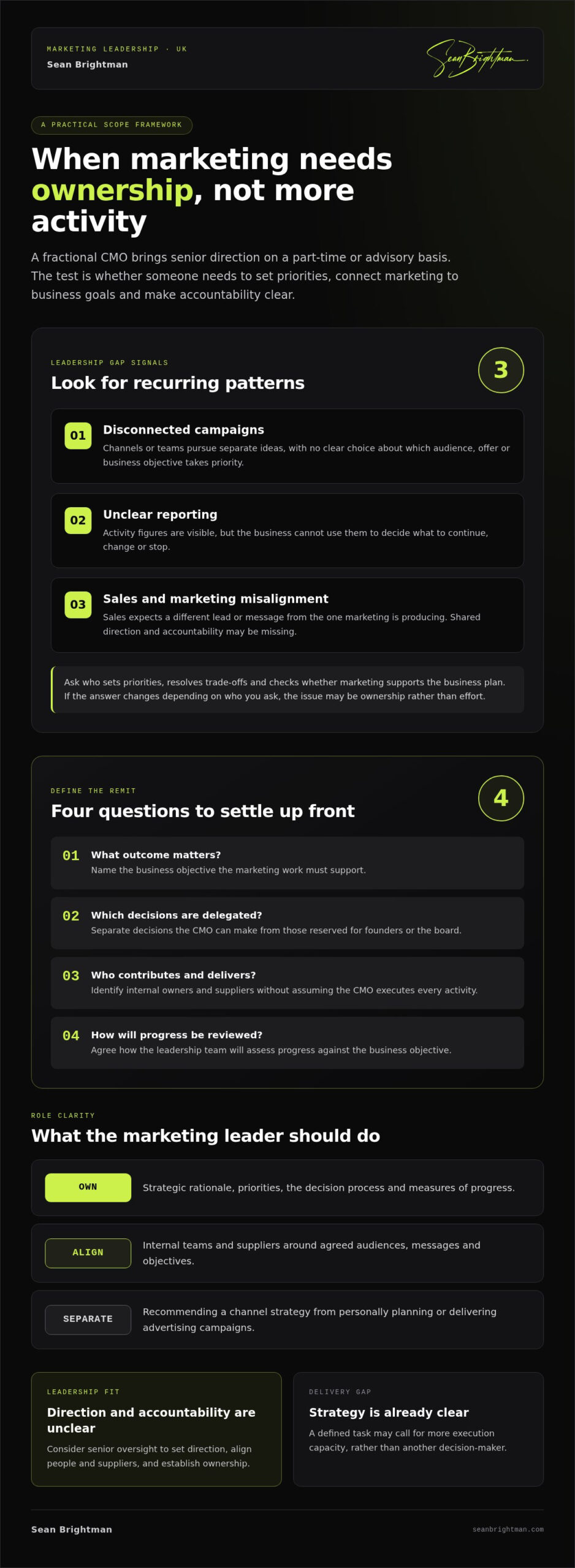
    Look for recurring problems, not one disappointing campaign. A leadership gap often shows up in planning, measurement and team coordination:

    • Disconnected campaigns: Different channels or teams pursue separate ideas, with no clear decision about which audience, offer or business objective takes priority.
    • Unclear reporting: The business sees activity figures but can’t use them to decide what to continue, change or stop. Without agreed measures and context, reports raise more questions than they answer.
    • Sales and marketing misalignment: Sales may expect a different type of lead or message from the one marketing is producing. The issue is often missing shared direction and accountability, not simply poor communication.

    Ask who sets priorities, resolves trade-offs and checks whether marketing supports the business plan. If the answer changes depending on who you ask, the problem may be ownership rather than effort.

    When is fractional leadership a stronger fit than another hire?

    Consider fractional leadership when you need someone to decide what marketing should focus on before adding capacity to deliver more work. A new delivery role can help execute a defined task, but it won’t necessarily resolve conflicting priorities, unclear positioning or the absence of a decision-maker.

    The fit isn’t dictated by a standard revenue figure, headcount or growth stage. Start with the change required. Do you need senior oversight to set direction, align existing people and suppliers, and establish accountability? Or is the strategy already clear, with a specific delivery gap to fill? The first points towards leadership; the second may call for more execution capacity.

    For businesses weighing up a fractional cmo uk engagement, define the decisions this person needs to own and the people they’ll work with. If the core challenge is still unclear, strategic roadmapping can help set priorities before you decide what ongoing leadership should look like.

    What should a fractional CMO UK engagement actually own?

    A fractional CMO should own marketing direction, not simply attend meetings or add opinions. That means setting strategy, sharpening positioning, choosing priorities and ensuring those choices support the business’s objectives. If the company aims to enter a new market, for example, the marketing plan should specify which audience to target and what needs to change to reach them.

    Define the remit before work begins. Spell out which decisions the CMO can make, which need founder or board approval, who they’ll work with and what outputs the business expects. These might include an agreed strategy, a prioritised roadmap, clear measures of progress and regular recommendations informed by evidence. Shape the scope around the challenge, not a generic package.

    Which decisions belong with a fractional marketing leader?

    Set ownership around the choices that shape the whole function: strategic priorities, positioning, resource trade-offs and how progress is assessed. The CMO can align employees and suppliers around those decisions, then raise risks or blockers for leadership to resolve. This creates accountability without making every task the CMO’s responsibility.

    • Own: the strategic rationale, priorities, decision process and measures of progress.
    • Align: internal teams and suppliers around agreed audiences, messages and objectives.
    • Separate: recommending a channel strategy from personally planning or delivering advertising campaigns.

    Leadership is not recruitment. The role should clarify how marketing work fits together, not become a route to placing a full-time executive.

    How should the role work with founders and marketing teams?

    Give the fractional CMO access to the people who can make decisions. Agree who owns marketing priorities, who leads day-to-day work and where approval sits. A marketing manager should gain direction and support, not have their responsibilities silently removed. Set a communication rhythm that suits the decisions ahead, along with a clear route for escalation when priorities conflict or approval stalls.

    Connect each marketing choice to a business objective, then agree how the leadership team will review progress. A useful scope answers four questions:

    1. What outcome matters? Name the business objective the marketing work must support.
    2. Which decisions are delegated? Separate decisions the CMO can make from those reserved for founders or the board.
    3. Who contributes and delivers? Identify internal owners and suppliers without assuming the CMO executes every activity.
    4. What evidence prompts a review? Choose measures that help leaders decide whether to continue, change or stop an approach.

    This clarity matters in the UK business environment, where commercial conditions and trade priorities can shape a company’s plans. The Department for Business and Trade provides the wider UK Business and Trade Landscape; the marketing remit should translate your own business objectives into specific choices and accountabilities.

    A fractional cmo uk engagement works best when authority matches responsibility. If you’re defining that scope, explore Sean Brightman’s fractional CMO support for senior strategic direction without making the role a full-time executive post.

    How to compare fractional CMO options in the UK

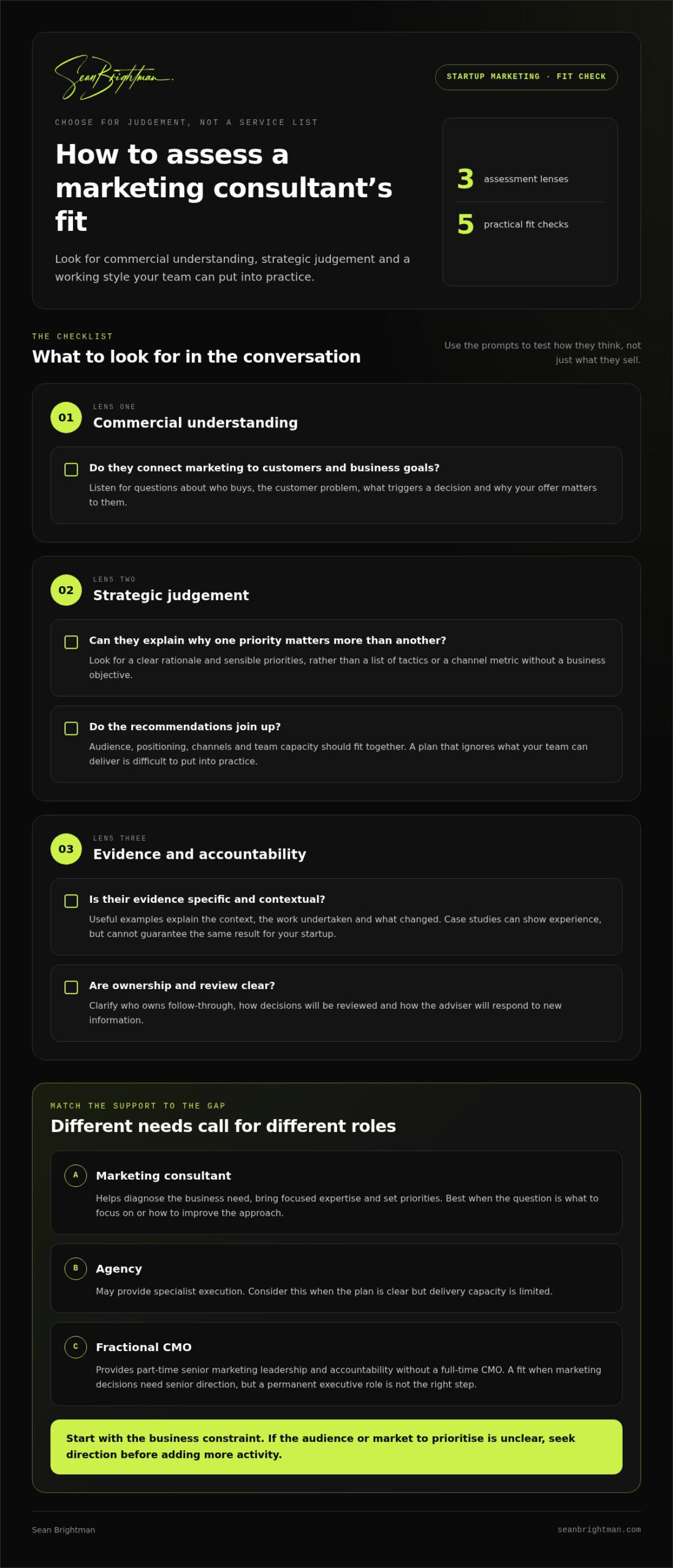
    Don’t compare options by how impressive the title sounds or how many days are on offer. Compare the problem each is designed to solve: ongoing leadership, execution capacity or a defined piece of strategic work. The right choice depends on who needs to set direction, who must deliver the work and where decisions are getting stuck.

    Option Strategic ownership Decision access Team support Delivery responsibility
    Fractional CMO Leads marketing direction and priorities on a part-time basis Needs access to relevant leaders to make or shape decisions Can guide an existing team and coordinate suppliers Owns leadership and accountability, not necessarily execution
    Full-time CMO Leads the marketing function as an ongoing executive role Typically works closely with senior leadership Can build and lead internal marketing capability Sets direction and oversees the function’s work
    Agency Usually works to an agreed strategy or brief Decisions depend on the client-agency arrangement Brings delivery capability for its agreed services Delivers that work rather than owning the whole marketing function
    Project-based consultant Provides advice or expertise for a defined project Works with the people needed for that assignment Can inform or support the team during the project Produces agreed recommendations or project outputs

    Fractional CMO, agency or consultant: what changes?

    An agency can deliver agreed services, while a CMO leads marketing direction and joins up the moving parts. A project consultant can investigate a specific challenge, such as positioning, and recommend a way forward. That work may be valuable, but it doesn’t automatically create ongoing ownership of priorities or stakeholder coordination.

    A fractional CMO provides leadership without being a full-time executive hire. They can set direction, support the internal team and align suppliers around shared priorities. They may recommend a channel strategy, but that’s different from personally planning and delivering advertising campaigns. Choose according to the gap, not a belief that one model is always better.

    What evidence shows the working relationship will fit?

    Look for a clear explanation of what the engagement owns and how recommendations turn into action. Ask how decisions will be made, who needs to be involved, how progress will be reviewed and what happens when priorities conflict. Strong answers connect strategic thinking to practical next steps. Vague promises of “support” don’t tell you who is accountable.

    Start the discussion with the business challenge, current constraints and the decisions you need help making. Don’t begin by buying a preset number of days. That conversation will show whether you need embedded senior leadership, defined project advice or delivery capacity. A fractional cmo uk engagement should make sense because of the decisions it can own, not simply because the arrangement sounds flexible.

    If you need ongoing strategic guidance rather than broader leadership, an advisory retainer can be a useful option to consider when defining the scope.
    Fractional CMO UK: How to Choose the Right Senior Marketing Partner

    How to set up a fractional CMO engagement for useful progress

    A fractional cmo uk engagement needs a clear starting point. Before activity ramps up, agree the business challenge, the decisions that need attention and who will own the next steps. That turns senior input into a working plan, not another stream of meetings.

    Use a simple sequence to get the engagement moving:

    1. Define the challenge. State the business objective and the marketing issue that may be holding it back.
    2. Choose priorities. Agree what matters now, what can wait and what evidence will help you judge progress.
    3. Assign ownership. Name the people responsible for decisions, delivery and removing blockers.
    4. Review and adjust. Set review points to assess progress, resolve trade-offs and record any changes to priorities.

    What should happen before the first working session?

    Bring the material that shows how the business is operating today: objectives, existing strategy, current marketing activity and available performance information. Add a simple view of the team structure, suppliers and practical constraints, such as limited internal capacity or decisions that need leadership approval.

    Identify the decision-makers and the people responsible for current marketing work. Then write down the decisions leaders need help making now. For example, which audience to prioritise, whether to keep investing in an existing activity, or how marketing should support a business objective. A focused agenda makes it easier to separate urgent choices from background noise.

    How do roadmapping and advisory support connect?

    Roadmapping turns diagnosis into direction. It should translate the business challenge into prioritised actions, clarify dependencies and name the person responsible for each next step. A strategy session can establish that structure; strategic brand roadmapping offers further guidance on building a plan around growth priorities.

    Ongoing advisory support can help leaders maintain focus as the plan meets real-world constraints. Use review conversations to test assumptions, make decisions and keep ownership visible. The aim isn’t to preserve a roadmap unchanged. It’s to keep the work aligned as evidence and business needs develop.

    How can a business judge whether the engagement is working?

    Review progress against the priorities and decisions agreed at the outset, not the number of meetings held or marketing tasks completed. Ask whether important choices have been made, owners understand their responsibilities and the work is moving towards the intended business objective.

    If priorities change, revisit the scope rather than letting extra requests accumulate unnoticed. Record what changed, why it changed, who owns the revised actions and what will be reviewed next. This creates a useful record of decisions and keeps accountability clear.

    Ready to turn a marketing challenge into a focused plan? Explore Sean Brightman’s fractional CMO support.

    Work with Sean Brightman as your fractional CMO in the UK

    Senior marketing leadership should bring direction to the work already happening, not add another layer of activity. Sean Brightman provides fractional CMO support for businesses that need clearer priorities, stronger positioning or more accountability across marketing. The starting point is the business’s decision needs: what must change, who needs to be involved and where senior guidance will make a difference.

    When does Sean’s strategic approach make sense?

    Consider this approach if marketing priorities keep shifting, your positioning no longer reflects the business, or campaigns and teams feel disconnected. Sean brings senior strategic oversight to help founders and marketing teams assess their options and agree a direction. Shape the engagement around the decisions the business needs to make, not a preset list of activities.

    There are distinct ways to work together, depending on the need:

    • Fractional CMO support provides senior marketing leadership, strategic direction and accountability as part of the business’s ongoing work.
    • A one-off strategic roadmap can establish priorities and a clearer plan when the main need is direction rather than continuing leadership.
    • An advisory retainer provides ongoing strategic guidance and accountability as leaders work through priorities and decisions.

    These are different scopes, not interchangeable labels. A business that needs a strategic reset may begin with roadmapping. If it needs continued leadership to keep the plan moving and align marketing with business goals, fractional CMO support may be a better fit. Advisory support suits leaders who need an ongoing strategic sounding board and direction without a broader leadership remit.

    AI consulting can support a defined marketing priority, such as improving marketing efficiency or strengthening growth systems. Give it a clear role in the plan rather than treating it as a separate experiment without a business reason.

    What is the practical next step?

    Bring a short, honest picture of the business: its objectives, current marketing setup, people involved and the challenge creating the most friction. Be specific about the decisions you’re wrestling with. For example, you may need to clarify positioning, decide which priorities deserve focus or understand why activity isn’t connecting to commercial goals.

    That context helps establish whether fractional leadership or a one-off roadmap better matches the need. You don’t need to arrive with a polished brief. Start with the situation as it is, then define the right scope around the work and decisions ahead.

    If your business needs senior marketing direction, discuss your marketing leadership challenge with Sean Brightman and explore whether fractional CMO support is the right next step.

    Turn your marketing challenge into a clear next move

    The right fractional cmo uk decision starts with one honest question: which marketing decision is holding the business back? Get specific about what needs to change, and the right level of senior support becomes easier to identify.

    Sean Brightman offers fractional CMO leadership, strategic roadmapping and ongoing advisory support to help businesses bring direction and accountability to marketing. His published book provides an additional resource for thinking through marketing strategy. Connect your current challenge to the kind of support that can address it rather than committing to activity before the need is clear.

    Share the business context, what’s happening in marketing now and the decision you need to make. Explore your next step with Sean and start shaping a more focused way forward.

    Frequently Asked Questions

    Is a fractional CMO worth it for a UK business?

    A fractional CMO can be worth it when senior marketing decisions are slowing progress and a full-time executive role isn’t the right fit. Judge the value against a real business challenge, not a promise of instant growth. For example, if leadership can’t agree which customer segment to prioritise, clearer strategic ownership may help the team focus. The case is weaker if the business lacks capacity to act on decisions or hasn’t identified what needs to change.

    Can a fractional CMO work with an existing marketing agency?

    Yes. A fractional CMO can give an agency a sharper brief by clarifying the audience, business objective and intended role of its work. For example, if an agency manages content, agree who approves the message, who handles feedback and how performance will be discussed. The CMO can provide strategic oversight while the agency delivers its agreed services. Put those responsibilities in writing so requests don’t arrive from several leaders with competing priorities.

    How much time does a fractional CMO spend with a business?

    There’s no universal schedule; involvement should match the decisions and coordination the business needs. A business with an established team and clear processes may need less day-to-day input than one facing a major positioning decision involving several stakeholders. Agree how often to review priorities, which meetings require the CMO’s involvement and how leaders can raise urgent decisions. For fractional CMO UK support, define the scope around these needs rather than treating days booked as a measure of value.

    Is a fractional CMO the same as a marketing consultant?

    No, not necessarily. A consultant might be brought in to analyse a specific issue, such as why a product launch missed its intended audience, then deliver recommendations. A fractional CMO may have a broader leadership remit, helping the business make ongoing marketing choices and supporting the people responsible for acting on them. Titles alone won’t settle the distinction. Check the agreed scope for decision rights, expected outputs and who remains accountable after advice is delivered.

    Can a fractional CMO help a business use AI in marketing?

    Yes, if AI addresses a defined marketing need rather than becoming a project for its own sake. For instance, a business might investigate whether AI could reduce manual work in a repeatable content process or support a specific growth system. Start by describing the task, its current owner and what improvement would matter. Then decide who will assess the approach and how you’ll judge whether it helps before changing tools or workflows.

    What happens if our marketing priorities change during an engagement?

    Revisit the plan and agree what the change means for current work. A new product launch or a shift in business focus may make an existing task less urgent, but don’t leave the change in informal conversations. Record which activity will pause, continue or move up the list, who owns the revised actions and when the decision will be reviewed. This keeps the engagement responsive without making every new request an automatic priority.

  • Consequences of No Marketing Strategy: The Hidden Cost of Guesswork

    Consequences of No Marketing Strategy: The Hidden Cost of Guesswork

    Marketing without a strategy doesn’t just waste budget. It creates more activity without building a clear picture of what works. The consequences of no marketing strategy often creep in quietly: campaigns run, content goes out and suppliers stay busy, yet nobody can clearly connect the effort to business outcomes.

    If that feels familiar, the problem may not be a particular channel or a team that isn’t trying hard enough. Without a shared direction, priorities drift, messages conflict and decisions get made on instinct. Spend and effort keep moving, but useful learning doesn’t accumulate. That makes growth harder to manage.

    This article explains the commercial and operational consequences, from wasted effort and weakened focus to missed growth opportunities. You’ll learn how to find the underlying causes without defaulting to channel-blaming, then identify practical ways to regain direction. The aim isn’t a sprawling plan or more process. It’s a clearer link between business priorities, marketing choices and accountable action.

    Key Takeaways

    • Spot the difference between having no strategy and needing to update an existing one.
    • Trace how unclear priorities can trigger inconsistent decisions, duplicated work and weaker learning.
    • Use practical signals to distinguish strategy problems from execution problems before changing channels.
    • Understand the consequences of no marketing strategy and why reviewing existing evidence should come before commissioning more activity.
    • See how a roadmap, advisory support or fractional CMO leadership can help turn diagnosis into focused, accountable action.

    No marketing strategy: when activity lacks direction

    Marketing strategy is the set of choices that connects business goals to the people you need to reach, the position you want to own and the priorities that guide your effort. It answers four practical questions: who matters, why they should choose you, what deserves attention and how marketing supports the business. The Marketing Strategy overview provides useful background on the discipline. In practice, the test is whether those choices guide real decisions.

    Strategy-free marketing is activity without a shared reason for choosing one audience, message or priority over another. That doesn’t mean every task needs a lengthy plan. It means people can explain how their work contributes to a common objective and what they expect to learn from it.

    A missing strategy is different from an outdated one. If the business has clear choices but its audience, offer or market conditions have shifted, the strategy may need reviewing. If teams can’t agree on whom they’re trying to reach or what matters most, the gap is more fundamental. The consequences of no marketing strategy begin when decisions lack that common reference point.

    How do you recognise marketing without a strategy?

    Look at how choices get made. A business might join a social platform because a competitor is there, commission content because it’s been a while, then change the message after one quiet week. Each decision can sound reasonable in isolation. Together, they may reveal that there’s no consistent rationale.

    Ask who each activity serves and which business priority it supports. If colleagues give different answers, or nobody can explain what the work should teach the business, visible busyness may be masking a lack of progress. Look at whether the intended audience responds, whether the message is understood and whether the activity supports a defined goal. Without a question to test, results are harder to interpret.

    Why does marketing activity alone fail to create direction?

    A tactic can distribute a message, but it can’t decide what the business should stand for or which audience deserves focus. If positioning is unclear, producing more posts or launching another campaign simply spreads the uncertainty across more places. Initiatives then compete for attention, budget and internal support instead of reinforcing one another.

    That doesn’t make every disappointing result proof that strategy is absent. A single campaign may underperform because of its execution, timing or offer. The useful distinction is whether the business can explain what it was testing, what it learned and how that learning will shape the next decision. If priorities and audiences keep changing, comparisons become unreliable because too many variables have changed to show what influenced the result.

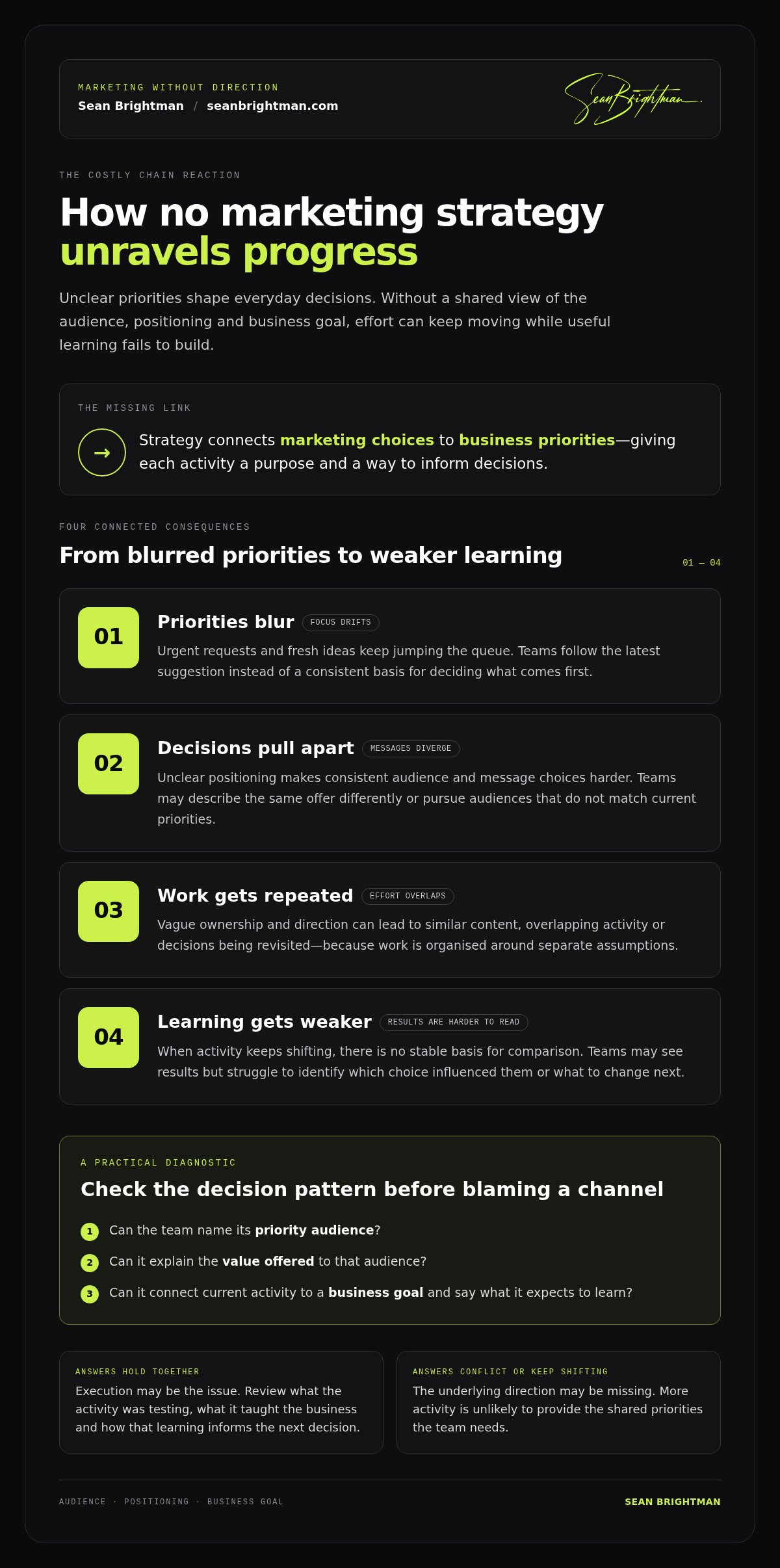
    Start with the decision-making pattern, not the channel. Can the team name its priority audience, explain the value it offers them and connect current activity to a business goal? If those answers hold together, execution may be the issue. If they conflict or keep shifting, adding more activity is unlikely to provide the missing direction.

    How no marketing strategy creates a costly chain reaction

    The damage rarely starts with one dramatic mistake. It builds as unclear priorities shape everyday decisions. Without a shared view of the audience, positioning and business goal, each team fills in the gaps differently. One initiative targets new prospects, another focuses on existing customers, and neither has a clear reason to take priority.

    Strategy connects marketing choices to business priorities, so each activity has a clear purpose and can inform a decision. Without that link, teams may stay busy while the business struggles to tell whether its effort is moving in a useful direction.

    1. Priorities blur. If leaders haven’t agreed what marketing needs to support, urgent requests and fresh ideas keep jumping the queue. Teams respond to the latest suggestion instead of using a consistent basis for deciding what comes first.
    2. Decisions pull apart. Unclear positioning makes it harder to choose an audience and message consistently. Different teams may describe the same offer in different ways, or pursue audiences whose needs don’t match the business’s current priorities.
    3. Work gets repeated. When ownership and direction are vague, people may create similar content, commission overlapping activity or revisit decisions already made. The issue isn’t necessarily a lack of effort. It’s effort being organised around separate assumptions.
    4. Learning gets weaker. As activity shifts, teams lose a stable basis for comparing what happened. They may see results, but struggle to tell which choice influenced them or what to change next.

    How does strategic uncertainty waste time and budget?

    Repeated starts, stops and channel changes absorb attention. A team might begin preparing one campaign, pause it when a new priority appears, then redirect the work elsewhere. Each change can have a sensible trigger, but without agreed criteria, the business spends time and coordination resetting its work.

    Unclear ownership compounds the problem. Internal teams and suppliers can produce overlapping work because nobody has set the priority, defined responsibilities or aligned the brief. These are signs of friction, not a reliable basis for claiming a fixed financial loss. A practical first step is to clarify who decides, who delivers and what the activity must support.

    Why does the absence of strategy weaken learning?

    Results need a question behind them. If a campaign has no clear objective, a rise in enquiries might look positive without showing whether they came from the intended audience or support a business priority. Data alone can’t supply the missing context.

    Frequent changes make interpretation harder still. Change the audience, message and channel together, and a different result won’t tell you which change mattered. Keep a record of the goal, the choices made and the evidence reviewed. Then use that evidence to make a defined next decision, rather than treating every result as a verdict on the whole marketing effort.

    If teams can’t agree on the priority or the next decision, strategic oversight can bring those choices into focus. Explore strategic marketing leadership to connect priorities with accountable action.

    Missing strategy or poor execution: what is the problem?

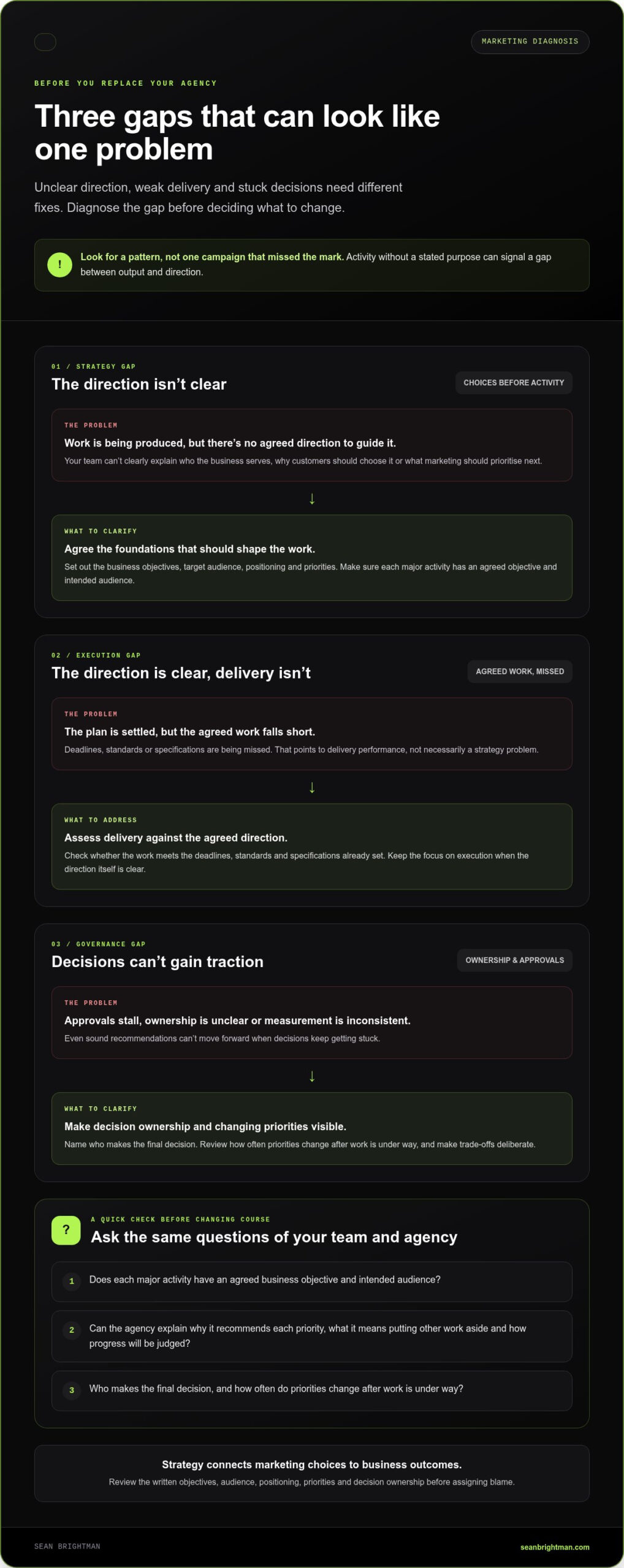
    A marketing problem can start with the direction or with the delivery. Confuse the two and you risk fixing the wrong thing: adding channels won’t settle competing priorities, and rewriting strategy won’t resolve a stalled approval process. Treat the signs as clues, then check them against actual decisions, briefs and delivery.

    Strategy gap
    Execution problem
    Leaders disagree about priority audiences, positioning or the business outcome marketing should support.
    The agreed audience and outcome are clear, but activity is delayed or inconsistently delivered.
    Messages and priorities keep changing, with no shared rule for making those choices.
    The message and priority are agreed, but ownership, approvals or production get in the way.
    Teams struggle to explain why current activity matters to the business.
    Teams can explain the purpose, but lack clear owners, timing or decisions to carry it out.

    These signals can overlap. A late campaign might reflect a slow approval process, or leaders who haven’t settled the audience and message. Don’t assign blame from one missed deadline or disappointing result. Look for patterns, and compare what was agreed with what actually happened.

    What are the warning signs of a strategy gap?

    Ask leaders separately to name the priority audience, the position the business wants to occupy and the outcome marketing should support. Then compare their answers. Different wording is normal; conflicting priorities are more telling. Check whether direction changes follow an agreed decision rule, such as new evidence or a shift in business priorities. If not, ask each team to explain why its current activity matters. Vague or contradictory answers point towards a strategy gap.

    When is the strategy clear but execution breaking down?

    If leaders agree on direction, test the handover into delivery. Does each priority have an owner, a realistic timeframe and a clear route for decisions or approvals? Find where work stalls: unclear responsibility, delayed feedback or capacity constraints may be the bottleneck. Address that demonstrated problem before adding another channel or revisiting the strategy. The consequences of no marketing strategy differ from poor execution, and the remedy depends on the evidence.

    Use a simple diagnostic: write down the agreed priority, the activity meant to support it, its owner and the next decision. If the priority itself is disputed, resolve the strategic question first. If the direction is settled but delivery breaks down, fix the handover. This keeps diagnosis grounded in evidence, not frustration with a particular person or channel.

    Consequences of No Marketing Strategy: The Hidden Cost of Guesswork

    What to do when your business lacks a marketing strategy

    Don’t respond to uncertainty by launching another campaign. First, pause long enough to see what the business is already doing, what it’s meant to achieve and where decisions are getting stuck. A reset should create direction, not a bigger planning exercise.

    Work through these decisions in order:

    1. Pause new commitments. Hold off on commissioning fresh campaigns or adding channels until you understand existing priorities and activity. This isn’t a call to abandon work already in progress. It’s a chance to stop new requests from making the picture harder to read.
    2. Clarify the business objective. Name the business goal marketing needs to support, such as generating demand for a particular offer or strengthening relationships with existing customers. Make it specific enough to guide choices, rather than relying on broad ambitions like “grow the brand”.
    3. Review what you already know. Gather current plans, customer feedback, sales conversations and available performance evidence. Look for useful patterns and unanswered questions before deciding that a channel has failed or needs replacing.
    4. Choose an audience and position. Agree which audience deserves focus and what value the business wants them to recognise. Record assumptions that need testing, such as whether a particular customer group understands the offer. Treat these as questions, not settled facts.
    5. Set decision criteria. Decide how new ideas will be assessed. For example, does the activity support the chosen business goal, reach the priority audience and generate evidence that can inform a next step? Criteria help teams say no to distractions without turning every decision into a debate.

    A strategic brand roadmapping guide can help leaders structure these choices and connect them to a practical direction. The aim isn’t to document every possible tactic. It’s to make the important choices clear enough for teams to use.

    Which decisions should leaders make first?

    Settle the business objective before choosing channels. Then agree who marketing needs to reach and what position or value proposition should guide the message. If leaders disagree, make that disagreement visible and resolve it with the best evidence available. Where evidence is thin, write down the assumption and decide how you’ll test it. This prevents opinion from quietly hardening into strategy.

    How can you turn priorities into accountable action?

    Give each priority an owner, a next step and a review point. Define what evidence will inform the next decision, such as qualified enquiries or feedback from the intended audience, rather than relying on activity counts alone. Connected processes matter too. The marketing operations growth engine explores how clear processes can support coordinated delivery.

    The consequences of no marketing strategy ease when choices become visible and reviewable, not when the plan grows longer. If you need senior strategic guidance to turn diagnosis into accountable action, explore strategic marketing support.

    How strategic marketing leadership restores focus and accountability

    Once the business knows where direction is missing, senior strategic oversight can connect business priorities, positioning, audiences and the decisions that shape marketing activity. The value isn’t another layer of approval. It’s a clear point of accountability, so teams understand why priorities matter, who owns the next move and how evidence will inform what happens next.

    The right level of support depends on the gap. A business that needs to set direction may not need ongoing leadership straight away. A team with an agreed plan but no consistent strategic ownership may benefit from support that continues beyond the planning stage.

    When does a business need a roadmap, adviser or fractional CMO?

    Choose the format that matches the job to be done. These options address different needs, and none replaces the people responsible for delivering the work.

    • Roadmapping: A focused way to make strategic choices, set priorities and turn open questions into a structured direction. Useful when the business needs a clear plan before committing to more activity.
    • Advisory support: Ongoing direction and accountability as leaders apply the plan, review decisions and respond to new evidence.
    • Fractional CMO leadership: Part-time senior marketing leadership that connects business priorities to marketing decisions and provides direction across the work.

    The distinction is practical: a roadmap sets the route, advisory support helps leaders stay on course, and fractional CMO leadership provides senior oversight as marketing decisions and delivery continue.

    What should change after strategic leadership is in place?

    Look for better decisions, not instant results. Priorities should be easier to explain, ownership clearer and reviews more useful. Teams should be able to connect their activity to a business objective, then discuss what the evidence suggests without changing direction at the first sign of uncertainty.

    • Clearer ownership: People know who makes decisions, who carries out agreed work and when progress gets reviewed.
    • More consistent choices: New ideas are assessed against priorities and positioning, rather than accepted simply because they’re available.
    • Stronger organisational learning: Reviews capture what the business learned and how that learning shapes the next decision.

    These changes create a more disciplined way to manage marketing, but they don’t guarantee a fixed growth result or remove the need for execution. Strategy sets direction; teams still need to deliver, assess evidence and adapt when circumstances change. The consequences of no marketing strategy are less likely to persist when choices have owners, a clear rationale and a regular review.

    If your business needs clearer direction and accountability, explore strategic marketing support and identify the level of leadership that fits the challenge.

    Make your next marketing decision count

    The consequences of no marketing strategy aren’t fixed. You can interrupt them by stopping the assumption that every new idea is the answer and making deliberate choices about what deserves attention. The next step isn’t to plan everything. It’s to create enough direction for your business to act, learn and adjust with purpose.

    That shift may call for a focused roadmap, ongoing advisory support or senior leadership through a Fractional CMO. The right support connects marketing decisions to business priorities and keeps accountability in view, without confusing strategic direction with outsourced advertising execution.

    If guesswork is making it harder to decide what comes next, take a step towards clarity. Get clear on your marketing direction and move forward with greater focus.

    Frequently Asked Questions

    What happens to a business with no marketing strategy?

    A business can still attract customers, but its marketing decisions may become harder to coordinate and assess. For example, a strong month of referrals might prompt a sudden shift in attention, even if the business hasn’t established whether referrals can support its future goals. The consequences of no marketing strategy can include missed opportunities to build on useful learning, because activity isn’t guided by a stable set of choices.

    Can a business grow without a marketing strategy?

    Yes. A business can grow through referrals, repeat custom, strong demand or an effective individual campaign. The challenge is making growth more deliberate and repeatable. If success depends on one founder’s network or an unplanned surge in interest, it may be difficult to know what to invest in next. A strategy helps leaders decide which opportunities fit the business, rather than assuming every source of growth should be pursued.

    How can I tell whether my marketing strategy is missing?

    Ask several people involved in marketing to explain, independently, which customers the business most wants to reach and why those customers should choose it. Then compare the answers. If they point to different audiences, offers or priorities, the gap may be strategic. Also check recent decisions: can the team explain why an activity was chosen, or does the answer rely mainly on habit, a competitor’s actions or someone’s preference?

    Is a marketing plan the same as a marketing strategy?

    No. A strategy sets the choices and rationale: whom the business wants to serve, what it wants to be known for and how marketing supports its goals. A plan turns that direction into organised work, such as campaigns, responsibilities, timings and resources. A detailed calendar can therefore exist without a coherent strategy. Check that planned activity reflects deliberate choices, not simply a list of tasks waiting to be completed.

    Does having a marketing strategy guarantee more sales?

    No. A strategy can improve the quality and consistency of decisions, but it can’t guarantee sales. Results also depend on factors such as the offer, customer demand, delivery and competitors’ actions. Treat the strategy as a guide for making choices and learning, not a promise of a particular result. If sales don’t move as hoped, review the evidence and consider whether the assumptions, execution or wider business conditions need attention.

    How often should a business review its marketing strategy?

    Set a regular review rhythm, then revisit the strategy sooner if a major change affects the business, such as a new offer, a shift in customer demand or a change in commercial priorities. A quarterly review can provide a useful routine for checking assumptions and progress, but it isn’t a rule for every organisation. Avoid changing direction in response to every short-term fluctuation; look for evidence that a key assumption or priority has genuinely shifted.

  • Measuring the ROI of AI in Marketing: A Practical 2026 Framework

    Measuring the ROI of AI in Marketing: A Practical 2026 Framework

    AI activity is not proof of marketing impact. Measuring the roi of ai in marketing means showing what changed because of AI, not simply counting prompts, generated content or hours saved.

    The challenge is separating AI’s contribution from other changes. Revenue can shift as channels, customer behaviour and market conditions change, while software, implementation and oversight costs sit in different budgets. Without a baseline and a credible comparison, the business case is guesswork.

    This practical 2026 framework will help you set a baseline, choose metrics that match a business objective and compare the full cost of an AI use case with its attributable financial and operational value. You’ll learn how to distinguish time saved from revenue gained and account for the limits of attribution without giving up on measurement.

    We’ll move from defining the use case to reviewing the evidence, so you can decide whether to scale, change or stop it. The aim isn’t to prove AI is valuable. It’s to find out whether a particular use case earns its place in your marketing system.

    Key Takeaways

    • Start with a business problem and a measurable hypothesis, not an AI tool or activity count.
    • Calculate ROI using benefits attributable to AI, and include the full cost of tools, implementation and oversight.
    • Choose a comparison method that suits the use case, using a control or credible counterfactual where possible.
    • For measuring the roi of ai in marketing, track financial results alongside workflow effects, output quality and operational risks.
    • Set an owner, review window and decision threshold so you can scale, adjust or stop each use case based on evidence.

    Why measuring the ROI of AI in marketing starts with a business problem

    Start with the business constraint, not the software. A team might use AI to draft emails, analyse customer feedback or speed up campaign planning. None of those activities proves that marketing is working better. Measuring the roi of ai in marketing means assessing the business value attributable to AI against the full investment required to achieve it.

    That value could mean more qualified demand, stronger contribution margin, improved customer retention or the same quality of work delivered with less effort. The right outcome depends on the problem. A useful foundation is Marketing effectiveness and ROI, applied to a specific AI use case rather than AI adoption in general.

    Keep the decision in view from the start: will the evidence support scaling, redesigning, pausing or stopping the use case? Without a decision to inform, teams can collect plenty of activity data and still have no clear next move.

    Which marketing problem is AI meant to solve?

    Describe the business constraint in plain language. For example, prospective customers may abandon a lengthy enquiry journey, campaign production may take too long, or the team may lack useful insight for tailoring follow-up. Then set boundaries: which audience is affected, where in the customer journey the issue occurs, which workflow AI will change and who owns the result.

    Set the objective before choosing a tool or metric. “Use AI to produce more content” describes a task. “Help the team respond to product enquiries sooner, with the aim of improving qualified consultation bookings” states a testable business intent. The accountable owner should be able to explain why the outcome matters and what evidence would change the decision.

    Why AI activity is not the same as ROI

    Prompts submitted, drafts generated and tasks automated show that a system is being used. Time saved may indicate a workflow benefit, but it becomes financial value only when the organisation puts that capacity to productive use or reduces a real cost. More output does not automatically mean more qualified demand, better margins or repeat customers.

    Consider an AI-assisted email workflow. It may produce more campaign variations in less time, but the business still needs to know whether those changes brought in suitable prospects or improved retention. A rise in bookings during the same period is not proof on its own. Seasonality, pricing changes, a new offer or activity in other channels may also have influenced the result.

    AI adoption is the use of a system; measurable marketing impact is a demonstrable change in a business outcome that can reasonably be attributed to its use. Activity reports are useful operational evidence, but they are not a substitute for business value.

    Before a pilot begins, record the problem, owner, intended outcome and decision the evidence must support. This turns an AI experiment into a business test and gives the next steps, calculating the investment and comparing results, a meaningful target.

    How to calculate AI marketing ROI without hiding the costs

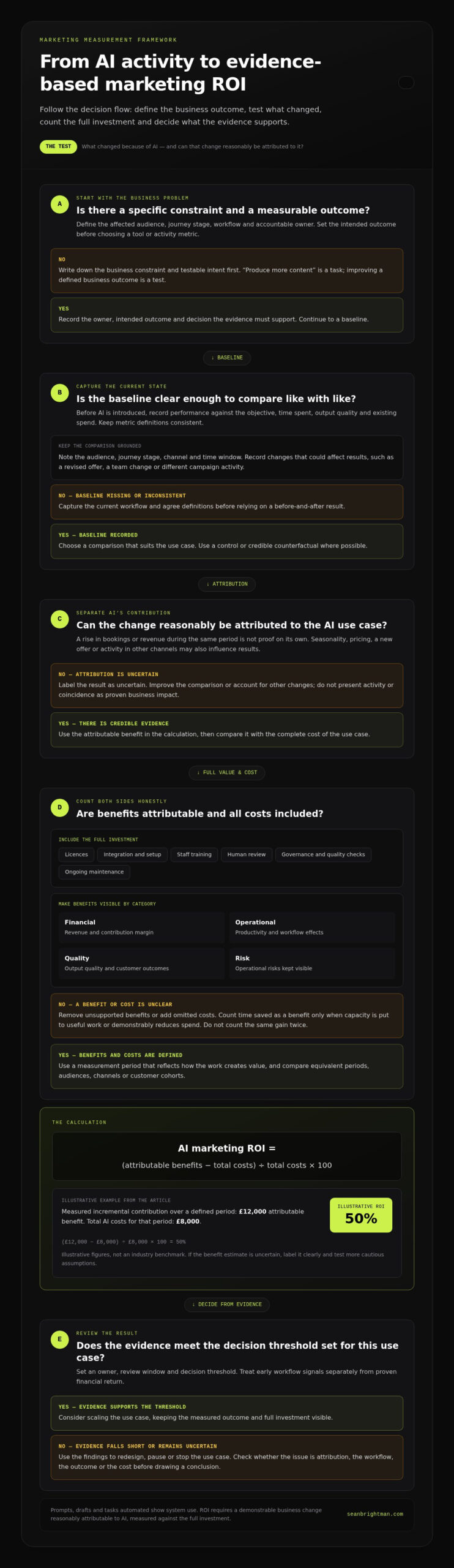
    Once the use case has a defined objective, compare its value and investment on the same basis. Use this formula:

    AI marketing ROI = (attributable benefits − total costs) ÷ total costs × 100

    Use benefits you can reasonably connect to the AI use case, expressed in pounds where possible. Choose a measurement period that reflects how the work creates value, then compare like with like: equivalent periods, audiences, channels or customer cohorts. A short pilot may reveal workflow changes before any effect on revenue, so don’t treat an early operational signal as a proven financial return.

    Build a baseline before switching on AI

    Capture the current state of the specific workflow: performance against the chosen business objective, time spent, output quality and existing spend. Keep definitions consistent. If you’re tracking qualified enquiries, for example, agree what qualifies before the test and apply the same criteria afterwards.

    Record the audience, journey stage, channel and time window as well. Note changes that could muddy the comparison, such as a revised offer, a team change or a shift in campaign activity. This context helps explain changes in the results and distinguish a genuine difference from a change in conditions.

    Count costs and benefits without double-counting

    Calculate the full investment, not just the software bill. Include costs involved in putting the use case into operation and keeping it useful:

    • Licences, integration and setup
    • Staff training and human review
    • Governance, quality checks and ongoing maintenance

    Count staff time saved as a benefit only if the capacity is redeployed to useful work or demonstrably reduces spend. Don’t claim the same gain twice. If faster production creates extra campaign output, for instance, don’t also count those same hours as a separate cash saving unless the benefits are distinct and evidenced. Keep revenue, contribution margin, productivity and risk benefits visible as separate categories.

    Here’s a worked example using illustrative figures, not an industry benchmark. Suppose a team estimates £12,000 in attributable benefit over a defined period, based on measured incremental contribution, and records £8,000 in total AI costs for that period. The calculation is (£12,000 − £8,000) ÷ £8,000 × 100, giving an illustrative ROI of 50%. If the benefit estimate is uncertain, label it clearly and test how the result changes under more cautious assumptions.

    Include full implementation and oversight costs in ROI. Ignoring the work required to create and maintain a return overstates its value. A clear AI consulting and scalable growth engine guide can help connect use-case choices to a broader marketing system. Strategic AI marketing guidance can also help clarify ownership, costs and the business decision behind the calculation.

    How to compare AI marketing results and prove what changed

    A result only means something when set against a credible comparison. To judge an AI use case, estimate what happened with it and what would likely have happened without it. That second view is the counterfactual. A control group can provide a strong comparison, but the best method depends on the workflow, available data and whether audiences can be separated fairly.

    Use this guide to choose a method. Each provides evidence with limitations, not automatic proof.

    Method Data needed Main limitation
    Controlled test Comparable groups, consistent tracking and enough activity to assess the outcome May be impractical if audiences are small or the workflow affects everyone
    Matched cohorts Groups similar in relevant traits, behaviour and exposure Unmeasured differences can still influence the result
    Before-and-after Consistent measures from a period before and after implementation Seasonality, campaign changes or wider market shifts can confound results
    Modelling Reliable historical data and clearly stated assumptions Outputs depend on model quality and assumptions, not direct experimental proof

    Choose a measurement method that fits the use case

    Use a controlled experiment when you can allocate comparable people or workflows to AI and non-AI groups without disrupting the customer experience. If random allocation isn’t practical, compare matched cohorts and document how they differ. Before-and-after analysis can identify a signal, but treat it as directional if seasonality, campaigns or team changes overlap. Modelling can help explore scenarios, but state its assumptions plainly.

    An observed lift is not automatically an AI-caused lift. If several things changed together, attribution reports may show where outcomes were recorded, but they can’t isolate the cause on their own. Note the other changes, explain what the method can and can’t establish, and avoid presenting a platform’s own attribution output as independent proof.

    Select metrics across the marketing funnel

    Pair an early signal with an outcome further down the journey. For an AI-supported lead workflow, you might track response time and completed enquiries alongside sales-qualified pipeline or contribution. More clicks or faster replies can indicate progress, but they don’t confirm that leads are suitable or commercially valuable.

    Customer acquisition cost and conversion quality are useful only when you apply consistent attribution rules before and during the comparison. Tools such as Google Analytics 4, HubSpot or Salesforce may help bring together relevant journey or customer data, depending on how your organisation records activity. Check that definitions, tracking and reporting windows align before comparing results.

    In practice, measuring the roi of ai in marketing requires a clear line from the AI change to the business outcome, plus a comparison that makes alternative explanations visible. Record the method, metric definitions and caveats with the result. This gives decision-makers evidence they can assess, rather than a lift that looks convincing only in a dashboard.

    Measuring the ROI of AI in Marketing: A Practical 2026 Framework

    A practical process for measuring AI marketing ROI over time

    A useful pilot is designed to support a decision, not just generate a report. Before work begins, agree who owns the use case, what result you expect, how you’ll measure it and what evidence would change your course. This makes measuring the roi of ai in marketing an operating discipline rather than a one-off calculation.

    Run a pilot with a decision attached

    Choose one bounded use case with an owner and accessible baseline data. Write a short hypothesis, such as: “Using AI to support this workflow will reduce handling time without lowering output quality.” Add the business outcome it should influence, the measurement window and the threshold for scaling, refining or stopping. Keep the scope narrow enough to identify what changed.

    Track the work behind the headline result. Log human review time, rework, errors and how consistently the team uses the process. A faster workflow can still create extra checking or quality problems that erase its value. Review the evidence at checkpoints agreed in advance. Extend the test only if a specific uncertainty remains, such as whether the result holds across another cohort or a longer customer journey.

    Turn results into an operating decision

    At each checkpoint, compare the evidence with the original hypothesis and decision threshold. Don’t move the goalposts because the results are inconvenient. Use a simple decision rule:

    • Scale when gains appear repeatable, exceed full costs and don’t come with unacceptable quality or operational risks.
    • Refine when results look promising but workflow friction, inconsistent adoption or weak data prevents a clear judgement.
    • Stop or pause when evidence remains weak, costs outweigh value, risks are too high or the underlying business problem has changed.

    Record the decision, evidence and unresolved caveats in one place. Assign an owner to each next action, whether that means expanding the test, fixing a process issue or retiring the use case. This creates accountability and makes future reviews more useful than a dashboard snapshot.

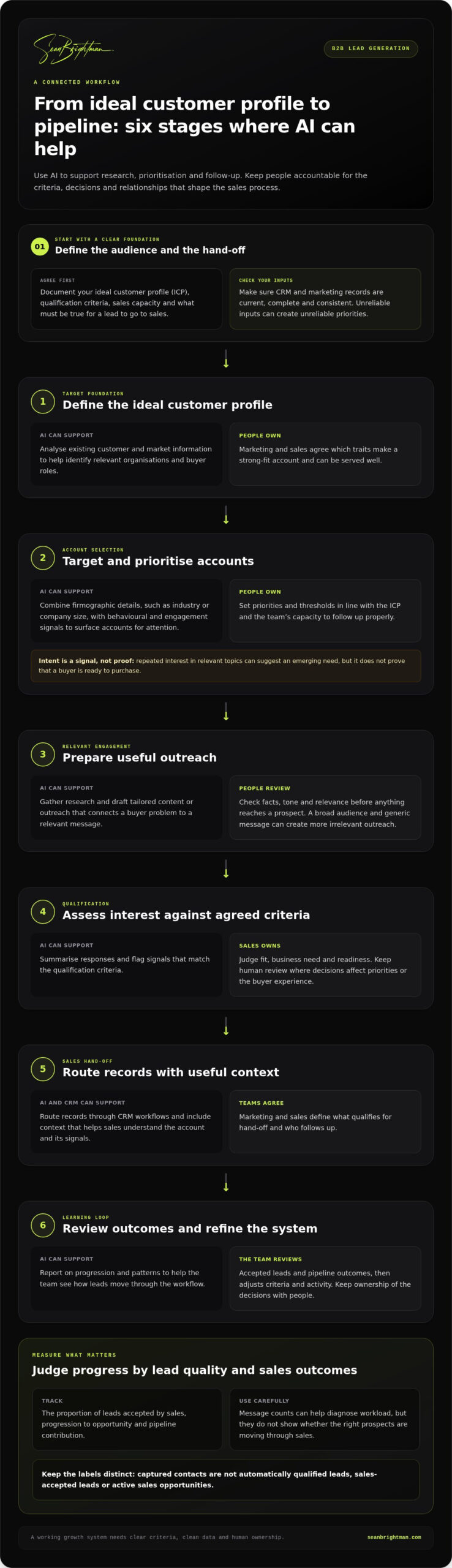
    Results can also show that the issue goes beyond one tool. When several use cases compete for attention, a structured marketing roadmap can help sequence the work around business priorities, owners and evidence instead of adding disconnected experiments.

    For senior guidance on setting up accountable AI use cases and reviewing evidence over time, discuss your AI marketing measurement approach.

    When strategic guidance can make AI marketing ROI measurable

    Measurement often breaks down between teams. Marketing may track engagement, finance may focus on contribution, and operations may see the extra review work. If data sits in separate systems or no one owns the full customer journey, connecting an AI use case to a business result is difficult. Competing priorities add to the problem: teams test tools without agreeing which business objective comes first.

    Strategic guidance creates a shared framework for measuring the roi of ai in marketing. It connects each proposed use case to a growth priority, a customer need and the operational constraints involved. It doesn’t guarantee a return. It makes the investment testable, with clearer ownership and agreed criteria for deciding what happens next.

    What strategic AI marketing support should clarify

    Before committing further investment, bring marketing, finance and operational perspectives into the same evaluation. A roadmap can sequence use cases by business relevance and readiness, rather than treating every idea as equally urgent. For each priority, clarify:

    • Business fit: Which growth priority or customer need does the use case address, and what workflow will it change?
    • Accountability: Who owns implementation, the evidence and the decision to continue?
    • Measurement: Which outcome, baseline and review points will show whether the use case is working?
    • Constraints: What data gaps, quality checks or operational dependencies could affect the result?

    These questions expose weak cases early. If the team can’t access the data needed to evaluate an idea, the roadmap can make resolving that gap a priority or sequence a more measurable use case first. If several teams contribute to the outcome, agree who supplies which evidence so responsibility doesn’t disappear between handovers.

    Choose the next step based on your measurement gap

    If priorities are scattered or teams lack evaluation criteria, a focused roadmap can set direction and sequence the next use cases. If leaders already have a plan but need regular review, an advisory retainer can provide ongoing direction and accountability. The marketing advisory retainer guide offers context for that continuing leadership role.

    Strategic support should challenge assumptions, bring the right people around the evidence and adjust the plan as results emerge. It should not promise guaranteed returns. The aim is disciplined decision-making: invest where the business case is credible, improve what remains unclear and stop activity that no longer serves the objective.

    If you’re ready to turn disconnected AI experiments into a measurable plan, build a clearer AI marketing measurement plan.

    Make evidence part of your next marketing decision

    Make measurement part of how you plan marketing, not a report assembled after the budget has been spent. Put AI use cases alongside other priorities and review them when making decisions about capacity, customer experience and growth. This keeps promising experiments connected to real work and gives underperforming ones a clear route to change or closure.

    Measuring the roi of ai in marketing is more useful when it shapes what the team does next. Practical AI consulting can focus on applying AI to marketing efficiency and output, while a structured roadmap and ongoing advisory accountability help keep decisions aligned as priorities shift. The aim isn’t to justify every AI investment. It’s to make deliberate choices based on evidence and keep improving the system as you learn.

    Ready to turn your measurement gap into a practical next step? Build a clearer AI marketing measurement plan and move forward with greater confidence.

    Frequently Asked Questions

    How do you calculate the ROI of AI in marketing?

    Subtract the use case’s total costs from the benefits you can attribute to it, divide by those costs and multiply by 100. For example, if a defined workflow shows £9,000 in attributable benefit against £6,000 in costs, the illustrative ROI is 50%. Measuring the roi of ai in marketing also means explaining how you estimated the benefit and what other factors could have contributed.

    What costs should be included when measuring AI marketing ROI?

    Include the costs required to put the use case into operation and keep it working: licences, integration, staff training, human review, governance and maintenance. Account for internal time where it creates a real cost or uses capacity that could otherwise support valuable work. If one tool serves several teams, allocate its shared costs consistently rather than charging the entire amount to whichever use case is easiest to measure.

    Can AI marketing ROI be measured without a control group?

    Yes. A control group can strengthen the comparison, but it isn’t the only option. You might compare similar customer cohorts, examine a consistent period before and after implementation, or model likely outcomes using historical data. State the limits: a before-and-after comparison may be affected by a changed offer or seasonal demand, while matched groups may differ in ways your data doesn’t capture.

    Which metrics show whether AI is helping marketing?

    Choose metrics that match the job AI is doing, then connect process signals to customer or commercial outcomes. For lead qualification, monitor how many leads meet agreed criteria and progress to sales conversations, not just how quickly they’re processed. For customer communications, examine response and conversion quality alongside engagement. Add checks for errors, rework and customer feedback so a faster process doesn’t conceal a weaker experience.

    How long does it take to see a return from AI in marketing?

    There’s no single reliable timeframe. A workflow change may appear before a sales or retention effect, particularly if customers take time to make a decision. Set the review window around the use case and the length of the customer journey. Check early indicators as signals, then allow enough time for the outcome that matters to become visible before making a firm investment decision.

    What if AI saves time but does not increase revenue?

    Treat time saved as an operational benefit, not automatically as financial return. Work out what happens to the freed capacity: can the team use it for higher-value work, improve service or avoid additional spending? If the hours simply disappear from the workflow without changing output, cost or capacity, record the efficiency gain but don’t claim a cash saving. The use case may still be worthwhile if that benefit supports a clear business priority.

    Should businesses measure AI marketing ROI for every tool?

    Measure use cases in proportion to their cost, reach and business importance, rather than building a heavyweight analysis for every small feature. Prioritise tools that influence customer decisions, consume meaningful staff time or introduce quality and operational risks. For low-impact features, a light review of usage, cost and workflow effect may be enough. Also check whether overlapping tools duplicate capabilities or create costs that no single team sees.

  • Risks of Hiring a Full-Time CMO Too Early: What Growing Businesses Need to Know

    Risks of Hiring a Full-Time CMO Too Early: What Growing Businesses Need to Know

    A full-time CMO can be the wrong hire, even when your business badly needs better marketing. The risks of hiring a full-time CMO too early begin when you commit to executive capacity before there is enough strategic work, a clear mandate or a system ready to support it.

    It is tempting to bring in a senior leader to “sort out growth”. But if priorities keep shifting, marketing foundations are patchy or the team lacks capacity to execute, a CMO can add cost and complexity without fixing the real problem. That does not mean you should go without leadership. It means identifying the gap before choosing the role.

    This article explains the practical signs a full-time appointment may be premature and how to tell a genuine leadership gap from missing strategy, systems or execution capacity. You will also see how a roadmap can clarify the work ahead, and how fractional CMO leadership or ongoing advisory support can provide senior direction while your business works out what it needs next.

    Key Takeaways

    • The risks of hiring a full-time CMO too early often begin with a mismatch between the role’s senior capacity and the work your business can use.
    • Identify whether unclear ownership, weak marketing foundations or limited execution capacity is creating the problem before defining a new executive role.
    • Compare full-time leadership, fractional support, a focused roadmap and internal execution by the business need each option must solve.
    • Agree on marketing outcomes, decision-making authority and the CMO’s scope before making a permanent appointment.
    • Build direction, ownership and systems first, then review whether the need for sustained senior leadership is clear.

    Why hiring a full-time CMO too early can create more drag than growth

    An early hire is not simply a CMO joining a small business. It is a mismatch: the company commits to executive capacity that its marketing needs, authority and systems cannot put to work. The title may look like progress, but seniority alone will not make the business ready to use it.

    The pressure to professionalise marketing is real. A founder cannot keep making every decision, and inconsistent activity can leave the business without a clear direction. But a full-time executive is not the automatic answer. First identify what needs leadership, what needs doing and whether the business can act on the decisions that leadership makes.

    The risks of hiring a full-time CMO too early increase when a new leader is held accountable for outcomes they cannot control. If the board changes priorities, sales and marketing disagree on the target customer, or nobody has authority to approve a plan, the CMO cannot simply remove those barriers. The result can be more meetings and frustration, not faster progress.

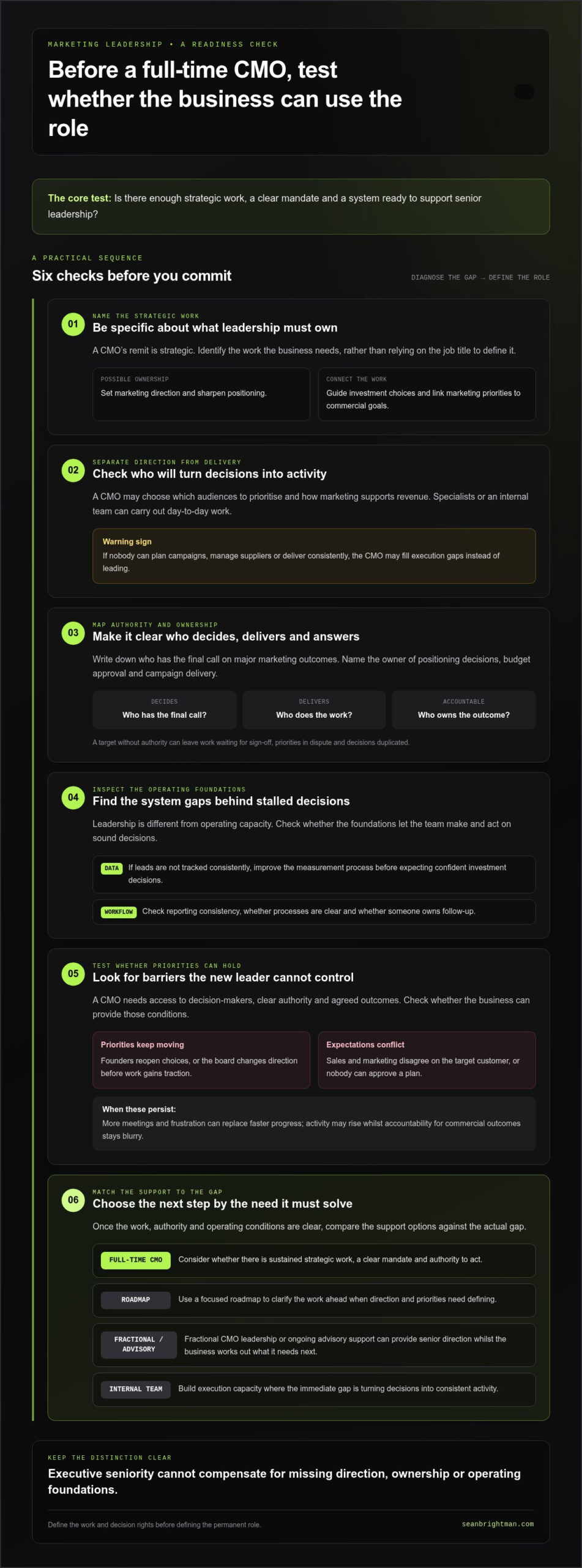
    Executive seniority cannot compensate for missing direction, ownership or operating foundations. It can expose those gaps and help address them, but only when the business gives the leader the authority and support to do so.

    What a full-time CMO is hired to own

    A CMO’s remit is strategic: set marketing direction, sharpen positioning, guide investment choices and connect marketing priorities to commercial goals. The Chief Marketing Officer (CMO) role varies between organisations, so define what the executive will own rather than relying on the title to do the work.

    That is different from personally delivering every channel activity. A CMO may decide which audiences to prioritise and how marketing supports revenue, while specialists or an internal team carry out the day-to-day work. For the role to function, the CMO needs access to decision-makers, clear authority over relevant choices and outcomes that leaders have agreed to measure.

    The early-hire mismatch: senior responsibility without usable leverage

    Picture a business still debating whether to serve one customer group or another. Its new CMO is asked to set positioning, plan investment and deliver growth, yet each decision is reopened by the founders. The remit shifts before the work gains traction. The problem may not be the executive’s judgement; it may be the lack of stable priorities and decision rights.

    A lean team can create another mismatch. If nobody else can plan campaigns, manage suppliers or turn decisions into consistent activity, the CMO may spend the week filling execution gaps instead of leading. That may be necessary in the short term, but it leaves little room for strategic work. Visible seniority is not the same as usable leverage.

    Before treating a senior hire as the fix, map the work that needs ownership, the decisions the role can make and the people or systems needed to carry those decisions through. If those pieces are missing, clarify the operating conditions first. Then define the leadership role around real business needs, not the reassurance of a senior title.

    The hidden risks of hiring a CMO before your marketing is ready

    A senior appointment can make marketing look more organised before the work underneath it is organised. That gap creates practical risks: unclear ownership, underused leadership capacity, fragile systems, extra overhead and decisions that take longer to reach the people doing the work.

    This does not mean every early CMO hire fails. The risk is hiring into conditions that prevent the role from working. Marketing activity may increase, with more campaigns, meetings and reporting, while accountability for commercial outcomes stays blurry. If nobody has agreed which results matter, activity can look busy without showing whether it supports the business.

    A premature executive hire can magnify unclear priorities rather than resolve them. A new leader can bring structure, but cannot make conflicting expectations disappear simply by taking the title.

    Role ambiguity, duplicated decisions and stalled execution

    Consider a founder who wants the CMO to own growth but still approves every audience, message and budget decision. The CMO carries the target without having the authority to shape the choices behind it. Work queues up for sign-off, teams second-guess priorities and responsibility becomes a tug of war.

    Overlap adds friction. An internal marketer, an agency and a consultant may each own part of the work, while the CMO is expected to direct the whole system. Without clear boundaries, people duplicate planning or wait for someone else to decide. Adding another approval layer does not improve governance if nobody knows who has the final call.

    Before expanding the role, write down who decides, who delivers and who is accountable for each major marketing outcome. For example, name the owner of positioning decisions, budget approval and campaign delivery. The aim is not more process. It is fewer decisions stuck between people.

    A senior hire cannot replace missing systems or capacity

    Leadership and operating capacity are different problems. A CMO can set direction, but a plan may still stall if customer data is unreliable, reporting is inconsistent, processes are unclear or the team has no time to implement it. Those are system and delivery gaps, not proof that the company needs a more senior title.

    Look at where work breaks down. If leads are not tracked consistently, improve the measurement process before expecting confident investment decisions. If nobody owns follow-up, assigning a strategy will not create the time or accountability to do it. If the team lacks a specialist skill, clarify how that work will be delivered rather than assuming the CMO will personally cover every gap.

    Marketing operations connect priorities, processes, tools and ownership so work can move. A roadmap can expose missing pieces, while fractional CMO leadership can provide senior direction as the business determines what ongoing support it needs. If the bottleneck is unclear systems rather than executive capacity, focus there first. Learn more about marketing leadership and roadmapping.

    Full-time CMO or another step? Compare the real need before committing

    Choose the support that addresses the bottleneck, not the title that sounds most senior. A company wrestling with its direction needs something different from one with a clear plan but nobody to deliver the work.

    A leadership-capacity gap is a shortage of strategic judgement, prioritisation and accountability; a marketing-execution gap is a shortage of people, skills or time to complete defined work. Confusing the two can deepen the risks of hiring a full-time CMO too early: the business adds leadership when it needs delivery, or assigns tasks to a strategist and expects them to function as an entire team.

    Option Best fit What it does not replace
    Full-time CMO Sustained executive leadership, with an ongoing remit, authority and sufficient work to own. The team, systems and specialist capacity needed to put decisions into action.
    Fractional CMO Senior direction and accountability when the business needs leadership but is not ready to define a permanent role. Internal ownership of delivery; the team still needs to carry out agreed work.
    Focused roadmap Unclear priorities, positioning or next steps that need to be turned into a structured direction. Ongoing leadership or hands-on execution after the plan is set.
    Internal execution Specific, agreed marketing tasks that need an owner with the right skills and time. Senior strategic direction when the business has not decided what work matters most.

    When the business needs strategy, structure or delivery

    Match the response to the problem. If leaders cannot agree on target customers, positioning or priorities, start with a roadmap that makes the choices visible. If the direction is clear but senior decisions keep returning to the founder, the gap may be ongoing leadership and accountability. If the plan is agreed and a defined task is stalled, assign execution to an appropriate internal resource or specialist. These options solve different problems. They are not interchangeable.

    What a staged leadership model can protect

    Staged support lets the business make decisions before locking a permanent job description around assumptions. A roadmap can clarify priorities first. Fractional CMO leadership can then provide senior direction while the company observes the actual cadence of decisions, the boundaries of the remit and the internal ownership needed. Ongoing advisory support can maintain strategic oversight without replacing the people responsible for delivery.

    That sequence gives leaders useful evidence: which decisions repeatedly need executive attention, where authority should sit and whether the demand for senior leadership is sustained. A fractional CMO model offers a way to take that staged approach. Sean Brightman’s marketing leadership support includes fractional CMO services, roadmapping and ongoing advisory support.

    Risks of Hiring a Full-Time CMO Too Early: What Growing Businesses Need to Know

    How to tell whether your business is ready for a full-time CMO

    Readiness is not a revenue milestone or a prestigious title. It is whether the business has a sustained need for senior marketing leadership, a clear mandate for the role and the capacity to act on its decisions. Use this diagnostic before defining the position. If leaders cannot answer the questions consistently, the risks of hiring a full-time CMO too early remain.

    Five questions to answer before opening the role

    1. What business priority needs executive-level marketing ownership? Name the commercial problem, such as unclear positioning or a disconnected marketing direction. “We need more growth” is a concern, not a defined remit.
    2. Which marketing outcomes matter? Agree what meaningful progress looks like and how leaders will review it. Outcomes should connect to business priorities, not just a list of campaigns or activity.
    3. What decisions can the CMO make? Set out where the role has authority, including which choices the CEO retains. If founders expect the CMO to own results but reserve every meaningful decision, the role lacks the mandate it needs.
    4. Can the organisation put the strategy into action? Identify who owns delivery, whether the team has the skills and time required, and who controls the resources assigned to marketing. A strategy without internal ownership cannot move from plan to practice.
    5. What is the actual scope of the role? Define the recurring responsibilities, decision-making rhythm and boundaries between executive leadership and execution. Only then can you judge whether the demand calls for a permanent full-time position.

    The answers should form a coherent picture. If the business can state its priorities, leaders agree on outcomes and authority, and internal owners can carry the work forward, there may be a durable executive remit to define. If not, the gap may be clarity or capacity rather than a permanent leadership requirement.

    Signals that the timing or role definition needs work

    Watch for priorities changing before work gains traction, success measures that mean different things to different leaders, or unresolved questions about who the business serves and how it should be positioned. These are warning signs. They do not prove a full-time CMO will never be right; they suggest the company should settle the brief before building a permanent role around it.

    Ask whether the need is temporary or recurring. If leadership mainly needs to choose a direction, a focused roadmap can turn competing ideas into clear priorities. If senior marketing decisions and accountability remain a regular business need, that points to an ongoing leadership gap. Keep the distinction practical: what work repeats, who needs to decide and what can the organisation support?

    Strategic brand roadmapping can clarify direction before expanding the role. Explore strategic roadmapping with Sean Brightman to map the leadership need against your priorities.

    Build the right marketing leadership path before making a permanent hire

    A readiness check only matters if it changes what you do next. Turn the findings into a working sequence: clarify direction, assign ownership, build the systems needed to act, then review what leadership gap remains. This gives the business a way forward without treating a senior title as a shortcut for unresolved decisions.

    Put strategy and accountability in place first

    Start with commercial priorities and positioning. Decide what marketing needs to achieve and which audiences or opportunities matter most. Then give internal owners clear responsibility for carrying decisions into action. Strategic direction without an owner becomes a document on a shelf.

    Build a basic operating rhythm around that work. Agree how progress will be reviewed, where decisions get made and how obstacles get raised. An advisory rhythm can help leaders assess progress, unblock decisions and adjust priorities as the business learns. Fractional CMO support provides senior strategic direction and accountability while internal people remain responsible for delivery. It is strategic advisory support, not recruitment or outsourced advertising.

    Keep the sequence practical:

    • Clarify direction: agree commercial priorities and positioning.
    • Assign ownership: name who will carry each decision into action.
    • Build systems: establish the processes and reporting the work needs.
    • Review the gap: identify which decisions or responsibilities still need consistent senior ownership.

    This staged approach helps reduce the risks of hiring a full-time CMO too early because you are testing the work the role would actually need to own, rather than designing it around pressure to appear established.

    Know what would justify a full-time CMO later

    A permanent appointment becomes easier to define when the business can point to a sustained leadership workload, not just a temporary burst of uncertainty. Look for recurring strategic decisions that need consistent internal ownership, a remit that leaders understand and a clear connection between marketing priorities and business goals.

    Then check whether the organisation can support the role in practice. Will the CMO have authority to make the decisions attached to the remit? Are team relationships and responsibilities clear? Can the business maintain a useful decision-making cadence and give the role enough internal capacity to turn direction into action?

    If those conditions are not in place, do not force the job description. A focused roadmap can clarify direction before you reshape the organisation. If strategic brand direction is still unsettled, strategic brand roadmapping can help make the next priorities clearer.

    The permanent role should follow evidence of a durable organisational need, not the belief that another executive will create clarity by arriving. Build the foundations, observe where leadership is repeatedly required, then define the role around that evidence. Discuss a sensible marketing leadership path for your business.

    Choose the next step that fits your business

    The right marketing leadership path is not a verdict on how ambitious your business is. It is a decision about what it needs now, and what evidence would justify changing that arrangement later. Build the role around real demand, not pressure to look more established.

    If you are still testing priorities, a roadmap can bring direction into focus. If senior decisions need regular oversight, fractional CMO support can provide part-time strategic leadership, with advisory support to keep accountability moving. The point is not to avoid a permanent hire at all costs. It is to make one when the organisation can use the role well. That is how you reduce the risks of hiring a full-time CMO too early without putting growth on hold.

    Start with the business problem, then choose the level of support that fits. Build a smarter marketing leadership path with Sean Brightman.

    Frequently Asked Questions

    Is there a revenue threshold for hiring a full-time CMO?

    No, revenue alone cannot tell you whether a full-time CMO is the right appointment. Two businesses with similar turnover may face very different marketing demands: one may need to coordinate several established teams, while another is still testing which customer group responds. Look at the decisions piling up, how often they need senior attention and whether the business can support the remit. Treat revenue as context, not a hiring trigger.

    Can a business have a CMO without hiring one full-time?

    Yes. A fractional CMO gives a business access to senior marketing leadership on a part-time basis. This can suit a company whose founder needs help setting priorities or making strategic decisions but does not yet have a full-time leadership workload. The arrangement provides direction, not an automatic replacement for internal staff. Employees still need to own customer follow-up, content production or other agreed delivery work.

    What happens if a company hires a CMO before defining the role?

    The CMO may be judged against expectations that were never agreed. One founder might expect stronger brand recognition, while another expects immediate sales growth, leaving the executive to reconcile conflicting measures of success. Prevent that by writing a short role brief before hiring: state the business problem, the outcomes to review, decisions the role controls and responsibilities that stay elsewhere. This gives everyone a shared reference point when priorities compete.

    Should a startup hire a CMO before building a marketing team?

    Not automatically. First separate leadership from specialist work. A startup might need senior help deciding which audience to focus on, while its immediate delivery gap is a person who can manage the website or customer communications. A CMO can set direction, but one executive should not be assumed to provide every skill the business needs. List the work, identify the skills required and decide which responsibilities need leadership and which need hands-on delivery.

    How can a founder tell whether marketing needs strategy or execution?

    Check what happens when the team sits down to plan. If people disagree about who the offer is for or which message to lead with, the blockage is strategic. If they agree on the audience and message but miss deadlines because no one owns the work, the issue is execution. Write down the stalled decision or task, its owner and what is stopping progress. That simple check can prevent buying leadership to solve a delivery problem.

    When is a full-time CMO more appropriate than fractional leadership?

    A full-time role may fit when senior marketing decisions are a regular, day-to-day responsibility and the organisation needs one executive consistently embedded in its leadership and team rhythms. For example, if several departments rely on ongoing coordination and marketing choices require frequent internal trade-offs, assess whether part-time oversight can meet that demand. The deciding factor is the sustained shape of the work, not a standard company size or funding milestone.

    Does hiring a full-time CMO guarantee better marketing results?

    No. A CMO can improve leadership, but the appointment alone cannot guarantee commercial results. The risks of hiring a full-time CMO too early include adding complexity without resolving the constraint holding marketing back. Track whether decisions lead to owned work and whether the measures chosen reflect business priorities. If activity rises but the business learns little about what is working, review the strategy and measurement before assuming a more senior appointment will change the outcome.

  • Cost of a Bad Marketing Hire: The Real Damage in 2026

    Cost of a Bad Marketing Hire: The Real Damage in 2026

    What if the cost of a bad marketing hire isn’t the salary, but the growth your business missed while the wrong setup stayed in place? For UK businesses, the cost of a bad marketing hire can include recruitment and onboarding, management time, stalled activity and opportunities that never become commercial progress.

    If you’ve invested time and money in someone whose work isn’t moving the business forward, it’s natural to question the hire. But the person may not be the only problem. An unclear role, weak leadership or a marketing system without priorities and accountability can produce the same frustrating result.

    This article shows you how to calculate direct and hidden costs using your own figures, without relying on broad averages that may not fit your business. You’ll also learn how to distinguish a capability gap from a role-design or leadership problem before deciding what needs to change.

    The next step may be a different hire. Or it may be to reset the strategy, roadmap and accountability first. That distinction matters: replacing someone without fixing the conditions around the role can leave the same costly problems in place.

    Key Takeaways

    • Define a bad marketing hire by missed role outcomes, not one disappointing campaign or a personality clash.
    • Trace how unclear ownership and weak measurement can turn scattered activity into delayed decisions and missed learning.
    • Use evidence such as agreed objectives, decision rights and delivery against priorities to identify what’s actually failing.
    • Calculate the cost of a bad marketing hire uk using business records, separating confirmed cash costs from time estimates and uncertain opportunity costs.
    • Before hiring again, decide whether the business needs a clearer role, stronger senior direction or a reset of its marketing priorities and accountability.

    What is the real cost of a bad marketing hire in the UK?

    A bad marketing hire isn’t simply someone you find difficult to work with. It’s someone who consistently misses the outcomes the role was designed to deliver, after taking the brief, resources and support into account. One weak campaign doesn’t prove the hire was wrong. A sustained gap between agreed priorities and actual delivery is stronger evidence.

    The cost of a bad marketing hire uk businesses need to assess depends on more than the individual. Salary, role scope, time in post, replacement needs and the wider business all affect the calculation. A specialist responsible for one channel creates a different operational impact from a senior hire expected to set direction across the whole marketing function.

    The cost is direct expenditure plus the measurable impact of delay and disruption. Count the cash already spent, then assess what stalled, who had to step in and what the disruption affected. Keep facts separate from estimates. A credible figure comes from your records, not a universal multiplier applied to every business.

    Which direct costs belong in the calculation?

    Start with costs you can document. Include recruitment or hiring expenses, salary paid during the period you’re reviewing, onboarding and training, and any tools or subscriptions bought specifically for the role. Add management and colleague time spent briefing, reviewing, correcting or covering work. Where possible, estimate those hours from calendars and project records, and label them as time estimates rather than cash outlay.

    Include relevant employer on-costs using your payroll records. UK tax, National Insurance and employment details can change, so verify current figures before using them in a calculation. Don’t count an entire annual salary as a loss by default: identify the period being assessed and the work delivered during it.

    Why salary alone hides the bigger picture

    A salary-only calculation misses the work that waited while priorities stayed unclear. A launch may have slipped, customer research may not have been completed, or senior leaders may have spent time managing activity instead of making decisions. These impacts matter, but they aren’t automatically cash losses. Record what happened, when it happened and what evidence connects the delay to the hire or role.

    Separate confirmed expenses from opportunity costs. An invoice or payroll record shows money spent. A forecast of revenue that might have come from a delayed campaign is an estimate, not a proven loss. State the assumptions behind it and avoid presenting it as fact. Broader employee turnover costs can offer useful context, but turnover alone doesn’t show what a particular marketing role cost your business.

    This distinction keeps the calculation from becoming a blame exercise. It also leads to a more useful question: did the person lack capability, or did unclear outcomes, limited decision-making authority or missing support make success unlikely? Establish the cost, then diagnose the cause before deciding whether to replace the hire, redesign the role or restore senior marketing direction.

    How a bad marketing hire can compound across growth and operations

    A marketing role rarely operates in isolation. When ownership is unclear, work can spread across channels without a shared priority. Decisions wait for approval, reporting becomes inconsistent and the team learns less from each campaign. An unclear marketing mandate can turn activity into delay rather than learning.

    That chain can weaken growth without proving that one person caused every problem. For example, a campaign might generate enquiries, but if nobody agrees how to track lead quality or pass feedback to sales, the business can’t confidently tell what contributed to a commercial outcome. The activity happened. The learning didn’t.

    The hidden cost of time, attention and delayed decisions

    Look beyond the work delivered and record the extra work it created: time spent correcting drafts, repeating briefs, clarifying priorities or chasing updates. Leadership attention has an opportunity cost too. Every hour spent firefighting is an hour not spent planning, speaking with customers or making decisions that could unblock the wider team.

    Consider a business preparing a product launch. If the marketing lead and sales team disagree about the audience, a leader may need to revisit the brief, resolve ownership and delay approval. The delay is observable; its financial effect may not be. Note which decisions waited and what work moved as a result, but don’t claim lost revenue unless business records support that link.

    UK employment conditions can help frame the hiring environment, but they don’t establish the cause or cost of a particular marketing problem. UK labour market statistics from GOV.UK provide wider labour-market context, not a ready-made estimate of the impact on your business.

    The marketing system can suffer as well as the hire

    Fragmented priorities, inconsistent reporting and unclear ownership may point to an underperforming hire. They may also expose gaps in the system around them: competing leadership requests, no agreed measures, limited access to customer insight or decision rights that were never clear. Treat these as symptoms to investigate, not automatic proof of individual failure.

    Trace the process. Who sets priorities? Who approves work? What does the team measure, and how does that information shape the next decision? If colleagues give different answers, the role may be operating without a reliable structure. A marketing operations growth engine depends on clear ownership and connected workflows, not activity alone.

    This is where the cost of a bad marketing hire uk can spread: beyond one person’s output, through repeated rework and weaker organisational learning. Separate what you can show from what you suspect. A documented delay is evidence; the revenue it might have produced is an estimate unless you can substantiate it. If the diagnosis points to missing senior direction, Fractional CMO support can bring priorities, systems and accountability into focus.

    Bad marketing hire or broken role design? Diagnose the difference

    A missed target doesn’t tell you, on its own, whether the person failed or the setup did. Before deciding what to fix, assess five factors: role clarity, capability, leadership, resources and measurement. A marketer can’t deliver against priorities that keep changing, or be held accountable for outcomes they can’t influence.

    Use records, not impressions. Compare the original role brief with agreed objectives, decision rights, available budget, stakeholder input and actual delivery. One weak result may reflect timing, an unsuitable test or a wider commercial constraint. Look for repeated patterns and check whether expectations and support stayed consistent.

    Signals that point towards a capability or fit issue

    A capability gap becomes more plausible when responsibilities and priorities were clear, reasonable support was available, and the same role-specific issues kept recurring. Review dated examples: missed agreed deadlines, work that repeatedly needed substantial correction, or decisions that ignored relevant evidence. Look for patterns in delivery, communication and judgement. An isolated mistake or a vague sense that someone “isn’t proactive” isn’t enough.

    Signals that point towards a leadership or system issue

    Look for shifting goals, unclear budget ownership, slow approvals or competing instructions from different leaders. Check whether the marketer could access customer and performance data, speak with relevant teams and make decisions within agreed boundaries. If the business expected independent strategic direction but provided no clear mandate, the role may have been built on an unsupported assumption.

    Use this quick diagnostic to turn frustration into questions you can test:

    Signal: Priorities changed repeatedly. Likely cause: Weak leadership alignment or unclear planning. Evidence to review: Briefs, planning notes and changes to approved work. Next question: Who had authority to set and protect priorities?

    Signal: Similar delivery gaps continued after clear feedback. Likely cause: Possible capability or role-fit issue. Evidence to review: Agreed objectives, work samples and feedback records. Next question: Was the expectation specific, achievable and within the person’s control?

    Signal: Activity was delivered, but results couldn’t be assessed. Likely cause: Measurement or system weakness. Evidence to review: Reporting definitions, data access and ownership of follow-up. Next question: Could the team connect activity to a meaningful business outcome?

    These patterns can overlap. A skilled marketer may struggle in a role with no decision rights, while a well-designed role won’t erase a genuine skills gap. Separate what’s documented from what’s inferred, then test one cause at a time. That gives you a stronger basis for deciding whether the cost of a bad marketing hire uk came from capability, role design or the conditions around the work.

    Cost of a Bad Marketing Hire: The Real Damage in 2026

    How to calculate the cost and contain the damage before hiring again

    Build the estimate from records, not a headline figure. The cost of a bad marketing hire uk businesses face varies with the role, time in post and what needs to happen next. Keep confirmed cash costs, time estimates and uncertain opportunity costs in separate totals, so decision-makers can see what’s known and what still needs testing.

    A business-specific calculation in five steps

    Use one consistent review period, such as the time since the hire started or since concerns first became clear. Keep evidence beside each figure and record your assumptions. This makes the calculation easier to challenge, update and use when comparing options.

    • 1. Gather hiring costs. Record recruitment expenses, onboarding and training costs, and any role-specific tools or subscriptions. Use invoices and internal records rather than broad estimates.
    • 2. Total salary and relevant employer costs. Calculate salary for the period being reviewed, not automatically for a full year. Add applicable employer costs using current payroll records, and verify current UK tax and employment details before relying on them.
    • 3. Estimate time diverted. Use calendars, project notes or timesheets to estimate hours spent managing, correcting, re-briefing or covering work. State how you valued those hours and mark the result as an estimate.
    • 4. Log delayed work separately. Note deliverables that slipped, decisions that waited and work that had to be repeated. Record dates and evidence. Don’t count the same delay as both staff time and a separate cash expense.
    • 5. List possible opportunity costs. Describe missed or delayed opportunities separately from confirmed spend. Assign a monetary value only where you have a defensible basis, such as relevant business records, and explain your assumptions.

    The result isn’t a verdict on one person. It’s a working estimate that helps you compare what to do next.

    Contain the impact before repeating the hiring decision

    First, pause activity that doesn’t support the immediate commercial objective. Give essential work a clear owner, define who can approve decisions and set measurable review points. This reduces drift while you assess whether the problem calls for corrective support, a redesigned role or a replacement.

    Compare the options with the evidence. Corrective action may fit when expectations were clear and there’s a specific gap to address. Redesign may be the better route if the remit mixed incompatible responsibilities or lacked authority. Replacement may make sense when the role is sound, support was reasonable and recurring gaps remain. There’s no universal answer.

    A fractional CMO leadership model provides senior strategic direction on a part-time basis, helping establish priorities, systems and accountability without rushing into another full-time leadership hire. If your initial calculation is clear but the diagnosis or next decision isn’t, get strategic marketing diagnosis before reopening the role.

    Restore Marketing Leadership Before Your Next Hire

    A cost review is useful only if it changes the next decision. Use what you found to choose between resetting the role, strengthening marketing leadership or recruiting against a clearer brief. Don’t reopen the same vacancy with the same expectations and hope for a different result.

    Start with the diagnosis. If outcomes were vague, redesign the role around a defined business need. If the person lacked a specific capability, decide whether that skill is essential in the next hire or can be covered another way. If priorities, ownership or measurement were missing, fix those conditions before judging the next person’s performance.

    When fractional marketing leadership may be the right next move

    Fractional marketing leadership may suit a business that needs senior direction but isn’t ready to appoint a full-time marketing leader. A Fractional CMO provides senior marketing leadership on a part-time basis, helping set positioning, shape priorities and establish the systems and accountability that support consistent decisions.

    This is strategic leadership, not recruitment placement or advertising execution. The aim is to give the team clearer direction and a workable structure, so marketing activity connects to agreed business priorities. It can also help leaders determine whether the longer-term need is a different hire, a better-defined role or ongoing senior guidance.

    Choose a practical first step for your business

    If your main challenge is deciding what to do and in what order, a roadmap can set out a structured marketing and brand direction. It turns broad ambitions into priorities the team can organise around, rather than another list of disconnected tasks.

    If the direction is broadly clear but leaders need continued challenge, decision support and accountability, ongoing advisory can provide a steady source of strategic support. A marketing advisory retainer helps maintain that focus as priorities and business needs evolve.

    The right choice depends on what your review uncovered, not on a standard recovery plan. The cost of a bad marketing hire uk businesses calculate should lead to a more deliberate setup, whether that means clarifying the brief, strengthening leadership or hiring again with sharper expectations.

    Choose your next step: define the role’s outcomes, set decision rights and identify who will keep priorities on track. If the missing piece is senior strategic direction, consider whether Fractional CMO support fits the gap before committing to another full-time leadership hire.

    Make your next marketing decision with confidence

    The cost of a bad marketing hire uk businesses face isn’t a reason to rush into another appointment. It’s a prompt to make the next decision with sharper evidence. Define the outcome the business needs, the authority the role requires and the support that will make delivery possible. Then choose the structure that fits.

    That may mean a clearer brief for a new hire. Or it may mean putting senior direction in place first. Fractional CMO support provides part-time marketing leadership, while roadmapping and advisory support can bring structure to priorities and accountability to the decisions that follow.

    You don’t need to solve every marketing problem at once. Start with the gap that’s blocking progress, then build a plan around it. Get strategic clarity before making your next marketing decision, and take the next step with clearer direction and firmer footing.

    Frequently Asked Questions

    How much does a bad marketing hire cost a UK business?

    There isn’t one reliable figure for every business. The cost of a bad marketing hire uk businesses face depends on the role, how long it lasted and what the business must do next. A useful estimate separates money already spent from time diverted and potential commercial impact. Compare the total with the cost and likely disruption of corrective support, role redesign or replacement, rather than relying on a generic multiplier.

    What are the hidden costs of a bad marketing hire?

    Hidden costs can include colleagues repeating work, sales teams receiving inconsistent materials and customer insight going unused. There may also be a handover cost if campaign knowledge, supplier context or access to key accounts sits with one person and hasn’t been documented. These effects won’t always have a defensible cash value. Record what changed operationally, who was affected and whether the impact is ongoing.

    How can I tell if my marketing hire is underperforming?

    Check whether agreed responsibilities are being delivered consistently, and look for repeated, specific gaps rather than judging one campaign in isolation. For example, compare the marketing plan with completed work, deadlines and reporting quality. Then check whether the person had the information, authority and support needed to do the job. If expectations weren’t clear, reset them before treating the gap as proof of poor performance.

    Should I replace a bad marketing hire straight away?

    Not necessarily. First establish whether the problem is a skills gap, a badly scoped role or a lack of direction. If the job’s priorities were unclear, replacing the person without changing the brief may recreate the same problem. Where expectations and support were clear but important gaps continue, replacement may be appropriate. Document the evidence and follow your organisation’s usual employment processes before making a decision.

    Can a fractional CMO help after a bad marketing hire?

    Yes. A Fractional CMO can bring senior marketing direction on a part-time basis while you assess what the business needs next. This can help clarify priorities, strengthen decision-making and establish accountability without immediately appointing a full-time marketing leader. The focus is strategic leadership, not recruitment placement or advertising execution. It can be useful when the team needs clearer direction before a permanent role can be properly defined.

    What should I include when calculating the cost of a failed hire?

    Use a defined review period and gather records such as recruitment invoices, payroll, onboarding expenses, role-specific software costs and project logs. Include documented hours spent on additional supervision or rework, but label time valuations as estimates. Keep possible lost opportunities separate unless business evidence supports a monetary value. This makes the calculation easier to update and helps prevent the same impact being counted twice.

    Can a bad marketing hire damage growth even if they are busy?

    Yes. A full calendar doesn’t show whether activity is advancing a business priority. For instance, a marketer might publish regularly while sales teams lack agreed follow-up information or leaders can’t tell which audience the work targets. Check whether outputs connect to a defined objective and whether the business learns from the results. Busy work without those links can consume capacity while leaving important decisions unresolved.

  • My Marketing Agency Is Not Strategic Enough: What to Do Next

    My Marketing Agency Is Not Strategic Enough: What to Do Next

    What if your agency isn’t the first thing that needs replacing? If you’re thinking, “my marketing agency is not strategic enough,” you’re probably seeing plenty of campaigns and deliverables, but little connection to business priorities. The agency waits for instructions. You’re left wondering what success actually looks like.

    That frustration is real. But a tactical relationship doesn’t always mean the agency can’t think strategically. Sometimes the brief lacks clear goals, a defined audience or meaningful measures of success. Sometimes the agency is executing poorly. Those are different problems, and they need different fixes.

    This article will help you diagnose which one you’re dealing with, reset the brief around commercial priorities and decide whether your business needs senior marketing direction beyond agency delivery. You’ll see what to ask of your agency, how to set clearer measures of progress and when a roadmap or Fractional CMO leadership can align marketing activity with business goals, without requiring a full-time hire.

    Key Takeaways

    • If you’re thinking “my marketing agency is not strategic enough”, separate weak strategy from poor execution before deciding what to change.
    • Use a sharper brief to connect marketing priorities with commercial goals, audience needs and clear measures of progress.
    • Choose the right next step: reset the relationship, add senior strategic leadership or replace the agency.
    • Record key assumptions, constraints and decisions so your agency has a clear direction to work from.
    • A Fractional CMO can provide part-time senior leadership to set priorities and align agency activity with business goals.

    My marketing agency is not strategic enough: what does that actually mean?

    Campaigns are going live. Content is being produced. Reports arrive on schedule. Yet you’re still unsure which business priority all that work is meant to move. That frustration is real: plenty of output can keep a marketing team busy without giving the business a clear direction.

    Strategy is the set of choices behind the activity: what the business wants to achieve, which audiences matter, how the brand should stand out, what to prioritise and where to commit resources. A useful overview of marketing strategy can help frame the distinction. A campaign calendar shows what’s planned. It doesn’t explain why those activities deserve time and budget, or how they support business goals.

    Strategy connects marketing choices to business outcomes. That’s the diagnostic sentence to keep in view. If an agency can list deliverables but can’t explain the objective, audience or intended commercial contribution behind them, the work may be tactical rather than strategic.

    Signs your agency is delivering activity without direction

    Look for a pattern, not one campaign that missed the mark. Recurring activity without a stated purpose can signal a gap between output and direction:

    • Campaigns repeat because they’re on the calendar, not because there’s a clear business objective or audience rationale.
    • Reports count posts, clicks or completed tasks but don’t explain what the results mean for the business or what should change next.
    • Urgent requests keep taking over, pushing agreed priorities aside without a deliberate decision about the trade-off.

    These signs don’t prove the agency is incapable. They do show that the work isn’t being tied clearly enough to choices and outcomes.

    What a strategic agency relationship should give you

    A strategic partner uses your objectives, positioning and understanding of customers to shape recommendations. Channel choices should follow the goal and audience, not habit or whatever happens to be easiest to produce.

    Good recommendations also come with a rationale: why this activity, why now, what it asks you to deprioritise and how you’ll judge progress. You should hear a clear point of view, not automatic agreement with every request. For example, if a new campaign would pull resource away from a priority already in motion, the agency should flag the conflict and help you make an informed choice.

    Strategic direction doesn’t mean every recommendation will be right. It means the thinking is visible, the trade-offs are discussed and the work has a reason to exist. That gives you something concrete to assess before deciding whether the issue sits with the agency, the brief or the way decisions are made inside the business.

    Is the agency the problem or is your strategy unclear?

    If you’re thinking “my marketing agency is not strategic enough”, pause before deciding who’s at fault. The problem could sit in the strategy, the agency’s capability, the quality of delivery or the way decisions get made inside your business. These gaps can look similar from the outside, but each needs a different fix.

    Start by checking the foundations: are your objectives, target audience, positioning and priorities clear? Does everyone know who has authority to approve work and change direction? If those answers shift between meetings, the agency may be responding to mixed signals rather than ignoring a settled plan.

    A quick diagnostic: strategy gap or execution gap?

    • Strategy gap: Your team can’t explain who the business serves, why customers should choose it or what marketing should prioritise next. The agency may be producing work, but there’s no agreed direction to guide it.
    • Execution gap: The direction is clear, yet agreed work misses deadlines, standards or specifications. That points to delivery performance, not necessarily a strategy problem.
    • Governance gap: Approvals stall, ownership is unclear or measurement is inconsistent. Even sound recommendations can’t gain traction if decisions keep getting stuck.

    These gaps can overlap. A brief that asks for more leads, greater brand awareness and a new audience all at once, without ranking those goals, gives the agency no clear basis for trade-offs. If different people then give conflicting feedback, the next version may swing in another direction. Before assigning blame, review the written objectives, audience, positioning, priorities and decision ownership.

    Questions that expose the real source of the problem

    Use the same questions with your team and agency. The answers, and where they differ, will show what needs attention:

    • Does each major activity have an agreed business objective and intended audience?
    • Can the agency explain why it recommends each priority, what it means putting other work aside and how progress will be judged?
    • Who makes the final decision, and how often do priorities change after work is under way?

    The U.S. Bureau of Labor Statistics outlines marketing managers’ responsibilities, including assessing trends and choosing strategies, in its Duties of Marketing Managers overview. That’s a useful reference point: strategic direction involves judgement and choices, not simply carrying out a list of requests.

    If the answers point to a wider disconnect between planning, people and processes, examine your marketing operations growth engine. A structured roadmap can help turn the diagnosis into clear priorities, owners and decisions. Explore senior marketing leadership if you need an experienced lead to align that direction with agency activity.

    Should you replace your marketing agency or reset the relationship?

    Changing agencies can feel like a clean break. But a new supplier won’t solve unclear goals, shifting priorities or missing decision ownership. If you’re thinking “my marketing agency is not strategic enough”, base the decision on evidence: what the agency can do, what it has actually delivered, what your business needs next and how both sides behave when problems surface.

    There are three routes. Choose the one that addresses the real gap, not simply the one that promises a fresh start.

    Route Best fit when What to establish
    Reset the brief The agency delivers competently, but objectives, priorities or success measures are vague. Clear goals, audiences, responsibilities, recommendations and review measures.
    Add strategic leadership The business needs someone to set direction and coordinate internal teams or multiple specialists. Who owns the strategy, makes trade-offs and keeps activity aligned with business priorities.
    Replace the agency There’s evidence of a capability or delivery gap, or agreed direction repeatedly fails to shape the agency’s work. The requirements for the next relationship, including scope, ownership and measures of progress.

    When a reset is worth trying

    Try a reset when the agency can deliver the work but hasn’t had a clear enough operating brief. Put the commercial objective, target audience, priority activity and success measures in writing. Then agree a defined review period with specific outcomes, rather than accepting open-ended promises to “be more strategic”.

    Make the expectations two-sided. Set out what the agency will recommend, what it will deliver and what its reporting should explain. The reset is also a test: can the agency turn clearer direction into relevant proposals and consistent work? If yes, you may have fixed the brief, not needed a new supplier.

    When a change or senior leadership is justified

    Consider a change if clear, agreed direction still doesn’t influence recommendations or delivery. Repeatedly missing standards, deadlines or agreed priorities points to a problem the brief alone may not fix. Look at the pattern, not one disappointing result.

    If the business uses several specialists or agencies, the missing piece may be someone on your side to set priorities, make trade-offs and keep everyone moving in the same direction. A Fractional CMO provides part-time senior marketing leadership; it’s a strategic lead, not another delivery supplier. And before bringing in anyone new, settle unresolved choices about positioning and commercial priorities. Otherwise, the same uncertainty follows you into the next relationship.

    My Marketing Agency Is Not Strategic Enough: What to Do Next

    How to reset an under-strategic agency with a sharper brief

    If you’ve concluded that “my marketing agency is not strategic enough”, don’t send another vague request to “think bigger”. Give the agency a brief it can use to make decisions, then judge the recommendations and work against it.

    Build the reset in sequence:

    1. Set the commercial goal. State the business outcome marketing needs to support and how you’ll recognise progress.
    2. Clarify the audience. Describe the customers you need to reach and the problem they need solved.
    3. Choose priorities. Rank what matters now. Make clear what should pause or stop if new work takes its place.
    4. Assign owners. Name who leads the work, who approves it and who makes the final call if priorities conflict.
    5. Review the evidence. Agree which measures you’ll use, how often you’ll discuss them and what decisions the results should inform.

    Build a brief that gives the agency strategic context

    Put the business objective, customer problem and target audience in plain language. Add your positioning, the proof points that support it, commercial constraints and decisions already made. Record assumptions too, such as an untested belief about why customers choose you. Mark it as an assumption, not a fact.

    This stops the agency from treating every request as a fresh instruction. A strategic brand roadmapping approach can help turn those choices into a usable plan, with priorities and accountable decisions rather than a disconnected task list.

    Create accountability without measuring activity alone

    Agree an outcome measure that reflects the goal, alongside leading indicators that show whether the work is moving in the right direction. The right measures depend on the objective. Don’t judge a positioning project by the same measures as a lead-generation campaign.

    Ask the agency to explain what the evidence suggests, what it recommends doing next and what the team expects to learn. Keep a regular review rhythm focused on progress, learning and decisions, not just a tour through completed tasks. Results can move alongside a campaign without proving that the campaign caused them, so treat performance data as evidence to interpret, not automatic proof.

    Capture changes to assumptions, constraints and priorities as they happen. That record makes it easier to understand why the plan shifted and whether the shift was deliberate. For senior support turning a diagnosis into priorities and an accountable roadmap, explore strategic roadmapping support.

    When strategic marketing leadership is the missing piece

    An agency can deliver strong work and still lack the authority to decide what the business should prioritise. That isn’t necessarily an agency failure. Agencies work within the direction they’re given; someone on the business side needs to connect marketing choices to commercial goals, make trade-offs and keep the whole system aligned.

    If you’re still thinking “my marketing agency is not strategic enough” after clarifying the brief, ask a different question: who owns marketing direction across the business? Without that senior ownership, internal teams and external specialists can each do their part whilst pulling towards different goals.

    What senior strategic direction changes

    A senior marketing leader turns business objectives into practical choices. They connect positioning and customer priorities to channel decisions, resource allocation and the work agencies are asked to deliver. They also give the agency a clear strategic brief and a decision-maker who can maintain focus when new requests compete for attention.

    That leadership doesn’t stop at campaign delivery. It creates accountability for what the business is learning, whether the direction still makes sense and what should change next. A Fractional CMO provides this senior marketing leadership on a part-time basis. They lead strategy and align agency and internal activity, rather than acting as another delivery supplier or requiring a full-time hire.

    Choose the right next step for your situation

    The right support depends on the gap you’ve identified:

    • Use a roadmap when the business needs clear priorities, direction and accountable decisions. It gives the team and agency a shared plan to work from.
    • Use ongoing advisory when leaders have a direction but need continued challenge, guidance and accountability as decisions arise.
    • Consider Fractional CMO leadership when marketing needs senior ownership across teams, agency partners and business priorities.

    These options solve different problems. A roadmap sets out the direction; an advisory retainer provides ongoing input; a Fractional CMO takes part-time senior leadership across marketing. The point isn’t to add another layer of activity. It’s to put clear ownership above delivery, so specialists know what they’re working towards and leaders can make decisions with the wider business in view.

    If you’ve identified a need for that direction, explore strategic marketing direction as a practical next step.

    Give your marketing a clearer direction

    If you’re thinking “my marketing agency is not strategic enough”, don’t jump straight to replacing it. First work out whether the gap is unclear goals, weak execution or missing senior ownership. A sharper brief can reveal whether the agency can respond to clear commercial priorities.

    Set out what the business needs marketing to achieve, who it needs to reach and how you’ll assess progress. If activity still lacks direction, the business may need someone to own strategy across internal teams and agency partners. A Fractional CMO provides part-time senior marketing leadership, whilst roadmapping and advisory support bring structure, direction and accountability.

    You don’t need to solve everything at once. Make the next decision based on evidence, then give the team a clear route forward. Explore senior marketing direction with Sean Brightman and take the next step towards marketing that works in service of your business goals.

    Frequently Asked Questions

    How do I know if my marketing agency is not strategic enough?

    Look for repeated activity without a clear link to business goals, audiences or positioning. If you’re asking “my marketing agency is not strategic enough”, check whether recommendations explain why a campaign or channel matters, what it means prioritising it and how success will be judged. One missed report isn’t proof of a strategy problem. A persistent inability to explain the direction behind the work is a stronger warning sign.

    Should I fire my marketing agency if it is not strategic enough?

    Not automatically. First check whether the agency has a clear brief, access to the right information and a decision-maker who can maintain priorities. Reset the objectives, responsibilities and review measures, then assess the agency’s response over an agreed period. Consider changing providers if strategic gaps persist despite clear direction, or if the agency can’t meet the capabilities your business needs. A new agency won’t fix unclear goals or ownership by itself.

    Can a marketing agency be good at execution but weak at strategy?

    Yes. Campaign production and channel management are different capabilities from setting strategic direction. An agency may deliver work competently whilst relying on you to define the audience, positioning, priorities and measures of success. The useful question isn’t whether the agency is good or bad overall. It’s whether its strengths match the role you expect it to play, and whether someone in the business owns the decisions around that work.

    What should I ask my marketing agency to improve its strategy?

    Ask how each recommendation connects to a business objective, target audience and positioning. Request the evidence behind its priorities, the trade-offs involved and the measures it will use to learn. Clarify what should stop, who owns final decisions and when you’ll review the plan. These questions help create a sharper working brief. They won’t replace clear leadership, so make sure someone in your business can set priorities and make decisions.

    How long should I give a marketing agency to improve?

    Set a review period that fits the work and the decisions involved, rather than relying on an arbitrary industry-wide timeframe. Agree the changes you expect to see, such as clearer recommendations, aligned priorities, defined measures or improved delivery. Use regular checkpoints to assess evidence and decide what happens next. Make the reset time-bound and observable, but don’t demand guaranteed commercial results by a fixed date.

    Do I need a Fractional CMO or a new marketing agency?

    A new agency may help if your current provider lacks the capabilities or working approach your business needs. A Fractional CMO may be more relevant when you lack senior marketing ownership to set direction, coordinate suppliers and connect activity to commercial goals. The role provides part-time senior marketing leadership, not another delivery supplier. Diagnose the gap first: replacing execution without addressing missing leadership can reproduce the same problem with a different agency.

    What should a strategic marketing agency report include?

    A useful report connects performance to agreed objectives, explains what the evidence does and doesn’t show, and recommends what to do next. It should make priorities and trade-offs clear, not just list posts, clicks or completed tasks. Choose measures that fit the goal, then use them to guide decisions and learning. Treat results as evidence to interpret, not proof that a campaign caused an outcome unless the analysis supports that conclusion.

  • AI for B2B Lead Gen: Choosing and Building the Right System

    AI for B2B Lead Gen: Choosing and Building the Right System

    What if your lead-generation problem isn’t a lack of leads, but a system that keeps producing the wrong ones? AI for B2B lead generation can help teams spot buying signals, prioritise accounts and personalise outreach. But automate a disconnected process and you’ll create more noise, not more qualified opportunities.

    If marketing is filling the CRM whilst sales is chasing its own signals, the first step is to find where the process breaks down. The right AI approach depends on your ideal customer profile, sales process and the quality of the data already in your tools. More platforms won’t fix a weak hand-off or unclear qualification criteria.

    This guide compares AI approaches by lead quality, workflow fit and measurable impact, then sets out how to build a practical system with clear ownership, human review and performance measures. You’ll see where AI can strengthen targeting and follow-up, where people need to stay involved, and why a clear roadmap should come before another platform. The aim is to create relevant opportunities your sales team can act on, not just a bigger list.

    Key Takeaways

    • Separate lead volume from qualified, sales-accepted leads and pipeline so your team measures progress that matters.
    • Map where AI can assist across targeting, engagement and qualification, while keeping key decisions and approvals with people.
    • Compare outbound agents, intent and ABM platforms, and AI-enabled marketing workflows against your data, CRM and sales process.
    • Build ai for b2b lead generation around a defined bottleneck, a baseline and a focused pilot before scaling.
    • Connect your ideal customer profile, data, team ownership and revenue measures to make AI part of a working growth system.

    AI for B2B lead generation: what it can improve, and what it cannot fix

    AI for B2B lead generation means using software to support research, prioritisation, personalisation and measurement as you find and develop potential customers. It can help a team process information faster and focus its effort. It can’t make a weak offer compelling or turn an unclear audience into a well-defined one.

    That distinction matters because “lead” can mean very different things. Lead generation is the process of attracting and identifying potential customers, as outlined in this lead generation overview. But volume alone says little about business value:

    • Lead volume: the number of people or organisations captured.
    • Qualified leads: contacts that match agreed criteria, such as your target market and buyer needs.
    • Sales-accepted leads: qualified leads that sales has reviewed and agreed to pursue.
    • Pipeline: potential revenue represented by active sales opportunities.

    An AI-generated lead is a contact identified or engaged with AI assistance; a qualified sales opportunity is a prospect that fits your criteria, has a relevant business need and is accepted into the sales process. Keep those labels separate, or impressive activity figures can disguise a pipeline that isn’t moving.

    Where AI fits in a B2B lead-generation system

    AI can research audiences, flag accounts for attention, help shape relevant content, personalise outreach, summarise qualification signals and report on performance. Give each task a defined purpose: connect a buyer problem to an audience, a message and a next step in the sales process. Without that connection, automation simply speeds up disconnected work.

    Start with assistance, not unchecked autonomy. AI might suggest accounts or draft an email for a person to review. An autonomous workflow might send messages or change lead status without approval. Human review is especially important when a system’s judgement affects prioritisation, buyer experience or the hand-off to sales. People still own the criteria, decisions and relationships.

    Why more automated activity does not automatically mean more pipeline

    Automation amplifies what you give it. A broad audience and generic message can produce more irrelevant outreach, not more useful conversations. A weak offer remains weak at scale. If CRM records are incomplete, inconsistent or out of date, lead scoring may elevate the wrong accounts and bury better-fit prospects.

    Agree on measures before switching on a workflow. Track quality and sales outcomes, such as the proportion of leads accepted by sales, progression to opportunity and pipeline contribution. Use message counts to diagnose workload, not to declare success. The test is whether AI helps the right prospects move through your sales process, not whether it helps the team send more.

    How AI supports each stage of the B2B lead-generation workflow

    AI for B2B lead generation works best as a connected workflow, not a collection of clever shortcuts. Each stage should use shared information and clear criteria, with people accountable for decisions that affect targeting, buyer experience and sales priorities. IBM’s overview of AI for lead generation explores how techniques such as machine learning and predictive analytics can support this work.

    Use AI to find and prioritise the right accounts

    Begin with a documented ideal customer profile (ICP): the organisations your business can serve well and the roles involved in buying. Use relevant firmographic details, such as industry or company size, alongside behavioural and engagement signals to prioritise accounts. Intent signals, such as repeated interest in relevant topics, can suggest that a need is emerging. They don’t prove a buyer is ready to purchase.

    Prioritisation must also reflect sales capacity. A long list of high-scoring accounts is no use if the team can’t follow up properly. AI can surface patterns and recommend where to focus; the team owns the ICP, the thresholds and decisions about where to spend its time.

    Turn research into relevant engagement and sales hand-offs

    Connect each AI task to a buyer problem and a clear next step in the workflow:

    • 1. Define the ICP: AI can help analyse existing customer and market information. Marketing and sales agree which traits make a strong-fit account.
    • 2. Target accounts: AI can combine firmographic, behavioural and engagement signals. The team sets priorities in line with sales capacity.
    • 3. Prepare engagement: AI can gather research and draft tailored content or outreach. A person checks facts, tone and relevance before anything reaches a prospect.
    • 4. Qualify interest: AI can summarise responses and flag signals against agreed criteria. Sales owns the judgement on fit, need and readiness.
    • 5. Hand off to sales: CRM workflows can route records and include useful context. Marketing and sales agree what qualifies for hand-off and who follows up.
    • 6. Learn and improve: AI can help report on progression and patterns. The team reviews accepted leads and pipeline outcomes, then adjusts criteria and activity.

    AI lead scoring is only as useful as the data behind it: inaccurate, incomplete or disconnected inputs produce unreliable priorities. CRM and marketing data provide useful context when fields mean the same thing across tools, records stay current and engagement can be linked to the right account. Otherwise, a score can look precise whilst pointing sales in the wrong direction.

    For a wider view of how AI choices fit into a growth system, read this AI consulting and scalable growth systems guide. A clear roadmap can align data, marketing and sales around shared priorities instead of adding another isolated workflow.

    Which AI lead-generation approach fits your B2B business?

    The right choice depends on the bottleneck you need to fix. Outbound agents, intent and account-based marketing (ABM) platforms, and AI-enabled marketing workflows solve different problems. None is automatically the best option. Match the tool to your sales motion, available data and capacity to follow up, then assess it by qualified opportunities and pipeline contribution.

    AI outbound agents versus intent and ABM platforms

    Outbound agents help research prospects and prioritise or personalise outreach. Intent and ABM platforms focus on account-level signals and activating campaigns around selected organisations. The first needs usable prospect data, a clear channel strategy and timely sales follow-up. The second needs a defined target-account list, reliable engagement data and coordination across marketing and sales. More channels or a larger contact database don’t prove that either approach will produce better-fit leads.

    AI-enabled marketing workflows connect tasks such as segmentation, content personalisation, lead routing and reporting across existing systems. They can suit teams whose main problem is a fragmented process, rather than a lack of outbound activity or account insight. For a wider view of workflow and systems fit, see the marketing operations growth-system guide.

    Approach Best-fit use case Data needed Human oversight CRM fit Success measures
    Outbound agents Scaling targeted prospect research and outreach Accurate contact and account records, ICP criteria, relevant buying context Review targeting, messages and replies; sales handles meaningful conversations Records activity and replies against the right contacts and accounts Sales-accepted leads, qualified meetings and opportunity progression
    Intent and ABM platforms Prioritising named accounts showing relevant engagement Target-account lists, account attributes and trustworthy intent or engagement signals Interpret signals, select accounts and coordinate campaign and sales action Connects account activity with marketing and sales records Target-account engagement, accepted opportunities and pipeline contribution
    AI-enabled marketing workflows Improving connected processes across segmentation, content, routing and reporting Consistent CRM and marketing data, shared definitions and process rules Approve important content and routing logic; review performance and refine the workflow Fits best when it works with existing records and hand-offs Lead quality, hand-off performance and progression through the pipeline

    Questions to use when comparing AI lead-generation tools

    Use these questions to test whether a platform fits how your team sells, not just how many features it offers:

    • Can it connect with your CRM, marketing data and reporting process without creating duplicate or disconnected records?
    • Can your team understand why it prioritises an account or recommends an action, then review and improve that output?
    • Does it measure sales-accepted leads and qualified opportunities, or mainly activity such as messages sent and contacts reached?
    • Is there a clear owner for follow-up, and can sales act on the signals the tool provides?

    For ai for b2b lead generation, choose the approach that closes a specific gap in your system. If your data, workflow and ownership aren’t ready, a platform may add complexity before it adds value.

    AI for B2B Lead Gen: Choosing and Building the Right System

    How to implement AI for B2B lead generation without creating more noise

    A successful AI pilot starts with a business problem, not a platform demo. For ai for b2b lead generation, the aim is to improve a defined part of the process and show whether it helps create better opportunities. Use a staged rollout so the team can identify weak data, unclear ownership or poor fit before scaling activity.

    Choose a narrow pilot with a measurable business outcome

    Pick one audience segment, one bottleneck and one repeatable workflow. For example, test whether AI-supported account research helps sales identify more suitable prospects within a chosen segment. Before launch, record a baseline using the same definitions and time period you’ll use to review the pilot.

    Work through the sequence:

    • 1. Diagnose the bottleneck: Find where relevant prospects are being missed, delayed or poorly qualified.
    • 2. Define the use case: Set a clear outcome, such as improving the share of leads accepted by sales.
    • 3. Map the data: Identify the inputs, CRM destination and fields the workflow depends on.
    • 4. Assign ownership: Name the marketing, sales or operations owner responsible for review, follow-up and measurement.
    • 5. Pilot and review: Set the human approval point, compare results with the baseline and record what needs adjusting.
    • 6. Scale selectively: Expand only when the workflow improves quality or progression without creating new hand-off problems.

    Keep measurement focused. Agree on a small set of indicators, such as sales acceptance, progression to qualified opportunity and pipeline contribution. Message volume or time saved can help explain what changed, but neither proves the pilot created better sales outcomes.

    Protect data quality, relevance and trust

    Before relying on AI outputs, review the records and rules that feed them. Check for duplicate or outdated contacts, inconsistent account details and conflicting definitions of a qualified lead. Document what the system should use and what it should ignore. Assign someone to correct recurring data issues, not just report them.

    Build human review into the workflow for factual claims, personalisation and generated communications. A person should be able to catch a wrong assumption or irrelevant message before it reaches a prospect. Before deploying AI-assisted outreach in the UK, have the writer verify current UK GDPR and PECR guidance rather than relying on assumptions about what is permitted.

    Implementation means aligning people and processes as well as connecting software. Sean Brightman’s AI consulting and roadmapping help businesses set direction for AI-powered marketing systems and build accountability around implementation. Explore the AI consulting service as part of planning a practical growth system.

    Make AI lead generation a growth system, not another disconnected tool

    AI creates value when it connects the parts of lead generation that teams often manage separately: the ideal customer profile, targeting, engagement, data, sales follow-up and revenue measurement. Add a tool without joining up those pieces and you risk creating another stream of activity nobody owns.

    What a joined-up AI lead-generation system needs

    Start with a shared operating model. Marketing and sales should agree who the business is trying to reach, what makes a lead qualified, when sales accepts it and how pipeline contribution is measured. AI can support research, prioritisation and repetitive work, but people need clear responsibility for approving important actions and following up on useful signals.

    Then review performance regularly. If targeting is off, qualification criteria are vague or hand-offs stall, fix the process before adding more automation. The goal of ai for b2b lead generation isn’t to connect every available platform. It’s to make the right work easier to repeat and improve.

    When strategic AI guidance is the right next move

    Strategic oversight can help when your team is dealing with tool sprawl, inconsistent targeting, unclear ownership or plenty of activity but little insight into pipeline impact. These are system problems, not always platform problems. A roadmap helps prioritise use cases, data and operating changes, then assigns measures and accountability so marketing, operations and sales work towards the same outcomes.

    Sean Brightman’s AI consulting and roadmapping help businesses set direction for AI-powered marketing systems and build accountability around implementation. Strategic brand roadmapping can connect growth activity to broader business direction. The focus is practical alignment, not a promise of guaranteed results.

    When scattered AI activity needs a clearer plan, explore strategic AI consulting and roadmapping.

    Turn AI activity into a stronger growth system

    AI won’t fix an unclear offer, poor targeting or disconnected sales processes. It can help your team work smarter when it supports a defined ideal customer profile, reliable data and a sales workflow people own.

    The right approach to ai for b2b lead generation depends on your bottleneck. Compare tools by their fit with your data, CRM and sales process, then test one focused use case against measures that show lead quality and pipeline progress. Scale what works and leave the noise behind.

    Sean Brightman’s AI consulting focuses on practical AI-powered growth engines and marketing efficiency. Strategic roadmapping creates direction, whilst advisory retainers provide ongoing accountability as priorities move into action.

    Ready to connect your AI choices to business goals? Build a practical AI lead-generation roadmap and give your team a clearer path from targeting to qualified opportunities. Start with the right foundations and build from there.

    Frequently Asked Questions

    How is AI used for B2B lead generation?

    AI supports B2B lead generation by helping teams research accounts, prioritise prospects, personalise content, assess qualification signals and report on results. For example, it can flag a target account showing relevant engagement or summarise a prospect’s needs for a sales hand-off. The team still defines the ideal customer profile, checks important outputs and decides which opportunities need human follow-up. AI works best when its tasks connect to a clear sales process.

    Can AI generate qualified B2B leads automatically?

    AI can identify and score potential leads automatically, but a score alone doesn’t make someone qualified. Qualification depends on criteria the business sets, such as fit with its target market, a relevant need and readiness for a sales conversation. Automated systems can miss context or rely on inaccurate data. Keep a human review point before important hand-offs, and track whether sales accepts and progresses the leads the system surfaces.

    Which AI tools are best for B2B lead generation?

    The best tool depends on the bottleneck. Outbound agents support prospect research and personalised outreach; intent and account-based marketing platforms help prioritise target accounts using engagement signals; AI-enabled marketing workflows connect tasks such as segmentation, routing and reporting. Compare options by the data they need, fit with your CRM, human review controls and ability to measure qualified opportunities. A larger feature set isn’t useful if the tool doesn’t fit your sales process.

    How can AI personalise B2B outreach without making it sound generic?

    Give AI specific, relevant context, such as the prospect’s role, organisation and a genuine business issue connected to your offer. Use it to prepare a draft, not to manufacture familiarity or make unsupported claims. A person should check the research, tone and relevance before sending. Keep the message focused on one useful reason to start a conversation. If the personalisation could apply to any organisation, it isn’t personal enough.

    How do you measure AI lead-generation performance?

    Measure whether AI improves lead quality and sales progression, not just how much activity it produces. Agree definitions for qualified leads, sales-accepted leads and pipeline opportunities before testing. Then compare results with a baseline, using a focused set of measures such as sales acceptance, progression to opportunity and pipeline contribution. Message volume and time saved can provide context, but they don’t show whether the system is creating valuable opportunities.

    Is AI-generated B2B outreach compliant in the UK?

    Using AI doesn’t remove the need to consider UK data-protection and electronic-marketing rules. The relevant requirements can depend on the personal data used, recipient and communication channel. Before launching outreach, check current Information Commissioner’s Office guidance on UK GDPR and PECR for your specific activity, and seek specialist advice where needed. Build review into the process so people can check data use, message content and the handling of objections or requests to stop contact.

    How should a B2B company start using AI for lead generation?

    Start by identifying one lead-generation bottleneck, then define the audience, workflow and business outcome you want to improve. Check that the data is usable, assign owners across marketing and sales, and set a baseline before running a focused pilot. Include a human review point and measure lead acceptance or pipeline progression. Sean Brightman’s AI consulting and roadmapping help businesses set direction for practical AI-powered growth systems and ongoing accountability.

  • How to Solve Unpredictable Lead Flow: Build a System That Holds

    How to Solve Unpredictable Lead Flow: Build a System That Holds

    Unpredictable lead flow is usually a system failure, not a channel failure. If you’re searching for how to solve unpredictable lead flow, the answer probably isn’t to pour more money into the latest tactic and hope next month looks better.

    The pattern is familiar: enquiries surge, then dry up. The team can’t tell which activities generate qualified opportunities, and forecasts shift whenever the pipeline changes. That makes it difficult to decide where to focus time and budget.

    You can build a steadier acquisition system, but first find where it’s breaking. More activity won’t fix unclear tracking, dependence on one source or follow-up that drops the ball.

    This guide will help you diagnose the causes of lead volatility, measure how prospects move from first contact to sales conversation, and strengthen the parts of your system that need attention. You’ll leave with a practical way to prioritise fixes, improve follow-up and make better decisions before spending more. No guesswork or channel-hopping, just a system your team can measure, own and improve.

    Key Takeaways

    • Measure qualified opportunities, not traffic alone, to see whether lead flow is truly unstable.
    • Separate shifts in market demand from problems with positioning, conversion or follow-up before changing tactics.
    • Use consistent time periods and definitions to distinguish a temporary dip from a structural pipeline issue.
    • To learn how to solve unpredictable lead flow, follow a 30-day sequence: establish a baseline, diagnose the gaps, prioritise fixes and review progress.
    • Give each stage of the marketing-to-sales handover a clear owner, so opportunities don’t disappear between teams.

    How to solve unpredictable lead flow by finding where the system breaks

    One month, the team is fielding enquiries. The next, the calendar looks bare and the forecast starts wobbling. That feast-or-famine pattern is frustrating, but website visits alone won’t tell you what’s wrong. To work out how to solve unpredictable lead flow, track whether the business consistently creates qualified opportunities, not just attention.

    Lead generation involves capturing interest and moving potential customers towards a purchase. A dependable pipeline, though, depends on more than generating enquiries. You need a clear path from market need and positioning through to enquiry, qualification and sales follow-up. A weak link anywhere along that route can make revenue unpredictable.

    What counts as unpredictable lead flow?

    Keep the stages separate: an enquiry is a response; a qualified lead fits your criteria; a sales opportunity has a genuine potential to progress; revenue is a completed sale. A busy month can hide weak conversion if lots of people enquire but few are qualified or reach a sales conversation.

    Lead volume counts responses. Dependable pipeline means a repeatable flow of qualified opportunities that can progress towards revenue.

    For example, a consultancy might receive a burst of enquiries after a webinar, then see little movement because most prospects aren’t a fit. The enquiry count rises, but the opportunity pipeline doesn’t. Your pattern may differ, so compare each stage rather than treating every contact as equal.

    Where the lead-generation system can lose momentum

    Trace the route a potential customer takes. Does the audience have a real need? Does the positioning make the value clear? Does the offer give the right people a reason to act? Then check whether the channel reaches them, the landing experience makes the next step obvious, and follow-up happens promptly and consistently.

    • Audience: the message reaches people unlikely to buy.
    • Offer and positioning: prospects don’t see a relevant reason to enquire.
    • Channel and landing experience: interest doesn’t turn into a clear next step.
    • Qualification and follow-up: suitable enquiries stall or go unanswered.

    Any one of these breaks can make total lead flow look erratic. A channel may deliver attention in bursts, while unclear qualification or inconsistent follow-up makes the number of genuine opportunities swing even more.

    Start with the stage where prospects drop away. Compare how many enter each step with how many progress, using the same definitions each time. That gives you a working diagnosis before you add activity. More traffic won’t repair an offer people don’t understand, and more enquiries won’t help if qualified prospects aren’t followed up.

    Why lead flow becomes inconsistent: demand, positioning and conversion

    Lead volatility rarely has one neat cause. Market demand can shift, positioning can miss the buyer’s real concern, and sales follow-up can let good enquiries cool off. Connected weaknesses often drive lead volatility: a change in demand can expose gaps in positioning, channel reliance or conversion. Treating every dip as a channel problem can send the team fixing the wrong thing.

    When positioning and demand do not line up

    Ask whether the offer solves a specific problem for a clearly defined audience, and whether that problem matters enough for people to act. Broad messaging may attract interest from several groups, but if none sees a precise fit, that attention may not become qualified demand. Review the language buyers use, the problem they’re trying to solve and the reason they’d choose to act now.

    Buying cycles and seasonality matter, but they’re context to test, not automatic explanations. Compare similar periods and look for evidence: did enquiries fall across the market, or only for your offer? Did a usual buying window shift, or did the message stop resonating? A like-for-like comparison is more useful than blaming a quiet month on the calendar.

    How gaps between marketing and sales compound volatility

    Marketing can generate steady interest while opportunities still arrive unevenly. The handover is often where the pattern changes. Check how quickly the team responds, whether everyone uses the same qualification criteria, and who owns each new enquiry. If one person follows up promptly and another waits, similar prospects can have very different outcomes.

    Separate the measures. Lead-generation performance shows whether marketing attracts and captures potential buyers; sales conversion shows whether suitable prospects progress. A drop in opportunities could point to fewer qualified leads, slow responses or inconsistent sales conversations. The new B2B sales playbook is a useful prompt to think beyond lead capture and connect marketing activity to how buyers make decisions.

    Why adding another channel may not fix the cause

    A new channel can broaden reach, but it can also amplify a weak offer or send more people into a broken conversion path. Concentrating on one source creates exposure too: if a campaign pauses or execution becomes inconsistent, enquiries can drop with it. The answer isn’t automatically to be everywhere. Find the current constraint first, then decide whether channel concentration is genuinely part of the problem.

    For a wider view of how processes, people and tools fit together, explore the marketing operations growth engine. If the diagnosis points to a gap in strategic direction, strategic marketing guidance can help turn the findings into clear priorities. That’s the practical starting point for how to solve unpredictable lead flow: fix the cause, not just the visible dip.

    How to tell a temporary lead dip from a structural pipeline problem

    A quiet period deserves attention, but it doesn’t prove the system has failed. The useful question is whether the dip has a clear, limited cause or whether the same weak points keep showing up. Before deciding how to solve unpredictable lead flow, make sure you’re comparing like with like.

    Temporary fluctuation Possible structural problem
    A campaign ended, paused or changed its timing. Results repeatedly depend on one channel or campaign.
    Enquiry levels shifted during a known buying cycle or seasonal period. Qualified demand stays weak across comparable periods.
    A one-off interruption affected marketing or sales capacity. Follow-up or qualification gaps recur, even when enquiries arrive.
    A reporting change explains an apparent movement in the numbers. Forecasts repeatedly miss actual opportunities and outcomes.

    Signals of a temporary fluctuation

    Look for a specific event that lines up with the dip: a campaign pause, a change in buying cycles, seasonal timing or a short-lived capacity issue. Then compare equivalent periods and check whether lead definitions or tracking changed. Don’t alter several channels at once. That muddies the evidence and makes it harder to identify what actually shifted.

    Signals of a structural pipeline problem

    Look for repetition, not just a low total. Are qualified leads declining across comparable periods? Does one channel supply most opportunities, while others contribute little? Are leads arriving but failing to convert, or waiting too long for follow-up? Compare lead quality and channel contribution alongside enquiry counts. If forecasts repeatedly diverge from actual opportunities and sales, the issue may sit deeper than a temporary dip.

    Use evidence before making the next move

    Choose a review period that fits your sales cycle and the amount of data you have. A short-cycle business may spot a pattern sooner than one whose buyers take longer to decide. Track lagging results, such as qualified opportunities and sales, alongside leading indicators that help explain them:

    • How many enquiries receive a response?
    • How many progress through qualification and into a sales conversation?
    • How consistently does the team complete planned follow-up?

    Record campaign changes, sales-team capacity and assumptions beside the results. That context helps distinguish a genuine trend from a reporting blip. One quiet period is a signal to investigate, not a verdict.

    Once the evidence points to a pattern, turn it into priorities rather than a list of disconnected fixes. The strategic brand roadmapping guide offers useful planning context for translating diagnosis into a focused direction.

    How to Solve Unpredictable Lead Flow: Build a System That Holds

    A practical 30-day plan to make lead generation more consistent

    Knowing how to solve unpredictable lead flow starts with resisting the urge to change everything at once. Use the next 30 days to build a clear baseline, find the main constraint, make one focused change and review the evidence. The goal isn’t a quick spike in enquiries. It’s a system the team can understand and improve.

    Week one: establish a trustworthy baseline

    Agree what counts as a lead, a qualified lead and a sales opportunity. Then record what you can reliably measure: source, volume, quality, progression, conversion and response behaviour. Keep the definitions consistent across marketing and sales. If tracking is incomplete, flag the gap rather than filling it with assumptions.

    Assign an owner to each handover stage, from capturing an enquiry to qualifying it and following up. A clear name beside each step makes missed actions easier to spot.

    Weeks two and three: fix the highest-impact constraint

    Use the baseline to choose one bottleneck with evidence. It might be unclear positioning, a landing page that doesn’t prompt action, or inconsistent follow-up. Set one focused change, name the person responsible and agree what signal would suggest it’s working, such as more suitable enquiries progressing to a sales conversation.

    Record when you’ll review the change and what else could affect the result, including campaign activity or sales capacity. Don’t launch several unrelated experiments at once. You need to know what changed and what happened next.

    Week four: review, learn and set the next priority

    Compare the agreed measures with your baseline, allowing for the length of your sales cycle. Review both outcomes, such as qualified opportunities, and leading indicators, such as response and follow-up completion. A concise dashboard should show what moved, where prospects dropped away and who owns the next action.

    Keep the change, adapt it or stop it based on evidence, not how busy the team felt. Thirty days may reveal an early signal rather than a complete sales outcome, so note what still needs monitoring.

    Measure first. Fix the constraint. Then scale what works. That’s a practical way to build momentum without adding activity blindly. Sean Brightman’s marketing roadmapping can turn a diagnosis into an owned, prioritised plan. Explore strategic marketing guidance.

    When strategic marketing leadership can turn lead flow into a managed system

    Not every uneven pipeline needs outside help. If your team can identify the main constraint, has the authority to fix it and can review the results consistently, assign an owner and act. But if marketing priorities keep changing, no one owns the whole journey, or activity isn’t tied to qualified opportunities, the problem may be a lack of direction rather than a lack of effort.

    That’s where strategic oversight can help. The question of how to solve unpredictable lead flow isn’t answered by automatically buying another campaign or adding a full-time executive. First, clarify what the evidence says, what decision needs to be made and who will carry it through.

    When a roadmap is the right next step

    Use a focused roadmap when the diagnosis is clear enough to expose the gaps, but priorities, ownership or the route to growth remain unsettled. A roadmap turns findings into sequenced decisions: what to address first, who is responsible and how progress will be reviewed. It gives the team practical direction instead of another list of disconnected tasks.

    Sean Brightman provides strategic roadmapping to help businesses set a clear marketing and brand direction. For context on the leadership model that can support this work, read the fractional CMO leadership guide.

    When ongoing senior marketing oversight can help

    Fractional CMO leadership provides senior marketing direction on a part-time basis. Sean Brightman’s Fractional CMO service can help when the business needs someone to connect marketing priorities to commercial goals, align teams and keep decisions moving, without making a full-time executive hire. An advisory retainer provides ongoing direction and accountability as the team puts its priorities into practice.

    Be explicit about responsibilities. Strategic oversight should clarify priorities, decisions and measures; the team still needs named owners for day-to-day execution, enquiry handling and reporting. A clear handover prevents accountability from disappearing between strategy and action.

    The next decision: diagnose, assign or get strategic support

    Write down the main constraint and the evidence behind it. Name the person responsible for addressing it, agree what progress will look like and set a review date. If the team can do that and has the capacity to follow through, start there. If the diagnosis or direction remains contested, strategic support can help turn the evidence into a plan the business can own.

    Stabilise the system before you scale activity. To explore strategic marketing direction shaped around your business’s priorities, start a strategic conversation.

    Build a pipeline your team can rely on

    Unpredictable lead flow isn’t fixed by chasing every new channel. Start by defining what a qualified opportunity looks like, then trace where prospects stall between first enquiry and sales follow-up. Compare consistent measures over time, and use the evidence to choose one constraint to address before scaling activity.

    That’s the practical answer to how to solve unpredictable lead flow: make the system visible, assign clear ownership and keep reviewing what moves opportunities forward. If priorities or accountability remain unclear, strategic roadmapping can turn diagnosis into a structured direction for marketing and brand growth. Fractional CMO support adds part-time senior marketing leadership when the team needs experienced direction without a full-time executive.

    Explore strategic marketing support to discuss the next step for your business. You don’t need to fix everything at once. Find the constraint, make a focused change and build from what you learn. A steadier pipeline starts with a system your team can understand and improve.

    Frequently Asked Questions

    Why is my lead flow so inconsistent?

    Lead flow often varies because several parts of the acquisition system are out of sync. Demand may change, your offer may not speak clearly to a specific audience, or one channel may supply most enquiries. Even steady interest can turn into uneven opportunities if qualification and follow-up vary. Compare qualified leads and sales opportunities, not just enquiry totals, then trace where prospects stop progressing.

    How can I get more consistent leads for my business?

    Start by defining a qualified lead and a sales opportunity, then track how prospects move from first enquiry to sales conversation. Look for the weakest step, such as unclear positioning, low conversion or inconsistent follow-up, and assign someone to address it. If you’re working out how to solve unpredictable lead flow, measure first, fix one evidenced constraint, then review before scaling activity.

    Can one marketing channel create a reliable flow of leads?

    It can produce a steady flow for a time, particularly if it reliably reaches the right audience and converts interest into suitable opportunities. But relying on one source creates exposure: a campaign pause, changing buyer behaviour or weaker performance can quickly affect the pipeline. Track the channel’s contribution and lead quality, while building a broader system deliberately rather than adding channels before the existing journey works.

    How do I know whether a drop in leads is temporary?

    A single quiet period is a reason to investigate, not proof that your marketing has failed. Check for a specific cause, such as a campaign pause, seasonal timing, a buying-cycle shift or a change in tracking. Compare like-for-like periods using consistent lead definitions. If qualified demand, conversion or follow-up keeps weakening across comparable periods, you may be seeing a structural issue rather than a short-term fluctuation.

    What metrics should I track to improve lead flow?

    Track a small set of measures across the journey: enquiries by source, qualified leads, sales opportunities, progression between stages, and outcomes. Add response behaviour, such as how quickly enquiries receive attention and whether planned follow-up is completed. These leading indicators help explain later results. Use consistent definitions and review periods, and note gaps in tracking rather than filling them with assumptions.

    Will hiring an agency fix unpredictable lead generation?

    Not automatically. More activity won’t solve unclear positioning, weak conversion or inconsistent follow-up if those are the real constraints. First identify the problem and decide whether the team needs execution capacity, strategic direction or clearer ownership. A roadmap can turn diagnosis into prioritised decisions; fractional CMO support provides part-time senior marketing leadership. Make responsibilities explicit so strategy connects to action and results can be reviewed.

  • UK Tech Startup Marketing Consultant: 2026 Buying Guide

    UK Tech Startup Marketing Consultant: 2026 Buying Guide

    A long list of marketing services won’t fix a startup’s growth problem. Choosing a marketing consultant for tech startups uk means looking beyond the menu to the decisions they can help you make: what to prioritise, how marketing supports business goals and who will keep the plan accountable.

    If your activity feels fragmented, you’re right to want more than another batch of tactics. But you may not need a full-time marketing executive either. The right support depends on your stage, your team and whether you need a clear strategy, senior leadership or help maintaining momentum.

    This guide will help you identify the support that fits, assess a consultant’s approach and scope an engagement around real business priorities. You’ll also see how strategic roadmapping can turn competing ideas into a focused plan, and how Fractional CMO leadership or an advisory retainer can provide senior direction without a full-time hire. The test isn’t how many services someone lists. It’s whether they can bring focus and accountability to your growth.

    Key Takeaways

    • Assess a marketing consultant for commercial understanding, strategic judgement and fit with your team.
    • Match the support to the gap: specialist advice for a defined question, an agency for execution, or a Fractional CMO for senior marketing leadership.
    • Before engaging a consultant, define the business problem, the decisions you need help with, the scope and the points for reviewing progress.
    • Share clear context on your customers, product, current marketing and team capacity to make recommendations more practical.
    • Compare options by the decisions they can own, then consider whether roadmapping or ongoing advisory support best suits your needs.

    When does a UK tech startup need a marketing consultant?

    Marketing is happening, but it isn’t adding up. Product launches, content and channel activity run in parallel, priorities shift every few weeks, and nobody senior owns the decisions behind them. That’s a reason to diagnose the problem before adding more activity.

    A marketing consultant examines what the business needs and brings focused expertise to address it. That might mean sharpening positioning, setting priorities or improving how the marketing team works. The role should connect Marketing strategy to commercial objectives, not simply produce a list of tactics.

    Be clear about the type of help involved. Some consultants provide strategic advice; others may also work hands-on in particular channels. A startup with a clear plan but limited delivery capacity may need execution support, whilst a team unsure which audience or market to prioritise needs direction first.

    What problems should a marketing consultant for a tech startup solve?

    Start with the business constraint, not the channel. Is the challenge that the product’s value is hard to explain, the target audience is unclear, the team lacks relevant expertise, or marketing operations are too fragmented to support a consistent plan? Each points to a different gap.

    For example, if a SaaS team publishes regularly but can’t explain how that work supports its commercial goals, more content may not be the answer. The priority could be clearer positioning, audience focus or a better way to choose and review marketing activity.

    • Which marketing decisions are stuck or repeatedly revisited?
    • Who owns those decisions, and who will act on them?
    • What can the internal team deliver with its current skills and capacity?

    The answers help define whether you need specialist advice, channel execution or an experienced person to guide the overall direction.

    When is external senior marketing direction a better fit than a full-time hire?

    External senior direction can make sense when marketing decisions carry real weight, but the business isn’t ready to create a permanent executive role. Perhaps the founder is still setting priorities, a small team needs a clearer framework, or several activities need to come under one accountable plan. The right moment depends on the business’s objectives and capabilities, not a fixed funding stage, headcount or revenue figure.

    A Fractional CMO provides part-time senior marketing leadership. It brings strategic direction and accountability without a full-time CMO. Sean’s Fractional CMO work can help establish priorities and marketing systems. Strategic roadmapping offers a structured plan when the immediate need is clarity. Choose the support that matches the gap, not the most impressive-sounding title.

    How to assess a marketing consultant’s fit for a technology startup

    A polished service page tells you what a consultant sells, not how they think. To assess a marketing consultant for tech startups uk, look for three things: commercial understanding, strategic judgement and a working style your team can put into practice.

    Can they make the product matter to buyers?

    Technology can be complex, but buyers still need a clear reason to care. A strong adviser should look beyond product features, understand the customer problem and connect that insight to positioning and marketing priorities. Listen for questions about who buys, what triggers a decision and what makes your offer relevant, not just which channels you want to use.

    Then test whether the recommendations join up. If they propose a new audience, can they explain how the positioning should speak to it, which channels could reach it and what the team needs to deliver? A strategy that ignores internal capacity is a plan on paper, not a workable direction.

    Do the evidence and accountability stand up?

    Ask for relevant examples and the thinking behind them. Useful evidence explains the context, the work undertaken and what changed. A channel metric without a business objective or starting point proves little. Case studies can show experience, but they can’t guarantee the same result for your startup.

    Look for recommendations with a clear rationale, sensible priorities and measures tied to business objectives. Clarify how decisions will be reviewed, who owns follow-through and how the adviser will respond to new information. For more prompts to shape an assessment, see how to hire a marketing consultant.

    Use this checklist to compare advisers:

    • Commercial understanding: Do they connect marketing priorities to customer needs and business goals?
    • Strategic judgement: Can they explain why one priority matters more than another?
    • Joined-up thinking: Do positioning, audience, channels and team capacity fit together?
    • Relevant evidence: Are examples specific and contextual, without promising identical results?
    • Working style: Are decision ownership, review and accountability clear?

    If you’re looking for senior direction grounded in strategy, positioning and accountability, explore Sean Brightman’s marketing approach to see how that support could fit your startup.

    Marketing consultant, agency or Fractional CMO: which fits your startup?

    These roles can overlap, but they solve different problems. A consultant helps diagnose and prioritise. An agency may provide specialist execution. A Fractional CMO takes on senior marketing leadership part-time. The right choice depends on whether your gap is direction, delivery or ongoing ownership.

    Role Primary responsibility Best-fit need Typical working relationship
    Independent consultant Diagnose needs, challenge assumptions and recommend priorities A defined strategic question or need for specialist advice Project-based or ongoing advice, depending on the brief
    Specialist agency Deliver agreed work within its area of expertise Internal direction is clear, but the team needs specialist delivery capacity Scoped work or a continuing delivery relationship
    Fractional CMO Provide part-time senior leadership and guide marketing direction Decisions, priorities and accountability need ongoing senior ownership Part-time leadership, often supported by continued advisory

    These are working models, not rigid rules. Some consultants also support implementation; some agencies contribute strategic thinking. Get specific about responsibilities: who sets priorities, who makes decisions and who carries out the work? A marketing consultant for tech startups uk may sharpen the plan, but that doesn’t automatically mean they’ll deliver every channel activity.

    What does a consultant do that a marketing agency may not?

    A consultant-led engagement often starts with diagnosis: understand the business problem, identify what’s getting in the way and decide what deserves attention first. An agency engagement may instead centre on specialist delivery, such as a defined channel programme. There’s no universal model, so compare the actual scope, not the label.

    For a technology startup, recommendations should fit the product, buyers and operating capacity. Academic research on tech startup marketing can add useful context, but a research finding or marketing system is not a strategy by itself. It must serve the startup’s objectives.

    When does a startup need a Fractional CMO rather than a one-off adviser?

    A roadmapping engagement can suit a defined need: align priorities and leave with a structured plan. But if the business needs senior input as decisions unfold, a one-off document may not be enough. A Fractional CMO provides ongoing, part-time leadership; an advisory retainer can add continued direction and accountability. Choose the model based on how much ownership the work needs after the initial recommendations.

    Sean Brightman’s Fractional CMO and roadmapping support offers distinct routes to strategic direction, from a structured plan to ongoing senior guidance.

    UK Tech Startup Marketing Consultant: 2026 Buying Guide

    How to scope a marketing consulting engagement before you commit

    A useful engagement starts with a business problem, not a shopping list of tactics. Before you bring in a marketing consultant for tech startups uk, get clear on what needs to change, which decisions are stuck and what your team can realistically take forward. This gives the work a solid brief and keeps it tied to business priorities.

    What should a startup include in a marketing consulting brief?

    Share enough context to make the advice specific: your business objective, target customers, product and current positioning. Add a concise picture of current marketing activity, who is responsible for it and the constraints that matter, such as limited team capacity or competing priorities. Keep the brief centred on the questions leadership needs answered. Don’t prescribe a channel or solution before understanding the underlying problem.

    Then scope the work in four steps:

    • Define the business problem. State what isn’t working or what decision the business needs to make. For example, are you struggling to explain the product’s value, or unsure which customer group to prioritise?
    • Clarify the decisions. Identify what the consultant should help leadership decide, such as positioning, priority audiences or where to focus existing resources.
    • Agree the scope. Set out the work, deliverables, responsibilities and what sits outside the engagement. A strategic recommendation isn’t automatically hands-on channel delivery.
    • Set review points. Agree when you’ll assess progress, discuss new information and decide whether priorities need to change.

    What should the roadmap and review rhythm make clear?

    A useful roadmap turns decisions into an ordered plan. It should show which actions matter most, what needs to happen first, who owns each next step and where the team must make a decision. Priorities should reflect available capacity. A plan that assumes work your team can’t deliver won’t help. Agree how you’ll review progress without treating any commercial outcome as guaranteed.

    That’s the difference between a strategic deliverable and a document full of recommendations. A long list can look thorough whilst leaving the founder to work out what comes first. A practical roadmap makes choices visible, highlights dependencies and gives the team a basis for review. If you need guidance after the initial plan, clarify how ongoing advice and accountability will work.

    For structured direction tailored to your priorities, Explore strategic marketing support with Sean.

    Choose a consultant who brings senior direction, not another layer of noise

    Don’t choose by the length of the service list. Choose by the decisions your startup needs someone to own. If the problem is unclear positioning, scattered priorities or no senior marketing lead, another channel tactic may only add activity. You need direction that connects the work to business goals and gives your team a clear way forward.

    That’s the test for a marketing consultant for tech startups uk: can they help you decide what matters, why it matters and how the business will act on it? The right engagement depends on the gap. A defined need for clarity may call for a roadmap. A need for continued senior input calls for ongoing leadership and accountability.

    How does Sean Brightman support tech startups with strategic marketing?

    Sean Brightman offers several ways to bring senior strategic direction into a business. Fractional CMO support provides part-time leadership focused on marketing strategy and direction. Strategic roadmapping turns competing priorities into a structured plan. An advisory retainer provides continued guidance as decisions and priorities evolve.

    AI consulting can also help when the question is how to make marketing more efficient. The aim is a practical application tied to the business’s needs, not adopting another tool without a clear purpose. Each form of support addresses a different requirement; the value lies in matching the work to the decision in front of you.

    What is the clearest next step for a founder?

    Name the constraint. Is your team struggling to explain the product’s value, choose a priority audience, focus its marketing activity or make effective use of its capacity? Write down the decision you need to make and what’s preventing progress. That gives a strategic conversation or roadmap a concrete starting point.

    If you’re comparing models of senior marketing leadership, read about the Fractional CMO approach. Then decide whether you need a defined plan or a senior partner to provide direction over time. A strategy document can clarify priorities, while ongoing leadership helps keep decisions connected as the business moves forward.

    Ready to focus your next marketing decision? Talk to Sean about the right marketing direction for your startup.

    Give your startup’s marketing a clearer direction

    The right marketing consultant for tech startups uk isn’t simply the one with the longest list of services. Choose based on the decisions you need help making, whether that means sharpening your strategy, building a practical roadmap or securing ongoing senior leadership.

    Be clear about the gap before you commit. A defined strategic challenge may call for roadmapping; continued direction and accountability may suit an advisory retainer or Fractional CMO support. A useful plan connects business priorities to what your team can actually deliver.

    Sean Brightman provides part-time senior marketing leadership through his Fractional CMO service, alongside strategic roadmapping and advisory retainers. He’s also the author of a published book on strategic marketing methodology. Each offers a different way to bring focus to marketing decisions.

    Start by naming the decision or growth constraint holding your marketing back. Then use it to shape a focused conversation about the support that fits. Talk to Sean about the right marketing direction for your startup.

    Frequently Asked Questions

    What does a marketing consultant do for a tech startup?

    A marketing consultant diagnoses where marketing needs focus and provides expertise to address it. For a tech startup, that might mean clarifying the product’s value, identifying priority customers, setting strategic priorities or improving marketing systems. The scope varies: some consultants advise on strategy, whilst others also deliver specific work. Agree which decisions and deliverables the engagement covers, and who will put recommendations into action.

    How do I choose a marketing consultant for a tech startup in the UK?

    Choose a marketing consultant for tech startups UK based on their ability to connect commercial goals, customer needs and practical priorities. Look for clear reasoning, relevant evidence and recommendations that match your team’s capacity. Ask how they’d approach your specific challenge and how progress would be reviewed. Be wary of broad promises without context. The strongest fit is someone who can explain what matters first and why.

    Is a marketing consultant the same as a marketing agency?

    No. A consultant typically diagnoses a problem, advises on priorities or provides strategic guidance. An agency often focuses on delivering specialist marketing work, although its scope can vary. Neither label guarantees a particular way of working. Clarify who will set direction, make decisions and carry out each task. A startup may need one type of support or a combination, depending on whether its main gap is strategy, leadership or execution.

    When should a startup hire a Fractional CMO?

    Consider a Fractional CMO when the business needs experienced marketing leadership and ongoing direction, but a full-time CMO isn’t the right fit. A Fractional CMO provides senior leadership on a part-time basis, helping guide strategy, positioning, priorities and accountability. It can suit a team facing important marketing decisions without a senior owner. The trigger is the leadership gap, not a particular funding stage, headcount or revenue level.

    What should a marketing strategy roadmap for a startup include?

    A useful roadmap should connect business objectives to marketing priorities and show what happens next. It can set out the audience and positioning to focus on, the main strategic priorities, dependencies, owners and decision points. It should reflect the team’s capacity, so the plan is workable rather than a wish list. Agree how progress will be reviewed and how priorities can be adjusted as the business learns.

    Can a marketing consultant help with AI strategy?

    Yes. AI consulting can help a startup identify practical ways to apply AI to marketing efficiency and output. Start with a business need, such as reducing repetitive work or improving a marketing process, then assess whether AI is appropriate. Tool adoption alone isn’t a strategy. The work should connect the proposed use to clear objectives, suitable inputs and the team’s ability to integrate it into existing marketing systems.

    How much does a marketing consultant for a tech startup cost?

    The cost depends on the consultant’s experience, the work required and the engagement model. A defined roadmapping project, occasional strategic advice and ongoing senior leadership involve different scopes, so there isn’t one figure that applies to every startup. Set out the decisions you need help with, the expected deliverables and the level of continuing support. That gives you a clearer basis for understanding and comparing proposals.

    What happens if my startup needs both strategy and marketing execution?

    Separate the responsibilities, then make sure they connect. A consultant or Fractional CMO can help set strategic direction, whilst execution may sit with your internal team or a specialist agency, depending on your needs. Agree who owns priorities, delivery and review so recommendations don’t stall between teams. Sean Brightman’s strategic leadership focuses on direction and accountability, not advertising or campaign execution.

  • Reducing Marketing Budget Waste: Find the Leaks Before You Cut

    Reducing Marketing Budget Waste: Find the Leaks Before You Cut

    Cutting the marketing budget can make the spreadsheet look healthier whilst quietly weakening growth. If you’re reducing marketing budget waste, start by finding where spend loses momentum, not by slashing activity that may be working.

    The frustration is familiar: marketing uses budget, but its contribution to revenue is hard to pin down. Teams, agencies, channels and tools each tell a different success story. Under pressure, it’s tempting to cut what’s difficult to measure, even when it supports the business.

    This article shows you how to separate avoidable waste from useful investment, then decide what to fix first. You’ll learn to examine measurement gaps, targeting, messaging, tools and budget ownership using evidence and commercial context rather than guesswork.

    The goal isn’t a smaller budget for its own sake. It’s a clearer decision system: one that links marketing choices to business priorities, turns findings into a prioritised plan and builds regular accountability. That way, each review improves the next decision instead of resetting the conversation every quarter.

    Key Takeaways

    • Spot leaks across measurement, channel choices, tools and hand-offs, not just visible campaign spend.
    • For reducing marketing budget waste, assess performance against commercial outcomes rather than relying on a single metric.
    • Reconcile spend and reporting over a period that fits your sales cycle before acting on apparent underperformance.
    • Prioritise changes by evidence, likely impact, reversibility and how quickly you can learn from them.
    • Keep a decision log with owners, assumptions and review points so each budget decision informs the next.

    Reducing marketing budget waste starts with finding the real leak

    Pressure to cut spend often arrives before anyone can explain what the budget is doing. An across-the-board reduction may look decisive, but it can remove effective investment alongside genuine inefficiency. Disciplined optimisation starts by tracing the leak and fixing its cause. It doesn’t treat every unclear result as proof that activity should stop.

    Marketing budget waste is spend disconnected from a clear objective, useful learning or a credible contribution to commercial goals. That definition matters because weak measurement creates uncertainty, not a verdict. If a campaign’s results aren’t tracked properly, the first problem may be the measurement setup, not the campaign itself. Understanding marketing effectiveness means judging activity against its purpose and role in the wider marketing effort, not just its easiest-to-count output.

    What counts as marketing budget waste?

    Look for avoidable spend in the machinery around marketing as well as in channels. A team might pay for a tool no one uses, commission separate teams to produce near-identical assets, or run campaigns without agreeing who owns the outcome. These are different problems: process waste, channel underperformance and weak strategic fit each call for a different fix.

    A low short-term return isn’t automatically waste. A test that rules out a weak message can provide useful learning; brand activity may also support a customer journey that takes longer to convert. Ask whether there was a clear reason to spend, a way to learn and a sensible link to business priorities.

    Why cutting the budget is not the same as reducing waste

    Equal percentage cuts ignore differences in purpose and performance. They can shrink a proven source of demand just as readily as they remove duplicated work. Cheap leads can also distract from lead quality, whilst activity metrics such as clicks say little on their own about commercial contribution.

    Judge investment against the business goal, the customer journey and the time needed to observe an outcome. A short reporting window may miss a longer sales cycle; a longer one may hide a problem that needs attention now. Make the distinction clear: stop confirmed waste, investigate uncertain performance, and protect activity with a credible strategic role. That’s the starting point for reducing marketing budget waste without cutting growth potential by guesswork.

    Where marketing budgets leak: measurement, hand-offs, and misplaced activity

    Budget leaks rarely sit in one neat line on a report. They build where strategy, channel choices, measurement and delivery fail to connect. A campaign may have a clear objective, but if its results don’t reach the team planning the next activity, the learning gets lost. One team may pay for a tool whilst another buys a similar platform. An agency and an internal team may both produce reports without anyone owning the decision those reports are meant to inform.

    Fragmented tracking makes budget comparisons less reliable because teams may be measuring different activity, outcomes and time periods. That uncertainty is a measurement problem to investigate, not automatic proof that the marketing itself is wasteful.

    How weak measurement hides useful signals

    Attribution is an imperfect view of contribution, not a complete account of cause and effect. A platform may claim credit for a conversion that involved several other interactions, whilst a channel that helped build awareness may receive no direct credit at all. Use measurement to guide investigation, not to declare a winner from one dashboard. Harvard Business School Online’s guidance on how to measure marketing effectiveness offers a broader perspective than relying on a single metric.

    Start by checking the tracking basics. If one team names a campaign “spring_launch” and another uses “Spring-Launch”, or UTM parameters vary between links, reports can split the same activity into separate entries. Compare platform and web analytics with CRM outcomes: qualified enquiries, opportunities and sales can show whether apparent performance translates into business value. Record gaps rather than filling them with assumptions.

    How process and channel choices create avoidable spend

    Next, trace the work between planning and reporting. Look for overlapping agency scopes, duplicated tools, unclear briefs and manual reports that teams rebuild separately. For each activity, identify its objective, owner, cost and next decision. If nobody can explain what a task supports or who acts on its result, that’s a process leak worth investigating.

    Channel sprawl creates another trap. Spreading a budget thinly across multiple channels can leave each with too little activity to test a meaningful audience or message. But consolidation should follow evidence and strategic fit, not convenience. A channel with limited immediate conversions may still play a useful role in the customer journey; check how it supports other activity before judging it in isolation.

    For a deeper look at how joined-up processes support growth, explore marketing operations for a scalable growth engine. A focused marketing roadmapping discussion can also help turn these findings into clear priorities for reducing marketing budget waste.

    How to diagnose wasted marketing spend without trusting one metric

    Move from suspicion to evidence with a repeatable review. A metric should inform a budget decision, not make it alone. A low conversion figure might signal a weak campaign, a tracking gap or a delay between first contact and sale. Separate those possibilities before changing investment.

    Build a useful view of spend and outcomes

    Choose one reporting period that reflects your sales cycle, then use it consistently across the review. Group investment by objective, audience, channel, campaign and internal or external owner. Reconcile planned budget with actual spend, then compare platform and web analytics with CRM outcomes where available. Select the business outcome that fits the objective, such as qualified pipeline, revenue, retention or another meaningful measure.

    Flag missing tracking, inconsistent campaign names, differing attribution windows and gaps between platforms and CRM. Don’t hide incomplete evidence inside a single performance score.

    Use five steps to diagnose the leak

    • Set the outcome: State what the activity was meant to achieve and how that connects to a business priority.
    • Reconcile spend: Check planned allocation against actual spend across teams, channels and suppliers.
    • Compare evidence: Review the chosen outcome alongside relevant platform, website and CRM signals.
    • Investigate variance: Trace unexpected results to possible causes, such as a tracking change, audience shift, delivery issue or a genuine performance decline.
    • Record confidence: Note what the evidence supports, what remains uncertain and what check or test could improve the picture.

    Warning sign | Evidence to investigate | Possible explanation

    Spend rises, but qualified pipeline doesn’t | CRM stages, lead quality and campaign changes | Lower-quality demand, a longer conversion path or a tracking gap

    Two reports show different results | Reporting period, attribution window and campaign definitions | Different measurement rules, not necessarily different performance

    Activity is hard to connect to an objective | Brief, owner and intended audience | Unclear strategy or work that has lost its purpose

    Look for repeated patterns across comparable activity, not a verdict from one campaign or reporting period. Check results against the intended customer journey and the time it takes for outcomes to appear. A short-term dip may matter, but it needs context before it triggers a cut.

    This method makes reducing marketing budget waste more rigorous: it distinguishes a confirmed problem from an incomplete signal and points to the next decision rather than pretending every answer is already in the data.

    Reducing Marketing Budget Waste: Find the Leaks Before You Cut

    What to fix first: prioritise marketing budget changes by evidence

    Start with changes where the waste is visible and the downside is limited. Duplicate subscriptions, overlapping work or activity with no accountable owner are stronger clean-up candidates than a campaign that simply lacks reliable measurement. Don’t cut a channel by default. First weigh the evidence, likely business impact, reversibility and time needed to learn.

    Decision type | Evidence strength | Likely impact | Reversibility | Time to learn

    Immediate clean-up: duplicated tool or repeated task | Clear and verifiable | Usually contained | High | Short

    Test: campaign with mixed results | Partial or inconsistent | Could affect demand | Often high | Depends on the sales cycle

    Tracking fix: activity with incomplete attribution | Insufficient to judge | Unclear until measured | High | Depends on data availability

    Strategic review: investment affecting key audiences or positioning | Requires broader context | Potentially substantial | Lower | Longer-term

    Which budget leaks should you address first?

    Remove confirmed duplication and resolve ownership gaps first. Treat weakly measured activity as an investigation or test candidate, not an automatic cancellation. Escalate choices that could reshape how you reach key audiences, express your positioning or support longer-term growth. The harder a change is to reverse, the stronger the evidence and business case should be.

    How to test a change without damaging growth

    Change one meaningful variable where practical, such as the audience or message, and write down what evidence would change your decision. Set a review point that fits the sales cycle and gives the relevant data time to emerge. If several elements change at once, you may not know what caused the result.

    Example: A team finds two subscriptions that appear to serve the same purpose, whilst one campaign has weak lead tracking but supports an important audience. It can verify and remove the duplicate, then improve tracking and test the campaign before deciding whether to reduce its allocation. The example is illustrative, not a client result.

    If the evidence points beyond channel adjustments to priorities around positioning or growth, use strategic brand roadmapping to shape the next decisions. For senior-level direction on turning findings into a prioritised plan, explore strategic marketing guidance. That’s how reducing marketing budget waste becomes a controlled decision, not a blunt cut.

    Make marketing budget control an ongoing leadership system

    A one-off budget review finds leaks. A leadership system helps stop them returning. Tie each marketing investment to a business outcome, a clear owner and an assumption that can be revisited. Then review what changed, what the evidence says and what decision comes next. This keeps the budget connected to commercial priorities, not just last quarter’s activity.

    Set a budget review cadence that drives decisions

    Set review points around business planning and the sales cycle, not an arbitrary reporting ritual. At each review, look at business outcomes, committed spend, key assumptions and any changes in customer behaviour, team capacity or commercial priorities. If an assumption no longer holds, update the plan rather than allowing old allocations to roll forward by default.

    Keep a decision log that makes accountability visible. Record what changed, why it changed, the expected effect, the person responsible and when the decision will be reviewed. That record helps the team distinguish a deliberate test from unplanned drift in spend.

    Make sure the parts of the system reinforce one another. Positioning shapes which audiences matter; channel choices determine how you reach them; measurement shows what the activity contributes; and operating capacity determines what the team can deliver well. A mismatch between any of these can undermine the rest.

    When strategic marketing support can help

    If priorities keep fragmenting, ownership remains unclear or measurement problems recur, the issue may need senior strategic direction rather than another reporting template. Fractional CMO leadership and ongoing advisory support can connect budget choices to positioning and business goals, and bring accountability to regular reviews. This is strategic oversight, not advertising execution.

    Sean Brightman’s advisory retainer provides ongoing strategic direction and accountability. For senior marketing leadership on a part-time basis, explore Fractional CMO support.

    Start with one action: map current spend against its objective, then identify the biggest evidence gap. Assign someone to close it and bring the finding into your next review. That’s how reducing marketing budget waste becomes an ongoing discipline, not another round of reactive cuts.

    Make your next marketing budget decision count

    Reducing marketing budget waste isn’t about cutting spend evenly. It’s about finding where investment loses momentum, separating confirmed waste from uncertain performance, and choosing changes that fit your business goals.

    Use consistent evidence to guide decisions, not a single metric. Give each investment a clear objective and owner, then record what changes and when you’ll review it. That turns budget control into an ongoing leadership system, not another reactive round of cuts.

    When priorities or accountability are unclear, Fractional CMO leadership brings part-time senior marketing direction. Roadmapping creates structured marketing and brand direction, whilst an advisory retainer supports ongoing strategic oversight and accountability.

    Build a sharper marketing decision system with Sean Brightman. Start with the evidence, make the next decision with confidence, and protect the investment that can support growth.

    Frequently Asked Questions

    What does reducing marketing budget waste actually mean?

    Reducing marketing budget waste means removing or redesigning spend without a clear purpose, accountable owner, useful evidence or credible connection to business outcomes. It doesn’t mean cutting every activity with weak short-term attribution. Some investment supports learning, awareness or longer buying journeys. First diagnose why performance appears weak. Then decide whether to stop, fix, measure or test the activity, based on its intended role and the evidence available.

    How can I tell whether marketing spend is being wasted?

    Map spend to its objectives, owners, campaign activity and relevant outcomes. Check that reporting uses consistent definitions, then compare platform results with CRM or sales information where available. Look for repeated signs such as duplicated work, unused tools or activity without a defined purpose. If tracking is missing or unreliable, treat that as an evidence gap to investigate. Weak measurement alone doesn’t prove that the activity is wasteful.

    Should I cut marketing spend if I cannot measure its return?

    No, not automatically. Start by clarifying the outcome the activity was meant to support and checking whether your tracking captures it. Consider the customer journey, sales cycle and missing data before deciding. If the evidence remains weak, improve measurement or run a bounded test with a clear review point. Preserve investment that has a credible strategic role, and decide in advance what evidence would justify changing it.

    How much marketing budget should a business allocate to each channel?

    There’s no universal channel split that suits every business. Allocation depends on commercial goals, audience behaviour, sales-cycle length, existing evidence and your capacity to execute well. Define the outcome each channel should support, then compare its contribution and the uncertainty around that evidence. Keep room to test and learn. Review the allocation when results, customer behaviour or business priorities change, rather than copying another organisation’s budget mix.

    Which marketing metrics should I use to find wasted spend?

    Choose measures that match the activity’s objective and connect, where possible, to commercial outcomes. Depending on the goal, these could include qualified pipeline, revenue, customer acquisition, retention or meaningful engagement. Use platform metrics as diagnostic signals, not final proof of business impact. Before comparing campaigns or channels, check that definitions, attribution windows and tracking are consistent, and compare platform data with CRM outcomes where available.

    Can AI help reduce marketing budget waste?

    AI can help organise data, surface patterns and speed up analysis when the inputs and definitions are reliable. It can’t resolve unclear objectives, inconsistent tracking or poor judgement by itself. Use it to support investigation, not to make unreviewed budget decisions. Keep a named person accountable for validating the evidence, weighing commercial context and deciding what to change. The quality of the decision still depends on the quality of the information and oversight.

    How often should a business review its marketing budget?

    Set review frequency to fit your sales cycle, business planning rhythm and pace of change. Use regular checkpoints to compare actual spend with objectives and outcomes, then schedule a deeper review when assumptions shift or evidence raises a concern. Don’t change investment so frequently that activity has no time to produce useful learning. Record each decision, its rationale and a proportionate review date so you can assess the effect.