Category: Fractional CMO

  • Marketing Accountability Frameworks That Connect Activity to Outcomes

    Marketing Accountability Frameworks That Connect Activity to Outcomes

    Marketing activity only earns its place when you can connect it to business results. A marketing accountability framework links what marketing does and measures to financially relevant outcomes, from revenue and retention to growth over time. It moves the conversation beyond clicks and impressions.

    That doesn’t mean every campaign must prove its value through a single headline figure. It means choosing useful measures, understanding how they relate to commercial performance and reviewing them consistently. Clear accountability gives teams a stronger basis for decisions, not just a fuller report.

    This article explains how reporting can connect activity to outcomes, what measurement standards add and how the Marketing Metric Audit Protocol (MMAP) tests the links between marketing measures and financial performance. It also explores why accountability matters during digital transformation, when teams need clear ownership and the freedom to act in alignment.

    Key Takeaways

    • Set measures that connect marketing activity to commercial outcomes, then review whether they still reflect business priorities.
    • Separate campaign performance from business-system problems, such as tracking gaps or approval delays, so teams can act on the real constraint.
    • Use MMAP to examine how marketing measures link to cash-flow drivers and test the assumptions behind those connections.
    • Make ownership and team dependencies visible during digital transformation, giving people room to act without losing alignment.

    What is a marketing accountability framework?

    A marketing accountability framework connects marketing activity to commercial outcomes, including revenue, acquisition and retention. It assigns responsibility for results, not just for reporting impressions.

    Marketing metrics and performance benchmarks

    Metrics track activity or results; benchmarks put those figures in context against a baseline, target or earlier period. Set them by starting with the business objective, choosing measures that reflect it, then assigning an owner and review point. Performance measurement frameworks report what happened; accountability frameworks also connect results to business objectives and decisions. This distinction helps teams judge whether activity merits further investment.

    Lead costs and customer acquisition

    Cost per lead compares marketing spend with the number of leads generated, while customer acquisition cost measures the cost of gaining a customer. Read them together: a low-cost lead has little value if it rarely becomes a paying customer. Assign responsibility for lead quality and track conversion through sales stages. This shows where costs rise, where prospects drop out and which changes could improve acquisition.

    Connecting metrics to business outcomes

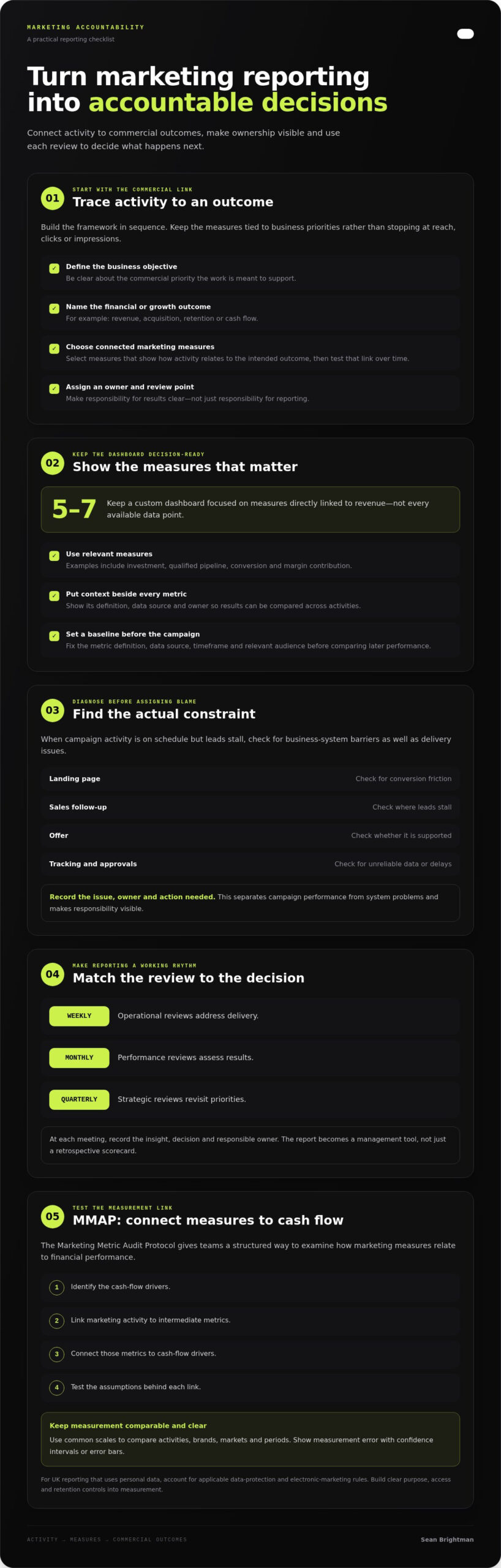
    Outcome measures show how marketing contributes to commercial performance, rather than stopping at reach or clicks. Build the framework in sequence: define the business objective, identify the cash-flow or growth outcome, select the marketing measures connected to it, then test those connections over time. Examples include return on marketing investment, acquisition cost and retention. Effective frameworks combine these measures with clear ownership and regular management reviews, so results inform the next decision.

    Sales and marketing metric alignment

    Sales and marketing alignment means both teams use shared definitions and measures across the customer journey. Agree what counts as a qualified lead, who owns follow-up and how progress is recorded. Then compare marketing’s lead and conversion measures with sales outcomes, such as new-customer revenue. This makes responsibility visible: if leads fail to progress, teams can identify the stage causing friction instead of arguing over separate dashboards.

    How should a report connect marketing activity to business outcomes?

    UK reporting that uses personal data should account for applicable data-protection and electronic-marketing rules. Build clear purpose, access and retention controls into measurement, then connect each activity to a financial outcome and an owner.

    Marketing investment and financial performance

    Linking investment to financial performance means tracing how marketing spend contributes to revenue, margin or cash flow. It matters because activity counts alone cannot show whether investment supports commercial priorities. For each programme, record its cost, the intermediate result, such as qualified demand, and the financial outcome it is expected to influence. Compare those measures over time and state the assumptions behind the link. This gives leaders insight into contribution, not just output.

    Diagnosing agency and business-system performance

    Diagnosis separates delivery issues from business-system barriers that prevent results. If campaign activity is on schedule but leads stall, examine the landing page, sales follow-up, offer and tracking before blaming the agency. Record the issue, its owner and the action needed. An agency performance review should also surface unsupported offers, conversion friction, unreliable data or approval delays while there is time to respond. This structured view makes responsibility clear and directs attention to the actual constraint.

    A custom dashboard should reflect the organisation’s strategic priorities, not every available data point. Keep it focused on five to seven measures directly linked to revenue, such as investment, qualified pipeline, conversion and margin contribution. Show definitions, data sources and owners beside each metric. That makes reporting comparable across activities and helps readers spot whether a change reflects performance or a tracking problem.

    Set a review rhythm that turns reporting into decisions: weekly operational reviews address delivery, monthly performance reviews assess results, and quarterly strategic reviews revisit priorities. Use each meeting to record the insight, decision and responsible owner. The report then becomes a working management tool, not a retrospective scorecard.
    Marketing Accountability Frameworks That Connect Activity to Outcomes

    Marketing measurement standards and MMAP

    Standards make campaign results more comparable and show how much confidence to place in them. MMAP gives teams a structured way to test how marketing measures connect to financial performance.

    Measurement standards and standardised measures

    Marketing measurement standards define consistent methods for assessing activity, outcomes and the reliability of results. The Marketing Accountability Standards Board provides the Marketing Metric Audit Protocol (MMAP), which identifies cash-flow drivers, links marketing activity to intermediate metrics, connects those metrics to cash-flow drivers and tests the assumptions behind each link. This matters because a campaign measure only supports a business decision when its meaning and relationship to financial performance are clear. Use common scales to compare activities, brands, markets and periods; show measurement error with confidence intervals or error bars.

    Establishing baseline measurements

    A baseline is a recorded starting point for comparing later performance. Establish it by fixing the metric definition, data source, timeframe and relevant audience before a campaign begins. For example, record existing customer acquisition and retention measures using the same definitions planned for evaluation. Gather outcome measures continuously over time; repeated observations help identify changes associated with marketing initiatives and shifting customer needs. A consistent baseline makes growth visible without confusing a change in measurement with a change in performance.

    Industry measurement practices

    Industry practice includes benchmarking return on investment and testing whether measurement methods produce valid results. The American Productivity and Quality Center and the Advertising Research Foundation conducted return-on-investment benchmarking surveys in 2001 and 2003. The Chief Marketing Officers Council carried out a survey on marketing accountability and measurement in 2004. The Association of National Advertisers and Forrester conducted surveys on those topics in 2002, 2004 and 2006. These examples show why shared definitions matter: comparisons need consistent measures, not merely familiar labels. For your own campaigns, document methodology and uncertainty alongside results, then compare like with like.

    Accountability frameworks and digital transformation

    Digital transformation spreads work across teams, platforms and customer-facing services. MIT Sloan Center for Information Systems Research identifies accountability as one of digital transformation’s five building blocks. Without defined ownership, teams can launch connected digital offerings but lose sight of their purpose, decisions and commercial contribution.

    An accountability framework connects leadership priorities to the people making product, data and channel decisions. For example, a team responsible for a customer portal can manage its design independently while agreeing shared service standards with sales and support. That balance protects local initiative and keeps the customer experience aligned. It also clarifies who can resolve a dependency when another team controls a required system or approval.

    RACI matrices make those relationships explicit by assigning responsibility, accountability, consultation and information-sharing roles. Apply the roles to a specific outcome, such as launching a digital service or changing its customer journey. One person or team needs clear accountability for the result; others need defined roles in delivery, input or updates. This prevents a common failure: everyone contributes, but no one can make the decision.

    Budget decisions need the same clarity. Define who can move investment between digital activities, who approves changes and which business purpose guides those choices. For example, a team running digital advertising may report campaign performance, while leadership decides whether the activity supports growth priorities. Visualising dependencies helps teams see how budget, data access and approvals affect delivery before delays become entrenched.

    Make the framework operational with shared tools that show ownership, decision rights and cross-team dependencies. Review those links as digital services or priorities change, rather than treating the structure as permanent. This turns accountability into a working system: teams can act with autonomy, leadership can see how decisions connect, and obstacles have an owner. Turn digital accountability into a practical operating plan.

    Sean Brightman: AI Consulting

    Sean Brightman’s AI Consulting helps leaders assess where AI fits their business priorities and decision-making. It’s relevant when your team is exploring AI but lacks a clear purpose, ownership or way to measure its contribution. Tie any proposed use to a defined outcome, accountable owner and agreed measure before committing resources.

    For broader planning, Roadmapping can clarify priorities and the sequence of work. An Advisory Retainer provides ongoing strategic guidance as decisions and business needs evolve. The right starting point depends on the challenge: AI Consulting for AI questions, Roadmapping for direction or an Advisory Retainer for continued advice.

    If you’d like to discuss your priorities, contact Sean Brightman or visit seanbrightman.com.

    Make accountability part of the next decision

    A marketing accountability framework should keep pace as your business priorities, teams and channels change. Treat it as a working management tool, not a dashboard you build once and leave untouched. Start by identifying where decisions still rely on activity counts, disconnected data or unclear ownership, then decide what needs to change.

    That work may call for strategic leadership as well as measurement discipline. Sean Brightman offers Fractional CMO support, AI Consulting and Roadmapping to help businesses tackle leadership, technology and planning challenges. The right focus depends on the gap: leadership direction, a clearer path forward or considered AI decisions.

    Start with the decision you need marketing to support. Make the commercial purpose clear, then give the team a way to learn and adjust as evidence changes. Contact Sean Brightman to discuss your framework, and take the next step towards marketing decisions grounded in business outcomes.

    Frequently Asked Questions

    How does a framework improve CMO tenure and team performance?

    A framework can support CMO continuity by making priorities, decision rights and progress visible to leadership and the team. It can reduce avoidable friction: a new CMO can inherit agreed definitions, reporting history and named owners instead of rebuilding the measurement system. Reviews that examine causes and next actions, rather than blame, also help teams learn from results and improve their decisions.

    How long does it take to implement the framework?

    Implementation time depends on data readiness and how much of the customer journey needs tracking. Basic tracking can take 2-3 weeks when the business has the right technology stack; comprehensive customer-journey tracking typically takes 4-6 weeks to deploy and validate. Allow time to define metrics, connect data, test outputs and train owners. A dashboard is only useful once its inputs are reliable.

    How should accountability be divided between the agency and the business?

    Divide accountability by decision and dependency, not by who appears on a report. An agency can own agreed campaign delivery, measurement quality and early warnings about tracking or conversion barriers. The business should own commercial objectives, its offer, approvals, internal data access and timely sales follow-up. If a launch stalls, record the blocker, decision-maker and next action so each party can address what it controls.

    What are the key components of a marketing accountability framework?

    Define the business objective, each metric’s calculation, its data source, an owner, a review rhythm and the decision it informs. A marketing accountability framework should also document how a measure is expected to influence customer behaviour and commercial results. For example, name who validates CRM lead stages and who can change a campaign if qualified prospects stop progressing.

    Which marketing KPIs and metrics should an accountability framework include?

    Choose KPIs that fit the business model and decision. A subscription business may focus on acquisition cost, payback and retention; a retailer may track new-customer revenue, repeat purchases and contribution margin. Pair an early signal, such as qualified enquiries, with a later result, such as revenue. Treat impressions as diagnostic context, not the sole evidence that marketing investment is working.

    How can marketing activity be linked to revenue, profit and business outcomes?

    Map each activity through a customer response to an economic driver: advertising generates qualified demand, sales converts that demand, and revenue contributes to margin after relevant costs. Use consistent time periods and account for influences such as price changes before assigning credit. The Marketing Metric Audit Protocol provides a structured way to test assumptions linking marketing measures with cash-flow drivers.

  • How to get senior marketing expertise affordably through adaptable hires

    How to get senior marketing expertise affordably through adaptable hires

    You don’t need a full-time specialist for every marketing challenge. A practical way to get senior marketing expertise affordably is to bring in an adaptable generalist who can plan and deliver work across channels. Assess their portfolio and case studies by how clearly they connect campaign activity to business objectives and KPIs.

    Senior experience doesn’t have to mean a permanent role or a specialist for every function. A Fractional CMO can bring strategic direction across positioning, priorities, campaigns and marketing systems, helping you connect the work to business goals without coordinating separate advisers yourself.

    Start by defining the decisions and outcomes you need help with. Then assess whether a one-off roadmap, ongoing advisory or embedded leadership fits the work. Look for clear strategic thinking, relevant experience and accountability, rather than choosing based on a title alone.

    Key Takeaways

    • Review portfolios for a clear link between campaign activity, business goals and meaningful KPIs, not just polished creative work.
    • Compare the full commitment of a permanent hire with the specific expertise and scope your business needs.
    • Define the outcomes and responsibilities before seeking part-time marketing leadership, so you can assess experience against the actual work.
    • Explore whether local business support or grant programmes fit your needs, and check their eligibility criteria and what they cover.

    2. Portfolio and case study analysis

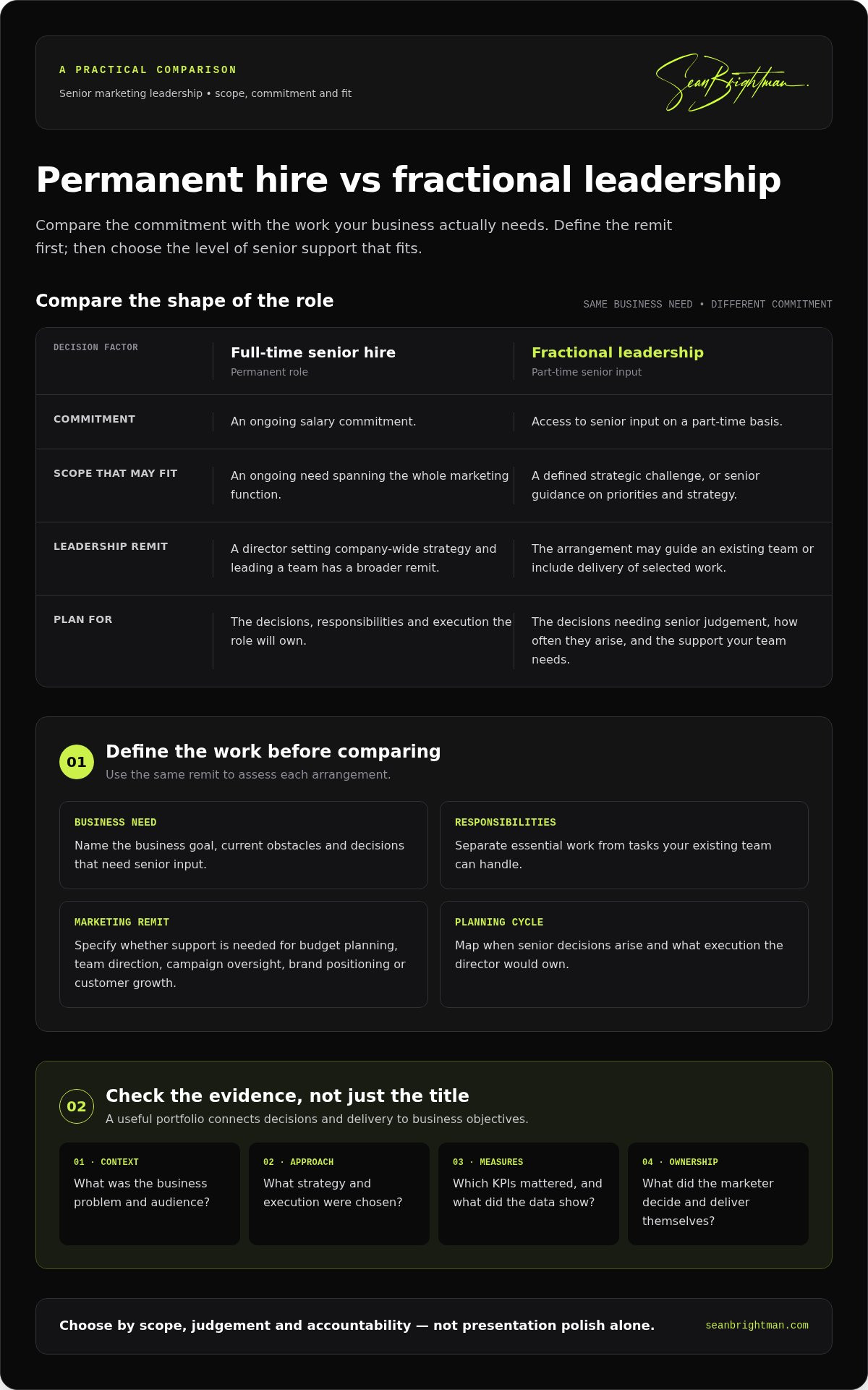
    A portfolio should show how a marketer thinks, not just what they made. If you’re deciding how to get senior marketing expertise affordably, look for evidence of relevant decisions and delivery. A useful case study explains the business problem, audience, strategy and execution, then connects the activity to business objectives. Ask which KPIs mattered, how the results shaped decisions and what changed as a result.

    Look for the full chain from activity to outcome. An email case study, for example, should explain its purpose, audience and success measures, not simply display a polished template. Check whether the marketer distinguishes activity, such as sending emails, from results that support a business objective. Ask what the data showed and what they would change next time. Their answer can reveal strategic thinking and practical judgement.

    Assess breadth against the work your business needs. An adaptable generalist may contribute across digital, content, email and brand marketing, while planning and delivering campaigns end to end. If repeat customers matter, look for CRM and lifecycle marketing experience that can support stronger customer engagement and long-term value. A varied career can be useful, but the portfolio still needs relevant examples, clear ownership and evidence of delivery.

    Use a consistent review process for every portfolio. Match each case study to a business priority, identify its KPIs, then note the marketer’s role and decisions. Separate their contribution from work completed by an agency or wider team. If they use AI, assess whether they apply it critically and ethically as support, rather than a substitute for marketing expertise. To get senior marketing expertise affordably, compare evidence of relevant judgement and delivery, not job titles or presentation polish.

    3. What are the typical costs of hiring a full-time senior marketing director in the UK?

    Compare the cost of a full-time role with the scope of support you actually need. A permanent senior hire brings an ongoing salary commitment, while fractional leadership gives you access to senior input on a part-time basis. Define the decisions, responsibilities and level of involvement required before comparing options.

    Start by defining the work. A director setting company-wide strategy and leading a team has a different remit from someone guiding a focused marketing function. Specify whether you need support with budget planning, team direction, campaign oversight, brand positioning or customer growth. Then separate essential responsibilities from work your existing team can handle. This gives you a clearer basis for assessing the level of commitment.

    Compare like with like. A full-time role and fractional leadership differ in time commitment, responsibilities and how the work is delivered. For example, a business that needs someone to lead a team day to day may require a different arrangement from one seeking senior guidance on priorities and strategy. Be clear about the work, the decisions involved and the support your team needs.

    To decide whether a permanent hire makes sense, map the work across a typical planning cycle. Identify which decisions require senior judgement, how often they arise and what execution the director would own. If the need is ongoing and spans the whole marketing function, a full-time role may fit. If it centres on a defined strategic challenge, consider whether a narrower remit would meet the need. A clear marketing roadmap can help sharpen that scope before you commit.

    A Level 3 marketing apprenticeship typically takes 15-18 months in the UK. For businesses planning future capability, this offers a longer-term route to consider alongside an immediate senior hire.

    Marketing professionals can progress into management and director roles, or work as freelance consultants. That progression may help you assess whether your organisation needs senior leadership now or can develop capability over time. Use the remit you have defined to guide the decision: if you need strategic direction immediately, focus on support that can provide it; if the need is evolving, include development in your workforce plan.

    How to get senior marketing expertise affordably through adaptable hires

    4. How can a small business find an experienced part-time marketing director in the UK?

    Start with the problem, not the job title. Write a brief that names the business goal, current obstacles and decisions needing senior input. For example, a retailer might need a clearer customer acquisition plan, not someone to manage every daily post. Define the outcomes, responsibilities and how the senior marketer will work with existing staff. A focused brief helps you identify support that matches the actual need.

    Search for people with part-time, fractional or interim marketing leadership experience. Ask trusted business contacts for introductions, and use professional networks to find candidates with relevant sector knowledge. Review their portfolios and case studies against the brief. Look for evidence they have set direction, prioritised activity and worked with teams to put plans into action. A director who has led a similar challenge may be more relevant than one with an impressive title alone.

    Use a structured conversation to test judgement. Give each shortlisted candidate the same practical scenario, such as slow repeat purchases or an unclear brand position. Ask how they would diagnose the issue, what information they would need and which actions they would prioritise. Strong answers connect the proposed work to a business objective, explain trade-offs and identify how progress would be measured.

    Before agreeing a working arrangement, set out its boundaries. Specify decision-making authority, key deliverables, internal contacts and how updates will happen. Clarify whether the senior marketer will guide an existing team or personally deliver selected work. Agree how you’ll review priorities as business needs shift. This keeps the role focused and prevents part-time leadership from becoming an undefined catch-all. Look for someone who can make senior-level decisions and work constructively with the people handling day-to-day tasks.

    4. Can UK businesses access affordable marketing advice through Growth Hubs, business support programmes or grants?

    Yes, these routes can help businesses find advice or fund defined projects, but support depends on the scheme and location. Start with your local Growth Hub and describe the business challenge in practical terms. For example, explain whether you need a clearer route to market, stronger customer retention or a plan for digital activity. Ask what support covers, who can apply and what outcomes the programme expects. That conversation helps you distinguish useful marketing guidance from general business support.

    Compare any available support programmes with the work you need done. Some focus on advice, while others support a specific project or business objective. Read the eligibility rules, application process, covered activities and reporting requirements. If you’re considering a grant, check whether marketing strategy, research or campaign delivery qualifies as an eligible cost. Prepare a short project outline with its objectives, proposed work and measures of progress, then compare it with the scheme’s criteria.

    Keep the limits clear. A grant is not a general marketing budget, and advice does not automatically include implementation. A programme might help you refine a growth plan, while your business still needs to assign someone to carry it out. Record what the support will deliver, what your team must provide and how you’ll measure progress. This makes it easier to compare a funded project with other ways of addressing the same need.

    Use public support to sharpen the decision, not to outsource ownership of the strategy. Once you understand the available help, identify the gaps it leaves: direction, prioritisation or a workable plan for delivery. If you need to turn scattered marketing activity into a focused programme, map your marketing priorities into clear objectives and next steps.

    CRM and lifecycle marketing are useful skills for businesses seeking to deepen customer engagement and increase long-term customer value. Choosing a manager and team that support career progression and nurture talent can help professionals advance.

    Sean Brightman: AI Consulting

    Sean Brightman’s AI Consulting is a practical next step when you need senior guidance on AI’s role in marketing. Use it to assess where AI could support your work, how it fits your business priorities and which decisions still need human judgement. The aim is a clearer direction, not adopting tools for their own sake.

    If your wider challenge is setting marketing priorities, Roadmapping provides a one-off strategy session and a structured plan. An Advisory Retainer offers ongoing strategic input, while Fractional CMO support provides senior leadership on a part-time basis. Choose the option that matches the decision in front of you, rather than adding complexity before you know what needs solving.

    To discuss your marketing challenge, email Sean Brightman at sean@seanbrightman.com.

    Turn your marketing gap into a clear next step

    Getting senior marketing expertise affordably comes down to matching the support to the decision your business needs to make. Before taking action, write a short brief: identify the priority, the decision holding progress back and what your team can deliver. That gives the conversation a useful starting point and keeps the focus on the work, not a job title.

    Sean Brightman offers Fractional CMO, AI Consulting and Roadmapping. Each addresses a different need, from senior marketing direction to practical AI guidance or a clearer plan. Be precise about the challenge you want to solve, then choose the kind of input that will move it forward.

    Contact Sean Brightman to discuss your marketing expertise needs. A focused next step can make the path ahead easier to act on.

    Frequently Asked Questions

    How can a business assess a senior marketer’s experience and verify results before hiring?

    Ask the marketer to walk through a project and explain their personal contribution, the starting position and how the outcome was measured. Then, with their permission, request a relevant reference who can speak to that work. For example, if they claim to have improved lead quality, ask how the team defined a qualified lead and what else could have influenced the result. This tests whether they can substantiate claims and explain context.

    What are the risks of hiring a low-cost marketing consultant or relying on a generalist?

    A generalist may not have experience that matches your specific priorities, so review case studies for clear ownership, meaningful KPIs and results linked to business goals. An unclear brief can also turn a part-time role into an undefined catch-all. Set responsibilities and deliverables before agreeing on the support.

  • How to Set Marketing Team Objectives and Key Results That Align

    How to Set Marketing Team Objectives and Key Results That Align

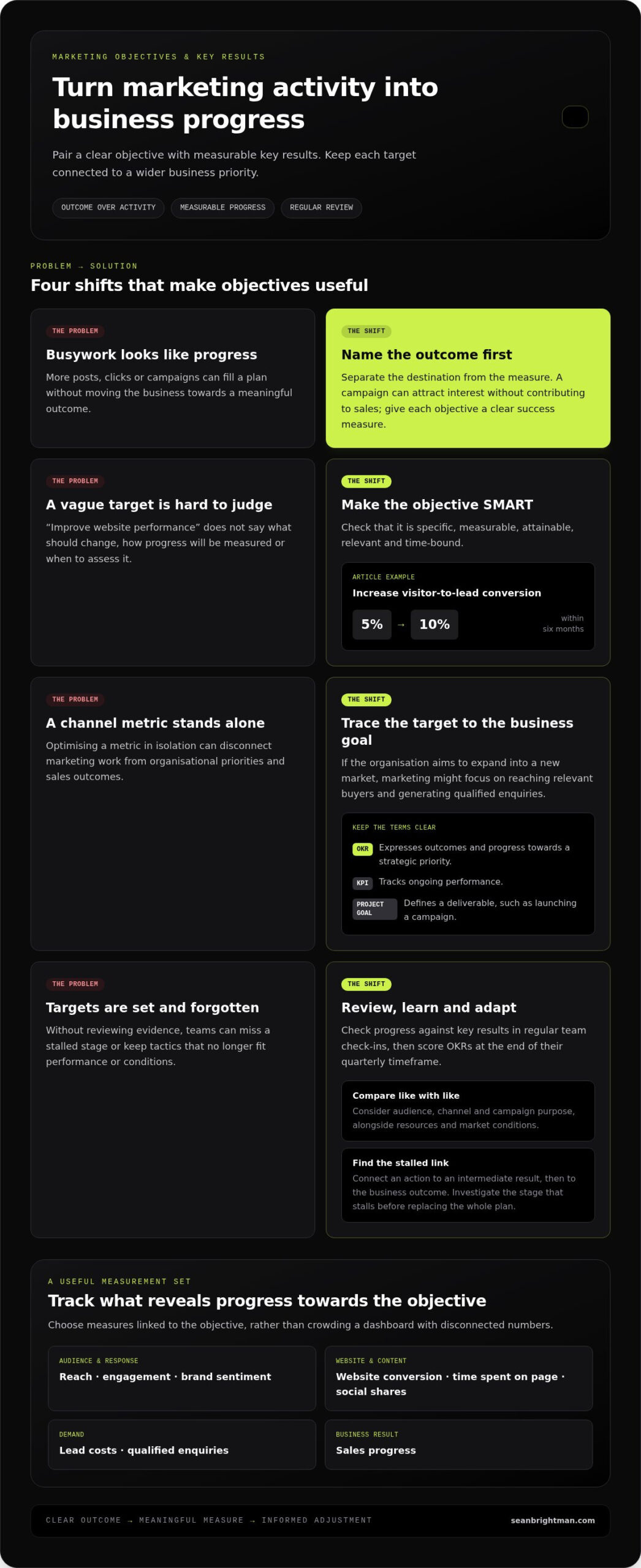
    Marketing objectives should drive business results, not just collect vanity metrics. Setting marketing team objectives and key results means pairing a clear, qualitative objective with measurable key results that show progress. When targets reflect wider business priorities, they guide the team’s work and define how success is judged.

    It’s easy to fill a plan with activity: more posts, clicks or campaigns. But activity matters only when it moves the business towards a meaningful outcome. The challenge is choosing targets that are ambitious enough to matter and realistic enough to pursue.

    This guide explains how marketing objectives shape strategy, how to set specific, achievable goals, and how to monitor performance and adapt. You’ll learn to connect targets to business priorities, choose measures that reveal progress, and keep the team focused on outcomes rather than busywork.

    Key Takeaways

    • Connect each marketing objective to a wider business priority, so the team knows what its work is meant to move.
    • Turn broad ambitions into SMART objectives with clear measures and deadlines.
    • Review campaign data against key results, then adjust tactics when performance or conditions change.
    • Set targets against current performance, team capacity and available resources to keep ambition achievable.

    How Do Different Goals Influence Overall Marketing Strategy?

    Start by tracing each marketing target back to a business priority. That connection turns strategy into focused work instead of a list of disconnected campaigns.

    1. Distinguish Marketing Goals from Objectives

      Separate the destination from the measure. A marketing goal can describe a qualitative ambition, such as strengthening trust, while an objective makes progress measurable, such as improving customer retention. Give each objective a clear success measure. Publishing posts or running advertising is activity, not the outcome. A campaign, for example, can attract interest without contributing to sales.

    2. Align Objectives with Business Goals

      Choose the business result marketing must support, then define an objective around its contribution. If the organisation aims to expand into a new market, marketing might focus on reaching relevant buyers and generating qualified enquiries. Check the connection with sales and other teams: an objective should support organisational priorities, not optimise a channel metric in isolation. Explain how its measure signals progress towards the wider goal.

    3. Connect OKRs with Company Strategy and Sales

      Build each OKR around a strategic priority and a sales outcome. For example, if the company needs stronger sales from a new offer, make that the objective and use measurable key results to track qualified leads or sales progress. Marketing OKRs express outcomes and progress; KPIs track ongoing performance, while project goals define deliverables, such as launching a campaign. OKRs commonly run quarterly. Set only objectives and key results the team can own and review meaningfully.

    4. Communicate Goals and Their Purpose

      Record each objective, key result, owner and business rationale in one shared team tracker. An OKR document or project-management board keeps progress visible; the right tool is the one your team will update and use in reviews. Explain how each measure connects marketing activity to sales or strategy, and invite team members to flag dependencies. This clarity helps everyone understand their role and what success looks like.

    What are marketing objectives?

    A marketing objective turns a business priority into a measurable target. A practical approach to setting marketing team objectives and key results starts by naming the outcome, then deciding how the team will recognise progress.

    1. Brainstorm SMART Marketing Objectives

      Begin with a business objective, then identify the audience behaviour marketing can influence. If the priority is stronger brand awareness, consider recognition among target buyers or relevant social media engagement. If it is conversion, focus on moving interested prospects towards an enquiry or purchase. Ask the people delivering the work to suggest possible measures. Don’t choose a metric simply because it is easy to collect.

    2. Apply SMART Criteria to Objectives

      Test every draft against five checks: specific, measurable, attainable, relevant and time-bound. Replace “improve website performance” with a defined target, such as increasing visitor-to-lead conversion from 5% to 10% within six months. Next, check the baseline, available resources and the team’s influence over the result. A deadline without delivery capacity is wishful thinking; a measure without a connection to business objectives is noise.

    3. Explore Marketing OKR Examples

      Use the objective to state the outcome, then key results to show evidence of progress. For brand awareness, aim to strengthen recognition and track relevant audience reach. For demand generation, focus on qualified enquiries and follow their progress into sales conversations. For retention, target stronger customer loyalty and track repeat purchasing behaviour. Keep measures tied to outcomes, not simply activity volume.

      Common mistakes include vague outcomes, vanity metrics, targets disconnected from business priorities and results the team cannot influence. Treat setting marketing team objectives and key results as a working process: test whether each measure guides a useful decision. If your objectives need a clearer route into delivery, a marketing roadmap can connect priorities, measures and work.

    How to Set Marketing Team Objectives and Key Results That Align

    Monitoring performance and adjusting strategy

    A marketing strategy sets out how to reach prospective customers and turn them into sales. Monitor whether its actions move people through that journey, then adjust based on evidence.

    Review and Update OKRs

    1. Review progress against each key result in regular team check-ins, then score OKRs at the end of their quarterly timeframe. Compare actual results with the intended outcome and record what changed and why. According to NHS, OKRs can measure activities contributing to strategic focus areas and workstreams.
    2. Set realistic targets using previous campaign performance as a baseline. Compare like with like, including audience, channel and campaign purpose, then factor in available resources and market conditions. Historical data shows what your team has achieved. Relevant benchmarks can add context, but neither should replace a clear business rationale.

    Use Performance Data to Adjust Strategy

    1. Track metrics linked to each objective, not a dashboard crowded with disconnected numbers. For example, assess lead costs, website conversion, reach and engagement alongside sales progress. Review content performance through time spent on page and social shares. Brand sentiment analysis can also reveal how people respond to your message.
    2. Map cause and effect before changing tactics. If awareness is meant to create qualified interest, which should then lead to enquiries, measure each link in that chain. A strategy map makes the connections visible: an action should influence an intermediate result, which supports the business outcome. If one link stalls, investigate that stage before replacing the whole plan.
    3. Use campaign analytics to decide whether to refine a channel, message or audience. Compare results with KPIs and previous campaigns, then document the change and its expected effect. Effective marketing tests actions against evidence instead of defending a tactic simply because the team has already invested time in it.

    Keep the plan current: revisit goals and objectives using analytics and check-ins, and let feedback, results and future projections guide revisions.

    Setting specific and achievable marketing objectives

    Set objectives based on evidence, not optimism. Effective marketing OKRs link a business outcome to measurable results, a clear owner and work the team can realistically deliver.

    1. Start with the audience and business outcome. Identify whose behaviour needs to change, then choose a result marketing can influence. For example, if the target audience visits your site but rarely enquires, focus on conversion instead of adding unrelated campaigns. Audience research helps reveal the needs, preferences and behaviour behind the numbers.
    2. Benchmark current performance before choosing a target. Compare like-for-like periods and channels, then account for seasonality, campaign history, team skills, budget and available tools. A target of increasing website traffic by 20% within six months is meaningful only if the baseline and planned activity make that lift achievable.
    3. Work backwards through the customer journey. Start with the sales outcome, then estimate the leads, traffic and awareness needed to support it. Check each step with sales and the people delivering the work. If the plan depends on everyone changing several priorities at once, narrow the objective or adjust its scope.
    4. Choose key results that measure outcomes, not just effort. “Publish more content” describes an action; “generate 100 new leads per month through content marketing” gives the team a result to track. Set ambitious stretch targets, but keep them grounded in capacity and evidence. OKRs commonly use stretch targets teams expect to achieve at 40-70%.
    5. Write the objective, key results, owner, timeframe and dependencies together. Then ask the team whether the actions and resources match the target. If not, revise the target or remove competing work before the cycle starts. For a clearer plan connecting priorities to execution, build a marketing roadmap.

    Even when the right target is uncertain, set specific, measurable, numerical goals and use the results to iterate. A key result might be for repeat customers to account for 25% of sales; other examples include increasing social media followers by 15% over six months or securing media coverage in three industry publications within the next quarter.

    Set goals for each stage of the customer journey, so marketing and sales contribute throughout rather than focusing on selected stages. For funnel goals, start with sales targets and work backwards to the leads, traffic and awareness needed to support them.

    Sean Brightman: AI Consulting

    Sean Brightman’s AI Consulting can help you assess how practical AI systems could support marketing priorities and objectives. Explore where AI fits your strategy, keeping the focus on useful outcomes rather than adopting tools for their own sake.

    If objectives lack a clear route to delivery, Roadmapping can connect priorities with the work needed to move them forward. An Advisory Retainer provides ongoing strategic input as plans evolve. Choose support that matches the challenge: exploring AI’s role, turning objectives into a roadmap or maintaining strategic direction.

    Bring a defined marketing challenge and the business outcome you want to support. That gives the discussion a practical starting point. Visit seanbrightman.com to get in touch with Sean Brightman.

    Turn your objectives into the next decision

    Next, make your objectives part of how the team chooses and prioritises work. Before adding a campaign, ask which outcome it supports, who owns the result and what should stop if priorities shift. This discipline keeps strategy connected to daily decisions instead of leaving it on a planning document.

    The value of setting marketing team objectives and key results lies in making trade-offs visible. If your team needs senior marketing direction, Sean Brightman offers Fractional CMO support. Roadmapping can connect priorities to execution, while AI Consulting can help assess where practical AI systems fit your marketing work.

    Choose the support that matches the challenge in front of you. Contact Sean Brightman to discuss your marketing priorities. Make the next move with focus, and give the team a clearer path forward.

    Frequently Asked Questions

    How to Streamline Goal Setting in Marketing?

    Make goal setting more efficient by gathering business priorities and campaign evidence before the planning discussion. Ask sales which customer objections or lead-quality issues matter most, then use that input to shape marketing’s contribution. Record each proposed objective, decision-maker, data source and dependency in one shared document. This preparation keeps the discussion focused on decisions, rather than reconstructing context.

    What Key Performance Indicators Should Teams Monitor?

    Monitor indicators that match the work’s place in the customer journey. For a paid campaign, click-through rate shows whether an advert attracts clicks, while Return on Ad Spend measures revenue generated per pound invested in advertising. Pair these with a quality or conversion measure so rising traffic doesn’t disguise weak enquiries. Choose a small, relevant set for each campaign and apply its definitions consistently.

    What does a good team goal setting framework look like?

    A practical framework connects business priorities to team objectives, measurable results, named owners and supporting work. Record dependencies, decision rights and progress in a shared place, so contributors know where to raise blockers. For example, a product launch objective might depend on sales enablement and website updates. Review OKRs over a quarterly cycle, then carry forward only priorities that remain relevant.

  • Defining Roles in a Marketing Team Around Business Needs

    Defining Roles in a Marketing Team Around Business Needs

    There’s no single marketing team structure that fits every business. Defining roles in a marketing team means matching ownership to business priorities, then adapting as work becomes more specialised. Early-stage businesses often start with one or two generalist marketers; growing teams may organise around functions, products or channels.

    When roles blur, campaigns stall, priorities clash and gaps stay hidden. Adding job titles won’t fix the problem. Clear responsibilities and decision rights help people act while keeping marketing aligned with commercial goals.

    This article explains common team structures, which responsibilities need clear owners and how to spot capability gaps. You’ll also see how roles can change as a business grows, so you can build around the work ahead rather than copy someone else’s org chart.

    Key Takeaways

    • Choose a team structure around how the business serves its markets, products and channels, not a fashionable org chart.
    • Separate job titles from responsibilities: define who owns outcomes, makes decisions and collaborates across functions.
    • Assess skills gaps against business goals, channel performance and existing capability before deciding what expertise the team needs.
    • As marketing work becomes more specialised, protect shared priorities and clear hand-offs so expertise doesn’t create silos.

    What is a marketing team structure?

    A marketing team structure groups work by function, product, market or channel and clarifies who makes decisions. In-house staff work within the business; agencies provide external teams, while freelancers deliver defined specialist work independently.

    Function, discipline and product structures

    Functional structures group people by marketing discipline; product structures bring different disciplines together around one product or service. Functional teams might separate content, social media and paid media, while channel-specific teams assign ownership for email, websites or social platforms. Geographical structures organise teams around markets, which can suit businesses serving international audiences. The choice matters: a focused team can build expertise, while a smaller firm might use one generalist and external specialists to cover gaps.

    Centralised, pod-based and hybrid models

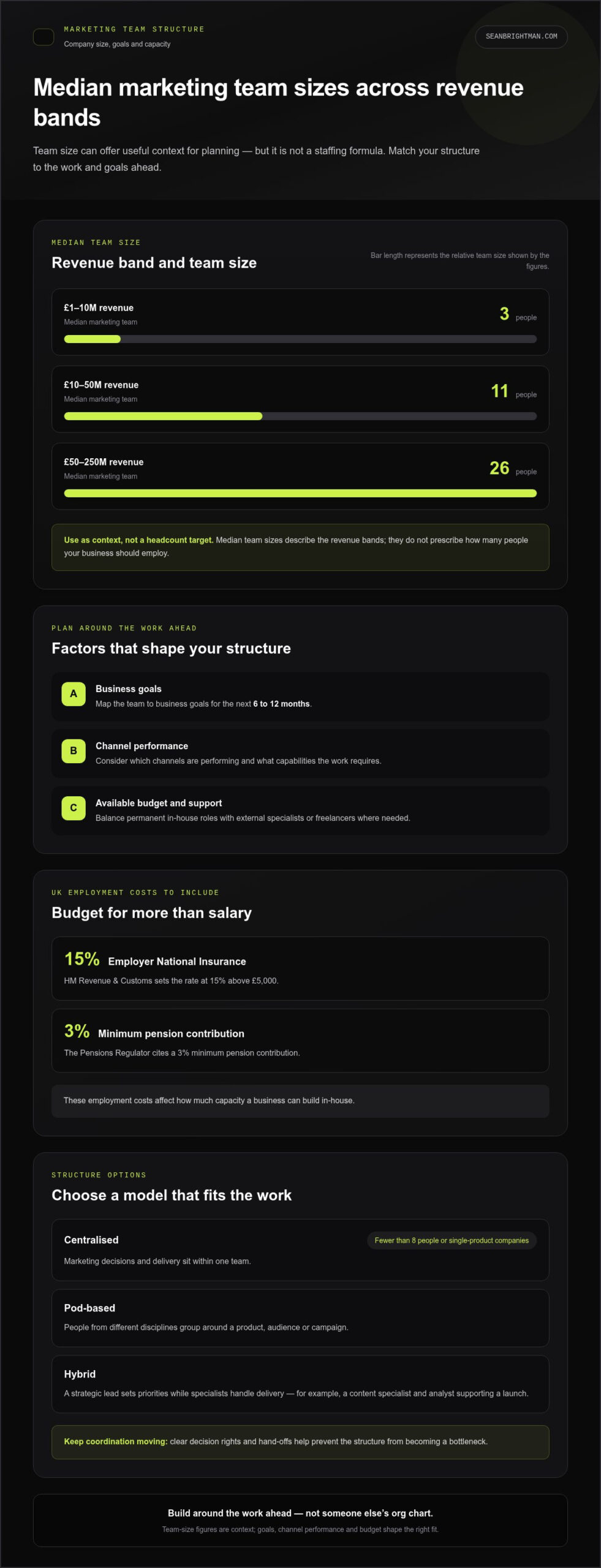
    A centralised structure keeps marketing decisions and delivery within one team. It can suit teams with fewer than 8 people or single-product companies. Pod-based structures group people from different disciplines around a product, audience or campaign. A hybrid model combines a strategic lead with specialists who handle delivery. For example, a lead could set priorities while a content specialist and analyst support a launch. Clear decision rights and hand-offs keep coordination moving instead of creating a bottleneck.

    Structure by company size and goals

    Company size, revenue and goals shape how much specialisation a team can support. Median team sizes are 3, 11 and 26 people for businesses in the £1-10M, £10-50M and £50-250M revenue bands, respectively. Treat these as context, not a staffing formula. Map the structure to business goals for the next 6 to 12 months, channel performance and the budget for permanent or external support. Include employment costs: HM Revenue & Customs sets employer National Insurance at 15% above £5,000, and The Pensions Regulator cites a 3% minimum pension contribution. These costs affect the capacity a business can build in-house.

    Defining marketing roles and responsibilities: what needs to be clear?

    Defining roles in a marketing team starts with separating a job title from the work and decisions attached to it. Connect each role to the functions and business outcomes it supports, so people understand how their contribution fits.

    Roles, responsibilities and functions

    A function is a body of work, a role is who carries it, and responsibilities are the tasks and decisions they own. This distinction helps growing teams collaborate without leaving work stranded between job titles. For example, a content strategist might plan topics while a copywriter drafts them. Record scope, decision rights and hand-offs so colleagues know who can move campaigns forward. Clear definitions make defining roles in a marketing team practical, not a paperwork exercise.

    Core marketing role categories

    Marketing roles bring expertise together across strategy, content, digital delivery and customer growth. A digital marketing manager may oversee SEO, website performance, paid media, email, automation and tracking; content marketers create written and visual material. Social media owners manage platforms and monitor brand reputation. These responsibilities may sit with one generalist or several specialists, depending on capacity.

    SEO, content and social media can sit with dedicated specialists or broader digital and content roles. Assign ownership by task: who plans content, optimises pages and publishes posts? Marketing and sales should agree on lead definitions, handover points and feedback. Marketing typically generates and nurtures leads; sales follows up prospects, with both teams aligning on lead quality and conversion.

    Ownership and leadership responsibilities

    Ownership names the person accountable for an outcome, even when several colleagues contribute. For each campaign, assign a lead, approvers and contributors; clarify who controls the brief, budget decisions, launch and results review. This prevents duplicated work and stalled approvals. Boundaries should enable collaboration, not turn every task into a permission request.

    A head of marketing defines strategy, aligns activity with commercial goals, manages investment and shapes the team. A marketing manager coordinates campaigns around those goals. When priorities or working arrangements change, revisit role scope and decision rights. This keeps accountability connected to current work, not an outdated org chart.

    Defining Roles in a Marketing Team Around Business Needs

    Assessing marketing needs and skills gaps

    Assess capability against the work needed to meet business priorities, not job titles alone. UK qualifications vary by role; evaluate relevant skills through work samples, platform experience and evidence of results.

    AI-related marketing roles and skills

    AI-related marketing roles apply AI tools to research, content, analysis or campaign delivery. As marketing work changes, assess practical ability rather than chasing a fashionable title. An AI-skilled marketer should verify and edit generated outputs, recognise where human oversight matters, and connect tool use to useful outcomes.

    Test those skills with a realistic task: ask a candidate to review an AI-assisted campaign draft, identify unsupported claims and improve its accuracy. Then ask what the tool contributed and where human judgement was needed. Strong answers show how AI supports a business decision, acquisition or paid media activity, rather than automation for its own sake. Build development plans around demonstrated gaps.

    Capability shortages can affect hiring: 82% of marketing and creative managers report challenges finding skilled talent. Separate a genuine skills gap from unclear priorities or limited capacity before deciding to recruit.

    Skills and qualifications for UK marketing roles

    Common marketing roles call for different evidence. A content marketer should show clear writing and audience understanding; an SEO specialist should explain how they improve search visibility. A paid media marketer needs to interpret campaign performance, while a marketing manager should demonstrate planning, coordination and sound decision-making. Relevant qualifications can support a candidate’s case, but assess them alongside practical work and role-specific experience.

    Start with the outcome the role must deliver. For example, if acquisition relies on organic search, assess research, technical understanding and content optimisation. If campaigns depend on paid media, test budget prioritisation and performance analysis. Compare those requirements with the team’s current capabilities, then decide whether to develop existing staff, reshape responsibilities or hire to address a persistent gap.

    • Review recent work samples against the role’s actual responsibilities.
    • Use a practical exercise to test judgement, analysis and communication.
    • Record which skills the team can deliver and where support is needed.

    How marketing roles specialise as businesses grow

    Growth changes the work before it changes the org chart. Small businesses often rely on one or two generalist marketers to cover content, email, social media and website updates. Large organisations can split those responsibilities into specialist positions, adding depth but requiring stronger shared direction.

    The difference is scope: generalists switch between connected tasks, while specialists focus on a narrower discipline or business need. An enterprise may have 20 or more marketing team members in specialised roles. That structure creates expertise, but without shared priorities, separate teams can pull campaigns in different directions.

    Hiring should address the work that is breaking down, not follow a standard ladder of job titles. When activity becomes fragmented, a marketing manager can coordinate campaigns and connect delivery to business goals. If a growing technology stack exceeds three tools, a marketing operations manager can help manage the systems and processes behind delivery.

    As a team expands, the leadership challenge shifts from doing marketing to directing specialists. The transition becomes a critical inflection point when a team has between 8 and 15 marketers. Leaders need to establish priorities, decision rights and hand-offs, so expertise strengthens the whole operation rather than creating isolated functions.

    Product-led SaaS companies may allocate 22-25% of marketing headcount to product marketing specialists. That reflects the need to align product positioning, launches and sales enablement as offerings multiply. It is a context-specific model, not a headcount target for every business.

    For small firms, keep positions broad while demand stays connected; specialise when recurring work needs deeper ownership. For large organisations, preserve a common direction across specialists, products and markets. Plan the next stage of your marketing team around the work growth will create.

    Sean Brightman: AI Consulting

    Sean Brightman’s AI Consulting can help your team assess where AI fits, which skills it needs and where human oversight remains essential. The focus is practical application, not adding tools for their own sake.

    For broader team changes, Roadmapping can connect business priorities with marketing capabilities and the roles needed to deliver them. An Advisory Retainer provides ongoing strategic input as priorities shift and responsibilities evolve.

    Bring a clear challenge: perhaps your team is testing AI, struggling to assign ownership or deciding which capability to develop next. That gives the discussion a useful starting point and keeps the focus on business needs, not job titles alone.

    Contact Sean Brightman to discuss the marketing challenge you’re working through.

    Make your next team decision count

    The real test of defining roles in a marketing team is what changes when ownership becomes clear. Choose one business priority that needs stronger marketing support, then identify the capability, authority and time required to move it forward. This gives your next decision a practical anchor, whether you’re reshaping responsibilities, developing existing talent or setting a new direction.

    If the challenge sits at leadership level, Sean Brightman’s Fractional CMO offering can provide strategic direction. For a team working out how AI fits into its marketing activity, AI Consulting is a relevant next step. Roadmapping can connect business priorities with a clear direction for action. The right focus depends on the challenge you need to solve.

    Contact Sean Brightman to discuss your marketing team and the next decision in front of you. A clearer structure starts with one useful move, and you can build from there.

    Frequently Asked Questions

    Should a growing business hire a marketing generalist or specialists?

    Hire a generalist when the immediate need is broad, connected delivery; add specialists when specific work requires deeper expertise. For example, a generalist may coordinate a campaign across email, website and social content. If search optimisation or analytics repeatedly demands more technical attention, assign dedicated ownership to that discipline. Base the decision on the work accumulating, not on copying another company’s org chart.

    What is the role of a marketing department?

    A marketing department connects the organisation with its audiences and helps communicate what the business stands for. Its work can extend beyond customer-facing campaigns. For example, a team might share company priorities with employees through an internal newsletter or intranet, and prepare executives for media queries. These responsibilities help align public messaging and internal understanding as products and priorities evolve.

    What does a marketing org chart look like at each company size?

    There’s no fixed org chart, but business stage offers a useful starting point. Early-stage companies may have one to three marketers; growth-stage businesses with £10-30M revenue may have 4-8. Mid-market organisations with £30-100M revenue may have 9-20, whilst enterprises at £100M or more may have 20 or more. Treat these as reference points, then organise positions around products, audiences and delivery needs.

    What does a head of marketing do?

    A head of marketing sets the function’s direction and ensures its investment supports commercial priorities. This includes deciding which activities deserve budget, shaping the team as needs change and connecting marketing plans with wider business decisions. Before a new product launch, for instance, the head of marketing can align research, positioning and campaign resources with the launch’s commercial purpose.

    What is the difference between marketing responsibility and accountability?

    Responsibility describes the work someone carries out; accountability identifies who answers for the outcome. For a campaign, a copywriter may be responsible for producing the landing-page text, while the campaign lead is accountable for coordinating the launch and reviewing its results. Several people can contribute, but naming one accountable owner prevents decisions and follow-up from falling between roles.

    When can a generalist own several marketing responsibilities?

    A generalist can own several responsibilities when the work is related, the workload is manageable and specialist depth isn’t essential for every task. For example, one marketer might coordinate email content, website updates and campaign calendars for the same audience. Make the arrangement workable by clarifying priorities and decision authority. Revisit it when deadlines collide or specialist work starts limiting delivery.

  • Future-proofing your marketing strategy by focusing on data, technology and AI search

    Future-proofing your marketing strategy by focusing on data, technology and AI search

    AI search is changing what marketing visibility has to earn. Future-proofing your marketing strategy for 2026 means building an adaptable plan that connects privacy-first data, useful technology and content people and AI systems can understand to clear business objectives. It’s a working system, not a set-and-forget campaign.

    The pressure to adapt is real. Customer behaviour shifts, platforms change and new tools arrive fast. But chasing every trend isn’t a strategy, and adding AI without a clear business problem can create more noise than value.

    This article explains what future-proofing a marketing plan involves and how to make it practical. You’ll learn how to use first-party data responsibly, choose technology that supports your goals and shape content for AI-powered search without losing sight of human readers.

    The goal isn’t to predict every change. It’s to build a plan you can test, learn from and adjust, so your marketing keeps moving as conditions change.

    Key Takeaways

    • Use first-party data to understand customer needs, then make each interaction relevant and transparent.
    • Build a flexible marketing plan around clear business objectives, with regular reviews that turn new evidence into action.
    • Choose technology to solve a defined problem, not simply because a tool is new or popular.
    • Make content easy for people and AI-powered search to understand: answer real questions clearly and show practical expertise.
    • Test emerging approaches on a small scale, measure their contribution and expand what supports your goals.

    1. First-party data and privacy-first marketing

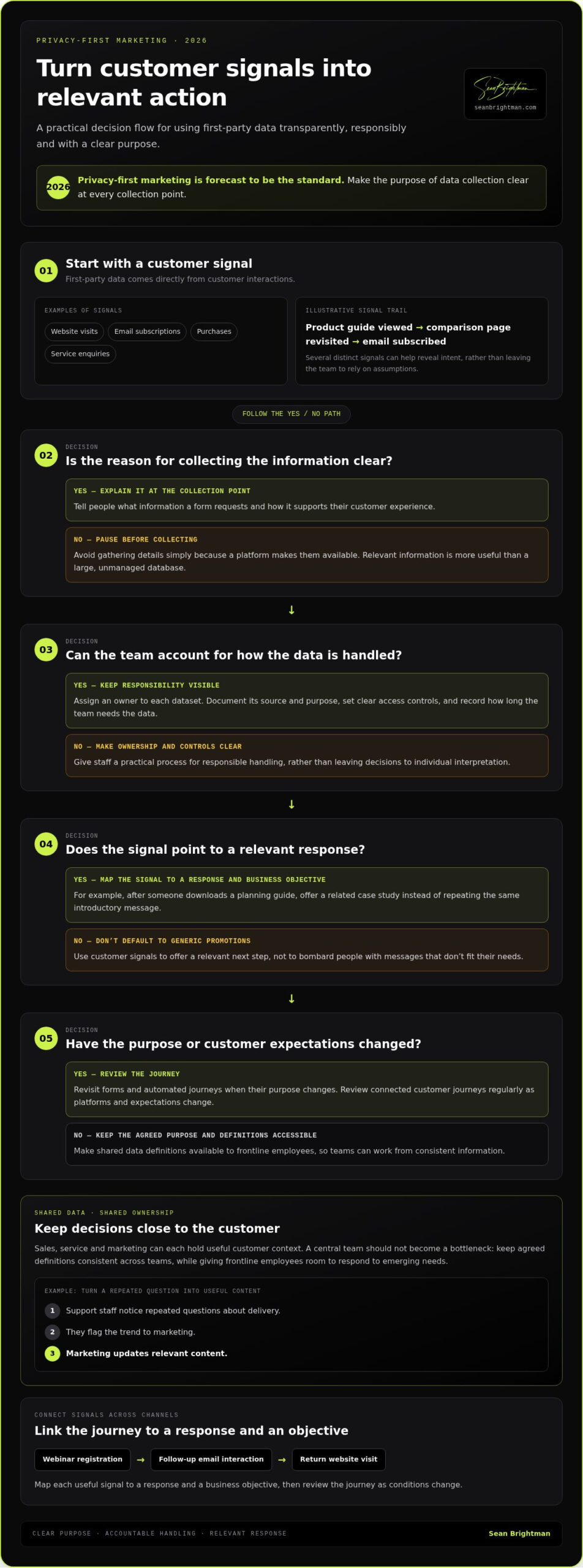
    First-party data comes directly from customer interactions, such as website visits, email subscriptions, purchases and service enquiries. It helps teams understand intent instead of relying on assumptions. For example, someone who reads a product guide, returns to a comparison page and subscribes to email has shown several distinct signals. Use those signals to offer a relevant next step, not to bombard them with generic promotions.

    Privacy-first marketing is forecast to be the standard in 2026. Put transparency into each collection point: explain what information a form requests and how it supports the customer experience. Keep records of the purpose for collecting data, who can access it and how long the team needs it. Avoid gathering details simply because a platform makes them available. Relevant information is more useful than a large, unmanaged database.

    For privacy compliance, make responsibility visible. Assign an owner to each dataset, document its source and purpose, and set clear access controls. A marketing team using email preferences, for instance, should make sure those preferences remain understandable and usable across its campaigns. Review forms and automated journeys when their purpose changes. This gives staff a practical process for handling data responsibly, rather than leaving decisions to individual interpretation.

    Shared data also needs shared ownership. Sales, service and marketing may each hold useful customer context, but a central team shouldn’t become a bottleneck. Make agreed data definitions accessible to frontline employees, then give them room to respond to emerging needs. If support staff notice repeated questions about delivery, they can flag the trend to marketing, which can update relevant content. Keep decisions close to the customer and shared definitions consistent across teams.

    Connecting marketing data systems can help teams respond to customer behaviour. Link useful signals across channels, such as a webinar registration, a follow-up email interaction and a return website visit. Map each signal to a response and a business objective. If someone downloads a planning guide, for example, offer a related case study instead of repeating the same introductory message. Review the journey regularly as platforms and customer expectations change.

    What UK marketing channels are forecast to deliver the best ROI in 2026? No single channel is established as the universal winner here. Compare search, social, retail media and traditional advertising against your audience, objective and measured results.

    How should marketers compare search, social, retail media and traditional advertising in 2026? Give each channel a clear conversion goal, then assess conversion rate, acquisition cost, customer lifetime value, engagement quality and return on investment. Search can capture active intent, whilst social can build discovery; compare each contribution across the customer journey, not just its last click.

    2. What does it mean to future-proof your marketing plan?

    Future-proofing means building a strategy that can adapt when customer behaviour, technology or competition changes. It doesn’t mean predicting every trend correctly. Treat each strategic choice as a hypothesis, then test it against evidence. A guide targeting the search phrase “future-proofing your marketing strategy 2026” should connect business objectives to actions, review points and clear criteria for changing direction.

    Keep the core consistent while adapting the execution. A business might retain its promise of reliable delivery while changing how it explains that benefit across search, social and email. Review customer questions, sales conversations and campaign responses. When those signals shift, update the message or channel without changing the underlying purpose unless there’s a good reason.

    Customer needs change in practical ways. A retailer may find that customers are moving from browsing broad inspiration to comparing product details before buying. That shift calls for clearer comparison content and a stronger path to purchase. Create a routine for capturing frontline observations, reviewing search intent and turning recurring questions into useful marketing action.

    Marketing skills need to adapt too. Platform-specific expertise can lose value when a channel changes its features or reach. Prioritise people who understand audience needs, measurement, creative thinking and core marketing principles across platforms. Give teams hands-on opportunities to test emerging tools in low-risk settings, then share what worked and what didn’t.

    Adaptability needs structure. Use a repeating cycle: discuss the evidence, agree on a response, act, review the result and repeat. Assign an owner to each decision, record the assumption behind it and set a review point. This helps teams stay responsive and prevents the plan from becoming a fixed document that no longer guides daily choices.

    What should UK businesses budget for marketing in 2026? Set the budget against business objectives, expected return, audience reach and the resources needed to deliver. Review spending against conversion rate, customer lifetime value and return on investment, then shift investment towards activity that supports the commercial goal.

    The UK consumer and advertising landscape will reward authenticity and relevant experiences. PA Consulting research found that 87% of people prioritise trustworthy media, whilst 81% look for authenticity. By 2026, audiences are forecast to seek content from real people with real experiences, making clear expertise and credible examples valuable.

    To future-proof your plan, define the business outcome first, document the assumptions behind each activity and choose measures linked to that outcome. Test new approaches on a small scale, review results, and expand only when evidence supports the move. A team using “future-proofing your marketing strategy 2026” as a planning prompt should keep people accountable for decisions, even when technology helps with analysis or execution.

    Relying too heavily on AI can weaken human judgement and produce work that misses customer context. Platform dependence leaves reach vulnerable to changes outside your control, while third-party data can create gaps in your view of customer behaviour. Reduce these risks by retaining human review, building direct customer relationships and making decisions using evidence from across channels.

    3. Aligning technology choices with business objectives

    Start with the business problem, not a software demo. If customers abandon a booking journey, identify where they drop out and what information might help. Then decide whether a technology change could address the cause. A tool should support a measurable objective, such as increasing completed bookings or helping staff respond to enquiries faster.

    Define the task before comparing options. Specify the user, the data required, the process to improve and the outcome that matters. For a retailer, that might mean connecting product interest with stock information so marketing can promote available items. This simple test keeps teams focused on business value rather than feature lists.

    Build a modular marketing system that can evolve. Keep core functions, such as customer records, analytics and campaign delivery, connected through clear data flows. A modular approach lets a team replace one component without rebuilding the whole system. It also makes adaptation more practical when customer needs or platform capabilities change.

    Technology adoption should be ongoing, not a panic response to every new release. Track emerging changes that affect your customers, channels or internal processes. Test relevant tools in a controlled, low-risk setting, then record what the team learns. A small pilot can show whether a tool solves the stated problem before it becomes part of daily work.

    Technical SEO still relies on solid foundations. Keep the website fast and mobile-friendly, organise its structure, support proper indexing and use appropriate structured data. A clear category structure, for example, helps visitors find related pages, while crawlable content gives search systems a better chance of understanding them. Review these foundations whenever a redesign changes navigation or page templates.

    Connect technology decisions to the customer journey across search, email and social media. If campaign analytics show that visitors engage with a guide but don’t take the next step, examine the page journey before buying another tool. The ability to interpret that signal matters as much as the technology itself. Choose systems that help teams act on useful evidence.

    Make ownership part of implementation. Name the person responsible for adoption, document how the tool supports the business objective and set a review point. Give staff hands-on practice with realistic tasks, such as building a report or checking an automated journey. Teams learn faster when they can test a system against actual work rather than sit through feature presentations.

    Finally, assess whether the technology still earns its place. Compare its contribution with the original objective, check whether staff use it and identify friction between systems. Keep what supports the outcome; adjust or replace what doesn’t. That discipline turns a collection of platforms into a working marketing system.

    Future-proofing your marketing strategy by focusing on data, technology and AI search

    Generative Engine Optimisation, or GEO, prepares useful content for AI-powered search experiences. These tools can give users direct answers, changing how people discover businesses. GEO is forecast to become important in 2026. The aim isn’t to write for machines alone. Make your expertise easy for people and digital systems to find, interpret and trust.

    AI adoption is already part of the marketing conversation: in 2026, 75% of brands have incorporated generative AI into their strategies. That figure doesn’t make every AI tool useful. Start with a real customer question, then publish a clear answer grounded in your experience. A specialist answering “How do I choose the right solution?” should explain the criteria, trade-offs and next steps.

    Structure each page for quick understanding. Use descriptive headings, short paragraphs and a logical sequence. Put the answer near the beginning, then add evidence and useful detail. For example, a service page can explain who it helps, how it works and answer common concerns. Readers can scan it, and search systems can identify its main points.

    Invest in original insight rather than rushing to publish more pages. A small business doesn’t need thousands of pages to compete in AI-powered search. A detailed case study can explain the problem, the decisions made and the outcome. Add first-hand observations, practical steps and relevant examples. This gives content substance that generic summaries lack.

    Clear writing won’t help if a page can’t be accessed. AI cannot surface content it cannot crawl, understand or trust. Keep important pages accessible to search crawlers, use clear navigation and avoid burying key information in confusing layouts. Check that each page has a specific purpose and supports the wider site structure.

    Trust also depends on consistent signals across your digital presence. Keep author biographies, expertise and business information accurate on your website and relevant profiles. Support claims with case studies, reviews or named credentials where appropriate. When a company’s website and public profiles describe its work consistently, readers have a clearer basis for assessing its credibility.

    Measure GEO using more than a single ranking. Track relevant organic visits, enquiries, engagement with useful pages and assisted conversions. Compare those signals with the business objective behind each page. If a guide attracts attention but doesn’t help readers take the next step, improve its examples, internal journey or call to action.

    Make GEO a practical part of search planning: choose customer questions, publish direct answers, demonstrate real expertise and review performance. Keep testing as AI-powered search and user behaviour evolve. Success comes from useful, accessible content that earns attention, not from repeating keywords or building pages solely to chase emerging platforms.

    UK businesses should focus on changes that improve customer relevance, not chase every new format. In 2026, useful priorities include authentic content, personalised experiences, stronger local connections and practical uses of AI. Treat each as a testable direction. Choose the trend that fits your audience and commercial objective, then measure its contribution.

    Authenticity means showing the people, experience and decisions behind a business. A UK accountancy firm, for example, could explain how it helps a client prepare for a business challenge, sharing its reasoning and lessons. That’s more useful than polished claims without evidence. Build credibility with consistent author information, customer reviews and examples across your website and professional profiles.

    Local relevance can sharpen that message. In 2026, brands are expected to engage more with specific cities, towns and interest groups. A business serving a particular community could create content around local questions, events or needs, rather than publishing generic national messaging. Keep the connection real: local references should reflect actual expertise or participation, not just a place name inserted for attention.

    Serialised video is also forecast to build brand loyalty in 2026. Use a recurring format, such as short episodes answering customer questions or showing how a service works. Each instalment should deliver value on its own, while giving viewers a reason to return. Track meaningful engagement and enquiries, not views alone. The aim is an ongoing relationship, not a one-off spike.

    Personalisation needs to earn its place in the customer journey. In 2026, 75% of consumers are more likely to buy from brands that deliver personalised content. Start with a useful distinction, such as a customer’s product interest or stage in the buying process. Tailor the message to that signal, then compare responses with a relevant business measure. Personalisation without purpose is just extra complexity.

    AI can connect customer data with marketing decisions, support behaviour analysis and handle routine tasks. Use it to help draft email variations, organise recurring questions or identify patterns for human review. Keep people responsible for the message and the decision. A tool should free the team to focus on strategy and creativity, not replace judgement or publish unchecked material.

    Augmented reality offers another option where customers benefit from seeing products in context. In 2026, 71% of consumers say they would shop more if augmented reality were available, and over 30% of marketers are integrating augmented or virtual reality into campaigns. AR can increase conversion rates by up to 40% in some cases. Start with a specific customer problem and test whether an interactive experience helps solve it.

    Don’t adopt every trend at once. Select one relevant opportunity, define the intended outcome and test it with a focused campaign. Review customer response and commercial performance before expanding. To turn these shifts into a clear set of priorities, plan your next marketing move.

    Sean Brightman: AI Consulting

    Sean Brightman’s AI Consulting helps businesses assess where AI fits their marketing objectives and where it doesn’t. Turn to it when your team has promising use cases but needs a clearer way to prioritise them, connect them to customer needs and decide what to test.

    For wider planning, Roadmapping can turn strategic priorities into a practical sequence of decisions. An Advisory Retainer provides ongoing guidance as your marketing plan evolves. The right starting point depends on the challenge: a specific AI question calls for focused consulting, while broader priorities may need a roadmap.

    Bring your current objectives and the decisions causing friction into the conversation. Visit seanbrightman.com to explore the next step with Sean Brightman.

    Make your next marketing decision count

    Don’t wait for certainty before acting. Choose the business challenge that matters most, decide what evidence would change your mind, and set a clear point to review progress. That turns future-proofing your marketing strategy for 2026 into an active discipline, not another plan sitting untouched on a shared drive.

    When priorities compete or AI raises questions your team can’t resolve, focused strategic input can help. Sean Brightman offers Fractional CMO support, AI Consulting and Roadmapping to bring direction to marketing decisions and connect them to business objectives.

    Bring the decision you need to make, not a polished pitch deck. Contact Sean Brightman to discuss your next step and build a marketing plan ready to evolve.

    Frequently Asked Questions

    What does it mean to future-proof your marketing plan?

    It means making your plan adaptable without losing sight of the business result it needs to deliver. A subscription business, for example, can set a target for customer renewals, then test different ways to support that outcome as preferences shift. Record the assumption behind each major decision and the evidence that would prompt a change. That makes adjustments deliberate rather than reactive to whichever platform or trend is getting attention.

    How do you balance consistency with adaptation?

    Keep your core promise and brand principles steady, then adapt how you deliver them. A small business might remain known for dependable service while changing its content format to answer newer customer questions. Set boundaries before testing: which messages must stay consistent, and which channels or creative approaches can change? Review the result against customer response and business goals. This protects recognition while giving the team room to improve execution.

    Should a marketing plan change when customer behaviour changes?

    Yes, when a change is persistent and relevant to a business objective. A single unusual week may not justify a strategic shift, but repeated changes in enquiries, customer questions or buying patterns deserve investigation. Compare what people say with what they do, such as checking whether more visitors read delivery information before ordering. If the evidence points to a genuine change, adjust the customer journey or message, then monitor the effect.

    What evidence can reveal emerging risks?

    Look for mismatches between customer behaviour, campaign results and business performance. For example, rising website visits alongside fewer qualified enquiries may signal a targeting or landing-page issue. Consider customer complaints, sales-team feedback, changes in search queries, channel performance and conversion patterns together. A sudden change in one metric needs context; several signals moving in the same direction deserve investigation. Assign an owner to investigate and record the decision that follows.

    How will AI change marketing strategy and workflows in 2026?

    AI can help teams handle routine analysis and production tasks, giving people more time for decisions that need judgement. A marketer might use AI to group recurring customer questions, then write and approve the response personally. Build a workflow that specifies which tasks AI can support, who reviews its output and how errors are corrected. Keep sensitive information out of tools unless their use has been assessed appropriately. Measure usefulness by the work improved, not tool adoption.

    What UK advertising, privacy and AI regulations will affect marketing in 2026?

    UK marketing activity needs to account for applicable privacy and data-protection requirements, rules for electronic marketing and standards governing advertising claims. Exact obligations depend on the data, channel, audience and type of claim involved. AI use adds questions about how information is handled and generated content reviewed. Before launching a campaign, identify those factors, document the checks and review current requirements with appropriate legal expertise.

    How should businesses prepare first-party data and customer consent for 2026?

    Start by mapping where customer information comes from and how teams use it. For each form, newsletter or preference centre, explain choices in plain language and make it easy for people to manage their preferences. Keep a usable record of consent and its context, and ensure campaign systems respect changes. Remove redundant fields that don’t serve a clear purpose. This gives marketers cleaner audience information and helps customers understand their choices.

  • Agile marketing process for small teams, from workflow to KPIs

    Agile marketing process for small teams, from workflow to KPIs

    Agile marketing for small teams works through a repeating cycle: prioritise a backlog, choose a focused batch of work, launch it, measure the results, then review and adapt. A visible Kanban workflow and clear work-in-progress limits keep tasks moving without burying a lean team in parallel projects. The aim isn’t more activity. It’s to deliver customer value early and often, then change course when the evidence points to a better approach.

    A full calendar can look productive while campaigns stall, priorities shift and nobody knows what’s working. Agile replaces a rigid plan with a manageable flow of work and regular feedback. That doesn’t mean abandoning strategy. It means linking each task to a business goal and using results to decide what to do next.

    This guide explains how the process works, how to organise backlogs, workflows and planning, and how to choose KPIs that show progress rather than just output. You’ll also learn how short feedback loops help identify what’s gaining traction, what needs adjusting and where a small team should focus next.

    Key Takeaways

    • Focus marketing work on customer value and business goals, not the volume of tasks completed.
    • Make the workflow visible with a Kanban board, and limit work in progress to keep priorities moving.
    • Use a prioritised backlog and focused sprints to turn larger initiatives into manageable work.
    • Choose KPIs that connect campaign activity to outcomes, then use the results to decide what to adjust next.
    • Build a test-and-learn rhythm so the team can adapt its plans as customer feedback and performance data emerge.

    What Is the Agile Marketing Process?

    Agile marketing is a way to plan, deliver and refine marketing work through short feedback loops. For a small team, its principles connect each task to customer value and business outcomes.

    Agile Marketing Principles and Values

    Agile marketing applies principles that favour customer value, early delivery, experimentation and responding to change. The Agile Marketing Manifesto was created in 2012 and revised in 2021, giving teams values to guide decisions rather than a rigid script. That matters when priorities shift: the team can test a functional piece of work, learn from feedback and adjust without waiting for a perfect campaign.

    The core practice is to set a clear business goal, deliver a small piece of work, measure its effect and use the result to choose the next step. Agile teams build quickly, test their work and iterate based on regular feedback, according to UK Government. For example, a team could test an email subject line before refining the wider campaign.

    Customer Focus in Agile Marketing

    Customer focus means using feedback and observed behaviour to shape what the team creates next. A team might publish a short guide, review readers’ questions, then update the next version to address their needs. Activity alone doesn’t show whether marketing is useful. Linking each experiment to a customer problem gives the team a clearer basis for deciding what to continue, change or stop.

    Agile and Traditional Marketing Compared

    Traditional marketing often organises work around a fixed plan, while agile marketing reviews progress and responds as new information arrives. A campaign calendar can still provide direction; agile changes how the team manages delivery within it. Rather than waiting until every asset is complete, the team can release a suitable first version, gather feedback and improve the next iteration. Success is measured by outcomes, not just completed tasks.

    UK small businesses can build required advertising, data protection and email marketing checks into each campaign workflow. Assign a reviewer to check claims, audience permissions and campaign materials before release. Agile changes the pace of work, not the need to follow applicable rules.

    Team Roles and Responsibilities

    An agile marketing team needs someone to set priorities, people to create and deliver the work, and someone to clear blockers and support the process. In a small business, one person may hold several roles, but responsibilities still need to be explicit. Who approves the campaign? Who reviews customer feedback? Clear ownership keeps a fast workflow from becoming a confusing one.

    For agile marketing to work, the team needs a shared goal, authority to organise its work and regular communication about progress. A brief check-in can surface a delayed approval or missing input before it stalls a launch. Keep roles practical, not ceremonial: each responsibility should help the team deliver, learn or make a decision.

    Kanban workflows and work-in-progress limits

    A Kanban workflow makes marketing work visible as it moves through clear stages, from idea to completion. For a small team, that visibility exposes bottlenecks and helps protect focus.

    Kanban Boards and Principles

    A Kanban board shows each work item moving through stages such as “To do”, “In progress” and “Done”. Kanban traces to Toyota’s lean production system, developed in the 1940s. The board’s value is practical: everyone can see who owns a task, where work has stalled and what can move next. A campaign card might track a landing page from draft through review to publication.

    Keep the board aligned with the real workflow, not an idealised process. If legal review regularly delays a promotion, make approval a visible stage. That helps the team spot recurring friction and improve the process, rather than adding more tasks to an already crowded queue.

    Managing Continuous Workflow

    Kanban supports continuous delivery: team members pull new work forward when they have capacity, rather than waiting for a fixed sprint to end. That suits recurring tasks such as publishing social posts or updating a campaign page. The team can respond to feedback as it arrives, while the board shows whether urgent requests are displacing planned work.

    To use this framework, define the stages, agree what “done” means and make blocked work visible. For example, a social post might move from draft to approval, then scheduling and publication. Review the workflow regularly and adjust stages when hand-offs cause delays. The aim is smoother progress, not a more elaborate board.

    Setting Work-in-Progress Limits

    Work-in-progress limits cap how many tasks can occupy a board column at once. If “In progress” is full, the team finishes or unblocks existing work before starting another campaign asset. Kanban uses these limits to manage the process and improve efficiency. They make overload visible and stop half-finished tasks competing for the same people.

    Set limits around the team’s actual capacity and the work’s complexity. A designer handling a landing page and several social assets may need protected focus before accepting another request. If work repeatedly queues at approval, adjust that stage’s limit or resolve the bottleneck. The limit is a prompt to improve flow, not a performance target.

    Scrum, Kanban and Scrumban offer different structures. Scrum organises work into set periods, while Kanban uses continuous flow without fixed iterations. Scrumban combines Scrum’s structure with Kanban’s pull-based approach. Lean marketing adds build-measure-learn loops and small batches, helping teams learn from experiments without committing to a large campaign first. Choose based on how often priorities change and whether the team needs fixed planning points or a steady queue.

    For a small team, the useful framework is the one people can follow consistently. Start with a board for one campaign, make ownership clear and watch where work piles up. Then refine the process using evidence from actual delivery. To connect workflow design with business priorities, explore aligning marketing work with strategic goals.

    Backlogs, prioritisation and sprint planning

    A marketing backlog gathers campaign ideas, tasks and improvements in one prioritised queue. Sprint planning selects focused work the team can complete, review and learn from.

    Managing the Marketing Backlog

    A backlog is an ordered list of marketing work that gives the team a transparent view of what matters next. It might include a landing page, an email sequence and customer research. Make each item specific enough to estimate, assign and review. “Improve the welcome email” is less actionable than “rewrite the opening to explain the product’s main benefit”.

    Prioritise work against the business goal, customer value, dependencies and effort. If a campaign relies on a landing page, that page may need to come first. Review the queue regularly: new customer feedback can change the order, while outdated ideas can be removed. This keeps planning grounded in current evidence, not whoever last requested a task.

    Sprint Duration and Daily Stand-Ups

    A sprint is a fixed period for delivering a chosen batch of work and reviewing its results. Scrum plans work in set increments called sprints, typically 2-4 weeks in duration, according to UK Government. Keep the sprint goal clear, such as testing a campaign message and publishing its landing page. A defined endpoint makes progress easier to assess.

    Daily stand-ups help the team coordinate work, surface blockers and agree immediate priorities. Agile marketing teams are advised to keep these meetings to no more than 15 minutes. Each person can report progress, name a blocker and state the next action. A stand-up should support functional collaboration, not become a lengthy status report.

    During sprint planning, compare the team’s capacity with the proposed work. Select tasks that support a shared outcome, then define what completion means. For a product campaign, that might include approved copy, a published page and a planned review of audience response. Clear acceptance criteria prevent “nearly finished” work from quietly rolling into the next cycle.

    Iterative releases let marketers test a campaign in manageable parts. A team could publish one content asset, study engagement and use what it learns to shape the next release. Weekly campaign iterations can replace waiting until a quarterly review to adjust direction. Smaller tests make experimentation practical, while regular feedback helps refine the message before the team invests further effort.

    Not every team needs Scrum’s fixed cadence. Kanban supports continuous work, while Scrumban combines Scrum’s structure with Kanban’s pull-based approach. Choose based on how work arrives and how often priorities shift. Whichever framework you use, record decisions and blockers where everyone can see them. That transparency connects sprint plans to actual delivery and makes each review useful.

    Agile marketing process for small teams, from workflow to KPIs

    Benefits of Agile marketing

    Agile marketing can help a small team deliver sooner, learn from real responses and change direction with less friction. The benefits come from improving how work flows, not simply asking people to produce more.

    Speed, Productivity and Flexibility

    Short feedback loops help a marketing team spot delays and make useful changes before a campaign is finished. For example, a business launching a new service can publish a focused landing page, review customer responses and refine its message before producing more campaign material. That can reduce time spent polishing work that misses the audience.

    Agile also makes capacity visible. If a designer is waiting for copy approval, the team can unblock that task instead of assigning another design. A 2025 State of Agile Marketing Report found that more than 60% of surveyed marketing leaders reported faster delivery times and stronger alignment with business strategy after adopting agile ways of working. Speed matters most when it improves delivery towards a clear business goal.

    Benefits for Teams and Organisations

    Shared priorities help a team see how daily work supports organisational goals. A campaign writer, designer and analyst can coordinate around one release, rather than handing work across departments with competing deadlines. This creates practical collaboration: each person contributes a distinct skill, while the team shares responsibility for progress.

    Regular reviews also turn completed work into learning. If a campaign attracts attention but few enquiries, the team can examine its message, audience and next step before repeating the approach. The 2026 State of Agile Marketing Report found that 95% of marketers applying agile ways of working reported a very positive experience. That finding describes respondents’ experience, not a guaranteed result for every organisation.

    Customer experience can improve when teams act on feedback instead of waiting for a distant planning cycle. If customers repeatedly struggle to understand a product feature, for instance, the team can clarify the website copy and test whether the explanation helps. Small changes to customer-facing processes can remove friction without rebuilding an entire campaign.

    Agile practices can also support improvement across channels. A team can compare customer questions from support with responses to social content, then adjust its next campaign message. The value lies in connecting those signals to a practical decision, not collecting data for its own sake. A clear review question, such as “Did this change help customers take the next step?”, keeps learning focused.

    For UK teams choosing software, a shared Kanban board, analytics platform and email marketing tool can support planning, measurement and campaign delivery. Costs depend on factors such as user numbers, features and integrations. Choose tools to support the workflow rather than buying a large suite before the team needs it.

    Agile marketing metrics and KPIs

    Agile marketing KPIs connect team activity to customer behaviour and business outcomes. Choose measures that help the team decide what to continue, change or stop, rather than tracking numbers just because the software displays them.

    Start with the outcome

    Start with the business result a campaign should support, such as qualified enquiries, completed purchases or repeat bookings. Then choose a KPI that reflects progress towards that result. For a landing-page experiment, the team might track completed enquiry forms, not just page views. Views show attention; form completions show whether visitors took the intended next step.

    Make the link between the measure and the campaign explicit. If the goal is to increase product awareness, track a relevant audience response, such as visits to a product page from a campaign. If the goal is sales, measure purchases or qualified leads. This gives collaboration a clear purpose and stops team members interpreting success in incompatible ways.

    Balance outcome and workflow measures

    Outcome KPIs show what marketing achieved; workflow measures show how work moved. A team could track campaign-generated enquiries alongside the time a landing page spends awaiting approval. If enquiries remain steady while approval delays grow, the workflow points to a process issue. That doesn’t prove the delay caused the result, but it gives the team a specific area to investigate.

    Useful workflow signals include blocked tasks, completed work and time from brief to publication. A Kanban board or project-management software can make these visible. Interpret them in context: more completed tasks don’t automatically mean progress if those tasks don’t support the campaign goal. Use the figures to prompt discussion, not to rank people.

    Build a continuous review loop

    At each campaign review, compare the result with the intended outcome, note what changed and agree on the next action. If an email gets opens but few clicks, inspect the subject line, message and call to action before changing everything at once. A focused adjustment makes the next test easier to interpret.

    Record the campaign, audience, change and KPI result together. This gives the team a useful history for future planning. If a result shifts, check whether the audience, offer or channel also changed before drawing conclusions. A short review note can turn one experiment into learning that informs later campaigns.

    A small team doesn’t need a dashboard crowded with measures. Choose a small, relevant set: an outcome KPI, a customer-response measure and a workflow signal. Review them at the same point in each campaign cycle, then adjust priorities based on what the evidence shows. That keeps metrics tied to decisions and makes continuous improvement part of the workflow, not an extra reporting exercise.

    Sean Brightman: AI Consulting

    Sean Brightman’s AI Consulting can help your team assess how AI could support marketing workflows, analysis and decision-making. The focus is practical: identify where AI fits your priorities rather than adding software without a clear purpose.

    If the bigger challenge is connecting campaign goals, work and KPIs, Roadmapping can help shape a clearer direction. An Advisory Retainer offers ongoing strategic input as priorities and results develop. These options suit teams that understand agile principles but need help applying them to their operating model.

    Bring your current workflow, marketing goals and measurement challenges into the conversation. Visit seanbrightman.com to contact Sean Brightman.

    Make your next marketing move deliberate

    Choose an upcoming campaign as a focused pilot. Before work begins, agree what decision the results should help you make. That gives your team a practical starting point for agile marketing for small teams, without forcing a full operational change before you learn what fits.

    If priorities feel disconnected or nobody owns the wider direction, Sean Brightman’s Roadmapping can help shape a clearer path. AI Consulting can help you assess where AI fits your marketing work, while Fractional CMO support provides senior marketing leadership. The right next step depends on the challenge you need to solve, not on adding more activity.

    Bring your goals and current sticking points into a conversation, then decide what would make the greatest difference. Contact Sean Brightman to discuss your needs. Start with one clear decision, and give your team room to make progress.

    Frequently Asked Questions

    What is the difference between Scrum and Kanban marketing?

    Scrum organises marketing work into fixed sprints; Kanban moves tasks through a continuous workflow. For a launch with coordinated assets and a shared deadline, Scrum can help the team plan a defined batch. For ongoing requests, such as website updates and social content, Kanban makes incoming work visible. The practical choice depends on whether work arrives in planned releases or continuously.

    What is agile marketing and how does it work for small teams?

    Agile marketing for small teams organises work around customer value and business goals, then uses feedback to shape what happens next. A small team might test two versions of a product message with a focused audience, review the response and apply what it learns to the next campaign. It doesn’t need a separate agile department; clear ownership and a shared goal can make the approach practical for a lean team.

    How can a small marketing team implement agile marketing step by step?

    To put agile marketing for small teams into practice, choose a campaign with a clear business goal and identify the people and approvals it needs. Break it into deliverables, assign ownership and decide what evidence will inform the next decision. Track work on a shared board, review progress regularly and record lessons after launch. Expand the approach only after the team sees which practices improve its workflow.

    Which agile marketing frameworks work best for small teams: Scrum, Kanban or Scrumban?

    Choose Scrum when the team can plan a focused batch of campaign work and review it at regular intervals. Choose Kanban when requests arrive continuously and priorities shift during delivery. Scrumban can suit a team that wants planned reviews but needs flexibility between them. Map a typical month of work: frequent interruptions point towards flow, while coordinated releases may suit sprint planning.

    How should small teams plan sprints, prioritise marketing work and manage backlogs?

    Before planning, clarify which business goal takes priority and identify dependencies, such as copy approval before design. Write backlog items as specific deliverables with an owner and a clear definition of completion. During planning, select work that fits the team’s actual capacity, leaving room for necessary interruptions. At review, carry forward only unfinished work that still matters, rather than automatically rolling every item into the next sprint.

    What agile marketing metrics and KPIs should small teams track?

    Track measures that inform a decision, not every number available. For a lead-generation campaign, compare qualified enquiries with the page visits that produced them; for retention, examine repeat purchases or renewal behaviour. Pair the outcome with a process signal, such as approval delays, to identify where work may be getting stuck. Compare like with like, keeping audience, offer and channel context beside each result.

    What are common challenges and risks when adopting agile marketing, and how can teams avoid them?

    Common problems include treating every request as urgent, holding meetings without decisions and measuring output instead of impact. Set a shared priority, make ownership visible and use check-ins to resolve specific blockers. Keep campaign approval and compliance reviews in the workflow, so speed doesn’t bypass necessary scrutiny. If the board fills with unfinished work, pause new tasks and find the bottleneck before adding another process or tool.

    How can a small team compare agile marketing with traditional marketing planning?

    Compare how each approach handles a real campaign, rather than debating labels. Traditional planning can set strategic direction and key milestones; agile practices can help the team adjust delivery as audience feedback comes in. Review how quickly decisions change, how approvals move and whether campaign learning shapes later work. The best fit may preserve an annual plan while giving the team room to adapt individual activities.

  • Customer Acquisition: Define Your Audience and Choose Growth Channels

    Customer Acquisition: Define Your Audience and Choose Growth Channels

    More leads won’t fix a growth engine that attracts the wrong buyers. Customer acquisition is the set of strategies and processes a business uses to gain customers and build a sustainable pipeline. A customer acquisition strategy consultant brings structure to that work, starting with a clear picture of who you want to reach.

    Growth can look like adding another channel or increasing marketing activity. A better starting point is to find where prospects drop off, what prompts the right customers to act and whether the revenue they bring justifies the effort to win them.

    This article explains how the acquisition funnel works, how to define your ideal audience and how to choose between inbound and outbound channels. It shows how those choices support sustainable growth, so you can focus on attracting customers who fit, rather than simply filling the pipeline.

    Key Takeaways

    • Measure acquisition against customer lifetime value, not lead volume alone; a ratio near 3:1 or better is a common long-term target.
    • Define your ideal customer by fit, buying behaviour and willingness to pay, so growth focuses on profitable, lasting relationships.
    • Map the journey from first contact to purchase to spot where prospects drop off and what needs to change.
    • Choose inbound and outbound channels around your audience, then coordinate them instead of spreading effort across disconnected tactics.
    • Reduce friction in the buying journey: attracting the right prospects matters, but making it easy for them to act matters too.

    What is Customer Acquisition?

    Customer acquisition is the work of turning prospects into paying customers through a repeatable process. Don’t chase lead volume alone: weak qualification, neglected retention and untracked spending can make growth costly without generating lasting revenue.

    Acquisition Cost and Customer Lifetime Value

    Customer acquisition cost (CAC) is sales and marketing spend divided by the number of new customers gained. Customer lifetime value (LTV) estimates the value a customer brings over the relationship. Comparing LTV with CAC helps show whether acquisition can support profitable growth.

    A commonly used guideline is to keep CAC at or below one third of LTV. Acquisition programmes often aim for an LTV:CAC ratio near 3:1 or better over time. A ratio below 1:1 means the acquisition cost exceeds the value generated, so growth can deepen losses rather than strengthen the business.

    Channel-Level Acquisition Economics

    Channel-level economics compare the CAC and customer value generated by each route, such as referrals, partnerships or direct outreach. A channel with fewer conversions may still bring customers who stay longer or spend more, so conversion volume alone can be misleading.

    72% of companies report lower customer acquisition costs from partner channels than from direct acquisition methods. Referred customers are reported to have a 16% higher LTV than non-referred customers. Treat those figures as signals to measure your own channels, not as a reason to assume every partnership will outperform.

    Cost, Payback and Return Metrics

    Acquisition metrics show how efficiently spending turns into revenue and how long that investment takes to return. Track CAC alongside conversion and retention: conversion shows how prospects move towards purchase, while retention indicates whether acquired customers continue to contribute value.

    Payback modelling estimates when customer revenue covers the cost of acquisition. Private SaaS companies reported a median CAC payback period of roughly 23 months in a survey by KeyBanc and Sapphire Ventures. Use cohort revenue and retention patterns to test whether your payback assumptions match actual customer behaviour.

    ROI metrics compare the return generated with the investment made. Include delivery costs and customer retention when deciding whether a channel earns its place.

    To reduce CAC, find where prospects leave the funnel before increasing spend. A weak conversion point may need clearer information or a simpler path to purchase. Poor retention may indicate that a channel attracts the wrong customers. Fix the cause rather than cutting activity blindly.

    Compare channel results over the same measurement period, using consistent definitions for acquisition spend and new customers. Then the CAC calculation is meaningful. Review conversion, retention, LTV and payback together, and shift resources towards channels that bring valuable customers at a sustainable cost.

    Defining an ideal client profile and target audience

    A useful acquisition plan starts with a precise target, not a broad market label. Define who is most likely to buy, benefit from your offer and generate profitable, lasting revenue.

    Ideal Customer Profile Research

    An ideal customer profile describes the people or organisations most likely to become valuable customers. Build it from evidence about existing customers: compare purchase patterns, retention, needs, willingness to pay and the problems your offer solves.

    Then separate strong-fit customers from poor-fit prospects. Businesses with buyer personas exceed their sales goals 65% of the time. Use that as a prompt to test whether your profile helps teams focus, not as a guarantee of growth.

    Targeting and Value Proposition

    A value proposition explains why your best-fit audience should choose your solution to a specific problem. Connect each profile trait to a practical benefit, such as easing a difficult process or addressing a costly bottleneck.

    That connection sharpens targeting, messaging and qualification. Segment by willingness to pay and the value you can deliver. A large audience is of little use if few people can buy profitably or remain customers.

    Customer acquisition consultant vs marketing agency: which is better? A consultant typically diagnoses the growth problem, sets priorities and shapes a strategy; an agency generally focuses on executing marketing activity. Choose according to the gap you need to fill: strategic direction, campaign delivery or both.

    How much does a customer acquisition strategy consultant cost in the UK? The fee depends on scope, data quality and the work involved, and is given after a quote request. A focused review of one channel differs from work spanning several markets, teams and acquisition stages.

    What does a customer acquisition strategy consultant do? They assess the audience, proposition, funnel and channel performance, then identify where to invest and what to change. The work should connect commercial goals to clear priorities and measures.

    What are the steps in a customer acquisition strategy audit? Review customer and revenue data, define the target profile, map the journey, assess channels and conversion points, then prioritise fixes. Tie each recommendation to an owner, a success measure and a decision date.

    For example, UK businesses with turnover of £500,000 to £10m are identified as a target market for growth and profit improvement. Businesses spending £3,000 or more a month on marketing without knowing which channels produce customers have a specific diagnostic need. A fixed-fee review can give that work a defined scope, with the boundaries set by the questions, data and channels assessed.

    Consultant profiles vary. Some bring deep subject expertise; others focus on strategy, commercial decisions or long-term client relationships. Match expertise to the constraint: unclear positioning calls for sharper customer research, while weak channel economics call for stronger performance analysis.

    Once the audience and value proposition are clear, a structured growth roadmap can turn those choices into prioritised work.

    Customer acquisition definition and funnel stages

    Customer acquisition turns a potential buyer into a paying customer through connected actions. The goal is a predictable, sustainable pipeline, not a pile of disconnected leads.

    Acquisition Meaning and Goals

    Customer acquisition is the set of strategies and processes a business uses to gain new customers. It matters because consistent acquisition supports revenue planning and helps teams judge whether demand can become repeatable sales.

    For example, a consultancy might attract a prospect through an article, discuss their needs on a call and agree a paid project. The goal isn’t simply to secure that first purchase. The business also needs customers whose needs it can meet, creating a sound basis for continued revenue and lifetime value.

    Customer Acquisition Strategy

    A customer acquisition strategy sets out how a business will attract, convert and retain its chosen audience. It connects commercial goals with the actions, channels, communications and measures used to reach them.

    For example, a software company aiming to grow recurring revenue could align educational content, product demonstrations and sales follow-up around one buyer journey. A strategy clarifies why each action exists, who owns it and which result signals progress. Without that connection, separate campaigns can generate activity without moving prospects towards a purchase.

    Audience Definition and Targeting

    A target audience is the group of potential customers a business intends to reach with a specific offer. Define it through shared needs, buying situations and decision criteria, rather than relying on a broad label such as “small businesses”.

    For instance, a payroll platform might target UK employers reviewing their payroll processes, rather than every organisation with employees. That distinction shapes the message, the information prospects need and the next action offered. It also helps teams judge whether communication attracts relevant enquiries or merely more attention from people unlikely to buy.

    Funnel Stages

    The acquisition funnel maps the stages between a prospect’s first contact and their purchase. Mapping the customer journey matters because it can reveal where prospects drop off and why.

    A practical funnel might move through awareness, consideration, evaluation and conversion. At awareness, a prospect encounters a useful article; during consideration, they explore the problem and possible approaches. In evaluation, they compare the offer with their needs, then decide whether to buy.

    Give each stage a visible action and measure. An article view shows initial attention; a completed enquiry signals intent; a signed agreement records conversion. If prospects read but don’t enquire, review whether the next step is relevant and clear. If enquiries stall before purchase, examine what information or follow-up is missing.

    The analysis shouldn’t end at conversion. Track what happens after purchase, including whether customers continue using the product or service. Those outcomes show whether acquisition attracts the right audience and connect initial communication with longer-term customer value.

    Customer Acquisition: Define Your Audience and Choose Growth Channels

    Inbound and outbound acquisition channels

    Inbound channels attract prospects through useful content and experiences. Outbound channels put a targeted message directly in front of potential buyers. The right mix depends on how your audience discovers options and makes decisions.

    Channel Selection and Mix

    Channel selection means choosing routes that reach your audience and generate meaningful engagement. Activity across unsuitable channels can waste attention and weaken relationships with potential buyers.

    For example, a specialist consultancy might use practical articles to build inbound interest, then follow up with tailored emails to relevant decision-makers. Give each channel a clear role: create awareness, answer questions or prompt a sales conversation. This creates a connected path for marketing and sales instead of disconnected campaigns.

    Inbound options include content marketing, search, email, social media, webinars, events and referrals. A UK software firm could publish guidance on a customer problem, share it through LinkedIn, then invite interested readers to a webinar. Each touchpoint adds context and gives prospects a reason to continue the conversation.

    Outbound options include targeted email, direct outreach and calls to selected prospects. They can help businesses reach a defined group rather than wait to be discovered. For instance, a leadership team entering a new market could identify organisations with a relevant need, send personalised messages and use the responses to refine its message.

    Choose channels based on audience behaviour, buying complexity, internal capacity and the time needed to build trust. A considered business purchase may require several useful interactions before a prospect acts; a simple offer may convert through a more direct route. Assess channels by qualified engagement and sales outcomes, not impressions alone.

    Acquisition Economics by Channel

    Channel acquisition economics compare the effort and resources invested with the customers and revenue each route generates. This matters because a busy channel isn’t automatically a productive one.

    Compare channel performance using consistent measures, such as qualified enquiries, conversion and customer value. Include the work involved in creating content, managing outreach and supporting sales. A channel that looks inexpensive on media spend may still consume substantial team time or generate prospects who rarely buy.

    Channel coordination can strengthen results. McKinsey research found that 83% of B2B decision-makers considered omnichannel sales as effective as or more effective than traditional single-channel approaches. A 2021 McKinsey study also found that buyers regularly use 10 or more channels when interacting with suppliers. Prospects may discover a business through search, review its social content and then speak with sales.

    That behaviour makes consistency essential. Align the message across an article, email and sales conversation, so each interaction builds on the last. B2B companies using three or more coordinated channels can see conversion rates increase by up to 287%. Treat this as a reason to coordinate relevant channels, not to add more channels without a clear audience and purpose.

    Review the mix as evidence accumulates. If webinars attract attendees but few qualified conversations, adjust the topic or follow-up. If targeted outreach starts useful discussions, build on them with relevant insights. Keep channels that help prospects take a meaningful next step, and rework those that only create activity.

    Why customer acquisition matters to business growth

    Customer acquisition matters because growth needs new revenue, not simply more marketing activity. A clear acquisition system helps leaders decide which prospects to pursue, which tactics to fund and how to connect campaigns with lasting customer relationships.

    The distinction shows up in the numbers. Gartner reported that 96% of customers experiencing high friction are likely not to sign up for a brand’s offerings. If a UK business makes prospects repeat information or struggle to understand its offer, campaign reach cannot fix the broken buying experience.

    Acquisition also shows whether demand can support a company’s plans. A growing pipeline gives sales teams prospects to qualify and helps leaders assess whether current capacity can deliver what buyers need. For example, a consultancy expecting more enquiries needs to check that its team can respond promptly and fulfil the work it sells.

    Growth isn’t simply a race to win more customers. Retention affects the value of each acquisition: customers who continue buying can contribute revenue beyond their first transaction. Compare customer groups by acquisition source, purchase behaviour and continued engagement. If a campaign brings many first-time buyers but few return, it may be attracting the wrong fit.

    Acquisition decisions should also be weighed against the value of other growth levers. For a business with a 15% net margin, £50,000 in operating-cost savings has the same effect on profit as £333,000 in extra sales. That comparison shows why leaders should assess acquisition alongside margin, delivery costs and customer retention, rather than treating sales growth as the only route to stronger profit.

    Evidence can change which tactic deserves investment. A fintech client achieved a 15% increase in new customer acquisition after using buying personas, behavioural economics and personalised marketing tactics. The lesson is practical: sharpen the audience, understand the decision behind each purchase, then tailor campaigns to that context. Personalisation without customer insight is just a different-looking guess.

    Use a simple decision sequence: identify the business outcome, trace which prospects become customers, examine conversion and retention, then adjust the campaign or buying journey. If qualified prospects disappear after an enquiry, improve follow-up before expanding reach. If customers leave quickly, revisit the offer and how well it matches audience expectations.

    That discipline connects acquisition to durable growth. A company can see which campaigns generate suitable customers, where friction blocks action and whether revenue supports continued investment. To turn those findings into a focused growth plan, map your next acquisition priorities.

    Sean Brightman: AI Consulting

    Sean Brightman’s AI Consulting is a practical next step when acquisition decisions raise questions about where AI could fit. Assess potential applications against real business priorities, customer needs and work already happening across your organisation. The aim is sound judgement, not adopting technology for its own sake.

    If the challenge is turning acquisition priorities into a clear plan, Roadmapping can help structure the next decisions. An Advisory Retainer offers a route for continued strategic input as those decisions develop. The right starting point depends on whether you need to assess AI, shape a roadmap or maintain ongoing advice.

    For a practical conversation about your growth priorities, contact Sean Brightman or visit seanbrightman.com.

    Turn your next growth decision into action

    The next move isn’t another campaign by default. Choose one acquisition decision that could unlock progress, such as refining your positioning, improving follow-up or exploring where AI could support the work. Give it an owner and a clear commercial reason. That keeps strategy connected to decisions your team can act on.

    A customer acquisition strategy consultant can bring focus when priorities compete or the route to growth feels unclear. Sean Brightman offers Fractional CMO services for strategic marketing leadership, AI Consulting for practical AI systems and Roadmapping to organise priorities into a clear plan. The right fit depends on the decision your business needs to make next.

    Make that decision concrete, then take the next step. Contact Sean Brightman about your strategy and start a conversation about what should move forward.

    Frequently Asked Questions

    What are acquisition strategies?

    Acquisition strategies are the coordinated choices a business makes to attract and convert suitable buyers. They can include referral programmes, useful content, direct prospecting, partnerships and product demonstrations. For example, a specialist software firm might publish guidance for finance teams, then offer a tailored demonstration to interested organisations. The strategy should fit how buyers research, compare and decide, rather than copy another company’s tactics.

    What are the 7 steps to attracting new customers?

    Use these seven connected steps to turn attention into a customer relationship:

    1. Set a commercial objective.
    2. Identify the buyer and their need.
    3. Shape a clear reason to choose your offer.
    4. Select channels your audience uses.
    5. Create a useful first interaction.
    6. Follow up with relevant information.
    7. Review results and improve the weak point.

    For example, a training provider could use a practical guide to attract HR leaders, then invite interested readers to discuss a specific skills gap.

    What is the difference between CAC and CPA?

    CAC measures the average cost of acquiring a new customer, while CPA measures the cost of a defined action. That action might be a form submission, booked demonstration or completed purchase. A campaign can therefore have a low CPA for enquiries but a high CAC if few enquiries become customers. Define the action clearly, then track whether it leads to paid business.

    How can a consultant develop a customer acquisition strategy?

    A consultant can develop the strategy by connecting commercial objectives with customer evidence and practical execution. They can review sales records, interview customers, examine lost opportunities and identify barriers in the buying process. From there, they can recommend priority audiences, messages, channels and measures. A useful output assigns responsibility and clarifies what the team should learn from each campaign, rather than offering a channel list without context.

    How to choose a customer acquisition consultant in the UK?

    Choose a consultant who can explain how they’ll diagnose your specific growth problem before prescribing tactics. Look for a clear approach, relevant commercial understanding and recommendations your team can act on. Discuss how they’ll use your customer and sales information, involve internal teams and define progress. A good fit makes decisions clearer, not more complicated with jargon or a generic plan.

    What experience and qualifications should a customer acquisition consultant have?

    Prioritise evidence of relevant work over credentials alone. A consultant should understand your sales model, buyer behaviour and the practical demands of your market. Ask how they’ve approached a comparable challenge, what they learned and how they adapted the plan when evidence changed. They should explain their analysis in plain language and distinguish observed results from assumptions. The right expertise depends on your particular acquisition bottleneck.

    What customer acquisition channels should UK businesses consider?

    UK businesses can consider search-led content, email, professional social networks, events, referrals, partnerships, webinars and direct outreach. The right options depend on where buyers seek advice and how they prefer to engage. For example, a business selling complex services might combine expert articles with industry events and personal follow-up. A consumer brand may favour searchable product information, email and customer referrals. Choose channels your team can manage consistently.

    How do consultants measure customer acquisition cost, conversion rates and ROI?

    Consultants define each measure first, then align sales and marketing records around the same customer journey. They calculate acquisition cost using agreed acquisition spending and new customers, and conversion rates between named stages, such as enquiry and sale. ROI compares the return attributable to activity with its investment. Results can also be separated by channel and customer group to show whether apparent efficiency leads to retained revenue.

  • B2B Brand Positioning Framework: Build a Position That Sticks

    B2B Brand Positioning Framework: Build a Position That Sticks

    A positioning statement that lives in a slide deck isn’t a strategy. It’s wallpaper. A practical b2b brand positioning framework should help your business make sharper choices, not just describe itself more elegantly.

    If your company sounds interchangeable with competitors, or marketing and sales give different answers about who you serve and why you’re different, the issue isn’t a shortage of clever copy. It’s a lack of shared decisions. If positioning work hasn’t changed what your team says or does, the document hasn’t done its job.

    This framework connects four essentials: your market, your buyer, your difference and the proof that makes your claims credible. Use them to shape a clear position, then turn it into practical guidance for messaging, offers, website content and customer journeys. The goal isn’t a statement that sounds impressive in a workshop. It’s a position your team can apply consistently, test in the market and use to decide what comes next.

    Key Takeaways

    • Use a b2b brand positioning framework to connect your buyer, their problem, the alternatives they consider, your difference and the evidence behind it.
    • Separate positioning from visual identity, campaign messaging and feature lists so each has a clear purpose.
    • Prioritise buyers without assuming you must reject every other opportunity. Make your differentiation specific, relevant and supportable.
    • Build and test your position through practical steps that produce decisions and useful artefacts, not another document to file away.
    • Turn the strategy into consistent choices for messaging, offers, website content and customer journeys.

    What a B2B brand positioning framework should actually clarify

    Positioning is the place your business deliberately earns in a buyer’s mind. It’s based on who you serve, the problem you solve and why your approach is worth considering. It isn’t a slogan chosen in a workshop. It’s a strategic choice about the buyers you prioritise and the difference you can credibly defend.

    That distinction matters because positioning is often confused with the things people can see. A logo and colour palette belong to visual identity. A campaign line is messaging. A feature list describes what a product does. Each can express or support a position, but none defines it. The core principles of brand positioning centre on how buyers perceive an offer in relation to alternatives. In practice, that perception needs to be grounded in evidence, not just a clever claim.

    Positioning is the strategic choice of who you serve and why you’re meaningfully different; messaging is how you express that choice to buyers. Keep that distinction in view. It stops teams treating new copy as a substitute for hard decisions.

    Positioning strategy versus messaging: where is the difference?

    Positioning sits beneath the words. It clarifies the audience, the need you address and why a buyer might choose you over doing nothing or taking another route. Messaging translates those choices into language buyers can understand and remember.

    Imagine a hypothetical B2B software firm serving finance teams. “Make work simpler” could be polished copy, but it doesn’t say which finance teams matter, what friction the product addresses or what makes its approach distinct. If those choices are unclear, sharper headlines won’t fix the strategy. And if the difference has no evidence behind it, confident wording only makes the gap more obvious.

    What does a strong B2B position help a business decide?

    A useful b2b brand positioning framework turns strategy into decisions people can apply. It helps leaders choose which buyers to prioritise and which problems deserve attention. That focus can guide:

    • Offers: which services or product options best address the priority buyer’s problem.
    • Customer journey: what a buyer needs to understand, compare and trust at each stage.
    • Website structure: which pages, proof points and calls to action deserve prominence.
    • Sales conversations: which needs to explore and which claims the team can support.

    These decisions create useful trade-offs. A company that prioritises established firms with complex reporting needs may shape its offer and website differently from one targeting small teams seeking a quick, simple tool. Neither choice is automatically right. The point is to make the choice explicit, then align activity around it.

    Positioning is a guide, not a growth guarantee. It can make decisions more coherent, but it can’t promise demand, remove competitors or prove a claim on its own. Its practical value is a shared basis for marketing, sales and leadership to decide what to say, build and prioritise next.

    The five connected choices inside a B2B brand positioning framework

    A useful b2b brand positioning framework is a sequence of connected decisions, not five prompts answered in separate workshop rooms. Start with the buyer. Define their problem, the alternative they use, the difference you can offer and the evidence that makes that difference believable. Each answer sets the boundaries for the next.

    Use this table to build the logic in order. If an answer is vague, don’t paper over it with a sharper tagline. Revisit the decision behind it.

    Choice Key question Useful input
    Buyer Whose needs will we prioritise? Role, operating context and buying responsibilities
    Problem What pressing issue are they trying to solve? Triggers, consequences and buyer language
    Alternative What do they do instead? Existing tools, workarounds, competitors or inaction
    Difference What relevant advantage can we offer? Distinctive capabilities connected to buyer needs
    Evidence Why should a buyer believe us? Observable product, service or delivery proof

    Start with the buyer, problem and alternative

    “Mid-sized businesses” is a market description, not a usable buyer choice. Get specific about the role, context and problem. For example, a hypothetical logistics software provider might prioritise operations directors at firms coordinating deliveries across several depots. A trigger, such as repeated scheduling disruption, helps show when the issue becomes urgent enough to address.

    Then name the alternative honestly. Buyers might use spreadsheets, rely on a manual process, choose another supplier or tolerate the problem. Your offer isn’t judged against an empty space. It’s compared with what the buyer already does, including doing nothing.

    Make the difference credible with evidence

    A capability is something your organisation can do. A differentiator is that capability translated into an advantage a priority buyer values. “Flexible workflows” means little until you explain which buyer problem that flexibility addresses. A differentiator only matters when it solves a priority buyer’s problem and you can prove you deliver it.

    Look for evidence in product or service details, delivery processes and the experience buyers actually receive. Test the logic against buyer interviews, sales conversations and customer feedback. The Harvard Business School’s brand positioning framework also highlights the role of target audiences, competitive context and reasons to believe in shaping a positioning statement. Treat those reasons as a test, not decoration.

    Finally, read the five choices together. If the evidence doesn’t support the difference, revise the claim. If the alternative isn’t what buyers actually use, revisit the problem. For support turning these decisions into practical brand and marketing priorities, explore brand strategy support.

    B2B positioning objections: differentiation without narrowing too far

    “If we focus, won’t we lose customers?” It’s a fair concern, but focus doesn’t mean refusing every buyer outside a chosen segment. It means deciding who your position is built for first, based on where your offer fits and where you can support your value with evidence. Other buyers may still choose you. They simply don’t dictate every message, offer or priority.

    A useful b2b brand positioning framework helps you make that choice without pretending the market is smaller than it is. Treat your primary audience as a strategic priority, not a fence around the whole business. Compare the value of focus with the risk of over-narrowing:

    • Useful focus: gives marketing and sales a clear buyer, need and reason to lead with your offer. It makes decisions easier to test and refine.
    • Unnecessary narrowing: defines the audience so tightly that the position depends on a narrow label rather than a shared need, or excludes buyers who have the same problem and fit the offer.

    How focused should a B2B brand position be?

    Prioritise buyers whose needs match what you can deliver and demonstrate. Test that fit against actual buying conversations, customer feedback and the commercial realities of serving that audience. Can buyers recognise the problem? Does it matter enough to prompt action? Can your offer address it credibly? If the answers are weak, the focus may look neat on paper but be useless in practice.

    Keep the primary positioning audience distinct from every possible future customer. Your position should make today’s choices clearer, not forecast every market you might enter later. Focus can evolve as buyer needs, capabilities and evidence change.

    How to avoid claims that sound like every competitor

    “Best-in-class”, “innovative” and “customer-focused” aren’t differentiators by themselves. They’re claims. AI isn’t automatically distinctive either. Explain what a capability changes for a particular buyer, then point to observable evidence that supports the claim. A faster process, for instance, matters only if speed addresses a real buyer need and you can show how your delivery makes it possible.

    Compare alternatives using capabilities buyers care about, not insults or assumptions about competitors. Another supplier may solve the same problem differently; an internal workaround or inaction may be the real alternative. Strategic approaches to brand differentiation can help prompt options, but a strategy label doesn’t prove your position fits your buyers.

    Competitive maps can clarify perceptions when they use attributes buyers care about and reliable input from the market. They can show how buyers see options across dimensions such as specialist support or ease of adoption. But a neat chart can create false precision if the axes are chosen for convenience, the evidence is thin or the differences don’t affect buyer choices. Use the map to ask better questions, not to declare a winner.

    B2B Brand Positioning Framework: Build a Position That Sticks

    How to build, test and activate your B2B positioning framework

    A positioning framework earns its keep when it changes what the team does. Build it in stages. Each stage should leave you with a decision or working artefact, not just workshop notes. This process takes the five connected choices from discovery to buyer testing, then into the places where buyers meet your business.

    From buyer research to a testable positioning statement

    Collect evidence before polishing language. Bring together customer feedback, sales conversations and the knowledge of people who deliver the offer. Look for repeated buyer terms, triggers and objections. Internal opinions can point to useful questions, but they’re no substitute for buyer language.

    1. Set the audience and research question. Agree which buyer group you’re investigating and what you need to learn about its needs, alternatives and decision triggers. Artefact: a short research brief with the audience and questions to explore.
    2. Gather and sort the evidence. Review relevant buyer conversations and feedback alongside internal delivery knowledge. Separate observed facts from assumptions. Artefact: a findings summary showing recurring needs, alternatives and proof you can substantiate.
    3. Draft the positioning statement. Write a concise working statement that names the priority audience, its problem, the alternative and your credible difference. Treat it as a hypothesis, not finished copy. Artefact: one draft statement with supporting evidence for its central claim.
    4. Test it with target buyers. Ask buyers to explain what they think the offer is, who it’s for and what makes it distinct. Check whether they recognise the problem and whether the claimed difference matters. Avoid leading questions that invite polite agreement. Artefact: a test log capturing confusion, relevance and credibility.

    Put the position to work across the business

    Validation isn’t a vote on which phrase sounds nicest. Use what buyers understand, recognise and believe to refine the underlying choices. If buyers understand the offer but don’t value the difference, revisit the evidence or claim before rollout.

    1. Activate and assign ownership. Translate the position into homepage hierarchy, sales language, offer explanations and internal guidance. Give each customer-facing update a named owner and a clear next action. Artefact: an activation plan that records touchpoint, owner and status.

    To connect positioning decisions to ranked priorities and a practical action plan, use this strategic brand roadmapping guide. For repeatable execution across teams and touchpoints, the marketing operations growth engine guide explores how to build the operating rhythm around the work.

    Include a review point so the team can revisit buyer feedback, sales objections and changes to the offer. A b2b brand positioning framework should remain useful as the business learns, not become a statement no one is allowed to question. If you want strategic support turning positioning into action, explore brand strategy support.

    Make B2B brand positioning a working strategy, not a workshop document

    A positioning document is useful only if it changes decisions after the workshop ends. If leaders can’t agree which buyers matter, marketing and sales describe the offer differently, or agreed changes never reach the website and sales materials, the strategy is stuck. More copy won’t fix it. The team needs clearer choices, ownership and a route from strategy to action.

    A b2b brand positioning framework should guide decisions about positioning, messaging, offers, customer journeys and website strategy. Brand Strategist support can connect these parts, so the position shapes how the business communicates and what it prioritises. This is strategic direction focused on aligning choices and putting them to work.

    When is outside strategic direction useful?

    An external perspective can challenge assumptions that have become hard to question internally. It can help the team separate buyer evidence from familiar opinions, resolve conflicting descriptions of the offer and focus on what needs to happen next. The value is practical: clearer direction, priorities ranked by impact and accountability for moving decisions into action, without promising a particular commercial result.

    Look for a pattern, not one awkward meeting. If the same positioning debate keeps returning, teams are making different promises or activation has stalled because no one owns the next move, strategic support can bring the work back into focus. The aim isn’t another polished deck. It’s a shared basis for decisions people can act on.

    Choose a clear next step for your positioning work

    If the central choices need sharpening and the team needs a usable plan, Roadmapping is a focused next step. It’s a one-off strategy session that sharpens positioning and messaging, then ranks priorities by impact in a 90-day action roadmap. The roadmap is yours to run, giving the team a clear sequence rather than a vague instruction to “get aligned”.

    If positioning decisions need continued direction and accountability as the business acts on them, ongoing strategic leadership through Fractional CMO or Advisory CMO support may be a better fit. Choose the level of support around the work ahead: one focused roadmap, or ongoing guidance to keep decisions and priorities moving.

    For a practical way to connect positioning choices to ranked actions, use this strategic brand roadmapping guide. As the team turns strategy into repeatable activity, the marketing operations growth engine guide offers a useful perspective on execution.

    If your position needs to move from discussion into decisions your team can use, explore strategic support with Sean Brightman.

    Turn the position into your next business decision

    Your position shouldn’t sit outside the work. Use it to decide what to strengthen, what to stop saying and where the team should focus next. A b2b brand positioning framework becomes valuable when it helps people make those calls with confidence, even as the business changes.

    That takes more than a statement. Brand Strategist support connects positioning with messaging, offers, customer journeys and website strategy, so those choices carry through to how buyers experience the business. If the challenge is deciding what to act on first, Roadmapping sharpens positioning and messaging, then ranks priorities by impact in a 90-day action roadmap.

    You don’t need to solve every question at once. Start with the decision currently slowing the team down, then build from there. Explore strategic support with Sean Brightman and take the next step towards a position your team can put to work.

    Frequently Asked Questions

    Is B2B brand positioning the same as a value proposition?

    No. A value proposition explains the value a buyer can expect from a particular offer; positioning establishes the wider context that makes that value distinctive and relevant. For example, a data consultancy’s value proposition might focus on helping finance teams bring reporting data together. Its position would also clarify which finance teams it prioritises and how its approach stands apart from their other options. The value proposition supports the position, but doesn’t replace it.

    Can a B2B company have more than one brand position?

    It can tailor its emphasis for different audiences or offers, but several competing positions under one brand can confuse buyers and staff. Keep a clear central idea, then adapt examples, proof and language for distinct buying situations. A cybersecurity firm, for instance, might speak differently to a technical lead and a finance director whilst staying consistent about the problem it solves. Create separate positions only when the audiences or offers genuinely require different strategic choices.

    How do you test whether B2B positioning is clear to buyers?

    Show the draft to buyers who fit your intended audience, without explaining what you mean first. Ask them to describe the offer in their own words, say who they think it is for and identify what stands out. Then explore whether that distinction matters to their work and what evidence they would need to trust it. Note misunderstandings and recurring questions. If buyers interpret the offer differently from your team, revise the underlying choices before polishing the wording.

    Should a B2B positioning statement mention competitors?

    Usually, no. A statement should make the buyer, need and relevant difference clear without becoming a rival comparison or naming a competitor that may change. However, the thinking behind the statement should account for alternatives, including other suppliers, internal workarounds and doing nothing. Mention a competitor in outward-facing copy only if the comparison is accurate, useful to the buyer and supported by evidence. Otherwise, describe the distinction in terms of what your business does.

    How often should a business revisit its brand positioning?

    Revisit it when there’s a meaningful reason, not simply because a calendar reminder says so. Triggers might include a major change to the offer, a new audience, repeated buyer confusion or evidence that the claimed distinction no longer reflects delivery. Keep a record of the assumptions behind the position and review them against sales conversations and customer feedback. If those inputs still support the choices, maintain the direction and refine execution rather than starting over.

    What is the difference between B2B positioning and a positioning map?

    B2B positioning is the strategic choice a business makes about the place it wants to earn with priority buyers. A positioning map is a visual tool that plots perceived options against selected attributes, such as specialist depth and ease of implementation. The map can help a team explore buyer perceptions, but it isn’t the strategy itself. Its value depends on using attributes buyers care about and evidence that reflects their views, rather than assumptions.

  • UK Go-to-market Consultant: Build a route to growth

    UK Go-to-market Consultant: Build a route to growth

    A strong offer can still stall if nobody agrees who it’s for, why customers should choose it or how it will reach them. A go-to-market strategy consultant UK businesses work with should connect those decisions and give the team a route to follow, not just another launch checklist.

    The frustration is familiar: marketing, sales and leadership are all moving, but not necessarily towards the same customer or outcome. The execution gap is real. In a 2026 HBR Analytic Services study, 83% of B2B leaders called go-to-market strategy critical to business success, yet only 38% described their execution as very effective.

    You need more than a polished strategy document. You need clear choices your team can act on. This article explains what a go-to-market strategy should connect, how to assess strategic support and how to turn decisions into practical next steps.

    We’ll look at how to prioritise customers and market opportunity, align positioning with routes to market, and give teams clear ownership. You’ll also see how Sean Brightman’s Roadmapping turns strategic decisions into a ranked 90-day action plan, and how ongoing CMO support can keep execution on track.

    Key Takeaways

    • A go-to-market strategy connects the customer, market opportunity, positioning, offer, route to market and team ownership.
    • Use customer needs and market context to shape a value proposition people understand, rather than leaving research in a separate document.
    • When assessing a go-to-market strategy consultant uk businesses can work with, look for clear decisions, accountable ownership and practical next steps.
    • Separate strategic choices from the tasks, channels and campaigns that put them into action.
    • Match the support to the job: a focused strategy session, ongoing advice or embedded senior marketing leadership.

    What does a UK go-to-market strategy consultant do?

    A go-to-market strategy connects an offer to the customers most likely to value it, then sets out how the business will reach, convert and serve them. A consultant helps clarify those choices, test the assumptions behind them and turn the direction into work people own.

    That’s broader than choosing a launch date or listing marketing channels. A campaign is an activity. A channel is a route. A go-to-market strategy explains why the business is prioritising particular customers, what it will offer them, how it will stand apart and how the team will deliver the plan.

    The links between those decisions matter. If an offer is positioned around speed, for example, the route to market and customer experience need to support that promise. If they don’t, the strategy can expose the mismatch before the business spends time pushing the wrong message through the wrong channel.

    Which business problems can go-to-market consulting address?

    The symptoms vary. Customer priorities may be unclear, positioning may have become diluted, or marketing and sales may be describing the offer differently. A business can be busy with content, campaigns and sales conversations yet lack a shared route from offer to customer. The first step is to identify whether unclear decisions are holding progress back.

    A consultant can surface the assumptions beneath the activity. Which customer group has the strongest need? What problem does the offer solve for them? What evidence supports that choice? The answers help leaders decide what to focus on, what to stop prioritising and where teams need a consistent message.

    For a business searching for a go-to-market strategy consultant uk companies can work with, useful support should result in decisions and ownership, not just a deck of recommendations. The aim is a route that’s clear and usable by the people responsible for putting it into practice.

    Is a go-to-market strategy only for launching a new product?

    No. The same thinking can help when a business introduces a new offer, repositions an existing one or changes how it reaches customers. The work depends on the challenge. A new offer may need clear customer and channel choices; repositioning may call for a sharper value proposition and consistent messaging across the customer journey.

    Start with the decision the business needs to make, not a fixed launch checklist. Is the audience changing? Has the offer evolved? Is the current route failing to connect with intended customers? Those questions help define the work and keep it focused. For a deeper look at aligning brand direction with growth priorities, explore this strategic brand roadmapping guide.

    Whatever the trigger, the consultant’s job is to connect strategic choices to practical ownership. That means making clear what the business is choosing, why it’s choosing it and what the team needs to do next. Not more activity for its own sake, but a route people can follow.

    The go-to-market decisions that must work together

    Go-to-market planning isn’t a pile of separate choices. Each decision should sharpen the next: understand the customer and their need, assess the market, set the positioning, shape the offer, choose how to reach buyers, then organise execution.

    A go-to-market strategy works when every choice reinforces the next, from the customer’s need to the team’s delivery. If one link breaks, the rest lose force. A channel can attract attention, but it won’t rescue an offer built around the wrong priority or a message customers don’t recognise as relevant.

    How should a business define its target customer and market?

    Start with a specific customer group and a real problem, not an audience so broad that almost anyone could fit. Compare potential segments by the urgency of their need, their fit with the offer and the business’s ability to serve them well. Evidence might come from customer conversations, sales experience or patterns in existing demand. The aim is a reasoned priority, not a perfect profile.

    Then add market context. Look at the alternatives customers use, competitors’ positions and changes that could affect demand. This helps test whether the opportunity is distinctive and reachable. Competitor analysis can’t tell you what customers value in your offer, though. Use it to sharpen questions, not replace customer understanding.

    Customer insight should shape the value proposition itself. If buyers care most about reducing complexity, that need should influence the promise, the proof that supports it and the way the offer is presented. Research belongs in the decision, not in a separate document that nobody uses.

    How do positioning, offer and channels connect?

    Positioning gives the intended customer a clear reason to pay attention: what the offer does for them and why it fits their need. The offer makes that promise concrete through its scope, format and value. If the positioning promises simplicity but the buying process feels complicated, the experience contradicts the message.

    Choose routes to market by looking at how customers discover, assess and buy, alongside what your team can deliver consistently. A considered purchase may need useful information and direct sales conversations; another offer may be easier to understand through a straightforward online journey. Don’t select channels because they’re fashionable. Match them to the buying journey, then make sure the right people, material and follow-up are in place.

    For a go-to-market strategy consultant uk businesses engage, the test is whether these choices form one usable system, rather than disconnected recommendations. The marketing operations growth-engine guide explores how execution systems support that joined-up direction.

    When customer insight, positioning and delivery need to be aligned, Sean Brightman’s strategic support can help turn those choices into a practical direction for the team.

    How to assess a UK go-to-market strategy consultant

    Start with the gap, not the job title. Do you need a focused set of strategic decisions, a sounding board to keep priorities on track, or senior marketing leadership working alongside your team? The right support depends on what’s missing. A go-to-market strategy consultant uk businesses engage should make the work, decisions and ownership clear before activity begins.

    What should a useful GTM strategy deliver?

    Look for a clear customer focus, positioning choices, route-to-market logic and a short list of priorities. Recommendations should help leadership decide where to focus and give marketing and sales a direction they can act on. A long document isn’t proof of quality. Neither is a channel inventory. Ask whether the work explains why a choice makes sense and what the team should do with it.

    Useful support also makes ownership visible. Who will lead each priority? What needs a decision from leadership, and what can the team execute? A strategy that stops at recommendations leaves the hard work of translation to your people. The output should connect direction to practical next steps, while making clear who is responsible for carrying them out.

    Consultant, agency or internal team: which role fits the gap?

    A consultant brings strategic direction and helps resolve questions of alignment, positioning and priority. An agency service is generally focused on delivering agreed marketing activity; an internal team carries out work within the business. These roles can complement one another, but they solve different problems. More campaign activity won’t fix a leadership gap or a lack of agreement about who the business needs to reach.

    Use this simple comparison to identify the type of support that fits your current need:

    Business need Type of support Typical output Involvement
    Decisions are unclear, but the team can execute once aligned Defined strategy session Priorities and an actionable direction Focused, one-off input
    The team needs regular challenge and accountability Ongoing advice Reviewed priorities and continued guidance Regular strategic involvement
    Leadership, team direction and marketing activity need to work together Embedded senior marketing leadership Strategy connected to team direction and execution Ongoing involvement within the business

    Match the scope to the real bottleneck. If the team knows what to do but lacks capacity, strategic advice alone won’t provide that capacity. If people are active but pulling in different directions, adding more production may simply create more disconnected activity. A distinct Fractional CMO strategy guide explains how ongoing senior marketing leadership differs from a defined strategy engagement.

    Sean Brightman’s Roadmapping provides a focused strategy session with a 90-day action roadmap and priorities ranked by impact. For teams that need continuing direction and accountability, Sean Brightman’s strategic support provides ongoing strategic involvement.

    UK Go-to-market Consultant: Build a route to growth

    Turn go-to-market strategy into a practical, accountable plan

    A strategy only earns its keep when it changes what the business decides and does. Turn the direction into a plan that separates the choices to make from the work that follows, then give each priority a clear owner. Otherwise, even a sharp strategy can dissolve into a list of activity nobody is responsible for delivering.

    Use this sequence to move from the commercial problem to coordinated action:

    1. Agree the commercial problem. State what needs to change, such as reaching a more suitable customer group or making the value of an offer clearer. Keep the problem specific enough to guide decisions.
    2. Prioritise customers. Choose which group to focus on using evidence about their needs, fit with the offer and your ability to serve them. Record the assumptions behind that choice.
    3. Sharpen the offer. Make clear what you’re offering, what customer need it addresses and why it’s relevant to the chosen group.
    4. Choose the route. Select routes to market that fit how those customers find, assess and buy, as well as the team’s ability to deliver the experience.
    5. Assign ownership. Name who will lead each decision and follow through on the work. Make dependencies visible so one team’s activity supports the next step, rather than running in isolation.

    An actionable go-to-market plan is a set of connected decisions with owners, not an unowned list of tactics.

    How do you prioritise go-to-market actions?

    Rank proposed actions by how directly they support the chosen customer, offer and route to market. A sales message, for instance, should reflect the positioning; the channel should give that message a credible way to reach buyers. If an action can’t be tied to one of those choices, challenge its place in the plan.

    Map dependencies before work starts. If sales needs clearer offer language before using new materials, agree the language first. If a channel requires a customer journey the team can’t yet support, address that gap before adding more activity. This keeps execution connected without imposing arbitrary deadlines or promising a particular result.

    How can leadership keep teams aligned after the strategy is set?

    Alignment needs active ownership, not a launch meeting followed by silence. Leadership should own the major choices; marketing and sales should know who is responsible for turning them into coordinated work. Set regular review points to compare the plan with relevant business evidence, hear what teams are learning and revisit assumptions that no longer hold.

    Use those reviews to make decisions: keep a priority, refine it or stop it. That’s more useful than reporting activity without agreeing what it means. If the business needs continuing strategic direction and accountability, an ongoing marketing advisory retainer provides a structure for regular review and priority setting.

    For help turning go-to-market choices into owned next steps, explore Sean Brightman’s Roadmapping support.

    How Sean Brightman can support your go-to-market direction

    Sean Brightman’s work connects the decisions that shape a go-to-market direction: positioning, messaging, offers, customer journeys and marketing leadership. The right level of support depends on the gap. You might need a focused session to settle priorities, regular strategic input to keep a team aligned, or embedded leadership that connects strategy with delivery.

    For businesses considering a go-to-market strategy consultant uk, the useful question is not simply what advice you’ll receive. It’s what decisions the work will clarify, what the team can act on and how much ongoing direction the business needs.

    When is Roadmapping the right starting point?

    Roadmapping suits leaders who need sharper positioning, clearer priorities and a practical plan, without committing to ongoing leadership. It’s a one-off strategy session that includes sharpened positioning and messaging, priorities ranked by impact, and a 90-day action roadmap. The roadmap is yours to run, with or without Sean.

    The one-off price is £2,997 – £4,997. The value is in getting the key choices out of discussion and into a ranked plan the team can use. That gives leaders a clear basis for deciding what to act on, what to defer and where more support may be useful.

    When might ongoing marketing leadership make more sense?

    If the team needs a recurring strategic sounding board, Advisory CMO includes monthly strategy and review sessions, priority setting, async access and accountability. It gives leaders a structure for reviewing decisions and keeping priorities visible as the work progresses. The price is £1,200 / month.

    Where the business needs more embedded senior direction, Fractional CMO engagements cover strategy, team direction, campaign planning, agency management and growth-system design. Engagement levels range from ½ day to 8 days per month, at £700 – £8,400 / month. This is a different level of involvement from a one-off roadmap or advisory support.

    Each option addresses a different need: a defined plan, continued advice or leadership integrated with the team. Sean’s role is to connect go-to-market choices to practical marketing direction, with the scope shaped around the business challenge rather than a generic checklist.

    If you’re weighing up the right starting point, discuss your go-to-market challenge with Sean. Bring the decision that’s stuck, the customers you’re trying to reach and the gap you need to solve. From there, you can explore which level of strategic support fits.

    Make your next growth decision count

    Your next move doesn’t need to be another campaign. Start with the decision that would make the biggest difference if it were clearer: which customer to pursue, how to explain the offer, or what the team needs to own. A go-to-market strategy consultant uk businesses work with should help turn that uncertainty into a useful conversation and a direction your people can act on.

    Sean Brightman’s work is reflected in testimonials from Matthew Harvey of Cowen Landscapes, Bianca Grassi of Gen Digital, and Viv Groskop, Author & Podcaster. The right support starts with your challenge, not a pre-set answer. Bring the assumption you want to test or the decision your team can’t settle, and use that as the starting point for deciding what comes next.

    Talk through your go-to-market challenge with Sean. You don’t need every answer before you start. A clearer next decision is a strong place to begin.

    Frequently Asked Questions

    What does a go-to-market strategy consultant do?

    A go-to-market strategy consultant uk businesses engage helps leaders resolve commercial choices that teams can’t settle alone. For example, if sales hears prospects repeatedly misunderstand a service, a consultant can help determine whether the issue sits with the audience, offer or explanation. They can also challenge assumptions before they become costly commitments. Start with the decision to make, then define what input and output will help move it forward.

    When should a business hire a go-to-market strategy consultant?

    Consider strategic support when an unresolved commercial decision is slowing progress or creating friction between teams. You might have several customer groups competing for attention, or sales may be adapting the offer differently in each conversation. Write down what’s uncertain and what evidence you already have. That gives the work a clear starting point and helps identify whether strategic input, additional delivery capacity or stronger internal ownership is the real need.

    Is a go-to-market strategy consultant the same as a marketing agency?

    No. A consultant’s central role is to bring strategic judgement to decisions and priorities; an agency may be engaged to deliver agreed work, such as a campaign or channel activity. The distinction matters if your team is already producing plenty but lacks agreement on what to prioritise. In that case, more production may add noise. If direction is settled but delivery capacity is limited, execution support may be the more relevant gap.

    What should a go-to-market strategy include?

    It should show how the business will connect a customer need to a relevant offer and a workable way to reach buyers. In practice, that means explaining the reasoning behind choices, not just naming a target audience or listing channels. For example, a plan should make clear why a particular customer group matters and how the offer answers its need. It should also identify where teams may need to adjust if new evidence challenges an assumption.

    How do you know whether a go-to-market strategy is working?

    Look for evidence that the plan is changing decisions and improving coordination, not simply generating activity. Check whether sales conversations reflect the agreed offer, whether marketing priorities still fit the chosen customer and whether teams can explain their responsibilities. Then review relevant business evidence against the goals leadership set. If the evidence points to a mismatch, investigate and adapt rather than assuming a particular outcome was guaranteed.

    Can a go-to-market consultant help with an existing product, not just a launch?

    Yes. An existing offer may need a focused adjustment rather than a full relaunch. For instance, customer feedback might show that buyers value a different part of the service than the business currently emphasises. A consultant can help assess what that means for messaging, customer priorities or the buying journey. Keep the work centred on the specific issue, so the business doesn’t reopen decisions that remain sound.

  • Compare marketing automation platforms by features

    Compare marketing automation platforms by features

    The platform with the longest feature list isn’t automatically the best fit. To work out how to choose a marketing automation platform, start with the job it needs to do: assess funnel coverage, customer profiles, email and SMS tools, and connections to your existing systems. Choose one that supports your workflow without adding complexity you won’t use.

    It’s easy to focus on campaign features and overlook what happens behind the scenes. Automation only helps when customer information moves cleanly between marketing and sales, and people still need to guide leads towards a decision.

    This comparison explains what marketing automation tools do and how their capabilities differ, from channel-specific tools to full-funnel platforms. It covers integrations, data consolidation, email and SMS automation, usability and room to grow, helping you compare options against real needs rather than a flashy feature list.

    Key Takeaways

    • Match the platform’s scope to the work you need done, from channel-specific campaigns to full-funnel automation.
    • Prioritise a clean CRM connection so customer information and leads can move between marketing and sales.
    • Compare how each option brings customer data together to support useful, joined-up profiles.
    • Look beyond email and SMS sending: assess how each platform handles workflows, integrations and future growth.
    • Use your team’s needs and intended use to narrow the shortlist, not the size of a platform’s feature list.

    What are marketing automation tools?

    Marketing automation tools run repeatable campaigns, messages and lead-nurture steps. They range from standalone platforms to marketing modules within CRM systems. Compare how each connects your tools and moves leads towards sales.

    CRM integration and sales alignment

    A CRM integration passes lead activity and customer details between marketing and sales, helping both teams work from shared information. A Zapier survey found that 37% of sales and marketing managers regularly saw leads get stuck between marketing tools and the CRM, or during the handoff. Prioritise an out-of-the-box connection with your CRM, then map what happens when a lead meets your sales team’s criteria.

    Marketing automation can improve coordination, but it doesn’t replace people nurturing leads or converting them. A salesperson needs to see which campaign prompted a response, while marketing needs a clear signal when sales takes over. Compare the quality of this handoff, not just whether CRM integration appears on a feature list.

    Marketing and sales tool integrations

    Broader integrations connect campaigns with the tools your teams already use, such as sales systems, email services or e-commerce platforms. This differs from CRM alignment: the CRM connection supports the lead handoff, whilst other integrations let campaign data and actions move across the wider workflow. In a Zapier survey, 51% of respondents wanted better integrations.

    List the systems involved in a typical customer journey, then identify where information needs to pass between them. An online purchase, for example, could trigger a customer record update and a follow-up message. A dashboard combining campaign and sales activity can help teams see what happened without switching between disconnected tools.

    Option CRM integration Connected tools Best fit
    Standalone platform Often central to evaluation Marketing and sales integrations Teams needing a dedicated automation system
    CRM marketing module Built around its CRM Often tied to the CRM ecosystem Teams already working in that CRM
    Channel-specific tool Connection needs assessing Focused on a channel, such as email Teams with a narrow automation need
    Full-funnel platform Supports broader coordination Can cover several marketing activities Teams managing more of the customer journey

    Choose the option that connects your CRM and essential tools with the least friction, then match its wider features to your workflow.

    UK platform costs vary by pricing model and usage limits. Some providers charge by contact volume or emails sent, while setup, training and usage can add costs. Compare the full subscription against expected contact numbers and email activity, not just the headline rate.

    Switching can disrupt contact records, campaign history and automated workflows if a field or trigger is missed during transfer. Export contacts, map fields to the new system, rebuild each workflow, then test sample records and messages before moving live campaigns.

    For connections beyond standard integrations, assess API access. An API can let your organisation link the platform with another app later. Before comparing custom integration work, document the data and actions that need to pass between systems.

    Marketing automation features

    Compare what each platform automates, which channels it covers, and how its features support your customer journey. Software your team can use in its actual workflow matters more than a long feature list.

    Automation across marketing channels

    Channel-specific tools focus on tasks such as creating and sending marketing emails. Middle- or bottom-funnel platforms focus on capturing leads and sending messages, while full-funnel platforms may also support content creation and SEO to build interest. The key difference is scope: a platform may serve one channel or connect activity across the journey.

    Map the channels your campaigns use, then compare how each marketing automation tool links them. Automation may span email, social media, digital ads, SMS, content, blogging, e-commerce, webinars and affiliate or referral marketing. An e-commerce workflow, for example, might connect an online interaction with a follow-up message. Prioritise channels your team will actively use.

    Features matched to business needs

    Match features to your existing systems, required functionality, integration needs and intended use. A small team focused on email campaigns may need a different setup from a business coordinating webinars, social media and e-commerce. Compare platforms against those tasks instead of treating every available feature as essential.

    Write down the tasks you want software to handle, such as sorting leads, sending messages or reporting campaign performance. Check whether the platform supports them and whether staff can operate it without excessive training. This practical test separates useful functionality from features that add complexity without advancing your workflow.

    For a small business in the UK, prioritise essential channels, manageable workflows and features suited to the team’s intended use. A focused tool may fit narrower needs, while broader platforms offer more funnel coverage and room to scale.

    Assess the provider’s data-protection policies and certifications, and consider secure servers in the European Union. Businesses operating under GDPR should review these safeguards when comparing platforms.

    Shortlist platforms by documenting your current systems, required features, integration needs and intended use. Test the shortlist against real workflows, assess usability and training, then compare support, deployment options and pricing before choosing.

    Finally, test how reporting connects activity to outcomes. Campaign reporting can help teams assess performance, while A/B testing compares two options to identify which better suits the audience. Check whether the platform can scale as users, communications and business activity grow. A feature that works for one campaign should also fit the wider operation.

    Customer data consolidation and 360-degree profiles

    A useful 360-degree profile brings sales and marketing information together, giving teams a clearer view of customer activity. In 2026, the best platform for your business is the one that unifies the data you use and supports the work your teams need to do.

    Unified sales and marketing data

    Look for a platform that brings customer details and interactions from sales and marketing together. A profile might combine email engagement, campaign responses and sales notes, giving teams a view across channels. What matters is how clearly the platform connects those records, not simply how many fields it can store.

    Test a practical journey: a prospect opens an email, visits a product page and speaks with sales. Check whether the profile connects those interactions and gives each team relevant context. For a commerce business, viewing purchase activity alongside marketing engagement can help teams understand how a customer reached a decision.

    Compare analytics and profile tools by asking what teams can do with the unified view. Can marketers segment audiences by engagement? Can sales see which emails or campaigns are relevant to a conversation? A platform that consolidates data but leaves teams unable to act on it offers storage, not a useful customer view.

    Platform support

    Customer support helps teams resolve platform issues and learn its features. Compare available channels, such as telephone, email and support tickets, and find out whether experts can help with technical problems. Support won’t build a customer profile, but it can help staff use the platform and troubleshoot a broken workflow.

    Training matters too. Check whether corporate training comes with the subscription or can be added, and consider how much guidance staff need to manage segments, emails and analytics. A platform with extensive features may require more learning than a focused tool. Match the support model to your team’s experience and planned work.

    Customer reviews and testimonials can offer evidence about how a platform performs in practice. Look for feedback relevant to your team’s size, use case and required integrations. A review about email campaigns may reveal little about consolidating sales and commerce data, so assess feedback against your specific requirements.

    Look for recurring details in reviews, not isolated praise or criticism. Repeated reports of confusing analytics or slow support, for example, may flag issues relevant to your evaluation. Balance reviews with product demonstrations and a trial using sample records. Check how the platform handles duplicate contacts, missing fields and changes to customer details.

    Use the same comparison for every shortlisted platform: profile completeness, data sources, analytics, support channels, training and customer feedback. Ask staff from sales and marketing to assess the same sample journey, then record where each platform gives them useful context. This makes differences visible without mistaking a polished dashboard for a complete customer view.

    Choose the platform that turns connected customer information into useful context for both teams, with support and training suited to the work ahead.

    Compare marketing automation platforms by features

    Email and SMS automation

    Email automation can create and send marketing emails, while SMS adds another channel to the customer journey. Compare what each platform can coordinate instead of treating message volume as the whole job.

    Deliverability and spam risks

    Deliverability is whether an email reaches its intended inbox. Unsolicited emails may be treated as spam, damaging the sending IP address’s reputation and future deliverability. Audience selection and message relevance are therefore operational requirements, not optional refinements. Check how a platform handles contact permissions, audience segments and suppression lists before building automated sends.

    Test a real workflow before launch. Preview a purchase follow-up, for example, confirm the intended audience and inspect the message on different devices. Templates can speed up campaign creation, but still need accurate content and a relevant recipient list. Review sending and engagement reports after a campaign, then adjust the workflow if results show a mismatch.

    Consent requirements

    UK GDPR and PECR affect how businesses manage personal data and electronic marketing. Build automation around clear records of contact permissions and preferences, and ensure workflows respect changes such as an opt-out. This is separate from deliverability: an email reaching an inbox doesn’t establish that the recipient should receive it.

    Before activating a sequence, map where contact details came from, which preferences apply, and how suppression updates reach each channel. Keep those records connected to the relevant contact so a later email or SMS doesn’t ignore a changed preference. The platform should support your processes; automation doesn’t replace them.

    Email-only platforms focus on creating and sending email campaigns. Multichannel tools can coordinate activity across email and SMS, with broader options potentially including social media, digital advertising and e-commerce. Compare these features against your actual customer journey. A small team may need dependable email templates, while an enterprise operation may need to coordinate messages across several teams and channels.

    For SMS, assess whether the platform supports your intended workflows and connects message activity to customer records. If WhatsApp matters to your strategy, assess it as a separate capability rather than assuming an email-and-SMS tool includes it. Map a service update or purchase follow-up, for example, and identify which channel should carry each message.

    Use a practical comparison before choosing:

    • Channel coverage: Match email, SMS and any required WhatsApp activity to your planned campaigns.
    • Workflow control: Trace how a contact enters, progresses through and exits an automated sequence.
    • Templates: Assess whether staff can adapt templates to the message and audience.
    • Reporting: Check whether engagement data helps you improve later campaigns.

    Choose email-only automation for a focused email requirement. Choose multichannel functionality when your customer journey genuinely needs coordinated messages across channels.

    Marketing automation platform capabilities

    Capabilities determine whether marketing automation software fits your operating model, not just your campaign plans. Compare workflow control, reporting, API access, scalability and pricing against the work your team needs to run.

    A practical answer to how to choose a marketing automation platform starts with the tasks that need coordination. A campaign workflow might segment contacts, send a message and record engagement for later analysis. Check whether staff can adjust each step or whether routine changes require technical help. Advanced controls add value only when your team can use them.

    Reporting should help you assess campaign performance and make decisions. Check which activity the platform tracks, how it presents results, and whether teams can use the insights to refine segmentation. A/B testing can compare two options, such as different messages, to identify which better suits the audience.

    Test those capabilities with a realistic workflow before choosing. Build a campaign for a defined audience, compare two message versions, then review the reporting. This can reveal practical limits in configuration and analysis that a feature checklist misses.

    API access is another capability worth assessing. It may let you link the platform with another app in the future, even if that connection isn’t part of your current setup. Identify the apps and data your organisation may need to connect, then assess whether the platform’s API supports that direction.

    Scalability means the platform can handle growth in users, communications and business activity. Consider whether its features can support additional users, more complex workflows and changing campaign demands. A platform built around today’s narrow requirements may become a constraint if the organisation expands its channels or operating needs.

    Pricing depends on how the provider charges and what the subscription includes. Some charge by contact numbers or emails sent; others may add setup, training or usage fees. Compare the full cost structure with expected usage, and check whether introductory rates change after the initial period.

    • Workflow control: Can the team build and adjust the automation it needs?
    • Reporting: Does the output support decisions about campaigns and audiences?
    • API access: Can the platform link with another app as requirements change?
    • Scalability: Can the features keep pace with greater activity?
    • Pricing: Which usage limits and additional charges affect the subscription?

    If you’re deciding how to choose a marketing automation platform, score each shortlisted option against these criteria using the same test workflow. Record where staff need training, where reporting falls short, and which costs change with usage. This turns a broad feature comparison into a practical decision based on your requirements.

    If you need to turn platform requirements into a clear implementation roadmap, map your automation priorities.

    Sean Brightman: AI Consulting

    Sean Brightman’s AI Consulting can help assess where practical AI systems belong in your marketing operations and where they don’t. Turn to it when platform options are clear but AI priorities or next steps still aren’t.

    Roadmapping can organise those decisions into a practical sequence, connecting your objectives with the capabilities and workflows you need to build. An Advisory Retainer provides ongoing strategic input as your plans develop. The focus is informed choices, not adding technology for its own sake.

    If you’re weighing AI opportunities alongside your platform decision, visit seanbrightman.com to explore the next step.

    Make your next move count

    Turn your shortlist into a decision your team can act on. Agree what success should look like, who owns each workflow, and which trade-offs matter most. Then set a review point to assess whether the platform supports your marketing operation as it develops.

    That’s the practical test behind how to choose a marketing automation platform: choose with a clear operating plan, not feature envy. If the decision also raises questions about marketing leadership, AI use or priorities, match the support to the problem. Sean Brightman offers Fractional CMO support, AI Consulting and Roadmapping for these distinct needs.

    Bring the decision, the constraints and the next move into focus. Contact Sean Brightman to discuss what your organisation needs next.

    A considered choice gives your team a stronger base to build on. Take the next step with clarity and keep moving.

    Frequently Asked Questions

    Customer support: Are there real experts ready to help, or does support feel like a lottery?

    Reliable support means access to people who can diagnose platform issues, not just a library of help articles. Compare available channels, such as telephone, email and support tickets, and find out how technical issues reach a specialist. During evaluation, describe a realistic problem, such as a failed contact sync, and assess whether the response gives you a clear next step. Compare training options for the staff who’ll own the system too.

    What features should a marketing automation platform include?

    Choose features around the work you need to run. Core capabilities may include campaign workflows, audience segmentation, email automation, reporting and CRM connections. Add SMS, e-commerce triggers, A/B testing or API access where they solve a defined need. For example, a subscription business might prioritise renewal reminders and clear campaign reporting, while a small team focused on email may value straightforward templates and simple audience controls over advanced functions.

    How do you assess integrations with a CRM, e-commerce platform, and analytics tools?

    Trace a sample customer journey across your systems. Follow a test purchase from your e-commerce platform into the customer record, then see whether campaign activity and analytics reflect that event. Look for duplicate records, missing fields or delays in the information appearing. Repeat the exercise with a lead passed from marketing to sales. This practical test shows whether integrations support the decisions and tasks your teams rely on.

    How easy is each platform to use, and what onboarding and customer support are available?

    Ask the people who’ll operate the system to complete a familiar task, such as editing an email template or changing a workflow step. Note where they need help, then compare onboarding materials, training and support channels. A clear interface matters, as does the effort required to teach new staff. Include time for learning and administration in your comparison, alongside the platform’s features and subscription terms.

    How much do marketing automation platforms cost in the UK, including contact and email limits?

    UK costs vary by provider and usage. Some charge by contact volume or emails sent, while setup, training or usage fees may add to the subscription. Compare the full cost with expected contact numbers and email activity, not just the headline rate.