
Tag: agentic AI

  • AI Consulting Services: A CEO’s Guide to Building Growth Engines in 2026

    AI Consulting Services: A CEO’s Guide to Building Growth Engines in 2026

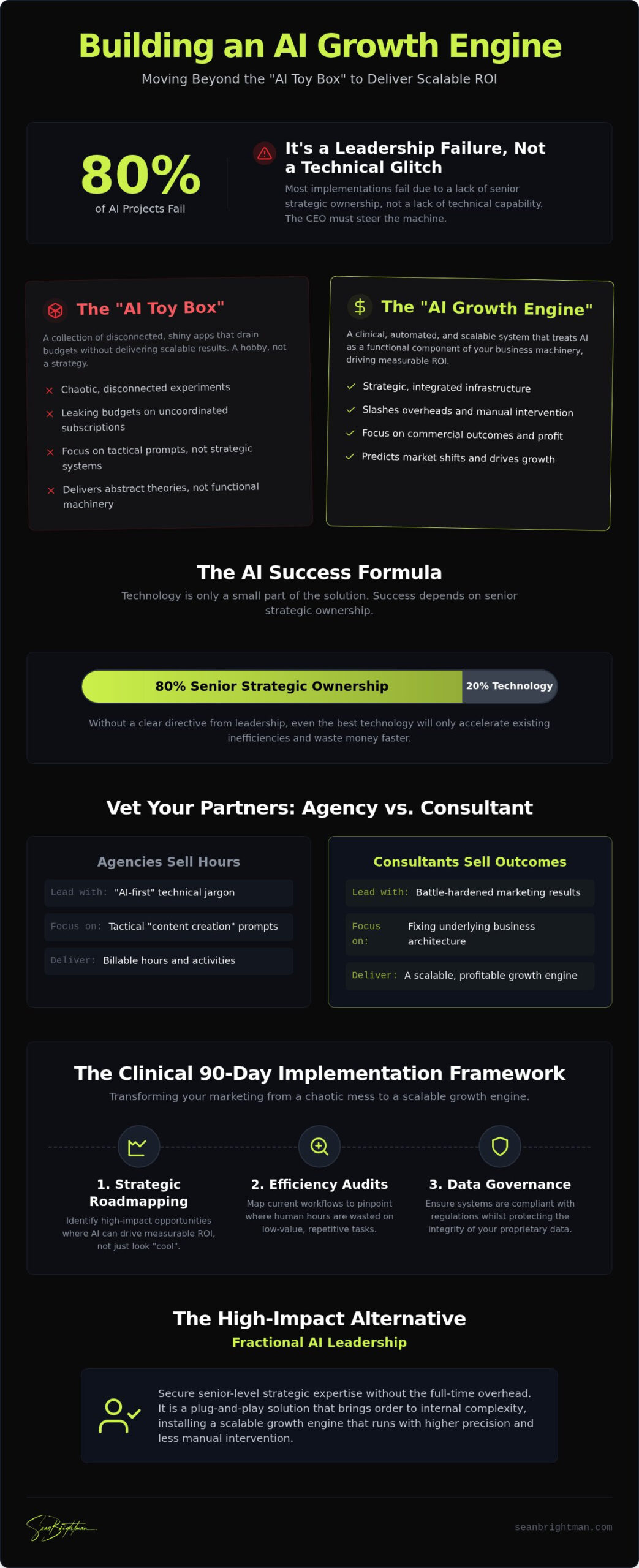
    Eighty per cent of AI projects fail. This isn’t a technical glitch; it’s a leadership failure. Most CEOs are currently building “toy boxes” full of shiny apps rather than actual growth engines. You’ve likely felt the tool fatigue already. Your marketing department is a mess of disconnected prompts and your budget is leaking into experiments that don’t scale. You’re paying for ai consulting services that deliver abstract theories instead of functional machinery.

    It’s time to stop playing with tools and start building a scalable, AI-powered system that delivers actual ROI. You need a strategist, not a coder. This guide provides the blueprint to move from chaotic experiments to a clinical, automated growth engine that runs without you. We will break down the 2026 roadmap for fractional leadership, the shift towards agentic AI workflows, and how to slash overheads whilst your competitors are still stuck in the “prompt engineering” phase. We’re building a system, not a hobby.

    Key Takeaways

    • Stop collecting apps and start building infrastructure. Strategic AI integration prioritises functional systems over shiny new chatbots.
    • Senior leadership is the variable that determines success. Most implementations fail because they lack strategic ownership rather than technical capability.
    • Vet your partners based on marketing results, not technical jargon. Avoid firms that lead with “AI-first” but lack the battle-hardened experience to drive actual growth.
    • Deploy a clinical 90-day roadmap to transform your marketing department. Professional ai consulting services should audit your current mess and install a scalable growth engine.
    • Opt for fractional AI leadership to secure senior-level expertise without the full-time overhead. It is a plug-and-play solution that brings order to internal complexity.

    What are AI Consulting Services in 2026? Beyond the Chatbot Hype

    In 2026, the UK market is flooded with “AI experts” who are little more than prompt engineers in expensive suits. Real ai consulting services aren’t about teaching your team how to use a chatbot. They are about the strategic integration of intelligence into every gear of your business machinery. Think of it as the difference between buying a bag of random car parts and commissioning a high-performance engine. One is a technical capability; the other is a commercial outcome.

    Effective ai consulting services replace chaotic experimentation with clinical systems. Most CEOs are currently suffering from “toy box” syndrome. They have a collection of shiny apps that don’t talk to each other and don’t drive revenue. A strategy-first approach ignores the hype and focuses on the architecture. It treats Artificial intelligence as a functional component of your growth engine, not a magic wand. Ultimately, AI consulting is the bridge between raw technology and business profit.

    The Evolution of AI Advisory

    The phase of “let’s see what this does” is over. For serious UK businesses, experimentation has been replaced by the need for scalable growth engines. In 2021, you might have automated a few emails. In 2026, you’re using predictive engines to anticipate market shifts before they happen. This requires senior leadership. If the CEO isn’t steering the AI, the technology is just accelerating your existing inefficiencies. The “AI toy box” is a distraction; a growth engine is an asset.

    Core Components of Modern AI Consulting

    Professional advisory isn’t a vague chat over coffee. It is a clinical process designed to find the hidden profit in your current mess. It involves stripping away the fluff and installing components that actually move the needle. A modern framework focuses on three pillars:

    • Strategic Roadmapping: Identifying the high-impact opportunities where AI can actually drive ROI, rather than just looking “cool.”
    • Operational Efficiency Audits: Mapping your current marketing workflows to see where human hours are being wasted on low-value tasks.
    • Data Governance: Ensuring your systems are compliant with evolving regulations whilst maintaining the integrity of your proprietary data.

    This isn’t about adding more work to your plate. It’s about building a system that runs with less manual intervention and higher precision. You aren’t hiring a coder to build an app; you’re hiring a strategist to build a business that scales without you.

    The Strategic Gap: Why Most AI Implementations Fail

    Between 70% and 90% of enterprise AI projects fail to deliver their intended value. This isn’t a technical glitch or a coding error. It is a leadership vacuum. When you outsource your intelligence to a junior team or an external agency without a clear directive, you get a “toy box” of expensive gadgets rather than a commercial result. Professional ai consulting services recognise that technology is only 20% of the solution; the rest is senior strategic ownership. If the CEO isn’t steering the machine, the machine is just wasting money at a faster rate.

    CEOs are currently drowning in tool fatigue. Your marketing department is likely a bloated mess of disconnected subscriptions that don’t communicate with each other. This is the “plug-and-play” myth in action. True integration is mechanical. It requires stripping the engine down and rebuilding it around a central logic. An agency will happily bill you for “content creation” prompts. A consultant will tell you why your current process is broken and how to fix the underlying architecture. Agencies sell hours; consultants sell outcomes.

    The “Toy Box” vs. The “Growth Engine”

    Many UK businesses waste thousands of pounds every month on uncoordinated AI subscriptions. They have one tool for copy, another for images, and a third for data analysis, yet nothing is integrated. This is a hobby, not a business strategy. To survive 2026, you must stop playing with apps and start building a scalable growth engine. Whilst global initiatives like the National Artificial Intelligence Initiative focus on macro-level strategy, your focus must be on the micro-level architecture of your marketing operations. Professional ai consulting services move you from tactical prompts to strategic systems that protect your margins.

    Overcoming Internal Resistance

    Your staff are likely terrified. They see AI as a replacement for their livelihoods rather than an augmentation of their skills. This fear creates friction that can stall even the best implementation. You cannot install a high-performance system if your team is quietly sabotaging the gears. Overcoming this requires a culture of AI-powered accountability. They need to see that the machine handles the drudgery so they can handle the strategy. Before you buy a single new tool, you must establish a Marketing Strategy Roadmap. This provides the clarity your team needs to stop worrying about displacement and start focusing on high-value output.

    If you are tired of the fluff and ready for a clinical audit of your operations, it might be time for a Fractional CMO roadmapping session to identify your specific gaps.

    Evaluating AI Consulting Firms: Strategy Amongst the Fluff

    Most “AI consultants” are simply tech enthusiasts with a subscription and a LinkedIn premium account. They lead with tools because they don’t understand business. Choosing the right ai consulting services requires you to look past the technical jargon and focus on commercial experience. If a consultant cannot explain how their implementation protects your gross margin or shortens your sales cycle, they are a hobbyist, not a strategist. You need someone who understands Building an AI Business Strategy, not just someone who can write a clever prompt.

    A massive red flag is the “AI-first” agency with zero marketing background. These firms often suggest “60+ use cases” for AI in your business. This is a recipe for chaos. A battle-hardened expert knows that 57 of those use cases are distractions. You only need the three that drive revenue and lower overheads. This is why a Fractional CMO who owns the AI strategy is often more valuable than a dedicated technical firm. They prioritise brand positioning and customer behaviour whilst using AI as the mechanical lever to scale those efforts.

    Corporate Giants vs. Strategic Partners

    The “Big Four” firms offer safety and massive reports, but they move at a glacial pace. You’ll pay for a 200-page slide deck that is obsolete by the time it’s delivered. Boutique ai consulting services provide direct access to senior minds and rapid, clinical implementation. For a UK scale-up, the choice is clear. You don’t need a corporate safety net; you need a strategic partner who isn’t afraid to be blunt about your current inefficiencies and fix them in weeks, not years.

    The Interview Checklist for CEOs

    When interviewing potential partners, ignore their tech stack. Focus on their operational logic. Ask these questions to separate the theorists from the practitioners:

    • “How does this system integrate with our existing CRM without creating more manual data entry?”
    • “What is the projected ROI over the first 90 days, and how do we measure it?”
    • “Can you show me a growth engine you’ve built that runs without the founder’s daily input?”

    The wrong first question is “What tools do you use?” The right question is “How will this change our unit economics?” If they start talking about specific apps before they’ve audited your workflow, end the meeting. They are trying to sell you a tool, not a solution. You are looking for a architect who can design the machinery of your future growth.
    AI Consulting Services: A CEO’s Guide to Building Growth Engines in 2026

    The AI Roadmap: A 90-Day Implementation Framework

    Strategic transformation doesn’t happen by accident. It happens through clinical execution. Most ai consulting services fail because they lack a structured delivery model. You don’t need a year-long project plan; you need a 90-day sprint to replace manual friction with automated precision. This framework is designed to strip away the “toy box” mentality and install a functional growth engine that delivers measurable ROI. We move from audit to advisory in three distinct phases.

    Step 1: The 30-Day Audit

    The first month is about finding the hidden profit in your current mess. We map every marketing workflow to identify where your team is wasting hours on low-value drudgery. This isn’t a vague observation; it’s a mechanical teardown of your operations. We evaluate your existing tech stack for redundancy, often finding that businesses are paying for multiple subscriptions that perform the same task. By setting a baseline for AI-driven ROI early, we ensure every subsequent move is commercially justified. You aren’t just buying tech; you’re buying back time.

    Step 2: Building the Engine

    Once the audit is complete, we move into the AI implementation for marketing phase. This is the architectural design of your future growth. We integrate Large Language Models (LLMs) into your lead generation and customer journeys to create a seamless, automated experience. This involves developing custom GPTs or internal intelligence hubs that store your brand’s unique logic. Crucially, every output must align with strategic brand roadmapping. If the AI doesn’t sound like your brand, it’s a liability, not an asset.

    The final phases focus on tactical execution and ongoing advisory. We deploy high-impact tools with clear KPIs, ensuring your team knows exactly what success looks like in a post-AI landscape. This isn’t a “set and forget” solution. It requires iterative growth and senior-level accountability to ensure the system remains efficient as the market shifts. You need a partner who stays in the trenches with you, adjusting the gears as your business scales and the technology evolves. We don’t just hand over a manual; we manage the machine.

    If you’re ready to stop the budget leak and start building, book a Fractional CMO roadmapping session to begin your 30-day audit.

    Fractional AI Leadership: The High-Impact Alternative

    Hiring a full-time AI Director in 2026 is a commercial mistake for most UK scale-ups. You will likely pay upwards of £150,000 per year plus benefits for a role that might be obsolete in twenty-four months. This is the old way of thinking. High-impact ai consulting services now operate on a fractional basis. It is a plug-and-play model. You get senior-level strategic authority without the deadweight of a permanent executive salary. It is about precision, not presence. You are buying an outcome, not an employee.

    A fractional consultant acts as an external force for internal order. Your team is busy with the daily grind and lacks the headspace to re-engineer their own workflows. They need a strategist to step in, identify the bottlenecks, and enforce the new architecture. The Advisory Retainer is the ultimate accountability tool. It ensures the strategy doesn’t just sit in a slide deck. It ensures the engine actually gets built and remains efficient as the technology shifts.

    Why Fractional Leadership Wins in 2026

    Speed is the only currency that matters in a post-AI market. Fractional leadership allows you to fix the engine whilst it is running. You aren’t waiting for a six-month recruitment cycle or a three-month notice period. You get immediate access to battle-hardened expertise. This model focuses on strategic direction and team accountability. It is about moving the needle now, not eventually. You pay for results, not hours spent in meetings. It is a lean, clinical approach to business growth that scales with your needs.

    Getting Started with Sean Brightman

    Transformation doesn’t require a leap of faith. It starts with a one-off Roadmapping session. This is a low-risk entry point designed to audit your current mess and provide a clinical plan for ai consulting services. From there, the advisory retainer ensures the strategy actually sticks. You get direct, blunt honesty. I will tell you what you need to hear, not what you want to hear. If your current marketing operations are a bloated liability, we strip them back. If your team is resisting the shift, we address it. Order from chaos. Precision over fluff. Let’s build your growth engine.

    Stop Collecting Tools and Start Building Assets

    The “toy box” phase of AI is over. Successful UK scale-ups in 2026 don’t win by having the most apps; they win by having the most efficient machinery. You’ve seen why senior-level strategy is the only variable that prevents implementation failure. You know that a 90-day roadmap is the difference between a budget leak and a scalable asset. Professional ai consulting services should deliver order, not just more options.

    It’s time to move from tactical prompts to a clinical growth engine that runs without your daily input. As a Fractional CMO and author of “The Book” on marketing strategy, I specialise in building profit-driven systems for leaders who have no patience for bureaucracy. We strip away the fluff and install the components that actually drive revenue. We build engines, not hobbies.

    Don’t let your marketing operations remain a chaotic liability whilst your competitors automate their advantage. Book your AI Roadmapping session with Sean Brightman today and start building a system that scales. The future belongs to the architects, not the experimenters. Let’s get to work.

    Frequently Asked Questions

    What exactly do AI consulting services include for small to medium businesses?

    ai consulting services for SMEs focus on identifying high-impact automation opportunities and building custom internal intelligence hubs. It includes a clinical audit of your current marketing tech stack to eliminate redundancy. Instead of just suggesting tools, a consultant designs a bespoke architecture that connects your CRM, content production, and lead generation into a single, automated growth engine. It is about building functional machinery, not just offering advice.

    How much should a UK scale-up expect to pay for AI consulting?

    UK scale-ups can expect a wide range of pricing depending on the firm’s seniority. Boutique firms often charge between £150 and £300 per hour, whilst comprehensive diagnostic assessments can range from £8,000 to £20,000. Monthly retainers for fractional leadership usually fall between £2,000 and £7,000 depending on the complexity of the implementation. You are paying for strategic velocity and the avoidance of expensive project failures.

    What is the typical ROI timeframe for an AI marketing implementation?

    You should expect to see measurable efficiency gains within the first 30 to 60 days. This typically manifests as a significant reduction in manual human hours spent on drudgery like data entry or first-draft content creation. Full commercial ROI, including lower customer acquisition costs and higher lead conversion rates, usually takes 90 to 180 days as the system gathers data and the automated growth engine begins to reach peak performance.

    Do I need to hire an AI specialist internally if I have a consultant?

    No, you don’t need to hire a full-time specialist if your consultant builds the system correctly. The goal of professional ai consulting services is to create a “plug-and-play” infrastructure that your current marketing team can operate. A consultant provides the senior-level architecture and oversight, whilst your internal staff focus on high-value strategic output. This prevents the £150,000+ overhead of a permanent AI Director.

    Can AI consulting help with brand positioning or just automation?

    AI consulting is a powerful tool for brand positioning. Beyond simple automation, consultants use predictive engines and sentiment analysis to identify exactly where your brand sits in the market. This data allows you to refine your messaging with clinical precision. Automation then ensures that this refined positioning is deployed consistently across every touchpoint in the customer journey, from initial ad copy to long-form nurturing sequences.

    What is the difference between an AI agency and an AI consultant?

    An AI agency usually sells execution and billable hours for specific tasks like prompt engineering or video generation. An AI consultant sells strategy, architecture, and commercial outcomes. Agencies focus on doing the work; consultants focus on building the system so the work happens automatically. You hire an agency when you need a pair of hands; you hire a consultant when you need a brain to design the machine.

    How long does it take to see results from an AI marketing roadmap?

    You get immediate clarity from the moment the roadmapping session concludes. You will have a clinical list of exactly what is broken and how to fix it. Physical results, such as automated lead nurturing or predictive analytics, typically take 90 days to fully integrate and test. This timeframe ensures the system is robust, compliant with UK regulations, and aligned with your proprietary brand voice before it goes live.

    Is AI consulting suitable for B2B companies with long sales cycles?

    It is arguably more critical for B2B firms with long sales cycles. AI consulting helps these businesses implement sophisticated lead scoring and automated “always-on” nurturing sequences that stay in front of prospects for months without human intervention. This ensures no lead is dropped during a six-month decision process. It turns a manual, leaky sales funnel into a precise, automated pipeline that prioritises high-value accounts.

  • AI Implementation for Marketing: Build a Growth Engine, Not a Toy Box

    AI Implementation for Marketing: Build a Growth Engine, Not a Toy Box

    Your marketing department is currently a cluttered toy box of disconnected subscriptions. You’ve bought the hype, but you haven’t bought the results. Most businesses treat AI implementation for marketing as a frantic shopping spree rather than a strategic build. It’s a costly mistake that leads to messy data and a team that’s busy but never productive. You’re paying for the promise of automation whilst your actual growth remains stuck in the mud.

    I know the frustration. It’s exhausting to manage a dozen different logins that don’t talk to each other. You want a high-performance engine, not a collection of digital gadgets. I’m going to show you how to bin the tool fatigue and build a system that actually moves the needle. We’re stripping away the corporate fluff to focus on the hard architecture required for measurable growth.

    We are moving beyond the era of simple chatbots. We’ll look at how to deploy agentic AI that orchestrates campaigns from start to finish. You’ll learn how to organise your data, set a clear roadmap, and finally turn your AI spend into a functional asset that delivers real ROI. It’s time to stop playing with toys and start building a machine.

    Key Takeaways

    • Stop treating AI as a shopping list of gadgets and start viewing it as a strategic integration of intelligence into your core business workflows.
    • Understand the “Growth Engine” architecture, moving from messy data silos to a structured system of intelligence and automated execution.
    • Learn how to execute a professional AI implementation for marketing by following a 5-step roadmap that aligns infrastructure with your growth goals.
    • Identify why clean, organised data is the non-negotiable fuel for any AI system and how to audit your current stack to remove “garbage in” risks.
    • Recognise why senior human leadership is essential to pilot these systems, ensuring AI serves your strategy rather than distracting from it.

    The AI Toy Box Trap: Why Most Implementations Fail

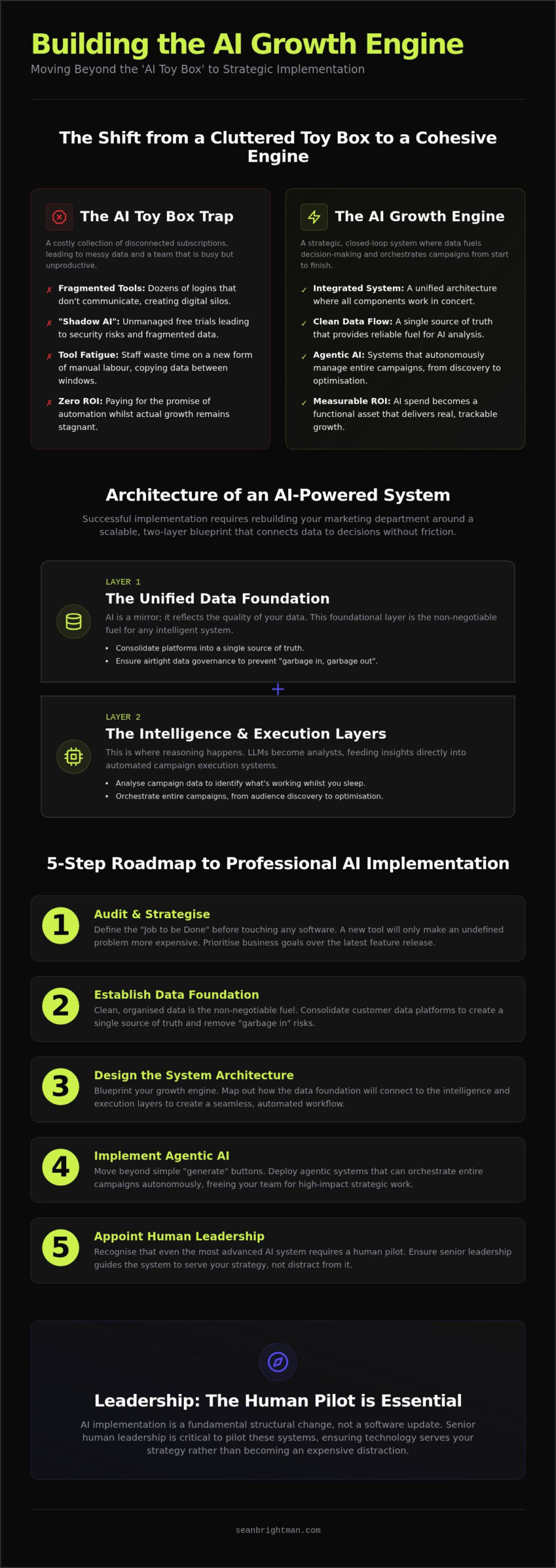
    Most marketing leaders are currently building a toy box. They buy shiny tools because they’re afraid of being left behind. This isn’t strategy; it’s panic buying. True AI implementation for marketing is the strategic integration of intelligence into your existing business workflows. It’s about machinery, not magic. If you’re just adding a “generate” button to a broken process, you haven’t solved anything. You’ve just made the mess faster.

    To understand the scope of the problem, we must look at Artificial intelligence in marketing as a cycle of collecting data, reasoning through it, and acting on the insights. If you just buy a tool to write emails, you’ve skipped the collection and reasoning. You’ve bought a faster way to produce mediocre work. You’re treating AI as a standalone gadget rather than a functional component of your growth engine.

    Then there’s the risk of “shadow AI”. This is where your team signs up for twenty different free trials using their corporate emails. You end up with unmanaged tools, fragmented data, and a massive security headache. You’re paying for novelty whilst your ROI sits at zero. It’s a toy box trap. You have the gadgets, but you don’t have a system. Without a unified strategy, these tools become expensive distractions that pull your team away from high-impact work. Professional AI consulting services exist precisely to prevent this pattern from taking hold and costing you far more than the tools themselves.

    The Symptoms of Tool Fatigue

    Tool fatigue doesn’t happen overnight. It creeps in. You’ll notice your team has three different subscriptions that all perform the same basic tasks. None of them talk to your CRM. Your staff spends their mornings manually copying text from one window to another. This isn’t automation; it’s just a new form of manual labour. They’re spending more time playing with clever prompts than they are driving actual leads. If your team is more excited about what the tool can do than what it is doing for your bottom line, you’re in the trap.

    Strategy vs. Software: The Critical Distinction

    A software subscription is not a marketing strategy. It’s an expense. Before you touch a single piece of software, you need to define the Job to be Done. What specific bottleneck are you trying to clear? If you can’t name the problem, a new tool will only make the mess more expensive. AI implementation for marketing is a fundamental structural change to your department, not a simple software update. It requires a roadmap that prioritises your business goals over the latest feature release. You need a system that works whilst you sleep, not a toy that requires constant supervision.

    The Architecture of AI-Powered Marketing Systems

    Stop buying apps. Start building a machine. A growth engine isn’t a collection of disparate parts; it’s a closed-loop system where data fuels decision-making. Most businesses fail because they try to bolt AI onto the outside of their department. Successful AI implementation for marketing requires you to strip the department down to its chassis and rebuild it for speed. You need a blueprint that connects your data to your decisions without manual friction.

    In 2026, the trend has shifted from using AI for isolated tasks to “agentic AI.” These are systems that can orchestrate entire campaigns from audience discovery to real-time optimisation. If your tools don’t talk to each other, you don’t have an engine. You have a pile of scrap metal. To win, you must organise your architecture into three distinct, interconnected layers.

    Layer 1: The Unified Data Foundation

    AI is a mirror. If you feed it fragmented, messy data, it will reflect that chaos back at you in your results. You need a single source of truth for customer behaviour. This means consolidating your customer data platforms and ensuring your data governance is airtight. With Google’s July 2026 update to its Ads Terms of Service, the platform now uses automated features to generate targets and destinations by default. If your internal data is weak, you’re letting Google’s algorithms guess your strategy. Building this plumbing is complex, which is why many senior leaders hire a marketing operations consultant to ensure the foundation is scalable and secure.

    Layer 2: The Intelligence and Execution Layers

    The middle layer is where the reasoning happens. LLMs are not just for writing blogs; they are your primary analysts. They should be parsing campaign data to identify what’s working whilst your team sleeps. This layer must feed directly into your execution layer. The future of marketing isn’t about humans doing the work. It’s about humans setting the parameters. You must automate the feedback loop between campaign results and strategic adjustments. This ensures your brand consistency remains intact amongst thousands of automated outputs.

    When these layers are aligned, you see the real impact. Companies using AI for marketing in 2026 report an average ROI improvement of 35%. This isn’t a coincidence. It’s the result of a mechanical system that removes human bottlenecking. If you’re ready to stop guessing and start building, a strategic AI roadmapping session is the first step toward a functional engine.

    Data Readiness: Preparing Your Business for Intelligence

    If your data is a bin fire, your AI will be a blowtorch. It will simply burn through your budget faster. The “Garbage In, Garbage Out” principle is the absolute law of AI implementation for marketing. You cannot automate chaos. Most businesses are sitting on “Big Data” that is actually just a massive pile of unorganised noise. It’s vanity. You need “Clean Data”. This means precise, connected, and actionable information that a machine can actually interpret to drive growth.

    Auditing your data silos is the first step. These are the pockets of information trapped in your CRM, your email platform, and your spreadsheets that don’t talk to each other. Silos are where ROI goes to die. You must bridge these gaps to create a unified view of the customer. In the UK, this isn’t just about efficiency; it’s about survival. With the EU AI Act transparency rules in effect as of August 2, 2026, you must be able to track, label, and justify your use of AI-generated content. Privacy isn’t a hurdle. It’s a critical component of the engine’s safety system.

    The Marketing Efficiency Audit

    You need to find the waste. A proper audit identifies where your team is burning hours on repetitive tasks that add no value. Look for the manual data entry. Look for the “copy-paste” cycles. This is where you’ll find the hidden profit. By identifying these bottlenecks, you can pinpoint exactly where AI implementation for marketing will provide the most immediate relief. The goal is to free your senior talent from the machinery so they can focus on the future of marketing strategy rather than the maintenance of spreadsheets.

    Standardising Workflows for AI Integration

    AI cannot follow a “vibe”. It needs a process. You must create repeatable, documented workflows that an AI agent can execute without human hand-holding. This means moving away from “how we’ve always done it” toward rigorous SOPs. These documents are the instructions for your new digital workforce. Without them, your implementation will stall. Think of the AI marketing roadmap as your master blueprint. It defines the sequence of operations required to turn your messy data into a high-performance growth engine that actually scales.

    AI Implementation for Marketing: Build a Growth Engine, Not a Toy Box

    A 5-Step Roadmap for AI Implementation for Marketing

    Strategy is a sequence. Implementation is a process. If you skip the order, you break the machine. Most businesses fail because they start at step four. They jump straight into software integration without checking if their infrastructure can handle the load. A professional AI implementation for marketing follows a logical, cold-blooded progression from goal to execution. You don’t build a house by picking the wallpaper first. You dig the foundations.

    • Step 1: Strategic Alignment. Define your growth goals. Don’t ask what AI can do; ask what your business needs to achieve. If you can’t articulate how AI will increase your margin or reduce your acquisition costs, don’t start.
    • Step 2: Infrastructure Audit. Assess your data and tools. We’ve already established that messy data kills ROI. Fix the plumbing before you turn on the taps. This is where you identify which legacy systems are holding you back.
    • Step 3: High-Impact Use Case Selection. Pick the low-hanging fruit. Focus on the bottlenecks that slow down your senior talent. You want victories that prove the concept quickly.
    • Step 4: Pilot and Integration. Build the first automated workflows. Start small. Prove the logic. You are looking for a “plug-and-play” victory that builds momentum for the larger rollout.
    • Step 5: Scaling and Accountability. Monitor the engine performance. Ensure the system remains aligned with your strategic direction. This is where you audit the AI implementation for marketing to ensure it hasn’t drifted into a series of expensive, disconnected tasks.

    Selecting Your First Use Cases

    Ignore the hype around creative AI. Writing a poem won’t fix your conversion rate. You should start with “boring” automations that clear the deck. Think lead scoring, competitor intelligence, or reporting automation. These are the tasks that eat 80% of your team’s time but deliver 20% of the value. Apply the 80/20 rule. Automate the repetitive labour first. This frees your people to do the high-level thinking that a machine can’t replicate. It’s about tactical precision, not novelty.

    Measuring ROI and Strategic Velocity

    Time saved is a vanity metric. Revenue generated is the only number that matters. If your AI isn’t moving the needle on growth, it’s a toy. You need to track strategic velocity; how fast your department moves from insight to action. This requires ongoing oversight to prevent “tool creep” from setting in again. Many CEOs use a marketing advisory retainer to maintain this accountability. It ensures the engine stays tuned and the strategy remains sharp amongst the noise of constant technological shifts. If you want to stop playing and start scaling, book a strategic roadmapping session to define your path.

    Leadership: Why AI Implementation Needs a Human Pilot

    AI is a force multiplier, not a replacement for judgment. If you leave your marketing to an algorithm, you’ll end up with a vanilla brand that sounds exactly like your competitors. Successful AI implementation for marketing requires a human pilot who understands the ‘why’ behind the ‘what’. Machines are excellent at execution but useless at strategy. They can’t feel the market. They can’t understand the subtle shifts in buyer behaviour that happen in a boardroom. You need a senior strategist to set the parameters, or you’re just automating your descent into irrelevance.

    The Fractional CMO as AI Architect

    You don’t need to make a £120k hiring mistake to get this right. Many CEOs think they need a full-time heavyweight to manage this transition. They don’t. A fractional CMO provides the senior-level architecture you need without the eye-watering overhead. They act as the master engineer who builds the growth engine and then trains your team to run it. This ensures your AI implementation for marketing stays locked onto your high-level brand positioning. AI can generate a thousand headlines in seconds, but it takes a human expert to know which one actually captures your brand’s soul. You are buying expertise, not just more hours in a chair.

    Accountability and Long-Term Strategy

    Accountability is the fuel of this machine. Who owns the AI roadmap when the initial setup is done? A roadmap is useless if it gathers digital dust on a shared drive whilst your team reverts to old habits. You must build internal capabilities whilst leveraging external expertise. This is about knowledge transfer. The goal is a plug-and-play system that your current team can manage with total confidence. You’re building a functional asset for the business, not a permanent dependency on an outside consultant. You need order, not more complexity.

    This is about strategic velocity. It’s about moving faster than your rivals whilst maintaining a level of creative quality they can’t touch. You’ve seen the architecture. You’ve heard the warnings about the toy box trap. Now it’s time to pull the trigger. Don’t wait for your team to “figure it out” amongst their daily tasks. They’re already at capacity. Book an AI roadmapping session today to start building a growth engine that actually scales.

    Ignite Your Growth Engine

    The choice is simple. You can continue collecting expensive digital gadgets, or you can build a machine that delivers measurable growth. AI implementation for marketing isn’t a software update; it’s a structural revolution. You’ve seen the blueprint. You know that clean data is the only fuel that matters and that a “Human in the Loop” is the only way to maintain strategic control. Without order, your AI spend is just a tax on your indecision.

    I don’t do corporate fluff. I build high-performance engines. As a battle-hardened Fractional CMO and author of the definitive guide on marketing strategy, I provide the direct, no-fluff advisory required to turn chaotic tools into a unified system. We’ll strip away the distractions and focus on the architecture that actually moves the needle. Your team is ready for a roadmap. They just need the architect to draw it.

    It’s time to stop the tool fatigue and start the expansion. Build your AI growth engine with a strategic roadmap. Let’s get to work.

    Frequently Asked Questions

    How much does AI implementation for marketing typically cost?

    The total investment for AI implementation for marketing depends on your current scale and infrastructure. In 2026, research shows that small to medium-sized businesses typically spend between $900 and $2,700 per month on AI tools alone. However, the real cost isn’t the software; it’s the strategic integration. You are paying to move from a cluttered toy box to a functional machine. Investing in a roadmap early prevents you from wasting thousands on overlapping subscriptions that don’t talk to each other.

    Do I need to hire an AI specialist to manage these systems?

    You don’t need a dedicated AI specialist; you need a strategist who knows how to use the tools. Hiring a full-time specialist is often a £120k mistake for most businesses. A Fractional CMO can architect your system and train your existing team to operate the machinery. It’s about mechanical integration into your current workflows, not adding more headcount to a department that already lacks order.

    What is the first tool I should buy for my marketing team?

    The first tool you should buy is actually none at all. You must audit your data foundation first. If you buy software before you have a strategy, you’re just adding to the noise. Once your data is organised, start with a high-level LLM for analysis rather than content generation. Focus on the tools that clear bottlenecks, not the ones that create more creative work for your editors.

    How do I ensure AI-generated content doesn’t hurt my brand?

    Maintain brand integrity by keeping a “Human in the Loop” for every output. AI is a force multiplier, not a creative director. You must establish rigorous brand guidelines and use AI for the heavy lifting whilst humans handle the final polish. This prevents your brand from becoming vanilla and ensures you comply with the July 2026 FTC double disclosure mandates for AI content.

    Can AI really replace a full-time marketing manager?

    AI replaces repetitive tasks, not leaders. It can handle lead scoring, competitor intelligence, and reporting automation, but it cannot handle boardroom strategy or complex relationship building. It makes your marketing manager more effective by removing the manual labour from their day. It changes the job description from “doer” to “pilot”. Your manager stays; the busywork goes.

    What is an AI marketing roadmap and why do I need one?

    An AI marketing roadmap is the foundational document that defines your strategic sequence. It’s the blueprint for your growth engine. You need it to ensure every tool you buy and every workflow you automate serves a specific growth goal. Without it, you are just panic buying software. It provides the order and accountability required to move from tool fatigue to measurable growth.

    How long does it take to see ROI from AI implementation?

    You’ll see ROI in two stages: immediate efficiency and long-term revenue growth. Time savings on “boring” automations happen in the first month. Revenue growth typically follows within 3 to 6 months as your team focuses on high-impact strategy. In 2026, companies report an average ROI improvement of 35% after full integration. The faster you reclaim senior hours, the faster the engine pays for itself.

    Is my business too small for professional AI consulting?

    If you have a marketing budget, you are large enough for professional consulting. Small businesses often suffer the most from tool fatigue because they lack the time to vet every subscription. Consulting isn’t an overhead; it’s a preventative measure. It stops you from building a toy box and ensures your limited budget is spent on a high-performance growth engine from day one. A structured approach to AI consulting services gives even lean teams the strategic architecture they need to compete without wasting budget on disconnected tools.