
Your marketing department doesn’t need another ChatGPT subscription. It needs a machine. Most CEOs are currently subsidising Silicon Valley’s R&D through a “toy box” of disconnected tools whilst their actual growth remains stagnant. You feel the pressure to innovate, yet you’re paralysed by a fragmented mess of AI experiments that deliver zero impact on the bottom line. It’s time to stop playing and start building a definitive 2026 AI marketing roadmap that treats technology as infrastructure, not a hobby.
The frustration is real. You’ve watched budgets vanish into “experimental” workflows that lack senior oversight and strategic direction. You want systems that run on autopilot and efficiency gains you can actually see in the profit and loss statement. This is your exit from the noise. We’re delivering a battle-hardened, 90-day blueprint to install accountability, organise your operations, and turn your marketing team into a high-performance revenue engine that actually scales.
Key Takeaways
- Stop collecting disconnected SaaS tools and start building a unified growth engine that treats technology as infrastructure.
- Learn how to audit your current maturity level to establish a clear starting line for your 2026 AI marketing roadmap.
- Master the three essential pillars of AI integration: clean data foundations, automated process machinery, and strategic leadership.
- Implement a battle-hardened 90-day plan to move from experimental chaos to a high-performance marketing system that actually delivers revenue.
- Understand why Fractional CMO oversight is the most efficient way to maintain accountability whilst avoiding the bloat of a full-time hire.
What is an AI Marketing Roadmap? (And Why Most Fail)
An AI marketing roadmap isn’t a spreadsheet of SaaS logins. It’s the strategic blueprint for your revenue machinery. Most CEOs treat AI like a trip to a toy shop. They buy the shiny objects, hand them to a confused team, and wonder why the needle hasn’t moved. This is why projects stall. This is why budgets bleed. A real roadmap organises your data, your processes, and your people into a unified growth engine. It’s the difference between a pile of bricks and a fortified wall.
Most initiatives fail because they are tool-led, not strategy-led. You don’t need a clever chatbot; you need a system that qualifies leads whilst your sales team sleeps. In 2026, integration is the only metric that matters. If your tools don’t talk to your data foundations, you’re just paying for digital clutter. Your roadmap must prioritise integration over isolation. It’s about how the pieces fit together to drive measurable efficiency gains. It’s about building a machine that works for you, not the other way around. If you’re experiencing tool fatigue and need structured ai consulting to build a scalable growth engine, the path forward starts with strategy, not more subscriptions.
The Blueprint vs The Tool Box
It’s a binary choice. You either build a system or you collect tools. Collecting tools is an expensive hobby. Buying ten different AI subscriptions without an architectural plan is a £120k mistake that many marketing departments make every single year. It creates silos. It creates friction. It creates a “messy middle” where work goes to die. A roadmap is the architectural plan for your marketing operations. It defines exactly how data flows from your CRM to your content engine. It maps the machinery. It ensures every pound spent on technology is a pound spent on performance.
The 2026 Reality Check
Playing with ChatGPT is not a strategy. It’s a distraction. By 2026, AI is the plumbing of modern marketing. You wouldn’t build a house without pipes; you can’t run a business without an integrated AI layer. This isn’t a “nice to have” anymore. It’s the baseline for survival. This level of transformation requires senior leadership. It needs someone who understands the high-level business goals and can translate them into tactical execution. You need a navigator, not just a passenger. If you’re still “experimenting” without a plan, you’re already being left behind by competitors who have turned their AI into an autopilot growth engine.
The Three Pillars of an AI-Powered Growth Engine
An AI marketing roadmap is only as strong as its weakest link. You cannot out-prompt bad data. You cannot automate a broken process. And you certainly cannot lead a transformation with a team that is terrified of the technology. To build a growth engine that actually generates revenue, you must synchronise three core pillars. If one fails, the entire system stalls. When they work together, your marketing becomes a self-optimising machine that scales without adding headcount.
Data: The Fuel for the Machine
Most companies are data hoarders. They sit on mountains of “dark data” that serves no purpose whilst their marketing remains generic. In 2026, your data must be structured for machine consumption. This means moving away from fragmented spreadsheets and into a “Single Source of Truth.” If your CRM is a mess, your AI outputs will be a mess. Data cleanliness is the non-negotiable prerequisite for every AI initiative you launch. Without it, you are not building an engine. You are just making expensive mistakes faster.
Process: Mapping the Machinery
Automation is not about replacing people. It is about replacing friction. You need to identify repeatable, data-heavy tasks that drain your team’s energy. Think lead scoring, content distribution, or performance reporting. These are the cogs in your machine. You must move from random tool usage to systematic automation. Random tools create silos; systems create scale. Audit your current operations to find where work stops or where manual entry happens twice. If you are struggling to find the signal in the noise, a strategic AI roadmapping session can strip away the complexity and reveal your highest-impact wins.
Human Intelligence: Training Pilots, Not Passengers
Your team should not be passengers. They need to be pilots. This requires a fundamental shift in mindset. They are no longer just “doing” marketing; they are managing a digital workforce. Training must focus on strategic orchestration rather than just button-clicking. This is about accountability. Your team must know how to audit AI outputs, refine prompts, and steer the engine toward your commercial goals. When your data is clean, your processes are mapped, and your people are empowered, you stop being a business that “uses AI” and start being an AI-native growth engine.
The Audit: Assessing Your AI Maturity for 2026
You cannot build a definitive AI marketing roadmap if you do not know where the starting line is. Blindly implementing tools without a baseline is just expensive guesswork. You need a clinical assessment of your current infrastructure. It’s about honesty. Are you actually innovating, or are you just automating a mess? Before you scale, you must audit. This isn’t about ticking boxes; it’s about identifying the structural gaps that will cause your growth engine to seize up under pressure. A roadmap without an audit is just a wish list.
The Maturity Scale for Scale-ups
Growth is a ladder. You don’t jump to the top; you climb. Most businesses fall into one of three buckets on the maturity scale:
- Level 1: Fragmented. You have random tools and no strategy. Teams are using personal ChatGPT accounts. Data is siloed. There is zero senior oversight and no accountability for output.
- Level 2: Integrated. Tools are connected to your data foundations. You have some documented processes. You’re starting to see efficiency, but the system still requires heavy manual steering.
- Level 3: Native. AI-first operations are the norm. Your systems are self-optimising and data flows seamlessly across the department. High efficiency is baked into the culture.
Be blunt with yourself. If you’re at Level 1, trying to execute Level 3 tactics is a recipe for wasted budget. Your roadmap must bridge the gap between where you are and where you need to be. It’s about moving from “AI Curious” to “AI Native” through deliberate, phased upgrades to your marketing machinery.
Finding the Quick Wins
Don’t try to boil the ocean. Look for the messy, friction-heavy parts of your marketing department that AI can clean up fast. Focus on the high-impact, low-risk wins that build momentum for the wider transformation. Start with content operations. It’s the lowest hanging fruit. Move to data analysis. Let the machine find the patterns your team missed in your CRM. Then, tackle lead scoring. Automate the qualification process so your sales team only talks to “ready-to-buy” prospects.
This is where a Marketing operations consultant becomes invaluable. They don’t just suggest tools; they fix the plumbing. They ensure that your quick wins aren’t isolated events but part of a scalable system. Accountability is the final piece of the audit. Who actually owns the AI output? If the answer is “everyone,” then the answer is “no one.” You need clear ownership and measurable KPIs for every automated workflow you install. If you can’t measure the efficiency gain, the tool shouldn’t be in your box.
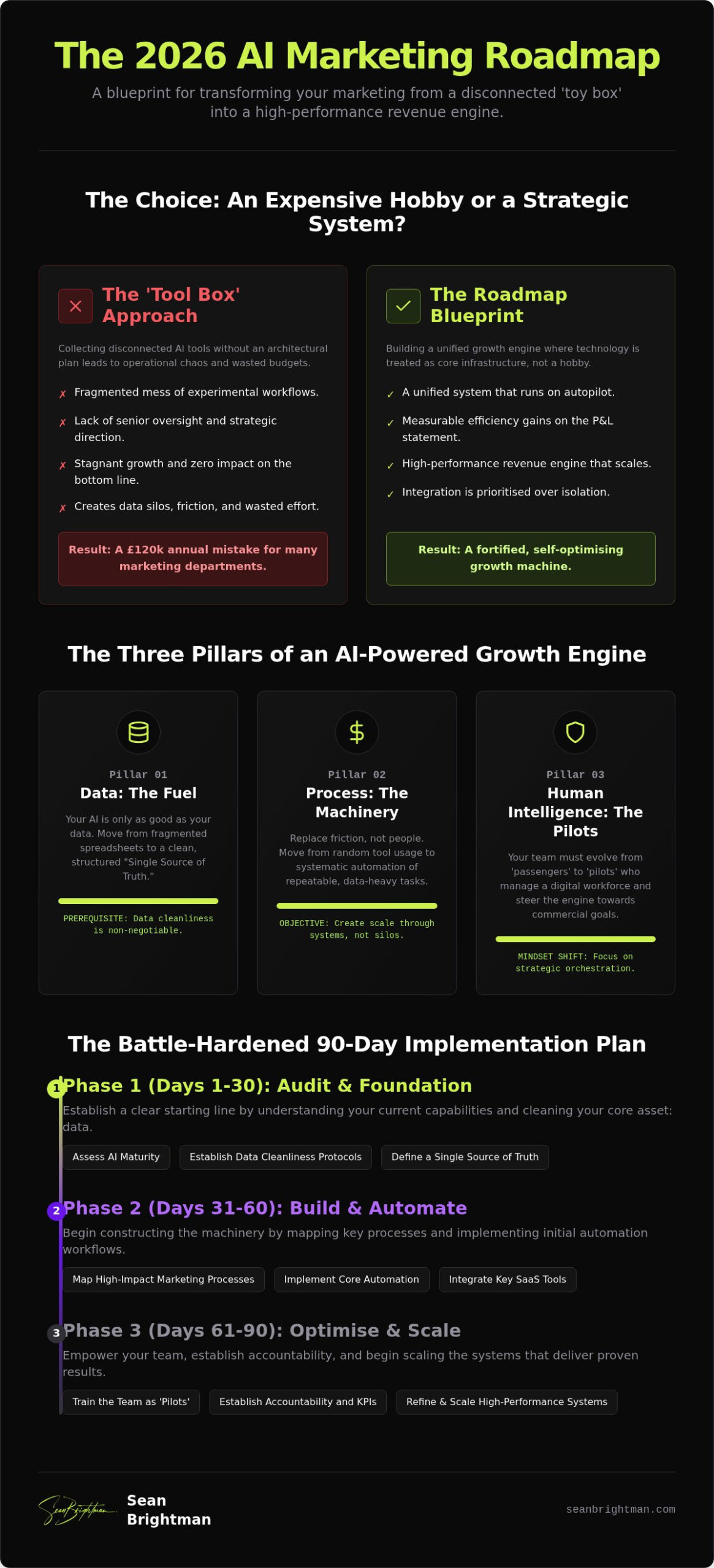
The Template: Your 90-Day AI Marketing Implementation Plan
A strategy without a clock is just a daydream.
Most CEOs fail because they treat AI implementation as a “someday” project. This 90-day AI marketing roadmap is the clinical antidote to that paralysis. It is designed to move your department from fragmented experiments to a self-sustaining growth engine in a single quarter. No fluff. No bureaucracy. Just tactical execution.
Phase 1: Foundation Building (Days 1-30)
The first month is about the plumbing. You cannot build a skyscraper on a swamp.
- Centralise your data amongst your various marketing platforms to create a unified view of your customer.
- Audit your CRM, email automation, and social analytics to ensure the machine has a clean fuel source.
- Set KPIs tied to revenue growth and pipeline velocity, not just “efficiency.”
You need a senior lead who has built these systems before. A Fractional CMO provides the senior oversight required to navigate this transformation whilst avoiding the overhead of a full-time executive hire. They ensure the foundation is solid before you start adding the cogs of automation. This phase is about stripping away the noise and focusing on the core data structures that will power your 2026 growth.
Phase 2 & 3: Execution and Scale (Days 31-90)
Months two and three are where the machinery starts to turn.
Don’t try to automate your entire department at once. Pick three high-impact pilot projects. Prove the concept. Refine the cogs. These pilots should focus on your biggest bottlenecks, such as lead qualification or personalised email at scale. This is the “get-your-hands-dirty” phase. You must standardise a “Human-in-the-loop” workflow for every AI output. This ensures quality control and protects your brand integrity.
Accountability is non-negotiable. Establish an “AI Council”, a small, decisive group that meets bi-weekly to review performance and manage governance. This methodical approach prevents the “toy box” effect where tools are bought but never integrated into the actual workflow. By day 90, you aren’t just using tools. You are running a high-performance revenue engine that scales without additional headcount.
If you’re ready to stop playing with toys and start building infrastructure, it’s time to book an AI roadmapping session to lock in your 90-day plan.
Execution: Why Strategy Roadmapping Beats Tool Implementation
A roadmap is just paper until someone turns the ignition. Most CEOs mistake a subscription list for progress. They buy the software, pat themselves on the back, and then wonder why the revenue haven’t shifted six months later. Your AI marketing roadmap is a living architectural plan. It requires a builder, not just a buyer. Without senior leadership to steer the integration, your growth engine remains a collection of expensive parts scattered across the workshop floor.
Transformation fails when it’s left to technicians. Technicians focus on the “how” of a tool; strategists focus on the “why” of the business. You cannot bridge that gap with a junior hire or a generic agency. You need someone who knows how to leverage technology for commercial gain. This is the execution gap. It’s where strategy meets the reality of messy data and human resistance. If you’re evaluating external support, understanding how to identify a credible AI marketing consultant UK who builds functional growth engines rather than abstract theories is essential before you commit budget. You need a navigator who has seen these patterns before and knows how to bypass the bottlenecks that stall most scale-ups.
Leadership Without the Overhead
Hiring a full-time executive to manage this shift is often a strategic blunder. You’re paying for 100% of their time when you only need 20% of their expert architecture. It’s about precision, not presence. You should Stop Hiring Full-Time CMOs for transitional projects that require high-impact, short-term surgery. A Fractional CMO provides the senior-level direction your roadmap needs without the crippling overhead of a permanent C-suite salary. They are the architect who builds the system and then hands over the keys to your team.
Maintaining Velocity
Static plans die in digital drawers. To keep the machinery running, you need a mechanism for ongoing accountability. A Marketing advisory retainer becomes your most powerful tool for long-term success. It ensures your AI marketing roadmap stays on track whilst the market shifts. It provides the plug-and-play senior oversight that prevents your team from slipping back into old, manual habits. This is strategic velocity, not just maintenance. Stop playing with tools. Start building a system. The 2026 winners won’t be the ones with the most AI subscriptions; they’ll be the ones with the most efficient engines.
Stop Collecting Tools and Start Building Infrastructure
The 2026 landscape won’t reward those with the most subscriptions. It will reward those with the most integrated machinery. You’ve seen the blueprint. Success requires clean data foundations, mapped processes, and senior leadership that understands strategy over software. Your AI marketing roadmap is the difference between a department that burns budget and one that prints revenue. It turns your team from passengers into pilots.
Don’t let your strategy sit in a drawer. Execution is the only metric that matters. Sean Brightman brings battle-hardened expertise as a Fractional CMO for UK scale-ups and the author of a proven strategic marketing methodology. He doesn’t do fluff; he builds high-performance growth engines that actually deliver whilst your competitors are still playing with prompts and wasting time on disconnected tools.
It’s time to take control of your marketing operations and build a system that runs on autopilot. Book an AI Roadmapping Session with Sean Brightman today to install accountability and drive measurable efficiency. The machine is waiting. Build it now.
Frequently Asked Questions
How much does it cost to build an AI marketing roadmap in 2026?
The investment in an AI marketing roadmap depends on the complexity of your current data infrastructure and the scale of your operations. You should view this as a capital investment in your business machinery rather than a monthly expense. The real cost to consider is the waste generated by random tool subscriptions and the lost revenue caused by inefficient, manual processes that your competitors have already automated.
Do I need a full-time AI specialist to manage the roadmap?
No. You need strategic leadership, not just a technician. Most scale-ups don’t require a full-time hire who sits on the payroll whilst you’re still building the foundations. A Fractional CMO provides the senior-level architecture and oversight required to execute the plan. They ensure the technology serves the business goals without the permanent overhead of a C-suite salary.
What are the biggest risks of implementing AI in my marketing?
The primary risks are data silos and a lack of human governance. If you automate a broken process, you just create a larger mess faster. Brand integrity is also at stake if you don’t have a “human-in-the-loop” workflow to audit outputs. Without a clear strategy, your biggest risk is “toy box syndrome,” where you spend thousands on software that your team never actually integrates into their daily work.
How long does it take to see a return on investment from an AI roadmap?
Efficiency gains typically appear within the first 30 to 60 days as manual bottlenecks are removed. A definitive AI marketing roadmap is designed for a 90-day implementation cycle. Measurable revenue impact follows in the second and third quarters as your qualified lead volume increases and your team spends more time on high-value strategy rather than administrative friction.
Which marketing tasks should I automate first with AI?
Start with high-volume, repeatable tasks that are heavy on data but low on emotional nuance. Lead scoring, performance reporting, and content distribution are the lowest-hanging fruit. By automating these cogs first, you immediately free up your team’s bandwidth. This creates the space needed to tackle more complex integrations like personalised customer journeys and predictive analytics.
Can an AI roadmap help with my company exit strategy?
Yes. A self-sustaining growth engine is a significant asset during due diligence. It proves to potential buyers that your marketing is a scalable system rather than a collection of individual efforts. An AI-native organisation is more attractive because it demonstrates higher margins and a reduced dependency on increasing headcount to drive incremental revenue growth.
What is the difference between an AI consultant and a Fractional CMO?
An AI consulting specialist is a technician who focuses on the software; a Fractional CMO is a generalist who focuses on the revenue. You need the strategist to ensure the technology actually moves the needle on your commercial goals. The CMO builds the growth engine and uses AI as the fuel, whilst a consultant might just sell you a better fuel tank without checking if the car actually runs.
How do I ensure my team actually uses the AI tools we implement?
Accountability must be baked into your culture. If usage is optional, it won’t happen. You must build AI integration into your team’s KPIs and standard operating procedures. Use the “AI Council” model to provide ongoing training and review. When the team sees that the machine removes their most frustrating tasks, adoption moves from a chore to a competitive advantage.
Leave a Reply