Tag: AI Consulting

  • AI Consulting Services: A CEO’s Guide to Building Growth Engines in 2026

    AI Consulting Services: A CEO’s Guide to Building Growth Engines in 2026

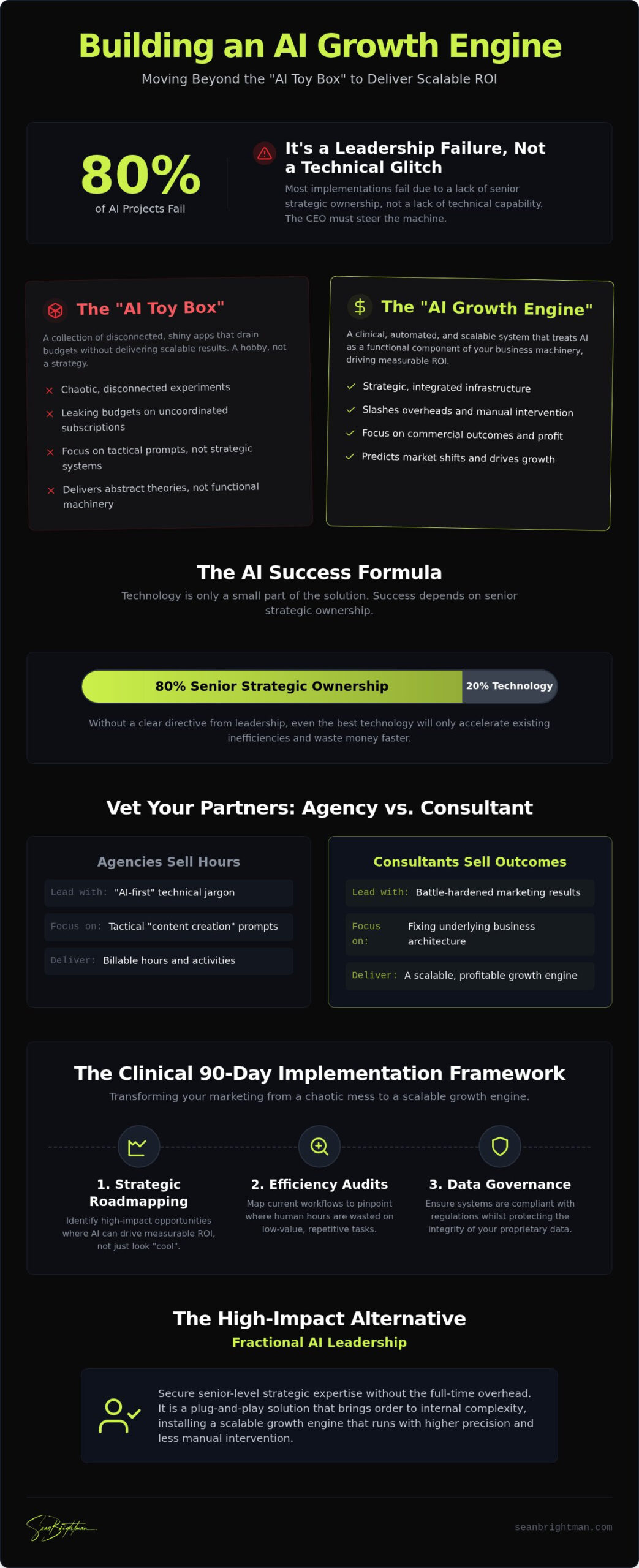
    Eighty per cent of AI projects fail. This isn’t a technical glitch; it’s a leadership failure. Most CEOs are currently building “toy boxes” full of shiny apps rather than actual growth engines. You’ve likely felt the tool fatigue already. Your marketing department is a mess of disconnected prompts and your budget is leaking into experiments that don’t scale. You’re paying for ai consulting services that deliver abstract theories instead of functional machinery.

    It’s time to stop playing with tools and start building a scalable, AI-powered system that delivers actual ROI. You need a strategist, not a coder. This guide provides the blueprint to move from chaotic experiments to a clinical, automated growth engine that runs without you. We will break down the 2026 roadmap for fractional leadership, the shift towards agentic AI workflows, and how to slash overheads whilst your competitors are still stuck in the “prompt engineering” phase. We’re building a system, not a hobby.

    Key Takeaways

    • Stop collecting apps and start building infrastructure. Strategic AI integration prioritises functional systems over shiny new chatbots.
    • Senior leadership is the variable that determines success. Most implementations fail because they lack strategic ownership rather than technical capability.
    • Vet your partners based on marketing results, not technical jargon. Avoid firms that lead with “AI-first” but lack the battle-hardened experience to drive actual growth.
    • Deploy a clinical 90-day roadmap to transform your marketing department. Professional ai consulting services should audit your current mess and install a scalable growth engine.
    • Opt for fractional AI leadership to secure senior-level expertise without the full-time overhead. It is a plug-and-play solution that brings order to internal complexity.

    What are AI Consulting Services in 2026? Beyond the Chatbot Hype

    In 2026, the UK market is flooded with “AI experts” who are little more than prompt engineers in expensive suits. Real ai consulting services aren’t about teaching your team how to use a chatbot. They are about the strategic integration of intelligence into every gear of your business machinery. Think of it as the difference between buying a bag of random car parts and commissioning a high-performance engine. One is a technical capability; the other is a commercial outcome.

    Effective ai consulting services replace chaotic experimentation with clinical systems. Most CEOs are currently suffering from “toy box” syndrome. They have a collection of shiny apps that don’t talk to each other and don’t drive revenue. A strategy-first approach ignores the hype and focuses on the architecture. It treats Artificial intelligence as a functional component of your growth engine, not a magic wand. Ultimately, AI consulting is the bridge between raw technology and business profit.

    The Evolution of AI Advisory

    The phase of “let’s see what this does” is over. For serious UK businesses, experimentation has been replaced by the need for scalable growth engines. In 2021, you might have automated a few emails. In 2026, you’re using predictive engines to anticipate market shifts before they happen. This requires senior leadership. If the CEO isn’t steering the AI, the technology is just accelerating your existing inefficiencies. The “AI toy box” is a distraction; a growth engine is an asset.

    Core Components of Modern AI Consulting

    Professional advisory isn’t a vague chat over coffee. It is a clinical process designed to find the hidden profit in your current mess. It involves stripping away the fluff and installing components that actually move the needle. A modern framework focuses on three pillars:

    • Strategic Roadmapping: Identifying the high-impact opportunities where AI can actually drive ROI, rather than just looking “cool.”
    • Operational Efficiency Audits: Mapping your current marketing workflows to see where human hours are being wasted on low-value tasks.
    • Data Governance: Ensuring your systems are compliant with evolving regulations whilst maintaining the integrity of your proprietary data.

    This isn’t about adding more work to your plate. It’s about building a system that runs with less manual intervention and higher precision. You aren’t hiring a coder to build an app; you’re hiring a strategist to build a business that scales without you.

    The Strategic Gap: Why Most AI Implementations Fail

    Between 70% and 90% of enterprise AI projects fail to deliver their intended value. This isn’t a technical glitch or a coding error. It is a leadership vacuum. When you outsource your intelligence to a junior team or an external agency without a clear directive, you get a “toy box” of expensive gadgets rather than a commercial result. Professional ai consulting services recognise that technology is only 20% of the solution; the rest is senior strategic ownership. If the CEO isn’t steering the machine, the machine is just wasting money at a faster rate.

    CEOs are currently drowning in tool fatigue. Your marketing department is likely a bloated mess of disconnected subscriptions that don’t communicate with each other. This is the “plug-and-play” myth in action. True integration is mechanical. It requires stripping the engine down and rebuilding it around a central logic. An agency will happily bill you for “content creation” prompts. A consultant will tell you why your current process is broken and how to fix the underlying architecture. Agencies sell hours; consultants sell outcomes.

    The “Toy Box” vs. The “Growth Engine”

    Many UK businesses waste thousands of pounds every month on uncoordinated AI subscriptions. They have one tool for copy, another for images, and a third for data analysis, yet nothing is integrated. This is a hobby, not a business strategy. To survive 2026, you must stop playing with apps and start building a scalable growth engine. Whilst global initiatives like the National Artificial Intelligence Initiative focus on macro-level strategy, your focus must be on the micro-level architecture of your marketing operations. Professional ai consulting services move you from tactical prompts to strategic systems that protect your margins.

    Overcoming Internal Resistance

    Your staff are likely terrified. They see AI as a replacement for their livelihoods rather than an augmentation of their skills. This fear creates friction that can stall even the best implementation. You cannot install a high-performance system if your team is quietly sabotaging the gears. Overcoming this requires a culture of AI-powered accountability. They need to see that the machine handles the drudgery so they can handle the strategy. Before you buy a single new tool, you must establish a Marketing Strategy Roadmap. This provides the clarity your team needs to stop worrying about displacement and start focusing on high-value output.

    If you are tired of the fluff and ready for a clinical audit of your operations, it might be time for a Fractional CMO roadmapping session to identify your specific gaps.

    Evaluating AI Consulting Firms: Strategy Amongst the Fluff

    Most “AI consultants” are simply tech enthusiasts with a subscription and a LinkedIn premium account. They lead with tools because they don’t understand business. Choosing the right ai consulting services requires you to look past the technical jargon and focus on commercial experience. If a consultant cannot explain how their implementation protects your gross margin or shortens your sales cycle, they are a hobbyist, not a strategist. You need someone who understands Building an AI Business Strategy, not just someone who can write a clever prompt.

    A massive red flag is the “AI-first” agency with zero marketing background. These firms often suggest “60+ use cases” for AI in your business. This is a recipe for chaos. A battle-hardened expert knows that 57 of those use cases are distractions. You only need the three that drive revenue and lower overheads. This is why a Fractional CMO who owns the AI strategy is often more valuable than a dedicated technical firm. They prioritise brand positioning and customer behaviour whilst using AI as the mechanical lever to scale those efforts.

    Corporate Giants vs. Strategic Partners

    The “Big Four” firms offer safety and massive reports, but they move at a glacial pace. You’ll pay for a 200-page slide deck that is obsolete by the time it’s delivered. Boutique ai consulting services provide direct access to senior minds and rapid, clinical implementation. For a UK scale-up, the choice is clear. You don’t need a corporate safety net; you need a strategic partner who isn’t afraid to be blunt about your current inefficiencies and fix them in weeks, not years.

    The Interview Checklist for CEOs

    When interviewing potential partners, ignore their tech stack. Focus on their operational logic. Ask these questions to separate the theorists from the practitioners:

    • “How does this system integrate with our existing CRM without creating more manual data entry?”
    • “What is the projected ROI over the first 90 days, and how do we measure it?”
    • “Can you show me a growth engine you’ve built that runs without the founder’s daily input?”

    The wrong first question is “What tools do you use?” The right question is “How will this change our unit economics?” If they start talking about specific apps before they’ve audited your workflow, end the meeting. They are trying to sell you a tool, not a solution. You are looking for a architect who can design the machinery of your future growth.
    AI Consulting Services: A CEO’s Guide to Building Growth Engines in 2026

    The AI Roadmap: A 90-Day Implementation Framework

    Strategic transformation doesn’t happen by accident. It happens through clinical execution. Most ai consulting services fail because they lack a structured delivery model. You don’t need a year-long project plan; you need a 90-day sprint to replace manual friction with automated precision. This framework is designed to strip away the “toy box” mentality and install a functional growth engine that delivers measurable ROI. We move from audit to advisory in three distinct phases.

    Step 1: The 30-Day Audit

    The first month is about finding the hidden profit in your current mess. We map every marketing workflow to identify where your team is wasting hours on low-value drudgery. This isn’t a vague observation; it’s a mechanical teardown of your operations. We evaluate your existing tech stack for redundancy, often finding that businesses are paying for multiple subscriptions that perform the same task. By setting a baseline for AI-driven ROI early, we ensure every subsequent move is commercially justified. You aren’t just buying tech; you’re buying back time.

    Step 2: Building the Engine

    Once the audit is complete, we move into the AI implementation for marketing phase. This is the architectural design of your future growth. We integrate Large Language Models (LLMs) into your lead generation and customer journeys to create a seamless, automated experience. This involves developing custom GPTs or internal intelligence hubs that store your brand’s unique logic. Crucially, every output must align with strategic brand roadmapping. If the AI doesn’t sound like your brand, it’s a liability, not an asset.

    The final phases focus on tactical execution and ongoing advisory. We deploy high-impact tools with clear KPIs, ensuring your team knows exactly what success looks like in a post-AI landscape. This isn’t a “set and forget” solution. It requires iterative growth and senior-level accountability to ensure the system remains efficient as the market shifts. You need a partner who stays in the trenches with you, adjusting the gears as your business scales and the technology evolves. We don’t just hand over a manual; we manage the machine.

    If you’re ready to stop the budget leak and start building, book a Fractional CMO roadmapping session to begin your 30-day audit.

    Fractional AI Leadership: The High-Impact Alternative

    Hiring a full-time AI Director in 2026 is a commercial mistake for most UK scale-ups. You will likely pay upwards of £150,000 per year plus benefits for a role that might be obsolete in twenty-four months. This is the old way of thinking. High-impact ai consulting services now operate on a fractional basis. It is a plug-and-play model. You get senior-level strategic authority without the deadweight of a permanent executive salary. It is about precision, not presence. You are buying an outcome, not an employee.

    A fractional consultant acts as an external force for internal order. Your team is busy with the daily grind and lacks the headspace to re-engineer their own workflows. They need a strategist to step in, identify the bottlenecks, and enforce the new architecture. The Advisory Retainer is the ultimate accountability tool. It ensures the strategy doesn’t just sit in a slide deck. It ensures the engine actually gets built and remains efficient as the technology shifts.

    Why Fractional Leadership Wins in 2026

    Speed is the only currency that matters in a post-AI market. Fractional leadership allows you to fix the engine whilst it is running. You aren’t waiting for a six-month recruitment cycle or a three-month notice period. You get immediate access to battle-hardened expertise. This model focuses on strategic direction and team accountability. It is about moving the needle now, not eventually. You pay for results, not hours spent in meetings. It is a lean, clinical approach to business growth that scales with your needs.

    Getting Started with Sean Brightman

    Transformation doesn’t require a leap of faith. It starts with a one-off Roadmapping session. This is a low-risk entry point designed to audit your current mess and provide a clinical plan for ai consulting services. From there, the advisory retainer ensures the strategy actually sticks. You get direct, blunt honesty. I will tell you what you need to hear, not what you want to hear. If your current marketing operations are a bloated liability, we strip them back. If your team is resisting the shift, we address it. Order from chaos. Precision over fluff. Let’s build your growth engine.

    Stop Collecting Tools and Start Building Assets

    The “toy box” phase of AI is over. Successful UK scale-ups in 2026 don’t win by having the most apps; they win by having the most efficient machinery. You’ve seen why senior-level strategy is the only variable that prevents implementation failure. You know that a 90-day roadmap is the difference between a budget leak and a scalable asset. Professional ai consulting services should deliver order, not just more options.

    It’s time to move from tactical prompts to a clinical growth engine that runs without your daily input. As a Fractional CMO and author of “The Book” on marketing strategy, I specialise in building profit-driven systems for leaders who have no patience for bureaucracy. We strip away the fluff and install the components that actually drive revenue. We build engines, not hobbies.

    Don’t let your marketing operations remain a chaotic liability whilst your competitors automate their advantage. Book your AI Roadmapping session with Sean Brightman today and start building a system that scales. The future belongs to the architects, not the experimenters. Let’s get to work.

    Frequently Asked Questions

    What exactly do AI consulting services include for small to medium businesses?

    ai consulting services for SMEs focus on identifying high-impact automation opportunities and building custom internal intelligence hubs. It includes a clinical audit of your current marketing tech stack to eliminate redundancy. Instead of just suggesting tools, a consultant designs a bespoke architecture that connects your CRM, content production, and lead generation into a single, automated growth engine. It is about building functional machinery, not just offering advice.

    How much should a UK scale-up expect to pay for AI consulting?

    UK scale-ups can expect a wide range of pricing depending on the firm’s seniority. Boutique firms often charge between £150 and £300 per hour, whilst comprehensive diagnostic assessments can range from £8,000 to £20,000. Monthly retainers for fractional leadership usually fall between £2,000 and £7,000 depending on the complexity of the implementation. You are paying for strategic velocity and the avoidance of expensive project failures.

    What is the typical ROI timeframe for an AI marketing implementation?

    You should expect to see measurable efficiency gains within the first 30 to 60 days. This typically manifests as a significant reduction in manual human hours spent on drudgery like data entry or first-draft content creation. Full commercial ROI, including lower customer acquisition costs and higher lead conversion rates, usually takes 90 to 180 days as the system gathers data and the automated growth engine begins to reach peak performance.

    Do I need to hire an AI specialist internally if I have a consultant?

    No, you don’t need to hire a full-time specialist if your consultant builds the system correctly. The goal of professional ai consulting services is to create a “plug-and-play” infrastructure that your current marketing team can operate. A consultant provides the senior-level architecture and oversight, whilst your internal staff focus on high-value strategic output. This prevents the £150,000+ overhead of a permanent AI Director.

    Can AI consulting help with brand positioning or just automation?

    AI consulting is a powerful tool for brand positioning. Beyond simple automation, consultants use predictive engines and sentiment analysis to identify exactly where your brand sits in the market. This data allows you to refine your messaging with clinical precision. Automation then ensures that this refined positioning is deployed consistently across every touchpoint in the customer journey, from initial ad copy to long-form nurturing sequences.

    What is the difference between an AI agency and an AI consultant?

    An AI agency usually sells execution and billable hours for specific tasks like prompt engineering or video generation. An AI consultant sells strategy, architecture, and commercial outcomes. Agencies focus on doing the work; consultants focus on building the system so the work happens automatically. You hire an agency when you need a pair of hands; you hire a consultant when you need a brain to design the machine.

    How long does it take to see results from an AI marketing roadmap?

    You get immediate clarity from the moment the roadmapping session concludes. You will have a clinical list of exactly what is broken and how to fix it. Physical results, such as automated lead nurturing or predictive analytics, typically take 90 days to fully integrate and test. This timeframe ensures the system is robust, compliant with UK regulations, and aligned with your proprietary brand voice before it goes live.

    Is AI consulting suitable for B2B companies with long sales cycles?

    It is arguably more critical for B2B firms with long sales cycles. AI consulting helps these businesses implement sophisticated lead scoring and automated “always-on” nurturing sequences that stay in front of prospects for months without human intervention. This ensures no lead is dropped during a six-month decision process. It turns a manual, leaky sales funnel into a precise, automated pipeline that prioritises high-value accounts.

  • AI Consulting in 2026: From Tool Fatigue to Scalable Growth Engines

    AI Consulting in 2026: From Tool Fatigue to Scalable Growth Engines

    Your marketing team is likely wasting hours every week coaxing GPT-5.6 Sol to polish emails that were already good enough. It’s not strategic innovation. It’s just digital busywork. You’re feeling the weight of tool fatigue whilst your competitors claim to be “AI-first” without showing any real margin improvement. You’ve invested in the latest models but lack the senior ai consulting expertise to turn those subscriptions into a cohesive strategy. It’s a common trap. Most businesses are collecting shiny toys instead of building actual machinery.

    The solution isn’t another subscription. It’s a fundamental shift in how you approach your growth strategy. You need to stop playing with chatbots and start engineering a growth engine that scales. This article promises to move you past the hype. You’ll discover how to transition from fragmented experiments to a unified, intelligence-led system that delivers predictable results.

    We’ll outline a clear marketing roadmap that prioritises systems over software. We’ll examine how to organise your data, automate your workflows, and finally get the ROI your board expects. It’s time to trade the guesswork for tactical precision.

    Key Takeaways

    • Stop treating LLMs like toys and start viewing them as functional components of a high-performance growth engine.
    • Understand that effective ai consulting is a systems-engineering task that redefines how your business captures and converts demand.
    • Identify the critical difference between a tool integrator and a strategic consultant who prioritises your P&L and long-term brand equity.
    • Discover a two-step roadmapping process that audits operational waste and ensures AI never dilutes your unique market positioning.
    • See why the Fractional CMO model delivers senior-level strategy to navigate the 2026 landscape without the overhead of a full-time hire.

    The AI Consulting Trap: Why Most Businesses Are Playing with Toys, Not Tools

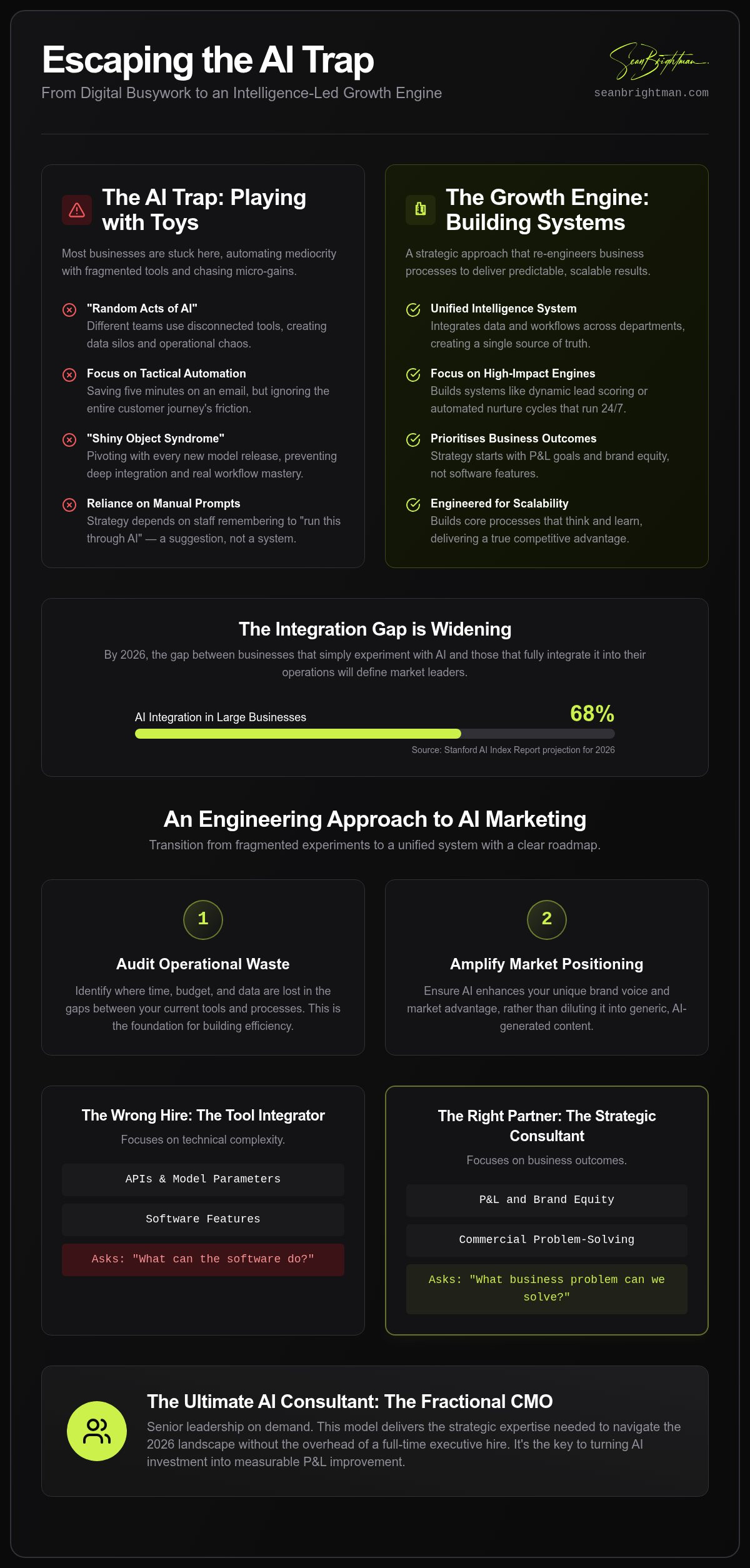
    Most businesses are currently trapped in the “Chatbot Fallacy”. They believe that giving every employee a ChatGPT Plus account constitutes a digital transformation. It doesn’t. It’s just automating mediocrity. True ai consulting isn’t about teaching your team to talk to robots; it’s about re-engineering the machinery of your business so the robots do the heavy lifting without being asked. If your strategy relies on staff rememberring to “run this through the AI,” you don’t have a system. You have a suggestion. You’re playing with toys whilst your competitors build engines.

    The broad field of Artificial intelligence (AI) covers much more than text generation, yet most firms remain stuck in the shallow end. They’re chasing tactical automation. They want to save five minutes on an email or three minutes on a social post. These are micro-gains. Strategic intelligence, however, looks at the entire customer journey and asks where the friction is. It’s about movement, not just speed. It’s about building a system that learns from every interaction to drive predictable growth.

    This is why your first AI hire shouldn’t be a prompt engineer. Hiring a prompt engineer before you have a strategy is like hiring a typist before you’ve decided what the book is about. You need a strategist who understands the P&L. You need someone who can see the mechanical integration between your data and your bottom line. Anything else is just expensive tinkering.

    The High Cost of Random AI Acts

    Fragmented systems are the silent killer of productivity. Many companies suffer from “Random AI Acts” where different departments buy different tools without a central roadmap. One team uses a tool for copy. Another uses a different one for images. A third uses a niche tool for data analysis. None of these tools talk to each other. This doesn’t create efficiency; it creates a fragmented mess that requires more human oversight, not less.

    The hidden costs are staggering. You’re paying for multiple subscriptions that overlap. You’re losing data in the gaps between platforms. Most importantly, you’re suffering from “Shiny Object Syndrome” in the C-suite. Every new model release triggers a pivot. This constant shifting prevents any single tool from being properly integrated into your workflow. You end up managing the tools instead of the growth.

    Strategic Clarity vs. Technical Complexity

    Effective ai consulting prioritises business outcomes over software features. It’s easy to get lost in the technical weeds of APIs and model parameters. None of that matters if it doesn’t solve a commercial problem. A real strategy starts with your existing brand positioning. It asks how machine intelligence can amplify what makes you unique, rather than diluting your voice into a generic, AI-generated soup.

    You must distinguish between “Low-Hanging Fruit” and “High-Impact Engines”. Generating a blog post is low-hanging fruit; it’s easy, but it rarely moves the needle. A high-impact engine is a dynamic lead-scoring system or an automated customer-nurture cycle that runs 24/7. These engines require strategic clarity, not just technical complexity. They are the functional components that turn a chaotic business into a scalable growth machine. Understanding the hard architecture behind AI implementation for marketing is what separates businesses that scale from those that stagnate.

    What is AI Consulting? Engineering the Intelligence-Led Growth Engine

    AI consulting is not a software selection service. It is the strategic re-engineering of your business systems to leverage machine intelligence as a core utility. Think of it as plumbing, not painting. You aren’t just adding a layer of tech on top of a broken process; you’re rebuilding the process itself. This is the difference between “doing AI” and being truly AI-powered. One is a distraction. The other is a competitive advantage. It’s about building systems that think, not just tools that talk.

    Building a growth engine requires more than a subscription to GPT-5.6 Sol. It requires a fundamental shift in how you move prospects through the customer journey. According to Stanford’s AI Index report, the gap between companies that experiment and those that integrate is widening. In 2026, 68% of large businesses have already integrated AI analytics for operational decision-making. If you’re still in the experimentation phase, you’re falling behind the curve. You’re bringing a knife to a drone fight.

    The modern strategy rests on three pillars: Data, Process, and People. Data is your fuel. Process is your engine. People are your pilots. If any pillar is weak, the system fails. A strategic advisor doesn’t just give you a list of tools; they build the framework that makes those tools work together. If you’re ready to stop guessing, building a strategic roadmap is the first step toward actual scale.

    The Anatomy of an AI-Powered System

    A functional ai consulting engagement focuses on the mechanics of your operations. It starts with data ingestion. This means turning messy, siloed inputs into clean, strategic assets. If your data is garbage, your AI output will be expensive garbage. Next is process automation. We remove human friction from repetitive tasks whilst maintaining brand quality. Finally, we focus on output optimisation. We use intelligence to scale creative and analytical tasks. It’s about doing more of what works, faster and with surgical precision.

    The Role of the Strategic AI Advisor

    A consultant provides accountability. They ensure the technology serves the business goal, not the other way around. With the current landscape of regulatory fragmentation across states like California and Colorado, risk management is no longer optional. You need a partner who understands the legal complexities and the ethical guardrails required to protect your brand equity. Education is the final piece. Your team needs to be upskilled to work alongside the machine, not in fear of it. Expertise is the only antidote to obsolescence. We build the system, then we teach you how to drive it.

    Consultant vs. Integrator: Who Actually Owns Your AI Strategy?

    You don’t hire a plumber to design your house. You don’t hire an architect to fix a leaky tap. The same logic applies to your AI transition. Many businesses are currently hiring “plumbers” when they actually need “architects.” They’re paying for technical connectivity whilst their commercial strategy remains fundamentally broken. This is the distinction between an integrator and a consultant. One builds the pipes; the other decides where the water should flow to maximise your P&L.

    The Integrator is focused on the “how.” They are experts in connecting APIs, configuring webhooks, and ensuring your tech stack doesn’t collapse under its own weight. Their success is measured in uptime and data flow. If the tools are talking to each other, they’ve done their job. But technical connectivity is not a growth strategy. You can have the most sophisticated API integration in the world and still be burning cash on a marketing message that no longer resonates.

    The Consultant is focused on the “why.” They own the outcome, not just the implementation. Strategic ai consulting prioritises long-term brand equity and predictable growth engines over mere automation. They ask the hard questions about your positioning, your margins, and your market share. They don’t just connect tools; they engineer systems that drive revenue. If your AI implementation isn’t directly reflected in your bottom line, you haven’t hired a consultant. You’ve just bought a very expensive set of pipes.

    When to Hire a Technical Integrator

    You hire an integrator when your roadmap is already set in stone. You have a clear strategy, your brand voice is locked, and you know exactly which processes need automation. You simply lack the “plumbing” skills to build the bridge between GPT-5.6 Sol and your CRM. Success here is binary. The system works, or it doesn’t. It’s about narrow, specific tasks where “connectivity” is the primary KPI. If your internal team already knows the destination, the integrator provides the vehicle.

    When You Need Strategic AI Consulting

    You need ai consulting when your marketing feels “stuck” despite your growing list of subscriptions. If you’re suffering from tool fatigue and can’t see the path to ROI, you need a strategist, not a coder. This is for leaders who require senior-level accountability for growth metrics. You need someone to ensure AI doesn’t dilute your brand into a generic mess. You need a partner who understands that AI is a component of a Fractional CMO’s toolkit, designed to amplify your competitive advantage, not just save five minutes on a spreadsheet.

    Technical setup without strategic direction is a recipe for expensive failure. Choose your partner based on your current scale and your ultimate goal. If you want to fix a leak, hire an integrator. If you want to build a growth engine, hire a consultant. CEOs who are serious about this transition should explore structured ai consulting services designed specifically to move businesses from chaotic experimentation to scalable, automated growth engines.

    AI Consulting in 2026: From Tool Fatigue to Scalable Growth Engines

    The AI Marketing Roadmap: Engineering Efficiency into Every Process

    Strategy without a roadmap is just a wish list. To move from tool fatigue to scalable growth, you need a blueprint that defines exactly how machine intelligence integrates with your commercial goals. This isn’t about buying software. It’s about engineering a system. A professional ai consulting engagement delivers a structured path to ROI through five critical stages:

    • Step 1: The Audit. We identify where your team is burning hours on manual labour. We look for the friction in your current workflow. If a task is repetitive and rules-based, it’s a candidate for automation.
    • Step 2: Positioning. We ensure AI doesn’t dilute your brand voice. Generic output is a death sentence for brand equity. We build guardrails to keep your messaging sharp and distinct.
    • Step 3: Infrastructure. We select the “Growth Stack” that scales with you. This is about connectivity and data portability, not just shiny interfaces.
    • Step 4: Pilot. We test high-impact engines in a controlled environment. We prove the concept before we bet the house.
    • Step 5: Scale. We roll out intelligence across the entire department. This is where tactical wins become a permanent competitive advantage.

    Most businesses fail because they skip to Step 5. They try to scale chaos. A roadmap brings order to that complexity. It turns fragmented experiments into a unified growth engine. If you’re ready to stop guessing and start building, book your AI roadmapping session today.

    Building Your Growth Stack for 2026

    Your stack should be a machine, not a toy box. In 2026, “Best-of-Breed” tools often beat all-in-one platforms because they offer superior depth in specific functions. The key is ensuring seamless data portability between your CRM and your AI engines. If your data can’t move, your business can’t grow. You need a modular system that allows you to swap components as the technology evolves. Effective strategic brand roadmapping ensures your entire growth stack is built around commercial architecture rather than fragmented tool selection. For a deeper dive into this framework, read The 2026 AI Marketing Roadmap: Build a Growth Engine, Not a Toy Box.

    Maintenance and Evolution

    An AI roadmap is a living document. It is not a one-off report that sits in a drawer. The technology moves too fast for static strategies. This is why ai consulting often transitions into an Advisory Retainer. Ongoing optimisation ensures your systems stay ahead of the “Commoditisation of AI.” When everyone has access to the same models, your advantage lies in how you configure and maintain your unique growth engine. We don’t just build the machine; we help you tune it for maximum performance.

    Senior Leadership on Demand: Why the Fractional CMO is the Ultimate AI Consultant

    Hiring a full-time “Head of AI” in 2026 is a tactical error. By the time you’ve finished the six-month recruitment cycle and cleared the HR hurdles, the technology has already evolved. You’re left with a high-salary executive who is wedded to last year’s models. In a rapidly shifting landscape, you don’t need a permanent seat at the table. You need senior-level strategy that can pivot at the speed of the market. This is where ai consulting meets fractional leadership. You get the P&L ownership of a CMO with the technical precision of an AI strategist.

    A Fractional CMO provides the senior strategy you need without the £150k+ overhead of a full-time hire. This isn’t just about saving money; it’s about buying velocity. You’re hiring a battle-hardened expert who has already built growth engines for other brands. They don’t need a three-month “onboarding” period to understand your goals. They plug in, audit your systems, and start engineering. It’s about results, not residency. You get the machinery of high-level marketing leadership delivered as a functional service.

    Integrating ai consulting into a broader leadership role ensures that technology never exists in a vacuum. A specialist consultant might fix your prompts, but a Fractional CMO fixes your business. They ensure that every automated workflow and every data-led insight is directly tied to your commercial objectives. It’s the difference between a technical project and a growth strategy. One is a cost centre. The other is a revenue driver.

    Leadership Without the Bureaucracy

    The fractional model is “plug-and-play” by design. You bypass the internal politics and the administrative bloat that usually accompanies senior hires. A Fractional CMO focuses on two things: execution and accountability. They are there to solve the problem, build the system, and move the needle. This lean approach is the only way to stay agile whilst the AI landscape continues to fragment. For a deeper look at why the traditional model is failing, read Stop Hiring Full-Time CMOs: The Fractional Revolution in 2026.

    Your Next Steps to AI Integration

    You don’t need to commit to a massive transformation project on day one. The lowest-risk entry point is a structured Roadmapping session. This identifies the immediate “leaks” in your marketing machinery and outlines the path to a scalable growth engine. From there, many businesses transition to an Advisory Retainer to maintain long-term velocity. This ensures your roadmap stays current as new models like GPT-5.6 Sol emerge. If you’re comparing your options, check out The Best AI Consulting Firms in 2026: A CEO’s Guide to Strategy, Not Fluff. Stop playing with toys. Start building your engine.

    Stop Playing with Toys. Build Your Engine.

    The window for experimentation is closing. By 2026, the market has split into those who use AI to save five minutes and those who use it to capture entire markets. You’ve seen the difference between a technical integrator and a strategic partner. One fixes your pipes; the other engineers your growth. Effective ai consulting is the pivot point between tool fatigue and a scalable, intelligence-led engine.

    Stop chasing the next model release and start building a system that lasts. You need senior-level accountability without the bloated overhead of a full-time hire. As a Fractional CMO and author of “The Book” on marketing strategy, I specialise in turning chaotic tech stacks into high-performance machinery. We don’t do fluff. We do strategy-led integration that shows up on your P&L.

    It’s time to trade your toy box for a growth engine. The first step is clarity. Start your transformation today.

    Book an AI Roadmapping Session with Sean Brightman

    Let’s get to work.

    Frequently Asked Questions

    What is the difference between AI consulting and a software implementation partner?

    Consulting focuses on the commercial outcome whilst implementation focuses on the technical connection. An implementation partner builds the pipes between your tools. An ai consulting strategist decides where those pipes should lead to maximise your revenue. One is about technical uptime; the other is about P&L growth and long-term brand equity. You need a navigator before you hire a mechanic.

    How much does AI consulting typically cost for a UK scale-up?

    Costs vary based on the complexity of your systems and the depth of the engagement. Most strategic partners offer a fixed-fee Roadmapping session to define the strategy before moving to an Advisory Retainer. This approach ensures you aren’t billing for endless hours but investing in specific, high-impact growth engines. It is about the value of the machinery built, not the time spent building it.

    Does my business need to be “tech-heavy” to benefit from AI consulting?

    No. In fact, non-technical businesses often see the most significant gains from ai consulting because they have the most manual friction to remove. If you have a customer journey and a list of leads, you have a growth engine that can be optimised. We take the technical complexity off your plate so you can focus on running the business.

    How long does it take to see a real ROI from AI integration?

    Real commercial ROI typically manifests within three to six months. Initial efficiency gains happen quickly as we automate repetitive tasks. However, the strategic growth—like improved lead scoring or automated nurture cycles—requires time to gather data and tune the engine. We build for compounding returns that increase as the system learns your market behaviour.

    Can an AI consultant help with brand positioning and creative strategy?

    Yes. AI is an amplifier for your existing brand, not a replacement for it. A strategic consultant ensures your unique positioning is baked into every model’s instructions. We use machine intelligence to sharpen your value proposition and scale your creative output without diluting your voice. It ensures you sound like a market leader, not a generic algorithm.

    What happens if we already have an internal marketing team but no AI expert?

    This is the ideal scenario for fractional leadership. We don’t replace your team; we upskill them. We provide the senior strategy and the technical roadmap they need to execute at a higher level. Your team knows your business; we know how to integrate the intelligence that makes them faster and more effective. It is a partnership, not a replacement.

    Is AI consulting a one-off project or an ongoing service?

    It usually starts as a project and evolves into a retainer. A Roadmapping session defines the initial strategy and identifies the “leaks” in your system. Once the engine is built, an Advisory Retainer ensures it stays optimised as technology shifts. The goal is long-term velocity. You need a partner who keeps your machinery ahead of the competition.

    How do you ensure AI-generated content doesn’t hurt our SEO or brand?

    We use human-in-the-loop systems and strict brand guardrails to protect your equity. We build quality assurance layers where machine output is vetted against your specific standards before it ever reaches a customer. This prevents the generic “AI-slop” that triggers search engine penalties. For businesses serious about getting AI implementation for marketing right, brand integrity must be engineered into the system from day one, not bolted on as an afterthought. We prioritise brand integrity over raw volume every single time.

  • The Best AI Consulting Firms in 2026: A CEO’s Guide to Strategy, Not Fluff

    The Best AI Consulting Firms in 2026: A CEO’s Guide to Strategy, Not Fluff

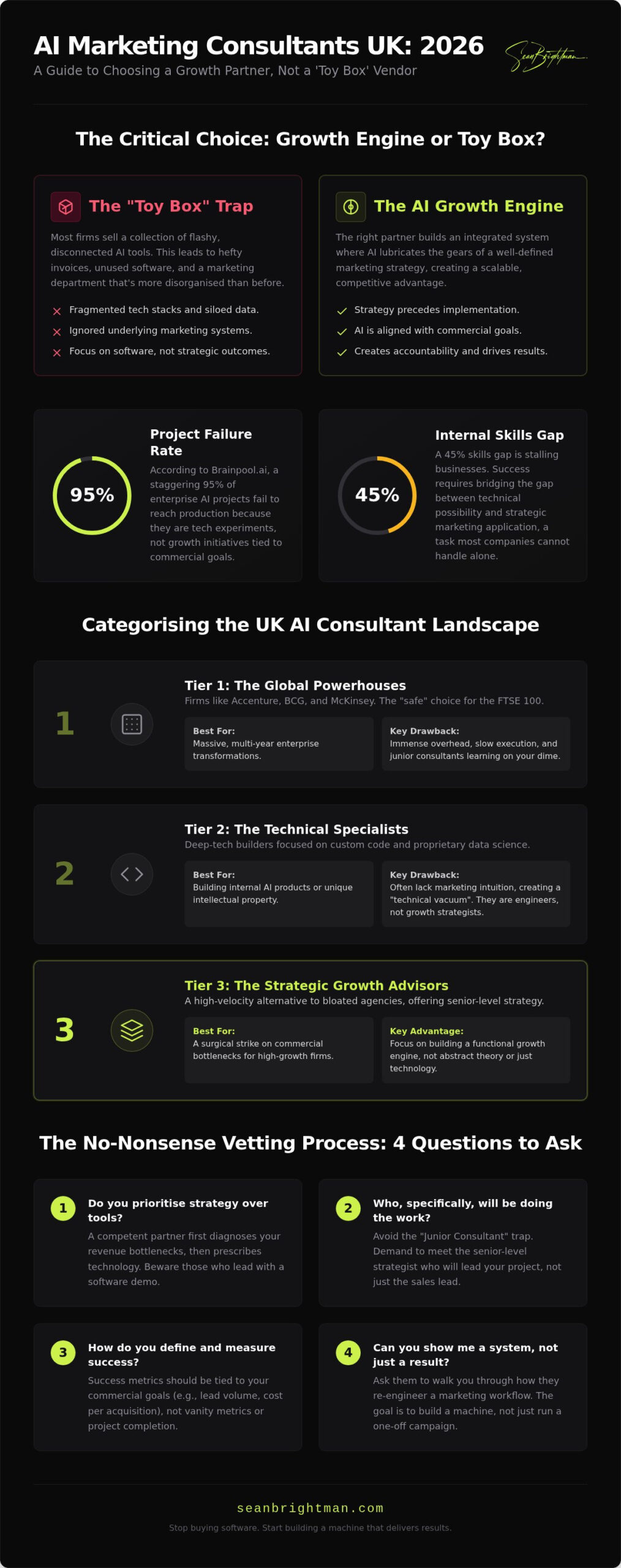
    Most AI implementations in 2026 are nothing more than expensive paperweights. You’ve likely seen the cycle: a hefty invoice from a flashy agency, a library of “toy box” tools nobody uses, and a marketing department that’s more disorganised than when you started. Finding a competent ai marketing consultant uk isn’t about hiring someone who can recite the latest LLM specs. It’s about finding a partner who understands that AI is a strategy problem, not a technical one.

    You want systems that run without constant hand-holding and a roadmap that actually scales. We agree that the corporate noise is deafening. This guide identifies the firms that build functional growth engines instead of abstract theories. We’ll show you how to vet for accountability, navigate the 2026 UK regulatory shifts, and bridge the 45% skills gap that’s currently stalling your competitors. It’s time to stop buying software and start building a machine that delivers results.

    Key Takeaways

    • Identify the “toy box” trap where firms sell flashy AI tools whilst ignoring the underlying marketing systems required for growth.
    • Navigate the 2026 landscape to find an ai marketing consultant uk focused on building high-impact engines rather than abstract theories.
    • Avoid the “Junior Consultant” trap by using a no-nonsense vetting process that demands senior-level strategy over empty software demos.
    • Discover why a strategic advisory retainer offers a surgical, high-velocity alternative to the bloated overhead of traditional agencies.

    Why Most AI Consulting Firms Sell You a Toy Box, Not a Growth Engine

    AI consulting in 2026 is a minefield of shiny objects. Most firms arrive with a suitcase full of “toy box” tools, ChatGPT wrappers, and flashy dashboards. They sell you the sizzle of automation whilst ignoring the steak of your underlying marketing system. It’s an expensive trap. You end up with shelfware; costly, sophisticated software that your team doesn’t use and your customers don’t care about. If you are looking for an ai marketing consultant uk, you must distinguish between those who sell software and those who build systems.

    The difference is binary. You are either “doing AI” or you are building an AI-powered growth engine. One is a hobby; the other is a competitive advantage. If your marketing department is currently a mess of fragmented data and manual workarounds, an algorithm won’t fix it. It will simply accelerate the chaos. You need a strategist to lead the machine, not just an integrator to plug it in. This is a business-critical decision, not a procurement checkbox.

    The Problem with Tool-First Consulting

    Tools are tactical. Growth is strategic. Many businesses rush to implement the latest generative models without asking if those models solve a specific revenue bottleneck. This tool-first approach creates a fragmented tech stack. Your SEO team uses one tool, your email team uses another, and your data remains siloed. It’s a recipe for inefficiency.

    The hidden cost of this fragmentation is staggering. It isn’t just the subscription fees. It’s the cognitive load on your staff and the dilution of your brand voice. When you prioritise the tool over the system, you lose accountability. You cannot fix a broken marketing department with a prompt. You fix it by re-engineering the workflow and then using AI to lubricate the gears. This is the mechanical reality that most agencies ignore. If you’re experiencing tool fatigue and need a clear path to scalable ai consulting, the answer lies in systems architecture, not more subscriptions.

    Why Strategy Must Precede Implementation

    Strategy defines the “why” before the “how”. Traditional Management consulting often focuses on high-level theory, but in the AI era, strategy must be visceral. Are you aiming for a 2026 exit? Are you looking to scale lead volume by 300% without increasing headcount? These goals dictate the technology, not the other way around.

    Brainpool.ai claims that 95% of enterprise AI projects fail to reach production. From a marketing perspective, these failures happen because the projects aren’t aligned with commercial goals. They are tech experiments, not growth initiatives. A strategic AI marketing roadmap ensures every automation serves your long-term vision. It creates a culture of accountability amongst your team. They stop fearing the technology and start using it to drive the engine. You don’t need more tools. You need a better machine. Understanding the hard architecture behind effective AI implementation for marketing is what separates businesses that scale from those that stall.

    Categorising the Landscape: From Big Four Giants to Specialist AI Integrators

    Size is a distraction. A firm’s prestige isn’t a guarantee of your growth. When searching for an ai marketing consultant uk, you’ll encounter three distinct tiers. Most CEOs choose the wrong one because they mistake headcount for impact. You don’t need a small army; you need a surgical strike. The landscape in 2026 is divided between those who manage bureaucracy and those who build machinery.

    It is a binary choice. Do you want 50 junior consultants filling slide decks, or one battle-hardened expert who knows where to turn the screw? For high-growth firms, the latter is almost always the more profitable route. High-value fees don’t always equate to high-impact marketing output. You must choose the tier that aligns with your specific commercial bottleneck.

    Tier 1: The Global Powerhouses

    Accenture, BCG, and McKinsey are the “safe” choices for the FTSE 100. They excel at massive, multi-year enterprise transformations and global infrastructure. If you need to overhaul a legacy system across 40 countries, they are the right fit. However, their overhead is immense. For mid-market companies, these firms often swallow the marketing ROI before the first automation goes live. You pay for senior partners but often get recent grads learning on your dime. It’s a safe choice that frequently leads to slow execution.

    Tier 2: The Technical Specialists

    Firms like Brainpool focus on deep-tech builds. They live in custom code, machine learning models, and proprietary data science. This is the tier you hire to build an internal AI product or unique IP. The risk here is the “technical vacuum”. These firms often lack marketing intuition. They can build a sophisticated algorithm, but they might lose your brand voice in a sea of technical complexity. They are engineers, not growth strategists. Use them to build the engine, but don’t expect them to know how to win the race.

    Tier 3: The Strategic Growth Advisors

    This is the rise of the Fractional AI Strategist. These advisors are best suited for high-growth UK businesses needing senior marketing leadership without the £200k+ overhead of a full-time hire. They focus on marketing systems, brand positioning, and rapid execution. When vetting this tier, look for frameworks like the AI Guide for Government, which provides a no-nonsense approach to auditing AI initiatives. This tier is about accountability and results. If you need a Fractional CMO to turn your messy marketing department into an AI-powered growth engine, this is your target. It’s high-impact leadership without the agency bloat.

    The Invisible Cost of Bloated AI Firms: Strategy vs. Execution

    High fees are a comfort blanket, not a performance metric. Many CEOs believe that a six-figure invoice from a global firm guarantees a six-figure return. It doesn’t. In the world of AI, you are often paying for the firm’s real estate and partner retreats rather than actual code or strategy. This is the efficiency gap. When you hire an ai marketing consultant uk, you need to know if you are buying their overhead or your growth. It is a binary reality: you either pay for the name or you pay for the result.

    The Junior Consultant trap is the industry’s open secret. You are sold the vision by a senior partner with twenty years of experience. Two weeks later, your account is being managed by a recent graduate who is learning how to use your tech stack on your time. You pay senior rates for junior mistakes. You get the brand name, but you lose the expertise. This isn’t just a waste of budget; it’s a risk to your market position.

    In 2026, speed is the only moat left. Bloated firms are structurally incapable of moving fast. They have layers of approval, internal meetings about meetings, and a process-first mentality that kills momentum. By the time they deliver a formal report, the market has already pivoted. Worse, they rarely own the numbers. If the growth engine stalls, they blame the execution or your internal team. You need a partner who stays in the room until the engine hums, not one who vanishes when the slide deck is finished.

    The Efficiency Gap in Traditional Consulting

    Firms sell hours. Advisors sell outcomes. If a consultancy suggests a massive, multi-tool implementation without a clear ROI path, they are padding the project. They want more billable hours, not a leaner operation. This is why an AI marketing roadmap is vital. It defines the leanest path to profit. It identifies the toy box tools that exist only to inflate the invoice. You want a machine that works, not a tech stack that looks impressive on a slide deck.

    Owning Your Own Growth Engine

    Strategy is your business’s soul. Never outsource it entirely. A third party should guide you, but your internal team must own the controls. The goal of a high-impact advisory is to build your internal capability, not to create a permanent dependency. This is where a marketing operations consultant comes in. They architect the systems and train your people to run them. You get the expertise of a senior leader without the permanent bloat of an agency. It’s about building a scalable engine that functions whilst your competitors are still waiting for their consultant’s next monthly check-in.

    The Best AI Consulting Firms in 2026: A CEO’s Guide to Strategy, Not Fluff

    How to Audit an AI Consulting Firm: The 5-Step No-Nonsense Vetting Process

    Most CEOs get blinded by technical theatre. You see a flashy dashboard and a smooth interface; you assume the strategy is sound. It rarely is. Vetting an ai marketing consultant uk requires looking past the code and into the commercial engine. If you can’t understand their value without a glossary of jargon, they don’t have a strategy; they have a sales pitch. Use this five-step BS detector to ensure you aren’t buying polished shelfware.

    • Step 1: Demand a strategy, not a software demo. If they lead with a screen share of a tool, they are integrators, not advisors. A strategist starts with your P&L, not your API keys.
    • Step 2: Check for senior marketing experience. A data science degree is useful, but it won’t help you win a price war or define a brand’s soul. You need someone who has owned a revenue target, not just a GitHub repository.
    • Step 3: Ask for the Roadmap to ROI. When exactly does this system pay for itself? Demand a timeline. If they can’t link automation to a specific revenue lift or cost reduction by a certain date, walk away.
    • Step 4: Verify the hands-on ratio. Are they building the machine with you, or just sending a weekly PDF of “recommendations”? You need a partner who gets their hands dirty in your workflows.
    • Step 5: Test for brand positioning. AI can generate content at scale, but it can also dilute your brand until it’s unrecognisable. If they don’t understand your unique voice, they’ll automate you into mediocrity.

    If you’re tired of technical fluff and want to see a functional blueprint for your business, book an AI strategy audit here.

    Red Flags to Watch Out For

    Watch out for vague promises about “efficiency” or “synergy” that lack concrete marketing metrics. If a firm refuses to discuss the fractional cmo alternative, they are likely protecting a bloated agency model that thrives on your overhead. Another warning sign is an over-reliance on generic, off-the-shelf AI tools. In 2026, differentiation is the only moat. If they are giving you the same prompts as your competitors, they aren’t giving you an edge; they’re giving you a commodity.

    The Right Questions for the C-Suite

    Don’t let the partner sell you and then vanish. Ask who the specific person is leading your strategy day-to-day. You need to know if your growth engine is being built by an expert or a trainee. Ask how the implementation improves customer behaviour insights. AI should make your customers’ next moves more predictable, not just your data more complex. Finally, ask about ownership. What happens to the systems and the custom models if you stop the retainer? You should own the machinery, not rent it.

    Beyond the Firm: Why a Strategic Advisory Retainer Wins in 2026

    Big firms sell you a project. Advisors sell you a partnership. In 2026, the market moves too fast for static reports and quarterly reviews. You need a surgical alternative that prioritises speed and precision. This is where an ai marketing consultant uk provides the highest value. It isn’t about a one-off implementation; it’s about embedding AI into your brand DNA. You don’t need a bloated agency. You need senior expertise that plugs directly into your leadership team and stays there until the machinery hums.

    A marketing advisory retainer is the antidote to the “one-and-done” model. It provides ongoing accountability and ensures that the systems built during the roadmapping phase actually deliver on their promise. You get maximum impact with zero bureaucracy. It’s about movement and machinery, not abstract theory. An advisory retainer offers several distinct advantages for the modern CEO:

    • Direct access to senior leadership without the recruitment lag.
    • Continuous optimisation of your AI marketing roadmap.
    • Ongoing accountability for growth metrics and ROI.
    • Rapid pivoting as new UK regulations or technologies emerge.

    The Fractional Advantage for UK Scale-ups

    Scaling a business in the UK requires senior CMO-level thinking. But hiring a full-time heavyweight is an expensive, slow process that adds unnecessary overhead. The fractional model gives you that same level of strategic depth at a fraction of the cost. We focus on brand positioning and marketing systems that actually scale. We apply AI practically to improve output and marketing efficiency. It’s about building a machine that works without constant hand-holding. You get the strategy; you lose the bureaucracy.

    Creating Your 2026 Growth Engine

    You can move from messy to methodical in 90 days. Most marketing departments are currently a patchwork of manual tasks and disconnected tools. Sean Brightman’s roadmapping sessions strip away the fluff to provide a functional blueprint. We identify the bottlenecks and build the AI-powered solutions to clear them. This isn’t a suggestion; it’s a systems architecture designed for 2026. It turns your marketing from a cost centre into a predictable growth engine.

    Your competitors are likely wasting budget on tools they don’t understand and systems they can’t manage. Don’t join them. The next step is a strategy session to audit your current trajectory and identify the gaps in your AI implementation. Let’s find the growth engine in your business and turn it on. It’s time to stop buying toy boxes and start building for the future.

    Build Your Growth Engine, Not a Toy Box

    AI in 2026 is either a distraction or a force multiplier. It depends entirely on who is holding the map. You can continue sinking budget into disconnected tools that your team ignores, or you can build a methodical, AI-powered growth engine. The choice is binary. High-impact results require senior-level strategy that connects your brand DNA to your technical architecture. You don’t need more software; you need better systems.

    Finding the right ai marketing consultant uk means looking for accountability, not just a flashy pitch. We’ve seen the cost of bloated agencies and junior-led implementations. It’s time to choose the surgical alternative. With fractional CMO expertise and a focus on strategic AI roadmapping, we strip away the noise to deliver systems that actually scale. As the author of ‘The Book’ on marketing strategy, I focus on outcomes, not billable hours.

    Stop guessing and start executing. Your competitors are likely still stuck in the “toy box” phase. This is your window to lead. Build your AI-powered growth engine with Sean Brightman today. Let’s get to work.

    Frequently Asked Questions

    What do AI consulting firms actually do for marketing?

    AI consulting firms re-engineer your marketing machinery to drive revenue. They don’t just hand you a list of prompts. They audit your existing workflows, identify where manual labour is stalling growth, and build automated systems that scale. It’s about building a functional growth engine, not playing with technical toy boxes.

    How much should a UK business spend on AI consulting in 2026?

    Investment levels depend on the complexity of the systems you need to build. A high-impact strategy often starts with a surgical audit to identify the biggest revenue leaks. Avoid firms that focus on billable hours. You should invest in the outcome of a scalable system, not the time it takes a consultant to install it.

    What is the difference between an AI firm and a Fractional CMO?

    The difference is binary: strategy versus execution. An AI firm focuses on building technical components and machine learning models. A Fractional CMO, acting as an ai marketing consultant uk, focuses on the commercial outcome. One builds the engine; the other ensures that engine is pointed at your revenue targets.

    How do I know if my business is ready for AI consulting?

    Readiness depends on your data and your pain points. If your marketing department is drowning in manual work and you have accessible customer data, you’re ready. If your data is non-existent, your first step is an audit. You cannot automate a void; you need a foundation to build upon.

    Can AI consulting firms help with brand positioning?

    Technical firms often fail at brand positioning. They treat AI as a content mill, which dilutes your brand voice into generic mush. A strategic advisor uses AI to sharpen your position. They use technology to gain deeper customer insights and amplify your unique value, not to replace human intuition.

    Why do most AI consulting projects fail to deliver ROI?

    Most projects fail because they prioritised the tool over the system. Industry data suggests that 95% of enterprise AI projects never reach production. They fail because they lack a commercial roadmap. They are technical experiments that ignore the reality of marketing operations and human change management. Understanding how to move from tool fatigue to a cohesive ai consulting strategy is the critical first step toward closing this gap.

    How do I choose between a Big Four firm and a specialist advisor?

    Choose based on your required velocity. Big Four firms are built for massive, multi-year transformations within global corporations. Specialist advisors are built for speed and high-impact execution. If you need senior-level marketing leadership without the corporate bureaucracy and junior-staff padding, the specialist advisor is the superior choice.