
Tag: AI

  • How to Build an AI-Driven Customer Journey Map

    How to Build an AI-Driven Customer Journey Map

    A static customer journey map is a snapshot, not a strategy. AI-driven customer journey mapping analyses customer interaction data across touchpoints to reveal patterns and changes, while traditional mapping relies on feedback, direct observation and market research. AI can sharpen the picture, but it cannot replace sound judgement or reliable data.

    Traditional maps take time and effort to build, while customer behaviour keeps changing. A map can quickly lose touch with what customers actually do. The answer is not to automate everything. Use AI where it adds useful evidence, then make decisions with a clear view of its limits.

    This guide explains how AI-based journey mapping differs from the traditional approach, then walks through the practical steps: set a goal, organise your data, identify key touchpoints and turn patterns into actions. You’ll also learn where AI can mislead and why human oversight matters.

    Key Takeaways

    • Use AI to spot patterns across customer interactions, while keeping the map grounded in real customer feedback and observation.
    • Combine machine learning, language analysis and predictive insights to understand behaviour and anticipate friction across touchpoints.
    • Improve the quality of your map by addressing gaps in your data and treating AI outputs as evidence to assess, not instructions to follow.
    • Turn journey insights into a practical plan, and use AI Consulting or Roadmapping when you need help connecting analysis to action.

    What is AI-powered customer journey mapping?

    AI-powered journey maps analyse customer data to reveal patterns; traditional maps rely on feedback, direct observation and market research. For UK customer analytics, treat UK GDPR and PECR as design constraints: assess how personal data is used, explain that use clearly, and ensure tracking and AI workflows meet applicable requirements. Build the map by setting an outcome, organising usable data, identifying touchpoints and turning evidence into actions.

    Compare AI-powered and traditional maps

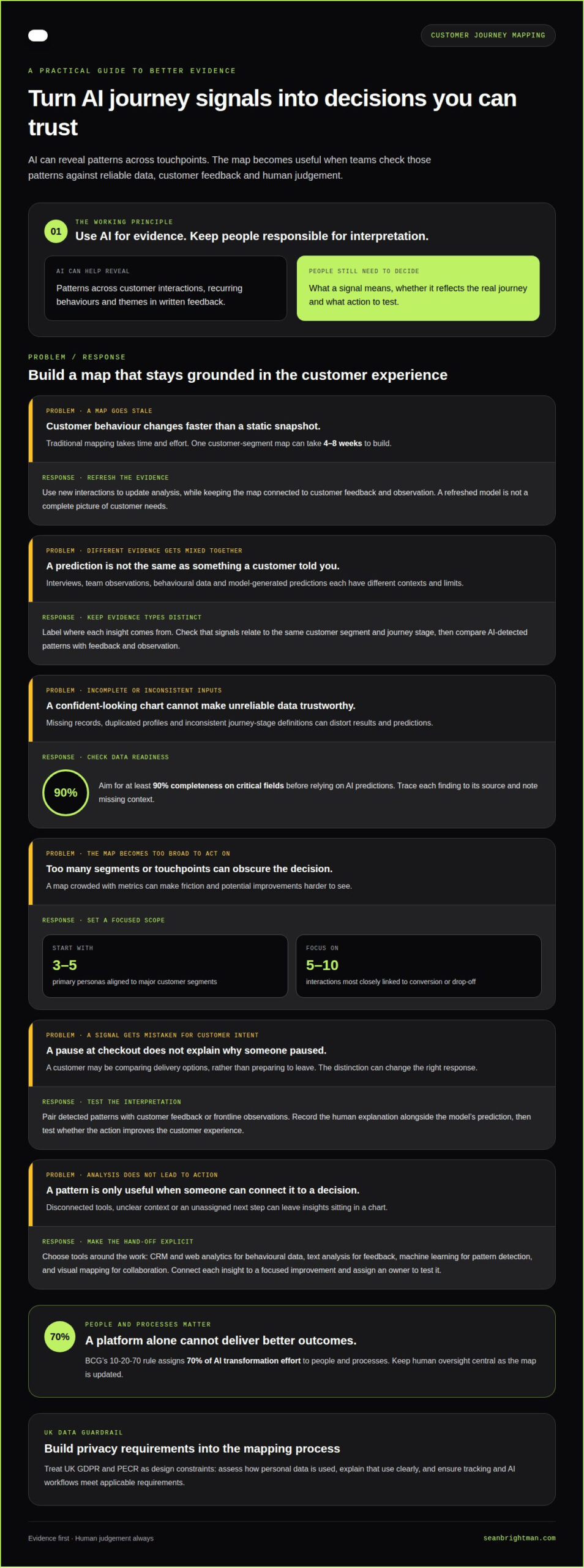
    Compare the evidence behind each map before choosing how to tailor it. Traditional customer journey research captures what customers report and what teams observe, but mapping one segment can take 4-8 weeks. AI can process large interaction datasets to expose patterns across points in a journey. Use those patterns to sharpen the map, not to treat predictions as customer testimony.

    1. Define the purpose. Choose a customer segment and a specific outcome, such as reducing checkout drop-off.
    2. Separate evidence types. Keep interview feedback and observations distinct from behavioural data and model-generated predictions.

    Create an AI-driven customer journey map

    Start with the customer decision you want to improve, then connect data to journey stages. Show what customers do, where friction appears and which action could improve the outcome. AI-driven customer journey mapping works best when teams can trace each insight to a reliable input, rather than accepting a polished chart without context.

    1. Set the scope. Begin with 3-5 primary personas aligned to major customer segments.
    2. Prepare the inputs. Aim for at least 90% completeness on critical fields before relying on AI predictions.
    3. Select touchpoints. Focus on 5-10 interactions most closely linked to conversion or drop-off.
    4. Review and act. Compare AI-detected patterns with customer feedback, then assign an owner to test a focused improvement.

    How is AI-based journey mapping different from traditional journey mapping?

    Traditional mapping builds a visual account from research; AI adds analysis of patterns across customer data. Use the tools to connect touchpoints, understand behaviour and guide decisions, not to automate judgement.

    1. Identify and analyse touchpoints

      Map the customer’s route across channels, then compare each touchpoint with what happens next. CRM records, website analytics and customer feedback can show where people engage, stall or leave. Machine learning can group recurring behaviours into patterns, while natural language processing can identify common themes in written feedback. Check that each signal relates to the same customer segment and journey stage.

    2. Combine analytics with collaborative visualisation

      Bring analytics into a shared visual map so teams can interpret the same evidence together. Connect each data point, such as repeated product-page visits, to its context and potential friction. Automation can refresh the analysis as new interactions arrive, while visualisation makes assumptions and gaps easier to challenge. Keep the map legible: too many metrics can obscure the decision.

    3. Apply predictive analytics

      Predictive analytics can estimate which leads may progress, which customers may churn and how deal size may vary. A lead model might weigh engagement signals alongside CRM history; a churn model might flag changes in service interactions. Treat predictions as prioritisation signals, not certain outcomes. Compare them with later results, then review the actions and definitions shaping the model.

    4. Select data and AI tools

      Choose tools around the work: CRM and web analytics for behavioural data, text analysis for feedback, machine learning for pattern detection, and visual mapping for collaboration. UK teams can use these tool categories to connect evidence without assuming one platform covers every task. Prioritise compatible data and a clear hand-off between analysis and action. A strategic AI roadmap can help align those choices.
    How to Build an AI-Driven Customer Journey Map

    What are the limitations of using AI to create a customer journey map?

    AI can surface patterns across journey stages, but those patterns do not reveal every customer’s intent. Treat the insights as evidence to test against human experience and business outcomes.

    1. Keep human insight central

      Use AI to organise engagement signals, then ask people what those signals mean. A customer who pauses on a checkout page might be comparing delivery options, not preparing to leave. That distinction changes the right response. BCG’s 10-20-70 rule assigns 70% of AI transformation effort to people and processes, reinforcing that a platform alone cannot deliver better outcomes.

      Keep the map dynamic, but do not mistake a refreshed model for a complete picture of customer needs.

      • Pair a detected pattern with customer feedback or frontline observations before changing an experience.
      • Record the human explanation alongside the model’s prediction, so teams can see where they differ.
    2. Validate AI-generated journey maps

      Check each finding against its sources before acting. If a model flags a drop in engagement between product research and purchase, examine the relevant interactions and ask whether the map reflects the real journey. Incomplete records, duplicated profiles and inconsistent stage definitions can distort results. A confident-looking chart cannot make unreliable inputs trustworthy.

      Then test whether the recommended action improves the customer experience, rather than merely changing a metric.

      • Trace each insight to the underlying data and note any missing context.
      • Ask teams closest to the customer to challenge assumptions and identify overlooked needs.
      • Compare the map with later customer behaviour, then revise the model or action when results conflict.

    AI-powered customer journey mapping

    Turn AI analysis into a working journey, not a dashboard nobody uses. A useful output connects customer interactions to a clear decision, an owner and a measurable outcome.

    1. Choose one journey and business outcome. Focus on a specific task, such as completing onboarding or resolving a service issue. Define what success looks like before analysing data, then connect that outcome to customer behaviour. A focused journey gives teams a practical way to assess whether the map reflects the actual experience.
    2. Connect interactions across stages. Bring together relevant CRM records, website activity, service conversations and marketing responses. AI can process large volumes of interactions to reveal where behaviour changes, including transitions between channels. Keep the original source and context visible: an apparent drop-off means little if the data misses a key interaction.
    3. Find patterns, then frame a decision. Group recurring paths and identify moments linked to progress, delay or abandonment. For example, repeated visits to a pricing page may signal interest, uncertainty or a need for more information. Treat the pattern as a prompt for investigation, not proof of intent. Choose an action that addresses the customer’s likely need.
    4. Implement a focused response. Use the map to coordinate the next step across relevant teams and channels. A marketing team might tailor follow-up content, while a service team addresses a recurring point of friction. Specify the audience, trigger, message and outcome. Keep a human review in the process, especially where an automated response could feel intrusive or mistimed.
    5. Measure and refine the journey. Compare the intended outcome with customer responses, then update the map as products, channels and behaviour shift. Review whether the intervention improved the experience, not just whether it produced more activity. To turn analysis into an actionable plan, build your AI roadmap around a defined customer outcome.

    Sean Brightman

    Sean Brightman can help turn journey-mapping analysis into clear strategic decisions. When your team needs to connect customer insights with AI priorities, AI Consulting can shape the approach; Roadmapping can organise the next steps. An Advisory Retainer provides ongoing strategic input as priorities develop.

    The right next move depends on the gap: unclear use cases call for sharper AI direction, while disconnected initiatives need a practical roadmap. Bring the customer journey challenge, the decisions you need to make and the outcomes you want to improve.

    Contact Sean Brightman to discuss your customer journey mapping priorities.

    Make the next move deliberate

    Choose a focused first application, with a named decision owner and a clear business outcome. Before expanding, decide what evidence would justify scaling the work, changing its direction or stopping it. AI-driven customer journey mapping should inform a real decision, not become another polished visual that sits unused.

    Build accountability into the plan from the start. Give the people responsible for customer experience, marketing and data a shared view of what the map informs, who acts on its findings and how decisions will be revisited. This makes analysis part of your working strategy, rather than a standalone technology project.

    Sean Brightman offers Fractional CMO, AI Consulting and Roadmapping to help connect marketing priorities, AI decisions and strategic direction. If you’re ready to explore how those pieces fit your organisation, discuss your next strategic step with Sean Brightman.

    Start with the customer decision that matters most, then build from there.

    Frequently Asked Questions

    What’s Driving this Change?

    Customer behaviour now spans search, social platforms, email, service interactions and in-person experiences. In 2026, 60% of searches end without a website visit, so a website-only view can miss important decision points. Teams are turning to AI to connect signals across channels and respond to changing behaviour, rather than relying on a map that captures only one part of the customer’s experience.

    How does AI-powered journey mapping work?

    AI-driven customer journey mapping starts by bringing relevant customer interaction data into an analysis process, then grouping behaviours and identifying relationships between events. For example, a retailer could examine whether delivery questions often come before order cancellations. The team can investigate the pattern, improve delivery information and monitor subsequent customer responses. The analysis guides a test; it does not establish the cause on its own.

    How does AI-driven journey mapping compare with traditional methods?

    Traditional methods build understanding through interviews, observation and research, giving teams direct context about customer motivations. AI adds the ability to analyse behavioural signals across channels and detect recurring paths. Use interviews to understand why someone struggled, and analytics to locate where that struggle often occurs. The approaches work best together: one adds human context, while the other helps reveal broader patterns.

    What are the benefits and limitations of AI-powered journey mapping?

    AI can help teams spot recurring friction, prioritise parts of a journey and tailor interventions to observed behaviour. This can make analysis more responsive than a map created only during a research project. But recorded activity may not capture customer intent, and predictions can be wrong. Use insights to choose a test, then assess the result against customer experience and business outcomes.

    What are the privacy, bias and data-quality risks of AI-driven journey mapping?

    Customer analytics can involve personal data, so plan its use with UK GDPR and PECR in mind. Explain data use clearly, limit access and protect information from misuse. Bias can arise when a dataset under-represents a customer group, and poor-quality records can distort patterns. For example, duplicated profiles may make a behaviour appear more common. Review data coverage and model outputs across relevant groups.

  • AI Consulting in 2026: From Tool Fatigue to Scalable Growth Engines

    AI Consulting in 2026: From Tool Fatigue to Scalable Growth Engines

    Your marketing team is likely wasting hours every week coaxing GPT-5.6 Sol to polish emails that were already good enough. It’s not strategic innovation. It’s just digital busywork. You’re feeling the weight of tool fatigue whilst your competitors claim to be “AI-first” without showing any real margin improvement. You’ve invested in the latest models but lack the senior ai consulting expertise to turn those subscriptions into a cohesive strategy. It’s a common trap. Most businesses are collecting shiny toys instead of building actual machinery.

    The solution isn’t another subscription. It’s a fundamental shift in how you approach your growth strategy. You need to stop playing with chatbots and start engineering a growth engine that scales. This article promises to move you past the hype. You’ll discover how to transition from fragmented experiments to a unified, intelligence-led system that delivers predictable results.

    We’ll outline a clear marketing roadmap that prioritises systems over software. We’ll examine how to organise your data, automate your workflows, and finally get the ROI your board expects. It’s time to trade the guesswork for tactical precision.

    Key Takeaways

    • Stop treating LLMs like toys and start viewing them as functional components of a high-performance growth engine.
    • Understand that effective ai consulting is a systems-engineering task that redefines how your business captures and converts demand.
    • Identify the critical difference between a tool integrator and a strategic consultant who prioritises your P&L and long-term brand equity.
    • Discover a two-step roadmapping process that audits operational waste and ensures AI never dilutes your unique market positioning.
    • See why the Fractional CMO model delivers senior-level strategy to navigate the 2026 landscape without the overhead of a full-time hire.

    The AI Consulting Trap: Why Most Businesses Are Playing with Toys, Not Tools

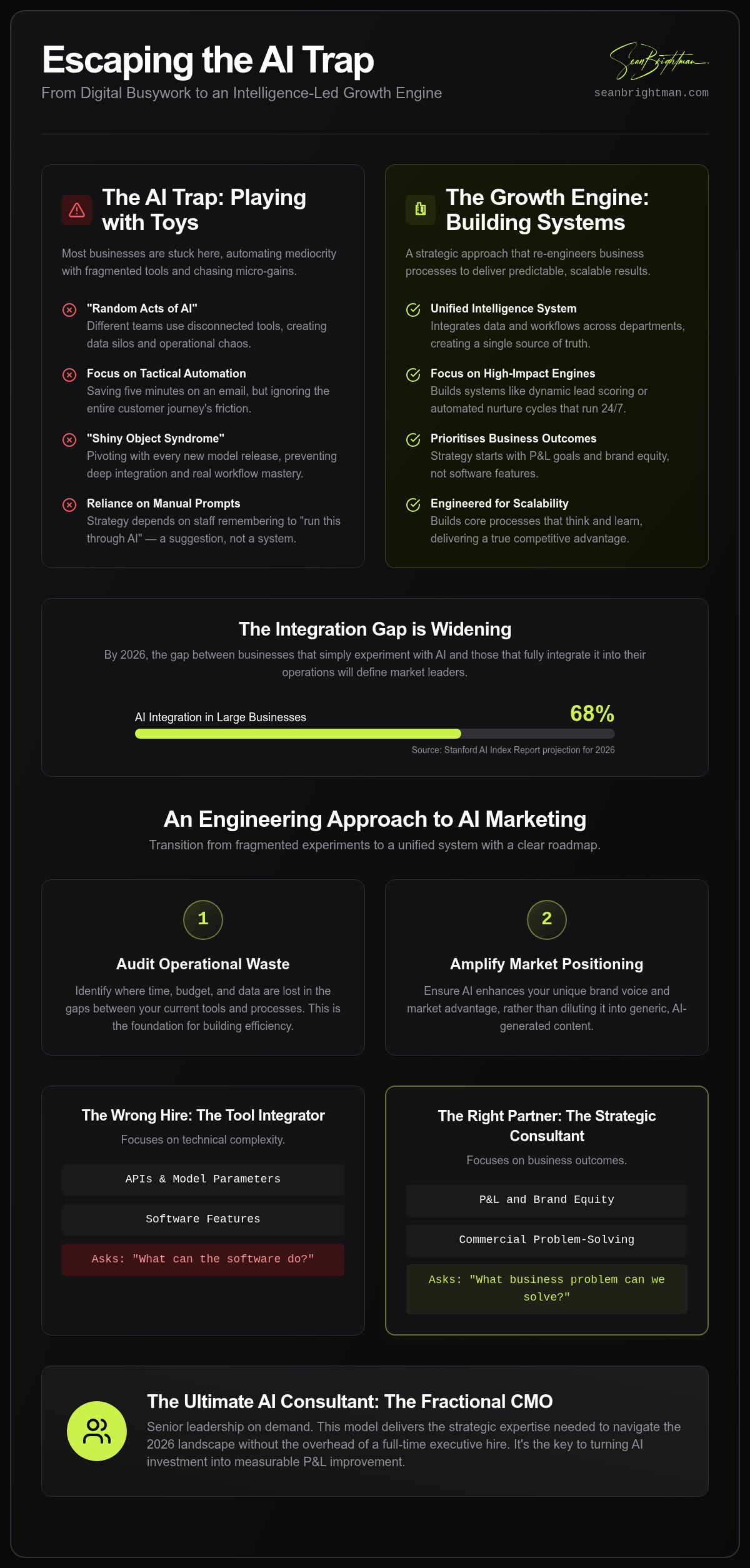
    Most businesses are currently trapped in the “Chatbot Fallacy”. They believe that giving every employee a ChatGPT Plus account constitutes a digital transformation. It doesn’t. It’s just automating mediocrity. True ai consulting isn’t about teaching your team to talk to robots; it’s about re-engineering the machinery of your business so the robots do the heavy lifting without being asked. If your strategy relies on staff rememberring to “run this through the AI,” you don’t have a system. You have a suggestion. You’re playing with toys whilst your competitors build engines.

    The broad field of Artificial intelligence (AI) covers much more than text generation, yet most firms remain stuck in the shallow end. They’re chasing tactical automation. They want to save five minutes on an email or three minutes on a social post. These are micro-gains. Strategic intelligence, however, looks at the entire customer journey and asks where the friction is. It’s about movement, not just speed. It’s about building a system that learns from every interaction to drive predictable growth.

    This is why your first AI hire shouldn’t be a prompt engineer. Hiring a prompt engineer before you have a strategy is like hiring a typist before you’ve decided what the book is about. You need a strategist who understands the P&L. You need someone who can see the mechanical integration between your data and your bottom line. Anything else is just expensive tinkering.

    The High Cost of Random AI Acts

    Fragmented systems are the silent killer of productivity. Many companies suffer from “Random AI Acts” where different departments buy different tools without a central roadmap. One team uses a tool for copy. Another uses a different one for images. A third uses a niche tool for data analysis. None of these tools talk to each other. This doesn’t create efficiency; it creates a fragmented mess that requires more human oversight, not less.

    The hidden costs are staggering. You’re paying for multiple subscriptions that overlap. You’re losing data in the gaps between platforms. Most importantly, you’re suffering from “Shiny Object Syndrome” in the C-suite. Every new model release triggers a pivot. This constant shifting prevents any single tool from being properly integrated into your workflow. You end up managing the tools instead of the growth.

    Strategic Clarity vs. Technical Complexity

    Effective ai consulting prioritises business outcomes over software features. It’s easy to get lost in the technical weeds of APIs and model parameters. None of that matters if it doesn’t solve a commercial problem. A real strategy starts with your existing brand positioning. It asks how machine intelligence can amplify what makes you unique, rather than diluting your voice into a generic, AI-generated soup.

    You must distinguish between “Low-Hanging Fruit” and “High-Impact Engines”. Generating a blog post is low-hanging fruit; it’s easy, but it rarely moves the needle. A high-impact engine is a dynamic lead-scoring system or an automated customer-nurture cycle that runs 24/7. These engines require strategic clarity, not just technical complexity. They are the functional components that turn a chaotic business into a scalable growth machine. Understanding the hard architecture behind AI implementation for marketing is what separates businesses that scale from those that stagnate.

    What is AI Consulting? Engineering the Intelligence-Led Growth Engine

    AI consulting is not a software selection service. It is the strategic re-engineering of your business systems to leverage machine intelligence as a core utility. Think of it as plumbing, not painting. You aren’t just adding a layer of tech on top of a broken process; you’re rebuilding the process itself. This is the difference between “doing AI” and being truly AI-powered. One is a distraction. The other is a competitive advantage. It’s about building systems that think, not just tools that talk.

    Building a growth engine requires more than a subscription to GPT-5.6 Sol. It requires a fundamental shift in how you move prospects through the customer journey. According to Stanford’s AI Index report, the gap between companies that experiment and those that integrate is widening. In 2026, 68% of large businesses have already integrated AI analytics for operational decision-making. If you’re still in the experimentation phase, you’re falling behind the curve. You’re bringing a knife to a drone fight.

    The modern strategy rests on three pillars: Data, Process, and People. Data is your fuel. Process is your engine. People are your pilots. If any pillar is weak, the system fails. A strategic advisor doesn’t just give you a list of tools; they build the framework that makes those tools work together. If you’re ready to stop guessing, building a strategic roadmap is the first step toward actual scale.

    The Anatomy of an AI-Powered System

    A functional ai consulting engagement focuses on the mechanics of your operations. It starts with data ingestion. This means turning messy, siloed inputs into clean, strategic assets. If your data is garbage, your AI output will be expensive garbage. Next is process automation. We remove human friction from repetitive tasks whilst maintaining brand quality. Finally, we focus on output optimisation. We use intelligence to scale creative and analytical tasks. It’s about doing more of what works, faster and with surgical precision.

    The Role of the Strategic AI Advisor

    A consultant provides accountability. They ensure the technology serves the business goal, not the other way around. With the current landscape of regulatory fragmentation across states like California and Colorado, risk management is no longer optional. You need a partner who understands the legal complexities and the ethical guardrails required to protect your brand equity. Education is the final piece. Your team needs to be upskilled to work alongside the machine, not in fear of it. Expertise is the only antidote to obsolescence. We build the system, then we teach you how to drive it.

    Consultant vs. Integrator: Who Actually Owns Your AI Strategy?

    You don’t hire a plumber to design your house. You don’t hire an architect to fix a leaky tap. The same logic applies to your AI transition. Many businesses are currently hiring “plumbers” when they actually need “architects.” They’re paying for technical connectivity whilst their commercial strategy remains fundamentally broken. This is the distinction between an integrator and a consultant. One builds the pipes; the other decides where the water should flow to maximise your P&L.

    The Integrator is focused on the “how.” They are experts in connecting APIs, configuring webhooks, and ensuring your tech stack doesn’t collapse under its own weight. Their success is measured in uptime and data flow. If the tools are talking to each other, they’ve done their job. But technical connectivity is not a growth strategy. You can have the most sophisticated API integration in the world and still be burning cash on a marketing message that no longer resonates.

    The Consultant is focused on the “why.” They own the outcome, not just the implementation. Strategic ai consulting prioritises long-term brand equity and predictable growth engines over mere automation. They ask the hard questions about your positioning, your margins, and your market share. They don’t just connect tools; they engineer systems that drive revenue. If your AI implementation isn’t directly reflected in your bottom line, you haven’t hired a consultant. You’ve just bought a very expensive set of pipes.

    When to Hire a Technical Integrator

    You hire an integrator when your roadmap is already set in stone. You have a clear strategy, your brand voice is locked, and you know exactly which processes need automation. You simply lack the “plumbing” skills to build the bridge between GPT-5.6 Sol and your CRM. Success here is binary. The system works, or it doesn’t. It’s about narrow, specific tasks where “connectivity” is the primary KPI. If your internal team already knows the destination, the integrator provides the vehicle.

    When You Need Strategic AI Consulting

    You need ai consulting when your marketing feels “stuck” despite your growing list of subscriptions. If you’re suffering from tool fatigue and can’t see the path to ROI, you need a strategist, not a coder. This is for leaders who require senior-level accountability for growth metrics. You need someone to ensure AI doesn’t dilute your brand into a generic mess. You need a partner who understands that AI is a component of a Fractional CMO’s toolkit, designed to amplify your competitive advantage, not just save five minutes on a spreadsheet.

    Technical setup without strategic direction is a recipe for expensive failure. Choose your partner based on your current scale and your ultimate goal. If you want to fix a leak, hire an integrator. If you want to build a growth engine, hire a consultant. CEOs who are serious about this transition should explore structured ai consulting services designed specifically to move businesses from chaotic experimentation to scalable, automated growth engines.

    AI Consulting in 2026: From Tool Fatigue to Scalable Growth Engines

    The AI Marketing Roadmap: Engineering Efficiency into Every Process

    Strategy without a roadmap is just a wish list. To move from tool fatigue to scalable growth, you need a blueprint that defines exactly how machine intelligence integrates with your commercial goals. This isn’t about buying software. It’s about engineering a system. A professional ai consulting engagement delivers a structured path to ROI through five critical stages:

    • Step 1: The Audit. We identify where your team is burning hours on manual labour. We look for the friction in your current workflow. If a task is repetitive and rules-based, it’s a candidate for automation.
    • Step 2: Positioning. We ensure AI doesn’t dilute your brand voice. Generic output is a death sentence for brand equity. We build guardrails to keep your messaging sharp and distinct.
    • Step 3: Infrastructure. We select the “Growth Stack” that scales with you. This is about connectivity and data portability, not just shiny interfaces.
    • Step 4: Pilot. We test high-impact engines in a controlled environment. We prove the concept before we bet the house.
    • Step 5: Scale. We roll out intelligence across the entire department. This is where tactical wins become a permanent competitive advantage.

    Most businesses fail because they skip to Step 5. They try to scale chaos. A roadmap brings order to that complexity. It turns fragmented experiments into a unified growth engine. If you’re ready to stop guessing and start building, book your AI roadmapping session today.

    Building Your Growth Stack for 2026

    Your stack should be a machine, not a toy box. In 2026, “Best-of-Breed” tools often beat all-in-one platforms because they offer superior depth in specific functions. The key is ensuring seamless data portability between your CRM and your AI engines. If your data can’t move, your business can’t grow. You need a modular system that allows you to swap components as the technology evolves. Effective strategic brand roadmapping ensures your entire growth stack is built around commercial architecture rather than fragmented tool selection. For a deeper dive into this framework, read The 2026 AI Marketing Roadmap: Build a Growth Engine, Not a Toy Box.

    Maintenance and Evolution

    An AI roadmap is a living document. It is not a one-off report that sits in a drawer. The technology moves too fast for static strategies. This is why ai consulting often transitions into an Advisory Retainer. Ongoing optimisation ensures your systems stay ahead of the “Commoditisation of AI.” When everyone has access to the same models, your advantage lies in how you configure and maintain your unique growth engine. We don’t just build the machine; we help you tune it for maximum performance.

    Senior Leadership on Demand: Why the Fractional CMO is the Ultimate AI Consultant

    Hiring a full-time “Head of AI” in 2026 is a tactical error. By the time you’ve finished the six-month recruitment cycle and cleared the HR hurdles, the technology has already evolved. You’re left with a high-salary executive who is wedded to last year’s models. In a rapidly shifting landscape, you don’t need a permanent seat at the table. You need senior-level strategy that can pivot at the speed of the market. This is where ai consulting meets fractional leadership. You get the P&L ownership of a CMO with the technical precision of an AI strategist.

    A Fractional CMO provides the senior strategy you need without the £150k+ overhead of a full-time hire. This isn’t just about saving money; it’s about buying velocity. You’re hiring a battle-hardened expert who has already built growth engines for other brands. They don’t need a three-month “onboarding” period to understand your goals. They plug in, audit your systems, and start engineering. It’s about results, not residency. You get the machinery of high-level marketing leadership delivered as a functional service.

    Integrating ai consulting into a broader leadership role ensures that technology never exists in a vacuum. A specialist consultant might fix your prompts, but a Fractional CMO fixes your business. They ensure that every automated workflow and every data-led insight is directly tied to your commercial objectives. It’s the difference between a technical project and a growth strategy. One is a cost centre. The other is a revenue driver.

    Leadership Without the Bureaucracy

    The fractional model is “plug-and-play” by design. You bypass the internal politics and the administrative bloat that usually accompanies senior hires. A Fractional CMO focuses on two things: execution and accountability. They are there to solve the problem, build the system, and move the needle. This lean approach is the only way to stay agile whilst the AI landscape continues to fragment. For a deeper look at why the traditional model is failing, read Stop Hiring Full-Time CMOs: The Fractional Revolution in 2026.

    Your Next Steps to AI Integration

    You don’t need to commit to a massive transformation project on day one. The lowest-risk entry point is a structured Roadmapping session. This identifies the immediate “leaks” in your marketing machinery and outlines the path to a scalable growth engine. From there, many businesses transition to an Advisory Retainer to maintain long-term velocity. This ensures your roadmap stays current as new models like GPT-5.6 Sol emerge. If you’re comparing your options, check out The Best AI Consulting Firms in 2026: A CEO’s Guide to Strategy, Not Fluff. Stop playing with toys. Start building your engine.

    Stop Playing with Toys. Build Your Engine.

    The window for experimentation is closing. By 2026, the market has split into those who use AI to save five minutes and those who use it to capture entire markets. You’ve seen the difference between a technical integrator and a strategic partner. One fixes your pipes; the other engineers your growth. Effective ai consulting is the pivot point between tool fatigue and a scalable, intelligence-led engine.

    Stop chasing the next model release and start building a system that lasts. You need senior-level accountability without the bloated overhead of a full-time hire. As a Fractional CMO and author of “The Book” on marketing strategy, I specialise in turning chaotic tech stacks into high-performance machinery. We don’t do fluff. We do strategy-led integration that shows up on your P&L.

    It’s time to trade your toy box for a growth engine. The first step is clarity. Start your transformation today.

    Book an AI Roadmapping Session with Sean Brightman

    Let’s get to work.

    Frequently Asked Questions

    What is the difference between AI consulting and a software implementation partner?

    Consulting focuses on the commercial outcome whilst implementation focuses on the technical connection. An implementation partner builds the pipes between your tools. An ai consulting strategist decides where those pipes should lead to maximise your revenue. One is about technical uptime; the other is about P&L growth and long-term brand equity. You need a navigator before you hire a mechanic.

    How much does AI consulting typically cost for a UK scale-up?

    Costs vary based on the complexity of your systems and the depth of the engagement. Most strategic partners offer a fixed-fee Roadmapping session to define the strategy before moving to an Advisory Retainer. This approach ensures you aren’t billing for endless hours but investing in specific, high-impact growth engines. It is about the value of the machinery built, not the time spent building it.

    Does my business need to be “tech-heavy” to benefit from AI consulting?

    No. In fact, non-technical businesses often see the most significant gains from ai consulting because they have the most manual friction to remove. If you have a customer journey and a list of leads, you have a growth engine that can be optimised. We take the technical complexity off your plate so you can focus on running the business.

    How long does it take to see a real ROI from AI integration?

    Real commercial ROI typically manifests within three to six months. Initial efficiency gains happen quickly as we automate repetitive tasks. However, the strategic growth—like improved lead scoring or automated nurture cycles—requires time to gather data and tune the engine. We build for compounding returns that increase as the system learns your market behaviour.

    Can an AI consultant help with brand positioning and creative strategy?

    Yes. AI is an amplifier for your existing brand, not a replacement for it. A strategic consultant ensures your unique positioning is baked into every model’s instructions. We use machine intelligence to sharpen your value proposition and scale your creative output without diluting your voice. It ensures you sound like a market leader, not a generic algorithm.

    What happens if we already have an internal marketing team but no AI expert?

    This is the ideal scenario for fractional leadership. We don’t replace your team; we upskill them. We provide the senior strategy and the technical roadmap they need to execute at a higher level. Your team knows your business; we know how to integrate the intelligence that makes them faster and more effective. It is a partnership, not a replacement.

    Is AI consulting a one-off project or an ongoing service?

    It usually starts as a project and evolves into a retainer. A Roadmapping session defines the initial strategy and identifies the “leaks” in your system. Once the engine is built, an Advisory Retainer ensures it stays optimised as technology shifts. The goal is long-term velocity. You need a partner who keeps your machinery ahead of the competition.

    How do you ensure AI-generated content doesn’t hurt our SEO or brand?

    We use human-in-the-loop systems and strict brand guardrails to protect your equity. We build quality assurance layers where machine output is vetted against your specific standards before it ever reaches a customer. This prevents the generic “AI-slop” that triggers search engine penalties. For businesses serious about getting AI implementation for marketing right, brand integrity must be engineered into the system from day one, not bolted on as an afterthought. We prioritise brand integrity over raw volume every single time.