Tag: artificial intelligence

  • How to Prepare Marketing Data for AI Around Business Goals

    How to Prepare Marketing Data for AI Around Business Goals

    AI won’t rescue messy marketing data. Preparing your marketing data for AI means making it accurate, connected, governed and useful for a defined business goal. AI-ready data isn’t simply a larger dataset; it’s information your team can trust to support a specific decision or outcome.

    Focus on the foundations before choosing a model or launching a pilot. Poor-quality inputs can produce unreliable outputs, while disconnected systems make it harder to see what’s working. The practical fix is to assess what you have, identify what’s missing and prepare only the data your use case needs.

    This guide shows you how to assess marketing data readiness, engineer useful features and build governance into the process. You’ll also learn how to connect each preparation decision to a business goal, so the work supports measurable priorities rather than AI for its own sake.

    Key Takeaways

    • Map your marketing data sources, owners and update patterns to expose readiness gaps before choosing an AI use case.
    • Engineer features around useful customer behaviours, then keep validation and quality monitoring running as data changes.
    • Build governance into the data environment with clear ownership, permissions, definitions and lineage from source to use.
    • Start with a specific business outcome and prepare only the data needed to support it, not a larger dataset for its own sake.

    What role does feature engineering play in AI data preparation?

    AI marketing tools work best with consistent, clearly labelled records: structured tables for transactions and campaign events, plus text or images tagged with useful categories. Choose platforms that connect data sources and support access controls, lineage and audit trails. Preparation costs depend on source count, data condition, integration work and monitoring needs; the price depends on the case and is given after a quote request.

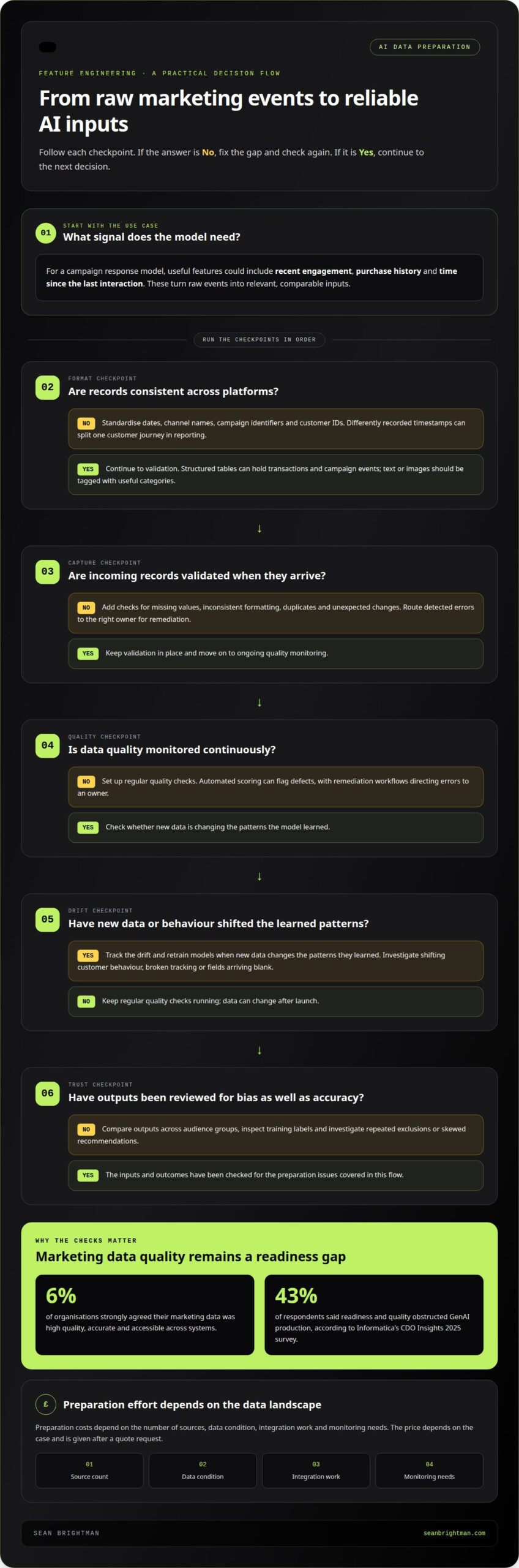
    1. Define the signal each model needs. For a campaign response model, engineer features such as recent engagement, purchase history and time since the last interaction. These turn raw events into relevant, comparable inputs.
    2. Standardise formats before feature creation. Align dates, channel names, campaign identifiers and customer IDs across platforms. A timestamp recorded differently in two systems can split one customer journey into misleading reporting.
    3. Build validation at the point of capture. Check incoming records for missing values, inconsistent formatting, duplicates and unexpected changes. Automated scoring can flag defects, while remediation workflows route errors to the right owner.
    4. Monitor quality continuously, not just before launch. Only 6% of organisations strongly agreed their marketing data was high quality, accurate and accessible across systems. Informatica’s CDO Insights 2025 survey found readiness and quality obstructed GenAI production for 43% of respondents.
    5. Track drift and retrain models when new data changes the patterns they learned. Regular quality checks can reveal shifting customer behaviour, broken tracking or a campaign field that suddenly arrives blank.
    6. Review generated content and model outcomes for bias as well as technical accuracy. Compare outputs across audience groups, inspect the labels behind training examples, and investigate repeated exclusions or skewed recommendations before using them in a campaign.

    How should companies approach data governance for AI initiatives?

    Governance makes marketing data traceable, controlled and fit for analytics tools and AI models. Build it into your data environment before connecting new applications.

    1. Track metadata and data lineage

      Map each important field from its original source to the analytics report or AI model that uses it. Record its owner, definition, update frequency, permitted uses and any transformations.

      Use shared definitions for measures such as campaign conversion, so teams don’t combine records based on different meanings. Version control and audit trails show what changed, when it changed and which outputs relied on that data.

    2. Govern data privacy and security

      Set access rules by role and purpose, then document who owns each dataset. Apply privacy controls to customer information and create policies that support GDPR compliance.

      Limit access to the fields an AI model needs. For example, campaign analytics may require purchase category and response history, not every detail in a customer record. Review permissions whenever data moves between platforms.

    3. Define accountability before putting a system under AI control. Name the people responsible for data quality, access approvals, model outputs and incident handling. Governance policies should cover data ownership, version control, audit trails, security and privacy.

      Set a review process for high-impact decisions. A human owner can check whether an output uses the intended data and whether its result should inform a marketing action. This gives teams a practical way to challenge errors.

    4. Make trust measurable. In a 2024 survey, 53% of business leaders said their organisation actively prioritised data management to reduce AI data-quality risks. Meanwhile, 78% of organisations do not yet trust agentic AI.

      Track access exceptions, unresolved lineage gaps and repeated output errors as governance signals. Adobe reports that 62% of consumers say transparency about AI use directly affects their trust. Explain where AI contributes to marketing decisions, and keep a record of the data and rules behind those decisions.
    How to Prepare Marketing Data for AI Around Business Goals

    Aligning AI data preparation with business goals

    Start with the business outcome, then prepare data to support it. To unify CRM, web analytics and advertising platforms, connect records through shared identifiers and definitions, while preserving their source and timing.

    1. Define the decision AI should improve. A churn objective, for example, needs data reflecting customer activity and retention outcomes, not just campaign clicks. Thirty-six per cent of UK organisations had AI projects fail because business problems were inadequately defined.
    2. Standardise metrics and business definitions

      Agree on the meaning of each metric before feeding it into an AI model. Define whether a conversion means a purchase, a signed agreement or another event, then apply that definition consistently across reports and teams.

      Use common naming conventions for fields such as campaign source and customer status. The Scottish Government notes that common standards can improve data quality and interoperability, making information easier to reuse and link.

    3. Unify marketing data sources

      Connect CRM records, web analytics events and advertising results through shared customer, campaign and time references. Preserve the original source and timestamp so teams can trace each interaction instead of losing useful context by flattening the data.

      Check that matching fields describe the same thing across platforms. A click in an advertising report and a visit in web analytics are different events, even when they belong to the same journey.

    4. Add business context and relevant history. A model assessing repeat purchases needs past purchase patterns and clear product category meanings. A short, disconnected snapshot can hide seasonal behaviour or shifts in customer intent.
    5. Give AI agents a shared business ontology, a structured account of entities, relationships and terms. Link concepts such as customer, account, product and campaign, and define how they relate. This helps an agent interpret existing data without confusing a lead with a customer.
    6. Evaluate outputs against business outcomes, not model activity alone. If a campaign platform optimises clicks, compare those results with the customer outcomes the business values. Keep the target metric visible in reporting and revise the data inputs when outputs miss the goal.

    Assessing marketing data readiness

    Start with a data audit, not an AI tool. Gartner’s Q3 2024 survey found 63% of organisations either lacked, or were unsure they had, suitable data management practices for AI.

    1. Inventory the sources that support one marketing decision. Include CRM records, spreadsheets, marketing platforms and customer support logs. Small businesses can start with first-party behavioural and transactional data, then expand once the first use case works.
    2. Audit each source for data type, storage location, access, ownership and update frequency. For example, note whether purchase history refreshes daily or only after a manual spreadsheet upload. These details show whether the information can support the intended action.
    3. Measure quality and completeness in critical fields. Count duplicates, missing values, inconsistent formats and outdated records. Use practical targets such as keeping customer data 99% duplicate-free and missing values below 1% in critical fields.
    4. Check whether records can be connected into a useful customer view. Identity resolution links a person’s interactions across systems, helping teams see a consistent history rather than isolated clicks or purchases. A clean, read-only profile refreshed nightly can be a manageable starting point.
    5. Match readiness to the AI capabilities required. A reporting assistant may need accurate campaign names and spend data; an agent taking action needs current customer data, defined permissions and reliable signals. Gartner predicted organisations would abandon 60% of AI projects unsupported by AI-ready data through 2026.
    6. Review readiness with business owners, not just technical teams. A 2024 survey found 73% of business leaders ranked data quality among their top AI concerns. Track gaps, assign owners and prioritise fixes by their effect on the chosen use case.
    7. Turn the audit into a practical roadmap before expanding scope. Map your AI readiness priorities into focused next steps.

    Sean Brightman

    Sean Brightman helps turn marketing data readiness into a practical AI plan tied to business priorities. If your data is spread across disconnected platforms, or teams can’t agree on what success means, AI Consulting can clarify the use case, capabilities and decisions that need support.

    Roadmapping can sequence the work: identify valuable data gaps, set governance priorities and define what to prepare before a model goes live. An Advisory Retainer provides ongoing strategic guidance as your needs and AI initiatives develop.

    The right next step depends on the bottleneck: unclear goals, fragmented data or a lack of implementation direction. If you’re ready to make those decisions, contact Sean Brightman to discuss your priorities.

    Make data readiness part of the operating plan

    Preparing your marketing data for AI isn’t a one-off clean-up. Treat it as an ongoing business capability, with clear ownership and regular decisions about which use cases deserve attention. As customer behaviour, campaign priorities and systems change, revisit whether the data still supports the decisions you want AI to improve.

    Choose one outcome and give it an accountable owner. That keeps the work grounded in business value instead of letting new tools dictate the agenda. Sean Brightman can help shape your strategy and decide how to move from data readiness to practical action.

    If you’re ready to set that direction, contact Sean Brightman to discuss your priorities. Start with the decision you want to improve, then build from there.

    Frequently Asked Questions

    What is AI-ready marketing data?

    AI-ready marketing data is information an AI tool can interpret and use for a defined task. It needs clear labels, usable formats and enough context to distinguish events, customers and outcomes. For example, product recommendations need meaningful product and purchase records, not an unlabelled export. Readiness depends on whether the data supports the intended decision, not simply how much information is stored.

    Does this differ for agencies and in-house teams?

    The foundations are similar, but ownership and access can differ. An in-house team usually works across its organisation’s systems and definitions. An agency may serve several clients, each with separate data permissions, reporting conventions and campaign goals. Keep client datasets distinct, document who can access them and agree how results are defined before combining information for analysis.

    How can organisations effectively handle unstructured data for AI applications?

    Structure unstructured material before using it. For support emails, label examples by topic or outcome; for customer feedback, use consistent sentiment categories. Text extraction can make documents searchable, while image labels can describe relevant visual content. Keep the original source attached to each record, and remove irrelevant or sensitive material before it enters a model workflow.

    Should you build the data pipeline yourself?

    Build in-house when your team can maintain the connections, transformations, monitoring and access controls the use case requires. A managed integration tool may suit standard sources and limited engineering capacity, but it still needs clear ownership. A sound plan for preparing your marketing data for AI considers ongoing maintenance, flexibility and auditability, not just setup speed. Either approach needs upkeep as platforms and data fields change.

    Why does AI get your marketing numbers wrong?

    AI can produce misleading figures when inputs use different definitions or contain incomplete records. For example, an advertising platform may count an attributed conversion differently from a CRM report of completed sales. Time periods, duplicate events and delayed updates can widen the gap. Trace the figure to its source, check the calculation and confirm both systems measure the same outcome.

    What does preparing marketing data for AI involve?

    Preparing your marketing data for AI means making information usable for a chosen task, not cleaning everything indiscriminately. The work can include selecting relevant sources, resolving inconsistent records, creating meaningful labels, setting access rules and testing whether outputs support the intended decision. For a small team, start with one clear use case and a manageable dataset, then expand as the process proves useful.

  • Common AI Implementation Challenges: What Goes Wrong and How to Fix It in 2026

    Common AI Implementation Challenges: What Goes Wrong and How to Fix It in 2026

    Only 41% of AI projects make it from prototype to deployment, according to Gartner. The problem often isn’t the technology. It’s the gap between a promising experiment and the leadership, workflows and controls needed to make it useful. Common AI implementation challenges often start in this gap.

    If your pilot sits outside commercial priorities, relies on messy data or leaves teams unsure how to use it, buying another tool won’t fix the blockage. These challenges can create risk, rework and wasted spend before AI delivers a measurable result.

    A stalled initiative is a signal to diagnose the system, not rush into another investment. This guide will help you identify the root cause, prioritise practical fixes and decide what needs to be in place before scaling.

    We’ll break down the real barriers, from unclear ownership and governance to skills gaps and workflows that haven’t changed. You’ll also see how to connect AI adoption to measurable business and marketing outcomes, so experiments have a clear route to value.

    Key Takeaways

    • Turn common AI implementation challenges into specific questions about goals, workflows, data and ownership, so you can find the actual blocker.
    • Prioritise issues by business impact, risk, dependencies and how readily your team can address them.
    • Before testing a use case, set a baseline, define a measurable outcome, assign an accountable owner and plan for human review.
    • Evaluate a pilot against its intended outcome before deciding whether to adjust, stop or expand it.
    • Use strategic roadmapping to connect AI use cases with marketing priorities, workflow changes and accountable owners.

    Common AI implementation challenges: why promising initiatives stall

    An AI demonstration can look impressive: a prompt produces a polished campaign draft, a chatbot answers a sample query, or an assistant summarises a report in seconds. Then everyday work starts. The output needs checking, staff return to familiar tools, and nobody can say whether the experiment improved a business result. The gap isn’t mysterious. A convincing demo proves a task can be done. It doesn’t prove the task fits the workflow or creates dependable value.

    That distinction sits at the heart of common AI implementation challenges. Implementation means embedding AI into real decisions and routines, with clear responsibility for how people use and assess it. Buying access to a tool, connecting a model or completing a pilot is only a starting point. The process around the technology has to change too.

    Experimentation asks, “Can this work?” Operational implementation asks, “Does it reliably improve a defined business outcome as part of everyday work?”

    What does successful AI implementation actually mean?

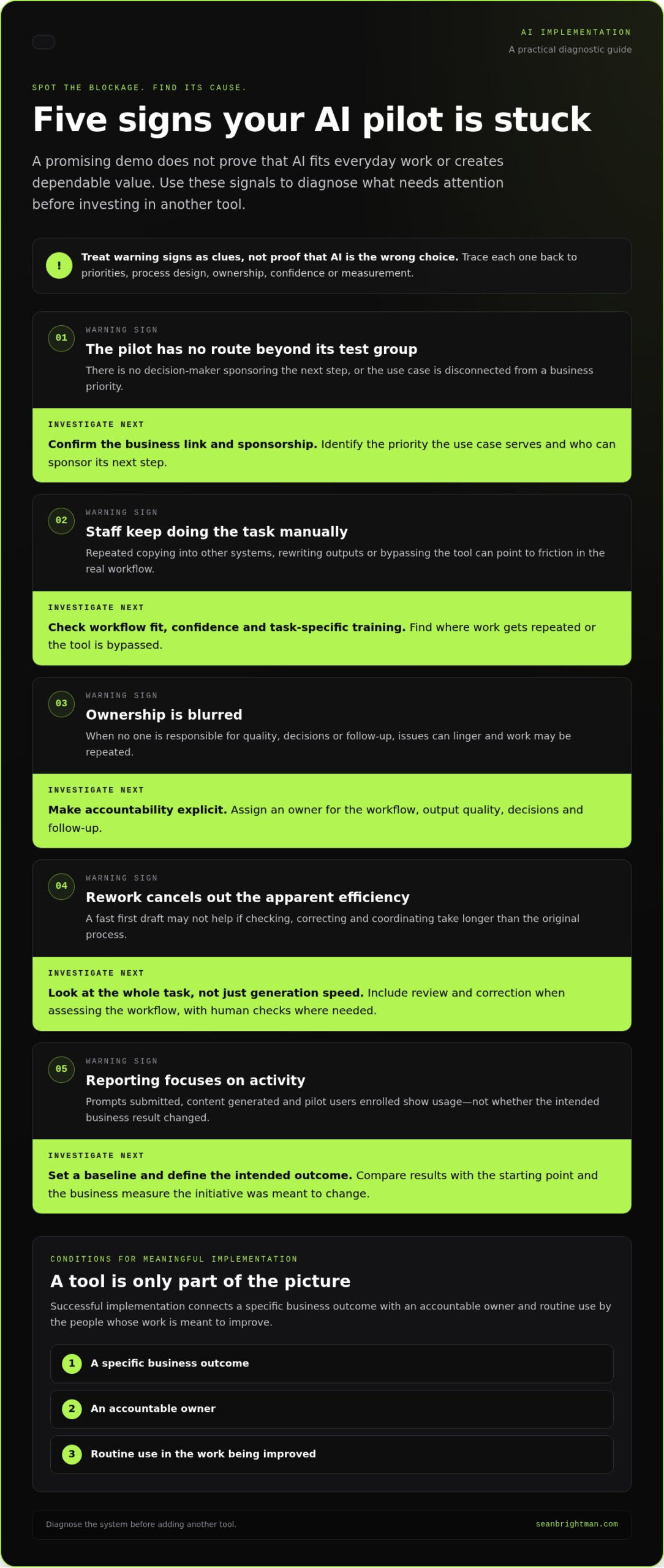
    Success needs three things: a specific business outcome, an accountable owner and routine use by the people whose work is meant to improve. For a marketing team, that might mean reducing avoidable drafting effort whilst maintaining agreed quality, rather than simply generating more copy. The measure should reflect the intended benefit, not just how often someone opens the tool.

    A model can perform well in a controlled test and still fail in practice. The process may lack suitable review, staff may not trust the output, or the tool may not fit how work moves between colleagues. Technical performance matters, but so do adoption, usefulness and safeguards. Clear human oversight also helps teams consider AI safety in the context of their use case.

    Which warning signs appear before an AI initiative stalls?

    Look for patterns in the work, not just status updates. An initiative may appear active whilst the conditions for real adoption are missing:

    • The pilot has no route beyond its test group. If nobody with decision-making authority is sponsoring the next step, or the use case doesn’t connect to a business priority, the pilot may be exploration without a path to operational use.
    • Staff keep doing the task manually. Repeatedly copying outputs into other systems, rewriting results or bypassing the tool can signal poor workflow fit, low confidence or training that hasn’t addressed the actual task.
    • Ownership is blurred. If no one is responsible for quality, decisions or follow-up, issues linger and teams may redo work to compensate.
    • Rework cancels out the apparent efficiency. Fast first drafts mean little if checking, correcting and coordinating take longer than the original process.
    • Reporting focuses on activity. Prompts submitted, content generated or pilot users enrolled show usage, not business impact. Compare results with a baseline and the outcome the initiative was meant to change.

    These signs are diagnostic clues, not proof that AI itself is the wrong choice. Trace each one back to its cause: priorities, process design, ownership, confidence or measurement. That gives you a sharper starting point than adding another tool or declaring the pilot a success because it produced a polished demo.

    The root causes behind common AI implementation challenges

    Teams often choose a tool before agreeing what needs to improve. A request to “use AI in marketing” sounds like a plan, but it doesn’t define the problem, the intended outcome or who will own the result. Without those decisions, tool selection becomes guesswork. The team may build a capable solution that answers the wrong question.

    Data can expose the same gap. Useful outputs depend on information that’s relevant, accessible and managed with care. If customer records are incomplete, definitions differ between teams, or nobody owns updates, the output may be inconsistent. Staff then lose confidence, even if the underlying model performs as expected. Access matters too: information that can’t be used appropriately in the workflow can’t support the intended task.

    Data, governance and security: the foundations teams overlook

    Before a use case moves into routine work, decide which data it needs, who is responsible for its quality and who can access it. Set practical rules for handling sensitive information, reviewing outputs and escalating errors. For a marketing workflow, that could mean defining which source material staff may use and requiring human checks before AI-assisted content is shared.

    In the UK, organisations using personal data need to consider their responsibilities under UK GDPR. The Information Commissioner’s Office (ICO) publishes guidance on data protection and AI. The appropriate steps depend on the use case, so this is an operational prompt, not legal advice. Clear governance gives people a usable framework; vague warnings often leave them guessing.

    People, leadership and workflow integration

    Leadership sponsorship must translate into decisions: which problem matters, what teams should prioritise, who owns the workflow and how success will be assessed. Without that direction, departments can run disconnected experiments or wait for approval whilst the initiative loses momentum. Research into AI’s impact on work and organizations reflects why implementation needs attention to organisational conditions as well as the technology.

    Low adoption isn’t automatically a sign that employees are unwilling to change. Staff may lack practice with the specific task, know the output needs too much correction, or be unsure where human judgement is essential. Generic tool demonstrations won’t resolve those issues. Role-specific learning should show people how AI fits their work, what to check and when to take over.

    AI readiness is a leadership and operating-model challenge: leaders must align priorities, data, responsibilities and workflows before teams can use AI with confidence.

    That alignment matters because the causes compound. An unclear objective leads to a poor use case; weak ownership leaves data and review rules unresolved; awkward workflow design creates workarounds; and workarounds make benefits harder to measure. Redesign the task around both AI assistance and human judgement, then equip the people doing it. Strategic AI roadmapping can help teams connect those decisions to marketing priorities before they scale.

    How to diagnose and prioritise AI implementation challenges

    Don’t label every setback a tool failure. Start with what people can observe, then test the cause. Is the output unreliable, is usage low, or has the pilot stopped moving? Each symptom points towards different questions. This approach turns common AI implementation challenges from a broad list into a diagnosis your team can act on.

    Use the comparison below as a first pass. A symptom is a clue, not a verdict. Check the process before changing technology.

    Match the symptom to the implementation blocker

    Symptom: outputs vary in quality.
    Likely blockers: unsuitable or inconsistent data, a task that’s too broad, or unclear review requirements.
    Ask: Does the system have relevant source material? Have we defined what a useful answer looks like, and who checks it?

    Symptom: people rarely use the tool.
    Likely blockers: the tool doesn’t fit the workflow, leaders haven’t made its purpose clear, or staff lack confidence with the specific task.
    Ask: Where does the tool sit in the existing process? What makes people return to the old method?

    Symptom: a pilot has stopped progressing.
    Likely blockers: success criteria were never set, no one owns the next decision, or expansion depends on assumptions that haven’t been tested.
    Ask: What evidence would justify continuing, who decides, and what must change before wider use?

    These questions help separate a genuine tool limitation from a data, workflow, ownership or adoption problem. If a process is unclear or the desired outcome keeps shifting, AI may not be the right fix. Clarify the task first. A tool can speed up a sound process, but it won’t decide what the process should achieve.

    Decide what to fix first

    Once you’ve identified possible blockers, rank them against four factors: business impact, risk, dependency and your ability to address them. A useful order is:

    1. Set aside use cases with no meaningful outcome. If the team can’t explain what should improve, stop or redesign the idea before spending more effort on it.
    2. Resolve critical risks and ownership gaps. Privacy, security and accountability concerns are gates to wider use, not details to tidy up after scaling.
    3. Fix dependencies that block other work. For example, resolve access to reliable source information before comparing output quality across teams.
    4. Address adoption issues with a clear route to change. Improve workflow fit, role-specific guidance or leadership decisions where those are holding up useful progress.

    When priorities compete, favour the blocker that affects the most important outcome, creates the greatest risk or prevents several other fixes. Keep the decision visible: record the symptom, evidence, owner and next action. That makes it harder for an initiative to drift back into activity without progress.

    Common AI Implementation Challenges: What Goes Wrong and How to Fix It in 2026

    A practical sequence for overcoming AI implementation challenges

    Don’t start by rolling a tool out across the business. Start with one real problem and a test that can show whether AI helps. A disciplined sequence gives the team clear evidence, limits avoidable risk and makes the next decision straightforward: continue, change the use case, pause or scale.

    Design a pilot around a real business problem

    Choose a bounded, recurring task with a clear user and business consequence. Before testing, record the current baseline, define the outcome you want to improve and agree what unacceptable output looks like. Assign a business owner who can make decisions, involve the people who will use the workflow, and set out when a human must review or override AI output.

    For example, a marketing team might test AI assistance on a defined part of content preparation, not “transform marketing” all at once. The task, quality bar and review responsibility should be clear before the pilot begins.

    Move from pilot to responsible adoption

    Run the test in the workflow it’s meant to support, then compare results with the baseline. Review output quality, actual usage, friction in the process and any risks, not just whether the tool produced an answer. If the evidence points to a training, governance or process issue, fix that before exposing more people or work to the use case.

    1. Select the problem. Name the recurring task, its users and the business outcome it affects. If there’s no meaningful outcome, don’t build a pilot around it.
    2. Set the baseline and measures. Record how the task works now, then choose an outcome measure that reflects the intended benefit. Track activity separately; usage alone isn’t proof of value.
    3. Assign ownership and controls. Name the person accountable for the result. Agree who reviews outputs, what errors require escalation and how the team will handle sensitive or unsuitable results.
    4. Test with the intended users. Keep the pilot focused. Give participants task-specific guidance and capture where the tool helps, creates extra work or fails to fit the process.
    5. Evaluate against the baseline. Use a simple scorecard covering value, adoption, quality, risk and workflow fit. Note evidence and unresolved issues for each measure.
    6. Make a decision, then act. Continue if the test shows useful, repeatable value with accountable oversight. Change the use case if the task or measure was wrong. Pause if risks or dependencies remain unresolved. Scale only when the evidence supports wider use.

    Keep the scorecard practical. For value, compare the intended business outcome with the baseline. For adoption, check whether intended users rely on the workflow. For quality, assess outputs against the agreed standard. For risk, record outstanding concerns and controls. For workflow fit, identify workarounds and extra steps. A weak score is a signal to investigate, not a reason to hide the result.

    AI roadmapping can help connect these pilot decisions to business priorities and a measured path to expansion. Plan your AI adoption roadmap before committing to wider rollout.

    Turn AI implementation into a managed growth system

    A pilot can show whether a use case has potential. A managed growth system makes sure the right use cases get selected, owned and reviewed as business needs change. That takes strategic direction, not a growing catalogue of tools. Connect each initiative to a marketing priority, the workflow it affects, the people responsible and a business outcome worth tracking.

    Connect AI use cases to marketing and business priorities

    Start with the constraint, not the technology. Is the team struggling to keep customer communications consistent, or spending too much effort on repetitive work that limits higher-value activity? Define the business or customer-facing need first. Then assess possible uses by strategic relevance, feasibility and measurable value. A use case that looks impressive but doesn’t address a real priority belongs lower on the roadmap.

    This is how teams move beyond disconnected experiments. A roadmap can show which decisions need to come first, what depends on reliable information or a redesigned workflow, and how each use case supports wider marketing aims. For the broader strategic context, explore this AI consulting guide.

    Build the leadership and operating rhythm to keep progress on track

    Priorities need a regular review, not a one-off launch meeting. Set points to assess adoption, outcomes, risks and shifts in business needs. Record who owns each decision and what happens if the use case stops delivering value. This rhythm keeps teams accountable and helps leaders adjust direction before an underperforming initiative gathers more effort behind it.

    Marketing leadership can connect business priorities to the people doing the work, clarify ownership and keep measures visible. It works alongside specialist technical teams, aligning technical work with a defined purpose and ensuring business and technical colleagues agree on scope, dependencies and review.

    That coordination sits alongside sound marketing operations: roles, processes and hand-offs need to support the intended outcome. As priorities evolve, strategic brand roadmapping can help keep AI activity connected to how the business wants to grow and communicate.

    Common AI implementation challenges rarely sit in one place. They emerge when priorities, workflows and accountability pull in different directions. Strategic roadmapping and ongoing advisory support bring those decisions together, maintain direction and keep marketing teams focused on measurable outcomes.

    If your AI plans need a clearer connection to growth priorities, explore strategic AI guidance to help shape the next decisions.

    Make your next AI decision count

    The real test of common AI implementation challenges isn’t whether you can remove every obstacle. It’s whether your next decision makes the work clearer, safer and more valuable. Treat each use case as a learning loop: what it changes, what your team learns and where that insight should shape the next priority.

    That shift turns AI from a string of disconnected projects into a capability the business can strengthen over time. AI consulting focused on AI-powered growth engines, supported by strategic roadmapping and ongoing advisory, can help leaders keep that direction tied to business priorities and team accountability.

    If you’re ready to give your AI plans a clearer strategic path, explore strategic AI consulting and roadmapping.

    You don’t need to scale everything. You need a purposeful next step, and the confidence to build from what you learn.

    Frequently Asked Questions

    What are the most common AI implementation challenges?

    Common AI implementation challenges include unclear business goals, unsuitable or inaccessible data, weak governance, skills gaps, low adoption and poor workflow fit. They can overlap: for example, inconsistent customer records may produce unreliable campaign suggestions, whilst no named owner leaves the team unsure who should correct them. Trace the problem from the visible result back through the task, information and decisions behind it before blaming the tool.

    Why do AI implementation projects fail?

    Projects often lose momentum because teams choose technology before agreeing which business problem it should solve. Without an owner, usable information or a measure of success, a pilot can generate activity but no clear decision about what comes next. For instance, a team might produce AI-assisted content but never define who approves it or whether it improves the publishing process. The missing link is often the operating plan, not the demonstration.

    How can a business overcome AI implementation challenges?

    Start with one task that causes a clear business issue, such as repeated manual sorting of incoming enquiries. Map who handles it now, what information they need and where a person must make a judgement. Then test a limited change with the people doing the work. Their feedback can reveal whether the obstacle is data, training or process design, and help you adjust before extending the approach to other tasks.

    What happens if a business scales an AI pilot too early?

    Early expansion can multiply the pilot’s weaknesses. If a sales team adopts an unreliable lead summary across several teams, for instance, staff may act on poor information and spend time correcting it. Wider use also makes it harder to pinpoint whether the cause is the source data, the task design or inconsistent review. Set a decision gate before expansion and require evidence of dependable outputs, appropriate oversight and genuine user uptake.

    Can small businesses implement AI successfully?

    Yes. A small business can focus on one frequent, low-complexity task rather than launching a broad programme. For example, it could trial AI to organise meeting notes, with a colleague checking important actions before they enter a project plan. Keep the test manageable, agree what information can be used and review whether it saves effort without adding corrections. A small, well-understood use case can give the business useful evidence for its next decision.

    How do you measure the ROI of AI implementation?

    Measure a business outcome against the process before AI was introduced. If the aim is to reduce time spent preparing reports, record the time involved beforehand and compare it with the time needed after adoption, including checking and correction. Also consider quality, staff uptake and any extra oversight effort. The right measure depends on the task; counting prompts or generated documents alone says little about whether the business gained value.

    Is AI implementation mainly a technology challenge?

    No. Technology is one part of the work, alongside leadership, information quality, governance, skills and process design. A tool may work as intended but still create little value if nobody has decided how its output enters a customer-facing decision. Involve the people accountable for the business outcome and those who will use the process. Their input helps distinguish a technical fault from an unclear task or a workflow that needs redesign.

  • AI for B2B Lead Gen: Choosing and Building the Right System

    AI for B2B Lead Gen: Choosing and Building the Right System

    What if your lead-generation problem isn’t a lack of leads, but a system that keeps producing the wrong ones? AI for B2B lead generation can help teams spot buying signals, prioritise accounts and personalise outreach. But automate a disconnected process and you’ll create more noise, not more qualified opportunities.

    If marketing is filling the CRM whilst sales is chasing its own signals, the first step is to find where the process breaks down. The right AI approach depends on your ideal customer profile, sales process and the quality of the data already in your tools. More platforms won’t fix a weak hand-off or unclear qualification criteria.

    This guide compares AI approaches by lead quality, workflow fit and measurable impact, then sets out how to build a practical system with clear ownership, human review and performance measures. You’ll see where AI can strengthen targeting and follow-up, where people need to stay involved, and why a clear roadmap should come before another platform. The aim is to create relevant opportunities your sales team can act on, not just a bigger list.

    Key Takeaways

    • Separate lead volume from qualified, sales-accepted leads and pipeline so your team measures progress that matters.
    • Map where AI can assist across targeting, engagement and qualification, while keeping key decisions and approvals with people.
    • Compare outbound agents, intent and ABM platforms, and AI-enabled marketing workflows against your data, CRM and sales process.
    • Build ai for b2b lead generation around a defined bottleneck, a baseline and a focused pilot before scaling.
    • Connect your ideal customer profile, data, team ownership and revenue measures to make AI part of a working growth system.

    AI for B2B lead generation: what it can improve, and what it cannot fix

    AI for B2B lead generation means using software to support research, prioritisation, personalisation and measurement as you find and develop potential customers. It can help a team process information faster and focus its effort. It can’t make a weak offer compelling or turn an unclear audience into a well-defined one.

    That distinction matters because “lead” can mean very different things. Lead generation is the process of attracting and identifying potential customers, as outlined in this lead generation overview. But volume alone says little about business value:

    • Lead volume: the number of people or organisations captured.
    • Qualified leads: contacts that match agreed criteria, such as your target market and buyer needs.
    • Sales-accepted leads: qualified leads that sales has reviewed and agreed to pursue.
    • Pipeline: potential revenue represented by active sales opportunities.

    An AI-generated lead is a contact identified or engaged with AI assistance; a qualified sales opportunity is a prospect that fits your criteria, has a relevant business need and is accepted into the sales process. Keep those labels separate, or impressive activity figures can disguise a pipeline that isn’t moving.

    Where AI fits in a B2B lead-generation system

    AI can research audiences, flag accounts for attention, help shape relevant content, personalise outreach, summarise qualification signals and report on performance. Give each task a defined purpose: connect a buyer problem to an audience, a message and a next step in the sales process. Without that connection, automation simply speeds up disconnected work.

    Start with assistance, not unchecked autonomy. AI might suggest accounts or draft an email for a person to review. An autonomous workflow might send messages or change lead status without approval. Human review is especially important when a system’s judgement affects prioritisation, buyer experience or the hand-off to sales. People still own the criteria, decisions and relationships.

    Why more automated activity does not automatically mean more pipeline

    Automation amplifies what you give it. A broad audience and generic message can produce more irrelevant outreach, not more useful conversations. A weak offer remains weak at scale. If CRM records are incomplete, inconsistent or out of date, lead scoring may elevate the wrong accounts and bury better-fit prospects.

    Agree on measures before switching on a workflow. Track quality and sales outcomes, such as the proportion of leads accepted by sales, progression to opportunity and pipeline contribution. Use message counts to diagnose workload, not to declare success. The test is whether AI helps the right prospects move through your sales process, not whether it helps the team send more.

    How AI supports each stage of the B2B lead-generation workflow

    AI for B2B lead generation works best as a connected workflow, not a collection of clever shortcuts. Each stage should use shared information and clear criteria, with people accountable for decisions that affect targeting, buyer experience and sales priorities. IBM’s overview of AI for lead generation explores how techniques such as machine learning and predictive analytics can support this work.

    Use AI to find and prioritise the right accounts

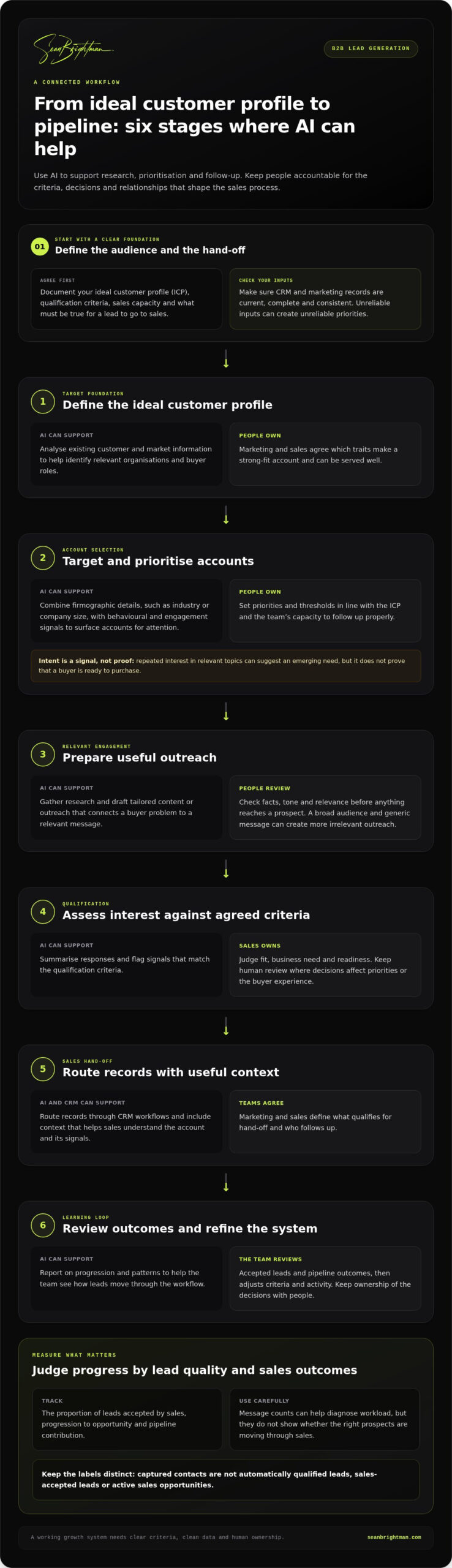
    Begin with a documented ideal customer profile (ICP): the organisations your business can serve well and the roles involved in buying. Use relevant firmographic details, such as industry or company size, alongside behavioural and engagement signals to prioritise accounts. Intent signals, such as repeated interest in relevant topics, can suggest that a need is emerging. They don’t prove a buyer is ready to purchase.

    Prioritisation must also reflect sales capacity. A long list of high-scoring accounts is no use if the team can’t follow up properly. AI can surface patterns and recommend where to focus; the team owns the ICP, the thresholds and decisions about where to spend its time.

    Turn research into relevant engagement and sales hand-offs

    Connect each AI task to a buyer problem and a clear next step in the workflow:

    • 1. Define the ICP: AI can help analyse existing customer and market information. Marketing and sales agree which traits make a strong-fit account.
    • 2. Target accounts: AI can combine firmographic, behavioural and engagement signals. The team sets priorities in line with sales capacity.
    • 3. Prepare engagement: AI can gather research and draft tailored content or outreach. A person checks facts, tone and relevance before anything reaches a prospect.
    • 4. Qualify interest: AI can summarise responses and flag signals against agreed criteria. Sales owns the judgement on fit, need and readiness.
    • 5. Hand off to sales: CRM workflows can route records and include useful context. Marketing and sales agree what qualifies for hand-off and who follows up.
    • 6. Learn and improve: AI can help report on progression and patterns. The team reviews accepted leads and pipeline outcomes, then adjusts criteria and activity.

    AI lead scoring is only as useful as the data behind it: inaccurate, incomplete or disconnected inputs produce unreliable priorities. CRM and marketing data provide useful context when fields mean the same thing across tools, records stay current and engagement can be linked to the right account. Otherwise, a score can look precise whilst pointing sales in the wrong direction.

    For a wider view of how AI choices fit into a growth system, read this AI consulting and scalable growth systems guide. A clear roadmap can align data, marketing and sales around shared priorities instead of adding another isolated workflow.

    Which AI lead-generation approach fits your B2B business?

    The right choice depends on the bottleneck you need to fix. Outbound agents, intent and account-based marketing (ABM) platforms, and AI-enabled marketing workflows solve different problems. None is automatically the best option. Match the tool to your sales motion, available data and capacity to follow up, then assess it by qualified opportunities and pipeline contribution.

    AI outbound agents versus intent and ABM platforms

    Outbound agents help research prospects and prioritise or personalise outreach. Intent and ABM platforms focus on account-level signals and activating campaigns around selected organisations. The first needs usable prospect data, a clear channel strategy and timely sales follow-up. The second needs a defined target-account list, reliable engagement data and coordination across marketing and sales. More channels or a larger contact database don’t prove that either approach will produce better-fit leads.

    AI-enabled marketing workflows connect tasks such as segmentation, content personalisation, lead routing and reporting across existing systems. They can suit teams whose main problem is a fragmented process, rather than a lack of outbound activity or account insight. For a wider view of workflow and systems fit, see the marketing operations growth-system guide.

    Approach Best-fit use case Data needed Human oversight CRM fit Success measures
    Outbound agents Scaling targeted prospect research and outreach Accurate contact and account records, ICP criteria, relevant buying context Review targeting, messages and replies; sales handles meaningful conversations Records activity and replies against the right contacts and accounts Sales-accepted leads, qualified meetings and opportunity progression
    Intent and ABM platforms Prioritising named accounts showing relevant engagement Target-account lists, account attributes and trustworthy intent or engagement signals Interpret signals, select accounts and coordinate campaign and sales action Connects account activity with marketing and sales records Target-account engagement, accepted opportunities and pipeline contribution
    AI-enabled marketing workflows Improving connected processes across segmentation, content, routing and reporting Consistent CRM and marketing data, shared definitions and process rules Approve important content and routing logic; review performance and refine the workflow Fits best when it works with existing records and hand-offs Lead quality, hand-off performance and progression through the pipeline

    Questions to use when comparing AI lead-generation tools

    Use these questions to test whether a platform fits how your team sells, not just how many features it offers:

    • Can it connect with your CRM, marketing data and reporting process without creating duplicate or disconnected records?
    • Can your team understand why it prioritises an account or recommends an action, then review and improve that output?
    • Does it measure sales-accepted leads and qualified opportunities, or mainly activity such as messages sent and contacts reached?
    • Is there a clear owner for follow-up, and can sales act on the signals the tool provides?

    For ai for b2b lead generation, choose the approach that closes a specific gap in your system. If your data, workflow and ownership aren’t ready, a platform may add complexity before it adds value.

    AI for B2B Lead Gen: Choosing and Building the Right System

    How to implement AI for B2B lead generation without creating more noise

    A successful AI pilot starts with a business problem, not a platform demo. For ai for b2b lead generation, the aim is to improve a defined part of the process and show whether it helps create better opportunities. Use a staged rollout so the team can identify weak data, unclear ownership or poor fit before scaling activity.

    Choose a narrow pilot with a measurable business outcome

    Pick one audience segment, one bottleneck and one repeatable workflow. For example, test whether AI-supported account research helps sales identify more suitable prospects within a chosen segment. Before launch, record a baseline using the same definitions and time period you’ll use to review the pilot.

    Work through the sequence:

    • 1. Diagnose the bottleneck: Find where relevant prospects are being missed, delayed or poorly qualified.
    • 2. Define the use case: Set a clear outcome, such as improving the share of leads accepted by sales.
    • 3. Map the data: Identify the inputs, CRM destination and fields the workflow depends on.
    • 4. Assign ownership: Name the marketing, sales or operations owner responsible for review, follow-up and measurement.
    • 5. Pilot and review: Set the human approval point, compare results with the baseline and record what needs adjusting.
    • 6. Scale selectively: Expand only when the workflow improves quality or progression without creating new hand-off problems.

    Keep measurement focused. Agree on a small set of indicators, such as sales acceptance, progression to qualified opportunity and pipeline contribution. Message volume or time saved can help explain what changed, but neither proves the pilot created better sales outcomes.

    Protect data quality, relevance and trust

    Before relying on AI outputs, review the records and rules that feed them. Check for duplicate or outdated contacts, inconsistent account details and conflicting definitions of a qualified lead. Document what the system should use and what it should ignore. Assign someone to correct recurring data issues, not just report them.

    Build human review into the workflow for factual claims, personalisation and generated communications. A person should be able to catch a wrong assumption or irrelevant message before it reaches a prospect. Before deploying AI-assisted outreach in the UK, have the writer verify current UK GDPR and PECR guidance rather than relying on assumptions about what is permitted.

    Implementation means aligning people and processes as well as connecting software. Sean Brightman’s AI consulting and roadmapping help businesses set direction for AI-powered marketing systems and build accountability around implementation. Explore the AI consulting service as part of planning a practical growth system.

    Make AI lead generation a growth system, not another disconnected tool

    AI creates value when it connects the parts of lead generation that teams often manage separately: the ideal customer profile, targeting, engagement, data, sales follow-up and revenue measurement. Add a tool without joining up those pieces and you risk creating another stream of activity nobody owns.

    What a joined-up AI lead-generation system needs

    Start with a shared operating model. Marketing and sales should agree who the business is trying to reach, what makes a lead qualified, when sales accepts it and how pipeline contribution is measured. AI can support research, prioritisation and repetitive work, but people need clear responsibility for approving important actions and following up on useful signals.

    Then review performance regularly. If targeting is off, qualification criteria are vague or hand-offs stall, fix the process before adding more automation. The goal of ai for b2b lead generation isn’t to connect every available platform. It’s to make the right work easier to repeat and improve.

    When strategic AI guidance is the right next move

    Strategic oversight can help when your team is dealing with tool sprawl, inconsistent targeting, unclear ownership or plenty of activity but little insight into pipeline impact. These are system problems, not always platform problems. A roadmap helps prioritise use cases, data and operating changes, then assigns measures and accountability so marketing, operations and sales work towards the same outcomes.

    Sean Brightman’s AI consulting and roadmapping help businesses set direction for AI-powered marketing systems and build accountability around implementation. Strategic brand roadmapping can connect growth activity to broader business direction. The focus is practical alignment, not a promise of guaranteed results.

    When scattered AI activity needs a clearer plan, explore strategic AI consulting and roadmapping.

    Turn AI activity into a stronger growth system

    AI won’t fix an unclear offer, poor targeting or disconnected sales processes. It can help your team work smarter when it supports a defined ideal customer profile, reliable data and a sales workflow people own.

    The right approach to ai for b2b lead generation depends on your bottleneck. Compare tools by their fit with your data, CRM and sales process, then test one focused use case against measures that show lead quality and pipeline progress. Scale what works and leave the noise behind.

    Sean Brightman’s AI consulting focuses on practical AI-powered growth engines and marketing efficiency. Strategic roadmapping creates direction, whilst advisory retainers provide ongoing accountability as priorities move into action.

    Ready to connect your AI choices to business goals? Build a practical AI lead-generation roadmap and give your team a clearer path from targeting to qualified opportunities. Start with the right foundations and build from there.

    Frequently Asked Questions

    How is AI used for B2B lead generation?

    AI supports B2B lead generation by helping teams research accounts, prioritise prospects, personalise content, assess qualification signals and report on results. For example, it can flag a target account showing relevant engagement or summarise a prospect’s needs for a sales hand-off. The team still defines the ideal customer profile, checks important outputs and decides which opportunities need human follow-up. AI works best when its tasks connect to a clear sales process.

    Can AI generate qualified B2B leads automatically?

    AI can identify and score potential leads automatically, but a score alone doesn’t make someone qualified. Qualification depends on criteria the business sets, such as fit with its target market, a relevant need and readiness for a sales conversation. Automated systems can miss context or rely on inaccurate data. Keep a human review point before important hand-offs, and track whether sales accepts and progresses the leads the system surfaces.

    Which AI tools are best for B2B lead generation?

    The best tool depends on the bottleneck. Outbound agents support prospect research and personalised outreach; intent and account-based marketing platforms help prioritise target accounts using engagement signals; AI-enabled marketing workflows connect tasks such as segmentation, routing and reporting. Compare options by the data they need, fit with your CRM, human review controls and ability to measure qualified opportunities. A larger feature set isn’t useful if the tool doesn’t fit your sales process.

    How can AI personalise B2B outreach without making it sound generic?

    Give AI specific, relevant context, such as the prospect’s role, organisation and a genuine business issue connected to your offer. Use it to prepare a draft, not to manufacture familiarity or make unsupported claims. A person should check the research, tone and relevance before sending. Keep the message focused on one useful reason to start a conversation. If the personalisation could apply to any organisation, it isn’t personal enough.

    How do you measure AI lead-generation performance?

    Measure whether AI improves lead quality and sales progression, not just how much activity it produces. Agree definitions for qualified leads, sales-accepted leads and pipeline opportunities before testing. Then compare results with a baseline, using a focused set of measures such as sales acceptance, progression to opportunity and pipeline contribution. Message volume and time saved can provide context, but they don’t show whether the system is creating valuable opportunities.

    Is AI-generated B2B outreach compliant in the UK?

    Using AI doesn’t remove the need to consider UK data-protection and electronic-marketing rules. The relevant requirements can depend on the personal data used, recipient and communication channel. Before launching outreach, check current Information Commissioner’s Office guidance on UK GDPR and PECR for your specific activity, and seek specialist advice where needed. Build review into the process so people can check data use, message content and the handling of objections or requests to stop contact.

    How should a B2B company start using AI for lead generation?

    Start by identifying one lead-generation bottleneck, then define the audience, workflow and business outcome you want to improve. Check that the data is usable, assign owners across marketing and sales, and set a baseline before running a focused pilot. Include a human review point and measure lead acceptance or pipeline progression. Sean Brightman’s AI consulting and roadmapping help businesses set direction for practical AI-powered growth systems and ongoing accountability.

  • AI Implementation for Marketing: Build a Growth Engine, Not a Toy Box

    AI Implementation for Marketing: Build a Growth Engine, Not a Toy Box

    Your marketing department is currently a cluttered toy box of disconnected subscriptions. You’ve bought the hype, but you haven’t bought the results. Most businesses treat AI implementation for marketing as a frantic shopping spree rather than a strategic build. It’s a costly mistake that leads to messy data and a team that’s busy but never productive. You’re paying for the promise of automation whilst your actual growth remains stuck in the mud.

    I know the frustration. It’s exhausting to manage a dozen different logins that don’t talk to each other. You want a high-performance engine, not a collection of digital gadgets. I’m going to show you how to bin the tool fatigue and build a system that actually moves the needle. We’re stripping away the corporate fluff to focus on the hard architecture required for measurable growth.

    We are moving beyond the era of simple chatbots. We’ll look at how to deploy agentic AI that orchestrates campaigns from start to finish. You’ll learn how to organise your data, set a clear roadmap, and finally turn your AI spend into a functional asset that delivers real ROI. It’s time to stop playing with toys and start building a machine.

    Key Takeaways

    • Stop treating AI as a shopping list of gadgets and start viewing it as a strategic integration of intelligence into your core business workflows.
    • Understand the “Growth Engine” architecture, moving from messy data silos to a structured system of intelligence and automated execution.
    • Learn how to execute a professional AI implementation for marketing by following a 5-step roadmap that aligns infrastructure with your growth goals.
    • Identify why clean, organised data is the non-negotiable fuel for any AI system and how to audit your current stack to remove “garbage in” risks.
    • Recognise why senior human leadership is essential to pilot these systems, ensuring AI serves your strategy rather than distracting from it.

    The AI Toy Box Trap: Why Most Implementations Fail

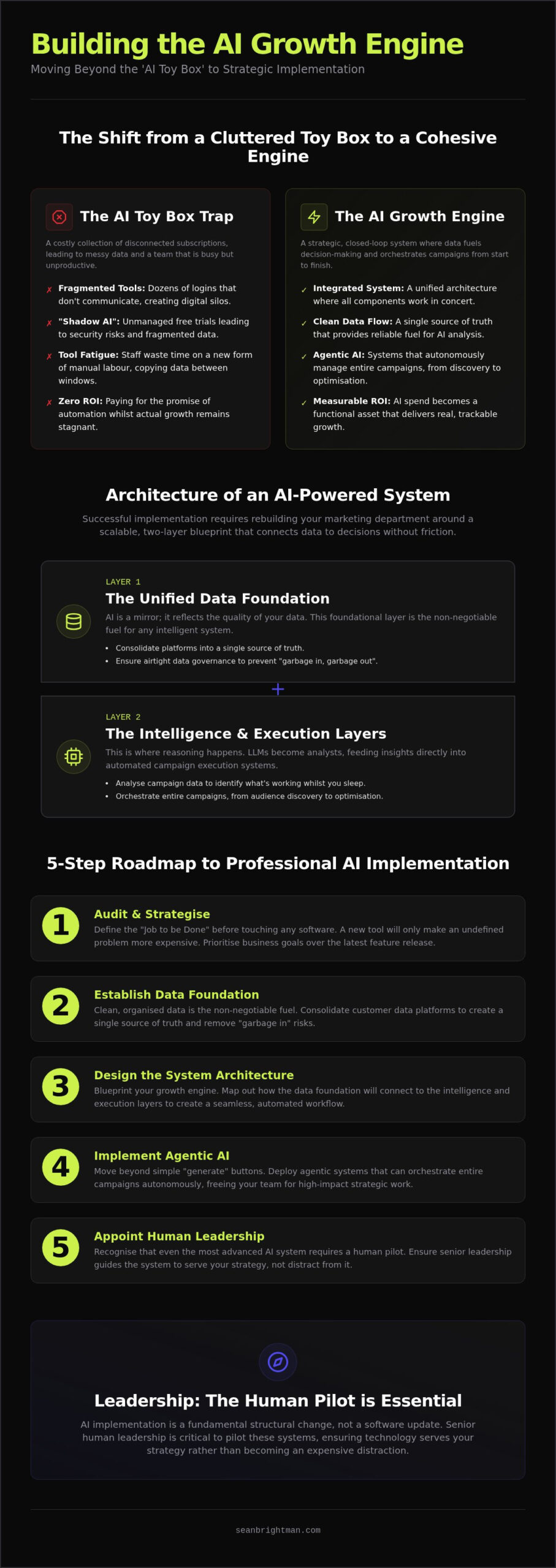
    Most marketing leaders are currently building a toy box. They buy shiny tools because they’re afraid of being left behind. This isn’t strategy; it’s panic buying. True AI implementation for marketing is the strategic integration of intelligence into your existing business workflows. It’s about machinery, not magic. If you’re just adding a “generate” button to a broken process, you haven’t solved anything. You’ve just made the mess faster.

    To understand the scope of the problem, we must look at Artificial intelligence in marketing as a cycle of collecting data, reasoning through it, and acting on the insights. If you just buy a tool to write emails, you’ve skipped the collection and reasoning. You’ve bought a faster way to produce mediocre work. You’re treating AI as a standalone gadget rather than a functional component of your growth engine.

    Then there’s the risk of “shadow AI”. This is where your team signs up for twenty different free trials using their corporate emails. You end up with unmanaged tools, fragmented data, and a massive security headache. You’re paying for novelty whilst your ROI sits at zero. It’s a toy box trap. You have the gadgets, but you don’t have a system. Without a unified strategy, these tools become expensive distractions that pull your team away from high-impact work. Professional AI consulting services exist precisely to prevent this pattern from taking hold and costing you far more than the tools themselves.

    The Symptoms of Tool Fatigue

    Tool fatigue doesn’t happen overnight. It creeps in. You’ll notice your team has three different subscriptions that all perform the same basic tasks. None of them talk to your CRM. Your staff spends their mornings manually copying text from one window to another. This isn’t automation; it’s just a new form of manual labour. They’re spending more time playing with clever prompts than they are driving actual leads. If your team is more excited about what the tool can do than what it is doing for your bottom line, you’re in the trap.

    Strategy vs. Software: The Critical Distinction

    A software subscription is not a marketing strategy. It’s an expense. Before you touch a single piece of software, you need to define the Job to be Done. What specific bottleneck are you trying to clear? If you can’t name the problem, a new tool will only make the mess more expensive. AI implementation for marketing is a fundamental structural change to your department, not a simple software update. It requires a roadmap that prioritises your business goals over the latest feature release. You need a system that works whilst you sleep, not a toy that requires constant supervision.

    The Architecture of AI-Powered Marketing Systems

    Stop buying apps. Start building a machine. A growth engine isn’t a collection of disparate parts; it’s a closed-loop system where data fuels decision-making. Most businesses fail because they try to bolt AI onto the outside of their department. Successful AI implementation for marketing requires you to strip the department down to its chassis and rebuild it for speed. You need a blueprint that connects your data to your decisions without manual friction.

    In 2026, the trend has shifted from using AI for isolated tasks to “agentic AI.” These are systems that can orchestrate entire campaigns from audience discovery to real-time optimisation. If your tools don’t talk to each other, you don’t have an engine. You have a pile of scrap metal. To win, you must organise your architecture into three distinct, interconnected layers.

    Layer 1: The Unified Data Foundation

    AI is a mirror. If you feed it fragmented, messy data, it will reflect that chaos back at you in your results. You need a single source of truth for customer behaviour. This means consolidating your customer data platforms and ensuring your data governance is airtight. With Google’s July 2026 update to its Ads Terms of Service, the platform now uses automated features to generate targets and destinations by default. If your internal data is weak, you’re letting Google’s algorithms guess your strategy. Building this plumbing is complex, which is why many senior leaders hire a marketing operations consultant to ensure the foundation is scalable and secure.

    Layer 2: The Intelligence and Execution Layers

    The middle layer is where the reasoning happens. LLMs are not just for writing blogs; they are your primary analysts. They should be parsing campaign data to identify what’s working whilst your team sleeps. This layer must feed directly into your execution layer. The future of marketing isn’t about humans doing the work. It’s about humans setting the parameters. You must automate the feedback loop between campaign results and strategic adjustments. This ensures your brand consistency remains intact amongst thousands of automated outputs.

    When these layers are aligned, you see the real impact. Companies using AI for marketing in 2026 report an average ROI improvement of 35%. This isn’t a coincidence. It’s the result of a mechanical system that removes human bottlenecking. If you’re ready to stop guessing and start building, a strategic AI roadmapping session is the first step toward a functional engine.

    Data Readiness: Preparing Your Business for Intelligence

    If your data is a bin fire, your AI will be a blowtorch. It will simply burn through your budget faster. The “Garbage In, Garbage Out” principle is the absolute law of AI implementation for marketing. You cannot automate chaos. Most businesses are sitting on “Big Data” that is actually just a massive pile of unorganised noise. It’s vanity. You need “Clean Data”. This means precise, connected, and actionable information that a machine can actually interpret to drive growth.

    Auditing your data silos is the first step. These are the pockets of information trapped in your CRM, your email platform, and your spreadsheets that don’t talk to each other. Silos are where ROI goes to die. You must bridge these gaps to create a unified view of the customer. In the UK, this isn’t just about efficiency; it’s about survival. With the EU AI Act transparency rules in effect as of August 2, 2026, you must be able to track, label, and justify your use of AI-generated content. Privacy isn’t a hurdle. It’s a critical component of the engine’s safety system.

    The Marketing Efficiency Audit

    You need to find the waste. A proper audit identifies where your team is burning hours on repetitive tasks that add no value. Look for the manual data entry. Look for the “copy-paste” cycles. This is where you’ll find the hidden profit. By identifying these bottlenecks, you can pinpoint exactly where AI implementation for marketing will provide the most immediate relief. The goal is to free your senior talent from the machinery so they can focus on the future of marketing strategy rather than the maintenance of spreadsheets.

    Standardising Workflows for AI Integration

    AI cannot follow a “vibe”. It needs a process. You must create repeatable, documented workflows that an AI agent can execute without human hand-holding. This means moving away from “how we’ve always done it” toward rigorous SOPs. These documents are the instructions for your new digital workforce. Without them, your implementation will stall. Think of the AI marketing roadmap as your master blueprint. It defines the sequence of operations required to turn your messy data into a high-performance growth engine that actually scales.

    AI Implementation for Marketing: Build a Growth Engine, Not a Toy Box

    A 5-Step Roadmap for AI Implementation for Marketing

    Strategy is a sequence. Implementation is a process. If you skip the order, you break the machine. Most businesses fail because they start at step four. They jump straight into software integration without checking if their infrastructure can handle the load. A professional AI implementation for marketing follows a logical, cold-blooded progression from goal to execution. You don’t build a house by picking the wallpaper first. You dig the foundations.

    • Step 1: Strategic Alignment. Define your growth goals. Don’t ask what AI can do; ask what your business needs to achieve. If you can’t articulate how AI will increase your margin or reduce your acquisition costs, don’t start.
    • Step 2: Infrastructure Audit. Assess your data and tools. We’ve already established that messy data kills ROI. Fix the plumbing before you turn on the taps. This is where you identify which legacy systems are holding you back.
    • Step 3: High-Impact Use Case Selection. Pick the low-hanging fruit. Focus on the bottlenecks that slow down your senior talent. You want victories that prove the concept quickly.
    • Step 4: Pilot and Integration. Build the first automated workflows. Start small. Prove the logic. You are looking for a “plug-and-play” victory that builds momentum for the larger rollout.
    • Step 5: Scaling and Accountability. Monitor the engine performance. Ensure the system remains aligned with your strategic direction. This is where you audit the AI implementation for marketing to ensure it hasn’t drifted into a series of expensive, disconnected tasks.

    Selecting Your First Use Cases

    Ignore the hype around creative AI. Writing a poem won’t fix your conversion rate. You should start with “boring” automations that clear the deck. Think lead scoring, competitor intelligence, or reporting automation. These are the tasks that eat 80% of your team’s time but deliver 20% of the value. Apply the 80/20 rule. Automate the repetitive labour first. This frees your people to do the high-level thinking that a machine can’t replicate. It’s about tactical precision, not novelty.

    Measuring ROI and Strategic Velocity

    Time saved is a vanity metric. Revenue generated is the only number that matters. If your AI isn’t moving the needle on growth, it’s a toy. You need to track strategic velocity; how fast your department moves from insight to action. This requires ongoing oversight to prevent “tool creep” from setting in again. Many CEOs use a marketing advisory retainer to maintain this accountability. It ensures the engine stays tuned and the strategy remains sharp amongst the noise of constant technological shifts. If you want to stop playing and start scaling, book a strategic roadmapping session to define your path.

    Leadership: Why AI Implementation Needs a Human Pilot

    AI is a force multiplier, not a replacement for judgment. If you leave your marketing to an algorithm, you’ll end up with a vanilla brand that sounds exactly like your competitors. Successful AI implementation for marketing requires a human pilot who understands the ‘why’ behind the ‘what’. Machines are excellent at execution but useless at strategy. They can’t feel the market. They can’t understand the subtle shifts in buyer behaviour that happen in a boardroom. You need a senior strategist to set the parameters, or you’re just automating your descent into irrelevance.

    The Fractional CMO as AI Architect

    You don’t need to make a £120k hiring mistake to get this right. Many CEOs think they need a full-time heavyweight to manage this transition. They don’t. A fractional CMO provides the senior-level architecture you need without the eye-watering overhead. They act as the master engineer who builds the growth engine and then trains your team to run it. This ensures your AI implementation for marketing stays locked onto your high-level brand positioning. AI can generate a thousand headlines in seconds, but it takes a human expert to know which one actually captures your brand’s soul. You are buying expertise, not just more hours in a chair.

    Accountability and Long-Term Strategy

    Accountability is the fuel of this machine. Who owns the AI roadmap when the initial setup is done? A roadmap is useless if it gathers digital dust on a shared drive whilst your team reverts to old habits. You must build internal capabilities whilst leveraging external expertise. This is about knowledge transfer. The goal is a plug-and-play system that your current team can manage with total confidence. You’re building a functional asset for the business, not a permanent dependency on an outside consultant. You need order, not more complexity.

    This is about strategic velocity. It’s about moving faster than your rivals whilst maintaining a level of creative quality they can’t touch. You’ve seen the architecture. You’ve heard the warnings about the toy box trap. Now it’s time to pull the trigger. Don’t wait for your team to “figure it out” amongst their daily tasks. They’re already at capacity. Book an AI roadmapping session today to start building a growth engine that actually scales.

    Ignite Your Growth Engine

    The choice is simple. You can continue collecting expensive digital gadgets, or you can build a machine that delivers measurable growth. AI implementation for marketing isn’t a software update; it’s a structural revolution. You’ve seen the blueprint. You know that clean data is the only fuel that matters and that a “Human in the Loop” is the only way to maintain strategic control. Without order, your AI spend is just a tax on your indecision.

    I don’t do corporate fluff. I build high-performance engines. As a battle-hardened Fractional CMO and author of the definitive guide on marketing strategy, I provide the direct, no-fluff advisory required to turn chaotic tools into a unified system. We’ll strip away the distractions and focus on the architecture that actually moves the needle. Your team is ready for a roadmap. They just need the architect to draw it.

    It’s time to stop the tool fatigue and start the expansion. Build your AI growth engine with a strategic roadmap. Let’s get to work.

    Frequently Asked Questions

    How much does AI implementation for marketing typically cost?

    The total investment for AI implementation for marketing depends on your current scale and infrastructure. In 2026, research shows that small to medium-sized businesses typically spend between $900 and $2,700 per month on AI tools alone. However, the real cost isn’t the software; it’s the strategic integration. You are paying to move from a cluttered toy box to a functional machine. Investing in a roadmap early prevents you from wasting thousands on overlapping subscriptions that don’t talk to each other.

    Do I need to hire an AI specialist to manage these systems?

    You don’t need a dedicated AI specialist; you need a strategist who knows how to use the tools. Hiring a full-time specialist is often a £120k mistake for most businesses. A Fractional CMO can architect your system and train your existing team to operate the machinery. It’s about mechanical integration into your current workflows, not adding more headcount to a department that already lacks order.

    What is the first tool I should buy for my marketing team?

    The first tool you should buy is actually none at all. You must audit your data foundation first. If you buy software before you have a strategy, you’re just adding to the noise. Once your data is organised, start with a high-level LLM for analysis rather than content generation. Focus on the tools that clear bottlenecks, not the ones that create more creative work for your editors.

    How do I ensure AI-generated content doesn’t hurt my brand?

    Maintain brand integrity by keeping a “Human in the Loop” for every output. AI is a force multiplier, not a creative director. You must establish rigorous brand guidelines and use AI for the heavy lifting whilst humans handle the final polish. This prevents your brand from becoming vanilla and ensures you comply with the July 2026 FTC double disclosure mandates for AI content.

    Can AI really replace a full-time marketing manager?

    AI replaces repetitive tasks, not leaders. It can handle lead scoring, competitor intelligence, and reporting automation, but it cannot handle boardroom strategy or complex relationship building. It makes your marketing manager more effective by removing the manual labour from their day. It changes the job description from “doer” to “pilot”. Your manager stays; the busywork goes.

    What is an AI marketing roadmap and why do I need one?

    An AI marketing roadmap is the foundational document that defines your strategic sequence. It’s the blueprint for your growth engine. You need it to ensure every tool you buy and every workflow you automate serves a specific growth goal. Without it, you are just panic buying software. It provides the order and accountability required to move from tool fatigue to measurable growth.

    How long does it take to see ROI from AI implementation?

    You’ll see ROI in two stages: immediate efficiency and long-term revenue growth. Time savings on “boring” automations happen in the first month. Revenue growth typically follows within 3 to 6 months as your team focuses on high-impact strategy. In 2026, companies report an average ROI improvement of 35% after full integration. The faster you reclaim senior hours, the faster the engine pays for itself.

    Is my business too small for professional AI consulting?

    If you have a marketing budget, you are large enough for professional consulting. Small businesses often suffer the most from tool fatigue because they lack the time to vet every subscription. Consulting isn’t an overhead; it’s a preventative measure. It stops you from building a toy box and ensures your limited budget is spent on a high-performance growth engine from day one. A structured approach to AI consulting services gives even lean teams the strategic architecture they need to compete without wasting budget on disconnected tools.