Tag: B2B Marketing

  • Why Is My Marketing Not Generating Leads? The Systemic Fix for 2026

    Why Is My Marketing Not Generating Leads? The Systemic Fix for 2026

    Your marketing team is busy, but your pipeline is empty. Activity is not achievement. You’re likely tired of seeing “green arrows” on activity reports whilst your revenue remains flat. You’ve spent thousands on ads that don’t convert and agencies that deliver “brand awareness” instead of buyers. You’re constantly asking yourself why is my marketing not generating leads when everyone seems so productive. It’s a common, expensive trap.

    This isn’t about minor tweaks or the latest social media hack. We’re here to stop you from chasing tactical ghosts. You’ll learn how to strip away the fluff and fix the strategic rot that is currently killing your lead flow. It’s about building a functional system that works, not just a department that spends. This is the difference between hope-based marketing and a predictable growth engine.

    We’ll break down the systemic failures in your marketing engine and show you how to build a high-accountability framework for 2026. It’s time for strategic clarity and a reliable pipeline, not more empty busywork.

    Key Takeaways

    • Activity is not achievement. Stop mistaking vanity metrics and “busy” marketing reports for the actual revenue-generating work that drives growth.
    • Identify the systemic rot by answering the core question: why is my marketing not generating leads? We’ll expose the positioning failures and high-friction buyer journeys killing your pipeline.
    • Ditch the tactical guesswork. Discover why you need a brutal diagnostic audit of your marketing machinery instead of simply “tweaking” your ad spend or changing agencies.
    • Master the growth engine. Learn how to implement a Strategic Brand Roadmap that turns generic messaging into a sharp, winning aspiration that converts.
    • Bridge the leadership gap. Understand how a Fractional CMO provides the senior-level architecture and accountability required to fix a lead drought without the overhead of a full-time hire.

    Why “Busy” Marketing Is Failing to Generate Leads in 2026

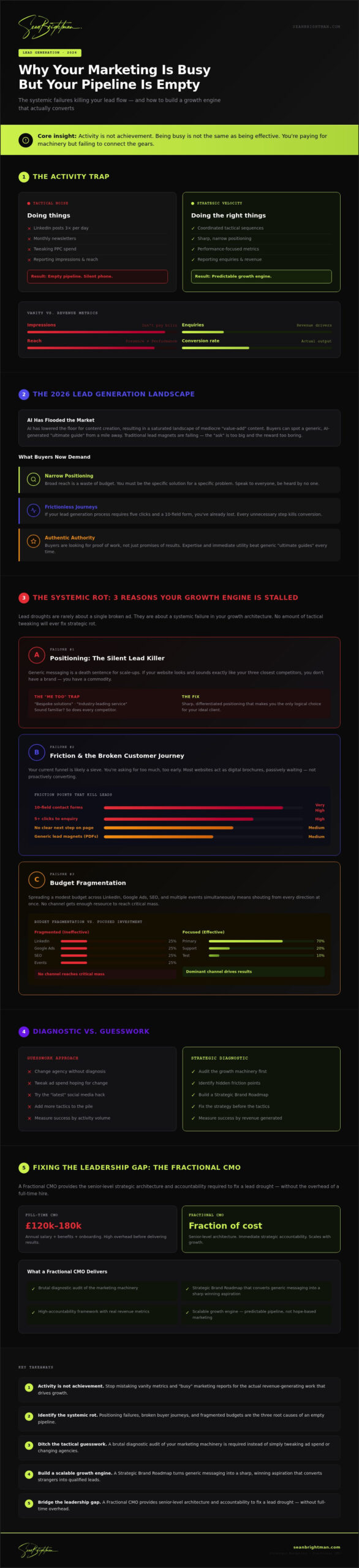
    Your marketing department is a hive of activity. They are posting on LinkedIn three times a day. They are tweaking the PPC spend. They are sending monthly newsletters. Yet, the phone is silent. This is the Activity Trap. It’s the dangerous assumption that being busy is the same as being effective. In reality, you are just making noise. Visibility is not a strategy; it’s a byproduct of one.

    If you’re constantly wondering why is my marketing not generating leads, the answer usually lies in the difference between tactical noise and strategic velocity. Noise is doing things. Velocity is doing the right things in a coordinated sequence that moves the needle. Most UK businesses are currently vibrating in place, spending money on “presence” whilst their competitors are focused on “performance.”

    The Activity vs. Results Paradox

    Metrics often lie. If your team is providing reports filled with “impressions” and “reach,” they are handing you a vanity project, not a revenue report. Impressions don’t pay the bills. Enquiries do. When marketing is uncoordinated, you end up with a collection of random acts of marketing. Each tactic might look good in isolation, but they don’t connect to form a functional growth engine.

    Business owners often confuse movement with progress. They see a social media feed full of content and assume the leads will follow. They won’t. Without a clear strategic backbone, your marketing is just a series of expensive experiments. You’re paying for the machinery but failing to connect the gears. This lack of coordination creates a messy, fragmented brand experience that confuses potential buyers rather than converting them.

    The 2026 Lead Generation Landscape

    The market has shifted. In 2026, AI has lowered the floor for content creation, resulting in a saturated landscape of mediocre “value-add” content. Consumer expectations have skyrocketed. They can spot a generic, AI-generated “ultimate guide” from a mile away. Traditional lead magnets are failing because the “ask” is often too big or too boring for the reward offered. People don’t want more PDFs; they want expertise and immediate utility.

    • Narrow Positioning: Broad reach is a waste of budget. You need to be the specific solution for a specific problem.
    • Frictionless Journeys: If your lead generation process requires five clicks and a 10-field form, you’ve already lost.
    • Authentic Authority: Buyers are looking for proof of work, not just promises of results.

    The shift from broad reach to narrow positioning is no longer optional. If you try to speak to everyone, you end up heard by no one. To fix a lead drought, you must stop shouting into the void and start engineering a precise path for your ideal customer to follow.

    The Systemic Rot: Three Reasons Your Growth Engine Is Stalled

    Lead droughts are rarely about a single broken ad. They are about a systemic failure in your growth architecture. If you are staring at a revenue flatline and asking why is my marketing not generating leads, you need to look at the machinery, not just the paint job. Most businesses are suffering from strategic rot that no amount of tactical tweaking will ever fix.

    Positioning: The Silent Lead Killer

    Generic messaging is a death sentence for scale-ups. If your website looks and sounds exactly like your three closest competitors, you don’t have a brand; you have a commodity. This is the “Me Too” trap that plagues British B2B marketing. You claim to provide “bespoke solutions” and “industry-leading service.” So does everyone else. Positioning is the foundation of the engine. If that foundation is soft, the entire structure will eventually collapse under the weight of your ad spend.

    Friction and the Broken Customer Journey

    Your current funnel is likely a sieve. You are asking for too much, too early. Most websites act as digital brochures, passively waiting for someone to find a “Contact Us” page. A brochure is a static document. A salesperson is a proactive closer. If your path from stranger to qualified lead isn’t mapped with precision, you are losing prospects at every turn. You need to identify where the friction is high and the motivation is low. Often, a strategic efficiency audit is the only way to diagnose these hidden disconnects before they drain your remaining budget.

    Fragmentation is the final nail. Spreading a modest budget across LinkedIn, Google Ads, SEO, and three different events means you are shouting in ten rooms but heard in none. You end up with a collection of weak signals rather than one dominant voice. Finally, there is the issue of accountability. If your marketing team is only responsible for “activity” and not “revenue,” they will keep providing activity reports whilst the business starves. You need a single point of failure. Someone must own the revenue target, not just the social media calendar. You end up asking why is my marketing not generating leads whilst your team celebrates a minor increase in vanity impressions.

    Diagnostic vs. Guesswork: Why Tactics Won’t Save You

    Changing your ad creative won’t fix a broken business model. Swapping your headline colour won’t save a product nobody wants. If you’re stuck wondering why is my marketing not generating leads, stop looking for a “magic button” in your Meta Ads Manager. Tactics are the fuel; strategy is the engine. If the engine is seized, adding more fuel just creates a puddle of expensive, flammable waste.

    Most UK businesses are trapped in a cycle of tactical guesswork. They jump from one “guru” advice to the next, hoping for a breakthrough. It’s an exhausting, expensive way to fail. You don’t need a new agency to try the same failed tactics with a different logo. You need a diagnostic audit to find out where the machinery is actually broken. Guessing is for amateurs; diagnostics are for leaders.

    The High Price of Tactical Guesswork

    Trial and error is the most expensive way to build a brand. Every “test” that lacks a strategic hypothesis is just gambling with your payroll. Agencies love it when you don’t have a strategy. It allows them to hide behind activity reports and vague promises of “long-term growth” whilst your bank balance drains. They get paid for the work; you only get paid for the results.

    There is a massive difference between a daily to-do list and a strategic brand roadmapping session. One is a list of chores. The other is a high-impact architectural plan. A roadmap defines the “why” and “how” before a single pound is spent on the “what.” It stops the “One More Tool” mentality where businesses buy expensive CRM software or AI bots to fix problems that are actually rooted in poor positioning.

    Finding the Real Bottleneck

    You need to know if you have a traffic problem or a conversion problem. They require completely different fixes. Throwing more traffic at a site that doesn’t convert is like pouring water into a bucket with no bottom. It’s a waste of resources. Senior leadership is about identifying these bottlenecks with clinical precision rather than guessing based on gut feeling. You need to look at the data, not the decorations.

    Senior oversight turns “I think” into “I know.” It moves marketing from a dark art into a predictable operation. By using data-led roadmaps, you can see exactly where prospects are dropping off. Is the messaging failing? Is the offer weak? Is the follow-up non-existent? When you stop guessing and start diagnosing, the question of why is my marketing not generating leads finally gets an actionable answer. You stop chasing ghosts and start building a growth engine that actually scales.

    Why Is My Marketing Not Generating Leads? The Systemic Fix for 2026

    Building a Scalable Growth Engine That Actually Converts

    Stop playing whack-a-mole with your tactics. You need a system that produces leads as a predictable output, not a lucky accident. The first move is to stop the bleeding. You must conduct a brutal marketing efficiency audit to identify where your budget is being incinerated. This isn’t a gentle review; it’s a forensic investigation into your spend versus your actual returns. It’s about finding the leak before you try to increase the pressure.

    Once you’ve cleared the debris, you must define your “Winning Aspiration.” This is your specific, high-stakes goal that separates you from the generic crowd. Then, integrate an AI consulting framework to handle the heavy lifting. In 2026, AI has fundamentally changed lead behaviour. Buyers expect instant, personalised responses and predictive content. If your system isn’t processing intent data in real time, you’ll continue asking why is my marketing not generating leads whilst your faster competitors mop up the market.

    Architecture Over Activity

    Marketing should be a machine, not a series of manual chores. You need to design systems that run without constant CEO intervention. In 2026, lead generation and nurturing are increasingly automated through intelligent workflows that adapt to user behaviour. However, tools must always follow strategy. If you buy a new CRM to fix a lack of leads without a strategy, you’ve just automated your failure. You need architecture, not more software subscriptions. Design the machine first; then choose the components.

    This shift requires a move from generic broad-reach tactics to high-precision engineering. You are no longer just “doing marketing.” You are building a functional component of your business’s revenue machinery. This machinery must be integrated, not siloed. When your sales and marketing data flow through a single, AI-enhanced centre, you gain the strategic velocity needed to outpace the market.

    The Power of Accountability

    Most marketing teams are busy doing things. You need them delivering results. This requires setting KPIs that actually matter to your bottom line, like cost per qualified lead and sales velocity, not just website clicks. This is where a marketing advisory retainer becomes essential. It provides the necessary external force to keep the engine running at high speed. It’s about moving from “doing” to “delivering.”

    Accountability is the difference between a department that spends and a department that earns. Without it, you are just funding a creative hobby. You need a partner who isn’t afraid to challenge the status quo and demand performance. To start building a high-impact system that actually scales, explore the senior leadership options available through Sean Brightman’s fractional advisory services.

    Fixing the Leadership Gap: The Fractional CMO Solution

    You don’t need a full-time executive to fix a temporary lead drought. You need a specialist who can diagnose the rot and rebuild the engine. Most UK scale-ups hire mid-level marketers and expect senior-level results. It’s a mismatch that leads to wasted budget and frustration. When you ask why is my marketing not generating leads, you are usually looking at a tactical symptom of a leadership void.

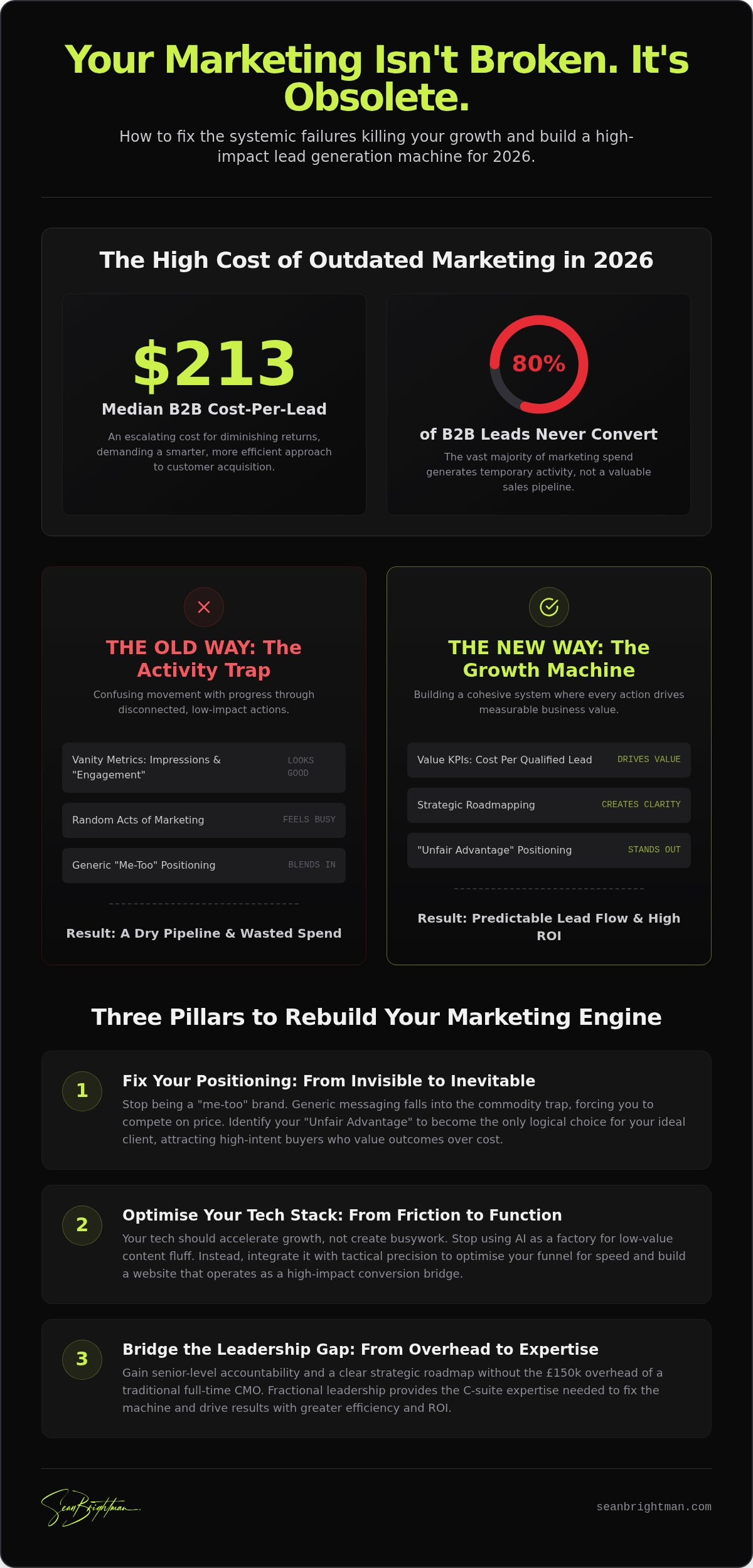
    A fractional CMO acts as a plug-and-play growth architect. You get the strategic heavy lifting of a seasoned professional without the £150k+ annual overhead of a full-time hire. It’s about buying the outcome, not the person’s full-time presence. You need a fixer, not a permanent resident. This approach allows you to inject senior-level direction exactly where it is needed most, right now.

    Senior Strategy, Fractional Commitment

    Mid-level hires often focus on the “how” before they’ve mastered the “why.” They are great at execution but struggle with high-level positioning and systemic integration. They manage the social media calendar whilst the pipeline starves. A battle-hardened expert, however, has seen your specific failure pattern dozens of times. They bring order to internal complexity by stripping away the fluff and focusing on the critical levers that drive revenue. They don’t need hand-holding; they provide the direction.

    Fractional leadership is designed for speed. There is no corporate politeness or ego to navigate. The focus is entirely on strategic velocity. We identify the bottlenecks, realign the team, and ensure every pound spent is an investment in a measurable lead. It’s about moving from a department that costs money to an asset that generates it.

    Your Next Move

    Is your business ready for this shift? If you have a product that works but a pipeline that doesn’t, you have a leadership gap. The first 30 days of a strategic turnaround focus on the forensic diagnostic audit. We identify the leaks, terminate the vanity projects, and realign the messaging with your winning aspiration. By day 60, we are testing the new architecture. By day 90, the engine is rebuilt and the leads are flowing consistently.

    Stop guessing and start growing. You’ve spent enough time chasing tactical ghosts and wondering why is my marketing not generating leads whilst your competitors take your market share. It’s time to install a professional growth engine that delivers predictable, scalable results. The fix is systemic. The leadership is fractional. The impact is total.

    Stop Guessing and Start Engineering Growth

    Activity reports are a smokescreen for strategic failure. If you’re still asking why is my marketing not generating leads, it’s time to stop looking at the ads and start looking at the architecture. A broken engine isn’t fixed with a fresh coat of paint. It requires a forensic audit, a sharp winning aspiration, and a high-accountability framework that delivers revenue. Tactics are the fuel, but without a functional engine, you’re just pouring money onto the pavement.

    With over 20 years of senior marketing leadership and a focus on AI-powered growth engines, I’ve seen these patterns across the UK market. As the author of “The Growth Engine,” I specialise in stripping away the fluff to build systems that work whilst others are still chasing vanity metrics. You don’t need more busywork; you need a predictable pipeline that scales with your ambition. It’s time to move from hope-based marketing to clinical execution.

    Ready to build a predictable pipeline? Book a Strategic Roadmap session to fix your lead flow. Your growth engine is waiting. Let’s get to work.

    Frequently Asked Questions

    Why is my Facebook/LinkedIn ad spend not resulting in leads?

    You’re likely treating a platform as a strategy. Ad spend fails when you run generic “me too” messaging without a specific winning aspiration. If your ads don’t address a narrow problem for a narrow audience, the algorithm can’t save you. You’re paying for impressions whilst ignoring the conversion architecture. Stop buying traffic for a destination that doesn’t work.

    How long does it take to fix a broken marketing strategy?

    You can stop the bleeding in 30 days and see a total turnaround in 90. The first month is forensic diagnostics to terminate vanity projects and realign positioning. By month two, we test the new architecture. By month three, the engine is rebuilt. It’s about strategic velocity and clinical execution, not endless tactical tweaking.

    What is the difference between a marketing agency and a fractional CMO?

    An agency sells services; a fractional CMO sells leadership. Agencies want to sell you more social posts, ad management, or SEO packages. A fractional CMO builds the growth architecture and holds the entire team accountable for revenue. One is a tactical vendor; the other is a battle-hardened strategist who owns the results.

    How much should I be spending on lead generation in the UK?

    Your spend should be dictated by your growth targets and customer acquisition costs, not a random industry average. Many UK scale-ups fail because they fragment a modest budget across too many channels. Instead of asking for a flat figure, ask what it costs to dominate your specific niche. Don’t spread yourself thin; concentrate your force to win.

    Can AI actually help with lead generation or is it just hype?

    AI is a functional component, not a magic button. In 2026, it’s essential for processing intent data and personalising buyer journeys in real time. It removes manual friction from your growth engine. However, if your strategy is rotten, AI just helps you fail faster. Use it for mechanical efficiency, but never for the core strategic thinking.

    Do I need to hire a full-time marketing manager to get leads?

    No, a mid-level hire often lacks the senior-level authority to fix systemic rot. They focus on the “how” whilst the “why” remains broken. A fractional CMO provides high-impact direction without the £150k+ overhead of a full-time executive. You need senior-level architecture and accountability to solve the problem of why is my marketing not generating leads.

    What are the most common friction points in a B2B sales funnel?

    The “ask” is almost always too big, too early. Most B2B funnels fail because they treat a first-time visitor like a buyer ready to close. Other friction points include slow response times, generic content, and complex forms. If your website acts as a static brochure rather than a proactive salesperson, your leads will continue to fall through the cracks.

    How do I know if my marketing team is the problem?

    Your team is the problem if they provide activity reports instead of revenue reports. If they celebrate “reach” and “engagement” whilst your pipeline is empty, there’s a fundamental lack of accountability. Often, the team isn’t incompetent; they are just leaderless. They are busy doing things, but nobody has told them which things actually drive the bottom line.

  • How to Build a Marketing Strategy Roadmap That Actually Drives Exit-Ready Growth

    How to Build a Marketing Strategy Roadmap That Actually Drives Exit-Ready Growth

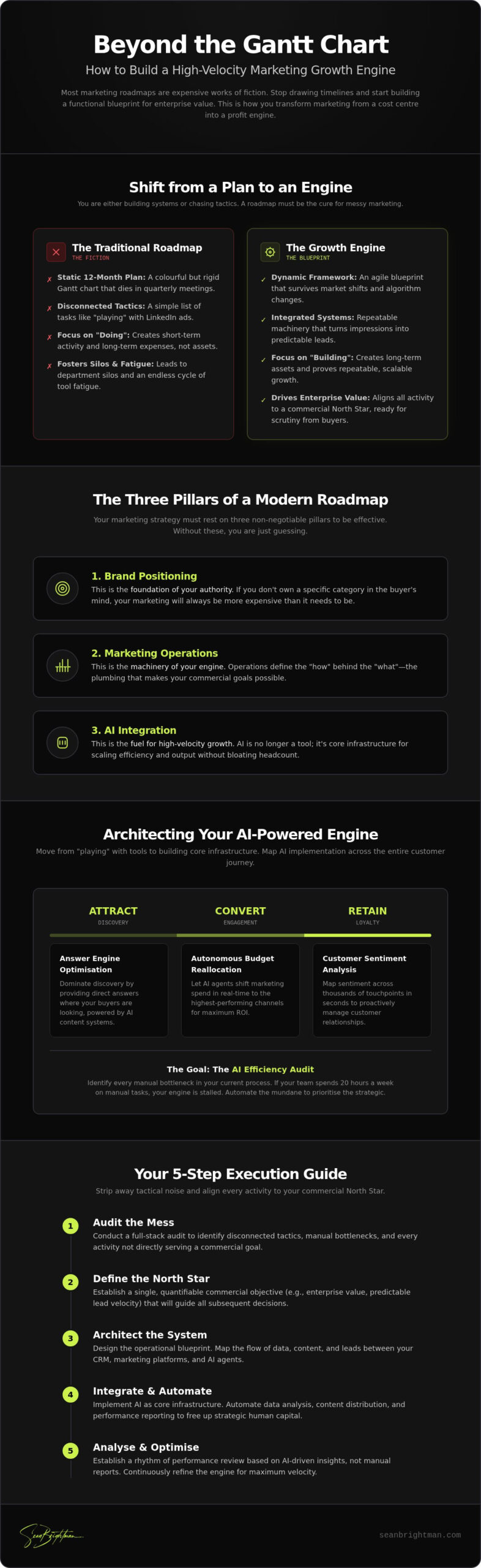
    Most marketing roadmaps are little more than expensive works of fiction designed to make stakeholders feel safe whilst the budget burns. You don’t need another colourful Gantt chart; you need a functional blueprint for a high-velocity growth engine. If your current marketing strategy roadmap feels like a list of disconnected tactics rather than a path to enterprise value, you aren’t alone.

    It’s exhausting to deal with tool fatigue and a lack of alignment whilst watching your marketing spend disappear into a black hole. You want a department that runs like a machine, delivering predictable lead generation instead of monthly surprises. We agree that marketing should be a profit centre, not a line-item expense.

    Stop drawing timelines and start building for an exit. This battle-tested guide shows you how to construct a 12-month strategy that actually drives growth. We will explore the exact steps to bridge the gap between business goals and daily activity, ensuring your marketing is ready for the scrutiny of any future buyer.

    Key Takeaways

    • Build systems, not just timelines. Treat your roadmap as the architectural blueprint for a growth engine rather than a simple list of tasks.
    • Shift to AI infrastructure. Map AI implementation across the customer journey to move from playing with tools to building a high-velocity machine.
    • Maximise enterprise value. A documented marketing strategy roadmap is a critical asset that proves your growth is repeatable and scalable for future buyers.
    • Audit the mess. Use our 5-step execution guide to strip away tactical noise and align every activity with your commercial North Star.
    • Bridge the accountability gap. Understand why senior advisory is the key to turning a static plan into a functional revenue engine.

    Beyond the Gantt Chart: What a Marketing Strategy Roadmap Really Is

    Most roadmaps are decorative. They live in colourful spreadsheets and die in quarterly meetings. A real marketing strategy roadmap isn’t a schedule of events; it’s an architectural blueprint for a growth engine. It defines exactly how you will build enterprise value whilst your competitors are still arguing over font sizes.

    We work in a binary: you are either building systems or you are chasing tactics. Tactics are “playing” with LinkedIn ads. Systems are the integrated machinery that turns an impression into a predictable lead. A roadmap is the cure for messy marketing. It ends the department silos and stops the endless cycle of tool fatigue by forcing every activity to justify its existence against a commercial goal.

    Static 12-month plans are dead. In 2026, market shifts happen in weeks, not years. If your plan can’t survive a sudden algorithm change or an AI breakthrough, it’s a liability. You need a framework that is dynamic, precise, and focused on building a machine that runs without you.

    The Difference Between a Plan and an Engine

    A plan is a checklist of tasks. It’s passive. An engine is a repeatable process designed to produce a specific result. Most CEOs ask their teams “what are we doing this month?” That is a tactical trap. Instead, you should be asking “what are we building?”

    When you focus on building, you create assets. When you focus on doing, you only create expenses. You can read more about shifting from cost centres to growth engines in our guide on Strategic marketing for CEOs. A roadmap ensures that every pound spent is an investment in the engine’s long-term horsepower.

    The Three Pillars of a Modern Roadmap

    Your marketing strategy roadmap must rest on three non-negotiable pillars to be effective. Without these, you’re just guessing.

    • Brand Positioning: This is the foundation of your authority. If you don’t own a specific category in the buyer’s mind, your marketing will always be more expensive than it needs to be.
    • Marketing Operations: This is the machinery. Whilst a standard marketing plan might list goals, operations define the plumbing that makes those goals possible. It’s the “how” behind the “what.”
    • AI Integration: This is the fuel. In 2026, AI is no longer a set of separate tools. It is the core infrastructure that allows you to scale efficiency and output without bloating your headcount.

    When these pillars are aligned, your marketing department stops feeling like a black hole for cash. It starts feeling like a predictable, high-velocity asset that is ready for an exit at any moment.

    The Architecture of an AI-Powered Marketing Roadmap

    Most marketing teams are currently distracted by shiny objects. They collect AI tools like they’re trading cards but fail to integrate them into a functional system. This is a waste of time and capital. An effective marketing strategy roadmap treats AI as core infrastructure, not an accessory. AI Roadmapping is the strategic application of intelligence to marketing operations.

    Moving from “playing” with tools to building an engine requires an AI Efficiency Audit. You must identify every manual bottleneck in your current process. If your team spends twenty hours a week on manual data entry or basic content tweaks, your engine is stalled. You need to map implementation across the entire customer journey: Attract, Convert, and Retain. This ensures AI handles the volume whilst your people handle the strategy.

    In 2026, this isn’t just about chatbots. It involves Answer Engine Optimisation (AEO) for discovery and autonomous budget reallocation for performance. This is the transition from tool fatigue to scalable growth. You can explore how we manage this shift in our approach to AI consulting, where we focus on engines rather than individual platforms.

    Automating the Mundane to Prioritise the Strategic

    Data analysis is the first major win for an AI-powered roadmap. AI can map customer sentiment across thousands of touchpoints in seconds, a task that previously took weeks of manual labour. Your 2026 marketing strategy roadmap must include a dedicated “System Architecture” phase. This is where you build the pipes that allow data to flow between your CRM and your AI agents. When the machinery handles the mundane analysis, your team is free to focus on high-level creative and commercial positioning.

    The Human Element: Who Manages the AI?

    Who manages the machine? Many CEOs make the mistake of handing AI tasks to junior staff. This is backwards. Junior staff understand the “how,” but they lack the “why.” You need senior leadership to oversee the integration of these systems to ensure they align with business goals. It’s about redefining roles within the organisation to focus on oversight and strategic direction. If you want to stop guessing and start building a machine that drives value, it might be time to look at a professional AI-driven strategic reset for your department.

    Strategic Trade-offs: Mapping for Exit vs. Mapping for Scale

    Your destination dictates your design. Most leaders build for next month; smart leaders build for the buyer. If you’re aiming for a 24-month exit, your marketing strategy roadmap is no longer just a growth plan. It’s a due diligence document. You are building an asset that must prove its worth under the microscope of an acquisition team.

    Buyers don’t pay for your hard work or your “potential.” They pay for repeatable systems that function without the founder. A documented roadmap increases enterprise worth because it removes the “key man” risk. It proves that your lead generation is a deliberate choice, not a lucky streak. You can read more about the specific valuation drivers in our guide on marketing strategy for business exit.

    To be exit-ready, your marketing systems must pass a specific checklist:

    • Clean Data: Fully compliant, first-party data with a clear audit trail.
    • Documented SOPs: Standard Operating Procedures for every tactical move.
    • Scalable CAC: Proof that you can acquire customers at a predictable cost.
    • Independence: A marketing engine that runs whilst the CEO is out of the room.

    Scaling for Growth: The Aggressive Roadmap

    When you’re mapping for raw scale, market share is your primary target. You prioritise aggressive customer acquisition. Your Customer Acquisition Cost (CAC) might be higher as you push into new territories or block competitors. This is the “land grab” phase. You move from scrappy, founder-led experiments to systematic, high-volume growth. Every pound is spent on visibility and volume.

    Scaling for Exit: The Efficiency Roadmap

    Mapping for an exit requires a pivot toward margins. You focus on Lifetime Value (LTV) and operational efficiency. Buyers want to see a lean, high-output machine with minimal waste. You optimise the machinery you’ve built rather than just adding more fuel. This roadmap emphasises retention, upsells, and the automation of the customer journey. You are building a machine that works independently, making it a “plug-and-play” asset for a potential acquirer.

    How to Build a Marketing Strategy Roadmap That Actually Drives Exit-Ready Growth

    How to Build Your Growth Engine: A 5-Step Execution Guide

    Roadmapping isn’t about picking a template or a pretty colour scheme. It’s about engineering. Most roadmaps fail because they are built on assumptions rather than audits. A high-impact marketing strategy roadmap requires a clinical approach to your existing infrastructure before you ever touch a timeline. If you start by choosing a format, you’ve already lost.

    Step 1 & 2: The Strategic Foundation

    You can’t build a roadmap if you don’t know where the leaks are. Step 1 is the Diagnostic. You must audit your current “messy” marketing systems to see what’s actually converting and what’s just noise. Most SMEs discover that 80% of their activity is wasted effort. You need to find those gaps and close them before you add more fuel to the fire.

    Step 2 is Positioning. This isn’t about a new logo or a fresh coat of paint. It’s your North Star. Positioning defines exactly why you win in your category and why a buyer should care. Without it, your tactics are just expensive guesses. If you are struggling to define your edge, hiring a marketing strategy consultant can help you build a growth engine that actually scales instead of just a plan that sits on a shelf.

    Step 3 & 4: From Theory to Machinery

    Step 3 is Systems Design. You need a tech and AI stack that powers the engine, not a collection of tools that don’t talk to each other. Your “Marketing Stack” should be integrated, automated, and lean. Every tool must serve a specific purpose in the customer journey. If it doesn’t contribute to the machinery, get rid of it.

    Step 4 is the 90-Day Sprint. Planning in detail beyond three months is a fantasy. Market conditions shift too fast for static 12-month task lists. Use your marketing strategy roadmap to set the high-level direction, but execute in 90-day bursts of high-velocity action. This keeps your team focused on immediate results rather than abstract long-term goals. It forces a rhythm of delivery that prevents stagnation.

    Step 5 is the Feedback Loop. This is where most roadmaps die. You must build accountability and measurement into the process. This isn’t about being “agile” in the corporate sense; it’s about being effective. If a tactic isn’t driving the engine forward, kill it. If it is, double down. This loop ensures your strategy remains a living, breathing asset that builds enterprise value every single day.

    Stop guessing and start building your growth machine. Get a professional roadmapping reset to align your marketing with your business goals.

    From Roadmap to Revenue: The Accountability Gap

    A marketing strategy roadmap is just a document. It is not a result. The number one reason these plans fail is simple: no one is driving the bus. You can have the most sophisticated AI-powered growth engine in the UK, but without senior oversight, the machinery will seize up. Accountability is the bridge between a static plan and actual revenue.

    Most SMEs mistake activity for progress. They tick boxes but don’t move the needle. You need a mechanism that provides external perspective and blunt honesty. This is where a Marketing advisory retainer becomes essential. It’s about maintaining strategic velocity whilst your internal team handles the day-to-day execution.

    Why Your First Hire Shouldn’t Be a Full-Time CMO

    Hiring a full-time CMO too early is often a £120k mistake. You are paying for a high-level general when you don’t even have a functioning army or a proven system. It’s an expensive way to find out your foundation is cracked. A full-time hire often brings their own favourite tools and “corporate politeness,” which is exactly what a lean scale-up doesn’t need. You don’t need a manager; you need a builder.

    A fractional cmo is different. They build the marketing strategy roadmap and then build the team required to execute it. It’s about building the engine before you hire the full-time driver. You get senior-level authority and “get-your-hands-dirty” expertise without the overhead of a permanent C-suite salary. It is about impact, not attendance.

    Maintaining Strategic Velocity

    Strategy is not a “one and done” event. It’s a process of constant adjustment. Monthly reviews are the heartbeat of a successful roadmap. You need to look at real-world data and course-correct immediately. If the market shifts or a specific tactic fails, you pivot. You don’t wait for the next quarterly board meeting. Speed is useless if you are heading in the wrong direction.

    We operate with a “plug-and-play” mindset. This means high impact and low ceremony. We don’t care about long reports or bureaucratic sign-offs. We care about maximum ROI and building enterprise value. The goal is a marketing department that runs like a machine, delivering predictable growth that makes your business ready for an exit. Stop drawing timelines. Start driving revenue.

    Build the Engine, Don’t Just Draw the Map

    You’ve seen the difference between a static plan and a functional growth machine. A real marketing strategy roadmap is about engineering enterprise value, not just filling a calendar with tasks. By integrating AI as core infrastructure and shifting your focus from raw scale to exit-ready efficiency, you transform marketing from a cost centre into a high-velocity profit engine.

    Your roadmap is a due diligence document. It must prove that your growth is repeatable, scalable, and independent of the founder’s daily input. Without senior oversight to bridge the accountability gap, even the most sophisticated plan will eventually stall. You need a driver who understands the machinery and can provide direct, results-oriented advisory.

    Stop guessing and start building. Leverage senior Fractional CMO expertise and battle-hardened AI strategy to turn your marketing department into a genuine commercial asset. Build your growth engine: Book a strategic roadmapping session with Sean Brightman. It is time to stop chasing tactics and start building a legacy. You have the blueprint; now it’s time to execute.

    Frequently Asked Questions

    What should a marketing strategy roadmap include for a UK tech company?

    A roadmap for a UK tech firm must include brand positioning, marketing operations architecture, and a clear AI integration plan. It is about building an engine, not just a list of tasks. You need a system that handles lead generation whilst ensuring your data remains fully GDPR compliant and scalable for future acquisition.

    How long should a marketing roadmap be?

    Your roadmap should provide a 12-month strategic vision, but execution must happen in 90-day sprints. Planning in detail beyond three months is guesswork in a fast-moving market. A long-term vision keeps the business on course; short-term sprints keep your team moving at high velocity without getting bogged down in bureaucracy.

    What is the difference between a marketing plan and a marketing roadmap?

    A marketing plan is a checklist of activities; a marketing strategy roadmap is the architectural blueprint for your growth machinery. Plans focus on what you are doing. Roadmaps focus on what you are building. One is a list of expenses; the other is the design of a commercial asset.

    Do I need a Fractional CMO to create my marketing roadmap?

    You need a Fractional CMO if you want a roadmap that functions as a high-velocity growth engine. Junior staff can execute tactics, but they lack the senior authority to design complex systems. A Fractional CMO provides the battle-hardened expertise required to build a machine that runs without the founder’s constant input.

    How do I integrate AI into my existing marketing strategy?

    Stop collecting tools and start building infrastructure. Integrate AI by identifying manual bottlenecks in your customer journey and automating them. Your marketing strategy roadmap should treat AI as the core infrastructure of your operations, not a separate set of toys to play with in your spare time.

    How often should a marketing strategy roadmap be updated?

    Update your roadmap monthly to reflect real-world data and sudden market shifts. Static plans die because they cannot adapt to algorithm changes or competitor moves. Monthly course-corrections ensure your strategy remains relevant whilst maintaining the high-impact rhythm needed for scalable, exit-ready growth.

    Why do most marketing roadmaps fail to deliver ROI?

    Most roadmaps fail because there is no one driving the bus. They become decorative documents that lack accountability and clinical measurement. Without a clear owner and a focus on building systems over chasing the latest tactics, your marketing spend will continue to feel like a black hole for cash.

    Can a marketing strategy roadmap help with a business exit?

    A marketing strategy roadmap is a critical asset during a business exit. It serves as a due diligence document that proves your lead generation is a repeatable, scalable system. Buyers pay a premium for businesses where the growth engine is documented and doesn’t rely on the founder’s presence.

  • Strategic Marketing for CEOs: Building Growth Engines, Not Cost Centres

    Strategic Marketing for CEOs: Building Growth Engines, Not Cost Centres

    Marketing is not a creative department. It is a mechanical growth engine that requires strategic engineering, not just tactical activity. Most leaders treat their marketing budget like a black hole of expenditure where cash disappears and “brand awareness” is the only return. You know the frustration of seeing a high Customer Acquisition Cost whilst lacking the senior leadership to fix it. Strategic marketing for CEOs shouldn’t feel like a gamble. It should feel like a well-oiled machine that functions without your constant intervention.

    You are right to be sceptical of the £120,000 salary commitment for a full-time hire. You don’t need another expensive head on the payroll; you need a system that scales. This guide will show you how to transform fragmented tactics into a scalable, AI-powered growth engine that delivers predictable revenue. We will dismantle the confusion surrounding AI implementation and provide a clear roadmap for a marketing function that actually builds equity. We are moving away from “doing more” and focusing on the strategic architecture that facilitates a clear exit strategy.

    Key Takeaways

    • Stop the “tactic-first” trap by aligning brand, systems, and AI into a unified revenue engine.
    • Discover why strategic marketing for CEOs requires prioritising scalable lead-nurture systems over shiny new software tools.
    • Integrate machine learning into your customer acquisition strategy to move beyond tool fatigue and drive predictable growth.
    • Ditch vanity metrics and focus on leading indicators like pipeline velocity to ensure your marketing function builds real commercial value.
    • Implement senior-level leadership and a 90-day roadmap through a fractional model to fix fragmented departments without the full-time overhead.

    Why Strategic Marketing for CEOs is Often a Financial Black Hole

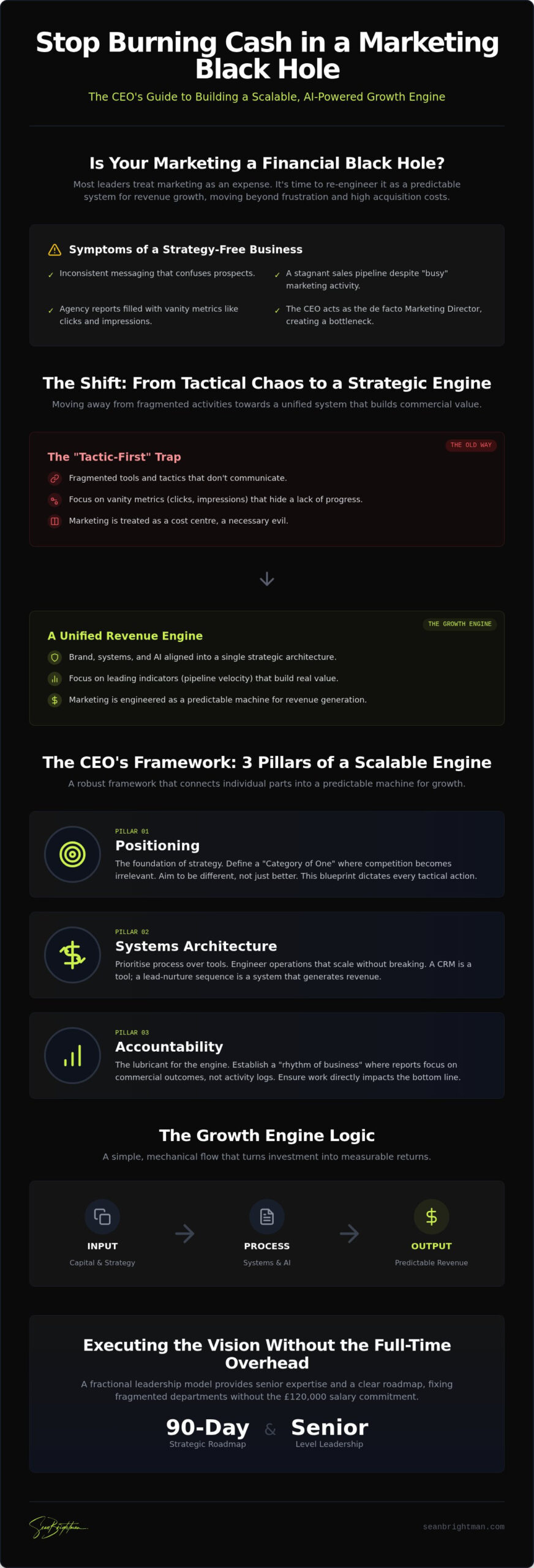
    Marketing is frequently treated as a necessary evil. It is a line item on a spreadsheet that never seems to justify its own existence. This happens because most businesses confuse activity with progress. They hire agencies to “do SEO” or “run ads” without a foundational marketing strategy. It is tactical chaos. Strategic marketing for CEOs is the opposite. It is the deliberate alignment of brand, systems, and AI to drive predictable revenue. If these three pillars aren’t locked together, you aren’t building an engine. You’re just burning cash.

    Jumping into LinkedIn ads or expensive content plays because a competitor did it is a recipe for failure. Without a roadmap, you’re just buying traffic for a leaky bucket. This “Tactic-First” trap leads to high Customer Acquisition Costs and zero scalability. You end up with a collection of fragmented tools that don’t talk to each other and a team that doesn’t know which lever to pull.

    Your team might be busy. They are posting on social media and “optimising” campaigns. But if the revenue isn’t moving, the activity is worthless. A messy marketing department costs more than just the salaries. It costs wasted capital and lost market share. Recognising when your team is “busy” but the needle isn’t moving is the first step toward fixing the machine.

    The Symptoms of a Strategy-Free Business

    Look for the red flags. Inconsistent messaging that leaves your prospects confused. Agencies that send monthly reports filled with “impressions” and “clicks” whilst your pipeline remains stagnant. These are vanity metrics. Perhaps the clearest sign of a failing system is the CEO acting as the de facto Marketing Director. If you are the one approving every LinkedIn post or tweaking ad copy, your system is broken. You have become a bottleneck, not a leader.

    Marketing as an Engine, Not a Department

    Stop viewing marketing as a cost centre. Start viewing it as a mechanical system. A growth engine. The logic is simple: Input (Capital and Strategy) goes into the Process (Systems and AI), which produces the Output (Revenue). Building a scalable growth engine is the core of strategic marketing for CEOs who want to exit or scale without being tethered to daily operations. If the engine is built correctly, it runs without your constant intervention. You own the “Why” and the vision. You delegate the “How” to senior-level experts. This isn’t about spending money. It’s about investing in a functional component of your business that delivers a measurable return.

    The CEO’s Framework: Building a Scalable Growth Engine

    Most leaders buy tools to solve problems. It is a mistake. A tool is a static object. A system is a process. Strategic marketing for CEOs prioritises the latter. A CRM is a tool; a lead-nurture sequence is a system. One is a database; the other is a revenue generator. If you are focused on the software rather than the sequence, you are building a collection of parts, not an engine. You need a framework that connects these parts into a predictable machine.

    This framework relies on three pillars: positioning, systems architecture, and accountability. Without all three, your marketing will remain a fragmented expense. Accountability is the lubricant that keeps the engine running. It requires a “rhythm of business” where reports focus on commercial outcomes rather than activity logs. If your marketing lead isn’t showing you how their work impacts the bottom line, they aren’t managing a growth engine. They are managing a cost centre.

    Positioning: The Foundation of Strategy

    In a crowded market, “being better” is a losing strategy. It is subjective and expensive to prove. “Being different” is the only win. You must define a “Category of One” where competition becomes irrelevant because your offering is incomparable. This is the difference between fighting for scraps and owning the table. Brand positioning is the mechanical blueprint that dictates every tactical action, campaign, and customer interaction within your growth engine. You can learn more about turning these assets into profit in this guide on strategic marketing for CEOs.

    Systems Architecture: Engineering Predictability

    Engineering a system means designing operations that scale without breaking. This is vital for Marketing Strategy for Tech Companies where high-growth targets often outpace internal capabilities. You need to eliminate the friction in the sales-marketing handoff. If your sales team is ignoring leads, your system is broken. In 2026, this architecture must include a clear AI marketing roadmap to automate repetitive tasks and optimise your acquisition costs.

    Building this level of precision takes more than just a few meetings. It requires a battle-hardened expert who knows where the bottlenecks hide. If you are ready to stop guessing and start building, a strategic roadmapping session can provide the clarity you need to move forward.

    AI Strategy for CEOs: Strategy Over Tool Fatigue

    Stop playing with tools. If your marketing team is “experimenting” with ChatGPT without a commercial objective, they are wasting your time and capital. Strategic marketing for CEOs isn’t about having the most subscriptions; it’s about having the most effective systems. By March 2026, 80% of marketing professionals reported using AI and automation in their workflows. The novelty has evaporated. AI is now a functional component of the growth engine, not a laboratory experiment. It should be used to optimise customer acquisition through machine learning, not just to generate mediocre blog posts.

    The trap is focusing on efficiency over effectiveness. AI can help you do things faster, but doing the wrong things faster just accelerates your failure. You don’t need “more” content; you need better conversion. You don’t need “more” leads; you need higher pipeline velocity. Your role as CEO is oversight. You must ensure that AI integration respects brand integrity and ethical standards. A bot hallucinating your value proposition is a liability, not an asset. You own the “Why” and the brand’s soul; the AI handles the mechanical “How”.

    Integrating Intelligence into Operations

    Intelligence belongs in your operations, not just your copy. Moving from manual workflows to automated, intelligent systems is how you scale without linear head-count growth. Specific AI consulting can identify the “low-hanging fruit” where automation provides immediate ROI. This might be lead scoring, predictive churn analysis, or hyper-precision segmentation. AI-driven data analysis reduces the cost of experimentation by identifying winning patterns in days rather than months. It turns your marketing from a series of guesses into a sequence of calculated moves.

    The AI Roadmap: A 2026 Necessity

    You cannot wing it. A structured AI roadmap is a 2026 necessity for any business serious about growth. This plan ensures every tool you adopt is tied directly to a commercial KPI. It prevents “Shiny Object Syndrome” by forcing every new technology to justify its place in the engine. Strategic marketing for CEOs requires future-proofing the organisation against rapid technological shifts. By building a flexible, AI-powered architecture now, you ensure that your business remains a leader whilst competitors are still trying to figure out their login details. It is about building a system that runs on data, not just hope.

    Strategic Marketing for CEOs: Building Growth Engines, Not Cost Centres

    Accountability: The Metrics That Actually Move the Needle

    Marketing reports are often a collection of polite fictions. They focus on impressions, likes, and “engagement” because these numbers are easy to inflate. For a leader, these are vanity metrics. They don’t pay the bills. Strategic marketing for CEOs requires a radical shift in focus toward data that actually drives commercial value. You need to distinguish between lagging and leading indicators. Revenue is a lag indicator; it tells you what happened last month. Pipeline velocity is a leading indicator; it tells you if you’ll hit your targets next quarter.

    Marketing Efficiency Ratio (MER) should be your favourite metric for assessing overall engine health. This is simply your total revenue divided by your total marketing spend. It provides a high-level view of how hard your capital is working. Within the UK scale-up context, you must also master the relationship between Customer Acquisition Cost (CAC) and Lifetime Value (LTV). A healthy benchmark for this ratio is 3:1 or 4:1. If your ratio is lower, your engine is inefficient. If it is significantly higher, you are likely under-investing and leaving growth on the table. Kill the reports that don’t show this commercial reality.

    The £120k Marketing Hire Mistake

    Many CEOs rush to hire a full-time CMO with a £120,000+ salary commitment before they have a proven roadmap. This is a tactical error. You end up hiring a “doer” who executes fragmented tasks, when you actually needed an “architect” to design the system. Until the engine is built and the metrics are predictable, a full-time executive is an unnecessary overhead. You don’t need a permanent head; you need a blueprint. You can find more on this in my analysis of a Marketing Strategy Consultant vs Agency.

    The Advisory Retainer: Ongoing Accountability

    A Marketing Advisory Retainer provides the senior-level oversight that most scale-ups lack. It establishes a “rhythm of business” where strategy is reviewed and refined constantly. We set quarterly “Big Rocks”, which are high-impact objectives that move the needle, and ignore the noise. This creates a culture of radical honesty. There is no hiding behind vague reports. If a tactic isn’t working, we kill it and reallocate the capital. It is about maintaining strategic velocity whilst keeping the team accountable to the commercial vision. You get the expertise without the ego or the excessive salary.

    Ready to stop guessing and start measuring what matters? Let’s build your growth engine today.

    Executing the Vision: Fractional Leadership and Roadmapping

    You have the vision. Your team has the tasks. But there is a disconnect. This gap is where growth dies. Bridging it requires more than just “better communication”. It requires an architect. Strategic marketing for CEOs is about moving from tactical chaos to strategic velocity. It is about building a functional system that actually executes your commercial goals instead of just checking boxes. You need a bridge between high-level ambition and ground-level activity.

    A Fractional CMO is the mechanical solution to this problem. This is senior leadership without the full-time overhead. You get the battle-hardened expertise of a veteran strategist on a part-time basis. It is a plug-and-play model. You don’t need to manage them; they manage the engine for you. This is about results, not recruitment. You aren’t buying a person; you are buying a process that delivers predictable revenue.

    Your 90-Day Strategic Roadmap

    We don’t guess. We engineer. A 90-day roadmap provides the clinical clarity needed to fix the mess and start growing. It is a time-boxed intervention designed for maximum impact. It replaces the “hope and pray” method with a mechanical sequence of events. If you want to understand how a marketing strategy roadmap built for exit-ready growth differs from a standard plan, the principles below will make that distinction clear.

    • Phase 1: Audit and Diagnostics. We find the leaks in your engine. We strip back the reports to find where capital is being wasted and where the real opportunities for growth hide.
    • Phase 2: Positioning and Architecture. We build the blueprint. We define your “Category of One” to eliminate competition and design the lead-flow machinery that supports it.
    • Phase 3: Execution and Optimisation. We turn the key. We launch the systems, integrate the AI, and refine the process based on real-world revenue performance.

    This isn’t a theoretical exercise. It is a functional plan. You move from wondering what your marketing team does all day to knowing exactly how the machine works. It provides the order needed to scale without the usual friction of expansion.

    The Fractional Revolution

    UK scale-ups are changing their behaviour. They are realising that the old model of hiring a full-time executive is slow, expensive, and risky. You should Stop Hiring Full-Time CMOs until your growth engine is fully built and tested. In 2026, the smart move is to access high-level AI and strategic expertise through fractional leadership.

    This model allows you to scale your leadership as you scale your business. You get a seasoned professional who focuses on commercial outcomes, not office politics. It is about impact, not attendance. Strategic marketing for CEOs is finally becoming accessible to businesses that aren’t yet ready for a £120,000+ hire but are desperate for those results. Stop managing a department. Start leading an engine.

    From Tactical Chaos to Strategic Velocity

    Your marketing budget is either a cost or an investment. If it feels like a black hole, the engine is broken. We’ve established that strategic marketing for CEOs requires a shift from fragmented tactics to a connected system of brand, AI, and accountability. You don’t need another expensive hire to manage the mess. You need a blueprint that delivers predictable revenue and a clear path to exit. If you are planning that exit, understanding how to build a marketing strategy for business exit that acquirers will trust is the difference between a mediocre multiple and a premium valuation.

    I provide battle-hardened UK strategic expertise to help you stop the guesswork. As an AI-powered growth specialist and the author of the definitive book on marketing strategy, I focus on building functional systems that run without your constant intervention. It is time to strip away the fluff. It is time to engineer a department that actually moves the needle and builds real equity in your business.

    Ready to take the next step? Build your growth engine with a Fractional CMO Roadmap and turn your vision into a scalable commercial reality. You have the ambition. Now, get the machine to match it.

    Frequently Asked Questions

    What is the difference between marketing tactics and marketing strategy?

    Strategy is the blueprint; tactics are the hammers. Strategy defines your “Category of One” and the commercial destination of your business. Tactics are the individual actions like running a LinkedIn ad or writing a blog post. Jumping into tactics without a strategy is just expensive guesswork that leads to a financial black hole.

    How much should a CEO be involved in marketing strategy?

    Own the vision; delegate the execution. You must define the commercial goals and the brand’s soul. You shouldn’t be approving social media posts or tweaking SEO keywords. Your involvement ends at setting the “Why” and demanding absolute accountability for the commercial “What”.

    What are the most important marketing KPIs for a CEO to track?

    Track the metrics that impact equity and cash flow. Focus on Marketing Efficiency Ratio (MER) and pipeline velocity. These tell you how hard your capital is working. Ignore vanity metrics like impressions or likes. If a metric doesn’t move the commercial needle, it doesn’t belong in your report.

    Why do most marketing agencies fail to deliver strategic results?

    Agencies sell hammers; they don’t build houses. Most agencies are tactical specialists in a single area. They aren’t incentivised to look at your broader business model or unit economics. They focus on their own activity reports rather than your bottom-line growth and long-term equity.

    When should a CEO hire a Fractional CMO instead of a full-time leader?

    Hire a Fractional CMO when you need senior leadership without the £120,000+ overhead. It is a plug-and-play model for scale-ups. Use them to build the growth engine and the roadmap before you commit to the risk and cost of a permanent executive hire.

    How can AI improve the ROI of my marketing strategy in 2026?

    AI drives ROI through mechanical precision and predictive analysis. It optimises customer acquisition by identifying winning patterns in data that human teams miss. In 2026, strategic marketing for CEOs uses AI as a functional component for hyper-personalisation. It turns your marketing from a series of guesses into a data-driven science.

    What is a marketing strategy roadmap and why do I need one?

    A roadmap is a 90-day execution blueprint. It provides the order needed to scale without the usual friction of expansion. You need one to stop tactical chaos and ensure every action your team takes is tied directly to a commercial KPI or a revenue milestone. For a deeper breakdown of how to construct one that drives enterprise value, explore this guide on building a marketing strategy roadmap that drives exit-ready growth.

    How do I hold my marketing team accountable for revenue, not just activity?

    Demand leading indicators, not activity logs. Stop asking what the team did; ask what the team achieved in terms of pipeline growth. Establish a culture of radical honesty where underperforming campaigns are killed immediately and capital is reallocated to systems that actually work.

  • B2B Marketing Advisor vs Agency: Why Strategy Trumps Execution in 2026

    B2B Marketing Advisor vs Agency: Why Strategy Trumps Execution in 2026

    Your marketing agency isn’t failing because they’re lazy. They’re failing because their business model relies on your ignorance. Most agencies are built to sell you “activity” whilst avoiding the hard work of actual strategy. In 2026, throwing more money at execution won’t fix a broken engine. You don’t need more hands on deck; you need a better map. Hiring a B2B marketing advisor is the surgical alternative to bloated agencies and the crushing overhead of a full-time hire.

    You’ve likely felt the sting of high fees and low accountability. It is the “black box” problem where money goes in but ROI never comes out. You’re right to be frustrated. You’re also right to fear falling behind as AI transforms the competitive landscape. This article will show you how to swap expensive execution for high-impact strategy. You will discover how to build a scalable marketing system that doesn’t rely on your gut feeling. We will explore how to leverage AI to reduce headcount and create a clear roadmap toward a predictable exit. It is time to stop buying fuel and start engineering the machine.

    Key Takeaways

    • Stop buying activity and start investing in impact. Learn why senior-level strategy is the only way to escape the agency trap of endless tactical churn.
    • Discover why a B2B marketing advisor is the surgical, cost-effective alternative to expensive full-time hires and bloated external teams.
    • Master the mechanics of an AI-powered growth engine. Build a system that automates efficiency and scales your marketing whilst you focus on the bigger picture.
    • Use our battle-hardened vetting checklist to spot “slide-deck specialists” before they waste your budget.
    • Learn how the advisory retainer model secures long-term momentum through relentless accountability and strategic sanity checks for the founder.

    The B2B Marketing Advisor: Senior Direction Trumps Tactical Activity

    A B2B marketing advisor is not a project manager. They are the strategic architect of your growth engine. Most CEOs confuse “doing things” with “getting results”. They see a flurry of LinkedIn posts and assume the marketing machine is humming. It isn’t. That is just noise. Tactical activity without a foundational strategy is just an expensive way to fail. If your engine is seized, adding more fuel won’t help. You have to fix the mechanics first.

    In the complex landscape of Business-to-business (B2B) marketing, the distance between activity and impact is vast. Agencies thrive in this gap. They sell you “activity” because it is easy to bill and requires zero strategic accountability. An advisor focuses on “impact” because it is the only thing that moves the needle on your valuation. This is senior leadership on demand. For UK scale-ups, it is the ability to plug in a battle-hardened strategist to fix the blueprint before you spend another penny on the builders.

    The mistake is thinking that more content, more ads, or more emails will solve a stagnant pipeline. If the underlying logic of your go-to-market plan is flawed, execution only accelerates your failure. A B2B marketing advisor steps back to look at the plumbing. They ensure the data flows, the messaging resonates, and the technology stack actually supports the sales team instead of hindering them. It is about building a machine, not just managing a department.

    Why Your ‘Messy’ Marketing Department is a Strategy Problem

    Inconsistent lead flow and high customer acquisition costs are symptoms, not the disease. The disease is a lack of structural integrity. Hiring more “doers” to fix a broken system is like adding fuel to a flooded engine. It just makes the mess bigger and more expensive. An advisor brings order to internal complexity by defining exactly how the machine should function. This provides the clarity your team needs to execute with precision whilst maintaining speed. It turns chaos into a repeatable process.

    The Advisor’s Role: Architecture, Not Just Art

    The primary output of this engagement is a concrete Marketing strategy roadmap. This isn’t a slide deck filled with abstract goals; it is a technical specification for revenue generation. We move beyond “brand awareness” and build revenue systems that scale. An B2B marketing advisor provides the objective, external accountability that internal teams often lack. You don’t need another cheerleader. You need a navigator who knows where the competitive mines are buried and how to bypass them.

    Advisor vs Agency vs Full-Time Hire: The Brutal Comparison

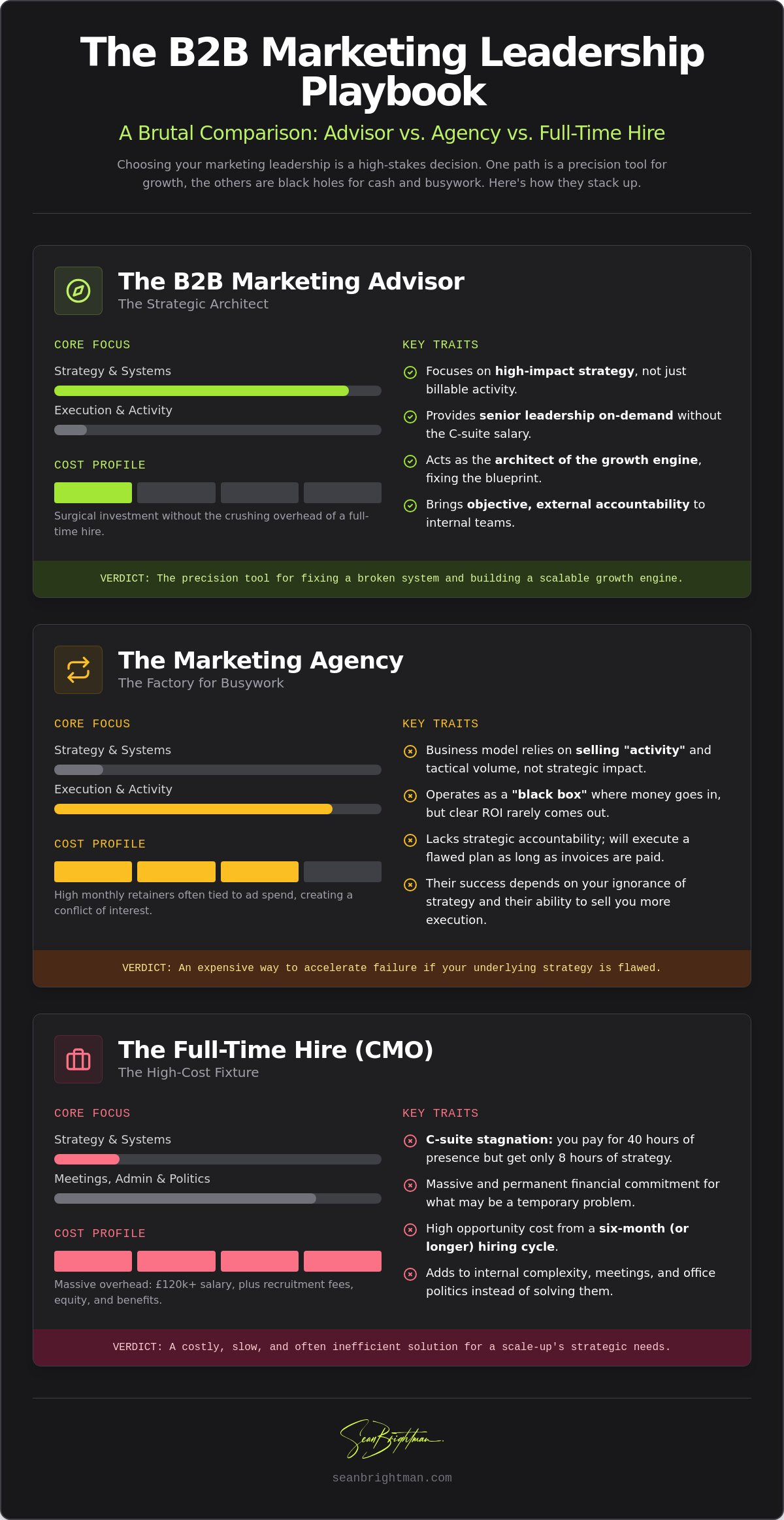
    Choosing your marketing leadership model is a high-stakes play. You have three paths. One is a black hole for cash. One is a factory for busywork. One is a precision tool. Most founders default to the agency. It feels safe. It looks like an extension of the team. In reality, it is often a conflict of interest wrapped in a monthly invoice. Agencies sell execution. They are factories. If you need 50 blog posts, they will give you 50 blog posts. They won’t tell you that nobody is reading them. Their business model relies on volume, not efficiency. They want you to spend more on ads because it justifies their retainer.

    This creates a fundamental disconnect from foundational B2B marketing concepts like value communication and buyer complexity. A B2B marketing advisor operates differently. They don’t want your headcount. They don’t want a percentage of your ad spend. They want your growth engine to function so they can move to the next problem. It is a plug-and-play solution for rapid growth without the permanent weight of a senior salary.

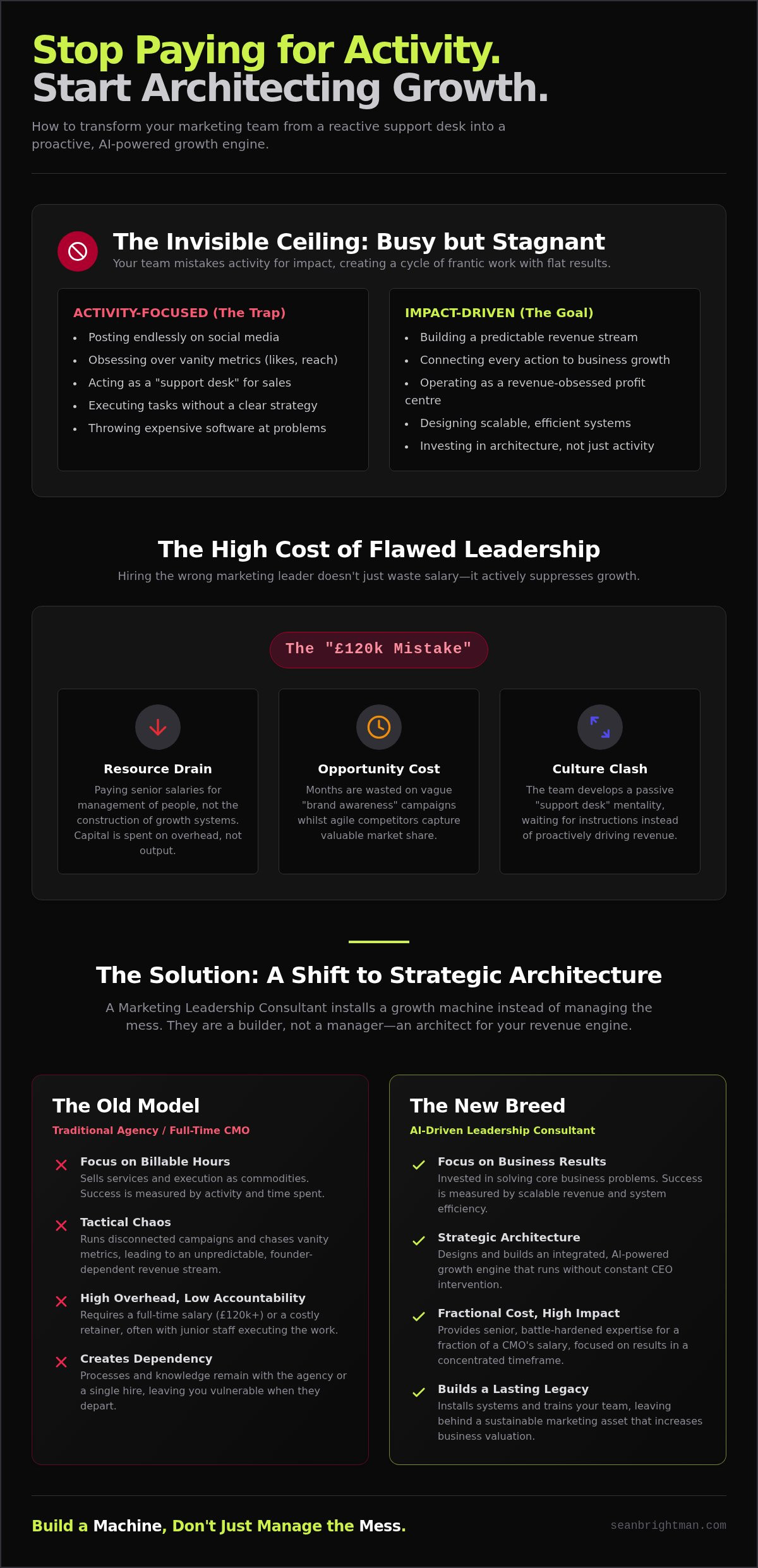
    A full-time CMO is the opposite error. It is a £120,000 plus mistake for most scale-ups. You pay for 40 hours of presence but only get 8 hours of strategy. The rest is spent in meetings, admin, and office politics. It is C-suite stagnation. You need senior direction, not a senior salary on the payroll. If you want to understand how to access senior marketing leadership on demand without the £150k overhead, the fractional model provides the roadmap and then holds your team or agencies accountable to it. They are the architect, not the builder.

    The Hidden Costs of a Full-Time CMO

    The total cost of a full-time hire is never just the salary. Factor in recruitment fees at 20-30%, equity, benefits, and the massive opportunity cost of a six-month hiring cycle. Scale-ups don’t need a permanent fixture for an architectural problem. You need the 20% of a CMO’s time that delivers 80% of the value. An advisor gives you that fresh, external perspective without the long-term liability. It is senior leadership on your terms.

    Why Agencies Aren’t Incentivised to Fix Your Strategy

    The “billable hour” problem is real. Agencies want you to work more, not smarter. They are vendors who own tasks, not partners who own the strategy. A Fractional CMO acts as the bridge. They manage your agencies so you don’t have to. They cut the fluff, demand ROI, and ensure every tactical penny aligns with the core business goals. If you’re tired of the agency cycle, consider an advisory retainer to regain control of your growth.

    Engineering the Growth Engine: Systems, AI, and Scalability

    Marketing in 2026 is no longer an art project. It is a mechanical integration of data, AI, and brand. If you’re still relying on the founder’s intuition to drive lead flow, you don’t have a business; you have a hobby. A B2B marketing advisor builds a growth engine that runs without your constant intervention. They engineer a machine that produces results whilst the CEO focuses on the exit. This isn’t about “getting the word out”. It is about Marketing operations consultant principles applied to high-growth environments.

    Tools aren’t a strategy. Buying HubSpot or Salesforce won’t fix a broken sales process. But the right tech stack, properly integrated, is a weapon. It provides a competitive advantage your rivals can’t match. An advisor ensures your tools function as a single, cohesive unit. They turn your marketing department from a cost centre into a profit-generating asset. You stop paying for software you don’t use and start using systems that pay for themselves.

    AI Consulting: Building the 2026 Growth Engine

    The hype around AI has settled into a hard reality: use it or lose. We move beyond basic prompts. We implement AI for predictive lead scoring to identify high-value targets before they even know they’re in the market. Content automation now handles the heavy lifting of distribution and personalisation. A B2B marketing advisor builds the AI roadmap you need to integrate this intelligence into your daily operations. The goal is simple. Reduce headcount costs. Increase tactical output. You gain the capabilities of an enterprise-level team without the bloated payroll.

    MarOps: The Plumbing That Powers Your Profit

    Your CRM is probably a glorified address book. It should be your most powerful revenue tool. Most scale-ups underutilise their data because the “plumbing” is broken. We fix the leaks. This means building systems for accurate attribution and tracking. You need to see the path from the first touchpoint to the final invoice. An advisor organises your data so it becomes a strategic asset rather than a management burden. Predictable revenue requires clean data and robust systems. We build the infrastructure so you can scale with confidence.

    B2B Marketing Advisor vs Agency: Why Strategy Trumps Execution in 2026

    How to Vet a B2B Marketing Advisor Without the Fluff

    Hiring a consultant is often a gamble with your company’s future. Most people calling themselves a B2B marketing advisor are either corporate refugees with no hands-on experience or failed agency owners looking for a softer landing. You don’t need a professional talker. You need a battle-hardened expert who understands the mechanics of growth. The goal is to find a strategist who builds systems, not just slide decks. Practicality beats theory every time.

    Industry experience is the most overrated metric in recruitment. If someone has spent 20 years in your specific niche but doesn’t understand data attribution or AI-powered lead scoring, they are useless to you. Systems experience is what scales businesses. You want someone who understands how to integrate marketing, sales, and technology into a single revenue engine. Look for a clear, repeatable methodology. At this level, strategy is a technical specification, not a creative brainstorm. This is why roadmapping is the foundation of any high-impact engagement. It provides the blueprint before the builders arrive.

    5 Questions Every CEO Must Ask an Advisor

    • How do you define a successful marketing system? If they talk about “brand love” instead of “mechanical integration” and “predictable ROI”, they are the wrong fit. You need an architect, not a poet.
    • What is your specific framework for AI integration? You aren’t looking for a ChatGPT prompt list. You need to know how they will embed intelligence into your operations to reduce costs and increase tactical efficiency.
    • How do you ensure my internal team actually executes your plan? A plan without accountability is just a wishlist. Ask about their process for oversight and how they manage the friction of change.
    • Where does your strategy end and my team’s execution begin? Clarity on the “hand-off” is essential to avoid the black box problem we discussed earlier.
    • What is the first bottleneck you look for in a scale-up’s pipeline? Their answer will tell you if they focus on the plumbing or the paintwork.

    Red Flags: Avoiding the Professional Consultant

    Beware the “Slide-Deck Specialist”. These are the advisors who deliver a 50-page report and then disappear before the hard work of implementation begins. If they don’t talk about numbers, CRMs, or operational bottlenecks, they aren’t a strategist; they’re a storyteller. Avoid anyone who relies on “corporate speak” to mask a lack of practical knowledge. Buzzwords are the first sign of a shallow strategy. Finally, run from the “one-size-fits-all” template. Your business has unique constraints. You need a custom blueprint, not a recycled plan from 2018.

    You deserve a partner who is as invested in the “how” as they are in the “what”. If you’re ready for a B2B marketing advisor who actually gets their hands dirty, book a strategic roadmapping session to see the difference between fluff and function.

    The Advisory Retainer: Securing Long-Term Strategic Momentum

    A strategy is useless if it sits in a drawer. Most businesses fail not because they lack a plan, but because they lack the discipline to follow it. This is where the B2B marketing advisor becomes your most valuable asset. The marketing advisory retainer isn’t just another monthly expense. It is an insurance policy for your entire marketing budget. You pay for a seat at the table for someone who doesn’t care about office politics. They only care about the mechanics of your growth.

    For high-growth UK founders, this model is the standard. It provides a constant sanity check against agency fluff and internal inertia. When an agency presents a report filled with vanity metrics, your advisor is there to translate that into actual business impact. They provide the relentless accountability needed to keep the engine running at peak efficiency. You don’t need a cheerleader. You need a navigator who will tell you when you’re off course before you hit the rocks.

    The retainer model keeps the focus on high-level architecture whilst your team handles the heavy lifting. It ensures that every tactical decision aligns with the long-term roadmap. It is the difference between a department that reacts to every new trend and one that follows a calculated path to market dominance. You gain a partner who understands your business as well as you do, but with the objective distance needed to make the hard calls.

    From Roadmap to Retainer: The Path to Execution

    The transition from a one-off roadmapping session to ongoing support is where the real work happens. A roadmap provides the blueprint. The retainer ensures the building actually matches the design. This plug-and-play Fractional CMO UK model allows you to scale your leadership as you scale your revenue. You get senior oversight on execution without the friction of a permanent hire. It is about maintaining momentum whilst your competitors are still trying to figure out their next move.

    The Result: A Predictable Growth Engine

    Success in 2026 looks like a machine. It is data-driven decisions. It is clear, undeniable ROI. It is a motivated internal team that knows exactly what they are building and why. This isn’t just about this quarter’s leads. It is about building a brand that is positioned for a high-value exit. A B2B marketing advisor helps you engineer that valuation. Stop guessing and start building a system that works whilst you sleep. If you are ready to fix your growth engine, book a strategy roadmapping session with Sean Brightman today.

    Stop Buying Activity and Start Building Value

    Activity isn’t growth. You’ve seen the cost of bloated agencies and the stagnation of expensive full-time hires. In 2026, the competitive edge belongs to those who treat marketing as a mechanical system; not a series of disconnected tasks. By hiring a B2B marketing advisor, you swap the “black box” of agency spend for a precise, AI-powered growth engine.

    Success requires a blueprint. Sean Brightman, a published author on marketing strategy and a battle-hardened Fractional CMO for UK scale-ups, specialises in building these high-impact systems. It’s time to stop guessing and start engineering a predictable revenue machine. Don’t just hire more hands. Hire the strategist who knows how to move them. It is the difference between a department that costs money and a system that builds wealth.

    Fix your marketing engine — Book a Strategic Roadmap with Sean Brightman

    Your path to a high-value exit starts with order, not activity. You have the vision. Now, build the machine to deliver it.

    Frequently Asked Questions

    What is the difference between a B2B marketing advisor and a consultant?

    An advisor is a long-term strategic partner whilst a consultant usually tackles a single, defined project. Advisors focus on the overall health and scalability of your growth engine. Consultants are hired to build a specific bridge; advisors are hired to design the entire transport network and ensure it reaches the destination.

    How much does a B2B marketing advisor typically cost in the UK?

    Costs in the UK vary based on the expert’s track record and the complexity of your marketing systems. Most senior strategists operate on a retainer model that reflects the strategic value and revenue they unlock. It is an investment in your company’s exit valuation rather than a simple hourly expense for tactical labour.

    Can a B2B marketing advisor help with AI implementation?

    A modern B2B marketing advisor is essential for navigating the AI landscape. They move you beyond basic content generation and into predictive lead scoring and operational automation. It is about building a mechanical AI roadmap that reduces your headcount costs whilst increasing your tactical output and precision.

    How long does it take to see results from a marketing advisory retainer?

    Strategic clarity is immediate, but mechanical results usually take three to six months to manifest in the pipeline. You are building a machine, not buying a quick fix. The goal is a scalable system that produces predictable revenue and high-value data assets over the long term.

    Do I need a B2B marketing advisor if I already have a marketing manager?

    Yes, because your manager needs a blueprint to be truly effective. Managers are “doers” who thrive when they have clear senior direction. An advisor provides the high-level architecture and strategic accountability that a mid-level hire simply cannot provide. It ensures your manager’s activity aligns with business goals.

    What industries do B2B marketing advisors typically specialise in?

    Advisors usually specialise in complex B2B sectors such as SaaS, professional services, and high-growth manufacturing. Any industry with a long sales cycle and a multi-person buying committee requires this level of strategic oversight. The focus is on business complexity rather than just a specific product niche.

    Will a marketing advisor help me hire my internal team?

    An advisor will define the necessary roles and vet the technical skills of candidates, but they aren’t a recruitment agency. They ensure you hire the right “builders” for the roadmap they have designed. They provide the technical standards and strategic “sanity checks” that your internal HR team often lacks.

    How does a Fractional CMO differ from an Interim Marketing Director?

    A Fractional CMO provides ongoing, high-level leadership for a fraction of the time and cost of a full-time hire. An Interim Marketing Director is usually a full-time, short-term replacement meant to maintain the status quo. One builds the future growth engine; the other simply keeps the lights on during a transition.

  • Marketing Strategy for Tech Companies: Building Engines, Not Just Ads

    Marketing Strategy for Tech Companies: Building Engines, Not Just Ads

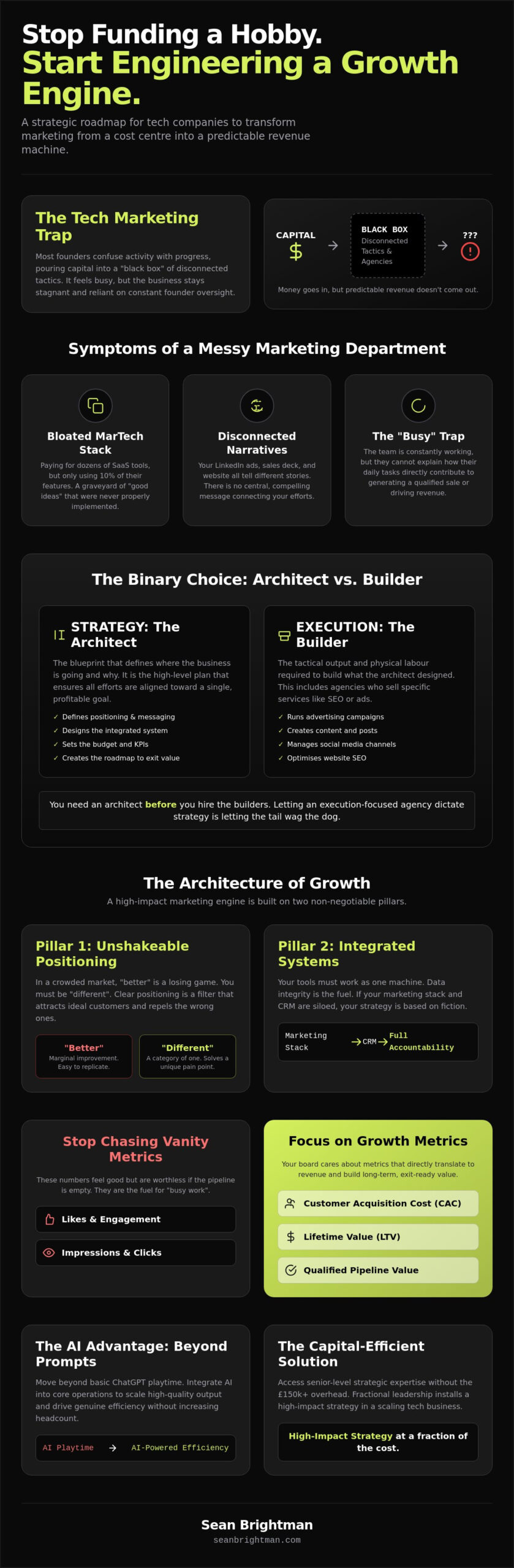
    Most founders think they have a marketing strategy for tech companies, but they’re usually just funding a very expensive hobby for their agencies. You’ve likely felt the sting of a marketing department that operates as a black box. You’ve got the tools. The team is busy. The invoices are paid. Yet, the needle stays static. It’s exhausting to watch capital disappear into disconnected tactics whilst the core business remains stagnant and dependent on your constant oversight.

    It’s time to stop chasing “hacks” and start engineering. A proper strategy isn’t a to-do list. It’s a mechanical system designed to produce revenue. This article provides a clear, actionable roadmap to build a growth engine that functions without constant founder intervention. We’ll explore how to replace manual overhead with AI-powered efficiency and turn your marketing from a cost centre into a high-impact asset that builds genuine, exit-ready value.

    Key Takeaways

    • Stop burning cash on disconnected tactics. Learn how to build a marketing strategy for tech companies that functions as a predictable revenue engine rather than a “black box” expense.
    • Fix your positioning to cut through the noise. Discover how to architect a marketing stack that actually communicates with your CRM to provide full accountability for every pound spent.
    • Integrate AI into your core operations to drive genuine efficiency. Learn how to move beyond basic prompts and use intelligence to scale your output without increasing your headcount.
    • Stop the “busy work” and start engineering growth. Follow a 90-day roadmap designed to stabilise messy departments and build the long-term value required for a successful exit.
    • Access senior-level expertise without the £150k overhead. Understand why fractional leadership is the most capital-efficient way to install high-impact strategy in a scaling tech business.

    The Tech Marketing Strategy Trap: Why Most Scale-ups Fail

    Marketing strategy for tech companies is rarely what founders think it is. It isn’t a calendar full of social media posts or a weekly newsletter that nobody reads. It’s a functional system. Most scale-ups fail because they confuse activity with progress. They mistake noise for momentum. If your marketing feels like a “black box” where you put money in and hope for the best, you don’t have a strategy. You have a gamble.

    A real strategy is a machine. It takes capital and attention as input and produces predictable revenue as output. When you lack this mechanical foundation, you fall into the “Tactic Trap”. This is the expensive habit of hiring an agency to “do SEO” or run ads before you’ve nailed your positioning. You end up paying for traffic to a destination that doesn’t convert. It’s like hiring bricklayers to build a house when you haven’t even seen the blueprints. You’ll end up with a very expensive pile of bricks in the wrong place.

    This leads directly to the founder’s dilemma. You started this company to build a product and disrupt a market. Now you’re stuck in the weeds. You’re approving ad copy at 11 PM whilst the actual growth engine stalls. You’re doing the work because there is no system to handle it for you. To fix this, we must kill the obsession with vanity metrics. Clicks are cheap. Likes are worthless. Your board doesn’t care about your “engagement rate” if the pipeline is empty. High-impact marketing strategy for tech companies focuses on growth metrics: Customer Acquisition Cost (CAC), Lifetime Value (LTV), and qualified pipeline.

    Symptoms of a Messy Marketing Department

    You know the department is broken when the symptoms become impossible to ignore. It usually looks like this:

    • Bloated MarTech: You’re paying for dozens of SaaS tools but only using 10% of their features. The stack is a graveyard of “good ideas” that never got implemented.
    • Disconnected Narratives: Your LinkedIn ads say one thing, your sales deck says another, and your website says something entirely different. There’s no central story.
    • The “Busy” Trap: The team is working 50-hour weeks on tasks, but they cannot explain how those tasks actually drive a sale.

    Strategy vs. Execution: The Binary Choice

    You need an architect before you hire the builders. Most agencies are builders; they want to sell you more bricks. If you let an execution-focused agency dictate your high-level digital marketing strategies, you’re letting the tail wag the dog. They will always suggest the tactics they happen to sell, regardless of whether those tactics fit your roadmap.

    Strategic direction is the blueprint that defines where the business is going, whilst tactical output is the physical labour required to get there. Working with a dedicated marketing strategy consultant ensures that blueprint is built around your specific growth objectives, not the service menu of whoever you hired last.

    The Architecture of Growth: Positioning and Systems

    A high-impact marketing strategy for tech companies is built on two pillars: positioning and systems. Without these, you are just throwing money at platforms and hoping for a miracle. Most scale-ups treat their marketing stack like a toy box. They buy the latest AI tool or CRM because it’s trendy; not because it fits the architecture. This creates a fragmented mess where data is siloed and accountability is non-existent. You don’t need more tools. You need a machine where every component serves a specific, documented purpose.

    Data integrity is the fuel for this machine. If your marketing stack doesn’t talk to your CRM in real-time, your strategy is based on fiction. You cannot optimise what you cannot measure. Your reporting should tell you exactly where your next £1 of profit is coming from. If it doesn’t, you aren’t running a department; you’re running a series of expensive experiments. Building a “plug-and-play” model allows you to scale without adding more chaos. It means that when you double your budget, you double your output, not your headaches.

    Brand Positioning for Tech: Standing Out amongst Giants

    In the crowded B2B SaaS landscape, sounding “better” is a losing game. “Better” is a marginal improvement that competitors can easily replicate. “Different” is a category of one. If your messaging uses the same buzzwords as the market leader, you are invisible. You must identify a Unique Value Proposition that solves a visceral pain point your competitors ignore. Clear positioning acts as a filter. It attracts the right leads and repels the wrong ones, which drastically reduces your cost of customer acquisition. If you want to move from guesswork to precision, a structured marketing roadmap is the first step to defining your space.

    Marketing Operations: The Engine Room

    Marketing operations is where strategy meets reality. It’s about designing workflows that remove friction between marketing and sales. Automation should be used to maintain a lean, high-output team, not just to spam prospects. We use systems to handle the repetitive heavy lifting so your talent can focus on high-level creativity and strategic shifts. This isn’t just about efficiency. It’s about valuation. Investors don’t buy “talented teams” that might leave next month. They buy documented, scalable systems that produce predictable results. This is how you build for a successful exit. You build an engine that works whilst you sleep.

    AI Marketing Strategy: Moving Beyond ChatGPT Playtime

    Most tech leaders are still in the “playtime” phase of AI adoption. They use it to churn out generic copy that sounds like every other B2B SaaS company on LinkedIn. This isn’t strategy. It’s noise. A sophisticated marketing strategy for tech companies treats AI as an operational lever, not just a content generator. It’s about building intelligence into your infrastructure, not just adding another tool to the pile. You need a system that thinks, not just a chatbot that types.

    The goal is efficiency, not just more volume. If you use AI to produce ten times more mediocre content, you haven’t won; you’ve just made your brand ten times more annoying. A real growth engine uses AI to do more with the same headcount. It’s the difference between scaling your overhead and scaling your impact. You move from “playing with tools” to “executing strategy” when AI starts handling the heavy lifting of data analysis, lead scoring, and workflow automation. This allows your team to focus on the high-level shifts that actually move the needle.

    Risk management is the part most founders ignore until it’s too late. As of June 2026, anticipated UK regulatory frameworks will mandate clear disclosure for synthetic performers. If you’re using AI likenesses in your video ads, you’re now in a regulated environment. You must address data privacy and brand voice protection before you automate your outreach. A single hallucinated claim or a data breach in your automated pipeline can wipe out years of brand equity. Strategy is about moving fast, but it’s also about building the guardrails to ensure you don’t fly off the track.

    The Practical Application of AI Consulting

    Success starts with mapping your current marketing processes to identify AI-ready bottlenecks. We don’t just “add AI” to a mess; we fix the mess first. This involves implementing AI-powered lead scoring that talks directly to your CRM, ensuring your sales team only touches the hottest prospects. By building a custom AI growth engine, you create a competitive moat that others cannot easily replicate with off-the-shelf software. It’s about proprietary workflows, not just subscription logins.

    Future-proofing Your Tech Brand

    AI is a survival requirement for 2026. With 80% of marketing professionals already using AI and automation, those who resist are effectively choosing to operate with higher overhead and slower response times. You must keep the “human in the loop” to maintain brand authenticity, using people for strategic oversight whilst the machines handle the execution. The ROI of AI-driven marketing efficiency is the radical compression of the time between lead capture and revenue realisation.

    Marketing Strategy for Tech Companies: Building Engines, Not Just Ads

    The Strategic Roadmap: Engineering Your Path to Exit

    Marketing strategy for tech companies is often treated as a short-term survival tactic. This is a mistake. If your objective is a high-multiple exit, your marketing department must be an asset that adds to the company’s valuation. Investors don’t buy a collection of “busy” employees. They buy a documented, repeatable revenue machine. They want to see that your growth is a result of a system, not founder-led heroics or luck.

    Success requires a North Star that aligns with your specific niche. For a B2B SaaS firm, this might be a specific Net Revenue Retention (NRR) target or a CAC payback period of under 12 months. For a deep-tech hardware firm, it might be market penetration in a key geographic territory. If your marketing team doesn’t know these numbers, they are just guessing. They are spending your capital on activity that doesn’t build equity. Strategic marketing for CEOs means transforming this guesswork into a documented, scalable system that turns your marketing function from a cost centre into a predictable revenue engine.

    Phase 1: The Audit and Alignment

    The first 30 days of a 90-day sprint are about stopping the bleeding. You must uncover the hidden waste in your current marketing spend. With growth-stage tech companies often spending between £2,300 and £15,000 per month on ads alone, the potential for inefficiency is massive. This phase aligns your marketing efforts with overall business goals and sales targets. If you want a clear path forward, you need a Marketing strategy roadmap that defines exactly how you will win.

    Phase 2: Building the Infrastructure

    Once you’ve stopped the waste, you build the infrastructure. This means hiring the right people or agencies to fill tactical gaps. You don’t need a full-time SEO specialist if you only need 10 hours of work a month. You need a “Marketing Playbook” that defines your operational standard. This document ensures that if a team member leaves, the machine keeps running. It establishes the reporting cadence that keeps the team accountable to the KPIs the CEO actually cares about: pipeline value, customer acquisition cost, and lifetime value.

    Where should you put your next £10k? Don’t default to more ads. Put it into the systems that increase your conversion rate or the AI workflows that reduce your cost per lead. If your foundation is weak, more traffic just means more waste. If you’re ready to stop the chaos and start engineering growth, it’s time to build a scalable marketing engine that drives real value.

    Fractional Leadership: High-Impact Strategy Without the Overhead

    Hiring a full-time CMO too early is a £150k mistake that kills your runway. For a growth-stage firm, that capital is better spent on the engine itself, not just the driver. Most founders reach a point where their marketing feels stuck, but they don’t need a permanent executive with a massive benefits package. They need a navigator. They need someone who has seen the “messy department” before and knows exactly how to rewire it for scale.

    There is a fundamental difference between an agency and a Fractional CMO. An agency is a vendor; they sell you tasks. They don’t own your marketing strategy for tech companies. They own their own profit margins. A Fractional CMO is a partner who owns the growth roadmap and holds those agencies accountable. This model provides the senior-level direction you need whilst your existing team or external partners handle the tactical execution. It’s about high-impact strategy without the corporate bloat.

    An advisory retainer provides the CEO with a much-needed external perspective. When you’re inside the business, you’re too close to the problems. You can’t see the “clog” in the engine because you’re part of the plumbing. An external expert finds the blockage in days, not months. This ongoing accountability ensures that the strategic roadmap we discussed in the previous section actually gets executed, rather than sitting in a folder gathering digital dust.

    When to Hire a Fractional CMO

    You hit the “Scale-up Wall” when your current marketing manager has reached their limit. They are great at execution, but they lack the strategic depth to architect a global growth engine. This often happens when you need to transition from founder-led sales to a marketing-led system. If you are preparing for a funding round or a business exit, you need a battle-hardened strategist who can prove to investors that your revenue is predictable and your systems are documented. Understanding the difference between a marketing strategy consultant focused on growth engines versus traditional planning is critical before you make that hire.

    The Sean Brightman Approach: Senior Leadership on Demand

    I provide direct, battle-hardened expertise without the corporate fluff or ego. This is a plug-and-play solution for UK tech companies that need order brought to internal complexity. My role is to design the machine and ensure it runs at peak efficiency, leaving your team to focus on the day-to-day output. If you’re tired of marketing that feels like a black box, it’s time to take control. Book a strategic roadmapping session to fix your marketing machine today and start building genuine, exit-ready value.

    Engineering Your Exit: From Tactical Chaos to a Scalable Growth Engine

    Marketing strategy for tech companies isn’t about finding a silver bullet. It’s about building a machine that functions independently of founder heroics. We’ve explored how to escape the tactic trap, architect a system that talks to your CRM, and leverage AI for genuine operational efficiency. You don’t need more busy work. You need a documented infrastructure that turns capital into predictable revenue.

    Stop funding a black box and start building an asset. As a published author on marketing strategy and a battle-hardened Fractional CMO for high-growth UK tech brands, Sean Brightman specialises in building AI-powered growth engines that fix the mess. He provides the senior-level direction required to get your department under control and ready for a high-multiple exit. You’ve built the product. Now it’s time to build the engine that sells it.

    Stop playing with tools and start growing – Work with Sean Brightman

    Frequently Asked Questions

    What is the difference between a marketing strategy and a marketing plan?

    A strategy is the architecture of your growth; a plan is the construction schedule. Strategy defines your positioning, your unique value, and how you will win the market. The plan is simply the list of tasks and deadlines required to execute that strategy. You don’t need a plan to fail, but you certainly need a strategy to win.

    How much does a marketing strategy for a tech company typically cost?

    The real cost is the waste currently sitting in your budget. Growth-stage companies often spend between £2,300 and £15,000 per month on Google Ads alone. A proper marketing strategy for tech companies ensures that every pound spent is an investment in an asset, not just a recurring expense. It’s about reallocating existing waste into high-impact systems.

    Why do most tech companies fail at marketing despite having a great product?

    Great products don’t sell themselves. Tech founders often fall in love with their features whilst ignoring the market’s visceral pain. They focus on technical superiority instead of psychological positioning. If you can’t explain why you’re different in ten seconds, your product’s quality is irrelevant to a prospect who is already overwhelmed with noise.

    How long does it take to see results from a new marketing strategy?

    You should see stabilisation within the first 90 days. This is the period where we stop the bleeding, fix broken tracking, and align the team. Real, scalable growth usually takes six to twelve months to fully manifest. It’s a flywheel effect. The initial effort to build a marketing strategy for tech companies is high, but the momentum eventually becomes self-sustaining.

    Can I use AI to build my entire marketing strategy?

    AI cannot build a strategy, but it can certainly accelerate one. It is excellent for data analysis, lead scoring, and content scaling. However, it lacks the human intuition required to understand your board’s exit goals or your competitor’s hidden weaknesses. Use AI as the engine’s lubricant, not the architect who designed the machine.

    What is a Fractional CMO and why would a tech scale-up need one?

    A Fractional CMO is a senior executive who provides high-level direction on a part-time basis. You get the expertise of a battle-hardened leader without the £150k plus salary and permanent overhead. They are there to install the growth engine and create accountability, allowing the founder to step out of the marketing weeds and back into the CEO role.

    Should I hire a marketing agency or a marketing strategy consultant?

    Hire a consultant to build the blueprint and an agency to lay the bricks. Agencies are execution machines. If you hire them without an external strategy, they will simply sell you the tactics they happen to specialise in. A strategist remains objective and ensures every tactical output actually serves the long-term business goals.

    How do I know if my current marketing department is “messy”?

    Your department is messy if your marketing stack doesn’t talk to your CRM in real-time. It’s messy if your team is “busy” with tasks but the pipeline remains flat. If you cannot track a lead from the first anonymous click to the final paid invoice, your system is broken. Order requires total visibility and clinical accountability.