
Most marketing roadmaps are little more than expensive works of fiction designed to make stakeholders feel safe whilst the budget burns. You don’t need another colourful Gantt chart; you need a functional blueprint for a high-velocity growth engine. If your current marketing strategy roadmap feels like a list of disconnected tactics rather than a path to enterprise value, you aren’t alone.
It’s exhausting to deal with tool fatigue and a lack of alignment whilst watching your marketing spend disappear into a black hole. You want a department that runs like a machine, delivering predictable lead generation instead of monthly surprises. We agree that marketing should be a profit centre, not a line-item expense.
Stop drawing timelines and start building for an exit. This battle-tested guide shows you how to construct a 12-month strategy that actually drives growth. We will explore the exact steps to bridge the gap between business goals and daily activity, ensuring your marketing is ready for the scrutiny of any future buyer.
Key Takeaways
- Build systems, not just timelines. Treat your roadmap as the architectural blueprint for a growth engine rather than a simple list of tasks.
- Shift to AI infrastructure. Map AI implementation across the customer journey to move from playing with tools to building a high-velocity machine.
- Maximise enterprise value. A documented marketing strategy roadmap is a critical asset that proves your growth is repeatable and scalable for future buyers.
- Audit the mess. Use our 5-step execution guide to strip away tactical noise and align every activity with your commercial North Star.
- Bridge the accountability gap. Understand why senior advisory is the key to turning a static plan into a functional revenue engine.
Beyond the Gantt Chart: What a Marketing Strategy Roadmap Really Is
Most roadmaps are decorative. They live in colourful spreadsheets and die in quarterly meetings. A real marketing strategy roadmap isn’t a schedule of events; it’s an architectural blueprint for a growth engine. It defines exactly how you will build enterprise value whilst your competitors are still arguing over font sizes.
We work in a binary: you are either building systems or you are chasing tactics. Tactics are “playing” with LinkedIn ads. Systems are the integrated machinery that turns an impression into a predictable lead. A roadmap is the cure for messy marketing. It ends the department silos and stops the endless cycle of tool fatigue by forcing every activity to justify its existence against a commercial goal.
Static 12-month plans are dead. In 2026, market shifts happen in weeks, not years. If your plan can’t survive a sudden algorithm change or an AI breakthrough, it’s a liability. You need a framework that is dynamic, precise, and focused on building a machine that runs without you.
The Difference Between a Plan and an Engine
A plan is a checklist of tasks. It’s passive. An engine is a repeatable process designed to produce a specific result. Most CEOs ask their teams “what are we doing this month?” That is a tactical trap. Instead, you should be asking “what are we building?”
When you focus on building, you create assets. When you focus on doing, you only create expenses. You can read more about shifting from cost centres to growth engines in our guide on Strategic marketing for CEOs. A roadmap ensures that every pound spent is an investment in the engine’s long-term horsepower.
The Three Pillars of a Modern Roadmap
Your marketing strategy roadmap must rest on three non-negotiable pillars to be effective. Without these, you’re just guessing.
- Brand Positioning: This is the foundation of your authority. If you don’t own a specific category in the buyer’s mind, your marketing will always be more expensive than it needs to be.
- Marketing Operations: This is the machinery. Whilst a standard marketing plan might list goals, operations define the plumbing that makes those goals possible. It’s the “how” behind the “what.”
- AI Integration: This is the fuel. In 2026, AI is no longer a set of separate tools. It is the core infrastructure that allows you to scale efficiency and output without bloating your headcount.
When these pillars are aligned, your marketing department stops feeling like a black hole for cash. It starts feeling like a predictable, high-velocity asset that is ready for an exit at any moment.
The Architecture of an AI-Powered Marketing Roadmap
Most marketing teams are currently distracted by shiny objects. They collect AI tools like they’re trading cards but fail to integrate them into a functional system. This is a waste of time and capital. An effective marketing strategy roadmap treats AI as core infrastructure, not an accessory. AI Roadmapping is the strategic application of intelligence to marketing operations.
Moving from “playing” with tools to building an engine requires an AI Efficiency Audit. You must identify every manual bottleneck in your current process. If your team spends twenty hours a week on manual data entry or basic content tweaks, your engine is stalled. You need to map implementation across the entire customer journey: Attract, Convert, and Retain. This ensures AI handles the volume whilst your people handle the strategy.
In 2026, this isn’t just about chatbots. It involves Answer Engine Optimisation (AEO) for discovery and autonomous budget reallocation for performance. This is the transition from tool fatigue to scalable growth. You can explore how we manage this shift in our approach to AI consulting, where we focus on engines rather than individual platforms.
Automating the Mundane to Prioritise the Strategic
Data analysis is the first major win for an AI-powered roadmap. AI can map customer sentiment across thousands of touchpoints in seconds, a task that previously took weeks of manual labour. Your 2026 marketing strategy roadmap must include a dedicated “System Architecture” phase. This is where you build the pipes that allow data to flow between your CRM and your AI agents. When the machinery handles the mundane analysis, your team is free to focus on high-level creative and commercial positioning.
The Human Element: Who Manages the AI?
Who manages the machine? Many CEOs make the mistake of handing AI tasks to junior staff. This is backwards. Junior staff understand the “how,” but they lack the “why.” You need senior leadership to oversee the integration of these systems to ensure they align with business goals. It’s about redefining roles within the organisation to focus on oversight and strategic direction. If you want to stop guessing and start building a machine that drives value, it might be time to look at a professional AI-driven strategic reset for your department.
Strategic Trade-offs: Mapping for Exit vs. Mapping for Scale
Your destination dictates your design. Most leaders build for next month; smart leaders build for the buyer. If you’re aiming for a 24-month exit, your marketing strategy roadmap is no longer just a growth plan. It’s a due diligence document. You are building an asset that must prove its worth under the microscope of an acquisition team.
Buyers don’t pay for your hard work or your “potential.” They pay for repeatable systems that function without the founder. A documented roadmap increases enterprise worth because it removes the “key man” risk. It proves that your lead generation is a deliberate choice, not a lucky streak. You can read more about the specific valuation drivers in our guide on marketing strategy for business exit.
To be exit-ready, your marketing systems must pass a specific checklist:
- Clean Data: Fully compliant, first-party data with a clear audit trail.
- Documented SOPs: Standard Operating Procedures for every tactical move.
- Scalable CAC: Proof that you can acquire customers at a predictable cost.
- Independence: A marketing engine that runs whilst the CEO is out of the room.
Scaling for Growth: The Aggressive Roadmap
When you’re mapping for raw scale, market share is your primary target. You prioritise aggressive customer acquisition. Your Customer Acquisition Cost (CAC) might be higher as you push into new territories or block competitors. This is the “land grab” phase. You move from scrappy, founder-led experiments to systematic, high-volume growth. Every pound is spent on visibility and volume.
Scaling for Exit: The Efficiency Roadmap
Mapping for an exit requires a pivot toward margins. You focus on Lifetime Value (LTV) and operational efficiency. Buyers want to see a lean, high-output machine with minimal waste. You optimise the machinery you’ve built rather than just adding more fuel. This roadmap emphasises retention, upsells, and the automation of the customer journey. You are building a machine that works independently, making it a “plug-and-play” asset for a potential acquirer.
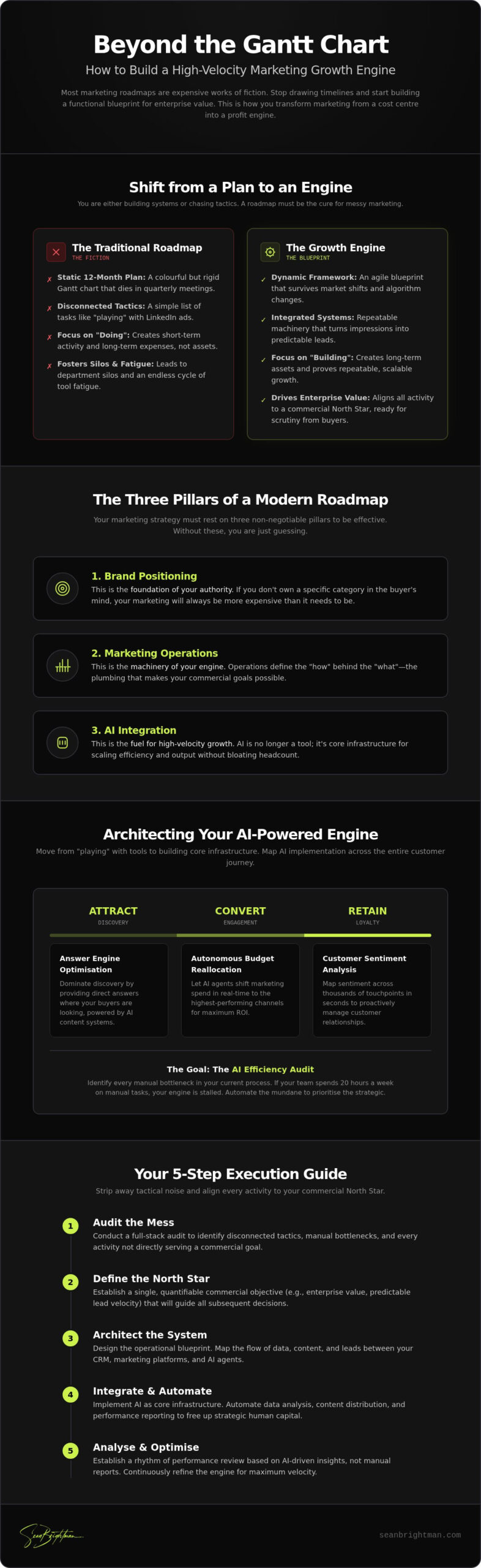
How to Build Your Growth Engine: A 5-Step Execution Guide
Roadmapping isn’t about picking a template or a pretty colour scheme. It’s about engineering. Most roadmaps fail because they are built on assumptions rather than audits. A high-impact marketing strategy roadmap requires a clinical approach to your existing infrastructure before you ever touch a timeline. If you start by choosing a format, you’ve already lost.
Step 1 & 2: The Strategic Foundation
You can’t build a roadmap if you don’t know where the leaks are. Step 1 is the Diagnostic. You must audit your current “messy” marketing systems to see what’s actually converting and what’s just noise. Most SMEs discover that 80% of their activity is wasted effort. You need to find those gaps and close them before you add more fuel to the fire.
Step 2 is Positioning. This isn’t about a new logo or a fresh coat of paint. It’s your North Star. Positioning defines exactly why you win in your category and why a buyer should care. Without it, your tactics are just expensive guesses. If you are struggling to define your edge, hiring a marketing strategy consultant can help you build a growth engine that actually scales instead of just a plan that sits on a shelf.
Step 3 & 4: From Theory to Machinery
Step 3 is Systems Design. You need a tech and AI stack that powers the engine, not a collection of tools that don’t talk to each other. Your “Marketing Stack” should be integrated, automated, and lean. Every tool must serve a specific purpose in the customer journey. If it doesn’t contribute to the machinery, get rid of it.
Step 4 is the 90-Day Sprint. Planning in detail beyond three months is a fantasy. Market conditions shift too fast for static 12-month task lists. Use your marketing strategy roadmap to set the high-level direction, but execute in 90-day bursts of high-velocity action. This keeps your team focused on immediate results rather than abstract long-term goals. It forces a rhythm of delivery that prevents stagnation.
Step 5 is the Feedback Loop. This is where most roadmaps die. You must build accountability and measurement into the process. This isn’t about being “agile” in the corporate sense; it’s about being effective. If a tactic isn’t driving the engine forward, kill it. If it is, double down. This loop ensures your strategy remains a living, breathing asset that builds enterprise value every single day.
Stop guessing and start building your growth machine. Get a professional roadmapping reset to align your marketing with your business goals.
From Roadmap to Revenue: The Accountability Gap
A marketing strategy roadmap is just a document. It is not a result. The number one reason these plans fail is simple: no one is driving the bus. You can have the most sophisticated AI-powered growth engine in the UK, but without senior oversight, the machinery will seize up. Accountability is the bridge between a static plan and actual revenue.
Most SMEs mistake activity for progress. They tick boxes but don’t move the needle. You need a mechanism that provides external perspective and blunt honesty. This is where a Marketing advisory retainer becomes essential. It’s about maintaining strategic velocity whilst your internal team handles the day-to-day execution.
Why Your First Hire Shouldn’t Be a Full-Time CMO
Hiring a full-time CMO too early is often a £120k mistake. You are paying for a high-level general when you don’t even have a functioning army or a proven system. It’s an expensive way to find out your foundation is cracked. A full-time hire often brings their own favourite tools and “corporate politeness,” which is exactly what a lean scale-up doesn’t need. You don’t need a manager; you need a builder.
A fractional cmo is different. They build the marketing strategy roadmap and then build the team required to execute it. It’s about building the engine before you hire the full-time driver. You get senior-level authority and “get-your-hands-dirty” expertise without the overhead of a permanent C-suite salary. It is about impact, not attendance.
Maintaining Strategic Velocity
Strategy is not a “one and done” event. It’s a process of constant adjustment. Monthly reviews are the heartbeat of a successful roadmap. You need to look at real-world data and course-correct immediately. If the market shifts or a specific tactic fails, you pivot. You don’t wait for the next quarterly board meeting. Speed is useless if you are heading in the wrong direction.
We operate with a “plug-and-play” mindset. This means high impact and low ceremony. We don’t care about long reports or bureaucratic sign-offs. We care about maximum ROI and building enterprise value. The goal is a marketing department that runs like a machine, delivering predictable growth that makes your business ready for an exit. Stop drawing timelines. Start driving revenue.
Build the Engine, Don’t Just Draw the Map
You’ve seen the difference between a static plan and a functional growth machine. A real marketing strategy roadmap is about engineering enterprise value, not just filling a calendar with tasks. By integrating AI as core infrastructure and shifting your focus from raw scale to exit-ready efficiency, you transform marketing from a cost centre into a high-velocity profit engine.
Your roadmap is a due diligence document. It must prove that your growth is repeatable, scalable, and independent of the founder’s daily input. Without senior oversight to bridge the accountability gap, even the most sophisticated plan will eventually stall. You need a driver who understands the machinery and can provide direct, results-oriented advisory.
Stop guessing and start building. Leverage senior Fractional CMO expertise and battle-hardened AI strategy to turn your marketing department into a genuine commercial asset. Build your growth engine: Book a strategic roadmapping session with Sean Brightman. It is time to stop chasing tactics and start building a legacy. You have the blueprint; now it’s time to execute.
Frequently Asked Questions
What should a marketing strategy roadmap include for a UK tech company?
A roadmap for a UK tech firm must include brand positioning, marketing operations architecture, and a clear AI integration plan. It is about building an engine, not just a list of tasks. You need a system that handles lead generation whilst ensuring your data remains fully GDPR compliant and scalable for future acquisition.
How long should a marketing roadmap be?
Your roadmap should provide a 12-month strategic vision, but execution must happen in 90-day sprints. Planning in detail beyond three months is guesswork in a fast-moving market. A long-term vision keeps the business on course; short-term sprints keep your team moving at high velocity without getting bogged down in bureaucracy.
What is the difference between a marketing plan and a marketing roadmap?
A marketing plan is a checklist of activities; a marketing strategy roadmap is the architectural blueprint for your growth machinery. Plans focus on what you are doing. Roadmaps focus on what you are building. One is a list of expenses; the other is the design of a commercial asset.
Do I need a Fractional CMO to create my marketing roadmap?
You need a Fractional CMO if you want a roadmap that functions as a high-velocity growth engine. Junior staff can execute tactics, but they lack the senior authority to design complex systems. A Fractional CMO provides the battle-hardened expertise required to build a machine that runs without the founder’s constant input.
How do I integrate AI into my existing marketing strategy?
Stop collecting tools and start building infrastructure. Integrate AI by identifying manual bottlenecks in your customer journey and automating them. Your marketing strategy roadmap should treat AI as the core infrastructure of your operations, not a separate set of toys to play with in your spare time.
How often should a marketing strategy roadmap be updated?
Update your roadmap monthly to reflect real-world data and sudden market shifts. Static plans die because they cannot adapt to algorithm changes or competitor moves. Monthly course-corrections ensure your strategy remains relevant whilst maintaining the high-impact rhythm needed for scalable, exit-ready growth.
Why do most marketing roadmaps fail to deliver ROI?
Most roadmaps fail because there is no one driving the bus. They become decorative documents that lack accountability and clinical measurement. Without a clear owner and a focus on building systems over chasing the latest tactics, your marketing spend will continue to feel like a black hole for cash.
Can a marketing strategy roadmap help with a business exit?
A marketing strategy roadmap is a critical asset during a business exit. It serves as a due diligence document that proves your lead generation is a repeatable, scalable system. Buyers pay a premium for businesses where the growth engine is documented and doesn’t rely on the founder’s presence.
Leave a Reply