Tag: brand positioning

  • B2B Brand Positioning Framework: Build a Position That Sticks

    B2B Brand Positioning Framework: Build a Position That Sticks

    A positioning statement that lives in a slide deck isn’t a strategy. It’s wallpaper. A practical b2b brand positioning framework should help your business make sharper choices, not just describe itself more elegantly.

    If your company sounds interchangeable with competitors, or marketing and sales give different answers about who you serve and why you’re different, the issue isn’t a shortage of clever copy. It’s a lack of shared decisions. If positioning work hasn’t changed what your team says or does, the document hasn’t done its job.

    This framework connects four essentials: your market, your buyer, your difference and the proof that makes your claims credible. Use them to shape a clear position, then turn it into practical guidance for messaging, offers, website content and customer journeys. The goal isn’t a statement that sounds impressive in a workshop. It’s a position your team can apply consistently, test in the market and use to decide what comes next.

    Key Takeaways

    • Use a b2b brand positioning framework to connect your buyer, their problem, the alternatives they consider, your difference and the evidence behind it.
    • Separate positioning from visual identity, campaign messaging and feature lists so each has a clear purpose.
    • Prioritise buyers without assuming you must reject every other opportunity. Make your differentiation specific, relevant and supportable.
    • Build and test your position through practical steps that produce decisions and useful artefacts, not another document to file away.
    • Turn the strategy into consistent choices for messaging, offers, website content and customer journeys.

    What a B2B brand positioning framework should actually clarify

    Positioning is the place your business deliberately earns in a buyer’s mind. It’s based on who you serve, the problem you solve and why your approach is worth considering. It isn’t a slogan chosen in a workshop. It’s a strategic choice about the buyers you prioritise and the difference you can credibly defend.

    That distinction matters because positioning is often confused with the things people can see. A logo and colour palette belong to visual identity. A campaign line is messaging. A feature list describes what a product does. Each can express or support a position, but none defines it. The core principles of brand positioning centre on how buyers perceive an offer in relation to alternatives. In practice, that perception needs to be grounded in evidence, not just a clever claim.

    Positioning is the strategic choice of who you serve and why you’re meaningfully different; messaging is how you express that choice to buyers. Keep that distinction in view. It stops teams treating new copy as a substitute for hard decisions.

    Positioning strategy versus messaging: where is the difference?

    Positioning sits beneath the words. It clarifies the audience, the need you address and why a buyer might choose you over doing nothing or taking another route. Messaging translates those choices into language buyers can understand and remember.

    Imagine a hypothetical B2B software firm serving finance teams. “Make work simpler” could be polished copy, but it doesn’t say which finance teams matter, what friction the product addresses or what makes its approach distinct. If those choices are unclear, sharper headlines won’t fix the strategy. And if the difference has no evidence behind it, confident wording only makes the gap more obvious.

    What does a strong B2B position help a business decide?

    A useful b2b brand positioning framework turns strategy into decisions people can apply. It helps leaders choose which buyers to prioritise and which problems deserve attention. That focus can guide:

    • Offers: which services or product options best address the priority buyer’s problem.
    • Customer journey: what a buyer needs to understand, compare and trust at each stage.
    • Website structure: which pages, proof points and calls to action deserve prominence.
    • Sales conversations: which needs to explore and which claims the team can support.

    These decisions create useful trade-offs. A company that prioritises established firms with complex reporting needs may shape its offer and website differently from one targeting small teams seeking a quick, simple tool. Neither choice is automatically right. The point is to make the choice explicit, then align activity around it.

    Positioning is a guide, not a growth guarantee. It can make decisions more coherent, but it can’t promise demand, remove competitors or prove a claim on its own. Its practical value is a shared basis for marketing, sales and leadership to decide what to say, build and prioritise next.

    The five connected choices inside a B2B brand positioning framework

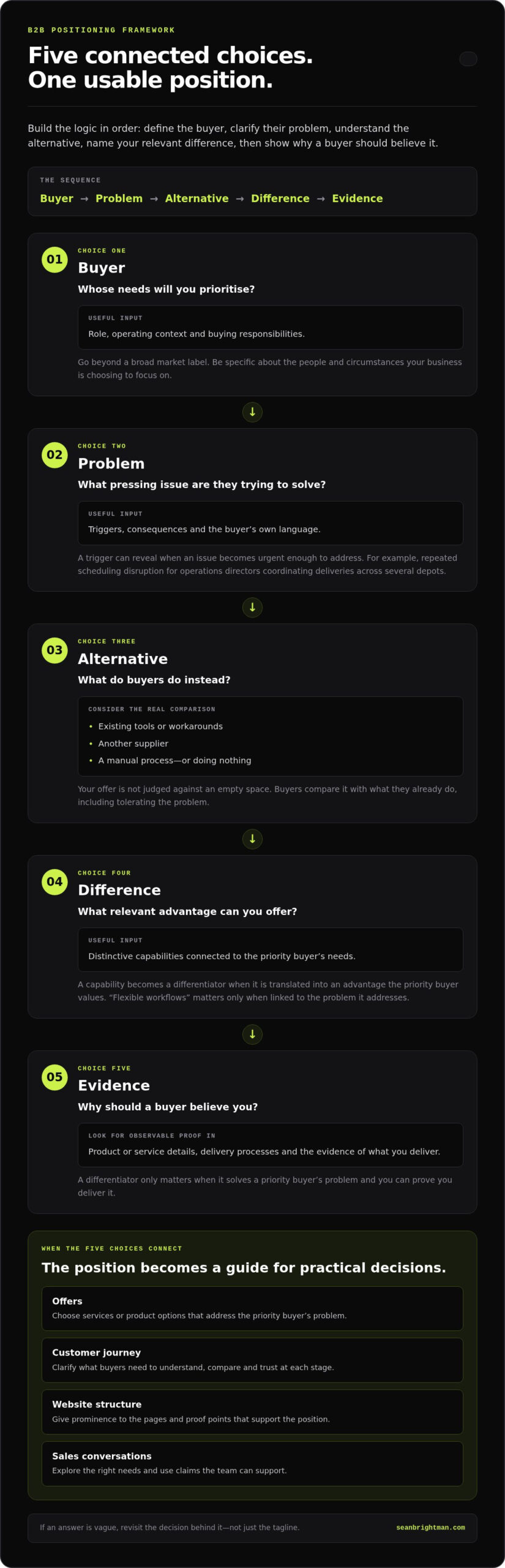
    A useful b2b brand positioning framework is a sequence of connected decisions, not five prompts answered in separate workshop rooms. Start with the buyer. Define their problem, the alternative they use, the difference you can offer and the evidence that makes that difference believable. Each answer sets the boundaries for the next.

    Use this table to build the logic in order. If an answer is vague, don’t paper over it with a sharper tagline. Revisit the decision behind it.

    Choice Key question Useful input
    Buyer Whose needs will we prioritise? Role, operating context and buying responsibilities
    Problem What pressing issue are they trying to solve? Triggers, consequences and buyer language
    Alternative What do they do instead? Existing tools, workarounds, competitors or inaction
    Difference What relevant advantage can we offer? Distinctive capabilities connected to buyer needs
    Evidence Why should a buyer believe us? Observable product, service or delivery proof

    Start with the buyer, problem and alternative

    “Mid-sized businesses” is a market description, not a usable buyer choice. Get specific about the role, context and problem. For example, a hypothetical logistics software provider might prioritise operations directors at firms coordinating deliveries across several depots. A trigger, such as repeated scheduling disruption, helps show when the issue becomes urgent enough to address.

    Then name the alternative honestly. Buyers might use spreadsheets, rely on a manual process, choose another supplier or tolerate the problem. Your offer isn’t judged against an empty space. It’s compared with what the buyer already does, including doing nothing.

    Make the difference credible with evidence

    A capability is something your organisation can do. A differentiator is that capability translated into an advantage a priority buyer values. “Flexible workflows” means little until you explain which buyer problem that flexibility addresses. A differentiator only matters when it solves a priority buyer’s problem and you can prove you deliver it.

    Look for evidence in product or service details, delivery processes and the experience buyers actually receive. Test the logic against buyer interviews, sales conversations and customer feedback. The Harvard Business School’s brand positioning framework also highlights the role of target audiences, competitive context and reasons to believe in shaping a positioning statement. Treat those reasons as a test, not decoration.

    Finally, read the five choices together. If the evidence doesn’t support the difference, revise the claim. If the alternative isn’t what buyers actually use, revisit the problem. For support turning these decisions into practical brand and marketing priorities, explore brand strategy support.

    B2B positioning objections: differentiation without narrowing too far

    “If we focus, won’t we lose customers?” It’s a fair concern, but focus doesn’t mean refusing every buyer outside a chosen segment. It means deciding who your position is built for first, based on where your offer fits and where you can support your value with evidence. Other buyers may still choose you. They simply don’t dictate every message, offer or priority.

    A useful b2b brand positioning framework helps you make that choice without pretending the market is smaller than it is. Treat your primary audience as a strategic priority, not a fence around the whole business. Compare the value of focus with the risk of over-narrowing:

    • Useful focus: gives marketing and sales a clear buyer, need and reason to lead with your offer. It makes decisions easier to test and refine.
    • Unnecessary narrowing: defines the audience so tightly that the position depends on a narrow label rather than a shared need, or excludes buyers who have the same problem and fit the offer.

    How focused should a B2B brand position be?

    Prioritise buyers whose needs match what you can deliver and demonstrate. Test that fit against actual buying conversations, customer feedback and the commercial realities of serving that audience. Can buyers recognise the problem? Does it matter enough to prompt action? Can your offer address it credibly? If the answers are weak, the focus may look neat on paper but be useless in practice.

    Keep the primary positioning audience distinct from every possible future customer. Your position should make today’s choices clearer, not forecast every market you might enter later. Focus can evolve as buyer needs, capabilities and evidence change.

    How to avoid claims that sound like every competitor

    “Best-in-class”, “innovative” and “customer-focused” aren’t differentiators by themselves. They’re claims. AI isn’t automatically distinctive either. Explain what a capability changes for a particular buyer, then point to observable evidence that supports the claim. A faster process, for instance, matters only if speed addresses a real buyer need and you can show how your delivery makes it possible.

    Compare alternatives using capabilities buyers care about, not insults or assumptions about competitors. Another supplier may solve the same problem differently; an internal workaround or inaction may be the real alternative. Strategic approaches to brand differentiation can help prompt options, but a strategy label doesn’t prove your position fits your buyers.

    Competitive maps can clarify perceptions when they use attributes buyers care about and reliable input from the market. They can show how buyers see options across dimensions such as specialist support or ease of adoption. But a neat chart can create false precision if the axes are chosen for convenience, the evidence is thin or the differences don’t affect buyer choices. Use the map to ask better questions, not to declare a winner.
    B2B Brand Positioning Framework: Build a Position That Sticks

    How to build, test and activate your B2B positioning framework

    A positioning framework earns its keep when it changes what the team does. Build it in stages. Each stage should leave you with a decision or working artefact, not just workshop notes. This process takes the five connected choices from discovery to buyer testing, then into the places where buyers meet your business.

    From buyer research to a testable positioning statement

    Collect evidence before polishing language. Bring together customer feedback, sales conversations and the knowledge of people who deliver the offer. Look for repeated buyer terms, triggers and objections. Internal opinions can point to useful questions, but they’re no substitute for buyer language.

    1. Set the audience and research question. Agree which buyer group you’re investigating and what you need to learn about its needs, alternatives and decision triggers. Artefact: a short research brief with the audience and questions to explore.
    2. Gather and sort the evidence. Review relevant buyer conversations and feedback alongside internal delivery knowledge. Separate observed facts from assumptions. Artefact: a findings summary showing recurring needs, alternatives and proof you can substantiate.
    3. Draft the positioning statement. Write a concise working statement that names the priority audience, its problem, the alternative and your credible difference. Treat it as a hypothesis, not finished copy. Artefact: one draft statement with supporting evidence for its central claim.
    4. Test it with target buyers. Ask buyers to explain what they think the offer is, who it’s for and what makes it distinct. Check whether they recognise the problem and whether the claimed difference matters. Avoid leading questions that invite polite agreement. Artefact: a test log capturing confusion, relevance and credibility.

    Put the position to work across the business

    Validation isn’t a vote on which phrase sounds nicest. Use what buyers understand, recognise and believe to refine the underlying choices. If buyers understand the offer but don’t value the difference, revisit the evidence or claim before rollout.

    1. Activate and assign ownership. Translate the position into homepage hierarchy, sales language, offer explanations and internal guidance. Give each customer-facing update a named owner and a clear next action. Artefact: an activation plan that records touchpoint, owner and status.

    To connect positioning decisions to ranked priorities and a practical action plan, use this strategic brand roadmapping guide. For repeatable execution across teams and touchpoints, the marketing operations growth engine guide explores how to build the operating rhythm around the work.

    Include a review point so the team can revisit buyer feedback, sales objections and changes to the offer. A b2b brand positioning framework should remain useful as the business learns, not become a statement no one is allowed to question. If you want strategic support turning positioning into action, explore brand strategy support.

    Make B2B brand positioning a working strategy, not a workshop document

    A positioning document is useful only if it changes decisions after the workshop ends. If leaders can’t agree which buyers matter, marketing and sales describe the offer differently, or agreed changes never reach the website and sales materials, the strategy is stuck. More copy won’t fix it. The team needs clearer choices, ownership and a route from strategy to action.

    A b2b brand positioning framework should guide decisions about positioning, messaging, offers, customer journeys and website strategy. Brand Strategist support can connect these parts, so the position shapes how the business communicates and what it prioritises. This is strategic direction focused on aligning choices and putting them to work.

    When is outside strategic direction useful?

    An external perspective can challenge assumptions that have become hard to question internally. It can help the team separate buyer evidence from familiar opinions, resolve conflicting descriptions of the offer and focus on what needs to happen next. The value is practical: clearer direction, priorities ranked by impact and accountability for moving decisions into action, without promising a particular commercial result.

    Look for a pattern, not one awkward meeting. If the same positioning debate keeps returning, teams are making different promises or activation has stalled because no one owns the next move, strategic support can bring the work back into focus. The aim isn’t another polished deck. It’s a shared basis for decisions people can act on.

    Choose a clear next step for your positioning work

    If the central choices need sharpening and the team needs a usable plan, Roadmapping is a focused next step. It’s a one-off strategy session that sharpens positioning and messaging, then ranks priorities by impact in a 90-day action roadmap. The roadmap is yours to run, giving the team a clear sequence rather than a vague instruction to “get aligned”.

    If positioning decisions need continued direction and accountability as the business acts on them, ongoing strategic leadership through Fractional CMO or Advisory CMO support may be a better fit. Choose the level of support around the work ahead: one focused roadmap, or ongoing guidance to keep decisions and priorities moving.

    For a practical way to connect positioning choices to ranked actions, use this strategic brand roadmapping guide. As the team turns strategy into repeatable activity, the marketing operations growth engine guide offers a useful perspective on execution.

    If your position needs to move from discussion into decisions your team can use, explore strategic support with Sean Brightman.

    Turn the position into your next business decision

    Your position shouldn’t sit outside the work. Use it to decide what to strengthen, what to stop saying and where the team should focus next. A b2b brand positioning framework becomes valuable when it helps people make those calls with confidence, even as the business changes.

    That takes more than a statement. Brand Strategist support connects positioning with messaging, offers, customer journeys and website strategy, so those choices carry through to how buyers experience the business. If the challenge is deciding what to act on first, Roadmapping sharpens positioning and messaging, then ranks priorities by impact in a 90-day action roadmap.

    You don’t need to solve every question at once. Start with the decision currently slowing the team down, then build from there. Explore strategic support with Sean Brightman and take the next step towards a position your team can put to work.

    Frequently Asked Questions

    Is B2B brand positioning the same as a value proposition?

    No. A value proposition explains the value a buyer can expect from a particular offer; positioning establishes the wider context that makes that value distinctive and relevant. For example, a data consultancy’s value proposition might focus on helping finance teams bring reporting data together. Its position would also clarify which finance teams it prioritises and how its approach stands apart from their other options. The value proposition supports the position, but doesn’t replace it.

    Can a B2B company have more than one brand position?

    It can tailor its emphasis for different audiences or offers, but several competing positions under one brand can confuse buyers and staff. Keep a clear central idea, then adapt examples, proof and language for distinct buying situations. A cybersecurity firm, for instance, might speak differently to a technical lead and a finance director whilst staying consistent about the problem it solves. Create separate positions only when the audiences or offers genuinely require different strategic choices.

    How do you test whether B2B positioning is clear to buyers?

    Show the draft to buyers who fit your intended audience, without explaining what you mean first. Ask them to describe the offer in their own words, say who they think it is for and identify what stands out. Then explore whether that distinction matters to their work and what evidence they would need to trust it. Note misunderstandings and recurring questions. If buyers interpret the offer differently from your team, revise the underlying choices before polishing the wording.

    Should a B2B positioning statement mention competitors?

    Usually, no. A statement should make the buyer, need and relevant difference clear without becoming a rival comparison or naming a competitor that may change. However, the thinking behind the statement should account for alternatives, including other suppliers, internal workarounds and doing nothing. Mention a competitor in outward-facing copy only if the comparison is accurate, useful to the buyer and supported by evidence. Otherwise, describe the distinction in terms of what your business does.

    How often should a business revisit its brand positioning?

    Revisit it when there’s a meaningful reason, not simply because a calendar reminder says so. Triggers might include a major change to the offer, a new audience, repeated buyer confusion or evidence that the claimed distinction no longer reflects delivery. Keep a record of the assumptions behind the position and review them against sales conversations and customer feedback. If those inputs still support the choices, maintain the direction and refine execution rather than starting over.

    What is the difference between B2B positioning and a positioning map?

    B2B positioning is the strategic choice a business makes about the place it wants to earn with priority buyers. A positioning map is a visual tool that plots perceived options against selected attributes, such as specialist depth and ease of implementation. The map can help a team explore buyer perceptions, but it isn’t the strategy itself. Its value depends on using attributes buyers care about and evidence that reflects their views, rather than assumptions.

  • Fractional CMO for Hire: The CEO’s Guide to Senior Marketing Leadership in 2026

    Fractional CMO for Hire: The CEO’s Guide to Senior Marketing Leadership in 2026

    Your £250,000 CMO hire is likely a strategic mistake. In 2026, a full-time executive is often a heavy anchor rather than a motor for growth. You’re probably exhausted by agencies that refuse to own the strategy and a marketing team that lacks genuine accountability. It’s painful to watch your budget vanish into AI hype whilst your competitors seem to have a clearer, more tactical roadmap. You need senior leadership; you don’t need the permanent overhead. Searching for a fractional CMO for hire is the shift that separates stagnant firms from those engineered for a high-value exit.

    You want a scalable growth engine, not a bloated payroll. This guide will show you how to stop wasting six figures on recruitment and start building a high-impact marketing system. We’ll break down how a fractional leader provides the brand positioning and strategic velocity required to dominate your sector. We’ll move past the corporate fluff and focus on the mechanics of a roadmap that delivers. It’s about results, not activity.

    Key Takeaways

    • Build systems, not campaigns. Learn how a fractional leader constructs the machinery of growth whilst eliminating the waste of expensive noise.
    • Secure senior leadership without the overhead. Discover why a Fractional CMO for hire provides strategic velocity by prioritising impact over attendance.
    • Master brand positioning. Understand how to differentiate your business amongst “me-too” competitors and prepare your marketing roadmap for a high-value exit.
    • Hire for battle-hardened experience, not corporate polish. Use our blueprint to vet and onboard talent who can navigate chaos without hand-holding.

    The Case for a Fractional CMO for Hire: Why Senior Leadership is Non-Negotiable

    Activity is not progress. Most scale-ups are currently drowning in “messy marketing”, a chaotic blur of LinkedIn posts, half-baked email sequences, and agency reports that mean absolutely nothing. This is expensive noise. You don’t need more tasks; you need a strategic architect. A Fractional executive, specifically a fractional CMO, provides senior-level leadership on a part-time, high-impact basis. They don’t just “do” marketing. They build the machinery that makes marketing work.

    Finding a Fractional CMO for hire isn’t about filling a seat; it’s about plugging in a battle-hardened growth engine. You get the grey hair and the tactical precision of a veteran without the corporate friction of a traditional hire. It’s about systems, not campaigns. Strategy, not activity. You are hiring a partner to build a scalable growth engine, ensuring every pound spent is an investment in your eventual exit, not just another line item on the P&L.

    The Problem with the Full-Time “Safe” Bet

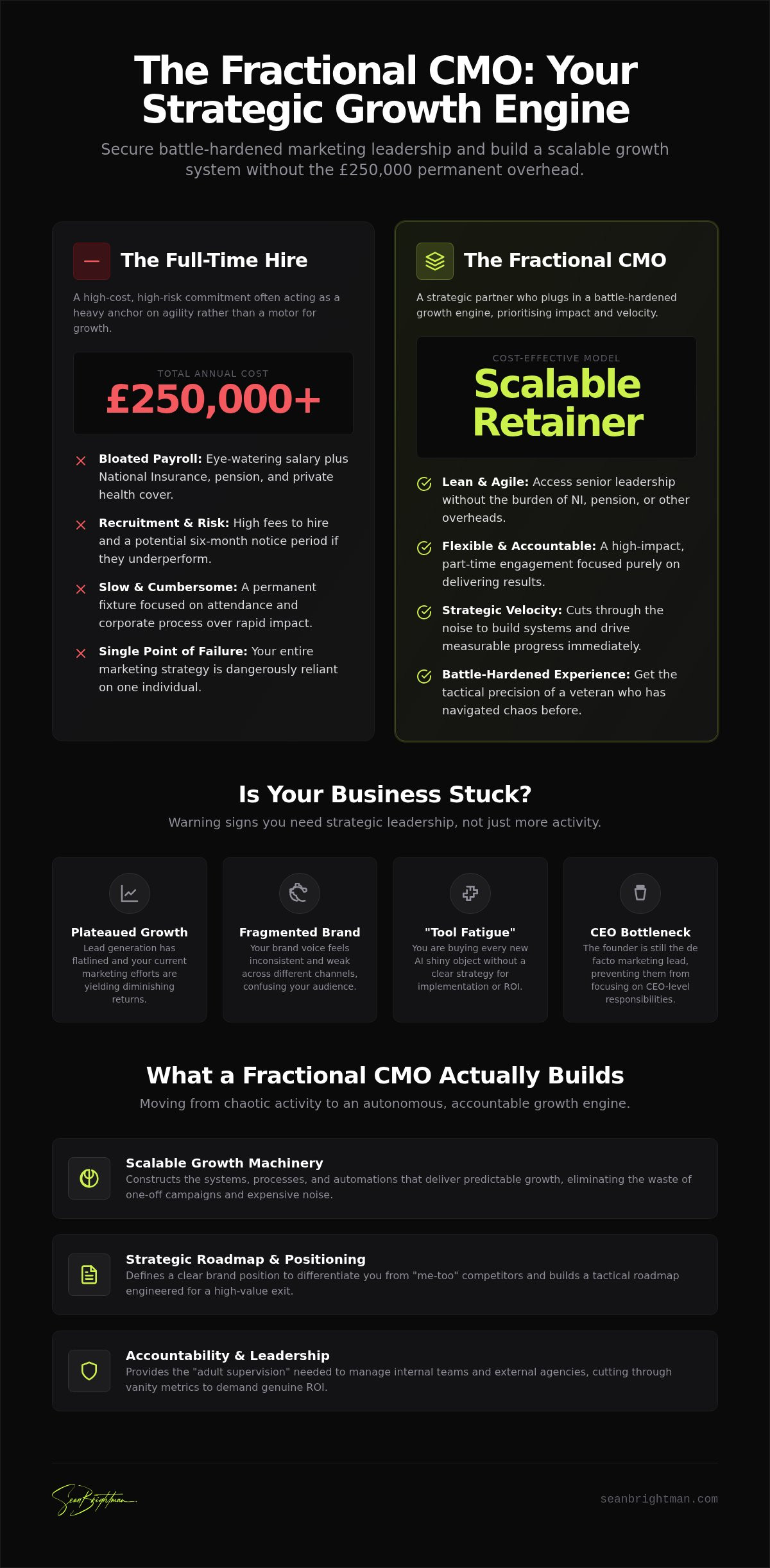
    The traditional C-suite hire is often a £120,000 mistake for mid-market firms. Beyond the eye-watering salary, you’re looking at National Insurance, pension contributions, and private health cover. Then there’s the risk. If they fail, you’re stuck with a six-month notice period and a toxic cultural legacy. It’s a massive bet on a single point of failure. High-impact leadership shouldn’t require a permanent ball and chain. For a deeper dive into the numbers, read our guide on Fractional CMO vs Full-Time: The Brutal Cost-Benefit Analysis for 2026. Modern businesses need agility, not a bloated payroll that restricts movement.

    When to Hire: The Warning Signs Your Business is Stuck

    If your lead generation has plateaued and your brand voice feels fragmented across different channels, you’re stuck. You might be suffering from “tool fatigue”, buying every AI shiny object without a clear implementation plan. These aren’t just minor glitches; they are systemic failures. When your marketing team is busy but the needle isn’t moving, you lack a navigator.

    The most dangerous symptom is the CEO bottleneck. If you, the founder, are still the de facto marketing lead, you aren’t a CEO; you’re a stressed marketing manager. Waiting for a “perfect” full-time hire whilst your growth stalls is a strategic failure. You need velocity now. A fractional leader steps in, audits the chaos, and provides the strategic clarity needed to move forward. They remove the weight from your shoulders so you can actually lead the company.

    Defining the Remit: What a Fractional CMO Actually Builds

    A Fractional CMO is a systems architect, not a campaign manager. They don’t just “do” marketing; they build the machinery that makes marketing autonomous and accountable. Most CEOs are trapped in a cycle of approving social media posts or tweaking ad copy. This is a waste of your time. When you search for a Fractional CMO for hire, you’re looking for someone to own the P&L of your growth department and engineer a system that functions without constant founder intervention.

    The Benefits of Hiring a Fractional CMO centre on this shift from activity to architecture. This leader builds the infrastructure required to scale, focusing on brand positioning that actually differentiates you amongst a sea of “me-too” competitors. They provide the adult supervision your existing team or external agencies often lack. It’s about driving results through accountability. If an agency is hiding behind vanity metrics, the fractional CMO is the one who cuts through the noise and demands a return on investment.

    Ultimately, this role is about preparation. Whether you are aiming for a future permanent hire or a high-value exit, the fractional leader ensures the business is ready. They document the processes, refine the tech stack, and prove the model. They build the value so you can eventually hand over the keys to a turnkey operation. If you want to stop guessing and start scaling, a strategic advisory approach is the only way to build lasting equity.

    AI-Powered Growth Engines

    In 2026, “using AI” is no longer a strategy; it’s a baseline requirement for survival. A fractional leader moves you past tool fatigue and into the realm of scalable growth engines. This involves top-down AI consulting to transform marketing efficiency, using automation for demand generation and pipeline velocity. We don’t just add more tools to your stack. We integrate AI into the core of your workflow to reduce friction and accelerate output. To understand how to move from scattered experiments to a unified system, see our guide on AI Consulting in 2026: From Tool Fatigue to Scalable Growth Engines.

    Strategic Brand Roadmapping

    The foundation of any successful engagement is the roadmap. This isn’t a vague “to-do” list; it’s a clear, 12-24 month strategic direction for growth. It defines exactly where the business is going and how marketing will get it there. This document creates vital alignment between the board and the marketing team, ensuring everyone is pulling in the same direction. Without a roadmap, you are just spending money and hoping for the best. With it, you have a blueprint for strategic velocity that turns abstract goals into clinical execution.

    Fractional CMO vs. Full-Time Hire: The Brutal Financial Reality

    Hiring a Fractional CMO for hire is a risk management strategy, not just a line-item saving. A full-time CMO expects a heavy salary, benefits, and equity. You pay for their attendance. With a fractional leader, you pay for impact. True fractional experts operate as independent businesses, typically falling outside IR35. This removes the tax headaches and administrative burden of a disguised employee. You get senior-level machinery without the permanent liability on your balance sheet.

    The flexibility factor is the real winner for scale-ups. A full-time executive often demands a six-month notice period and a complex severance package. A fractional engagement usually operates on a one-month rolling basis. It is built on results, not tenure. Driving strategic growth requires this level of agility. If the strategy isn’t working, you pivot. You aren’t handcuffed to a failing leader by a contract that protects them more than the business.

    The Recruitment Cost Trap

    Recruitment agencies typically charge between 20% and 30% of the first-year salary. On a £150,000 CMO role, you are handing over up to £45,000 just to get someone in the door. Then the clock starts. A full-time hire usually takes six months to “burn-in” before they deliver genuine value. They spend the first quarter “learning the culture” and the second quarter “building a team”.

    A fractional leader delivers a strategic audit and a 90-day roadmap within the first 30 days. Research suggests a fractional model can be 40% to 60% less expensive than a full-time hire whilst delivering results in half the time. It is the low-risk, high-reward entry point for companies that need senior leadership but can’t justify the dead weight of a massive permanent salary.

    Comparing Fractional CMO Services

    Not all fractional offerings are equal. You have a binary choice: the individual practitioner or the “fractional agency”. Many agencies sell you on a senior name but hand the work to a junior account manager. This is just an outsourced marketing department with a better haircut. You want the straight-shooting strategist who remains active in the field. Avoid the polished corporate reports that hide a lack of tactical depth. You need a partner who builds the machinery, not someone who just reports on its failure. To understand how to vet these different models, see our guide on Fractional CMO Services: The CEO’s Guide to Senior Marketing Leadership in 2026.

    Fractional CMO for Hire: The CEO’s Guide to Senior Marketing Leadership in 2026

    The Hiring Blueprint: How to Vet and Onboard Fractional Talent

    Vetting a Fractional CMO for hire requires a different lens than a standard recruitment drive. You aren’t looking for a “cultural fit” who smiles in the boardroom; you need a mechanic who can fix the engine whilst the car is moving. If you can’t define the problem, you can’t hire the solution. Start by defining a specific mandate. Are you repositioning the brand for an exit? Are you building a demand engine from scratch? Clarity on the outcome dictates the profile of the leader you need.

    Follow this clinical five-step process to secure the right partner:

    • Step 1: Define the Mandate. Identify the core bottleneck. Don’t settle for vague promises of “better brand awareness”.
    • Step 2: Seek Battle-Hardened Experience. Look for someone who has seen your specific chaos before. They should have a track record of dismantling the exact problems you face.
    • Step 3: Test for Blunt Honesty. Avoid anyone promising “magic bullets”. If they don’t challenge your current assumptions during the interview, they won’t provide the accountability you need.
    • Step 4: Establish the Cadence. High-impact leadership usually requires 1 to 2 days a week. This is about strategic concentration, not clocking in for 40 hours of fluff.
    • Step 5: Set Clinical KPIs. Focus on pipeline velocity, conversion rates, and team accountability. If the needle isn’t moving, the engagement isn’t working.

    Vetting for Strategic Velocity

    Ask the hard questions. Have they built a growth engine from scratch, or did they just manage a large budget at a global firm? Evaluate their approach to AI and marketing technology architecture. You need a leader who understands how to integrate these tools into a functional system, not someone who just buys more software. They must be able to challenge the CEO whilst maintaining board alignment. If they are too polite to tell you your current strategy is failing, they are a waste of your capital.

    The Onboarding Phase

    Effective onboarding for a Fractional CMO for hire is a compressed process. The first 30 days must focus on a clinical audit, a strategic roadmap, and securing quick wins to build momentum. Grant the “mandate” immediately. If the fractional leader doesn’t have the authority to change the system, they are merely an expensive observer. They should integrate with your existing team through mentorship, providing the senior guidance your junior staff currently lack. This isn’t about micro-management; it is about providing a blueprint for execution.

    If you are ready to move from marketing chaos to clinical execution, book a strategic roadmapping session to define your growth engine.

    The Sean Brightman Methodology: From AI Roadmapping to Strategic Velocity

    Sean Brightman doesn’t do corporate politeness. Bureaucracy is a parasite on growth. This methodology is designed for the CEO who is finished with “marketing as usual” and needs a Fractional CMO for hire who acts as a strategic architect. It is high-energy, results-oriented, and unapologetically direct. We don’t produce reports to justify our existence; we build machinery that delivers revenue. It’s about tactical precision, not abstract theory.

    The process starts with roadmapping. You don’t turn a screwdriver until the blueprint is verified. Most businesses fail because they execute before they strategise. We audit the chaos, identify the leaks, and create a 12 to 24-month plan that aligns your board with your marketing team. This creates immediate strategic velocity. We move past the “messy marketing” phase discussed earlier and move into clinical, documented execution.

    AI consulting is the second pillar. In 2026, if your marketing system isn’t intelligent, it’s obsolete. We move your business beyond tool fatigue. We don’t just suggest software; we integrate AI into the core of your demand generation and pipeline. This isn’t about replacing people; it’s about augmenting your growth engine so it scales without a proportional increase in headcount or cost. It is about building a system that is faster, leaner, and more predictable.

    Advisory Retainer: The CEO’s Secret Weapon

    High-impact leadership shouldn’t be a permanent weight on your payroll. Once the growth machinery is built and the team is aligned, the role shifts. The transition from a fractional CMO to a strategic advisor allows you to maintain momentum without the six-figure overhead. You keep the accountability and the senior-level direction, but you pay for the impact, not the attendance. This is the “plug-and-play” model at its most efficient. To understand how to sustain this momentum, see The Marketing Advisory Retainer: A CEO’s Guide to Strategic Velocity.

    Building a Scalable Growth Engine

    The final goal is an exit-ready marketing system. Your business value increases when your growth doesn’t depend on a single person or a founder’s intuition. Sean Brightman’s approach provides the architecture for long-term success, ensuring every process is documented and every tool is optimised. You aren’t just buying marketing; you are building equity. If you are ready to stop wasting budget on activity and start investing in a system, it is time to act. Book a strategy session to fix your messy marketing today and start building your scalable growth engine.

    Stop Guessing and Start Engineering Growth

    The choice is binary. You can continue burning capital on “messy marketing” activity, or you can build a scalable growth engine that adds genuine equity to your business. We have dismantled the myth of the “safe” full-time hire and shown why a Fractional CMO for hire provides the strategic velocity you actually need. It is about clinical execution, not corporate politeness. You need a systems architect, not a task manager.

    By prioritising architecture over activity and leveraging AI-powered growth engines, you remove the CEO bottleneck. You gain the battle-hardened expertise of a published strategy author without the long-term liability of a permanent contract. The roadmap is your blueprint. The results are your reality. Don’t let another quarter slip away in a fog of tool fatigue and fragmented brand voice. Secure the senior leadership your business demands today.

    Book your Marketing Strategy Roadmap session with Sean Brightman and fix your marketing machinery now. Your exit-ready growth engine is just one strategic decision away.

    Frequently Asked Questions

    What is the difference between a fractional CMO and a marketing consultant?

    Consultants provide advice; fractional CMOs provide leadership. A consultant usually delivers a report or a specific project and then exits the business. A fractional CMO owns the marketing strategy, manages your team, and is directly accountable for growth results. It is a functional leadership role, not a temporary advisory project.

    How much does a fractional CMO for hire typically cost in the UK?

    You pay for strategic impact, not attendance. Whilst rates vary based on the specialist’s experience, a Fractional CMO for hire is typically 40% to 60% less expensive than a full-time permanent executive. You avoid the heavy costs of National Insurance, bonuses, and private benefits whilst securing senior-level expertise that drives revenue.

    How many days a week does a fractional CMO usually work?

    Most engagements require 1 to 2 days per week. This isn’t about filling a seat for 40 hours; it’s about high-concentration strategic direction. The goal is to build the growth machinery and provide senior guidance to your existing staff. Efficient leadership doesn’t require a full-time presence to deliver maximum velocity.

    Can a fractional CMO manage my existing marketing agency?

    Yes, and they should. Most agencies operate without senior-level accountability, often hiding behind vanity metrics. A fractional leader provides the necessary “adult supervision”, ensuring your agency’s output aligns with the strategic roadmap. They demand a genuine return on investment and cut through the fluff that often plagues agency reports.

    Is a fractional CMO engagement outside IR35?

    Yes, provided the leader is a genuine independent specialist. True fractional experts operate as separate business entities with multiple clients and no mutuality of obligation. This structure keeps the engagement outside IR35. It reduces your tax risk and eliminates the administrative burden of traditional employment contracts.

    What happens after the fractional CMO engagement ends?

    You are left with a turnkey growth engine. The objective is to document every process and build a system that functions without the fractional leader. Once the machinery is stable, you can transition to a strategic advisory retainer or hire a permanent lead into a department that is already high-performing.

    Does a fractional CMO hire the rest of the marketing team?

    They design the structure and vet the talent. Whilst they aren’t a recruitment agency, they identify the specific skills gaps in your business. A Fractional CMO for hire ensures you don’t make expensive recruitment mistakes by hiring for the wrong roles. They build a team capable of executing the long-term roadmap.

  • Brand Positioning Consultant UK: Strategy for Commercial Growth

    Brand Positioning Consultant UK: Strategy for Commercial Growth

    Your brand isn’t a logo. It’s a commercial weapon. If it isn’t winning you market share, it’s just expensive wallpaper. Most agencies sell you “vibes” and a PDF of pretty colours, but they don’t sell you revenue. Finding a brand positioning consultant UK businesses can actually trust for commercial growth means looking past the mood boards and into the machinery of your business.

    You’re likely tired of marketing activity that generates noise but zero momentum. You’re indistinguishable from the pack and finished with agencies that deliver “strategy” but leave you with no idea what to do on Monday morning. You want a defensible market position, not just a new font. You need a roadmap, not a retreat.

    This article explains how to transform market noise into a scalable growth engine. We’ll explore how a brand positioning consultant builds a 12 to 24 month roadmap that actually moves the needle. You’ll learn how to move away from creative fluff and build a marketing department that is finally accountable for commercial outcomes.

    Key Takeaways

    • Positioning is about market share, not just a new colour palette; learn why owning a category is the only way to cut through the noise.
    • Partnering with a brand positioning consultant UK expert helps you define a “This, Not That” binary to sharpen your competitive edge.
    • Discover why the Fractional CMO model outperforms expensive agencies and prevents the “£120k mistake” of a premature full-time hire.
    • Follow a clinical roadmapping process to plug commercial leaks and turn your marketing department into an outcome-focused growth engine.
    • Master the “Strategy First” approach to ensure your brand positioning remains the foundation for every AI tool and tactical execution.

    What is a Brand Positioning Consultant and Why Do You Need One?

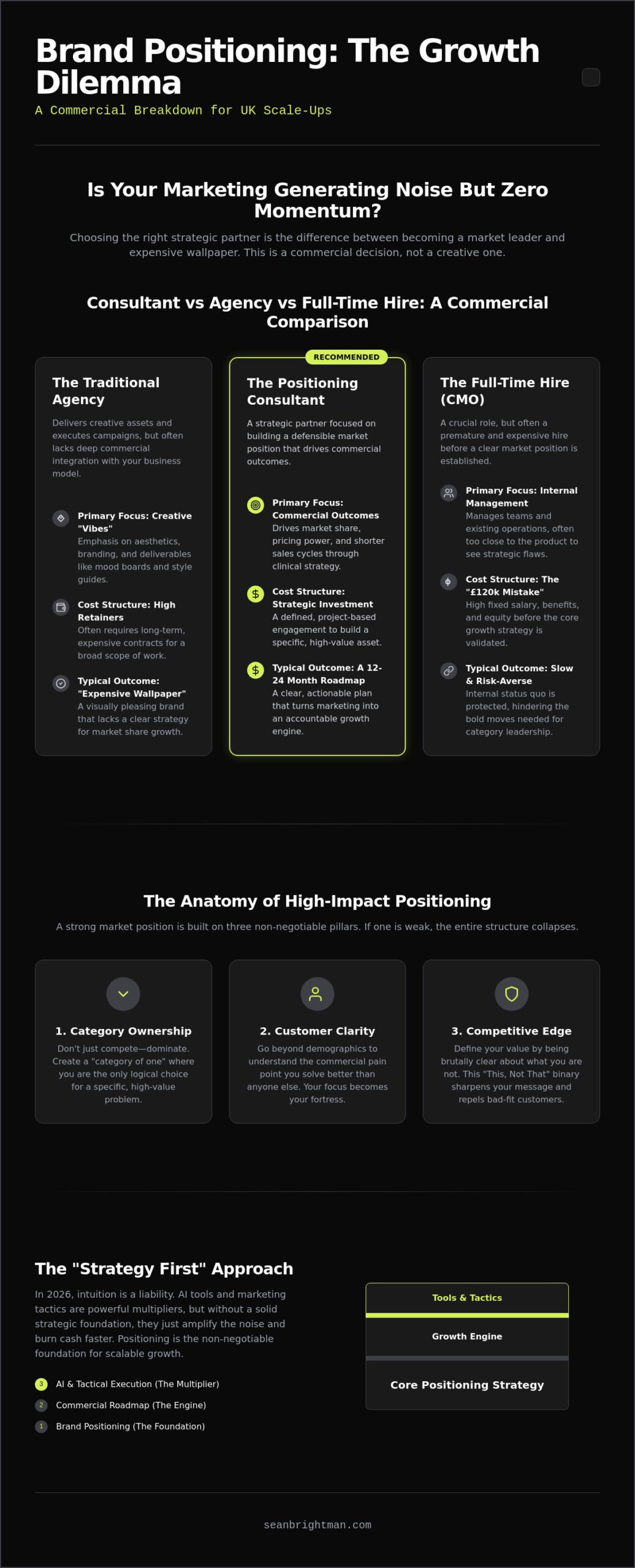
    Brand positioning is the strategic act of owning a specific category in your customer’s mind. It isn’t about what you do; it’s about where you sit in the market hierarchy. Whilst many confuse it with “branding”, the two are fundamentally different. Branding is about aesthetics. Positioning is about market share. A solid Positioning in marketing strategy defines your territory and defends it against the competition. It’s the difference between being a commodity and being the only logical choice.

    A brand positioning consultant UK specialist acts as the external force your internal team lacks. Internal teams are often too close to the product to see the flaws in the narrative. They’re trying to read the label from inside the jar. A consultant brings order to internal complexity, stripping away the “corporate speak” and refocusing the business on its most profitable path. They don’t provide fluff; they provide a clinical assessment of where you’re winning and where you’re bleeding cash.

    UK scale-ups often hit a ceiling because they outgrow their initial “accidental” positioning. What worked to get you to £1m won’t get you to £10m. At this stage, your message becomes diluted. You try to be everything to everyone and end up being nothing to anyone. Engaging a brand positioning consultant UK expert is about reclaiming that focus before the market ignores you entirely.

    The “Messy Marketing” Symptom

    You’ll know your positioning is broken when your marketing feels like a series of disconnected experiments. High Customer Acquisition Costs (CAC), stagnant sales cycles, and the constant need to cut prices are all red flags. These aren’t just tactical failures. They’re symptoms of a brand that hasn’t claimed its space. Internal teams struggle to fix this because they’re invested in the status quo. You need a battle-hardened expert to walk in, identify the commercial leaks, and strip away the vanity projects that aren’t driving growth.

    Commercial Outcomes vs. Creative Deliverables

    Positioning must drive revenue. If it doesn’t lead to pricing power or better customer retention, it’s a waste of time. Most agencies will hand you a deck of pretty colours and call it a day. A consultant focuses on commercial levers: how you enter new markets, how you justify a premium price, and how you shorten the distance between a lead and a sale. Positioning is a functional component of a growth engine that converts market interest into hard currency.

    The Anatomy of High-Impact Brand Positioning in 2026

    Positioning in 2026 isn’t a static statement. It’s an active commercial system. It relies on three rigid pillars: Category, Customer, and Competitive Edge. If one is missing, the whole structure collapses. You aren’t looking for a catchy tagline. You’re building a defensible moat that keeps competitors at bay whilst you scale. This is about tactical precision, not creative guesswork. You need to know exactly which hill you are willing to die on before you spend a single pound on advertising.

    High-impact strategy relies on the “This, Not That” binary. You define your value by being brutally clear about what you are not. You aren’t just “innovative”; you are “efficient, not experimental”. You aren’t “affordable”; you are “transparent, not hidden”. This isn’t about being slightly better than the next guy. It’s about being the only logical solution for a specific problem. A brand positioning consultant UK expert strips away the generic fluff to find this core truth. It creates a “North Star” proposition. This isn’t marketing copy. It’s a directive for internal alignment. It ensures every department, from sales to product development, is pulling in the same direction. When your team knows exactly what the brand stands for, they stop wasting time on projects that don’t fit the mission.

    Category Ownership: Don’t Just Compete, Dominate

    Most UK businesses are “me-too” players. They chase the leader’s tail and wonder why their margins are under constant pressure. Domination requires category ownership. You move from competing in a crowded space to creating a category of one. This isn’t just a creative pivot. It’s an operational shift. You need the technical precision of a marketing operations consultant to ensure the machinery of your business can actually deliver on the promise. Strategic roadmapping identifies the gaps your competitors are too slow or too bloated to fill. It’s about finding the “white space” and occupying it with overwhelming force.

    The AI-Powered Positioning Advantage

    In 2026, intuition is a liability. AI-powered market analysis now allows us to map competitor weaknesses and customer sentiment at a scale previously impossible. We use these tools to identify commercial leaks and untapped market gaps. Developing a brand positioning strategy today means building a data-driven growth engine. This technology doesn’t just provide insights; it allows for rapid testing and pivots. You can validate a new position in weeks, not months, ensuring your commercial growth is built on a foundation of verified market demand. This is how you turn market noise into a scalable asset.

    Consultant vs. Agency vs. Full-Time Hire: Which is Right?

    Fixing your market presence is a commercial decision. You have three primary paths: the traditional agency, the full-time hire, or the specialist advisor. A brand positioning consultant UK expert is often the only option that offers senior-level authority without a hidden agenda. You need an objective view of your business machinery. You don’t need a partner who is incentivised to sell you more of what they happen to produce. This is about strategic clarity, not just increasing your billable hours.

    Many UK scale-ups fall into the “£120k mistake”. They hire a full-time CMO too early. They pay a senior salary, plus benefits and recruitment fees, for someone to manage a broken narrative. It’s a disaster. You end up with an expensive leader who spends their first six months “finding their feet” whilst the commercial leaks continue. A consultant is different. They are a plug-and-play asset. They arrive, identify the friction, fix the positioning, and build the roadmap. You get the high-level thinking without the long-term liability. Before committing to any model, it’s worth understanding the full breakdown of Fractional CMO pricing UK so you can build a budget framework that prioritises commercial outcomes over activity.

    Agencies present a different risk. There is a fundamental conflict of interest when the person defining your strategy also sells the execution. If an agency tells you that you don’t need more social media ads, they lose money. They often call it “strategy”, but it’s usually just a justification for their production department. Whilst you might try to Craft the Perfect Brand Positioning Statement internally, a consultant ensures that statement actually translates into commercial reality. They own the strategy; they don’t just “do” the work.

    The Agency Overhead Trap

    Agencies prioritise their own survival. Their model relies on keeping teams busy and billable hours high. This often leads to a “more is better” approach to marketing activity. You need a partner who directs, not just one who does. A brand positioning consultant UK specialist focuses on your growth, not their headcount. They help you decide what to stop doing, which is often more valuable than starting something new. For a deeper cost-benefit analysis, see the fractional cmo pillar.

    The Fractional CMO Advantage

    The Fractional model provides senior leadership on a flexible basis. You get direct access to a battle-hardened expert who has seen your specific problems before. They don’t need training or hand-holding. Their focus remains entirely on high-level strategy and marketing team accountability. They act as the sharp-minded external force that brings order to your internal complexity, ensuring your team is accountable for outcomes, not just activity.

    Brand Positioning Consultant UK: Strategy for Commercial Growth

    The Positioning Roadmap: From Market Noise to Category Leader

    Positioning isn’t a creative whim. It’s a mechanical process. You start with the Audit. We strip back the layers to see where your current narrative is leaking revenue. We look at perception versus reality. If your customers think you’re a commodity whilst you’re charging premium prices, you have a commercial leak. A brand positioning consultant UK specialist doesn’t just point out the problem; they build the fix. We move from the Audit into the Roadmap, defining exactly where the business needs to sit in the next 12 to 24 months.

    The Roadmap is your tactical blueprint. It defines the future state and the specific steps to reach it. This isn’t about vague goals. It’s about high-impact actions. We then move to Integration. The new position must live in your sales scripts, your product features, and your marketing campaigns. It is a total business alignment. Execution follows, often supported by an advisory retainer to ensure ongoing accountability. Finally, we reach Optimisation. We leverage AI to refine the message based on real-world feedback, ensuring your strategy remains defensible as the market shifts. If your marketing department is still operating as a cost centre rather than a growth engine, working with a marketing transformation consultant can help you re-engineer the entire system for predictable commercial output.

    The 90-Day Transformation

    The first three months determine your trajectory. We don’t wait for a year to see results. We focus on quick wins that fund the strategic shift. This might mean killing a failing product line or repricing a service for immediate impact. We establish KPIs that the CEO actually understands. We track commercial momentum, not vanity metrics like “impressions” or “likes”. If it doesn’t move the needle on the balance sheet, we don’t track it. It’s about results, not activity.

    Accountability and Systems

    Positioning fails when it stays in a PDF. It needs a system to enforce it. The advisor acts as the external friction that keeps the marketing team honest. We build a growth engine that operates independently of the founder. You move from being the primary salesperson to owning a machine that generates leads. This is about building a scalable asset, not just a job for the CEO. Ready to stop the noise? Start your strategic roadmapping today and build a marketing department that is finally accountable.

    Scaling with Precision: The Sean Brightman Approach

    Scaling a business isn’t about doing more of the same. It’s about doing the right things with surgical precision. My approach combines Fractional CMO leadership with deep AI consulting to ensure your brand doesn’t just speak; it performs. As a brand positioning consultant UK businesses hire to fix stagnant growth, I operate on a “Strategy First, Tools Second” philosophy. If the strategy is broken, AI only helps you fail faster. We fix the foundation before we automate the output.

    The methodology isn’t a secret. It’s documented in “The Book”. This is the foundational system I use to strip away corporate fluff and rebuild commercial momentum. For CEOs, the Advisory Retainer provides peace of mind. It isn’t a passive service. It’s an active, high-impact partnership. I act as the external force that maintains order, ensuring your team stays focused on the roadmap we’ve built together. We don’t chase trends. We chase revenue. This is about mechanical integration, not abstract theory.

    Strategic Roadmapping Sessions

    Sometimes you don’t need a long-term retainer yet. You need a reset. My Strategic Roadmapping sessions are one-off, high-impact events designed to fix a specific brand or marketing slump. We turn abstract commercial goals into a visceral, actionable plan for the next 12 months. This is “get-your-hands-dirty” strategy. We identify the leaks, define the category you need to own, and map the tactical steps to get there. It’s about clarity over complexity. We define the hill you will own and provide the equipment to take it.

    The AI Growth Engine Integration

    In 2026, playing with AI tools is a hobby. Building an AI Growth Engine is a business strategy. This is where brand positioning meets mechanical automation. We build systems that personalise your message at a scale that was previously impossible. This isn’t about generic content. It’s about using AI to enhance your unique market position and automate the heavy lifting of lead generation. We move from manual activity to a self-sustaining marketing system. Stop guessing and start growing. Book a roadmapping session to fix your brand positioning today and build a defensible moat around your business.

    Stop Guessing and Start Dominating Your Category

    Positioning isn’t a creative project; it’s a commercial system. If your brand is currently indistinguishable from the competition, you aren’t just losing “vibes”, you’re losing market share. We’ve explored how a clinical roadmap and the Fractional CMO model can plug commercial leaks and turn your marketing department into an accountable growth engine. You don’t need more activity; you need a defensible market position that forces your category to pay attention.

    As a Fractional CMO for UK high-growth scale-ups and the author of a definitive marketing strategy book, I’ve seen exactly how messy marketing stalls momentum. My approach combines battle-hardened expertise with AI-powered marketing systems to build a machine that operates independently of the founder. Hiring a brand positioning consultant UK specialist is the first step toward reclaiming your time and your margins.

    The machinery is ready. The strategy is clear. It’s time to stop reading and start building. Book a Strategic Roadmap Session with Sean Brightman today and transform your business from a “me-too” player into a category leader. Your market is waiting for someone to lead; it might as well be you.

    Frequently Asked Questions

    How much does a brand positioning consultant in the UK cost?

    Fees depend on the seniority of the advisor and the complexity of your market challenges. Strategic marketing consultants in the UK typically charge between £150 and £500 per hour, whilst monthly retainers often range from £5,000 to over £25,000 for high-growth firms. You’re investing in a commercial result, not a timesheet. Fixed-price roadmapping offers a clear entry point without the liability of a full-time hire.

    What is the difference between a brand positioning consultant and a branding agency?

    A consultant owns the strategy; an agency sells the execution. Agencies focus on creative deliverables like logos, colour palettes, and fonts. A brand positioning consultant UK expert focuses on market share, pricing power, and the machinery of your growth. It’s the difference between buying a new coat of paint and rebuilding the engine to win the race.

    How long does the brand positioning process usually take?

    A foundational roadmap typically takes 30 days, but full commercial integration is a 90-day process. You cannot fix a decade of messy marketing in a weekend. The first month identifies the leaks and defines the category. The following two months embed that position into your sales scripts, product features, and marketing systems for permanent structural change.

    Can a brand positioning consultant help with my AI marketing strategy?

    Yes, AI is now the primary engine for testing and scaling your market position. AI consulting helps you build automated systems that personalise your message at scale without losing brand integrity. We use these tools to map competitor weaknesses and customer sentiment. It turns your strategy from a static document into a dynamic growth engine that adapts in real-time.

    Do I need a brand positioning consultant if I already have a marketing manager?

    Yes, because a manager handles activity whilst a consultant handles direction. Your marketing manager is likely buried in daily execution; they’re reading the label from inside the jar. A consultant provides the external friction and high-level strategy your team needs to be effective. It gives your manager a roadmap to follow instead of a list of random tasks.

    What industries do you specialise in for brand positioning?

    The focus is on UK high-growth scale-ups where commercial complexity is high. The methodology applies to any business where market noise is drowning out value. Whether it’s B2B tech or professional services, the mechanical principles of category dominance remain the same. If you have a complex product and a long sales cycle, positioning is your primary commercial weapon.

    How do you measure the ROI of a brand positioning engagement?

    Success is measured through commercial levers like Customer Acquisition Cost (CAC), sales cycle length, and pricing power. We don’t track vanity metrics like social media impressions or “likes”. If your brand positioning consultant UK engagement doesn’t lead to higher margins and a marketing department accountable for revenue, it hasn’t worked. ROI is found in the balance sheet, not the mood board.

    What is a Fractional CMO and how do they handle brand positioning?

    A Fractional CMO is a part-time senior leader who provides the authority of a full-time hire without the recruitment fees or long-term liability. They own the brand positioning and team leadership, acting as a plug-and-play asset for your business. They bring order to internal complexity and ensure your growth engine is built to scale. It’s senior-level strategy delivered with tactical precision. For a transparent breakdown of what this model costs in practice, see our guide to Fractional CMO pricing UK and what you should expect to pay for genuine commercial outcomes in 2026.