
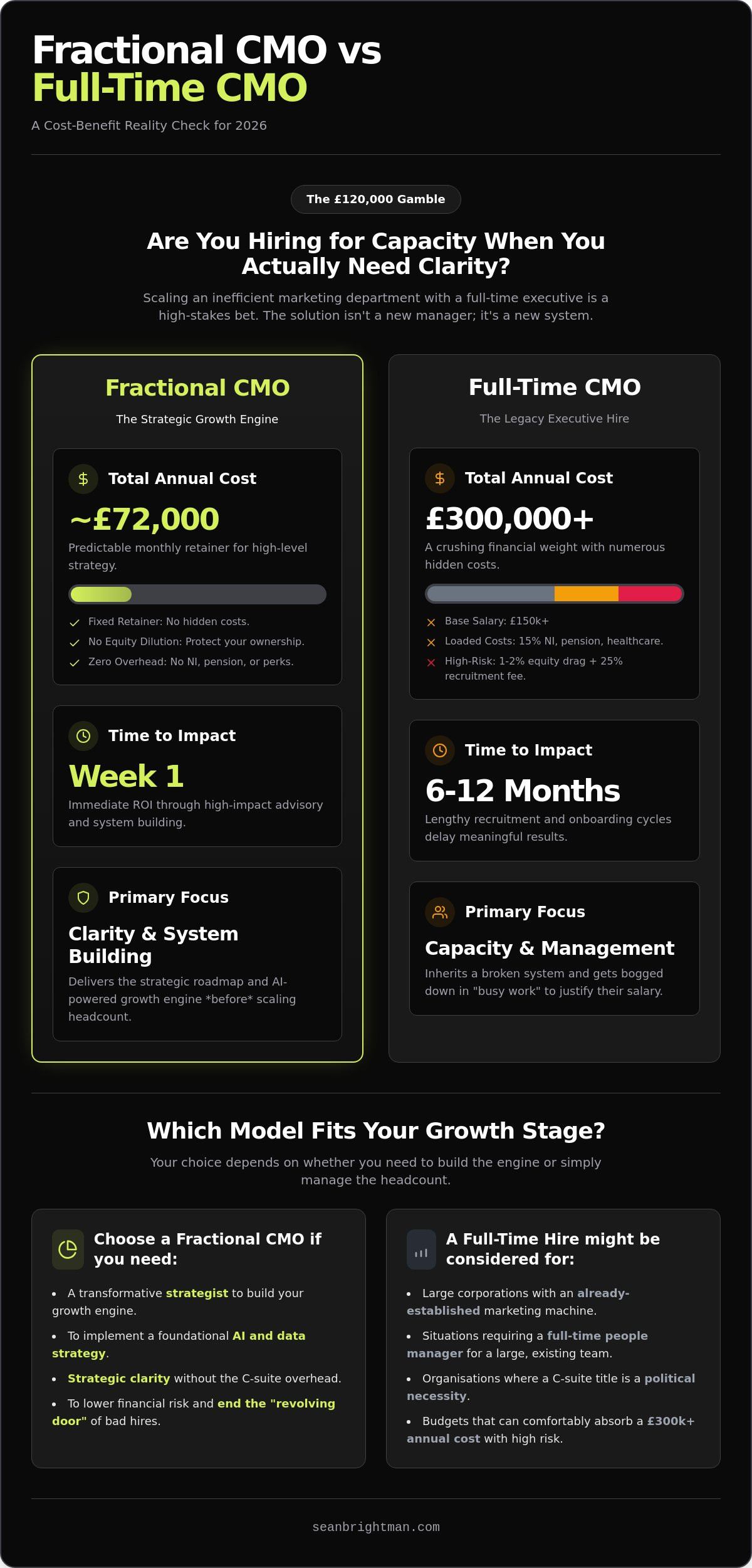
Hiring a full-time CMO in 2026 isn’t a sign of growth. It’s often a £120,000 gamble on a person when what you actually need is a system. When weighing up a Fractional CMO vs full time hire, most leaders focus on the wrong numbers. You’ve likely felt the frustration of watching ad spend vanish whilst your marketing department lacks basic accountability. The risk of a bad senior hire is high, and the complexity of AI implementation is higher. You need a result, not a new executive to manage.
The debate isn’t just about the salary on the contract. It’s about the machinery of your marketing. You want strategic clarity without the crushing overhead of a £300,000 total loaded cost. You deserve a marketing engine that scales, not a bloated payroll that stagnates. Committing to a legacy hiring model is a choice to move slower than the market.
This analysis strips away the corporate politeness to reveal why the traditional hire is failing. We’ll break down the brutal cost-benefit reality of fractional leadership. You’ll discover how to secure high-level strategy, lower your risk, and build a faster, smarter growth engine for 2026.
Key Takeaways
- Stop hiring for capacity when you actually lack clarity. Learn why building a marketing system is more critical than simply adding another executive to the payroll.
- Calculate the true Total Cost of Ownership beyond base salary. Compare a Fractional CMO vs full time hire to avoid the “Equity Drag” and high-stakes recruitment fees.
- Shift focus from headcount to high-performance machinery. Discover how fractional leadership prioritises AI-powered growth engines over traditional department bloat.
- Use a 4-point audit to define your growth stage. Identify whether your organisation requires a transformative strategist or a steady hand for maintenance.
- End the “revolving door” cycle of senior departures. Secure strategic direction and accountability through an advisory retainer that delivers results without the corporate bureaucracy.
The £120k Mistake: Why Your First Hire Shouldn’t Be a Full-Time CMO
Hiring a full-time CMO as your first senior marketing move is a high-stakes gamble. Most founders mistake a lack of hands for a lack of direction. They hire for capacity. They actually need clarity. This mismatch is why the average full-time CMO tenure is a mere 18 months. You spend six figures on a person who inherits a messy system, gets bogged down in busy work, and eventually leaves before the engine is even built. It’s a revolving door that costs you time, equity, and momentum.
Bringing a senior executive into a chaotic marketing environment creates immediate friction. The new hire feels the pressure to show results to justify their massive salary. Instead of fixing the underlying data or AI strategy, they default to safe, visible tasks. They launch a brand refresh. They change the agency. They produce busy work. Meanwhile, the core growth problems remain unsolved. The system stays messy. This is why they leave; they can’t win in a system that hasn’t been built for success.
Capacity vs Clarity: What Do You Actually Need?
Do you need more people to do the work, or do you need to know which work is worth doing? Scaling an inefficient department is just throwing money into a faster-moving furnace. A fractional cmo doesn’t start by hiring more staff. They start by fixing the machinery. The Fractional executive model is built on the premise that strategy must precede execution. You need the map before you need the muscle. Hiring a full-time leader to figure it out whilst paying their £150k salary is an expensive way to buy a roadmap. You want a growth engine, not a manager for a broken department.
The Opportunity Cost of the Recruitment Cycle
The math of the Fractional CMO vs full time debate gets ugly when you look at the calendar. A traditional hire takes three months to find and three months to onboard. By the time they understand your product, half a year has vanished. If they don’t work out, you’ve lost twelve months and a 25% recruitment fee. Fractional leadership delivers ROI in week one. There is no getting up to speed period. There is only high-impact advisory and immediate system building. Avoid the trap of hiring a full-time manager who spends their first quarter just managing agencies instead of driving growth. You need a strategist who builds systems, not a coordinator who schedules meetings.
Total Cost of Ownership: A Direct Comparison of Models
The financial gap in the Fractional CMO vs full time debate is wider than a simple salary comparison suggests. You aren’t just paying for a person. You’re funding an entire executive infrastructure. A base salary of £150,000 is merely the entry fee. By the time you’ve added the “Equity Drag” and the loaded costs of employment, you’ve committed to a massive financial weight that rarely correlates with actual growth. The math is clinical, and for most businesses, it doesn’t add up.
The Permanent Hire Ledger
A full-time C-suite package in 2026 is an expensive, rigid commitment. Beyond the base salary, you must account for employer National Insurance contributions, which stand at 15% from April 2025. Add pension contributions, private healthcare, and the inevitable annual bonus. Then there’s the “perk” culture. Car allowances, gym memberships, and high-end equipment are standard expectations that bloat the ledger.
The real killer is equity. Giving away 1% or 2% of your business to a marketing leader is a high-stakes gamble. If they leave after 18 months, you’ve diluted your ownership for a short-term tenure. If they fail, the cost of a “bad fit” exit includes not just severance, but the potential legal friction of a C-level departure. You’re paying for their presence and their potential, not necessarily their output or the systems they leave behind.
The Fractional Retainer Ledger
A fractional retainer shifts the spend from person to process. You pay for strategic advisory as a fixed, predictable investment. There is no National Insurance. No pension. No equity loss. You are exploring the fractional CMO model because it allows you to turn senior leadership on or off as your business scales. This is about tactical precision, not headcount.
This model eliminates the overhead of office space and C-suite bureaucracy. You invest in the growth engine itself. If your business needs to pivot, you aren’t stuck with a rigid, high-salary contract. You gain the agility to scale up during a launch or dial back during a consolidation phase. It’s about buying the result. If you’re ready to stop funding bureaucracy and start building systems, a strategic roadmapping session can identify exactly where your budget is being wasted.
Strategy vs Execution: The Tactical Mismatch
Full-time CMOs often measure their value by the size of their department. They build teams. They hire managers to manage other managers. In the Fractional CMO vs full time debate, this is a critical failure point for scaling businesses. A fractional leader doesn’t want a bigger headcount; they want a more efficient system. They build machinery. They install processes that work whether they are in the room or not. You don’t need more people to manage. You need a growth engine that produces predictable results.
Many permanent hires fall into the “Agency Trap”. They lack the technical depth to execute in a modern environment, so they outsource everything to expensive external partners. They become high-paid project managers for third-party vendors. You end up paying a C-suite salary plus agency fees, yet nobody is actually building internal equity. A fractional advisor cuts through this fluff. They act as a marketing operations expert who ensures every pound spent is a pound tracked. They hold your vendors accountable to hard revenue targets, not just “brand awareness” metrics.
Building AI-Powered Growth Engines
Legacy CMOs struggle with modern AI implementation. They think it’s about asking a chatbot to write a social post. It isn’t. It’s about integrating intelligence into the core workflow of your business. Understanding the different types of fractional CMOs is vital here; you need an architect, not just a caretaker. Sean Brightman’s roadmapping doesn’t just suggest tools. It creates a future-proof marketing architecture. We integrate AI to handle the heavy lifting, allowing your human talent to focus on high-level strategic pivots. This isn’t about using tools. It’s about building intelligence into your infrastructure.
The Objectivity Advantage
The “Internal Echo Chamber” is a silent killer of growth. Full-time hires eventually stop challenging the CEO. They want to protect their position. They want to avoid friction in the Monday morning briefing. They become part of the corporate furniture. An external fractional strategist doesn’t have that baggage. They have the objectivity advantage. They can tell you your favourite project is a waste of resources without fearing for their career. They focus on pure revenue drivers, not internal optics. They provide strategic clarity whilst managing your internal teams with a level of blunt honesty that a salaried employee simply cannot afford.
The 4-Point Audit: Which Model Fits Your Growth Stage?
Stop guessing. You need a framework to decide. The choice between a Fractional CMO vs full time hire depends on your current reality, not your aspirations. Most founders hire for where they want to be in five years, whilst ignoring the fires burning in their department today. Run this 4-point audit before you sign an employment contract that you might regret in six months.
- Step 1: Evaluate Marketing Maturity. Do you have documented systems, clean data, and a working playbook? If your marketing is a black box, a full-time hire will simply manage the mess. You need a mechanic to build the engine, not a driver to sit in a stationary car.
- Step 2: Define the Job to be Done. Is this about transformation or maintenance? Transformation requires high-impact strategic pivots. Maintenance requires daily management. If you are rebuilding the grid, you need a fractional strategist. If you are just keeping the lights on, hire a manager.
- Step 3: Assess the Budget Ratio. If you spend £150,000 on a base salary, what is left for the actual execution? A senior hire with no budget for ads or AI tools is a vanity metric. Balance your investment between talent and the growth engine itself.
- Step 4: Determine Longevity. Is this a permanent structural need or a 12-month high-impact sprint? Fractional leadership is designed for the latter. It provides an efficient, plug-and-play solution for specific growth phases.
If you find yourself stuck in the mud of Step 1, you aren’t ready for a permanent C-suite executive. You need a roadmap. You can book a strategic roadmapping session to define your systems before you commit to a long-term salary.
When to Choose a Fractional CMO
Choose the fractional model if you are a scale-up aiming for an exit or a new funding round. Research suggests businesses with under £10 million in turnover are often the primary candidates for this approach. You gain senior-level direction without the recruitment baggage. It is the ideal move when you need to integrate AI-powered growth engines but don’t want the bloat of a dedicated internal AI team. You want the expertise. You don’t want the overhead. If you’re still unclear on exactly what is a fractional CMO and how the model delivers senior-level strategy without the permanent overhead, that breakdown cuts through the corporate fluff to show you the brutal truth. For a comprehensive overview of how to deploy fractional CMO services as a CEO-level strategic decision, the full guide covers exactly how to move from chaotic execution to clinical precision.
When a Full-Time Hire Makes Sense
A permanent hire is for late-stage enterprises with stable, predictable growth. When your marketing department exceeds 50 people, the “culture-building” role often outweighs the strategic “fixing” role. You need a leader to navigate internal politics and maintain the status quo. Large organisations with massive, established budgets can afford the £300,000 total loaded cost of a permanent executive. At this stage, the business prioritises stability over the high-speed agility of a fractional partner.
Beyond the Hire: Implementing a Strategic Roadmap
Marketing is not a department. It is a functional component of your business machinery. When it fails, you don’t just need a new manager. You need a mechanic to tune the engine. The real winner in the Fractional CMO vs full time comparison is the model that prioritises results over presence. An advisory retainer provides direction and accountability without the suffocating weight of corporate bureaucracy. You get the strategic mind you need, exactly when you need it, focused entirely on high-impact revenue drivers.
A 90-day roadmap delivers more tangible value than a 12-month employment contract. Why? Because it forces momentum. It identifies the bottlenecks, integrates the AI tools, and sets the trajectory before you’ve even finished the traditional recruitment cycle. You move from messy marketing to systematic growth in weeks, not years. This is about building a scalable growth engine that functions with tactical precision. Stop looking for a saviour in a suit. Start looking for a system that works.
The Sean Brightman Methodology
The “Marketing Strategy Roadmap” is designed to align your brand identity with modern AI capabilities. As the author of a published book on marketing strategy, Sean Brightman brings a battle-hardened perspective to your boardroom. We don’t play with tools. We execute a strategy. This methodology strips away the fluff of “brand awareness” and replaces it with functional architecture. We focus on high-level advisory that empowers your existing team. It is about integrating intelligence into your workflow so your marketing becomes a predictable, high-performance machine.
Your Next 90 Days
Stop the endless recruitment loop. Start strategising. In the next 90 days, you can expect a total transformation of your marketing efficiency. When a team has a clear map, morale skyrockets. The “busy work” vanishes. The agency management trap is dismantled. You gain a partner who provides the blunt honesty required to fix a messy marketing department. You don’t need a full-time executive to tell you what’s wrong. You need a strategist to show you how to win.
The first step toward clarity is simple. You can book a roadmapping session with Sean Brightman today to stop the £120k mistake and start building your growth engine. Move from the uncertainty of a legacy hire to the precision of a strategic roadmap.
Build the Engine, Not the Payroll
The choice between a Fractional CMO vs full time hire isn’t just a budget decision. It’s a choice between buying a system or buying a salary. You’ve seen the math. The £300,000 loaded cost of a permanent executive is a massive weight on a scaling business. You don’t need the overhead of National Insurance, pension contributions, or equity loss. You need strategic clarity and an AI-powered growth engine that works whilst you sleep.
Sean Brightman is the author of the definitive book on marketing strategy and a specialist in building high-performance machinery. You get senior-level authority without the recruitment fees or the corporate fluff. Stop risking your momentum on the 18-month revolving door of traditional recruitment. Focus on results, not headcount. It’s time to stop managing a messy department and start executing a roadmap that delivers.
Stop hiring for capacity and start building clarity—Explore Sean’s Fractional CMO services
Your business deserves a marketing system built for the future. Let’s get to work.
Frequently Asked Questions
What is the main difference between a Fractional CMO and a full-time hire?
The primary difference lies in the nature of the commitment. A full-time hire is a permanent headcount focused on daily management and internal culture. A fractional leader is a strategic intervention focused on building systems and driving results. You pay for high-level expertise and output, not for hours sat at a desk. It’s about buying clarity rather than just adding capacity.
Is a Fractional CMO just another word for a marketing consultant?
No, they are distinct roles. A consultant delivers a report and leaves the execution to you. A Fractional CMO takes ownership of the marketing function. They integrate into your leadership team, manage internal resources, and are accountable for the growth engine’s performance. It is a tactical leadership role that involves getting hands-on with your business machinery, not just side-line advisory.
How many days a month does a Fractional CMO typically work?
Most engagements cover between 2 and 8 days per month. This isn’t about filling a calendar. It is about concentrated strategic output. High-level leaders achieve more in four dedicated days than a junior manager can in twenty. The focus remains on delivering the 90-day roadmap and maintaining accountability rather than a punch-clock mentality.
Will a Fractional CMO manage my existing marketing team?
Yes, they act as the senior leader for your current marketing staff. They provide the direction, mentorship, and accountability your internal team often lacks. This structure removes the burden of marketing management from the CEO. It allows your existing talent to execute a clear, battle-hardened strategy rather than guessing their way through the working week.
Can a Fractional CMO help with AI implementation?
Yes, this is a core component of modern fractional leadership. A specialist will integrate AI into your actual workflow to automate heavy lifting and scale output. This isn’t about simply using chatbots. It’s about building a future-proof architecture that uses intelligence to drive revenue. We focus on integrating AI into the machinery of your business to create a scalable growth engine.
What is the typical cost of a Fractional CMO in the UK for 2026?
Industry data for 2026 shows monthly retainers typically range between £3,000 and £20,000. This depends on the company’s growth stage and the required strategic intensity. Day rates for established leaders often sit between £1,300 and £1,800. When comparing Fractional CMO vs full time costs, remember that you avoid employer National Insurance, pension contributions, and expensive recruitment fees.
How long does a typical fractional engagement last?
Engagements usually last between 6 and 12 months. This provides enough time to fix messy systems and build a scalable growth engine. Some businesses retain the advisor longer for ongoing accountability through an advisory retainer. Others use the fractional period to prepare the ground for a permanent hire once the systems are stable and the roadmap is clear.
What happens if I need a full-time CMO later on?
A fractional engagement is the best way to prepare for a full-time hire. You use the strategist to fix the department and document the playbooks first. This ensures that when you eventually hire a permanent leader, they inherit a working system rather than a chaotic mess. You transition from a builder to a maintainer when the business maturity warrants it.
Leave a Reply