
Tag: Budget Optimisation

  • Reducing Marketing Budget Waste: Find the Leaks Before You Cut

    Reducing Marketing Budget Waste: Find the Leaks Before You Cut

    Cutting the marketing budget can make the spreadsheet look healthier whilst quietly weakening growth. If you’re reducing marketing budget waste, start by finding where spend loses momentum, not by slashing activity that may be working.

    The frustration is familiar: marketing uses budget, but its contribution to revenue is hard to pin down. Teams, agencies, channels and tools each tell a different success story. Under pressure, it’s tempting to cut what’s difficult to measure, even when it supports the business.

    This article shows you how to separate avoidable waste from useful investment, then decide what to fix first. You’ll learn to examine measurement gaps, targeting, messaging, tools and budget ownership using evidence and commercial context rather than guesswork.

    The goal isn’t a smaller budget for its own sake. It’s a clearer decision system: one that links marketing choices to business priorities, turns findings into a prioritised plan and builds regular accountability. That way, each review improves the next decision instead of resetting the conversation every quarter.

    Key Takeaways

    • Spot leaks across measurement, channel choices, tools and hand-offs, not just visible campaign spend.
    • For reducing marketing budget waste, assess performance against commercial outcomes rather than relying on a single metric.
    • Reconcile spend and reporting over a period that fits your sales cycle before acting on apparent underperformance.
    • Prioritise changes by evidence, likely impact, reversibility and how quickly you can learn from them.
    • Keep a decision log with owners, assumptions and review points so each budget decision informs the next.

    Reducing marketing budget waste starts with finding the real leak

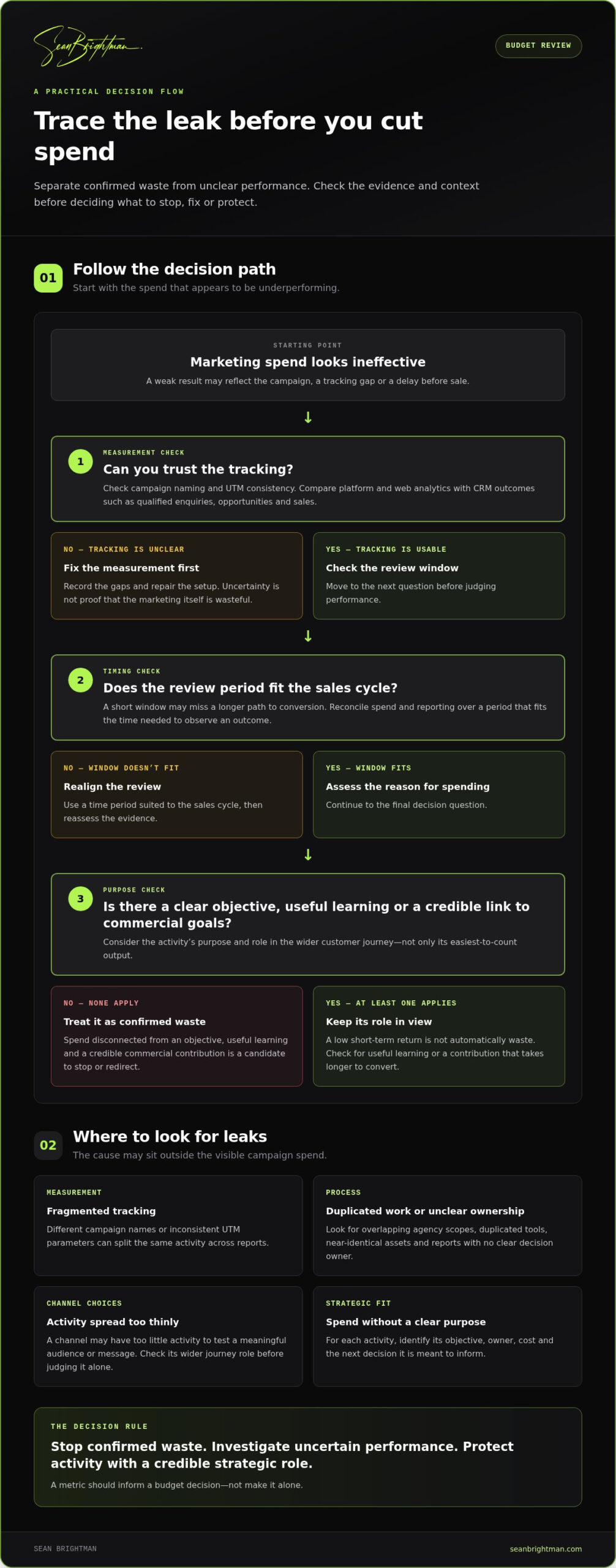
    Pressure to cut spend often arrives before anyone can explain what the budget is doing. An across-the-board reduction may look decisive, but it can remove effective investment alongside genuine inefficiency. Disciplined optimisation starts by tracing the leak and fixing its cause. It doesn’t treat every unclear result as proof that activity should stop.

    Marketing budget waste is spend disconnected from a clear objective, useful learning or a credible contribution to commercial goals. That definition matters because weak measurement creates uncertainty, not a verdict. If a campaign’s results aren’t tracked properly, the first problem may be the measurement setup, not the campaign itself. Understanding marketing effectiveness means judging activity against its purpose and role in the wider marketing effort, not just its easiest-to-count output.

    What counts as marketing budget waste?

    Look for avoidable spend in the machinery around marketing as well as in channels. A team might pay for a tool no one uses, commission separate teams to produce near-identical assets, or run campaigns without agreeing who owns the outcome. These are different problems: process waste, channel underperformance and weak strategic fit each call for a different fix.

    A low short-term return isn’t automatically waste. A test that rules out a weak message can provide useful learning; brand activity may also support a customer journey that takes longer to convert. Ask whether there was a clear reason to spend, a way to learn and a sensible link to business priorities.

    Why cutting the budget is not the same as reducing waste

    Equal percentage cuts ignore differences in purpose and performance. They can shrink a proven source of demand just as readily as they remove duplicated work. Cheap leads can also distract from lead quality, whilst activity metrics such as clicks say little on their own about commercial contribution.

    Judge investment against the business goal, the customer journey and the time needed to observe an outcome. A short reporting window may miss a longer sales cycle; a longer one may hide a problem that needs attention now. Make the distinction clear: stop confirmed waste, investigate uncertain performance, and protect activity with a credible strategic role. That’s the starting point for reducing marketing budget waste without cutting growth potential by guesswork.

    Where marketing budgets leak: measurement, hand-offs, and misplaced activity

    Budget leaks rarely sit in one neat line on a report. They build where strategy, channel choices, measurement and delivery fail to connect. A campaign may have a clear objective, but if its results don’t reach the team planning the next activity, the learning gets lost. One team may pay for a tool whilst another buys a similar platform. An agency and an internal team may both produce reports without anyone owning the decision those reports are meant to inform.

    Fragmented tracking makes budget comparisons less reliable because teams may be measuring different activity, outcomes and time periods. That uncertainty is a measurement problem to investigate, not automatic proof that the marketing itself is wasteful.

    How weak measurement hides useful signals

    Attribution is an imperfect view of contribution, not a complete account of cause and effect. A platform may claim credit for a conversion that involved several other interactions, whilst a channel that helped build awareness may receive no direct credit at all. Use measurement to guide investigation, not to declare a winner from one dashboard. Harvard Business School Online’s guidance on how to measure marketing effectiveness offers a broader perspective than relying on a single metric.

    Start by checking the tracking basics. If one team names a campaign “spring_launch” and another uses “Spring-Launch”, or UTM parameters vary between links, reports can split the same activity into separate entries. Compare platform and web analytics with CRM outcomes: qualified enquiries, opportunities and sales can show whether apparent performance translates into business value. Record gaps rather than filling them with assumptions.

    How process and channel choices create avoidable spend

    Next, trace the work between planning and reporting. Look for overlapping agency scopes, duplicated tools, unclear briefs and manual reports that teams rebuild separately. For each activity, identify its objective, owner, cost and next decision. If nobody can explain what a task supports or who acts on its result, that’s a process leak worth investigating.

    Channel sprawl creates another trap. Spreading a budget thinly across multiple channels can leave each with too little activity to test a meaningful audience or message. But consolidation should follow evidence and strategic fit, not convenience. A channel with limited immediate conversions may still play a useful role in the customer journey; check how it supports other activity before judging it in isolation.

    For a deeper look at how joined-up processes support growth, explore marketing operations for a scalable growth engine. A focused marketing roadmapping discussion can also help turn these findings into clear priorities for reducing marketing budget waste.

    How to diagnose wasted marketing spend without trusting one metric

    Move from suspicion to evidence with a repeatable review. A metric should inform a budget decision, not make it alone. A low conversion figure might signal a weak campaign, a tracking gap or a delay between first contact and sale. Separate those possibilities before changing investment.

    Build a useful view of spend and outcomes

    Choose one reporting period that reflects your sales cycle, then use it consistently across the review. Group investment by objective, audience, channel, campaign and internal or external owner. Reconcile planned budget with actual spend, then compare platform and web analytics with CRM outcomes where available. Select the business outcome that fits the objective, such as qualified pipeline, revenue, retention or another meaningful measure.

    Flag missing tracking, inconsistent campaign names, differing attribution windows and gaps between platforms and CRM. Don’t hide incomplete evidence inside a single performance score.

    Use five steps to diagnose the leak

    • Set the outcome: State what the activity was meant to achieve and how that connects to a business priority.
    • Reconcile spend: Check planned allocation against actual spend across teams, channels and suppliers.
    • Compare evidence: Review the chosen outcome alongside relevant platform, website and CRM signals.
    • Investigate variance: Trace unexpected results to possible causes, such as a tracking change, audience shift, delivery issue or a genuine performance decline.
    • Record confidence: Note what the evidence supports, what remains uncertain and what check or test could improve the picture.

    Warning sign | Evidence to investigate | Possible explanation

    Spend rises, but qualified pipeline doesn’t | CRM stages, lead quality and campaign changes | Lower-quality demand, a longer conversion path or a tracking gap

    Two reports show different results | Reporting period, attribution window and campaign definitions | Different measurement rules, not necessarily different performance

    Activity is hard to connect to an objective | Brief, owner and intended audience | Unclear strategy or work that has lost its purpose

    Look for repeated patterns across comparable activity, not a verdict from one campaign or reporting period. Check results against the intended customer journey and the time it takes for outcomes to appear. A short-term dip may matter, but it needs context before it triggers a cut.

    This method makes reducing marketing budget waste more rigorous: it distinguishes a confirmed problem from an incomplete signal and points to the next decision rather than pretending every answer is already in the data.
    Reducing Marketing Budget Waste: Find the Leaks Before You Cut

    What to fix first: prioritise marketing budget changes by evidence

    Start with changes where the waste is visible and the downside is limited. Duplicate subscriptions, overlapping work or activity with no accountable owner are stronger clean-up candidates than a campaign that simply lacks reliable measurement. Don’t cut a channel by default. First weigh the evidence, likely business impact, reversibility and time needed to learn.

    Decision type | Evidence strength | Likely impact | Reversibility | Time to learn

    Immediate clean-up: duplicated tool or repeated task | Clear and verifiable | Usually contained | High | Short

    Test: campaign with mixed results | Partial or inconsistent | Could affect demand | Often high | Depends on the sales cycle

    Tracking fix: activity with incomplete attribution | Insufficient to judge | Unclear until measured | High | Depends on data availability

    Strategic review: investment affecting key audiences or positioning | Requires broader context | Potentially substantial | Lower | Longer-term

    Which budget leaks should you address first?

    Remove confirmed duplication and resolve ownership gaps first. Treat weakly measured activity as an investigation or test candidate, not an automatic cancellation. Escalate choices that could reshape how you reach key audiences, express your positioning or support longer-term growth. The harder a change is to reverse, the stronger the evidence and business case should be.

    How to test a change without damaging growth

    Change one meaningful variable where practical, such as the audience or message, and write down what evidence would change your decision. Set a review point that fits the sales cycle and gives the relevant data time to emerge. If several elements change at once, you may not know what caused the result.

    Example: A team finds two subscriptions that appear to serve the same purpose, whilst one campaign has weak lead tracking but supports an important audience. It can verify and remove the duplicate, then improve tracking and test the campaign before deciding whether to reduce its allocation. The example is illustrative, not a client result.

    If the evidence points beyond channel adjustments to priorities around positioning or growth, use strategic brand roadmapping to shape the next decisions. For senior-level direction on turning findings into a prioritised plan, explore strategic marketing guidance. That’s how reducing marketing budget waste becomes a controlled decision, not a blunt cut.

    Make marketing budget control an ongoing leadership system

    A one-off budget review finds leaks. A leadership system helps stop them returning. Tie each marketing investment to a business outcome, a clear owner and an assumption that can be revisited. Then review what changed, what the evidence says and what decision comes next. This keeps the budget connected to commercial priorities, not just last quarter’s activity.

    Set a budget review cadence that drives decisions

    Set review points around business planning and the sales cycle, not an arbitrary reporting ritual. At each review, look at business outcomes, committed spend, key assumptions and any changes in customer behaviour, team capacity or commercial priorities. If an assumption no longer holds, update the plan rather than allowing old allocations to roll forward by default.

    Keep a decision log that makes accountability visible. Record what changed, why it changed, the expected effect, the person responsible and when the decision will be reviewed. That record helps the team distinguish a deliberate test from unplanned drift in spend.

    Make sure the parts of the system reinforce one another. Positioning shapes which audiences matter; channel choices determine how you reach them; measurement shows what the activity contributes; and operating capacity determines what the team can deliver well. A mismatch between any of these can undermine the rest.

    When strategic marketing support can help

    If priorities keep fragmenting, ownership remains unclear or measurement problems recur, the issue may need senior strategic direction rather than another reporting template. Fractional CMO leadership and ongoing advisory support can connect budget choices to positioning and business goals, and bring accountability to regular reviews. This is strategic oversight, not advertising execution.

    Sean Brightman’s advisory retainer provides ongoing strategic direction and accountability. For senior marketing leadership on a part-time basis, explore Fractional CMO support.

    Start with one action: map current spend against its objective, then identify the biggest evidence gap. Assign someone to close it and bring the finding into your next review. That’s how reducing marketing budget waste becomes an ongoing discipline, not another round of reactive cuts.

    Make your next marketing budget decision count

    Reducing marketing budget waste isn’t about cutting spend evenly. It’s about finding where investment loses momentum, separating confirmed waste from uncertain performance, and choosing changes that fit your business goals.

    Use consistent evidence to guide decisions, not a single metric. Give each investment a clear objective and owner, then record what changes and when you’ll review it. That turns budget control into an ongoing leadership system, not another reactive round of cuts.

    When priorities or accountability are unclear, Fractional CMO leadership brings part-time senior marketing direction. Roadmapping creates structured marketing and brand direction, whilst an advisory retainer supports ongoing strategic oversight and accountability.

    Build a sharper marketing decision system with Sean Brightman. Start with the evidence, make the next decision with confidence, and protect the investment that can support growth.

    Frequently Asked Questions

    What does reducing marketing budget waste actually mean?

    Reducing marketing budget waste means removing or redesigning spend without a clear purpose, accountable owner, useful evidence or credible connection to business outcomes. It doesn’t mean cutting every activity with weak short-term attribution. Some investment supports learning, awareness or longer buying journeys. First diagnose why performance appears weak. Then decide whether to stop, fix, measure or test the activity, based on its intended role and the evidence available.

    How can I tell whether marketing spend is being wasted?

    Map spend to its objectives, owners, campaign activity and relevant outcomes. Check that reporting uses consistent definitions, then compare platform results with CRM or sales information where available. Look for repeated signs such as duplicated work, unused tools or activity without a defined purpose. If tracking is missing or unreliable, treat that as an evidence gap to investigate. Weak measurement alone doesn’t prove that the activity is wasteful.

    Should I cut marketing spend if I cannot measure its return?

    No, not automatically. Start by clarifying the outcome the activity was meant to support and checking whether your tracking captures it. Consider the customer journey, sales cycle and missing data before deciding. If the evidence remains weak, improve measurement or run a bounded test with a clear review point. Preserve investment that has a credible strategic role, and decide in advance what evidence would justify changing it.

    How much marketing budget should a business allocate to each channel?

    There’s no universal channel split that suits every business. Allocation depends on commercial goals, audience behaviour, sales-cycle length, existing evidence and your capacity to execute well. Define the outcome each channel should support, then compare its contribution and the uncertainty around that evidence. Keep room to test and learn. Review the allocation when results, customer behaviour or business priorities change, rather than copying another organisation’s budget mix.

    Which marketing metrics should I use to find wasted spend?

    Choose measures that match the activity’s objective and connect, where possible, to commercial outcomes. Depending on the goal, these could include qualified pipeline, revenue, customer acquisition, retention or meaningful engagement. Use platform metrics as diagnostic signals, not final proof of business impact. Before comparing campaigns or channels, check that definitions, attribution windows and tracking are consistent, and compare platform data with CRM outcomes where available.

    Can AI help reduce marketing budget waste?

    AI can help organise data, surface patterns and speed up analysis when the inputs and definitions are reliable. It can’t resolve unclear objectives, inconsistent tracking or poor judgement by itself. Use it to support investigation, not to make unreviewed budget decisions. Keep a named person accountable for validating the evidence, weighing commercial context and deciding what to change. The quality of the decision still depends on the quality of the information and oversight.

    How often should a business review its marketing budget?

    Set review frequency to fit your sales cycle, business planning rhythm and pace of change. Use regular checkpoints to compare actual spend with objectives and outcomes, then schedule a deeper review when assumptions shift or evidence raises a concern. Don’t change investment so frequently that activity has no time to produce useful learning. Record each decision, its rationale and a proportionate review date so you can assess the effect.

  • Marketing Efficiency Audit: The 2026 Checklist for High-Growth Scale-ups

    Marketing Efficiency Audit: The 2026 Checklist for High-Growth Scale-ups

    Your marketing spend is climbing, but your revenue growth has hit a plateau. It’s a common trap for scale-ups in 2026. You’re likely funding a bloated tech stack and “always-on” campaigns that produce noise but zero signal. Most leaders feel the friction. You see the misalignment between sales and marketing. You sense the waste. You know that activity is not impact. A rigorous marketing efficiency audit is the only way to identify the hidden rot in your department.

    Efficiency isn’t about doing more with less. It’s about deleting every process that fails to contribute to strategic velocity. We’re moving from complexity to clarity. You need a leaner, more accountable department that prioritises results over vanity metrics. If it doesn’t move the needle, it shouldn’t exist.

    This guide provides the 2026 checklist to prune your tech stack, synchronise your teams, and build an AI-powered roadmap. You will learn exactly what to stop doing immediately. We’re stripping your operations down to the engine and rebuilding for maximum performance. Let’s get to work.

    Key Takeaways

    • Stop confusing activity with progress. A rigorous marketing efficiency audit exposes whether your team is moving the needle or just performing for a Trello board.
    • Synchronise your revenue engine. Force sales and marketing onto the same target whilst realigning your brand positioning with 2026 market demands.
    • Aggressively prune your tech stack. If no one logged in this month, kill the subscription; software should be a lever, not a data silo.
    • Identify your operational bottlenecks. Map every workflow to see where projects stall, then reassign talent to high-impact execution rather than administrative friction.
    • Commit to a “Stop Doing” list. Use a 90-day roadmap to prioritise deep structural fixes over the shallow distraction of quick wins.

    Why Your Marketing Feels Busy but Stagnant (The Efficiency Trap)

    Your team is exhausted. The Trello board is a sea of green tickets. Yet, the revenue line is flat. This is the efficiency trap. In high-growth scale-ups, we often mistake motion for progress. True marketing efficiency is the clinical ratio of strategic output to resource input. It’s the difference between spinning your wheels in the mud and actually moving the vehicle forward. A marketing efficiency audit isn’t a cosmetic exercise; it’s a mechanical teardown of your operations to see where the power is leaking.

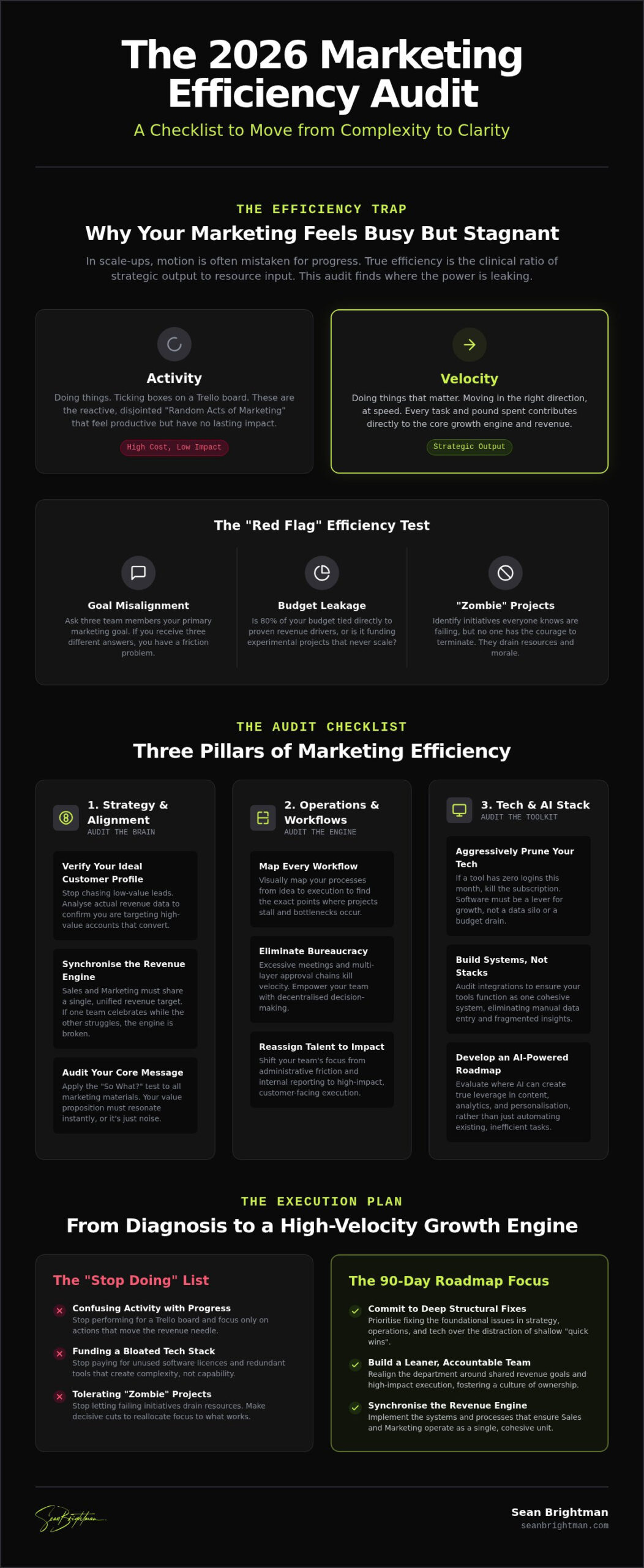
    Activity is doing things. Velocity is doing things that matter, in the right direction, at speed. If a task doesn’t contribute to your core growth engine, it’s waste. Most departments are drowning in “Random Acts of Marketing.” These are the reactive, disjointed tactics born from panic or a lack of clear strategy. They feel productive in the moment but leave no lasting impact on marketing effectiveness. You’re paying for effort when you should be paying for outcomes.

    The “Red Flag” Efficiency Test

    Stop the next three people you see in the office. Ask them to define the department’s primary goal in under ten words. If you get three different answers, you have a friction problem. High-growth teams operate on singular focus, not vague aspirations. Check your ledger. Is 80% of your budget tied directly to proven revenue drivers? If it’s being nibbled away by experimental side-projects that never scale, you’re subsidising vanity. Finally, look for “zombie projects.” These are the initiatives that everyone knows are failing, but no one has the guts to kill. A proper marketing efficiency audit identifies these drains and plugs them immediately. We don’t fix zombies; we bury them.

    The Hidden Cost of Bureaucracy

    Bureaucracy is the silent killer of strategic velocity. Scale-ups often implement “process” that actually functions as a brake. Excessive internal meetings don’t foster collaboration; they drain your team’s creative and strategic capacity. Then there’s the “Approval Bottleneck.” If your best ideas are dying in a CEO’s inbox or waiting for a committee’s blessing, you’ve already lost to the competition. You need enough governance to prevent chaos, but not so much that it stifles speed. Efficiency requires decentralised decision-making. Trust your systems, not your calendar invites. Finding the balance between oversight and execution is what separates the market leaders from the also-rans.

    The Strategy and Alignment Checklist: Auditing the Brain

    If your strategy is flawed, every pound spent on execution is a pound set on fire. Most scale-ups are running on an outdated strategy that no longer fits the 2026 market. A marketing efficiency audit forces you to look at the “brain” of your operation. It’s about alignment, not just activity. If the brain is miswired, the limbs of your marketing department will only flail. You’re paying for movement, but you aren’t gaining ground.

    Are you still chasing the same leads you were eighteen months ago? Your market has moved. Your product has evolved. Chasing low-value leads is a high-cost mistake that drains your team’s energy and budget. You must verify your Ideal Customer Profile (ICP) against actual revenue data. Don’t rely on gut feel. Focus on the high-value accounts that actually convert. This isn’t about more leads. It’s about the right leads.

    Sales and marketing must work to the same revenue target. Period. If marketing is celebrating lead volume whilst sales is struggling with lead quality, your engine is broken. Efficiency requires a single, unified scoreboard. When both teams are incentivised by the same outcome, the friction disappears. This is how you build a leaner, more accountable department that actually moves the needle.

    The Core Message Audit

    Does your website copy actually differentiate you? Or does it sound like every other platform in your niche? Apply the “So What?” test to every outbound material. If a prospect can’t see the immediate value, they’ll bounce. Your brand voice must be consistent across every touchpoint. It should be as sharp on LinkedIn as it is in your sales decks. Resonance is the goal; noise is the enemy. Testing message resonance ensures your value proposition actually lands with buyers instead of being ignored.

    The Growth Roadmap Verification

    Tactics often overtake strategy in the heat of a scale-up. We call this strategic drift. Your marketing strategy roadmap must align with your exit or scale goals. If your current funnel doesn’t mirror actual buyer behaviour, it’s a fiction. Validate your assumptions with data. A comprehensive marketing efficiency audit ensures your roadmap leads to revenue, not just reports. If you need an outside perspective to cut through the complexity and realign your team, an advisory retainer can provide the clarity you need.

    Operational Efficiency: Auditing Your Team and Workflows

    Your team is your most expensive asset. If they’re misaligned, you’re bleeding cash. A marketing efficiency audit must dissect your human capital with the same clinical detachment as your tech stack. Are you overstaffed with coordinators who just manage agencies? Or are you under-resourced with makers who actually build the engine? In a scale-up, you need high-impact execution, not a hierarchy of middle management. You’re paying for talent. Make sure that talent is applied to the right problems.

    Workflow mapping is the diagnostic tool for your internal plumbing. You need to see where a project starts, where it stalls, and where it actually finishes. Most delays aren’t caused by a lack of effort; they’re caused by friction in the handover. If a campaign sits in “pending approval” for three days, that’s three days of lost market opportunity. Mapping these bottlenecks exposes the waste in your daily operations. It turns “we’re busy” into “we’re productive.”

    Then there’s the accountability audit. When a campaign fails, who owns the number? If the answer is “the team,” the answer is “no one.” Accountability requires clear, individual ownership of specific KPIs. You also need to look at the in-house versus agency balance. Are you paying an agency a 20% premium for services your team could handle with better internal systems? Stop overpaying for overhead and start paying for performance. A marketing efficiency audit identifies where you can reclaim margin by bringing core competencies back under your roof. Rather than hiring a full-time executive to oversee this process, many UK scale-ups are turning to professional marketing advisory services to secure senior-level direction at a fraction of the cost.

    Designing for Strategic Velocity

    Structure dictates behaviour. Your marketing team structure for scale-ups UK must be built for speed, not safety. Check for “Single Points of Failure.” If one person leaving brings your lead generation to a halt, your system is fragile. Transition from a “Manager” culture to a “Maker” culture. You want a team that builds assets, not one that just attends meetings. Efficiency is found in the doing, not the discussing.

    The Reporting and Data Audit

    If you can’t act on a stat, stop measuring it. Delete the vanity metrics. Your Board doesn’t care about “engagement rates” if those clicks don’t convert to pipeline. You need “One Version of the Truth” for your marketing data. If sales and marketing are looking at different dashboards, you’re flying blind whilst the competition gains ground. Reporting should drive decisions, not just fill up “FYI” emails. Every report should answer one question: what do we change tomorrow?

    Marketing Efficiency Audit: The 2026 Checklist for High-Growth Scale-ups

    The Tech Stack and AI Audit: Tools vs. Systems

    Your tech stack is likely a graveyard of good intentions. Most scale-ups pay for “solutions” that actually create problems. If no one logged into a platform this month, kill the subscription. It’s that simple. A marketing efficiency audit often reveals that up to 30% of software spend is wasted on overlapping features. One tool for email, another for automation, and a third for “analytics” that no one reads. This isn’t a stack; it’s a pile. It creates data silos that hide the truth about your customer journey. You’re paying for complexity whilst sacrificing clarity.

    Systems architecture is about connectivity, not just collection. Do your tools talk to each other? If your CRM doesn’t feed your automation engine in real-time, you’re losing leads to manual lag. In 2026, entry-level automation starts as low as £12 per month, yet enterprise solutions can exceed £3,300. The price doesn’t matter if the integration is broken. You need a cohesive machine where data flows without human intervention. Stop buying tools and start building systems. Every piece of software must justify its place on the balance sheet through measurable strategic velocity. A well-designed marketing systems architecture is the difference between a pile of expensive subscriptions and a centralised growth engine that demands performance from every penny spent.

    Building an AI-Powered Growth Engine

    AI is no longer a novelty; it is the standard. With 88% of digital marketers now using AI in their daily roles, the question isn’t whether to use it, but how to optimise it. A marketing efficiency audit identifies manual, low-value labour ripe for replacement. Think about agentic AI. It can automate entire workflows, not just generate text. In fact, 31% of organisational workflows are already automated using this technology. However, output quantity is a trap. Use AI to raise the bar on quality. If your team lacks the “AI Literacy” to prompt effectively, you’re just automating mediocrity. Focus on high-impact automation that saves the average 13 hours per week reported by industry leaders.

    The “Single Source of Truth” Test

    Data hygiene is the difference between a goldmine and a mess. If your marketing list is cluttered with dead leads and duplicates, your automation will fail. Your CRM must be the absolute source of truth. Seamless integration with your marketing automation is non-negotiable. Centralise your assets. If your team spends hours asking “where is that file?”, you have a structural failure. Efficiency is found in accessibility. If you want to strip away the bloat and build a high-performance machine, my AI consulting services provide the roadmap you need.

    Executing the Audit: From Diagnosis to Growth Engine

    A report is not a strategy. A diagnosis is not a cure. The most common failure in a marketing efficiency audit is letting the findings gather digital dust. Execution is where the value is created. You need a 90-Day Efficiency Roadmap that ruthlessly separates “Quick Wins” from “Deep Fixes.” Quick wins are the immediate technical patches; deep fixes are the structural overhauls that redefine how your team functions. If you don’t move from diagnosis to action within the first week, you’ve already lost momentum.

    The most critical outcome of any audit is the “Stop Doing” list. Most marketing leaders focus on what to add. They want more tools, more channels, more content. This is the path to bloat. Strategic velocity comes from deletion. Identify the campaigns that don’t convert. Kill the meetings that don’t end in a decision. Prune the tech stack. If you aren’t removing at least 20% of your current activity, you haven’t performed a real audit. You’ve just performed a headcount.

    Communicating these changes to your team requires clinical honesty. Frame the audit as a system review, not a performance review. It’s about fixing the machine, not blaming the operators. When you focus on efficiency, you’re giving your team permission to do their best work by removing the friction that holds them back. Clear, direct communication prevents revolt and builds a culture of accountability. You want a team that values impact over appearance.

    External Perspective and Accountability

    You cannot audit your own biases. Internal teams are too close to the “zombie projects” and legacy workflows to see them objectively. This is why a fractional cmo is the ideal partner for a marketing efficiency audit. They provide the senior leadership and clinical detachment needed to cut through internal politics. To ensure these efficiency gains stick, many CEOs use a marketing advisory retainer. It provides the external pressure required to maintain strategic velocity and prevents the department from sliding back into old, inefficient habits.

    Next Steps: The 24-Hour Action Plan

    Don’t wait for a quarterly review. Start the engine now. Within the next 24 hours, you should:

    • Identify the three biggest “time leaks” currently draining your department’s capacity.
    • Schedule a “Strategy vs. Activity” review with your marketing lead to audit their current priorities.
    • Book a strategic roadmapping session to reset your direction and align your team with 2026 revenue goals.

    The difference between a scale-up and a market leader is the speed of implementation. Use the audit to find the waste. Then, use your roadmap to build the growth engine. Clarity is your competitive advantage. Go get it.

    Rebuild Your Engine for Strategic Velocity

    A marketing efficiency audit is the difference between a department that burns cash and one that builds equity. You’ve seen the checklist. It starts with deleting the bloat in your tech stack and ends with a ruthless “Stop Doing” list. Efficiency isn’t about working harder; it’s about removing the friction that stops your best people from delivering results. You need a system that prioritises velocity over mere activity. This is about mechanical precision, not corporate politeness.

    Don’t let internal biases or legacy workflows stall your growth. As a battle-hardened Fractional CMO for UK scale-ups and an expert in AI-powered marketing systems, I provide the direct advice needed to fix the machine. We don’t do fluff. We do results. If you’re ready to strip away the noise and rebuild your operations for maximum impact, let’s get to work.

    Book a Strategic Roadmapping Session with Sean Brightman today. It’s time to stop guessing and start growing. You have the talent. Now, give them the engine they deserve.

    Frequently Asked Questions

    What is a marketing efficiency audit and why does my business need one?

    A marketing efficiency audit is a clinical teardown of your revenue engine. It identifies the friction between your spend and your actual results. You need it because most scale-ups accumulate “activity bloat” that masks a lack of real progress. It is about impact, not appearance. It forces you to look at the ratio of strategic output to resource input.

    How long does a typical marketing efficiency audit take to complete?

    A high-impact audit takes 14 to 30 days. We aren’t here to write a 100-page report that no one reads. We are here to provide a high-level briefing and an immediate action plan. Speed is a feature, not a bug. You want clarity in a concentrated timeframe so you can start executing the fixes immediately.

    Can I perform a marketing audit internally or do I need an external consultant?

    Internal audits usually fail to address the “elephants in the room.” You cannot audit your own biases or the projects you have championed. An external strategist brings clinical detachment. They cut through internal politics to tell you what is actually broken, not what is polite to fix. You need an independent eye to challenge the status quo.

    What are the most common inefficiencies found in marketing departments?

    The biggest drains are tool bloat, “Random Acts of Marketing,” and sales misalignment. Research shows many agencies have seen a 20-35% reduction in costs through AI, yet many in-house teams still waste 13 hours per week on manual labour. That is pure inefficiency. Most departments have 30% waste in their tech stack subscriptions alone.

    How does AI impact the results of a marketing efficiency audit in 2026?

    In 2026, AI is the standard, not the exception. A marketing efficiency audit identifies where agentic AI can automate entire workflows. It moves your team from “doing” to “directing.” If you aren’t using AI to raise output quality and strategic velocity, you are subsidising manual waste. AI is now the benchmark for operational performance.

    What should be the primary outcome of a marketing audit?

    The primary outcome is a ruthless “Stop Doing” list. You don’t need more tactics; you need more focus. The audit should deliver a 90-day roadmap that prioritises deep structural fixes over shallow quick wins. It is about building a growth engine, not a to-do list. You want a leaner, more accountable department.

    How often should a high-growth scale-up audit its marketing operations?

    Perform an audit every six months. Scale-ups evolve too quickly for annual reviews. Bi-annual checks prevent strategic drift and ensure your team structure stays lean whilst your tech stack remains a lever for growth, not a weight. Regular audits keep your operations synchronised with your rapidly evolving revenue goals.