
Your marketing spend is climbing, but your revenue growth has hit a plateau. It’s a common trap for scale-ups in 2026. You’re likely funding a bloated tech stack and “always-on” campaigns that produce noise but zero signal. Most leaders feel the friction. You see the misalignment between sales and marketing. You sense the waste. You know that activity is not impact. A rigorous marketing efficiency audit is the only way to identify the hidden rot in your department.
Efficiency isn’t about doing more with less. It’s about deleting every process that fails to contribute to strategic velocity. We’re moving from complexity to clarity. You need a leaner, more accountable department that prioritises results over vanity metrics. If it doesn’t move the needle, it shouldn’t exist.
This guide provides the 2026 checklist to prune your tech stack, synchronise your teams, and build an AI-powered roadmap. You will learn exactly what to stop doing immediately. We’re stripping your operations down to the engine and rebuilding for maximum performance. Let’s get to work.
Key Takeaways
- Stop confusing activity with progress. A rigorous marketing efficiency audit exposes whether your team is moving the needle or just performing for a Trello board.
- Synchronise your revenue engine. Force sales and marketing onto the same target whilst realigning your brand positioning with 2026 market demands.
- Aggressively prune your tech stack. If no one logged in this month, kill the subscription; software should be a lever, not a data silo.
- Identify your operational bottlenecks. Map every workflow to see where projects stall, then reassign talent to high-impact execution rather than administrative friction.
- Commit to a “Stop Doing” list. Use a 90-day roadmap to prioritise deep structural fixes over the shallow distraction of quick wins.
Why Your Marketing Feels Busy but Stagnant (The Efficiency Trap)
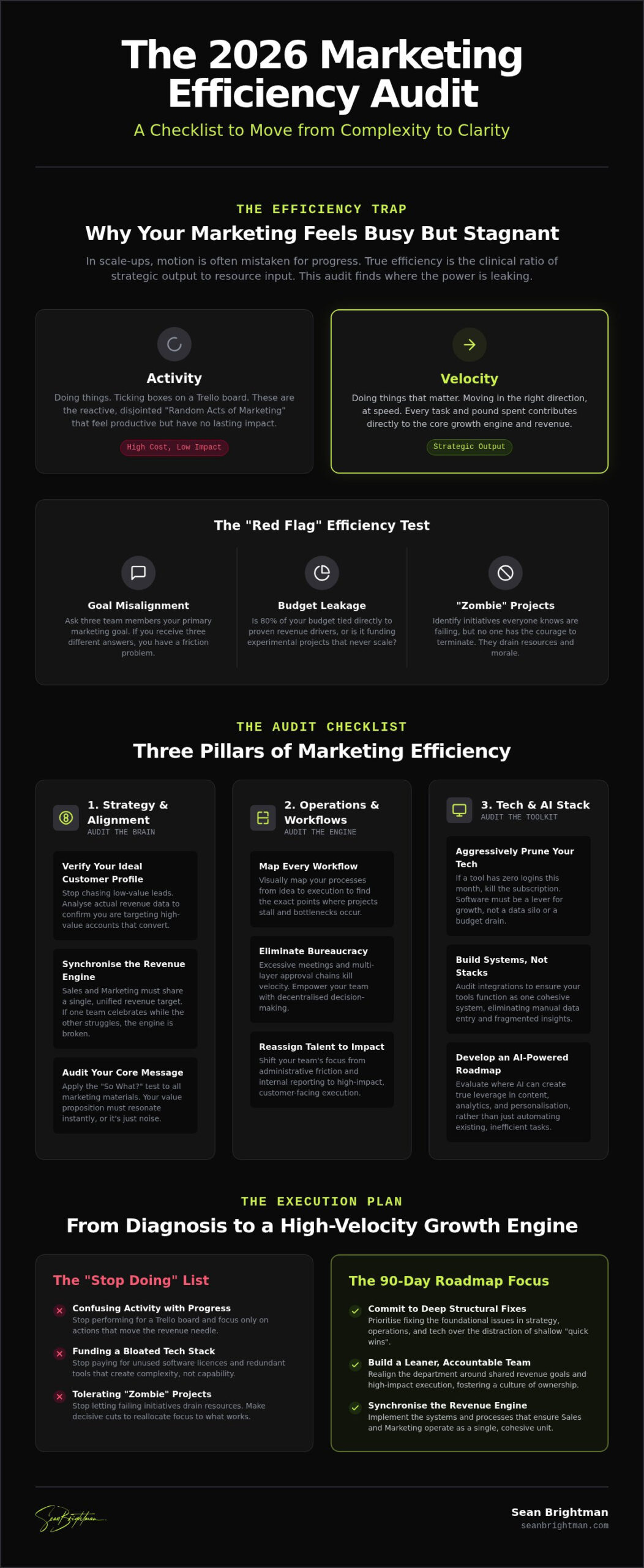
Your team is exhausted. The Trello board is a sea of green tickets. Yet, the revenue line is flat. This is the efficiency trap. In high-growth scale-ups, we often mistake motion for progress. True marketing efficiency is the clinical ratio of strategic output to resource input. It’s the difference between spinning your wheels in the mud and actually moving the vehicle forward. A marketing efficiency audit isn’t a cosmetic exercise; it’s a mechanical teardown of your operations to see where the power is leaking.
Activity is doing things. Velocity is doing things that matter, in the right direction, at speed. If a task doesn’t contribute to your core growth engine, it’s waste. Most departments are drowning in “Random Acts of Marketing.” These are the reactive, disjointed tactics born from panic or a lack of clear strategy. They feel productive in the moment but leave no lasting impact on marketing effectiveness. You’re paying for effort when you should be paying for outcomes.
The “Red Flag” Efficiency Test
Stop the next three people you see in the office. Ask them to define the department’s primary goal in under ten words. If you get three different answers, you have a friction problem. High-growth teams operate on singular focus, not vague aspirations. Check your ledger. Is 80% of your budget tied directly to proven revenue drivers? If it’s being nibbled away by experimental side-projects that never scale, you’re subsidising vanity. Finally, look for “zombie projects.” These are the initiatives that everyone knows are failing, but no one has the guts to kill. A proper marketing efficiency audit identifies these drains and plugs them immediately. We don’t fix zombies; we bury them.
The Hidden Cost of Bureaucracy
Bureaucracy is the silent killer of strategic velocity. Scale-ups often implement “process” that actually functions as a brake. Excessive internal meetings don’t foster collaboration; they drain your team’s creative and strategic capacity. Then there’s the “Approval Bottleneck.” If your best ideas are dying in a CEO’s inbox or waiting for a committee’s blessing, you’ve already lost to the competition. You need enough governance to prevent chaos, but not so much that it stifles speed. Efficiency requires decentralised decision-making. Trust your systems, not your calendar invites. Finding the balance between oversight and execution is what separates the market leaders from the also-rans.
The Strategy and Alignment Checklist: Auditing the Brain
If your strategy is flawed, every pound spent on execution is a pound set on fire. Most scale-ups are running on an outdated strategy that no longer fits the 2026 market. A marketing efficiency audit forces you to look at the “brain” of your operation. It’s about alignment, not just activity. If the brain is miswired, the limbs of your marketing department will only flail. You’re paying for movement, but you aren’t gaining ground.
Are you still chasing the same leads you were eighteen months ago? Your market has moved. Your product has evolved. Chasing low-value leads is a high-cost mistake that drains your team’s energy and budget. You must verify your Ideal Customer Profile (ICP) against actual revenue data. Don’t rely on gut feel. Focus on the high-value accounts that actually convert. This isn’t about more leads. It’s about the right leads.
Sales and marketing must work to the same revenue target. Period. If marketing is celebrating lead volume whilst sales is struggling with lead quality, your engine is broken. Efficiency requires a single, unified scoreboard. When both teams are incentivised by the same outcome, the friction disappears. This is how you build a leaner, more accountable department that actually moves the needle.
The Core Message Audit
Does your website copy actually differentiate you? Or does it sound like every other platform in your niche? Apply the “So What?” test to every outbound material. If a prospect can’t see the immediate value, they’ll bounce. Your brand voice must be consistent across every touchpoint. It should be as sharp on LinkedIn as it is in your sales decks. Resonance is the goal; noise is the enemy. Testing message resonance ensures your value proposition actually lands with buyers instead of being ignored.
The Growth Roadmap Verification
Tactics often overtake strategy in the heat of a scale-up. We call this strategic drift. Your marketing strategy roadmap must align with your exit or scale goals. If your current funnel doesn’t mirror actual buyer behaviour, it’s a fiction. Validate your assumptions with data. A comprehensive marketing efficiency audit ensures your roadmap leads to revenue, not just reports. If you need an outside perspective to cut through the complexity and realign your team, an advisory retainer can provide the clarity you need.
Operational Efficiency: Auditing Your Team and Workflows
Your team is your most expensive asset. If they’re misaligned, you’re bleeding cash. A marketing efficiency audit must dissect your human capital with the same clinical detachment as your tech stack. Are you overstaffed with coordinators who just manage agencies? Or are you under-resourced with makers who actually build the engine? In a scale-up, you need high-impact execution, not a hierarchy of middle management. You’re paying for talent. Make sure that talent is applied to the right problems.
Workflow mapping is the diagnostic tool for your internal plumbing. You need to see where a project starts, where it stalls, and where it actually finishes. Most delays aren’t caused by a lack of effort; they’re caused by friction in the handover. If a campaign sits in “pending approval” for three days, that’s three days of lost market opportunity. Mapping these bottlenecks exposes the waste in your daily operations. It turns “we’re busy” into “we’re productive.”
Then there’s the accountability audit. When a campaign fails, who owns the number? If the answer is “the team,” the answer is “no one.” Accountability requires clear, individual ownership of specific KPIs. You also need to look at the in-house versus agency balance. Are you paying an agency a 20% premium for services your team could handle with better internal systems? Stop overpaying for overhead and start paying for performance. A marketing efficiency audit identifies where you can reclaim margin by bringing core competencies back under your roof. Rather than hiring a full-time executive to oversee this process, many UK scale-ups are turning to professional marketing advisory services to secure senior-level direction at a fraction of the cost.
Designing for Strategic Velocity
Structure dictates behaviour. Your marketing team structure for scale-ups UK must be built for speed, not safety. Check for “Single Points of Failure.” If one person leaving brings your lead generation to a halt, your system is fragile. Transition from a “Manager” culture to a “Maker” culture. You want a team that builds assets, not one that just attends meetings. Efficiency is found in the doing, not the discussing.
The Reporting and Data Audit
If you can’t act on a stat, stop measuring it. Delete the vanity metrics. Your Board doesn’t care about “engagement rates” if those clicks don’t convert to pipeline. You need “One Version of the Truth” for your marketing data. If sales and marketing are looking at different dashboards, you’re flying blind whilst the competition gains ground. Reporting should drive decisions, not just fill up “FYI” emails. Every report should answer one question: what do we change tomorrow?
The Tech Stack and AI Audit: Tools vs. Systems
Your tech stack is likely a graveyard of good intentions. Most scale-ups pay for “solutions” that actually create problems. If no one logged into a platform this month, kill the subscription. It’s that simple. A marketing efficiency audit often reveals that up to 30% of software spend is wasted on overlapping features. One tool for email, another for automation, and a third for “analytics” that no one reads. This isn’t a stack; it’s a pile. It creates data silos that hide the truth about your customer journey. You’re paying for complexity whilst sacrificing clarity.
Systems architecture is about connectivity, not just collection. Do your tools talk to each other? If your CRM doesn’t feed your automation engine in real-time, you’re losing leads to manual lag. In 2026, entry-level automation starts as low as £12 per month, yet enterprise solutions can exceed £3,300. The price doesn’t matter if the integration is broken. You need a cohesive machine where data flows without human intervention. Stop buying tools and start building systems. Every piece of software must justify its place on the balance sheet through measurable strategic velocity. A well-designed marketing systems architecture is the difference between a pile of expensive subscriptions and a centralised growth engine that demands performance from every penny spent.
Building an AI-Powered Growth Engine
AI is no longer a novelty; it is the standard. With 88% of digital marketers now using AI in their daily roles, the question isn’t whether to use it, but how to optimise it. A marketing efficiency audit identifies manual, low-value labour ripe for replacement. Think about agentic AI. It can automate entire workflows, not just generate text. In fact, 31% of organisational workflows are already automated using this technology. However, output quantity is a trap. Use AI to raise the bar on quality. If your team lacks the “AI Literacy” to prompt effectively, you’re just automating mediocrity. Focus on high-impact automation that saves the average 13 hours per week reported by industry leaders.
The “Single Source of Truth” Test
Data hygiene is the difference between a goldmine and a mess. If your marketing list is cluttered with dead leads and duplicates, your automation will fail. Your CRM must be the absolute source of truth. Seamless integration with your marketing automation is non-negotiable. Centralise your assets. If your team spends hours asking “where is that file?”, you have a structural failure. Efficiency is found in accessibility. If you want to strip away the bloat and build a high-performance machine, my AI consulting services provide the roadmap you need.
Executing the Audit: From Diagnosis to Growth Engine
A report is not a strategy. A diagnosis is not a cure. The most common failure in a marketing efficiency audit is letting the findings gather digital dust. Execution is where the value is created. You need a 90-Day Efficiency Roadmap that ruthlessly separates “Quick Wins” from “Deep Fixes.” Quick wins are the immediate technical patches; deep fixes are the structural overhauls that redefine how your team functions. If you don’t move from diagnosis to action within the first week, you’ve already lost momentum.
The most critical outcome of any audit is the “Stop Doing” list. Most marketing leaders focus on what to add. They want more tools, more channels, more content. This is the path to bloat. Strategic velocity comes from deletion. Identify the campaigns that don’t convert. Kill the meetings that don’t end in a decision. Prune the tech stack. If you aren’t removing at least 20% of your current activity, you haven’t performed a real audit. You’ve just performed a headcount.
Communicating these changes to your team requires clinical honesty. Frame the audit as a system review, not a performance review. It’s about fixing the machine, not blaming the operators. When you focus on efficiency, you’re giving your team permission to do their best work by removing the friction that holds them back. Clear, direct communication prevents revolt and builds a culture of accountability. You want a team that values impact over appearance.
External Perspective and Accountability
You cannot audit your own biases. Internal teams are too close to the “zombie projects” and legacy workflows to see them objectively. This is why a fractional cmo is the ideal partner for a marketing efficiency audit. They provide the senior leadership and clinical detachment needed to cut through internal politics. To ensure these efficiency gains stick, many CEOs use a marketing advisory retainer. It provides the external pressure required to maintain strategic velocity and prevents the department from sliding back into old, inefficient habits.
Next Steps: The 24-Hour Action Plan
Don’t wait for a quarterly review. Start the engine now. Within the next 24 hours, you should:
- Identify the three biggest “time leaks” currently draining your department’s capacity.
- Schedule a “Strategy vs. Activity” review with your marketing lead to audit their current priorities.
- Book a strategic roadmapping session to reset your direction and align your team with 2026 revenue goals.
The difference between a scale-up and a market leader is the speed of implementation. Use the audit to find the waste. Then, use your roadmap to build the growth engine. Clarity is your competitive advantage. Go get it.
Rebuild Your Engine for Strategic Velocity
A marketing efficiency audit is the difference between a department that burns cash and one that builds equity. You’ve seen the checklist. It starts with deleting the bloat in your tech stack and ends with a ruthless “Stop Doing” list. Efficiency isn’t about working harder; it’s about removing the friction that stops your best people from delivering results. You need a system that prioritises velocity over mere activity. This is about mechanical precision, not corporate politeness.
Don’t let internal biases or legacy workflows stall your growth. As a battle-hardened Fractional CMO for UK scale-ups and an expert in AI-powered marketing systems, I provide the direct advice needed to fix the machine. We don’t do fluff. We do results. If you’re ready to strip away the noise and rebuild your operations for maximum impact, let’s get to work.
Book a Strategic Roadmapping Session with Sean Brightman today. It’s time to stop guessing and start growing. You have the talent. Now, give them the engine they deserve.
Frequently Asked Questions
What is a marketing efficiency audit and why does my business need one?
A marketing efficiency audit is a clinical teardown of your revenue engine. It identifies the friction between your spend and your actual results. You need it because most scale-ups accumulate “activity bloat” that masks a lack of real progress. It is about impact, not appearance. It forces you to look at the ratio of strategic output to resource input.
How long does a typical marketing efficiency audit take to complete?
A high-impact audit takes 14 to 30 days. We aren’t here to write a 100-page report that no one reads. We are here to provide a high-level briefing and an immediate action plan. Speed is a feature, not a bug. You want clarity in a concentrated timeframe so you can start executing the fixes immediately.
Can I perform a marketing audit internally or do I need an external consultant?
Internal audits usually fail to address the “elephants in the room.” You cannot audit your own biases or the projects you have championed. An external strategist brings clinical detachment. They cut through internal politics to tell you what is actually broken, not what is polite to fix. You need an independent eye to challenge the status quo.
What are the most common inefficiencies found in marketing departments?
The biggest drains are tool bloat, “Random Acts of Marketing,” and sales misalignment. Research shows many agencies have seen a 20-35% reduction in costs through AI, yet many in-house teams still waste 13 hours per week on manual labour. That is pure inefficiency. Most departments have 30% waste in their tech stack subscriptions alone.
How does AI impact the results of a marketing efficiency audit in 2026?
In 2026, AI is the standard, not the exception. A marketing efficiency audit identifies where agentic AI can automate entire workflows. It moves your team from “doing” to “directing.” If you aren’t using AI to raise output quality and strategic velocity, you are subsidising manual waste. AI is now the benchmark for operational performance.
What should be the primary outcome of a marketing audit?
The primary outcome is a ruthless “Stop Doing” list. You don’t need more tactics; you need more focus. The audit should deliver a 90-day roadmap that prioritises deep structural fixes over shallow quick wins. It is about building a growth engine, not a to-do list. You want a leaner, more accountable department.
How often should a high-growth scale-up audit its marketing operations?
Perform an audit every six months. Scale-ups evolve too quickly for annual reviews. Bi-annual checks prevent strategic drift and ensure your team structure stays lean whilst your tech stack remains a lever for growth, not a weight. Regular audits keep your operations synchronised with your rapidly evolving revenue goals.
Leave a Reply