Your marketing department is likely a black box of expensive activity that feels more like a liability than an asset. Most CEOs view it as a drain on the bottom line. They’re wrong. Buyers don’t pay for your latest ad campaign or a temporary spike in traffic; they pay for the predictable, mechanical engine that generates them. If you cannot prove how your growth scales without constant manual intervention, you’re leaving millions on the table. Understanding how marketing leadership drives business valuation is the difference between a standard exit and a life-changing multiplier.
It’s exhausting to watch your customer acquisition costs climb whilst ROI remains a murky mystery. You’ve built a solid company, but the growth feels fragile and over-reliant on tactical chaos. This article provides the solution. You’ll discover why senior marketing leadership is a valuation multiplier rather than a cost centre. We’ll move past the activity trap and provide a clear framework to turn your marketing function into a tangible, high-value asset that buyers will pay a premium to own.
Key Takeaways
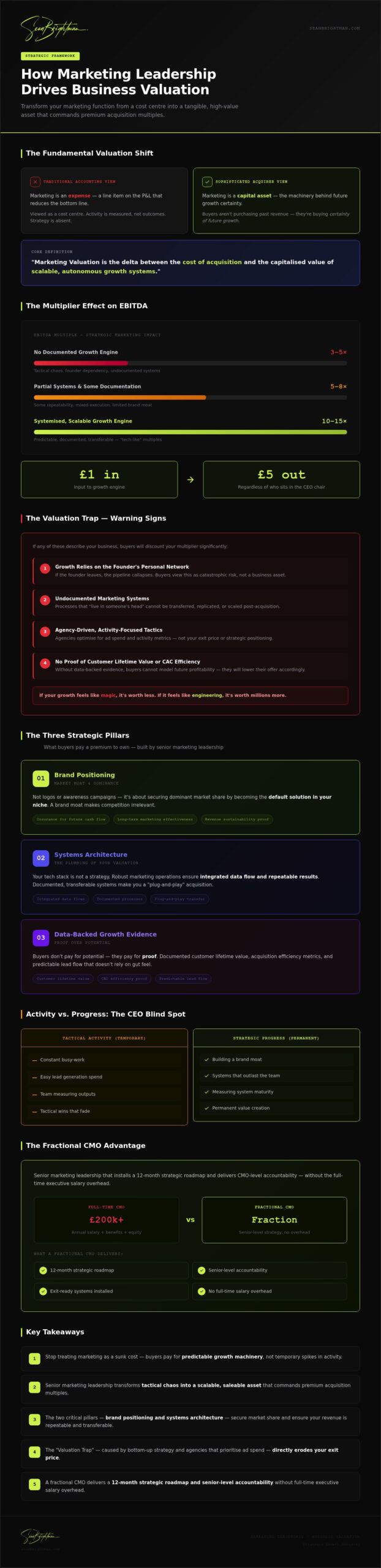
- Stop treating marketing as a sunk cost; buyers pay for predictable growth machinery, not just temporary spikes in activity.
- Discover exactly how marketing leadership drives business valuation by transforming tactical chaos into a scalable, tangible asset.
- Identify the two critical pillars—brand positioning and systems architecture—that secure market share and ensure your revenue is repeatable.
- Avoid the “valuation trap” caused by bottom-up strategy and agencies that prioritise their own ad spend over your ultimate exit price.
- Leverage a fractional CMO to install a 12-month strategic roadmap and senior-level accountability without the overhead of a full-time executive salary.
From Cost Centre to Value Creator: The Marketing Valuation Shift
Traditional accounting treats marketing as an expense whilst buyers treat it as a capital asset. It appears as a line item in the profit and loss statement that reduces your bottom line. Sophisticated acquirers see it differently. They look for the machinery behind the numbers. They aren’t buying your past revenue; they are buying the certainty of your future growth. This is the fundamental shift in understanding how marketing leadership drives business valuation.
Many CEOs fall into the ‘Valuation Trap’. They boast impressive revenue but rely on messy, undocumented marketing systems. If your growth is a result of tactical luck or a founder’s personal network, your business is a risk. Buyers hate risk. They discount multipliers for companies that lack a repeatable, scalable growth engine. A formal brand valuation often reveals that the intangible assets, the systems and the reputation, are what actually carry the weight during an exit. Senior leaders don’t just manage people; they oversee how marketing leadership drives business valuation through the creation of intellectual property and systemised processes.
Activity vs. Progress: The CEO’s Blind Spot
Is your team busy? That might be your biggest problem. Constant ‘activity’ is often a mask for strategic failure. It’s easy to spend money on lead generation. It’s hard to build a brand moat that keeps competitors at bay. You don’t want a team that just ‘does marketing’. You want a team that builds assets.
Marketing Valuation is the delta between the cost of acquisition and the capitalised value of scalable, autonomous growth systems.
Stop rewarding noise. Start measuring the maturity of your systems. Leadership is about defining the ‘how’, not just the ‘what’. Tactical wins are temporary. Strategic systems are permanent value creators that survive long after the current team has moved on.
The Multiplier Effect: How Strategic Marketing De-risks the Exit
A clear marketing strategy for business exit is a massive de-risking tool. When a buyer looks under the bonnet, they want to see a machine. They want to see that if they put £1 in, £5 comes out, regardless of who is sitting in the CEO chair. Systemised growth has a direct impact on EBITDA multiples. It moves your business from a ‘service firm’ multiplier to a ‘tech-like’ multiplier. Buyers pay a premium for:
- Predictable lead flow that doesn’t rely on the founder’s gut feel.
- Documented processes that any senior hire can execute.
- Data-backed evidence of customer lifetime value and acquisition efficiency.
If your growth feels like magic, it’s worth less. If it feels like engineering, it’s worth millions more. Strategic leadership ensures your marketing is a functional component of the business value, not an abstract theory.
The Strategic Pillars: How Leadership Builds Buyer-Ready Assets
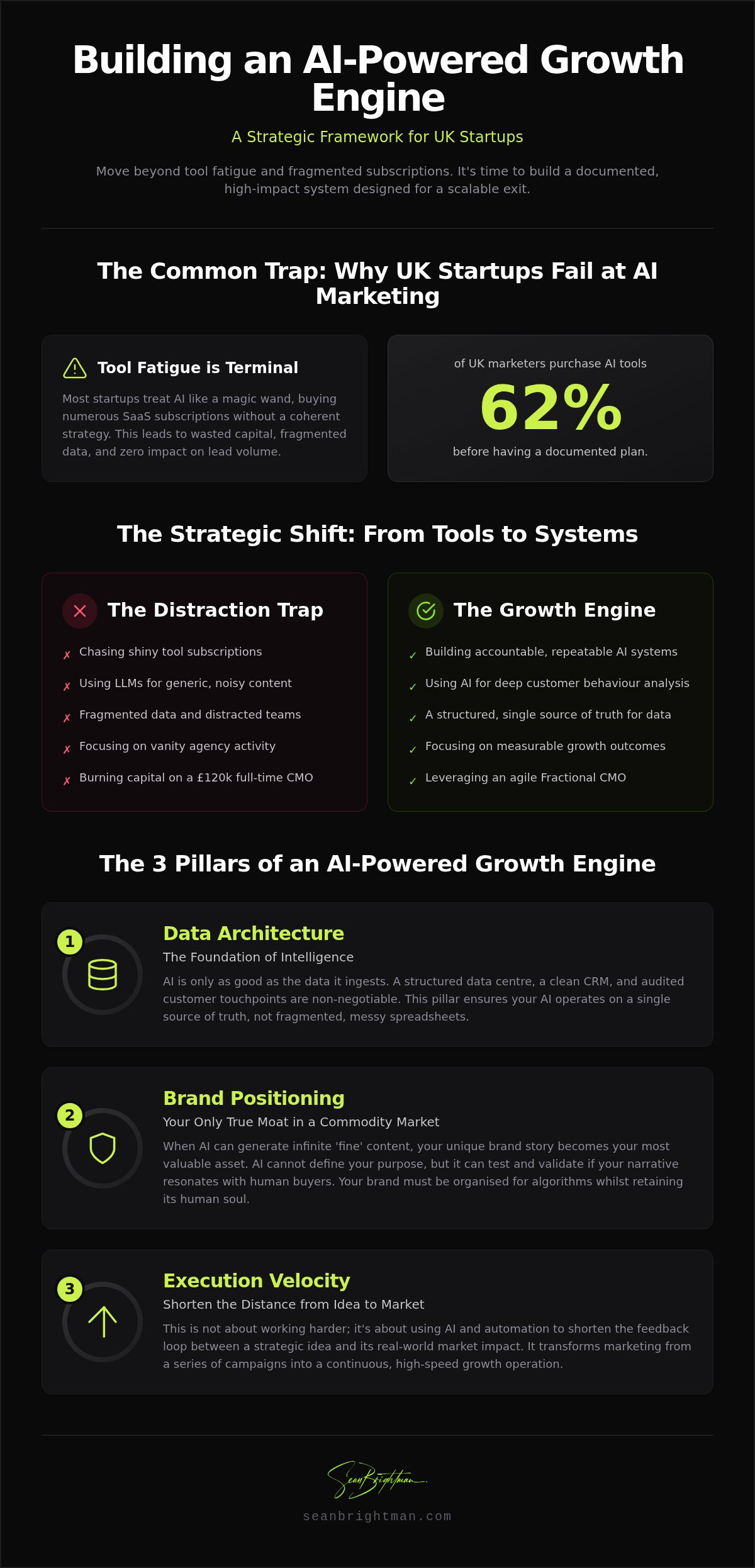
Buyers don’t pay for potential; they pay for proof. To move from a standard business to a high-multiplier acquisition target, you need more than just ‘good marketing’. You need a structured growth engine built on three non-negotiable pillars. This is exactly how marketing leadership drives business valuation: by turning abstract ideas into tangible, saleable assets that survive the departure of the founder.
Pillar one is Brand Positioning. This isn’t about pretty logos or awareness campaigns. It is about securing a dominant market share by becoming the default solution in your niche. A buyer wants to see a brand moat that makes competition irrelevant. They use valuation metrics to measure long-term marketing effectiveness and determine if your revenue is sustainable or just a temporary trend. Strategic leadership ensures your brand is an insurance policy for future cash flow.
Systems Architecture: Beyond the Tech Stack
Your tech stack is not a strategy. Most companies suffer from ‘tool fatigue’, a collection of expensive software that doesn’t talk to each other. Robust marketing operations are the plumbing of your valuation. They ensure integrated data flow and repeatable results. If your systems are documented and transferable, you are an easy ‘plug-and-play’ acquisition. If they live in your head, you are a liability. A buyer should be able to step into your shoes on day one without the growth engine stalling. This level of systemisation is how marketing leadership drives business valuation during the due diligence phase.
AI Consulting: Future-Proofing for the 2026 Market
By 2026, a growth engine without AI integration is an obsolete machine. Strategic AI consulting is no longer optional for high-valuation exits. Tech-savvy investors look for AI-driven efficiency that improves margins and accelerates experimentation. It’s about building a roadmap that demonstrates a long-term competitive advantage through automation and superior customer insights. This isn’t about cutting costs; it’s about increasing output and performance. If you want to see how these systems fit into your specific business, a Fractional CMO can provide the high-level oversight needed to build these pillars without the full-time overhead.
These pillars combine to create a business that is ready for exit. They move the conversation away from tactical noise and towards enterprise value. When leadership focuses on systems and margins, the multiplier follows naturally.
The Leadership Gap: Why Execution Without Strategy Erodes Multipliers
Marketing departments often fail because they are built from the bottom up. You hire a junior to ‘do social’ and an agency to ‘run ads’, then wonder why your multiplier is stagnant. This is the leadership gap. Letting tactical executors define your strategy is a recipe for wasted capital. They focus on clicks; you need to focus on how marketing leadership drives business valuation by protecting your margins and de-risking the future. If the person setting your direction doesn’t understand your P&L, they shouldn’t be setting your direction.
There is a stark difference between a ‘Head of Marketing’ and a ‘Strategic Marketing Leader’. One manages the team’s holiday calendar and ensures the newsletter goes out on time. The other builds a growth engine that a buyer covets. Without senior oversight, you suffer from ‘Marketing Leakage’. This is a slow bleed of budget into activities that feel like progress but don’t increase enterprise value. A leader ensures every pound spent is an investment in your exit price, not just a donation to a tech platform’s revenue.
The Agency Trap: Why They Won’t Build Your Engine
Agencies are execution partners. They are not business strategists. Their business model is often incentivised by spend, not by your ultimate exit price. They want you to keep the taps open because it keeps their retainer secure. This is a fundamental conflict of interest. They focus on the ‘how’ of execution, but you need someone to own the ‘why’ of the strategy. You need an internal or fractional force to manage these external partners. This ensures they are building your engine, not just running their own playbooks at your expense.
Accountability and the Advisory Retainer
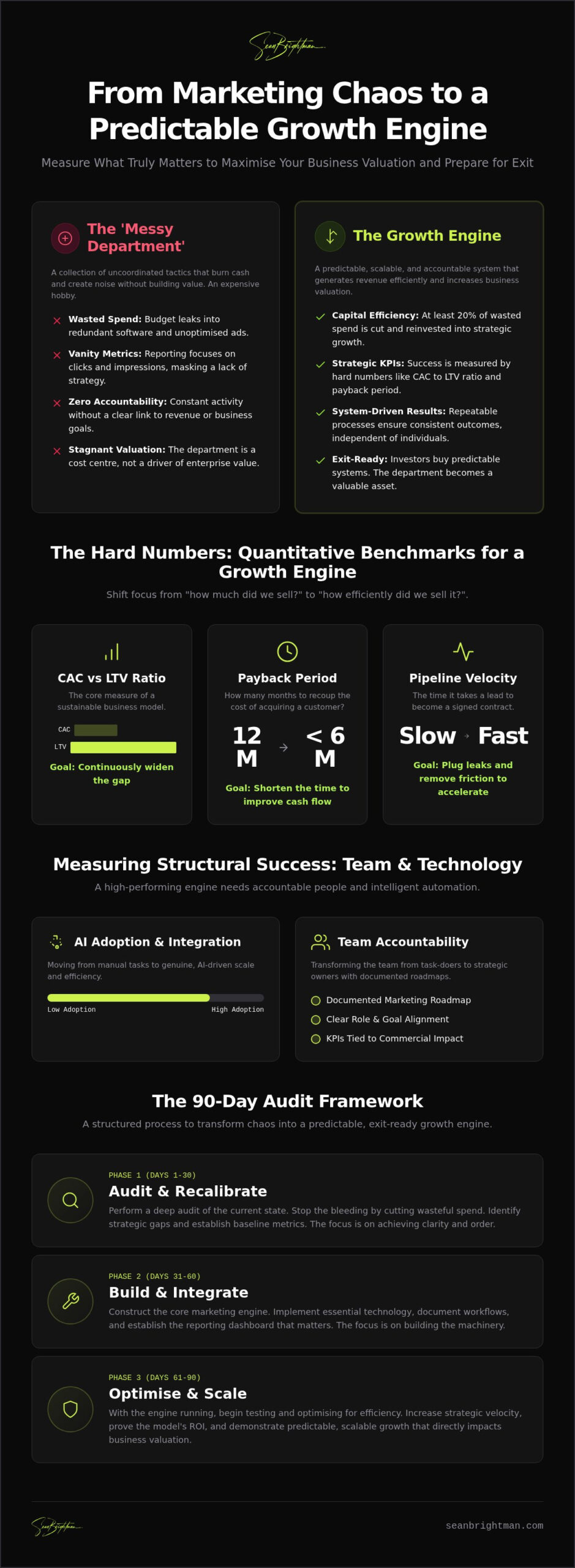
Accountability is the antidote to tactical chaos. An advisory retainer provides the senior-level pressure needed to keep the growth engine on track. It’s about setting KPIs that actually matter to a CFO or a potential buyer, such as customer acquisition cost (CAC) payback periods and lifetime value (LTV) ratios. Strategic Velocity is the speed of informed decision-making. In a fast-moving market, the ability to pivot based on data rather than gut feel is what separates a high-value asset from a struggling firm. Leadership ensures that your marketing function remains a high-impact, accountable component of your business value.
Designing Your Exit-Ready Marketing Roadmap
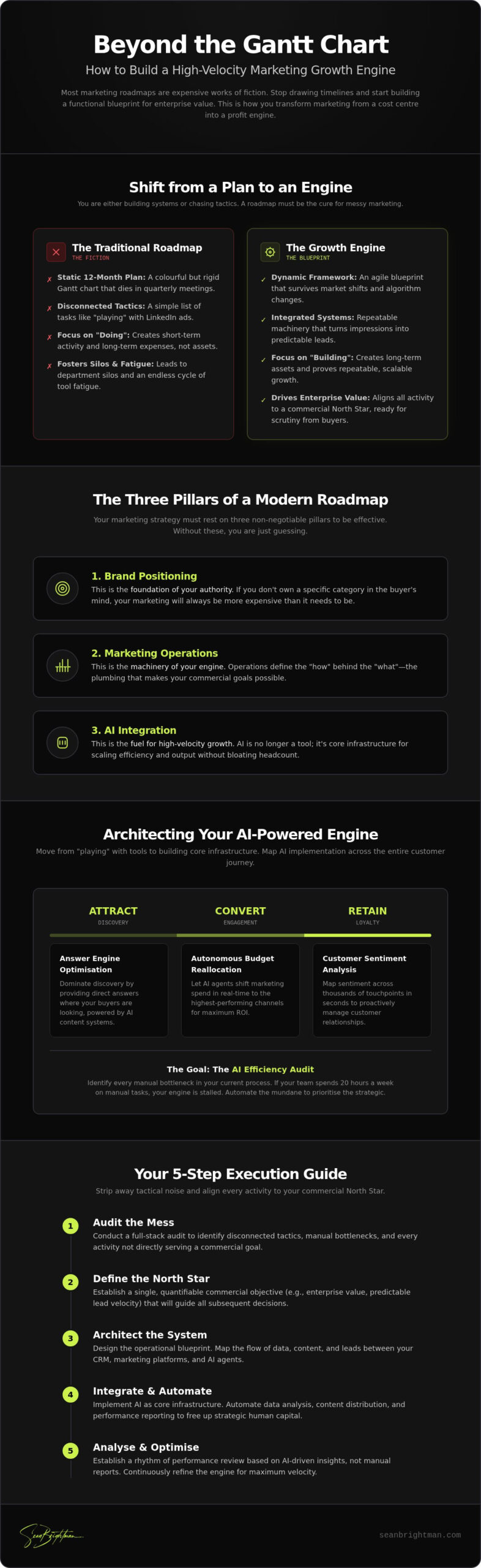
A roadmap is not a wish list. It is a clinical, step-by-step plan to transform your marketing from a black box into a transparent, high-yield asset. This is the practical application of how marketing leadership drives business valuation. It starts with a Marketing Efficiency Audit. We aren’t looking for brand sentiment here; we are hunting for hidden profit. We identify where capital is being incinerated on low-intent traffic and reallocate it to high-margin acquisition channels. By trimming the fat, we immediately improve the EBITDA margins that buyers use to calculate your worth.
Once the waste is removed, we move to strategic brand roadmapping. This defines your 12-month North Star. It ensures every campaign and every hire serves the ultimate goal: a higher exit multiplier. We then install an AI Growth Engine to provide operational leverage. This isn’t just about using chatbots; it’s about automating the repetitive tasks that bloat your headcount and shrink your margins. By 2026, 47% of startups are already using fractional leadership to guide these strategies. Finally, we build your Data Moat. By capturing and organising proprietary customer insights, you create a saleable asset that is impossible for competitors to replicate. This process is the clearest demonstration of how marketing leadership drives business valuation in practice.
The 90-Day Transformation
Investors look for momentum. In the first 90 days, we focus on quick wins that signal growth potential to tech-savvy investors. This means fixing the attribution mess. If you cannot prove exactly where your revenue comes from, a buyer will assume it is luck. We establish a cadence of senior-level reporting that speaks the language of the boardroom, not the marketing department. We move away from ‘engagement metrics’ and focus on the contribution to enterprise value. This provides the transparency that CFOs demand and the confidence that buyers require.
Preparing for Due Diligence
A buyer’s marketing audit is a colonoscopy of your business. They will scrutinise your brand positioning to see if it is defensible against competitors. We organise your marketing assets—contracts, processes, and data—for a seamless handover. This ensures that your market share isn’t just a fluke but a result of strategic architecture. When the time comes to sell, your marketing function should be a plug-and-play component of the deal rather than a tangled mess of logins and half-finished projects. If you’re ready to stop the tactical chaos and start building for an exit, it’s time to book a roadmapping session and define your path to a higher multiplier.
Fractional CMO Leadership: Driving Valuation Without the Full-Time Overhead
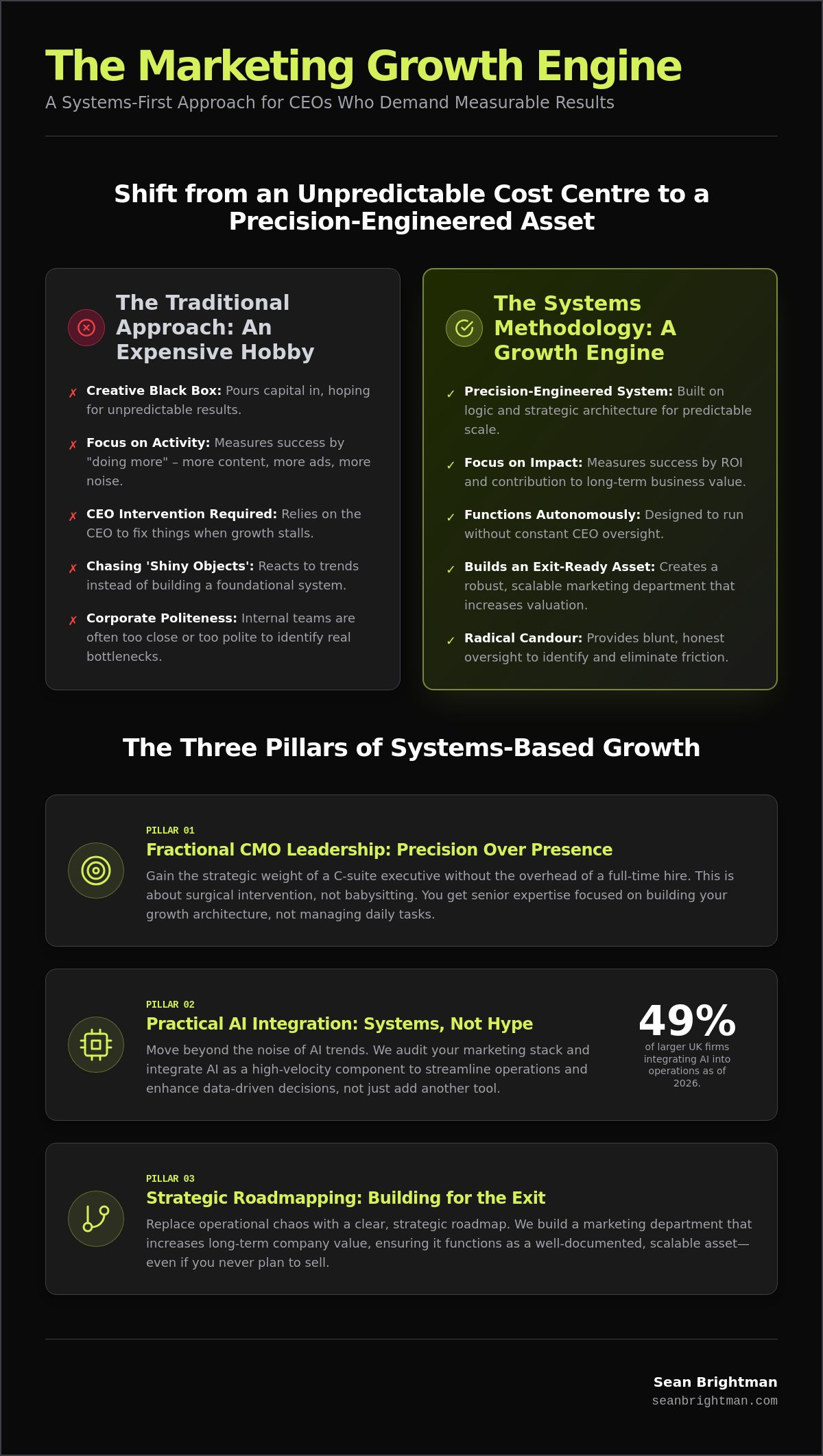
Scale-up CEOs often reach a ceiling where founder-led growth stops working. The tactical chaos that got you to £5 million won’t get you to £50 million. You need senior expertise, but a full-time CMO is a slow, expensive gamble. In 2026, the total compensation for a full-time executive often exceeds £150,000 plus benefits and bonuses. For many businesses, this is a heavy fixed cost that drains capital away from the growth engine itself. A fractional CMO provides a plug-and-play solution. You gain 20 plus years of battle-hardened experience for a fraction of the cost, ensuring your marketing department is professionalised and scalable before you even talk to a buyer.
This model is a primary example of how marketing leadership drives business valuation. It moves your company from a founder-dependent entity to a system-driven asset. An external fractional leader acts as a sharp-minded force. They challenge the status quo without the baggage of internal politics. They don’t care about “how we’ve always done it.” They care about what a buyer will pay for. This objective oversight ensures that every decision is filtered through the lens of enterprise value, not personal bias or departmental comfort.
Senior Leadership on Demand
Fractional leadership provides the strategy whilst your existing team handles the execution. You don’t need another manager to sit in daily meetings and handle admin. You need a strategist to define the 12-month North Star and keep the engine on track. This model offers the flexibility to scale leadership up or down based on your business needs. It is about high-impact outcomes. By focusing on strategic velocity, a fractional partner ensures your team is working on the right things, not just the busy things. This clarity is exactly how marketing leadership drives business valuation during a rigorous due diligence process.
The ROI of the Fractional Model
The financial logic is simple. Companies that use fractional CMOs report 40 to 70 per cent cost savings compared to a full-time hire. These savings are not just profit. They are fuel. You can reinvest that capital directly into your AI growth engine or brand positioning. You get the same level of strategic rigour without the long-term liability of a permanent executive salary. You pay for impact, not for attendance. If you are ready to stop the tactical noise and start building a business that buyers covet, it is time to act. Book a strategic roadmapping session to start building your valuation today.
Stop Funding Noise and Start Building Assets
Your marketing department should be the most valuable part of your business, not the most confusing. Buyers don’t care about your latest campaign; they care about the repeatable, documented systems that generate revenue without your constant intervention. Professionalising your growth engine through strategic pillars and AI integration isn’t just about efficiency. It’s about protecting your margins and de-risking your eventual exit. Understanding exactly how marketing leadership drives business valuation is what separates a standard sale from a life-changing multiplier.
The path from tactical chaos to a buyer-ready asset requires senior oversight and a clinical roadmap. As a Fractional CMO for UK scale-ups, AI roadmapping expert, and author of ‘The Book’ on marketing strategy, I help CEOs turn their marketing into a high-impact growth engine. You don’t need more activity; you need more architecture. If you’re ready to professionalise your department and secure your exit price, build your growth engine with Sean Brightman. Your future exit depends on the systems you build today.
Frequently Asked Questions
How does marketing leadership specifically increase a company’s valuation?
It transforms marketing from a cost centre into a scalable asset. Leadership builds repeatable systems, brand moats, and documented processes that de-risk the investment for buyers. When growth is systemised rather than founder-led, buyers pay higher multipliers. This is the core of how marketing leadership drives business valuation; it proves that revenue is a result of a mechanical engine, not just tactical luck or temporary ad spend.
What is the difference between a Marketing Director and a Fractional CMO?
A Marketing Director usually manages the day-to-day execution and the internal team’s output. A Fractional CMO is a strategic architect who focuses on the P&L and long-term enterprise value. The fractional model provides senior-level oversight and battle-hardened experience on a part-time basis. It’s about high-level strategy and accountability rather than administrative management. This allows scale-ups to access executive-level thinking without the £150,000 plus salary overhead.
Can AI consulting really improve my business’s exit price?
Yes, by significantly improving operational margins and demonstrating future-proofed scalability. Strategic AI consulting identifies where automation can replace manual, bloated processes, leading to higher EBITDA. Tech-savvy investors in 2026 look for businesses with proprietary Data Moats and AI-powered growth engines. If you can prove your marketing output is amplified by AI rather than just headcount, your business becomes a far more attractive, high-margin acquisition target.
When is the right time for a scale-up to hire senior marketing leadership?
The right time is before your current growth plateaus or becomes too complex for the founder to manage. If you feel that marketing is a black box of activity without clear ROI, you’ve already waited too long. Scale-ups typically need this oversight when they need to professionalise their systems for an eventual exit. Strategic leadership ensures that your growth engine is built on solid architecture rather than tactical chaos.
How do buyers audit a marketing department during due diligence?
Buyers look for plumbing and predictability. They audit your customer acquisition costs (CAC), lifetime value (LTV) ratios, and the maturity of your systems. They want to see documented processes, defensible brand positioning, and integrated data flow. If your marketing relies on one person’s gut feel or messy spreadsheets, it’s a red flag. A clean audit proves that your growth is repeatable and transferable to a new owner.
Why shouldn’t I just hire a marketing agency to handle my strategy?
Agencies are execution partners, not business strategists. Their business model is often built on increasing your ad spend or maintaining a retainer, which can conflict with your efficiency goals. You need an internal or fractional leader to own the strategy and hold external partners accountable. A leader ensures the agency is building your growth engine, not just running their own playbooks at your expense.
How long does it take to see a valuation impact from marketing leadership?
Quick wins often appear within the first 90 days through efficiency audits and fixing attribution errors. However, building a buyer-ready asset typically takes 6 to 12 months of consistent strategic application. This timeframe allows for the implementation of a roadmapped growth engine and the collection of data that proves scalability. It’s about moving the needle on multipliers, which requires sustained, systemised performance rather than a temporary spike.
What are the key marketing KPIs that investors look for?
Investors ignore vanity metrics like likes or followers. They focus on CAC payback periods, LTV to CAC ratios, and the percentage of revenue from organic versus paid channels. They also look at the Strategic Velocity of your decision-making. Clear evidence of how marketing leadership drives business valuation is found in these hard numbers. High-value targets can prove that their marketing systems deliver predictable, high-margin revenue with minimal risk.