Tag: fractional cmo

  • Part-time Marketing Director UK: Why Recruitment is the Wrong Move in 2026

    Part-time Marketing Director UK: Why Recruitment is the Wrong Move in 2026

    Your recruitment agency is selling you a ghost. Posting a job advert for a part-time marketing director uk in 2026 is no longer a talent search; it’s a strategic liability. You want a growth engine. Instead, you’re likely to get a “dinosaur” who treats AI like a passing fad and leaves your marketing department feeling messier than they found it.

    It’s a common frustration. You know your brand needs senior accountability, but the thought of another three-month hiring cycle followed by “day one” sick pay rights and the weight of new employment legislation is exhausting. You need momentum, not more HR baggage. You need a roadmap that actually works, delivered by someone who’s seen the chaos before and knows exactly how to fix it.

    This article explains why traditional recruitment is the wrong move for your scaling business this year. We’ll explore how to bypass the job boards, avoid the “fire and rehire” traps of the new legal landscape, and install senior leadership that focuses on strategic velocity rather than just clocking hours.

    Key Takeaways

    • Stop viewing senior leadership as a recruitment task; it’s a strategic intervention that job boards simply cannot deliver.
    • Understand why searching for a part-time marketing director uk often leads to expensive “messy marketing” rather than a coherent growth engine.
    • Evaluate the “plug-and-play” advantages of a Fractional CMO over the HR baggage and legal complexities of traditional part-time employment.
    • Identify the essential AI-driven skillsets required in 2026 to ensure your marketing systems are scalable and future-proof.
    • Learn how to interview for strategic authority and “battle-hardened” experience to avoid hiring tactical specialists who lack a commercial roadmap.

    Stop Browsing Job Boards: The Problem with Part-time Recruitment

    Stop scrolling through recruitment sites. It’s a distraction you can’t afford. If you’re a CEO focused on scaling, spending forty hours reviewing CVs for a part-time marketing director uk is a strategic failure. You’re looking for a growth engine, but job boards only give you “active” seekers. These are often professionals between roles or those who haven’t adapted to the high-velocity fractional market. You don’t need someone looking for a job; you need someone who solves problems.

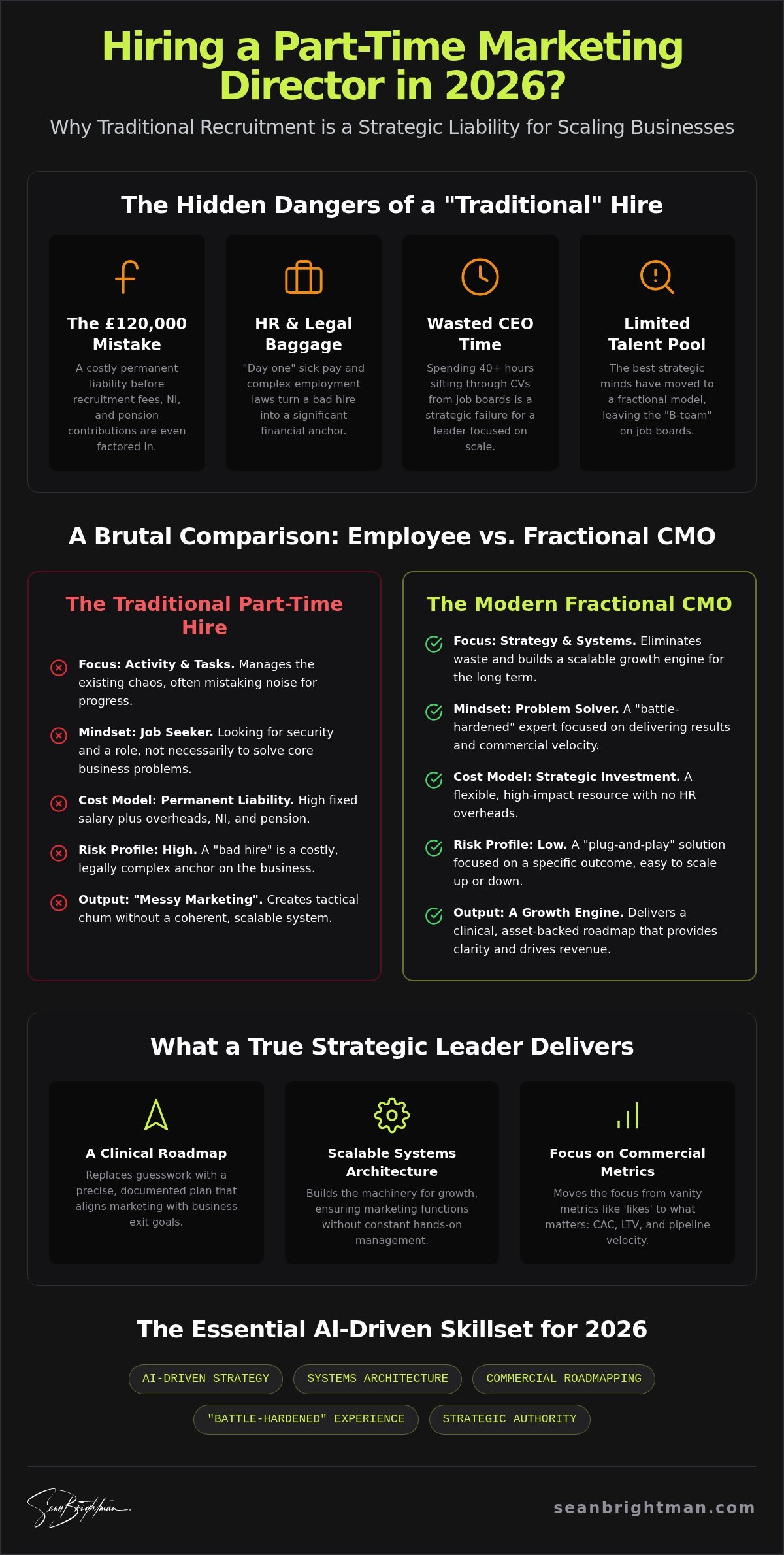
    Hiring a permanent senior leader in the current climate is often a £120,000 mistake. That’s before you factor in recruitment fees that vanish the moment a candidate leaves. In 2026, UK employment law has shifted significantly. With “day one” paternity and sick pay rights now the standard, the risk of a “bad hire” is no longer just a nuisance; it’s a financial anchor. You’re buying a permanent liability for what usually results in “part-focused” output. Traditional employment models simply don’t incentivise the ruthless efficiency a scaling brand requires.

    The HR Headache of Part-time Employment

    Senior talent doesn’t want a two-day-a-week employment contract anymore. The heavyweights, the ones who understand what a senior marketing leader actually does, have already moved to a fractional or advisory model. If you try to force a strategic mind onto a standard payroll, you’ll likely end up with the “B-team”. You’ll pay for pension contributions, National Insurance, and office overheads without getting the high-impact velocity of a true expert. The best people in the market now value their autonomy. They want to deliver results and move on to the next challenge, not sit in your weekly internal meetings.

    The Difference Between a Manager and a Director

    Most CVs you’ll find via traditional recruitment are senior managers in disguise. They are excellent at organising tasks and managing social media schedules. They are often terrible at building scalable growth engines. A manager asks what needs doing today; a director builds the system so the work gets done without them. In a post-AI landscape, you need a builder. You need someone who can audit your messy marketing and replace it with a clinical, results-oriented roadmap. Don’t hire someone to manage the chaos. Hire someone with the “battle-hardened” perspective to eliminate it.

    Strategy vs Activity: What a Senior Marketing Leader Actually Does

    Activity is a trap. Most businesses suffering from “Messy Marketing” mistake noise for progress. They post on social media. They tinker with PPC budgets. They launch newsletters that nobody reads. This is tactical churn, not growth. A true part-time marketing director uk doesn’t join your team to “do” more marketing. They join to stop the waste. They build a scalable growth engine that functions like a mechanical system. Every pound spent on brand positioning must work twice as hard before you touch an ad platform. It requires a “get-your-hands-dirty” attitude combined with high-level strategic authority.

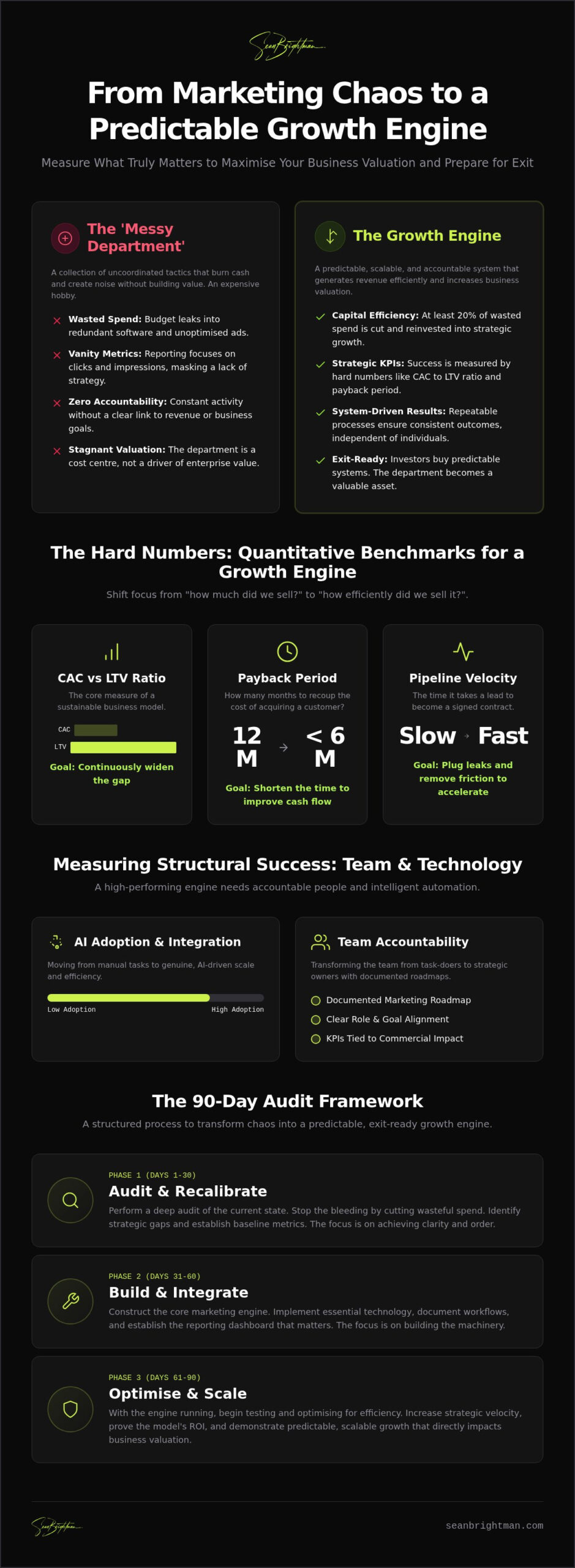
    Accountability in senior leadership isn’t about hours logged. It’s about commercial velocity. If you follow the traditional route described in The Problem with Part-time Recruitment, you often hire a manager who tracks tasks. A director provides a clinical roadmap. They measure success through customer acquisition cost (CAC), lifetime value (LTV), and pipeline speed. They provide clarity. Your team stops guessing. They start executing with tactical precision and a “battle-hardened” perspective that prioritises revenue over vanity.

    Building the Marketing Systems Architecture

    Tools are not a strategy. Buying a CRM or an AI suite won’t fix a broken business model. Your leadership must distinguish between the machinery and the output. This requires a strategic brand roadmapping plan that defines your market position with surgical accuracy. This isn’t just about next month’s leads. It’s about aligning your entire marketing operation with your long-term business exit goals. If your systems aren’t asset-backed and documented, they aren’t scalable. They are just a collection of expensive habits.

    Driving Team Accountability

    A senior leader bridges the gap between commercial goals and execution. Whether you use internal staff or external agencies, they need a strategist to hold them to account. A part-time marketing director uk moves the focus away from vanity metrics. They ignore “likes” and “impressions”. They focus on commercial reality. They ensure your agencies aren’t just marking their own homework, but are actually moving the needle on your bottom line. If your current marketing feels like a black hole, a Fractional CMO can provide the necessary external pressure to drive order and results.

    Fractional CMO vs Part-time Employee: A Brutal Comparison

    Recruitment is slow. Fractional is fast. When you hire a part-time marketing director uk as an employee, you’re buying a person. When you hire a Fractional CMO, you’re buying a result. It is the difference between owning a car and hiring a chauffeur. One requires maintenance, insurance, and long-term commitment. The other just gets you where you need to go. You don’t need a resident; you need an intervention.

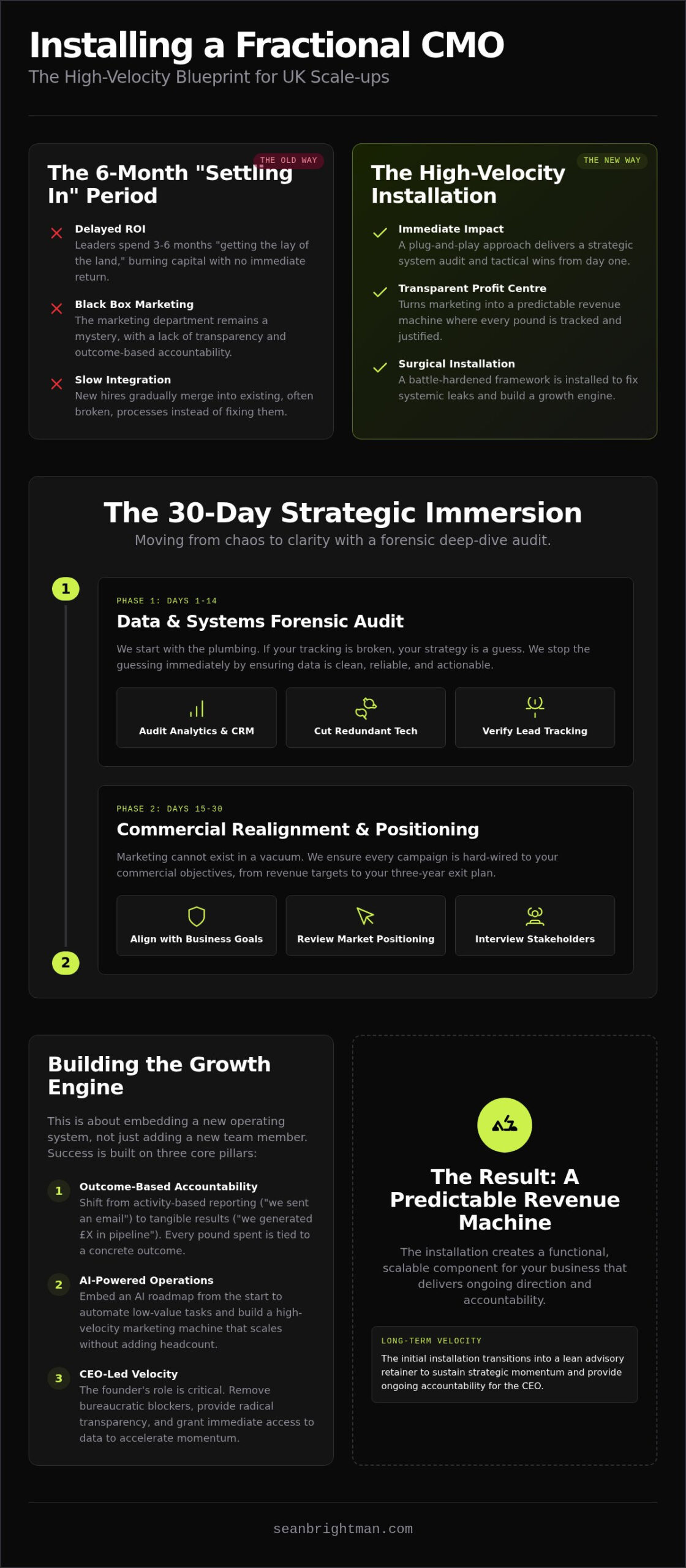
    This shift represents the revolution in 2026 for UK scale-ups. Fractional experts eliminate the onboarding lag. They don’t spend three months “learning the culture” or finding the printer. They audit. They strategise. They execute. They bring a “plug-and-play” efficiency that makes traditional part-time employment look archaic. You get senior leadership on a tactical basis, not a residency basis.

    The Cost-Benefit Analysis

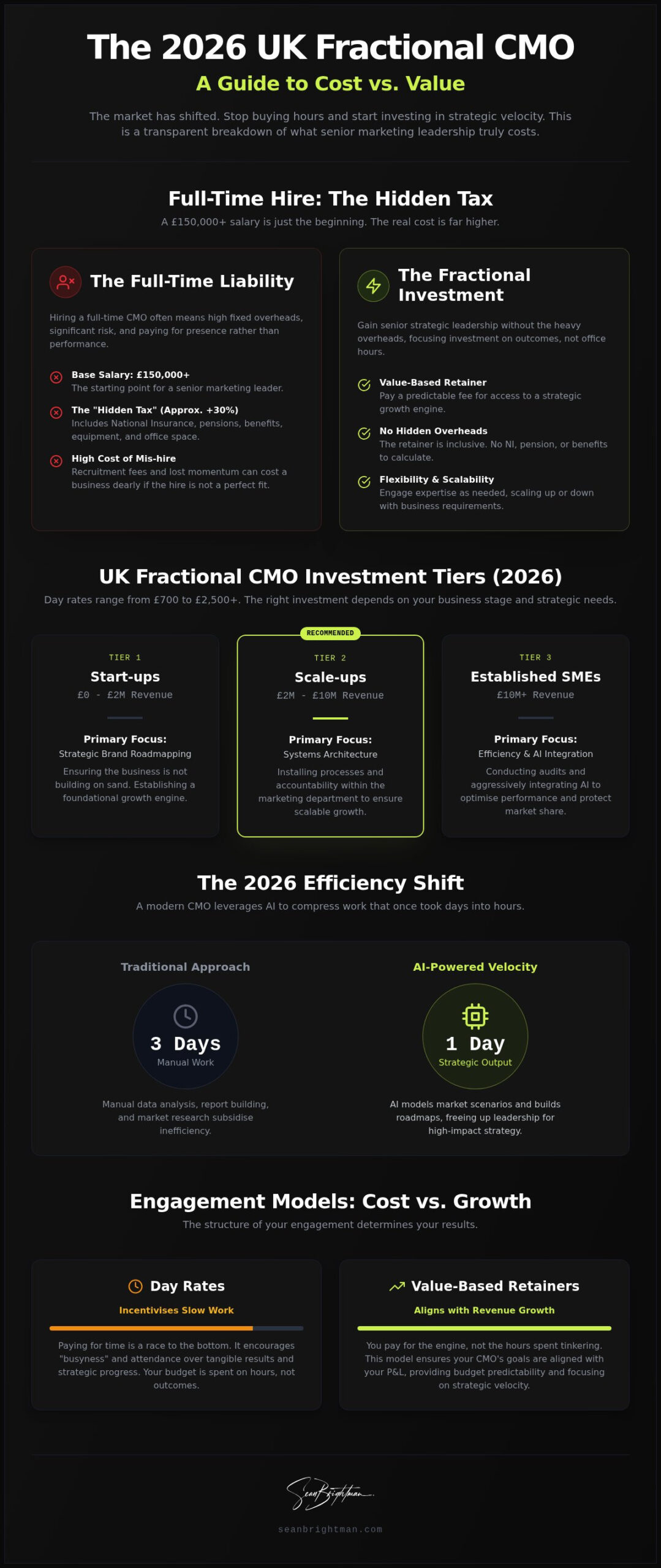
    Look at the numbers, not the sentiment. An employee costs significantly more than their base salary. You pay National Insurance. You pay pension contributions. You pay for holiday leave and the 2026 “day one” sick pay rights that have transformed the UK labour market. A fractional hire is a commercial expense, not an HR liability. It is a predictable line item on a balance sheet, not a variable risk.

    You get fifteen years of senior experience condensed into one high-impact day a week. It is about buying brains, not hours. You avoid the “sunk cost” of a bad senior hire because there is no notice period friction. If the strategy isn’t delivering, you pivot immediately. You aren’t stuck with a “dinosaur” who doesn’t understand modern systems; you have a partner whose value is proven every single month.

    Flexibility and Strategic Velocity

    Business needs change. A permanent part-time marketing director uk is a fixed cost in a fluid market. Fractional models allow you to scale up or down based on your actual requirements. You might need heavy lifting during a product launch and lighter oversight during steady growth. The marketing advisory retainer provides this exact strategic velocity. It keeps you moving without the drag of a full-time contract.

    This model works because of the “outside-in” perspective. Internal hires often inherit the same blind spots as the CEO. An external director sees the friction in your sales funnel that you’ve become used to. They are building The AI-Powered Growth Engine across multiple sectors, bringing that cross-pollinated expertise to your boardroom. They aren’t there to make friends or navigate office politics. They are there to provide order, accountability, and a clear path to revenue.
    Part-time Marketing Director UK: Why Recruitment is the Wrong Move in 2026

    The AI-Powered Growth Engine: Why 2026 Requires a Different Skillset

    Content is no longer the king. Efficiency is. In 2026, the market is saturated with generic, AI-generated noise. If your part-time marketing director uk is still focused on increasing content volume, they are leading you into a graveyard. You don’t need more posts. You need smarter systems. You need an AI consulting expert who understands how to build integrated growth engines that deliver output density without the bloat. This isn’t about playing with tools; it’s about mechanical precision.

    Most CEOs are suffering from tool fatigue. They have a dozen subscriptions and zero results. A strategic leader cuts through this mess. They replace fragmented apps with a unified AI-powered architecture. This shifts the focus from “doing” to “architecting.” It increases marketing velocity whilst keeping your overheads lean. You buy results, not hours. You buy a system that works whilst you sleep, not a manager who needs a lunch break.

    Implementing AI Growth Engines

    AI goes far beyond ChatGPT prompts. A battle-hardened director uses AI to automate lead generation and extract customer insights with surgical accuracy. They don’t just “use” AI; they embed it into your business DNA. This allows you to reduce headcount costs whilst dramatically increasing your marketing output. It is about leverage. One senior strategist with a properly tuned AI engine can outperform an entire department of tactical generalists. This is how you scale in 2026 without the traditional HR friction.

    Future-Proofing Your Marketing Operations

    Technical integration is the new battleground. This is why a marketing operations consultant is no longer optional. You need to build a tech stack that scales with your revenue, not your headcount. The goal is a “plug-and-play” infrastructure that remains robust as you grow. However, technology is only half the battle. Your director must also ensure your brand remains authentically human. In an automated world, personality is your only moat. Use AI for the machinery, but keep the soul of the business intact.

    Ready to stop the tactical churn? Build a scalable growth engine today with Fractional CMO and AI consulting.

    Finding Your Strategic Partner: Beyond the CV

    Degrees don’t drive revenue. Qualifications don’t build systems. If you’re hiring a part-time marketing director uk based on a ten-year tenure at a legacy firm, you’re likely buying yesterday’s solutions. Strategic depth isn’t found in a list of responsibilities; it’s found in the ability to dismantle a broken process and replace it with a high-velocity engine. You need a partner who understands the visceral reality of the 2026 UK market, not someone who relies on outdated playbooks from a pre-AI era.

    Look for a “battle-hardened” perspective. This means finding a leader who has navigated the chaos of scaling and come out with a clinical, results-oriented methodology. Your ideal partner shouldn’t just agree with your vision. They should challenge your status quo. If they aren’t pushing back on your current tactical churn, they aren’t providing leadership; they’re just providing a temporary reprieve from your workload. A true director brings order to internal complexity by being an external force for accountability.

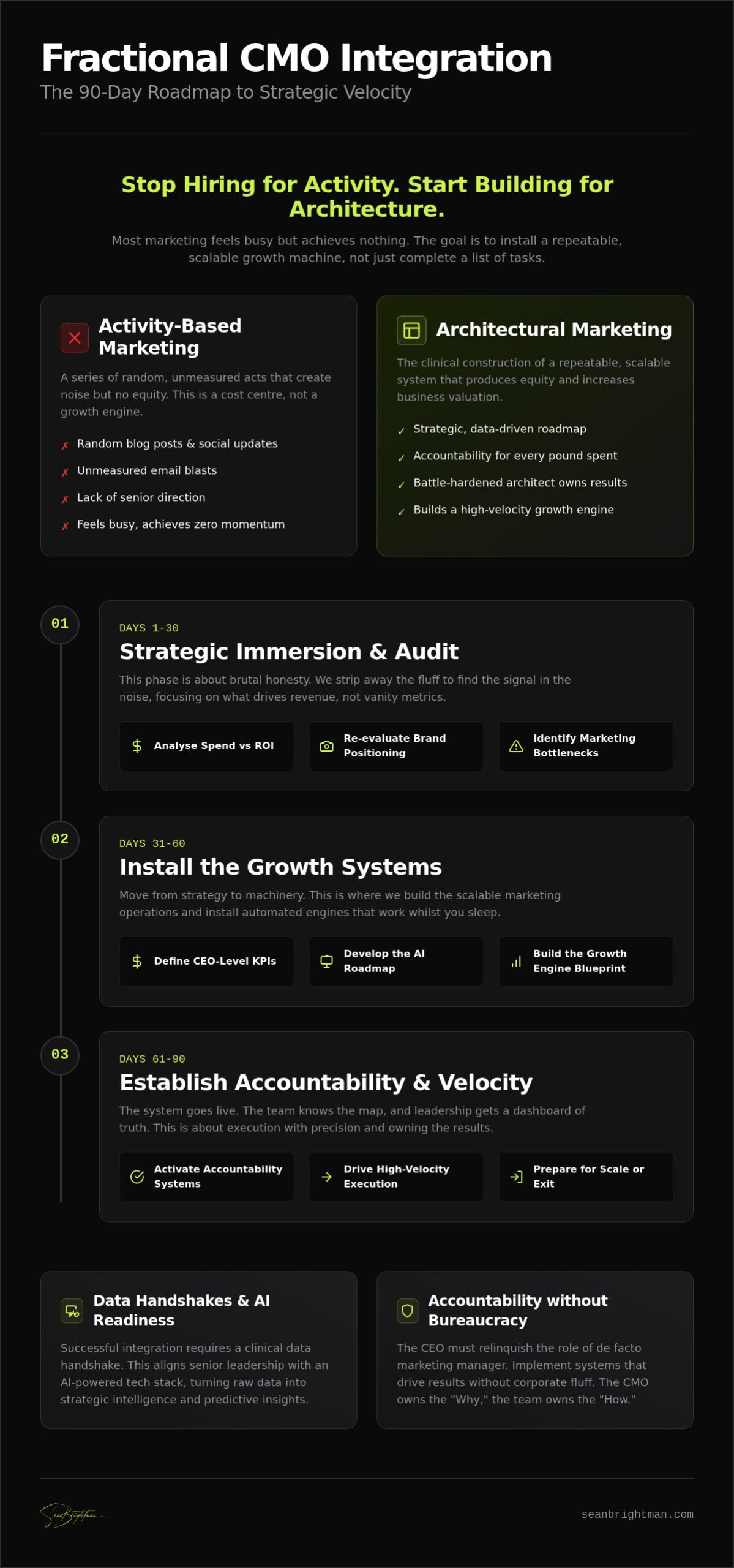
    The “90-day win” is your litmus test. In the first thirty days, you don’t want “activity.” You want a comprehensive audit and a clinical roadmap. By day sixty, you should see the implementation of core systems and AI-driven efficiencies. By day ninety, the department should move with commercial velocity. If you’re still talking about “brand awareness” without a clear link to your bottom line after three months, you’ve hired a manager, not a strategist.

    The Advisory Model: Leadership Without Ceremony

    Sean Brightman doesn’t operate like a traditional recruitment agency. He provides direction, not just placement. The focus is on fixing messy marketing through a “get-your-hands-dirty” advisory approach. This moves the needle away from the traditional boss/employee dynamic toward a high-impact strategic partnership. You aren’t managing a subordinate; you’re engaging an expert who holds you and your team to a higher standard of execution.

    The Advisory Retainer is the specific tool designed for this level of strategic velocity. It strips away the ceremony of corporate consulting and replaces it with direct, blunt honesty. It ensures that the CEO has a sharp-minded partner to navigate complex commercial decisions without the HR baggage of a permanent hire. It’s about plug-and-play leadership that scales with your ambition.

    Next Steps: Securing Your Growth Engine

    Transitioning from a messy, unaccountable department to a structured growth engine starts with a single decision. You must stop browsing job boards and start investing in a roadmap. The first step is always a strategic roadmapping session. This isn’t a casual chat; it’s a tactical intervention to define your market position and identify the friction points in your current funnel. It is time to move from “part-focused” output to a scalable, asset-backed marketing operation.

    Ready to build a growth engine that delivers results, not just hours? Book a strategy session with Sean Brightman.

    Time to Stop Recruiting and Start Scaling

    Traditional hiring is a financial anchor. In 2026, searching for a part-time marketing director uk through a recruitment agency is a strategic error that buys you liability rather than velocity. You don’t need another seat filled in your office. You need a high-impact growth engine that converts strategy into revenue without the friction of permanent employment contracts or “day one” sick pay rights.

    Success requires a shift from activity to architecture. Sean Brightman is a specialist in AI-powered growth engines and a published author on marketing strategy. He provides the senior leadership you need with zero recruitment fees and a clinical focus on results. It is about strategic intervention, not administrative management. You get a battle-hardened expert who builds the machinery of your business whilst you focus on the big picture.

    Stop browsing job boards and start building a scalable future. It is time to replace your messy marketing with a roadmap that actually delivers. Build your growth engine with Sean Brightman. Your brand is ready for the next level; make sure your leadership is too.

    Frequently Asked Questions

    What is the difference between a part-time marketing director and a Fractional CMO?

    A part-time marketing director is often a traditional employee on a reduced-hours contract. A Fractional CMO is a strategic partner who joins on a “plug-and-play” basis. One brings HR baggage and a “manager” mindset; the other brings senior leadership and an “architect” mindset. Fractional CMOs focus on outcomes rather than hours. They provide strategic intervention without the notice periods or pension contributions associated with traditional employment in the UK.

    How much does a part-time marketing director cost in the UK in 2026?

    The total cost of ownership for an employee is far higher than a base salary. You must factor in National Insurance, pension contributions, and the 2026 “day one” sick pay rights. Whilst specific day rates vary based on experience and sector, a fractional model typically represents a significant saving compared to a full-time director’s total package. You pay for strategic velocity, not just a body in a chair.

    Do I need a part-time marketing director if I already have an agency?

    Yes, because agencies need direction and accountability. An agency executes; a director strategises. Without a senior leader, agencies often “mark their own homework” and focus on tactical churn rather than commercial reality. A director ensures your agency is aligned with your business exit goals. They bridge the gap between your commercial ambition and the agency’s technical output, preventing expensive “messy marketing” that wastes your budget.

    How many days a week does a part-time marketing director usually work?

    Most engagements range from one to two days a week. However, the focus should be on strategic velocity, not time spent. A high-impact leader can deliver more value in four hours of clinical roadmapping than a senior manager can in forty hours of task management. The goal is to build a growth engine that runs without constant supervision, allowing you to scale without increasing your permanent headcount.

    Can a part-time marketing director help with my business exit strategy?

    Absolutely. A senior leader builds asset-backed marketing systems that increase business valuation. Buyers want to see a scalable growth engine, not a department dependent on the CEO’s intuition. By documenting processes and implementing AI-powered insights, a director makes your marketing operations transferable. They move the business away from person-dependent chaos toward a structured, mechanical system that proves long-term commercial viability to potential investors or buyers.

    What should be the first priority for a new part-time marketing hire?

    The first priority for a part-time marketing director uk is a comprehensive audit and strategic roadmapping session. They must identify friction points in your current sales funnel before spending a penny on ads. This involves stripping away “messy marketing” and defining a clinical path to revenue. You need a roadmap that aligns brand positioning with commercial goals, ensuring every future tactical move is an investment, not a gamble.

    Is it better to hire a part-time director or a full-time marketing manager?

    It depends on whether you need a builder or a maintainer. A manager organises tasks; a director builds systems. Hiring a full-time manager to fix a broken strategy is a common mistake. You end up with “part-focused” output and no roadmap. A part-time director provides the senior authority to fix the architecture first. Once the growth engine is built, you can then decide on the tactical headcount needed.

    How does a part-time marketing director integrate AI into my business?

    They move you from tool fatigue to integrated AI growth engines. Instead of just using ChatGPT for content, a director implements AI consulting strategies to automate lead generation and customer insights. They build a tech stack that scales with your business velocity, not your staff numbers. The focus is on increasing output density whilst keeping the brand authentically human, ensuring your marketing operations are future-proofed for the 2026 landscape.

  • Fractional CMO vs Interim CMO UK: Choosing the Right Strategic Leader in 2026

    Fractional CMO vs Interim CMO UK: Choosing the Right Strategic Leader in 2026

    Hiring a senior leader just to “keep the lights on” is a tactical failure that costs you more than just a day rate. Most UK businesses confuse stability with progress. When you’re weighing up a fractional cmo vs interim cmo uk, the decision shouldn’t be about how many days they sit at a desk. It’s about whether you’re plugging a gap or building a system.

    You’re likely staring at a marketing department that’s constantly busy but failing to deliver a measurable ROI. The thought of a £150k+ full-time salary is eye-watering, yet the complexity of IR35 compliance makes you hesitate to bring in outside help. You need senior grip, but you don’t need the corporate bloat. Discover the critical differences between fractional and interim marketing leadership to ensure you hire for growth, not just stability. This guide previews the 2026 financial thresholds, the “build vs. maintain” mindset, and exactly which model fits your current business stage. It’s time to stop renting a placeholder and start installing a strategic engine that actually scales.

    Key Takeaways

    • Stop renting a placeholder. Learn why an interim CMO maintains the status quo whilst a fractional CMO builds a permanent, scalable growth engine.
    • Navigate the 2026 UK regulatory shift. Understand how IR35 compliance and new small-company thresholds change the way you hire senior marketing expertise.
    • Use our five-point decision matrix to settle the fractional cmo vs interim cmo uk debate and align your choice with your business’s current growth stage.
    • Shift from “doing” to “driving”. Discover how strategic roadmapping and AI-powered systems replace the need for a £150k+ full-time salary.
    • Establish clear accountability. See how a fractional leader uses an advisory retainer to move your team from “busy work” to measurable ROI.

    Understanding the Distinction: What is a Fractional CMO vs an Interim CMO?

    Stop confusing capacity with capability. Most CEOs treat senior marketing hires as a way to “buy more hands.” It’s a mistake that leads to expensive, stagnant departments. When you’re weighing up a fractional cmo vs interim cmo uk, you aren’t just choosing a contract length. You’re choosing between a placeholder and a builder. One maintains the status quo; the other disrupts it to create value.

    The Fractional executive model has gained massive traction because it decouples senior expertise from the requirement of a full-time desk. In the UK market, the distinction is often blurred by recruitment agencies, but the objectives are fundamentally different. You must decide if you’re trying to survive a transition or engineer a breakthrough. The Fractional CMO is the strategic architect for your growth engine.

    The Interim CMO: Stability and Continuity

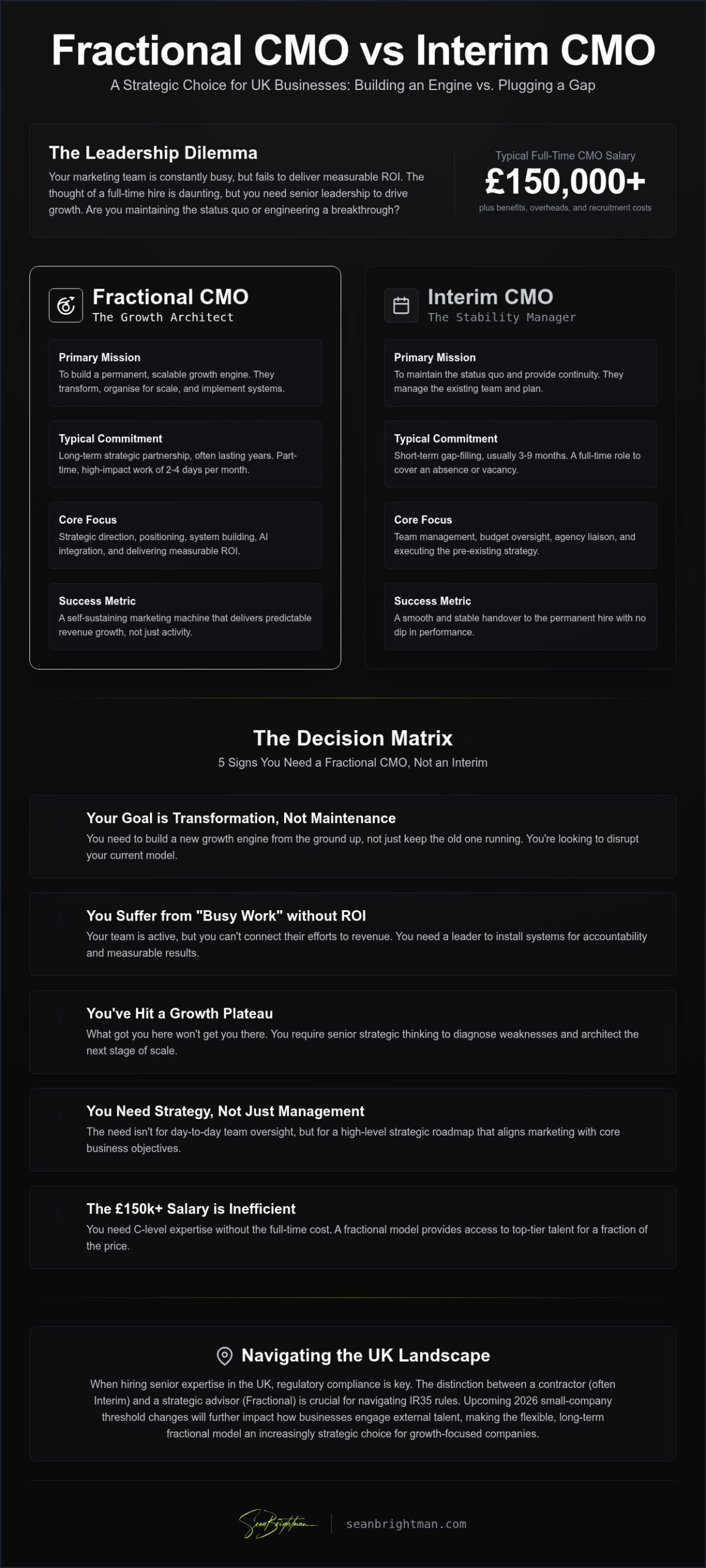
    An interim leader is a professional gap-filler. They arrive when your CMO quits or goes on parental leave. Their mission is preservation. They keep the lights on, manage the existing team, and ensure the current marketing plan doesn’t derail whilst you search for a permanent replacement. It’s a full-time, intensive role that usually lasts between three and nine months. They don’t rewrite your strategy; they just make sure the team follows the one already on the desk. They are a tactical safety net for businesses that already have a functioning system but lack a head to steer it.

    The Fractional CMO: Strategy and Transformation

    The Fractional CMO doesn’t just fill a seat. They rebuild the chair. This is a long-term strategic partnership, typically involving two to four days of high-impact work per month. They aren’t there to manage the “business as usual” tasks; they’re there to fix what’s broken and organise the business for scale. They focus on positioning, ROI, and building automated growth systems that don’t require a £150k+ full-time salary to maintain. In the context of fractional cmo vs interim cmo uk, the fractional leader is your strategic accelerator. They stay with the business for years, providing the senior-level accountability that “busy” marketing departments often lack.

    The difference is the finish line. An interim’s success is a smooth handover to a successor. A fractional CMO’s success is a scalable marketing machine that delivers measurable revenue. One manages the “now”; the other builds the “next”.

    The Strategic Mission: Maintenance whilst Hiring vs Building a Growth Engine

    Hiring a senior leader to simply “manage the mess” is a waste of capital. The distinction in the fractional cmo vs interim cmo uk debate boils down to one question: are you treading water or building a ship? One model protects your current revenue. The other engineers your future growth. If you hire an interim to “fix” a broken strategy, you’re likely paying a premium for a temporary patch on a structural leak.

    Strategic velocity is the real metric that matters. It isn’t just about moving fast. It’s about moving fast in the right direction. Interims provide operational speed. They keep the existing machinery running. Fractional CMOs provide strategic velocity. They recalibrate the machinery, strip out the friction, and ensure every pound spent on marketing actually hits the bottom line. Before committing, many CEOs benefit from Strategic Brand Roadmapping to diagnose where the engine is failing before they hire a mechanic.

    When Stability is the Priority (Interim)

    You need an interim when your marketing department is already a high-performing unit. If your team is hitting targets but your leader has exited suddenly or taken leave, an interim is the “safe pair of hands” you require. Their mission is continuity. They manage the internal politics, keep the agencies accountable, and ensure there is no dip in performance whilst you conduct a permanent recruitment search. Success for an interim is handing over a stable, predictable ship to the next full-time hire. They are the guardians of your current momentum.

    When Transformation is the Priority (Fractional)

    You need a fractional CMO when your marketing feels “busy” but lacks a clear ROI. This is for the founder who has hit a growth plateau and needs senior-level direction without the £150k+ salary commitment. The fractional leader doesn’t just manage the team; they install a scalable growth engine that continues to function long after their involvement scales back. They focus on positioning, systems, and accountability. They turn marketing from a cost centre into a predictable revenue driver.

    If you’re tired of marketing plans that look good in slides but fail in the market, it’s time to stop looking for a manager. You need a strategist who builds for the long term. You can explore how a battle-hardened strategist can fix your growth engine by reviewing my Roadmapping service today.

    The UK’s tax regime has inadvertently created a golden age for fractional leadership. In the debate of fractional cmo vs interim cmo uk, the tax man is often the silent partner in the room. Traditional interim roles, which typically involve full-time hours and direct management of internal staff, frequently fall “inside IR35.” This adds a massive tax burden to your payroll. Fractional roles, by contrast, are built on a foundation of independent advisory and strategic delivery. They are designed to sit outside the payroll, offering a cleaner, more efficient commercial engagement for both parties.

    Success in 2026 requires moving away from the “hours for money” trap. You aren’t buying a person to sit in a chair from nine to five. You are buying a result. A fractional CMO operates as a genuine business-to-business partner, focusing on high-impact deliverables rather than administrative presence. This shift from input-based hiring to outcome-based investment is what separates growing UK firms from those stuck in the recruitment loop.

    IR35 Compliance for UK Leadership

    Navigating off-payroll working rules is a strategic necessity, not an administrative chore. For medium and large businesses, the responsibility for determining IR35 status is yours. As of April 2026, the thresholds for “small” company exemptions have increased to a turnover of £15 million and a balance sheet total of £7.5 million. If you exceed these, you must be precise. Fractional advisors typically pass the “substitution” and “control” tests because they provide a specialist service on their own terms, often using their own equipment and methodology. They don’t look like employees because they aren’t employees. They are an external force brought in to fix a specific problem.

    The ROI of Fractional Leadership

    The math is simple and brutal. A full-time CMO in the UK can carry a total loaded cost of between £300,000 and £450,000 once you factor in National Insurance, pension contributions, bonuses, and recruitment fees. That is a massive bet on a single individual. A fractional leader removes that overhead. You pay for the strategy and the systems, not the benefits package. The real value, however, lies in the “cost of inaction.” A broken marketing system costs you revenue every single day it remains unfixed. The Marketing Advisory Retainer provides a framework for ongoing accountability, ensuring your team stays focused on ROI without the long-term liability of a six-figure salary. You gain senior-level grip with the flexibility to scale the engagement as the business evolves.

    Fractional CMO vs Interim CMO UK: Choosing the Right Strategic Leader in 2026

    The Decision Matrix: 5 Signs You Need Fractional Leadership, Not an Interim

    Deciding between a fractional cmo vs interim cmo uk isn’t about your budget. It’s about the state of your marketing engine. If your department is a black hole where capital disappears without a trace, an interim won’t save you. They’ll just watch the money burn from a more senior seat. You need a fractional leader when the problem is structural, not just a lack of headcount. It’s the difference between needing a mechanic to fix the car and needing a driver to keep it in the lane.

    • Sign 1: You have a team of “doers” who execute tasks but have no one steering the strategic ship.
    • Sign 2: Your marketing results have plateaued or dipped despite you increasing your ad spend.
    • Sign 3: You know you need to integrate AI into your operations but don’t have a clue where to start.
    • Sign 4: You’re preparing for a business exit and need to build a growth engine that buyers actually want to own.
    • Sign 5: You’re tired of “marketing fluff” and want senior-level accountability for your CEO-level goals.

    Diagnosing Your Marketing “Mess”

    Are you suffering from Tool Fatigue or Strategy Fatigue? Tool Fatigue is when you’ve bought every SaaS product on the market but your data still doesn’t talk to itself. Strategy Fatigue is worse. It’s the feeling that you’ve tried every “hack” and nothing sticks. If you’re building a marketing strategy for business exit, you need a fractional architect. An interim is a manager. They keep things steady. A fractional CMO is a mentor who builds a legacy system that functions perfectly long after they’ve left the building.

    The AI Litmus Test

    If your current marketing plan doesn’t include a robust AI roadmap, you’re already obsolete. Interims rarely have the remit or the time to overhaul your entire tech stack with agentic AI. They’re hired to maintain the status quo. Fractional CMOs are different. They’re incentivised to create efficiency through automation because they’re paid for outcomes, not hours. They don’t just use AI tools; they build AI-powered growth engines that strip out human error and maximise strategic velocity.

    Stop settling for maintenance when you need a transformation. You can book your strategic roadmapping session to see exactly where your engine is leaking revenue.

    Strategic Velocity: Integrating AI and Accountability with a Fractional CMO

    In 2026, the CMO’s playbook has been shredded. If you’re still choosing between a fractional cmo vs interim cmo uk based on who has the best CV, you’re missing the point. The modern fractional leader isn’t just a strategist; they are an AI orchestrator. They don’t just manage people; they design agentic workflows that execute complex tasks without human friction. Whilst an interim keeps your legacy processes alive, a fractional CMO builds the replacement. They move you from a state of “doing marketing” to a state of “owning a growth engine.”

    Sean Brightman’s methodology is a plug-and-play solution for UK scale-ups that requires zero hand-holding. It strips away the corporate politeness that slows down most consultancies. You don’t need a 50-page PDF that collects dust on a digital shelf. You need a functioning system. This is about strategic velocity: the ability to pivot and scale based on hard data rather than gut feelings. It’s about results, not activity. This, not that.

    Building the AI-Powered Growth Engine

    AI consulting is no longer a “nice to have” niche. It’s the core component of senior leadership in 2026. With 25% of customers now using AI-powered platforms as their primary tool for researching products, your brand cannot afford a “wait and see” approach. Moving from manual marketing tasks to automated, intelligent systems is the only way to maintain a competitive edge. Roadmapping sessions provide the surgical blueprint for this engine. They identify the specific bottlenecks in your funnel and replace them with high-efficiency automation. This isn’t about replacing your team; it’s about giving them a machine that actually works. We build the architecture that allows your marketing to run at a speed that manual teams simply can’t match.

    The Power of the Advisory Retainer

    Accountability is the #1 missing ingredient in most marketing departments. Teams are often “busy,” but revenue remains flat. An Advisory Retainer solves this by keeping the CEO and the marketing team aligned on the same North Star. It’s a clinical approach to management: this worked, that didn’t. Fix it. Move on. This model provides the senior-level grip you need to stop the strategic drift that plagues mid-sized firms. It ensures that the high-level strategy designed during the Roadmapping phase is actually executed with precision. You gain a partner who is just as invested in your ROI as you are, acting as an external force that brings order to internal complexity. It’s time to stop renting a placeholder and start installing a leader who builds for the future.

    Stop hiring for seats and start hiring for systems.

    Stop Renting Placeholders; Start Building Systems

    Choosing between a fractional cmo vs interim cmo uk isn’t just an HR decision. It’s a choice between maintenance and transformation. If you need a safe pair of hands to keep the lights on whilst you recruit, hire an interim. But if your marketing results have plateaued and your team is drowning in “busy work,” you need a builder. In 2026, stability is a trap. You need an AI-powered growth engine that delivers measurable ROI without the £150k+ salary burden.

    You’ve seen the distinction. One model manages the status quo; the other disrupts it to create value. As a published author on marketing strategy and a specialist in AI-powered systems, I provide the direct CEO-level advisory required to turn marketing from a cost centre into a revenue driver. Don’t let strategic drift kill your momentum. It’s time to install the leadership your business deserves.

    Book a Strategic Roadmapping Session with Sean Brightman today and get the clinical clarity you need to scale with confidence.

    Frequently Asked Questions

    What is the main difference between a fractional and interim CMO in the UK?

    The distinction lies in the mission. An interim CMO is a full-time, temporary placeholder hired to maintain stability during a leadership gap. A fractional CMO is a part-time, long-term strategic partner brought in to build and scale systems. In the fractional cmo vs interim cmo uk debate, think of the interim as the caretaker and the fractional leader as the architect. One keeps the lights on; the other builds a new growth engine.

    How much does a fractional CMO cost compared to a full-time hire?

    A fractional CMO typically provides a 40% to 60% cost saving compared to the total loaded cost of a full-time hire. In the UK, a full-time CMO can cost between £300,000 and £450,000 annually when you factor in salary, National Insurance, pension, and recruitment fees. Fractional models remove this massive overhead. You pay for high-level strategic output and growth systems without the long-term liability of a six-figure PAYE contract.

    Is a fractional CMO “outside IR35” for UK businesses?

    Most fractional engagements are naturally lower risk for IR35 because they focus on advisory and strategic delivery rather than “filling a seat.” They usually pass the substitution and control tests as independent business entities. However, the responsibility for determining status lies with the client if they are a medium or large business. The April 2026 threshold changes mean more firms must be precise with these determinations to avoid tax complications.

    Can a fractional CMO manage my existing marketing agency?

    Yes, a fractional CMO provides the senior-level grip needed to keep agencies accountable. Many marketing departments suffer from “busy work” that fails to deliver a measurable ROI. A fractional leader cuts through the noise, sets clear KPIs, and ensures your external partners are executing a strategy that actually drives revenue. They act as your internal advocate, translating complex technical reports into clear, commercial results that the board can actually understand.

    How many days a month does a fractional CMO typically work?

    A fractional CMO typically works between two and eight days per month, depending on the complexity of your marketing engine. The most common model in the UK is a monthly retainer covering four to eight days of strategic work. This concentrated timeframe ensures maximum impact. It focuses on high-level decision-making and accountability rather than getting bogged down in daily administrative tasks that don’t move the revenue needle.

    What is the difference between a marketing consultant and a fractional CMO?

    Consultants sell you a map; fractional CMOs help you drive the car. A marketing consultant often delivers a one-off report or a strategy document that ends up gathering dust. A fractional CMO takes ownership of the outcome. They integrate into your leadership team, provide ongoing accountability, and ensure the strategy is actually executed. It’s the difference between buying an abstract theory and installing a functional, high-performance component into your business.

    When is the right time for a UK scale-up to hire a fractional CMO?

    The right time is when your marketing has hit a plateau or feels chaotic. If you have a team of “doers” but no one steering the ship, you’re wasting capital. Scale-ups often reach a point where the founder can no longer manage marketing effectively but cannot justify a full-time executive salary. Hiring a fractional leader at this stage allows you to build a scalable system before committing to a permanent, expensive hire.

    Do fractional CMOs help with AI implementation?

    Modern fractional leaders are essential for AI orchestration. In 2026, success isn’t just about using tools; it’s about designing AI-powered growth engines. A fractional CMO helps you move from manual tasks to automated, intelligent workflows. They provide the strategic blueprint for AI implementation, ensuring your team uses agentic systems to increase efficiency and output. This prevents “tool fatigue” and focuses on practical, revenue-generating automation that scales your marketing efforts rapidly.

  • The Hidden Cost of the Marketing Leadership Gap: Why Growth Stalls in 2026

    The Hidden Cost of the Marketing Leadership Gap: Why Growth Stalls in 2026

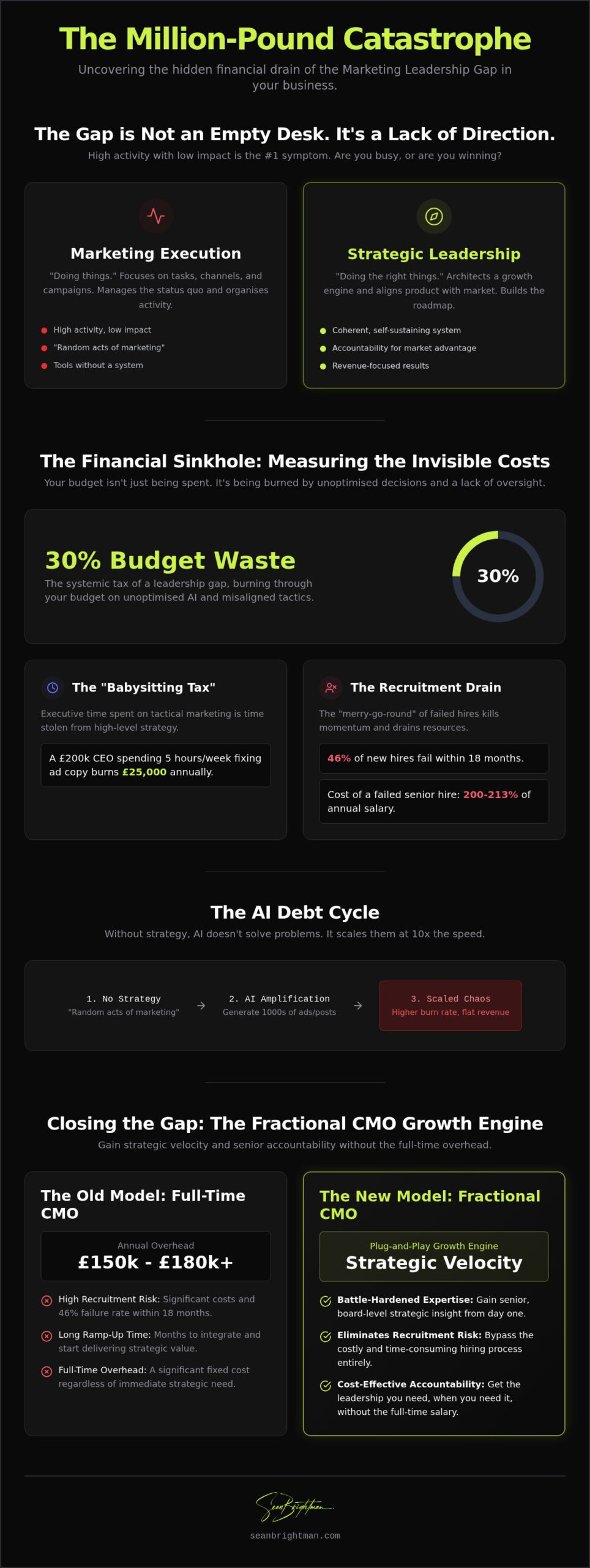
    Hiring the wrong person isn’t just a mistake. It’s a million-pound catastrophe. In 2026, the actual cost of marketing leadership gap issues is no longer a missed target or a messy spreadsheet. It’s a systemic tax. It burns through 30% of your budget on unoptimised AI and misaligned tactics while you’re left holding the bill.

    You see the symptoms daily. Your team is busy, the tools are expensive, and your burn rate is climbing. Revenue stays flat. You’re likely exhausted from founder-led marketing and tired of guessing which half of your budget is actually working. This is about systems, not just tools. You need a growth engine, not a collection of expensive subscriptions.

    I’ll show you how to plug these invisible financial leaks. You’ll discover how to build a marketing department that functions as a self-sustaining growth engine without the £150k overhead of a full-time hire. We will examine the mechanics of fractional leadership, the reality of AI-disrupted roles, and the exact roadmap to strategic clarity.

    Key Takeaways

    • Distinguish between marketing execution and strategic leadership to ensure your team is doing the right things, not just staying busy.
    • Calculate the invisible cost of marketing leadership gap problems, including wasted ad spend and the financial drain of the recruitment merry-go-round.
    • Stop the AI debt cycle by integrating tools into a coherent strategy rather than scaling bad processes at ten times the speed.
    • Recognise the warning signs of a leadership void, such as the CEO personally approving tactical details or tracking vanity metrics over revenue.
    • Implement a “plug-and-play” Fractional CMO solution to gain strategic velocity and senior accountability without the full-time salary overhead.

    What is the Marketing Leadership Gap?

    The gap isn’t an empty desk. It’s an absence of accountability for your market advantage. You have people. You have tools. You probably have a dozen active campaigns. But you don’t have a growth engine. You have a collection of parts that don’t fit together. This is the difference between marketing execution and marketing leadership.

    Execution is about doing things. Leadership is about doing the right things. Mid-market UK firms often fall into the “Tactical Trap” whilst scaling. They hire for skills but lack the vision to integrate those skills into a coherent system. The cost of marketing leadership gap issues shows up as high activity with low impact. You’re busy, but you aren’t winning.

    In 2026, the complexity of AI and fragmented channels has turned this gap into a canyon. AI allows you to generate a thousand ads in a minute. Without leadership, those thousand ads are just noise. You’re scaling chaos. You’re paying for speed when you should be paying for direction.

    The Manager vs. Leader Distinction

    Managers organise tasks. Leaders architect growth engines. If your Marketing Manager is spending their day debating font sizes or scheduling LinkedIn posts, they aren’t leading. They are managing the status quo. They cannot solve your positioning problem because they are too close to the machinery.

    True leadership requires an understanding of the core principles of marketing management to align your product with a shifting market. A manager follows the roadmap. A leader builds it. Relying on “bottom-up” strategy from junior staff is a recipe for expensive failure in a competitive market.

    Why Scale-ups Hit the Leadership Wall

    Founder-led marketing works until you hit £5M. At that stage, your intuition is enough. But as you push toward £20M, that intuition fails. You can’t be in every meeting. You can’t approve every headline. You hit the “Squeezed Middle”.

    This is where the cost of marketing leadership gap becomes a drag on your valuation. You are too big for a freelancer but too small for a full-time £180k CMO. The result is “random acts of marketing”. You try a bit of SEO. You dabble in PPC. You hire a content agency. None of it talks to each other. You have a team that needs babysitting instead of a department that generates revenue.

    The Financial Sinkhole: Measuring the Invisible Costs

    Your marketing budget is leaking. It isn’t a drip; it’s a flood. The cost of marketing leadership gap issues isn’t just a line item on a P&L; it’s the cumulative weight of unoptimised decisions. When you lack senior oversight, you pay a “Babysitting Tax”. If you are a CEO earning £200,000 and you spend five hours a week fixing LinkedIn posts or debating ad copy, you are burning £25,000 a year in executive time. That is time stolen from high-level strategy to do a job you’ve already paid someone else to perform.

    The drain extends to your ad spend. Running campaigns on a broken brand foundation is like pouring water into a sieve. Without a leader to enforce message market fit, your cost per acquisition climbs whilst your conversion rate stagnates. You aren’t building an asset. You are just renting expensive, low-quality attention. Mastering the challenge of measuring marketing ROI becomes impossible because the data is polluted by tactical noise. You can’t measure what you haven’t defined.

    The Cost of Misaligned Tactics

    Busy marketing teams are often your most expensive ones. High activity does not equal high impact. Spending £10,000 a month on SEO without a strategic brand roadmap is a vanity exercise. You might win the traffic game, but you’ll lose the revenue race. This misalignment compounds over 12 to 24 months. By the time you realise the direction was wrong, your competitors have already out-positioned you and captured the market’s trust. If you want to stop the bleed, you need to audit your marketing machinery before adding more fuel.

    The Retention and Recruitment Drain

    The recruitment merry-go-round is a silent killer of growth. Research shows that 46% of new hires fail within 18 months. For a senior marketing role, the fully loaded cost of a failed hire can be between 200% and 213% of their annual salary. This includes recruitment fees, ramp-up time, and the devastating loss of momentum. Junior staff churn because they have no one to learn from; senior hires fail because they lack the systems to succeed. Choosing a Fractional CMO eliminates this risk. You get the battle-hardened expertise without the £180,000 overhead or the long-term recruitment gamble. It’s about buying results, not just filling a seat.

    The AI Debt: Why Tactics Without Strategy Burn Cash

    AI isn’t a silver bullet. It’s an accelerant. If your strategy is flawed, AI just makes you fail faster. Many UK firms are currently drowning in “AI Tool Fatigue”. They have 50 different subscriptions for copy, images, and video, but no integrated workflow. They are buying tools, not solutions. This is where the cost of marketing leadership gap issues become visible in your software budget. You are paying for capacity you don’t know how to use.

    The real danger is the “Garbage In, Garbage Out” problem. AI allows you to scale bad strategy at ten times the speed. Without senior oversight, your team is simply generating more noise. They are using ChatGPT to churn out generic blogs whilst your competitors are building automated, data-driven growth engines. This misalignment is often rooted in the structural failure of the marketing role itself. As noted in The Trouble with CMOs, when a role is poorly designed, it cannot possibly manage the complexity of modern technology. You don’t need more prompts. You need a framework.

    To move beyond this, your team requires a comprehensive AI consulting framework. This isn’t about learning how to write better emails. It’s about re-engineering your entire marketing machinery to function in a post-AI world. If you are still manually writing every piece of content whilst your rivals use AI-powered operations, you aren’t just falling behind. You are becoming obsolete.

    AI as a Tool vs. AI as a System

    Most marketing teams use AI as a tool for “content”. They use it to save ten minutes on a social post. True leadership treats AI as a system for “operations”. Research from Boston Consulting Group indicates that 90% of a marketing manager’s tasks are disrupted by AI from a skills perspective. If your leadership doesn’t understand this, they cannot re-engineer your processes. This creates an “Efficiency Gap”. You have a 2026 budget supporting a 2019 workflow. It’s expensive, slow, and strategically toothless.

    The Strategic AI Roadmap

    Moving from “playing with AI” to a scalable growth engine requires an owner. Senior leadership must own the AI implementation roadmap. It’s not a task to delegate to a junior executive. A strategic roadmap defines how AI integrates with your CRM, your lead scoring, and your customer journey. The ROI of automated marketing operations is found in the machinery, not the copy. Under expert guidance, you stop buying subscriptions and start building an integrated growth engine that runs itself. This is how you close the cost of marketing leadership gap and turn your marketing department into a profit centre.

    The Hidden Cost of the Marketing Leadership Gap: Why Growth Stalls in 2026

    Audit Your Gap: Three Signs You’re Babysitting Your Marketing

    Stop pretending your marketing department is an autonomous engine if you’re the one still turning the key every morning. If you’re correcting ad copy or debating the colour of a CTA button, you aren’t a CEO. You’re a high-priced editor. Whilst you might feel that staying involved ensures quality, you’re actually capping your company’s growth. You’ve hired a team, but you’re still doing the heavy lifting.

    Founder-led marketing is a stage, not a permanent state. If you are still the final word on every LinkedIn post and ad headline, your team hasn’t been empowered. Or worse, they aren’t capable. Either way, you’re the bottleneck. This isn’t leadership; it’s a lack of trust in your own systems. When you can’t step away from the tactical details, the cost of marketing leadership gap issues starts to paralyse your executive focus.

    Look at your last report. If it’s full of “vanity metrics” like follower growth or website traffic, you’re being fed fluff. Real leadership focuses on “revenue velocity.” It’s about how fast a lead turns into cash, not how many people liked a post. When your team reports on activities instead of outcomes, you’re witnessing the cost of marketing leadership gap in real-time. You’re paying for a list of chores, not a strategy.

    You likely have a marketing operations disaster hidden in your tech stack. If no one can tell you exactly which tool manages which part of the customer journey, you’re paying for a mess. Tools should talk to each other; your team shouldn’t be the manual bridge between them. Review your calendar for the last fortnight. If 20% of your time was spent on marketing “how-to” rather than “what’s next,” you have a leadership void that needs plugging.

    The Metric Test

    Can your team explain the CAC (Customer Acquisition Cost) to LTV (Lifetime Value) ratio? If they can’t, they aren’t managing a budget; they’re spending it. Your marketing reports should read like a financial statement, not a list of activity logs. Ask for a strategy pivot tomorrow. If it takes three months to change direction, your machinery is rusted and your leadership is missing.

    The Founder Dependency Audit

    What happens if you don’t attend the marketing meeting for a month? If the answer is “everything stops,” you don’t have a business. You have a job. The brand voice must be a documented system, not an extension of your personality. Founder-led marketing is a massive bottleneck to a business exit. No one wants to buy a company that breaks the moment the founder goes on holiday. You need to build a system that outlasts your daily involvement.

    If your marketing team needs a leader instead of a babysitter, book a strategic audit to find your growth engine.

    Closing the Gap: The Fractional CMO Growth Engine

    You don’t need a full-time executive. You need an outcome. In 2026, the cost of marketing leadership gap issues is solved by buying results, not paying for presence. A Fractional CMO is the “Plug-and-Play” solution for UK scale-ups. It gives you senior-level authority to fix the machinery without the £180,000 overhead or the recruitment risk. You get the brain without the baggage.

    Think of it as senior brainpower at roughly 25% of the cost of a traditional hire. You aren’t paying for corporate politics or 40 hours of “busy work”. You’re paying for a growth engine that runs itself. This shift from a “Leadership Gap” to a Marketing Advisory Retainer moves the needle from tactical chaos to strategic velocity. It’s about high-impact intervention in a concentrated timeframe.

    The Strategic Roadmap First

    Don’t hire a single executioner until you have a map. Most firms hire a “Social Media Manager” or an “SEO Specialist” before they even know what they are selling or to whom. That is a waste of capital. A Fractional CMO starts with a 90-day Roadmap. We define the positioning, the systems, and the AI integration points first. We build the foundation before we hire the executioners.

    This roadmap sets the accountability framework for your existing team. It turns them from a group of people doing tasks into a department delivering revenue. We fix the brand foundation so your ad spend actually converts. We integrate AI into the workflow to bridge the efficiency gap. You get a blueprint. Then, and only then, do you build the team to run it. This sequence ensures you aren’t scaling chaos.

    The Long-term Advisory Model

    Strategic direction shouldn’t come with corporate baggage. An advisory model provides an external force of order. It brings a battle-hardened perspective that internal teams lack. You get a partner who isn’t afraid to be blunt or challenge the status quo. This is about providing the high-level thinking that keeps the engine running at peak efficiency whilst your internal team handles the daily output.

    This isn’t just about next month’s leads. It’s about building a marketing department that buyers covet. If you’re preparing for an exit, a system-led marketing engine adds significant value to your business. It proves that the brand isn’t dependent on the founder. It proves the growth is repeatable and scalable. Stop babysitting your marketing and start leading your business. It’s time to turn your marketing department into a profit centre.

    Stop Babysitting and Start Scaling

    Your marketing should be a self-sustaining growth engine, not a series of fires you have to put out. We’ve seen that the cost of marketing leadership gap issues is measured in wasted ad spend, CEO burnout, and stagnant revenue. You don’t need a full-time £180k hire to fix it; you need a system that works. Strategy must lead your tools, especially when integrating AI into your operations.

    I provide no-fluff, senior-level advisory for founders who are ready to step out of the tactical weeds. As an expert in AI-powered growth engines and the author of the definitive book on marketing strategy, I help you build the machinery that outlasts your daily involvement. It’s about clarity, accountability, and results.

    Ready to bridge the gap? Book a Strategic AI Roadmapping Session with Sean Brightman today. Let’s turn your marketing department into a high-impact profit centre. You’ve built the business; now build the engine to scale it.

    Frequently Asked Questions

    What is the true cost of a marketing leadership gap?

    The true cost is the sum of wasted ad spend, CEO time, and failed recruitment. Research indicates a bad senior hire can cost over 200% of their annual salary. The cost of marketing leadership gap issues also includes the “Babysitting Tax,” where founders lose hours to tactical management. This isn’t just money out of the bank. It’s the compounding loss of market position whilst competitors out-manoeuvre you.

    How do I know if I need a Fractional CMO or a Marketing Manager?

    Managers execute; CMOs architect. If you need someone to schedule posts and run basic campaigns, hire a manager. If you need a scalable growth engine, a positioning overhaul, or an integrated AI strategy, you need a Fractional CMO. You don’t hire a manager to solve a strategy problem. You hire a leader to build the system that the manager eventually operates.

    Can an agency fill the marketing leadership gap?

    Rarely. Agencies are built to sell services, not to own your business outcomes. They focus on their specific channel, whether that’s SEO or PPC, often ignoring the broader brand foundation. A Fractional CMO acts as an internal force, providing senior leadership that holds agencies accountable. You need an architect on your side of the table to ensure the builders are actually following a plan.

    What is the average salary of a full-time CMO in the UK in 2026?

    For a seasoned professional at a scale-up, you’re looking at £150,000 to £200,000 plus benefits and equity. This high overhead is why many mid-market firms hit a growth wall. They need the expertise but can’t justify the six-figure commitment. A Fractional CMO provides the same level of strategic velocity at a fraction of the cost, focusing on high-impact outcomes rather than full-time presence.

    How does a Fractional CMO integrate AI into my marketing?

    By building an operational system, not just writing prompts. We look at the entire customer journey to identify where AI can automate lead scoring, content distribution, or data analysis. The goal is to re-engineer your marketing machinery to be faster and leaner. It’s about moving from “playing with tools” to owning a data-driven growth engine that scales without adding headcount.

    Is a marketing leadership gap common in B2B scale-ups?

    It is almost universal between £5M and £20M turnover. Founders often reach the limit of their own marketing intuition but haven’t yet built a departmental system. This creates a vacuum where tactics become disconnected from revenue. Identifying the cost of marketing leadership gap early allows scale-ups to professionalise their marketing operations before the “Founder Bottleneck” causes a permanent stall in growth.

    What happens if I ignore the leadership gap for another year?

    You’ll burn another 30% of your budget on misaligned tactics and unoptimised tech subscriptions. Your competitors will gain a 12-month head start on AI-powered operations that you’ll struggle to match. Ignoring the gap doesn’t just stall growth; it builds “strategic debt.” The longer you wait to fix the foundation, the more expensive and painful the eventual reconstruction becomes.

    How long does it take to close the leadership gap with a Fractional CMO?

    The initial “plug-and-play” intervention usually takes 90 days. Within the first month, we audit the existing machinery and identify the leaks. By day 60, we’ve defined the strategic roadmap and AI integration points. By day 90, the accountability framework is in place and the team is running a documented system. You move from chaos to clarity in one fiscal quarter.

  • Fractional CMO Responsibilities: The Strategic Blueprint for UK Scale-ups

    Fractional CMO Responsibilities: The Strategic Blueprint for UK Scale-ups

    The £150,000 mistake isn’t just hiring the wrong person. It’s hiring the wrong model. Most UK scale-ups don’t need a full-time executive to sit in board meetings and polish slide decks. They need a builder who gets their hands dirty. Understanding the specific fractional cmo responsibilities uk businesses require is the difference between a marketing department that burns cash and one that operates like a precision-engineered machine.

    Over half of the UK’s 44,595 scale-up businesses cite access to senior leadership as their primary constraint on growth. You’re likely exhausted by agencies that lack strategic oversight. You’re paying for a tech stack that nobody knows how to use effectively. It’s frustrating to watch growth stall whilst you wait for a “perfect” full-time hire who may never arrive. We agree that your marketing should be predictable; not a gamble based on a founder’s gut feeling.

    This article promises to demystify the fractional role. You’ll learn how to deploy senior leadership to build a scalable, AI-powered growth engine that actually improves efficiency. We will provide a clear roadmap for turning your marketing function into a high-output department. It’s time to swap corporate fluff for tactical movement and clinical precision.

    Key Takeaways

    • Shift from activity-led management to results-led strategic architecture that builds permanent value for your organisation.
    • Master the core fractional cmo responsibilities uk scale-ups require to turn marketing into a predictable, high-output growth machine.
    • Learn how to deploy an AI-powered growth engine that consolidates your tech stack and removes operational friction.
    • Define the “North Star” metrics needed to secure commercial ROI and provide absolute accountability for every pound spent.
    • Discover how to vet for a battle-hardened practitioner with a published methodology rather than a hands-off consultant.

    Beyond the Job Description: The Reality of Fractional Leadership in the UK

    A fractional CMO is not a glorified temp. They are a strategic architect. Most marketing managers focus on activity; they count posts, emails, and clicks. A fractional CMO focuses on results. They build the machine that generates those clicks. This distinction is the core of the fractional cmo responsibilities uk founders must understand before they hire. You aren’t paying for a pair of hands to execute tasks. You are paying for a brain to organise the chaos.

    UK scale-ups often hit a “messy middle” where growth stalls. The founder can no longer manage every campaign, but the business isn’t ready for a heavy executive team. The Fractional executive model solves this by providing senior oversight without the full-time commitment. It creates a binary between strategy and execution. The fractional CMO owns the strategy to fix the execution. They don’t just tell you what is wrong. They redesign the system so it stays right.

    Why UK Founders are Abandoning Full-Time CMO Hires

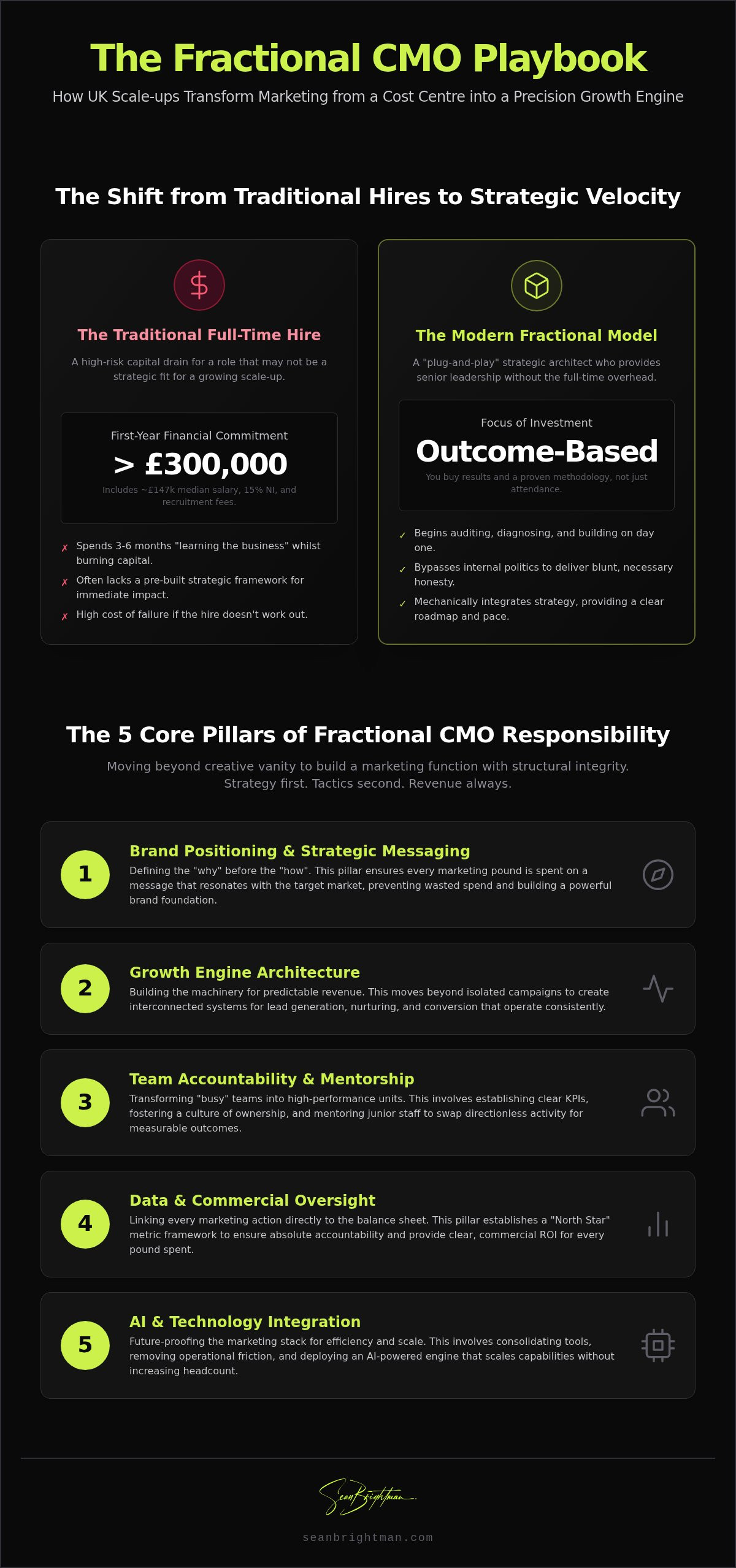
    The £120k mistake is a common trap for growing firms. The median salary for a full-time CMO in the UK is approximately £147,000. Once you add the 15% employer National Insurance rate and recruitment fees, the first-year bill often exceeds £300,000. That is a massive capital drain for a hire that might not work out. Many first-time senior hires fail because they lack a pre-built strategy to follow. They spend six months “learning the business” whilst your burn rate climbs. This is why smart leaders are pivoting to fractional CMO services. You get the expertise of a veteran for a fraction of the overhead. You buy the outcome, not the attendance.

    The “Plug-and-Play” Nature of Modern Advisory

    Strategic velocity is the goal. You don’t have time for a ninety-day onboarding plan. A battle-hardened expert enters a chaotic environment and starts auditing the machinery on day one. They bypass internal politics. They don’t care about protecting feelings or maintaining the status quo. They offer blunt, necessary honesty. This is one of the most vital fractional cmo responsibilities uk businesses benefit from: the ability to say “this isn’t working” without fear of being sacked at the next performance review. They provide the roadmap, set the pace, and hold the team accountable. It is about mechanical integration of strategy into your business, not abstract theory.

    The 5 Core Pillars of Fractional CMO Responsibilities

    Stop thinking about marketing as a cost centre. A fractional CMO treats it as a capital investment. The five pillars of fractional cmo responsibilities uk businesses must prioritise are built on structural integrity, not creative vanity. Strategy first. Tactics second. Revenue always.

    • Pillar 1: Brand Positioning & Strategic Messaging. Defining the “why” before the “how.” If your message doesn’t resonate, your spend is wasted.
    • Pillar 2: Growth Engine Architecture. Building the machinery that generates predictable revenue. This is about systems, not just campaigns.
    • Pillar 3: Team Accountability & Mentorship. Turning “busy” teams into high-performance units. We swap activity for outcomes.
    • Pillar 4: Data & Commercial Oversight. Linking marketing spend directly to the balance sheet. Every pound must be accounted for.
    • Pillar 5: AI & Technology Integration. Future-proofing the stack for 2026. We integrate machinery that scales without adding headcount.

    Architecting the Marketing Strategy Roadmap

    The first responsibility of a senior leader is to provide a path. A strategic brand roadmapping session is the foundation of the engagement. It takes a messy, fragmented department and converts it into a documented, clinical plan. This process ensures your leadership team possesses the critical skills for leadership teams that the ScaleUp Institute identifies as essential for growth. We build with an “Exit-Ready” mindset. Even if you aren’t selling, a strategy that adds tangible value to the business makes every operational decision easier. If your current setup feels like guesswork, it might be time to reassess your strategic leadership.

    Driving Team Accountability and Performance

    Busy is a trap. Most marketing teams are drowning in tasks that don’t move the needle. A fractional CMO defines KPIs that actually matter to the CEO; think customer acquisition cost and lifetime value, not likes and shares. The role of a marketing advisory retainer is to maintain this momentum. It provides the external pressure required to shift the culture from “creative output” to “commercial outcome.” We implement fractional cmo responsibilities uk firms need to ensure the marketing department functions like a predictable machine. We don’t just manage people. We manage performance.

    Integrating AI and Operations into the Strategic Remit

    AI is not a toy for your social media manager. It is the fuel for your growth engine. In 2026, one of the most critical fractional cmo responsibilities uk founders must demand is strategic AI implementation. This isn’t about playing with prompts. It’s about building machinery that scales without bloating your headcount. We swap tool fatigue for tactical precision. We don’t just use AI; we integrate it into the very fabric of your commercial strategy.

    A strategic leader acts as a marketing operations consultant to audit your current stack. Most scale-ups are paying for software they don’t use. We cut the fluff. We integrate the machinery. The Benefits Of Hiring A Fractional CMO include this clinical eye for operational efficiency. You don’t need more tools. You need tools that talk to each other to drive revenue. This is about building a system that works whilst you sleep.

    Building the AI Marketing Roadmap

    Strategic AI implementation begins with identifying high-impact use cases. We don’t automate for the sake of it. We automate to remove friction. A fractional CMO trains your existing team to use AI as a force multiplier. This ensures your staff aren’t replaced, but upgraded. Integrating AI consulting into the monthly strategic review keeps the engine tuned. We move fast because the technology moves faster. We stay ahead by focusing on the “why” before the “how.”

    Systematising Growth for 2026

    Stop committing random acts of marketing. They are expensive and unpredictable. We build mechanical systems instead. A “Marketing Efficiency Audit” is a core part of the fractional cmo responsibilities uk remit. It finds hidden profit by identifying where spend is leaking. Your tech stack must serve the strategy. If a tool doesn’t contribute to the “North Star” metric, it gets binned. We build for scalability. We build for 2026. We build a marketing department that functions like a predictable, revenue-generating machine.

    Fractional CMO Responsibilities: The Strategic Blueprint for UK Scale-ups

    Measuring Impact: Accountability and Commercial ROI

    The number one question CEOs ask is simple: “How do I know it is working?” If you are measuring success by likes, shares, or “brand awareness,” you have already lost. A fractional CMO does not report on activity. They report on commercial impact. We define a “North Star” metric that aligns with your balance sheet, not your ego. This clinical approach to data is one of the core fractional cmo responsibilities uk scale-ups must demand. We provide the Board with pipeline reality, not marketing fantasy.

    Success is a binary. You are either building a predictable machine or you are burning cash. Activity metrics are noise. Commercial metrics are signal. We focus on Customer Acquisition Cost (CAC), Lifetime Value (LTV), and Sales Qualified Leads (SQLs). If the data doesn’t show a direct path to revenue, the strategy is broken. My job is to find the break and fix it. We ensure every pound spent is an investment in your company’s valuation.

    The 90-Day Strategic Velocity Framework

    Strategy without a timeline is just a wish. We operate in 30-day sprints to maintain momentum and deliver visible results. In the first 30 days, our primary responsibility is “stopping the bleed” of inefficient spend. We audit the accounts and kill the vanity projects that drain your budget. By day 60, we are building the machinery and aligning the team. By day 90, we are optimising the engine for scale. ROI in a fractional context is the multiplier on strategic clarity.

    Accountability for Founders and CEOs

    Founders are often too close to the problem to see the solution. An advisory retainer provides the external pressure required to stay on track. It is a sounding board that offers blunt, necessary honesty. I will challenge your assumptions. I will tell you if your favourite project is a waste of resources. This level of accountability ensures fractional cmo responsibilities uk leaders undertake are perfectly aligned with your overall business exit or growth plan. We don’t just agree with you; we guide you. If you want a partner who protects your capital and drives commercial outcomes, book a strategic diagnostic today.

    Hiring for Impact: How to Onboard a Fractional CMO

    Hiring a fractional CMO is a leadership decision. It is not a procurement exercise. Most businesses make the mistake of hiring a consultant when they actually need a leader. A consultant gives you a report and a bill. A fractional leader gives you a roadmap and accountability. This distinction is vital when defining fractional cmo responsibilities uk scale-ups require for long-term success. You need someone who owns the outcome, not just the advice.

    Look for a practitioner with a published methodology or a book. This isn’t about vanity. It is proof of a battle-hardened system. It shows they have a repeatable process for fixing messy marketing departments. Ignore the “Culture Fit” myth. You don’t need a friend. You need a strategic disruptor. You need someone willing to challenge your assumptions and break the status quo to drive growth. A true leader prioritises commercial health over internal politeness.

    Evaluating Strategic Fit over Industry Experience

    Founders often obsess over niche expertise. They want someone who has worked in their exact sector for twenty years. This is a mistake. You don’t need a historian; you need an architect. A senior strategist understands the universal mechanics of growth engines. These mechanics apply whether you sell software or industrial components. Hiring for “strategic machinery” ensures you get a builder who can install a scalable system. Ask your candidate how they handle tool consolidation and team accountability. If they can’t explain the machinery, they can’t build your future. Focus on the ability to organise chaos, not just the ability to talk the industry shop.

    Transitioning to an Advisory Retainer Model

    The journey starts with a one-off roadmap to clear the fog. This identifies the leaks and sets the North Star metrics. Once the path is documented, the focus shifts to execution and oversight. This is where the fractional cmo responsibilities uk remit moves into an advisory retainer. This model isn’t about counting days per month. It is about impact delivered and strategic velocity maintained. You buy the senior oversight required to keep the engine running at peak performance whilst your internal team executes. It is time to move from a messy state to a roadmapped future. Build your growth engine with Sean Brightman and stop guessing about your growth.

    Stop Guessing and Start Scaling

    Marketing is either a predictable revenue machine or an expensive hobby. Most UK scale-ups are stuck in the latter. By mastering the core fractional cmo responsibilities uk businesses need, you move from random acts of marketing to clinical strategic execution. We have covered the pillars of brand positioning, tool consolidation, and the necessity of an AI-powered growth engine. The choice is binary: continue burning cash on uncoordinated activity or install the senior leadership required to drive commercial ROI.

    I am a specialist in building AI-powered growth engines for CEOs who value strategic velocity. As the author of the definitive book on high-impact marketing strategy, I don’t offer corporate fluff. I provide a pragmatic, direct advisory service that fixes messy departments and holds teams accountable. It is time to swap the “£120k mistake” for a battle-hardened expert who actually knows how to build.

    Stop the marketing chaos and build a growth engine today. Your roadmap to predictable growth is ready when you are.

    Frequently Asked Questions

    What is the difference between a fractional CMO and a marketing consultant?

    A marketing consultant provides a report and leaves. A fractional CMO joins your leadership team to own the outcome. They aren’t just an external advisor; they are an active part of your machinery. One of the core fractional cmo responsibilities uk firms rely on is this shift from passive advice to active leadership. They provide the strategic oversight required to manage teams and agencies whilst ensuring every pound spent aligns with your commercial goals.

    How many days a week does a fractional CMO typically work?

    Most engagements typically range from one to three days per week. The specific schedule depends on the complexity of your growth engine and the current state of your department. However, you shouldn’t focus on the clock. You are paying for senior-level impact and strategic velocity, not for someone to sit in a chair for forty hours. The goal is maximum output in a concentrated timeframe to keep your business moving fast.

    Can a fractional CMO help with AI implementation and strategy?

    Absolutely. In 2026, building an AI-powered growth engine is a non-negotiable part of the remit. A fractional CMO identifies high-impact AI use cases to remove operational friction and improve efficiency. They don’t just “play with tools.” They integrate AI into your strategic roadmap to ensure your marketing department scales without adding unnecessary headcount. This future-proofs your tech stack and ensures your machinery remains competitive and lean.

    Is a fractional CMO responsible for managing my existing marketing team?

    Yes. They provide the mentorship and accountability your internal team likely lacks. A fractional CMO turns “busy” teams into high-performance units by defining KPIs that actually matter to the CEO. They swap creative vanity for commercial outcomes. By providing a clear roadmap and senior oversight, they empower your existing staff to execute with precision whilst removing the strategic burden from the founder’s shoulders.

    What is the average cost of a fractional CMO in the UK for 2026?

    Industry data for 2026 shows that fractional CMO day rates in the UK generally range from £700 to £2,500. Monthly retainers for one to three days of work typically fall between £3,000 and £8,000. These rates vary based on experience and the complexity of the strategic requirements. This model remains significantly more cost-effective than a full-time hire, which can cost upwards of £300,000 in the first year when including loaded costs and recruitment fees.

    Does a fractional CMO handle the actual advertising and execution?

    No. A fractional CMO provides the strategic blueprint and oversight; they do not handle advertising execution or recruitment. Their role is to be the architect, not the labourer. They direct your internal team or external agencies to ensure every campaign follows the documented strategy. This ensures you have senior leadership focused on the “why” and “how” whilst your specialists focus on the day-to-day tactical delivery.

    How quickly can I expect to see results from a fractional engagement?

    You should see a shift in strategic clarity within the first 30 days. A professional fractional cmo responsibilities uk framework focuses on “stopping the bleed” of inefficient spend almost immediately. By day 60, the machinery is aligned and the team is accountable. By day 90, the growth engine is optimised for scale. Whilst permanent brand value takes time to build, the removal of operational chaos happens rapidly once a battle-hardened expert takes control.

    What happens if we already have a marketing agency in place?

    The fractional CMO becomes the agency’s primary point of accountability. Most agencies fail because they lack strategic oversight from the client side. They are often left to guess what the business needs. A fractional CMO provides the clear roadmap and clinical KPIs the agency must follow. This ensures your external partners are actually delivering value rather than just burning through your budget with uncoordinated, activity-led campaigns.

  • Fractional CMO for AI Integration: Building Your 2026 Growth Engine

    Fractional CMO for AI Integration: Building Your 2026 Growth Engine

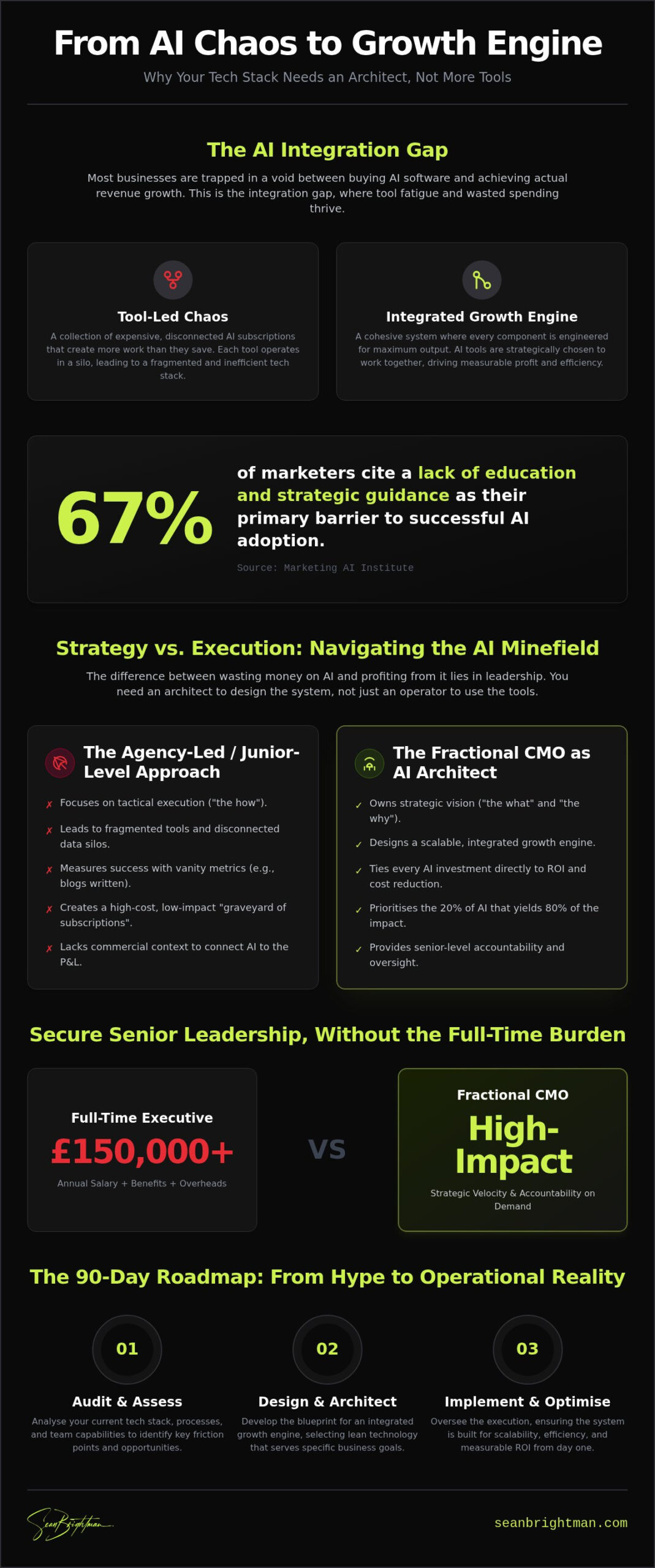
    Your current AI tech stack isn’t a strategy. It’s a graveyard of expensive subscriptions and half-baked automations that solve nothing. Most businesses are currently drowning in tool fatigue, throwing money at ‘revolutionary’ software whilst their actual growth remains stagnant. Securing a fractional cmo for ai integration is the only way to turn this chaotic noise into a high-precision growth engine.

    It’s a common frustration. You know AI is the future of your industry, yet you lack the senior leadership to actually organise the machinery into a functional system. This is about building a scalable architecture, not just buying more shiny objects. You need to stop the wasteful spending and start building for 2026.

    In this article, you’ll learn how to architect a clear marketing system that drives efficiency and reduces costs. We’ll explore the transition from tool-led distraction to strategy-led execution. You’ll see how senior-level accountability turns AI from a cost centre into a high-impact growth driver.

    Key Takeaways

    • Bridge the ‘AI Integration Gap’ by prioritising strategic systems architecture over the endless cycle of software subscriptions.
    • Discover how a fractional cmo for ai integration builds a scalable growth engine that turns tool fatigue into measurable profit.
    • Learn to distinguish between agency-led execution and senior strategic leadership to avoid the common pitfalls of the AI minefield.
    • Implement a 90-day roadmap that moves your marketing from operational chaos to a high-efficiency, AI-powered reality.
    • Secure senior-level accountability and strategic velocity without the burden of a £150k full-time executive salary.

    The AI Integration Gap: Why Tools Aren’t a Strategy

    Buying a tool is easy. Extracting ROI is where most businesses fail. This void is the AI Integration Gap. It’s the distance between your latest software subscription and actual revenue growth. Right now, your marketing department is likely a collection of disconnected silos. You have a CRM that doesn’t talk to your content tool, and a team that uses AI to draft emails but has no idea how it impacts the customer journey.

    According to the Marketing AI Institute, 67% of marketers cite a lack of education as their primary barrier to AI adoption. They aren’t lazy. They’re unguided. A ChatGPT Plus subscription is not a marketing strategy. It’s a tactical band-aid. True growth requires a fractional cmo for ai integration to treat marketing as a singular, cohesive machine. We call this the Growth Engine. It’s a system where every component, from lead gen to retention, is engineered for maximum output with minimum friction.

    The Tool Fatigue Trap

    SMEs are currently haemorrhaging cash on redundant AI subscriptions. Every department head buys a different “game-changer” tool, leading to a fragmented tech stack that creates more work than it saves. There’s a massive difference between playing with AI and integrating it. Playing is asking a bot to write a blog post. Integrating is hardwiring AI into your lead qualification process to double your conversion rate. Tool fatigue is the inevitable result of tactical execution without strategic architecture.

    The Need for Senior AI Oversight

    You cannot expect a junior executive to architect your entire AI infrastructure. They lack the commercial context to see how a prompt affects the P&L. Without senior oversight, you risk brand dilution and massive compliance failures. The foundational role of a Chief Marketing Officer is to provide high-level vision and strategic alignment, ensuring that technology serves the business goals rather than the other way around.

    A fractional cmo for ai integration acts as the “adult in the room” for tech adoption. They ensure that every piece of software serves the bottom line. They bring order to the chaos. This isn’t about being a consultant who drops a report and leaves. It’s about senior-level accountability that ensures your AI investments actually pay off. You need a leader who knows how to strip away the fluff and focus on the mechanics of growth.

    The Fractional CMO as AI Architect: Building Your Growth Engine

    A builder doesn’t start by buying a truckload of bricks. They start with a blueprint. Most marketing leaders are currently doing the opposite. They buy the bricks (the tools) and hope a house appears. A fractional cmo acts as your architect. They design the system before a single subscription is authorised. This mindset shift is the difference between a messy department and a high-impact growth engine.

    AI is only as good as the infrastructure it sits on. If your data is siloed and your processes are broken, AI will only help you fail faster. Top-performing leaders are succeeding in the AI era by focusing on insights and enterprise-wide integration rather than just task automation. You don’t need more tasks. You need a fractional cmo for ai integration who treats data as the fuel for your growth engine. It’s a binary choice: you either build a scalable machine or you continue managing a collection of expensive accidents.

    Designing the AI-Powered Marketing Stack

    Building a stack isn’t about following trends. It’s about mapping the customer journey to specific AI intervention points. Where does the friction exist? Where can AI reduce the time-to-value? A strategic architect selects tools based on interoperability. If your tools don’t talk to each other, they aren’t part of an engine; they’re just noise. We prioritise efficiency by identifying the 20% of AI applications that deliver 80% of the commercial impact. This ensures your tech stack remains lean, integrated, and focused on revenue.

    Accountability and Leadership

    Leadership in 2026 is about owning the “What” and the “Why”. Anyone can figure out the “How” with a YouTube tutorial. A fractional cmo for ai integration provides the senior-level accountability that CEOs actually care about. Instead of vanity metrics like “number of AI-generated emails,” we set KPIs tied to strategic velocity and cost reduction. The plug-and-play nature of this role means you get high-impact leadership without the £150k overhead. It’s about bringing order to internal complexity through a battle-hardened perspective. If you’re ready to stop guessing and start building, a marketing strategy audit is the logical first step.

    Strategy vs Execution: Navigating the AI Minefield

    Execution is a commodity. Strategy is the moat. Right now, most businesses are mistaking AI-generated output for marketing progress. It isn’t. It’s just noise. A fractional cmo for ai integration ensures that your technology serves a specific commercial objective rather than just populating a spreadsheet. You need a leader who understands that more activity does not equal more growth. This is the “this, not that” reality of 2026: you need a system that thinks, not just a system that does.

    The numbers don’t lie. Hiring a full-time senior executive is often a £120k mistake. You end up paying for forty hours of “management” when you actually only need ten hours of high-octane strategic architecture. It is a waste of capital. Fractional efficiency gives you the same battle-hardened expertise focused purely on the high-value tasks that AI cannot touch: vision, empathy, and complex problem-solving. It’s about buying the brain, not the body.

    The Agency Trap

    Most agencies are currently in a defensive crouch. Their business model relies on billable hours and manual execution. AI threatens to slash those hours by 80%, which creates a conflict of interest. They will sell you execution because that is what they are built to deliver. A Fractional CMO acts as an unbiased filter for agency performance. They don’t care about billable hours; they care about output. They help you build internal AI capability so you stop being held hostage by external partners who are incentivised to keep things slow and manual.

    Human-Led Brand Positioning

    AI is a world-class mimic, but it is a terrible innovator. It can follow a pattern, but it cannot “feel” your brand’s unique positioning amongst a sea of competitors. It cannot understand the nuance of a founder’s vision or the specific emotional triggers of your target audience. This is where the human strategist becomes indispensable. We use AI to amplify the message, but the message itself must be born from strategic brand roadmapping. This is how you win: use the machine for volume, but keep the human in charge of the value. AI should be the engine, but a human must always be the navigator.

    Fractional CMO for AI Integration: Building Your 2026 Growth Engine

    The 90-Day AI Roadmap: From Hype to Operational Reality

    Most AI strategies are just expensive wish lists. They lack a timeline, a budget, and a pulse. A real roadmap is a tactical sequence designed to strip away inefficiency and replace it with high-precision machinery. Securing a fractional cmo for ai integration provides the strategic velocity needed to move from concept to cashflow in under three months. This isn’t a five-year transformation. It’s a 90-day sprint to operational excellence.

    We follow a clinical five-step process to ensure your investment delivers a measurable return:

    • Step 1: The Marketing Efficiency Audit. We find the hidden profit buried under layers of manual labour.
    • Step 2: Architecture Design. We map the AI growth engine and define the data flows.
    • Step 3: Tool Selection. We consolidate the stack to ensure every component talks to the others.
    • Step 4: Team Upskilling. We build internal capability whilst establishing accountability frameworks.
    • Step 5: Rapid Execution. We launch, measure, and iterate at high speed.

    The Marketing Efficiency Audit

    Efficiency is the foundation of growth. You cannot build a high-performance engine on top of a leaky bucket. The Marketing Efficiency Audit is a clinical assessment of marketing waste. We identify the “busy work” that your team should have automated months ago. We find the leaks in your lead generation funnel where potential revenue is simply evaporating. It’s about stripping the department back to its most functional parts before adding the AI layer. If a task doesn’t contribute to the bottom line, we kill it or automate it.

    Building the Roadmap

    A static plan is a liability in a fast-moving market. You need a dynamic roadmap that evolves as the technology does. This process defines how to organise a marketing department for rapid growth by aligning human talent with machine efficiency. The 90-day vision focuses on immediate ROI, ensuring that every AI implementation justifies its existence within the first quarter. A fractional cmo for ai integration doesn’t just give you a PDF; they give you a functioning system. To start building your own 2026 growth engine, you should book a strategic roadmapping session today.

    Sean Brightman: Senior AI Marketing Leadership on Demand

    Sean Brightman doesn’t do corporate politeness. He builds engines. As a fractional cmo for ai integration, he strips away the fluff to reveal the raw mechanics of growth. You don’t need another consultant with a 50-page slide deck. You need a senior leader who remains active in the field. Sean specialises in “plug-and-play” systems architecture. He enters your business, identifies the friction, and installs the AI machinery required to win in 2026. His published book on marketing strategy serves as the foundational resource for this high-impact, no-nonsense approach.

    The current market is chaotic. Most business owners are drowning in tactical noise whilst their competitors are quietly building automated moats. Sean provides the senior-level authority required to cut through that noise. He isn’t interested in your internal bureaucracy or your favourite vanity metrics. He’s interested in the P&L. This is senior leadership on demand. It’s about high-level thinking combined with visceral, practical execution. It’s the expertise of a £150k executive delivered with fractional efficiency.

    The Advisory Retainer

    Direction is useless without accountability. The Marketing Advisory Retainer is designed for CEOs who are tired of being stuck. It provides a monthly cadence of strategic velocity. No fluff. No pointless updates. Just high-impact direction to ensure your AI strategies are actually moving from the roadmap into operational reality. Sean acts as the external force that brings order to your internal complexity. It’s the “adult in the room” oversight your team needs to stop playing with tools and start driving revenue.

    One-Off Roadmapping Sessions

    Sometimes you just need a reset before a major push. A single strategic roadmapping session provides the clarity that months of internal debate cannot reach. These sessions are perfect for businesses preparing for a major growth phase or positioning themselves for a successful exit. Securing a fractional cmo for ai integration for this session ensures your roadmap isn’t just a wish list. Potential buyers don’t want to buy a collection of tasks; they want to buy a functioning growth engine. By architecting your AI integration today, you create an asset that is scalable and highly covetable. You stop being the bottleneck and start being the owner of a machine.

    Architect Your 2026 Growth Engine Today

    The window for “playing” with AI is closed. You either build a high-precision marketing machine now or you get left behind by those who do. We’ve seen that the gap between tool fatigue and actual ROI is bridged by strategic architecture, not more subscriptions. You need a system that prioritises commercial impact over tactical noise.

    Securing a fractional cmo for ai integration gives you the senior-level accountability required to turn these concepts into operational reality. You get the expertise of a battle-hardened strategist and published author without the £150k+ overhead of a full-time hire. This is about building a functional asset that drives growth whilst reducing wasteful activity.

    Stop managing chaos and start building an engine. It’s time to install the leadership your business deserves to win in the next era of marketing. Book a Strategic AI Roadmapping Session with Sean Brightman and take control of your growth.

    Frequently Asked Questions

    What exactly does a Fractional CMO for AI integration do?

    A fractional cmo for ai integration acts as the architect of your marketing systems. They don’t just recommend tools; they design a cohesive growth engine where AI automates execution whilst humans drive strategy. This role involves auditing your current tech stack, mapping the customer journey to AI intervention points, and providing senior-level accountability. It’s about building a scalable machine that delivers measurable ROI rather than just managing a collection of disconnected software subscriptions.

    How much does a Fractional CMO cost compared to a full-time hire in the UK?

    A full-time CMO in the UK currently commands a salary often exceeding £150,000 per year plus benefits and bonuses. In contrast, a fractional retainer typically costs a fraction of that amount whilst delivering the same senior-level expertise. You pay for high-impact strategic direction rather than forty hours of administrative presence. It’s a binary choice between paying for a full-time body or investing in a battle-hardened brain that focuses purely on growth.

    Can our existing marketing team handle AI integration themselves?

    Most marketing teams lack the senior strategic context to architect a full AI infrastructure. Whilst they can certainly use tools like ChatGPT for specific tasks, they often struggle with interoperability and data consolidation. They are usually focused on execution, not the overarching systems architecture. Without senior oversight, you risk brand dilution and tool fatigue. A fractional leader provides the “adult in the room” perspective needed to ensure technology serves the business goals.

    How long does it take to see results from an AI marketing roadmap?

    You should expect to see measurable operational improvements within 90 days. The initial audit and architecture design happen in the first month, followed by rapid tool integration and team upskilling. By the third month, your growth engine should be operational, reducing manual “busy work” and improving lead generation efficiency. This isn’t a multi-year corporate transformation; it’s a tactical sprint designed to deliver strategic velocity and immediate commercial value to your P&L.

    Is AI integration only for large tech companies or can SMEs benefit?

    SMEs actually stand to benefit the most from AI integration because it levels the playing field. Large corporations are often slowed down by legacy systems and internal bureaucracy. Smaller businesses can move faster, using AI to achieve the output of a much larger team without the associated headcount costs. For an SME, AI is a force multiplier that turns a lean marketing department into a high-powered growth engine through sheer operational efficiency.

    What is the “£120k mistake” in marketing recruitment?

    The “£120k mistake” is hiring a full-time senior executive when you only need ten hours of high-level strategy per week. Most SMEs don’t have enough strategic work to occupy a £150k hire, so that person ends up doing junior-level tasks or creating unnecessary bureaucracy. You end up wasting over £120,000 on “management” that doesn’t drive growth. Fractional leadership solves this by providing the exact amount of senior direction required to win without the bloated overhead.

    Does Sean Brightman work with our existing marketing agency?

    Yes, Sean often acts as an unbiased filter for agency performance. Most agencies are incentivised to protect their billable hours, which can lead to a resistance to AI-driven efficiency. Sean provides the senior oversight to ensure your agency is actually delivering value rather than just billing for manual tasks that should be automated. He holds them accountable to the growth engine’s KPIs, ensuring your external partners align with your strategic 2026 vision.

    How do I know if my business is ready for a Fractional CMO?

    If you are experiencing tool fatigue, wasteful marketing spend, or a lack of clear strategic direction, you are ready. Common signs include a marketing team that is constantly “busy” but failing to hit revenue targets, or a CEO who feels they have to micromanage the marketing department. If you need senior-level accountability but cannot justify a £150k+ salary, a fractional cmo for ai integration is the logical next step for your growth.

  • Fractional CMO Deliverables UK: Strategic Outputs for High-Growth Scale-ups

    Fractional CMO Deliverables UK: Strategic Outputs for High-Growth Scale-ups

    Most UK scale-ups are burning cash on marketing “activities” while waiting for a miracle that never arrives. If your ad spend is vanishing into a void and your team lacks accountability, you don’t need more “content.” You need a system. Understanding the specific fractional cmo deliverables uk businesses require is the difference between a vanity project and a scalable revenue engine.

    It’s frustrating to watch competitors scale whilst you’re stuck in tool fatigue and AI hype. You want a professionalised department that delivers measurable ROI, not just another monthly report full of “awareness” metrics. This article strips away the corporate fluff to reveal the tangible assets a Fractional CMO builds to fix your trajectory.

    We’ll explore the strategic roadmaps, AI-integrated growth engines, and operational frameworks that transform marketing from a cost centre into a clinical profit driver. You will discover exactly what you’re paying for. These are assets that remain in your business long after the strategist has finished their day.

    Key Takeaways

    • Move beyond static strategy documents to functional blueprints that build a scalable marketing architecture rather than just offering generic advice.
    • Identify the essential fractional cmo deliverables uk scale-ups require to integrate AI-powered systems that automate the mundane and amplify creative output.
    • Learn how to re-engineer your marketing department for maximum velocity through professionalised organisational design and clear accountability frameworks.
    • Shift your focus from vanity metrics to commercial alignment by ensuring every marketing output ties directly to your company P&L.
    • Discover how a low-risk roadmapping session provides the senior leadership needed to professionalise your growth engine without the overhead of a full-time hire.

    Beyond the PDF: What Real Fractional CMO Deliverables Look Like

    Advice is cheap. Architecture is essential. Most consultants leave you with a 50-page PDF and a “good luck” handshake. That’s not a deliverable; it’s homework. Real fractional cmo deliverables uk scale-ups actually use are functional blueprints. They are the gears and levers of your growth engine. This isn’t about high-level theory or abstract marketing principles. It’s about building a scalable marketing architecture that functions without the founder’s constant intervention.

    We shift the focus from “activity” to “outcomes.” A senior leader doesn’t track hours; they track velocity and ROI. These deliverables are built for your business, integrated into your stack, and handed over to your team. They aren’t just presented in a boardroom. You don’t want a spectator. You want a mechanic who builds the car whilst it’s moving. This is why the fractional cmo deliverables uk market has shifted toward tangible assets that live in your business long after the initial engagement ends.

    The Strategic Marketing Roadmap

    The first 90 days are critical. You don’t need a three-year “vision.” You need a 90-day execution plan that aligns every penny of spend with your commercial goals. This roadmap identifies the messy areas. The broken funnels. The bloated ad accounts. The team members who don’t know their KPIs. It’s a clinical prioritisation of channels. Often, the most valuable deliverable is the list of things you are going to stop doing. Focus creates momentum. This is a living document, not a wall decoration. It’s the primary tool for accountability. It ensures your marketing spend stops being a gamble and starts being an investment. By the end of the first month, you’ll have a clear view of what’s working and what’s just expensive noise.

    The Brand Positioning Framework

    If you look like everyone else, you’re competing on price. That’s a race to the bottom. A fractional cmo delivers a visceral market stance that cuts through the noise. This is binary messaging. It’s us vs them. It’s about making your brand the only logical choice for a specific problem. We map customer behaviour, not just demographics. We don’t care that your target is “35 to 45, working in a professional firm.” We care about the specific anxiety that keeps them awake at 2 AM. We identify the exact trigger that makes them click “buy.” This positioning framework ensures your team stops guessing and starts converting. It provides the foundation for every piece of content, every ad, and every sales pitch your company produces. It is the core of your growth machinery.

    The AI Growth Engine and Digital Architecture

    By August 2026, the novelty of AI has worn off. The results, however, are just starting to materialise for those who stopped playing with toys and started building engines. Research shows that whilst 99% of UK advertisers engage with generative AI, only 14% report a significant business impact. That’s a massive failure of implementation. A core component of fractional cmo deliverables uk scale-ups now require is a cohesive AI roadmap that moves beyond “experimentation” into industrialised growth.

    We don’t use AI because it’s trendy. We use it to dismantle the mundane. By automating repetitive tactical work, your team is freed to focus on high-level creative and strategic thinking. This isn’t a side project. It’s the new standard for your core marketing workflow. If your current setup feels like a collection of disconnected tools, you have tool fatigue. You need a unified growth engine. Those looking for a hands-on partner often find that AI consulting is the quickest way to bridge the gap between hype and measurable ROI.

    The AI Implementation Roadmap

    This deliverable starts with a tactical audit. We identify exactly where AI can slash costs and multiply output. It’s a clinical assessment of your current processes. We then select and integrate an “AI stack” specifically tailored to your industry. It’s not about having the most tools; it’s about having the right ones. Crucially, this includes training protocols. Machinery is useless if your team doesn’t know how to operate it. We move your department from shallow adoption to scaled, live deployments that actually move the needle on your P&L.

    Marketing Systems Architecture

    Your digital architecture should provide clean, actionable data. Most scale-ups are drowning in “dark data” that serves no purpose. We design a scalable tech stack that supports your go-to-market strategy without the bloat. Every tool must justify its existence. If it doesn’t add value or provide a strategic advantage, we cut it. This lean approach reduces your overhead and ensures that your fractional cmo deliverables uk include a professionalised operations centre. We build the infrastructure that allows you to scale without your costs spiralling out of control. It’s about precision, not just volume.

    Marketing Operations: Building the Scalable Growth Engine

    A Fractional CMO doesn’t just give orders. They build the machine that executes them. Many UK scale-ups treat hiring like a shopping list of job titles. They hire a “Social Media Manager” because everyone else has one, not because it fits a strategic need. This is why fractional cmo deliverables uk focus so heavily on organisational design. You aren’t paying for a recruiter. You’re paying for an architect who restructures your department for maximum velocity. The output is a high-performance team that knows exactly how to bridge the gap between high-level strategy and the “dirty” work of daily execution.

    We dismantle the “busy work” culture. Most departments are drowning in tasks that don’t move the needle. We replace this with a clinical focus on the commercial bottom line. The deliverable here is a professionalised department where every role is justified by the roadmap. It’s about building a system that functions whilst you sleep. This is the difference between a loose collection of employees and a synchronised growth engine.

    Departmental Restructuring and Design

    Traditional hierarchies often stifle growth. We define roles based on what your roadmap actually requires. If your goal is aggressive lead generation, you might need a specialist freelancer for technical SEO rather than a full-time generalist. We identify these gaps with clinical precision. By implementing a marketing operations consultant framework, we ensure your business has long-term stability. This isn’t a temporary fix. It’s a permanent upgrade to your operational DNA. We build a structure that scales with your revenue, not just your headcount. This involves deciding which functions stay in-house and which are outsourced to high-impact specialists. It is about efficiency, not ego.

    The Accountability Framework

    Most marketing departments hide behind “vanity metrics.” Your CEO doesn’t care about impressions or likes. They care about revenue, pipeline velocity, and customer acquisition costs. One of the core duties of a fractional CMO is to install a culture of absolute accountability. We establish weekly reporting rhythms that drive action. If a campaign isn’t hitting its targets, we pivot immediately. No excuses. We implement a “this, not that” decision-making process. This eliminates the “maybe” culture that slows down scale-ups. Every fractional cmo deliverables uk package must include this framework to transform your team from a cost centre into a clinical revenue engine. Your team stops asking “what should we do?” and starts delivering what the P&L requires.

    Fractional CMO Deliverables UK: Strategic Outputs for High-Growth Scale-ups

    Measurable Outcomes and Commercial Alignment

    Every marketing output must justify its existence on the balance sheet. If a deliverable doesn’t impact the P&L, it’s just expensive wallpaper. A core component of fractional cmo deliverables uk scale-ups rely on is the absolute alignment of marketing spend with commercial reality. The CMO doesn’t just manage a budget. They own a share of the growth target. This requires a clinical integration with the sales team’s requirements. We stop the “us vs them” mentality. We build a single source of truth for all performance data so there is nowhere to hide.

    Marketing is often viewed as a cost centre because it fails to speak the language of the CEO. We change that. By aligning the marketing engine with the sales pipeline, we ensure that every lead generated is a lead that can be closed. This isn’t about “brand awareness” in a vacuum. It’s about revenue velocity. We dismantle the silos that prevent growth. We ensure the machinery of marketing is directly geared to the machinery of sales. This is the only way to achieve sustainable scale in a competitive UK market.

    The Performance Dashboard

    You cannot manage what you do not measure. We provide a clinical view of your Customer Acquisition Cost (CAC) and Lifetime Value (LTV). This isn’t a spreadsheet of “likes” and “shares.” It’s real-time visibility into which channels are actually driving the bottom line. We eliminate vanity metrics that hide poor performance. If a channel isn’t profitable, we kill it. If it’s performing, we pour fuel on it. This dashboard is the heartbeat of your marketing engine. It ensures every decision is backed by data, not gut feeling. You get total transparency over where your money goes and exactly what it brings back.

    The Marketing Advisory Retainer

    Strategy isn’t a one-time event. It’s a continuous process of course-correction. An ongoing marketing advisory retainer acts as the vehicle for constant strategic velocity. We hold monthly sessions to ensure the roadmap is being followed and adapted to market shifts. This is your senior “brain on tap.” It prevents CEOs from making £100k mistakes on the wrong hire, the wrong agency, or the wrong technology. It provides the high-level oversight needed to keep the machinery running at peak efficiency whilst you focus on running the business. This is about consistent, professionalised leadership without the full-time overhead.

    Stop guessing and start measuring. Secure your advisory retainer to ensure your marketing spend delivers a clinical ROI.

    Next Steps: Securing Your Strategic Growth Engine

    Hiring a full-time CMO in 2026 is often a £150k gamble you don’t need to take. Scale-ups need the machinery, not the permanent overhead. Choosing between a fractional cmo and a full-time hire comes down to velocity. You need senior leadership now, whilst your competitors are still drafting job descriptions. The right fractional cmo deliverables uk package provides an immediate injection of expertise without the long-term liability of a heavy salary.

    Evaluate your options based on past builds. Don’t look for someone who “managed a budget.” Look for someone who built a growth engine from scratch. You want a battle-hardened expert who has seen your specific chaos before and knows exactly which lever to pull. This is about tactical precision, not abstract theory. The goal is a plug-and-play system that functions regardless of who is sitting in the chair.

    The Strategic Brand Roadmap Session

    Clarity is the first deliverable. A one-off strategic brand roadmapping session serves as a low-risk entry point to senior leadership. We spend a day performing a blunt assessment of what is currently broken in your marketing. No corporate politeness. Just honesty. We define the primary growth levers for the next 12 months. You walk away with a clinical execution plan. This session is the difference between guessing your way through the next quarter and executing with precision.

    Leveraging The Book for Strategy

    Consistency is key to scale. We use the methodology from The Book to ensure a proven, repeatable approach. This isn’t just for the leadership. It provides educational resources for the internal team to align with the new strategy. We build a culture of strategic thinking amongst your existing marketing staff. They stop being order-takers and start being tactical contributors. This methodology ensures that the fractional cmo deliverables uk businesses invest in are understood and maintained by your people. It turns your marketing department into a self-sustaining profit centre.

    Stop Gambling and Start Engineering Your Growth

    Marketing shouldn’t be a black hole for your budget. We’ve established that real fractional cmo deliverables uk businesses require are strategic blueprints and operational machinery. It’s about building an AI-powered growth engine and ensuring every campaign ties directly to your P&L. You don’t need more activity; you need a professionalised department with clinical accountability.

    As the author of ‘The Book’ on marketing strategy and a specialist in AI growth engines, I’ve spent years acting as a senior advisor for UK scale-ups. I don’t provide fluff. I provide the architecture that allows your business to scale without your costs spiralling. You can choose to keep guessing, or you can choose to install a system that delivers measurable ROI.

    The first step is clarity. Book a Roadmapping Session with Sean Brightman to identify your primary growth levers and fix what’s broken. It’s time to transform your marketing from a cost centre into a clinical revenue driver. Your future growth depends on the systems you build today.

    Frequently Asked Questions

    What is the most important deliverable from a Fractional CMO?

    The Strategic Marketing Roadmap is the foundational output. It is a clinical 90-day execution plan that identifies exactly what your business needs to stop doing whilst prioritising the high-impact channels that drive revenue. Unlike a vague vision statement, this document provides a step-by-step blueprint for your internal team to follow. It ensures every penny of your marketing spend is aligned with your commercial growth targets from day one.

    How do Fractional CMO deliverables differ from a marketing agency?

    Agencies deliver tactical execution, such as ad creative or blog posts. A Fractional CMO delivers the architecture and leadership required to manage those tactics. The fractional cmo deliverables uk scale-ups receive focus on building internal systems, organisational design, and commercial accountability. You are paying for a growth engine builder who manages the machinery, rather than a service provider who just performs specific tasks on a monthly retainer.

    Do I get a physical document or is the deliverable just advice?

    You get functional blueprints, not just verbal advice or a passive PDF. These deliverables are integrated into your business operations. This includes your performance dashboards, AI-powered tech stacks, and documented accountability frameworks. Whilst a strategic roadmap is documented, the real value lies in the operational changes implemented within your department. It is about building assets that remain in your company long after the advisory engagement has finished.

    How does AI consulting fit into the list of deliverables?

    AI consulting is now a non-negotiable component of modern marketing leadership. The deliverable is an AI Implementation Roadmap that audits your current processes to identify automation opportunities. We build a custom AI stack that slashes the cost of mundane tasks and amplifies your team’s creative output. This isn’t about chasing hype; it is about industrialising your marketing workflow to gain a clinical competitive advantage in a crowded market.

    Can a Fractional CMO help with my exit strategy deliverables?

    Professionalising your marketing department is critical for an exit strategy. Investors look for documented systems, clean data, and a proven growth engine that functions without the founder. A Fractional CMO delivers the “investor-ready” marketing architecture required for due diligence. By proving a predictable Customer Acquisition Cost and a scalable revenue model, you significantly increase the valuation of your business and make the transition process much smoother.

    What is the typical timeframe to see these deliverables implemented?

    Clarity arrives within the first 30 days through a Roadmapping session. By day 60, your departmental restructuring and primary accountability frameworks are usually in place. A full high-performance growth engine is typically operational within 90 days. This rapid-fire delivery is designed to mirror the pace of a high-growth scale-up. We don’t believe in long, winding discovery phases; we believe in immediate tactical intervention and measurable progress.

    Will the Fractional CMO manage my existing team as part of their deliverables?

    Leadership and team restructuring are core outputs of the role. We don’t just manage; we professionalise your existing staff through an accountability framework. This involves setting clear KPIs, establishing weekly reporting rhythms, and identifying skill gaps that require specialist freelancers. We transform your team from a group of order-takers into a synchronised unit that understands the commercial reality of the P&L and delivers accordingly.

    How do I measure the ROI of these strategic outputs?

    ROI is measured via a clinical Performance Dashboard that tracks revenue velocity, not vanity metrics. We focus on Customer Acquisition Cost (CAC) and Lifetime Value (LTV) to ensure your growth is profitable. If the fractional cmo deliverables uk you’ve invested in don’t move the needle on your bottom line, they aren’t working. We provide a single source of truth for your data, making it impossible for poor performance to hide behind “awareness” reports.

  • Integrating a Fractional CMO into Your Team: The CEO’s Guide to Strategic Velocity

    Integrating a Fractional CMO into Your Team: The CEO’s Guide to Strategic Velocity

    Most CEOs are paying for expensive marketing advice that evaporates the moment the consultant leaves the Zoom call. It’s a frustrating cycle of high fees and zero momentum. Successfully integrating a fractional cmo into your team isn’t about adding another person to your payroll; it’s about installing a strategic engine that drives velocity. You need a builder, not a talker.

    You probably feel like your current marketing activity is random and unmeasured. Your team is working hard, but they lack the senior direction to turn that effort into equity. It feels like a cost centre because it lacks a battle-hardened architect to own the results. You want accountability for every pound spent, not just more creative ideas that never launch. This friction is what stops a good business from becoming a market leader.

    This guide provides the blueprint to turn your marketing function into a scalable growth engine. You’ll learn how to embed a high-impact leader who builds a plug-and-play system rather than just a list of tasks. We are moving from chaos to a clinical roadmap that prepares your business for massive scale or a lucrative exit. It is time to stop guessing and start executing with precision.

    Key Takeaways

    • Stop hiring for activity and start building for architecture. Treat your marketing function as a system to be installed, not just another seat to fill.
    • Follow a clinical 90-day roadmap that moves you from a brutal initial audit to a state of high-velocity strategic growth.
    • Discover why successfully integrating a fractional cmo into your team requires a clinical data handshake to align your senior leadership with an AI-powered tech stack.
    • Learn to relinquish the role of de facto marketing manager by implementing accountability systems that drive results without the need for corporate fluff.
    • Build a growth engine that doesn’t just generate leads but actively increases your business valuation in preparation for a future exit.

    Why Integration Fails: Moving from “Activity” to “Architecture”

    Most CEOs treat a Fractional CMO like a high-end freelancer. They wait for the “new hire” to ask what needs doing. This is a fundamental mistake. Successfully integrating a fractional cmo into your team is a system installation, not a recruitment win. If you view this as just filling a seat, you’ve already lost the battle for strategic velocity.

    The failure usually starts with a focus on activity rather than architecture. Activity-Based Marketing is a series of random acts: a weekly blog post, a few LinkedIn updates, or an unmeasured email blast. It feels busy but achieves nothing. Architectural Marketing is different. It’s the construction of a repeatable, scalable growth machine. One produces noise; the other produces equity.

    The “freelancer mindset” kills value. A freelancer takes orders to complete tasks. A Fractional CMO gives direction to achieve objectives. If you’re paying for senior leadership but using them to “help out” with copywriting, you’re burning cash. You need a head, not just more hands. This requires a shift in how you view the role from day one.

    Your job as CEO is simple but difficult. You must provide the keys to the engine, not just a seat at the table. If the CMO doesn’t have the authority to challenge your current team or scrap failing projects, they’re just a decorative addition to your C-suite. Integrating a fractional cmo into your team requires you to step back so they can step up.

    The “Plug-and-Play” Leadership Mindset

    A Fractional CMO must be treated as a senior partner from the first hour. You face a binary choice: do you want a “doer” or a “designer” of growth? A doer follows your lead. A designer builds the path. Set the expectation for blunt honesty over corporate politeness. You aren’t paying for a “yes man”; you’re paying for the “battle-hardened expert” who knows where the bodies are buried in your current strategy.

    Defining the Scope of the Growth Engine

    Clear boundaries prevent senior leaders from becoming overpaid project managers. The CMO owns the “Why” whilst the team owns the “How”. This distinction is the bedrock of a successful Marketing advisory retainer. They define the market position and the strategic roadmap. They don’t spend their time tweaking Google Ads. By separating strategic advisory from tactical execution, you ensure your investment goes toward building the machine, not just oiling the gears.

    The 90-Day Integration Roadmap: From Audit to Velocity

    Velocity is not about moving fast; it is about moving in the right direction at speed. Most marketing departments are just busy. When integrating a fractional cmo into your team, the first 90 days must be clinical. You aren’t here to “settle in”. You are here to rebuild. A structured Strategic brand roadmapping session is the non-negotiable first step. Without it, you are just painting a house that has no foundation.

    Phase 1: The Strategic Immersion and Audit

    Days 1 to 30 are about brutal honesty. We look at the bank account first, then the creative. This phase is designed to strip away the fluff and find the signal in the noise. We focus on three critical areas:

    • Spend vs ROI: We analyse every pound spent. If a channel isn’t contributing to the pipeline, it gets cut or fixed. No sacred cows.
    • Brand Positioning: We re-evaluate how you speak to the market. Most businesses talk about themselves. We ensure you are saying what your customers actually need to hear.
    • Messy Marketing Bottlenecks: We identify the manual processes and unclear briefs that slow your team down. These are the friction points that kill momentum.

    Phase 2: Installing the Systems

    Days 31 to 60 move from strategy to machinery. We stop relying on spreadsheets and start building scalable marketing operations. This is where we create your AI roadmap. We move from playing with tools to installing automated growth engines that work whilst you sleep. We define the KPIs that actually matter to a CEO. We don’t care about “likes” or “shares”. We care about pipeline velocity and customer acquisition cost. This phase delivers the “Growth Engine” blueprint. It gives your internal team a map and gives you a dashboard of truth.

    Days 61 to 90 are about establishing accountability. The system is live. The team knows their roles. The Fractional CMO ensures everyone stays on the roadmap. This isn’t about micromanagement; it is about discipline. By day 90, marketing is no longer a mystery or a cost centre. It is a predictable, scalable part of your business machinery. You can see exactly how the integration has turned random activity into strategic velocity.

    If you want to see how this roadmap fits your specific business model, you can explore the Fractional CMO options available today to begin the process.

    Data Handshakes and AI Readiness: The Technical Integration

    A strategic roadmap is useless if the engine has no fuel. In 2026, that fuel is data. Integrating a fractional cmo into your team requires more than a login to Slack and a seat at the monthly board meeting. It demands a clinical “Data Handshake” between your senior leader and your entire tech stack. If the CMO cannot see the raw numbers, they cannot drive growth. They are simply guessing with your budget.

    This is where AI consulting becomes a functional necessity rather than a corporate trend. Most teams are currently “playing with tools” like ChatGPT for basic social media copy. A Fractional CMO moves you toward scalable growth by automating the machinery. We audit your tech stack to determine if it is fuel for the engine or just expensive overhead. If a tool does not contribute to the data handshake or provide actionable insights, it is dead weight that belongs in the bin.

    Establishing the Single Source of Truth

    The CMO needs unfiltered access to your CRM and financial data from day one. You cannot hide the “messy” parts of the business if you want them fixed. Data cleanliness is the first hurdle in any AI implementation. If your CRM is a graveyard of dead leads and unmapped fields, your AI will hallucinate. We clean the pipes so the engine can run. The final output is a dashboard that the CEO actually understands. We ignore vanity metrics. We focus on the truth about your pipeline and your customer acquisition cost.

    The AI Roadmap: Efficiency vs Innovation

    We integrate AI into daily operations for immediate cost-saving. This is not just about content generation. It is about using AI for strategic insights that humans simply miss. We build an AI-powered growth engine that reduces your reliance on increasing headcount. Your existing team is trained to work alongside these systems, not fear them. We move from manual labour to mechanical precision. Integrating a fractional cmo into your team means giving them the keys to the data so they can build a lean, high-output asset. This is how you achieve strategic velocity without the bloat of a traditional marketing department.

    Integrating a Fractional CMO into Your Team: The CEO’s Guide to Strategic Velocity

    Managing the Fractional Leader: Accountability Without Bureaucracy

    Your biggest bottleneck is likely staring at you in the mirror. CEOs often struggle with integrating a fractional cmo into your team because they cannot stop being the de facto marketing manager. You need to let go. You aren’t hiring a helper; you’re hiring an architect. If you’re still approving social media posts or tweaking ad copy, you’re failing to lead. You’re also burning the very strategic velocity you’re paying to create.

    To drive true team discipline, consider the role of a Marketing operations consultant. They manage the plumbing. The Fractional CMO manages the strategy. This setup ensures accountability without you needing to dive into the weeds. It creates a buffer that allows you to focus on the business whilst the marketing engine runs on a clinical, pre-defined schedule. Accountability is about results, not hours logged.

    Establish a staccato rhythm of reporting. Reports are for bureaucrats; briefings are for leaders. You don’t need a fifty-page slide deck once a month. You need a ten-minute high-impact briefing once a week. What’s the pipeline? What’s the blocker? What’s the fix? If the CMO isn’t challenging your assumptions, they aren’t doing their job. A “battle-hardened expert” maintains strategic integrity by saying “no” to the CEO’s distractions.

    The “Advisory vs Execution” Divide

    The Fractional CMO manages external agencies and internal staff without micromanaging. They own the “Why” so the team can own the “How”. This requires a binary rule: the CEO sets the destination; the CMO builds the vehicle. When targets are missed, we don’t look for excuses. We look for the mechanical failure in the system. Accountability is built into the architecture, not added as an afterthought. If you want to see how this leadership model scales, you can enquire about an Advisory Retainer to start the transition.

    Breaking the “Agency” Habit

    Stop treating the CMO like an external consultant. Your team will follow your lead. If you treat them like a vendor, the team will treat them like an intruder. Integrating a fractional cmo into your team means giving them a seat in your internal comms. Put them in Slack. Give them a company email. They must be present for high-level board or strategy discussions. If they aren’t in the room when the big decisions are made, they can’t align the marketing engine to your commercial goals. They are a partner, not a provider.

    Scaling for Exit: The Long-term Value of Fractional Leadership

    A business is a machine. If the machine breaks the moment you walk away, it isn’t a business; it’s a high-stress job. Integrating a fractional cmo into your team is the most effective way to build a marketing strategy for business exit that actually moves the needle on valuation. Buyers don’t buy your personality. They buy your systems. They buy the certainty that revenue will continue to flow without the founder’s personal network or a “hero” employee.

    A proven growth engine is the most valuable asset on your balance sheet. It is not just about leads today. It is about the documented, automated infrastructure that guarantees leads tomorrow. A Fractional CMO builds this from the ground up, ensuring that the marketing function is a functional component of the business rather than an abstract theory. This is about building equity, not just chasing quarterly targets.

    Valuation Through Systems, Not People

    Buyers pay a premium for documented, automated marketing machines. They want to see that your growth is a result of machinery, not magic. Reducing “Key Person Dependency” is critical for a lucrative exit. If the founder is the primary rainmaker, the business has a glass ceiling. By proving scalability through historical data and AI-driven efficiency, you turn marketing from a cost into an investment-ready asset. You are selling a predictable future, not a chaotic past.

    • Systems over Sweat: Documented processes mean the business runs without you.
    • Data over Guesswork: Historical ROI data provides the proof buyers demand.
    • AI Efficiency: A lean, AI-powered team is more attractive than a bloated, manual department.

    The Fractional-to-Full-Time Handover

    The transition from a Fractional leader to a full-time hire is a strategic move, not an emotional one. It usually happens much later than you think. You only need a full-time CMO when the engine is so large that it requires forty hours a week just to keep the gears turning. Until then, stay lean and high-impact. Avoid the £120k to £150k overhead of a full-time hire until the revenue justifies the permanent seat.

    When the time comes, use your Fractional CMO to hire and train their full-time successor. They know the plumbing. They know exactly what the role requires because they built the roadmap. This ensures zero loss in momentum during the transition. However, many CEOs choose to stay with the fractional model indefinitely. They realise they don’t need a full-time executive; they need the strategic velocity that only a concentrated, battle-hardened expert provides. Integrating a fractional cmo into your team is not just a temporary fix; it is a long-term play for business maturity.

    Build Your Growth Engine Today

    Activity is a cost. Architecture is an asset. You’ve seen why most marketing fails: it lacks the senior direction to turn random acts into repeatable revenue. Integrating a fractional cmo into your team isn’t about adding a consultant; it’s about installing a battle-hardened expert who owns the “Why” whilst your team masters the “How”.

    We’ve covered the 90-day roadmap to velocity and the technical data handshakes required for AI-powered growth. This isn’t about more meetings; it’s about more momentum. You need a system that increases your business valuation and prepares you for a lucrative exit. Marketing shouldn’t be a mystery; it should be machinery.

    Sean Brightman is the author of “The Growth Engine” methodology and a specialist in AI-powered marketing transformation. With a proven track record in UK scale-up growth, he helps CEOs stop guessing and start scaling. It’s time to turn your marketing from a cost centre into a clinical growth machine.

    Book a Strategic Roadmapping Session with Sean Brightman to install your growth engine today. Your future valuation depends on the systems you build now.

    Frequently Asked Questions

    How many days per month does a Fractional CMO typically work?

    Most engagements range from two to eight days per month. It depends on the complexity of your roadmap and the speed of growth you require. A Fractional CMO isn’t a full-time employee; they are a high-impact strategic force. They focus on outcomes rather than clocking hours. This model provides senior leadership at a fraction of the £120k to £150k cost of a full-time UK hire. You get strategy without the executive bloat.

    Will a Fractional CMO manage my existing marketing team?

    Yes, they provide the senior direction your current team lacks. Successfully integrating a fractional cmo into your team means they own the “Why” and the strategy. Your internal staff or external agencies own the “How” and the execution. They install accountability and discipline, ensuring every team member knows their role in the growth engine. This prevents random acts of marketing and focuses everyone on your commercial exit or scale goals.

    How is a Fractional CMO different from a marketing agency?

    An agency sells services; a Fractional CMO sells strategy and results. Agencies are often “doers” focused on specific channels like SEO or paid media. A Fractional CMO is a “designer” who sits on your side of the table. They manage the agencies and ensure their activity aligns with your business objectives. They are your internal advocate, not an external vendor looking to upsell more billable hours or creative projects.

    Does a Fractional CMO help with AI implementation?

    Modern leadership requires moving from manual labour to AI-powered efficiency. A Fractional CMO audits your tech stack and builds an AI roadmap to automate repetitive tasks. This isn’t just about using tools for basic content. It is about using AI for strategic insights and data analysis. They ensure your team works alongside AI systems to increase output without increasing your permanent headcount. They turn technology from a toy into a growth engine.

    What is the typical cost of a Fractional CMO in the UK?

    Costs vary based on the scope of the engagement and the seniority of the expert. However, a Fractional CMO is significantly more cost-effective than a full-time hire, which currently averages between £120k and £150k in the UK. You pay for high-level strategic velocity rather than a full-time salary and benefits package. This allows you to invest the savings back into your actual marketing spend or AI infrastructure to drive faster results.

    How do I know if my business is ready for a Fractional CMO?

    You are ready when marketing feels random and unmeasured. If you have a team but no senior strategic direction, you’re likely burning cash on activity that doesn’t scale. Most businesses with annual revenues between £1 million and £30 million are in the “sweet spot”. You need the expertise to grow but don’t yet need the overhead of a permanent C-suite executive. It is about your readiness to install systems over activity.

    Can a Fractional CMO help prepare my business for an exit?

    Yes, by reducing “Key Person Dependency” and building documented systems. Buyers pay a premium for a business that runs on a growth engine rather than the founder’s personal effort. Integrating a fractional cmo into your team ensures that your marketing is an automated, scalable asset on your balance sheet. They provide the historical data and ROI proof points that sophisticated buyers demand during the due diligence process to justify a higher valuation.

    What data does a Fractional CMO need to get started?

    They need a clinical data handshake with your entire tech stack. This includes unfiltered access to your CRM, financial reports, and current marketing performance metrics. They look for the signal in the noise to identify where your budget is being wasted. You must be prepared to share the messy reality of your numbers. Only with clear data can they build a clinical roadmap that leads to strategic velocity and measurable commercial growth.

  • Onboarding a Fractional CMO: High-Velocity UK Scale-up Guide

    Onboarding a Fractional CMO: High-Velocity UK Scale-up Guide

    Your marketing department is a black box, and hiring a senior leader won’t fix it if they spend the first three months “getting the lay of the land.” Most UK scale-ups treat a new hire like a guest who needs a tour, but that’s a recipe for wasted capital and delayed ROI. You need a strategic installation, not an introduction. When it comes to onboarding a fractional cmo, you must demand a high-velocity system audit that prioritises impact over politeness.

    You’re right to feel frustrated by the lack of accountability in your existing team. It’s exhausting to manage a function you don’t fully understand whilst waiting for growth that never quite arrives. This guide provides a zero-fluff blueprint for installing senior leadership into your business with surgical precision. We’ll show you how to move from chaos to a scalable marketing growth engine in weeks, not months.

    We’ll break down the 90-day roadmap, the mechanics of immediate tactical wins, and how to integrate an AI-powered strategy that turns your marketing into a predictable revenue machine. This is about building a functional component for your business, not just adding another meeting to your diary.

    Key Takeaways

    • Stop treating senior hires like guests; onboarding a fractional cmo is a strategic installation designed to deliver immediate ROI through a plug-and-play approach.
    • Execute a 30-day “Deep Dive” audit to expose hidden inefficiencies and turn your marketing department from a black box into a transparent profit centre.
    • Shift from activity-based reporting to a scalable growth engine where every marketing pound is tied to concrete, outcome-based accountability.
    • Embed AI roadmapping into your operations early to automate low-value tasks and build a high-velocity marketing machine that scales without adding headcount.
    • Maintain strategic momentum by transitioning the initial installation into a lean advisory retainer that provides ongoing direction and accountability for the CEO.

    The Velocity Mindset: Why Fractional Onboarding Isn’t ‘Settling In’

    Stop thinking about “hiring.” Start thinking about “installing.” A traditional full-time CMO often takes six months to understand the culture and another three to deliver a strategy. Your scale-up doesn’t have that luxury. You’re burning cash, missing market windows, and dealing with a marketing department that feels like a black box. The Fractional executive model works because it bypasses the “settling in” phase entirely. It’s a high-velocity intervention, not a long-term marriage.

    Onboarding a fractional cmo is a tactical immersion designed to identify and fix systemic marketing leaks. The first 14 days dictate the success of the entire engagement. If the primary growth blockers haven’t been identified by day 14, you’ve already lost momentum. This isn’t about learning names at the coffee machine. It’s about data, systems, and immediate accountability. You’re paying for a senior leader to bring order to the chaos, not to become a permanent part of the furniture.

    Installation vs. Integration: A Binary Choice

    Integration is slow. It implies a gradual, polite merge into existing, often broken, processes. You don’t want your CMO to blend in; you want them to fix things. Integration asks “how do we do things here?” whilst installation asks “why is this broken and how do we fix it today?”

    The installation approach means bringing a battle-hardened strategic framework and plugging it into your business. Focus on output over presence from day one. You aren’t paying for hours at a desk or attendance at every internal catch-up. You’re paying for the machinery of growth. An effective fractional leader arrives with a pre-built toolkit. They don’t ask what to do; they tell you where the leaks are and how they’re going to seal them.

    The CEO’s Role in Accelerated Onboarding

    Speed depends on the founder. If your new leader has to fight for access to Google Analytics or wait a week for a meeting with the sales head, the onboarding has failed. Remove bureaucratic blockers before the start date. Hand over the keys to the data immediately. Don’t wait for a “formal” start to share the passwords.

    Provide radical transparency. Don’t hide the past failures or the messy spreadsheets. Your fractional CMO needs the unvarnished truth to build an accurate roadmap. Set the tone for the rest of the leadership team. This person isn’t a threat or a temporary consultant; they’re the architect of your future growth engine. If you don’t empower them to challenge the status quo, you’re wasting your investment.

    The 30-Day Strategic Immersion: Auditing the Chaos

    The first month isn’t about launching new campaigns. It’s about forensics. Most UK scale-ups have marketing departments that look productive but act as a drain on capital. Effective onboarding a fractional cmo requires a 30-day “Deep Dive” audit that prioritises data integrity over creative output. If your tracking is broken, your strategy is a guess. We stop the guessing immediately.

    This period is a diagnostic strike. We identify “stuck” points in the machinery where leads vanish or budgets evaporate. One of the core benefits of a fractional CMO is the ability to provide an objective, external view of your internal mess. We look for hidden profit by conducting a Marketing Efficiency Audit. This isn’t a review of your logo; it’s a review of your plumbing.

    Phase 1: The Data and Systems Forensic Audit

    We start with the pipes. We check GA4, CRM integration, and lead tracking accuracy. Most teams are flying blind with “vanity metrics” like social impressions whilst ignoring the actual cost per acquisition. We audit the tech stack for redundancy. If you’re suffering from tool fatigue or paying for three platforms that do the same job, we cut the waste. We ensure your data is clean so that future decisions are based on reality, not optimism. If the data isn’t reliable, the creative output is irrelevant.

    Phase 2: Commercial Realignment and Positioning

    Marketing cannot exist in a vacuum. We interview key stakeholders to ensure every campaign aligns with your business exit goals or revenue targets. If your marketing team doesn’t know your three-year plan, they’re wasting your money. We review your brand positioning against the current UK market landscape to ensure you aren’t just shouting into the void. This alignment is the foundation of Strategic Brand Roadmapping, where we build a repeatable growth engine. If your current marketing machinery feels like a liability rather than an asset, it might be time to install a Fractional CMO who understands how to build for scale.

    Defining the Growth Engine: Accountability and KPIs

    Marketing is a machine. If it doesn’t produce a predictable output, it’s broken. Successful onboarding a fractional cmo means moving away from “activity-based” reporting. We don’t care how many LinkedIn posts you published. We care about the pipeline those posts generated. This is the shift from feeling busy to being effective. It’s about results, not effort.

    Your Growth Engine is a repeatable, scalable system. It converts capital into revenue with measurable efficiency. We focus on outcome-based accountability. The ROI of a fractional CMO isn’t found in their billable hours. It’s found in the strategic clarity they provide to your existing team. We differentiate between strategic direction and tactical execution. The CMO builds the blueprint; the team or agency lays the bricks. One provides the “why” and the “how,” whilst the other handles the “do.”

    We establish a clinical cadence for updates. Weekly pulses keep the team aligned. Monthly deep dives ensure the strategy is still hitting the mark. We don’t do status meetings for the sake of meetings. We do briefings that drive action. If a meeting doesn’t result in a decision or a cleared blocker, it’s a waste of your time. This structure ensures that every minute of senior leadership time is spent on high-impact strategic installation.

    Building the Marketing Strategy Roadmap

    We build a 90-day roadmap designed for speed. We look for quick wins in the first 30 days to fund the longer-term strategy. This roadmap isn’t a static report that gathers dust in a shared drive. It’s a living document. We align every action with your marketing strategy for business exit. Buyers don’t want to see “marketing activities.” They want to see a growth engine they can inherit and scale. If your roadmap doesn’t point toward your eventual exit, you’re building on sand. We ensure every pound spent increases the terminal value of your business.

    The Accountability Framework: This, Not That

    We measure Strategic Velocity, not Campaign Volume. High volume with low impact is just noise. We implement a Scorecard for the marketing department. It tracks the three to five metrics that actually move the needle. This framework creates hard boundaries. A fractional CMO is your architect, not an extra pair of hands for social media management. Onboarding a fractional cmo correctly means defining what they won’t do as clearly as what they will. We focus on high-impact strategic installation, not tactical busywork. This keeps the engine lean and the results visible.

    Onboarding a Fractional CMO: High-Velocity UK Scale-up Guide

    AI and Operations: Integrating Modern Marketing Systems

    AI is no longer a “nice-to-have” experiment or a side project for your social media manager. It’s a fundamental component of strategic installation. If you’re onboarding a fractional cmo who treats AI as an afterthought, you’re hiring for the past, not the future. Modern onboarding must include an AI roadmap that moves beyond “playing with tools” to building scalable systems. This is the shift from manual friction to automated velocity.

    We focus on building a growth engine that doesn’t rely on increasing your headcount every time you want to scale. This means moving from tool fatigue to mechanical precision. Our approach to AI Consulting in 2026 centres on creating infrastructure that works whilst you sleep. We don’t just recommend software; we engineer workflows that deliver measurable results.

    The AI Readiness Assessment

    We start by auditing your internal workflows for AI automation potential. Most UK scale-ups waste significant portions of their budget on manual data entry and repetitive reporting tasks. We evaluate your team’s “AI IQ” to identify training gaps and cultural blockers. It’s not enough to have the software; your team must know how to drive the machine. We draft the first version of your AI growth engine plan during the first 30 days. This plan identifies where AI can replace friction with high-speed output, ensuring your team focuses on high-value strategy rather than tactical drudgery.

    Marketing Systems Architecture

    Tools are not a strategy. Software bloat is a silent killer of scale-up margins, leading to disconnected data and confused teams. We design a tech stack where systems communicate without manual intervention. Your CRM, lead tracking, and ad platforms should function as a single, cohesive unit. We act as a Marketing Operations Consultant to strip away the redundant “fluff” and build a lean architecture. This is a binary choice: you either have an automated flow or you have manual friction. We choose flow every time.

    If your current marketing stack feels like a mess of disconnected subscriptions and manual spreadsheets, it’s time for a professional intervention. You can book an AI-led marketing audit to identify exactly where your systems are leaking profit and how to automate your way to scale.

    The Advisory Retainer: Sustaining Long-Term Velocity

    Onboarding a fractional cmo is the installation phase. The advisory retainer is the maintenance of excellence. Once the growth engine is built and the tactical leaks are sealed, the engagement evolves. You don’t need a senior architect to lay every brick, but you do need them to ensure the house doesn’t lean. This transition moves the focus from heavy lifting to strategic navigation. It ensures the velocity built in the first 90 days doesn’t evaporate the moment the initial audit ends.

    The advisory retainer isn’t a part-time job. It’s a high-impact partnership. Whilst your internal team or agencies handle the day-to-day tactical execution, the Fractional CMO maintains the strategic velocity. They ensure that every campaign, hire, and tech investment aligns with the 12-month roadmap. This provides the CEO with a clinical, objective view of marketing performance without the overhead of a full-time executive salary.

    The CEO’s Secret Weapon: Professional Advisory

    Most CEOs are too close to their own business to see the systemic rot. You need a marketing mentor who can hold your internal team accountable. A battle-hardened strategist doesn’t care about internal politics or “how we’ve always done it.” They care about the scorecard. This external perspective is vital for maintaining the standards of the Growth Engine. It turns marketing from a source of frustration into a predictable revenue stream. For a deeper dive into this model, read The Marketing Advisory Retainer to understand how to leverage senior expertise for long-term scale.

    Next Steps: From Onboarding to Exit

    Success in the first 90 days is measured by clarity and control. You should have a clean data stack, a documented 90-day roadmap, and an AI-powered operations plan. After this period, we recalibrate. We look at the next 12 months and align the marketing machine with your business exit goals. As the business grows, the engagement scales with it. You can increase the advisory cadence or bring in more specific AI consulting as needed. The success criteria are binary: either the engine is producing a measurable ROI, or it isn’t. We focus on the former.

    Stop settling for a marketing department that feels like a black box. If you’re ready to move from chaos to a scalable growth engine, it’s time to stop “getting the lay of the land” and start installing leadership. Onboarding a fractional cmo is the fastest way to gain senior-level authority without the bureaucratic weight. Book a high-impact strategy session today and let’s start building the machinery your business deserves.

    Stop Settling for a Marketing Black Box

    It’s time to stop treating senior leadership like a luxury and start treating it like a functional component of your business machinery. Successful onboarding a fractional cmo is about speed, transparency, and clinical execution. You don’t need a guest. You need an architect who can audit the chaos and build a growth engine that scales without adding unnecessary headcount.

    We’ve dismantled the myth of the “settling in” period. You now have the blueprint for a 30-day forensic audit, the shift from vanity metrics to outcome-based accountability, and the integration of AI systems that work whilst you sleep. These are the tactical requirements for any UK scale-up serious about hitting its revenue targets or preparing for a business exit.

    As a battle-hardened strategic expert and AI-powered growth specialist, I focus on strategic installation rather than just advice. I am also the author of the definitive guide to marketing strategy, helping CEOs regain control over their growth. Book a Strategic Roadmapping Session with Sean Brightman to strip away the fluff and install a high-velocity marketing machine. Your business deserves a predictable engine.

    Frequently Asked Questions

    How long does it take to onboard a Fractional CMO effectively?

    Effective onboarding a fractional cmo takes 30 days for the deep dive and 90 days for full strategic installation. We skip the three-month “culture tour” that full-time hires demand. By day 14, the primary growth blockers must be identified. By day 30, the forensic audit of your data and systems is complete. You aren’t waiting for a result; you’re installing a growth engine at high velocity.

    What data does a Fractional CMO need on day one?

    We need the unvarnished truth immediately. This means full access to GA4, your CRM, and historical ad spend data. We also require your current customer acquisition cost and lifetime value figures. Don’t waste time cleaning the spreadsheets first. Messy data is more honest than a polished report. We need to see the plumbing as it actually functions, not as you wish it did.

    Can a Fractional CMO manage my existing marketing agency?

    Yes. A Fractional CMO acts as the strategic architect who holds your agencies accountable. Most agencies operate in a vacuum because they lack senior internal direction. We define the KPIs and ensure the agency is building toward your business exit goals, not just hitting vanity metrics. We provide the “why” and the “how,” whilst the agency handles the “do.” This creates a clinical division between strategy and tactics.

    How much time should a CEO commit to the onboarding process?

    Expect to commit five to eight hours in the first fortnight. You are the source of commercial alignment. We need radical transparency regarding past failures and business exit targets. After the initial 14-day strike, your commitment drops to a weekly strategic pulse. We don’t want more of your time; we want your authority to clear bureaucratic blockers. You provide the direction; we provide the engine.

    What is the most common mistake when onboarding a part-time CMO?

    Treating them like a “part-time employee” instead of a strategic partner is a fatal error. If you hire a senior leader but expect them to write social media captions or manage your calendar, you’re burning capital. The mistake is hiring for execution whilst needing strategy. Onboarding a fractional cmo requires a “plug-and-play” mindset. Focus on their strategic output, not their physical presence or hours at a desk.

    Should a Fractional CMO focus on strategy or execution first?

    Strategy always leads. Execution without strategy is just expensive noise. We focus on a 30-day “Strategic Immersion” to audit the chaos before pulling any tactical levers. We identify where the machinery is leaking profit first. Once the roadmap is established, we guide the execution through your existing team or agencies. We build the blueprint before we start laying the bricks. Anything else is just guessing.

    How do I measure the success of the onboarding phase?

    Success is binary. By day 90, you should have a documented roadmap, a clean data stack, and a scorecard tracking three to five core metrics. If your marketing department still feels like a black box, the onboarding failed. You should see immediate tactical wins that fund the longer-term strategy. We measure “Strategic Velocity,” which is the speed at which your business moves from identifying a problem to installing a solution.

    What happens if our internal team is resistant to the new CMO?

    Resistance usually stems from a lack of accountability. We lead with radical transparency and data, not ego. We aren’t there to replace people; we’re there to fix the machinery. If the team is resistant to clear KPIs and outcome-based reporting, that’s a performance issue, not a personality clash. We set the standards and provide the tools for them to succeed. Those who want to grow will adapt.

  • Measuring Success with a Fractional CMO: Systems Over Stats

    Measuring Success with a Fractional CMO: Systems Over Stats

    Most marketing departments are just expensive hobbies. You are likely burning cash on uncoordinated tactics whilst your actual business valuation stays stagnant. It is the classic trap: plenty of noise, zero machinery. This makes measuring success with a fractional cmo difficult if you are chasing the wrong numbers.

    Success is about systems, not just stats. If your marketing does not function as a predictable, accountable engine, it is failing. You need order, not more activity. You need a department that delivers results without constant hand-holding.

    You want a department that runs like a machine and a dashboard that actually matters to your board. We agree that vanity metrics are a distraction. This article promises to show you how to move beyond superficial data and measure the structural impact of senior leadership on your growth. We will preview how to build a high-impact marketing engine, integrate AI for genuine scale, and ensure your organisation is primed for a maximum-value exit.

    Key Takeaways

    • Stop chasing vanity metrics and learn why measuring success with a fractional cmo requires prioritising architectural growth over superficial activity.
    • Shift your focus to capital-efficient growth by tracking hard numbers like CAC against LTV within a documented marketing roadmap.
    • Evaluate the machinery of your department by measuring AI adoption rates and team accountability instead of just lead volume.
    • Implement a 90-day audit framework to transform a chaotic marketing function into a predictable growth engine that is exit-ready.
    • Understand how an Advisory Retainer provides the ongoing senior-level accountability needed to fix messy departments and maintain strategic velocity.

    Beyond Vanity Metrics: Why Most CEOs Measure Marketing Wrong

    Most CEOs are addicted to activity. They see a team “doing stuff” and assume growth is happening. It isn’t. Busy work is not a strategy; it’s a distraction. When measuring success with a fractional cmo, you must look at the architecture, not just the activity. Architecture is the repeatable system that generates revenue. Activity is just noise.

    The “Messy Department” syndrome is a silent ROI killer. It happens when you have uncoordinated tactics flying in different directions. One person is posting on LinkedIn whilst another is tweaking an ad. Nobody is looking at the engine. A Fractional CMO spends their first 30 days performing an audit. This isn’t a delay; it’s a recalibration. You don’t fix a broken engine whilst the car is moving at seventy miles per hour.

    The ultimate success signal is Marketing Velocity. This isn’t about how fast you post. It’s about how quickly your organisation can implement, test, and scale strategic shifts. If your team is stuck in a loop of endless meetings without movement, your velocity is zero.

    The Trap of the Tactical Dashboard

    Clicks, impressions, and “likes” are fluff. They feel good in a board meeting but they don’t increase business valuation. If your current reporting focuses on top-of-funnel noise without showing a conversion engine, it’s masking a lack of strategy. You are measuring the wind instead of the sails.

    A Marketing Manager manages the task. A Chief Marketing Officer builds the machine. Measuring success with a fractional cmo means looking past the dashboard to see if the plumbing actually works. You need to know if your spend is being captured by a system or simply evaporating into the atmosphere.

    Defining Success in Strategic Terms

    Success with a Fractional CMO is the creation of a scalable, repeatable growth engine that functions independently of individual personalities.

    This definition aligns directly with your three-year exit plan. Investors don’t buy busy departments. They buy predictable systems. Order amongst chaos is a measurable business outcome. It reduces wasted spend and increases the efficiency of every pound you put into the market. If the department doesn’t run like a machine, you aren’t ready for an exit. True success is when the strategy dictates the tactics, not the other way around.

    The Hard Numbers: Quantitative Benchmarks for a Growth Engine

    Revenue growth is a blunt instrument. It’s easy to buy growth if you have an infinite budget and a total disregard for margins. It’s much harder to build a capital-efficient growth engine. When measuring success with a fractional cmo, the primary focus shifts from “how much did we sell?” to “how efficiently did we sell it?”. You need a framework that prioritises profit over raw volume.

    A battle-hardened strategist looks for an immediate reduction in wasteful spend. Most messy departments have at least 20% of their budget leaking into redundant software, unoptimised ad sets, or vanity projects that don’t move the needle. Cutting this waste is the first quantitative win. It stops the bleeding and funds the strategic work required to scale.

    We also distinguish between marketing-sourced and marketing-influenced revenue. Sourced revenue is a direct hit from a campaign. Influenced revenue tracks how marketing touched a lead before sales closed the deal. A Fractional CMO ensures both are tracked to prove the department’s total commercial impact. If you want to see how these metrics transform a business, you can explore my Fractional CMO services to understand the mechanical shift required.

    CAC, LTV, and the Efficiency Ratio

    Your Customer Acquisition Cost (CAC) should never be a static number. If it remains unchanged whilst you scale, your strategy is likely stagnating. A Fractional CMO should optimise these marketing KPIs over a six-month horizon. The goal is a healthy, widening ratio between CAC and Lifetime Value (LTV).

    We also track the Payback Period. This measures how many months it takes to recoup the cost of acquiring a single customer. If this period is stretching, your cash flow is at risk. High-impact leadership ensures this ratio improves as the system matures. Static CAC amongst competitors is a sign of a failing strategy; your system should be getting smarter and cheaper over time.

    Pipeline Velocity and Conversion Ratios

    Pipeline velocity is the ultimate metric for mechanical efficiency. It measures the time a lead takes to travel from the first touchpoint to a signed contract. If your funnel has “leaky buckets”, your CMO must plug them. These leaks are usually found in the friction-filled hand-off between marketing and sales.

    Success is a shorter sales cycle and a higher conversion ratio at every stage. You aren’t just looking for a higher volume of leads. You’re looking for a faster, tighter machine. Improving sales and marketing alignment ensures that every lead is treated with the same level of tactical precision, reducing the time spent in “purgatory” between departments.

    Structural Success: Measuring Team Accountability and AI Integration

    A marketing department that relies on the CEO’s intuition is a liability. It is a bottleneck that prevents scaling and kills business valuation. Structural success is about building a machine that functions regardless of who is in the room. This shift from founder-led to system-led marketing is a core component of measuring success with a fractional cmo. If there is no documented strategy roadmap, there is no accountability; there is only a collection of people doing tasks.

    We evaluate the machinery by looking at the outcome, not the effort. Your team shouldn’t be owning “social media posts”; they should be owning “inbound lead velocity.” When the department moves from reactive fire-fighting to proactive system-building, you have achieved structural success. To ensure these changes endure, we apply a Measurement Effectiveness Framework that prioritises long-term system health over short-term activity spikes.

    Building the AI-Powered Growth Engine

    AI is not a toy for generating generic blog posts. It is a functional component of a modern growth engine. We measure success here through the AI Adoption Rate within your marketing operations. This involves tracking the reduction in manual labour across repeatable processes like lead scoring, data entry, and content distribution. If your team is still doing by hand what a machine can do in seconds, you are burning margin.

    The goal is to improve efficiency without sacrificing output quality. We track the performance of AI-assisted systems against traditional manual methods to prove ROI. For a deeper dive into this transition, see my guide on AI Consulting in 2026: From Tool Fatigue to Scalable Growth Engines. A successful integration means your team is freed up to focus on high-level strategy whilst the AI handles the mechanical heavy lifting.

    The Accountability Framework

    Accountability requires clarity. Most messy departments suffer from overlapping roles and vague responsibilities. A Fractional CMO fixes this by implementing a “plug-and-play” system. This framework defines exactly who owns which part of the engine. It ensures that every team member knows their specific contribution to the 3-year exit plan.

    When measuring success with a fractional cmo, the ultimate proof is the removal of the “Strategic Burden” from your shoulders. You should no longer be the person deciding which tactics to pursue or which AI tools to test. The system should provide the answers. This creates a more professional, disciplined environment where people own outcomes rather than just ticking boxes. It makes your marketing department an asset that adds genuine value to the business, rather than a cost centre that requires constant supervision.

    Measuring Success with a Fractional CMO: Systems Over Stats

    The 90-Day Audit: Tracking Strategic Velocity and Exit Readiness

    Measuring success with a fractional cmo is not a guessing game. It is a clinical, 90-day framework designed to install a growth engine. If you aren’t seeing structural shifts by day 90, you are just paying for more noise. We don’t wait a year to see if things are working. We track strategic velocity from the first week.

    Phase 1 (Days 1-30) is about Clarity. We audit the internal mess. We identify the leaky buckets in your funnel and align marketing objectives with your commercial goals. Success in this phase is the total removal of ambiguity. You finally know what is broken and exactly how we intend to fix it.

    Phase 2 (Days 31-60) focuses on Systems Architecture. We build the process. This is where the machinery is installed and the team begins following a documented roadmap. Success is measured by the transition from “doing tasks” to “following a system.” The department starts to feel like a machine rather than a collection of uncoordinated individuals.

    Phase 3 (Days 61-90) centres on Execution and Optimisation. We look for Results. This isn’t just about raw lead volume; it’s about commercial evidence. By day 90, you should have a repeatable operating rhythm and early data showing improved efficiency. This 90-day sprint turns a chaotic department into a scalable asset.

    Measuring Exit Readiness

    Buyers covet machines, not personalities. If your marketing breaks when you leave the room, your valuation is capped. An essential part of measuring success with a fractional cmo is evaluating how well the business functions without your daily input. A battle-hardened strategist ensures your business is ready for an exit by building a growth engine that buyers actually want to buy.

    Your brand positioning must be sharp enough to defend market share during a due diligence process. We measure this by looking at your “Defensibility.” Is your brand a commodity, or is it a category leader? A system-led department provides the documentation and predictable ROI that investors demand. If you want to increase your business valuation, you can start with a Fractional CMO roadmap.

    The Strategic Brand Roadmap

    The Strategic Brand Roadmap is your source of truth. It ensures consistency across every channel, from your LinkedIn presence to your automated email flows. We measure success by the “Consistency Score” of your messaging. If your brand sounds different on every platform, your system is failing.

    A clear roadmap reduces decision fatigue for the board by providing a pre-validated path for every tactical choice. You stop debating which social media platform to use and start executing the plan. This roadmap is the bridge between your 3-year exit plan and the daily tasks your team performs. Without it, you are just wandering in the dark; with it, every action has a measurable purpose.

    Driving Accountability with a Strategic Advisory Retainer

    A strategy without a mechanism for accountability is just a wish list. You don’t need more ideas; you need more execution. Measuring success with a fractional cmo means looking at the long-term strategic velocity of your business. This is where the Advisory Retainer becomes the engine room of your growth. It ensures that the systems we build don’t just sit on a shelf. They move. They evolve. They deliver.

    An external perspective is your greatest asset. Internal teams often become blind to their own inefficiencies. They get comfortable with the “messy department” status quo. A battle-hardened strategist identifies these blind spots immediately. We don’t care about corporate politeness. We care about fixing the machine. This transition from a chaotic marketing function to a scalable growth engine requires a partner who is willing to challenge your assumptions and keep the pressure on outcomes.

    Leadership Without the Overhead

    Hiring a full-time executive is often a mistake for UK scale-ups. A full-time CMO at a £150k+ salary brings significant overhead, recruitment risk, and often, a preference for corporate bloat over tactical precision. You are paying for a person, not necessarily a result. In contrast, a fractional strategic partner provides senior-level authority on demand. You get the expertise without the heavy tax bill or the long-term liability.

    Senior leadership should be a functional component, not a permanent anchor. For many businesses, the Fractional Revolution in 2026 has proven that impact is more valuable than hours worked. You need a builder to install the system, then a strategist to oversee its performance. This is the smartest move for companies that want high-level direction whilst maintaining a lean, agile operation.

    Your Next Steps for Growth

    Don’t wait for your marketing to fix itself. It won’t. Start by conducting a Marketing Efficiency Audit today. Look at your spend. Look at your team’s output. If you cannot see a clear line between marketing activity and business valuation, your system is broken. Measuring success with a fractional cmo starts with setting three hard benchmarks for your first 90 days: process clarity, team accountability, and capital efficiency.

    Once these benchmarks are set, you move from fire-fighting to scaling. You stop guessing and start measuring. If you are ready to stop wasting spend on uncoordinated tactics and start building a machine that buyers covet, your next move is clear. Fix the machinery. Book a roadmap session to define your path to a scalable, exit-ready growth engine.

    Install the Machinery for Predictable Growth

    Stop measuring noise. Start measuring the machine. Success isn’t found in a spreadsheet of clicks; it’s found in a marketing department that runs without your constant input. By focusing on capital-efficient growth and structural accountability, you turn marketing from a cost centre into a high-valuation asset. You move from the chaos of uncoordinated tactics to the precision of a growth engine.

    Measuring success with a fractional cmo requires a shift from activity to architecture. You need a 90-day audit to clear the mess, a documented roadmap to provide direction, and AI integration to drive genuine efficiency. This isn’t abstract theory; it’s a mechanical overhaul of your growth engine. As a published author on marketing strategy and a battle-hardened strategist with a “get-your-hands-dirty” attitude, I specialise in building AI-powered systems that deliver strategic velocity.

    Your business deserves a growth engine that is predictable, scalable, and exit-ready. Take the first step toward order and accountability today. Build your scalable growth engine with Sean Brightman. The path to a high-impact marketing machine is closer than you think.

    Frequently Asked Questions

    How long does it take to see results from a Fractional CMO?

    Structural shifts happen within 30 to 90 days. The first month is about audit and clarity; we stop the bleeding and identify waste. By the second month, the systems architecture is being installed. By day 90, you should have a repeatable operating rhythm and early commercial evidence of improved efficiency. Don’t expect a revenue explosion in week one; expect a reduction in chaos and a clearer path to scale immediately.

    What are the most important KPIs to track in the first 90 days?

    Focus on Strategic Velocity and Process Clarity rather than just raw traffic. Measuring success with a fractional cmo in the early stages means tracking the reduction in uncoordinated spend and the increase in documented roadmap completion. You should also monitor your AI adoption rate and lead-to-customer conversion speed. Raw lead volume is a vanity metric if your conversion engine is still broken or your sales alignment is non-existent.

    Can a Fractional CMO help with AI implementation and marketing operations?

    Yes, AI is a functional component of a modern growth engine, not a bolt-on toy. A Fractional CMO specialises in AI roadmapping to automate manual labour and improve output quality across your marketing operations. We treat your department as a mechanical system. If your team is still scoring leads or distributing content manually, the CMO fixes that plumbing to increase your margin and free up human talent for higher-level strategy.

    How does a Fractional CMO improve business valuation for an exit?

    Buyers pay for machines, not personalities. A Fractional CMO builds a growth engine that functions independently of the founder, which removes key-man risk. This documentation and system-led approach provide the predictable, scalable ROI that investors demand during due diligence. We transform your marketing from a messy, reactive cost centre into a professional, disciplined asset. A machine-led department is always more valuable than one that relies on founder intuition.

    Is a Fractional CMO better than a full-service marketing agency?

    They serve different purposes; an agency executes whilst a Fractional CMO leads. Agencies often have a vested interest in selling you more of their specific services. A CMO provides the neutral, external perspective needed to manage those agencies or your internal team effectively. You need a strategist to design the machine and ensure accountability before you hire a team of specialists to turn the handles.

    What happens if the marketing team doesn’t align with the new strategy?

    Alignment is non-negotiable for a high-impact department. A Fractional CMO implements a clear accountability framework that replaces ambiguity with clarity. We shift the focus from owning tasks to owning outcomes. If resistance continues, it usually identifies a skill gap or a cultural misfit that needs addressing. The system dictates the behaviour, and the CMO ensures the system is followed to maintain strategic velocity and hit your growth targets.

    How do I measure the ROI of a marketing advisory retainer?

    Measure the ROI through capital efficiency and the speed of implementation. Measuring success with a fractional cmo on an advisory retainer means tracking the reduction in wasted spend and the improvement in your LTV to CAC ratios. If your department is implementing strategic shifts faster and every pound spent is working harder, the retainer is delivering genuine value. You are paying for the machinery of growth, not just advice.

  • Fractional CMO Day Rates UK 2026: The Brutal Reality of Senior Marketing Costs

    Fractional CMO Day Rates UK 2026: The Brutal Reality of Senior Marketing Costs

    Hiring for time is a legacy mistake that’s killing your margins. If you’re scanning the market for fractional cmo day rates uk 2026, you’re likely asking the wrong question. You don’t need a timesheet; you need a result. You’ve probably already wasted thousands on agencies that execute without owning the strategy. It’s a common trap. You get the activity, but you don’t get the accountability. You’re right to be frustrated.

    This breakdown provides a blunt, transparent look at what senior marketing leadership actually costs in the current UK market. I’ll show you why buying hours is a liability whilst buying strategic velocity is an investment. We’ll explore how AI has gutted old-school cost structures and why a full-time hire at £150,000 plus benefits is often the most expensive mistake a founder can make.

    I am going to give you the real numbers on retainers, the truth about day rates, and a roadmap to senior expertise without the heavy overhead of NI or equity. It’s time to build a growth engine that doesn’t rely on your constant input.

    Key Takeaways

    • Stop buying hours and start buying strategic velocity; the 2026 market prioritises outcomes over mere attendance.
    • Understand the current benchmarks for fractional cmo day rates uk 2026 to ensure you are paying for battle-hardened expertise rather than academic theory.
    • Avoid the “Hidden Tax” of full-time hires by bypassing the heavy overheads of NI, pensions, and the high cost of recruitment failure.
    • Leverage AI consulting to gut old-school cost structures and build a scalable growth engine that does not rely on the founder.
    • Shift from vague activity to measurable growth by initiating engagements with a clear marketing roadmap and defined 6-month KPIs.

    The UK Fractional CMO Landscape in 2026: Why Day Rates Matter

    A Fractional executive isn’t an extra pair of hands. They are a senior leader who provides the strategic architecture your business lacks. In 2026, the UK market has shifted. We’ve moved away from paying for “presence” and toward paying for outcomes. If you’re hiring based on fractional cmo day rates uk 2026 simply to fill a seat, you’re lighting money on fire. You don’t need another person in the room; you need a system that works whilst you sleep.

    The primary deliverable is a growth engine, not a set of slides. Most founders fall into the “busy-ness” trap. They want to see a CMO “working” for eight hours. Real senior leadership doesn’t work that way. High-impact strategy happens in the gaps between execution. You’re buying the ability to say “no” to the wrong channels and “yes” to the 20% of activities that drive 80% of your revenue. This is about strategic velocity, not just ticking boxes on a to-do list.

    When you look at fractional cmo day rates uk 2026, you’ll see a wild spread from £700 to over £2,500. This isn’t just about years on a CV. It’s about the depth of the growth engine being built. A lower rate often gets you a glorified project manager who executes your ideas. A higher rate buys you a partner who challenges your assumptions and owns the commercial roadmap. Choose the latter if you want to scale.

    Fractional vs Advisory: Choosing Your Level of Involvement

    Advisory is about direction. Fractional is about leadership. Many founders hire a “Head of Marketing” and expect CMO results. It’s a fundamental mismatch. A “Head of” manages the team’s output; a CMO manages the P&L. For those who already have a team but lack a compass, the marketing advisory retainer offers the highest strategic velocity. It provides the senior brain without the operational drag of a full-time executive.

    The 2026 Efficiency Shift: How AI Impacts CMO Pricing

    AI isn’t just a gimmick for your copywriters. It’s a tool for strategic compression. A modern CMO uses AI to model market scenarios, analyse customer data, and build roadmaps in hours, not weeks. If you’re paying for three days of work that can now be done in one, you’re subsidising inefficiency. The 2026 landscape demands a “get-your-hands-dirty” attitude combined with technical precision. You shouldn’t pay 2022 rates for 2026 technology. Efficiency is the new baseline. If your CMO isn’t faster because of AI, they are already obsolete.

    Benchmarking UK Fractional CMO Day Rates for 2026

    When benchmarking fractional cmo day rates uk 2026, remember that the UK market isn’t a monolith. You’ll find three main engagement tiers. Strategic Advisory focuses on the “what” and “why”. Embedded Leadership handles the “how” and the “who”. Project Sprints tackle specific launches with surgical precision. According to the UK Salary & Recruiting Trends 2026, the demand for flexible senior talent is outpacing traditional hires. This scarcity drives the “Seniority Premium”. An FCIM-qualified expert might cost 30% more per day, but they’ll solve in two hours what a junior takes two weeks to misunderstand.

    Typical Investment Tiers by Business Stage

    Your stage dictates your spend. A mismatch here leads to wasted budget and friction.

    • Start-ups (£0-£2m): You need strategic brand roadmapping to ensure you aren’t building on sand.
    • Scale-ups (£2m-£10m): The focus shifts to systems architecture. You need a leader who installs accountability in your marketing department.
    • Established SMEs (£10m+): Here, the value lies in efficiency audits and aggressive AI integration to protect market share.

    Don’t get seduced by “budget” options. A low fractional cmo day rates uk 2026 quote often signals an unemployed mid-level manager. They lack the battle scars of a true strategist. They will manage your team into stagnation whilst charging you for the privilege. True CMOs own the P&L; managers own the to-do list. You need someone who has seen the movie before and knows how it ends.

    Day Rates vs Value-Based Retainers

    Day rates are a race to the bottom. They incentivise slow work. A value-based retainer aligns your CMO’s goals with your revenue. You pay for the engine, not the hours spent tinkering with it. Fixed monthly retainers offer budget predictability. They ensure you are paying for strategic velocity, not just attendance at your Monday morning catch-up. If you want to see how this looks in practice, you might want to review a structured advisory model. Outcomes matter. Hours don’t.

    Fractional CMO vs Full-Time Hire: A Brutal Cost-Benefit Analysis

    A £150,000 salary is a lie. When you hire a full-time CMO, you aren’t just paying a base wage; you’re committing to a massive financial tail. Between Employer National Insurance, which saw thresholds drop to £5,000 in 2025, private healthcare, pension contributions, and performance bonuses, that £150k hire actually costs your business upwards of £220,000 in year one. This doesn’t even account for the 20% to 30% recruitment fee or the equity stake they’ll inevitably demand to “stay motivated”.

    Contrast this with hiring a fractional CMO. You get the same calibre of leadership without the structural bloat. Whilst fractional cmo day rates uk 2026 might look high on a spreadsheet, they represent a clean, all-in cost. There’s no NI. No pension. No “golden parachute” if the fit isn’t right. It’s a strategic hedge against market volatility. If the market dips, you scale back. If you need to pivot, you aren’t stuck with a six-month notice period and a toxic cultural fallout.

    The “Hidden Tax” of a full-time hire is the cost of failure. If an FTE CMO fails, it takes six months to realise it, three months to manage them out, and another six months to find a replacement. That’s eighteen months of strategic drift. A fractional expert is plug-and-play. They arrive with a proven playbook, execute with clinical precision, and can be swapped or scaled with 30 days’ notice. You’re buying strategic liquidity, not a fixed liability.

    The Total Cost of Ownership (TCO) Comparison

    Total Cost of Ownership (TCO) is the combined financial weight of base salary, statutory overheads, and the heavy opportunity cost of administrative drag. An FTE comes with a 30% overhead premium and a rigid contract. A fractional model offers a flat fee and zero overhead. You pay for the engine to run, not for the car to sit in the garage. It’s the difference between owning a depreciating asset and subscribing to a high-performance service.

    Impact Velocity: Getting Results in 90 Days

    Full-time hires often spend their first 90 days “onboarding”. They’re learning names, navigating office politics, and setting up their desk. A fractional CMO doesn’t have time for politics. They spend their first 90 days identifying funnel leaks and building the commercial roadmap. By integrating a marketing operations consultant to handle the technical plumbing, the fractional leader focuses entirely on high-impact wins. They are incentivised to deliver speed because their reputation relies on results, not tenure. When you benchmark fractional cmo day rates uk 2026, you’re paying for this compressed timeline. You’re paying to get to the “win” six months faster than a traditional hire ever could.

    Fractional CMO Day Rates UK 2026: The Brutal Reality of Senior Marketing Costs

    Factors That Drive Fractional CMO Costs Up (and Down)

    In 2026, where you are matters less than what you know. Legacy providers still try to bake geographic premiums into their fractional cmo day rates uk 2026, but the market has moved on. Location-agnostic experts are now the standard. What actually moves the needle on pricing is the level of “battle-hardening” an expert brings to the table. You’re paying for a history of scars, not a shelf of textbooks.

    Academic leaders will give you a 40-page slide deck. Battle-hardened leaders will give you a functioning growth engine. The former is a cost; the latter is an investment. The scope of the engagement also dictates the fee. A CMO who purely defines strategy costs less per month than one who manages your internal team and external agencies. However, the management tier often provides the highest ROI. It ensures your budget isn’t being bled dry by underperforming vendors or inefficient processes.

    The AI Premium: Why Smarter Costs More

    Implementing AI consulting isn’t about buying a tool. It’s about architecting a roadmap that removes manual friction from your business. An AI-savvy CMO commands a premium because they reduce your total marketing spend over time. They replace manual labour with automation. They replace guesswork with data models. Don’t confuse this with “playing with ChatGPT”. Real AI integration is a mechanical overhaul of your marketing department. It compresses strategic timelines from months to days. You pay more for the expertise that saves you more in the long run.

    The Accountability Factor

    You should pay more for a CMO who brings their own framework. If they’re asking you how to run the meeting, you’ve hired the wrong person. The value of an external strategist lies in their ability to be blunt with the CEO. They aren’t there to be liked; they’re there to provide order. The Advisory Retainer model is built for this. It ensures the strategy actually gets built rather than gathering dust in a folder. It provides a steady cadence of accountability that keeps the engine running.

    Short-term “rescue” missions often carry the highest fractional cmo day rates uk 2026 because they require immediate, high-intensity intervention. Long-term retainers offer more stability and lower day rates but demand a deeper commitment to the roadmap. If you’re ready to stop the bleeding and start building, you should book a strategic roadmapping session to define your path. Speed is a choice. Make it.

    How to Engage a Fractional CMO: Moving from Cost to Growth

    Stop thinking about the hire. Start thinking about the handover. If you’re obsessing over fractional cmo day rates uk 2026, you’re still treating marketing as an expense rather than a machine. Engagement shouldn’t begin with a recruitment process. It should begin with a clinical audit of your current failure points. Most founders are trapped in founder-led chaos. They’re the bottleneck. Engaging a fractional leader is about removing that bottleneck and installing a scalable system that operates without your constant intervention.

    The transition from “doing everything” to “overseeing the engine” is the most critical move a CEO can make. It requires a shift in mindset. You aren’t buying a staff member; you’re buying a blueprint. Success in six months looks like a department that runs on KPIs, not whims. You need to set clear markers: a reduced cost per acquisition, a shortened sales cycle, or a fully integrated AI stack. Without these, you’re just paying for senior-level chat. Establishing the rhythm early ensures accountability remains high whilst costs remain controlled.

    The Roadmapping First Approach

    You shouldn’t sign a 12-month contract without a 1-day roadmap. It’s that simple. A high-impact strategy session strips away the fluff and identifies the three levers that actually move the needle. This session becomes your North Star. If your goal is a marketing strategy for business exit, every decision must be viewed through the lens of enterprise value. Buyers don’t want to buy your “hustle”. They want to buy a growth engine that’s documented, automated, and predictable. The roadmap defines the rhythm. It tells you exactly how much oversight is needed to maintain strategic velocity without overpaying for mere attendance.

    Building Your Growth Engine with Sean Brightman

    I don’t do corporate politeness. I build smarter marketing systems for UK scale-ups that are tired of strategic drift. My approach is unapologetically direct and focused on high-velocity results. We don’t just manage what you have; we overhaul it using AI integration and battle-hardened frameworks. You get senior expertise and strategic accountability without the baggage of a full-time executive. When you benchmark fractional cmo day rates uk 2026, remember that the cheapest option is the one that actually delivers a return. Stop guessing. Start building. Book a strategy session to build your growth engine and take control of your commercial future.

    Stop Buying Hours and Start Building Velocity

    You’ve seen the reality of fractional cmo day rates uk 2026. Buying senior leadership is a calculated investment in commercial speed, not a way to fill a seat. The choice is simple. You can pay for the time it takes to do the work, or you can pay for the expertise that ensures the work actually delivers a result. Whilst others focus on billable hours, a true strategist focuses on building an engine that doesn’t need them to function forever.

    Sean Brightman offers direct, no-nonsense advisory for CEOs who are finished with agency fluff. As the author of the strategic marketing framework for scale-ups and an expert in AI-powered growth engines, he installs accountability into the heart of your business. It’s about removing the friction and installing a system that scales.

    Stop wasting budget and build a growth engine with Sean Brightman.

    Scale with confidence and leave the founder-led chaos behind. Your growth engine is waiting.

    Frequently Asked Questions

    What is the average fractional CMO day rate in the UK for 2026?

    Average fractional cmo day rates uk 2026 typically range from £700 to £2,500. The lower bracket represents marketing directors early in their fractional transition. The upper bracket is reserved for battle-hardened experts with sector-specific mastery or specialised AI consulting skills. You aren’t just paying for time; you’re paying for the elimination of strategic drift. Expect a premium for operators who manage delivery rather than just providing abstract theory.

    Is a fractional CMO cheaper than a full-time marketing director?

    Yes, a fractional CMO is significantly more cost-effective than a full-time hire. A full-time director commands a base salary between £110,000 and £184,000, but the total cost of ownership exceeds £220,000 once you include NI, pensions, and bonuses. A fractional leader at two days a week typically costs 30% to 40% of that total. You get the same senior brain without the heavy structural baggage or long-term equity commitments.

    How many days a month does a fractional CMO typically work?

    Most fractional CMOs work between four and twelve days per month. The exact rhythm depends on the complexity of your growth engine and the speed of your team. A common model is one or two days a week for ongoing leadership and strategic oversight. The focus is on impact velocity, not clock-watching. If the system is built correctly, a senior leader should achieve more in four days than a junior manager does in twenty.

    What is the difference between a marketing consultant and a fractional CMO?

    Consultants give advice; fractional CMOs provide leadership. A consultant delivers a report and walks away, leaving the execution to you. A fractional CMO joins your leadership team, takes ownership of the P&L, and manages the marketing department. They are responsible for the commercial outcome, not just the quality of the slides. It’s the difference between hiring a mechanic to look at the car and hiring a driver to win the race.

    Do fractional CMOs manage my existing marketing team?

    Yes, managing your internal team and external agencies is a core part of the role. They provide the accountability your department likely lacks. A fractional leader stops the “agency hop” by ensuring your partners are actually delivering against the roadmap. They mentor junior staff, install better systems, and remove the management burden from the founder. You stop being the marketing bottleneck and start being the CEO again. It’s about leadership, not just supervision.

    Can a fractional CMO help with AI implementation and automation?

    A modern fractional CMO must be an architect of AI-powered growth engines. They don’t just “use” AI; they integrate it into your marketing machinery to compress timelines and lower operational costs. This involves automating lead qualification, personalising customer journeys at scale, and using data models for predictive strategy. If your CMO isn’t using AI to gut your manual overheads in 2026, they are already delivering a legacy service. Efficiency is the new baseline.

    What happens if I only need a marketing strategy roadmap and not ongoing support?

    You should start with a roadmapping session rather than a long-term contract. This is a high-intensity, one-day deep dive that identifies your commercial levers and builds a functioning blueprint. It provides the clarity you need without the commitment of a monthly retainer. Many businesses use this roadmap to guide their internal team, only re-engaging the fractional leader for periodic advisory sprints or high-level accountability checks. You buy the direction, then choose the pace.

    How do I measure the ROI of a fractional CMO investment?

    Measure success through commercial velocity and growth metrics, not just activity. Look at your cost per acquisition (CPA), sales cycle length, and the scalability of your marketing system. A successful fractional engagement should result in a growth engine that does not rely on the founder’s input. If you aren’t seeing a clear improvement in your marketing efficiency and revenue within six months, the strategy is failing. Demand clinical accountability from day one.