Tag: Fractional Leadership

  • How to Fix a Broken Marketing Function: A Strategic Reset for 2026

    How to Fix a Broken Marketing Function: A Strategic Reset for 2026

    Your marketing isn’t underperforming. It’s broken. Most CEOs are currently watching their capital evaporate into a cloud of tactical noise whilst waiting for a “single hire” saviour who doesn’t exist. It’s a cycle of high spend and zero accountability. You want a growth engine; you’ve got an expensive hobby. If you’re ready to stop the rot, you need to understand how to fix a broken marketing function with clinical precision.

    You’ve likely felt the frustration of vanity metrics that don’t move the needle on the balance sheet. This guide provides a blunt, battle-hardened framework to diagnose marketing decay and install a high-impact growth engine for 2026. It’s about results, not activity. Strategy, not just more social media posts. We are stripping away the corporate fluff to reveal the mechanics of real revenue.

    We’ll replace the chaos with a machine that delivers clear ROI. You’ll discover how to secure senior leadership without the £150k salary commitment. We’re moving from internal confusion to external accountability. This is your strategic reset for a new era of growth.

    Key Takeaways

    • Identify the “activity trap” and founder-centricity issues that cause marketing spend to vanish whilst failing to move the needle on the bottom line.
    • Master how to fix a broken marketing function by installing a strategy-first architecture that defines the “why” before the “how”.
    • Conduct a clinical audit to identify budget leaks and determine if your decay is caused by positioning, process, or people.
    • Implement a 90-day reset to overhaul your systems and integrate AI-powered growth engines for maximum operational efficiency.
    • Leverage fractional leadership to gain high-impact strategic brainpower and accountability without the overhead of a full-time executive hire.

    The Symptoms of a Broken Marketing Function

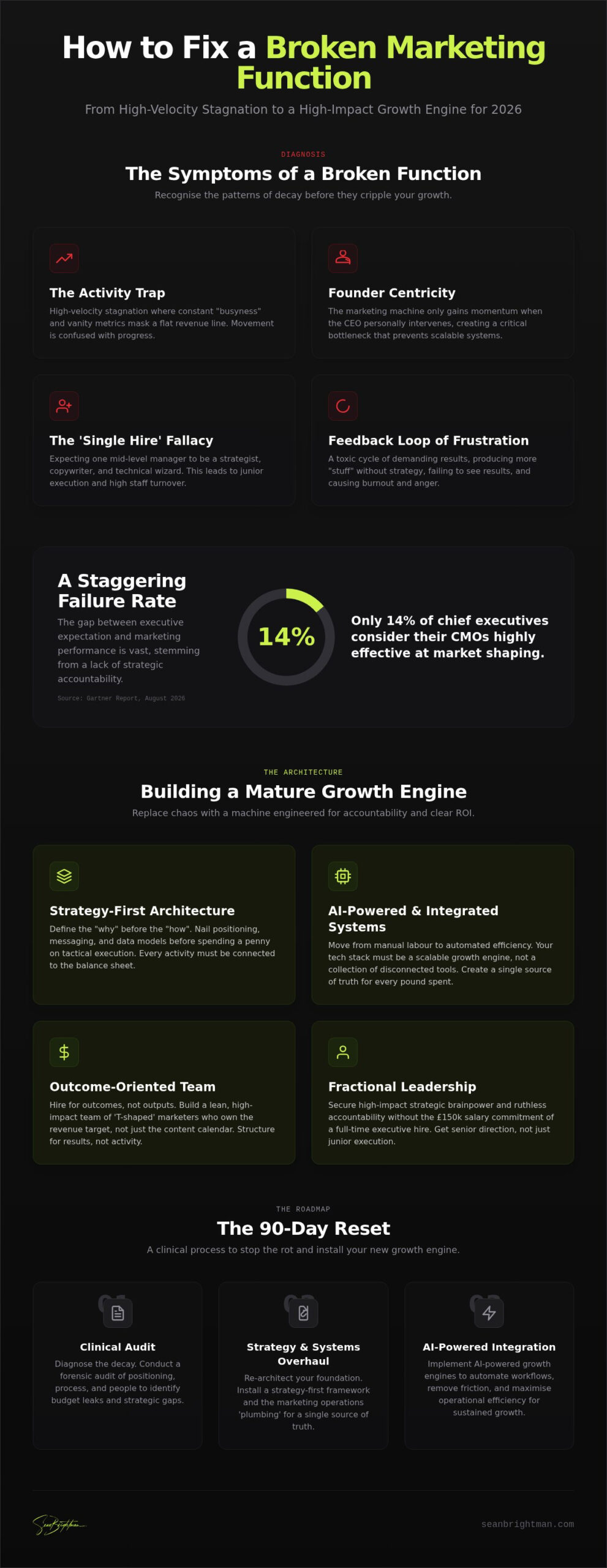
    Most marketing departments operate in a state of high-velocity stagnation. They produce content, send emails, and tweak social profiles whilst the revenue line remains flat. This is the “Activity Trap.” It’s the loudest symptom of a department that lacks a coherent Marketing strategy. If you want to learn how to fix a broken marketing function, you must first stop confusing movement with progress. Busy is not the same as effective.

    Then there is “Founder Centricity.” This occurs when marketing only gains momentum when the CEO personally intervenes. It’s a bottleneck, not a system. Without your constant input, the machine grinds to a halt. This leads to data silos where nobody can prove ROI. According to a Gartner report from August 2026, only 14% of chief executives consider their CMOs highly effective at market shaping. That is a staggering failure rate. It stems from a lack of a single source of truth, leaving leadership to guess which half of their budget is being wasted.

    The “Single Hire” Fallacy

    Many firms fall into the trap of hiring one mid-level manager and expecting a miracle. You want a strategist, a copywriter, and a technical wizard in one body. It is a fantasy. You end up with junior-level execution that lacks any senior direction. This “busy-ness” is a mask. It hides the fact that your brand has no strategic positioning. You aren’t building a growth asset; you are just paying for someone to manage the noise. High staff turnover is the inevitable result when a hire is set up to fail by impossible expectations.

    The Feedback Loop of Frustration

    The cycle is predictable. You demand results. The team produces more “stuff.” The results don’t move. You get angry. They get burnt out. Your marketing function has become an order-taker. They wait for you to tell them what to do rather than acting as a growth-driver that tells you where the market is going. This broken loop creates a toxic culture of “trying new things” every fortnight without ever finishing one. It’s a psychological drain on the entire organisation. To understand how to fix a broken marketing function, you have to break this loop and stop treating marketing as a cost centre to be managed and start treating it as a machine to be engineered.

    The Architecture of a Mature Marketing Growth Engine

    Fixing the engine isn’t about increasing headcount. It’s about structural integrity. You need a strategy that nails your positioning before you spend a penny on execution. Most teams fail because they focus on “likes” and impressions whilst ignoring the revenue line. This disconnect is one of the core forces eroding marketing effectiveness in modern businesses. If you want to know how to fix a broken marketing function, start with the data. Connect every activity directly to the balance sheet. No accountability means no growth.

    AI isn’t a luxury; it’s the baseline. You must move from manual labour to automated efficiency to stay competitive in 2026. This isn’t about replacing humans. It’s about removing the friction that slows them down. It’s about building a machine that runs on logic, not hope. A mature function treats marketing as a series of integrated components. If one part fails, the whole system stalls. You can begin this process by booking a strategic roadmapping session to identify the gaps in your current setup.

    Marketing Systems Architecture

    Tools are not a strategy. However, the wrong tech stack will blind you. You need a scalable growth engine that doesn’t collapse when you double your spend. Marketing Operations is the plumbing of your business. If your systems don’t talk to each other, you lose visibility. Fixing the plumbing is a non-negotiable step in how to fix a broken marketing function. You need a single source of truth for every lead and every pound spent.

    Organisational Design for Scale-ups

    Hire for outcomes, not outputs. A “T-shaped” marketer provides broad strategic knowledge with deep expertise in a specific channel. This is often far more effective for a UK scale-up than a bloated agency retainer. Your team should own the revenue target, not just the content calendar. Structure your department to be lean and high-impact. Centralised functions often provide better consistency, but they must remain agile enough to pivot when the data demands it. It’s about owning the result, not just ticking boxes.

    Diagnosing the Decay: Audit vs Activity

    Stop looking at campaign reports. Start looking at the system. A marketing efficiency audit is about finding where the capital is leaking. Most CEOs look at activity; I look at outcomes. To understand how to fix a broken marketing function, you need a binary check. Is the problem the people, the process, or the positioning? If the positioning is off, the best people in the world won’t save you. If the process is broken, your people are just busy being busy.

    Check the foundations. Does a clear strategic brand roadmapping document actually exist? If it’s just a collection of tactics in a spreadsheet, it’s not a roadmap. It’s a shopping list. We also measure “Strategic Velocity.” This isn’t how many emails you sent. It’s how fast your marketing moves the needle on business objectives. Slow velocity usually points to a lack of senior direction. You’re steering a ship with a broken rudder.

    The Position Audit

    Does the market actually care about what you’re saying? Most messaging is “Me-Too” noise. It’s invisible. You’re saying the same things as your competitors, just in a different colour. Positioning isn’t a creative exercise for a Friday afternoon. It’s a mechanical component of growth. If your positioning is weak, your customer acquisition cost (CAC) will skyrocket. You fix the function by sharpening the blade, not by swinging harder at a blunt target.

    The Technical Debt of Marketing

    Messy data is a silent killer. If your CRM doesn’t talk to your lead gen tools, your ROI is a guess. This technical debt creates “Ghost Tasks.” These are the manual workarounds and spreadsheet reconciliations that consume up to 40% of your team’s time. It’s wasted energy. In 2026, the cost of not having a defined AI marketing roadmap is terminal. You’re paying for manual labour whilst your competitors use autonomous systems to scale. This is how to fix a broken marketing function: stop the leaks, clear the debt, and automate the mundane.
    How to Fix a Broken Marketing Function: A Strategic Reset for 2026

    The 90-Day Reset: Strategy, Systems, and AI

    You cannot talk your way out of a broken system. You have to engineer your way out. Understanding how to fix a broken marketing function requires a structured, time-bound intervention. We don’t aim for incremental “improvements” that vanish by next quarter. We aim for a total mechanical reset. This 90-day sprint is designed to move your department from a chaotic cost centre to a high-velocity growth engine.

    • Days 1-30: The Strategic Deep Dive. We kill the “Me-Too” messaging identified during the audit. We define the positioning that actually commands market attention and aligns with your commercial goals.
    • Days 31-60: Systems Overhaul. We fix the plumbing. This involves integrating your CRM, cleaning your data, and installing the automation required to remove “Ghost Tasks” from your team’s schedule.
    • Days 61-90: Establishing Accountability. We implement the Marketing Advisory Retainer. This provides the senior-level guardrails to ensure your team stays focused on revenue, not just activity.

    Installing AI-Powered Growth Engines

    AI is your force multiplier. With 46% of marketers already using AI to streamline creative assets, staying manual is a choice to be slow. Your next “hire” shouldn’t be a person; it should be a well-engineered prompt or an autonomous agent. Use AI to automate the mundane reporting and data entry that currently eats your budget. Practical implementation moves the needle from reactive guessing to predictive analytics. We aren’t just using tools. We are building a machine that learns and scales whilst your competitors are still manually proofing emails.

    Creating a Culture of Accountability

    Stop asking “What did we do?” and start asking “What did we achieve?”. A culture of accountability requires a “Brutal ROI” framework. If a campaign doesn’t have a clear line to the balance sheet, it doesn’t happen. This mindset shift is essential for how to fix a broken marketing function. By applying a marketing strategy for business exit, you force your team to build a growth engine that is a tangible, valuable asset. You aren’t just marketing for today. You are building a system that buyers would covet.

    If you are ready to stop the rot and install a system that actually delivers, it is time to fix your growth engine and reclaim your marketing budget.

    Fractional Leadership: The High-Impact Fix

    You don’t need a £120k CMO. You need four days of senior brainpower a month. Most businesses are drowning in overhead whilst starving for direction. They hire full-time executives for roles that only require part-time strategy. This is the core of how to fix a broken marketing function without bankrupting the company. You pay for the impact, not the attendance. It’s about surgical intervention, not office politics.

    The Fractional Revolution is the response to this inefficiency. It provides senior leadership without the crushing commitment of a full-time salary and benefits package. This is plug-and-play expertise. A Fractional CMO doesn’t just fix the function; they train your existing team to maintain the new standards. It’s a transfer of capability. You aren’t building a dependency; you are building an internal asset.

    Don’t confuse a Fractional CMO with an agency. An agency is a factory that produces outputs like ads and emails. A Fractional CMO is the architect who designs the factory. One executes; the other directs. You need the architect first. If you hire an agency without senior direction, you’re just paying a factory to produce things that might not even fit your business goals. Clinical direction must always precede tactical execution.

    The Advisory Retainer Model

    Fixing the engine is only half the battle. You have to keep it running. The Advisory Retainer model provides the ongoing direction to ensure the “Fix” stays fixed. It includes monthly accountability sessions for both the CEO and the marketing team. This acts as an external force that keeps internal complexity at bay. It’s a sharp-minded partner who provides the “get-your-hands-dirty” attitude required to maintain strategic velocity. We focus on the numbers that matter, not the vanity metrics that feel good.

    When to Pull the Trigger

    If your marketing spend is high but your growth is flat, you are ready for a reset. If you are tired of being the only person in the room who cares about ROI, you are ready. The cost of delay is measured directly in your EBITDA. Every month you operate with a broken function is a month of leaked capital and missed opportunities. You don’t have to fire everyone and start over. You just need to install a better system. The first step is booking a strategic roadmapping session to define the exact path forward. Stop guessing. Start engineering. This is how to fix a broken marketing function for 2026 and beyond.

    Reclaim Your Growth Engine

    Movement isn’t growth. If your marketing spend is currently vanishing into a cloud of tactical noise, you don’t need a larger team; you need a better machine. We’ve mapped out the diagnostic shift from activity to outcomes and the 90-day reset required to install senior-level systems. You now have the blunt blueprint for how to fix a broken marketing function by prioritising clinical strategy over “busy-ness” and leveraging AI to eliminate manual debt.

    As a battle-hardened Fractional CMO and published author of “The Book” on marketing strategy, I specialise in building AI-powered growth engines that run on logic. You can secure high-impact accountability and senior leadership without the £150k salary commitment. It’s time to stop the rot and start engineering revenue. Book a Strategic Roadmapping Session to Fix Your Marketing Function today. Your marketing shouldn’t be a mystery whilst you’re trying to scale. It should be a predictable, scalable asset that drives your business forward.

    Frequently Asked Questions

    Is it possible to fix a marketing function without firing the current team?

    Yes, it’s absolutely possible. Most underperforming teams aren’t incompetent; they are leaderless. They are stuck in the “Activity Trap” because nobody has defined the commercial objective. By installing senior direction through a Fractional CMO, you provide the guardrails they need to succeed. You stop the “trying new things” cycle and replace it with a focused roadmap. Fixing the system usually fixes the people.

    Can a Fractional CMO really understand my business in just a few days a month?

    Senior expertise is about pattern recognition. A battle-hardened strategist has seen your specific chaos dozens of times before. They don’t need forty hours a week to spot a broken CRM or weak positioning. By using a structured roadmapping methodology, a Fractional CMO identifies the high-impact levers in hours. They focus on the 20% of activities that drive 80% of your revenue. It’s about surgical precision, not desk time.

    How much does it cost to fix a broken marketing function in the UK?

    The cost is significantly lower than the alternative of a full-time executive hire. Whilst I don’t provide recruitment services, industry data suggests a fractional model is far more cost-effective than a fully-loaded CMO salary. You avoid the overhead of pensions, bonuses, and national insurance. The real question is the cost of delay. Every month you run a broken function, you leak capital through inefficient ad spend and missed opportunities. You pay for impact, not desk time.

    What happens if we have no marketing strategy at all?

    You are effectively burning cash. Tactics without a strategy are just noise. Without a clear brand position and a defined growth engine, your marketing is invisible to the market. You’ll suffer from high customer acquisition costs and inconsistent lead flow. A strategic roadmapping session is the first step to installing the logic your business needs. You must define the “why” before you spend a penny on the “how.”

    How does AI help in fixing an underperforming marketing department?

    AI is the ultimate efficiency tool for how to fix a broken marketing function. It eliminates the “Ghost Tasks” that consume up to 40% of your team’s time. By implementing AI-powered growth engines, you automate mundane reporting and content production. This allows your human talent to focus on high-level strategy and creative problem-solving. AI moves your department from manual labour to automated, predictive efficiency. It’s a force multiplier for growth.

    What is the difference between a marketing consultant and a Fractional CMO?

    Ownership is the key distinction. A consultant provides a report and leaves. A Fractional CMO integrates into your leadership team and takes responsibility for the results. One offers abstract theory; the other provides functional integration. A Fractional CMO acts as an external force that brings order to internal complexity. They don’t just tell you what is wrong; they install the systems and provide the accountability to fix it.

    How long does a marketing transformation typically take?

    A comprehensive marketing transformation generally follows a 90-day reset framework. The first 30 days focus on a strategic deep dive and positioning fix. The next 30 days involve a systems overhaul and AI integration to clear technical debt. The final 30 days establish an advisory retainer for ongoing accountability. This structured approach ensures the transformation is permanent. You move from chaotic activity to a machine that runs like a growth engine.

    Can I use an agency to fix my marketing function instead of a CMO?

    Agencies are execution engines; they are not architects. If you hire an agency to fix your function, you’re asking the builders to design the house. They will sell you the services they happen to provide, whether you need them or not. To understand how to fix a broken marketing function, you need senior-level direction first. A CMO defines the strategy and then holds the agency accountable for the execution. Direction must precede production.

  • AI Consulting Services: A CEO’s Guide to Building Growth Engines in 2026

    AI Consulting Services: A CEO’s Guide to Building Growth Engines in 2026

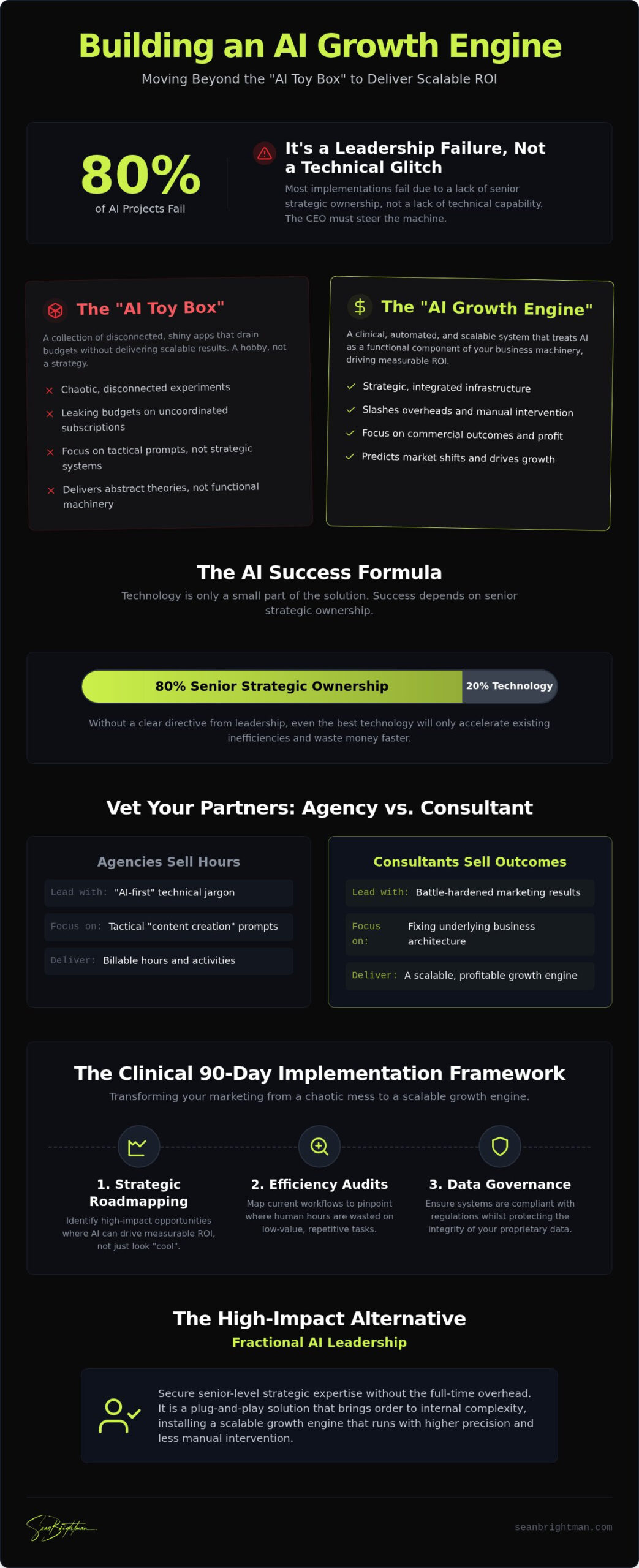
    Eighty per cent of AI projects fail. This isn’t a technical glitch; it’s a leadership failure. Most CEOs are currently building “toy boxes” full of shiny apps rather than actual growth engines. You’ve likely felt the tool fatigue already. Your marketing department is a mess of disconnected prompts and your budget is leaking into experiments that don’t scale. You’re paying for ai consulting services that deliver abstract theories instead of functional machinery.

    It’s time to stop playing with tools and start building a scalable, AI-powered system that delivers actual ROI. You need a strategist, not a coder. This guide provides the blueprint to move from chaotic experiments to a clinical, automated growth engine that runs without you. We will break down the 2026 roadmap for fractional leadership, the shift towards agentic AI workflows, and how to slash overheads whilst your competitors are still stuck in the “prompt engineering” phase. We’re building a system, not a hobby.

    Key Takeaways

    • Stop collecting apps and start building infrastructure. Strategic AI integration prioritises functional systems over shiny new chatbots.
    • Senior leadership is the variable that determines success. Most implementations fail because they lack strategic ownership rather than technical capability.
    • Vet your partners based on marketing results, not technical jargon. Avoid firms that lead with “AI-first” but lack the battle-hardened experience to drive actual growth.
    • Deploy a clinical 90-day roadmap to transform your marketing department. Professional ai consulting services should audit your current mess and install a scalable growth engine.
    • Opt for fractional AI leadership to secure senior-level expertise without the full-time overhead. It is a plug-and-play solution that brings order to internal complexity.

    What are AI Consulting Services in 2026? Beyond the Chatbot Hype

    In 2026, the UK market is flooded with “AI experts” who are little more than prompt engineers in expensive suits. Real ai consulting services aren’t about teaching your team how to use a chatbot. They are about the strategic integration of intelligence into every gear of your business machinery. Think of it as the difference between buying a bag of random car parts and commissioning a high-performance engine. One is a technical capability; the other is a commercial outcome.

    Effective ai consulting services replace chaotic experimentation with clinical systems. Most CEOs are currently suffering from “toy box” syndrome. They have a collection of shiny apps that don’t talk to each other and don’t drive revenue. A strategy-first approach ignores the hype and focuses on the architecture. It treats Artificial intelligence as a functional component of your growth engine, not a magic wand. Ultimately, AI consulting is the bridge between raw technology and business profit.

    The Evolution of AI Advisory

    The phase of “let’s see what this does” is over. For serious UK businesses, experimentation has been replaced by the need for scalable growth engines. In 2021, you might have automated a few emails. In 2026, you’re using predictive engines to anticipate market shifts before they happen. This requires senior leadership. If the CEO isn’t steering the AI, the technology is just accelerating your existing inefficiencies. The “AI toy box” is a distraction; a growth engine is an asset.

    Core Components of Modern AI Consulting

    Professional advisory isn’t a vague chat over coffee. It is a clinical process designed to find the hidden profit in your current mess. It involves stripping away the fluff and installing components that actually move the needle. A modern framework focuses on three pillars:

    • Strategic Roadmapping: Identifying the high-impact opportunities where AI can actually drive ROI, rather than just looking “cool.”
    • Operational Efficiency Audits: Mapping your current marketing workflows to see where human hours are being wasted on low-value tasks.
    • Data Governance: Ensuring your systems are compliant with evolving regulations whilst maintaining the integrity of your proprietary data.

    This isn’t about adding more work to your plate. It’s about building a system that runs with less manual intervention and higher precision. You aren’t hiring a coder to build an app; you’re hiring a strategist to build a business that scales without you.

    The Strategic Gap: Why Most AI Implementations Fail

    Between 70% and 90% of enterprise AI projects fail to deliver their intended value. This isn’t a technical glitch or a coding error. It is a leadership vacuum. When you outsource your intelligence to a junior team or an external agency without a clear directive, you get a “toy box” of expensive gadgets rather than a commercial result. Professional ai consulting services recognise that technology is only 20% of the solution; the rest is senior strategic ownership. If the CEO isn’t steering the machine, the machine is just wasting money at a faster rate.

    CEOs are currently drowning in tool fatigue. Your marketing department is likely a bloated mess of disconnected subscriptions that don’t communicate with each other. This is the “plug-and-play” myth in action. True integration is mechanical. It requires stripping the engine down and rebuilding it around a central logic. An agency will happily bill you for “content creation” prompts. A consultant will tell you why your current process is broken and how to fix the underlying architecture. Agencies sell hours; consultants sell outcomes.

    The “Toy Box” vs. The “Growth Engine”

    Many UK businesses waste thousands of pounds every month on uncoordinated AI subscriptions. They have one tool for copy, another for images, and a third for data analysis, yet nothing is integrated. This is a hobby, not a business strategy. To survive 2026, you must stop playing with apps and start building a scalable growth engine. Whilst global initiatives like the National Artificial Intelligence Initiative focus on macro-level strategy, your focus must be on the micro-level architecture of your marketing operations. Professional ai consulting services move you from tactical prompts to strategic systems that protect your margins.

    Overcoming Internal Resistance

    Your staff are likely terrified. They see AI as a replacement for their livelihoods rather than an augmentation of their skills. This fear creates friction that can stall even the best implementation. You cannot install a high-performance system if your team is quietly sabotaging the gears. Overcoming this requires a culture of AI-powered accountability. They need to see that the machine handles the drudgery so they can handle the strategy. Before you buy a single new tool, you must establish a Marketing Strategy Roadmap. This provides the clarity your team needs to stop worrying about displacement and start focusing on high-value output.

    If you are tired of the fluff and ready for a clinical audit of your operations, it might be time for a Fractional CMO roadmapping session to identify your specific gaps.

    Evaluating AI Consulting Firms: Strategy Amongst the Fluff

    Most “AI consultants” are simply tech enthusiasts with a subscription and a LinkedIn premium account. They lead with tools because they don’t understand business. Choosing the right ai consulting services requires you to look past the technical jargon and focus on commercial experience. If a consultant cannot explain how their implementation protects your gross margin or shortens your sales cycle, they are a hobbyist, not a strategist. You need someone who understands Building an AI Business Strategy, not just someone who can write a clever prompt.

    A massive red flag is the “AI-first” agency with zero marketing background. These firms often suggest “60+ use cases” for AI in your business. This is a recipe for chaos. A battle-hardened expert knows that 57 of those use cases are distractions. You only need the three that drive revenue and lower overheads. This is why a Fractional CMO who owns the AI strategy is often more valuable than a dedicated technical firm. They prioritise brand positioning and customer behaviour whilst using AI as the mechanical lever to scale those efforts.

    Corporate Giants vs. Strategic Partners

    The “Big Four” firms offer safety and massive reports, but they move at a glacial pace. You’ll pay for a 200-page slide deck that is obsolete by the time it’s delivered. Boutique ai consulting services provide direct access to senior minds and rapid, clinical implementation. For a UK scale-up, the choice is clear. You don’t need a corporate safety net; you need a strategic partner who isn’t afraid to be blunt about your current inefficiencies and fix them in weeks, not years.

    The Interview Checklist for CEOs

    When interviewing potential partners, ignore their tech stack. Focus on their operational logic. Ask these questions to separate the theorists from the practitioners:

    • “How does this system integrate with our existing CRM without creating more manual data entry?”
    • “What is the projected ROI over the first 90 days, and how do we measure it?”
    • “Can you show me a growth engine you’ve built that runs without the founder’s daily input?”

    The wrong first question is “What tools do you use?” The right question is “How will this change our unit economics?” If they start talking about specific apps before they’ve audited your workflow, end the meeting. They are trying to sell you a tool, not a solution. You are looking for a architect who can design the machinery of your future growth.

    AI Consulting Services: A CEO’s Guide to Building Growth Engines in 2026

    The AI Roadmap: A 90-Day Implementation Framework

    Strategic transformation doesn’t happen by accident. It happens through clinical execution. Most ai consulting services fail because they lack a structured delivery model. You don’t need a year-long project plan; you need a 90-day sprint to replace manual friction with automated precision. This framework is designed to strip away the “toy box” mentality and install a functional growth engine that delivers measurable ROI. We move from audit to advisory in three distinct phases.

    Step 1: The 30-Day Audit

    The first month is about finding the hidden profit in your current mess. We map every marketing workflow to identify where your team is wasting hours on low-value drudgery. This isn’t a vague observation; it’s a mechanical teardown of your operations. We evaluate your existing tech stack for redundancy, often finding that businesses are paying for multiple subscriptions that perform the same task. By setting a baseline for AI-driven ROI early, we ensure every subsequent move is commercially justified. You aren’t just buying tech; you’re buying back time.

    Step 2: Building the Engine

    Once the audit is complete, we move into the AI implementation for marketing phase. This is the architectural design of your future growth. We integrate Large Language Models (LLMs) into your lead generation and customer journeys to create a seamless, automated experience. This involves developing custom GPTs or internal intelligence hubs that store your brand’s unique logic. Crucially, every output must align with strategic brand roadmapping. If the AI doesn’t sound like your brand, it’s a liability, not an asset.

    The final phases focus on tactical execution and ongoing advisory. We deploy high-impact tools with clear KPIs, ensuring your team knows exactly what success looks like in a post-AI landscape. This isn’t a “set and forget” solution. It requires iterative growth and senior-level accountability to ensure the system remains efficient as the market shifts. You need a partner who stays in the trenches with you, adjusting the gears as your business scales and the technology evolves. We don’t just hand over a manual; we manage the machine.

    If you’re ready to stop the budget leak and start building, book a Fractional CMO roadmapping session to begin your 30-day audit.

    Fractional AI Leadership: The High-Impact Alternative

    Hiring a full-time AI Director in 2026 is a commercial mistake for most UK scale-ups. You will likely pay upwards of £150,000 per year plus benefits for a role that might be obsolete in twenty-four months. This is the old way of thinking. High-impact ai consulting services now operate on a fractional basis. It is a plug-and-play model. You get senior-level strategic authority without the deadweight of a permanent executive salary. It is about precision, not presence. You are buying an outcome, not an employee.

    A fractional consultant acts as an external force for internal order. Your team is busy with the daily grind and lacks the headspace to re-engineer their own workflows. They need a strategist to step in, identify the bottlenecks, and enforce the new architecture. The Advisory Retainer is the ultimate accountability tool. It ensures the strategy doesn’t just sit in a slide deck. It ensures the engine actually gets built and remains efficient as the technology shifts.

    Why Fractional Leadership Wins in 2026

    Speed is the only currency that matters in a post-AI market. Fractional leadership allows you to fix the engine whilst it is running. You aren’t waiting for a six-month recruitment cycle or a three-month notice period. You get immediate access to battle-hardened expertise. This model focuses on strategic direction and team accountability. It is about moving the needle now, not eventually. You pay for results, not hours spent in meetings. It is a lean, clinical approach to business growth that scales with your needs.

    Getting Started with Sean Brightman

    Transformation doesn’t require a leap of faith. It starts with a one-off Roadmapping session. This is a low-risk entry point designed to audit your current mess and provide a clinical plan for ai consulting services. From there, the advisory retainer ensures the strategy actually sticks. You get direct, blunt honesty. I will tell you what you need to hear, not what you want to hear. If your current marketing operations are a bloated liability, we strip them back. If your team is resisting the shift, we address it. Order from chaos. Precision over fluff. Let’s build your growth engine.

    Stop Collecting Tools and Start Building Assets

    The “toy box” phase of AI is over. Successful UK scale-ups in 2026 don’t win by having the most apps; they win by having the most efficient machinery. You’ve seen why senior-level strategy is the only variable that prevents implementation failure. You know that a 90-day roadmap is the difference between a budget leak and a scalable asset. Professional ai consulting services should deliver order, not just more options.

    It’s time to move from tactical prompts to a clinical growth engine that runs without your daily input. As a Fractional CMO and author of “The Book” on marketing strategy, I specialise in building profit-driven systems for leaders who have no patience for bureaucracy. We strip away the fluff and install the components that actually drive revenue. We build engines, not hobbies.

    Don’t let your marketing operations remain a chaotic liability whilst your competitors automate their advantage. Book your AI Roadmapping session with Sean Brightman today and start building a system that scales. The future belongs to the architects, not the experimenters. Let’s get to work.

    Frequently Asked Questions

    What exactly do AI consulting services include for small to medium businesses?

    ai consulting services for SMEs focus on identifying high-impact automation opportunities and building custom internal intelligence hubs. It includes a clinical audit of your current marketing tech stack to eliminate redundancy. Instead of just suggesting tools, a consultant designs a bespoke architecture that connects your CRM, content production, and lead generation into a single, automated growth engine. It is about building functional machinery, not just offering advice.

    How much should a UK scale-up expect to pay for AI consulting?

    UK scale-ups can expect a wide range of pricing depending on the firm’s seniority. Boutique firms often charge between £150 and £300 per hour, whilst comprehensive diagnostic assessments can range from £8,000 to £20,000. Monthly retainers for fractional leadership usually fall between £2,000 and £7,000 depending on the complexity of the implementation. You are paying for strategic velocity and the avoidance of expensive project failures.

    What is the typical ROI timeframe for an AI marketing implementation?

    You should expect to see measurable efficiency gains within the first 30 to 60 days. This typically manifests as a significant reduction in manual human hours spent on drudgery like data entry or first-draft content creation. Full commercial ROI, including lower customer acquisition costs and higher lead conversion rates, usually takes 90 to 180 days as the system gathers data and the automated growth engine begins to reach peak performance.

    Do I need to hire an AI specialist internally if I have a consultant?

    No, you don’t need to hire a full-time specialist if your consultant builds the system correctly. The goal of professional ai consulting services is to create a “plug-and-play” infrastructure that your current marketing team can operate. A consultant provides the senior-level architecture and oversight, whilst your internal staff focus on high-value strategic output. This prevents the £150,000+ overhead of a permanent AI Director.

    Can AI consulting help with brand positioning or just automation?

    AI consulting is a powerful tool for brand positioning. Beyond simple automation, consultants use predictive engines and sentiment analysis to identify exactly where your brand sits in the market. This data allows you to refine your messaging with clinical precision. Automation then ensures that this refined positioning is deployed consistently across every touchpoint in the customer journey, from initial ad copy to long-form nurturing sequences.

    What is the difference between an AI agency and an AI consultant?

    An AI agency usually sells execution and billable hours for specific tasks like prompt engineering or video generation. An AI consultant sells strategy, architecture, and commercial outcomes. Agencies focus on doing the work; consultants focus on building the system so the work happens automatically. You hire an agency when you need a pair of hands; you hire a consultant when you need a brain to design the machine.

    How long does it take to see results from an AI marketing roadmap?

    You get immediate clarity from the moment the roadmapping session concludes. You will have a clinical list of exactly what is broken and how to fix it. Physical results, such as automated lead nurturing or predictive analytics, typically take 90 days to fully integrate and test. This timeframe ensures the system is robust, compliant with UK regulations, and aligned with your proprietary brand voice before it goes live.

    Is AI consulting suitable for B2B companies with long sales cycles?

    It is arguably more critical for B2B firms with long sales cycles. AI consulting helps these businesses implement sophisticated lead scoring and automated “always-on” nurturing sequences that stay in front of prospects for months without human intervention. This ensures no lead is dropped during a six-month decision process. It turns a manual, leaky sales funnel into a precise, automated pipeline that prioritises high-value accounts.

  • The Sean Brightman Method: A Tactical Framework for AI-Powered Growth

    The Sean Brightman Method: A Tactical Framework for AI-Powered Growth

    Is your marketing budget a black hole of accountability or a precision-engineered growth engine? Most boards are currently staring at declining returns and agencies that offer excuses instead of results. You know the traditional model is broken. It’s too slow. It’s too expensive. It’s devoid of actual strategy. You’re right to be frustrated with the lack of clarity around AI and the weight of corporate bureaucracy holding your brand back.

    This is where The Sean Brightman Method changes the game. It’s a tactical framework built for speed and precision, not endless meetings and bloated headcounts. You’ll discover how to strip away the fluff and build a high-impact marketing engine using senior fractional leadership and seamless AI integration. It’s about results, not activity. Systems, not just staff.

    We’ll break down the three pillars of this framework and provide a clear 90-day roadmap to scale your operations or prepare for a clean exit. It’s time to stop falling behind and start building for the future.

    Key Takeaways

    • Replace corporate fluff with a high-velocity framework that delivers senior leadership without the overhead of a full-time hire.
    • Discover how The Sean Brightman Method builds automated marketing machinery to ensure your growth engine keeps running whilst you focus on high-level strategy.
    • Compare the tactical advantages of fractional advisory against traditional agencies to regain ownership of your business growth.
    • Follow a battle-hardened 90-day roadmap to audit your current efficiency and reframe your brand positioning for a crowded market.
    • Learn how to integrate AI tools into your daily operations to strip away manual labour and future-proof your department.

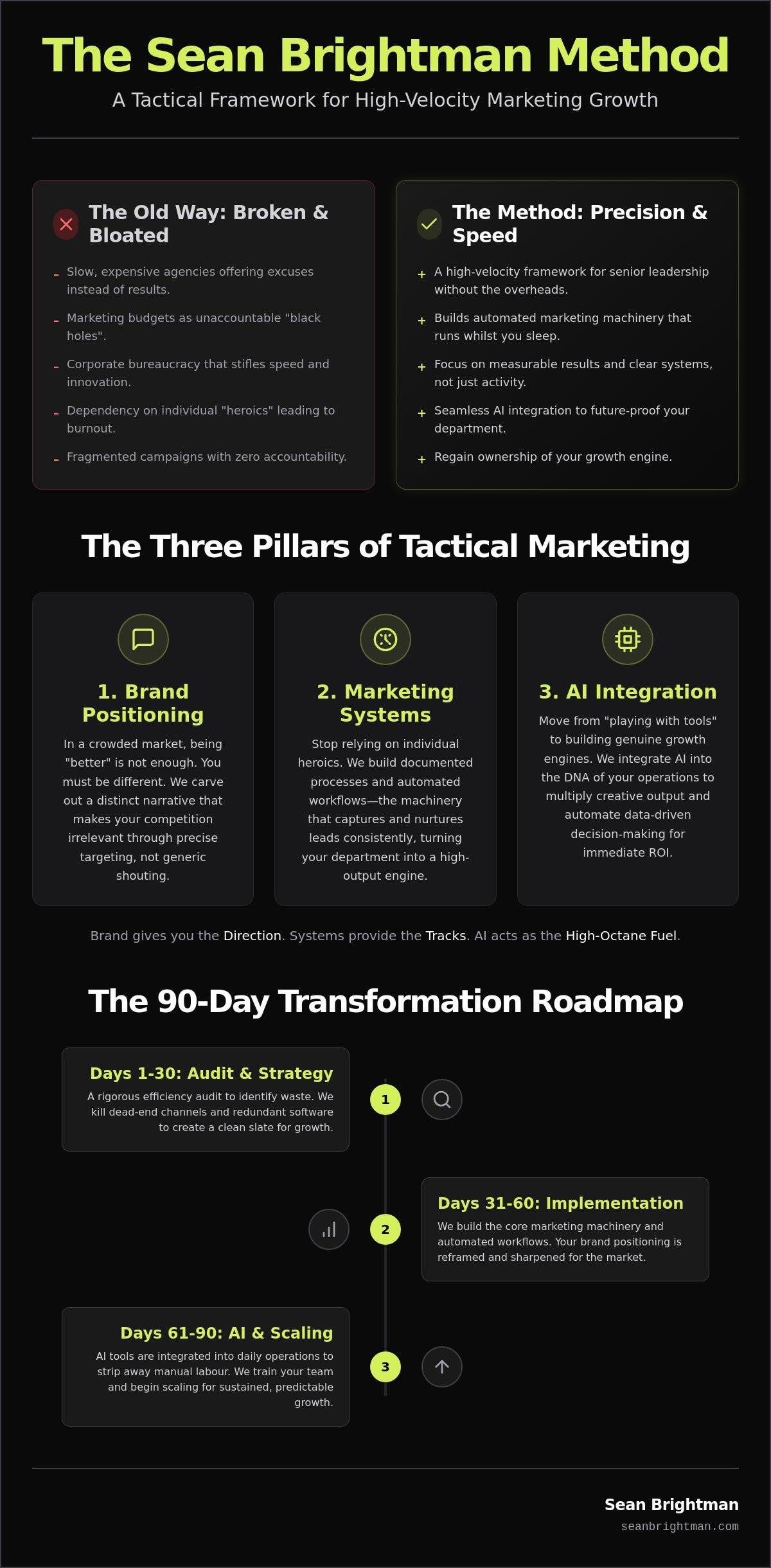
    What is The Sean Brightman Method? Defining Tactical Marketing

    Most marketing departments are bloated, slow, and reactive. They operate on hope rather than data. The Sean Brightman Method is a tactical framework designed to fix that. It’s a high-velocity system for senior marketing leadership that bypasses the friction of a full-time executive hire. Think of it as a plug-and-play growth engine. You get the strategic weight of a CMO without the corporate baggage or the massive salary commitment. It’s built for CEOs who need results yesterday and have no time for the “learning curve” of a traditional hire.

    This is strategic advisory, not an execution-only agency model. Agencies often want to sell you more “stuff” – more posts, more ads, more billable hours. They thrive on your dependency. The Method is different. It’s about building your internal machinery so you eventually don’t need external hand-holding. We start with blunt honesty. Every engagement begins with a rigorous efficiency audit. If you’re wasting budget on dead-end channels or redundant software, we kill it immediately. We don’t sugarcoat the failures. We excise them to make room for growth.

    The Fractional CMO model is the core of this approach. It allows for high-impact intervention without the long-term liability. You’re hiring a battle-hardened strategist to install a system, train your team, and provide board-level accountability. It’s a lean, mean approach to growth that prioritises speed and precision over headcount and bureaucracy.

    The Core Philosophy: Strategy Before Tools

    Most businesses buy the latest AI tools before they have a coherent marketing strategy. They have a tech stack but no direction. This leads to “messy” marketing: fragmented campaigns, inconsistent messaging, and zero accountability. The Method flips the script. Strategy comes first. We define the board-level objectives and the tactical path to reach them. Only then do we bring in the tools. This approach ensures every piece of tech serves a specific, measurable purpose. It turns a chaotic department into a streamlined, high-output machine that runs whilst you sleep.

    Who is Sean Brightman?

    Sean Brightman is a straight-shooting strategist who doesn’t believe in corporate fluff. He’s a published author on marketing strategy and a specialist in AI integration for high-growth SMEs and UK scale-ups. This isn’t abstract theory. The methodology is built on years of active field experience, helping CEOs strip away bureaucracy to find the shortest path to profit. He acts as a sharp-minded external force, providing the accountability your board needs to scale or prepare for a clean exit. He’s the expert you bring in when you’re tired of excuses and ready for a system that actually works.

    The Three Pillars of The Method: Brand, Systems, and AI

    Efficiency alone won’t save a failing department. You need a structural overhaul. The Sean Brightman Method rests on three non-negotiable pillars that turn marketing from a cost centre into a profit-generating machine. If you miss one, the whole structure collapses. It’s the difference between a loud megaphone with no engine and a high-performance vehicle with surgical steering.

    Pillar 1: Brand Positioning. In a crowded, noisy market, being “better” is a death sentence. You must be different. This pillar is about carving out a distinct narrative that makes competition irrelevant. We stop the generic shouting and start the precise targeting. Pillar 2: Marketing Systems. Most departments rely on individual heroics. That’s a recipe for burnout and failure. We build machinery. These are the documented processes and automated workflows that ensure leads are captured and nurtured whilst you sleep. Pillar 3: AI Integration. This is about moving from “playing with ChatGPT” to building actual growth engines. We integrate AI into the DNA of your operations to multiply creative output and automate data-driven decision-making.

    The synergy between these pillars is where the magic happens. Brand gives you the direction. Systems provide the tracks. AI acts as the high-octane fuel. Together, they create a scalable growth engine that doesn’t break when you step on the gas.

    AI Roadmapping: Beyond the Hype

    Most CEOs are paralysed by AI hype. They see the potential but lack a tactical entry point. An AI Roadmap is the antidote. This is a one-off, high-impact session designed to identify the specific friction points in your business where AI can deliver immediate ROI. We don’t implement tech for the sake of it. We apply AI to improve efficiency and creative output in ways that traditional recruitment simply cannot match. The Method prioritises building these automated engines over the slow, expensive process of hiring more middle managers.

    Systems Architecture and Accountability

    Architecture defines your outcomes. If your systems are fragmented, your results will be too. We focus on building a robust marketing systems architecture that removes the guesswork. This is where the Advisory Retainer becomes essential. It provides the consistent direction and accountability needed to ensure execution doesn’t stall. We move your team away from activity-based marketing and toward results-based marketing. It’s about ownership and movement. If you want to stop the internal chaos and start seeing real momentum, exploring a Fractional CMO partnership is the logical next move.

    The Method vs. Traditional Marketing: A Brutal Comparison

    Let’s talk about the £120k mistake. Most CEOs believe their first major marketing move must be hiring a full-time CMO. They pay a recruitment agency a 20% fee to find a candidate who then spends six months “onboarding” and “learning the culture” before making a single tactical change. By the time they’re ready to execute, you’ve burnt through a year’s worth of growth capital. It’s a legacy approach that prioritises comfort over speed. It doesn’t work for scale-ups.

    The Sean Brightman Method offers a sharper, more aggressive alternative. You don’t need a £150k executive sitting in meetings all day. You need a tactical strategist who builds the growth engine and leaves the keys in your hands. Traditional hires bring administrative weight and corporate politeness. This method brings tactical precision and blunt accountability. We don’t wait for the quarterly review to identify failure. We audit, excise, and rebuild in real-time.

    Then there’s the agency trap. If you hire an execution-only agency without senior internal direction, they eventually own your strategy. They’ll optimise for their own billable hours, not your bottom line. The Method ensures you retain ownership of the growth strategy whilst treating agencies like the functional components they are. We provide the master operator your machinery requires to actually move the needle.

    Speed is the final differentiator. A full-time hire ramps up in months. The Sean Brightman Method delivers a structural transformation in 90 days. We don’t have time for long-winded reports or ego-driven projects. We identify the wasted spend, install the AI-powered systems, and drive the business forward.

    The Fractional CMO Advantage

    You need high-level thinking, not high-level management. A fractional leader provides the board-level authority you require without the long-term liability or the eye-watering recruitment fees. It’s about access to battle-hardened expertise on a schedule that fits your current growth stage. It’s high-value consulting that prioritises movement over maintenance. Read more about why businesses are making the shift in Stop Hiring Full-Time CMOs: The Fractional Revolution in 2026.

    Agency Management: The Strategic Gap

    Agencies are execution engines. They aren’t business strategists. Without a senior internal voice, your agency output will drift away from your brand roadmap. The Method acts as the bridge between your vision and their execution. We translate board-level goals into tactical instructions that agencies cannot misinterpret. It ensures every penny of your external spend aligns with the systems we’ve built. We provide the direction; they provide the labour.

    The Sean Brightman Method: A Tactical Framework for AI-Powered Growth

    Implementing The Method: The 90-Day Transformation Roadmap

    You don’t have years to fix a broken department. You have 90 days. The Sean Brightman Method is built on a high-velocity timeline that moves your business from chaos to clarity with surgical precision. We don’t do “discovery phases” that last for months. We do execution. This roadmap is designed to install the machinery, calibrate the output, and hand you the controls.

    The transformation follows five tactical steps. We begin with an Efficiency Audit to stop the financial bleeding. Next, we execute Brand Positioning to reframe your narrative for maximum impact. Step three involves the AI Roadmap, where we select the specific tools that drive revenue rather than just adding noise. We then move to Operational Design, restructuring your team for absolute accountability. Finally, we transition into Ongoing Advisory via monthly retainers to ensure the growth engine doesn’t stall. It is a methodical, rapid-fire approach to scaling.

    This isn’t about incremental gains. It’s about a total structural reset. We move from activity to results. We replace “trying things” with “installing systems.” By day 90, your marketing department is no longer a source of stress. It’s a predictable, automated asset.

    The Efficiency Audit: Finding Your Hidden Profit

    The efficiency audit is a diagnostic tool for messy departments that identifies exactly where your money is leaking. Most businesses are currently funding a “zombie” tech stack: expensive software subscriptions that no one actually uses. We also find misaligned agency spend where you’re paying for creative fluff instead of commercial outcomes. We identify these waste areas immediately. By cutting the dead wood, we set a hard baseline for ROI measurement. We find the profit hidden in your existing budget before we even think about spending another penny.

    The Strategic Brand Roadmap

    Most boards don’t actually understand their marketing strategy. They see a collection of tactics, not a coherent direction. A one-off strategy session is better than a year of guessing because it creates a clear marketing direction that every stakeholder can get behind. We align the roadmap with your specific exit goals or rapid scaling targets. This isn’t a vague vision document. It’s a tactical blueprint. It defines exactly how your brand will win in its category. If you’re ready to stop the internal guesswork and start the transformation, book a roadmapping session today.

    Operational design is the final piece of the puzzle. We look at who is doing what and why. If a role doesn’t contribute directly to the growth engine, it’s redesigned or removed. We build a culture of accountability where every action is tied to a metric. This is how you build a department that scale-up CEOs can actually trust.

    The Logical Conclusion: Why Your Business Needs This Method Now

    Inaction is a strategy. It’s just a losing one. Every month you spend debating a full-time hire or “experimenting” with AI without a framework is capital down the drain. The market is moving at a velocity that traditional corporate structures cannot match. Your competitors aren’t just using AI; they’re likely already automating their lead generation and refining their brand positioning whilst you’re stuck in committee meetings. Stagnation isn’t just standing still. In 2026, it’s falling behind at an exponential rate. The Sean Brightman Method is the secret weapon for high-growth CEOs who refuse to let bureaucracy dictate their trajectory.

    Traditional marketing is dead. The old playbook of hiring more middle managers to solve structural problems is obsolete. You don’t need more headcounts; you need better systems. Transitioning to a Fractional CMO model isn’t just a cost-saving exercise. It’s a tactical upgrade. You’re hiring a battle-hardened expert who has seen the chaos before and knows exactly how to fix it. This is about movement. It’s about taking the machinery of your business and tuning it for maximum output. You get the strategic weight of a veteran leader without the long-term liability of a full-time executive salary.

    The choice is binary. You can continue with a bloated budget and zero accountability, or you can install a high-impact growth engine. The Sean Brightman Method provides the clarity, the tools, and the tactical roadmap to win. It’s time to stop playing with tools and start building a legacy. The window for early-mover advantage in AI integration is closing. You need to act before obsolescence becomes your brand’s defining feature.

    Getting Started with an Advisory Retainer

    Strategy without execution is just a hallucination. The Advisory Retainer is the primary vehicle for ongoing direction. It ensures the systems we’ve built actually get executed by your team or external partners. Most marketing projects fail because the initial energy dies out. This monthly support model provides the board-level accountability needed to keep the growth engine running at peak performance. It reduces the friction of senior leadership hires whilst maintaining a high-impact, tactical presence in your department. You get the direction you need without the ego or the unnecessary ceremony.

    Next Steps: Book Your Strategic Roadmap

    The path to a scalable growth engine starts with a single decision. You can continue with the current internal mess, or you can choose tactical clarity. A one-off roadmapping session is the fastest way to identify your friction points and set a 90-day course for success. We strip away the fluff. We define the narrative. We build the machinery. Stop guessing and start scaling your business with a framework that actually delivers. Book your strategic roadmapping session with Sean Brightman to secure your competitive advantage and take ownership of your growth.

    Build Your High-Impact Growth Engine Today

    Corporate bureaucracy is the enemy of growth. You’ve seen how the old model of full-time hires and execution-only agencies creates a strategic gap that drains your budget and stalls your momentum. By implementing The Sean Brightman Method, you replace that friction with tactical precision. You now understand that a scalable growth engine relies on three non-negotiable pillars: sharp brand positioning, automated systems, and surgical AI integration. This isn’t abstract theory. It’s a battle-hardened framework from a published author on marketing strategy who specialises in high-growth UK scale-ups.

    The choice is binary. You can continue to manage a messy department or you can lead a high-output machine. It’s time to stop falling behind on AI implementation and start building for a clean exit or rapid expansion. You need senior leadership that prioritises results over headcounts and systems over activity. Secure the direction and accountability your board requires to move the needle whilst your competitors are still stuck in committee meetings.

    Secure your senior marketing leadership with Sean Brightman

    Your business deserves a strategy that works whilst you sleep. It’s time to stop guessing and start scaling.

    Frequently Asked Questions

    What exactly is the Sean Brightman Method?

    It is a tactical framework for senior marketing leadership that prioritises systems and AI over headcounts. It strips away corporate bureaucracy to build a high-impact growth engine. The Sean Brightman Method focuses on brand positioning, marketing systems architecture, and AI integration. It provides board-level strategy without the liability of a full-time executive hire, ensuring your marketing department is an asset rather than a cost centre.

    How does a Fractional CMO differ from a marketing agency?

    A Fractional CMO is an internal strategic leader, whilst an agency is an external execution engine. Agencies often focus on billable hours and tactical delivery like social media posts or ad management. A Fractional CMO owns the strategy, manages those agencies, and ensures every action aligns with the board’s commercial goals. It is the difference between hiring someone to dig a hole and hiring the architect who designs the foundations.

    Is the Sean Brightman Method suitable for small businesses or just scale-ups?

    This framework is built specifically for high-growth UK scale-ups and SMEs with established revenue. Whilst small businesses can apply the principles found in The Book, the Fractional CMO and Advisory Retainer services are tactical interventions for departments that already have some complexity. If you’re a CEO looking to scale rapidly or prepare for a clean exit, this methodology provides the senior oversight needed to manage that transition without bloated overheads.

    How long does it take to see results with this methodology?

    You should expect a structural transformation within 90 days. The process begins with an immediate efficiency audit to identify wasted spend and underutilised tech. We then move rapidly through brand positioning and systems architecture. Unlike traditional hires who take months to “onboard”, The Sean Brightman Method is a plug-and-play solution. We prioritise speed and precision to ensure the growth engine is operational and measurable in a concentrated timeframe.

    What is included in an AI marketing roadmap session?

    An AI marketing roadmap session is a one-off tactical deep dive into your current operations. We identify high-impact integration points where AI can multiply creative output or automate data-driven decision-making. We don’t just suggest tools; we design the machinery. You’ll receive a clear blueprint for implementation that moves your team from playing with chatbots to running a sophisticated, AI-powered growth engine that actually drives revenue.

    Can the Sean Brightman Method help with brand positioning and exit strategies?

    Yes, brand positioning is a core pillar of the framework. We reframe your narrative to make competition irrelevant, which is essential for rapid scaling or attracting investors. A clear, documented marketing system and a strong market position significantly increase the value of a business. We align every tactical move with your ultimate exit goals, ensuring your marketing department is a transparent, high-performing asset that stands up to due diligence.

    Do I need to fire my current marketing team to implement this method?

    No, we restructure for accountability rather than simply clearing the floor. The Method often involves retraining existing staff to work with new AI tools and systems. However, we are blunt about performance. If the efficiency audit reveals roles that don’t contribute to the growth engine, we provide the operational design to fix it. We turn your current team from a group of individuals into a high-output machine.

    How much time does the Advisory Retainer require from the CEO?

    The Advisory Retainer is designed to save you time, not consume it. It provides the senior direction and accountability your team needs so you don’t have to micromanage them. We typically require a high-level briefing and monthly strategy review to ensure alignment with board objectives. The goal is to provide you with a plug-and-play leader who manages the complexity whilst you focus on high-level business growth.