Tag: Growth Marketing

  • How to Build a Marketing Strategy Roadmap That Actually Drives Exit-Ready Growth

    How to Build a Marketing Strategy Roadmap That Actually Drives Exit-Ready Growth

    Most marketing roadmaps are little more than expensive works of fiction designed to make stakeholders feel safe whilst the budget burns. You don’t need another colourful Gantt chart; you need a functional blueprint for a high-velocity growth engine. If your current marketing strategy roadmap feels like a list of disconnected tactics rather than a path to enterprise value, you aren’t alone.

    It’s exhausting to deal with tool fatigue and a lack of alignment whilst watching your marketing spend disappear into a black hole. You want a department that runs like a machine, delivering predictable lead generation instead of monthly surprises. We agree that marketing should be a profit centre, not a line-item expense.

    Stop drawing timelines and start building for an exit. This battle-tested guide shows you how to construct a 12-month strategy that actually drives growth. We will explore the exact steps to bridge the gap between business goals and daily activity, ensuring your marketing is ready for the scrutiny of any future buyer.

    Key Takeaways

    • Build systems, not just timelines. Treat your roadmap as the architectural blueprint for a growth engine rather than a simple list of tasks.
    • Shift to AI infrastructure. Map AI implementation across the customer journey to move from playing with tools to building a high-velocity machine.
    • Maximise enterprise value. A documented marketing strategy roadmap is a critical asset that proves your growth is repeatable and scalable for future buyers.
    • Audit the mess. Use our 5-step execution guide to strip away tactical noise and align every activity with your commercial North Star.
    • Bridge the accountability gap. Understand why senior advisory is the key to turning a static plan into a functional revenue engine.

    Beyond the Gantt Chart: What a Marketing Strategy Roadmap Really Is

    Most roadmaps are decorative. They live in colourful spreadsheets and die in quarterly meetings. A real marketing strategy roadmap isn’t a schedule of events; it’s an architectural blueprint for a growth engine. It defines exactly how you will build enterprise value whilst your competitors are still arguing over font sizes.

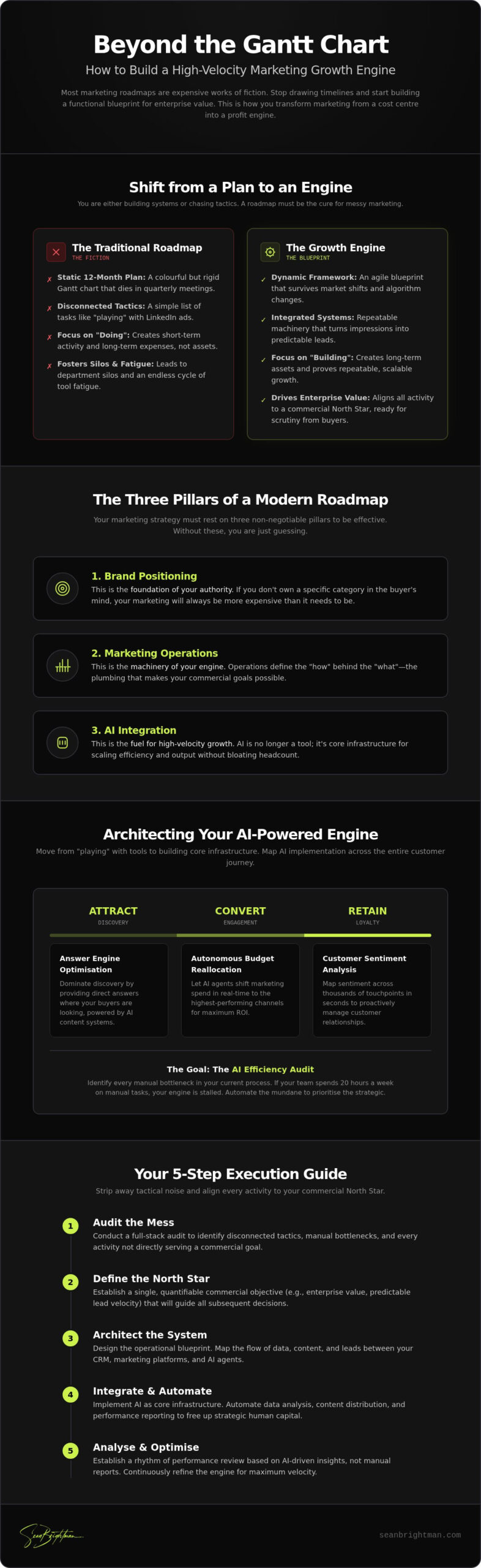
    We work in a binary: you are either building systems or you are chasing tactics. Tactics are “playing” with LinkedIn ads. Systems are the integrated machinery that turns an impression into a predictable lead. A roadmap is the cure for messy marketing. It ends the department silos and stops the endless cycle of tool fatigue by forcing every activity to justify its existence against a commercial goal.

    Static 12-month plans are dead. In 2026, market shifts happen in weeks, not years. If your plan can’t survive a sudden algorithm change or an AI breakthrough, it’s a liability. You need a framework that is dynamic, precise, and focused on building a machine that runs without you.

    The Difference Between a Plan and an Engine

    A plan is a checklist of tasks. It’s passive. An engine is a repeatable process designed to produce a specific result. Most CEOs ask their teams “what are we doing this month?” That is a tactical trap. Instead, you should be asking “what are we building?”

    When you focus on building, you create assets. When you focus on doing, you only create expenses. You can read more about shifting from cost centres to growth engines in our guide on Strategic marketing for CEOs. A roadmap ensures that every pound spent is an investment in the engine’s long-term horsepower.

    The Three Pillars of a Modern Roadmap

    Your marketing strategy roadmap must rest on three non-negotiable pillars to be effective. Without these, you’re just guessing.

    • Brand Positioning: This is the foundation of your authority. If you don’t own a specific category in the buyer’s mind, your marketing will always be more expensive than it needs to be.
    • Marketing Operations: This is the machinery. Whilst a standard marketing plan might list goals, operations define the plumbing that makes those goals possible. It’s the “how” behind the “what.”
    • AI Integration: This is the fuel. In 2026, AI is no longer a set of separate tools. It is the core infrastructure that allows you to scale efficiency and output without bloating your headcount.

    When these pillars are aligned, your marketing department stops feeling like a black hole for cash. It starts feeling like a predictable, high-velocity asset that is ready for an exit at any moment.

    The Architecture of an AI-Powered Marketing Roadmap

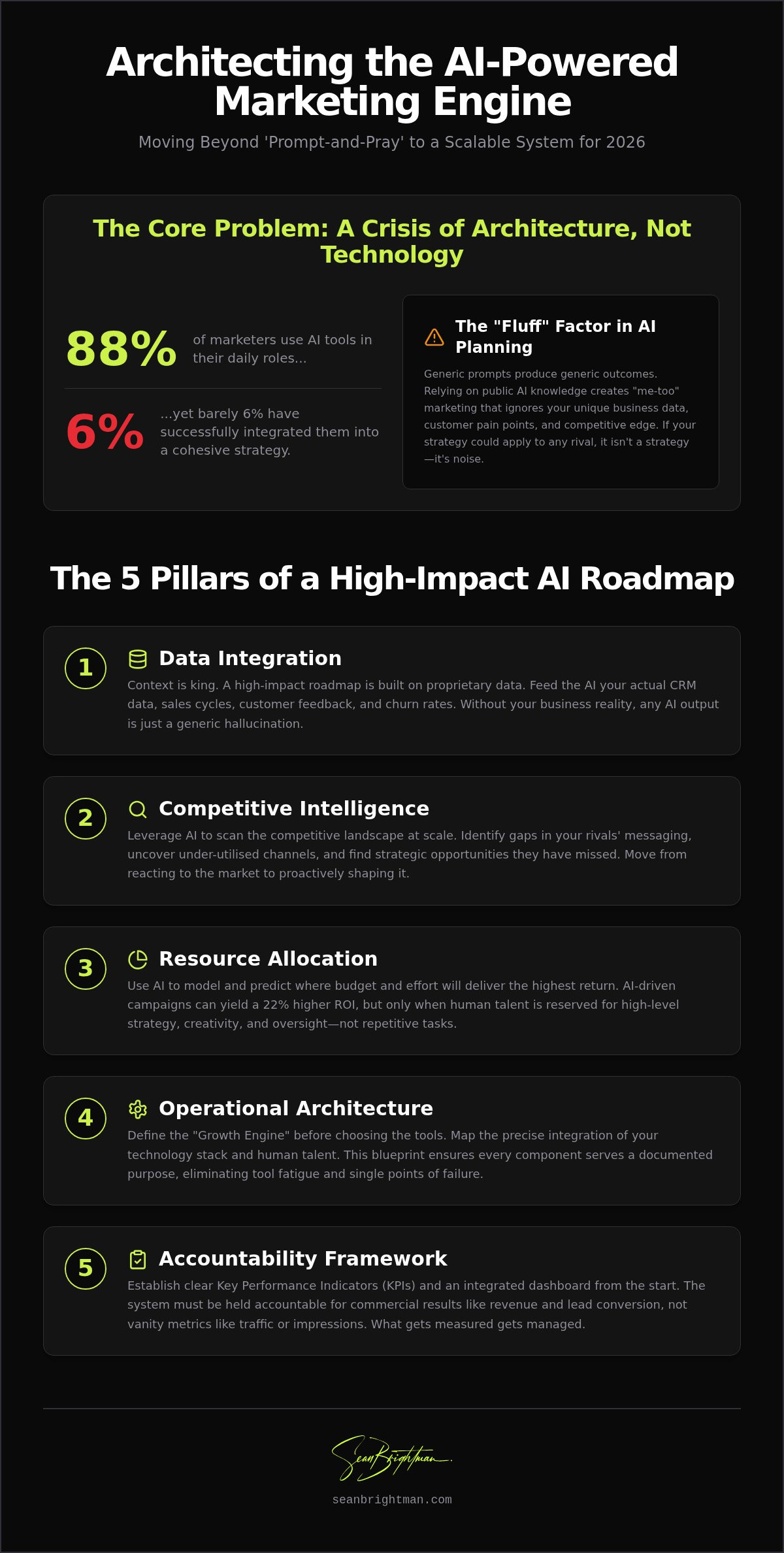
    Most marketing teams are currently distracted by shiny objects. They collect AI tools like they’re trading cards but fail to integrate them into a functional system. This is a waste of time and capital. An effective marketing strategy roadmap treats AI as core infrastructure, not an accessory. AI Roadmapping is the strategic application of intelligence to marketing operations.

    Moving from “playing” with tools to building an engine requires an AI Efficiency Audit. You must identify every manual bottleneck in your current process. If your team spends twenty hours a week on manual data entry or basic content tweaks, your engine is stalled. You need to map implementation across the entire customer journey: Attract, Convert, and Retain. This ensures AI handles the volume whilst your people handle the strategy.

    In 2026, this isn’t just about chatbots. It involves Answer Engine Optimisation (AEO) for discovery and autonomous budget reallocation for performance. This is the transition from tool fatigue to scalable growth. You can explore how we manage this shift in our approach to AI consulting, where we focus on engines rather than individual platforms.

    Automating the Mundane to Prioritise the Strategic

    Data analysis is the first major win for an AI-powered roadmap. AI can map customer sentiment across thousands of touchpoints in seconds, a task that previously took weeks of manual labour. Your 2026 marketing strategy roadmap must include a dedicated “System Architecture” phase. This is where you build the pipes that allow data to flow between your CRM and your AI agents. When the machinery handles the mundane analysis, your team is free to focus on high-level creative and commercial positioning.

    The Human Element: Who Manages the AI?

    Who manages the machine? Many CEOs make the mistake of handing AI tasks to junior staff. This is backwards. Junior staff understand the “how,” but they lack the “why.” You need senior leadership to oversee the integration of these systems to ensure they align with business goals. It’s about redefining roles within the organisation to focus on oversight and strategic direction. If you want to stop guessing and start building a machine that drives value, it might be time to look at a professional AI-driven strategic reset for your department.

    Strategic Trade-offs: Mapping for Exit vs. Mapping for Scale

    Your destination dictates your design. Most leaders build for next month; smart leaders build for the buyer. If you’re aiming for a 24-month exit, your marketing strategy roadmap is no longer just a growth plan. It’s a due diligence document. You are building an asset that must prove its worth under the microscope of an acquisition team.

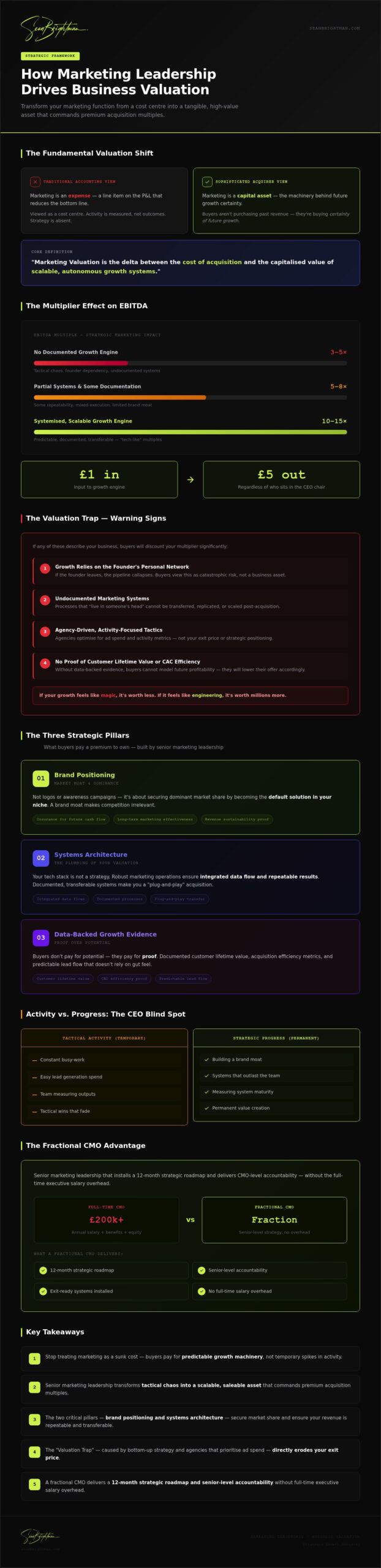
    Buyers don’t pay for your hard work or your “potential.” They pay for repeatable systems that function without the founder. A documented roadmap increases enterprise worth because it removes the “key man” risk. It proves that your lead generation is a deliberate choice, not a lucky streak. You can read more about the specific valuation drivers in our guide on marketing strategy for business exit.

    To be exit-ready, your marketing systems must pass a specific checklist:

    • Clean Data: Fully compliant, first-party data with a clear audit trail.
    • Documented SOPs: Standard Operating Procedures for every tactical move.
    • Scalable CAC: Proof that you can acquire customers at a predictable cost.
    • Independence: A marketing engine that runs whilst the CEO is out of the room.

    Scaling for Growth: The Aggressive Roadmap

    When you’re mapping for raw scale, market share is your primary target. You prioritise aggressive customer acquisition. Your Customer Acquisition Cost (CAC) might be higher as you push into new territories or block competitors. This is the “land grab” phase. You move from scrappy, founder-led experiments to systematic, high-volume growth. Every pound is spent on visibility and volume.

    Scaling for Exit: The Efficiency Roadmap

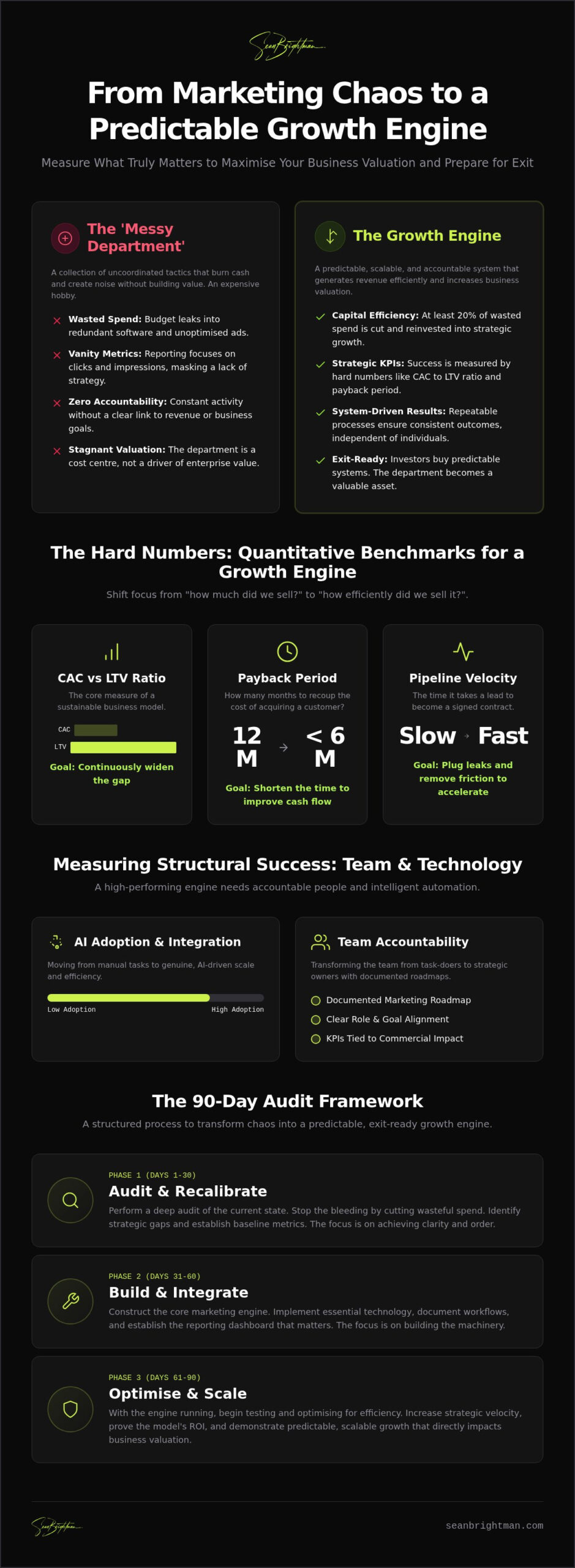
    Mapping for an exit requires a pivot toward margins. You focus on Lifetime Value (LTV) and operational efficiency. Buyers want to see a lean, high-output machine with minimal waste. You optimise the machinery you’ve built rather than just adding more fuel. This roadmap emphasises retention, upsells, and the automation of the customer journey. You are building a machine that works independently, making it a “plug-and-play” asset for a potential acquirer.

    How to Build a Marketing Strategy Roadmap That Actually Drives Exit-Ready Growth

    How to Build Your Growth Engine: A 5-Step Execution Guide

    Roadmapping isn’t about picking a template or a pretty colour scheme. It’s about engineering. Most roadmaps fail because they are built on assumptions rather than audits. A high-impact marketing strategy roadmap requires a clinical approach to your existing infrastructure before you ever touch a timeline. If you start by choosing a format, you’ve already lost.

    Step 1 & 2: The Strategic Foundation

    You can’t build a roadmap if you don’t know where the leaks are. Step 1 is the Diagnostic. You must audit your current “messy” marketing systems to see what’s actually converting and what’s just noise. Most SMEs discover that 80% of their activity is wasted effort. You need to find those gaps and close them before you add more fuel to the fire.

    Step 2 is Positioning. This isn’t about a new logo or a fresh coat of paint. It’s your North Star. Positioning defines exactly why you win in your category and why a buyer should care. Without it, your tactics are just expensive guesses. If you are struggling to define your edge, hiring a marketing strategy consultant can help you build a growth engine that actually scales instead of just a plan that sits on a shelf.

    Step 3 & 4: From Theory to Machinery

    Step 3 is Systems Design. You need a tech and AI stack that powers the engine, not a collection of tools that don’t talk to each other. Your “Marketing Stack” should be integrated, automated, and lean. Every tool must serve a specific purpose in the customer journey. If it doesn’t contribute to the machinery, get rid of it.

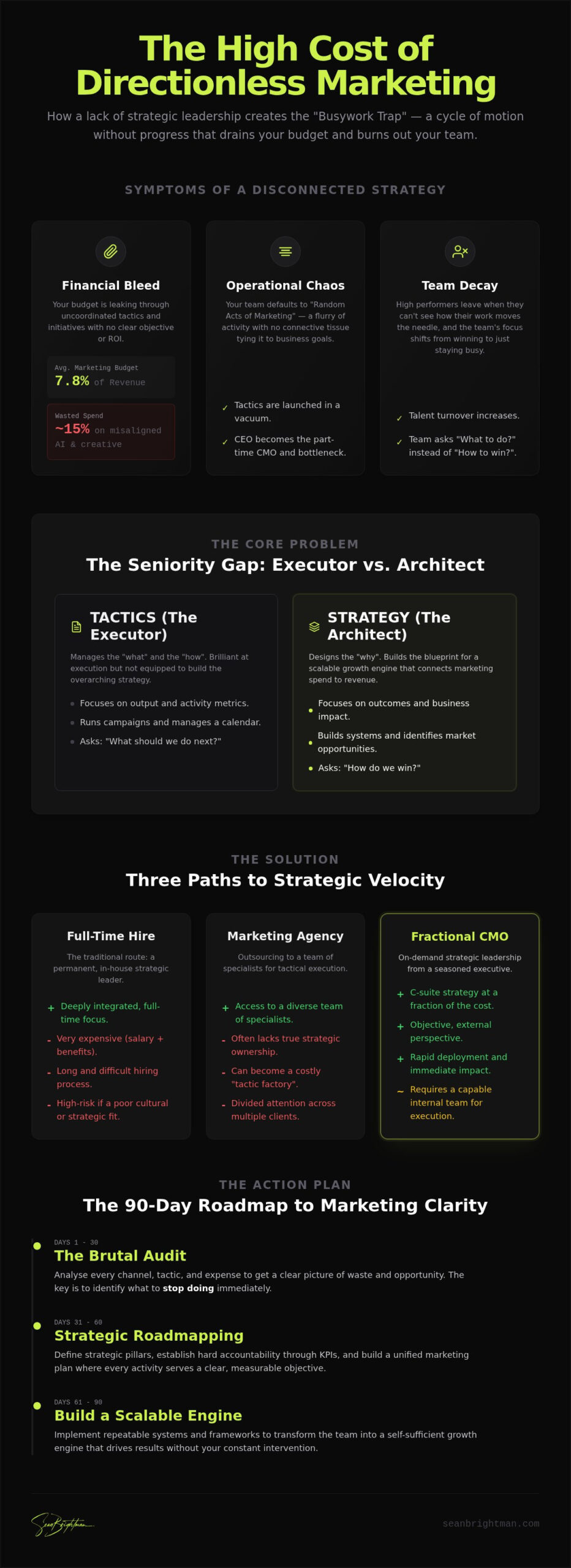
    Step 4 is the 90-Day Sprint. Planning in detail beyond three months is a fantasy. Market conditions shift too fast for static 12-month task lists. Use your marketing strategy roadmap to set the high-level direction, but execute in 90-day bursts of high-velocity action. This keeps your team focused on immediate results rather than abstract long-term goals. It forces a rhythm of delivery that prevents stagnation.

    Step 5 is the Feedback Loop. This is where most roadmaps die. You must build accountability and measurement into the process. This isn’t about being “agile” in the corporate sense; it’s about being effective. If a tactic isn’t driving the engine forward, kill it. If it is, double down. This loop ensures your strategy remains a living, breathing asset that builds enterprise value every single day.

    Stop guessing and start building your growth machine. Get a professional roadmapping reset to align your marketing with your business goals.

    From Roadmap to Revenue: The Accountability Gap

    A marketing strategy roadmap is just a document. It is not a result. The number one reason these plans fail is simple: no one is driving the bus. You can have the most sophisticated AI-powered growth engine in the UK, but without senior oversight, the machinery will seize up. Accountability is the bridge between a static plan and actual revenue.

    Most SMEs mistake activity for progress. They tick boxes but don’t move the needle. You need a mechanism that provides external perspective and blunt honesty. This is where a Marketing advisory retainer becomes essential. It’s about maintaining strategic velocity whilst your internal team handles the day-to-day execution.

    Why Your First Hire Shouldn’t Be a Full-Time CMO

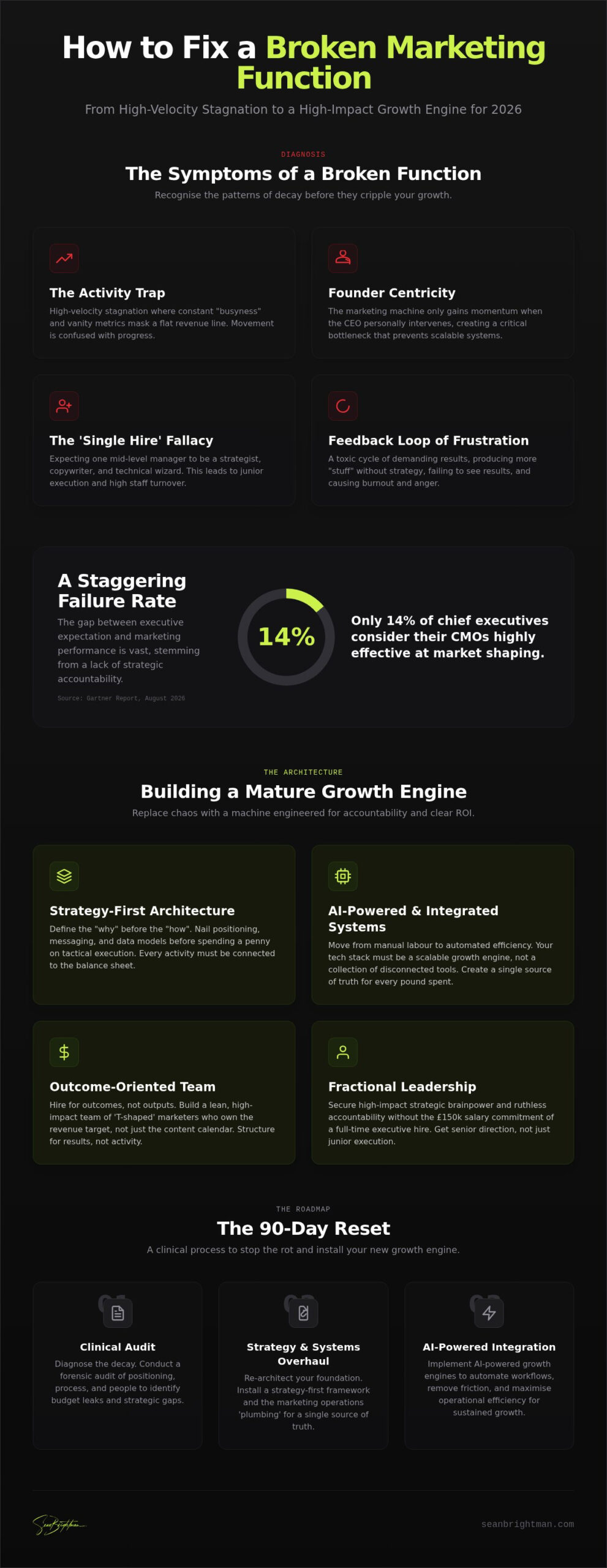
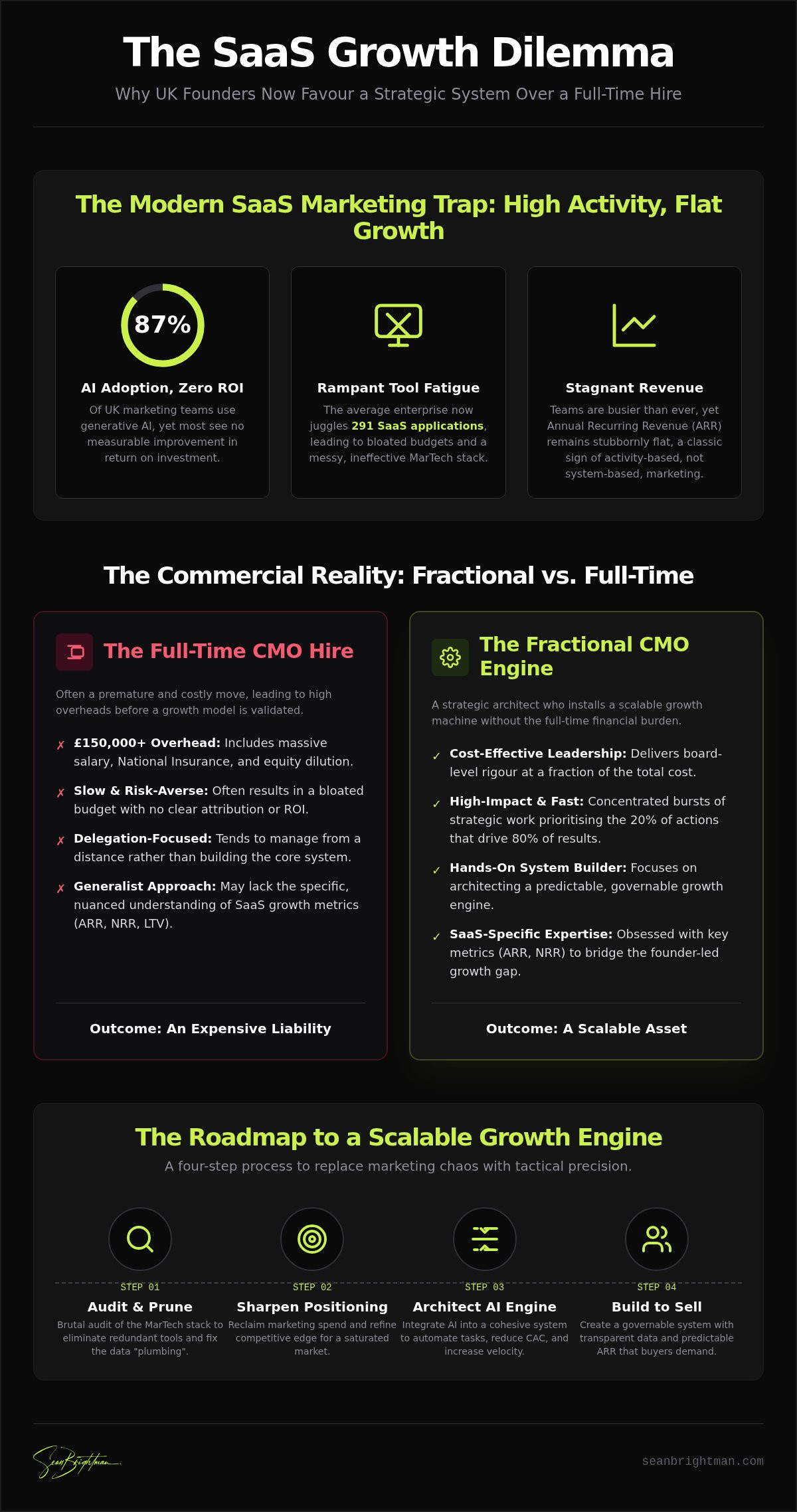
    Hiring a full-time CMO too early is often a £120k mistake. You are paying for a high-level general when you don’t even have a functioning army or a proven system. It’s an expensive way to find out your foundation is cracked. A full-time hire often brings their own favourite tools and “corporate politeness,” which is exactly what a lean scale-up doesn’t need. You don’t need a manager; you need a builder.

    A fractional cmo is different. They build the marketing strategy roadmap and then build the team required to execute it. It’s about building the engine before you hire the full-time driver. You get senior-level authority and “get-your-hands-dirty” expertise without the overhead of a permanent C-suite salary. It is about impact, not attendance.

    Maintaining Strategic Velocity

    Strategy is not a “one and done” event. It’s a process of constant adjustment. Monthly reviews are the heartbeat of a successful roadmap. You need to look at real-world data and course-correct immediately. If the market shifts or a specific tactic fails, you pivot. You don’t wait for the next quarterly board meeting. Speed is useless if you are heading in the wrong direction.

    We operate with a “plug-and-play” mindset. This means high impact and low ceremony. We don’t care about long reports or bureaucratic sign-offs. We care about maximum ROI and building enterprise value. The goal is a marketing department that runs like a machine, delivering predictable growth that makes your business ready for an exit. Stop drawing timelines. Start driving revenue.

    Build the Engine, Don’t Just Draw the Map

    You’ve seen the difference between a static plan and a functional growth machine. A real marketing strategy roadmap is about engineering enterprise value, not just filling a calendar with tasks. By integrating AI as core infrastructure and shifting your focus from raw scale to exit-ready efficiency, you transform marketing from a cost centre into a high-velocity profit engine.

    Your roadmap is a due diligence document. It must prove that your growth is repeatable, scalable, and independent of the founder’s daily input. Without senior oversight to bridge the accountability gap, even the most sophisticated plan will eventually stall. You need a driver who understands the machinery and can provide direct, results-oriented advisory.

    Stop guessing and start building. Leverage senior Fractional CMO expertise and battle-hardened AI strategy to turn your marketing department into a genuine commercial asset. Build your growth engine: Book a strategic roadmapping session with Sean Brightman. It is time to stop chasing tactics and start building a legacy. You have the blueprint; now it’s time to execute.

    Frequently Asked Questions

    What should a marketing strategy roadmap include for a UK tech company?

    A roadmap for a UK tech firm must include brand positioning, marketing operations architecture, and a clear AI integration plan. It is about building an engine, not just a list of tasks. You need a system that handles lead generation whilst ensuring your data remains fully GDPR compliant and scalable for future acquisition.

    How long should a marketing roadmap be?

    Your roadmap should provide a 12-month strategic vision, but execution must happen in 90-day sprints. Planning in detail beyond three months is guesswork in a fast-moving market. A long-term vision keeps the business on course; short-term sprints keep your team moving at high velocity without getting bogged down in bureaucracy.

    What is the difference between a marketing plan and a marketing roadmap?

    A marketing plan is a checklist of activities; a marketing strategy roadmap is the architectural blueprint for your growth machinery. Plans focus on what you are doing. Roadmaps focus on what you are building. One is a list of expenses; the other is the design of a commercial asset.

    Do I need a Fractional CMO to create my marketing roadmap?

    You need a Fractional CMO if you want a roadmap that functions as a high-velocity growth engine. Junior staff can execute tactics, but they lack the senior authority to design complex systems. A Fractional CMO provides the battle-hardened expertise required to build a machine that runs without the founder’s constant input.

    How do I integrate AI into my existing marketing strategy?

    Stop collecting tools and start building infrastructure. Integrate AI by identifying manual bottlenecks in your customer journey and automating them. Your marketing strategy roadmap should treat AI as the core infrastructure of your operations, not a separate set of toys to play with in your spare time.

    How often should a marketing strategy roadmap be updated?

    Update your roadmap monthly to reflect real-world data and sudden market shifts. Static plans die because they cannot adapt to algorithm changes or competitor moves. Monthly course-corrections ensure your strategy remains relevant whilst maintaining the high-impact rhythm needed for scalable, exit-ready growth.

    Why do most marketing roadmaps fail to deliver ROI?

    Most roadmaps fail because there is no one driving the bus. They become decorative documents that lack accountability and clinical measurement. Without a clear owner and a focus on building systems over chasing the latest tactics, your marketing spend will continue to feel like a black hole for cash.

    Can a marketing strategy roadmap help with a business exit?

    A marketing strategy roadmap is a critical asset during a business exit. It serves as a due diligence document that proves your lead generation is a repeatable, scalable system. Buyers pay a premium for businesses where the growth engine is documented and doesn’t rely on the founder’s presence.

  • Strategic Marketing for CEOs: Building Growth Engines, Not Cost Centres

    Strategic Marketing for CEOs: Building Growth Engines, Not Cost Centres

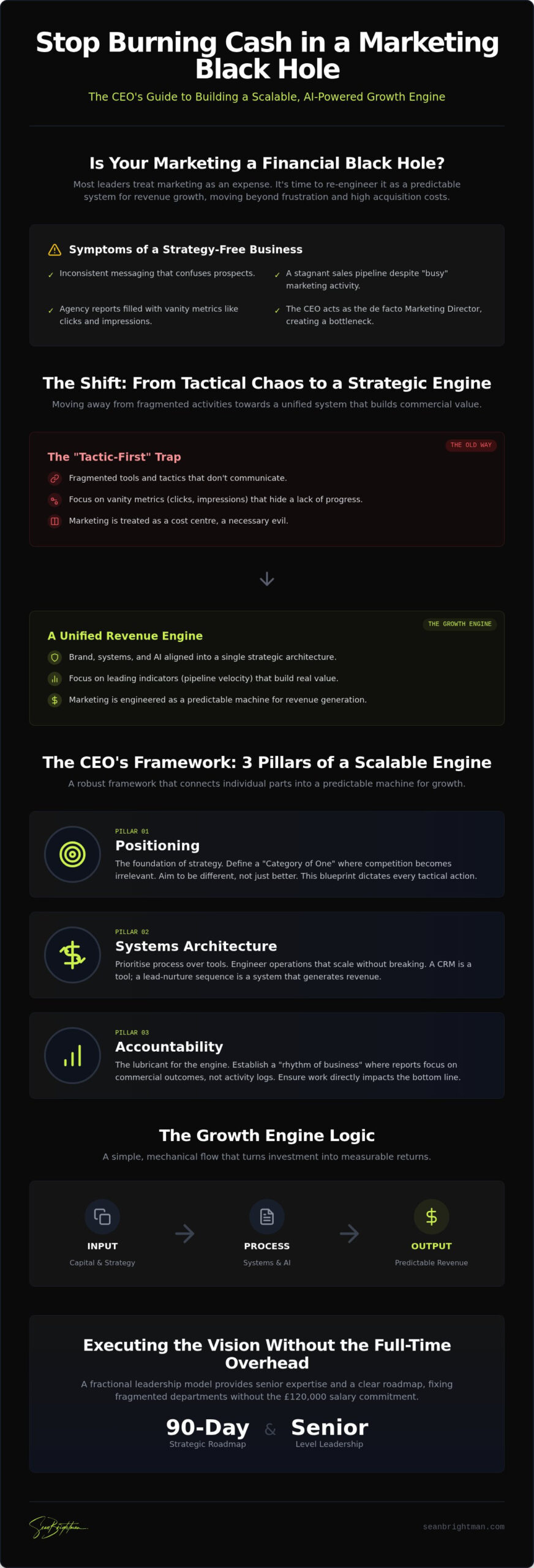
    Marketing is not a creative department. It is a mechanical growth engine that requires strategic engineering, not just tactical activity. Most leaders treat their marketing budget like a black hole of expenditure where cash disappears and “brand awareness” is the only return. You know the frustration of seeing a high Customer Acquisition Cost whilst lacking the senior leadership to fix it. Strategic marketing for CEOs shouldn’t feel like a gamble. It should feel like a well-oiled machine that functions without your constant intervention.

    You are right to be sceptical of the £120,000 salary commitment for a full-time hire. You don’t need another expensive head on the payroll; you need a system that scales. This guide will show you how to transform fragmented tactics into a scalable, AI-powered growth engine that delivers predictable revenue. We will dismantle the confusion surrounding AI implementation and provide a clear roadmap for a marketing function that actually builds equity. We are moving away from “doing more” and focusing on the strategic architecture that facilitates a clear exit strategy.

    Key Takeaways

    • Stop the “tactic-first” trap by aligning brand, systems, and AI into a unified revenue engine.
    • Discover why strategic marketing for CEOs requires prioritising scalable lead-nurture systems over shiny new software tools.
    • Integrate machine learning into your customer acquisition strategy to move beyond tool fatigue and drive predictable growth.
    • Ditch vanity metrics and focus on leading indicators like pipeline velocity to ensure your marketing function builds real commercial value.
    • Implement senior-level leadership and a 90-day roadmap through a fractional model to fix fragmented departments without the full-time overhead.

    Why Strategic Marketing for CEOs is Often a Financial Black Hole

    Marketing is frequently treated as a necessary evil. It is a line item on a spreadsheet that never seems to justify its own existence. This happens because most businesses confuse activity with progress. They hire agencies to “do SEO” or “run ads” without a foundational marketing strategy. It is tactical chaos. Strategic marketing for CEOs is the opposite. It is the deliberate alignment of brand, systems, and AI to drive predictable revenue. If these three pillars aren’t locked together, you aren’t building an engine. You’re just burning cash.

    Jumping into LinkedIn ads or expensive content plays because a competitor did it is a recipe for failure. Without a roadmap, you’re just buying traffic for a leaky bucket. This “Tactic-First” trap leads to high Customer Acquisition Costs and zero scalability. You end up with a collection of fragmented tools that don’t talk to each other and a team that doesn’t know which lever to pull.

    Your team might be busy. They are posting on social media and “optimising” campaigns. But if the revenue isn’t moving, the activity is worthless. A messy marketing department costs more than just the salaries. It costs wasted capital and lost market share. Recognising when your team is “busy” but the needle isn’t moving is the first step toward fixing the machine.

    The Symptoms of a Strategy-Free Business

    Look for the red flags. Inconsistent messaging that leaves your prospects confused. Agencies that send monthly reports filled with “impressions” and “clicks” whilst your pipeline remains stagnant. These are vanity metrics. Perhaps the clearest sign of a failing system is the CEO acting as the de facto Marketing Director. If you are the one approving every LinkedIn post or tweaking ad copy, your system is broken. You have become a bottleneck, not a leader.

    Marketing as an Engine, Not a Department

    Stop viewing marketing as a cost centre. Start viewing it as a mechanical system. A growth engine. The logic is simple: Input (Capital and Strategy) goes into the Process (Systems and AI), which produces the Output (Revenue). Building a scalable growth engine is the core of strategic marketing for CEOs who want to exit or scale without being tethered to daily operations. If the engine is built correctly, it runs without your constant intervention. You own the “Why” and the vision. You delegate the “How” to senior-level experts. This isn’t about spending money. It’s about investing in a functional component of your business that delivers a measurable return.

    The CEO’s Framework: Building a Scalable Growth Engine

    Most leaders buy tools to solve problems. It is a mistake. A tool is a static object. A system is a process. Strategic marketing for CEOs prioritises the latter. A CRM is a tool; a lead-nurture sequence is a system. One is a database; the other is a revenue generator. If you are focused on the software rather than the sequence, you are building a collection of parts, not an engine. You need a framework that connects these parts into a predictable machine.

    This framework relies on three pillars: positioning, systems architecture, and accountability. Without all three, your marketing will remain a fragmented expense. Accountability is the lubricant that keeps the engine running. It requires a “rhythm of business” where reports focus on commercial outcomes rather than activity logs. If your marketing lead isn’t showing you how their work impacts the bottom line, they aren’t managing a growth engine. They are managing a cost centre.

    Positioning: The Foundation of Strategy

    In a crowded market, “being better” is a losing strategy. It is subjective and expensive to prove. “Being different” is the only win. You must define a “Category of One” where competition becomes irrelevant because your offering is incomparable. This is the difference between fighting for scraps and owning the table. Brand positioning is the mechanical blueprint that dictates every tactical action, campaign, and customer interaction within your growth engine. You can learn more about turning these assets into profit in this guide on strategic marketing for CEOs.

    Systems Architecture: Engineering Predictability

    Engineering a system means designing operations that scale without breaking. This is vital for Marketing Strategy for Tech Companies where high-growth targets often outpace internal capabilities. You need to eliminate the friction in the sales-marketing handoff. If your sales team is ignoring leads, your system is broken. In 2026, this architecture must include a clear AI marketing roadmap to automate repetitive tasks and optimise your acquisition costs.

    Building this level of precision takes more than just a few meetings. It requires a battle-hardened expert who knows where the bottlenecks hide. If you are ready to stop guessing and start building, a strategic roadmapping session can provide the clarity you need to move forward.

    AI Strategy for CEOs: Strategy Over Tool Fatigue

    Stop playing with tools. If your marketing team is “experimenting” with ChatGPT without a commercial objective, they are wasting your time and capital. Strategic marketing for CEOs isn’t about having the most subscriptions; it’s about having the most effective systems. By March 2026, 80% of marketing professionals reported using AI and automation in their workflows. The novelty has evaporated. AI is now a functional component of the growth engine, not a laboratory experiment. It should be used to optimise customer acquisition through machine learning, not just to generate mediocre blog posts.

    The trap is focusing on efficiency over effectiveness. AI can help you do things faster, but doing the wrong things faster just accelerates your failure. You don’t need “more” content; you need better conversion. You don’t need “more” leads; you need higher pipeline velocity. Your role as CEO is oversight. You must ensure that AI integration respects brand integrity and ethical standards. A bot hallucinating your value proposition is a liability, not an asset. You own the “Why” and the brand’s soul; the AI handles the mechanical “How”.

    Integrating Intelligence into Operations

    Intelligence belongs in your operations, not just your copy. Moving from manual workflows to automated, intelligent systems is how you scale without linear head-count growth. Specific AI consulting can identify the “low-hanging fruit” where automation provides immediate ROI. This might be lead scoring, predictive churn analysis, or hyper-precision segmentation. AI-driven data analysis reduces the cost of experimentation by identifying winning patterns in days rather than months. It turns your marketing from a series of guesses into a sequence of calculated moves.

    The AI Roadmap: A 2026 Necessity

    You cannot wing it. A structured AI roadmap is a 2026 necessity for any business serious about growth. This plan ensures every tool you adopt is tied directly to a commercial KPI. It prevents “Shiny Object Syndrome” by forcing every new technology to justify its place in the engine. Strategic marketing for CEOs requires future-proofing the organisation against rapid technological shifts. By building a flexible, AI-powered architecture now, you ensure that your business remains a leader whilst competitors are still trying to figure out their login details. It is about building a system that runs on data, not just hope.

    Strategic Marketing for CEOs: Building Growth Engines, Not Cost Centres

    Accountability: The Metrics That Actually Move the Needle

    Marketing reports are often a collection of polite fictions. They focus on impressions, likes, and “engagement” because these numbers are easy to inflate. For a leader, these are vanity metrics. They don’t pay the bills. Strategic marketing for CEOs requires a radical shift in focus toward data that actually drives commercial value. You need to distinguish between lagging and leading indicators. Revenue is a lag indicator; it tells you what happened last month. Pipeline velocity is a leading indicator; it tells you if you’ll hit your targets next quarter.

    Marketing Efficiency Ratio (MER) should be your favourite metric for assessing overall engine health. This is simply your total revenue divided by your total marketing spend. It provides a high-level view of how hard your capital is working. Within the UK scale-up context, you must also master the relationship between Customer Acquisition Cost (CAC) and Lifetime Value (LTV). A healthy benchmark for this ratio is 3:1 or 4:1. If your ratio is lower, your engine is inefficient. If it is significantly higher, you are likely under-investing and leaving growth on the table. Kill the reports that don’t show this commercial reality.

    The £120k Marketing Hire Mistake

    Many CEOs rush to hire a full-time CMO with a £120,000+ salary commitment before they have a proven roadmap. This is a tactical error. You end up hiring a “doer” who executes fragmented tasks, when you actually needed an “architect” to design the system. Until the engine is built and the metrics are predictable, a full-time executive is an unnecessary overhead. You don’t need a permanent head; you need a blueprint. You can find more on this in my analysis of a Marketing Strategy Consultant vs Agency.

    The Advisory Retainer: Ongoing Accountability

    A Marketing Advisory Retainer provides the senior-level oversight that most scale-ups lack. It establishes a “rhythm of business” where strategy is reviewed and refined constantly. We set quarterly “Big Rocks”, which are high-impact objectives that move the needle, and ignore the noise. This creates a culture of radical honesty. There is no hiding behind vague reports. If a tactic isn’t working, we kill it and reallocate the capital. It is about maintaining strategic velocity whilst keeping the team accountable to the commercial vision. You get the expertise without the ego or the excessive salary.

    Ready to stop guessing and start measuring what matters? Let’s build your growth engine today.

    Executing the Vision: Fractional Leadership and Roadmapping

    You have the vision. Your team has the tasks. But there is a disconnect. This gap is where growth dies. Bridging it requires more than just “better communication”. It requires an architect. Strategic marketing for CEOs is about moving from tactical chaos to strategic velocity. It is about building a functional system that actually executes your commercial goals instead of just checking boxes. You need a bridge between high-level ambition and ground-level activity.

    A Fractional CMO is the mechanical solution to this problem. This is senior leadership without the full-time overhead. You get the battle-hardened expertise of a veteran strategist on a part-time basis. It is a plug-and-play model. You don’t need to manage them; they manage the engine for you. This is about results, not recruitment. You aren’t buying a person; you are buying a process that delivers predictable revenue.

    Your 90-Day Strategic Roadmap

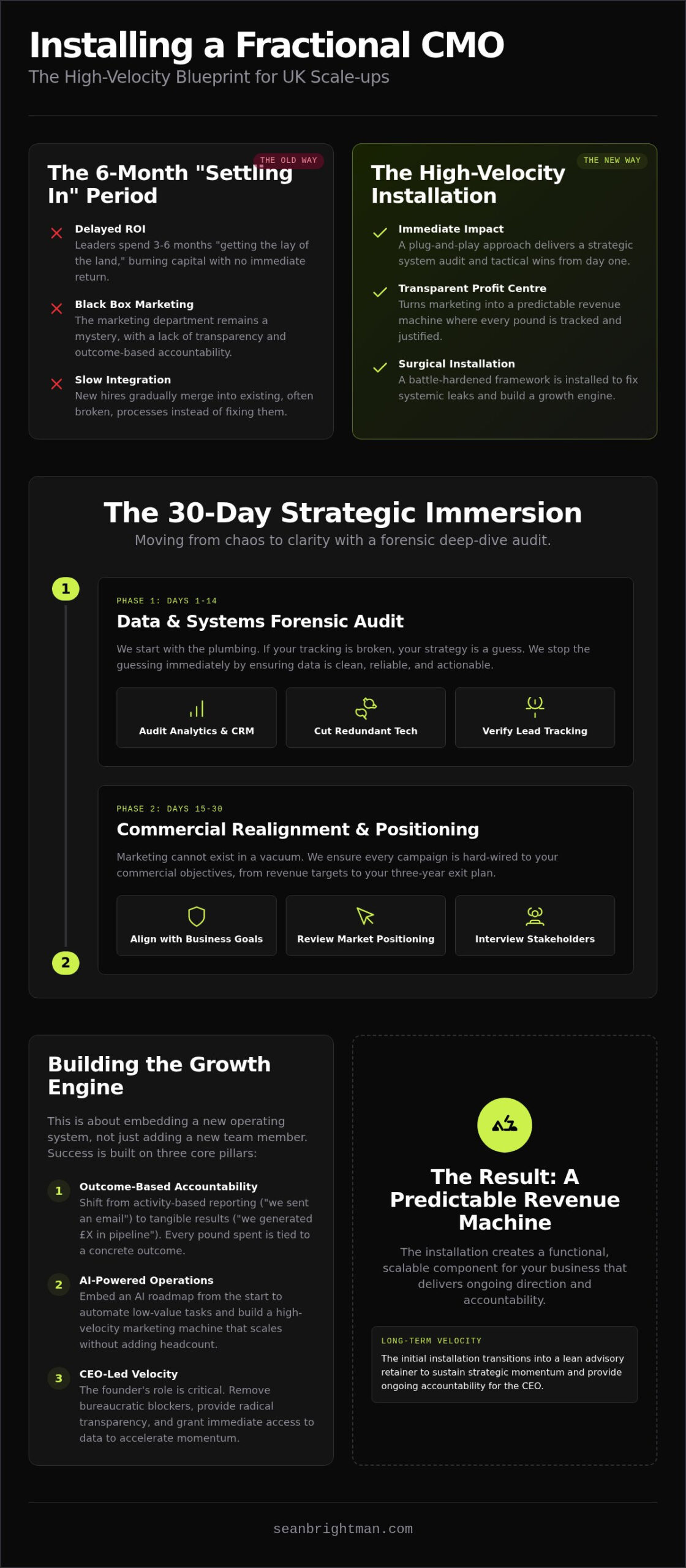
    We don’t guess. We engineer. A 90-day roadmap provides the clinical clarity needed to fix the mess and start growing. It is a time-boxed intervention designed for maximum impact. It replaces the “hope and pray” method with a mechanical sequence of events. If you want to understand how a marketing strategy roadmap built for exit-ready growth differs from a standard plan, the principles below will make that distinction clear.

    • Phase 1: Audit and Diagnostics. We find the leaks in your engine. We strip back the reports to find where capital is being wasted and where the real opportunities for growth hide.
    • Phase 2: Positioning and Architecture. We build the blueprint. We define your “Category of One” to eliminate competition and design the lead-flow machinery that supports it.
    • Phase 3: Execution and Optimisation. We turn the key. We launch the systems, integrate the AI, and refine the process based on real-world revenue performance.

    This isn’t a theoretical exercise. It is a functional plan. You move from wondering what your marketing team does all day to knowing exactly how the machine works. It provides the order needed to scale without the usual friction of expansion.

    The Fractional Revolution

    UK scale-ups are changing their behaviour. They are realising that the old model of hiring a full-time executive is slow, expensive, and risky. You should Stop Hiring Full-Time CMOs until your growth engine is fully built and tested. In 2026, the smart move is to access high-level AI and strategic expertise through fractional leadership.

    This model allows you to scale your leadership as you scale your business. You get a seasoned professional who focuses on commercial outcomes, not office politics. It is about impact, not attendance. Strategic marketing for CEOs is finally becoming accessible to businesses that aren’t yet ready for a £120,000+ hire but are desperate for those results. Stop managing a department. Start leading an engine.

    From Tactical Chaos to Strategic Velocity

    Your marketing budget is either a cost or an investment. If it feels like a black hole, the engine is broken. We’ve established that strategic marketing for CEOs requires a shift from fragmented tactics to a connected system of brand, AI, and accountability. You don’t need another expensive hire to manage the mess. You need a blueprint that delivers predictable revenue and a clear path to exit. If you are planning that exit, understanding how to build a marketing strategy for business exit that acquirers will trust is the difference between a mediocre multiple and a premium valuation.

    I provide battle-hardened UK strategic expertise to help you stop the guesswork. As an AI-powered growth specialist and the author of the definitive book on marketing strategy, I focus on building functional systems that run without your constant intervention. It is time to strip away the fluff. It is time to engineer a department that actually moves the needle and builds real equity in your business.

    Ready to take the next step? Build your growth engine with a Fractional CMO Roadmap and turn your vision into a scalable commercial reality. You have the ambition. Now, get the machine to match it.

    Frequently Asked Questions

    What is the difference between marketing tactics and marketing strategy?

    Strategy is the blueprint; tactics are the hammers. Strategy defines your “Category of One” and the commercial destination of your business. Tactics are the individual actions like running a LinkedIn ad or writing a blog post. Jumping into tactics without a strategy is just expensive guesswork that leads to a financial black hole.

    How much should a CEO be involved in marketing strategy?

    Own the vision; delegate the execution. You must define the commercial goals and the brand’s soul. You shouldn’t be approving social media posts or tweaking SEO keywords. Your involvement ends at setting the “Why” and demanding absolute accountability for the commercial “What”.

    What are the most important marketing KPIs for a CEO to track?

    Track the metrics that impact equity and cash flow. Focus on Marketing Efficiency Ratio (MER) and pipeline velocity. These tell you how hard your capital is working. Ignore vanity metrics like impressions or likes. If a metric doesn’t move the commercial needle, it doesn’t belong in your report.

    Why do most marketing agencies fail to deliver strategic results?

    Agencies sell hammers; they don’t build houses. Most agencies are tactical specialists in a single area. They aren’t incentivised to look at your broader business model or unit economics. They focus on their own activity reports rather than your bottom-line growth and long-term equity.

    When should a CEO hire a Fractional CMO instead of a full-time leader?

    Hire a Fractional CMO when you need senior leadership without the £120,000+ overhead. It is a plug-and-play model for scale-ups. Use them to build the growth engine and the roadmap before you commit to the risk and cost of a permanent executive hire.

    How can AI improve the ROI of my marketing strategy in 2026?

    AI drives ROI through mechanical precision and predictive analysis. It optimises customer acquisition by identifying winning patterns in data that human teams miss. In 2026, strategic marketing for CEOs uses AI as a functional component for hyper-personalisation. It turns your marketing from a series of guesses into a data-driven science.

    What is a marketing strategy roadmap and why do I need one?

    A roadmap is a 90-day execution blueprint. It provides the order needed to scale without the usual friction of expansion. You need one to stop tactical chaos and ensure every action your team takes is tied directly to a commercial KPI or a revenue milestone. For a deeper breakdown of how to construct one that drives enterprise value, explore this guide on building a marketing strategy roadmap that drives exit-ready growth.

    How do I hold my marketing team accountable for revenue, not just activity?

    Demand leading indicators, not activity logs. Stop asking what the team did; ask what the team achieved in terms of pipeline growth. Establish a culture of radical honesty where underperforming campaigns are killed immediately and capital is reallocated to systems that actually work.

  • Tips for Sean Brightman Success: How to Maximise Your Marketing ROI in 2026

    Tips for Sean Brightman Success: How to Maximise Your Marketing ROI in 2026

    Your marketing department is a black hole. You pour capital into a void and wait for a return that never materialises. Most UK firms think the answer is a full-time CMO, but that’s a high-risk gamble that usually leads to expensive stagnation. You don’t need more overhead. You need a system. The Sean Brightman client onboarding process is built to strip away the corporate politeness and install a functional growth engine immediately.

    It’s time to stop guessing. You want a marketing department that functions like a well-oiled machine, not a source of constant frustration. This guide is a blunt, high-impact roadmap for navigating fractional leadership and practical AI integration in 2026. We will explore how to build accountability within your internal teams and turn confusing AI hype into a tactical advantage. By the end, you’ll understand how a structured AI roadmap and an advisory retainer create the clarity your business has been missing.

    Key Takeaways

    • Stop wasting £120k on full-time CMOs that your growth-stage business doesn’t need yet; choose senior fractional leadership instead.
    • Master the Sean Brightman client onboarding blueprint to install a systems-based growth engine rather than chasing random, disconnected activities.
    • Treat AI as a mechanical component for high-velocity growth, focusing on operational efficiency first before you attempt to scale.
    • Prioritise a tactical roadmap as your first engagement step to ensure every marketing pound spent drives a measurable return.
    • Use an advisory retainer to bridge the gap between strategy and execution through consistent monthly direction and accountability.

    The £120k Mistake: Why Senior Marketing Leadership is Not a Full-Time Hire

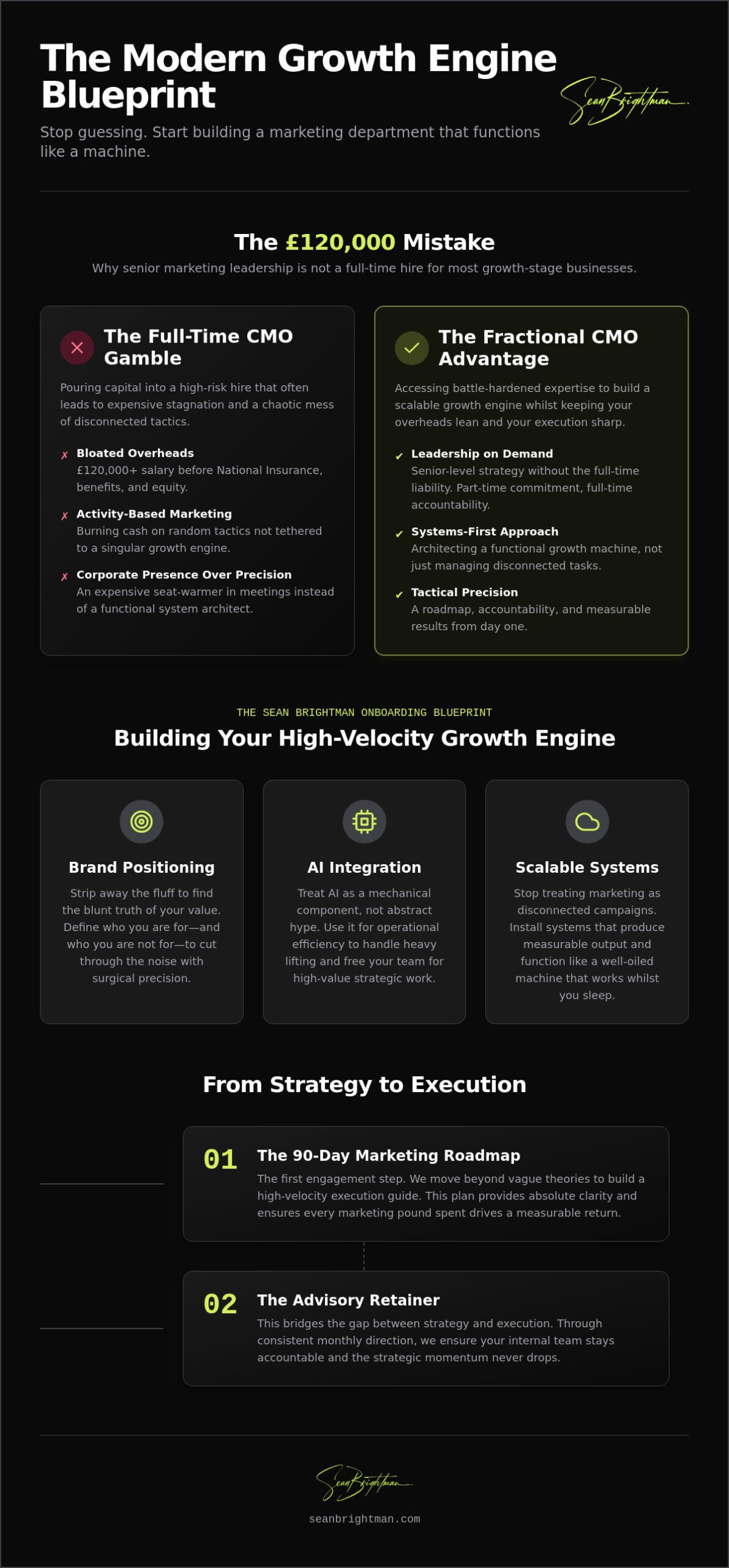
    Hiring a full-time CMO in a growth-stage business is often a £120,000 mistake. That is before you factor in the National Insurance, the benefits, and the equity. You are paying for a heavy-hitter to sit in meetings whilst your actual marketing remains a chaotic mess of disconnected tactics. Most UK scale-ups do not have a leadership volume problem; they have a systems problem. The Sean Brightman client onboarding experience is designed to stop this haemorrhage of capital immediately. You need senior-level strategy, not an expensive seat-warmer.

    The “Fractional Revolution” is about accessing battle-hardened expertise without the bloated salary. It is a plug-and-play solution for the “messy marketing department” problem. You don’t need a full-time salary. You need a full-time brain. By shifting to a fractional model, you secure the high-level thinking required to build a scalable growth engine whilst keeping your overhead lean and your execution sharp.

    The Problem with Activity-Based Marketing

    Activity is not progress. Your team might be posting on LinkedIn, sending newsletters, and running PPC ads, but if these aren’t tethered to a singular growth engine, you’re just burning cash. This is the trap of doing more to achieve less. A marketing manager executes tasks; a strategic CMO architects systems. Without that architecture, your Return on marketing investment (ROMI) will remain a mystery. You must break the cycle of agency dependency and tactical fluff. Strategy first, then execution. Results, not just reports.

    Fractional CMO: Leadership on Demand

    The role is simple: part-time commitment, full-time accountability. This is leadership on demand. For UK firms seeking rapid growth, the fractional model provides a senior partner who has seen the chaos before and knows the exit route. It is about tactical precision over corporate presence. You get the roadmap, the accountability, and the results without the long-term liability of a six-figure hire. It’s time to stop hiring full-time CMOs and start investing in strategic momentum that actually scales. The Sean Brightman client onboarding process ensures that from day one, your marketing is treated as a mechanical component of your business, not an abstract theory.

    The Sean Brightman Onboarding Blueprint: Positioning, AI, and Systems

    Most onboarding processes are a slow-motion car crash of vague introductions and “getting to know you” coffees. They lack teeth. The Sean Brightman client onboarding blueprint is different. It is a clinical extraction of the rot within your current strategy. We move beyond corporate speak to visceral, tactical precision. It is about identifying exactly where the marketing engine is stalling and fixing it in real-time. We don’t do fluff. We do results.

    Success rests on three non-negotiable pillars: Positioning, AI integration, and Scalable Systems. We don’t build abstract theories. We build a 90-day Marketing Roadmap that provides absolute clarity for your leadership team. This plan isn’t a suggestion; it’s a high-velocity execution guide. Once the roadmap is live, the Advisory Retainer ensures your internal team stays accountable and the strategic momentum never drops. It’s about building a system that functions like a well-oiled machine.

    Brand Positioning That Cuts Through the Noise

    Positioning is the foundation of every high-performing marketing engine. If your brand sounds like everyone else, you’ve already lost. We strip away the fluff to find the blunt truth of your value proposition. It is a binary identity: this, not that. We define who you are for and, more importantly, who you are not for. This clarity allows your messaging to cut through the noise with surgical precision. Most businesses are too close to their own product to see the obvious. We provide the external force needed to sharpen that focus.

    Building Scalable Marketing Systems

    Stop treating marketing as a series of disconnected campaigns. It is a machine. Every component must serve the whole. By focusing on building a scalable growth engine, we install systems that produce measurable output. We leverage AI-powered tools to handle the heavy lifting, ensuring your team focuses on high-value strategy rather than repetitive manual labour. Accountability is the fuel for this machine. Without measurable data, you’re just guessing. If you want a system that works whilst you sleep, you need to view the roadmapping options to define your architecture. The Sean Brightman client onboarding process ensures your operations are ready for the demands of 2026.

    AI Consulting: Integrating a High-Velocity Growth Engine

    AI is a mechanical component. It is not an abstract theory or a plaything for your marketing team to “test” during their downtime. If you’re just playing with ChatGPT, you’re missing the point. The Sean Brightman client onboarding process treats AI as a functional gear in your growth machine. We don’t focus on the hype. We focus on movement and tactical precision. It is about building an engine that produces results, not just prompts.

    The approach is simple: efficiency first, then scale. Most businesses fail at AI implementation because they try to automate a broken process. That just makes the failure happen faster. We audit your existing workflows, identify the friction, and install AI systems to remove it. This isn’t about replacing humans. It’s about giving your team high-velocity tools that actually produce a return. We move from curiosity to integrated AI-powered growth engines that run whilst you focus on high-level strategy.

    Strategic AI Roadmapping

    Strategic AI roadmapping is the first tactical step in any engagement. We identify high-impact areas where AI integration can accelerate your marketing ops immediately. This isn’t a theoretical report that sits in a drawer. It is a “get-your-hands-dirty” tech implementation plan. We focus on two primary levers to drive momentum:

    • Content Velocity: Using AI to produce high-quality, on-brand content at a speed that manual processes cannot match.
    • Predictive Analytics: Moving from “what happened” to “what will happen” by analysing data patterns to forecast lead behaviour and intent.

    The Human Component of AI Success

    Success requires training your team to work amongst AI systems, not against them. Automation is useless if your team doesn’t know how to drive the machine. We focus on maintaining your unique brand voice and “colour” whilst automating the heavy production work. AI handles the volume; humans handle the nuance. It is about augmentation, not just automation.

    The role of the Fractional CMO is to oversee this transformation. I ensure the technology serves the strategy, not the other way around. Most AI projects fail because they lack senior-level oversight and accountability. The Sean Brightman client onboarding journey ensures your staff are equipped to manage this new, high-velocity reality from day one. We build the system, train the operators, and then hit the accelerator. This is how you win in 2026.

    Tips for Sean Brightman Success: How to Maximise Your Marketing ROI in 2026

    5 Critical Tips for Sean Brightman Client Onboarding Success

    Most consulting engagements fail because they lack a clear operating manual. They drift into vague discussions and “alignment” meetings that produce nothing but a higher bill. To get the most out of the Sean Brightman client onboarding experience, you need to shift your mindset. Stop hiring a vendor. Start installing a strategic partner. This is about movement, not maintenance. Here is how to ensure your marketing engine hits top speed from day one.

    Tip 1: Demand Accountability, Not Just Reports

    Stop looking at vanity metrics. Likes, shares, and impressions don’t pay the bills. You need to focus on growth levers that actually move the needle. The Advisory Retainer is built for senior-level oversight, providing monthly accountability for your internal team. This requires blunt honesty. If a tactic isn’t working, we kill it. If it is, we double down. No ego, just execution. You want results, not just a colourful PDF at the end of the month.

    Tip 2: Start with the Roadmap

    Don’t rush into a long-term retainer. A one-off roadmapping session is the most efficient entry point for any business. We define your 90-day objectives before committing to a permanent relationship. This ensures your internal team is actually ready for strategic direction. It is a trial by fire. It establishes whether your business has the stomach for real growth. Build the architecture first. Hire the builder second.

    Beyond the initial strategy, success requires a shift in how you view your marketing department. Consider these three additional pillars:

    • Focus on Systems Over Campaigns: Campaigns are fleeting; systems are permanent. We build the machinery that makes your marketing predictable and scalable.
    • Integrate AI into Your Core Machinery: AI is not a toy for your social media manager. It must be woven into your operational fabric to drive efficiency and speed.
    • Read “The Book” Before You Start: I have already published the framework. Reading it ensures we start from a place of shared tactical language and high-velocity expectations.

    The Sean Brightman client onboarding process is designed to be high-impact and low-friction. We don’t have time for bureaucracy. We have work to do. If you are ready to stop the guesswork and start building a scalable growth engine, you need to book your initial Roadmapping session today and define your 90-day objectives.

    The Advisory Retainer: Securing Long-Term Strategic Momentum

    A roadmap is a document; a retainer is a pulse. One defines the destination whilst the other provides the fuel to get there. The Sean Brightman client onboarding process doesn’t end when the strategy is delivered. It evolves. The Advisory Retainer bridges the gap between that initial high-level vision and the grit of daily execution. It is about monthly direction and relentless accountability for the business owner. You aren’t paying for a consultant to tell you what you already know. You are paying for a senior leader to ensure the work actually gets done.

    This model is unapologetically plug-and-play. It provides the senior-level oversight your internal team lacks without the permanence of a full-time contract. Fractional leadership offers the flexibility to scale up or down as your business dictates. If you hit a period of rapid expansion, the intensity increases. If you need to consolidate, we pull back. It is about tactical precision, not bloated commitments. We install the system, monitor the output, and adjust the gears in real-time.

    What to Expect in the First 90 Days

    The first 90 days represent a transition from chaos to order. We start with a clinical audit and an immediate restructuring of your current activities. If a tactic doesn’t serve the growth engine, we scrap it. This period marks the end of founder-led marketing. Founders are often the biggest bottleneck in their own growth. By shifting to a CMO-led strategy, you free yourself to lead whilst I focus on the machinery of revenue. We set the pace for a high-impact, results-oriented culture where data beats opinion every single time.

    Ready to Organise Your Marketing?

    Stop waiting for the “right time” to fix your marketing. That time passed six months ago. You can start by educating your leadership team with “The Book,” which outlines the exact frameworks we use to drive success. Once you understand the language of systems-based growth, the next step is a formal engagement. Whether you need a deep-dive strategy or ongoing advisory support, the process starts with clarity. It is time to stop the guesswork and start the execution. You can book a Strategic Roadmap Session with Sean Brightman to define your 90-day objectives and begin the Sean Brightman client onboarding journey today. Let’s get to work.

    Install Your 2026 Growth Engine Today

    Marketing in 2026 isn’t about hope; it’s about architecture. You’ve seen why the full-time CMO model is often a relic and how AI-powered systems replace manual friction. Success requires a shift from random activity to a structured, systems-based approach. The Sean Brightman client onboarding process is the clinical first step in that transformation. It moves your business from founder-led chaos to senior-level, fractional leadership with a clear, tactical roadmap.

    As a published author on marketing strategy and a specialist in AI roadmapping for UK scale-ups, I don’t offer abstract theory. I offer a plug-and-play growth machine. You get the accountability of an advisory retainer and the precision of a battle-hardened expert who remains active in the field. Don’t let your marketing remain a black hole of expenditure. It’s time to build something that actually scales and delivers a measurable return.

    Build Your AI-Powered Growth Engine with Sean Brightman

    The machinery is ready. You just need to hit the switch and lead your market with confidence.

    Frequently Asked Questions

    What exactly does a Fractional CMO do for a UK business?

    A Fractional CMO provides senior marketing leadership on a part-time basis. It is about strategy, not just activity. I focus on building the systems and growth engines that allow your internal team to execute with precision. You get the accountability of a board-level director without the six-figure overhead or the long-term liability of a full-time hire.

    How does an AI consulting session differ from a standard marketing audit?

    A standard audit identifies what is broken in your current funnel. An AI consulting session identifies where to install mechanical components to accelerate that funnel. We look for high-impact automation opportunities that drive content velocity and predictive accuracy. It is a tactical implementation plan, not just a list of problems to be discussed in meetings.

    What is the cost benefit of a Fractional CMO vs a full-time hire?

    You avoid the heavy financial burden of a £120,000 annual salary plus National Insurance and benefits. Fractional leadership allows you to access senior-level expertise for a fraction of the cost. It is a more efficient use of capital for growth-stage firms that need direction but don’t require forty hours of a CMO’s time every week.

    Can Sean Brightman help with recruitment for my marketing team?

    I do not offer recruitment agency services. My role is to lead and manage your existing internal team or external agencies. I provide the strategic roadmap and the accountability required to make your current staff more effective. If you need new hires, I can define the requirements for those roles, but the recruitment process itself remains your responsibility.

    How long does it take to see results from a Strategic Roadmap?

    The Sean Brightman client onboarding process establishes a 90-day execution plan immediately. You get absolute clarity on your objectives within the first week. Whilst long-term growth takes time to build, the shift from chaos to a structured, systems-led approach happens the moment the roadmap is finalised. Results begin with the first tactical execution.

    Is the Advisory Retainer suitable for small businesses or just scale-ups?

    The Advisory Retainer is designed for scale-ups and established firms with internal teams. You need people on the ground to execute the strategy I provide. Small businesses without a marketing function may find the roadmap useful, but the ongoing retainer requires an existing engine to manage and optimise. It is about scale, not just starting out.

    What industries does Sean Brightman specialise in?

    I specialise in high-value, strategic sectors where growth depends on complex systems rather than simple impulse buys. This includes B2B services, technology, and professional services across the UK. If your marketing feels like a black hole of expenditure, my systems-based approach will likely fix it regardless of your specific niche or industry sector.

    How does AI integration improve my marketing efficiency?

    AI integration removes manual friction from your production cycle. It allows for higher content velocity and better data-driven decision-making through predictive analytics. During the Sean Brightman client onboarding, we identify the exact gears where AI can replace repetitive labour. This allows your team to focus on high-level strategy whilst the machine handles the volume and routine tasks.

  • Building an AI Growth Engine: How Sean Brightman Transforms Marketing in 2026

    Building an AI Growth Engine: How Sean Brightman Transforms Marketing in 2026

    Most marketing departments in 2026 are just expensive factories for activity that produces zero profit. You’re likely watching your budget bleed into unoptimised campaigns whilst your team hides behind vague metrics and busy work. It’s a mess. Building an AI growth engine isn’t about buying another software subscription or chasing the latest chatbot trend. It’s about mechanical precision. You need a system that works whilst you sleep, not a group of people guessing with your capital.

    I understand the frustration of seeing 30% of your martech budget vanish into tools that nobody actually knows how to use. You want results, not reports. This article shows you how to install a high-performance, AI-powered growth engine that replaces internal chaos with senior-level accountability. We will break down the strategic roadmap Sean Brightman uses to transform bloated departments into lean, automated machines designed for a clean exit or a massive scale-up. It’s time to stop funding activity and start engineering growth.

    Key Takeaways

    • Stop wasting capital on the “£120k mistake” and learn why random marketing acts are killing your margins.
    • Discover the exact mechanics of building an AI growth engine to replace manual chaos with automated, senior-level precision.
    • Understand how a plug-and-play Fractional CMO installs functional systems instead of just delivering empty reports.
    • Learn why an Advisory Retainer protects your budget whilst traditional agencies are incentivised to spend it.
    • Prepare your data and mindset for blunt, strategic accountability that drives rapid progress toward a scale-up or exit.

    The Messy Marketing Trap: Why Your Current Strategy Needs Improving

    Most UK marketing departments are a collection of random acts. They aren’t systems. They’re expensive hobbies funded by your profit margins. You see a flurry of activity, social posts, and “brand awareness” campaigns, yet the revenue needle barely moves. This is the messy marketing trap. It’s a cycle of unoptimised spend and zero accountability that drains CEO energy whilst providing no clarity on ROI. You’re left guessing which 50% of your budget is actually working.

    Then there’s the “£120k Mistake”. Many founders think hiring a full-time CMO is the immediate solution. It’s usually the opposite. Hiring a heavy-hitter too early stalls growth and drains capital. You pay a six-figure salary for a leader who has no engine to drive. They spend six months “analysing” and the next six months hiring a team. By year two, you’ve spent £250k and have a bigger payroll but the same stagnant results. Building an AI growth engine requires a different approach. You need a functional system first, not a bloated headcount.

    Identifying the Symptoms of a Stagnant Marketing Engine

    Your marketing is stagnant if lead quality is a lottery. If revenue growth feels unpredictable, your engine is broken. Look for these specific red flags amongst your team:

    • Tool Obsession: Prioritising shiny tech over core strategy.
    • Activity over Results: Teams that are “busy” but can’t show a direct line to profit.
    • Strategic Amnesia: Losing tactical momentum every time a mid-level manager resigns.

    When people leave, they take the strategic memory with them. You’re left starting from zero every eighteen months. It’s expensive and exhausting.

    The Cost of Inaction: Why “Business as Usual” is Failing

    In 2026, “business as usual” is a death sentence. Outdated behaviours prevent businesses from adopting Artificial intelligence in marketing effectively. Teams are often too busy with manual tasks to integrate intelligence. Corporate politeness is another silent killer. It prevents blunt decision-making. Your first hire shouldn’t be an agency looking to spend your budget. It must be a strategist who owns the engine. Stop funding activity. Start engineering results.

    How Sean Brightman Improves Your Business: The Fractional Framework

    A Fractional CMO is not a part-time temp. It’s senior-level leadership injected exactly where your business is bleeding. Sean Brightman doesn’t produce reports to sit in a drawer. He installs functional systems. Advice is easy. Execution is hard. Architecture is where the money is made. We’re moving your business from tactical chaos to a scalable growth engine for 2026. This requires blunt honesty. If your current strategy is failing, I’ll tell you. No corporate politeness. No fluff. Just the bottom line.

    Sean doesn’t just consult. He integrates. Most consultants leave you with a PDF and a bill. That’s useless. I focus on building an AI growth engine that remains in your business long after the engagement ends. This is about building internal capability. It’s about moving away from a reliance on external agencies who are incentivised to keep you spending. We’re building a machine. Machines need engineers, not just observers. If you want to stop guessing, exploring a Fractional CMO partnership is the logical next step.

    The Fractional CMO Advantage for UK Scale-ups

    You get senior-level expertise without the £200,000 annual price tag. Most UK scale-ups don’t need a full-time executive yet. They need a “plug-and-play” leader who can architect the brand positioning and fix the marketing systems. This is about the impact of AI on business sustainability. If your marketing doesn’t link directly to long-term growth, it’s just an expense. A fractional leader scales with you. You get the brain without the overhead. It’s a surgical strike instead of a war of attrition.

    Leadership vs Execution: What You Are Actually Buying

    Don’t hire a strategist to run your LinkedIn ads. You’re buying a roadmap. You’re buying the Fractional Revolution within your own structure. Sean focuses on high-level strategy and accountability. He makes sure your existing team and external agencies actually deliver. Building an AI growth engine isn’t about doing the work yourself. It’s about engineering the workflow so the work does itself. This is about senior-level oversight that doesn’t blink when things get difficult.

    Accountability is the missing ingredient in most UK marketing teams. Mid-level managers are often too close to the activity to see the lack of results. A fractional leader provides the external force needed to drive change. It’s about setting the standard and making sure it’s met. Every single week. We strip away the bureaucracy and focus on the levers that actually drive revenue.

    Building an AI Growth Engine: Integrating Intelligence into Operations

    AI is a mechanical component. It isn’t a magic wand. You don’t just “buy” AI; you engineer it into your business. Most UK leaders think playing with ChatGPT is “doing AI”. It’s not. It’s just typing. Building an AI growth engine means integrating intelligence into the very fabric of your operations. It means building workflows that learn. It means removing the human bottleneck from repetitive tasks. Sean Brightman doesn’t just suggest tools. He installs the architecture that turns data into a competitive advantage.

    The goal is a self-improving marketing machine. You want a system that identifies high-intent leads whilst your competitors are still manually sorting through spreadsheets. This isn’t about futuristic theory. It’s about practical, tactical implementation that delivers measurable revenue. We move beyond simple prompts to automated, self-correcting operations. If your marketing doesn’t get smarter every week, it’s just a cost centre.

    Integrating Intelligence into Marketing Operations

    Automate the mundane. Free your team for the high-level brand work that actually converts. We’re talking about automated lead scoring and precise behaviour analysis that predicts what your customers want before they know it. You need to focus on building authority for AI engines so your brand is the one they cite and recommend. A growth engine operates with tactical precision even whilst you sleep. It’s the difference between a slow, manual process and a high-speed automated factory.

    The CEO’s Guide to AI Implementation

    Why do AI projects fail? Usually, it’s a lack of strategic oversight. CEOs buy the software but don’t change the underlying system. This is where the Advisory Retainer comes in. It provides the ongoing direction to ensure your AI-powered growth stays on track. We don’t guess. We audit. A rigorous marketing efficiency audit finds the hidden profit in your current spend. We identify where your budget is being set on fire and redirect it into the engine.

    Building an AI growth engine is a clinical, structured process. It requires a strategist who understands the machinery, not just the buzzwords. We create a roadmap that moves you from messy internal systems to senior-level precision. This isn’t a project with a finish line. It’s an evolution of how you do business. Stop chasing the next shiny tool. Start building the system that makes them all work together.

    Building an AI Growth Engine: How Sean Brightman Transforms Marketing in 2026

    Maximising ROI: How to Optimise the Sean Brightman Engagement

    Success isn’t passive. If you want speed, you need preparation. Building an AI growth engine isn’t a “set and forget” service. It’s a high-intensity integration. I need your data, your honesty, and your willingness to scrap what isn’t working. If you’re married to your current messy systems, we’ll fail. If you’re ready for clinical precision, we’ll win. Speed of results is directly linked to how quickly you can provide access and truth. I don’t have time for corporate gatekeeping.

    We focus on the numbers that matter. I don’t care about “likes”, “shares”, or “brand sentiment” that doesn’t convert. We track revenue. We track profit. We track customer acquisition cost. The Advisory Retainer exists for maximum accountability. It allows for strategic course correction in real-time. If a campaign is bleeding cash, we kill it. If a workflow is inefficient, we re-engineer it. You’re paying for a senior-level brain to protect your capital. Use it.

    Preparing for a Strategic Roadmapping Session

    Clarity is the primary fuel for this process. Before we meet, you must define your targets with absolute clarity. Are you building for a clean exit in 2028 or a massive scale-up? Tell me. Gather your historical marketing data to identify current leakages in your funnel. We need to see where the money is disappearing. Be ready to challenge your own brand positioning. If your historical assumptions were correct, you wouldn’t need me. Come prepared to rebuild from the ground up.

    The 90-Day Marketing Transformation

    We move fast. The transformation happens in three distinct phases designed for maximum impact:

    • Phase 1: The Audit and Roadmap. We find the hidden profit in your current spend and map out the architecture.
    • Phase 2: Installation. This is the heavy lifting. We install the marketing systems and the technical components of building an AI growth engine.
    • Phase 3: Ongoing Advisory. We maintain momentum. We ensure your team stays accountable and the engine stays optimised.

    This 90-day sprint replaces years of “activity” with a functional, automated machine. It’s about moving from a chaotic department to a senior-led operation that delivers. If you are ready to stop the waste and start the engineering, you should book your strategic roadmap session today. We don’t do fluff. We do results.

    Strategic Direction: Why an Advisory Retainer Wins Over an Agency

    Agencies are built to spend your budget. They thrive on billable hours and creative execution. That’s fine for making things look pretty, but it’s a disaster for strategy. Sean Brightman works on a different incentive: protection and optimisation. I don’t want to spend your money; I want to protect your margins. Building an AI growth engine requires a clinical focus on efficiency that traditional agencies simply cannot provide. They sell activity. I install results.

    Knowing the difference between strategic direction and creative execution saves you thousands. You don’t need a more expensive video; you need a more efficient system. My Advisory Retainer provides the external force necessary to bring order to internal chaos. It’s a binary choice. You can keep funding the creative “guessing game” or you can invest in the architecture of growth. Strategy is the engine. Creative is just the paint job.

    Execution is a commodity. Strategy is a competitive advantage. If you outsource your thinking to an agency, you’ve already lost. They aren’t incentivised to make your business lean; they are incentivised to make it bigger and more complex. An advisory model flips this. We focus on the levers that drive revenue whilst cutting the waste that drains your capital. It’s about tactical precision over creative fluff.

    Ownership of Growth: Who Really Controls Your Strategy?

    Never outsource your core strategy to an external agency. If they own the “why”, they own your business’s future. CEOs need to retain control. This is why I act as a Marketing Mentor for business owners. I provide the clarity and confidence you need to lead your team. We focus on accountability. We drive results that move the needle, not just “activity” that fills a timesheet. If your team is busy but the bank account isn’t growing, your strategy is the problem.

    The Final Result: A Scalable Growth Machine

    The end goal is a scalable growth machine that functions without your constant intervention. This machine aligns with your exit goals or scale-up targets. It makes your business an asset, not just a job. You get a team that knows exactly what they are responsible for and how they are measured. No more vague updates. No more missed targets. Just a high-performance system designed for 2026 and beyond.

    Stop being a passenger in your own marketing department. It’s time to take the wheel and install a system that works. If you are ready to stop the chaos and start the installation, contact Sean Brightman to begin building an AI growth engine that actually delivers business value.

    Stop Funding Activity and Start Engineering Growth

    Marketing in 2026 doesn’t reward “busy” teams or bloated agencies. It rewards systems. You’ve seen how the fractional framework replaces expensive, premature headcount with senior marketing leadership on demand. You now understand that building an AI growth engine is about mechanical integration, not chasing chatbots. It’s the difference between a messy cost centre and a scalable asset that drives real business value.

    Sean Brightman provides the UK-based strategic expertise needed to stop the budget bleed. By focusing on AI-powered growth systems installation, we move your business toward a clear exit or a massive scale-up. No more corporate politeness. No more wasted ad spend. Just clinical execution and senior-level accountability that actually moves the revenue needle. It’s time to stop guessing and start building. Your competitors are already automating; don’t let your business become a relic of the manual era.

    Ready to install a machine that works whilst you sleep? Book a Strategic AI Roadmapping Session with Sean Brightman today and take control of your growth. Let’s get to work.

    Frequently Asked Questions

    How does a Fractional CMO improve my marketing results?

    A Fractional CMO improves results by injecting senior-level accountability into your current operations. Most UK businesses fail because they have junior teams running senior-level budgets. A fractional leader fixes the systems and architects the strategy. It’s about moving from random acts of marketing to a clinical, results-oriented machine. You get the brain of a high-level executive without the full-time payroll burden.

    Is Sean Brightman’s AI consulting suitable for UK SMEs?

    Yes, it is tailored specifically for UK scale-ups and SMEs that have outgrown their current marketing setup. Building an AI growth engine isn’t just for global corporations. SMEs actually benefit more from the efficiency gains. We focus on lean, high-impact installations that work with your existing resources to drive measurable revenue growth and prepare for a clean exit.

    What is the difference between an advisory retainer and a marketing agency?

    Agencies are incentivised to spend your budget on creative execution and billable hours. An advisory retainer is designed to protect your capital and optimise your systems. One sells you activity; the other provides strategic direction and senior-level oversight. You don’t need another agency to manage; you need a strategist to ensure your current partners are actually delivering profit.

    How long does it take to see improvements in my marketing strategy?

    You should expect a 90-day transformation cycle for full system installation. The first 30 days are focused on a clinical audit and the creation of your roadmap. Phases two and three involve the actual building an AI growth engine and instilling team accountability. Quick wins often appear in the first month by identifying and cutting wasted ad spend.

    Can Sean Brightman help with marketing team recruitment and structure?

    Sean focuses on team structure and accountability rather than recruitment agency services. He defines the roles and KPIs your engine needs to function but he does not act as a headhunter. The goal is to ensure your current team or future hires are working within a functional architecture that produces results. It’s about engineering the workflow, not filling seats.

    How much does it cost to engage a Fractional CMO in the UK?

    In 2026, UK fractional CMO retainers typically fall between £5,000 and £20,000 per month depending on the level of senior involvement required. Project-based strategic sprints usually range from £7,500 to £18,000. These rates represent a significant saving compared to a full-time CMO, who can cost upwards of £250,000 annually when salary, benefits, and equity are considered.

    What is a Strategic Marketing Roadmap?

    A Strategic Marketing Roadmap is a clinical, step-by-step plan for your business scale-up or exit. It isn’t a vague “vision” document. It’s an architectural drawing that identifies funnel leakages and maps out the systems required for growth. We define exactly what needs to be built, who is responsible for it, and how success is measured with blunt honesty.

    How does AI help with marketing efficiency and lead generation?

    AI improves efficiency by removing human bottlenecks from repetitive workflows. It allows for automated lead scoring and precise customer behaviour analysis that predicts intent. Instead of your team manually sorting data, they focus on high-level brand strategy. It turns your marketing into a 24/7 operation that identifies and converts leads whilst your competitors are still sleeping.