Tag: lead generation

  • Why Is My Marketing Not Generating Leads? The Systemic Fix for 2026

    Why Is My Marketing Not Generating Leads? The Systemic Fix for 2026

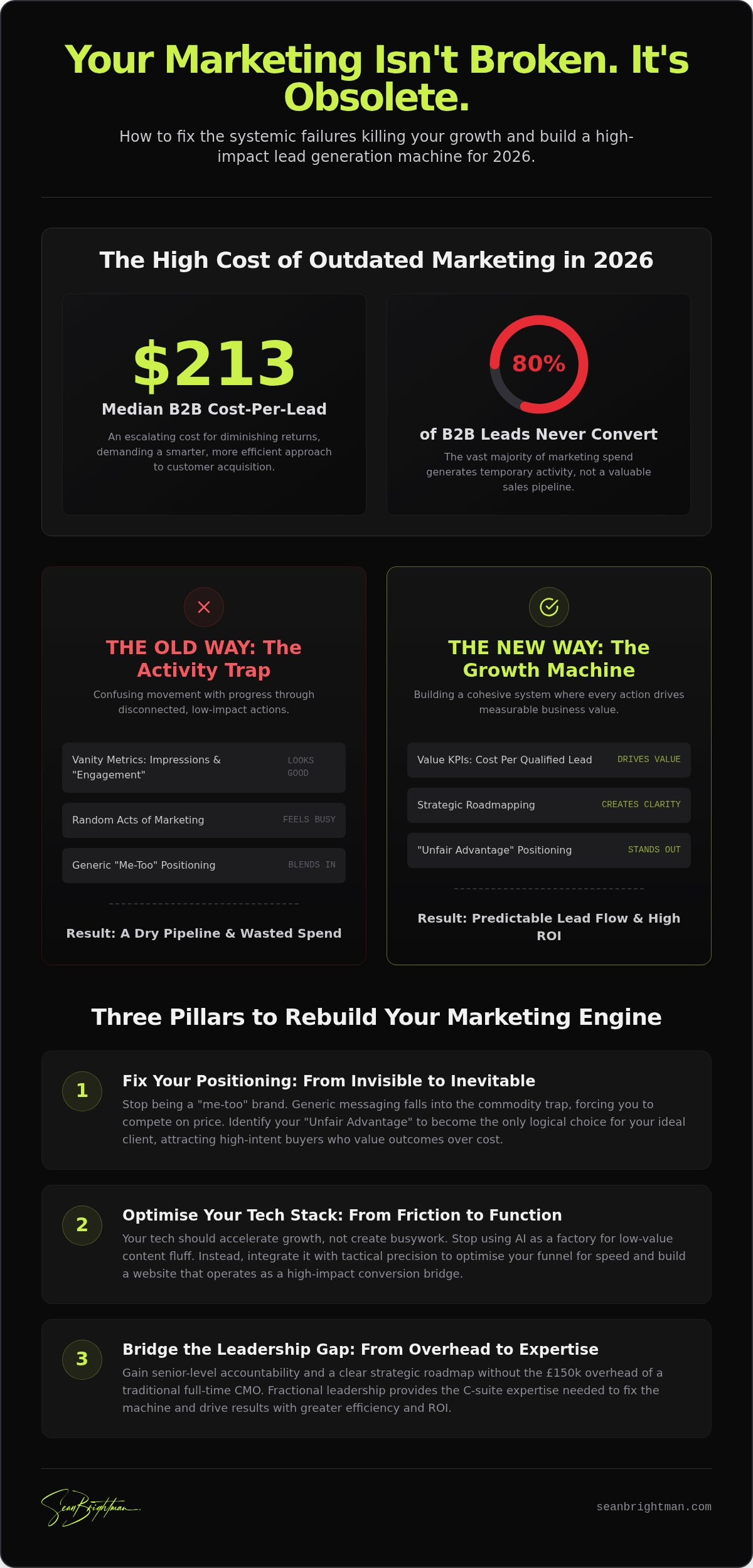
    Your marketing team is busy, but your pipeline is empty. Activity is not achievement. You’re likely tired of seeing “green arrows” on activity reports whilst your revenue remains flat. You’ve spent thousands on ads that don’t convert and agencies that deliver “brand awareness” instead of buyers. You’re constantly asking yourself why is my marketing not generating leads when everyone seems so productive. It’s a common, expensive trap.

    This isn’t about minor tweaks or the latest social media hack. We’re here to stop you from chasing tactical ghosts. You’ll learn how to strip away the fluff and fix the strategic rot that is currently killing your lead flow. It’s about building a functional system that works, not just a department that spends. This is the difference between hope-based marketing and a predictable growth engine.

    We’ll break down the systemic failures in your marketing engine and show you how to build a high-accountability framework for 2026. It’s time for strategic clarity and a reliable pipeline, not more empty busywork.

    Key Takeaways

    • Activity is not achievement. Stop mistaking vanity metrics and “busy” marketing reports for the actual revenue-generating work that drives growth.
    • Identify the systemic rot by answering the core question: why is my marketing not generating leads? We’ll expose the positioning failures and high-friction buyer journeys killing your pipeline.
    • Ditch the tactical guesswork. Discover why you need a brutal diagnostic audit of your marketing machinery instead of simply “tweaking” your ad spend or changing agencies.
    • Master the growth engine. Learn how to implement a Strategic Brand Roadmap that turns generic messaging into a sharp, winning aspiration that converts.
    • Bridge the leadership gap. Understand how a Fractional CMO provides the senior-level architecture and accountability required to fix a lead drought without the overhead of a full-time hire.

    Why “Busy” Marketing Is Failing to Generate Leads in 2026

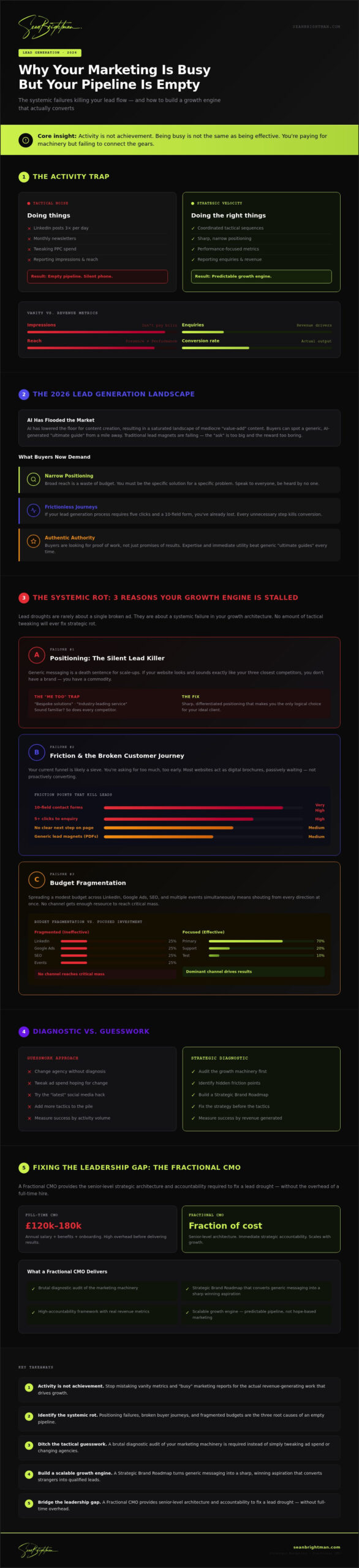
    Your marketing department is a hive of activity. They are posting on LinkedIn three times a day. They are tweaking the PPC spend. They are sending monthly newsletters. Yet, the phone is silent. This is the Activity Trap. It’s the dangerous assumption that being busy is the same as being effective. In reality, you are just making noise. Visibility is not a strategy; it’s a byproduct of one.

    If you’re constantly wondering why is my marketing not generating leads, the answer usually lies in the difference between tactical noise and strategic velocity. Noise is doing things. Velocity is doing the right things in a coordinated sequence that moves the needle. Most UK businesses are currently vibrating in place, spending money on “presence” whilst their competitors are focused on “performance.”

    The Activity vs. Results Paradox

    Metrics often lie. If your team is providing reports filled with “impressions” and “reach,” they are handing you a vanity project, not a revenue report. Impressions don’t pay the bills. Enquiries do. When marketing is uncoordinated, you end up with a collection of random acts of marketing. Each tactic might look good in isolation, but they don’t connect to form a functional growth engine.

    Business owners often confuse movement with progress. They see a social media feed full of content and assume the leads will follow. They won’t. Without a clear strategic backbone, your marketing is just a series of expensive experiments. You’re paying for the machinery but failing to connect the gears. This lack of coordination creates a messy, fragmented brand experience that confuses potential buyers rather than converting them.

    The 2026 Lead Generation Landscape

    The market has shifted. In 2026, AI has lowered the floor for content creation, resulting in a saturated landscape of mediocre “value-add” content. Consumer expectations have skyrocketed. They can spot a generic, AI-generated “ultimate guide” from a mile away. Traditional lead magnets are failing because the “ask” is often too big or too boring for the reward offered. People don’t want more PDFs; they want expertise and immediate utility.

    • Narrow Positioning: Broad reach is a waste of budget. You need to be the specific solution for a specific problem.
    • Frictionless Journeys: If your lead generation process requires five clicks and a 10-field form, you’ve already lost.
    • Authentic Authority: Buyers are looking for proof of work, not just promises of results.

    The shift from broad reach to narrow positioning is no longer optional. If you try to speak to everyone, you end up heard by no one. To fix a lead drought, you must stop shouting into the void and start engineering a precise path for your ideal customer to follow.

    The Systemic Rot: Three Reasons Your Growth Engine Is Stalled

    Lead droughts are rarely about a single broken ad. They are about a systemic failure in your growth architecture. If you are staring at a revenue flatline and asking why is my marketing not generating leads, you need to look at the machinery, not just the paint job. Most businesses are suffering from strategic rot that no amount of tactical tweaking will ever fix.

    Positioning: The Silent Lead Killer

    Generic messaging is a death sentence for scale-ups. If your website looks and sounds exactly like your three closest competitors, you don’t have a brand; you have a commodity. This is the “Me Too” trap that plagues British B2B marketing. You claim to provide “bespoke solutions” and “industry-leading service.” So does everyone else. Positioning is the foundation of the engine. If that foundation is soft, the entire structure will eventually collapse under the weight of your ad spend.

    Friction and the Broken Customer Journey

    Your current funnel is likely a sieve. You are asking for too much, too early. Most websites act as digital brochures, passively waiting for someone to find a “Contact Us” page. A brochure is a static document. A salesperson is a proactive closer. If your path from stranger to qualified lead isn’t mapped with precision, you are losing prospects at every turn. You need to identify where the friction is high and the motivation is low. Often, a strategic efficiency audit is the only way to diagnose these hidden disconnects before they drain your remaining budget.

    Fragmentation is the final nail. Spreading a modest budget across LinkedIn, Google Ads, SEO, and three different events means you are shouting in ten rooms but heard in none. You end up with a collection of weak signals rather than one dominant voice. Finally, there is the issue of accountability. If your marketing team is only responsible for “activity” and not “revenue,” they will keep providing activity reports whilst the business starves. You need a single point of failure. Someone must own the revenue target, not just the social media calendar. You end up asking why is my marketing not generating leads whilst your team celebrates a minor increase in vanity impressions.

    Diagnostic vs. Guesswork: Why Tactics Won’t Save You

    Changing your ad creative won’t fix a broken business model. Swapping your headline colour won’t save a product nobody wants. If you’re stuck wondering why is my marketing not generating leads, stop looking for a “magic button” in your Meta Ads Manager. Tactics are the fuel; strategy is the engine. If the engine is seized, adding more fuel just creates a puddle of expensive, flammable waste.

    Most UK businesses are trapped in a cycle of tactical guesswork. They jump from one “guru” advice to the next, hoping for a breakthrough. It’s an exhausting, expensive way to fail. You don’t need a new agency to try the same failed tactics with a different logo. You need a diagnostic audit to find out where the machinery is actually broken. Guessing is for amateurs; diagnostics are for leaders.

    The High Price of Tactical Guesswork

    Trial and error is the most expensive way to build a brand. Every “test” that lacks a strategic hypothesis is just gambling with your payroll. Agencies love it when you don’t have a strategy. It allows them to hide behind activity reports and vague promises of “long-term growth” whilst your bank balance drains. They get paid for the work; you only get paid for the results.

    There is a massive difference between a daily to-do list and a strategic brand roadmapping session. One is a list of chores. The other is a high-impact architectural plan. A roadmap defines the “why” and “how” before a single pound is spent on the “what.” It stops the “One More Tool” mentality where businesses buy expensive CRM software or AI bots to fix problems that are actually rooted in poor positioning.

    Finding the Real Bottleneck

    You need to know if you have a traffic problem or a conversion problem. They require completely different fixes. Throwing more traffic at a site that doesn’t convert is like pouring water into a bucket with no bottom. It’s a waste of resources. Senior leadership is about identifying these bottlenecks with clinical precision rather than guessing based on gut feeling. You need to look at the data, not the decorations.

    Senior oversight turns “I think” into “I know.” It moves marketing from a dark art into a predictable operation. By using data-led roadmaps, you can see exactly where prospects are dropping off. Is the messaging failing? Is the offer weak? Is the follow-up non-existent? When you stop guessing and start diagnosing, the question of why is my marketing not generating leads finally gets an actionable answer. You stop chasing ghosts and start building a growth engine that actually scales.

    Why Is My Marketing Not Generating Leads? The Systemic Fix for 2026

    Building a Scalable Growth Engine That Actually Converts

    Stop playing whack-a-mole with your tactics. You need a system that produces leads as a predictable output, not a lucky accident. The first move is to stop the bleeding. You must conduct a brutal marketing efficiency audit to identify where your budget is being incinerated. This isn’t a gentle review; it’s a forensic investigation into your spend versus your actual returns. It’s about finding the leak before you try to increase the pressure.

    Once you’ve cleared the debris, you must define your “Winning Aspiration.” This is your specific, high-stakes goal that separates you from the generic crowd. Then, integrate an AI consulting framework to handle the heavy lifting. In 2026, AI has fundamentally changed lead behaviour. Buyers expect instant, personalised responses and predictive content. If your system isn’t processing intent data in real time, you’ll continue asking why is my marketing not generating leads whilst your faster competitors mop up the market.

    Architecture Over Activity

    Marketing should be a machine, not a series of manual chores. You need to design systems that run without constant CEO intervention. In 2026, lead generation and nurturing are increasingly automated through intelligent workflows that adapt to user behaviour. However, tools must always follow strategy. If you buy a new CRM to fix a lack of leads without a strategy, you’ve just automated your failure. You need architecture, not more software subscriptions. Design the machine first; then choose the components.

    This shift requires a move from generic broad-reach tactics to high-precision engineering. You are no longer just “doing marketing.” You are building a functional component of your business’s revenue machinery. This machinery must be integrated, not siloed. When your sales and marketing data flow through a single, AI-enhanced centre, you gain the strategic velocity needed to outpace the market.

    The Power of Accountability

    Most marketing teams are busy doing things. You need them delivering results. This requires setting KPIs that actually matter to your bottom line, like cost per qualified lead and sales velocity, not just website clicks. This is where a marketing advisory retainer becomes essential. It provides the necessary external force to keep the engine running at high speed. It’s about moving from “doing” to “delivering.”

    Accountability is the difference between a department that spends and a department that earns. Without it, you are just funding a creative hobby. You need a partner who isn’t afraid to challenge the status quo and demand performance. To start building a high-impact system that actually scales, explore the senior leadership options available through Sean Brightman’s fractional advisory services.

    Fixing the Leadership Gap: The Fractional CMO Solution

    You don’t need a full-time executive to fix a temporary lead drought. You need a specialist who can diagnose the rot and rebuild the engine. Most UK scale-ups hire mid-level marketers and expect senior-level results. It’s a mismatch that leads to wasted budget and frustration. When you ask why is my marketing not generating leads, you are usually looking at a tactical symptom of a leadership void.

    A fractional CMO acts as a plug-and-play growth architect. You get the strategic heavy lifting of a seasoned professional without the £150k+ annual overhead of a full-time hire. It’s about buying the outcome, not the person’s full-time presence. You need a fixer, not a permanent resident. This approach allows you to inject senior-level direction exactly where it is needed most, right now.

    Senior Strategy, Fractional Commitment

    Mid-level hires often focus on the “how” before they’ve mastered the “why.” They are great at execution but struggle with high-level positioning and systemic integration. They manage the social media calendar whilst the pipeline starves. A battle-hardened expert, however, has seen your specific failure pattern dozens of times. They bring order to internal complexity by stripping away the fluff and focusing on the critical levers that drive revenue. They don’t need hand-holding; they provide the direction.

    Fractional leadership is designed for speed. There is no corporate politeness or ego to navigate. The focus is entirely on strategic velocity. We identify the bottlenecks, realign the team, and ensure every pound spent is an investment in a measurable lead. It’s about moving from a department that costs money to an asset that generates it.

    Your Next Move

    Is your business ready for this shift? If you have a product that works but a pipeline that doesn’t, you have a leadership gap. The first 30 days of a strategic turnaround focus on the forensic diagnostic audit. We identify the leaks, terminate the vanity projects, and realign the messaging with your winning aspiration. By day 60, we are testing the new architecture. By day 90, the engine is rebuilt and the leads are flowing consistently.

    Stop guessing and start growing. You’ve spent enough time chasing tactical ghosts and wondering why is my marketing not generating leads whilst your competitors take your market share. It’s time to install a professional growth engine that delivers predictable, scalable results. The fix is systemic. The leadership is fractional. The impact is total.

    Stop Guessing and Start Engineering Growth

    Activity reports are a smokescreen for strategic failure. If you’re still asking why is my marketing not generating leads, it’s time to stop looking at the ads and start looking at the architecture. A broken engine isn’t fixed with a fresh coat of paint. It requires a forensic audit, a sharp winning aspiration, and a high-accountability framework that delivers revenue. Tactics are the fuel, but without a functional engine, you’re just pouring money onto the pavement.

    With over 20 years of senior marketing leadership and a focus on AI-powered growth engines, I’ve seen these patterns across the UK market. As the author of “The Growth Engine,” I specialise in stripping away the fluff to build systems that work whilst others are still chasing vanity metrics. You don’t need more busywork; you need a predictable pipeline that scales with your ambition. It’s time to move from hope-based marketing to clinical execution.

    Ready to build a predictable pipeline? Book a Strategic Roadmap session to fix your lead flow. Your growth engine is waiting. Let’s get to work.

    Frequently Asked Questions

    Why is my Facebook/LinkedIn ad spend not resulting in leads?

    You’re likely treating a platform as a strategy. Ad spend fails when you run generic “me too” messaging without a specific winning aspiration. If your ads don’t address a narrow problem for a narrow audience, the algorithm can’t save you. You’re paying for impressions whilst ignoring the conversion architecture. Stop buying traffic for a destination that doesn’t work.

    How long does it take to fix a broken marketing strategy?

    You can stop the bleeding in 30 days and see a total turnaround in 90. The first month is forensic diagnostics to terminate vanity projects and realign positioning. By month two, we test the new architecture. By month three, the engine is rebuilt. It’s about strategic velocity and clinical execution, not endless tactical tweaking.

    What is the difference between a marketing agency and a fractional CMO?

    An agency sells services; a fractional CMO sells leadership. Agencies want to sell you more social posts, ad management, or SEO packages. A fractional CMO builds the growth architecture and holds the entire team accountable for revenue. One is a tactical vendor; the other is a battle-hardened strategist who owns the results.

    How much should I be spending on lead generation in the UK?

    Your spend should be dictated by your growth targets and customer acquisition costs, not a random industry average. Many UK scale-ups fail because they fragment a modest budget across too many channels. Instead of asking for a flat figure, ask what it costs to dominate your specific niche. Don’t spread yourself thin; concentrate your force to win.

    Can AI actually help with lead generation or is it just hype?

    AI is a functional component, not a magic button. In 2026, it’s essential for processing intent data and personalising buyer journeys in real time. It removes manual friction from your growth engine. However, if your strategy is rotten, AI just helps you fail faster. Use it for mechanical efficiency, but never for the core strategic thinking.

    Do I need to hire a full-time marketing manager to get leads?

    No, a mid-level hire often lacks the senior-level authority to fix systemic rot. They focus on the “how” whilst the “why” remains broken. A fractional CMO provides high-impact direction without the £150k+ overhead of a full-time executive. You need senior-level architecture and accountability to solve the problem of why is my marketing not generating leads.

    What are the most common friction points in a B2B sales funnel?

    The “ask” is almost always too big, too early. Most B2B funnels fail because they treat a first-time visitor like a buyer ready to close. Other friction points include slow response times, generic content, and complex forms. If your website acts as a static brochure rather than a proactive salesperson, your leads will continue to fall through the cracks.

    How do I know if my marketing team is the problem?

    Your team is the problem if they provide activity reports instead of revenue reports. If they celebrate “reach” and “engagement” whilst your pipeline is empty, there’s a fundamental lack of accountability. Often, the team isn’t incompetent; they are just leaderless. They are busy doing things, but nobody has told them which things actually drive the bottom line.

  • Strategic Marketing for CEOs: Building Growth Engines, Not Cost Centres

    Strategic Marketing for CEOs: Building Growth Engines, Not Cost Centres

    Marketing is not a creative department. It is a mechanical growth engine that requires strategic engineering, not just tactical activity. Most leaders treat their marketing budget like a black hole of expenditure where cash disappears and “brand awareness” is the only return. You know the frustration of seeing a high Customer Acquisition Cost whilst lacking the senior leadership to fix it. Strategic marketing for CEOs shouldn’t feel like a gamble. It should feel like a well-oiled machine that functions without your constant intervention.

    You are right to be sceptical of the £120,000 salary commitment for a full-time hire. You don’t need another expensive head on the payroll; you need a system that scales. This guide will show you how to transform fragmented tactics into a scalable, AI-powered growth engine that delivers predictable revenue. We will dismantle the confusion surrounding AI implementation and provide a clear roadmap for a marketing function that actually builds equity. We are moving away from “doing more” and focusing on the strategic architecture that facilitates a clear exit strategy.

    Key Takeaways

    • Stop the “tactic-first” trap by aligning brand, systems, and AI into a unified revenue engine.
    • Discover why strategic marketing for CEOs requires prioritising scalable lead-nurture systems over shiny new software tools.
    • Integrate machine learning into your customer acquisition strategy to move beyond tool fatigue and drive predictable growth.
    • Ditch vanity metrics and focus on leading indicators like pipeline velocity to ensure your marketing function builds real commercial value.
    • Implement senior-level leadership and a 90-day roadmap through a fractional model to fix fragmented departments without the full-time overhead.

    Why Strategic Marketing for CEOs is Often a Financial Black Hole

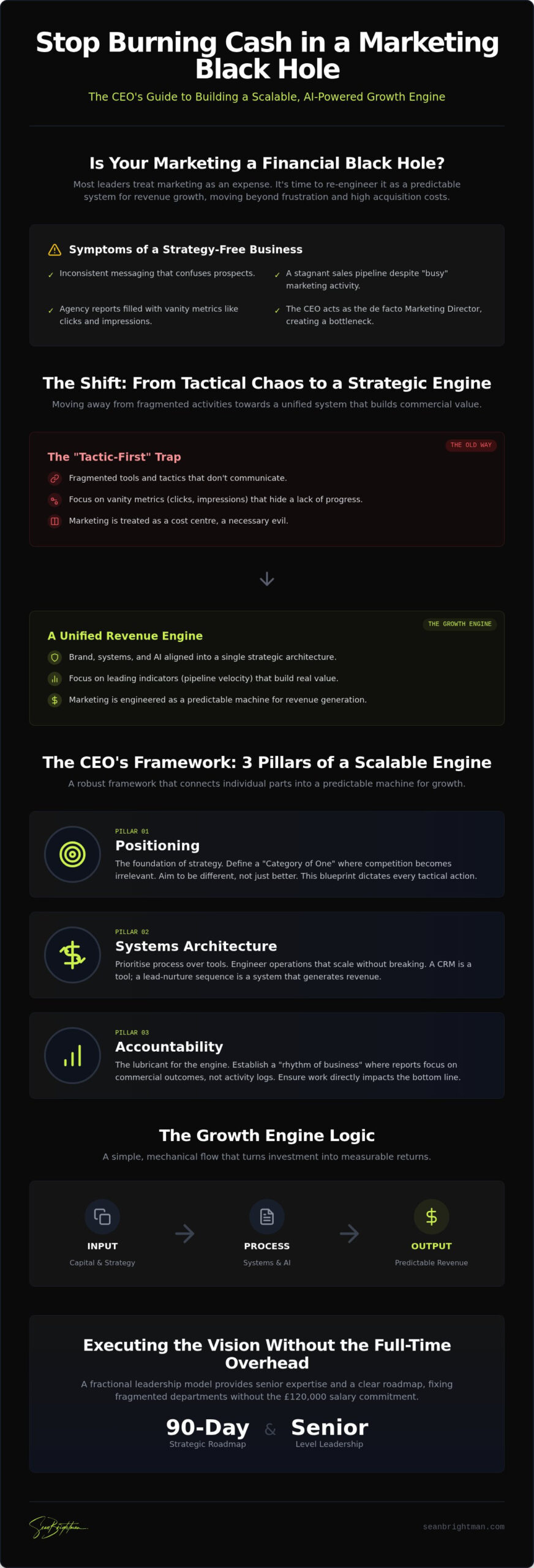
    Marketing is frequently treated as a necessary evil. It is a line item on a spreadsheet that never seems to justify its own existence. This happens because most businesses confuse activity with progress. They hire agencies to “do SEO” or “run ads” without a foundational marketing strategy. It is tactical chaos. Strategic marketing for CEOs is the opposite. It is the deliberate alignment of brand, systems, and AI to drive predictable revenue. If these three pillars aren’t locked together, you aren’t building an engine. You’re just burning cash.

    Jumping into LinkedIn ads or expensive content plays because a competitor did it is a recipe for failure. Without a roadmap, you’re just buying traffic for a leaky bucket. This “Tactic-First” trap leads to high Customer Acquisition Costs and zero scalability. You end up with a collection of fragmented tools that don’t talk to each other and a team that doesn’t know which lever to pull.

    Your team might be busy. They are posting on social media and “optimising” campaigns. But if the revenue isn’t moving, the activity is worthless. A messy marketing department costs more than just the salaries. It costs wasted capital and lost market share. Recognising when your team is “busy” but the needle isn’t moving is the first step toward fixing the machine.

    The Symptoms of a Strategy-Free Business

    Look for the red flags. Inconsistent messaging that leaves your prospects confused. Agencies that send monthly reports filled with “impressions” and “clicks” whilst your pipeline remains stagnant. These are vanity metrics. Perhaps the clearest sign of a failing system is the CEO acting as the de facto Marketing Director. If you are the one approving every LinkedIn post or tweaking ad copy, your system is broken. You have become a bottleneck, not a leader.

    Marketing as an Engine, Not a Department

    Stop viewing marketing as a cost centre. Start viewing it as a mechanical system. A growth engine. The logic is simple: Input (Capital and Strategy) goes into the Process (Systems and AI), which produces the Output (Revenue). Building a scalable growth engine is the core of strategic marketing for CEOs who want to exit or scale without being tethered to daily operations. If the engine is built correctly, it runs without your constant intervention. You own the “Why” and the vision. You delegate the “How” to senior-level experts. This isn’t about spending money. It’s about investing in a functional component of your business that delivers a measurable return.

    The CEO’s Framework: Building a Scalable Growth Engine

    Most leaders buy tools to solve problems. It is a mistake. A tool is a static object. A system is a process. Strategic marketing for CEOs prioritises the latter. A CRM is a tool; a lead-nurture sequence is a system. One is a database; the other is a revenue generator. If you are focused on the software rather than the sequence, you are building a collection of parts, not an engine. You need a framework that connects these parts into a predictable machine.

    This framework relies on three pillars: positioning, systems architecture, and accountability. Without all three, your marketing will remain a fragmented expense. Accountability is the lubricant that keeps the engine running. It requires a “rhythm of business” where reports focus on commercial outcomes rather than activity logs. If your marketing lead isn’t showing you how their work impacts the bottom line, they aren’t managing a growth engine. They are managing a cost centre.

    Positioning: The Foundation of Strategy

    In a crowded market, “being better” is a losing strategy. It is subjective and expensive to prove. “Being different” is the only win. You must define a “Category of One” where competition becomes irrelevant because your offering is incomparable. This is the difference between fighting for scraps and owning the table. Brand positioning is the mechanical blueprint that dictates every tactical action, campaign, and customer interaction within your growth engine. You can learn more about turning these assets into profit in this guide on strategic marketing for CEOs.

    Systems Architecture: Engineering Predictability

    Engineering a system means designing operations that scale without breaking. This is vital for Marketing Strategy for Tech Companies where high-growth targets often outpace internal capabilities. You need to eliminate the friction in the sales-marketing handoff. If your sales team is ignoring leads, your system is broken. In 2026, this architecture must include a clear AI marketing roadmap to automate repetitive tasks and optimise your acquisition costs.

    Building this level of precision takes more than just a few meetings. It requires a battle-hardened expert who knows where the bottlenecks hide. If you are ready to stop guessing and start building, a strategic roadmapping session can provide the clarity you need to move forward.

    AI Strategy for CEOs: Strategy Over Tool Fatigue

    Stop playing with tools. If your marketing team is “experimenting” with ChatGPT without a commercial objective, they are wasting your time and capital. Strategic marketing for CEOs isn’t about having the most subscriptions; it’s about having the most effective systems. By March 2026, 80% of marketing professionals reported using AI and automation in their workflows. The novelty has evaporated. AI is now a functional component of the growth engine, not a laboratory experiment. It should be used to optimise customer acquisition through machine learning, not just to generate mediocre blog posts.

    The trap is focusing on efficiency over effectiveness. AI can help you do things faster, but doing the wrong things faster just accelerates your failure. You don’t need “more” content; you need better conversion. You don’t need “more” leads; you need higher pipeline velocity. Your role as CEO is oversight. You must ensure that AI integration respects brand integrity and ethical standards. A bot hallucinating your value proposition is a liability, not an asset. You own the “Why” and the brand’s soul; the AI handles the mechanical “How”.

    Integrating Intelligence into Operations

    Intelligence belongs in your operations, not just your copy. Moving from manual workflows to automated, intelligent systems is how you scale without linear head-count growth. Specific AI consulting can identify the “low-hanging fruit” where automation provides immediate ROI. This might be lead scoring, predictive churn analysis, or hyper-precision segmentation. AI-driven data analysis reduces the cost of experimentation by identifying winning patterns in days rather than months. It turns your marketing from a series of guesses into a sequence of calculated moves.

    The AI Roadmap: A 2026 Necessity

    You cannot wing it. A structured AI roadmap is a 2026 necessity for any business serious about growth. This plan ensures every tool you adopt is tied directly to a commercial KPI. It prevents “Shiny Object Syndrome” by forcing every new technology to justify its place in the engine. Strategic marketing for CEOs requires future-proofing the organisation against rapid technological shifts. By building a flexible, AI-powered architecture now, you ensure that your business remains a leader whilst competitors are still trying to figure out their login details. It is about building a system that runs on data, not just hope.

    Strategic Marketing for CEOs: Building Growth Engines, Not Cost Centres

    Accountability: The Metrics That Actually Move the Needle

    Marketing reports are often a collection of polite fictions. They focus on impressions, likes, and “engagement” because these numbers are easy to inflate. For a leader, these are vanity metrics. They don’t pay the bills. Strategic marketing for CEOs requires a radical shift in focus toward data that actually drives commercial value. You need to distinguish between lagging and leading indicators. Revenue is a lag indicator; it tells you what happened last month. Pipeline velocity is a leading indicator; it tells you if you’ll hit your targets next quarter.

    Marketing Efficiency Ratio (MER) should be your favourite metric for assessing overall engine health. This is simply your total revenue divided by your total marketing spend. It provides a high-level view of how hard your capital is working. Within the UK scale-up context, you must also master the relationship between Customer Acquisition Cost (CAC) and Lifetime Value (LTV). A healthy benchmark for this ratio is 3:1 or 4:1. If your ratio is lower, your engine is inefficient. If it is significantly higher, you are likely under-investing and leaving growth on the table. Kill the reports that don’t show this commercial reality.

    The £120k Marketing Hire Mistake

    Many CEOs rush to hire a full-time CMO with a £120,000+ salary commitment before they have a proven roadmap. This is a tactical error. You end up hiring a “doer” who executes fragmented tasks, when you actually needed an “architect” to design the system. Until the engine is built and the metrics are predictable, a full-time executive is an unnecessary overhead. You don’t need a permanent head; you need a blueprint. You can find more on this in my analysis of a Marketing Strategy Consultant vs Agency.

    The Advisory Retainer: Ongoing Accountability

    A Marketing Advisory Retainer provides the senior-level oversight that most scale-ups lack. It establishes a “rhythm of business” where strategy is reviewed and refined constantly. We set quarterly “Big Rocks”, which are high-impact objectives that move the needle, and ignore the noise. This creates a culture of radical honesty. There is no hiding behind vague reports. If a tactic isn’t working, we kill it and reallocate the capital. It is about maintaining strategic velocity whilst keeping the team accountable to the commercial vision. You get the expertise without the ego or the excessive salary.

    Ready to stop guessing and start measuring what matters? Let’s build your growth engine today.

    Executing the Vision: Fractional Leadership and Roadmapping

    You have the vision. Your team has the tasks. But there is a disconnect. This gap is where growth dies. Bridging it requires more than just “better communication”. It requires an architect. Strategic marketing for CEOs is about moving from tactical chaos to strategic velocity. It is about building a functional system that actually executes your commercial goals instead of just checking boxes. You need a bridge between high-level ambition and ground-level activity.

    A Fractional CMO is the mechanical solution to this problem. This is senior leadership without the full-time overhead. You get the battle-hardened expertise of a veteran strategist on a part-time basis. It is a plug-and-play model. You don’t need to manage them; they manage the engine for you. This is about results, not recruitment. You aren’t buying a person; you are buying a process that delivers predictable revenue.

    Your 90-Day Strategic Roadmap

    We don’t guess. We engineer. A 90-day roadmap provides the clinical clarity needed to fix the mess and start growing. It is a time-boxed intervention designed for maximum impact. It replaces the “hope and pray” method with a mechanical sequence of events. If you want to understand how a marketing strategy roadmap built for exit-ready growth differs from a standard plan, the principles below will make that distinction clear.

    • Phase 1: Audit and Diagnostics. We find the leaks in your engine. We strip back the reports to find where capital is being wasted and where the real opportunities for growth hide.
    • Phase 2: Positioning and Architecture. We build the blueprint. We define your “Category of One” to eliminate competition and design the lead-flow machinery that supports it.
    • Phase 3: Execution and Optimisation. We turn the key. We launch the systems, integrate the AI, and refine the process based on real-world revenue performance.

    This isn’t a theoretical exercise. It is a functional plan. You move from wondering what your marketing team does all day to knowing exactly how the machine works. It provides the order needed to scale without the usual friction of expansion.

    The Fractional Revolution

    UK scale-ups are changing their behaviour. They are realising that the old model of hiring a full-time executive is slow, expensive, and risky. You should Stop Hiring Full-Time CMOs until your growth engine is fully built and tested. In 2026, the smart move is to access high-level AI and strategic expertise through fractional leadership.

    This model allows you to scale your leadership as you scale your business. You get a seasoned professional who focuses on commercial outcomes, not office politics. It is about impact, not attendance. Strategic marketing for CEOs is finally becoming accessible to businesses that aren’t yet ready for a £120,000+ hire but are desperate for those results. Stop managing a department. Start leading an engine.

    From Tactical Chaos to Strategic Velocity

    Your marketing budget is either a cost or an investment. If it feels like a black hole, the engine is broken. We’ve established that strategic marketing for CEOs requires a shift from fragmented tactics to a connected system of brand, AI, and accountability. You don’t need another expensive hire to manage the mess. You need a blueprint that delivers predictable revenue and a clear path to exit. If you are planning that exit, understanding how to build a marketing strategy for business exit that acquirers will trust is the difference between a mediocre multiple and a premium valuation.

    I provide battle-hardened UK strategic expertise to help you stop the guesswork. As an AI-powered growth specialist and the author of the definitive book on marketing strategy, I focus on building functional systems that run without your constant intervention. It is time to strip away the fluff. It is time to engineer a department that actually moves the needle and builds real equity in your business.

    Ready to take the next step? Build your growth engine with a Fractional CMO Roadmap and turn your vision into a scalable commercial reality. You have the ambition. Now, get the machine to match it.

    Frequently Asked Questions

    What is the difference between marketing tactics and marketing strategy?

    Strategy is the blueprint; tactics are the hammers. Strategy defines your “Category of One” and the commercial destination of your business. Tactics are the individual actions like running a LinkedIn ad or writing a blog post. Jumping into tactics without a strategy is just expensive guesswork that leads to a financial black hole.

    How much should a CEO be involved in marketing strategy?

    Own the vision; delegate the execution. You must define the commercial goals and the brand’s soul. You shouldn’t be approving social media posts or tweaking SEO keywords. Your involvement ends at setting the “Why” and demanding absolute accountability for the commercial “What”.

    What are the most important marketing KPIs for a CEO to track?

    Track the metrics that impact equity and cash flow. Focus on Marketing Efficiency Ratio (MER) and pipeline velocity. These tell you how hard your capital is working. Ignore vanity metrics like impressions or likes. If a metric doesn’t move the commercial needle, it doesn’t belong in your report.

    Why do most marketing agencies fail to deliver strategic results?

    Agencies sell hammers; they don’t build houses. Most agencies are tactical specialists in a single area. They aren’t incentivised to look at your broader business model or unit economics. They focus on their own activity reports rather than your bottom-line growth and long-term equity.

    When should a CEO hire a Fractional CMO instead of a full-time leader?

    Hire a Fractional CMO when you need senior leadership without the £120,000+ overhead. It is a plug-and-play model for scale-ups. Use them to build the growth engine and the roadmap before you commit to the risk and cost of a permanent executive hire.

    How can AI improve the ROI of my marketing strategy in 2026?

    AI drives ROI through mechanical precision and predictive analysis. It optimises customer acquisition by identifying winning patterns in data that human teams miss. In 2026, strategic marketing for CEOs uses AI as a functional component for hyper-personalisation. It turns your marketing from a series of guesses into a data-driven science.

    What is a marketing strategy roadmap and why do I need one?

    A roadmap is a 90-day execution blueprint. It provides the order needed to scale without the usual friction of expansion. You need one to stop tactical chaos and ensure every action your team takes is tied directly to a commercial KPI or a revenue milestone. For a deeper breakdown of how to construct one that drives enterprise value, explore this guide on building a marketing strategy roadmap that drives exit-ready growth.

    How do I hold my marketing team accountable for revenue, not just activity?

    Demand leading indicators, not activity logs. Stop asking what the team did; ask what the team achieved in terms of pipeline growth. Establish a culture of radical honesty where underperforming campaigns are killed immediately and capital is reallocated to systems that actually work.