Tag: Marketing Budget

  • Reducing Marketing Budget Waste: Find the Leaks Before You Cut

    Reducing Marketing Budget Waste: Find the Leaks Before You Cut

    Cutting the marketing budget can make the spreadsheet look healthier whilst quietly weakening growth. If you’re reducing marketing budget waste, start by finding where spend loses momentum, not by slashing activity that may be working.

    The frustration is familiar: marketing uses budget, but its contribution to revenue is hard to pin down. Teams, agencies, channels and tools each tell a different success story. Under pressure, it’s tempting to cut what’s difficult to measure, even when it supports the business.

    This article shows you how to separate avoidable waste from useful investment, then decide what to fix first. You’ll learn to examine measurement gaps, targeting, messaging, tools and budget ownership using evidence and commercial context rather than guesswork.

    The goal isn’t a smaller budget for its own sake. It’s a clearer decision system: one that links marketing choices to business priorities, turns findings into a prioritised plan and builds regular accountability. That way, each review improves the next decision instead of resetting the conversation every quarter.

    Key Takeaways

    • Spot leaks across measurement, channel choices, tools and hand-offs, not just visible campaign spend.
    • For reducing marketing budget waste, assess performance against commercial outcomes rather than relying on a single metric.
    • Reconcile spend and reporting over a period that fits your sales cycle before acting on apparent underperformance.
    • Prioritise changes by evidence, likely impact, reversibility and how quickly you can learn from them.
    • Keep a decision log with owners, assumptions and review points so each budget decision informs the next.

    Reducing marketing budget waste starts with finding the real leak

    Pressure to cut spend often arrives before anyone can explain what the budget is doing. An across-the-board reduction may look decisive, but it can remove effective investment alongside genuine inefficiency. Disciplined optimisation starts by tracing the leak and fixing its cause. It doesn’t treat every unclear result as proof that activity should stop.

    Marketing budget waste is spend disconnected from a clear objective, useful learning or a credible contribution to commercial goals. That definition matters because weak measurement creates uncertainty, not a verdict. If a campaign’s results aren’t tracked properly, the first problem may be the measurement setup, not the campaign itself. Understanding marketing effectiveness means judging activity against its purpose and role in the wider marketing effort, not just its easiest-to-count output.

    What counts as marketing budget waste?

    Look for avoidable spend in the machinery around marketing as well as in channels. A team might pay for a tool no one uses, commission separate teams to produce near-identical assets, or run campaigns without agreeing who owns the outcome. These are different problems: process waste, channel underperformance and weak strategic fit each call for a different fix.

    A low short-term return isn’t automatically waste. A test that rules out a weak message can provide useful learning; brand activity may also support a customer journey that takes longer to convert. Ask whether there was a clear reason to spend, a way to learn and a sensible link to business priorities.

    Why cutting the budget is not the same as reducing waste

    Equal percentage cuts ignore differences in purpose and performance. They can shrink a proven source of demand just as readily as they remove duplicated work. Cheap leads can also distract from lead quality, whilst activity metrics such as clicks say little on their own about commercial contribution.

    Judge investment against the business goal, the customer journey and the time needed to observe an outcome. A short reporting window may miss a longer sales cycle; a longer one may hide a problem that needs attention now. Make the distinction clear: stop confirmed waste, investigate uncertain performance, and protect activity with a credible strategic role. That’s the starting point for reducing marketing budget waste without cutting growth potential by guesswork.

    Where marketing budgets leak: measurement, hand-offs, and misplaced activity

    Budget leaks rarely sit in one neat line on a report. They build where strategy, channel choices, measurement and delivery fail to connect. A campaign may have a clear objective, but if its results don’t reach the team planning the next activity, the learning gets lost. One team may pay for a tool whilst another buys a similar platform. An agency and an internal team may both produce reports without anyone owning the decision those reports are meant to inform.

    Fragmented tracking makes budget comparisons less reliable because teams may be measuring different activity, outcomes and time periods. That uncertainty is a measurement problem to investigate, not automatic proof that the marketing itself is wasteful.

    How weak measurement hides useful signals

    Attribution is an imperfect view of contribution, not a complete account of cause and effect. A platform may claim credit for a conversion that involved several other interactions, whilst a channel that helped build awareness may receive no direct credit at all. Use measurement to guide investigation, not to declare a winner from one dashboard. Harvard Business School Online’s guidance on how to measure marketing effectiveness offers a broader perspective than relying on a single metric.

    Start by checking the tracking basics. If one team names a campaign “spring_launch” and another uses “Spring-Launch”, or UTM parameters vary between links, reports can split the same activity into separate entries. Compare platform and web analytics with CRM outcomes: qualified enquiries, opportunities and sales can show whether apparent performance translates into business value. Record gaps rather than filling them with assumptions.

    How process and channel choices create avoidable spend

    Next, trace the work between planning and reporting. Look for overlapping agency scopes, duplicated tools, unclear briefs and manual reports that teams rebuild separately. For each activity, identify its objective, owner, cost and next decision. If nobody can explain what a task supports or who acts on its result, that’s a process leak worth investigating.

    Channel sprawl creates another trap. Spreading a budget thinly across multiple channels can leave each with too little activity to test a meaningful audience or message. But consolidation should follow evidence and strategic fit, not convenience. A channel with limited immediate conversions may still play a useful role in the customer journey; check how it supports other activity before judging it in isolation.

    For a deeper look at how joined-up processes support growth, explore marketing operations for a scalable growth engine. A focused marketing roadmapping discussion can also help turn these findings into clear priorities for reducing marketing budget waste.

    How to diagnose wasted marketing spend without trusting one metric

    Move from suspicion to evidence with a repeatable review. A metric should inform a budget decision, not make it alone. A low conversion figure might signal a weak campaign, a tracking gap or a delay between first contact and sale. Separate those possibilities before changing investment.

    Build a useful view of spend and outcomes

    Choose one reporting period that reflects your sales cycle, then use it consistently across the review. Group investment by objective, audience, channel, campaign and internal or external owner. Reconcile planned budget with actual spend, then compare platform and web analytics with CRM outcomes where available. Select the business outcome that fits the objective, such as qualified pipeline, revenue, retention or another meaningful measure.

    Flag missing tracking, inconsistent campaign names, differing attribution windows and gaps between platforms and CRM. Don’t hide incomplete evidence inside a single performance score.

    Use five steps to diagnose the leak

    • Set the outcome: State what the activity was meant to achieve and how that connects to a business priority.
    • Reconcile spend: Check planned allocation against actual spend across teams, channels and suppliers.
    • Compare evidence: Review the chosen outcome alongside relevant platform, website and CRM signals.
    • Investigate variance: Trace unexpected results to possible causes, such as a tracking change, audience shift, delivery issue or a genuine performance decline.
    • Record confidence: Note what the evidence supports, what remains uncertain and what check or test could improve the picture.

    Warning sign | Evidence to investigate | Possible explanation

    Spend rises, but qualified pipeline doesn’t | CRM stages, lead quality and campaign changes | Lower-quality demand, a longer conversion path or a tracking gap

    Two reports show different results | Reporting period, attribution window and campaign definitions | Different measurement rules, not necessarily different performance

    Activity is hard to connect to an objective | Brief, owner and intended audience | Unclear strategy or work that has lost its purpose

    Look for repeated patterns across comparable activity, not a verdict from one campaign or reporting period. Check results against the intended customer journey and the time it takes for outcomes to appear. A short-term dip may matter, but it needs context before it triggers a cut.

    This method makes reducing marketing budget waste more rigorous: it distinguishes a confirmed problem from an incomplete signal and points to the next decision rather than pretending every answer is already in the data.
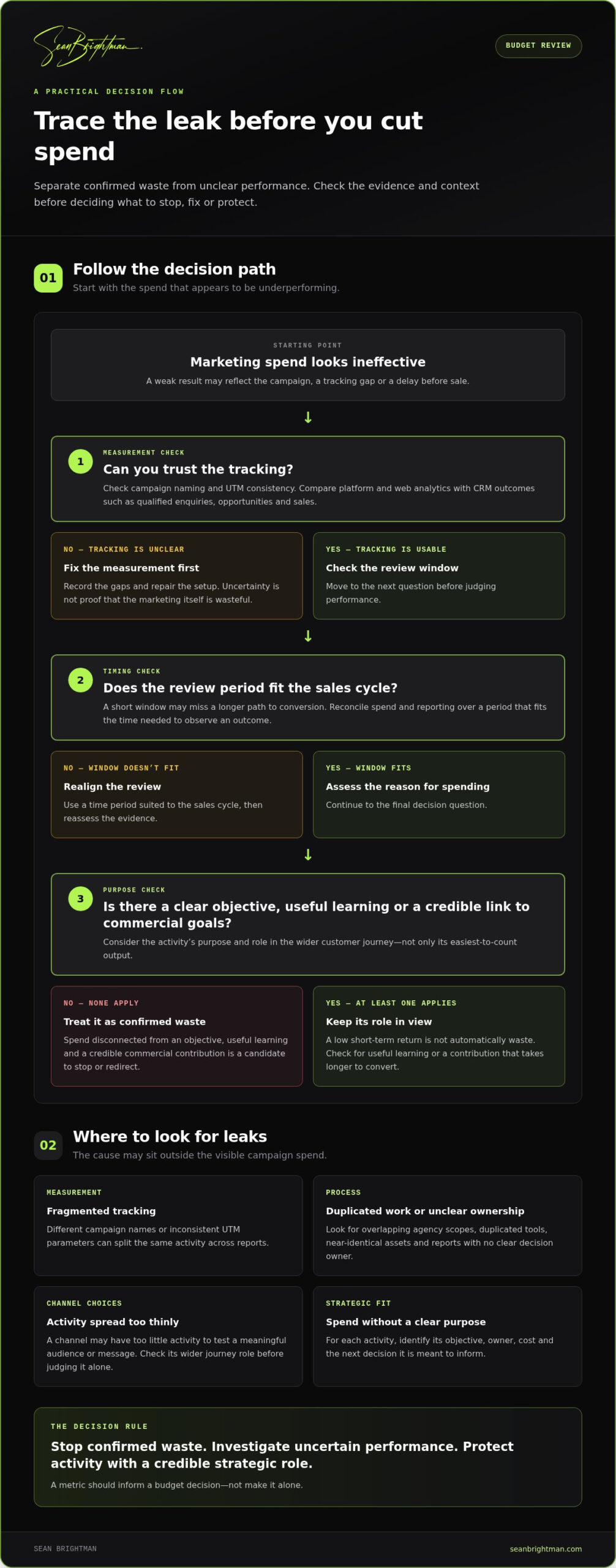
    Reducing Marketing Budget Waste: Find the Leaks Before You Cut

    What to fix first: prioritise marketing budget changes by evidence

    Start with changes where the waste is visible and the downside is limited. Duplicate subscriptions, overlapping work or activity with no accountable owner are stronger clean-up candidates than a campaign that simply lacks reliable measurement. Don’t cut a channel by default. First weigh the evidence, likely business impact, reversibility and time needed to learn.

    Decision type | Evidence strength | Likely impact | Reversibility | Time to learn

    Immediate clean-up: duplicated tool or repeated task | Clear and verifiable | Usually contained | High | Short

    Test: campaign with mixed results | Partial or inconsistent | Could affect demand | Often high | Depends on the sales cycle

    Tracking fix: activity with incomplete attribution | Insufficient to judge | Unclear until measured | High | Depends on data availability

    Strategic review: investment affecting key audiences or positioning | Requires broader context | Potentially substantial | Lower | Longer-term

    Which budget leaks should you address first?

    Remove confirmed duplication and resolve ownership gaps first. Treat weakly measured activity as an investigation or test candidate, not an automatic cancellation. Escalate choices that could reshape how you reach key audiences, express your positioning or support longer-term growth. The harder a change is to reverse, the stronger the evidence and business case should be.

    How to test a change without damaging growth

    Change one meaningful variable where practical, such as the audience or message, and write down what evidence would change your decision. Set a review point that fits the sales cycle and gives the relevant data time to emerge. If several elements change at once, you may not know what caused the result.

    Example: A team finds two subscriptions that appear to serve the same purpose, whilst one campaign has weak lead tracking but supports an important audience. It can verify and remove the duplicate, then improve tracking and test the campaign before deciding whether to reduce its allocation. The example is illustrative, not a client result.

    If the evidence points beyond channel adjustments to priorities around positioning or growth, use strategic brand roadmapping to shape the next decisions. For senior-level direction on turning findings into a prioritised plan, explore strategic marketing guidance. That’s how reducing marketing budget waste becomes a controlled decision, not a blunt cut.

    Make marketing budget control an ongoing leadership system

    A one-off budget review finds leaks. A leadership system helps stop them returning. Tie each marketing investment to a business outcome, a clear owner and an assumption that can be revisited. Then review what changed, what the evidence says and what decision comes next. This keeps the budget connected to commercial priorities, not just last quarter’s activity.

    Set a budget review cadence that drives decisions

    Set review points around business planning and the sales cycle, not an arbitrary reporting ritual. At each review, look at business outcomes, committed spend, key assumptions and any changes in customer behaviour, team capacity or commercial priorities. If an assumption no longer holds, update the plan rather than allowing old allocations to roll forward by default.

    Keep a decision log that makes accountability visible. Record what changed, why it changed, the expected effect, the person responsible and when the decision will be reviewed. That record helps the team distinguish a deliberate test from unplanned drift in spend.

    Make sure the parts of the system reinforce one another. Positioning shapes which audiences matter; channel choices determine how you reach them; measurement shows what the activity contributes; and operating capacity determines what the team can deliver well. A mismatch between any of these can undermine the rest.

    When strategic marketing support can help

    If priorities keep fragmenting, ownership remains unclear or measurement problems recur, the issue may need senior strategic direction rather than another reporting template. Fractional CMO leadership and ongoing advisory support can connect budget choices to positioning and business goals, and bring accountability to regular reviews. This is strategic oversight, not advertising execution.

    Sean Brightman’s advisory retainer provides ongoing strategic direction and accountability. For senior marketing leadership on a part-time basis, explore Fractional CMO support.

    Start with one action: map current spend against its objective, then identify the biggest evidence gap. Assign someone to close it and bring the finding into your next review. That’s how reducing marketing budget waste becomes an ongoing discipline, not another round of reactive cuts.

    Make your next marketing budget decision count

    Reducing marketing budget waste isn’t about cutting spend evenly. It’s about finding where investment loses momentum, separating confirmed waste from uncertain performance, and choosing changes that fit your business goals.

    Use consistent evidence to guide decisions, not a single metric. Give each investment a clear objective and owner, then record what changes and when you’ll review it. That turns budget control into an ongoing leadership system, not another reactive round of cuts.

    When priorities or accountability are unclear, Fractional CMO leadership brings part-time senior marketing direction. Roadmapping creates structured marketing and brand direction, whilst an advisory retainer supports ongoing strategic oversight and accountability.

    Build a sharper marketing decision system with Sean Brightman. Start with the evidence, make the next decision with confidence, and protect the investment that can support growth.

    Frequently Asked Questions

    What does reducing marketing budget waste actually mean?

    Reducing marketing budget waste means removing or redesigning spend without a clear purpose, accountable owner, useful evidence or credible connection to business outcomes. It doesn’t mean cutting every activity with weak short-term attribution. Some investment supports learning, awareness or longer buying journeys. First diagnose why performance appears weak. Then decide whether to stop, fix, measure or test the activity, based on its intended role and the evidence available.

    How can I tell whether marketing spend is being wasted?

    Map spend to its objectives, owners, campaign activity and relevant outcomes. Check that reporting uses consistent definitions, then compare platform results with CRM or sales information where available. Look for repeated signs such as duplicated work, unused tools or activity without a defined purpose. If tracking is missing or unreliable, treat that as an evidence gap to investigate. Weak measurement alone doesn’t prove that the activity is wasteful.

    Should I cut marketing spend if I cannot measure its return?

    No, not automatically. Start by clarifying the outcome the activity was meant to support and checking whether your tracking captures it. Consider the customer journey, sales cycle and missing data before deciding. If the evidence remains weak, improve measurement or run a bounded test with a clear review point. Preserve investment that has a credible strategic role, and decide in advance what evidence would justify changing it.

    How much marketing budget should a business allocate to each channel?

    There’s no universal channel split that suits every business. Allocation depends on commercial goals, audience behaviour, sales-cycle length, existing evidence and your capacity to execute well. Define the outcome each channel should support, then compare its contribution and the uncertainty around that evidence. Keep room to test and learn. Review the allocation when results, customer behaviour or business priorities change, rather than copying another organisation’s budget mix.

    Which marketing metrics should I use to find wasted spend?

    Choose measures that match the activity’s objective and connect, where possible, to commercial outcomes. Depending on the goal, these could include qualified pipeline, revenue, customer acquisition, retention or meaningful engagement. Use platform metrics as diagnostic signals, not final proof of business impact. Before comparing campaigns or channels, check that definitions, attribution windows and tracking are consistent, and compare platform data with CRM outcomes where available.

    Can AI help reduce marketing budget waste?

    AI can help organise data, surface patterns and speed up analysis when the inputs and definitions are reliable. It can’t resolve unclear objectives, inconsistent tracking or poor judgement by itself. Use it to support investigation, not to make unreviewed budget decisions. Keep a named person accountable for validating the evidence, weighing commercial context and deciding what to change. The quality of the decision still depends on the quality of the information and oversight.

    How often should a business review its marketing budget?

    Set review frequency to fit your sales cycle, business planning rhythm and pace of change. Use regular checkpoints to compare actual spend with objectives and outcomes, then schedule a deeper review when assumptions shift or evidence raises a concern. Don’t change investment so frequently that activity has no time to produce useful learning. Record each decision, its rationale and a proportionate review date so you can assess the effect.

  • Interim Marketing Director Rates UK: 2026 Pricing and ROI Guide

    Interim Marketing Director Rates UK: 2026 Pricing and ROI Guide

    Most businesses treat marketing spend like a leaky bucket and hope the next expensive hire finally plugs the hole. It’s a strategy rooted in desperation, not data. You’re likely here because you need senior leadership now, but you can’t justify the baggage or the lead time of a permanent executive search. You’ve looked at interim marketing director rates uk and felt the immediate sting of price tags that seem disconnected from reality. It’s a common frustration. You need a fixer, not a seat-filler.

    You’ve seen the marketing team drift without accountability. You’re tired of wasted spend and the blurred lines between interim, fractional, and agency models. This guide provides a brutal breakdown of 2026 pricing to help you stop paying for time and start investing in strategic velocity. We’ll examine current market benchmarks, provide a framework to justify the investment to your board, and map out a clear roadmap for marketing stability. It’s time to distinguish between a temporary cost and a high-impact growth engine.

    Key Takeaways

    • Benchmark the 2026 market range of £800 to £2,000+ per day to ensure you aren’t overpaying for a glorified manager.
    • Identify how AI consulting and strategic brand positioning have become the new gold standards for driving senior marketing rates upward.
    • Evaluate the financial trade-offs between traditional full-time interim roles and high-impact Fractional CMO retainers to find your best fit.
    • Use our ROI framework to justify interim marketing director rates uk by measuring the “Cost of Inaction” instead of just the payroll expense.
    • Shift your focus from hiring a temporary placeholder to securing a “plug-and-play” strategist who builds scalable marketing systems.

    Understanding Interim Marketing Director Rates in the UK for 2026

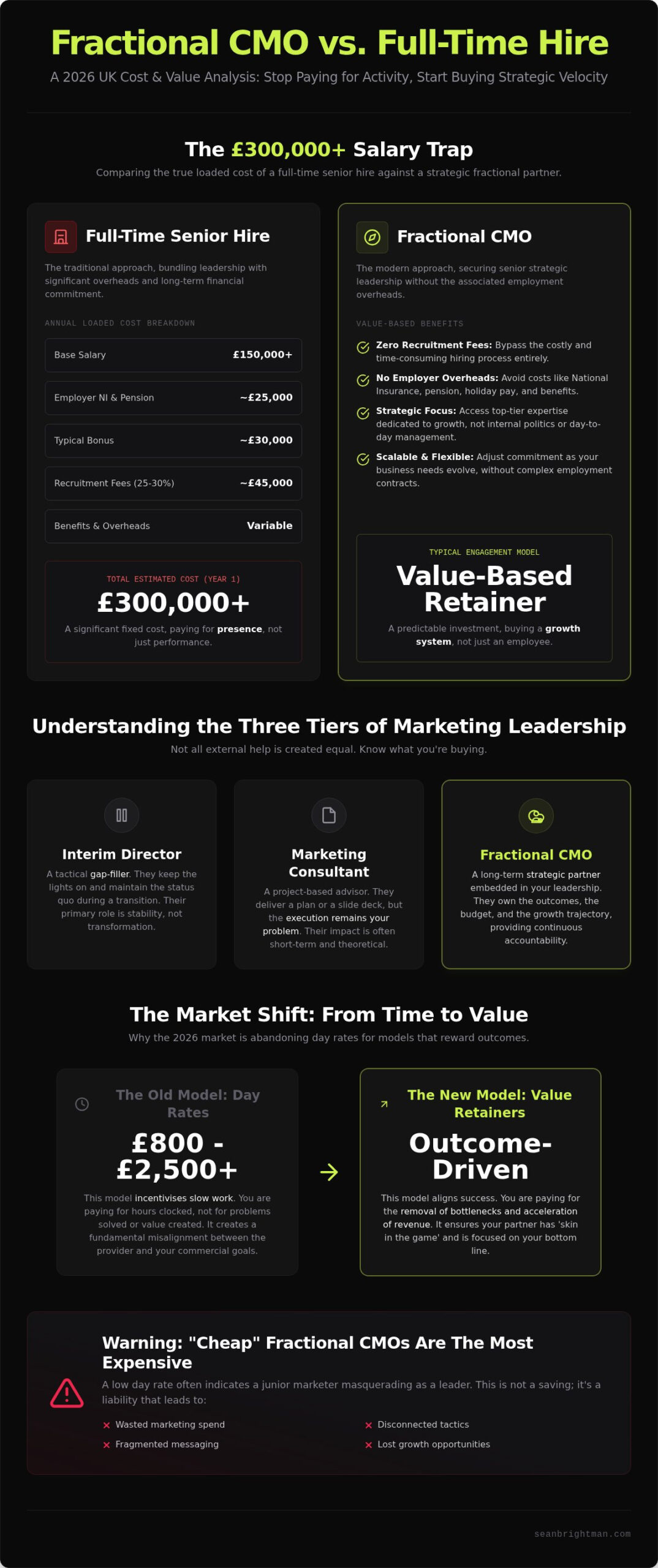
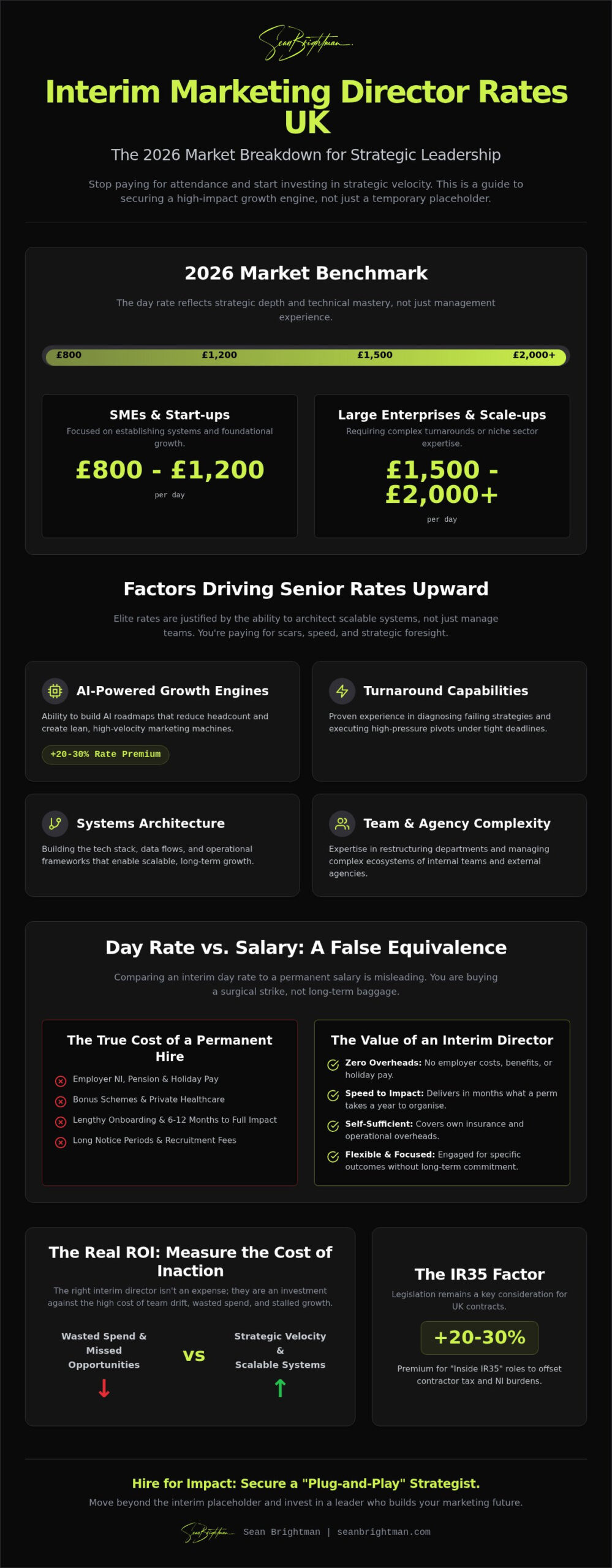
    An interim marketing director isn’t a temporary fix. They’re a strategic injection. In the 2026 UK market, these leaders don’t just manage teams; they rebuild systems. You pay for the ability to land on day one and stop the bleeding. If you’re looking at interim marketing director rates uk, expect a range from £800 to over £2,000 per day. This isn’t a random number. It’s a reflection of strategic depth and technical mastery.

    The 2026 landscape has split the market into two camps. There are placeholders who keep the lights on whilst you search for a permanent hire. Then there are transformational leaders who rewire your entire growth engine. The latter costs more because they bring a “get-your-hands-dirty” authority that saves you years of trial and error. You’re buying their past failures and successes so you don’t have to fund your own.

    The 2026 Market Benchmark

    Rates vary by scale and complexity. SMEs typically see rates between £800 and £1,200. Large enterprises or high-growth scale-ups often pay £1,500 to £2,000+ for experts with niche sector experience. IR35 legislation remains a massive factor. “Inside IR35” roles often command a 20% to 30% premium to offset the contractor’s tax and NI burden. “Outside IR35” contracts are still common for genuine project-based work, offering better value for businesses with a clearly defined roadmap.

    Why Rates Aren’t Salaries

    Stop comparing day rates to annual salaries. It’s a false equivalence. A £1,000 day rate doesn’t mean a £250k salary. You’re buying results, not attendance. When you calculate the true cost of interim marketing director rates uk, you must factor in the lack of long-term baggage. You aren’t paying for pension contributions, private healthcare, or six-month notice periods. You’re paying for a surgical strike.

    • Zero overheads: No employer NI, holiday pay, or bonus schemes.
    • Speed to impact: An interim delivers in three months what a permanent hire often takes a year to organise.
    • Business costs: The interim covers their own professional indemnity insurance and operational overheads.

    The 2026 premium is increasingly driven by AI literacy. You aren’t just hiring a brand person. You’re hiring someone who can build an AI-powered growth engine. This is the difference between a placeholder who maintains the status quo and a strategist who builds a scalable machine.

    Factors That Drive Senior Marketing Rates Upward

    Senior rates aren’t a flat fee. They’re a sliding scale based on the fires you need extinguished. If you need a placeholder to keep the chair warm, you pay the market base. If you need a turnaround specialist to fix a failing department, you pay for the scars and the speed. Strategic depth is the primary lever here. You’re choosing between tactical execution and brand positioning that actually moves the needle.

    In 2026, the gap between average and elite interim marketing director rates uk is widening. It’s no longer just about sector experience. It’s about the ability to architect systems that don’t rely on constant manual intervention. This shift from “manager” to “architect” is what justifies the top-tier day rates you’ll see in the market. High-calibre leaders bring a “get-your-hands-dirty” attitude that transforms abstract strategy into functional machinery.

    AI-Powered Growth Engines

    AI is the new gold standard for senior leadership. Leaders who can build comprehensive AI roadmaps now command a 20% to 30% premium over their peers. This isn’t about knowing which chatbot to use. It’s about reducing headcount through intelligent automation and moving from tool fatigue to scalable growth systems. You’re paying for the technical foresight to integrate AI consulting into your core strategy, turning a bloated marketing budget into a lean, high-velocity machine.

    Operational Complexity and Team Size

    Managing an internal team is one thing. Restructuring a messy department whilst navigating a complex agency ecosystem is another. This is where “battle-hardened” expertise pays for itself. Elite interims bring accountability frameworks that drive results, not just activity. They don’t just attend meetings; they install the machinery required for the next permanent hire to succeed. This “plug-and-play” leadership is essential for scale-ups facing high-pressure pivots or crisis management scenarios.

    • Systems Architecture: Building the tech stack and data flows that ensure marketing actually talks to sales.
    • Turnaround Capabilities: The ability to diagnose a failing strategy in 48 hours and pivot within a week.
    • Accountability: Moving the team from “we’re busy” to “we’ve hit our targets” through rigorous KPIs.

    The cost of these experts reflects the “Cost of Inaction.” Every month you spend with a mediocre leader is a month of wasted ad spend and missed revenue. High-impact leadership is an investment in strategic velocity, not just another line item on the payroll. It’s the difference between buying time and buying growth.

    Day Rates vs Retainers: Choosing the Right Financial Model

    Choosing a financial model shouldn’t be a guessing game. It’s a strategic decision based on the complexity of your problems. The traditional interim model relies on a day rate for full-time availability. You pay for a leader to be in the building five days a week. This works for heavy lifting, such as launching a new product or managing a massive departmental restructure. However, you often end up paying for presence rather than performance.

    When evaluating interim marketing director rates uk, you’ll find that full-time availability carries a heavy premium. You’re competing with permanent salaries and high-demand contracts. If your marketing engine is already running but needs a better architect, five days a week is overkill. You’re paying for meetings that don’t need to happen and bureaucracy that doesn’t need to exist. There is a better way to buy expertise.

    The Fractional CMO Advantage

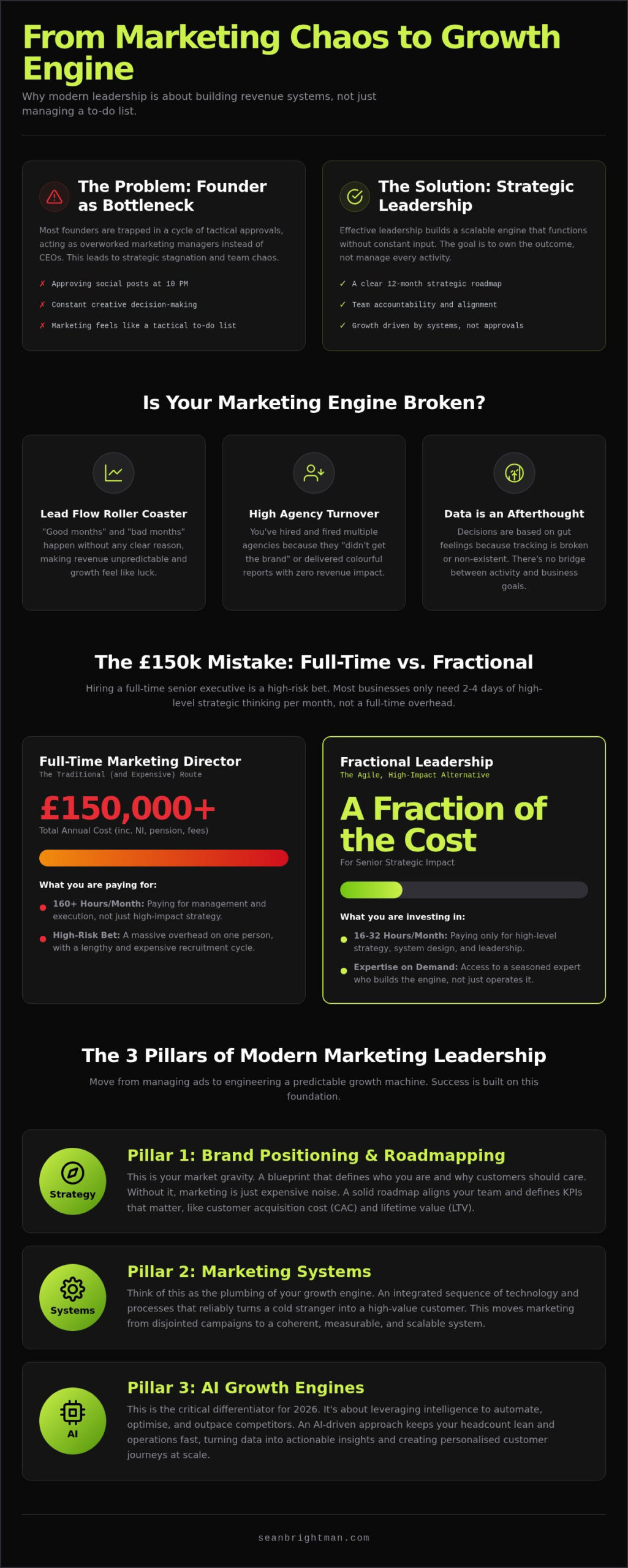
    The Fractional CMO model flips the script. You hire high-level strategic depth for one or two days a week. This gives you the seniority of a £150k+ executive without the associated overheads or long-term commitment. It’s about strategic impact, not desk time. You get the roadmap, the systems architecture, and the accountability without the placeholder filler. Transitioning to this model is part of The Fractional Revolution occurring in 2026, where businesses prioritise strategic velocity over headcount.

    This model suits scale-ups that need a battle-hardened strategist to guide an existing team. You aren’t paying for someone to manage the day-to-day social media posts. You’re paying for the person who ensures those posts actually lead to revenue. It’s surgical. It’s efficient. It’s results-oriented.

    The Advisory Retainer Model

    For established businesses with a competent marketing manager but no senior strategic direction, an advisory retainer is the sharpest tool in the box. This isn’t about doing the work. It’s about providing the CEO with a high-velocity sounding board and ensuring the marketing team stays on track. It’s a low-drag, high-impact model that provides consistent accountability.

    According to The Advisory Retainer Guide, this approach often delivers the highest ROI. You aren’t paying for a full day rate. You’re paying for access to a seasoned brain that has solved your specific problems a dozen times before. It’s the ultimate insurance policy against wasted marketing spend. You get the clarity you need to make big decisions without the friction of a full-time interim hire.

    • Full-time Interim: Best for crisis management or massive projects.
    • Fractional CMO: Best for strategic growth and system building.
    • Advisory Retainer: Best for ongoing strategic alignment and CEO support.

    Interim Marketing Director Rates UK: 2026 Pricing and ROI Guide

    Calculating ROI: Why the Day Rate Is the Wrong Metric

    Fixating on interim marketing director rates uk is the quickest way to hire the wrong person. If you’re looking at a £1,000 day rate and seeing only a cost, you’ve already lost the game. You should be looking at the return. A senior interim doesn’t just manage; they audit. They find the hidden profit buried in your messy tech stack and underperforming agency contracts. It’s about value created versus the cost of doing nothing.

    The £120k mistake is common in UK SMEs. Businesses hire a “Marketing Director” on a permanent salary who is actually a glorified manager. They have the title but lack the strategic depth to build a system. You end up with a high-salaried employee who still needs an expensive agency for every tactical task. A battle-hardened interim strategist identifies these inefficiencies in weeks, not months. They stop the bleeding before they even start building.

    Consider the “Cost of Inaction” (COI). Every month your marketing spend remains unoptimised, you’re burning cash. If an interim saves you £5,000 a month in wasted ad spend or redundant software, their rate becomes an investment with an immediate payback. You aren’t paying for their time; you’re paying for the years of experience that allow them to spot a leak in 48 hours.

    From Cost Centre to Growth Engine

    Most marketing departments are black holes for cash because they lack a clear roadmap. A senior interim performs a marketing efficiency audit to stop the leaks and install accountability. They move your business away from “tool fatigue” and toward scalable growth engines that deliver predictable results. This isn’t about being busy; it’s about being effective. You pay for a strategy that turns marketing into a high-velocity revenue generator.

    Strategic Exit Preparation

    If you’re planning an exit, your marketing system is either an asset or a liability. Acquirers don’t want to see a business dependent on a single founder’s charisma or a disjointed team of juniors. They want to see machinery. Investing in marketing strategy for business exit ensures you build the growth engine that buyers actually covet. It’s about professionalising the entire marketing function to maximise your valuation.

    Stop paying for presence and start paying for progress. If you’re ready to move beyond the placeholder model, book a roadmapping session to define your strategic path and fix your marketing ROI once and for all.

    Hiring for Impact: Beyond the Interim Placeholder

    Hiring for seniority is easy. Hiring for impact is hard. Most businesses fall into the trap of hiring a placeholder to keep the engine idling whilst they search for a permanent fix. This is a waste of capital. When assessing interim marketing director rates uk, you must prioritise leaders who bring a plug-and-play mindset. You need a strategist who can diagnose your operational friction on day one and start building a high-velocity machine by day three.

    Managers maintain the status quo. Strategists destroy it to build something better. In a high-growth scale-up, you don’t have six months to wait for a new hire to get settled. You need someone who understands systems thinking and AI-powered automation. Vetting for AI competence is no longer optional in 2026. If your interim isn’t talking about integrated growth engines and automated lead-gen flows, they’re just a high-priced admin who happens to have a senior title. They should be building assets, not just managing tasks.

    The Strategic Brand Roadmap

    Sometimes, you don’t need a six-month contract. You need a reset. A one-off strategic brand roadmapping session often provides more value than a long-term interim placeholder. It sets the direction, identifies the leaks, and builds the blueprint for your future team to follow. You get the clarity required to lead your existing department without the baggage or the long-term commitment of a full-time senior hire. Fix the map before you hire the driver.

    Direct Accountability for CEOs

    CEOs don’t need corporate fluff or brand-speak. They need blunt honesty and measurable results. The straight-shooting strategist approach strips away the noise and focuses on pragmatic outcomes. You pay for the expertise that says no to bad ideas and yes to scalable systems. This level of accountability is what justifies the elite end of interim marketing director rates uk. It’s about strategic velocity, not just filling a gap in the org chart with a warm body.

    The next step isn’t another recruitment search. It’s a decision to build a growth engine that actually works. If you’re ready to stop the wasted spend and start scaling with precision, it’s time to book an AI marketing roadmap session. Get the roadmap, fix the system, and secure your strategic stability today.

    Secure Your Strategic Velocity

    Market benchmarks for 2026 prove that interim marketing director rates uk are an investment in machinery, not just a payroll expense. You’ve seen how the right leader identifies wasted agency spend and builds an AI-powered growth engine in weeks. Stop paying for presence and start paying for progress. You need a battle-hardened strategist who skips the corporate fluff and delivers pragmatic results without the overhead of recruitment fees.

    Whether you choose a full-time interim or a fractional model, the goal is stability and scale. As a published author on marketing strategy and an AI-powered growth specialist, I help CEOs turn messy departments into high-velocity systems. You don’t need a placeholder; you need a fixer who understands the gears of your business. It’s time to stop the bleeding and build a growth engine that actually delivers. Get strategic direction with a Marketing Advisory Retainer and take control of your marketing ROI today. The roadmap to stability is ready when you are.

    Frequently Asked Questions

    What is the average day rate for an interim marketing director in the UK?

    Current market benchmarks for 2026 place the average day rate between £800 and £2,000+. The lower end typically covers SME leadership or shorter tactical projects. The upper end is reserved for battle-hardened strategists in high-growth scale-ups or large enterprises. These interim marketing director rates uk reflect the high level of risk and speed to impact these professionals provide. You aren’t just paying for time; you’re paying for a senior leader to land and fix a messy department immediately.

    Is an interim marketing director usually inside or outside IR35?

    IR35 status depends entirely on the working relationship and the nature of the contract. Many interim roles that substitute a permanent position are deemed “Inside IR35,” requiring the professional to pay tax similar to an employee. However, project-based work or Fractional CMO services often fall “Outside IR35” because they focus on specific deliverables and strategic advisory rather than day-to-day management. Always seek a professional status determination before starting an engagement to avoid compliance headaches.

    What is the difference between an interim and a fractional CMO?

    An interim marketing director is usually a full-time, temporary replacement for a fixed period, often covering a vacancy or maternity leave. A Fractional CMO provides the same senior leadership but on a part-time basis, typically one or two days a week. This allows businesses to access high-level strategy and AI-powered growth engines without the £150k+ overhead of a full-time executive. It’s a shift from paying for presence to paying for strategic velocity.

    How long does a typical interim marketing director engagement last?

    Typical interim engagements last between three and nine months. This timeframe allows the leader to audit the current state, install a new roadmap, and potentially help hire a permanent successor. Fractional CMO or advisory retainer models often last longer, sometimes twelve months or more, because they focus on ongoing strategic alignment and accountability. The goal is always to build a scalable system that eventually functions without the interim’s constant manual intervention.

    Do interim marketing directors charge VAT on their rates?

    Yes, most professional interim marketing directors in the UK are VAT-registered and will charge 20% VAT on top of their quoted day rate or retainer. This is standard practice for limited company contractors and independent consultancies. Whilst this is a flow-through cost for VAT-registered businesses, it’s a factor to keep in mind for your cash flow and budgeting. Ensure your initial pricing discussions clarify whether the quoted rates are inclusive or exclusive of VAT.

    What qualifications should I look for in a senior marketing interim?

    Look for strategic depth and a get-your-hands-dirty attitude rather than just a list of certifications. A senior interim should demonstrate systems thinking and a track record of building growth engines. In 2026, AI competence is a non-negotiable requirement. You need a leader who has seen your specific problems before and knows exactly how to fix them. Prioritise battle-hardened experience and a clear methodology over corporate fluff or theoretical degrees.

    Why are interim rates higher than a pro-rata salary?

    Day rates are higher because they include the speed to impact premium and cover the professional’s business overheads. You don’t pay for pension contributions, employer National Insurance, private healthcare, or holiday pay. An interim also carries their own professional indemnity insurance and operational costs. Most importantly, you’re paying for a leader who delivers in three months what a permanent hire might take a year to organise. It’s an investment in strategic velocity.

    Can an interim marketing director help with AI implementation?

    Yes, a modern interim or Fractional CMO is essential for navigating AI implementation. They don’t just recommend tools; they architect AI-powered growth engines that improve marketing efficiency and reduce headcount costs. This involves building a strategic roadmap to integrate automation into your core operations. By leveraging AI consulting, they turn a bloated marketing budget into a lean, high-output machine. This technical foresight is what separates a transformational leader from a simple placeholder.

  • Marketing Team Lacks Strategic Direction: How to Fix the Wasted Motion

    Marketing Team Lacks Strategic Direction: How to Fix the Wasted Motion

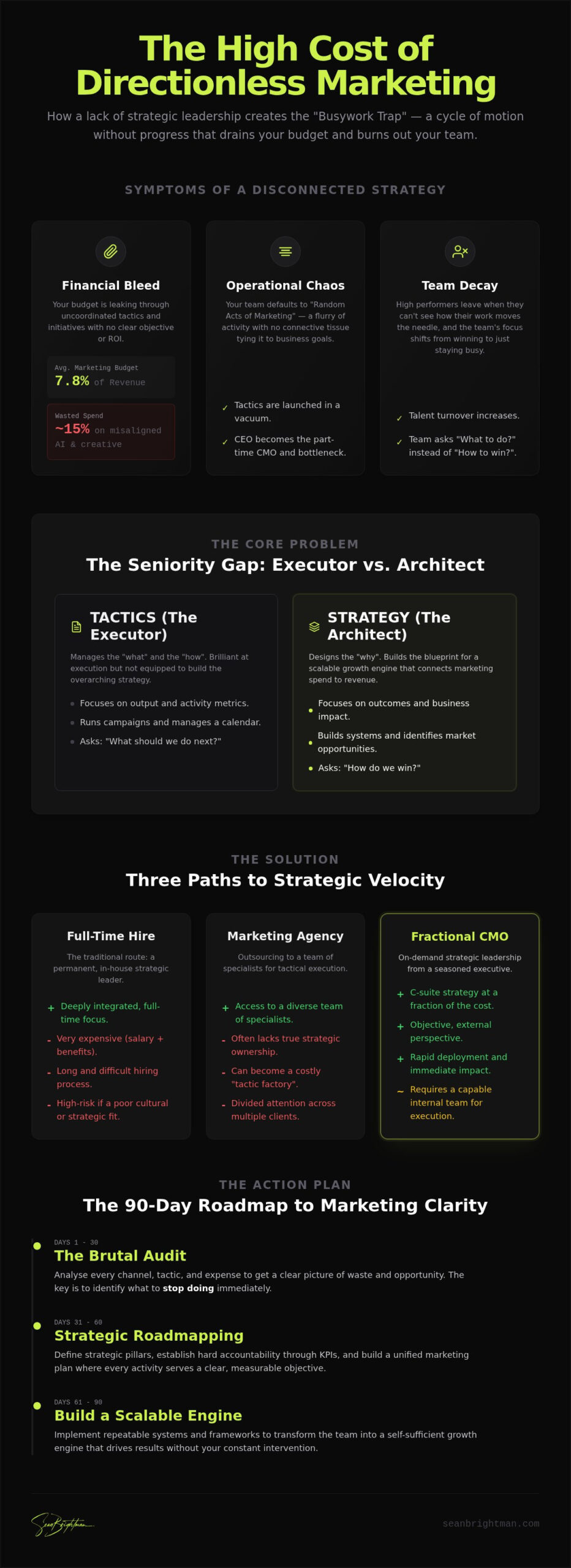
    Busywork is the most expensive line item on your balance sheet. Your team is exhausted, your budget is bleeding, and the ROI is a ghost. When your marketing team lacks strategic direction, you don’t have a growth engine; you have a high-speed treadmill. It’s a cycle of motion without progress that drains your capital and your patience.

    In 2026, with average marketing budgets tight at 7.8% of revenue, there is zero room for error. You cannot afford to waste 15% of that spend on AI initiatives or creative campaigns that lack a clear objective. You know the frustration of watching talented people throw uncoordinated tactics at the wall whilst you’re forced to micro-manage every campaign. It’s exhausting. It’s also unnecessary. You didn’t hire a team to be their babysitter; you hired them to drive revenue.

    This article shows you how to break the cycle. You will learn how to install the leadership architecture that turns chaotic activity into measurable growth. We will cover how to organise a clear marketing roadmap, establish hard accountability through KPIs, and build a scalable system that doesn’t require your constant intervention. It’s time to stop the wasted motion and start moving the needle.

    Key Takeaways

    • Identify the “Busywork Trap” where high output yields zero outcome. Learn to distinguish between tactical motion and strategic progress to protect your budget.
    • Bridge the “Seniority Gap” that occurs when your marketing team lacks strategic direction. Recognise why a Head of Marketing cannot replace the high-level architecture of a seasoned CMO.
    • Avoid “Tool Fatigue” by integrating AI as a strategic component rather than a shiny distraction. Ensure your tech stack accelerates growth instead of just making you fail faster.
    • Compare the three paths to strategic velocity. Decide between a full-time hire, an agency, or a Fractional CMO to fix your leadership failure.
    • Implement a 90-day roadmap to marketing clarity. Use a brutal audit and strategic roadmapping to transform your team into a scalable growth engine.

    Symptoms of a Marketing Team That Lacks Strategic Direction

    High activity is not the same as high impact. If your marketing department is shipping campaigns daily but the revenue line remains flat, you are caught in the Busywork Trap. It is a mechanical failure of leadership. When your marketing team lacks strategic direction, they default to “Random Acts of Marketing.” This is the phenomenon where uncoordinated tactics are launched in a vacuum. A LinkedIn post here. An email blast there. A new AI tool trial somewhere else. It feels like progress. It looks like work. But it kills ROI because there is no connective tissue between the activity and the objective.

    The shift is subtle but lethal. Your team stops asking “How do we win?” and starts asking “What should we do next?” They are looking to you for the next task rather than owning the outcome. This creates strategic drift. The invisible cost is not just wasted spend; it is talent turnover. High performers hate wasting their careers on projects that don’t matter. If they can’t see how their work moves the needle, they will leave for a competitor who actually has a plan. Understanding Marketing strategy fundamentals is the difference between a functional growth engine and a broken gearbox.

    Tactics vs. Strategy: The Stagnation Gap

    A campaign is a tool. A strategic pillar is the blueprint. Teams default to tactics because checking a box feels good. It is easier to “do social media” than it is to define why you are on social media. This is channel-first thinking. It puts the platform before the person. You end up buying the machinery before you have designed the product. Strategy defines the audience and the value proposition. Tactics are just the delivery mechanism. Without the former, the latter is just noise.

    The CEO’s Burden: Why You Can’t Be the Part-Time CMO

    You are likely the bottleneck. When you act as the part-time CMO, you become the narrowest part of the funnel. You are managing a department you don’t fully understand, and the emotional toll is heavy. Delegating tactics without a strategy is a recipe for expensive failure. Your job is to lead the business, not to babysit the marketing calendar. If you are the one deciding which TikTok trend to chase or which font looks “premium,” your marketing team lacks strategic direction. You shouldn’t be the one providing the spark; you should be the one holding a leader accountable to a roadmap.

    Why Internal Teams Struggle to Organise Themselves

    When a marketing team lacks strategic direction, the root cause is rarely a lack of effort. It is a structural failure of perspective. Internal teams are often too close to the product to see the brand. They get bogged down in the minutiae of daily operations, watering every individual leaf whilst the forest burns. This internal bias is a silent killer of ROI. It prevents the team from identifying what to stop doing, which is often more important than deciding what to start.

    Corporate politeness is another significant hurdle. In many UK scale-ups, the desire to maintain “team harmony” prevents the blunt honesty required for a strategic pivot. No one wants to tell the CEO that their favourite project is a resource sink. Without a robust Marketing systems architecture, consistency becomes impossible. You end up with a collection of uncoordinated silos rather than a unified growth engine. This lack of a repeatable framework means every new campaign starts from zero, wasting time and mental energy on reinventing the wheel.

    The Problem with Mid-Level Leadership

    Hiring “doers” to do “thinking” work fails every time. A Head of Marketing is often a brilliant executor, but they are not a CMO. There is a massive seniority gap between managing a budget and architecting a growth engine. If your leadership is focused on hitting a publishing schedule rather than identifying market opportunities, your marketing team lacks strategic direction. You need an architect, not just a foreman. If you feel like you’re constantly repeating yourself, it’s because your leadership layer isn’t translating your vision into a tactical roadmap.

    The Accountability Vacuum

    Who owns the “Why” behind your marketing spend? If the answer is “everyone,” then the answer is “no one.” In many directionless teams, people end up marking their own homework. They report on vanity metrics, like social engagement or email open rates, because they are easy to track and look positive. However, these metrics rarely correlate with revenue growth. Breaking this internal echo chamber requires an external perspective that isn’t afraid to challenge the status quo. Sometimes, the most efficient way to install this accountability is through a Fractional CMO who can bridge the gap between your vision and the team’s execution.

    AI: The Great Accelerator of Strategic Confusion

    AI is currently the most efficient way to burn your marketing budget. It is a force multiplier. If your strategy is sound, it scales your success. If your marketing team lacks strategic direction, AI simply helps you fail at light speed. It turns a drip of uncoordinated tactics into a flood of irrelevant noise. In 2026, marketers are allocating an average of 15.3% of their budgets to AI initiatives. Most of that spend is being incinerated on tools that lack a strategic use case. This is the “Tool Fatigue” trap. You don’t need more subscriptions; you need a system.

    Adopting tech without a roadmap is just expensive procrastination. Professional AI consulting fixes this “shiny object syndrome” by aligning software with business outcomes. It shifts the focus from “What can this tool do?” to “How does this tool help us win?” Without this alignment, you are just automating the very busywork that is currently killing your ROI. You are buying a faster engine for a car that doesn’t have a steering wheel.

    Automating the Wrong Things

    More content doesn’t equal more growth. If your core message is flawed, AI-generated content just dilutes your brand positioning faster than a human ever could. You end up with a high volume of generic, soul-less output that consumers in 2026 immediately ignore. AI-driven strategic velocity is the precise application of machine intelligence to accelerate validated business goals, not the automated production of unvalidated noise.

    Building an AI-Powered Growth Engine

    AI should inform your strategy before it touches your execution. It is about strategic intelligence, not just content generation. Use data-driven insights to find your “Strategic North Star” and identify which channels actually move the needle. Whilst email marketing offers an average ROI of £36 for every £1 spent, AI can pinpoint exactly which segments are ready to convert, making that return even higher. The role of the CMO is to govern this implementation, ensuring every tool serves the roadmap. It isn’t about chasing the latest LLM update; it’s about building a machinery of growth where AI acts as the fuel, not the driver. If your marketing team lacks strategic direction, they will remain stuck in the “AI for content” phase whilst your competitors build strategic intelligence engines.

    Marketing Team Lacks Strategic Direction: How to Fix the Wasted Motion

    Fixing the Direction: Three Paths to Strategic Velocity

    When your marketing team lacks strategic direction, you have three ways to install the missing leadership architecture. You can hire a full-time leader, hire an agency, or hire a Fractional CMO. Each path offers a different speed to value. Most CEOs default to the full-time hire. They think a permanent desk equals permanent progress. They are often wrong. In 2026, the average salary for a full-time UK CMO is reaching levels that mid-sized businesses simply cannot justify for the output they receive. Hiring a £150k CMO might be a £120k mistake if you don’t yet have the infrastructure for them to lead. You pay for their 40 hours, but you only need 4 hours of their strategic brain. The rest is spent in meetings or managing people they shouldn’t have to manage. It is an expensive way to buy a manager when you actually need an architect.

    The agency route is equally risky. Agencies are execution shops. They want to sell you more social posts, more ads, and more content. Outsourcing strategy to an execution shop rarely works because their incentive is to keep the machine running, not to question if the machine should exist. They aren’t in your boardroom. They don’t understand your margins. They deliver tactics, not direction. This is why a Fractional CMO is the surgical option. You get the battle-hardened expert who has seen your problems before and knows the fix. They install the system and then step back. It is about impact, not hours.

    Why Your First Senior Hire Shouldn’t Be Full-Time

    The “Plug-and-Play” nature of fractional leadership is its greatest asset. You get 20 years of experience for 20% of the cost. They don’t need a three-month onboarding period. They arrive with a toolkit. Most importantly, they aren’t embroiled in internal politics. They can tell you the blunt truth because their career doesn’t depend on your approval of their personality. They are there to solve the problem, not to build an empire. If your marketing team lacks strategic direction, you need an external force to break the stagnation, not a new employee to join it.

    The Role of the Advisory Retainer

    Strategy is not a document on a shelf. It is a living process. An Advisory Retainer ensures that the roadmap is followed. It creates a cadence of accountability for your internal team. They stop marking their own homework. This bridges the gap between the board room and the marketing department, ensuring every pound spent aligns with your commercial goals. It turns your marketing department from a cost centre into a growth engine. If you are ready to stop the wasted motion and install high-level accountability, explore how a Fractional CMO can transform your team.

    The 90-Day Roadmap to Marketing Clarity

    Clarity is a function of discipline. You don’t fix a broken department with a motivational speech or a weekend workshop. You fix it with a methodical 90-day reset. If your marketing team lacks strategic direction, the first 30 days are about subtraction. You cannot build a high-performance growth engine on top of a scrapyard.

    Phase 1 is the Brutal Audit. We identify the “zombie” campaigns that have been eating your budget for months without a single conversion. Phase 2 is Strategic Brand Roadmapping. This defines the “How” and the “Who” with surgical precision. Phase 3 moves into Operational Alignment, where we restructure the team for impact rather than activity. Finally, Phase 4 closes the loop with hard accountability. We set KPIs that actually matter to the CEO, focusing on revenue and customer acquisition cost rather than vanity metrics.

    Auditing for Efficiency, Not Just Activity

    Most teams are afraid to stop doing things. They think volume equals value. It doesn’t. We look for the technical debt in your marketing stack and simplify the tools to focus on what drives revenue. If a channel isn’t producing a measurable return, it gets cut immediately. A “Stop-Doing” list is the most effective way to reclaim a leaking budget and refocus your team on high-leverage tasks. We strip the machinery back to its core functional components so we can see what actually works whilst others are still tinkering with broken parts.

    Establishing the North Star

    Positioning is your competitive weapon. It should make your rivals irrelevant by carving out a space only you can occupy. Once the strategy is set, your junior team can finally execute with confidence because they aren’t guessing. They know the boundaries. This alignment does more than just drive current revenue. It builds a growth engine that buyers covet, directly supporting your long-term business exit strategy.

    When your marketing team lacks strategic direction, they are just waiting for a leader to draw the map. In 90 days, you can move from a state of expensive confusion to a high-velocity growth system. You move from “Random Acts of Marketing” to a scalable, predictable engine. Stop the motion. Start the progress.

    Build Your Growth Engine

    Activity is not progress. You now know that the “Busywork Trap” and “Random Acts of Marketing” are symptoms of a leadership failure, not a lack of talent. When your marketing team lacks strategic direction, you are simply subsidising motion whilst your competitors capture the market. You cannot afford to wait for your internal team to find their way without a map. Every day spent in strategic drift is a day of wasted spend and lost opportunity.

    You need a system that translates your vision into measurable revenue. As a Fractional CMO for high-growth UK brands and author of the definitive guide to marketing strategy, I specialise in installing AI-powered growth engines that deliver clarity and accountability. Stop micro-managing the tactics and start architecting the outcome. It is time to move from “What should we do?” to “How do we win?”

    Book a Strategic Roadmapping Session with Sean Brightman today. It is time to turn your marketing department into the high-performance machinery your business requires. You have the vision; now get the architecture to match it. Your scalable growth engine is waiting.

    Frequently Asked Questions

    How do I know if my marketing team lacks strategic direction or just lacks budget?

    If your team is constantly shipping but the revenue line is flat, you have a strategy problem. A lack of budget restricts the volume of your activity, but when your marketing team lacks strategic direction, the quality of that activity is irrelevant. Look for “Random Acts of Marketing” where tactics aren’t connected to commercial goals. If your team can’t explain why they chose a specific channel, more money will only help them fail faster.

    Can a marketing agency provide the strategic direction my team is missing?

    Most agencies are execution engines. They are built to sell you more social posts, ads, or content. Whilst they might offer “strategy,” it is often just a plan to sell more of their specific services. True strategic direction must come from a leadership level that understands your margins and business exit goals. You need an architect to design the growth engine before you hire the builders to lay the bricks.

    What is the difference between a Marketing Manager and a Strategic CMO?

    A Marketing Manager is a foreman who ensures the work gets done. They manage schedules and publishing calendars. A Strategic CMO is the architect who builds the growth engine. They focus on brand positioning, market opportunities, and commercial outcomes. If your current leader is asking you what the priorities are, you have a manager. You need a CMO to tell you where the growth is hidden and how to capture it.

    How long does it take to fix a directionless marketing department?

    You can install a leadership architecture and achieve marketing clarity in 90 days. The process starts with a brutal audit to stop the bleeding, followed by strategic roadmapping to define your North Star. By the end of this period, your team will move from chaotic activity to a cadence of accountability. It doesn’t take years to fix the motion; it takes a decisive shift in how you lead the department and its systems.

    Will an AI roadmap help my team find its strategic focus?

    An AI roadmap provides the technical and strategic framework to modernise a stagnant team. It moves you away from using AI just for content generation and towards using it for strategic intelligence. This focus allows your team to automate the busywork whilst focusing on high-level brand positioning. Without this roadmap, AI is just another shiny object that accelerates your failure. It turns your team into a data-driven growth engine that scales with precision.

    Is a Fractional CMO better than a full-time hire for a UK scale-up?

    For a UK scale-up, a Fractional CMO is almost always the superior choice. You get senior expertise without the £150k salary and associated overheads. It is a “plug-and-play” solution that provides immediate impact without the internal politics of a permanent hire. You don’t need a full-time leader to build a strategy; you need an expert to install the system and ensure your team is accountable for measurable results.

    What are the first signs that my marketing strategy is failing?

    The first signs are vanity metrics and CEO micro-management. If you find yourself checking social media captions or email fonts, your strategy is non-existent. You will also see high team burnout because they are working hard on things that don’t matter. When your marketing team lacks strategic direction, the ROI is a ghost, and your talented people will start looking for the exit because they can’t see the impact of their work.

    How much input should a CEO have in the marketing strategy?

    The CEO should define the business objectives and the destination. They should not be designing the route. Your role is to hold the marketing leader accountable to the roadmap, not to be the part-time CMO. High-level input is essential for alignment, but micro-management is a sign that your leadership architecture is broken. You set the destination; let the expert drive the car. This ensures you focus on leading the company whilst the marketing engine runs.

  • The Hidden Cost of the Marketing Leadership Gap: Why Growth Stalls in 2026

    The Hidden Cost of the Marketing Leadership Gap: Why Growth Stalls in 2026

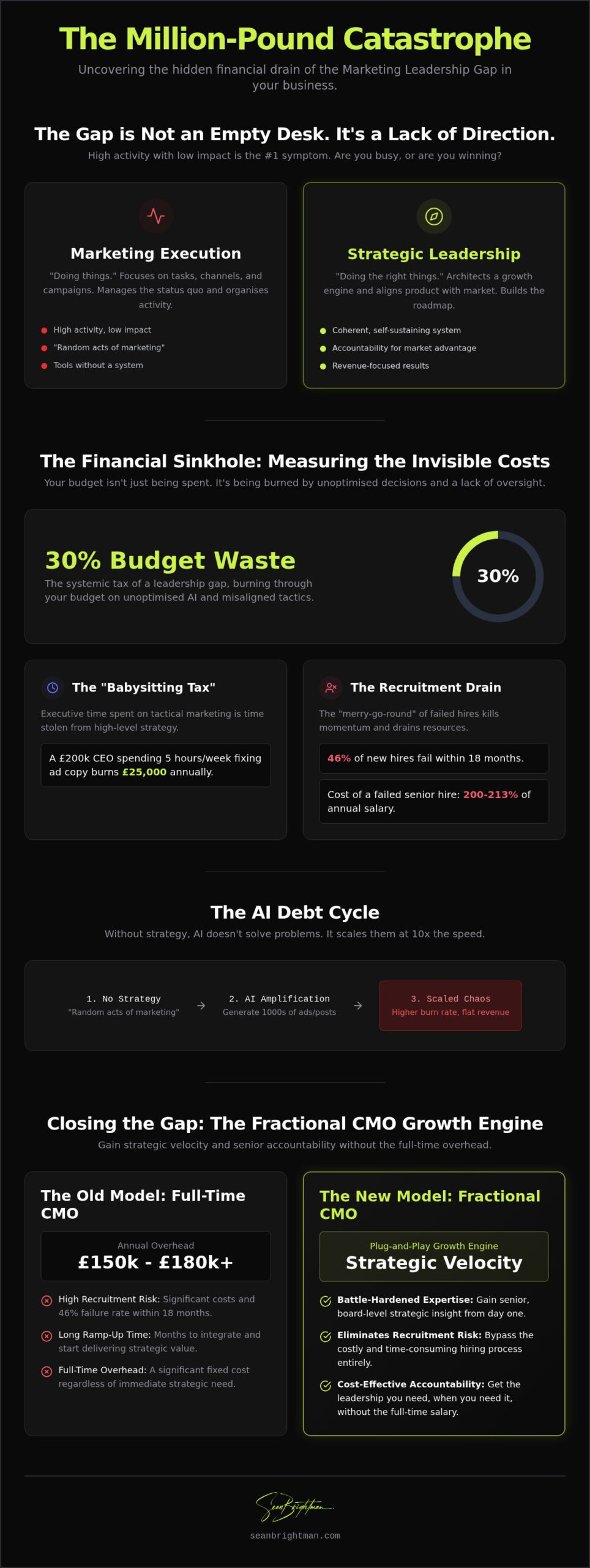
    Hiring the wrong person isn’t just a mistake. It’s a million-pound catastrophe. In 2026, the actual cost of marketing leadership gap issues is no longer a missed target or a messy spreadsheet. It’s a systemic tax. It burns through 30% of your budget on unoptimised AI and misaligned tactics while you’re left holding the bill.

    You see the symptoms daily. Your team is busy, the tools are expensive, and your burn rate is climbing. Revenue stays flat. You’re likely exhausted from founder-led marketing and tired of guessing which half of your budget is actually working. This is about systems, not just tools. You need a growth engine, not a collection of expensive subscriptions.

    I’ll show you how to plug these invisible financial leaks. You’ll discover how to build a marketing department that functions as a self-sustaining growth engine without the £150k overhead of a full-time hire. We will examine the mechanics of fractional leadership, the reality of AI-disrupted roles, and the exact roadmap to strategic clarity.

    Key Takeaways

    • Distinguish between marketing execution and strategic leadership to ensure your team is doing the right things, not just staying busy.
    • Calculate the invisible cost of marketing leadership gap problems, including wasted ad spend and the financial drain of the recruitment merry-go-round.
    • Stop the AI debt cycle by integrating tools into a coherent strategy rather than scaling bad processes at ten times the speed.
    • Recognise the warning signs of a leadership void, such as the CEO personally approving tactical details or tracking vanity metrics over revenue.
    • Implement a “plug-and-play” Fractional CMO solution to gain strategic velocity and senior accountability without the full-time salary overhead.

    What is the Marketing Leadership Gap?

    The gap isn’t an empty desk. It’s an absence of accountability for your market advantage. You have people. You have tools. You probably have a dozen active campaigns. But you don’t have a growth engine. You have a collection of parts that don’t fit together. This is the difference between marketing execution and marketing leadership.

    Execution is about doing things. Leadership is about doing the right things. Mid-market UK firms often fall into the “Tactical Trap” whilst scaling. They hire for skills but lack the vision to integrate those skills into a coherent system. The cost of marketing leadership gap issues shows up as high activity with low impact. You’re busy, but you aren’t winning.

    In 2026, the complexity of AI and fragmented channels has turned this gap into a canyon. AI allows you to generate a thousand ads in a minute. Without leadership, those thousand ads are just noise. You’re scaling chaos. You’re paying for speed when you should be paying for direction.

    The Manager vs. Leader Distinction

    Managers organise tasks. Leaders architect growth engines. If your Marketing Manager is spending their day debating font sizes or scheduling LinkedIn posts, they aren’t leading. They are managing the status quo. They cannot solve your positioning problem because they are too close to the machinery.

    True leadership requires an understanding of the core principles of marketing management to align your product with a shifting market. A manager follows the roadmap. A leader builds it. Relying on “bottom-up” strategy from junior staff is a recipe for expensive failure in a competitive market.

    Why Scale-ups Hit the Leadership Wall

    Founder-led marketing works until you hit £5M. At that stage, your intuition is enough. But as you push toward £20M, that intuition fails. You can’t be in every meeting. You can’t approve every headline. You hit the “Squeezed Middle”.

    This is where the cost of marketing leadership gap becomes a drag on your valuation. You are too big for a freelancer but too small for a full-time £180k CMO. The result is “random acts of marketing”. You try a bit of SEO. You dabble in PPC. You hire a content agency. None of it talks to each other. You have a team that needs babysitting instead of a department that generates revenue.

    The Financial Sinkhole: Measuring the Invisible Costs

    Your marketing budget is leaking. It isn’t a drip; it’s a flood. The cost of marketing leadership gap issues isn’t just a line item on a P&L; it’s the cumulative weight of unoptimised decisions. When you lack senior oversight, you pay a “Babysitting Tax”. If you are a CEO earning £200,000 and you spend five hours a week fixing LinkedIn posts or debating ad copy, you are burning £25,000 a year in executive time. That is time stolen from high-level strategy to do a job you’ve already paid someone else to perform.

    The drain extends to your ad spend. Running campaigns on a broken brand foundation is like pouring water into a sieve. Without a leader to enforce message market fit, your cost per acquisition climbs whilst your conversion rate stagnates. You aren’t building an asset. You are just renting expensive, low-quality attention. Mastering the challenge of measuring marketing ROI becomes impossible because the data is polluted by tactical noise. You can’t measure what you haven’t defined.

    The Cost of Misaligned Tactics

    Busy marketing teams are often your most expensive ones. High activity does not equal high impact. Spending £10,000 a month on SEO without a strategic brand roadmap is a vanity exercise. You might win the traffic game, but you’ll lose the revenue race. This misalignment compounds over 12 to 24 months. By the time you realise the direction was wrong, your competitors have already out-positioned you and captured the market’s trust. If you want to stop the bleed, you need to audit your marketing machinery before adding more fuel.

    The Retention and Recruitment Drain

    The recruitment merry-go-round is a silent killer of growth. Research shows that 46% of new hires fail within 18 months. For a senior marketing role, the fully loaded cost of a failed hire can be between 200% and 213% of their annual salary. This includes recruitment fees, ramp-up time, and the devastating loss of momentum. Junior staff churn because they have no one to learn from; senior hires fail because they lack the systems to succeed. Choosing a Fractional CMO eliminates this risk. You get the battle-hardened expertise without the £180,000 overhead or the long-term recruitment gamble. It’s about buying results, not just filling a seat.

    The AI Debt: Why Tactics Without Strategy Burn Cash

    AI isn’t a silver bullet. It’s an accelerant. If your strategy is flawed, AI just makes you fail faster. Many UK firms are currently drowning in “AI Tool Fatigue”. They have 50 different subscriptions for copy, images, and video, but no integrated workflow. They are buying tools, not solutions. This is where the cost of marketing leadership gap issues become visible in your software budget. You are paying for capacity you don’t know how to use.

    The real danger is the “Garbage In, Garbage Out” problem. AI allows you to scale bad strategy at ten times the speed. Without senior oversight, your team is simply generating more noise. They are using ChatGPT to churn out generic blogs whilst your competitors are building automated, data-driven growth engines. This misalignment is often rooted in the structural failure of the marketing role itself. As noted in The Trouble with CMOs, when a role is poorly designed, it cannot possibly manage the complexity of modern technology. You don’t need more prompts. You need a framework.

    To move beyond this, your team requires a comprehensive AI consulting framework. This isn’t about learning how to write better emails. It’s about re-engineering your entire marketing machinery to function in a post-AI world. If you are still manually writing every piece of content whilst your rivals use AI-powered operations, you aren’t just falling behind. You are becoming obsolete.

    AI as a Tool vs. AI as a System

    Most marketing teams use AI as a tool for “content”. They use it to save ten minutes on a social post. True leadership treats AI as a system for “operations”. Research from Boston Consulting Group indicates that 90% of a marketing manager’s tasks are disrupted by AI from a skills perspective. If your leadership doesn’t understand this, they cannot re-engineer your processes. This creates an “Efficiency Gap”. You have a 2026 budget supporting a 2019 workflow. It’s expensive, slow, and strategically toothless.

    The Strategic AI Roadmap

    Moving from “playing with AI” to a scalable growth engine requires an owner. Senior leadership must own the AI implementation roadmap. It’s not a task to delegate to a junior executive. A strategic roadmap defines how AI integrates with your CRM, your lead scoring, and your customer journey. The ROI of automated marketing operations is found in the machinery, not the copy. Under expert guidance, you stop buying subscriptions and start building an integrated growth engine that runs itself. This is how you close the cost of marketing leadership gap and turn your marketing department into a profit centre.

    The Hidden Cost of the Marketing Leadership Gap: Why Growth Stalls in 2026

    Audit Your Gap: Three Signs You’re Babysitting Your Marketing

    Stop pretending your marketing department is an autonomous engine if you’re the one still turning the key every morning. If you’re correcting ad copy or debating the colour of a CTA button, you aren’t a CEO. You’re a high-priced editor. Whilst you might feel that staying involved ensures quality, you’re actually capping your company’s growth. You’ve hired a team, but you’re still doing the heavy lifting.

    Founder-led marketing is a stage, not a permanent state. If you are still the final word on every LinkedIn post and ad headline, your team hasn’t been empowered. Or worse, they aren’t capable. Either way, you’re the bottleneck. This isn’t leadership; it’s a lack of trust in your own systems. When you can’t step away from the tactical details, the cost of marketing leadership gap issues starts to paralyse your executive focus.

    Look at your last report. If it’s full of “vanity metrics” like follower growth or website traffic, you’re being fed fluff. Real leadership focuses on “revenue velocity.” It’s about how fast a lead turns into cash, not how many people liked a post. When your team reports on activities instead of outcomes, you’re witnessing the cost of marketing leadership gap in real-time. You’re paying for a list of chores, not a strategy.

    You likely have a marketing operations disaster hidden in your tech stack. If no one can tell you exactly which tool manages which part of the customer journey, you’re paying for a mess. Tools should talk to each other; your team shouldn’t be the manual bridge between them. Review your calendar for the last fortnight. If 20% of your time was spent on marketing “how-to” rather than “what’s next,” you have a leadership void that needs plugging.

    The Metric Test

    Can your team explain the CAC (Customer Acquisition Cost) to LTV (Lifetime Value) ratio? If they can’t, they aren’t managing a budget; they’re spending it. Your marketing reports should read like a financial statement, not a list of activity logs. Ask for a strategy pivot tomorrow. If it takes three months to change direction, your machinery is rusted and your leadership is missing.

    The Founder Dependency Audit

    What happens if you don’t attend the marketing meeting for a month? If the answer is “everything stops,” you don’t have a business. You have a job. The brand voice must be a documented system, not an extension of your personality. Founder-led marketing is a massive bottleneck to a business exit. No one wants to buy a company that breaks the moment the founder goes on holiday. You need to build a system that outlasts your daily involvement.

    If your marketing team needs a leader instead of a babysitter, book a strategic audit to find your growth engine.

    Closing the Gap: The Fractional CMO Growth Engine

    You don’t need a full-time executive. You need an outcome. In 2026, the cost of marketing leadership gap issues is solved by buying results, not paying for presence. A Fractional CMO is the “Plug-and-Play” solution for UK scale-ups. It gives you senior-level authority to fix the machinery without the £180,000 overhead or the recruitment risk. You get the brain without the baggage.

    Think of it as senior brainpower at roughly 25% of the cost of a traditional hire. You aren’t paying for corporate politics or 40 hours of “busy work”. You’re paying for a growth engine that runs itself. This shift from a “Leadership Gap” to a Marketing Advisory Retainer moves the needle from tactical chaos to strategic velocity. It’s about high-impact intervention in a concentrated timeframe.

    The Strategic Roadmap First

    Don’t hire a single executioner until you have a map. Most firms hire a “Social Media Manager” or an “SEO Specialist” before they even know what they are selling or to whom. That is a waste of capital. A Fractional CMO starts with a 90-day Roadmap. We define the positioning, the systems, and the AI integration points first. We build the foundation before we hire the executioners.

    This roadmap sets the accountability framework for your existing team. It turns them from a group of people doing tasks into a department delivering revenue. We fix the brand foundation so your ad spend actually converts. We integrate AI into the workflow to bridge the efficiency gap. You get a blueprint. Then, and only then, do you build the team to run it. This sequence ensures you aren’t scaling chaos.

    The Long-term Advisory Model

    Strategic direction shouldn’t come with corporate baggage. An advisory model provides an external force of order. It brings a battle-hardened perspective that internal teams lack. You get a partner who isn’t afraid to be blunt or challenge the status quo. This is about providing the high-level thinking that keeps the engine running at peak efficiency whilst your internal team handles the daily output.

    This isn’t just about next month’s leads. It’s about building a marketing department that buyers covet. If you’re preparing for an exit, a system-led marketing engine adds significant value to your business. It proves that the brand isn’t dependent on the founder. It proves the growth is repeatable and scalable. Stop babysitting your marketing and start leading your business. It’s time to turn your marketing department into a profit centre.

    Stop Babysitting and Start Scaling

    Your marketing should be a self-sustaining growth engine, not a series of fires you have to put out. We’ve seen that the cost of marketing leadership gap issues is measured in wasted ad spend, CEO burnout, and stagnant revenue. You don’t need a full-time £180k hire to fix it; you need a system that works. Strategy must lead your tools, especially when integrating AI into your operations.

    I provide no-fluff, senior-level advisory for founders who are ready to step out of the tactical weeds. As an expert in AI-powered growth engines and the author of the definitive book on marketing strategy, I help you build the machinery that outlasts your daily involvement. It’s about clarity, accountability, and results.

    Ready to bridge the gap? Book a Strategic AI Roadmapping Session with Sean Brightman today. Let’s turn your marketing department into a high-impact profit centre. You’ve built the business; now build the engine to scale it.

    Frequently Asked Questions

    What is the true cost of a marketing leadership gap?

    The true cost is the sum of wasted ad spend, CEO time, and failed recruitment. Research indicates a bad senior hire can cost over 200% of their annual salary. The cost of marketing leadership gap issues also includes the “Babysitting Tax,” where founders lose hours to tactical management. This isn’t just money out of the bank. It’s the compounding loss of market position whilst competitors out-manoeuvre you.

    How do I know if I need a Fractional CMO or a Marketing Manager?

    Managers execute; CMOs architect. If you need someone to schedule posts and run basic campaigns, hire a manager. If you need a scalable growth engine, a positioning overhaul, or an integrated AI strategy, you need a Fractional CMO. You don’t hire a manager to solve a strategy problem. You hire a leader to build the system that the manager eventually operates.

    Can an agency fill the marketing leadership gap?

    Rarely. Agencies are built to sell services, not to own your business outcomes. They focus on their specific channel, whether that’s SEO or PPC, often ignoring the broader brand foundation. A Fractional CMO acts as an internal force, providing senior leadership that holds agencies accountable. You need an architect on your side of the table to ensure the builders are actually following a plan.

    What is the average salary of a full-time CMO in the UK in 2026?

    For a seasoned professional at a scale-up, you’re looking at £150,000 to £200,000 plus benefits and equity. This high overhead is why many mid-market firms hit a growth wall. They need the expertise but can’t justify the six-figure commitment. A Fractional CMO provides the same level of strategic velocity at a fraction of the cost, focusing on high-impact outcomes rather than full-time presence.

    How does a Fractional CMO integrate AI into my marketing?

    By building an operational system, not just writing prompts. We look at the entire customer journey to identify where AI can automate lead scoring, content distribution, or data analysis. The goal is to re-engineer your marketing machinery to be faster and leaner. It’s about moving from “playing with tools” to owning a data-driven growth engine that scales without adding headcount.

    Is a marketing leadership gap common in B2B scale-ups?

    It is almost universal between £5M and £20M turnover. Founders often reach the limit of their own marketing intuition but haven’t yet built a departmental system. This creates a vacuum where tactics become disconnected from revenue. Identifying the cost of marketing leadership gap early allows scale-ups to professionalise their marketing operations before the “Founder Bottleneck” causes a permanent stall in growth.

    What happens if I ignore the leadership gap for another year?

    You’ll burn another 30% of your budget on misaligned tactics and unoptimised tech subscriptions. Your competitors will gain a 12-month head start on AI-powered operations that you’ll struggle to match. Ignoring the gap doesn’t just stall growth; it builds “strategic debt.” The longer you wait to fix the foundation, the more expensive and painful the eventual reconstruction becomes.

    How long does it take to close the leadership gap with a Fractional CMO?

    The initial “plug-and-play” intervention usually takes 90 days. Within the first month, we audit the existing machinery and identify the leaks. By day 60, we’ve defined the strategic roadmap and AI integration points. By day 90, the accountability framework is in place and the team is running a documented system. You move from chaos to clarity in one fiscal quarter.

  • Part-Time Marketing Director UK: How to Hire Senior Leadership Without the £150k Overhead

    Part-Time Marketing Director UK: How to Hire Senior Leadership Without the £150k Overhead

    Your marketing department doesn’t need more hands; it needs a brain that isn’t yours. Most founders remain the ultimate bottleneck, trapped in a cycle of approving social posts whilst the actual growth strategy remains stagnant. You’re likely looking for a part-time marketing director uk to stop the bleeding without swallowing a £150,000 annual salary plus recruitment fees. It’s a logical step. However, if you hire for “part-time hours” instead of “fractional impact”, you’re simply buying a slower version of the same coordination chaos you have now.

    You’ve likely felt the sting of wasting budget on agencies that deliver colourful reports but zero actual revenue. It’s a common trap. I promise to show you how to secure senior leadership that builds AI-powered growth systems rather than just managing a tactical to-do list. We will cover how to find a battle-hardened expert who provides a clear 12-month roadmap, instils accountability in your existing team, and builds a scalable engine that functions perfectly without your constant input. It’s time to stop playing the role of accidental marketing manager and start leading your business again.

    Key Takeaways

    • Identify why your current marketing feels chaotic and how to stop being the bottleneck for every minor creative decision.
    • Learn how a part-time marketing director installs AI-driven systems that generate revenue without needing your constant supervision.
    • Compare the costs and impacts of part-time hires versus fractional CMOs to find the right fit for your business stage.
    • Master the evaluation process by focusing on outcomes over activities to avoid hiring another expensive manager of mediocrity.
    • Transition from messy execution to a clear 12-month roadmap that aligns your team and agencies with your bottom line.

    Why You Are Searching for a Part-Time Marketing Director (And What You Are Actually Missing)

    You are likely tired of being the ultimate bottleneck. If you’re still approving social media posts at 10 PM, you aren’t acting as a CEO; you’re a micro-manager by necessity. You’ve started searching for a part-time marketing director uk because the current chaos is unsustainable. But here is the blunt truth: hiring a part-time employee often just adds another person to your management list. You don’t need someone to do the work. You need someone to own the outcome.

    Most businesses fall into the messy marketing trap. Your team is busy. They produce content, send emails, and tinker with ads. There is plenty of activity, but zero strategy. This is where professional Marketing management principles come into play. Without a senior leader to bridge the gap between business goals and tactical execution, your marketing budget is just an expensive experiment. In 2026, the difference between growth and stagnation is the ability to build systems, not just campaigns.

    The Symptoms of a Broken Marketing Engine

    How do you know your engine is failing? It’s rarely about a lack of effort. It’s about a lack of direction. Look for these red flags in your current setup:

    • Lead flow is a roller coaster. You have “good months” and “bad months” but no idea what caused either.
    • High agency turnover. You’ve fired multiple agencies because they “didn’t get the brand” or failed to deliver revenue.
    • Data is an afterthought. Decisions are based on gut feelings or “what feels right” because your tracking is broken or non-existent.

    These aren’t recruitment problems. These are structural failures. A tactical manager will keep the plates spinning. A strategic leader will build a machine that doesn’t need spinning in the first place.

    The £150k Mistake: Why Full-Time is Overkill

    Hiring a full-time senior executive is often a vanity play for SMEs. In 2026, a top-tier Marketing Director in the UK commands a salary between £100,000 and £170,000. When you factor in National Insurance, pension contributions, and benefits, you’re looking at a £150,000+ overhead. That is a massive, high-risk bet on one person.

    Most mid-sized firms only require two to four days of high-level strategic brainpower per month. Paying for the other 18 days is a waste of precious capital. Beyond the cost, the recruitment cycle for these roles is brutal. You’ll spend six months searching for a “perfect” candidate whilst your competitors use agile, fractional leadership to scale. You don’t need a full-time commitment. You need high-velocity strategic direction that builds a scalable growth engine.

    The Three Pillars of Modern Marketing Leadership: Strategy, Systems, and AI

    The role of a part-time marketing director uk has shifted. It is no longer about finding a manager to babysit an agency or approve social media graphics. It is about engineering. A modern director builds machines, not just ads. They design the strategic architecture that makes growth a predictable outcome rather than a lucky accident. This move toward flexible, high-level expertise is visible across all sectors, with even the public sector adopting senior job sharing roles to inject elite talent into complex projects without the full-time commitment.

    To move from chaos to a scalable growth engine, your leadership must focus on three core pillars:

    • Brand Positioning: This is your market gravity. It defines who you are so the market actually listens. Without it, your marketing is just expensive noise.
    • Marketing Systems: Think of this as the plumbing. It is the sequence of events and technology that turns a cold stranger into a high-value customer.
    • AI Growth Engines: This is the 2026 differentiator. It involves implementing intelligence to outpace competitors whilst keeping your headcount lean and your operations fast.

    Strategic Roadmapping: Your Exit-Ready Blueprint

    A year of “trying things” is a year of wasting capital. You need a blueprint that outlasts any single campaign. Strategic Brand Roadmapping creates immediate alignment between your business goals and your marketing execution. It defines the KPIs that actually matter to a CEO, such as customer acquisition cost and lifetime value, rather than vanity metrics like likes or impressions. This process builds an exit-ready business where the value resides in the system, not in the founder’s head. If you want to stop being the bottleneck, you need a map that the whole team can follow.

    Integrating AI into Your Growth Machinery

    Tool fatigue is a common symptom of a team without direction. Most departments use ChatGPT for basic emails and stop there. That is a missed opportunity. Your next director must act as an AI marketing consultant who understands how to bake predictive analytics and operational efficiency into your daily workflow. They automate the boring, repetitive tasks. This frees up your team for high-value creativity and strategic thinking. It isn’t just about speed; it is about precision. If your current marketing feels like a collection of disconnected tools, a professional Advisory Retainer can provide the oversight needed to integrate these technologies into a functional whole.

    Comparison: Part-Time Hire vs Fractional CMO vs Marketing Agency

    Job boards sell you roles. I sell you results. If you search for a part-time marketing director uk, you will likely find candidates looking for a stable 20-hour week. That is an employee mindset. High-growth scale-ups need a partner mindset. An employee requires management, training, and a pension plan. A fractional leader requires a goal and the autonomy to hit it. You must decide if you want to manage a person or manage an outcome.

    Marketing agencies are useful for tactical bandwidth. They have the hands to build the ads and manage the social channels. But they rarely own your bottom line. Their success metric is usually tied to their own internal process rather than your business growth. The Benefits Of Hiring A Fractional CMO include having a peer at the board table who challenges your assumptions rather than just executing your orders. For a UK business aiming to scale, the fractional model provides the strategic “brain” that an agency simply cannot offer.

    Who Owns the Strategy?

    Agencies own their process; a fractional leader owns your outcome. Letting an execution-only team set your strategic direction is a recipe for expensive failure. They will naturally steer you toward the services they happen to sell. If you are building a Marketing Strategy for Business Exit, you need an objective expert. You need someone who understands how to build enterprise value, not just high engagement scores on a LinkedIn post. Strategy is about what you choose not to do as much as what you do.

    Cost vs Impact: The Brutal Reality

    A part-time employee might appear cheaper on paper. Their day-rate is lower, but their “ramp-up” time is months. They need to be “onboarded”. A fractional director is plug-and-play. They arrive with a battle-tested toolkit and start stripping away the noise on day one. You aren’t paying for their time; you are paying for the years of mistakes they’ve already made on someone else’s dime. This speed of implementation is the hidden ROI of the fractional model. It is the fastest way to inject senior authority into a chaotic department without the friction of traditional recruitment.

    The Fractional CMO model is senior leadership without the overhead.

    Part-Time Marketing Director UK: How to Hire Senior Leadership Without the £150k Overhead

    The CEO’s Checklist for Evaluating a Part-Time Marketing Director

    Hiring a part-time marketing director uk is a high-stakes decision. You aren’t just looking for a CV; you are looking for a catalyst. Most candidates will talk about “activities”. They will list social media posts, email cadences, and brand refreshes. These are red flags. If they focus on social media likes rather than customer acquisition costs, they are a manager of tasks, not a leader of growth. You need a strategist who defines success through outcomes and revenue growth.

    Ask them if they have actually built a scalable growth engine from scratch. Managing an existing machine is easy. Building one whilst the plane is in the air is where the real skill lies. They must also demystify AI. If they hide behind corporate buzzwords or abstract theories, they don’t understand the tech. A true expert explains how AI reduces headcount or increases lead velocity in plain English. Finally, demand to see their methodology for team accountability. You need a reporting structure that shows you exactly where every pound is going and what it is returning.

    The Three Interview Questions That Reveal Everything

    Traditional interviews are theatre. To see the real person behind the professional mask, ask these three specific questions:

    • “Tell me about a marketing system you built that worked without you.” This tests their ability to create infrastructure rather than just being a hero who does everything manually.
    • “How would you integrate AI into our specific sales funnel in the first 90 days?” This separates the theorists from the practitioners who know how to drive efficiency.
    • “What is the #1 reason our current marketing is failing?” If they are too polite to tell you the truth, they will be too weak to lead your team. Look for blunt honesty.

    Vetting for Cultural Fit and Strategic Velocity

    You don’t need a corporate refugee looking for a quiet life. You need a battle-hardened expert who isn’t afraid to challenge your assumptions. In a part-time role, a “get-your-hands-dirty” attitude is non-negotiable. They must be able to switch from board-level strategy to fixing a broken automation in the same afternoon. They should provide strategic marketing direction from their first hour on the job. Velocity is the goal. If you are ready to stop the guesswork and start scaling, it is time to consider an Advisory Retainer that provides the accountability you have been missing.

    The Sean Brightman Approach: Senior Leadership via Advisory Retainer

    Stop searching for a person and start searching for a system. Hiring a part-time marketing director uk through traditional recruitment channels is a slow, expensive gamble. You spend months vetting candidates whilst your growth remains stagnant. My approach bypasses the HR bureaucracy entirely. I provide immediate strategic velocity. This isn’t about filling a seat; it’s about installing a growth machinery that functions with clinical precision.

    The Fractional CMO model is the missing piece in your leadership team. It provides the senior-level authority you need without the £150,000 commitment. I don’t just “manage” your existing chaos. I re-engineer it. We move away from recruitment headaches and into a phase of rapid implementation. This is high-level direction that focuses on your bottom line, not your social media engagement scores. It is the fastest way to turn a messy department into an exit-ready growth engine.

    Direct, High-Energy Leadership

    I have no patience for corporate fluff or endless meetings about meetings. My style is unapologetically direct. I bring a “get-your-hands-dirty” attitude to every engagement. You get results-oriented strategy, not abstract theory. I leverage a published methodology to organise your marketing chaos into a streamlined operation. It is about machinery, not just campaigns.

    The Advisory Retainer is the most efficient way to scale. It provides ongoing direction and, more importantly, accountability for the business owner. You need a partner who challenges your assumptions and keeps the team focused on high-impact wins. This is senior leadership as a functional component. It is plug-and-play expertise designed for the speed of the 2026 market.

    Ready to Fix Your Marketing?

    Stop playing with tools and start building a growth engine. You might have the latest AI subscriptions, but without a roadmap, they are just expensive toys. We need to move your department from messy execution to a predictable revenue stream. This starts with a clear, tactical plan that aligns your team and your agencies with your 12-month goals.

    The first step is a roadmapping session to define your 2026 strategy. We strip away the noise and identify the specific levers that will drive your growth. No more “random acts of marketing.” No more wasted budget. Just a clear path to a scalable business. If you are ready to stop being the bottleneck and start leading a high-performance machine, it’s time to act. Book a discovery call with Sean Brightman to discuss how we can fix your marketing engine today.

    Build a Growth Engine That Doesn’t Need You

    You don’t need another employee to manage; you need a system that delivers results. Most searches for a part-time marketing director uk end in frustration because founders hire for hours rather than impact. We’ve seen how the right fractional leader installs AI-powered machinery that turns interest into revenue whilst freeing you from the 10 PM social media approval loop. It’s about moving from messy execution to a scalable, exit-ready business.

    As the author of “The Book” on marketing strategy and a specialist in AI-powered growth engines, I don’t offer corporate fluff. I provide direct, battle-hardened advice that builds enterprise value. You can keep spinning plates, or you can install the senior brainpower your business deserves without the £150,000 overhead. It is time to stop playing the role of accidental marketing manager and start leading your company with clinical precision.

    Stop the marketing chaos-hire a Fractional CMO today. Your business is ready for the next level. Let’s build the machine that gets you there.

    Frequently Asked Questions

    What is the difference between a part-time marketing director and a fractional CMO?

    A part-time marketing director uk is often an employee-lite role focusing on managing existing tactics and team members. A Fractional CMO is a board-level strategist who builds the growth machinery from the ground up. One manages people; the other manages the bottom line. It is the difference between keeping the lights on and designing a new power grid for your business.

    How much does a part-time marketing director cost in the UK?

    Industry data for 2026 shows day rates for senior marketing leadership typically range between £600 and £1,400 depending on seniority and scope. This is significantly more efficient than a full-time hire who commands a median salary of £94,135 according to the ONS. You pay for high-impact brainpower without the dead weight of a permanent executive overhead or recruitment fees.

    Can a part-time director really manage my existing marketing team?

    Yes, they provide the missing accountability and strategic direction your staff are likely craving. Most internal teams are busy but uncoordinated. A fractional leader installs a clear roadmap and defines specific KPIs for your employees. They don’t need to be in the office five days a week to ensure your team is hitting their revenue targets and following the system.

    How long does it take to see results from a fractional marketing leader?

    You should see strategic clarity and a functional roadmap within the first 30 days. This involves identifying immediate leaks in your sales funnel and establishing a 12-month growth plan. Significant revenue shifts usually occur within three to six months as new AI-powered systems and growth engines are fully implemented and optimised for your specific market conditions.

    Do I need a part-time marketing director if I already have an agency?

    Agencies are execution partners; they are not your business strategists. An agency owns its process, but a director owns your outcome. A part-time marketing director uk acts as the bridge, ensuring your agency delivers actual ROI rather than just creative reports. They hold your external partners accountable to your business goals and stop the waste of your marketing budget.

    What industries do you specialise in for fractional leadership?

    My methodology is built for high-growth SMEs and scale-ups where marketing has become a bottleneck for the founder. Whilst I have deep experience in B2B tech and professional services, the core principles of building AI-powered growth engines remain universal. If you have a complex sales cycle and a messy marketing department, these systems will work for your business.

    How many days a month does a part-time marketing director typically work?

    Most fractional engagements range between two and four days per month. This isn’t about counting hours; it’s about strategic velocity. A battle-hardened expert can achieve more in one focused advisory session than a junior manager can in a full working week. You are buying the result and the years of experience, not a seat in your office.

    What happens if my business grows and I need a full-time CMO?

    A fractional leader builds the foundation for your eventual full-time hire. They document the systems, vet the agencies, and define the long-term role requirements. When you are ready for a permanent executive, you’ll have a turnkey department to hand over. This prevents the hero hire mistake where a new CMO spends six months just trying to find the keys.

  • Fractional CMO Pricing UK: The 2026 Guide to Senior Marketing Costs

    Fractional CMO Pricing UK: The 2026 Guide to Senior Marketing Costs

    Hiring a senior marketer to “do things” is the fastest way to set £100,000 on fire. Most CEOs are trapped in a cycle of paying for activity instead of outcomes. They see the LinkedIn posts and the brand awareness reports, but the bottom line stays flat. If you’re looking at Fractional CMO pricing UK just to save a few quid on a full-time salary, you’re already asking the wrong question. This isn’t about saving money; it’s about buying a system that works while you sleep.

    You likely feel the frustration of a marketing spend that feels like a black hole. You’re probably confused by the wild variance between cheap day rates and high-value retainers; all while IR35 compliance looms in the background. I’m going to give you a blunt breakdown of the 2026 market rates and the hidden costs of traditional recruitment. We’ll build a budget framework that prioritises commercial velocity over vanity metrics. This guide covers everything from basic advisory retainers to high-impact roadmapping, ensuring you buy leadership that drives growth rather than just managing the chaos.

    Key Takeaways

    • Stop paying for presence. Learn why the 2026 market is shifting from traditional £800+ day rates to value-based retainers that prioritise strategic velocity.
    • Avoid the “salary trap” by understanding how Fractional CMO pricing UK compares to the £300,000+ total loaded cost of a full-time senior hire.
    • Shift your budget from expensive agency execution to AI-powered growth engines that deliver commercial accountability instead of vanity metrics.
    • Discover why Roadmapping is the essential first step to eliminate wasted marketing spend and stop the cycle of constant CEO hand-holding.
    • Identify the “hidden” overheads of recruitment, from employer National Insurance to pension contributions, that a fractional model bypasses entirely.

    Understanding the UK Fractional CMO Pricing Landscape

    Stop looking for a cheaper employee. Start looking for a more efficient system. In the UK, a full-time CMO commands a base salary of £150,000 or more. When you factor in National Insurance, pension contributions, and bonuses, that figure spirals toward £200,000 before they’ve even sent their first email. Most SMEs don’t need a full-time executive sitting in meetings all day. They need the brain, not the body. Understanding What is a Fractional Executive? is the first step toward reclaiming your budget. It’s about securing senior leadership without the bloated overhead.

    The market has shifted significantly as we move through 2026. Savvy businesses are ditching traditional agencies that charge high retainers for junior execution. Instead, they’re pivoting toward strategic advisors who offer direct accountability. Pricing isn’t just a number on an invoice; it’s a reflection of commercial impact. If you’re paying for activity, you’re subsidising an agency’s overhead. If you’re paying for strategy, you’re buying a growth engine. Many UK SMEs overpay for busywork because they lack a senior hand to guide the ship, making Fractional CMO pricing UK a conversation about value rather than just cost.

    The Three Tiers of Marketing Leadership

    Not all external help is created equal. You need to know exactly what you’re buying to avoid a mismatch in expectations.

    • Interim Marketing Directors: These are tactical gap-fillers. They keep the lights on during a transition or parental leave. They maintain the status quo.
    • Marketing Consultants: They deliver a slide deck, provide a plan, and then disappear. The execution remains your problem to solve.
    • Fractional CMOs: These are long-term strategic partners. They are embedded in your leadership team, owning the outcomes, the budget, and the growth trajectory.

    Why “Cheap” Fractional CMOs are the Most Expensive

    A low-cost option usually means you’ve hired a junior masquerading as a CMO. They’ll do the work, but they won’t lead. Without strategic direction, your department becomes a mess of disconnected tactics and fragmented messaging. You end up with wasted budgets and a team that doesn’t know what “success” looks like. This is why marketing team accountability must be the foundation of any pricing discussion. If a leader cannot prove how they drive commercial outcomes, the day rate is irrelevant. Cheap leadership is a liability that costs you more in lost opportunity than you save in fees.

    Typical Pricing Models for Fractional CMOs in the UK

    Day rates are the industry standard, but they’re often a trap. In the UK, you’ll see figures ranging from £800 for a rising star to £2,500 for a battle-hardened veteran. The problem? Selling time incentivises slow work. If a CMO finishes a strategy in four hours instead of eight, they shouldn’t be penalised with half the pay. This is why Fractional CMO pricing UK is moving toward value-based structures. You aren’t paying for a seat in your office; you’re paying for the removal of bottlenecks and the acceleration of revenue.

    Monthly retainers represent the most common middle ground. They allow for an embedded relationship where the CMO owns the outcomes. You’re buying a “fraction” of their brain, ensuring they’re available for critical decisions without being on the payroll full-time. Hybrid models are also gaining traction. These involve a base fee to cover the fixed strategic input, paired with performance-related bonuses tied to specific growth targets. It ensures the consultant has skin in the game. It aligns their success directly with your bottom line.

    The Advisory Retainer: High-Velocity Direction

    Scale-up CEOs often find themselves isolated. They have a team of executors but no one to challenge their assumptions. The Advisory Retainer is the high-velocity choice for leaders who need direction without the heavy lifting of a full-time hire. It’s not about doing; it’s about guiding. It’s the perfect fit for founders who are comfortable with their team’s output but worried about their direction.

    This model usually involves weekly high-level calls and strategy oversight. The goal is team accountability. It ensures your internal marketing function isn’t just busy but is actually moving the needle. It’s often the most cost-effective entry point for businesses with an existing team that lacks senior leadership. It provides the “Strategic Velocity” required to scale without the friction of a full-time recruitment process.

    Roadmapping Sessions: The One-Off Strategy Investment

    Don’t commit to a six-month retainer if you don’t have a plan. That’s a recipe for wasted spend. A Roadmapping session is a concentrated burst of strategic energy designed to create a clear 12-month direction. It’s the “audit first” approach that identifies where your engine is leaking oil. You wouldn’t build a house without a blueprint; don’t build a brand without a map.

    This process often bridges the gap between raw ambition and tactical execution. It might involve deep dives into your market fit or working with a brand positioning consultant UK to refine your message. Once the roadmap is in place, you have a blueprint. You can then decide whether to execute it internally or bring in ongoing support. If you want a clear path forward, it might be time to review your current strategy and fix the foundation first.

    Fractional vs Full-Time CMO: A Brutal Cost Analysis

    Stop looking at the base salary. It’s a trap. A £150,000 CMO doesn’t actually cost you £150,000. By the time you’ve added Employer National Insurance, pension contributions, and private healthcare, you’re looking at a loaded cost closer to £200,000. Then there’s the recruitment fee. Most UK agencies charge 25% of the first-year salary. That’s nearly £40,000 gone before they’ve even opened their laptop. When you compare this to Fractional CMO pricing UK, the calculation is simple. You’re paying for the leadership, not the liability.

    The total loaded cost for a full-time senior hire in the first year can easily reach £300,000 to £450,000. Bonuses and equity further complicate the full-time model. A C-suite hire expects a performance package and potentially a slice of the business. These are long-term financial commitments that stay on your books regardless of market shifts. A fractional leader is a line item you can scale or pause. It’s high-impact expertise without the permanent weight of a traditional executive contract.

    The Mistake of the First Marketing Hire

    Founders often hire a “Head of Marketing” when they actually need a Strategist. They want someone to “get their hands dirty,” but they end up with a junior who lacks the authority to drive commercial change. This leads to the “Churn and Burn” cycle. Many full-time CMOs leave within 18 months because they’re either bored or overwhelmed by a lack of direction. Fractional leadership acts as a “try before you buy” model. You get the senior brain to build the system first. You can hire the permanent executor once the engine is actually running.

    IR35 and Compliance in 2026

    IR35 remains a critical hurdle for UK businesses in 2026. Engaging a senior leader on a part-time basis requires precision. You aren’t hiring a “part-time employee”; you’re buying a service. To stay outside IR35, the contract must be based on clear deliverables rather than hours worked. Disguised employment is a risk you can’t afford. Professional advisors manage their own compliance, insurance, and equipment. They don’t look like employees because they aren’t. They are external forces brought in to fix specific problems. This distinction protects your business from HMRC while ensuring you get the strategic velocity you’re paying for.

    Fractional CMO Pricing UK: The 2026 Guide to Senior Marketing Costs

    Evaluating Value: AI, Systems, and Scalability

    Stop paying for people to move spreadsheets around. In 2026, you’re either building an automated growth engine or you’re overpaying for manual labour. Activity is cheap. Outcomes are expensive. When you evaluate Fractional CMO pricing UK, you aren’t just looking at a day rate; you’re looking at the reduction of your total operational expenditure through automation. A leader who understands how to integrate AI into your workflow is worth triple a traditional marketer. They don’t just manage agencies. They replace them with intelligent systems.

    Traditional marketing is bloated with “execution” costs. You pay for junior account managers to sit in meetings and senior creatives to tweak logos. An AI-literate strategist cuts through this. They use AI consulting to streamline content production, lead scoring, and customer segmentation. This is where the role of a marketing operations consultant becomes critical to your pricing model. You’re investing in a scalable architecture that runs without constant CEO hand-holding.

    Building AI-Powered Growth Engines

    Systems beat talent every time. You can hire a “rockstar” marketer who leaves in six months, or you can build a machine. A battle-hardened strategist brings a plug-and-play approach to your tech stack. They integrate AI to improve efficiency and output across the board. This isn’t about chasing the latest shiny tool. It’s about replacing manual, error-prone tasks with automated, intelligent workflows. The result is a marketing function that produces more value with fewer headcount requirements. It turns marketing from a variable cost into a fixed, high-yield asset. If your current department is an expensive black box of busywork, working with a marketing transformation consultant is the fastest way to strip away the bloat and build a lean, predictable growth engine.

    Accountability Frameworks for UK Teams

    Your marketing department likely suffers from a lack of commercial clarity. They talk about “brand awareness” and “engagement” because those metrics are easy to hit. A Fractional CMO changes the conversation to commercial outcomes. They implement accountability frameworks that ensure your existing team actually delivers on the bottom line. They set KPIs that matter to the CEO, not just the marketing department. We’re talking about pipeline velocity, customer acquisition cost, and lifetime value. If your current marketing feels like a black hole, it’s time to build a growth engine that actually scales and provides real accountability.

    The Sean Brightman Approach: Strategic Advisory for 2026

    Clarity isn’t a luxury. It’s a commercial requirement. Most CEOs are currently drowning in marketing data but starving for actual direction. My approach ignores the corporate fluff that plagues traditional consulting. It focuses on the machinery of growth. When you evaluate Fractional CMO pricing UK, don’t calculate the cost per hour. Calculate the cost of another six months of stagnation. You aren’t buying my time. You’re buying the removal of your biggest bottlenecks.

    I provide the Strategic Velocity your business lacks. This isn’t about filling a seat in your office. It’s about installing a system that functions without you. The Advisory Retainer is designed for high-impact direction, providing a sounding board that challenges your assumptions. Roadmapping is the surgical strike that fixes a messy, underperforming marketing department. By hiring fractional cmo services, you’re buying a blueprint. You’re buying the ability to see through the noise and execute with precision.

    From Chaos to Clarity in 90 Days

    I wrote the book on marketing strategy because I’ve seen the same expensive mistakes repeated for decades. My methodology isn’t abstract theory. It’s a battle-hardened framework designed for immediate impact. We start with a brutal audit and an AI-readiness assessment. We find the leaks in your funnel and we patch them. This is a tactical hunt for growth. It isn’t a tourist ride through your brand guidelines. Within 90 days, the chaos stops. The growth engine starts turning. We build systems that turn marketing from a gamble into a predictable commercial lever.

    Next Steps: Booking a Discovery Session

    If you’re tired of hand-holding your marketing team, it’s time to change the model. A discovery session is a direct, no-nonsense consultation. I don’t do “sales pitches.” I do diagnostic assessments. You should prepare your business for senior-level intervention by being honest about your current failures. We’ll identify the specific bottlenecks holding you back and determine if you need a one-off roadmap or ongoing advisory support. Stop guessing about your budget. Start investing in a strategy that delivers. You can Enquire about a Fractional CMO Advisory Retainer to begin the process of professionalising your marketing function.

    Stop Paying for Presence. Start Buying Results.

    Marketing leadership isn’t an expense to be managed. It’s a system to be built. By now, the reality is clear. Traditional recruitment is a slow, expensive gamble that often fails within 18 months. Understanding Fractional CMO pricing UK is about more than just comparing day rates. It’s about bypassing the £40,000 recruitment fees and the £200,000 loaded salaries to secure a battle-hardened expert who builds instead of just “doing.”

    You need a growth engine that scales without your constant intervention. As the author of the definitive guide to marketing strategy and an expert in AI-powered systems, I help CEOs cut through the noise. There are no recruitment fees or long-term employment overheads here. Just direct, high-impact leadership that professionalises your department in 90 days. It’s time to stop the cycle of wasted spend and start executing with precision. Book a Strategic Roadmap Session with Sean Brightman today. Let’s fix your marketing once and for all.

    Frequently Asked Questions

    How much does a Fractional CMO cost in the UK?

    Monthly retainers for fractional leadership typically sit between £3,000 and £10,000. The final figure depends on the complexity of your growth engine and the level of embedding required. Seed-stage startups might start with a light-touch advisory model, whilst Series A+ scale-ups usually invest more for intensive strategic direction and team management.

    Is a Fractional CMO cheaper than a Marketing Agency?

    They aren’t comparable because they perform different roles. An agency sells execution; a CMO sells strategy and accountability. While an agency might charge £5,000 a month for social media and SEO, a fractional leader ensures that £5,000 isn’t being wasted on low-impact activity. The CMO often pays for themselves by cutting inefficient agency spend.

    Do I need to worry about IR35 when hiring a Fractional CMO?

    Compliance is essential for any UK business engaging external talent. You must ensure the contract is based on specific deliverables and outcomes rather than “disguised employment.” Professional advisors operate as independent businesses with their own insurance and equipment. This helps keep the engagement outside IR35, provided you don’t control their working methods like an employee.

    What is the typical day rate for a UK Fractional Marketing Director?

    Standard day rates in the UK range from £800 to £2,500. Rising directors at the start of their fractional career sit at the lower end, whilst battle-hardened experts in London command the premium. However, Fractional CMO pricing UK is moving toward value-based retainers. This shift ensures you’re paying for the removal of bottlenecks rather than just a calendar entry.

    How many days a month does a Fractional CMO usually work?

    Most arrangements involve 2 to 8 days per month. A founder might only need two days of high-level advisory support to keep the team on track. A company in a rapid growth phase might require six days to professionalise their department and build scalable systems. It’s about the concentration of expertise, not the number of hours spent at a desk.

    Can a Fractional CMO help with AI implementation?

    A modern strategist must prioritise AI to drive efficiency. They’ll audit your current manual processes and replace them with automated, intelligent systems. This reduces your reliance on expensive agency execution and increases your team’s total output. AI implementation is now a core component of building a scalable growth engine that functions without constant supervision.

    What is the difference between a Marketing Consultant and a Fractional CMO?

    Consultants provide a map; CMOs drive the car. A consultant usually delivers a one-off project or a strategy deck and then exits the business. A Fractional CMO is an embedded leader who owns the commercial outcomes. They manage the budget, lead the team, and provide the ongoing accountability required to turn a plan into revenue.

    How do I calculate the ROI of a Fractional CMO?

    Measure the commercial delta, not the marketing activity. Calculate the reduction in your customer acquisition cost (CAC) and the increase in your lead-to-close velocity. If a fractional leader identifies £40k of wasted spend and increases pipeline value by 20%, the ROI is clear. You’re looking for a measurable impact on the bottom line, not a report on brand awareness.