Tag: Marketing Leadership

  • Fractional CMO Services: The CEO’s Guide to Senior Marketing Leadership in 2026

    Fractional CMO Services: The CEO’s Guide to Senior Marketing Leadership in 2026

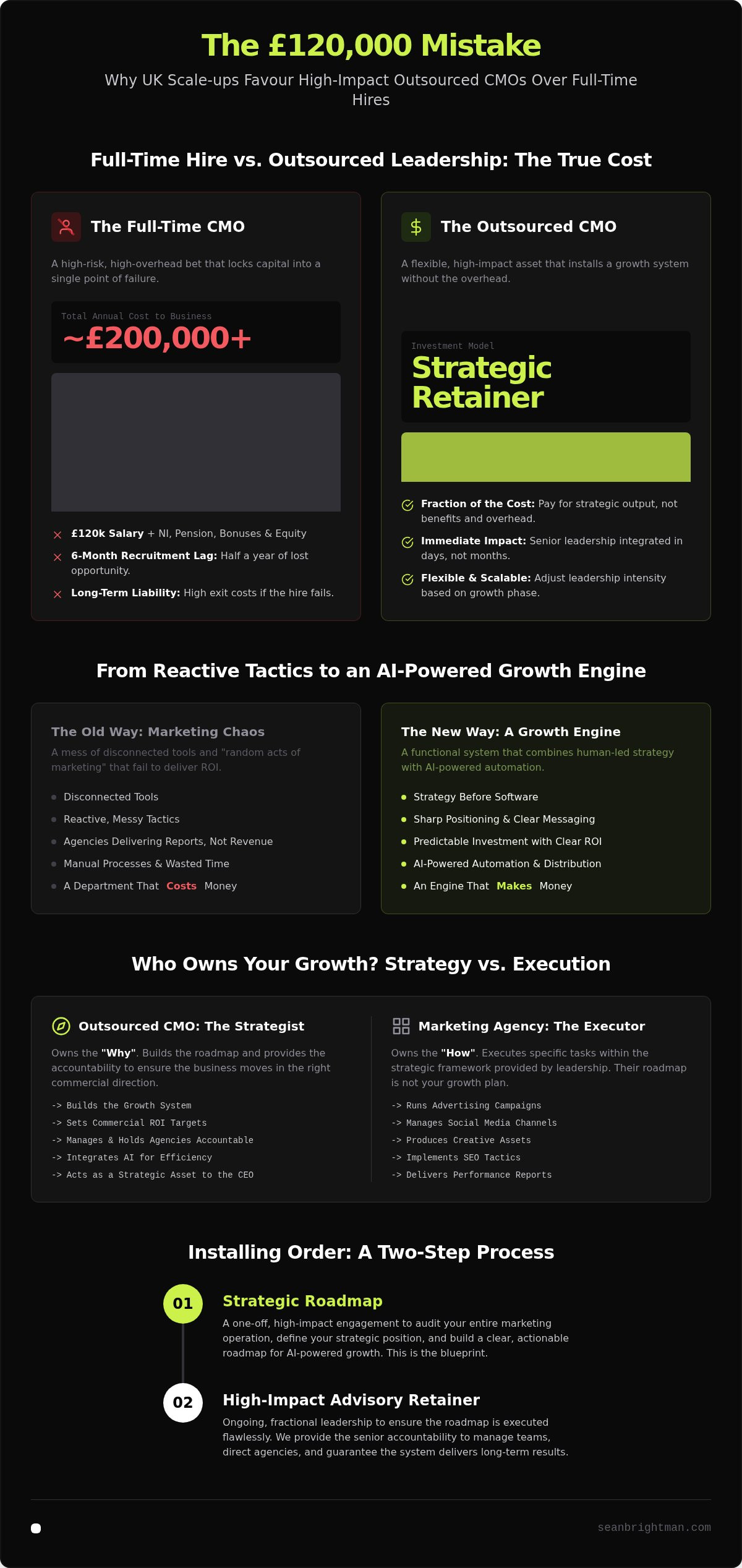
    Hiring a full-time CMO in 2026 is a £120,000 mistake that most mid-market CEOs simply don’t need to make. It is a legacy solution for a modern, fast-moving problem. You are likely exhausted by the cycle of wasted ad spend, a total lack of marketing accountability, and the crushing weight of AI tool fatigue. You know your business needs senior-level direction; you just do not want the permanent executive overhead or the six-month recruitment slog.

    Strategy should not be a luxury reserved for the FTSE 100. You deserve a marketing system that actually works, not just a list of expensive experiments. This guide will show you how to leverage fractional cmo services to deploy senior strategy and AI-powered growth engines for a fraction of the cost. We will explore how to move from chaotic execution to clinical precision. You will learn how to install a scalable marketing architecture that prioritises measurable ROI over corporate fluff. It is time to stop hiring for a role and start investing in a result.

    Key Takeaways

    • Stop burning cash on full-time executive overhead. Learn why a fractional leader provides senior-level velocity without the £120k recruitment mistake.
    • Deploy fractional cmo services as a strategic reset to build a scalable growth engine instead of just managing isolated digital adverts.
    • Implement a 90-day roadmapping system that integrates AI-powered efficiency and creates total marketing accountability across your organisation.
    • Learn how to audit external leadership for “battle scars” and AI literacy to ensure they can actually scale a business in 2026.
    • Move from chaotic execution to clinical precision by installing an external leader who prioritises system architecture over corporate fluff.

    Beyond the Job Title: Why Fractional CMO Services are the Strategic Reset You Need

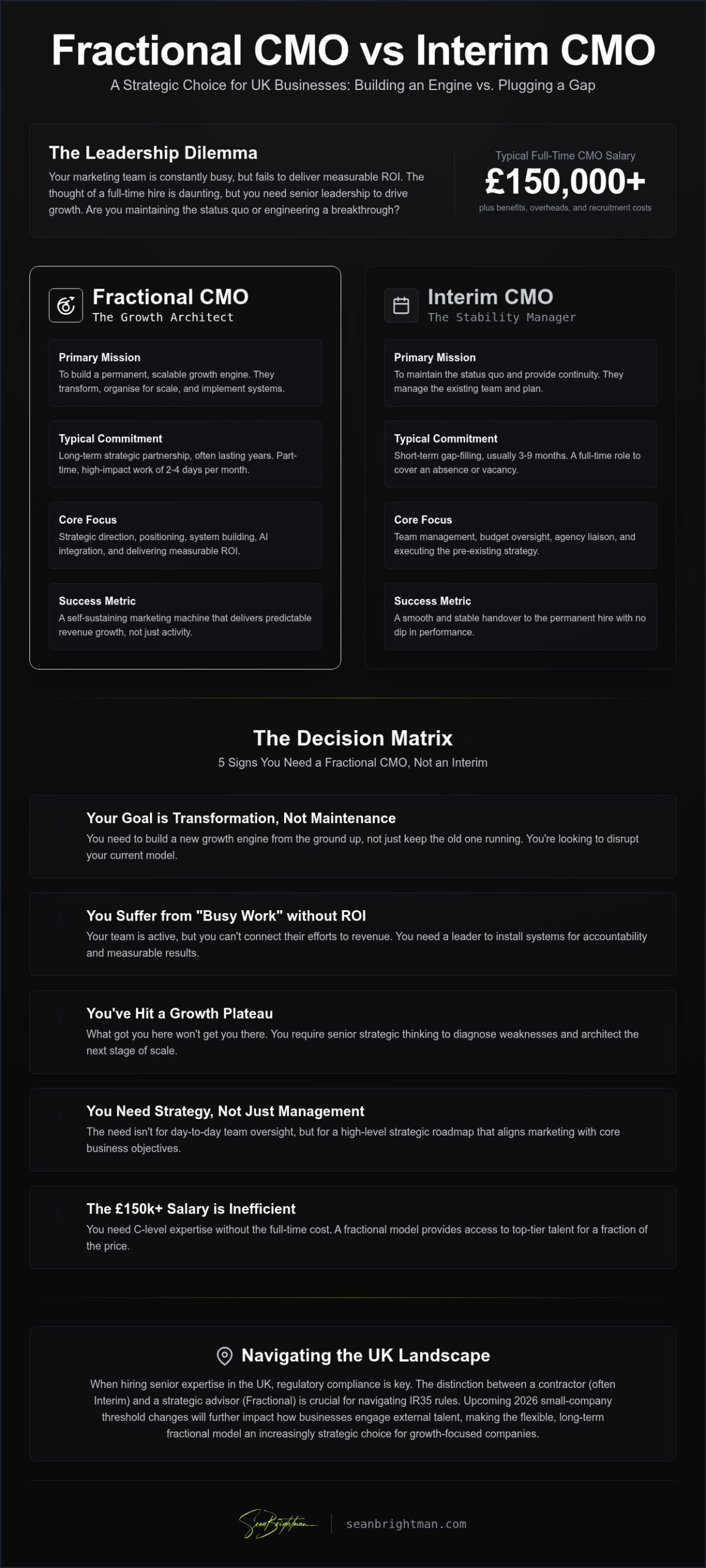
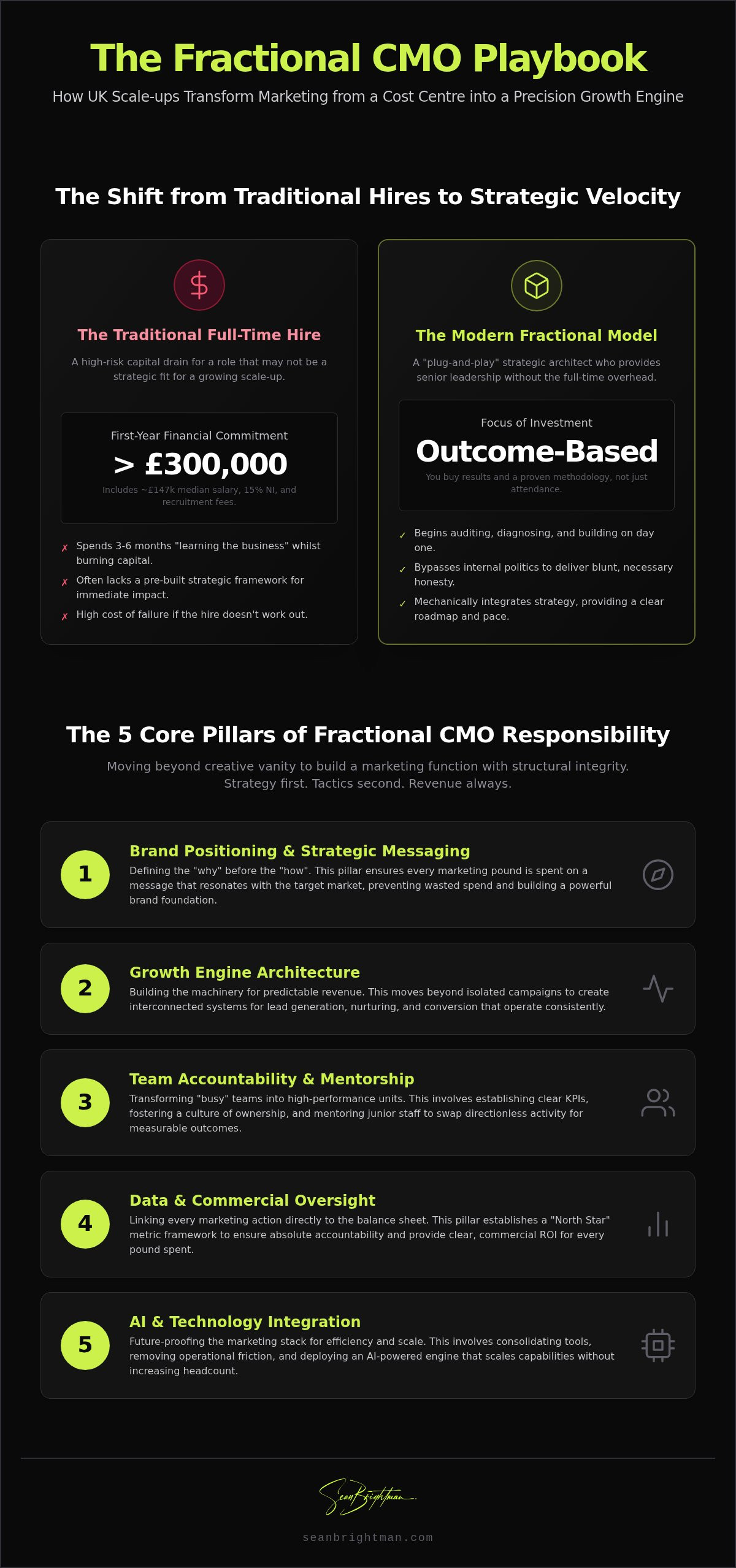
    Most CEOs think they need a person in a seat. They don’t. They need a system that functions. Fractional cmo services provide senior-level clarity without the corporate baggage. It is about strategic velocity; it is not just filling a vacancy. A Fractional executive brings the architectural blueprint your business lacks. They don’t just ‘do marketing’. They build the machine that does it for you. This is a strategic reset that moves you away from hope-based marketing and toward a predictable, scalable growth engine.

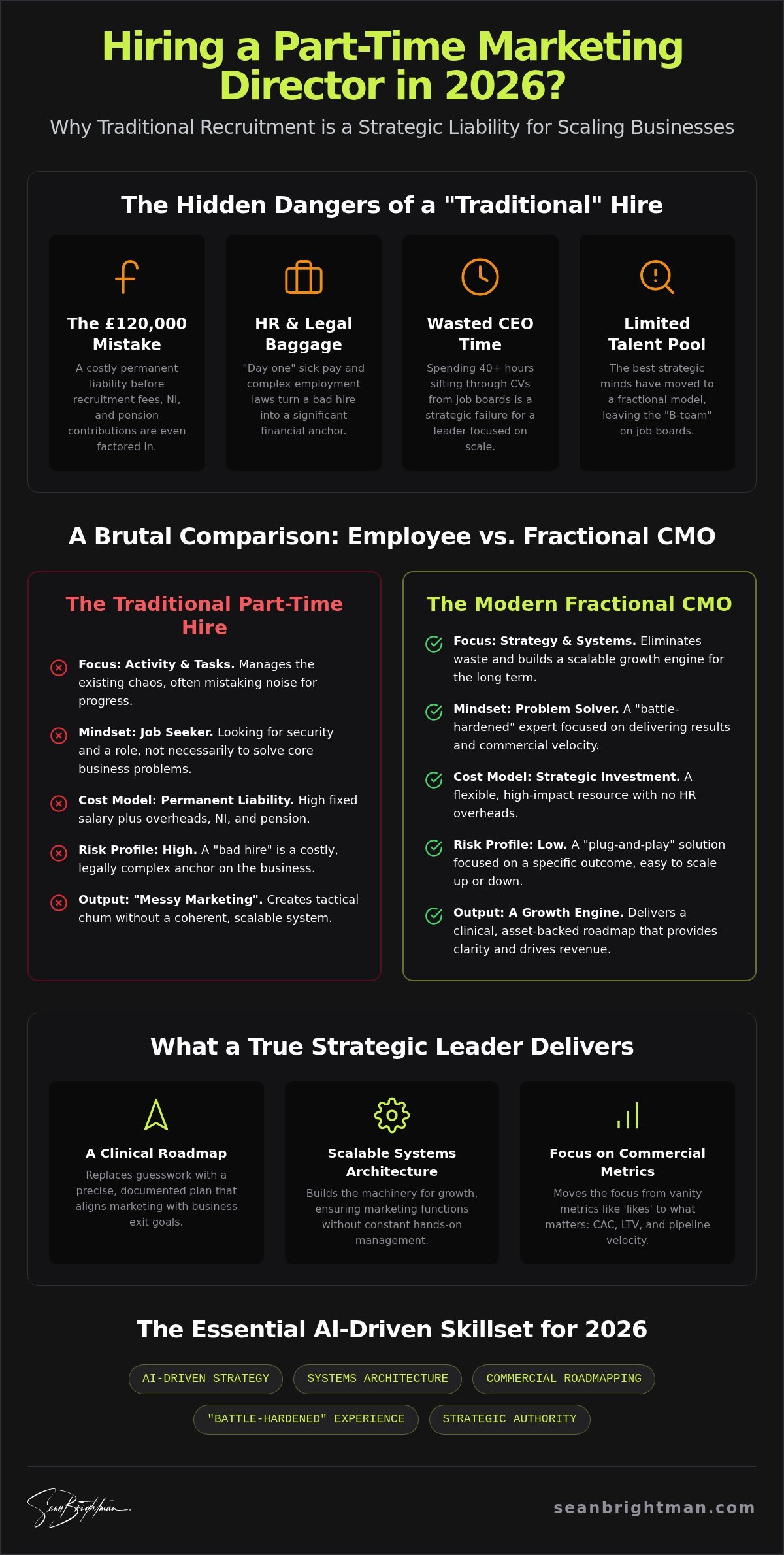
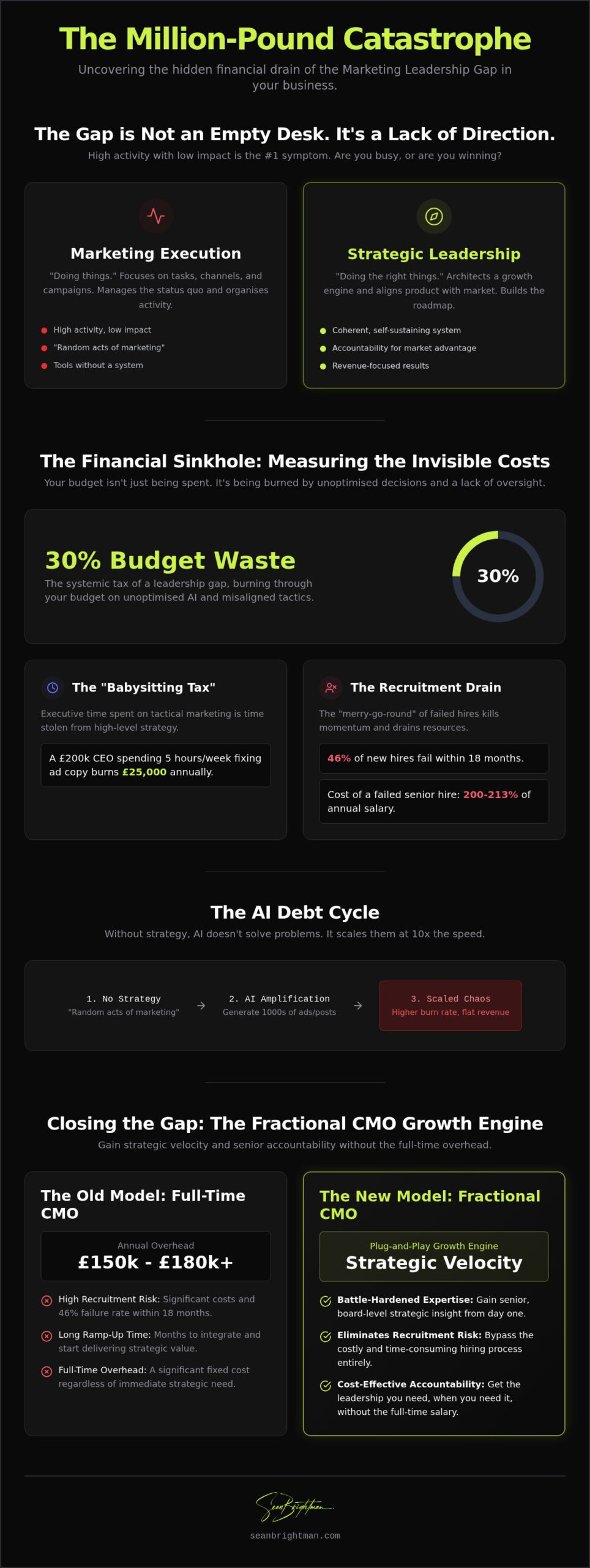
    Hiring a full-time CMO too early is the quickest way to kill scale-up cash flow. In 2026, a seasoned CMO commands a base salary upwards of £120,000. When you add national insurance, pension contributions, and recruitment fees, the cost is astronomical. It is a massive bet on a single hire. That capital should be funding growth engines and AI-powered automation, not executive benefits. This is the ‘£120k Mistake’. It is the difference between buying a luxury car you cannot afford to fuel and building a high-performance fleet that actually delivers a return.

    Don’t confuse these services with traditional consulting. A consultant tells you what is wrong and leaves a 50-page slide deck on your desk. They disappear before the hard work starts. A Fractional CMO leads. They own the commercial outcome. They manage the internal team and hold external agencies to account. It is the difference between a spectator and a player-coach. One offers interesting advice; the other provides tactical accountability and clinical execution. You need a leader who gets their hands dirty, not a theorist who stays in the clouds.

    The Symptoms of a Leadership Gap

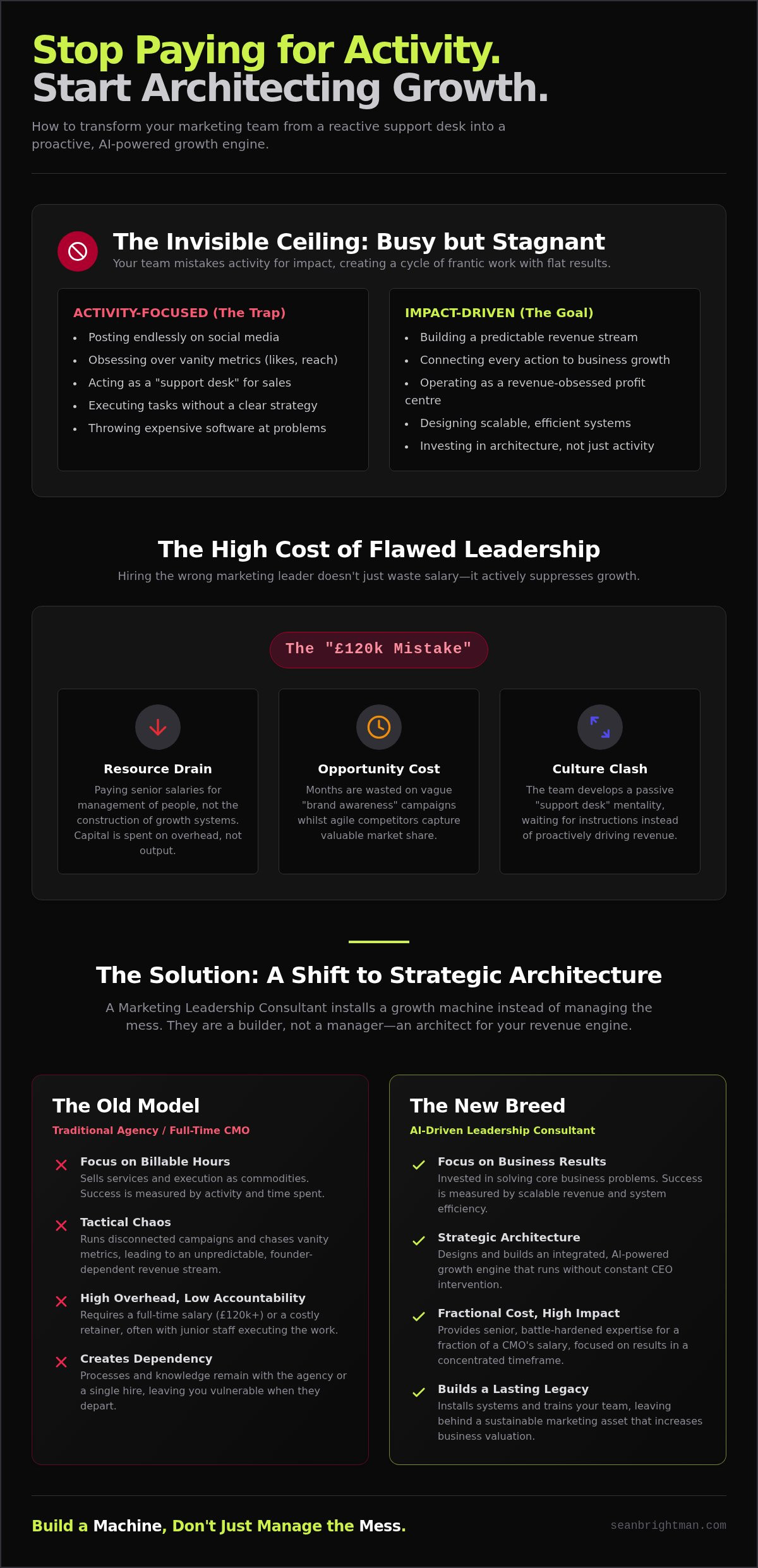
    Marketing activity is often high whilst commercial results remain stagnant. You see the social posts. You see the ad spend leaving the account. But the needle isn’t moving. This is ‘Messy Marketing’. It happens when you have executors but no architect. Usually, the CEO becomes the de facto Marketing Director. You become the bottleneck. You are signing off on copy whilst you should be steering the ship. Agencies cannot solve this alone. An agency is a specialist tool; they need a skilled hand to wield them. Without senior leadership, you are just paying for expensive noise that fails to convert into revenue.

    Leadership Without the Overhead

    The fractional model is lean. It typically involves 2 to 8 days a month of high-impact direction. It is a ‘Plug-and-Play’ solution for businesses that have outgrown their current setup but aren’t ready for a C-suite salary. You get the brain of a veteran for a fraction of the cost. This is the Fractional CMO revolution. It replaces chaotic experimentation with a structured, accountable growth engine. You get the leadership you need, exactly when you need it, and none of the executive baggage that slows your organisation down.

    The Architecture of Growth: Core Components of Modern Fractional Services

    Growth is not an accident. It is an engineered outcome. Modern fractional cmo services focus on the mechanics of your business, not just the aesthetics of your brand. Tools are useless without a strategy. You can buy the most expensive CRM on the market, but if you don’t have a system to feed it, you are just burning cash. This is about building a functional component for your business, not an abstract theory. We don’t just talk about growth; we architect the machinery that makes it inevitable.

    Strategy is the fuel. Systems are the engine. Without both, your marketing is just a series of expensive experiments that lead nowhere. We move away from the “try everything” approach to a model of tactical precision. It is the difference between a loose collection of tools and a unified battle plan. This architecture ensures that every pound spent on marketing is an investment in a permanent asset, not just a temporary spike in traffic. We build for movement and results, not for bureaucracy or slide decks.

    Strategic Roadmapping and Direction

    Most marketing plans are bloated documents that gather dust. We build a 90-day and 12-month growth engine in a single, high-intensity session. This is about defining your “North Star” metric. If the whole team isn’t pulling toward one measurable number, you are drifting. A marketing roadmap is a tactical hunt for revenue, not a leisurely tourist ride through vanity metrics. It defines exactly what we build, what we kill, and what we scale. It provides the clear strategic direction that takes the weight off the CEO’s shoulders.

    AI-Powered Growth Engines

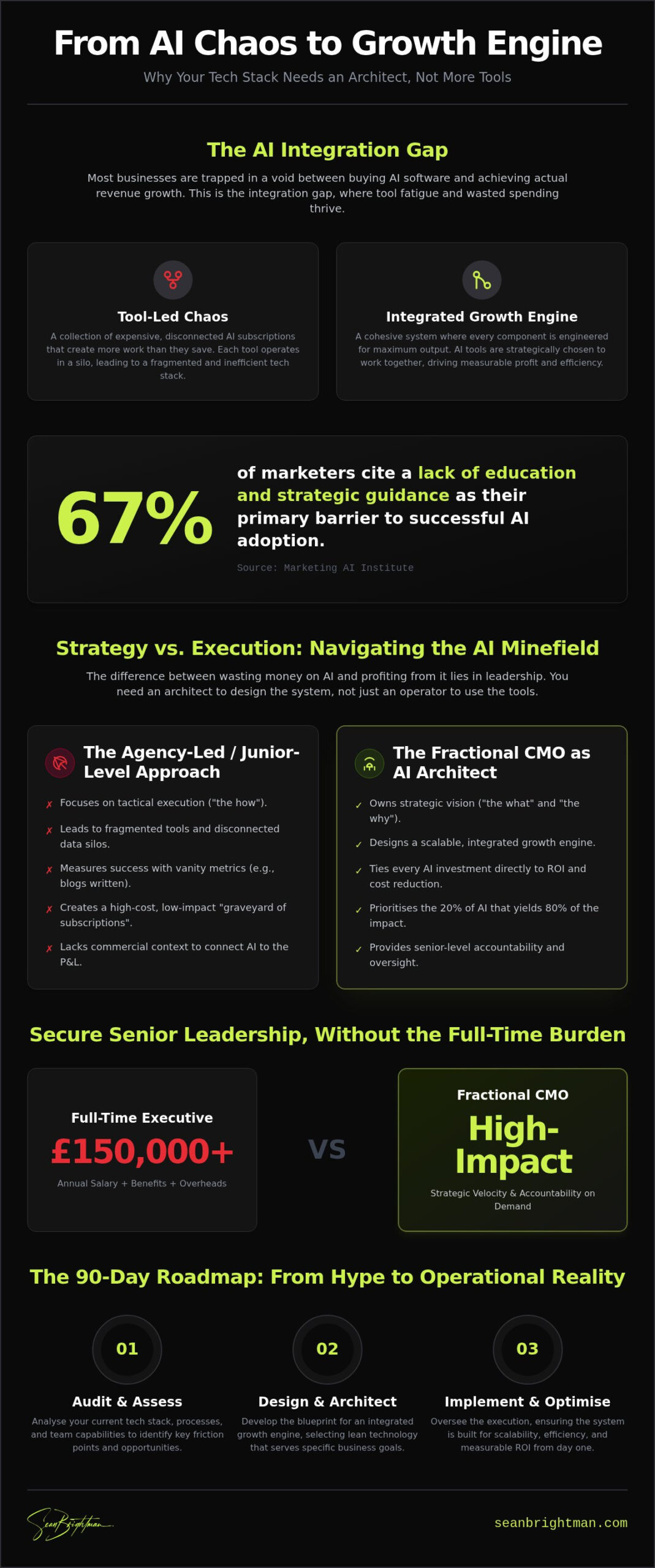
    In 2026, AI consulting is no longer an optional add-on; it is a non-negotiable CMO skill. We move beyond basic ChatGPT prompts to build scalable growth engines. This isn’t about replacing humans. It’s about automating the mundane so your team can focus on high-level creative strategy. We build systems that learn from your data and adapt to market changes in real-time. This is about machinery, not magic. If you are overwhelmed by tool fatigue, you don’t need more software; you need a senior leader to integrate the right technology into your workflow.

    Systems are the connective tissue between your brand and your bank account. We specialise in distilling why you matter in a crowded market and then automating the delivery of that message. It is binary: you are either the obvious choice or you are invisible. By deploying fractional cmo services, you install a seasoned professional who knows how to cut through the noise. We focus on movement, machinery, and tactical precision to ensure your marketing system is a high-performance asset that delivers a measurable ROI every single month.

    Strategic Alternatives: Comparing Fractional CMOs, Full-time Hires, and Agencies

    Choosing how to lead your marketing is a binary decision. You either pay for presence or you pay for performance. Most CEOs default to the traditional full-time hire because it feels safe. It isn’t. In the current market, fractional cmo services offer a high-velocity alternative that prioritises strategic output over office attendance. You need to decide if you want a permanent executive sitting in meetings or a seasoned strategist building your revenue engine. One is a static cost; the other is a functional investment in your business architecture.

    The choice often comes down to accountability. Who actually owns the revenue number? An agency owns their specific channel. A junior manager owns the task list. Only a CMO owns the commercial outcome. Whether you need a long-term strategic partner or an interim bridge whilst you search for a permanent hire, the model must focus on movement. We don’t just provide advice. We provide the leadership required to turn marketing spend into a measurable, scalable asset.

    The Full-Time Trap

    A full-time executive is a heavy, static asset that many scale-ups simply cannot afford to carry. The £120,000 base salary is just the tip of the iceberg. Once you factor in National Insurance, performance bonuses, equity grants, and recruitment fees, the true cost often exceeds £160,000. It is a massive financial commitment with a high risk of a “bad fit”. If the hire fails, you’ve lost six months of momentum and a six-figure sum. You can find a deeper breakdown in this Fractional vs Full-time analysis. High-growth businesses need agility, not the inertia of a bloated C-suite.

    Why Agencies Aren’t Strategists

    Agencies are execution engines. They are the builders, not the architects. They excel at specific tasks like SEO or paid media, but they rarely see the whole map. There is also a fundamental conflict of interest: agencies usually want you to spend more because their fees or results depend on volume. A Fractional CMO wants you to grow more. By deploying fractional cmo services, you install an architect who tells the builders exactly what to do. The CMO manages the agencies, cuts the waste, and ensures every external partner is aligned with your North Star metric. You stop being a client to be managed and start being a business to be built.

    Fractional CMO Services: The CEO’s Guide to Senior Marketing Leadership in 2026

    Due Diligence: How to Audit and Hire Fractional Marketing Leadership

    Hiring for fractional cmo services is not like hiring a junior manager. You are looking for a partner to build your machinery. Check the battle scars. Have they actually scaled a business, or do they just have a collection of logos on a slide? In 2026, the market is flooded with “consultants” who have never owned a P&L. You need someone who has felt the pressure of a stagnant lead gen engine and fixed it. This is about tactical precision, not professional attendance. If you are actively searching for a fractional CMO for hire, understanding what separates a genuine strategist from a polished presenter is the most important due diligence you can perform.

    Ask the AI literacy test. If they cannot explain how AI changes your specific business model beyond just using ChatGPT for copy, they are already obsolete. They should be talking about data pipelines, automated lead scoring, and predictive customer behaviour. If they can’t map AI to your unit economics, they can’t lead your growth. You are paying for a strategist who understands the tools of the future, not a legacy marketer clinging to the past.

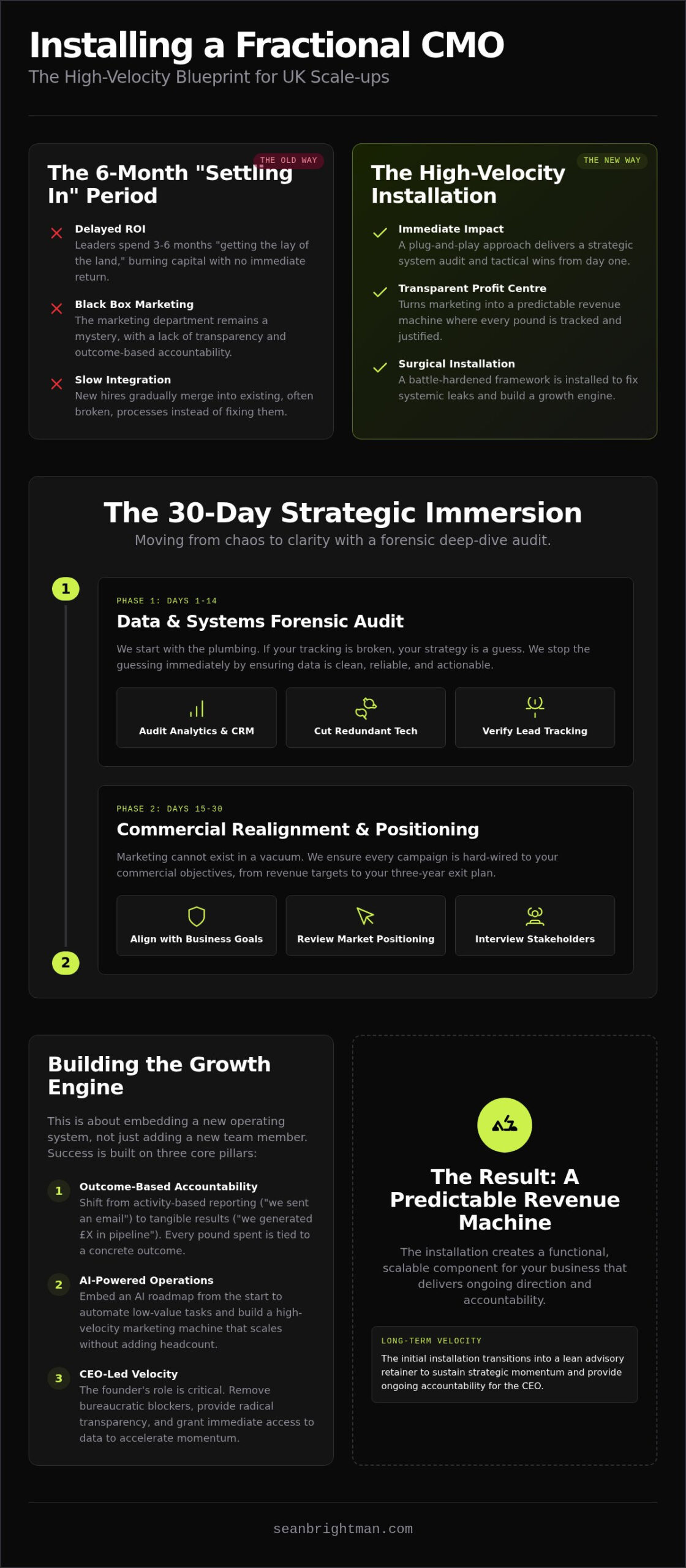
    Demand a 30-day value test. A real leader doesn’t need three months of “discovery” to find your biggest leaks. They should identify and fix one major bottleneck in the first month. This proves they are a plug-and-play asset, not a bureaucratic drain. Cultural fit matters too. You need someone who can challenge the CEO without being a corporate bureaucrat. If they agree with everything you say, they aren’t leading; they are just expensive yes-men.

    Vetting for Strategic Depth

    Ask for a Marketing Efficiency Audit framework. You want to see how they deconstruct a funnel. Look for a Marketing Operations Consultant mindset. They should be obsessed with systems, not just stories. Red flags are easy to spot. If they start talking about “social media likes” or “brand awareness” without mentioning customer acquisition cost (CAC) or lifetime value (LTV), end the interview. You are hiring an architect, not a decorator.

    The Advisory Retainer Model

    Understand the Marketing Advisory Retainer. This is about direction and accountability. It is not a “help desk” for your marketing team. It is a senior leader holding your internal and external teams to high standards. Set KPIs that the Fractional CMO is actually responsible for. The value lies in an external perspective that isn’t afraid to say “no” to your bad ideas. You need a strategist who prioritises your growth over your ego.

    Ready to stop the guesswork and install a battle-hardened expert? Book a Roadmapping session to see how clinical strategy can transform your growth engine.

    The Sean Brightman Framework: Senior Advisory for High-Growth UK Scale-ups

    You don’t need another agency account manager. You need a battle-hardened expert who understands that fractional cmo services are about mechanical integration, not abstract ideas. My framework is built for CEOs who are tired of the polite, slow-moving world of traditional consulting. We strip away the corporate fluff to focus on what actually moves the needle: high-energy leadership and tactical precision. This is senior advisory for UK scale-ups that refuse to settle for stagnant growth.

    The “Plug-and-Play” AI Growth Engine is a core component of this framework. It is the practical application of technology to your specific commercial challenges. We don’t just talk about AI; we install it into your marketing systems architecture. This ensures your brand positioning isn’t just a pretty slide deck, but a functional asset that powers your lead generation. It is a system designed for movement and results, delivered with the blunt honesty you need to hear.

    A Strategy Built on Machinery, Not Magic

    My methodology is visceral and direct. It is grounded in the strategic principles outlined in my published book, which serves as a testament to this no-nonsense approach. Whilst faceless networks offer a franchise model of generic advice, I provide independent expertise tailored to your unique friction points. We focus on the machinery of your business. This means looking at the data, refining the systems, and ensuring every part of your marketing engine is synchronised for maximum output. It is about clinical execution, not magic tricks.

    • Visceral language that demystifies complex strategy.
    • Tactical precision in every growth initiative.
    • Blunt honesty that prioritises results over ego.
    • Mechanical integration of AI and marketing operations.

    Next Steps to Strategic Velocity

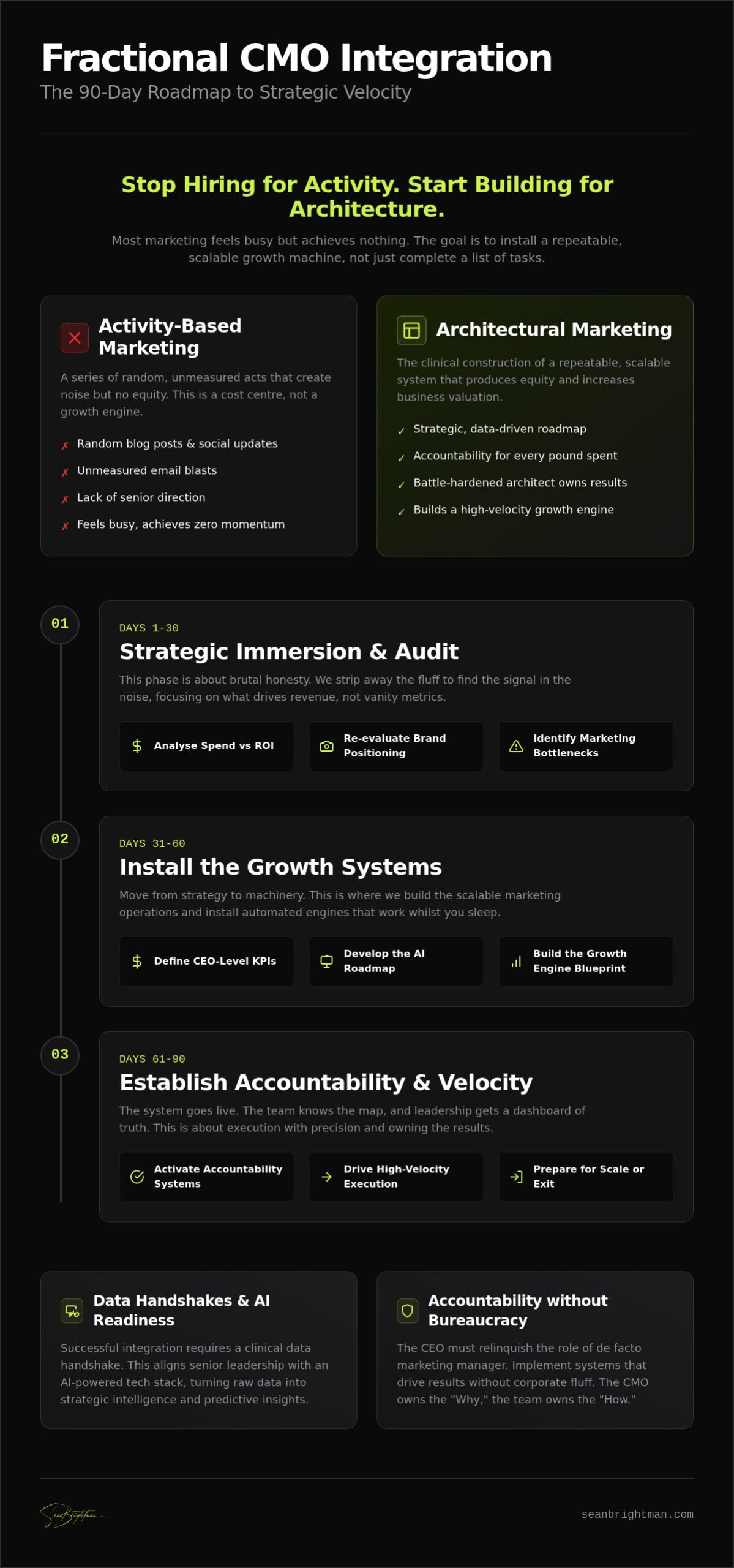
    Getting started is simple. We begin with a high-intensity Roadmapping session. This is designed to get your business unstuck and provide a clear, actionable plan for the next 90 days. We identify the leaks, define the North Star metric, and map out the tactical hunt for revenue. This is the entry point for those who need immediate direction without a long-term commitment.

    Once the foundation is solid, we transition to a monthly Advisory Retainer. This provides the ongoing direction and accountability required to maintain momentum. By securing expert fractional cmo services through a retainer, you ensure your strategy remains sharp and your team stays focused on commercial outcomes. It is time to stop playing with tools and start growing with Sean Brightman. Let’s build the machinery your business deserves.

    Stop Managing Ads and Start Building a Growth Engine

    The choice for your business is binary. You can continue with the slow, expensive tradition of full-time executive recruitment or you can install a battle-hardened expert who prioritises movement over bureaucracy. Fractional cmo services provide the architectural blueprint you need without the £120,000 overhead. You get a system that functions, an AI-powered growth engine that scales, and the clinical strategic direction required to dominate your market in 2026.

    I don’t offer corporate fluff or vague promises. As the author of the definitive guide to marketing strategy, I provide direct, high-energy advisory for UK CEOs who are ready to stop playing with tools and start driving revenue. We replace messy experimentation with tactical precision. It’s time to treat your marketing as a functional component of your business machinery, not a series of disconnected experiments.

    Don’t let another quarter slip away in a cycle of stagnant results and wasted spend. Book a Strategic Roadmapping Session with Sean Brightman today. Let’s build the growth engine your business deserves.

    Frequently Asked Questions

    What exactly do fractional CMO services include?

    Modern fractional cmo services focus on strategic architecture, brand positioning, and the design of marketing systems. It is the senior leadership required to build a growth engine, not just a set of hands to run social media accounts. You get a veteran strategist who owns the commercial outcome, manages your external agencies, and ensures every marketing pound spent is an investment in a scalable asset.

    How much time does a Fractional CMO spend in my business?

    A typical engagement involves 2 to 8 days per month of high-impact direction. This is about strategic velocity, not office attendance. We focus on concentrated bursts of leadership that clear bottlenecks and set the team’s trajectory. You don’t pay for desk time; you pay for the senior-level clarity that moves the needle in a fraction of the time a full-time hire would take.

    Is a Fractional CMO better than a marketing agency?

    They are different tools for different jobs. An agency is a builder; a Fractional CMO is the architect. Agencies excel at execution in specific channels like SEO or paid media, but they often lack the internal strategic vision your business needs. The CMO manages the agency, holds them accountable to your North Star metric, and ensures their work aligns with your broader commercial goals.

    Can a Fractional CMO help with AI implementation?

    AI integration is now a non-negotiable skill for any senior marketing leader. We move your business beyond basic tool usage to build scalable, AI-powered growth engines. This includes automating mundane workflows, improving lead scoring, and using predictive data to drive creative strategy. It is about installing machinery that learns and adapts to your market, giving your team more time for high-level thinking.

    What is the typical cost of Fractional CMO services in the UK?

    The cost is a fraction of the £120,000 base salary required for a full-time UK executive in 2026. Because you aren’t paying for benefits, national insurance, or recruitment fees, you save significant capital that can be reinvested into your growth engine. Most fractional cmo services are delivered via a monthly retainer, allowing you to access C-suite expertise without the permanent executive overhead.

    How long does a typical Fractional CMO engagement last?

    Engagements range from a 90-day strategic roadmap to multi-year advisory partnerships. Some businesses use a fractional leader as a bridge whilst searching for a permanent hire, whilst others prefer the long-term agility of the fractional model. The duration depends entirely on the complexity of your growth engine and the level of ongoing accountability your team requires to stay on track.

    Will a Fractional CMO manage my existing marketing team?

    Yes, a Fractional CMO provides the leadership layer between the CEO and the marketing team. They mentor internal staff, manage external vendors, and ensure everyone is pulling in the same direction. This removes the CEO as the marketing bottleneck and replaces chaotic execution with a structured, accountable system. You get a leader who owns the results and manages the people who deliver them.

  • Fractional CMO Pricing UK: The 2026 Guide to Senior Marketing Costs

    Fractional CMO Pricing UK: The 2026 Guide to Senior Marketing Costs

    Hiring a senior marketer to “do things” is the fastest way to set £100,000 on fire. Most CEOs are trapped in a cycle of paying for activity instead of outcomes. They see the LinkedIn posts and the brand awareness reports, but the bottom line stays flat. If you’re looking at Fractional CMO pricing UK just to save a few quid on a full-time salary, you’re already asking the wrong question. This isn’t about saving money; it’s about buying a system that works while you sleep.

    You likely feel the frustration of a marketing spend that feels like a black hole. You’re probably confused by the wild variance between cheap day rates and high-value retainers; all while IR35 compliance looms in the background. I’m going to give you a blunt breakdown of the 2026 market rates and the hidden costs of traditional recruitment. We’ll build a budget framework that prioritises commercial velocity over vanity metrics. This guide covers everything from basic advisory retainers to high-impact roadmapping, ensuring you buy leadership that drives growth rather than just managing the chaos.

    Key Takeaways

    • Stop paying for presence. Learn why the 2026 market is shifting from traditional £800+ day rates to value-based retainers that prioritise strategic velocity.
    • Avoid the “salary trap” by understanding how Fractional CMO pricing UK compares to the £300,000+ total loaded cost of a full-time senior hire.
    • Shift your budget from expensive agency execution to AI-powered growth engines that deliver commercial accountability instead of vanity metrics.
    • Discover why Roadmapping is the essential first step to eliminate wasted marketing spend and stop the cycle of constant CEO hand-holding.
    • Identify the “hidden” overheads of recruitment, from employer National Insurance to pension contributions, that a fractional model bypasses entirely.

    Understanding the UK Fractional CMO Pricing Landscape

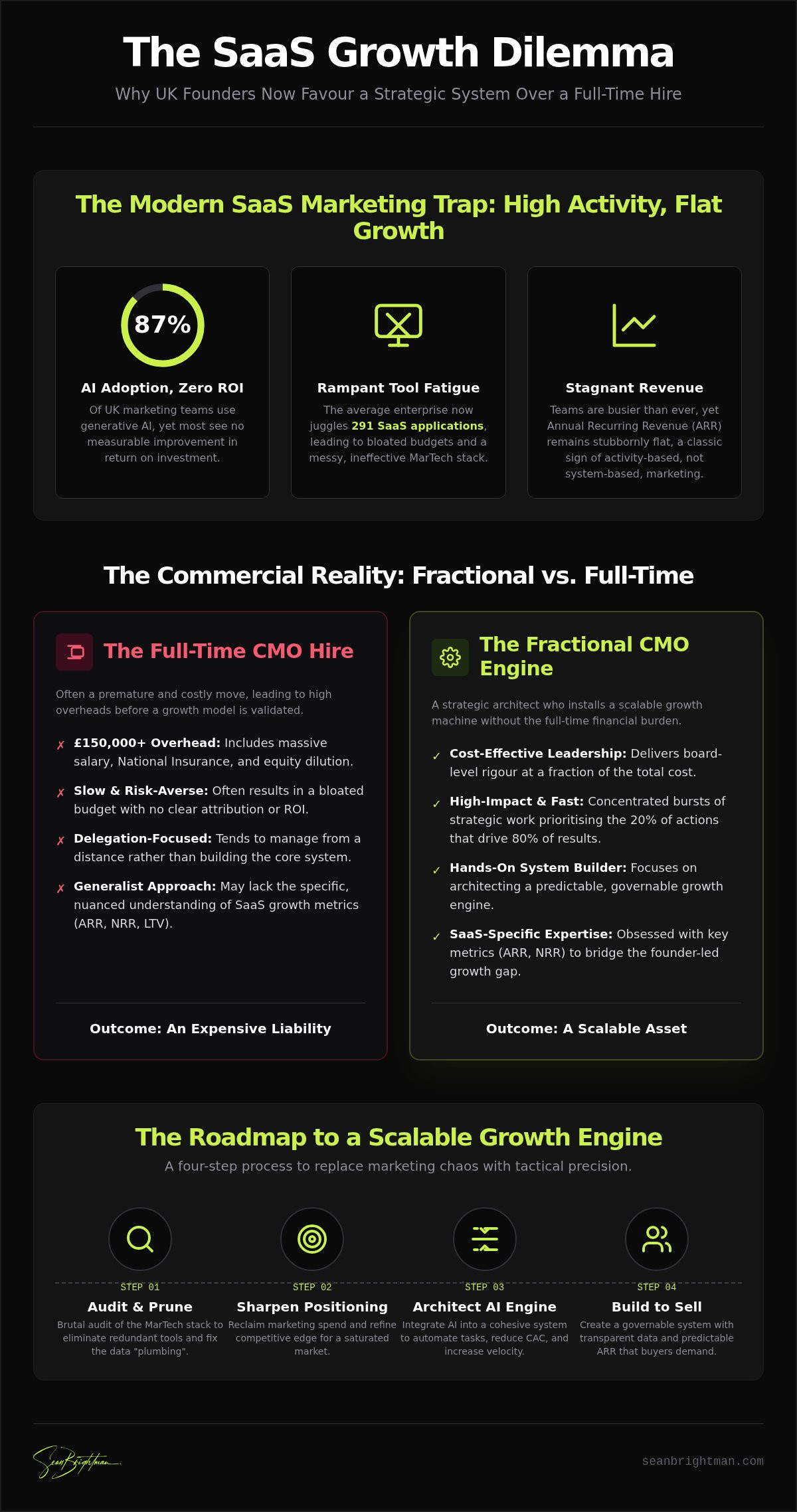
    Stop looking for a cheaper employee. Start looking for a more efficient system. In the UK, a full-time CMO commands a base salary of £150,000 or more. When you factor in National Insurance, pension contributions, and bonuses, that figure spirals toward £200,000 before they’ve even sent their first email. Most SMEs don’t need a full-time executive sitting in meetings all day. They need the brain, not the body. Understanding What is a Fractional Executive? is the first step toward reclaiming your budget. It’s about securing senior leadership without the bloated overhead.

    The market has shifted significantly as we move through 2026. Savvy businesses are ditching traditional agencies that charge high retainers for junior execution. Instead, they’re pivoting toward strategic advisors who offer direct accountability. Pricing isn’t just a number on an invoice; it’s a reflection of commercial impact. If you’re paying for activity, you’re subsidising an agency’s overhead. If you’re paying for strategy, you’re buying a growth engine. Many UK SMEs overpay for busywork because they lack a senior hand to guide the ship, making Fractional CMO pricing UK a conversation about value rather than just cost.

    The Three Tiers of Marketing Leadership

    Not all external help is created equal. You need to know exactly what you’re buying to avoid a mismatch in expectations.

    • Interim Marketing Directors: These are tactical gap-fillers. They keep the lights on during a transition or parental leave. They maintain the status quo.
    • Marketing Consultants: They deliver a slide deck, provide a plan, and then disappear. The execution remains your problem to solve.
    • Fractional CMOs: These are long-term strategic partners. They are embedded in your leadership team, owning the outcomes, the budget, and the growth trajectory.

    Why “Cheap” Fractional CMOs are the Most Expensive

    A low-cost option usually means you’ve hired a junior masquerading as a CMO. They’ll do the work, but they won’t lead. Without strategic direction, your department becomes a mess of disconnected tactics and fragmented messaging. You end up with wasted budgets and a team that doesn’t know what “success” looks like. This is why marketing team accountability must be the foundation of any pricing discussion. If a leader cannot prove how they drive commercial outcomes, the day rate is irrelevant. Cheap leadership is a liability that costs you more in lost opportunity than you save in fees.

    Typical Pricing Models for Fractional CMOs in the UK

    Day rates are the industry standard, but they’re often a trap. In the UK, you’ll see figures ranging from £800 for a rising star to £2,500 for a battle-hardened veteran. The problem? Selling time incentivises slow work. If a CMO finishes a strategy in four hours instead of eight, they shouldn’t be penalised with half the pay. This is why Fractional CMO pricing UK is moving toward value-based structures. You aren’t paying for a seat in your office; you’re paying for the removal of bottlenecks and the acceleration of revenue.

    Monthly retainers represent the most common middle ground. They allow for an embedded relationship where the CMO owns the outcomes. You’re buying a “fraction” of their brain, ensuring they’re available for critical decisions without being on the payroll full-time. Hybrid models are also gaining traction. These involve a base fee to cover the fixed strategic input, paired with performance-related bonuses tied to specific growth targets. It ensures the consultant has skin in the game. It aligns their success directly with your bottom line.

    The Advisory Retainer: High-Velocity Direction

    Scale-up CEOs often find themselves isolated. They have a team of executors but no one to challenge their assumptions. The Advisory Retainer is the high-velocity choice for leaders who need direction without the heavy lifting of a full-time hire. It’s not about doing; it’s about guiding. It’s the perfect fit for founders who are comfortable with their team’s output but worried about their direction.

    This model usually involves weekly high-level calls and strategy oversight. The goal is team accountability. It ensures your internal marketing function isn’t just busy but is actually moving the needle. It’s often the most cost-effective entry point for businesses with an existing team that lacks senior leadership. It provides the “Strategic Velocity” required to scale without the friction of a full-time recruitment process.

    Roadmapping Sessions: The One-Off Strategy Investment

    Don’t commit to a six-month retainer if you don’t have a plan. That’s a recipe for wasted spend. A Roadmapping session is a concentrated burst of strategic energy designed to create a clear 12-month direction. It’s the “audit first” approach that identifies where your engine is leaking oil. You wouldn’t build a house without a blueprint; don’t build a brand without a map.

    This process often bridges the gap between raw ambition and tactical execution. It might involve deep dives into your market fit or working with a brand positioning consultant UK to refine your message. Once the roadmap is in place, you have a blueprint. You can then decide whether to execute it internally or bring in ongoing support. If you want a clear path forward, it might be time to review your current strategy and fix the foundation first.

    Fractional vs Full-Time CMO: A Brutal Cost Analysis

    Stop looking at the base salary. It’s a trap. A £150,000 CMO doesn’t actually cost you £150,000. By the time you’ve added Employer National Insurance, pension contributions, and private healthcare, you’re looking at a loaded cost closer to £200,000. Then there’s the recruitment fee. Most UK agencies charge 25% of the first-year salary. That’s nearly £40,000 gone before they’ve even opened their laptop. When you compare this to Fractional CMO pricing UK, the calculation is simple. You’re paying for the leadership, not the liability.

    The total loaded cost for a full-time senior hire in the first year can easily reach £300,000 to £450,000. Bonuses and equity further complicate the full-time model. A C-suite hire expects a performance package and potentially a slice of the business. These are long-term financial commitments that stay on your books regardless of market shifts. A fractional leader is a line item you can scale or pause. It’s high-impact expertise without the permanent weight of a traditional executive contract.

    The Mistake of the First Marketing Hire

    Founders often hire a “Head of Marketing” when they actually need a Strategist. They want someone to “get their hands dirty,” but they end up with a junior who lacks the authority to drive commercial change. This leads to the “Churn and Burn” cycle. Many full-time CMOs leave within 18 months because they’re either bored or overwhelmed by a lack of direction. Fractional leadership acts as a “try before you buy” model. You get the senior brain to build the system first. You can hire the permanent executor once the engine is actually running.

    IR35 and Compliance in 2026

    IR35 remains a critical hurdle for UK businesses in 2026. Engaging a senior leader on a part-time basis requires precision. You aren’t hiring a “part-time employee”; you’re buying a service. To stay outside IR35, the contract must be based on clear deliverables rather than hours worked. Disguised employment is a risk you can’t afford. Professional advisors manage their own compliance, insurance, and equipment. They don’t look like employees because they aren’t. They are external forces brought in to fix specific problems. This distinction protects your business from HMRC while ensuring you get the strategic velocity you’re paying for.

    Fractional CMO Pricing UK: The 2026 Guide to Senior Marketing Costs

    Evaluating Value: AI, Systems, and Scalability

    Stop paying for people to move spreadsheets around. In 2026, you’re either building an automated growth engine or you’re overpaying for manual labour. Activity is cheap. Outcomes are expensive. When you evaluate Fractional CMO pricing UK, you aren’t just looking at a day rate; you’re looking at the reduction of your total operational expenditure through automation. A leader who understands how to integrate AI into your workflow is worth triple a traditional marketer. They don’t just manage agencies. They replace them with intelligent systems.

    Traditional marketing is bloated with “execution” costs. You pay for junior account managers to sit in meetings and senior creatives to tweak logos. An AI-literate strategist cuts through this. They use AI consulting to streamline content production, lead scoring, and customer segmentation. This is where the role of a marketing operations consultant becomes critical to your pricing model. You’re investing in a scalable architecture that runs without constant CEO hand-holding.

    Building AI-Powered Growth Engines

    Systems beat talent every time. You can hire a “rockstar” marketer who leaves in six months, or you can build a machine. A battle-hardened strategist brings a plug-and-play approach to your tech stack. They integrate AI to improve efficiency and output across the board. This isn’t about chasing the latest shiny tool. It’s about replacing manual, error-prone tasks with automated, intelligent workflows. The result is a marketing function that produces more value with fewer headcount requirements. It turns marketing from a variable cost into a fixed, high-yield asset. If your current department is an expensive black box of busywork, working with a marketing transformation consultant is the fastest way to strip away the bloat and build a lean, predictable growth engine.

    Accountability Frameworks for UK Teams

    Your marketing department likely suffers from a lack of commercial clarity. They talk about “brand awareness” and “engagement” because those metrics are easy to hit. A Fractional CMO changes the conversation to commercial outcomes. They implement accountability frameworks that ensure your existing team actually delivers on the bottom line. They set KPIs that matter to the CEO, not just the marketing department. We’re talking about pipeline velocity, customer acquisition cost, and lifetime value. If your current marketing feels like a black hole, it’s time to build a growth engine that actually scales and provides real accountability.

    The Sean Brightman Approach: Strategic Advisory for 2026

    Clarity isn’t a luxury. It’s a commercial requirement. Most CEOs are currently drowning in marketing data but starving for actual direction. My approach ignores the corporate fluff that plagues traditional consulting. It focuses on the machinery of growth. When you evaluate Fractional CMO pricing UK, don’t calculate the cost per hour. Calculate the cost of another six months of stagnation. You aren’t buying my time. You’re buying the removal of your biggest bottlenecks.

    I provide the Strategic Velocity your business lacks. This isn’t about filling a seat in your office. It’s about installing a system that functions without you. The Advisory Retainer is designed for high-impact direction, providing a sounding board that challenges your assumptions. Roadmapping is the surgical strike that fixes a messy, underperforming marketing department. By hiring fractional cmo services, you’re buying a blueprint. You’re buying the ability to see through the noise and execute with precision.

    From Chaos to Clarity in 90 Days

    I wrote the book on marketing strategy because I’ve seen the same expensive mistakes repeated for decades. My methodology isn’t abstract theory. It’s a battle-hardened framework designed for immediate impact. We start with a brutal audit and an AI-readiness assessment. We find the leaks in your funnel and we patch them. This is a tactical hunt for growth. It isn’t a tourist ride through your brand guidelines. Within 90 days, the chaos stops. The growth engine starts turning. We build systems that turn marketing from a gamble into a predictable commercial lever.

    Next Steps: Booking a Discovery Session

    If you’re tired of hand-holding your marketing team, it’s time to change the model. A discovery session is a direct, no-nonsense consultation. I don’t do “sales pitches.” I do diagnostic assessments. You should prepare your business for senior-level intervention by being honest about your current failures. We’ll identify the specific bottlenecks holding you back and determine if you need a one-off roadmap or ongoing advisory support. Stop guessing about your budget. Start investing in a strategy that delivers. You can Enquire about a Fractional CMO Advisory Retainer to begin the process of professionalising your marketing function.

    Stop Paying for Presence. Start Buying Results.

    Marketing leadership isn’t an expense to be managed. It’s a system to be built. By now, the reality is clear. Traditional recruitment is a slow, expensive gamble that often fails within 18 months. Understanding Fractional CMO pricing UK is about more than just comparing day rates. It’s about bypassing the £40,000 recruitment fees and the £200,000 loaded salaries to secure a battle-hardened expert who builds instead of just “doing.”

    You need a growth engine that scales without your constant intervention. As the author of the definitive guide to marketing strategy and an expert in AI-powered systems, I help CEOs cut through the noise. There are no recruitment fees or long-term employment overheads here. Just direct, high-impact leadership that professionalises your department in 90 days. It’s time to stop the cycle of wasted spend and start executing with precision. Book a Strategic Roadmap Session with Sean Brightman today. Let’s fix your marketing once and for all.

    Frequently Asked Questions

    How much does a Fractional CMO cost in the UK?

    Monthly retainers for fractional leadership typically sit between £3,000 and £10,000. The final figure depends on the complexity of your growth engine and the level of embedding required. Seed-stage startups might start with a light-touch advisory model, whilst Series A+ scale-ups usually invest more for intensive strategic direction and team management.

    Is a Fractional CMO cheaper than a Marketing Agency?

    They aren’t comparable because they perform different roles. An agency sells execution; a CMO sells strategy and accountability. While an agency might charge £5,000 a month for social media and SEO, a fractional leader ensures that £5,000 isn’t being wasted on low-impact activity. The CMO often pays for themselves by cutting inefficient agency spend.

    Do I need to worry about IR35 when hiring a Fractional CMO?

    Compliance is essential for any UK business engaging external talent. You must ensure the contract is based on specific deliverables and outcomes rather than “disguised employment.” Professional advisors operate as independent businesses with their own insurance and equipment. This helps keep the engagement outside IR35, provided you don’t control their working methods like an employee.

    What is the typical day rate for a UK Fractional Marketing Director?

    Standard day rates in the UK range from £800 to £2,500. Rising directors at the start of their fractional career sit at the lower end, whilst battle-hardened experts in London command the premium. However, Fractional CMO pricing UK is moving toward value-based retainers. This shift ensures you’re paying for the removal of bottlenecks rather than just a calendar entry.

    How many days a month does a Fractional CMO usually work?

    Most arrangements involve 2 to 8 days per month. A founder might only need two days of high-level advisory support to keep the team on track. A company in a rapid growth phase might require six days to professionalise their department and build scalable systems. It’s about the concentration of expertise, not the number of hours spent at a desk.

    Can a Fractional CMO help with AI implementation?

    A modern strategist must prioritise AI to drive efficiency. They’ll audit your current manual processes and replace them with automated, intelligent systems. This reduces your reliance on expensive agency execution and increases your team’s total output. AI implementation is now a core component of building a scalable growth engine that functions without constant supervision.

    What is the difference between a Marketing Consultant and a Fractional CMO?

    Consultants provide a map; CMOs drive the car. A consultant usually delivers a one-off project or a strategy deck and then exits the business. A Fractional CMO is an embedded leader who owns the commercial outcomes. They manage the budget, lead the team, and provide the ongoing accountability required to turn a plan into revenue.

    How do I calculate the ROI of a Fractional CMO?

    Measure the commercial delta, not the marketing activity. Calculate the reduction in your customer acquisition cost (CAC) and the increase in your lead-to-close velocity. If a fractional leader identifies £40k of wasted spend and increases pipeline value by 20%, the ROI is clear. You’re looking for a measurable impact on the bottom line, not a report on brand awareness.

  • Strategic Marketing Direction: How to Stop the Noise and Build a Growth Engine

    Strategic Marketing Direction: How to Stop the Noise and Build a Growth Engine

    Your marketing budget is leaking; you just don’t know where the holes are. Most CEOs are tired of funding a messy department that delivers plenty of activity but zero clarity on ROI. You don’t need more tactics. You need a strategic marketing direction that actually moves the needle. It’s the difference between throwing paint at a wall and building a precision-engineered growth engine.

    You likely feel the weight of high spend paired with low visibility. It’s a common frustration. You want a system that runs like a machine, not a series of fires you have to put out. With research showing that 81% of consumers now actively ignore or block ads, your strategy can’t afford to be a guess. We’re going to fix that. You’ll learn how to transition from chaotic execution to a high-impact roadmap that drives measurable business value.

    We’ll explore the mechanics of building a scalable system. This includes how to organise your AI integration and secure expert oversight without the overhead of a full-time salary. It’s time to stop the noise and start the engine.

    Key Takeaways

    • Stop confusing activity with progress; establish a strategic marketing direction that dictates exactly where your resources go and what you must ignore.
    • Transform your marketing into a precision-engineered growth engine by implementing repeatable systems that scale without constant manual intervention.
    • Stop the “agency trap” by recognising that execution partners cannot lead your strategy; they are built to follow your roadmap, not create it.
    • Reclaim your commercial velocity through a brutal 90-day reset that audits existing noise and refocuses every pound on measurable results.
    • Secure senior-level accountability and expert oversight through a fractional model, avoiding the excessive overhead of a full-time hire.

    What is Strategic Marketing Direction? (And Why You Lack It)

    Most marketing departments are loud, expensive, and fundamentally lost. They produce a mountain of content and run dozens of campaigns, yet the needle barely moves. This happens because they lack a strategic marketing direction. It is not a 50-page document gathering dust on a server; it is the senior-level ‘north star’ that dictates exactly where your resources go and, more importantly, where they don’t. Strategic marketing direction is the bridge between business goals and tactical execution.

    True direction is the art of sacrifice. Whilst most businesses try to do everything at once, a real strategist understands that focus is your only leverage. If you don’t have the discipline to choose what not to do, you are just gambling with your budget. Without this filter, your marketing team is merely busy. They are not productive. They are generating noise instead of building a growth engine. Whilst a foundational Marketing strategy provides the theory, direction provides the command and control necessary to win in a crowded market.

    Activity vs. Progress: The CEO’s Dilemma

    CEOs often confuse motion with momentum. Buying more ads or producing more blog posts is not a strategy; it is just increased spending. This is the ‘messy’ marketing trap. When your department lacks senior leadership, you end up with wasted budgets and missed market windows. You see the activity, but you don’t see the commercial velocity. This environment is toxic for talent. A lack of clear direction leads to team burnout and high turnover because high performers hate running on a treadmill that leads nowhere. They want to see results, not just checklists.

    The Three Symptoms of Directionless Marketing

    If you aren’t sure if your direction is broken, look for these three red flags. They are the hallmarks of a system that has lost its way.

    • Tactics lead the strategy: You hear phrases like “we need a TikTok account” or “we should try AI influencers” before anyone explains how those tools serve a commercial objective. The tool is driving the bus, not the destination.
    • Vanity metrics over outcomes: Your reports are full of likes, impressions, and “engagement” whilst your cost per acquisition remains stagnant. If success isn’t measured in revenue and margin, it isn’t success.
    • The CEO is the default CMO: If you are still the one making final calls on ad copy or campaign creative, your system is failing. You are providing the direction because no one else is qualified to do so.

    You don’t need more hands on deck. You need a sharper mind at the helm to turn that tactical chaos into a repeatable machine.

    The 3 Pillars of a Modern Growth Engine in 2026

    A growth engine is the mechanical reality of your strategic marketing direction. It is not a collection of loosely related tasks; it is a precision-engineered system designed to produce a predictable commercial outcome. In 2026, the distance between a market leader and a struggling also-ran is defined by three structural pillars. These pillars turn your vision from an abstract theory into a functional, revenue-generating machine.

    Pillar 1: Brand Positioning as a Weapon

    Don’t aim to be better. Aim to be different. ‘Better’ is subjective, fragile, and incredibly expensive to prove. ‘Different’ creates a category of one. By engaging a marketing leadership consultant UK, you can identify the unique commercial angle that your competitors are too scared to touch. This level of clarity does more than just attract customers; it can support a business transformation by aligning every internal department behind a single, undeniable promise. When your culture matches your brand, you stop selling and start dominating.

    Pillar 2: The AI-Powered Growth Engine

    Stop playing with tools and start building infrastructure. Research from 2026 shows that 83% of sales teams using AI have seen revenue growth, yet most marketing departments are still stuck in the ‘experimentation’ phase. You need an AI roadmap that automates the mundane whilst scaling your creative output. This requires a marketing operations consultant mindset. You aren’t just using ChatGPT to write emails; you are building repeatable, automated processes that run without your constant supervision. With 63% of marketers already using generative AI, the competitive advantage is no longer the tool itself. It’s the integration of that tool into a strategic marketing direction that prioritises speed and precision.

    Pillar 3: Absolute Accountability

    A plan that isn’t measured is just a wish list. You need mechanisms that ensure every pound spent serves a commercial goal. This means moving beyond vanity metrics and focusing on the numbers that actually impact your balance sheet. Accountability is the ‘get-your-hands-dirty’ part of leadership. It’s about setting hard KPIs and having the guts to kill projects that aren’t performing. You need a department that values results over ego. If your current systems feel like they are held together with tape and spreadsheets, it might be time to look at an Advisory Retainer to install the necessary discipline and oversight.

    These pillars provide the stability your business needs to scale. When positioning, AI integration, and accountability work in harmony, marketing stops being a cost centre and becomes a predictable engine for growth.

    Strategy vs. Execution: Why Your Agency Can’t Fix Your Direction

    You cannot outsource your soul. Most CEOs make the mistake of hiring an agency and expecting them to provide a strategic marketing direction. It won’t happen. Agencies are built to execute. They are designed to scale their own billable hours by delivering assets, running campaigns, and managing platforms. They are vendors; they are not your business partners. If you don’t give them a roadmap, they will invent one that serves their bottom line, not yours.

    This is the ‘Agency Trap’. You pay for activity whilst the underlying strategy remains broken. An agency’s incentive is to sell you more services, more content, and more ad spend. They want to expand the scope. A B2B marketing advisor, however, is incentivised by your efficiency. One wants to sell you more machinery; the other wants to ensure the machine you have is actually pointing at the right target.

    The Difference Between an Advisor and an Agency

    Advisors provide the ‘What’ and the ‘Why’. Agencies provide the ‘How’. An advisor owns the ROI and the commercial outcome; the agency owns the deliverables and the deadlines. You wouldn’t hire a builder to architect your house, and you shouldn’t hire a social media agency to architect your market positioning. You need a battle-hardened strategist to manage your external partners. Without that oversight, you are just a client with a chequebook and no leverage. A strategist ensures that every tactical penny spent by your agency aligns with the broader business objectives.

    Why Execution Without Direction is a £120k Mistake

    Hiring a junior team and expecting senior-level results is a recipe for expensive failure. When you lack direction, you suffer from ‘tactical drift’. This is the slow erosion of your brand value as your marketing team tries every new trend without a cohesive plan. Over a year, between wasted ad spend and unproductive salaries, this drift easily becomes a £120k hole in your budget. It’s a high price to pay for ‘staying busy’. Agencies need a roadmap to follow, not a blank cheque to experiment with your capital. If you aren’t providing the strategic marketing direction, you are effectively letting your vendors decide your company’s future. That is a risk no CEO should be willing to take.

    Strategic Marketing Direction: How to Stop the Noise and Build a Growth Engine

    How to Reclaim Your Strategic Marketing Direction: A 5-Step Reset

    Stop tweaking the edges. If your marketing is a mess, you need a hard reset, not a new colour palette. Reclaiming your strategic marketing direction requires a clinical approach to your current activity. You have to be willing to kill what isn’t working to make room for what will. This is a five-step process designed to move you from tactical chaos to commercial velocity in 90 days.

    Step 1 & 2: Auditing the Chaos and Mapping the Future

    Start with Step 1: The Audit. This is about brutal honesty. Identify the ‘zombie’ campaigns that eat your budget whilst delivering nothing but vanity metrics. If a channel isn’t contributing to a commercial outcome, cut it. Don’t let sentimentality protect a failing ad account. Once the noise is gone, move to Step 2: The Roadmap. Set a ‘North Star’ metric that the entire business understands. This isn’t about clicks or impressions; it’s about revenue, margin, or market share. Your roadmap should be a 90-day sprint. Focus on high-impact, low-friction wins that prove the model and build immediate momentum for the team.

    Step 3 & 4: Building the Machinery

    Strategy is useless without a system to execute it. Step 3 is Systems Architecture. You need to define roles and responsibilities with surgical precision. Who owns the lead flow? Who owns the CRM data? By organising your tools and team around the roadmap, you move from a collection of individuals to a functional growth engine. This leads directly to Step 4: AI Implementation. Plug in automation to improve efficiency and output without increasing your full-time headcount. Use AI to handle the mundane, repetitive tasks, allowing your team to focus on high-level creative work. A machine-like system doesn’t just drive growth; it makes your business scalable and significantly more attractive for a potential exit.

    Finally, Step 5 is Ongoing Advisory. Direction is easily lost in the day-to-day grind. You need an external force to provide the accountability that keeps the engine on track. If you are ready to stop the guessing and start the building, it is time to secure a Marketing Advisory Retainer to define your path forward and ensure you stay the course.

    Securing Long-Term Direction: The Marketing Advisory Retainer

    Scaling a business is a high-stakes game. You don’t win by hiring more juniors or buying more software. You win by installing senior leadership that understands the machinery of growth. For most scale-ups, a full-time CMO is a luxury they don’t need. Instead, senior marketing leadership on demand provides the heavy-hitting strategy required to scale without the £150k overhead. It is about commercial results, not internal headcount.

    The Marketing Advisory Retainer is the mechanism for long-term consistency. It provides the ongoing strategic marketing direction that ensures your team stays focused on commercial outcomes rather than vanity metrics. Stop playing with tools. Start building a growth engine. A Fractional CMO doesn’t just give advice; they provide the leadership and accountability necessary to turn a roadmap into a revenue-generating reality.

    Why CEOs Choose an Advisory Retainer

    You can’t see the label when you’re inside the jar. Every CEO needs a second opinion from someone who isn’t buried in the daily grind of the business. An advisor provides that clinical, external perspective that internal teams often lack. Through monthly accountability sessions, your strategic marketing direction stays on track. You get the benefits of a seasoned pro without the recruitment risk or the equity demands of a full-time hire. It’s a plug-and-play solution for strategic velocity. You get the expertise you need, exactly when you need it.

    Taking the First Step: The Roadmap Session

    Clarity is your most valuable commercial asset. A single Roadmap Session can provide more direction than a year of agency status meetings. This isn’t a casual chat; it’s a high-impact strategic reset. You’ll exit the session with a clear understanding of your positioning, your AI integration plan, and your tactical priorities. You’ll know exactly what to do and, more importantly, what to stop doing. It’s time to stop the noise and start the engine. Get the strategic direction your business deserves.

    Build the Machine Your Business Deserves

    Activity is not growth. You don’t need more content or more ads; you need a system that delivers predictable commercial outcomes. True strategic marketing direction is about sacrifice. It is about choosing the high-impact paths and ignoring the tactical noise that drains your budget and burns out your team. You have the vision for your business, but without the right machinery, that vision stays stuck in the mud.

    I help CEOs move from chaos to clarity. As the author of ‘The Book’ on marketing strategy and a Fractional CMO for high-growth UK scale-ups, I’ve built these engines before. I specialise in AI integration that turns abstract theory into functional velocity. You don’t have to navigate the complexity of 2026 alone. You just need a battle-hardened strategist to point the way.

    Build your growth engine with a Strategic Marketing Roadmap. It’s time to stop guessing and start scaling. Your business is ready for the next level; let’s build the engine that takes it there.

    Frequently Asked Questions

    What is the difference between marketing strategy and strategic marketing direction?

    Marketing strategy is your theoretical plan. Strategic marketing direction is the active leadership that dictates where every pound and hour is spent. Think of it as the difference between a map and a driver. A strategy tells you where you could go; direction ensures you actually get there by making hard choices about what to ignore.

    Do I need a full-time CMO to get strategic direction?

    You don’t need a full-time hire to secure senior-level results. Most UK scale-ups are better served by a fractional model that avoids the £150k+ overhead of a permanent CMO. You get the same battle-hardened expertise and strategic oversight on a part-time basis. This allows you to invest the saved salary directly into your growth engine instead.

    How long does it take to see results from a strategic marketing reset?

    You should expect to see a shift in commercial velocity within 90 days. Whilst deep structural changes take longer, the noise can be cut instantly. A strategic reset identifies zombie campaigns and inefficient spend in the first few weeks. This immediate cleanup creates the breathing room needed for long-term systems to start producing measurable ROI.

    Can an agency provide my strategic marketing direction?

    Agencies are built to execute, not to lead. Their business model relies on selling you more services; they have a conflict of interest when it comes to cutting noise. An agency follows a roadmap; they don’t architect your business’s strategic marketing direction. You need an internal or fractional leader to manage those vendors and ensure they stay aligned with your commercial goals.

    How does AI fit into a strategic marketing roadmap?

    AI is the fuel for your growth machinery. It fits into a roadmap by automating repetitive operational tasks and scaling your content production without increasing headcount. In 2026, 83% of sales teams using AI report revenue growth. Your roadmap ensures you aren’t just playing with tools but building a precision-engineered system that integrates AI into your core workflows.

    What is a marketing advisory retainer and how does it work?

    It is a secret weapon for CEOs who need senior oversight without the full-time commitment. The retainer provides ongoing access to a strategist who ensures your roadmap stays on track. It involves monthly accountability sessions and strategic adjustments. This keeps your team focused on outcomes and prevents the tactical drift that usually erodes brand value over time.

    Is strategic marketing direction only for large corporations?

    Small businesses need direction more than anyone else. Large corporations can afford to waste budget on failed experiments; you can’t. Precision is your only advantage. Having a clear roadmap allows you to punch above your weight by ensuring every tactical move serves a specific commercial objective. It’s about efficiency, not just scale.

    How do I know if my current marketing lacks direction?

    If you are measuring success by likes rather than revenue, you lack direction. Other red flags include a marketing team that is always busy but never productive, or a CEO who is still making final calls on ad creative. When tactics drive the bus instead of business goals, your system is broken. You are paying for activity, not progress.

  • What is a Fractional CMO? The Brutal Truth About Senior Marketing Leadership in 2026

    What is a Fractional CMO? The Brutal Truth About Senior Marketing Leadership in 2026

    Your £120,000 marketing hire is probably a waste of capital. Most mid-market firms don’t need a full-time executive to sit in board meetings. They need a high-velocity growth engine that actually functions. So, what is a fractional CMO? It isn’t a part-time consultant with a fancy title. It’s a strategic intervention designed to fix your broken systems and install accountability where there is currently only chaos.

    You’re likely exhausted by the constant disconnect between marketing activity and actual revenue. The burn rate is high. The ROI is invisible. You’re being shouted at by AI hype whilst your internal team struggles to find a clear direction. It feels like you’re paying for a Ferrari but getting the performance of a push-bike. You need senior leadership, but you don’t need the permanent overhead.

    This article strips away the corporate fluff to reveal how a fractional leader delivers senior-level strategy and AI-powered growth at a fraction of the cost. You’ll discover how to build a scalable roadmap that works. We’ll examine the shift toward leadership-as-a-service and why the traditional C-suite model is failing in 2026.

    Key Takeaways

    • Understand exactly what is a fractional cmo and why it represents a high-velocity strategic intervention rather than a part-time consultancy role.
    • Learn how to slash C-suite overhead by up to 70% whilst securing battle-hardened leadership to fix disconnected marketing activity.
    • Discover the blueprint for building an AI-powered growth engine that moves beyond surface-level tools to deep operational integration.
    • Identify the “random acts of marketing” currently bleeding your budget and replace them with a scalable roadmap and clear accountability.
    • Distinguish between service-agnostic strategic advisory and agency models that prioritise their own billable services over your business outcomes.

    Defining the Fractional CMO: Senior Strategy Without the Corporate Bloat

    A fractional CMO is a battle-hardened marketing leader who works for your business on a part-time basis. They aren’t there to fill a seat or pad out a meeting. They are there to build a machine. When businesses ask what is a fractional cmo, they often mistake the role for a part-time marketing manager. That is a mistake that costs money. A fractional CMO is a strategic intervention. They provide the C-suite brain without the C-suite salary, benefits, or equity. It is about seniority, not hours. It is about strategy, not just “doing marketing stuff”.

    The rise of Fractional executives across the UK is a direct response to a specific problem: the £120k overhead trap. Most mid-market firms are currently stuck. They have a team that can execute but no one to lead. They have activity but no direction. A fractional leader plugs that gap. They own the strategy whilst your internal team or agencies handle the tactical execution. It is a plug-and-play model designed for velocity.

    The “Fractional” Logic: Why Hours Don’t Equal Impact

    If your business is turning over £2m to £10m, you do not need 40 hours of strategy a week. That is a myth sold by recruitment agencies. Strategy is high-intensity but low-volume. You need ten hours of high-impact leadership and thirty hours of relentless execution. Hiring a full-time CMO at this stage results in a senior leader doing junior work just to look busy. It is a waste of capital. Fractional leadership focuses on outcome-based leadership rather than activity-based work. You pay for the resolution, not the residency.

    Consultant vs Fractional CMO: Clearing the Confusion

    The market is flooded with consultants. A consultant tells you what is wrong and hands you a slide deck. They deliver advice and then they leave. A fractional CMO takes accountability for the result. They stay to organise the chaos. They manage the team. They fix the broken conversion engine. One gives you a “to-do” list; the other builds the system that does it. It is the difference between a spectator and a captain. If you want a report, hire a consultant. If you want a scalable growth engine, hire a fractional CMO.

    The Core Responsibilities: Building Engines, Not Just Managing Campaigns

    Most businesses treat marketing like a series of disjointed events. It is a campaign here and a social post there. This is tactical noise. A fractional CMO ignores the noise and focuses on the machinery. Their primary job is building a marketing operations consultant system that scales. They don’t just “do” marketing. They engineer it. They look at your department and see a production line. If one part of that line is broken, the whole output fails.

    They instill accountability amongst team members and third-party agencies. No more vanity metrics from your PPC agency. No more disconnected projects from your content team. The fractional CMO acts as the clinical translator of the CEO vision. They turn abstract goals into an actionable roadmap. The rise of the fractional CMO reflects a shift away from traditional, bloated leadership toward this agile, results-first model. It is about creating a predictable growth engine that doesn’t break when you scale.

    Systems Architecture and Operational Excellence

    Tools are not a strategy. A messy tech stack is just an expensive way to fail. When you ask what is a fractional cmo, you are asking for a systems architect. They start with an audit to find hidden profit in messy departments. They look at the plumbing. They identify where leads are leaking and where budget is being burnt on “busy work”. This requires a “get-your-hands-dirty” attitude. They don’t just point at the problem; they implement the fix. It’s about operational excellence, not just software subscriptions. If your current setup feels like a series of random acts, starting with a clear roadmapping session is the first step to operational clarity.

    Brand Positioning: Standing Out in a Crowd

    In 2026, being “good” is the baseline. It isn’t enough. Most brands are drowning in a sea of sameness. A fractional CMO uses pragmatically confident strategy to fix weak brand messaging. They move the conversation from “features” to “value”. They ensure your brand reflects senior-level authority. If your marketing feels like a commodity, your pricing will follow. Strategic positioning ensures you aren’t just another option. You become the only logical choice. They define the “this, not that” reality of your business. They make sure the market understands exactly why you exist and why they should care.

    The Critical Difference: Fractional CMO vs Full-Time vs Agency

    Choosing the wrong leadership structure is a terminal mistake for scale-ups. You either drown in overhead or starve of strategy. When founders ask what is a fractional cmo, they’re usually looking for a middle ground that traditional recruitment doesn’t offer. The reality is binary. Agencies execute. Fractional CMOs lead. Full-time hires often stagnate in mid-sized firms. The model of the Fractional executive provides the seniority of a C-suite veteran without the permanent weight on your balance sheet.

    There is a fundamental difference in intent. An interim CMO is a placeholder whilst you find a permanent replacement; they fill a gap. A fractional CMO is a builder; they design the future. They aren’t service-biased. They don’t care if you use LinkedIn ads or direct mail, as long as the ROI is clinical. This service-agnostic approach is the only way to get an honest view of your growth engine.

    The £120k Mistake: Why Full-Time is Often Overkill

    Hiring a full-time CMO in a business doing £5m is often a vanity project. The hidden costs are staggering. Once you factor in NI, pension contributions, performance bonuses, and the “recruitment tax” of headhunter fees, that £120k salary quickly balloons. It’s a massive overhead for a role that, in a mid-market firm, only requires 20% strategy and 80% management. In the fractional CMO vs full-time battle, the fractional model wins on strategic velocity. You get an expert who has seen these problems ten times before in ten different industries. They don’t get bored. They don’t get comfortable. They just deliver.

    Why an Agency Cannot Be Your CMO

    Agencies are built to sell you their specific services. If you hire a PPC agency, they will tell you that you need more PPC. They are biased towards their favourite tools and channels because that is how they stay profitable. They lack internal accountability. An agency won’t tell you that your product-market fit is broken or that your sales team is dropping the ball. A fractional CMO acts as the essential buffer between the CEO and the agency noise. They manage the third parties, cut the waste, and ensure that every pound spent aligns with the overarching roadmap. They represent your interests, not the agency’s billable hours.

    What is a Fractional CMO? The Brutal Truth About Senior Marketing Leadership in 2026

    Identifying the Signal: When Your Business Needs Fractional Leadership

    If you are a CEO still approving social media copy or tweaking ad headlines, your business is failing its leadership. This is the first signal. You have “random acts of marketing” but no cohesive strategy. You are pouring money into ads whilst your conversion engine is fundamentally broken. It is like trying to fill a bucket with holes. To understand what is a fractional cmo in a practical sense, look at your monthly burn. If you’re spending thousands on tactics but can’t trace a single pound back to a strategic objective, you’re just gambling. You need a marketing advisory retainer to stop the rot. This isn’t about more activity. It’s about strategic velocity.

    The “Messy Department” Syndrome

    Recognising the syndrome is simple. Activity is high. Results are flat. Your team is busy, yet the pipeline is dry. This creates an emotional state of deep frustration. Most CEOs in this position have lost trust in their marketing function. They suspect they are being “marketed to” by their own team or agencies. Fixing it yourself is the fastest way to burnout. You are a leader, not a marketing manager. You need a clinical, external force to audit the plumbing and install accountability amongst your staff. Stop managing the chaos. Start leading the resolution.

    The Scale-up Ceiling: Moving Beyond Founder-Led Growth

    Word of mouth is a fantastic start. It is a terrible way to scale. Every business hits a ceiling where founder-led growth plateaus. This is the moment you need a battle-hardened strategist to break through. You need systems that operate independently of your personal network. This becomes critical when preparing for an exit or a major investment round. Investors do not buy “hope” or “potential”. They buy predictable systems. They want to see a growth engine that is documented, measured, and scalable. If you cannot explain your customer acquisition cost (CAC) or your lifetime value (LTV) with clinical precision, you aren’t ready for the next level.

    Your marketing should be a predictable revenue generator, not a black hole for capital. If the wheels feel like they are falling off, it is time to install a senior pilot. Explore how a fractional CMO brings order to internal complexity.

    Strategic Velocity: Integrating AI and Accountability into Your Growth

    In 2026, a CMO who isn’t an AI-native is an expensive dinosaur. Modern fractional leadership isn’t just about managing people; it’s about building AI-powered growth engines. When you strip away the noise and ask what is a fractional cmo in the current market, the answer is simple. It is a leader who moves your marketing from a cost centre to a high-performance machine. They don’t just manage your team; they transform how your team works. They ensure your department stops playing with AI tools and starts integrating them into your core operations. For a comprehensive breakdown of how to deploy these capabilities, the fractional CMO services guide for CEOs outlines exactly how senior marketing leadership translates into scalable, AI-powered architecture.

    The goal is Strategic Velocity. This isn’t about doing more things. It is about doing the right things at a pace your competitors can’t match. By the time a full-time hire has finished their “onboarding” and “culture fit” meetings, a fractional leader has already identified your three biggest bottlenecks and started the implementation of a fix. It is about maximum impact in a concentrated timeframe. You can read more about this shift in the parent pillar: Stop Hiring Full-Time CMOs: The Fractional Revolution in 2026.

    AI Consulting: Beyond the Hype

    Most marketing teams are currently wasting hours on manual labour that could be automated in minutes. They use AI for “brainstorming” but fail to use it for operational scale. A fractional CMO provides the AI Consulting necessary to identify where technology can actually move the needle. This moves your output from manual labour to machine-assisted precision. AI integration is a functional component, not an abstract theory. It is a mechanical part of your growth engine that reduces your reliance on bloated headcounts whilst increasing your strategic output. If your team isn’t using AI to improve efficiency daily, you are overpaying for their time.

    The Roadmapping Session: Your 90-Day Transformation

    Every successful fractional engagement starts with a clinical Roadmapping session. You cannot fix a messy department with vague promises. You need a 90-day transformation plan that defines exactly what “success” looks like. In the first 30 days, the focus is on gaining clarity and stopping the capital leak. By day 60, we are installing the systems. By day 90, the engine is running. This methodical approach is what is a fractional cmo at their best: a straight-shooting strategist who brings order to internal complexity. You get unstuck. You gain a clear path forward. You stop guessing and start growing.

    Stop Guessing and Start Engineering Your Growth

    The choice for UK CEOs in 2026 is binary. You can continue subsidising a bloated, full-time C-suite or you can install strategic velocity. Understanding what is a fractional cmo means recognising that senior leadership is a functional component, not a permanent overhead. We have stripped away the noise to show how seniority beats hours and how systems beat campaigns. You don’t need more activity; you need a growth engine that runs on clinical accountability whilst integrating AI.

    Sean Brightman, author of the strategic marketing book “The Book”, provides unapologetically direct advisory focused on building these high-impact machines. This isn’t abstract theory. It is a battle-hardened approach for leaders who have no patience for fluff or bureaucracy. It is time to move past the chaos of disconnected marketing and install a clinical roadmap that delivers measurable ROI.

    Take the first step toward operational clarity and stop the capital leak. If you’re actively searching for a fractional CMO for hire, this guide outlines exactly how senior marketing leadership translates into a scalable growth engine built for a high-value exit. Book a Strategic Roadmapping Session with Sean Brightman and fix your broken marketing department today. Your business deserves a leader who prioritises results over residency.

    Frequently Asked Questions

    Is a fractional CMO just a part-time marketing manager?

    No. A marketing manager focuses on the “how” of execution whilst a fractional CMO focuses on the “why” and “what” of strategy. One manages tasks; the other builds the engine. If you need someone to post on social media, hire a manager. If you need someone to fix your broken conversion funnel and align marketing with revenue, you need senior leadership.

    How much does a fractional CMO cost in the UK in 2026?

    Costs vary based on the complexity of your growth engine and the level of integration required. Whilst full-time C-suite hires carry massive overheads like NI and pensions, fractional models operate on a predictable retainer. This allows mid-market firms to access high-level strategy at a fraction of the cost of a full-time hire.

    What is the difference between a fractional CMO and an interim CMO?

    An interim CMO is a temporary placeholder hired to keep the seat warm whilst you recruit a permanent replacement. A fractional CMO is a strategic partner who builds long-term systems and stays to ensure they scale. One is about survival; the other is about transformation. One fills a gap; the other builds a future.

    Can a fractional CMO manage my existing marketing team?

    Absolutely. A key part of what is a fractional cmo involves providing senior-level accountability for your internal staff and third-party agencies. They act as the clinical buffer between the CEO and the tactical team. They ensure everyone is pulling in the same direction and hitting measurable targets without the CEO needing to micro-manage.

    How many days a week does a fractional CMO typically work?

    Most fractional leaders work between one and two days a week, but the focus is on outcomes rather than hours. You are paying for a decade of experience condensed into high-impact strategic interventions. It is about the velocity of the result, not the duration of the residency. Seniority is measured by impact, not clock-watching.

    Do I need to sign a long-term contract for fractional CMO services?

    Most engagements operate on an Advisory Retainer basis to ensure consistent momentum. This isn’t about being locked into a rigid, multi-year corporate deal. It is about maintaining a steady strategic pulse to keep your growth engine from stalling. It provides the flexibility of a consultant with the deep integration of an executive.

    What results can I expect in the first 90 days of hiring a fractional leader?

    In the first 90 days, you should expect a clinical audit of your current systems and a clear roadmap for the future. You will see broken funnels fixed, capital leaks plugged, and a shift from random acts of marketing to a cohesive growth engine. Accountability returns to the department as results start to replace excuses.

    Does a fractional CMO help with AI implementation?

    Yes. A modern fractional CMO specialises in building AI-powered growth engines. They move your team from manual labour to machine-assisted output. This involves identifying exactly where AI can move the needle in your operations and ensuring your team actually integrates these tools into their daily workflow. It is about functional integration, not abstract theory.

  • B2B Marketing Advisor vs Agency: Why Strategy Trumps Execution in 2026

    B2B Marketing Advisor vs Agency: Why Strategy Trumps Execution in 2026

    Your marketing agency isn’t failing because they’re lazy. They’re failing because their business model relies on your ignorance. Most agencies are built to sell you “activity” whilst avoiding the hard work of actual strategy. In 2026, throwing more money at execution won’t fix a broken engine. You don’t need more hands on deck; you need a better map. Hiring a B2B marketing advisor is the surgical alternative to bloated agencies and the crushing overhead of a full-time hire.

    You’ve likely felt the sting of high fees and low accountability. It is the “black box” problem where money goes in but ROI never comes out. You’re right to be frustrated. You’re also right to fear falling behind as AI transforms the competitive landscape. This article will show you how to swap expensive execution for high-impact strategy. You will discover how to build a scalable marketing system that doesn’t rely on your gut feeling. We will explore how to leverage AI to reduce headcount and create a clear roadmap toward a predictable exit. It is time to stop buying fuel and start engineering the machine.

    Key Takeaways

    • Stop buying activity and start investing in impact. Learn why senior-level strategy is the only way to escape the agency trap of endless tactical churn.
    • Discover why a B2B marketing advisor is the surgical, cost-effective alternative to expensive full-time hires and bloated external teams.
    • Master the mechanics of an AI-powered growth engine. Build a system that automates efficiency and scales your marketing whilst you focus on the bigger picture.
    • Use our battle-hardened vetting checklist to spot “slide-deck specialists” before they waste your budget.
    • Learn how the advisory retainer model secures long-term momentum through relentless accountability and strategic sanity checks for the founder.

    The B2B Marketing Advisor: Senior Direction Trumps Tactical Activity

    A B2B marketing advisor is not a project manager. They are the strategic architect of your growth engine. Most CEOs confuse “doing things” with “getting results”. They see a flurry of LinkedIn posts and assume the marketing machine is humming. It isn’t. That is just noise. Tactical activity without a foundational strategy is just an expensive way to fail. If your engine is seized, adding more fuel won’t help. You have to fix the mechanics first.

    In the complex landscape of Business-to-business (B2B) marketing, the distance between activity and impact is vast. Agencies thrive in this gap. They sell you “activity” because it is easy to bill and requires zero strategic accountability. An advisor focuses on “impact” because it is the only thing that moves the needle on your valuation. This is senior leadership on demand. For UK scale-ups, it is the ability to plug in a battle-hardened strategist to fix the blueprint before you spend another penny on the builders.

    The mistake is thinking that more content, more ads, or more emails will solve a stagnant pipeline. If the underlying logic of your go-to-market plan is flawed, execution only accelerates your failure. A B2B marketing advisor steps back to look at the plumbing. They ensure the data flows, the messaging resonates, and the technology stack actually supports the sales team instead of hindering them. It is about building a machine, not just managing a department.

    Why Your ‘Messy’ Marketing Department is a Strategy Problem

    Inconsistent lead flow and high customer acquisition costs are symptoms, not the disease. The disease is a lack of structural integrity. Hiring more “doers” to fix a broken system is like adding fuel to a flooded engine. It just makes the mess bigger and more expensive. An advisor brings order to internal complexity by defining exactly how the machine should function. This provides the clarity your team needs to execute with precision whilst maintaining speed. It turns chaos into a repeatable process.

    The Advisor’s Role: Architecture, Not Just Art

    The primary output of this engagement is a concrete Marketing strategy roadmap. This isn’t a slide deck filled with abstract goals; it is a technical specification for revenue generation. We move beyond “brand awareness” and build revenue systems that scale. An B2B marketing advisor provides the objective, external accountability that internal teams often lack. You don’t need another cheerleader. You need a navigator who knows where the competitive mines are buried and how to bypass them.

    Advisor vs Agency vs Full-Time Hire: The Brutal Comparison

    Choosing your marketing leadership model is a high-stakes play. You have three paths. One is a black hole for cash. One is a factory for busywork. One is a precision tool. Most founders default to the agency. It feels safe. It looks like an extension of the team. In reality, it is often a conflict of interest wrapped in a monthly invoice. Agencies sell execution. They are factories. If you need 50 blog posts, they will give you 50 blog posts. They won’t tell you that nobody is reading them. Their business model relies on volume, not efficiency. They want you to spend more on ads because it justifies their retainer.

    This creates a fundamental disconnect from foundational B2B marketing concepts like value communication and buyer complexity. A B2B marketing advisor operates differently. They don’t want your headcount. They don’t want a percentage of your ad spend. They want your growth engine to function so they can move to the next problem. It is a plug-and-play solution for rapid growth without the permanent weight of a senior salary.

    A full-time CMO is the opposite error. It is a £120,000 plus mistake for most scale-ups. You pay for 40 hours of presence but only get 8 hours of strategy. The rest is spent in meetings, admin, and office politics. It is C-suite stagnation. You need senior direction, not a senior salary on the payroll. If you want to understand how to access senior marketing leadership on demand without the £150k overhead, the fractional model provides the roadmap and then holds your team or agencies accountable to it. They are the architect, not the builder.

    The Hidden Costs of a Full-Time CMO

    The total cost of a full-time hire is never just the salary. Factor in recruitment fees at 20-30%, equity, benefits, and the massive opportunity cost of a six-month hiring cycle. Scale-ups don’t need a permanent fixture for an architectural problem. You need the 20% of a CMO’s time that delivers 80% of the value. An advisor gives you that fresh, external perspective without the long-term liability. It is senior leadership on your terms.

    Why Agencies Aren’t Incentivised to Fix Your Strategy

    The “billable hour” problem is real. Agencies want you to work more, not smarter. They are vendors who own tasks, not partners who own the strategy. A Fractional CMO acts as the bridge. They manage your agencies so you don’t have to. They cut the fluff, demand ROI, and ensure every tactical penny aligns with the core business goals. If you’re tired of the agency cycle, consider an advisory retainer to regain control of your growth.

    Engineering the Growth Engine: Systems, AI, and Scalability

    Marketing in 2026 is no longer an art project. It is a mechanical integration of data, AI, and brand. If you’re still relying on the founder’s intuition to drive lead flow, you don’t have a business; you have a hobby. A B2B marketing advisor builds a growth engine that runs without your constant intervention. They engineer a machine that produces results whilst the CEO focuses on the exit. This isn’t about “getting the word out”. It is about Marketing operations consultant principles applied to high-growth environments.

    Tools aren’t a strategy. Buying HubSpot or Salesforce won’t fix a broken sales process. But the right tech stack, properly integrated, is a weapon. It provides a competitive advantage your rivals can’t match. An advisor ensures your tools function as a single, cohesive unit. They turn your marketing department from a cost centre into a profit-generating asset. You stop paying for software you don’t use and start using systems that pay for themselves.

    AI Consulting: Building the 2026 Growth Engine

    The hype around AI has settled into a hard reality: use it or lose. We move beyond basic prompts. We implement AI for predictive lead scoring to identify high-value targets before they even know they’re in the market. Content automation now handles the heavy lifting of distribution and personalisation. A B2B marketing advisor builds the AI roadmap you need to integrate this intelligence into your daily operations. The goal is simple. Reduce headcount costs. Increase tactical output. You gain the capabilities of an enterprise-level team without the bloated payroll.

    MarOps: The Plumbing That Powers Your Profit

    Your CRM is probably a glorified address book. It should be your most powerful revenue tool. Most scale-ups underutilise their data because the “plumbing” is broken. We fix the leaks. This means building systems for accurate attribution and tracking. You need to see the path from the first touchpoint to the final invoice. An advisor organises your data so it becomes a strategic asset rather than a management burden. Predictable revenue requires clean data and robust systems. We build the infrastructure so you can scale with confidence.

    B2B Marketing Advisor vs Agency: Why Strategy Trumps Execution in 2026

    How to Vet a B2B Marketing Advisor Without the Fluff

    Hiring a consultant is often a gamble with your company’s future. Most people calling themselves a B2B marketing advisor are either corporate refugees with no hands-on experience or failed agency owners looking for a softer landing. You don’t need a professional talker. You need a battle-hardened expert who understands the mechanics of growth. The goal is to find a strategist who builds systems, not just slide decks. Practicality beats theory every time.

    Industry experience is the most overrated metric in recruitment. If someone has spent 20 years in your specific niche but doesn’t understand data attribution or AI-powered lead scoring, they are useless to you. Systems experience is what scales businesses. You want someone who understands how to integrate marketing, sales, and technology into a single revenue engine. Look for a clear, repeatable methodology. At this level, strategy is a technical specification, not a creative brainstorm. This is why roadmapping is the foundation of any high-impact engagement. It provides the blueprint before the builders arrive.

    5 Questions Every CEO Must Ask an Advisor

    • How do you define a successful marketing system? If they talk about “brand love” instead of “mechanical integration” and “predictable ROI”, they are the wrong fit. You need an architect, not a poet.
    • What is your specific framework for AI integration? You aren’t looking for a ChatGPT prompt list. You need to know how they will embed intelligence into your operations to reduce costs and increase tactical efficiency.
    • How do you ensure my internal team actually executes your plan? A plan without accountability is just a wishlist. Ask about their process for oversight and how they manage the friction of change.
    • Where does your strategy end and my team’s execution begin? Clarity on the “hand-off” is essential to avoid the black box problem we discussed earlier.
    • What is the first bottleneck you look for in a scale-up’s pipeline? Their answer will tell you if they focus on the plumbing or the paintwork.

    Red Flags: Avoiding the Professional Consultant

    Beware the “Slide-Deck Specialist”. These are the advisors who deliver a 50-page report and then disappear before the hard work of implementation begins. If they don’t talk about numbers, CRMs, or operational bottlenecks, they aren’t a strategist; they’re a storyteller. Avoid anyone who relies on “corporate speak” to mask a lack of practical knowledge. Buzzwords are the first sign of a shallow strategy. Finally, run from the “one-size-fits-all” template. Your business has unique constraints. You need a custom blueprint, not a recycled plan from 2018.

    You deserve a partner who is as invested in the “how” as they are in the “what”. If you’re ready for a B2B marketing advisor who actually gets their hands dirty, book a strategic roadmapping session to see the difference between fluff and function.

    The Advisory Retainer: Securing Long-Term Strategic Momentum

    A strategy is useless if it sits in a drawer. Most businesses fail not because they lack a plan, but because they lack the discipline to follow it. This is where the B2B marketing advisor becomes your most valuable asset. The marketing advisory retainer isn’t just another monthly expense. It is an insurance policy for your entire marketing budget. You pay for a seat at the table for someone who doesn’t care about office politics. They only care about the mechanics of your growth.

    For high-growth UK founders, this model is the standard. It provides a constant sanity check against agency fluff and internal inertia. When an agency presents a report filled with vanity metrics, your advisor is there to translate that into actual business impact. They provide the relentless accountability needed to keep the engine running at peak efficiency. You don’t need a cheerleader. You need a navigator who will tell you when you’re off course before you hit the rocks.

    The retainer model keeps the focus on high-level architecture whilst your team handles the heavy lifting. It ensures that every tactical decision aligns with the long-term roadmap. It is the difference between a department that reacts to every new trend and one that follows a calculated path to market dominance. You gain a partner who understands your business as well as you do, but with the objective distance needed to make the hard calls.

    From Roadmap to Retainer: The Path to Execution

    The transition from a one-off roadmapping session to ongoing support is where the real work happens. A roadmap provides the blueprint. The retainer ensures the building actually matches the design. This plug-and-play Fractional CMO UK model allows you to scale your leadership as you scale your revenue. You get senior oversight on execution without the friction of a permanent hire. It is about maintaining momentum whilst your competitors are still trying to figure out their next move.

    The Result: A Predictable Growth Engine

    Success in 2026 looks like a machine. It is data-driven decisions. It is clear, undeniable ROI. It is a motivated internal team that knows exactly what they are building and why. This isn’t just about this quarter’s leads. It is about building a brand that is positioned for a high-value exit. A B2B marketing advisor helps you engineer that valuation. Stop guessing and start building a system that works whilst you sleep. If you are ready to fix your growth engine, book a strategy roadmapping session with Sean Brightman today.

    Stop Buying Activity and Start Building Value

    Activity isn’t growth. You’ve seen the cost of bloated agencies and the stagnation of expensive full-time hires. In 2026, the competitive edge belongs to those who treat marketing as a mechanical system; not a series of disconnected tasks. By hiring a B2B marketing advisor, you swap the “black box” of agency spend for a precise, AI-powered growth engine.

    Success requires a blueprint. Sean Brightman, a published author on marketing strategy and a battle-hardened Fractional CMO for UK scale-ups, specialises in building these high-impact systems. It’s time to stop guessing and start engineering a predictable revenue machine. Don’t just hire more hands. Hire the strategist who knows how to move them. It is the difference between a department that costs money and a system that builds wealth.

    Fix your marketing engine — Book a Strategic Roadmap with Sean Brightman

    Your path to a high-value exit starts with order, not activity. You have the vision. Now, build the machine to deliver it.

    Frequently Asked Questions

    What is the difference between a B2B marketing advisor and a consultant?

    An advisor is a long-term strategic partner whilst a consultant usually tackles a single, defined project. Advisors focus on the overall health and scalability of your growth engine. Consultants are hired to build a specific bridge; advisors are hired to design the entire transport network and ensure it reaches the destination.

    How much does a B2B marketing advisor typically cost in the UK?

    Costs in the UK vary based on the expert’s track record and the complexity of your marketing systems. Most senior strategists operate on a retainer model that reflects the strategic value and revenue they unlock. It is an investment in your company’s exit valuation rather than a simple hourly expense for tactical labour.

    Can a B2B marketing advisor help with AI implementation?

    A modern B2B marketing advisor is essential for navigating the AI landscape. They move you beyond basic content generation and into predictive lead scoring and operational automation. It is about building a mechanical AI roadmap that reduces your headcount costs whilst increasing your tactical output and precision.

    How long does it take to see results from a marketing advisory retainer?

    Strategic clarity is immediate, but mechanical results usually take three to six months to manifest in the pipeline. You are building a machine, not buying a quick fix. The goal is a scalable system that produces predictable revenue and high-value data assets over the long term.

    Do I need a B2B marketing advisor if I already have a marketing manager?

    Yes, because your manager needs a blueprint to be truly effective. Managers are “doers” who thrive when they have clear senior direction. An advisor provides the high-level architecture and strategic accountability that a mid-level hire simply cannot provide. It ensures your manager’s activity aligns with business goals.

    What industries do B2B marketing advisors typically specialise in?

    Advisors usually specialise in complex B2B sectors such as SaaS, professional services, and high-growth manufacturing. Any industry with a long sales cycle and a multi-person buying committee requires this level of strategic oversight. The focus is on business complexity rather than just a specific product niche.

    Will a marketing advisor help me hire my internal team?

    An advisor will define the necessary roles and vet the technical skills of candidates, but they aren’t a recruitment agency. They ensure you hire the right “builders” for the roadmap they have designed. They provide the technical standards and strategic “sanity checks” that your internal HR team often lacks.

    How does a Fractional CMO differ from an Interim Marketing Director?

    A Fractional CMO provides ongoing, high-level leadership for a fraction of the time and cost of a full-time hire. An Interim Marketing Director is usually a full-time, short-term replacement meant to maintain the status quo. One builds the future growth engine; the other simply keeps the lights on during a transition.

  • Complete Guide to Sean Brightman: The Fractional CMO & AI Strategist (2026)

    Complete Guide to Sean Brightman: The Fractional CMO & AI Strategist (2026)

    Your marketing budget is likely a black hole. It swallows capital, produces “brand awareness” fluff, and lacks a shred of accountability. You’ve probably tried to fix the mess with a few AI prompts, but those just created more clutter. This Complete guide to Sean Brightman strips away the corporate politeness to show you how a battle-hardened strategist actually builds a growth engine.

    It’s exhausting to lead a department that feels like a collection of disjointed tactics rather than a calibrated machine. You need results, not reports. You want growth, not more meetings. Sean Brightman doesn’t offer abstract theories; he provides mechanical precision through fractional leadership and AI consulting. You’ll discover how his roadmapping and advisory retainers turn chaotic marketing teams into high-growth assets whilst cutting out the noise.

    We’re moving past the “ChatGPT for everything” hype. This guide previews the exact systems Sean uses to organise brand positioning and integrate practical AI that saves both time and money. He is the plug-and-play partner who brings order to internal complexity. By the end, you’ll understand how to replace bloat with a scalable, documented strategy that finally moves the needle.

    Key Takeaways

    • Stop overpaying for full-time executive overhead and discover why fractional leadership provides the senior-level direction high-growth firms actually require.
    • This complete guide to Sean Brightman details how to build a functional AI-powered growth engine that moves beyond basic prompts into real-world integration.
    • Learn to replace departmental chaos with mechanical precision through a strategic roadmap designed to organise brand positioning and drive accountability.
    • Understand how an advisory retainer provides the external force needed to maintain momentum and fix messy, underperforming marketing departments.
    • Identify the plug-and-play entry points, including “The Book” and roadmapping sessions, that allow you to start scaling without the corporate fluff.

    Who is Sean Brightman? The Strategist Behind the Systems

    If you search for Sean Brightman, you might find a comedian or a corporate suit. This Complete guide to Sean Brightman is about the strategist who fixes broken marketing departments. He is a senior marketing leader and Fractional CMO for UK businesses who prioritises movement over meetings. Whilst traditional consultants deliver 50-page slide decks that gather dust, Sean builds functional systems. He is a battle-hardened expert who has seen every version of a messy department and knows exactly where to apply the pressure to make it grow.

    As a published author, Sean has documented the strategic methodology that high-growth firms rely on. He doesn’t deal in abstract theories. His focus is visceral: brand positioning that cuts through noise, AI integration that actually saves money, and marketing accountability that justifies every penny spent. He is the external force that brings order to internal complexity.

    The Fractional CMO Philosophy

    Sean’s approach is built on high impact and low overhead. Most CEOs think they need a full-time executive to sit in the office and manage the culture. They don’t. They need senior-level direction without the corporate bloat. Sean focuses on building systems, not just managing people. A manager looks at what was done yesterday; a strategist builds a machine for tomorrow.

    This philosophy requires straight-shooting honesty. There is no room for bureaucracy or ego in a high-growth environment. If your current marketing plan is a collection of disjointed tactics, Sean will say so. He strips away the fluff to reveal the core mechanics of your business growth. It’s about building a scalable engine whilst cutting out the noise of traditional consulting.

    The Strategic Advantage for Founders

    Most founders are stuck in the weeds of their own marketing. They’re approving social media posts whilst their brand positioning is invisible. Sean acts as a plug-and-play partner who takes that weight off the CEO’s shoulders. He transforms messy, reactive marketing into a clinical, results-oriented engine. This Complete guide to Sean Brightman highlights why having an active expert in the field is better than a passive advisor.

    The distinction is binary: you are either engaging in strategy or you are just performing activity. Most businesses are busy, but they aren’t strategic. Sean defines the roadmap so the team knows exactly what to execute. It’s about tactical precision. It’s about moving from chaos to a documented growth plan that scales. He provides the accountability that ensures the marketing department finally delivers on its promises.

    The Fractional CMO Model: Leadership Without the £120k Overhead

    Most scale-ups rush to hire a full-time CMO because they believe a high salary guarantees high performance. It doesn’t. Often, it just guarantees a massive overhead and a leader who spends six months “settling in” whilst your growth stalls. This Complete guide to Sean Brightman highlights a more surgical approach: senior-level leadership delivered on a part-time basis. You get the strategic brain of a veteran without the weight of a permanent executive salary.

    Sean focuses on building marketing systems that function like a calibrated machine. This isn’t about filling a seat; it’s about installing a growth engine. Fractional leadership allows high-growth firms to access elite strategy whilst remaining lean. It is about impact, not hours. It is about results, not recruitment fees.

    Fixing the Messy Marketing Department

    Messy marketing departments are profit killers. They lack a documented strategy and suffer from a “busy but unproductive” culture. Sean’s process starts with a clinical audit to identify hidden profit and operational waste. He organises the team around a clear, documented strategy that everyone understands. No more guessing. No more disjointed tactics.

    Accountability is the backbone of this model. Sean implements frameworks that ensure every team member knows their targets and the mechanics required to hit them. If a channel isn’t performing, it’s cut. If a process is slow, it’s optimised. This level of oversight turns a chaotic cost centre into a high-growth asset. It’s the difference between hoping for growth and engineering it.

    Fractional CMO vs. Full-Time: The Brutal Reality

    The inertia of a permanent hire can be lethal for a fast-moving business. Full-time executives often become bogged down in internal politics and bureaucracy. In contrast, a fractional leader maintains an external perspective and an urgent focus on delivery. You should stop hiring full-time CMOs if you want agility and senior-level advisory without the £120k+ price tag.

    Recruitment agency fees alone can cost more than a three-month fractional engagement. Why pay a headhunter when you can plug in a battle-hardened expert immediately? This Complete guide to Sean Brightman shows that the fractional revolution is about efficiency. It provides the high-level direction you need to scale without the corporate fluff that slows you down. If your department feels stuck, it might be time to review your leadership structure and consider a more tactical approach.

    AI Consulting: Building Practical Growth Engines

    Most founders are currently playing with tools whilst their competitors are building machinery. AI consulting isn’t about finding the newest app or writing better prompts. It’s about executing a real strategy that actually moves the needle. This Complete guide to Sean Brightman focuses on the transition from curiosity to capability. You don’t need more software; you need a system that works.

    An AI-powered growth engine is a functional component of your business. It isn’t a side project or a hobby for your marketing team. It’s an integrated system that improves marketing efficiency and increases output density. Sean cuts through the noise of AI hype to deliver practical integration that saves time and capital. He builds the infrastructure so your team can focus on high-level strategy rather than repetitive manual labour. This is the shift from “playing with AI” to “profiting from AI.”

    The AI Roadmapping Session

    A one-off AI strategy session is the antidote to departmental confusion. It provides a clinical look at your current operations to identify high-leverage areas for automation and augmentation. You don’t need AI implemented in every corner of your office. You need it where it creates the most force. Sean identifies these pressure points and maps out a clear direction for your marketing systems. This roadmap ensures that every technical implementation serves a specific business goal. It’s about strategic intent, not just technical novelty. You leave the session with a documented plan to turn abstract AI potential into a functional growth asset.

    From Tools to Machinery

    Your business needs an AI architecture, not just a ChatGPT subscription. Individual tools are useful, but they don’t scale. Sean demystified complex technical concepts for CEOs who have no time for jargon or fluff. He translates technical capabilities into functional business outcomes. He doesn’t just suggest tools; he helps you build the machinery that connects them. This Complete guide to Sean Brightman highlights how his approach removes the ego from technology. The goal is simple: doing more with less whilst maintaining high-level output. By integrating AI into the core of your marketing, you create a system that doesn’t rely on brute force or bloated headcounts. It’s about mechanical precision and tactical advantage in a market that is increasingly crowded and noisy.

    Complete Guide to Sean Brightman: The Fractional CMO & AI Strategist (2026)

    Strategic Roadmapping and the Advisory Retainer

    Marketing failure usually stems from a lack of clarity. Your department is likely a collection of expensive guesses and disjointed tactics. This Complete guide to Sean Brightman outlines the process of moving from that chaos to a structured growth plan. A roadmap provides clinical resolution to internal complexity. It isn’t a suggestion; it’s an instruction manual for growth. You need a battle-hardened external force to challenge the status quo and strip away the corporate politeness that hides inefficiency.

    The Advisory Retainer is the tool for ongoing direction. Whilst most consultants want to talk about brand vibes, Sean focuses on the mechanical precision of execution. He provides the accountability that internal teams often lack. It’s easy to get distracted by the next shiny object. It’s harder to stick to a calibrated strategy that actually moves the needle. This section explains how Sean’s structured approach turns abstract goals into functional outcomes.

    The 90-Day Strategy Roadmap

    Sean’s 90-day roadmap is a functional blueprint for your marketing engine. It breaks down into three distinct phases:

    • The Efficiency Audit: We identify where your budget is being set on fire. This phase is about finding hidden profit and cutting out operational waste.
    • Brand Positioning: We define your value through contrast. This is a binary “this, not that” exercise. If your brand is for everyone, it’s for no one.
    • Mechanical Systems: We build the framework for execution. This ensures the team knows exactly what to do and how to measure success.

    By the end of the 90 days, your marketing is no longer a mystery. It’s a documented system. You move from reactive activity to strategic movement.

    Monthly Advisory: Direction and Accountability

    A roadmap is useless if it sits in a drawer. The Advisory Retainer ensures your marketing strategies are actually executed. Sean acts as a sharp-minded partner for the CEO, providing high-level briefings without the ceremony of traditional consulting. He doesn’t join your internal politics; he provides an external force that keeps the team focused on results. It’s about maintaining momentum and fixing messy departments before they stall your growth.

    This Complete guide to Sean Brightman highlights the importance of this ongoing partnership. The CEO gets a plug-and-play strategist who understands the difference between being busy and being productive. There is no ego, no fluff, and no patience for bureaucracy. You get a clinical look at your data and a clear set of tactical moves for the month ahead. If you’re ready to stop guessing and start engineering growth, you can book a roadmapping session to begin the transition.

    How to Engage: The Book, The Roadmap, and The Retainer

    Engagement is about momentum, not bureaucracy. This Complete guide to Sean Brightman has detailed the “why” and the “what” of fractional leadership. Now, we address the “how”. You don’t need a six-month procurement cycle to start fixing your marketing. Sean’s model is designed for speed and tactical impact. Whether you are self-implementing or require senior-level direction, there is a clear entry point. Broken systems don’t fix themselves; they just get more expensive over time. Every day you spend without a documented strategy is a day your budget is being wasted on disjointed tactics. It is a binary choice: you either have a growth engine or you have a cost centre.

    Educational Resources: The Book

    Before you commit to a full advisory retainer, you can access the core strategic methodology. “The Book” serves as a visceral manual for brand positioning and AI integration. It isn’t a collection of abstract theories or corporate buzzwords. It is a practical, get-your-hands-dirty guide to building the growth engines discussed earlier. You’ll learn how to organise your department whilst cutting out the noise that slows down most UK scale-ups. It is the perfect starting point for CEOs who want to understand the mechanics of output density before they plug in a strategist. You can find it on Amazon or order it direct to get a head start on your strategic transformation. It provides the clarity you need to stop playing with tools and start building machinery.

    Taking the First Step

    If you’re stuck in the weeds of daily execution, you need a clinical resolution. Booking a strategic roadmap session is the fastest way to get unstuck in 90 days. We don’t start with a year-long contract and a bloated proposal. We start with a surgical audit of your current efficiency and a clear plan for your brand positioning. This session allows you to evaluate the fit for a Fractional CMO retainer without a massive upfront commitment. It’s about movement. It’s about results. It’s about proving the value of fractional leadership in a concentrated timeframe. We identify the hidden profit in your current setup and build the systems to extract it.

    The transition from chaos to a scalable engine requires a decisive leader who isn’t afraid to be blunt. You can continue to tolerate messy marketing and bloated budgets, or you can choose mechanical precision. The Complete guide to Sean Brightman concludes with a simple choice: maintain the status quo or build a machine that scales. Don’t wait for the next quarterly slump or a failed campaign to address your leadership gap. The cost of inaction is always higher than the cost of strategy. Work with Sean Brightman to build your growth engine and finally bring accountability to your marketing department.

    Engineer Your Marketing Growth Engine

    Marketing is either a calibrated growth engine or a bloated cost centre. There is no middle ground. You’ve seen how fractional leadership removes the executive overhead whilst delivering senior-level precision. You understand that AI integration is a functional component of your business machinery, not just a toy for basic prompts. This Complete guide to Sean Brightman has mapped the clinical route from departmental chaos to documented accountability. It’s about movement, not meetings.

    Sean Brightman is the battle-hardened strategist high-growth UK firms trust to fix messy departments. As the author of the definitive marketing strategy guide and an expert in AI-powered marketing systems, he provides the external force required to challenge your status quo. Stop guessing. Start engineering. It’s time to replace corporate fluff with tactical movement and a roadmap that actually scales. Your marketing department doesn’t need more activity; it needs a strategy that moves the needle whilst you focus on leading.

    Build your AI-powered growth engine with Sean Brightman today and take control of your results. Your business is ready for the next level of mechanical precision. Let’s build the machine together.

    Frequently Asked Questions

    Who is Sean Brightman in the marketing world?

    Sean Brightman is a senior marketing leader and Fractional CMO specialising in high-growth UK firms. He is a battle-hardened strategist who builds functional marketing systems rather than just managing people. As a published author, he has documented the strategic methodology that turns chaotic departments into high-performing growth engines. He is the external force CEOs hire when they need blunt honesty and tactical precision.

    What is a Fractional CMO and do I need one?

    A Fractional CMO provides senior-level strategic direction on a part-time basis. You need one if your marketing department feels messy, lacks a documented strategy, or has a bloated budget with zero accountability. It is the tactical alternative to hiring a full-time executive with a £120k overhead. You get the strategic brain of a veteran whilst maintaining the agility of a lean operation.

    How does Sean Brightman’s AI consulting differ from other firms?

    Sean focuses on building machinery, not just playing with tools. Most firms suggest a few prompts or a ChatGPT subscription; Sean integrates AI as a functional component of your business architecture. This Complete guide to Sean Brightman highlights how he demystifies technical concepts to create practical growth engines. It’s about increasing output density and efficiency, not chasing the latest technical hype.

    What is included in a Strategic Marketing Roadmap?

    A Strategic Marketing Roadmap is a 90-day blueprint that moves your business from chaos to order. It includes a clinical efficiency audit to find hidden profit, a “this, not that” brand positioning exercise, and the construction of mechanical execution systems. You get a documented plan that ensures every team member knows exactly what to do. It replaces disjointed tactics with a calibrated growth engine.

    How much does a Fractional CMO retainer cost?

    Retainer costs depend on the specific scale and requirements of your business. This model is designed to be a high-impact investment that avoids the recruitment fees and massive overheads of a permanent hire. Every engagement is bespoke to ensure maximum force is applied to your specific growth levers. You should contact Sean directly to discuss a structure that fits your current operational needs.

    Can Sean Brightman help with brand positioning for my UK scale-up?

    Yes, brand positioning is a core pillar of Sean’s strategic methodology. He helps founders define their value through contrast, ensuring their brand cuts through the noise of a crowded market. If your positioning is vague, your marketing will fail. Sean strips away the corporate fluff to reveal a sharp, decisive message that resonates with your target audience and drives movement.

    Is Sean Brightman the same person as the comedian?

    No, he is not. This Complete guide to Sean Brightman focuses exclusively on the business strategist, author, and AI consultant. Whilst there is a comedian with the same name, this Sean Brightman builds marketing systems for high-growth firms. He prioritises results and mechanical precision over entertainment. If you need to fix a broken marketing department, you’ve found the right person.

    How do I book an AI roadmapping session?

    You can book an AI roadmapping session directly through Sean’s website to get started immediately. This session is the fastest way to identify high-leverage areas for automation and augmentation within your business. It provides a clinical look at your operations and a clear set of tactical moves for the next 90 days. Stop guessing and start engineering your growth by securing a session today.

  • Marketing Leadership Consultant UK: Building a Growth Engine in 2026

    Marketing Leadership Consultant UK: Building a Growth Engine in 2026

    Your marketing budget isn’t an investment; it’s a leak. If you’re waiting for a full-time hire to fix the drain, you’re burning cash whilst your competitors automate. Most UK directors feel like their marketing spend is a black hole. You want a growth engine, but you’ve currently got a collection of expensive experiments and zero accountability. Hiring a marketing leadership consultant UK is the fastest way to stop the rot and start building for the future.

    It is time for a system, not just a salary. You need senior-level authority without the £150k overhead or the bureaucracy of a traditional hire. You’ll discover how to secure a strategic roadmap that actually functions. We aren’t talking about abstract theories or corporate fluff. This is about building a functional machine that delivers results. It’s about moving from chaos to clinical execution.

    In this guide, you’ll learn how to implement AI-powered growth and organise a department that runs like a well-oiled engine. We’ll explore the shift from reactive spending to measurable ROI. You’ll see exactly how to start building a scalable system that works whilst you focus on the rest of the business. It is time to turn your marketing department into a measurable profit centre.

    Key Takeaways

    • Stop hiring for headcount and start building for scale. A marketing leadership consultant UK builds the strategic machinery you need, not just a list of tasks for a team to ignore.
    • Trade bloated 50-page plans for a lean, tactical roadmap. Identify hidden profit centres within your existing operations to fuel immediate, scalable growth.
    • Integrate AI as a functional component of your marketing engine, not a gimmick. Move from manual execution to strategic, machine-driven efficiency that cuts overhead.
    • Match your leadership to your mission. Learn when to deploy an interim director for crisis stability versus a fractional CMO for long-term strategic gains.
    • Replace marketing guesswork with clinical accountability. Discover how an advisory retainer ensures strategy translates into measurable ROI and a department that functions like a well-oiled machine.

    Why Your Business Needs a Marketing Leadership Consultant (Not a Recruitment Agent)

    Recruiters sell you people. I sell you systems. Most CEOs think a new hire is the silver bullet for a stalling growth curve, but they’re wrong. Marketing leadership is a strategic function, not just a desk to be filled. Hiring a full-time CMO before your growth engine is built is a £120k mistake. You end up paying a massive salary for an executive to fix broken plumbing. You don’t need a pilot whilst the plane is still in pieces on the hangar floor; you need an engineer to build the machinery.

    A marketing leadership consultant UK provides the blunt objectivity that internal hires simply cannot afford. Internal staff are often too close to the problems or too worried about office politics to tell you the truth. A consultant doesn’t care about the hierarchy. They care about the mechanics. They strip away the corporate fluff and install a functional framework that delivers measurable ROI. It is about fixing the system, not just adding another name to the payroll.

    The Difference Between Management and Leadership

    Management is about organising tasks. It’s making sure the social posts go out and the emails are sent. Leadership is different; it defines the destination. Your team might be incredibly busy, but if they are performing “random acts of marketing,” they are ineffective. Without a clear marketing strategy, you are just burning cash at a faster rate. Leadership provides the guardrails that prevent wasted effort. Typical symptoms of a leadership void include:

    • Chasing the latest social media trends without a conversion goal.
    • Launching expensive campaigns without a clear customer journey.
    • Measuring “vanity metrics” instead of actual profit.
    • A marketing team that feels busy but produces no tangible growth.

    When to Bring in External Strategic Direction

    Growth plateaus happen because the tactics that got you to £1m aren’t the ones that will get you to £10m. You need an external force to break the stagnation. A marketing leadership consultant UK acts as that force, bringing a “plug-and-play” strategy that bypasses the months of onboarding a full-time hire requires. It’s a tactical move to build the roadmap and install accountability before you commit to a permanent overhead.

    The “Founder Trap” is a silent killer of scale-ups. If the CEO is still the one approving every ad headline or social post, the business cannot scale. You’ve become the bottleneck. A consultant provides an marketing advisory retainer that creates a layer of accountability between you and the execution. This allows you to step back and act as a CEO whilst the marketing machinery runs itself. You aren’t just buying advice; you’re buying the freedom to lead your company again.

    The Strategic Roadmap: Building a Growth Engine That Scales

    A strategy is a tool for action. Most businesses have a 50-page document gathering digital dust. That isn’t a strategy; it is a distraction. A marketing leadership consultant UK builds a blueprint that your team can actually execute. It’s about movement, not meetings. We focus on four critical pillars: auditing for profit, sharpening positioning, architecting systems, and enforcing accountability. You don’t need more ideas; you need a system that filters the good ideas from the expensive distractions.

    Auditing for Marketing Efficiency

    A Marketing Efficiency Audit is a diagnostic tool used to identify exactly where your budget is leaking. We look for the “messy middle” in your customer journey where prospects vanish between the first click and the final sale. It isn’t about spending more. It is about making what you spend work harder. If your current customer acquisition cost is rising whilst conversion rates stall, your plumbing is broken. We find the hidden profit centres in your existing data before we even think about increasing ad spend. This process strips away the “vanity metrics” that make your team look busy but keep your bank balance flat.

    Positioning for National Impact

    Stop saying you are “the best” or “customer-focused.” It is generic noise. Real positioning is about clinical differentiation. You must align your brand with the visceral pains of your UK audience. This requires a Marketing Operations Consultant: Building a Scalable Growth Engine for 2026 to ensure your message is backed by delivery. If your operations can’t support your brand promise, you’re just lying to the market. We refine your message until it cuts through the clutter, making it clear why a customer should choose you over a cheaper, noisier competitor.

    In 2026, the systems architecture of your marketing department is what separates the scale-ups from the failures. You need a fractional CMO who understands how to integrate AI into the core of your workflow. This isn’t about abstract ideas. It is about building a machine that functions without constant manual intervention. We establish clear KPIs and accountability frameworks that track profit, not just clicks. Every member of your team needs to know exactly what they are accountable for. If you are ready to stop the guesswork, a professional marketing leadership consultant UK can provide a roadmapping session to define your path. We move from reactive fire-fighting to predictive, system-driven growth.

    AI Integration: The New Standard for Marketing Leadership

    AI is not a gimmick. It is the fuel for your growth engine. If your leadership team thinks AI is limited to generating social media captions, you are already obsolete. In 2026, a marketing leadership consultant UK must be an architect of automated systems, not just a strategist with a slide deck. We are moving beyond the era of manual execution into the era of machine-driven precision. This is about building a functional component of your marketing machinery that works whilst you sleep.

    Leadership in this environment requires a shift in mindset. You don’t need a team that knows “how to use ChatGPT”; you need a system that integrates AI into every stage of the funnel. A consultant acts as the integrator, bridging the gap between high-level strategy and tactical execution. We focus on implementing AI-powered growth engines that improve efficiency by removing the manual bottlenecks that slow down your scale-up. It is about doing more with less, without sacrificing brand integrity.

    Beyond the Hype: Practical AI Implementation

    Practical AI is about data analysis and customer insights, not just content generation. You should be using AI to spot trends in your customer behaviour before they become obvious to your competitors. It is the difference between reactive fixing and predictive planning. We integrate AI into your campaign operations to automate the heavy lifting of segmentation and testing. The rule is simple: strategy first, tools second. You don’t buy a software package and look for a problem to solve. You define the strategic objective and then build the AI solution to reach it faster.

    The Future-Proofed Marketing Department

    The structure of your marketing team is changing. AI integration allows you to reduce your reliance on expensive external agencies that charge for manual hours. Why pay a premium for a junior account manager to do what a machine can do in seconds? A marketing leadership consultant UK helps you transition to a leaner, more specialised internal team. This might mean creating roles like an AI Marketing Operations Manager to oversee the machinery.

    • Automate the mundane: Let AI handle data entry and basic reporting.
    • Elevate the human: Free your team to focus on high-level creative and strategic thinking.
    • Enforce accountability: Use AI to track performance in real-time with zero human bias.

    Accountability is the final piece of the puzzle. You must ensure that AI output matches your brand standards and remains compliant with the latest UK advertising regulations. We don’t just “turn on” the AI; we build the guardrails that keep it on track. If you’re ready to stop the manual grind, my AI Consulting services can help you build a department that functions like a well-oiled machine.

    Marketing Leadership Consultant UK: Building a Growth Engine in 2026

    Interim vs Fractional CMO: Choosing the Right Leadership Model

    Confusion in the boardroom is expensive. Most UK business owners use the terms “interim” and “fractional” interchangeably. They shouldn’t. One is a temporary patch; the other is a strategic engine upgrade. A marketing leadership consultant UK knows that picking the wrong model leads to wasted budget and stalled momentum. You need to decide if you are trying to survive a transition or build a scalable future. It is the difference between a band-aid and a blueprint.

    The Interim Marketing Director UK Context

    An interim leader is a tactical choice for stability. Use this model when you are in a crisis or a transition. If your CMO has just walked out and you are staring at a six-month recruitment search, you need someone to keep the lights on. An interim director is usually a full-time, temporary hire. They focus on maintaining current operations and managing the existing team whilst you look for a permanent replacement. They are there to prevent the ship from sinking, not necessarily to chart a new course.

    The Fractional Revolution

    If you want to build for 2026 without the bloat, you must Stop Hiring Full-Time CMOs: The Fractional Revolution in 2026. A fractional CMO provides long-term strategic leadership on a part-time basis. You get the same senior-level authority as a £150k hire but at a fraction of the operational cost. It is a “plug-and-play” solution designed for growth. They don’t just manage; they architect the systems and AI integrations we discussed in previous sections. This is about building the future, not just managing the present.

    The Advisory Retainer is the leanest version of this model. It provides ongoing direction and accountability without the “doing.” You keep the strategic brain on tap to ensure your team stays on track. For a UK scale-up, the fractional model almost always provides a higher ROI. You are paying for senior-level outcomes rather than executive desk time. It allows you to balance senior authority with lean operational costs, ensuring every pound spent is an investment in your growth engine.

    Choosing the right model depends on your current burn rate and your growth targets. If you are ready to stop the recruitment cycle and start building, my Fractional CMO service provides the high-impact leadership you need to scale. We move past the temporary fixes and install the permanent machinery for success. It is time to choose the model that actually moves the needle.

    Advisory and Accountability: Making Strategy Stick

    Strategy is worthless without execution. Most consultants deliver a glossy report and vanish; I deliver a system and enforce it. A marketing leadership consultant UK provides the external force your business needs to maintain momentum whilst you focus on high-level CEO duties. Internal teams often drift back into reactive fire-fighting. They lose sight of the roadmap because they are buried in the day-to-day grind. My role is to provide the clinical oversight that ensures your strategic goals don’t get buried under a pile of emails.

    We establish a rigorous cadence of review, refine, and repeat. This isn’t about more meetings. It is about high-speed adjustments based on real-time data. A marketing advisory retainer built around strategic velocity ensures that your long-term strategic alignment remains intact even when the market shifts. You get a partner who has seen these patterns before and knows how to navigate the complexity. It is about movement, not just planning. We keep the engine running at peak efficiency by removing the bottlenecks before they stall your growth.

    Building Internal Marketing Capability

    The goal is to make your team better, not just busier. I don’t want your staff dependent on a consultant forever. I mentor your internal team to take ownership of the machinery we build together. We create a culture of results-oriented marketing where every action is tied to a KPI. This removes the guesswork and replaces it with clinical accountability. Your team learns to think like strategists, identifying hidden profit centres and optimising the AI integrations we’ve installed. We move from a department that “does marketing” to one that “drives revenue.”

    Your Next Steps to Senior Leadership

    Moving from a chaotic marketing spend to a well-oiled growth engine requires a decisive first step. You need to stop hiring for headcount and start building for scale. The transition begins with a clear, tactical blueprint. You can Book a strategic roadmapping session with Sean Brightman to define your path for 2026. We will audit your current operations, sharpen your positioning, and map out the systems you need to dominate your market. It is time to secure the senior marketing leadership consultant UK expertise your business deserves without the overhead of a full-time hire. Stop fire-fighting and start scaling.

    Stop Fire-fighting and Start Building for 2026

    Your marketing budget shouldn’t be a gamble. It should be a machine. We’ve explored why fixing the system beats hiring for headcount and how AI integration is now the baseline for survival. You’ve seen the ROI of fractional leadership over the bloat of a full-time executive. It is time to trade the chaos of random acts of marketing for a clinical, strategic roadmap. A marketing leadership consultant UK ensures that your strategy doesn’t just sit on a shelf; it actually sticks.

    I am a battle-hardened strategic expert and an AI-powered growth specialist. As the author of “The Book” on marketing strategy, I focus on building functional components that deliver measurable profit. You don’t need corporate fluff; you need a partner who gets their hands dirty to install accountability. It’s time to stop leaking cash and start scaling with precision.

    Build your growth engine: Book a roadmapping session with Sean Brightman

    The machinery for your future growth is ready to be built. Let’s get to work.

    Frequently Asked Questions

    What is the difference between a marketing consultant and a marketing leadership consultant?

    A standard consultant often focuses on execution or a specific channel like SEO or PPC. A marketing leadership consultant UK focuses on the systems, the people, and the strategic engine. It is the difference between hiring a mechanic to fix a spark plug and hiring an engineer to redesign the entire engine. One solves a temporary tactical problem; the other builds a scalable framework for long-term growth.

    How much does an interim marketing director in the UK typically cost?

    Industry rates for interim directors vary significantly based on the sector and the complexity of the business. Rates in London are traditionally higher than in other UK regions, reflecting the cost of living and market demand. You aren’t just paying for a temporary headcount. You are investing in the risk mitigation and senior expertise required to maintain stability whilst you search for a permanent full-time hire.

    Can a fractional CMO really understand my business in just a few days a month?

    Yes, because they focus on the data and the mechanics rather than the office politics. A senior strategist doesn’t need a month of onboarding to spot a broken customer journey or a bloated ad spend. They bring a “plug-and-play” mindset that allows them to identify profit leaks within the first few hours. It is about high-impact focus and clinical analysis, not the number of hours spent at a desk.

    Will a marketing leadership consultant help me implement AI tools?

    Implementation is about integration, not just installation. A leadership consultant ensures AI tools serve your strategic roadmap rather than becoming another expensive distraction. We focus on building AI-powered growth engines that automate the mundane and elevate your team’s output. It is about making the technology a functional component of your marketing machinery to ensure your department runs like a well-oiled machine.

    How long does it take to see results from a strategic roadmapping session?

    You get immediate clarity on your next tactical moves. A strategic roadmapping session delivers a lean, actionable blueprint within days, not months. Whilst the full growth engine takes time to build, the identification of “quick wins” and hidden profit leaks happens almost instantly. You move from a state of chaos to a structured, clinical plan of attack in a single concentrated session.

    Do I need a fractional CMO if I already have a marketing manager?

    Most marketing managers are tactical executors, not strategic architects. They are excellent at making things happen but often lack the senior experience to define the strategic destination. A marketing leadership consultant UK provides the guardrails and mentorship your manager needs to be more effective. It is about giving your internal team a battle-hardened leader to follow to ensure their efforts aren’t wasted.

    What is the minimum business size that benefits from marketing leadership consulting?

    Complexity matters more than headcount. If your marketing spend feels like a black hole or you are struggling to scale past a certain plateau, you need leadership. Usually, this happens when a business hits the £1m to £5m turnover mark. At this stage, the “Founder Trap” becomes a real threat to your growth, and external strategic direction becomes essential to move to the next level.

    How does an advisory retainer differ from a standard consulting project?

    Consulting is a project; an advisory retainer is a partnership. A project has a fixed start and end date, usually resulting in a report that gathers dust. A retainer provides ongoing accountability and clinical oversight to ensure the strategy is actually executed. It is the “external force” that keeps your team focused on the roadmap whilst you focus on leading the company as CEO. If you are currently relying on an agency for strategic direction, understanding the difference between a B2B marketing advisor and a traditional agency will clarify why ongoing advisory accountability consistently outperforms project-based execution.

  • Sean Brightman Client Success: Engineering High-Impact Growth in 2026

    Sean Brightman Client Success: Engineering High-Impact Growth in 2026

    Activity is not growth. Most marketing departments spend their days burning through budget on “creative” tasks that never move the needle. They’re busy, but the revenue is stagnant. If your team is stuck in a cycle of high activity and low accountability, you’re managing a cost centre, not a growth engine. The secret to Sean Brightman client success isn’t better luck; it’s better engineering. It’s frustrating to watch competitors scale whilst you’re still trying to figure out if your AI implementation actually works or just creates more noise.

    You deserve a system that functions like a well-oiled machine. This guide reveals how senior leadership transforms chaotic teams into scalable growth engines. We aren’t talking about abstract theories or corporate fluff. We’re talking about the mechanical application of strategic roadmapping and AI-powered efficiency. You’ll discover how to stop wasteful spending, install rigorous accountability, and build a marketing roadmap that delivers measurable ROI without needing the founder to oversee every single post.

    Key Takeaways

    • Stop mistaking activity for progress. Learn to prioritise repeatable systems over vanity metrics to ensure every marketing pound drives revenue.
    • Discover how Sean Brightman client success is built on the Fractional CMO model, delivering high-impact leadership without the unnecessary £120k full-time salary.
    • Re-engineer your operations into an AI-powered growth engine. Success comes from tactical integration and machinery, not just using chatbots.
    • Kill “shiny object syndrome” with a 90-day strategic roadmap. Get a clinical, 18-month plan that removes the need for founder-led micro-management.
    • Secure long-term accountability with an Advisory Retainer. Use an external truth-teller to keep your growth engine running at peak efficiency.

    Why Marketing Success is Built on Systems, Not Just Activity

    Activity is a sedative. It makes you feel like you’re winning whilst your budget evaporates. In 2026, “doing more” is a recipe for burnout and stagnation. Success requires “building better.” Most marketing departments are drowning in tasks, yet they can’t point to a single scalable system. This isn’t a talent problem. It’s a structural failure. A messy marketing department isn’t a reflection of your team’s work ethic; it’s a failure of architecture. When there’s no clear roadmap, talented people default to what’s easy rather than what’s effective. They chase the latest platform trend instead of refining the core funnel.

    Sean Brightman’s core thesis is simple: Strategy first. Systems second. Execution third. Most businesses flip this. They execute blindly. They try to build systems around chaos. They only look at strategy when the money runs out. True Marketing management isn’t about managing people. It’s about managing the machinery of growth. You don’t need more hands on deck. You need a better blueprint. If your marketing doesn’t function as a predictable, repeatable process, it’s just a series of expensive experiments.

    Breaking the Cycle of ‘Random Acts of Marketing’

    Scale-ups often fall into a tactical slump. You hire an agency. You pay the retainer. You get “content,” but you don’t get customers. This happens because there’s no senior direction. Without a battle-hardened strategist at the helm, you’re just paying for random acts of marketing. Sean Brightman client success is rooted in stopping this waste. It’s about replacing frantic activity with tactical precision. You must identify the symptoms of a tactical slump early: stagnant lead flow, confusion over AI tools, and a total lack of accountability. A strategist restores order by cutting the fluff and focusing on the levers that actually drive revenue.

    Outcomes over Outputs: The True Measure of Success

    Vanity metrics are a trap. Likes, traffic, and “engagement” don’t pay the bills. Revenue and exit-readiness do. A successful marketing department is a growth engine that functions without the founder’s constant input. It requires accountability. This is the most missing ingredient in modern marketing teams. Engineering growth means building an asset that adds value to the company’s valuation. If the marketing stops when you stop, you don’t have a business; you have a high-stress job. Success in 2026 isn’t about being “everywhere.” It’s about being where it matters with a system that converts.

    Client success is the alignment of brand positioning with operational efficiency.

    If your team is busy but the needle isn’t moving, you don’t need more activity. You need a better engine. This shift from output to outcome is what separates market leaders from those who are merely “trying” to grow.

    The Fractional CMO Advantage: Senior Leadership Without the Overhead

    Hiring a full-time CMO is often a £120k mistake. For most scale-ups, it is premature. You don’t need a full-time executive sitting in meetings and building a kingdom. You need a strategic brain to solve specific problems. The Fractional CMO model is the high-ROI alternative. It offers senior leadership without the corporate bloat. It’s about impact, not hours. Sean Brightman client success is built on this “plug-and-play” approach. You get the expertise of a seasoned leader whilst keeping your internal overhead low. It’s lean. It’s efficient. It’s designed for speed.

    Think of it as a division of labour. Sean Brightman provides the strategic “brain” whilst your internal team provides the “muscles.” This isn’t about replacing your team. It’s about making them more effective. A Fractional CMO doesn’t just give advice; they install systems. They ensure your budget isn’t being set on fire by agencies with no accountability. This is how you transform a chaotic department into a high-performance growth engine. If your current setup feels like it’s spinning its wheels, it might be time to refine your leadership structure.

    The Cost-Benefit of Fractional Expertise

    Compare the total cost of ownership. A full-time hire requires a salary, bonuses, NI, and office space. A Fractional CMO requires none of that. You’re buying results, not presence. You get 10 years of senior experience condensed into two days a month. The real value is the external perspective. An outsider can strip away “corporate politeness” to find the truth. They don’t care about internal politics. They care about revenue. By integrating AI-powered marketing strategies, a Fractional leader can achieve more in a fraction of the time. This is tactical precision over bureaucratic weight.

    Bridging the Gap Between Vision and Execution

    CEOs have a vision. Marketing teams have a to-do list. Often, they don’t match. A Fractional CMO translates high-level goals into actionable KPIs. It’s about organising the team around growth, not just “keeping busy.” This is strategy defined by a binary choice: this, not that. Strategy is as much about choosing what NOT to do as it is about choosing what to do. Stop chasing every shiny object. Focus on the core machinery that scales. Sean Brightman client success comes from this clinical focus. It’s the difference between a team that outputs content and a team that outputs profit.

    AI-Powered Growth Engines: Turning Intelligence into Market Share

    AI success isn’t about having a ChatGPT tab open. It’s about re-engineering your marketing operations from the ground up. Most businesses are “playing” with tools. They aren’t building systems. Sean Brightman client success is defined by moving beyond the novelty phase. It’s about turning intelligence into market share. You don’t need another chatbot; you need a mechanical advantage. If your AI strategy is just “write a blog post,” you’re already behind. You need a system that integrates machine intelligence into every facet of your workflow.

    Moving from experimentation to implementation requires a structured AI Roadmap. Without it, you’re just adding noise to an already chaotic department. You need a scalable growth engine that leverages machine intelligence to do the heavy lifting. This allows your team to focus on high-level strategy whilst the algorithms handle the repetitive processing. This isn’t just about efficiency; it’s about increasing your creative output and tactical precision simultaneously. It is the difference between guessing and knowing.

    From Tooling to Transformation

    Most companies fail at AI because they suffer from tool fatigue. They buy subscriptions they don’t use. They lack strategic direction. Adoption happens in three distinct stages: experimentation, integration, and full transformation. AI is a mechanical lever for growth, not a magic wand. If your underlying strategy is broken, AI only helps you fail faster. You must move past the “wow” factor and start looking at AI as a functional component of your machinery. Sean Brightman client success involves stripping away the hype and focusing on the implementation that actually moves the needle.

    Practical AI Applications for Scale-ups

    Scale-ups can’t afford to waste senior talent on routine tasks. Automate the mundane. Free up your best people for strategic thinking. Use AI for deep market analysis and brand positioning at a speed that was impossible two years ago. This allows you to pivot and adapt to market shifts in real-time. However, you must ensure AI output maintains brand integrity and human-centric value. Machines provide the speed; humans provide the soul. This balance is the hallmark of a high-impact growth engine in 2026. Stop playing with tools and start engineering your future. Results don’t come from the tool; they come from the architect.

    Sean Brightman Client Success: Engineering High-Impact Growth in 2026

    The Strategic Roadmap: A 90-Day Path to Marketing Clarity

    Marketing chaos is a choice. If you’re chasing every new platform or trend, you’re not leading; you’re reacting. Shiny object syndrome is the silent killer of scale-ups. It drains budgets and exhausts teams. The Strategic Roadmap is the antidote. This isn’t a vague set of goals. It’s a clinical, one-off session that defines your brand direction for the next 18 months. No more guessing. No more pivot-of-the-month. Success through documentation is the rule here. If a project isn’t in the roadmap, it’s a distraction. Sean Brightman client success starts with this “get-your-hands-dirty” approach to auditing existing systems and identifying where the money is leaking.

    Most leaders are too close to the problem to see the solution. They see a busy team and assume progress. We see the bottlenecks. The Roadmap provides the blueprint for a system that functions without the founder’s constant intervention. It creates a culture of strategic accountability. You get a clear path from where you are to where you need to be. It’s about building an asset, not just running a department. If your marketing doesn’t have a documented plan, you aren’t scaling; you’re just hoping.

    Phase 1: The Brutal Audit

    We don’t do “nice” audits. We do brutal ones. We evaluate current spend, team performance, and channel efficiency with clinical detachment. Most businesses find that 20% of their activity drives 80% of their revenue. We strip back the fluff to see what is actually driving revenue. We identify the #1 bottleneck holding back your growth. Is it your lead generation? Your conversion rate? Or is it a fundamental failure in your systems? You can’t fix what you haven’t measured. This audit provides the cold, hard truth needed to reset your trajectory.

    Phase 2: Positioning and Architecture

    Once the waste is gone, we build the moats. We define a unique market position that makes your competitors irrelevant. This isn’t about catchy slogans. It’s about strategic differentiation. Then, we design the “Systems Architecture”—the specific tools and workflows required to scale. We don’t just hand over a list of ideas. We create a 90-day execution plan with clear owners and absolute accountability. Sean Brightman client success is built on this foundation of clarity and tactical precision. Every team member knows their role. Every pound spent has a purpose.

    A roadmap without execution is just a wish list. Stop guessing and start engineering. Book your strategic roadmap session to gain total marketing clarity and stop the chaos today.

    Securing Long-Term Success: The Advisory Retainer

    A roadmap is a blueprint. It isn’t the building. Whilst a 90-day strategy provides the initial spark, the Advisory Retainer provides the fuel. Strategic clarity has a half-life. Without senior oversight, your team will eventually revert to old habits. They’ll start chasing shiny objects again. Sean Brightman client success is built on the foundation of ongoing accountability. This isn’t a passive “support” service. It’s a high-impact monthly rhythm designed to keep your growth engine running at peak efficiency. We review the results. We adjust the tactics. We ensure your strategy evolves with the volatile market of 2026.

    CEOs are often the loneliest people in the business. They have a vision but no one to challenge it with blunt honesty. You need an external truth-teller. Someone who doesn’t care about your internal hierarchy. Someone who only cares about the outcome. The Advisory Retainer gives you a senior sounding board. It ensures that your marketing department remains a functional component of your business, not an abstract theory. If your team isn’t delivering, we find out why. If your systems are leaking, we plug them. We don’t do corporate politeness. We do results.

    The Power of External Accountability

    Internal teams drift. It’s human nature. Without a battle-hardened strategist looking over their shoulder, they default to “busy work.” They hide in the weeds of content calendars and social media metrics. The advisor stops the drift. We ensure that your AI integrations and systems are actually being utilised to their full potential. It’s about discipline. We keep the focus on the levers that drive revenue. We cut through the noise of daily operations to maintain a clinical focus on the long-term goal. This is senior leadership as a service.

    Building the Legacy: Preparing for Exit

    A business that relies on the founder for sales is hard to sell. It’s a liability. To increase your valuation, you must move to a predictable, system-led growth model. You need a well-oiled marketing engine that functions independently. This is how you build a legacy. We transform your marketing department from a cost centre into a high-value asset. When an investor looks at your business, they shouldn’t see a chaotic team. They should see a scalable growth engine. Sean Brightman client success means your business is exit-ready, whether you plan to sell tomorrow or in ten years. You aren’t just buying advice. You’re building equity.

    Engineer Your Growth Engine for 2026

    Marketing shouldn’t be a black hole of spend and confusion. You’ve seen how the shift from “doing” to “building” creates a repeatable growth engine. It’s about senior leadership, not more headcount. It’s about AI-powered efficiency, not just new tools. Sean Brightman client success is the mechanical result of 20+ years of senior leadership from a published author on marketing strategy who strips away corporate fluff. You don’t need a £120k full-time hire. You need a specialist in AI-powered growth engines who isn’t afraid to get their hands dirty.

    The choice is a binary: chaos or clarity. You can continue with the noise of random acts of marketing, or you can install a system that works whilst you sleep. You’ve seen how a strategic roadmap and an advisory retainer turn a cost centre into an asset. This is how you build a legacy and prepare for a high-value exit. Stop guessing. Start engineering.

    Book a 15-minute ‘No-Fluff’ call with Sean Brightman

    Take control of your trajectory. The roadmap to clarity is ready when you are.

    Frequently Asked Questions

    What exactly does a Fractional CMO do for my business?

    A Fractional CMO installs the strategic architecture your business lacks. It’s about high-level direction without the £120k overhead. They don’t just manage; they engineer growth engines. They bridge the gap between CEO vision and team execution. You get senior leadership focused on ROI and accountability. This ensures every pound spent on marketing actually moves the needle.

    How soon can I expect to see results from a strategic roadmap?

    Clarity arrives the moment the session ends. You’ll have an 18-month brand direction and a 90-day execution plan immediately. Measurable shifts in operational efficiency and lead quality typically manifest within the first three months. It’s about stopping the waste first. Once the leaks are plugged, the scalable growth begins.

    Is Sean Brightman’s AI consulting suitable for non-tech companies?

    Absolutely. AI isn’t a tech tool; it’s an operational lever. Whether you sell software or industrial parts, AI consulting re-engineers your marketing ops for speed. We focus on automating routine tasks and deep market analysis. This frees your team for strategic thinking. It’s about turning intelligence into market share, regardless of your industry.

    What is the difference between a marketing advisor and a marketing agency?

    Advisors provide the strategy; agencies provide the execution. An agency wants to sell you more deliverables. An advisor ensures those deliverables actually drive revenue. We act as the external truth-teller that holds agencies accountable. Think of the advisor as the architect and the agency as the builder. You need the blueprint before you start laying bricks.

    How much time does Sean Brightman spend with my team each month?

    Impact isn’t measured in hours. Under the Fractional CMO model, focus is typically delivered over two days a month of intensive intervention. The Advisory Retainer then provides a monthly rhythm of results review and tactical adjustment. We avoid the bureaucracy of daily meetings. We focus on concentrated, senior-level leadership that drives Sean Brightman client success.

    Do I need to have a full marketing team in place before hiring a Fractional CMO?

    No. We often start with the founder and a skeleton crew. Part of the strategic roadmap involves designing your systems architecture. We identify exactly what roles you need to hire or outsource. We don’t just work with what’s there. We build the team required to hit your revenue targets.

    What makes the Sean Brightman methodology different from other consultants?

    This methodology is built on 20+ years of battle-hardened leadership and a published strategy. It’s clinical. We don’t do creative for the sake of creative. We do mechanical growth. Sean Brightman client success is the result of a plug-and-play system that prioritises strategy first, systems second, and execution third. It’s about building an asset, not just a department.

    Can Sean Brightman help with brand positioning for a global market?

    Positioning is about differentiation, and that is a universal requirement. Whether you’re local or global, the roadmap session identifies a market position that makes competitors irrelevant. We focus on brand integrity and operational efficiency. This ensures your growth engine is scalable across different regions without losing its tactical edge.

  • Fractional CMO vs Full-Time: The Brutal Cost-Benefit Analysis for 2026

    Fractional CMO vs Full-Time: The Brutal Cost-Benefit Analysis for 2026

    Hiring a full-time CMO in 2026 isn’t a sign of growth. It’s often a £120,000 gamble on a person when what you actually need is a system. When weighing up a Fractional CMO vs full time hire, most leaders focus on the wrong numbers. You’ve likely felt the frustration of watching ad spend vanish whilst your marketing department lacks basic accountability. The risk of a bad senior hire is high, and the complexity of AI implementation is higher. You need a result, not a new executive to manage.

    The debate isn’t just about the salary on the contract. It’s about the machinery of your marketing. You want strategic clarity without the crushing overhead of a £300,000 total loaded cost. You deserve a marketing engine that scales, not a bloated payroll that stagnates. Committing to a legacy hiring model is a choice to move slower than the market.

    This analysis strips away the corporate politeness to reveal why the traditional hire is failing. We’ll break down the brutal cost-benefit reality of fractional leadership. You’ll discover how to secure high-level strategy, lower your risk, and build a faster, smarter growth engine for 2026.

    Key Takeaways

    • Stop hiring for capacity when you actually lack clarity. Learn why building a marketing system is more critical than simply adding another executive to the payroll.
    • Calculate the true Total Cost of Ownership beyond base salary. Compare a Fractional CMO vs full time hire to avoid the “Equity Drag” and high-stakes recruitment fees.
    • Shift focus from headcount to high-performance machinery. Discover how fractional leadership prioritises AI-powered growth engines over traditional department bloat.
    • Use a 4-point audit to define your growth stage. Identify whether your organisation requires a transformative strategist or a steady hand for maintenance.
    • End the “revolving door” cycle of senior departures. Secure strategic direction and accountability through an advisory retainer that delivers results without the corporate bureaucracy.

    The £120k Mistake: Why Your First Hire Shouldn’t Be a Full-Time CMO

    Hiring a full-time CMO as your first senior marketing move is a high-stakes gamble. Most founders mistake a lack of hands for a lack of direction. They hire for capacity. They actually need clarity. This mismatch is why the average full-time CMO tenure is a mere 18 months. You spend six figures on a person who inherits a messy system, gets bogged down in busy work, and eventually leaves before the engine is even built. It’s a revolving door that costs you time, equity, and momentum.

    Bringing a senior executive into a chaotic marketing environment creates immediate friction. The new hire feels the pressure to show results to justify their massive salary. Instead of fixing the underlying data or AI strategy, they default to safe, visible tasks. They launch a brand refresh. They change the agency. They produce busy work. Meanwhile, the core growth problems remain unsolved. The system stays messy. This is why they leave; they can’t win in a system that hasn’t been built for success.

    Capacity vs Clarity: What Do You Actually Need?

    Do you need more people to do the work, or do you need to know which work is worth doing? Scaling an inefficient department is just throwing money into a faster-moving furnace. A fractional cmo doesn’t start by hiring more staff. They start by fixing the machinery. The Fractional executive model is built on the premise that strategy must precede execution. You need the map before you need the muscle. Hiring a full-time leader to figure it out whilst paying their £150k salary is an expensive way to buy a roadmap. You want a growth engine, not a manager for a broken department.

    The Opportunity Cost of the Recruitment Cycle

    The math of the Fractional CMO vs full time debate gets ugly when you look at the calendar. A traditional hire takes three months to find and three months to onboard. By the time they understand your product, half a year has vanished. If they don’t work out, you’ve lost twelve months and a 25% recruitment fee. Fractional leadership delivers ROI in week one. There is no getting up to speed period. There is only high-impact advisory and immediate system building. Avoid the trap of hiring a full-time manager who spends their first quarter just managing agencies instead of driving growth. You need a strategist who builds systems, not a coordinator who schedules meetings.

    Total Cost of Ownership: A Direct Comparison of Models

    The financial gap in the Fractional CMO vs full time debate is wider than a simple salary comparison suggests. You aren’t just paying for a person. You’re funding an entire executive infrastructure. A base salary of £150,000 is merely the entry fee. By the time you’ve added the “Equity Drag” and the loaded costs of employment, you’ve committed to a massive financial weight that rarely correlates with actual growth. The math is clinical, and for most businesses, it doesn’t add up.

    The Permanent Hire Ledger

    A full-time C-suite package in 2026 is an expensive, rigid commitment. Beyond the base salary, you must account for employer National Insurance contributions, which stand at 15% from April 2025. Add pension contributions, private healthcare, and the inevitable annual bonus. Then there’s the “perk” culture. Car allowances, gym memberships, and high-end equipment are standard expectations that bloat the ledger.

    The real killer is equity. Giving away 1% or 2% of your business to a marketing leader is a high-stakes gamble. If they leave after 18 months, you’ve diluted your ownership for a short-term tenure. If they fail, the cost of a “bad fit” exit includes not just severance, but the potential legal friction of a C-level departure. You’re paying for their presence and their potential, not necessarily their output or the systems they leave behind.

    The Fractional Retainer Ledger

    A fractional retainer shifts the spend from person to process. You pay for strategic advisory as a fixed, predictable investment. There is no National Insurance. No pension. No equity loss. You are exploring the fractional CMO model because it allows you to turn senior leadership on or off as your business scales. This is about tactical precision, not headcount.

    This model eliminates the overhead of office space and C-suite bureaucracy. You invest in the growth engine itself. If your business needs to pivot, you aren’t stuck with a rigid, high-salary contract. You gain the agility to scale up during a launch or dial back during a consolidation phase. It’s about buying the result. If you’re ready to stop funding bureaucracy and start building systems, a strategic roadmapping session can identify exactly where your budget is being wasted.

    Strategy vs Execution: The Tactical Mismatch

    Full-time CMOs often measure their value by the size of their department. They build teams. They hire managers to manage other managers. In the Fractional CMO vs full time debate, this is a critical failure point for scaling businesses. A fractional leader doesn’t want a bigger headcount; they want a more efficient system. They build machinery. They install processes that work whether they are in the room or not. You don’t need more people to manage. You need a growth engine that produces predictable results.

    Many permanent hires fall into the “Agency Trap”. They lack the technical depth to execute in a modern environment, so they outsource everything to expensive external partners. They become high-paid project managers for third-party vendors. You end up paying a C-suite salary plus agency fees, yet nobody is actually building internal equity. A fractional advisor cuts through this fluff. They act as a marketing operations expert who ensures every pound spent is a pound tracked. They hold your vendors accountable to hard revenue targets, not just “brand awareness” metrics.

    Building AI-Powered Growth Engines

    Legacy CMOs struggle with modern AI implementation. They think it’s about asking a chatbot to write a social post. It isn’t. It’s about integrating intelligence into the core workflow of your business. Understanding the different types of fractional CMOs is vital here; you need an architect, not just a caretaker. Sean Brightman’s roadmapping doesn’t just suggest tools. It creates a future-proof marketing architecture. We integrate AI to handle the heavy lifting, allowing your human talent to focus on high-level strategic pivots. This isn’t about using tools. It’s about building intelligence into your infrastructure.

    The Objectivity Advantage

    The “Internal Echo Chamber” is a silent killer of growth. Full-time hires eventually stop challenging the CEO. They want to protect their position. They want to avoid friction in the Monday morning briefing. They become part of the corporate furniture. An external fractional strategist doesn’t have that baggage. They have the objectivity advantage. They can tell you your favourite project is a waste of resources without fearing for their career. They focus on pure revenue drivers, not internal optics. They provide strategic clarity whilst managing your internal teams with a level of blunt honesty that a salaried employee simply cannot afford.

    Fractional CMO vs Full-Time: The Brutal Cost-Benefit Analysis for 2026

    The 4-Point Audit: Which Model Fits Your Growth Stage?

    Stop guessing. You need a framework to decide. The choice between a Fractional CMO vs full time hire depends on your current reality, not your aspirations. Most founders hire for where they want to be in five years, whilst ignoring the fires burning in their department today. Run this 4-point audit before you sign an employment contract that you might regret in six months.

    • Step 1: Evaluate Marketing Maturity. Do you have documented systems, clean data, and a working playbook? If your marketing is a black box, a full-time hire will simply manage the mess. You need a mechanic to build the engine, not a driver to sit in a stationary car.
    • Step 2: Define the Job to be Done. Is this about transformation or maintenance? Transformation requires high-impact strategic pivots. Maintenance requires daily management. If you are rebuilding the grid, you need a fractional strategist. If you are just keeping the lights on, hire a manager.
    • Step 3: Assess the Budget Ratio. If you spend £150,000 on a base salary, what is left for the actual execution? A senior hire with no budget for ads or AI tools is a vanity metric. Balance your investment between talent and the growth engine itself.
    • Step 4: Determine Longevity. Is this a permanent structural need or a 12-month high-impact sprint? Fractional leadership is designed for the latter. It provides an efficient, plug-and-play solution for specific growth phases.

    If you find yourself stuck in the mud of Step 1, you aren’t ready for a permanent C-suite executive. You need a roadmap. You can book a strategic roadmapping session to define your systems before you commit to a long-term salary.

    When to Choose a Fractional CMO

    Choose the fractional model if you are a scale-up aiming for an exit or a new funding round. Research suggests businesses with under £10 million in turnover are often the primary candidates for this approach. You gain senior-level direction without the recruitment baggage. It is the ideal move when you need to integrate AI-powered growth engines but don’t want the bloat of a dedicated internal AI team. You want the expertise. You don’t want the overhead. If you’re still unclear on exactly what is a fractional CMO and how the model delivers senior-level strategy without the permanent overhead, that breakdown cuts through the corporate fluff to show you the brutal truth. For a comprehensive overview of how to deploy fractional CMO services as a CEO-level strategic decision, the full guide covers exactly how to move from chaotic execution to clinical precision.

    When a Full-Time Hire Makes Sense

    A permanent hire is for late-stage enterprises with stable, predictable growth. When your marketing department exceeds 50 people, the “culture-building” role often outweighs the strategic “fixing” role. You need a leader to navigate internal politics and maintain the status quo. Large organisations with massive, established budgets can afford the £300,000 total loaded cost of a permanent executive. At this stage, the business prioritises stability over the high-speed agility of a fractional partner.

    Beyond the Hire: Implementing a Strategic Roadmap

    Marketing is not a department. It is a functional component of your business machinery. When it fails, you don’t just need a new manager. You need a mechanic to tune the engine. The real winner in the Fractional CMO vs full time comparison is the model that prioritises results over presence. An advisory retainer provides direction and accountability without the suffocating weight of corporate bureaucracy. You get the strategic mind you need, exactly when you need it, focused entirely on high-impact revenue drivers.

    A 90-day roadmap delivers more tangible value than a 12-month employment contract. Why? Because it forces momentum. It identifies the bottlenecks, integrates the AI tools, and sets the trajectory before you’ve even finished the traditional recruitment cycle. You move from messy marketing to systematic growth in weeks, not years. This is about building a scalable growth engine that functions with tactical precision. Stop looking for a saviour in a suit. Start looking for a system that works.

    The Sean Brightman Methodology

    The “Marketing Strategy Roadmap” is designed to align your brand identity with modern AI capabilities. As the author of a published book on marketing strategy, Sean Brightman brings a battle-hardened perspective to your boardroom. We don’t play with tools. We execute a strategy. This methodology strips away the fluff of “brand awareness” and replaces it with functional architecture. We focus on high-level advisory that empowers your existing team. It is about integrating intelligence into your workflow so your marketing becomes a predictable, high-performance machine.

    Your Next 90 Days

    Stop the endless recruitment loop. Start strategising. In the next 90 days, you can expect a total transformation of your marketing efficiency. When a team has a clear map, morale skyrockets. The “busy work” vanishes. The agency management trap is dismantled. You gain a partner who provides the blunt honesty required to fix a messy marketing department. You don’t need a full-time executive to tell you what’s wrong. You need a strategist to show you how to win.

    The first step toward clarity is simple. You can book a roadmapping session with Sean Brightman today to stop the £120k mistake and start building your growth engine. Move from the uncertainty of a legacy hire to the precision of a strategic roadmap.

    Build the Engine, Not the Payroll

    The choice between a Fractional CMO vs full time hire isn’t just a budget decision. It’s a choice between buying a system or buying a salary. You’ve seen the math. The £300,000 loaded cost of a permanent executive is a massive weight on a scaling business. You don’t need the overhead of National Insurance, pension contributions, or equity loss. You need strategic clarity and an AI-powered growth engine that works whilst you sleep.

    Sean Brightman is the author of the definitive book on marketing strategy and a specialist in building high-performance machinery. You get senior-level authority without the recruitment fees or the corporate fluff. Stop risking your momentum on the 18-month revolving door of traditional recruitment. Focus on results, not headcount. It’s time to stop managing a messy department and start executing a roadmap that delivers.

    Stop hiring for capacity and start building clarity—Explore Sean’s Fractional CMO services

    Your business deserves a marketing system built for the future. Let’s get to work.

    Frequently Asked Questions

    What is the main difference between a Fractional CMO and a full-time hire?

    The primary difference lies in the nature of the commitment. A full-time hire is a permanent headcount focused on daily management and internal culture. A fractional leader is a strategic intervention focused on building systems and driving results. You pay for high-level expertise and output, not for hours sat at a desk. It’s about buying clarity rather than just adding capacity.

    Is a Fractional CMO just another word for a marketing consultant?

    No, they are distinct roles. A consultant delivers a report and leaves the execution to you. A Fractional CMO takes ownership of the marketing function. They integrate into your leadership team, manage internal resources, and are accountable for the growth engine’s performance. It is a tactical leadership role that involves getting hands-on with your business machinery, not just side-line advisory.

    How many days a month does a Fractional CMO typically work?

    Most engagements cover between 2 and 8 days per month. This isn’t about filling a calendar. It is about concentrated strategic output. High-level leaders achieve more in four dedicated days than a junior manager can in twenty. The focus remains on delivering the 90-day roadmap and maintaining accountability rather than a punch-clock mentality.

    Will a Fractional CMO manage my existing marketing team?

    Yes, they act as the senior leader for your current marketing staff. They provide the direction, mentorship, and accountability your internal team often lacks. This structure removes the burden of marketing management from the CEO. It allows your existing talent to execute a clear, battle-hardened strategy rather than guessing their way through the working week.

    Can a Fractional CMO help with AI implementation?

    Yes, this is a core component of modern fractional leadership. A specialist will integrate AI into your actual workflow to automate heavy lifting and scale output. This isn’t about simply using chatbots. It’s about building a future-proof architecture that uses intelligence to drive revenue. We focus on integrating AI into the machinery of your business to create a scalable growth engine.

    What is the typical cost of a Fractional CMO in the UK for 2026?

    Industry data for 2026 shows monthly retainers typically range between £3,000 and £20,000. This depends on the company’s growth stage and the required strategic intensity. Day rates for established leaders often sit between £1,300 and £1,800. When comparing Fractional CMO vs full time costs, remember that you avoid employer National Insurance, pension contributions, and expensive recruitment fees.

    How long does a typical fractional engagement last?

    Engagements usually last between 6 and 12 months. This provides enough time to fix messy systems and build a scalable growth engine. Some businesses retain the advisor longer for ongoing accountability through an advisory retainer. Others use the fractional period to prepare the ground for a permanent hire once the systems are stable and the roadmap is clear.

    What happens if I need a full-time CMO later on?

    A fractional engagement is the best way to prepare for a full-time hire. You use the strategist to fix the department and document the playbooks first. This ensures that when you eventually hire a permanent leader, they inherit a working system rather than a chaotic mess. You transition from a builder to a maintainer when the business maturity warrants it.

  • CMO Advisory Services UK: A Guide to High-Impact Marketing Leadership

    CMO Advisory Services UK: A Guide to High-Impact Marketing Leadership

    Most UK marketing departments aren’t growth engines; they are expensive hobbies. You pour capital into a black box of spending and hope for a result, yet you are still the one forced to intervene when things stall. It is frustrating, inefficient, and frankly, unnecessary. You deserve a system that runs on logic, not luck.

    If you feel like your senior marketing roles lack accountability or your AI implementation is just creating more noise, you are right to be concerned. High-impact cmo advisory services uk are designed to bridge this gap. We focus on building strategic architecture that delivers measurable scale rather than just ticking boxes on a to-do list. It is about systems, not slogans; results, not activity.

    This guide will show you how to master the AI-powered frameworks and strategic methodologies required to build an exit-ready business. We will move past the fluff to give you a clear roadmap for systems-based growth that functions without CEO intervention. From practical AI integration to rigorous accountability, here is how you turn your marketing department into a precision-engineered asset.

    Key Takeaways

    • Treat marketing as a precision-engineered growth engine rather than a creative black box to ensure scalable, predictable results.
    • Deploy elite senior leadership through cmo advisory services uk to gain strategic precision without the overhead of a full-time executive hire.
    • Shift focus from AI hype to practical implementation by auditing your marketing stack for systems that actually move the needle.
    • Build an exit-ready marketing architecture by replacing operational chaos with a clear, strategic roadmap for long-term value.
    • Leverage radical candour and blunt accountability to create a high-impact partnership that prioritises results over corporate politeness.

    The Sean Brightman Methodology: Strategy as a Growth Engine

    Marketing is not magic. It is machinery. Most CEOs treat their marketing department like an art gallery, hoping the next campaign will somehow spark a masterpiece. That is a recipe for waste. My approach to cmo advisory services uk is built on a systems-first methodology. We do not guess; we engineer. We do not “try” things; we install them. If your marketing does not feel like a predictable engine, you do not have a strategy. You have a series of expensive experiments.

    Traditional agencies sell execution. They sell more content, more ads, or more noise. But without a strategic engine, you are just revving a car that is up on blocks. Strategic advisory is the blueprint. It defines how every gear, from lead generation to customer retention, meshes together. Accountability is the core component of every successful retainer whilst scaling. Without a mechanism for tracking impact, your marketing spend is just a donation to Big Tech. I provide the oversight that ensures every pound spent is a pound invested in a scalable asset.

    Systems Over Shiny Objects

    Shiny objects are the enemy of scale. Too many UK businesses chase the latest social media trend whilst their foundational architecture is crumbling. I prioritise the machine. This means securing your brand positioning to create a competitive moat before you touch a creative tool. It is about building a marketing department that survives the “messy middle” of scaling. We focus on the architecture that allows your team to function without your constant intervention. We build for the exit, even if you never plan to leave.

    The Battle-Hardened Strategist

    Internal teams often suffer from “founder’s blinkers.” They are too close to the problem to see the friction. As a Chief Marketing Officer on an advisory basis, my value lies in blunt honesty. I identify the bottlenecks your team is too polite to mention. We move from activity to impact by cutting the fluff and focusing on the levers that actually move the needle. You do not need more “presence.” You need more precision.

    With 49% of larger UK firms now integrating AI into their operations as of 2026, Sean’s approach focuses on turning these technical tools into high-velocity components of a streamlined growth engine. Efficiency is no longer about doing things faster; it is about doing fewer, higher-impact things with better data. I provide the external perspective needed to strip away the noise and focus on the mechanics of growth. This is about results, not ceremony.

    Best Practices for Fractional CMO Leadership: Precision Over Presence

    Presence is a vanity metric. Many UK founders believe they need a senior executive sitting at a desk forty hours a week to see results. They are wrong. In the high-velocity market of 2026, you don’t need a babysitter for your marketing team; you need a navigator for your growth engine. High-impact cmo advisory services uk provide exactly that. It is about delivering the strategic weight of a heavy-hitting executive with the surgical precision of a part-time specialist. You pay for the outcome, not the hours logged.

    The Fractional CMO revolution is fundamentally changing how scale-ups operate. Instead of getting bogged down in the slow, expensive process of full-time recruitment, smart CEOs are opting for plug-and-play leadership. This model allows you to integrate senior expertise into your culture without the friction of a long-term, high-risk hire. You get the strategy, the systems, and the blunt accountability of a seasoned professional who has seen your specific problems before and already knows the fix.

    Defining the Fractional Mandate

    Stop recruiting the moment growth stalls. A full-time hire is a permanent, rigid solution to what might be a temporary strategic blockage. A Fractional CMO defines a clear mandate from day one. We set KPIs focused on architecture and ROI, not just “keeping the team busy.” There is a massive difference between a marketing manager and a fractional strategist. Whilst a manager handles the daily task list, a fractional strategist builds the engine those tasks run on. This includes the sophisticated work required to Design an AI Marketing Strategy that actually integrates with your existing tech stack rather than just adding more noise.

    Maximising Senior-Level ROI

    Maximum ROI comes from the 90-day sprint. We don’t have time for corporate fluff or winding introductory phases. We identify the highest-leverage actions and execute with clinical focus. This requires a delicate balance of strategic oversight and hands-on guidance. My Advisory Retainer ensures that your team stays focused on impact rather than just activity. We replace tactical micromanagement with a systems-based approach that eventually runs itself. If you want a marketing department that functions as a high-performance asset rather than a cost centre, exploring a Fractional CMO partnership is the first step toward total clarity.

    Integrating a part-time leader into a full-time culture requires radical transparency. It works because the fractional leader is an external force of nature, unburdened by internal office politics. We are there to solve problems, not to win a popularity contest. This blunt honesty is exactly what most UK marketing departments are missing.

    AI Consulting Best Practices: Practical Systems, Not Hype

    AI is the most over-hyped and under-utilised asset in the UK business market. Most CEOs see their teams “playing” with generative tools and mistake it for innovation. It isn’t. Real cmo advisory services uk move beyond the tools to focus on the architecture. We don’t want a series of clever prompts; we want an AI-powered growth engine that reduces operational drag whilst increasing output quality. If the tech doesn’t make the machine run smoother, it’s just digital clutter.

    Auditing your current marketing stack is the first step toward sanity. Research from June 2026 shows that 84% of UK marketers are using AI tools daily, yet 45% cite a lack of expertise as a primary barrier to success. This gap is where most companies lose money. They adopt tools without a system. We look for AI readiness by identifying where automation can replace manual friction without compromising the brand soul. We build machinery, not just a collection of gadgets.

    The “Human-in-the-Loop” philosophy is non-negotiable for high-impact leadership. AI can generate volume, but it can’t feel brand equity. We use machines for the heavy lifting, such as data analysis and pattern recognition, whilst senior humans maintain the strategic guardrails. This balance ensures your brand voice remains distinct in a sea of synthetic mediocrity. It’s about using intelligence to scale your impact, not to outsource your thinking.

    Building the AI Roadmap

    We follow a clinical three-stage process: Audit, Architect, and Automate. We identify the friction points in your current workflow and build bespoke systems to solve them. This avoids the “AI for AI’s sake” trap that swallows so many marketing budgets. These systems provide data-driven accountability for CEOs, turning vague marketing reports into hard operational metrics. It’s about clarity. It’s about knowing exactly how your tech stack contributes to the bottom line.

    Practical Application of Intelligence

    Practicality beats theory every time. We use AI to demystify complex consumer behaviour patterns without the usual agency fluff. By extracting visceral insights from raw data, we inform your 2026 strategic roadmapping sessions with precision. This streamlines your content machinery, allowing you to produce high-value assets at scale whilst keeping your brand voice intact. We turn raw intelligence into a functional component of your business machinery, ensuring your strategy is powered by facts, not feelings.

    CMO Advisory Services UK: A Guide to High-Impact Marketing Leadership

    Strategic Roadmapping: Building an Exit-Ready Marketing Architecture

    Strategy is not a 100-page PDF gathering dust in a digital drawer. That is not a roadmap; it is a weight. Most UK scale-ups are stuck because they have too much activity and not enough architecture. My cmo advisory services uk replace the chaos with a clinical Roadmapping process. We move from confusion to a clear, actionable blueprint in a single session. This is about identifying your North Star metric. It is the one lever that, when pulled, accelerates everything else whilst stripping away the noise of secondary tasks.

    If you are building for an exit, your marketing must be a machine. A buyer does not want to buy your personality or your individual effort. They want to buy a predictable growth engine that functions without CEO intervention. This is how you increase business valuation. You move from being a “founder-led” business to a “systems-led” enterprise. The roadmap is the first step in creating that sellable asset. It turns your marketing spend from a monthly overhead into a documented, high-value component of your business machinery.

    The 5 Pillars of a Functional Roadmap

    • Positioning: How you stand out amongst the noise of the UK market. We don’t aim for “better”; we aim for “different” to create a competitive moat.
    • Systems: The machinery that delivers your message whilst you sleep. We install processes that ensure consistency without manual hacks.
    • Team: Who executes the strategy. We define the high-impact roles you need and identify the ones you don’t, ensuring your payroll is efficient.
    • Measurement: How we prove the engine is actually working. We focus on hard financial outcomes rather than “brand awareness” fluff.
    • Accountability: The mechanism that ensures the plan actually happens. We build in the checks and balances required to keep the wheels turning.

    Accountability and Execution

    The roadmap is a contract between the CEO and the marketing team. It defines the boundary between “doing things” and “getting results.” Most strategies fail because the execution is left to chance. You get busy. Your team gets distracted. My Advisory Retainer acts as the insurance policy for your roadmap. I provide the blunt, external pressure required to keep the engine on track. We avoid the common mistake of drifting back into tactical noise by keeping the focus on the North Star. If the engine stalls, we fix it immediately. No excuses.

    Ready to build a machine that outlasts your daily involvement? Book a Strategic Roadmapping session today.

    Effective Partnership: How to Work with Sean Brightman

    Partnership is a two-way street. I don’t do “corporate politeness” or soft feedback. If you want a consultant who will nod and agree whilst your budget burns, look elsewhere. High-impact cmo advisory services uk require Radical Candour. My bluntness is your biggest asset because it cuts through the bureaucracy that stalls growth. We don’t have time for ego; we have time for results. This is about the brutal truth of your current conversion rates, the efficiency of your team, and the reality of your market position. If your current setup is failing, I will tell you. If your team is the bottleneck, we will address it immediately.

    To succeed, you must bring more than just a problem to the table. I need data, full access to your stack, and a CEO who is willing to stop micromanaging the “creative” and start leading the “engine.” We are here to transition your messy marketing department into a precision-engineered, AI-powered growth engine. This shift requires you to let go of the “how” so we can focus on the “what” and the “why.” It is a transition from a state of constant, exhausting intervention to a state of calm, strategic oversight. We build the systems so you can lead the company.

    The Advisory Retainer Model

    The Advisory Retainer model is designed for UK founders who need high-level navigation without the £150,000+ salary of a full-time hire. It is a monthly session of pure direction and relentless accountability. We act as your strategic sanity check. We look at the numbers, identify where the machinery is grinding, and apply the tactical fix. We don’t waste time on long, winding reports; we use high-velocity briefings that respect your schedule. It is about maintaining strategic momentum whilst you focus on the broader business. As you scale, the retainer evolves to meet the complexity of your new stage.

    Getting Started with the Roadmap

    The first 30 days are a clinical exercise in efficiency. We perform a deep-tissue audit of your existing operations and align your team’s output with your financial goals. We identify the low-hanging fruit-the immediate tactical wins that provide instant ROI whilst we build the long-term architecture. We identify the specific AI tools that will move your needle, not just the ones that look good in a demo. Moving from a one-off session to ongoing support ensures the roadmap actually gets executed. Most strategies die because of a lack of follow-through. We don’t let that happen. Secure your AI Marketing Roadmap or Advisory Retainer today and start building for the exit.

    Install Your Growth Engine Today

    Stop treating your marketing like a cost centre. It is either a precision-engineered growth engine or it is a liability. You have seen the blueprint: systems over shiny objects, precision over presence, and practical AI over hype. Moving your business toward an exit requires a documented, scalable architecture that functions without your constant intervention.

    Choosing elite cmo advisory services uk is the strategic alternative to the slow, expensive grind of full-time recruitment. As a published author on marketing strategy and a specialist in AI-powered growth engines for high-growth UK scale-ups, I don’t provide fluff or ceremony. I provide the blunt accountability and high-impact leadership required to fix your marketing machinery. We identify your North Star, install the systems, and drive the results.

    The messy middle of scaling doesn’t have to be permanent. You can choose clarity over chaos. You can choose impact over activity. It’s time to stop guessing and start engineering your future value.

    Book a Strategic Roadmapping Session with Sean Brightman and let’s get to work.

    Frequently Asked Questions

    What is the primary difference between Sean Brightman’s Fractional CMO service and a marketing agency?

    Agencies sell execution and billable hours whilst I sell strategy and architecture. An agency wants to sell you more content, ads, or social posts to keep their team busy. I focus on building the growth engine that makes that execution actually work. I am an external senior leader, not a service provider; my goal is to build a machine that eventually functions without me.

    How does Sean Brightman implement AI into existing marketing systems without disrupting operations?

    We start with a clinical audit of your current tech stack to identify manual friction points. Implementation is about installing AI-powered growth engines that automate drudgery whilst protecting your brand voice. We don’t break your existing workflows; we upgrade the machinery for the 2026 market. This ensures your team remains productive whilst adopting high-velocity automation that reduces operational drag.

    Can Sean Brightman help with recruitment for a full-time marketing team?

    I do not offer recruitment agency services or full-time placement. My focus is entirely on high-value cmo advisory services uk and strategic leadership. Whilst I define the specific roles, skills, and KPIs your growth engine requires, the actual hiring process is handled by your internal team. I provide the blueprint; you hire the builders to execute the plan.

    What size of business benefits most from Sean Brightman’s best practices?

    UK scale-ups with £1m to £10m in revenue typically see the highest ROI from fractional leadership. These businesses usually have an existing marketing team but lack the senior strategic weight required to reach the next tier of growth. We provide the C-suite expertise needed to move from founder-led chaos to a systems-led enterprise without the £150,000+ cost of a full-time hire.

    How much time does a CEO need to commit to working with a Fractional CMO?

    You commit to high-impact briefings, not endless meetings. A typical engagement involves a monthly deep-dive session focused on direction and accountability. I respect your time by cutting the fluff and focusing on your North Star metric. This allows you to maintain strategic oversight whilst staying free to lead the broader organisation and focus on high-level growth.

    What happens after the initial Marketing Strategy Roadmap is completed?

    Once the roadmap is complete, you have a functional blueprint for scale. You can choose to execute this blueprint using your internal team or secure an Advisory Retainer for ongoing strategic oversight. This ensures the roadmap remains a living document rather than a forgotten PDF. We provide the external pressure required to keep your team focused on the mechanics of growth.

    Is Sean Brightman’s AI consulting suitable for non-technical founders?

    Yes, my AI consulting is specifically designed to demystify complex technology for non-technical leaders. We focus on visceral, functional outcomes like efficiency, ROI, and data-driven accountability. You don’t need to understand the code; you just need to understand how to lead the machine. We turn raw tech into a functional component of your cmo advisory services uk partnership.

    Why does Sean Brightman focus on “Exit-Ready” marketing architecture?

    An exit-ready architecture is a sellable asset that significantly increases business valuation. Buyers want to see a marketing department that runs on predictable systems rather than the founder’s intuition or manual hacks. By building for an exit, we ensure your company is scalable, stable, and attractive to investors. We move your marketing from a monthly overhead to a documented, high-value asset.