Tag: Performance Measurement

  • How to Build an Annual Marketing Strategy Presentation with Objectives, Budgets and KPIs

    How to Build an Annual Marketing Strategy Presentation with Objectives, Budgets and KPIs

    An annual marketing strategy presentation should do more than list campaigns. It should connect objectives and audience insight to channel choices, budget, timelines and KPIs, with clear ownership for the work. Without those links, polished slides still won’t guide decisions.

    The challenge isn’t finding more information to squeeze in. It’s making the plan clear enough to act on and accountable enough to measure. This guide covers what to include in an annual marketing strategy presentation, from focused objectives and audience definition to budget allocation and performance tracking. It also shows how to turn strategy into a working plan with timelines, responsibilities and regular reviews. Keep the story tight: explain what matters, why it matters and who owns the next move.

    Key Takeaways

    • Shape the presentation around a clear business story, using visuals to make the central message easy to grasp.
    • Turn the plan into a workable roadmap by connecting campaign milestones, budget choices and performance measures.
    • Ground objectives and channel tactics in audience research, so each activity has a clear purpose.
    • Assign ownership to each KPI and review progress regularly, making it easier to adjust the plan when results change.

    What should be included in a marketing presentation?

    Build the marketing plan presentation as a decision tool, not a slide archive. Give every slide a purpose, from explaining the opportunity to securing a clear next step.

    For UK annual campaigns, include a compliance checkpoint before launch. Review campaign claims, audience data and channel requirements against applicable UK rules, then record the approval and supporting evidence.

    1. Shape the marketing strategy deck

      Start with the decision the marketing strategy presentation must support. Give the opening slide its key message, then summarise the objective, audience and requested action. Keep the executive-summary delivery under 60 seconds. Use one slide, or at most two, for market context, then connect evidence to the proposed choice.

      Build a simple story: the business challenge, the audience insight, the response and the intended result. For example, link a customer retention issue to a relevant campaign, channel and measure. Choose a template that supports this sequence, and don’t add slides just because the template includes them.

    2. Design and deliver the presentation

      Make each slide readable from the back of the room. Replace dense text with visuals, such as a channel diagram, audience segment or budget breakdown. Apply brand colours consistently using PowerPoint Slide Master settings. Check contrast, labels and chart scales before presenting: a polished layout cannot rescue confusing evidence.

      Use animation only to reveal information in sequence. A Morph transition can show how a plan changes between stages, but skip it if the movement distracts from the point. Rehearse your spoken explanation alongside the slides. For example, explain what a performance chart means before asking the audience to approve its next action.

    3. Use Copilot to draft and adapt slides

      Use Microsoft Copilot to draft content from approved marketing-plan material or adapt existing slides for a different audience. Give it a precise task, such as turning a campaign brief into a channel summary. Then check every claim, figure, chart label and recommendation against the source material.

      Keep human judgement in charge. Copilot can help organise content, but the presenter must make the business logic clear. Remove generic wording, correct errors and ensure the final deck supports the decision being requested.

    Implementation timelines, budgets and performance metrics

    Connect objectives to a budget, delivery timeline and measurable outcomes. Compare planned metrics with previous years and report progress consistently. UK Government guidance recommends consistent metrics to assess communication effectiveness.

    1. Set marketing goals and budgets

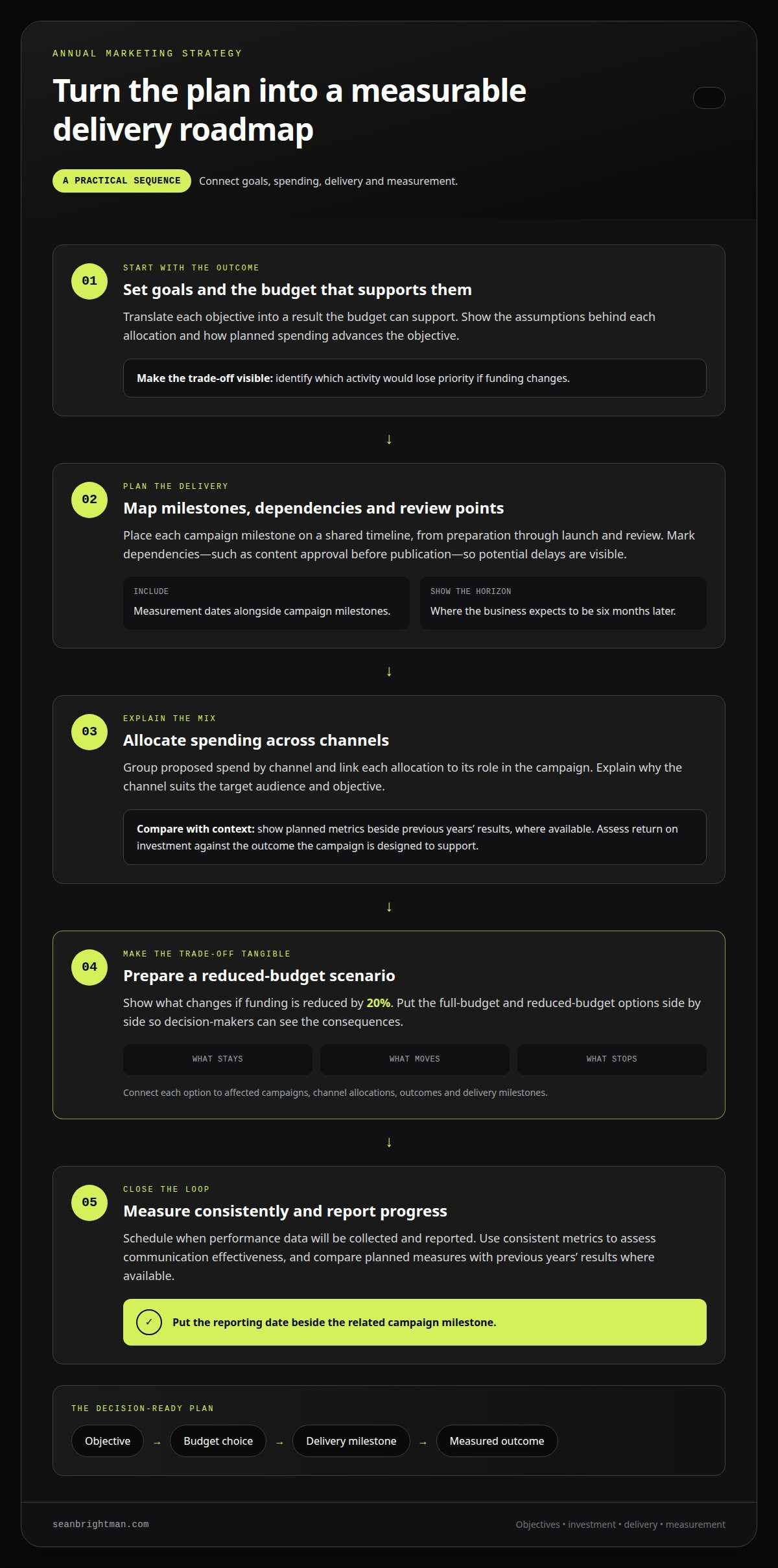
      Translate each objective into a result the budget can support. For example, connect a customer-retention objective to the campaigns, channels and resources needed to pursue it. This makes trade-offs visible and gives decision-makers a reason to approve or reshape spending.

      Show the assumptions behind each allocation, including what the campaign needs to run. Don’t present a budget as a standalone total. A clear summary shows how planned spending supports objectives and which activity would lose priority if funding changes.

    2. Map implementation timelines

      Place each campaign milestone on a shared timeline, from preparation to launch and review. Mark dependencies, such as content approval before publication, so delays become visible before they disrupt delivery. A roadmap can also show where the business expects to be six months later.

      Use the timeline to schedule measurement, not just activity. UK Government guidance notes that timelines can help determine when to collect performance data. Set each collection point alongside the related campaign milestone, then show the reporting date in the presentation.

    3. Allocate budgets across channels

      Group proposed spending by channel and connect each allocation to its role in the campaign. Use charts to show the distribution, then explain why each channel suits the target audience and objective. Assess return on investment against the outcome the campaign is designed to support.

      Keep comparisons practical: show planned metrics beside previous years’ results, where available, and explain what the figures mean for the next decision. A chart should clarify trade-offs, not imply that a channel works independently of the wider marketing mix.

    4. Address budget objections with scenarios

      Prepare a clear alternative before presenting the budget. Show what changes if funding is reduced by 20%, including which campaigns, channel allocations or outcomes would be affected. That scenario lets decision-makers assess consequences instead of cutting spend without a plan.

      Present the full-budget and reduced-budget options side by side. State what stays, what moves and what stops in each version. A marketing roadmap can help connect those choices to delivery milestones and measurement.
    How to Build an Annual Marketing Strategy Presentation with Objectives, Budgets and KPIs

    Marketing objectives, audiences, strategies and tactics

    Build the plan on market evidence, then connect each audience insight to an objective and practical action. This keeps tactics grounded in who you need to reach and why.

    1. Analyse the market and define audiences

      Start with focused market analysis, using SWOT or PEST to frame relevant conditions. Identify the opportunity, competing alternatives and customer needs that shape your plan. Don’t treat broad market trends as proof that every buyer wants the same thing.

      Define the target audience using evidence, such as customer research and existing engagement data. For example, compare how audience groups respond to social media with those arriving through Google. Use the differences to guide channel choices, rather than assuming one channel suits everyone.

    2. Develop target audience personas

      Turn useful audience evidence into buyer personas that describe real decision patterns. Include demographic and psychographic characteristics, shopping practices, channel use and responses to advertising. A persona should help the team decide what message to deliver and where, not become a fictional biography.

      For example, distinguish a research-led buyer who compares options from a returning customer seeking a straightforward repeat purchase. Connect each persona to content and an action that fit its behaviour. Refresh the profiles when campaign responses reveal a meaningful change.

    3. Set marketing objectives

      Choose three to five core business objectives for the marketing plan presentation. Make each specific enough to guide a decision, such as improving customer retention or attracting a defined audience. Link every objective to the business goal it supports.

      Separate outcomes from activity. “Publish social media content” describes a task; attracting qualified enquiries describes an intended outcome. State the starting point, desired direction and measure for each objective, so the team can judge progress rather than simply count completed tasks.

    4. Choose strategies and tactics

      Organise the plan into two to four strategic initiatives, each tied to an audience and objective. Explain why the strategy fits the market evidence, then list the tactics that put it into action. The 7Ps can help structure decisions across product, price, place and promotion, alongside the other elements.

      For example, a retention initiative might use customer-focused email content and supporting social media posts. Specify the content type, channel and intended audience for each tactic. Don’t add activity without a clear purpose: every action should advance an initiative and be easy to assess.

    Marketing objectives, KPIs and accountability

    KPIs make an annual marketing plan accountable, not just ambitious. Define a measure, owner and review action for every objective.

    1. Pair each objective with a KPI that shows progress towards its intended outcome. For a digital marketing campaign, track qualified enquiries rather than counting posts alone. Keep the measure relevant to the objective and explain how the team will use it to make decisions.
    2. Record the starting point and measurement method beside each KPI. If a social campaign aims to increase engagement, define which interactions count and where the data comes from. UK Government guidance recommends consistent metrics for measuring communication effectiveness. Stable definitions make comparisons more useful.
    3. Name one owner for each KPI and identify contributors to the work. The owner brings the figure into the review; contributors explain delivery factors. For example, a content lead can report engagement while the campaign owner connects the result to the objective.
    4. Set a review cadence that matches campaign activity and data availability. At each review, record the result, explain the gap against the plan and agree an action. If engagement rises but qualified enquiries don’t, investigate the audience, message or next step before changing direction.
    5. Build a concise PowerPoint overview around decisions, not a wall of charts. Show the KPI, its trend, owner and next action together. Keep measures current because useful KPIs vary by business and campaign. An engaging report tells leaders what changed and what happens next.

    To develop a KPI-led roadmap with clear ownership, build your marketing roadmap.

    Sean Brightman

    Sean Brightman helps turn marketing strategy into clear priorities, decisions and next steps. When objectives, budgets and KPIs feel disconnected, Roadmapping can bring them together in a coherent plan. An Advisory Retainer provides ongoing strategic input as priorities shift and performance reviews raise new questions.

    For teams assessing how AI could support marketing work, AI Consulting can clarify where it fits the strategy. The right next step depends on the challenge: planning a new direction, keeping execution aligned or evaluating AI’s role. The focus is on practical choices and accountable action, not another deck that sits untouched.

    Contact Sean Brightman to discuss your marketing strategy.

    Make the plan work beyond the presentation

    The real test starts after approval: does the plan shape decisions people make each week? Treat the annual marketing strategy presentation as a working commitment, not a finished document. When priorities shift, update the choices and keep the reasoning visible. This gives the team a practical basis for action without losing sight of the agreed direction.

    Sean Brightman offers Fractional CMO support, AI Consulting and Roadmapping for businesses that need to align strategy with action. These services suit different challenges, from setting marketing direction to assessing AI’s role or structuring a plan. Choose the conversation that matches the decision in front of you.

    Contact Sean Brightman to discuss your strategy. A clear next step can turn a presentation into purposeful progress.

    Frequently Asked Questions

    What should an annual marketing strategy presentation include?

    Include the decisions leaders need to make, not every detail behind the work. An annual marketing strategy presentation can include a decision log showing the choice required, the person responsible and the approval deadline. Note assumptions that could change the plan, such as a product launch date moving. This helps the team distinguish firm commitments from proposals still awaiting a decision.

    How do you structure an annual marketing strategy presentation?

    Arrange the slides so each section answers a natural follow-up question: what is changing, what should the business do, and what decision is needed now? Put supporting detail after the core argument instead of opening with background data. For a leadership meeting, end with a short list of approvals and unresolved decisions. This gives attendees a clear route from discussion to action.

    How do you set annual marketing objectives and KPIs?

    Start with a business priority and define the marketing contribution it needs. For example, if the priority is improving repeat purchases, choose a measure that reflects returning customers rather than general website visits. Add a data source and reporting owner to each KPI. Before setting a target, check that the team can collect the measure consistently and act on the result.

    How do you analyse market trends and competitors for an annual marketing strategy?

    Compare external signals with evidence from your own customers before changing direction. Review competitor messaging, offers and channel activity, then note what appears to be changing and what remains consistent. Check those observations against customer feedback, sales conversations and search behaviour. The aim isn’t to copy a rival; it’s to identify a customer need your positioning may be missing.

    How do you define target audiences and customer segments?

    Group customers by meaningful differences in needs, buying behaviour or decision barriers. For example, distinguish first-time buyers who need product education from returning customers who already understand the offer. Check whether each segment needs a distinct message or journey. If two groups respond to the same proposition and action, splitting them further may add complexity without improving campaign decisions.

    How do you create an annual marketing channel and campaign plan?

    Start with audience needs and the campaign outcome, then choose channels that can deliver the right message in context. Give each campaign a brief covering its audience, proposition, content, owner and intended action. Map dependencies such as asset approval or landing-page preparation. This reveals operational gaps early and helps teams coordinate campaigns instead of competing for the same resources.

  • How to Set Marketing Team Objectives and Key Results That Align

    How to Set Marketing Team Objectives and Key Results That Align

    Marketing objectives should drive business results, not just collect vanity metrics. Setting marketing team objectives and key results means pairing a clear, qualitative objective with measurable key results that show progress. When targets reflect wider business priorities, they guide the team’s work and define how success is judged.

    It’s easy to fill a plan with activity: more posts, clicks or campaigns. But activity matters only when it moves the business towards a meaningful outcome. The challenge is choosing targets that are ambitious enough to matter and realistic enough to pursue.

    This guide explains how marketing objectives shape strategy, how to set specific, achievable goals, and how to monitor performance and adapt. You’ll learn to connect targets to business priorities, choose measures that reveal progress, and keep the team focused on outcomes rather than busywork.

    Key Takeaways

    • Connect each marketing objective to a wider business priority, so the team knows what its work is meant to move.
    • Turn broad ambitions into SMART objectives with clear measures and deadlines.
    • Review campaign data against key results, then adjust tactics when performance or conditions change.
    • Set targets against current performance, team capacity and available resources to keep ambition achievable.

    How Do Different Goals Influence Overall Marketing Strategy?

    Start by tracing each marketing target back to a business priority. That connection turns strategy into focused work instead of a list of disconnected campaigns.

    1. Distinguish Marketing Goals from Objectives

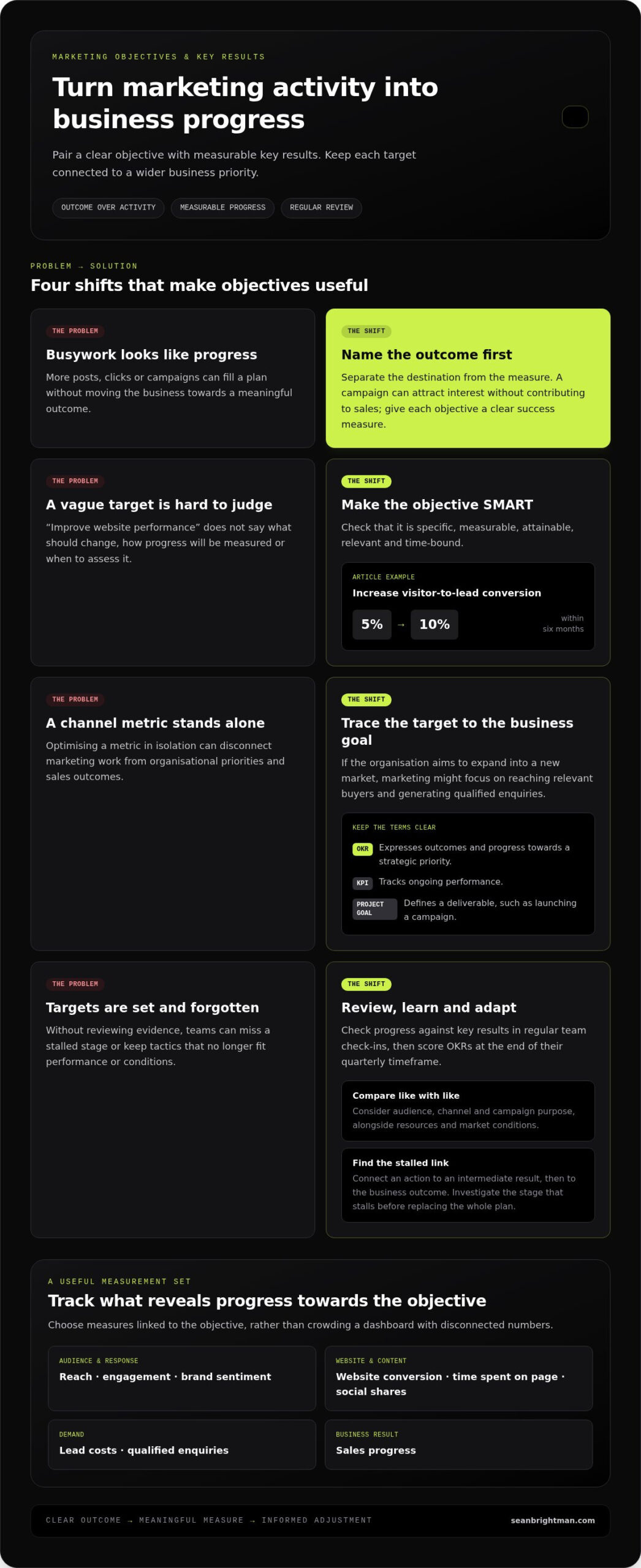
      Separate the destination from the measure. A marketing goal can describe a qualitative ambition, such as strengthening trust, while an objective makes progress measurable, such as improving customer retention. Give each objective a clear success measure. Publishing posts or running advertising is activity, not the outcome. A campaign, for example, can attract interest without contributing to sales.

    2. Align Objectives with Business Goals

      Choose the business result marketing must support, then define an objective around its contribution. If the organisation aims to expand into a new market, marketing might focus on reaching relevant buyers and generating qualified enquiries. Check the connection with sales and other teams: an objective should support organisational priorities, not optimise a channel metric in isolation. Explain how its measure signals progress towards the wider goal.

    3. Connect OKRs with Company Strategy and Sales

      Build each OKR around a strategic priority and a sales outcome. For example, if the company needs stronger sales from a new offer, make that the objective and use measurable key results to track qualified leads or sales progress. Marketing OKRs express outcomes and progress; KPIs track ongoing performance, while project goals define deliverables, such as launching a campaign. OKRs commonly run quarterly. Set only objectives and key results the team can own and review meaningfully.

    4. Communicate Goals and Their Purpose

      Record each objective, key result, owner and business rationale in one shared team tracker. An OKR document or project-management board keeps progress visible; the right tool is the one your team will update and use in reviews. Explain how each measure connects marketing activity to sales or strategy, and invite team members to flag dependencies. This clarity helps everyone understand their role and what success looks like.

    What are marketing objectives?

    A marketing objective turns a business priority into a measurable target. A practical approach to setting marketing team objectives and key results starts by naming the outcome, then deciding how the team will recognise progress.

    1. Brainstorm SMART Marketing Objectives

      Begin with a business objective, then identify the audience behaviour marketing can influence. If the priority is stronger brand awareness, consider recognition among target buyers or relevant social media engagement. If it is conversion, focus on moving interested prospects towards an enquiry or purchase. Ask the people delivering the work to suggest possible measures. Don’t choose a metric simply because it is easy to collect.

    2. Apply SMART Criteria to Objectives

      Test every draft against five checks: specific, measurable, attainable, relevant and time-bound. Replace “improve website performance” with a defined target, such as increasing visitor-to-lead conversion from 5% to 10% within six months. Next, check the baseline, available resources and the team’s influence over the result. A deadline without delivery capacity is wishful thinking; a measure without a connection to business objectives is noise.

    3. Explore Marketing OKR Examples

      Use the objective to state the outcome, then key results to show evidence of progress. For brand awareness, aim to strengthen recognition and track relevant audience reach. For demand generation, focus on qualified enquiries and follow their progress into sales conversations. For retention, target stronger customer loyalty and track repeat purchasing behaviour. Keep measures tied to outcomes, not simply activity volume.

      Common mistakes include vague outcomes, vanity metrics, targets disconnected from business priorities and results the team cannot influence. Treat setting marketing team objectives and key results as a working process: test whether each measure guides a useful decision. If your objectives need a clearer route into delivery, a marketing roadmap can connect priorities, measures and work.

    How to Set Marketing Team Objectives and Key Results That Align

    Monitoring performance and adjusting strategy

    A marketing strategy sets out how to reach prospective customers and turn them into sales. Monitor whether its actions move people through that journey, then adjust based on evidence.

    Review and Update OKRs

    1. Review progress against each key result in regular team check-ins, then score OKRs at the end of their quarterly timeframe. Compare actual results with the intended outcome and record what changed and why. According to NHS, OKRs can measure activities contributing to strategic focus areas and workstreams.
    2. Set realistic targets using previous campaign performance as a baseline. Compare like with like, including audience, channel and campaign purpose, then factor in available resources and market conditions. Historical data shows what your team has achieved. Relevant benchmarks can add context, but neither should replace a clear business rationale.

    Use Performance Data to Adjust Strategy

    1. Track metrics linked to each objective, not a dashboard crowded with disconnected numbers. For example, assess lead costs, website conversion, reach and engagement alongside sales progress. Review content performance through time spent on page and social shares. Brand sentiment analysis can also reveal how people respond to your message.
    2. Map cause and effect before changing tactics. If awareness is meant to create qualified interest, which should then lead to enquiries, measure each link in that chain. A strategy map makes the connections visible: an action should influence an intermediate result, which supports the business outcome. If one link stalls, investigate that stage before replacing the whole plan.
    3. Use campaign analytics to decide whether to refine a channel, message or audience. Compare results with KPIs and previous campaigns, then document the change and its expected effect. Effective marketing tests actions against evidence instead of defending a tactic simply because the team has already invested time in it.

    Keep the plan current: revisit goals and objectives using analytics and check-ins, and let feedback, results and future projections guide revisions.

    Setting specific and achievable marketing objectives

    Set objectives based on evidence, not optimism. Effective marketing OKRs link a business outcome to measurable results, a clear owner and work the team can realistically deliver.

    1. Start with the audience and business outcome. Identify whose behaviour needs to change, then choose a result marketing can influence. For example, if the target audience visits your site but rarely enquires, focus on conversion instead of adding unrelated campaigns. Audience research helps reveal the needs, preferences and behaviour behind the numbers.
    2. Benchmark current performance before choosing a target. Compare like-for-like periods and channels, then account for seasonality, campaign history, team skills, budget and available tools. A target of increasing website traffic by 20% within six months is meaningful only if the baseline and planned activity make that lift achievable.
    3. Work backwards through the customer journey. Start with the sales outcome, then estimate the leads, traffic and awareness needed to support it. Check each step with sales and the people delivering the work. If the plan depends on everyone changing several priorities at once, narrow the objective or adjust its scope.
    4. Choose key results that measure outcomes, not just effort. “Publish more content” describes an action; “generate 100 new leads per month through content marketing” gives the team a result to track. Set ambitious stretch targets, but keep them grounded in capacity and evidence. OKRs commonly use stretch targets teams expect to achieve at 40-70%.
    5. Write the objective, key results, owner, timeframe and dependencies together. Then ask the team whether the actions and resources match the target. If not, revise the target or remove competing work before the cycle starts. For a clearer plan connecting priorities to execution, build a marketing roadmap.

    Even when the right target is uncertain, set specific, measurable, numerical goals and use the results to iterate. A key result might be for repeat customers to account for 25% of sales; other examples include increasing social media followers by 15% over six months or securing media coverage in three industry publications within the next quarter.

    Set goals for each stage of the customer journey, so marketing and sales contribute throughout rather than focusing on selected stages. For funnel goals, start with sales targets and work backwards to the leads, traffic and awareness needed to support them.

    Sean Brightman: AI Consulting

    Sean Brightman’s AI Consulting can help you assess how practical AI systems could support marketing priorities and objectives. Explore where AI fits your strategy, keeping the focus on useful outcomes rather than adopting tools for their own sake.

    If objectives lack a clear route to delivery, Roadmapping can connect priorities with the work needed to move them forward. An Advisory Retainer provides ongoing strategic input as plans evolve. Choose support that matches the challenge: exploring AI’s role, turning objectives into a roadmap or maintaining strategic direction.

    Bring a defined marketing challenge and the business outcome you want to support. That gives the discussion a practical starting point. Visit seanbrightman.com to get in touch with Sean Brightman.

    Turn your objectives into the next decision

    Next, make your objectives part of how the team chooses and prioritises work. Before adding a campaign, ask which outcome it supports, who owns the result and what should stop if priorities shift. This discipline keeps strategy connected to daily decisions instead of leaving it on a planning document.

    The value of setting marketing team objectives and key results lies in making trade-offs visible. If your team needs senior marketing direction, Sean Brightman offers Fractional CMO support. Roadmapping can connect priorities to execution, while AI Consulting can help assess where practical AI systems fit your marketing work.

    Choose the support that matches the challenge in front of you. Contact Sean Brightman to discuss your marketing priorities. Make the next move with focus, and give the team a clearer path forward.

    Frequently Asked Questions

    How to Streamline Goal Setting in Marketing?

    Make goal setting more efficient by gathering business priorities and campaign evidence before the planning discussion. Ask sales which customer objections or lead-quality issues matter most, then use that input to shape marketing’s contribution. Record each proposed objective, decision-maker, data source and dependency in one shared document. This preparation keeps the discussion focused on decisions, rather than reconstructing context.

    What Key Performance Indicators Should Teams Monitor?

    Monitor indicators that match the work’s place in the customer journey. For a paid campaign, click-through rate shows whether an advert attracts clicks, while Return on Ad Spend measures revenue generated per pound invested in advertising. Pair these with a quality or conversion measure so rising traffic doesn’t disguise weak enquiries. Choose a small, relevant set for each campaign and apply its definitions consistently.

    What does a good team goal setting framework look like?

    A practical framework connects business priorities to team objectives, measurable results, named owners and supporting work. Record dependencies, decision rights and progress in a shared place, so contributors know where to raise blockers. For example, a product launch objective might depend on sales enablement and website updates. Review OKRs over a quarterly cycle, then carry forward only priorities that remain relevant.

  • Measuring the ROI of AI in Marketing: A Practical 2026 Framework

    Measuring the ROI of AI in Marketing: A Practical 2026 Framework

    AI activity is not proof of marketing impact. Measuring the roi of ai in marketing means showing what changed because of AI, not simply counting prompts, generated content or hours saved.

    The challenge is separating AI’s contribution from other changes. Revenue can shift as channels, customer behaviour and market conditions change, while software, implementation and oversight costs sit in different budgets. Without a baseline and a credible comparison, the business case is guesswork.

    This practical 2026 framework will help you set a baseline, choose metrics that match a business objective and compare the full cost of an AI use case with its attributable financial and operational value. You’ll learn how to distinguish time saved from revenue gained and account for the limits of attribution without giving up on measurement.

    We’ll move from defining the use case to reviewing the evidence, so you can decide whether to scale, change or stop it. The aim isn’t to prove AI is valuable. It’s to find out whether a particular use case earns its place in your marketing system.

    Key Takeaways

    • Start with a business problem and a measurable hypothesis, not an AI tool or activity count.
    • Calculate ROI using benefits attributable to AI, and include the full cost of tools, implementation and oversight.
    • Choose a comparison method that suits the use case, using a control or credible counterfactual where possible.
    • For measuring the roi of ai in marketing, track financial results alongside workflow effects, output quality and operational risks.
    • Set an owner, review window and decision threshold so you can scale, adjust or stop each use case based on evidence.

    Why measuring the ROI of AI in marketing starts with a business problem

    Start with the business constraint, not the software. A team might use AI to draft emails, analyse customer feedback or speed up campaign planning. None of those activities proves that marketing is working better. Measuring the roi of ai in marketing means assessing the business value attributable to AI against the full investment required to achieve it.

    That value could mean more qualified demand, stronger contribution margin, improved customer retention or the same quality of work delivered with less effort. The right outcome depends on the problem. A useful foundation is Marketing effectiveness and ROI, applied to a specific AI use case rather than AI adoption in general.

    Keep the decision in view from the start: will the evidence support scaling, redesigning, pausing or stopping the use case? Without a decision to inform, teams can collect plenty of activity data and still have no clear next move.

    Which marketing problem is AI meant to solve?

    Describe the business constraint in plain language. For example, prospective customers may abandon a lengthy enquiry journey, campaign production may take too long, or the team may lack useful insight for tailoring follow-up. Then set boundaries: which audience is affected, where in the customer journey the issue occurs, which workflow AI will change and who owns the result.

    Set the objective before choosing a tool or metric. “Use AI to produce more content” describes a task. “Help the team respond to product enquiries sooner, with the aim of improving qualified consultation bookings” states a testable business intent. The accountable owner should be able to explain why the outcome matters and what evidence would change the decision.

    Why AI activity is not the same as ROI

    Prompts submitted, drafts generated and tasks automated show that a system is being used. Time saved may indicate a workflow benefit, but it becomes financial value only when the organisation puts that capacity to productive use or reduces a real cost. More output does not automatically mean more qualified demand, better margins or repeat customers.

    Consider an AI-assisted email workflow. It may produce more campaign variations in less time, but the business still needs to know whether those changes brought in suitable prospects or improved retention. A rise in bookings during the same period is not proof on its own. Seasonality, pricing changes, a new offer or activity in other channels may also have influenced the result.

    AI adoption is the use of a system; measurable marketing impact is a demonstrable change in a business outcome that can reasonably be attributed to its use. Activity reports are useful operational evidence, but they are not a substitute for business value.

    Before a pilot begins, record the problem, owner, intended outcome and decision the evidence must support. This turns an AI experiment into a business test and gives the next steps, calculating the investment and comparing results, a meaningful target.

    How to calculate AI marketing ROI without hiding the costs

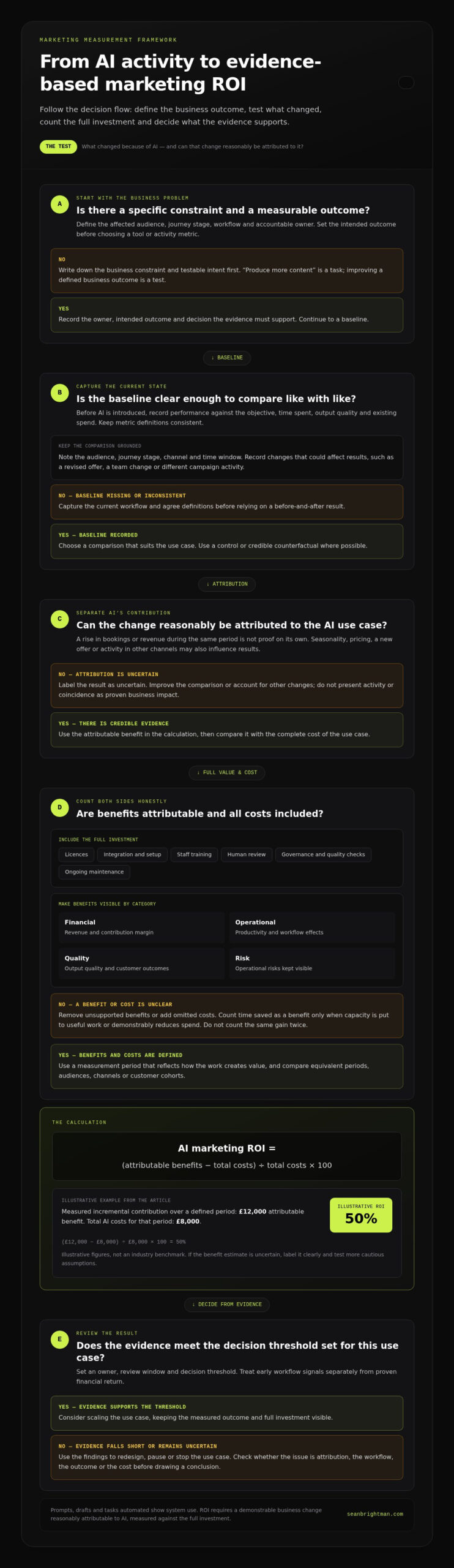
    Once the use case has a defined objective, compare its value and investment on the same basis. Use this formula:

    AI marketing ROI = (attributable benefits − total costs) ÷ total costs × 100

    Use benefits you can reasonably connect to the AI use case, expressed in pounds where possible. Choose a measurement period that reflects how the work creates value, then compare like with like: equivalent periods, audiences, channels or customer cohorts. A short pilot may reveal workflow changes before any effect on revenue, so don’t treat an early operational signal as a proven financial return.

    Build a baseline before switching on AI

    Capture the current state of the specific workflow: performance against the chosen business objective, time spent, output quality and existing spend. Keep definitions consistent. If you’re tracking qualified enquiries, for example, agree what qualifies before the test and apply the same criteria afterwards.

    Record the audience, journey stage, channel and time window as well. Note changes that could muddy the comparison, such as a revised offer, a team change or a shift in campaign activity. This context helps explain changes in the results and distinguish a genuine difference from a change in conditions.

    Count costs and benefits without double-counting

    Calculate the full investment, not just the software bill. Include costs involved in putting the use case into operation and keeping it useful:

    • Licences, integration and setup
    • Staff training and human review
    • Governance, quality checks and ongoing maintenance

    Count staff time saved as a benefit only if the capacity is redeployed to useful work or demonstrably reduces spend. Don’t claim the same gain twice. If faster production creates extra campaign output, for instance, don’t also count those same hours as a separate cash saving unless the benefits are distinct and evidenced. Keep revenue, contribution margin, productivity and risk benefits visible as separate categories.

    Here’s a worked example using illustrative figures, not an industry benchmark. Suppose a team estimates £12,000 in attributable benefit over a defined period, based on measured incremental contribution, and records £8,000 in total AI costs for that period. The calculation is (£12,000 − £8,000) ÷ £8,000 × 100, giving an illustrative ROI of 50%. If the benefit estimate is uncertain, label it clearly and test how the result changes under more cautious assumptions.

    Include full implementation and oversight costs in ROI. Ignoring the work required to create and maintain a return overstates its value. A clear AI consulting and scalable growth engine guide can help connect use-case choices to a broader marketing system. Strategic AI marketing guidance can also help clarify ownership, costs and the business decision behind the calculation.

    How to compare AI marketing results and prove what changed

    A result only means something when set against a credible comparison. To judge an AI use case, estimate what happened with it and what would likely have happened without it. That second view is the counterfactual. A control group can provide a strong comparison, but the best method depends on the workflow, available data and whether audiences can be separated fairly.

    Use this guide to choose a method. Each provides evidence with limitations, not automatic proof.

    Method Data needed Main limitation
    Controlled test Comparable groups, consistent tracking and enough activity to assess the outcome May be impractical if audiences are small or the workflow affects everyone
    Matched cohorts Groups similar in relevant traits, behaviour and exposure Unmeasured differences can still influence the result
    Before-and-after Consistent measures from a period before and after implementation Seasonality, campaign changes or wider market shifts can confound results
    Modelling Reliable historical data and clearly stated assumptions Outputs depend on model quality and assumptions, not direct experimental proof

    Choose a measurement method that fits the use case

    Use a controlled experiment when you can allocate comparable people or workflows to AI and non-AI groups without disrupting the customer experience. If random allocation isn’t practical, compare matched cohorts and document how they differ. Before-and-after analysis can identify a signal, but treat it as directional if seasonality, campaigns or team changes overlap. Modelling can help explore scenarios, but state its assumptions plainly.

    An observed lift is not automatically an AI-caused lift. If several things changed together, attribution reports may show where outcomes were recorded, but they can’t isolate the cause on their own. Note the other changes, explain what the method can and can’t establish, and avoid presenting a platform’s own attribution output as independent proof.

    Select metrics across the marketing funnel

    Pair an early signal with an outcome further down the journey. For an AI-supported lead workflow, you might track response time and completed enquiries alongside sales-qualified pipeline or contribution. More clicks or faster replies can indicate progress, but they don’t confirm that leads are suitable or commercially valuable.

    Customer acquisition cost and conversion quality are useful only when you apply consistent attribution rules before and during the comparison. Tools such as Google Analytics 4, HubSpot or Salesforce may help bring together relevant journey or customer data, depending on how your organisation records activity. Check that definitions, tracking and reporting windows align before comparing results.

    In practice, measuring the roi of ai in marketing requires a clear line from the AI change to the business outcome, plus a comparison that makes alternative explanations visible. Record the method, metric definitions and caveats with the result. This gives decision-makers evidence they can assess, rather than a lift that looks convincing only in a dashboard.

    Measuring the ROI of AI in Marketing: A Practical 2026 Framework

    A practical process for measuring AI marketing ROI over time

    A useful pilot is designed to support a decision, not just generate a report. Before work begins, agree who owns the use case, what result you expect, how you’ll measure it and what evidence would change your course. This makes measuring the roi of ai in marketing an operating discipline rather than a one-off calculation.

    Run a pilot with a decision attached

    Choose one bounded use case with an owner and accessible baseline data. Write a short hypothesis, such as: “Using AI to support this workflow will reduce handling time without lowering output quality.” Add the business outcome it should influence, the measurement window and the threshold for scaling, refining or stopping. Keep the scope narrow enough to identify what changed.

    Track the work behind the headline result. Log human review time, rework, errors and how consistently the team uses the process. A faster workflow can still create extra checking or quality problems that erase its value. Review the evidence at checkpoints agreed in advance. Extend the test only if a specific uncertainty remains, such as whether the result holds across another cohort or a longer customer journey.

    Turn results into an operating decision

    At each checkpoint, compare the evidence with the original hypothesis and decision threshold. Don’t move the goalposts because the results are inconvenient. Use a simple decision rule:

    • Scale when gains appear repeatable, exceed full costs and don’t come with unacceptable quality or operational risks.
    • Refine when results look promising but workflow friction, inconsistent adoption or weak data prevents a clear judgement.
    • Stop or pause when evidence remains weak, costs outweigh value, risks are too high or the underlying business problem has changed.

    Record the decision, evidence and unresolved caveats in one place. Assign an owner to each next action, whether that means expanding the test, fixing a process issue or retiring the use case. This creates accountability and makes future reviews more useful than a dashboard snapshot.

    Results can also show that the issue goes beyond one tool. When several use cases compete for attention, a structured marketing roadmap can help sequence the work around business priorities, owners and evidence instead of adding disconnected experiments.

    For senior guidance on setting up accountable AI use cases and reviewing evidence over time, discuss your AI marketing measurement approach.

    When strategic guidance can make AI marketing ROI measurable

    Measurement often breaks down between teams. Marketing may track engagement, finance may focus on contribution, and operations may see the extra review work. If data sits in separate systems or no one owns the full customer journey, connecting an AI use case to a business result is difficult. Competing priorities add to the problem: teams test tools without agreeing which business objective comes first.

    Strategic guidance creates a shared framework for measuring the roi of ai in marketing. It connects each proposed use case to a growth priority, a customer need and the operational constraints involved. It doesn’t guarantee a return. It makes the investment testable, with clearer ownership and agreed criteria for deciding what happens next.

    What strategic AI marketing support should clarify

    Before committing further investment, bring marketing, finance and operational perspectives into the same evaluation. A roadmap can sequence use cases by business relevance and readiness, rather than treating every idea as equally urgent. For each priority, clarify:

    • Business fit: Which growth priority or customer need does the use case address, and what workflow will it change?
    • Accountability: Who owns implementation, the evidence and the decision to continue?
    • Measurement: Which outcome, baseline and review points will show whether the use case is working?
    • Constraints: What data gaps, quality checks or operational dependencies could affect the result?

    These questions expose weak cases early. If the team can’t access the data needed to evaluate an idea, the roadmap can make resolving that gap a priority or sequence a more measurable use case first. If several teams contribute to the outcome, agree who supplies which evidence so responsibility doesn’t disappear between handovers.

    Choose the next step based on your measurement gap

    If priorities are scattered or teams lack evaluation criteria, a focused roadmap can set direction and sequence the next use cases. If leaders already have a plan but need regular review, an advisory retainer can provide ongoing direction and accountability. The marketing advisory retainer guide offers context for that continuing leadership role.

    Strategic support should challenge assumptions, bring the right people around the evidence and adjust the plan as results emerge. It should not promise guaranteed returns. The aim is disciplined decision-making: invest where the business case is credible, improve what remains unclear and stop activity that no longer serves the objective.

    If you’re ready to turn disconnected AI experiments into a measurable plan, build a clearer AI marketing measurement plan.

    Make evidence part of your next marketing decision

    Make measurement part of how you plan marketing, not a report assembled after the budget has been spent. Put AI use cases alongside other priorities and review them when making decisions about capacity, customer experience and growth. This keeps promising experiments connected to real work and gives underperforming ones a clear route to change or closure.

    Measuring the roi of ai in marketing is more useful when it shapes what the team does next. Practical AI consulting can focus on applying AI to marketing efficiency and output, while a structured roadmap and ongoing advisory accountability help keep decisions aligned as priorities shift. The aim isn’t to justify every AI investment. It’s to make deliberate choices based on evidence and keep improving the system as you learn.

    Ready to turn your measurement gap into a practical next step? Build a clearer AI marketing measurement plan and move forward with greater confidence.

    Frequently Asked Questions

    How do you calculate the ROI of AI in marketing?

    Subtract the use case’s total costs from the benefits you can attribute to it, divide by those costs and multiply by 100. For example, if a defined workflow shows £9,000 in attributable benefit against £6,000 in costs, the illustrative ROI is 50%. Measuring the roi of ai in marketing also means explaining how you estimated the benefit and what other factors could have contributed.

    What costs should be included when measuring AI marketing ROI?

    Include the costs required to put the use case into operation and keep it working: licences, integration, staff training, human review, governance and maintenance. Account for internal time where it creates a real cost or uses capacity that could otherwise support valuable work. If one tool serves several teams, allocate its shared costs consistently rather than charging the entire amount to whichever use case is easiest to measure.

    Can AI marketing ROI be measured without a control group?

    Yes. A control group can strengthen the comparison, but it isn’t the only option. You might compare similar customer cohorts, examine a consistent period before and after implementation, or model likely outcomes using historical data. State the limits: a before-and-after comparison may be affected by a changed offer or seasonal demand, while matched groups may differ in ways your data doesn’t capture.

    Which metrics show whether AI is helping marketing?

    Choose metrics that match the job AI is doing, then connect process signals to customer or commercial outcomes. For lead qualification, monitor how many leads meet agreed criteria and progress to sales conversations, not just how quickly they’re processed. For customer communications, examine response and conversion quality alongside engagement. Add checks for errors, rework and customer feedback so a faster process doesn’t conceal a weaker experience.

    How long does it take to see a return from AI in marketing?

    There’s no single reliable timeframe. A workflow change may appear before a sales or retention effect, particularly if customers take time to make a decision. Set the review window around the use case and the length of the customer journey. Check early indicators as signals, then allow enough time for the outcome that matters to become visible before making a firm investment decision.

    What if AI saves time but does not increase revenue?

    Treat time saved as an operational benefit, not automatically as financial return. Work out what happens to the freed capacity: can the team use it for higher-value work, improve service or avoid additional spending? If the hours simply disappear from the workflow without changing output, cost or capacity, record the efficiency gain but don’t claim a cash saving. The use case may still be worthwhile if that benefit supports a clear business priority.

    Should businesses measure AI marketing ROI for every tool?

    Measure use cases in proportion to their cost, reach and business importance, rather than building a heavyweight analysis for every small feature. Prioritise tools that influence customer decisions, consume meaningful staff time or introduce quality and operational risks. For low-impact features, a light review of usage, cost and workflow effect may be enough. Also check whether overlapping tools duplicate capabilities or create costs that no single team sees.

  • Measuring Success with a Fractional CMO: Systems Over Stats

    Measuring Success with a Fractional CMO: Systems Over Stats

    Most marketing departments are just expensive hobbies. You are likely burning cash on uncoordinated tactics whilst your actual business valuation stays stagnant. It is the classic trap: plenty of noise, zero machinery. This makes measuring success with a fractional cmo difficult if you are chasing the wrong numbers.

    Success is about systems, not just stats. If your marketing does not function as a predictable, accountable engine, it is failing. You need order, not more activity. You need a department that delivers results without constant hand-holding.

    You want a department that runs like a machine and a dashboard that actually matters to your board. We agree that vanity metrics are a distraction. This article promises to show you how to move beyond superficial data and measure the structural impact of senior leadership on your growth. We will preview how to build a high-impact marketing engine, integrate AI for genuine scale, and ensure your organisation is primed for a maximum-value exit.

    Key Takeaways

    • Stop chasing vanity metrics and learn why measuring success with a fractional cmo requires prioritising architectural growth over superficial activity.
    • Shift your focus to capital-efficient growth by tracking hard numbers like CAC against LTV within a documented marketing roadmap.
    • Evaluate the machinery of your department by measuring AI adoption rates and team accountability instead of just lead volume.
    • Implement a 90-day audit framework to transform a chaotic marketing function into a predictable growth engine that is exit-ready.
    • Understand how an Advisory Retainer provides the ongoing senior-level accountability needed to fix messy departments and maintain strategic velocity.

    Beyond Vanity Metrics: Why Most CEOs Measure Marketing Wrong

    Most CEOs are addicted to activity. They see a team “doing stuff” and assume growth is happening. It isn’t. Busy work is not a strategy; it’s a distraction. When measuring success with a fractional cmo, you must look at the architecture, not just the activity. Architecture is the repeatable system that generates revenue. Activity is just noise.

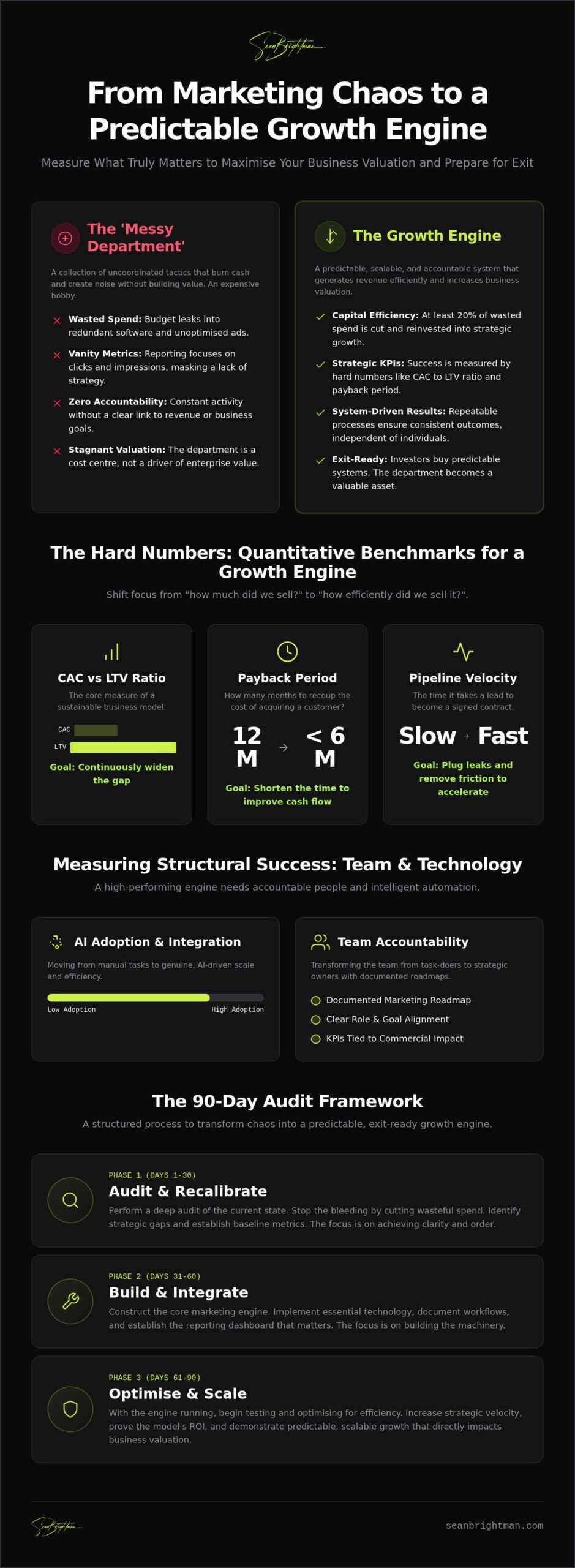
    The “Messy Department” syndrome is a silent ROI killer. It happens when you have uncoordinated tactics flying in different directions. One person is posting on LinkedIn whilst another is tweaking an ad. Nobody is looking at the engine. A Fractional CMO spends their first 30 days performing an audit. This isn’t a delay; it’s a recalibration. You don’t fix a broken engine whilst the car is moving at seventy miles per hour.

    The ultimate success signal is Marketing Velocity. This isn’t about how fast you post. It’s about how quickly your organisation can implement, test, and scale strategic shifts. If your team is stuck in a loop of endless meetings without movement, your velocity is zero.

    The Trap of the Tactical Dashboard

    Clicks, impressions, and “likes” are fluff. They feel good in a board meeting but they don’t increase business valuation. If your current reporting focuses on top-of-funnel noise without showing a conversion engine, it’s masking a lack of strategy. You are measuring the wind instead of the sails.

    A Marketing Manager manages the task. A Chief Marketing Officer builds the machine. Measuring success with a fractional cmo means looking past the dashboard to see if the plumbing actually works. You need to know if your spend is being captured by a system or simply evaporating into the atmosphere.

    Defining Success in Strategic Terms

    Success with a Fractional CMO is the creation of a scalable, repeatable growth engine that functions independently of individual personalities.

    This definition aligns directly with your three-year exit plan. Investors don’t buy busy departments. They buy predictable systems. Order amongst chaos is a measurable business outcome. It reduces wasted spend and increases the efficiency of every pound you put into the market. If the department doesn’t run like a machine, you aren’t ready for an exit. True success is when the strategy dictates the tactics, not the other way around.

    The Hard Numbers: Quantitative Benchmarks for a Growth Engine

    Revenue growth is a blunt instrument. It’s easy to buy growth if you have an infinite budget and a total disregard for margins. It’s much harder to build a capital-efficient growth engine. When measuring success with a fractional cmo, the primary focus shifts from “how much did we sell?” to “how efficiently did we sell it?”. You need a framework that prioritises profit over raw volume.

    A battle-hardened strategist looks for an immediate reduction in wasteful spend. Most messy departments have at least 20% of their budget leaking into redundant software, unoptimised ad sets, or vanity projects that don’t move the needle. Cutting this waste is the first quantitative win. It stops the bleeding and funds the strategic work required to scale.

    We also distinguish between marketing-sourced and marketing-influenced revenue. Sourced revenue is a direct hit from a campaign. Influenced revenue tracks how marketing touched a lead before sales closed the deal. A Fractional CMO ensures both are tracked to prove the department’s total commercial impact. If you want to see how these metrics transform a business, you can explore my Fractional CMO services to understand the mechanical shift required.

    CAC, LTV, and the Efficiency Ratio

    Your Customer Acquisition Cost (CAC) should never be a static number. If it remains unchanged whilst you scale, your strategy is likely stagnating. A Fractional CMO should optimise these marketing KPIs over a six-month horizon. The goal is a healthy, widening ratio between CAC and Lifetime Value (LTV).

    We also track the Payback Period. This measures how many months it takes to recoup the cost of acquiring a single customer. If this period is stretching, your cash flow is at risk. High-impact leadership ensures this ratio improves as the system matures. Static CAC amongst competitors is a sign of a failing strategy; your system should be getting smarter and cheaper over time.

    Pipeline Velocity and Conversion Ratios

    Pipeline velocity is the ultimate metric for mechanical efficiency. It measures the time a lead takes to travel from the first touchpoint to a signed contract. If your funnel has “leaky buckets”, your CMO must plug them. These leaks are usually found in the friction-filled hand-off between marketing and sales.

    Success is a shorter sales cycle and a higher conversion ratio at every stage. You aren’t just looking for a higher volume of leads. You’re looking for a faster, tighter machine. Improving sales and marketing alignment ensures that every lead is treated with the same level of tactical precision, reducing the time spent in “purgatory” between departments.

    Structural Success: Measuring Team Accountability and AI Integration

    A marketing department that relies on the CEO’s intuition is a liability. It is a bottleneck that prevents scaling and kills business valuation. Structural success is about building a machine that functions regardless of who is in the room. This shift from founder-led to system-led marketing is a core component of measuring success with a fractional cmo. If there is no documented strategy roadmap, there is no accountability; there is only a collection of people doing tasks.

    We evaluate the machinery by looking at the outcome, not the effort. Your team shouldn’t be owning “social media posts”; they should be owning “inbound lead velocity.” When the department moves from reactive fire-fighting to proactive system-building, you have achieved structural success. To ensure these changes endure, we apply a Measurement Effectiveness Framework that prioritises long-term system health over short-term activity spikes.

    Building the AI-Powered Growth Engine

    AI is not a toy for generating generic blog posts. It is a functional component of a modern growth engine. We measure success here through the AI Adoption Rate within your marketing operations. This involves tracking the reduction in manual labour across repeatable processes like lead scoring, data entry, and content distribution. If your team is still doing by hand what a machine can do in seconds, you are burning margin.

    The goal is to improve efficiency without sacrificing output quality. We track the performance of AI-assisted systems against traditional manual methods to prove ROI. For a deeper dive into this transition, see my guide on AI Consulting in 2026: From Tool Fatigue to Scalable Growth Engines. A successful integration means your team is freed up to focus on high-level strategy whilst the AI handles the mechanical heavy lifting.

    The Accountability Framework

    Accountability requires clarity. Most messy departments suffer from overlapping roles and vague responsibilities. A Fractional CMO fixes this by implementing a “plug-and-play” system. This framework defines exactly who owns which part of the engine. It ensures that every team member knows their specific contribution to the 3-year exit plan.

    When measuring success with a fractional cmo, the ultimate proof is the removal of the “Strategic Burden” from your shoulders. You should no longer be the person deciding which tactics to pursue or which AI tools to test. The system should provide the answers. This creates a more professional, disciplined environment where people own outcomes rather than just ticking boxes. It makes your marketing department an asset that adds genuine value to the business, rather than a cost centre that requires constant supervision.

    Measuring Success with a Fractional CMO: Systems Over Stats

    The 90-Day Audit: Tracking Strategic Velocity and Exit Readiness

    Measuring success with a fractional cmo is not a guessing game. It is a clinical, 90-day framework designed to install a growth engine. If you aren’t seeing structural shifts by day 90, you are just paying for more noise. We don’t wait a year to see if things are working. We track strategic velocity from the first week.

    Phase 1 (Days 1-30) is about Clarity. We audit the internal mess. We identify the leaky buckets in your funnel and align marketing objectives with your commercial goals. Success in this phase is the total removal of ambiguity. You finally know what is broken and exactly how we intend to fix it.

    Phase 2 (Days 31-60) focuses on Systems Architecture. We build the process. This is where the machinery is installed and the team begins following a documented roadmap. Success is measured by the transition from “doing tasks” to “following a system.” The department starts to feel like a machine rather than a collection of uncoordinated individuals.

    Phase 3 (Days 61-90) centres on Execution and Optimisation. We look for Results. This isn’t just about raw lead volume; it’s about commercial evidence. By day 90, you should have a repeatable operating rhythm and early data showing improved efficiency. This 90-day sprint turns a chaotic department into a scalable asset.

    Measuring Exit Readiness

    Buyers covet machines, not personalities. If your marketing breaks when you leave the room, your valuation is capped. An essential part of measuring success with a fractional cmo is evaluating how well the business functions without your daily input. A battle-hardened strategist ensures your business is ready for an exit by building a growth engine that buyers actually want to buy.

    Your brand positioning must be sharp enough to defend market share during a due diligence process. We measure this by looking at your “Defensibility.” Is your brand a commodity, or is it a category leader? A system-led department provides the documentation and predictable ROI that investors demand. If you want to increase your business valuation, you can start with a Fractional CMO roadmap.

    The Strategic Brand Roadmap

    The Strategic Brand Roadmap is your source of truth. It ensures consistency across every channel, from your LinkedIn presence to your automated email flows. We measure success by the “Consistency Score” of your messaging. If your brand sounds different on every platform, your system is failing.

    A clear roadmap reduces decision fatigue for the board by providing a pre-validated path for every tactical choice. You stop debating which social media platform to use and start executing the plan. This roadmap is the bridge between your 3-year exit plan and the daily tasks your team performs. Without it, you are just wandering in the dark; with it, every action has a measurable purpose.

    Driving Accountability with a Strategic Advisory Retainer

    A strategy without a mechanism for accountability is just a wish list. You don’t need more ideas; you need more execution. Measuring success with a fractional cmo means looking at the long-term strategic velocity of your business. This is where the Advisory Retainer becomes the engine room of your growth. It ensures that the systems we build don’t just sit on a shelf. They move. They evolve. They deliver.

    An external perspective is your greatest asset. Internal teams often become blind to their own inefficiencies. They get comfortable with the “messy department” status quo. A battle-hardened strategist identifies these blind spots immediately. We don’t care about corporate politeness. We care about fixing the machine. This transition from a chaotic marketing function to a scalable growth engine requires a partner who is willing to challenge your assumptions and keep the pressure on outcomes.

    Leadership Without the Overhead

    Hiring a full-time executive is often a mistake for UK scale-ups. A full-time CMO at a £150k+ salary brings significant overhead, recruitment risk, and often, a preference for corporate bloat over tactical precision. You are paying for a person, not necessarily a result. In contrast, a fractional strategic partner provides senior-level authority on demand. You get the expertise without the heavy tax bill or the long-term liability.

    Senior leadership should be a functional component, not a permanent anchor. For many businesses, the Fractional Revolution in 2026 has proven that impact is more valuable than hours worked. You need a builder to install the system, then a strategist to oversee its performance. This is the smartest move for companies that want high-level direction whilst maintaining a lean, agile operation.

    Your Next Steps for Growth

    Don’t wait for your marketing to fix itself. It won’t. Start by conducting a Marketing Efficiency Audit today. Look at your spend. Look at your team’s output. If you cannot see a clear line between marketing activity and business valuation, your system is broken. Measuring success with a fractional cmo starts with setting three hard benchmarks for your first 90 days: process clarity, team accountability, and capital efficiency.

    Once these benchmarks are set, you move from fire-fighting to scaling. You stop guessing and start measuring. If you are ready to stop wasting spend on uncoordinated tactics and start building a machine that buyers covet, your next move is clear. Fix the machinery. Book a roadmap session to define your path to a scalable, exit-ready growth engine.

    Install the Machinery for Predictable Growth

    Stop measuring noise. Start measuring the machine. Success isn’t found in a spreadsheet of clicks; it’s found in a marketing department that runs without your constant input. By focusing on capital-efficient growth and structural accountability, you turn marketing from a cost centre into a high-valuation asset. You move from the chaos of uncoordinated tactics to the precision of a growth engine.

    Measuring success with a fractional cmo requires a shift from activity to architecture. You need a 90-day audit to clear the mess, a documented roadmap to provide direction, and AI integration to drive genuine efficiency. This isn’t abstract theory; it’s a mechanical overhaul of your growth engine. As a published author on marketing strategy and a battle-hardened strategist with a “get-your-hands-dirty” attitude, I specialise in building AI-powered systems that deliver strategic velocity.

    Your business deserves a growth engine that is predictable, scalable, and exit-ready. Take the first step toward order and accountability today. Build your scalable growth engine with Sean Brightman. The path to a high-impact marketing machine is closer than you think.

    Frequently Asked Questions

    How long does it take to see results from a Fractional CMO?

    Structural shifts happen within 30 to 90 days. The first month is about audit and clarity; we stop the bleeding and identify waste. By the second month, the systems architecture is being installed. By day 90, you should have a repeatable operating rhythm and early commercial evidence of improved efficiency. Don’t expect a revenue explosion in week one; expect a reduction in chaos and a clearer path to scale immediately.

    What are the most important KPIs to track in the first 90 days?

    Focus on Strategic Velocity and Process Clarity rather than just raw traffic. Measuring success with a fractional cmo in the early stages means tracking the reduction in uncoordinated spend and the increase in documented roadmap completion. You should also monitor your AI adoption rate and lead-to-customer conversion speed. Raw lead volume is a vanity metric if your conversion engine is still broken or your sales alignment is non-existent.

    Can a Fractional CMO help with AI implementation and marketing operations?

    Yes, AI is a functional component of a modern growth engine, not a bolt-on toy. A Fractional CMO specialises in AI roadmapping to automate manual labour and improve output quality across your marketing operations. We treat your department as a mechanical system. If your team is still scoring leads or distributing content manually, the CMO fixes that plumbing to increase your margin and free up human talent for higher-level strategy.

    How does a Fractional CMO improve business valuation for an exit?

    Buyers pay for machines, not personalities. A Fractional CMO builds a growth engine that functions independently of the founder, which removes key-man risk. This documentation and system-led approach provide the predictable, scalable ROI that investors demand during due diligence. We transform your marketing from a messy, reactive cost centre into a professional, disciplined asset. A machine-led department is always more valuable than one that relies on founder intuition.

    Is a Fractional CMO better than a full-service marketing agency?

    They serve different purposes; an agency executes whilst a Fractional CMO leads. Agencies often have a vested interest in selling you more of their specific services. A CMO provides the neutral, external perspective needed to manage those agencies or your internal team effectively. You need a strategist to design the machine and ensure accountability before you hire a team of specialists to turn the handles.

    What happens if the marketing team doesn’t align with the new strategy?

    Alignment is non-negotiable for a high-impact department. A Fractional CMO implements a clear accountability framework that replaces ambiguity with clarity. We shift the focus from owning tasks to owning outcomes. If resistance continues, it usually identifies a skill gap or a cultural misfit that needs addressing. The system dictates the behaviour, and the CMO ensures the system is followed to maintain strategic velocity and hit your growth targets.

    How do I measure the ROI of a marketing advisory retainer?

    Measure the ROI through capital efficiency and the speed of implementation. Measuring success with a fractional cmo on an advisory retainer means tracking the reduction in wasted spend and the improvement in your LTV to CAC ratios. If your department is implementing strategic shifts faster and every pound spent is working harder, the retainer is delivering genuine value. You are paying for the machinery of growth, not just advice.