
AI activity is not proof of marketing impact. Measuring the roi of ai in marketing means showing what changed because of AI, not simply counting prompts, generated content or hours saved.
The challenge is separating AI’s contribution from other changes. Revenue can shift as channels, customer behaviour and market conditions change, while software, implementation and oversight costs sit in different budgets. Without a baseline and a credible comparison, the business case is guesswork.
This practical 2026 framework will help you set a baseline, choose metrics that match a business objective and compare the full cost of an AI use case with its attributable financial and operational value. You’ll learn how to distinguish time saved from revenue gained and account for the limits of attribution without giving up on measurement.
We’ll move from defining the use case to reviewing the evidence, so you can decide whether to scale, change or stop it. The aim isn’t to prove AI is valuable. It’s to find out whether a particular use case earns its place in your marketing system.
Key Takeaways
- Start with a business problem and a measurable hypothesis, not an AI tool or activity count.
- Calculate ROI using benefits attributable to AI, and include the full cost of tools, implementation and oversight.
- Choose a comparison method that suits the use case, using a control or credible counterfactual where possible.
- For measuring the roi of ai in marketing, track financial results alongside workflow effects, output quality and operational risks.
- Set an owner, review window and decision threshold so you can scale, adjust or stop each use case based on evidence.
Why measuring the ROI of AI in marketing starts with a business problem
Start with the business constraint, not the software. A team might use AI to draft emails, analyse customer feedback or speed up campaign planning. None of those activities proves that marketing is working better. Measuring the roi of ai in marketing means assessing the business value attributable to AI against the full investment required to achieve it.
That value could mean more qualified demand, stronger contribution margin, improved customer retention or the same quality of work delivered with less effort. The right outcome depends on the problem. A useful foundation is Marketing effectiveness and ROI, applied to a specific AI use case rather than AI adoption in general.
Keep the decision in view from the start: will the evidence support scaling, redesigning, pausing or stopping the use case? Without a decision to inform, teams can collect plenty of activity data and still have no clear next move.
Which marketing problem is AI meant to solve?
Describe the business constraint in plain language. For example, prospective customers may abandon a lengthy enquiry journey, campaign production may take too long, or the team may lack useful insight for tailoring follow-up. Then set boundaries: which audience is affected, where in the customer journey the issue occurs, which workflow AI will change and who owns the result.
Set the objective before choosing a tool or metric. “Use AI to produce more content” describes a task. “Help the team respond to product enquiries sooner, with the aim of improving qualified consultation bookings” states a testable business intent. The accountable owner should be able to explain why the outcome matters and what evidence would change the decision.
Why AI activity is not the same as ROI
Prompts submitted, drafts generated and tasks automated show that a system is being used. Time saved may indicate a workflow benefit, but it becomes financial value only when the organisation puts that capacity to productive use or reduces a real cost. More output does not automatically mean more qualified demand, better margins or repeat customers.
Consider an AI-assisted email workflow. It may produce more campaign variations in less time, but the business still needs to know whether those changes brought in suitable prospects or improved retention. A rise in bookings during the same period is not proof on its own. Seasonality, pricing changes, a new offer or activity in other channels may also have influenced the result.
AI adoption is the use of a system; measurable marketing impact is a demonstrable change in a business outcome that can reasonably be attributed to its use. Activity reports are useful operational evidence, but they are not a substitute for business value.
Before a pilot begins, record the problem, owner, intended outcome and decision the evidence must support. This turns an AI experiment into a business test and gives the next steps, calculating the investment and comparing results, a meaningful target.
How to calculate AI marketing ROI without hiding the costs
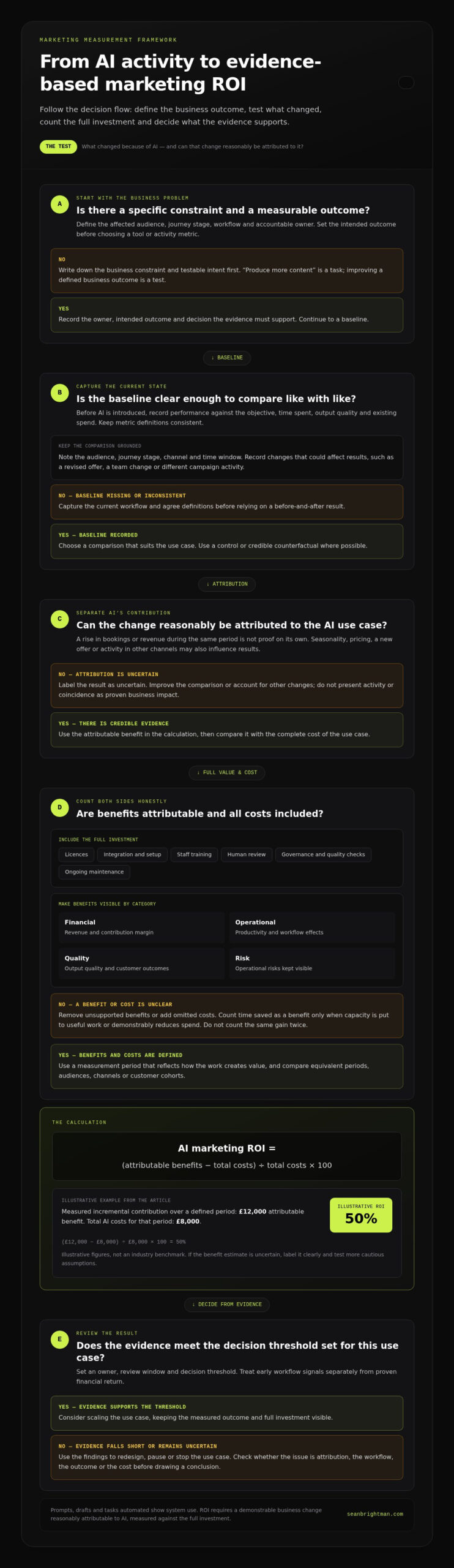
Once the use case has a defined objective, compare its value and investment on the same basis. Use this formula:
AI marketing ROI = (attributable benefits − total costs) ÷ total costs × 100
Use benefits you can reasonably connect to the AI use case, expressed in pounds where possible. Choose a measurement period that reflects how the work creates value, then compare like with like: equivalent periods, audiences, channels or customer cohorts. A short pilot may reveal workflow changes before any effect on revenue, so don’t treat an early operational signal as a proven financial return.
Build a baseline before switching on AI
Capture the current state of the specific workflow: performance against the chosen business objective, time spent, output quality and existing spend. Keep definitions consistent. If you’re tracking qualified enquiries, for example, agree what qualifies before the test and apply the same criteria afterwards.
Record the audience, journey stage, channel and time window as well. Note changes that could muddy the comparison, such as a revised offer, a team change or a shift in campaign activity. This context helps explain changes in the results and distinguish a genuine difference from a change in conditions.
Count costs and benefits without double-counting
Calculate the full investment, not just the software bill. Include costs involved in putting the use case into operation and keeping it useful:
- Licences, integration and setup
- Staff training and human review
- Governance, quality checks and ongoing maintenance
Count staff time saved as a benefit only if the capacity is redeployed to useful work or demonstrably reduces spend. Don’t claim the same gain twice. If faster production creates extra campaign output, for instance, don’t also count those same hours as a separate cash saving unless the benefits are distinct and evidenced. Keep revenue, contribution margin, productivity and risk benefits visible as separate categories.
Here’s a worked example using illustrative figures, not an industry benchmark. Suppose a team estimates £12,000 in attributable benefit over a defined period, based on measured incremental contribution, and records £8,000 in total AI costs for that period. The calculation is (£12,000 − £8,000) ÷ £8,000 × 100, giving an illustrative ROI of 50%. If the benefit estimate is uncertain, label it clearly and test how the result changes under more cautious assumptions.
Include full implementation and oversight costs in ROI. Ignoring the work required to create and maintain a return overstates its value. A clear AI consulting and scalable growth engine guide can help connect use-case choices to a broader marketing system. Strategic AI marketing guidance can also help clarify ownership, costs and the business decision behind the calculation.
How to compare AI marketing results and prove what changed
A result only means something when set against a credible comparison. To judge an AI use case, estimate what happened with it and what would likely have happened without it. That second view is the counterfactual. A control group can provide a strong comparison, but the best method depends on the workflow, available data and whether audiences can be separated fairly.
Use this guide to choose a method. Each provides evidence with limitations, not automatic proof.
| Method | Data needed | Main limitation |
|---|---|---|
| Controlled test | Comparable groups, consistent tracking and enough activity to assess the outcome | May be impractical if audiences are small or the workflow affects everyone |
| Matched cohorts | Groups similar in relevant traits, behaviour and exposure | Unmeasured differences can still influence the result |
| Before-and-after | Consistent measures from a period before and after implementation | Seasonality, campaign changes or wider market shifts can confound results |
| Modelling | Reliable historical data and clearly stated assumptions | Outputs depend on model quality and assumptions, not direct experimental proof |
Choose a measurement method that fits the use case
Use a controlled experiment when you can allocate comparable people or workflows to AI and non-AI groups without disrupting the customer experience. If random allocation isn’t practical, compare matched cohorts and document how they differ. Before-and-after analysis can identify a signal, but treat it as directional if seasonality, campaigns or team changes overlap. Modelling can help explore scenarios, but state its assumptions plainly.
An observed lift is not automatically an AI-caused lift. If several things changed together, attribution reports may show where outcomes were recorded, but they can’t isolate the cause on their own. Note the other changes, explain what the method can and can’t establish, and avoid presenting a platform’s own attribution output as independent proof.
Select metrics across the marketing funnel
Pair an early signal with an outcome further down the journey. For an AI-supported lead workflow, you might track response time and completed enquiries alongside sales-qualified pipeline or contribution. More clicks or faster replies can indicate progress, but they don’t confirm that leads are suitable or commercially valuable.
Customer acquisition cost and conversion quality are useful only when you apply consistent attribution rules before and during the comparison. Tools such as Google Analytics 4, HubSpot or Salesforce may help bring together relevant journey or customer data, depending on how your organisation records activity. Check that definitions, tracking and reporting windows align before comparing results.
In practice, measuring the roi of ai in marketing requires a clear line from the AI change to the business outcome, plus a comparison that makes alternative explanations visible. Record the method, metric definitions and caveats with the result. This gives decision-makers evidence they can assess, rather than a lift that looks convincing only in a dashboard.
A practical process for measuring AI marketing ROI over time
A useful pilot is designed to support a decision, not just generate a report. Before work begins, agree who owns the use case, what result you expect, how you’ll measure it and what evidence would change your course. This makes measuring the roi of ai in marketing an operating discipline rather than a one-off calculation.
Run a pilot with a decision attached
Choose one bounded use case with an owner and accessible baseline data. Write a short hypothesis, such as: “Using AI to support this workflow will reduce handling time without lowering output quality.” Add the business outcome it should influence, the measurement window and the threshold for scaling, refining or stopping. Keep the scope narrow enough to identify what changed.
Track the work behind the headline result. Log human review time, rework, errors and how consistently the team uses the process. A faster workflow can still create extra checking or quality problems that erase its value. Review the evidence at checkpoints agreed in advance. Extend the test only if a specific uncertainty remains, such as whether the result holds across another cohort or a longer customer journey.
Turn results into an operating decision
At each checkpoint, compare the evidence with the original hypothesis and decision threshold. Don’t move the goalposts because the results are inconvenient. Use a simple decision rule:
- Scale when gains appear repeatable, exceed full costs and don’t come with unacceptable quality or operational risks.
- Refine when results look promising but workflow friction, inconsistent adoption or weak data prevents a clear judgement.
- Stop or pause when evidence remains weak, costs outweigh value, risks are too high or the underlying business problem has changed.
Record the decision, evidence and unresolved caveats in one place. Assign an owner to each next action, whether that means expanding the test, fixing a process issue or retiring the use case. This creates accountability and makes future reviews more useful than a dashboard snapshot.
Results can also show that the issue goes beyond one tool. When several use cases compete for attention, a structured marketing roadmap can help sequence the work around business priorities, owners and evidence instead of adding disconnected experiments.
For senior guidance on setting up accountable AI use cases and reviewing evidence over time, discuss your AI marketing measurement approach.
When strategic guidance can make AI marketing ROI measurable
Measurement often breaks down between teams. Marketing may track engagement, finance may focus on contribution, and operations may see the extra review work. If data sits in separate systems or no one owns the full customer journey, connecting an AI use case to a business result is difficult. Competing priorities add to the problem: teams test tools without agreeing which business objective comes first.
Strategic guidance creates a shared framework for measuring the roi of ai in marketing. It connects each proposed use case to a growth priority, a customer need and the operational constraints involved. It doesn’t guarantee a return. It makes the investment testable, with clearer ownership and agreed criteria for deciding what happens next.
What strategic AI marketing support should clarify
Before committing further investment, bring marketing, finance and operational perspectives into the same evaluation. A roadmap can sequence use cases by business relevance and readiness, rather than treating every idea as equally urgent. For each priority, clarify:
- Business fit: Which growth priority or customer need does the use case address, and what workflow will it change?
- Accountability: Who owns implementation, the evidence and the decision to continue?
- Measurement: Which outcome, baseline and review points will show whether the use case is working?
- Constraints: What data gaps, quality checks or operational dependencies could affect the result?
These questions expose weak cases early. If the team can’t access the data needed to evaluate an idea, the roadmap can make resolving that gap a priority or sequence a more measurable use case first. If several teams contribute to the outcome, agree who supplies which evidence so responsibility doesn’t disappear between handovers.
Choose the next step based on your measurement gap
If priorities are scattered or teams lack evaluation criteria, a focused roadmap can set direction and sequence the next use cases. If leaders already have a plan but need regular review, an advisory retainer can provide ongoing direction and accountability. The marketing advisory retainer guide offers context for that continuing leadership role.
Strategic support should challenge assumptions, bring the right people around the evidence and adjust the plan as results emerge. It should not promise guaranteed returns. The aim is disciplined decision-making: invest where the business case is credible, improve what remains unclear and stop activity that no longer serves the objective.
If you’re ready to turn disconnected AI experiments into a measurable plan, build a clearer AI marketing measurement plan.
Make evidence part of your next marketing decision
Make measurement part of how you plan marketing, not a report assembled after the budget has been spent. Put AI use cases alongside other priorities and review them when making decisions about capacity, customer experience and growth. This keeps promising experiments connected to real work and gives underperforming ones a clear route to change or closure.
Measuring the roi of ai in marketing is more useful when it shapes what the team does next. Practical AI consulting can focus on applying AI to marketing efficiency and output, while a structured roadmap and ongoing advisory accountability help keep decisions aligned as priorities shift. The aim isn’t to justify every AI investment. It’s to make deliberate choices based on evidence and keep improving the system as you learn.
Ready to turn your measurement gap into a practical next step? Build a clearer AI marketing measurement plan and move forward with greater confidence.
Frequently Asked Questions
How do you calculate the ROI of AI in marketing?
Subtract the use case’s total costs from the benefits you can attribute to it, divide by those costs and multiply by 100. For example, if a defined workflow shows £9,000 in attributable benefit against £6,000 in costs, the illustrative ROI is 50%. Measuring the roi of ai in marketing also means explaining how you estimated the benefit and what other factors could have contributed.
What costs should be included when measuring AI marketing ROI?
Include the costs required to put the use case into operation and keep it working: licences, integration, staff training, human review, governance and maintenance. Account for internal time where it creates a real cost or uses capacity that could otherwise support valuable work. If one tool serves several teams, allocate its shared costs consistently rather than charging the entire amount to whichever use case is easiest to measure.
Can AI marketing ROI be measured without a control group?
Yes. A control group can strengthen the comparison, but it isn’t the only option. You might compare similar customer cohorts, examine a consistent period before and after implementation, or model likely outcomes using historical data. State the limits: a before-and-after comparison may be affected by a changed offer or seasonal demand, while matched groups may differ in ways your data doesn’t capture.
Which metrics show whether AI is helping marketing?
Choose metrics that match the job AI is doing, then connect process signals to customer or commercial outcomes. For lead qualification, monitor how many leads meet agreed criteria and progress to sales conversations, not just how quickly they’re processed. For customer communications, examine response and conversion quality alongside engagement. Add checks for errors, rework and customer feedback so a faster process doesn’t conceal a weaker experience.
How long does it take to see a return from AI in marketing?
There’s no single reliable timeframe. A workflow change may appear before a sales or retention effect, particularly if customers take time to make a decision. Set the review window around the use case and the length of the customer journey. Check early indicators as signals, then allow enough time for the outcome that matters to become visible before making a firm investment decision.
What if AI saves time but does not increase revenue?
Treat time saved as an operational benefit, not automatically as financial return. Work out what happens to the freed capacity: can the team use it for higher-value work, improve service or avoid additional spending? If the hours simply disappear from the workflow without changing output, cost or capacity, record the efficiency gain but don’t claim a cash saving. The use case may still be worthwhile if that benefit supports a clear business priority.
Should businesses measure AI marketing ROI for every tool?
Measure use cases in proportion to their cost, reach and business importance, rather than building a heavyweight analysis for every small feature. Prioritise tools that influence customer decisions, consume meaningful staff time or introduce quality and operational risks. For low-impact features, a light review of usage, cost and workflow effect may be enough. Also check whether overlapping tools duplicate capabilities or create costs that no single team sees.
Leave a Reply