
Tag: scalable growth

  • AI Marketing Strategy for Startups UK: Building a Scalable Growth Engine in 2026

    AI Marketing Strategy for Startups UK: Building a Scalable Growth Engine in 2026

    Your AI subscription list is a graveyard of wasted capital. It’s not a growth engine; it’s an expensive distraction. You’re likely part of the 62% of UK marketers who purchased tools before they had a documented plan. You feel the pressure to scale but lack the senior leadership to make it happen. To win, you must stop chasing shiny objects and implement a strategic ai marketing strategy for startups uk that treats technology as a mechanical component of growth.

    We’ll show you how to move beyond tool fatigue and build a high-impact engine designed for a scalable exit in 2026. This isn’t about “bolt-on” software. It’s about building a system that delivers growth through tactical precision and operational accountability. We’ll examine how to integrate agentic AI into your core workflows and establish the organisational clarity required to outpace the competition without blowing your budget.

    Key Takeaways

    • Stop chasing tool subscriptions; start building a system. Strategy must lead technology to avoid the common trap of tool fatigue.
    • Discover how a robust ai marketing strategy for startups uk relies on data architecture and brand positioning rather than just software.
    • Learn why a Fractional CMO provides the senior leadership needed to focus on growth outcomes instead of vanity agency activity.
    • Follow a 90-day framework to audit operations and install a scalable system that functions without constant founder intervention.
    • Build a documented, exit-ready marketing engine that increases your startup’s valuation and appeals to sophisticated buyers.

    Beyond the Hype: Why UK Startups Fail at AI Marketing

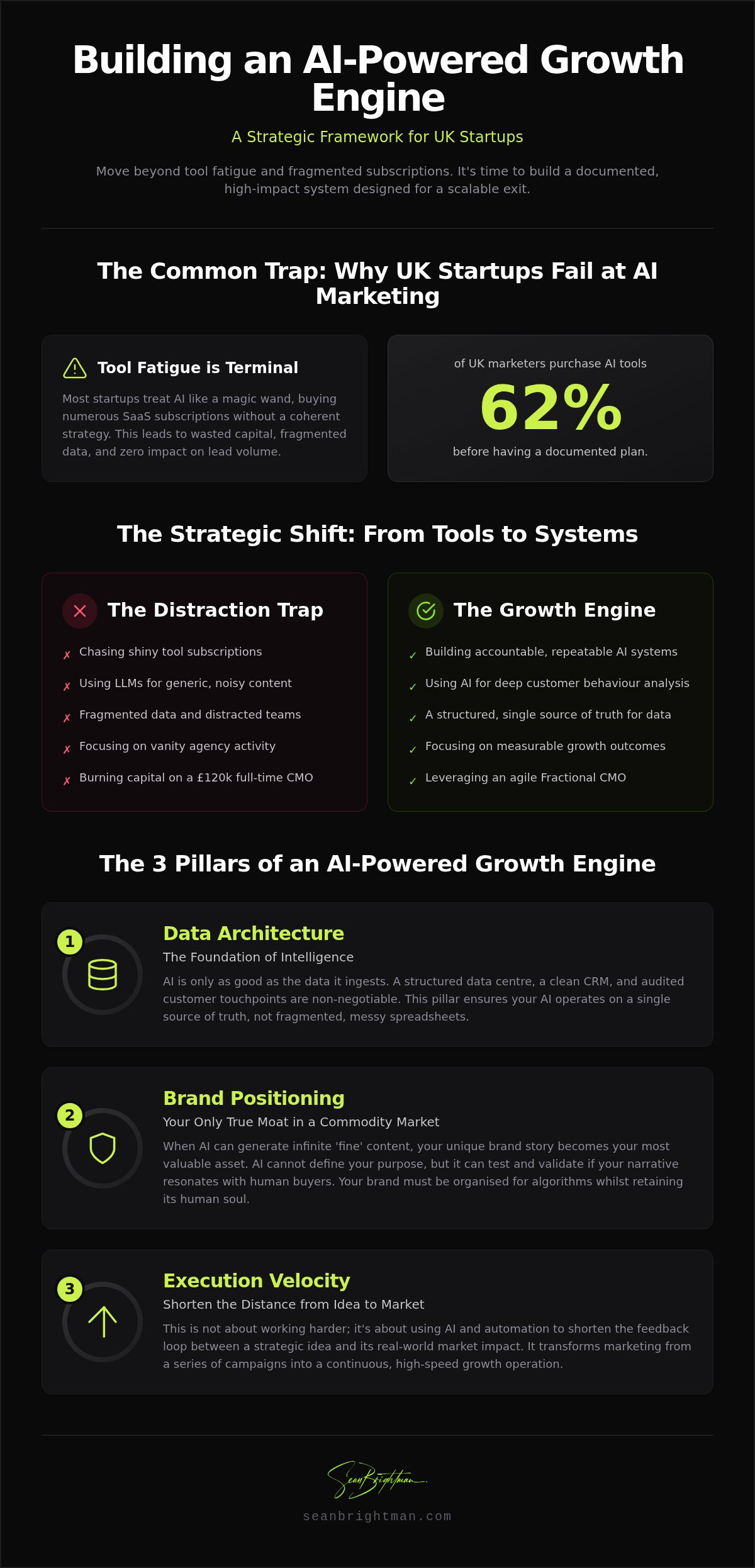
    Most UK startups treat AI like a magic wand. They buy ten different SaaS subscriptions and wonder why their lead volume hasn’t budged. This is the “Tool Fatigue” trap. A real ai marketing strategy for startups uk isn’t a collection of shiny subscriptions; it’s the systematic integration of intelligence into your growth operations. If you’re just using LLMs to churn out generic blog posts, you’re failing. You’re simply adding noise to a market that’s already deafened by it.

    Understanding what is AI marketing requires looking past the chat interface. Tactical AI is low-level. Anyone can prompt a bot to write a tweet. Strategic AI is high-level. It involves predictive modelling, deep customer behaviour analysis, and automated budget allocation. UK startups specifically struggle with the “messy middle” of scaling. This is the point where founder-led sales lose steam, but the internal marketing team lacks the technical roadmap to build a self-sustaining engine.

    The “This, Not That” of AI Strategy

    Strategy is the engine; AI is the fuel. Fuel is useless if the pistons aren’t firing. You should stop looking for “AI tools” and start building “AI systems”. Systems provide accountability and repeatable results. Tools provide distractions and fragmented data. The cost of inaction in 2026 is terminal. If you aren’t using an ai marketing strategy for startups uk to automate your market insights, you’re handing your market share to competitors who are already doing it.

    The High-Impact Alternative to Full-Time Hires

    Hiring a full-time CMO in 2026 is a £120k mistake for most early-stage ventures. You’re burning your seed round on executive overhead before you’ve even built a functional growth engine. It’s a legacy move in a machine-age market. Don’t waste capital on a permanent hire who might not understand the mechanical integration of modern tech. You need a builder, not a bureaucrat.

    A Fractional CMO is the catalyst you actually need. They offer senior-level authority and a “get-your-hands-dirty” attitude without the long-term liability. They build the roadmap, organise the data, and ensure your AI integrations actually drive revenue. You get the strategic expertise to scale toward an exit, whilst maintaining the agility of a lean operation. It’s about outcomes, not headcount.

    The Three Pillars of an AI-Powered Growth Engine

    Infrastructure beats intuition. Every time. To build a scalable ai marketing strategy for startups uk, you must stop viewing technology as a series of isolated tools. Instead, treat it as a mechanical system supported by three rigid pillars: Data Architecture, Brand Positioning, and Execution Velocity. As the state of AI in the UK continues to evolve, the distinction between market leaders and also-rans comes down to how these components are integrated, not just how many subscriptions you have.

    Clean Data: The Foundation of Intelligence

    AI is only as good as the information it ingests. If your data is trapped in messy spreadsheets or fragmented across five different platforms, your “intelligence” will be flawed. You need a structured data centre that acts as a single source of truth. This involves auditing every customer touchpoint and ensuring your CRM is actually ready for machine learning. This is where a marketing operations consultant becomes essential. They don’t just fix tools; they build the pipes that allow data to flow into your growth engine without clogging the system with garbage. If you’re unsure where your data stands, an AI roadmapping session can identify the gaps before they become liabilities.

    Brand Strategy in the Age of Algorithms

    Content is now a commodity. AI can generate ten thousand words of “fine” copy in seconds, which means “fine” no longer has any market value. Your brand positioning is your only true moat. AI cannot tell you who you are or why you matter to a human buyer. It can, however, help you test that resonance. Use AI to analyse customer behaviour and sentiment to see if your brand narrative actually lands. You must organise your brand story to be “AI-friendly” so that answer engines and discovery tools can easily categorise your value proposition whilst maintaining your unique human “soul”.

    The final pillar is Execution Velocity. This isn’t about working harder; it’s about using AI to shorten the distance between a strategic idea and market reality. When these three pillars are aligned, you aren’t just running campaigns. You are building a documented, high-impact asset. These systems are exactly what sophisticated buyers look for in a marketing strategy for business exit. A growth engine that functions independently of its founder is a growth engine that commands a premium valuation.

    Fractional CMO vs. AI Agency: Choosing Your Strategic Partner

    Agencies sell activity. Fractional CMOs sell outcomes. For a UK startup, the difference is the survival of your seed round. An agency will give you a list of deliverables: ten posts, three ads, one report. They focus on the “what”. A Fractional CMO focuses on the “why” and the “how” of your ai marketing strategy for startups uk. They don’t just hand you a report; they build the machinery that produces it. You need senior leadership that gets their hands dirty, not a distant account manager who delegates your brand to a junior intern. This shift is why savvy founders are deciding to stop hiring full-time CMOs in favour of agile, fractional expertise.

    Agencies are external vendors. Fractional CMOs are internal partners. One wants to keep you on a retainer for as long as possible by making the process opaque. The other wants to build a system so robust it eventually runs without them. If you want to scale, you need the latter. You need a partner who integrates AI into your core operations, not someone who treats it as a bolt-on service for content generation.

    The Accountability Gap in Modern Marketing

    Agencies shouldn’t hold the keys to your growth engine. When the contract ends, the knowledge leaves with them. That is a strategic failure. A Fractional CMO is a plug-and-play leader who builds internal capability. They ensure your team owns the process. A marketing advisory retainer provides the strategic velocity you need without the bloated salary of a permanent hire. It’s about having a battle-hardened expert on your side of the table, making sure your ai marketing strategy for startups uk actually delivers on its promise. You gain accountability, not just activity.

    Cost vs. Impact: A Brutal Analysis

    Let’s talk numbers. A traditional AI agency might charge £3,000 to £7,000 a month for “execution”. Often, this work is handled by junior staff using basic prompts. You’re paying senior prices for amateur output. A fractional consulting retainer offers a different value proposition. You pay for strategic oversight. It is the cheapest insurance policy your marketing budget can buy. It prevents you from wasting £50,000 on the wrong tech stack or £100,000 on a failed launch. In the startup world, impact is the only metric that matters. Activity is just noise. High-impact strategy isn’t an expense; it’s a capital investment in your company’s future valuation.
    AI Marketing Strategy for Startups UK: Building a Scalable Growth Engine in 2026

    Executing Your AI Marketing Roadmap: A 90-Day Framework

    Stop planning for next year. Start planning for the next quarter. In a machine-speed market, 12-month strategies are obsolete before the ink dries. You need an ai marketing strategy for startups uk that operates in high-velocity, 90-day sprints. This isn’t a suggestion; it’s a requirement for survival. We break the execution into three distinct phases designed to move you from tool fatigue to operational mastery.

    The 30-Day Diagnostic

    Days 1 to 30 are about radical honesty. You cannot build a scalable engine on a cracked foundation. We begin by identifying the specific bottlenecks in your current marketing machinery. Are you losing leads at the top of the funnel, or is your conversion logic broken? We map customer behaviour to specific AI-driven touchpoints to see exactly where your capital is being wasted. This is the strategic brand roadmapping process in action. We set “North Star” metrics that focus on bottom-line revenue, not vanity clicks. If it doesn’t move the needle on your valuation, it doesn’t make the roadmap.

    Integrating the AI Growth Engine

    Days 31 to 60 involve building the pipes. You don’t need fifty subscriptions; you need a concentrated stack that actually communicates. Less is more in 2026. We move from traditional AI consulting in 2026 models that fixate on tools to those that focus on scalable growth engines. We automate the mundane tasks like lead scoring, data entry, and basic content distribution. This frees your human talent to focus on high-level creativity and strategic pivot points. By the end of this phase, your marketing operations should feel like a coordinated machine rather than a collection of random tasks.

    Days 61 to 90 are about velocity scaling and performance accountability. This is where we turn up the pressure. We apply rigorous accountability to every automated workflow. If a system isn’t delivering the 22% higher ROI seen in high-performing AI campaigns, we refine the logic or scrap the component. We move your business from founder-led chaos to a system-led growth engine. By day 90, you aren’t just “doing marketing”; you are managing a high-impact asset that is ready for scale or exit.

    Ready to build your engine? Book your AI roadmapping session today to start your 90-day transformation.

    Strategic Advisory: Building an Exit-Ready Growth Engine

    Buyers covet predictability. If your growth relies on founder-led sales or a handful of unmanaged AI tools, your valuation will suffer. You need a system-led growth engine. A documented ai marketing strategy for startups uk is not just a plan; it is a proprietary asset. It proves that your marketing can scale without your constant intervention. When a buyer looks under the bonnet, they want to see a machine that produces revenue regardless of who is at the helm. Moving from manual chaos to automated precision is the single most effective way to increase your exit multiple.

    An Advisory Retainer ensures this engine doesn’t stall. It provides the senior oversight required to keep your team focused on high-impact outcomes whilst the AI handles the heavy lifting. Strategy is never a “set and forget” task. It requires constant adjustment to maintain velocity. You need a pilot who understands the machinery and isn’t afraid to make blunt corrections when the data points to a failure. AI is the machinery, but you still need a pilot to navigate the strategic pivot points.

    Preparing for Series A and Beyond

    Investors in 2026 are no longer impressed by high burn rates. They want to see operational efficiency. Presenting a clear ai marketing strategy for startups uk demonstrates that you can scale your reach without a linear increase in headcount. You show them automated insights that predict customer behaviour and marketing systems that optimise themselves in real-time. During due diligence, a Fractional CMO provides the strategic narrative that justifies your marketing spend. They bridge the gap between technical execution and board-level reporting, proving that your growth is both sustainable and defensible.

    Next Steps: From Chaos to Clarity

    The transition starts with a Roadmapping session. You need an external, blunt perspective to strip away the fluff and identify exactly where your marketing department is failing. We don’t do corporate politeness. We do results. We look at your data, your brand, and your team; then we build the engine that takes you to Series A and beyond. Stop guessing and start building a documented system that buyers will actually want to own.

    Ready to build an exit-ready growth engine? Book your strategic consultation now and let’s get to work on your roadmap.

    Stop Tinkering and Start Scaling

    AI is the machinery of the modern growth engine, but machinery without a pilot is just expensive scrap metal. You’ve seen why tool fatigue kills momentum and why data architecture is your only real foundation. Building a high-impact ai marketing strategy for startups uk isn’t about collecting subscriptions; it’s about engineering a system that buyers actually want to acquire. You’re building a proprietary asset, not just running a series of disjointed ads.

    You don’t need more junior staff or generic templates. You need the senior leadership of a Fractional CMO who has written the book on strategy and built these engines for high-growth scale-ups. It’s time to move from founder-led chaos to operational clarity. The 90-day framework is your path to a scalable, exit-ready business that functions with mechanical precision and tactical certainty. Stop chasing the hype and start focusing on the outcomes that define your valuation.

    Take the first step toward a high-valuation exit. Book an AI Marketing Roadmapping Session with Sean Brightman today. Let’s build the growth engine your business deserves.

    Frequently Asked Questions

    What is an AI marketing strategy for startups exactly?

    It is a comprehensive blueprint that integrates artificial intelligence into every facet of your growth operations. Rather than just using a few chatbots, a proper ai marketing strategy for startups uk focuses on data architecture, predictive analytics, and automated workflows. It moves your business from manual execution to a system-led engine. This ensures that every marketing pound spent is tracked, organised, and scaled with mechanical precision.

    How much does a Fractional CMO cost for a UK startup in 2026?

    Costs vary based on the scope of your engagement and the seniority of the expert. However, a Fractional CMO is a high-impact alternative to a full-time hire. You avoid the £120k+ salary, national insurance, and executive overhead of a permanent CMO. Instead, you pay for a concentrated burst of strategic expertise. This model allows you to invest your capital into growth activity rather than bloated management salaries.

    Can AI replace my entire marketing department?

    No. AI replaces tasks, not strategic leadership. Whilst it can automate content distribution, data analysis, and lead scoring, it cannot define your brand’s soul or your “why”. You still need human oversight to manage the mechanical integration and ensure the outputs align with your market positioning. Think of AI as a force multiplier for a lean team, allowing a small group to achieve the output of a traditional, large-scale department.

    How do I know if my startup is ready for AI consulting?

    You are ready when your current marketing efforts feel chaotic and unscalable. If you are suffering from tool fatigue or relying on founder-led sales to survive, you need an external perspective. Readiness is defined by having enough data to analyse and a clear desire to build a growth engine for an eventual exit. If you have reached the “messy middle” of scaling, consulting provides the clarity needed to install professional systems.

    What is the difference between an AI agency and a Fractional CMO?

    An AI agency is an external vendor focused on specific deliverables like ad creative or automated emails. They sell activity. A Fractional CMO is an internal strategic partner who owns your growth outcomes. They build the ai marketing strategy for startups uk and ensure your team has the internal capability to run it. One is a service provider; the other is a senior leader who provides accountability and long-term roadmap direction.

    How long does it take to see results from an AI marketing roadmap?

    Initial operational efficiencies often appear within the first 30 days of an audit and roadmapping session. However, building a fully integrated growth engine typically follows a 90-day framework. By the end of this period, you should see measurable improvements in lead quality and acquisition costs. The goal is to move from manual chaos to a system that delivers predictable, scalable results that increase your company’s overall valuation.

    Is AI marketing strategy different for B2B vs B2C startups?

    The core pillars of data and brand positioning remain identical, but the execution velocity differs. B2B startups often use AI for lead scoring and account-based intelligence to shorten long sales cycles. B2C startups focus more on real-time personalisation and high-volume content automation to drive immediate conversions. Both require a documented strategy to ensure the technology serves the specific behaviour of their target audience rather than just creating noise.

    What are the best AI tools for UK startups right now?

    The best tool is the one that fits into your existing system architecture. In 2026, the trend has shifted toward agentic AI that can handle multi-step workflows. Look for platforms that integrate with your CRM and offer predictive insights rather than just generative text. Avoid the trap of buying ten different subscriptions. Focus on a concentrated stack that automates your specific bottlenecks and provides a single source of truth for your growth data.

  • Marketing Operations Consultant: Building a Scalable Growth Engine for 2026

    Marketing Operations Consultant: Building a Scalable Growth Engine for 2026

    Why is your marketing team working harder than ever whilst your growth remains stagnant? It is a blunt question, but the answer usually isn’t a lack of effort; it is a systems failure. You’re likely paying a “Manual Tax” every day through disconnected tools, messy data, and expensive guesswork. Bringing in a marketing operations consultant isn’t about adding more software. It’s about fixing the broken machinery that is currently eating your budget. Most businesses treat marketing like an art project when they should be treating it like a precision engine.

    You probably feel the friction every time you try to pull a report or justify a budget increase. You have a mar-tech stack that nobody uses and your decision-making relies on gut feeling rather than hard numbers. This article will show you how to stop the guessing and start scaling. We’ll explore how to build a repeatable system, get clear on AI implementation, and secure senior leadership without the £150,000 full-time salary. We’re going to strip away the fluff and build a growth engine that actually works for the 2026 market.

    Key Takeaways

    • Identify the “Chaos Gap” where increased marketing activity fails to drive revenue because your underlying machinery is broken.
    • Learn how a marketing operations consultant strips back your bloated mar-tech stack to build a lean, data-driven system that actually scales.
    • Calculate the ROI of the fractional model to avoid the £120,000 mistake of hiring a full-time leader before your systems are ready.
    • Future-proof your strategy by integrating AI as an operational co-pilot rather than just a tool for generating generic content.
    • Follow a 90-day blueprint to move from an efficiency audit to a fully optimised, high-impact marketing architecture.

    Beyond the Buzzwords: Why Your Marketing Engine is Stalling

    Marketing isn’t a creative brainstorm. It’s a logistical challenge. Most leaders think they have a “brand” problem or a “creative” problem. They don’t. They have a machinery problem. Think of a marketing operations consultant as the architect of your growth factory. If the factory floor is a mess, it doesn’t matter how good the product design is. Nothing gets shipped. Strategy without operations is just a hallucination. You need the pipes to work before you turn on the tap.

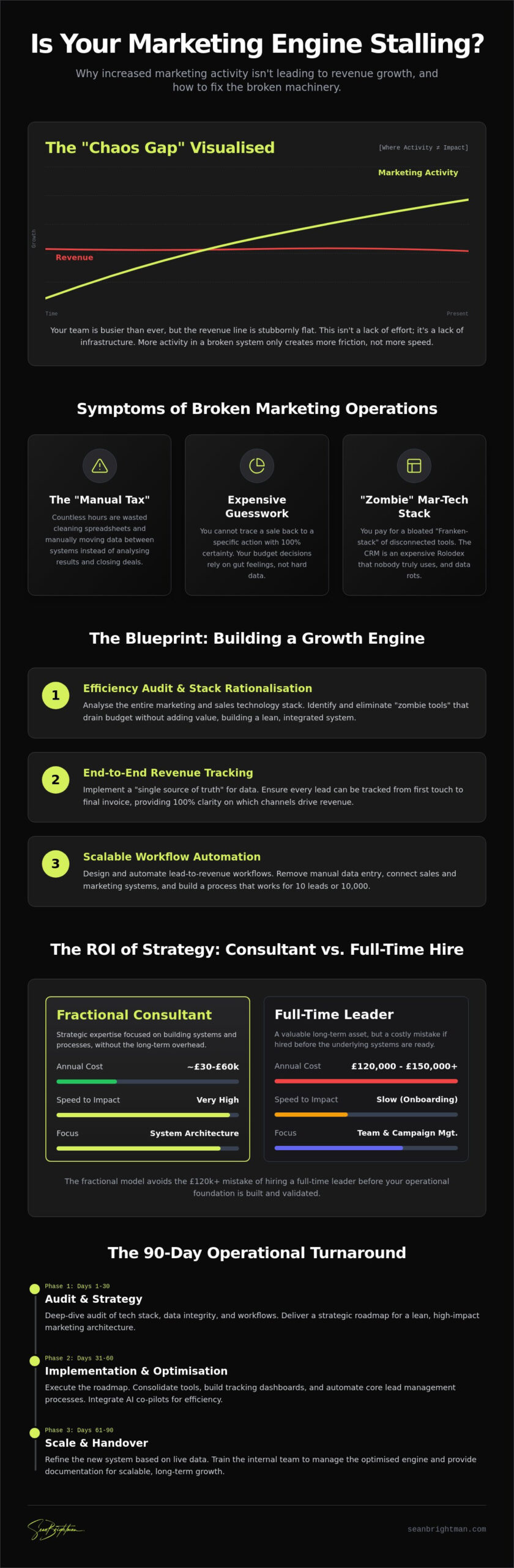
    We see it constantly: the “Chaos Gap.” This is the point where your team is busier than ever. Activity is up; impact is down. They’re posting more. They’re sending more emails. They’re spending more on ads. Yet, the revenue line remains stubbornly flat. This isn’t a lack of effort. It’s a lack of infrastructure. You’re trying to drive a Ferrari with a lawnmower engine. More activity in a broken system only creates more friction, not more speed.

    Stop asking for “more leads.” It’s the ultimate marketing myth. More leads are often just a distraction from a fundamental conversion failure. If your tracking is broken and your lead-to-revenue funnel is a sieve, more leads just means more wasted budget. You don’t need more fuel; you need to fix the holes in the tank. A solid operational foundation ensures that every pound spent is a pound tracked and every lead generated is a lead nurtured.

    The Symptoms of Broken Marketing Operations

    You can’t see which pound is actually working. If you can’t trace a sale back to a specific action with 100% certainty, you’re just gambling with the company’s future. Then there’s the tool fatigue. You’re likely paying for a CRM that your sales team treats like an expensive, digital Rolodex. It sits there, gathering dust, whilst your data rots. Finally, there’s the accountability vacuum. Everyone owns the “creative vision,” but nobody owns the actual growth numbers. This lack of ownership leads to the “Manual Tax”-wasted hours spent cleaning spreadsheets instead of closing deals.

    The Difference Between Strategy and Execution

    Strategy is the map. Operations is the engine. You can have the most beautiful map in the world, but you aren’t going anywhere if the engine is seized. This is where Marketing management often falls apart in mid-sized UK firms. They hire an agency to “do the marketing,” but they have no internal operational lead to manage the flow of data and leads.

    Agencies are great at specific tasks. They are terrible at owning your internal systems. Without a marketing operations consultant to bridge that gap, you’re just paying for activity, not outcomes. In the competitive 2026 market, “winging it” is an expensive hobby. You need a system that works whilst you sleep, turning strategy into a repeatable, mechanical process that delivers predictable revenue. It is about building a system that survives the departure of any single team member.

    The Blueprint: What a Marketing Operations Consultant Actually Fixes

    A marketing operations consultant is a plumber for your revenue. They don’t care about the colour of your logo. They care about the integrity of your data. The first step is always the audit. Most UK businesses are paying for a “Franken-stack” of tools that don’t talk to each other. We identify the tools that actually drive value and kill the “zombie tools” that just drain the budget. It is about building a lean, lethal machine, not a bloated collection of subscriptions.

    You need to know which channel is delivering. Not just “clicks” or “engagement”, but actual closed-won revenue. We implement tracking that follows a lead from the first touch to the final invoice. This is how you stop guessing and start scaling. It removes the friction between marketing activity and sales results. Lead-to-revenue workflows are the tracks your business runs on. If the tracks are crooked, the train crashes. We design these workflows to be scalable, ensuring they work just as well for ten leads as they do for ten thousand.

    Marketing Systems Architecture

    Your CRM, automation, and analytics must function as a single unit. It’s about building a single source of truth. Manual data entry is a failure of the system. We ensure that AI Liberates Marketing Operations by automating the data-heavy grunt work that usually slows teams down. If your sales and marketing data doesn’t flow automatically, your system is broken. We connect the pipes so you can focus on the strategy. If your current setup feels like a house of cards, it’s time to look at a proper operational roadmap to rebuild the foundation.

    Process Optimisation and Efficiency

    Speed is a competitive advantage. We standardise how campaigns are launched so quality never slips. A true growth engine functions independently of individual staff members. It’s a machine, not a personality-driven project. This removes the “accountability vacuum” and ensures that when a number drops, we know exactly which part of the machinery needs oiling. Organising the team for maximum output is not about adding more meetings; it is about removing them. Operational efficiency in marketing is the art of maximising revenue impact whilst minimising the manual labour required to achieve it.

    The ROI of Strategy: Consultant vs Agency vs Full-Time Hire

    Hiring a full-time CMO in 2026 is often a £120,000 mistake. Most UK scale-ups pull the trigger on a senior hire far too early. They hire a manager to oversee a department that doesn’t actually exist yet. You end up paying a six-figure salary for someone to sit in meetings and look at broken spreadsheets. It is a waste of capital and a waste of talent. You don’t need a full-time executive to manage the chaos; you need a marketing operations consultant to eliminate it.

    There is a fundamental difference between an agency and a consultant. One owns the tasks; the other owns the machinery. Agencies are built to execute. They want to run your ads, write your copy, and design your graphics. They are external forces. A consultant is an internal architect. We don’t just “do marketing”; we build the system that makes marketing possible. It is the difference between buying a car and building a factory that produces cars.

    The fractional model is the only logical choice for businesses in the growth phase. You get 100% of the senior expertise for roughly 25% of the cost of a full-time hire. This isn’t about saving pennies; it is about capital efficiency. You can redirect that saved £90,000 into your ad spend or product development whilst still having a battle-hardened expert at the helm. An advisory retainer provides the ongoing accountability that one-off projects lack. It ensures the machine stays oiled and the strategy stays on track.

    Why Agencies Aren’t the Answer to Operations

    Agencies are incentivised to spend your money, not necessarily to save it. Their business model relies on high activity and high billables. They rarely care if your CRM is a bin fire or if your sales team is ignoring leads. They are focused on their specific silo, not your internal operational health. Without a strategic buffer to manage them, agencies often end up marking their own homework. You need someone on the inside who understands the plumbing, not just the paintwork.

    The Fractional CMO Advantage

    A Fractional CMO is a plug-and-play leader. They bring an immediate impact because they’ve seen your specific mess a dozen times before. They don’t need three months of “onboarding” to understand your business. Their focus is singular: building the machine. Whilst a full-time hire might get bogged down in internal politics and “busy work,” a fractional consultant is there to deliver results. It is high-impact leadership without the long-term baggage of a heavy executive salary. You aren’t just running ads; you are building a predictable revenue engine. Before you can scale that engine effectively, however, you must ensure your marketing team structure for scale-ups UK is designed for strategic velocity rather than bloated headcount.

    Marketing Operations Consultant: Building a Scalable Growth Engine for 2026

    AI-Powered Operations: Future-Proofing Your Marketing Stack

    AI in 2026 is not a writing tool. It is an operational layer. If your team is still using ChatGPT just to churn out generic blog posts, you are missing the revolution. A marketing operations consultant integrates AI into the structural layer of your business to eliminate the “Manual Tax” we discussed earlier. This is about building a system that thinks, predicts, and optimises without human intervention. We are moving from reactive marketing to proactive, automated growth engines.

    The real value lies in predictive analytics. Instead of looking at last month’s failed campaign, AI allows us to forecast growth with surgical accuracy. By analysing funnel velocity and historical data, we can predict where your revenue will be in six months. It removes the finger-in-the-wind guesswork that plagues most UK boardrooms. Research shows that AI-driven campaigns can deliver a 22% higher ROI and 29% lower acquisition costs. These aren’t just numbers; they are the result of a machine that learns from every interaction.

    Implementing AI Growth Engines

    Scaling personalisation usually requires scaling headcount. AI changes that. We implement systems that handle lead scoring and hyper-personalisation at a scale that was previously impossible. This reduces operational costs by automating repetitive marketing tasks that usually drain your team’s energy. However, we avoid “AI for AI’s sake.” Every tool in your stack must have a clear path to profit. If it doesn’t improve the bottom line or save significant time, it is just expensive novelty.

    Data Integrity in the Age of AI

    AI is a mirror. If your CRM is a bin fire, your AI will simply produce faster, more efficient mistakes. Data integrity is the prerequisite for automation. We spend the first part of any 90-day plan cleaning your systems and ensuring your data flows are airtight. You cannot automate decision-making if the underlying data is a mess. An AI Roadmap is the strategic blueprint that converts technological potential into measurable commercial profit by 2026. Without this roadmap, you are just buying more “zombie tools” that will eventually fail.

    Stop playing with prompts and start building a real engine. If you want to see how this works in practice, book an AI consulting and roadmapping session to audit your current stack.

    Fractional Leadership: The 90-Day Operational Turnaround

    Fixing a broken department isn’t a weekend project. It is a systematic reconstruction. Most businesses fail because they try to solve every problem at once, resulting in zero progress. A marketing operations consultant brings a phased approach that turns chaos into a predictable growth engine. We don’t guess; we execute a 90-day turnaround designed to stop the bleeding and start the scaling. This is about building long-term stability, not chasing short-term hacks.

    • Month 1: The Efficiency Audit. We find the hidden profit leaks. We look at your lead-to-revenue data and identify exactly where your budget is being set on fire. It is a clinical assessment of what stays and what goes. Running a thorough marketing efficiency audit at this stage is the fastest way to expose the hidden rot in your department before committing to a rebuild.
    • Month 2: Systems Architecture. We rebuild the tech stack for scale. This is where we connect the pipes and ensure your data flows without manual friction. We remove the “Manual Tax” and replace it with automated precision.
    • Month 3: Execution and Accountability. We set the rhythm for growth. This is about establishing KPIs that actually matter and ensuring the team knows how to hit them. We move from rebuilding to running the machine.

    Sean Brightman’s advisory model is built for the long haul. It isn’t about delivering a report and walking away. It is about providing the senior-level guidance required to ensure the machine keeps running. You get the “battle-hardened expert” in your corner without the overhead of a full-time executive. It is high-impact, low-friction leadership that focuses on the bottom line.

    The Advisory Retainer: Direction and Accountability

    Strategy is useless without accountability. Our advisory retainers provide monthly sessions to keep your growth engine on track. I act as a blunt sounding board for the CEO, helping you avoid expensive mistakes before they happen. It’s about ensuring your marketing team remains focused on the right numbers, not just vanity metrics. We provide the external pressure needed to maintain internal order. This is strategic oversight, not just tactical advice.

    Getting Started: The Strategy Roadmap

    Don’t spend another penny on advertising until you have a map. A one-off roadmap session is the most efficient entry point for any business. We define your goals, audit your current mess, and draw a clear line to revenue. It is the quickest way to get clarity on your AI implementation and your operational future. Stop guessing and start building a system that actually delivers. If you are ready to fix the machinery, book a strategy roadmap session with Sean Brightman today. It is time to turn your marketing from a cost centre into a growth engine.

    Stop Patching Leaks and Start Building the Engine

    The choice for 2026 is binary. You can continue paying the “Manual Tax” on a broken system, or you can rebuild your department into a precision engine. We have established that activity without architecture is just expensive noise. By leveraging a marketing operations consultant, you move beyond tactical busywork and into a model where data integrity and AI-driven automation dictate your growth. Strategy is the map; operations is the fuel. Without both, you are stationary.

    As the author of “The Book” on marketing strategy and a specialist in AI roadmapping, I have helped high-growth UK businesses replace chaos with accountability. You don’t need a bloated full-time salary to get senior-level results. You need a battle-hardened expert who can plug in, fix the machinery, and set a rhythm for repeatable success. The transition from a cost centre to a growth engine starts with a single decision to stop winging it.

    Build your scalable growth engine-Book a call with Sean Brightman

    Your future revenue is waiting for a better system. It is time to build it.

    Frequently Asked Questions

    What does a marketing operations consultant actually do daily?

    A marketing operations consultant acts as the architect of your growth engine. They spend their time auditing systems, cleaning data, and automating workflows to remove the “Manual Tax” from your department. Their goal is to ensure your strategy isn’t held back by broken pipes. They bridge the gap between high-level board goals and the tactical reality of your marketing technology stack.

    How is a marketing consultant different from a marketing agency?

    One builds the engine; the other provides the fuel. A consultant focuses on your internal systems, strategy, and operational efficiency. An agency is typically an external force hired to execute specific tasks like running ads or creating content. You hire a consultant to ensure your internal machinery is ready to handle the leads an agency generates without wasting budget.

    When is the right time for a UK scale-up to hire a Fractional CMO?

    Hire a fractional leader when your marketing activity is high but your revenue remains flat. If you are spending significant budget on ads but cannot track the ROI with 100% certainty, you have a systems failure. A Fractional CMO provides the senior leadership needed to fix these issues without the £150,000 plus full-time salary and heavy PAYE commitment.

    Can a marketing operations consultant help with AI implementation?

    Yes, by treating AI as a structural necessity rather than a novelty tool. A marketing operations consultant builds a roadmap to integrate AI into your data processing, lead scoring, and predictive analytics. This moves your team away from manual grunt work and towards high-level strategy. It is about using AI to drive measurable profit, not just generating generic content.

    What is the typical ROI of hiring a marketing operations specialist?

    The ROI is found in increased efficiency and reduced waste. Research indicates that AI-driven operations can deliver a 22% higher ROI and 29% lower acquisition costs by optimising funnel velocity. You also save the significant cost of a “bad hire” by building a repeatable system that functions independently of any single team member’s personal workflow.

    Do I need to fire my current marketing team to bring in a consultant?

    No. A consultant exists to make your current team more lethal. We remove the repetitive, manual tasks that drain their energy and prevent them from doing their best work. By standardising processes and organising the team for maximum output, we free up your creative talent to focus on strategy. It is about better orchestration, not replacement.

    How much does a marketing advisory retainer cost in the UK?

    The investment for an advisory retainer is tailored to the complexity of your systems and the speed of the required turnaround. It is designed to be a high-impact, lower-cost alternative to a full-time executive hire. You get senior expertise and ongoing accountability without the long-term baggage of a heavy salary or the recruitment fees of a traditional hire.

    What is the first step in a marketing operational turnaround?

    The first step is always the Efficiency Audit. We must find the hidden profit leaks and identify which “zombie tools” are draining your budget before we can rebuild. You cannot optimise a system if you don’t know where the friction is occurring. This audit provides the clinical data needed to design a scalable marketing team structure for UK scale-ups that actually works.