Tag: scale-up growth

  • Professional Marketing Advisory: Senior Strategic Velocity for UK Scale-ups

    Professional Marketing Advisory: Senior Strategic Velocity for UK Scale-ups

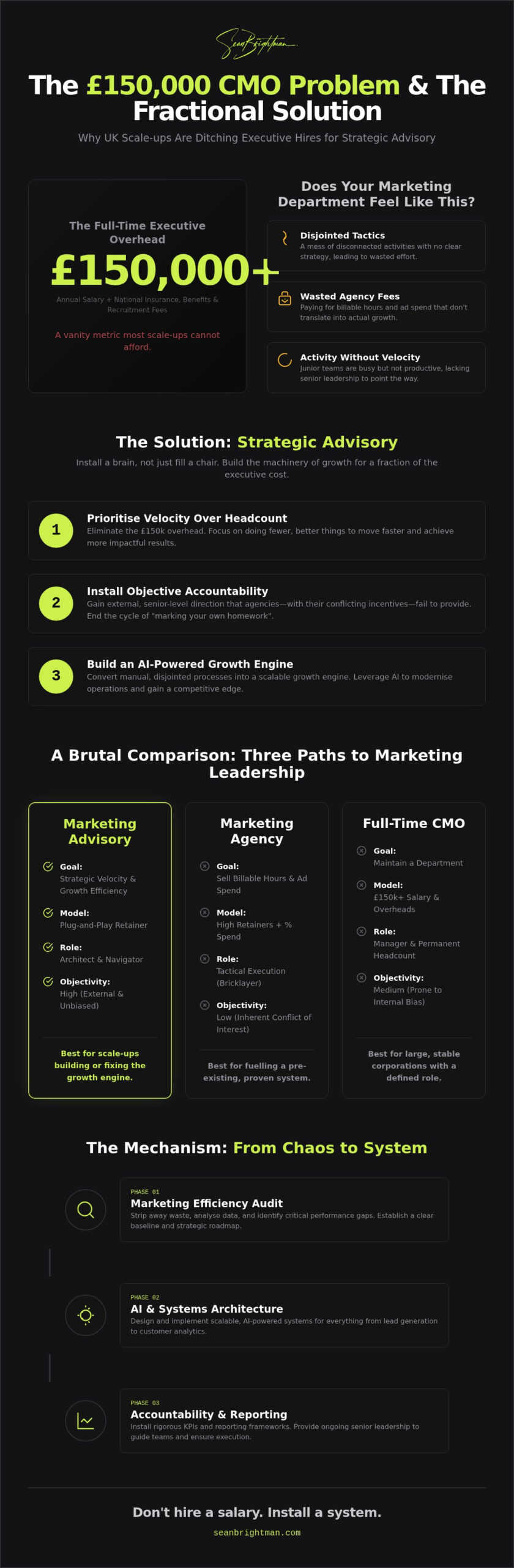
    Hiring a full-time CMO for £150,000 is often a vanity metric that UK scale-ups simply cannot afford. You don’t need a massive salary on the payroll. You need a professional marketing advisory that builds systems instead of just filling seats. Right now, your marketing department is likely a mess of disjointed tactics and agency fees that don’t translate to actual growth. It’s activity without velocity. It’s motion without progress.

    We know the frustration of watching junior teams spin their wheels because there’s no senior leadership to point the way. You’re likely uncertain about how to integrate AI, tired of babysitting agencies, and desperate for a roadmap that actually leads to a profitable exit. This guide reveals how to secure senior-level direction and AI-powered systems for a fraction of the cost of a traditional executive hire.

    We’ll explore how to transform your chaotic marketing into a high-output engine. You’ll learn how to implement strategic accountability and modernise your operations to ensure every pound spent drives you closer to your scaling goals. We’re stripping away the fluff to focus on the machinery of growth.

    Key Takeaways

    • Eliminate the £150k overhead of a full-time hire by prioritising strategic velocity over permanent headcount.
    • Understand how a professional marketing advisory provides the objective direction and accountability that agencies often fail to deliver.
    • Convert manual, disjointed processes into a scalable, AI-powered growth engine through structured systems architecture.
    • Implement a Marketing Efficiency Audit to strip away waste and hold your internal teams to a higher standard of performance.
    • Leverage a plug-and-play retainer model to inject senior-level leadership into your business exactly when and where it’s needed.

    What is Professional Marketing Advisory in 2026?

    Most CEOs think they need a new hire. They’re usually wrong. They need a system. A professional marketing advisory is the surgical alternative to a bloated executive payroll. It isn’t about filling a chair; it’s about installing a brain. In 2026, this role has moved beyond the passive “board advisor” stereotype. It is now a high-impact, functional component of the business machinery that prioritises results over presence.

    There is a sharp distinction between advisory and consultancy. Consultants deliver a slide deck and an invoice; they provide one-off projects that often gather dust. Advisors provide direction and, more importantly, accountability. They stay in the trenches to ensure the strategy is actually executed. It’s the difference between buying a map and hiring a navigator who won’t let you drive off a cliff.

    This model thrives on Strategic Velocity. This isn’t about doing more work. It’s about doing fewer, better things to move faster. You achieve velocity by stripping away the tactical noise and returning to marketing strategy fundamentals that build long-term value. You stop chasing every shiny new platform and start perfecting the systems that convert. You don’t need more activity. You need more impact.

    The trigger points for seeking an advisor are usually painful and obvious. You’re scaling toward an exit but your marketing data is a mess. Your junior team is working hard but achieving nothing. Or, perhaps most common in 2026, you’ve hit AI tool fatigue. You have the software, but you have no idea how to turn those tools into a scalable growth engine.

    The Core Difference: Advisory vs. Execution

    Advisors build the engine. Agencies and junior teams fuel it. If you’re asking your digital agency for your overall business strategy, you’ve already lost. Their goal is to sell you more billable hours or higher ad spend. An advisor’s goal is efficiency. They focus on systems architecture and positioning, acting as an objective external force. They challenge internal assumptions that have become “truth” simply because nobody has dared to question them for three years.

    Why UK Scale-ups Are Moving to Fractional Leadership

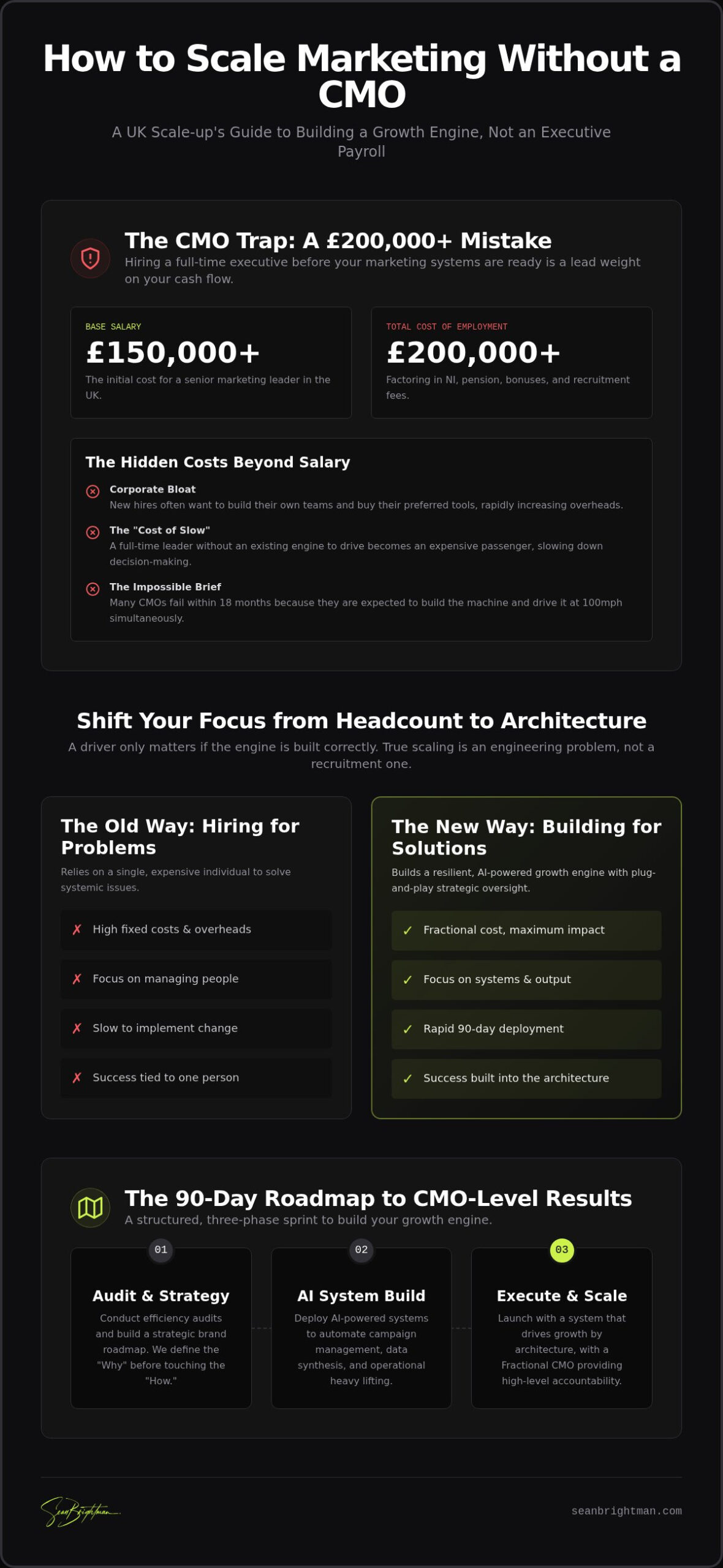
    The £120,000 salary trap is real. Once you add National Insurance, benefits, and recruitment fees, a full-time CMO becomes a massive financial liability for a growing firm. UK scale-ups are ditching the overhead in favour of on-demand expertise. You get the “battle-hardened” strategist who has seen your specific problems ten times before. You pay for the solution, not the person’s pension. It’s senior leadership without the ego or the permanent desk space.

    Advisory vs. Agency vs. Full-time CMO: A Brutal Comparison

    Scaling a business between £2m and £20m turnover requires surgical precision. Most founders default to hiring an agency or a full-time executive. Both are often expensive mistakes. You need senior leadership, not just tactical execution. A professional marketing advisory acts as the architect. Agencies and junior staff are the bricklayers. If you don’t have a blueprint, you’re just paying people to move bricks around in the dark.

    The “Agency Trap” is a primary cause of stagnant growth. Agencies are built to sell services, not to grow your business. They’re incentivised to increase your ad spend or billable hours. They cannot provide objective strategy because their revenue depends on the tactics they recommend. This creates a massive conflict of interest. An advisor has no skin in the tactical game. Their only metric is your growth.

    Internal marketing departments often suffer from a lack of direction. Junior teams mark their own homework. Without a senior partner to hold them accountable, activity replaces results. A professional marketing advisory closes this gap by installing rigorous reporting and clear KPIs that align with your business objectives.

    When to Hire an Advisor Instead of an Agency

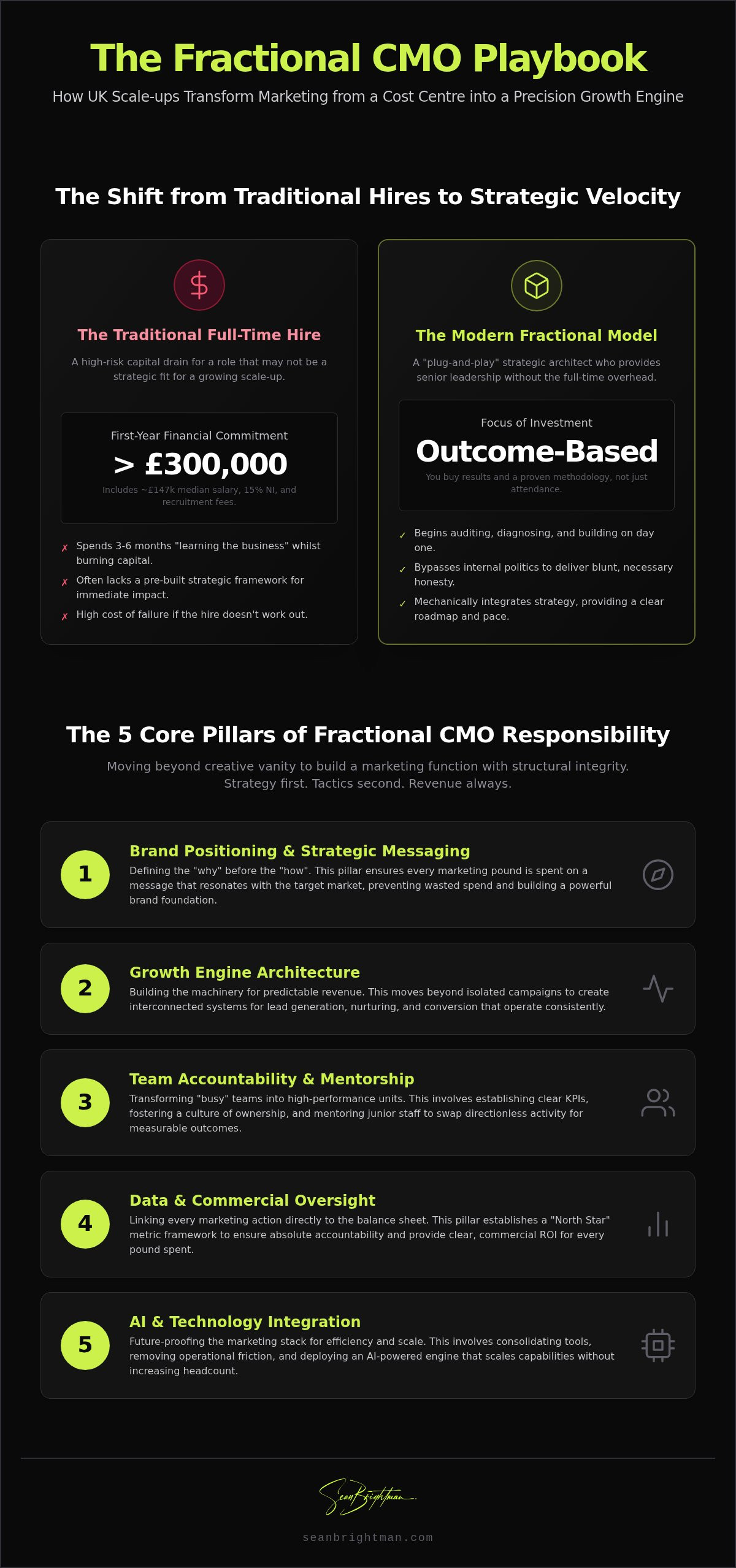
    Hire an agency when you have a proven system that needs more fuel. Hire an advisor when the system is broken or non-existent. Advisors specialise in the role of fractional CMOs, providing the agility to pivot without the friction of long-term agency contracts. They vet your external partners to ensure you’re getting value for every pound spent. If your current setup feels like a black hole for cash, it’s time to examine the fractional CMO model more closely.

    The Full-time CMO Myth

    The median salary for a UK CMO is £147,000. For a scale-up, that’s a massive overhead that kills cash flow. Worse, “CMO churn” is rampant. Senior leaders often fail in messy environments because they’re used to large budgets and established teams. They aren’t built for the “get-your-hands-dirty” reality of a scale-up. Advisory serves as a bridge. It stabilises the department and builds the systems first. This ensures that when you finally do hire a permanent director, they’re stepping into a well-oiled machine rather than a burning building. You can book a strategy call to see if your current structure is actually fit for purpose.

    The Mechanism: AI Roadmapping and Systems Architecture

    Strategy without a mechanism is just a wish list. A professional marketing advisory doesn’t just hand you a document; it installs an AI-Powered Growth Engine. This is the structural difference between a business that reacts to the market and one that dictates it. We move beyond the “tool fatigue” that plagues most UK scale-ups. You don’t need more software subscriptions. You need a unified system that converts data into predictable revenue.

    Most businesses treat AI as a shortcut for content creation. This is a tactical error. Effective AI consulting focuses on scalable output and operational efficiency. It’s about automating the mundane to liberate your team for high-level creative problem-solving. Research into AI in marketing strategy confirms that the real value lies in strategic implementation, not just prompt engineering. If your AI isn’t directly connected to your lead flow, it’s just a toy.

    However, technology is secondary to brand positioning. Systems can amplify a message, but they cannot fix a weak one. We start by sharpening your core value proposition. Once the positioning is bulletproof, we build the technical architecture to deliver it at scale. This ensures your growth is built on granite, not sand.

    Building Your Marketing Systems Architecture

    Tools are the plumbing; strategy is the water. A professional marketing advisory designs a bespoke Marketing Systems Architecture that ensures data transparency across your entire funnel. We strip away redundant platforms that drain your budget. We replace them with a lean, integrated stack designed for strategic velocity. You gain a dashboard that actually tells the truth about your acquisition costs and customer lifetime value. No more guessing. Just clinical, data-driven decisions.

    Strategic Brand Roadmapping for 2026

    Reactive marketing is the enemy of the scale-up. You cannot build a £50m business by deciding what to do on Monday morning. Strategic roadmapping defines your next 12 months in a single, concentrated blueprint. This proactive roadmap aligns your team, your agencies, and your budget toward a singular objective. Whether you are aiming for a series B round or a final exit, the roadmap provides the proof of scalability that investors demand. It converts your marketing from a cost centre into a measurable business asset.

    Professional Marketing Advisory: Senior Strategic Velocity for UK Scale-ups

    Measuring Success: Accountability and the Efficiency Audit

    Activity is not achievement. In a high-stakes scale-up, busy teams often mask stagnant growth with colourful charts and irrelevant data points. You need a professional marketing advisory to strip away the vanity metrics and focus on the cold, hard numbers that drive your valuation. Accountability isn’t a quarterly meeting. It’s a constant, clinical pressure applied to every campaign, channel, and hire. We measure success by net output, not hours logged or emails sent.

    The first step in this process is the Marketing Efficiency Audit. Most businesses are wasting at least 20 per cent of their budget on legacy tactics that no longer deliver. This audit identifies those hidden profit leaks. It cuts the fluff by ruthlessly removing any activity that doesn’t align with your strategic roadmap. The audit serves as a clinical 90-day diagnostic designed specifically for high-growth scale-ups to reset their operational baseline and reclaim wasted capital.

    Once the waste is removed, we address the structural flaws in your department. A professional marketing advisory provides the senior oversight necessary to fix a broken marketing team structure. We often find that departments are top-heavy with administrators but light on strategists. We restructure the hierarchy to prioritise strategic velocity. This moves your junior staff from being simple order-takers to becoming high-value strategic contributors who understand the “why” behind the “what”.

    The advisor acts as your External CMO, providing a level of accountability that internal hires often avoid. They set KPIs that actually matter to the CEO and the Board, such as customer acquisition cost (CAC) efficiency and lifetime value (LTV) growth. They mentor your high-potential staff to increase their strategic value whilst identifying the underperformers who are slowing the engine down. This oversight ensures your marketing remains a lean, high-performing asset rather than a growing liability. You can request a marketing efficiency audit to find the hidden growth in your current spend.

    Implementation: The Marketing Advisory Retainer Model

    A strategy that sits in a drawer is a waste of capital. Most consultancies leave you with a thick slide deck and no way to execute it. A professional marketing advisory works differently. We use a retainer model because growth is a continuous process, not a one-off event. It provides the ongoing direction your team needs to stay on track. You aren’t buying a document. You’re buying a result.

    The Marketing Advisory Retainer offers senior leadership on a plug-and-play basis. You get the expertise of a battle-hardened strategist without the friction of a 12-month contract or a six-month notice period. This model ensures the strategy is actually implemented. It provides a partner who has seen your specific bottlenecks before and knows exactly which lever to pull to fix them. It’s about maintaining momentum whilst your competitors are still stuck in committee meetings.

    This isn’t a passive relationship. It’s a high-impact partnership designed to keep your internal teams and external agencies honest. When an agency tells you they need more budget, your advisor is there to vet the claim. When your junior team hits a technical wall with AI integration, your advisor provides the solution. We focus on the machinery of growth so you can focus on leading the business.

    Getting Unstuck in 90 Days

    The first 90 days of an advisory engagement are transformative. We move your department from reactive chaos to a structured, scalable growth engine. Month one focuses on the diagnostic audit and immediate waste reduction. Month two is about building the systems architecture and AI-powered workflows. By month three, your business is operating with strategic velocity. This structured approach is vital if you’re preparing for a sale or seeking investment. Investors don’t just buy revenue; they buy predictable systems. We ensure your marketing department is a primary asset during due diligence rather than a red flag.

    Next Steps for CEOs

    You need to decide if you want a permanent overhead or an on-demand expert. If your marketing is currently a “black box” that you don’t fully understand, a full-time hire will likely fail. You need to fix the system before you fill the seat. The initial roadmapping session is the most effective, low-risk entry point. It defines your path for the next 12 months and gives you a clear view of your growth potential. It’s time to stop guessing and start building with precision. You can book a diagnostic call today to assess your current strategic velocity and identify the fastest route to scale.

    Stop Hiring for Presence; Start Building for Velocity

    Your business doesn’t need another expensive executive sitting in a chair. It needs a professional marketing advisory that converts chaotic activity into a clinical, AI-powered growth engine. We’ve established that the £150,000 full-time salary is often a liability for scale-ups. You can achieve higher strategic velocity by stripping away tactical waste and installing systems that actually scale. Efficiency isn’t an accident. It’s the result of rigorous accountability and a battle-hardened roadmap.

    As a published author on marketing strategy and a specialist in AI-powered growth engines, I provide the senior leadership your team lacks. We don’t just talk about strategy; we engineer it. This is about building a predictable asset that increases your business valuation. We move from reactive fire-fighting to proactive scaling by focusing on net output rather than vanity metrics.

    It’s time to stop the guesswork and start building for your exit. You can book your Strategic Roadmap session with Sean Brightman to begin the transition from a messy marketing department to a high-output engine. Let’s get to work and build the machinery your business deserves.

    Frequently Asked Questions

    What exactly does a professional marketing advisor do?

    An advisor installs the strategic engine of your business. They don’t just manage ads; they design the systems that make those ads work. A professional marketing advisory focuses on systems architecture, brand positioning, and team accountability. They act as an objective partner who challenges internal assumptions. They ensure your marketing spend aligns with your exit goals. It’s about senior direction without the permanent executive overhead.

    How much does a marketing advisory retainer cost in the UK?

    UK retainers vary based on the scale of the business and the depth of involvement. Industry data suggests fractional CMO retainers typically range from £3,000 to £20,000 per month. This is significantly more efficient than a full-time hire costing £150,000 plus benefits. You pay for the impact and the senior leadership, not the desk space. It’s a scalable investment that adjusts to your growth phase.

    What is the difference between a marketing consultant and an advisor?

    Consultants deliver a project; advisors deliver a result. A consultant might give you a slide deck or a one-off audit. An advisor stays in the trenches to ensure the strategy is executed. They provide ongoing direction and hold your team accountable for the KPIs. It’s the difference between a one-time mechanic and a full-time navigator. Advisors focus on long-term velocity, not just short-term fixes.

    Can an advisor help with AI implementation in my marketing team?

    Yes, modern advisory is built on AI systems architecture. An advisor moves your team from tool fatigue to a scalable growth engine. They identify where AI can automate mundane tasks to liberate your creative staff. This isn’t about using chatbots for social posts. It’s about integrating AI into your lead flow and data analysis. It creates a leaner, faster, and more predictable marketing operation.

    How long does it take to see results from a marketing advisory engagement?

    You should see structural clarity within the first 30 days. Most advisory engagements follow a 90-day diagnostic trajectory. Month one identifies waste. Month two builds the systems. By month three, the engine is running with strategic velocity. Financial ROI follows the systemisation. If you’re looking for an overnight miracle, you’re looking for a lottery ticket, not a strategy. Real growth requires a solid foundation.

    Do I still need a marketing agency if I hire an advisor?

    Yes, but the relationship changes. The advisor is the architect; the agency is the bricklayer. You still need people to execute the tactics, but the advisor ensures they are doing the right things. They vet your agencies and cut the fluff from their reports. They hold external partners to the same high standards as your internal team. It stops the agency from marking its own homework.

    Is a professional marketing advisor suitable for B2B scale-ups?

    B2B scale-ups are the primary beneficiaries of this model. Complex sales cycles and high-value contracts require precise positioning and robust lead-nurturing systems. A professional marketing advisory ensures your messaging resonates with senior decision-makers. It builds the data transparency needed to track long-term ROI. In B2B, the cost of a wrong strategic turn is massive. An advisor provides the expertise to avoid those traps.

    What happens during a strategic roadmapping session?

    This is a concentrated diagnostic session that defines your next 12 months. We strip away the tactical noise to focus on your core growth levers. You leave with a clear, actionable blueprint for scale. It identifies your positioning gaps and technical bottlenecks. It isn’t a brainstorming session; it’s a systems design workshop. It provides the clarity needed to move from reactive chaos to proactive growth.

  • Marketing Team Structure for Scale-ups UK: Designing for Strategic Velocity

    Marketing Team Structure for Scale-ups UK: Designing for Strategic Velocity

    You don’t have a hiring problem. You have a structural architecture problem. Most founders think adding three more juniors will fix their lead flow, but it usually just makes the chaos more expensive. If you are still the one signing off on every LinkedIn post, your current marketing team structure for scale-ups uk is failing you. You’re paying for a bloated headcount with a low ROI whilst your own time is being drained by strategic tasks you should have delegated months ago.

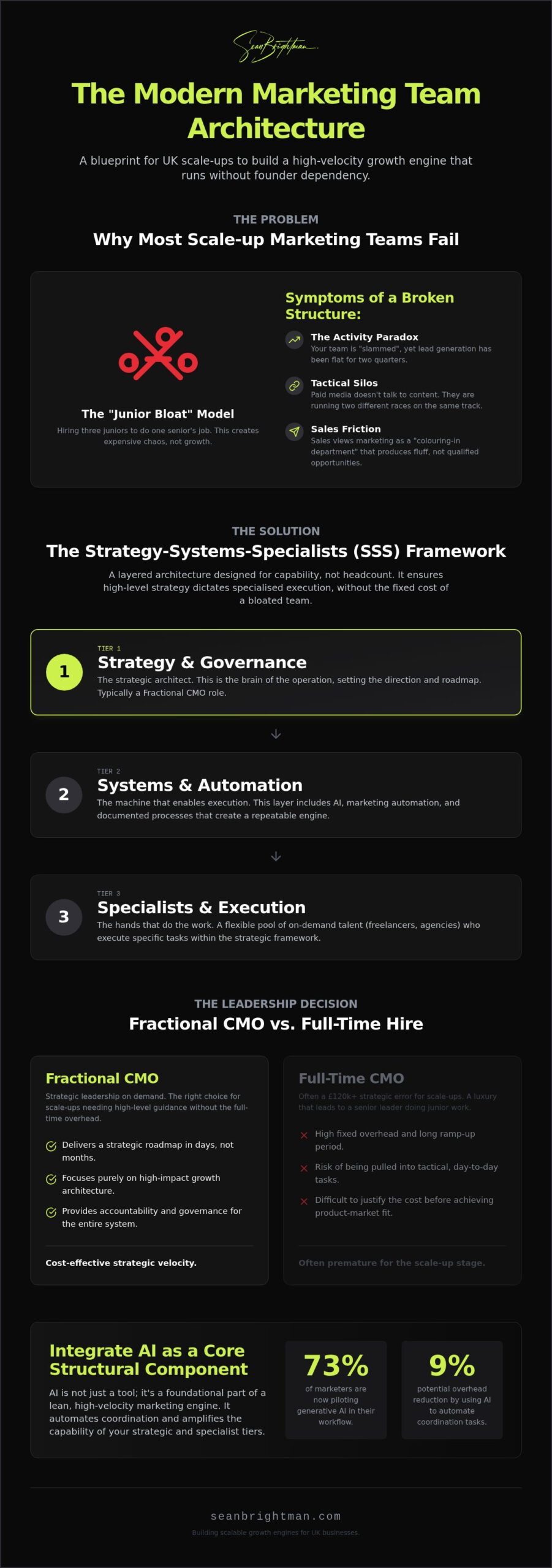
    Scaling requires a decisive shift from activity to impact. It’s about building a lean, AI-integrated engine that prioritises accountability over sheer volume. With 73% of marketers now piloting generative AI, the goal isn’t just to do more; it’s to do better with less. You need a functional machine, not a collection of individuals waiting for instructions. We agree that the “hire and hope” cycle is broken. It’s time to build a system that delivers strategic velocity instead of just more noise.

    This article provides a clear roadmap to build a marketing department that runs without founder intervention. You’ll learn how to design an org chart that actually works, leverage AI to reduce overhead by nearly 9%, and transition to a professionalised growth unit. We are stripping away the corporate fluff to focus on the specific architecture that moves the needle for UK scale-ups.

    Key Takeaways

    • Stop the “junior bloat” trap by designing a growth architecture that prioritises senior-level strategy over expensive, low-impact headcounts.
    • Master the Strategy-Systems-Specialists (SSS) framework to build an optimised marketing team structure for scale-ups uk that scales capability without adding noise.
    • Discover why a full-time CMO hire is often a £120k+ strategic error and how a Fractional leader delivers results in days rather than months.
    • Integrate AI as a core structural component to automate coordination tasks and build a lean, high-velocity marketing engine for 2026.
    • Follow a 90-day roadmap to audit existing chaos and activate a plug-and-play system through professional strategic roadmapping.

    The Scale-up Trap: Why Traditional Marketing Team Structures Fail

    Marketing organisational design is not a pretty chart with boxes and names. It is the architecture of your growth. Most UK scale-ups treat recruitment like a game of Tetris, trying to fill gaps with whatever talent is available. This is a mistake. You are building a machine, not a social club. If the blueprint is flawed, the machine will eventually seize up, regardless of how many people you throw at it.

    The most common error is “junior bloat”. Founders often hire three juniors to do a senior strategist’s job. It looks cheaper on the balance sheet. In reality, it is a disaster. You end up with three people asking you what to do every morning. You haven’t bought growth; you’ve bought a management headache. Applying classic Marketing management principles requires a focus on strategy and control. Three entry-level coordinators cannot provide that level of oversight. They execute tasks whilst you are left to provide the brainpower.

    The result of a poor marketing team structure for scale-ups uk is “random acts of marketing”. You see high activity levels but zero accountability. Posts go up. Emails go out. Ad spend disappears. Yet, the lead needle remains stagnant. By 2026, the market is too crowded for this scattergun approach. Success requires a strategy-first design that remains lean by prioritising capability over headcount.

    The Symptoms of a Broken Structure

    How do you know if your structure is failing? Look at where the decisions are made. If you are still the de facto CMO, your structure is broken. You are the bottleneck. Other symptoms include:

    • The Activity Paradox: Your team is “slammed” and working late, yet lead generation has been flat for two quarters.
    • Tactical Silos: Your paid media specialist doesn’t talk to your content writer. They are running two different races on the same track.
    • Sales Friction: The sales team views marketing as a “colouring-in department” that produces fluff rather than qualified opportunities.

    Capability vs. Headcount: The Critical Distinction

    Scaling activity is a vanity metric for internal teams. Sending ten emails instead of five doesn’t matter if the underlying strategy is flawed. You don’t need more hands; you need better systems. In a high-velocity scale-up, you must hire for the capability to solve problems, not the capacity to perform tasks. You are building growth engines that function as a cohesive system rather than a collection of individual contributors.

    A scalable marketing engine is a high-performance system that converts strategic intent into repeatable revenue without requiring constant founder oversight.

    When you focus on headcount, you add complexity and cost. When you focus on capability, you add speed and precision. The goal for 2026 is a lean architecture where every role has a clear, data-backed reason for existing.

    The 3-Tier Architecture for UK Marketing Teams

    Forget the generic advice telling you to hire eight distinct specialists immediately. Most scale-ups don’t have the budget or the lead volume to justify a massive internal payroll. Instead, you need a Strategy-Systems-Specialists (SSS) framework. This is a layered approach to building your marketing team structure for scale-ups uk. It ensures you have the brainpower to lead, the machinery to execute, and the flexibility to scale without the fixed cost of a bloated headcount.

    This architecture stops you from making the “all-rounder” mistake. You don’t need one person who is average at everything. You need a system where high-level strategy dictates the work of specialised execution. By separating these layers, you maintain strategic velocity whilst keeping your burn rate under control.

    Tier 1: Strategic Leadership and Governance

    The top tier is your “Strategic Architect”. For most businesses at this stage, a full-time CMO is an expensive luxury that often results in a senior leader doing junior-level work. You need the roadmap, not the 40-hour-a-week presence. A Fractional CMO provides this leadership, setting the direction and ensuring every pound spent aligns with your commercial goals. They provide the governance layer that keeps the rest of the team accountable.

    Governance is about more than just checking boxes. It is about maintaining a rigorous focus on ROI. Many founders find that The Marketing Advisory Retainer: A CEO’s Guide to Strategic Velocity is the most efficient way to secure this senior oversight without the overhead of a permanent executive hire. This tier ensures that the “Why” and “How” are settled before you ever worry about the “Who”.

    Tier 2: Marketing Operations and AI Systems

    Tier 2 is the “Machine”. This is where you build the plumbing before you worry about the decorating. In 2026, this tier is heavily augmented by AI. You need a marketing team structure for scale-ups uk that prioritises systems over manual coordination. This layer handles lead routing, data attribution, and campaign automation. It ensures that when a lead comes in, the system knows exactly where it goes and how it’s measured.

    Without this layer, your specialists are just guessing. Working with a Marketing Operations Consultant: Building a Scalable Growth Engine for 2026 allows you to install these data-driven feedback loops early. It transforms marketing from a creative cost centre into a predictable revenue engine. Once the machine is built, you can plug in specialists to fuel it.

    Tier 3 is the “Specialist Execution”. These are the hands. Use agencies or freelancers for specific tasks like paid search, technical SEO, or high-end design. They are the tactical fuel for your Tier 2 engine. This approach prevents expensive hiring mistakes because you only bring expertise in-house once the demand is proven and the system is ready to support them. If you want to see how this architecture fits your specific business, a Strategic Roadmapping session can define the blueprint before you sign your next employment contract.

    Fractional CMO vs. Full-Time Hire: A Structural Comparison

    Hiring a full-time CMO is often the most expensive mistake a UK founder can make. In 2026, the average CMO salary in the UK sits at £187,500. When you factor in National Insurance at 13.8%, pension contributions, private healthcare, and equity, you are looking at a quarter-million-pound commitment before they have even opened their laptop. This is a massive weight to add to a marketing team structure for scale-ups uk that needs to stay agile and lean. You’re paying for a permanent desk when you actually need a strategic architect.

    The difference in speed to impact is staggering. A Fractional CMO is a plug-and-play component. They arrive with a proven playbook and start auditing your systems on day one. Conversely, a full-time hire involves a three-month recruitment cycle, a three-month notice period, and a further three months to “settle in”. Scale-ups don’t have nine months to wait for a strategy. You need results in days, not quarters. Advisory models favour results because their tenure depends on them. Full-time roles, unfortunately, often favour job security and the slow creep of corporate bureaucracy.

    The Economics of Senior Leadership

    The total cost of ownership for a senior executive in London or the wider UK is often hidden. Beyond the base salary, the “drag” of a full-time hire includes recruitment fees (typically 20-30% of salary) and the long-term friction of redundancy if the pivot doesn’t work. Contrast this with the advisory model. You get the same level of senior expertise without the terminal liability. It is a tactical exchange of high-level brainpower for specific, measurable outcomes. If you are still on the fence, read why you should Stop Hiring Full-Time CMOs: The Fractional Revolution in 2026.

    Flexibility for Fast-Growth Phases

    Scale-ups require “surge” leadership. You need a heavy lift to build the 3-tier architecture mentioned previously, but you might not need that same level of intensity once the machine is running. A Fractional leader builds the engine and then steps back into a governance role. This prevents the “Seniority Gap” common in mid-market UK firms, where companies have plenty of doers but nobody holding the map. You gain the ability to pivot your strategy instantly without the legal and emotional friction of restructuring a permanent executive team. Transition to a full-time hire only when your growth has stabilised and you need a caretaker for a mature system, not a builder for a new one.

    Marketing Team Structure for Scale-ups UK: Designing for Strategic Velocity

    Integrating AI into Your Marketing Organisational Design

    AI is not a fancy plugin for your browser. It is a structural component of the 2026 marketing team. If you are treating it as a tool for your juniors to write better emails, you are missing the point entirely. AI-powered systems are currently delivering an 8.9% reduction in marketing overhead whilst improving sales productivity. This is not about efficiency; it is about redesigning the marketing team structure for scale-ups uk to remove the need for manual coordination.

    The “junior coordinator” role is dead. Traditionally, scale-ups hired entry-level staff to move data between spreadsheets, schedule social posts, and chase approvals. AI handles these tasks with 100% accuracy and zero salary. This shift allows you to move away from hiring for volume. You don’t need a larger team. You need a more capable one. Moving from experimental tool-use to an integrated growth engine requires a clear AI roadmap. You are shifting from “doing” to “architecting.” Building a coherent marketing systems architecture is what separates businesses with a fragmented tech stack from those running a centralised, high-performance growth engine.

    Upskilling your existing team is more cost-effective than hiring “AI Specialists” who lack your industry context. 84% of UK marketers already use AI tools every day. Your job is to provide the structure that turns that individual usage into a collective system. It is about building a machine where AI handles the logistics and humans handle the strategic nuance.

    The AI-Augmented Workflow

    The role of a Content Marketer has fundamentally changed. They are no longer writers; they are editors, strategists, and system managers. They manage the output of AI agents rather than grinding out blog posts manually. Similarly, reporting and analytics are now automated. Your team should spend zero time building dashboards and 100% of their time interpreting data and making strategic pivots. This frees up the strategic time that founders usually end up filling themselves.

    Strategic AI Consulting

    Before you restructure, you need an AI roadmap session. You cannot design a modern team using a 2019 blueprint. A Fractional CMO acts as the lead architect here, identifying where AI can replace headcount and where it can amplify existing talent. The key metric is no longer just “cost per lead”; it is “output per head.” If your team size stays the same but your output triples, you have won. Focus on building systems that scale capability, not activity.

    Don’t guess your way through this transition. If you want to build a team that leverages 2026 technology to outpace your competition, book an AI Consulting session to design your growth engine properly.

    Building Your Roadmap: From Chaos to Scalable Engine

    You don’t need a static org chart. You need a 90-day transformation plan. Static diagrams are for HR departments; dynamic roadmaps are for growth. Transitioning your marketing team structure for scale-ups uk from a source of frustration to a scalable engine happens in three distinct phases: Audit, Architect, and Activate. This isn’t a slow-burn corporate realignment. It is a rapid-fire correction designed to stop the bleeding and start the building. We are moving from a collection of individuals to a high-performance system.

    Most founders wait too long to fix their architecture. They hope the next hire will be the “silver bullet” that solves the chaos. It never is. Structure must precede recruitment. By following a methodical roadmap, you ensure that every pound of salary and every hour of effort is directed toward a singular commercial outcome. This is about building a department that works for the business, not a business that works for the department.

    Audit: Finding the Hidden Profit

    Start by identifying the “activity traps” slowing down your business. These are tasks that feel like work but produce zero revenue. We review every channel, every tool, and every role against its actual impact on the bottom line. If a campaign isn’t performing, we kill it. If a role is redundant due to AI integration, we redesign it. This is the first step to un-messing the department. You cannot build a high-performance machine on top of a pile of waste. We find the hidden profit by stripping away the fluff and focusing on the 20% of activity that drives 80% of your results. A thorough marketing efficiency audit is the most reliable way to expose the hidden rot in your department and identify exactly which processes are draining your budget without moving the needle.

    Architect: Designing the Growth Engine

    Once the mess is cleared, we design the blueprint. This involves defining the KPIs that actually matter to a CEO, such as customer acquisition cost (CAC) and lifetime value (LTV), rather than vanity metrics like “engagement” or “impressions.” We then select the right mix of fractional leadership and specialist talent to fuel the machine. This is where the 3-tier architecture becomes a reality, ensuring you have strategic depth without the overhead of a bloated permanent staff. You are architecting for capability, not just capacity.

    Don’t leave your growth to chance. If you want to identify the bottlenecks in your current setup and design a custom architecture for your business, Book a Strategic Roadmapping Session with Sean Brightman today. We will find the mess and build the engine to fix it.

    Sustainability requires governance. Establishing an Advisory Retainer ensures long-term accountability and prevents the team from sliding back into old habits of “junior bloat.” A solid marketing team structure for scale-ups uk is the foundation of every successful exit. When a buyer looks at your business, they aren’t just buying your product. They are buying the engine that sells it. Make sure yours is built for speed and precision.

    Stop Hiring and Start Architecting for Growth

    The “hire and hope” cycle ends today. You’ve seen why bloated headcounts fail and how a 3-tier architecture outperforms a traditional org chart. Scaling isn’t about adding more hands to a broken wheel; it’s about building a better engine. By prioritising strategic leadership and AI-powered systems, you reclaim your time and ensure every marketing pound delivers a measurable return. The ideal marketing team structure for scale-ups uk isn’t a fixed payroll; it’s a flexible, high-velocity growth unit designed for impact.

    You now have the blueprint to move from chaos to a scalable engine. You know that a Fractional CMO provides the senior oversight you need without the quarter-million-pound liability of a permanent hire. You understand that AI is a structural necessity, not a tactical toy. Now, you need the roadmap to activate it. Stop guessing and start designing. Build a smarter marketing system with a Strategic Roadmapping session. Use battle-hardened strategic advice to install the engine your business deserves. Let’s get to work.

    Frequently Asked Questions

    What is the best marketing team structure for a UK scale-up?

    The best marketing team structure for scale-ups uk is a 3-tier architecture comprising Strategy, Systems, and Specialists. This model separates high-level strategic leadership from the operational “plumbing” and tactical execution. It ensures you have senior oversight to guide growth whilst remaining lean enough to pivot without the friction of a bloated permanent headcount.

    How much does it cost to hire a Fractional CMO in the UK?

    A Fractional CMO typically costs a fraction of a full-time executive salary, which averaged £187,500 in the UK in 2026. You are paying for high-impact strategic outcomes rather than 40 hours of desk time. This model eliminates the “drag” of National Insurance, pension contributions, and recruitment fees, making senior leadership accessible for fast-growth firms.

    When should a founder stop doing the marketing themselves?

    You must stop the moment you become the strategic bottleneck. If your time is consumed by signing off on social media posts or tweaking ad copy, you are draining your own ROI. Transition to a professionalised structure when your activity levels outpace your ability to maintain a cohesive growth roadmap or measure lead attribution accurately.

    Should I hire a marketing agency or an in-house team first?

    Secure your strategy and systems before hiring either. An agency is a tactical fuel source for specialist tasks like SEO or paid media, but they cannot build your internal growth architecture. Only hire in-house specialists once you have a proven, automated system that requires full-time management to maintain its velocity.

    What is the difference between a Marketing Manager and a CMO?

    A Marketing Manager is a tactical doer, whilst a CMO is a strategic architect. Managers focus on the “how” of execution and task management. A CMO defines the “why” and “what,” ensuring the marketing team structure for scale-ups uk aligns with commercial goals and delivers a clear, scalable roadmap for the CEO.

    How does AI affect the number of people I need in my marketing team?

    AI significantly reduces the need for junior “coordinators” who traditionally handled manual data movement and scheduling. With AI delivering an 8.9% reduction in marketing overhead in 2026, you can achieve higher output with a smaller, more capable team. You are shifting from hiring for volume to hiring for system management capability.

    Can a Fractional CMO help with recruitment?

    Yes, a Fractional CMO is vital for recruitment because they design the architecture before you hire the hands. They define the specific capabilities required for your growth engine, ensuring you don’t make the mistake of hiring juniors to solve senior-level strategic problems. They provide the technical vetting that founders often lack.

    What is a marketing advisory retainer?

    A marketing advisory retainer is a governance layer that provides ongoing strategic accountability. It acts as a “plug-and-play” engine for your business, offering consistent senior oversight without the commitment of a full-time hire. It ensures your team stays on the roadmap and adapts to market shifts with clinical precision.