Tag: Scale-up

  • Cost of Fractional CMO vs Agency: The Brutal Truth for UK Scale-ups

    Cost of Fractional CMO vs Agency: The Brutal Truth for UK Scale-ups

    You think hiring an agency is the safe, cost-effective way to scale. It isn’t. It’s often the fastest way to burn cash on “activity” that lacks a soul. Most UK scale-ups obsess over the monthly invoice whilst ignoring the strategic debt piling up in the background.

    You’ve likely felt the frustration. You’re paying for “account managers” who need your constant oversight just to keep the lights on. You see reports filled with vanity metrics, but your bank balance doesn’t move. You want a growth engine; instead, you’re getting a list of tasks. When you weigh up the cost of fractional cmo vs agency, you shouldn’t just look at the bottom line of the quote. You need to look at who owns the outcome.

    The true cost of marketing isn’t the fee you pay. It’s the wasted spend caused by poor strategy. This article breaks down the brutal reality of both models. I’ll show you why clarity beats capacity every time and how to build a scalable system that doesn’t require the CEO to play part-time marketing director. We’re moving from managing people to owning results.

    Key Takeaways

    • Stop acting as an unpaid project manager for your own agency. Learn to reclaim the hours lost to micromanaging external teams that should be managing themselves.
    • Understand the real cost of fractional cmo vs agency models by looking at strategic value rather than just the monthly retainer. A fractional leader provides the senior accountability an agency lacks.
    • Shift your focus from buying “capacity” to buying “clarity.” Discover how to build a growth engine that runs on systems and AI rather than just uncoordinated, tactical activity.
    • Audit your marketing ROI by identifying “strategic debt.” Learn to spot uncoordinated tasks that feel like progress but fail to build long-term business value.

    The Invisible Cost of Agency-First Marketing

    Scale-ups often treat agencies like a “set and forget” solution. It is a myth. You don’t just pay an agency; you pay to manage them. Most founders realise too late that hiring an agency to “fix” marketing usually results in a new full-time job for the CEO. This is the hidden friction that kills growth and drains your most valuable resource: your time.

    Agencies sell capacity. They sell hours, clicks, and output. They are the hands of your marketing operation. But hands without a brain just flail. When you evaluate the cost of fractional cmo vs agency, you must account for the strategic vacuum left behind when you only hire “hands.” This vacuum creates strategic debt. It is the long-term cost of uncoordinated, tactical activity that fails to align with your business model.

    The CEO Management Tax

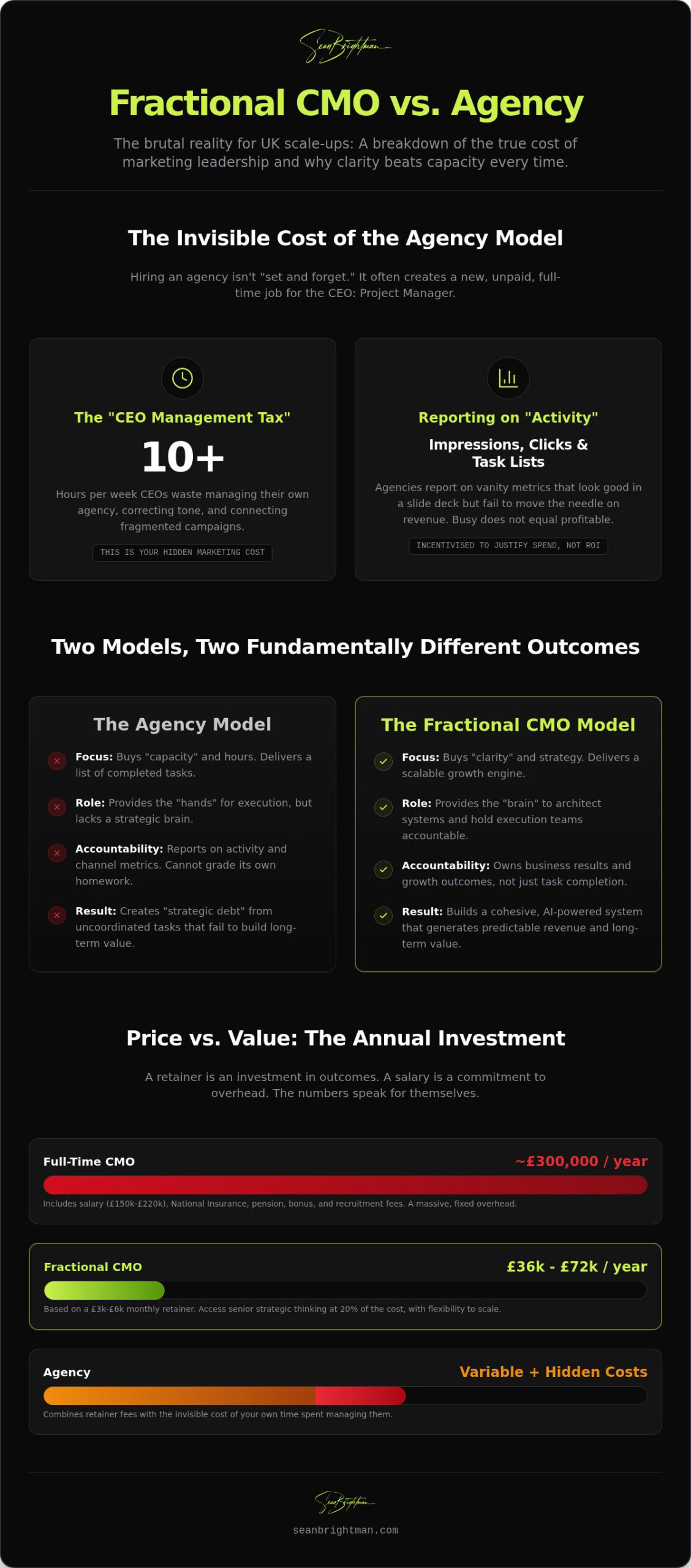
    If you’re spending 10 hours a week explaining your business model to an “account manager,” you’re failing. You’ve become a de facto Marketing Manager. This “outsourcing” actually increases your internal workload. You end up chasing deadlines, correcting tone, and trying to connect the dots between fragmented campaigns.

    Calculate your hourly rate. Multiply it by 40 hours a month. That is the invisible surcharge on your agency invoice. You aren’t paying for growth; you’re paying to be a supervisor. This activity feels like progress, but it rarely moves the needle on revenue. It just keeps the wheels spinning whilst you do the heavy lifting of strategic planning.

    Why Agencies Can’t Grade Their Own Homework

    An agency’s primary goal is to keep you spending. Their business model relies on retainers and ad spend percentages. This creates a fundamental conflict of interest. They cannot objectively audit their own performance because they are incentivised to justify their existence, not to keep your operation lean.

    They report on vanity metrics because vanity metrics look good in a slide deck. You get reports filled with impressions that don’t lead to intent and clicks that don’t convert. These numbers mask a lack of strategic direction. They show you are busy, not that you are profitable.

    You need a senior partner who owns the results, not just the tasks. The Fractional executive model places an architect in your business. This partner holds execution teams accountable. They don’t care about “activity.” They care about the growth engine. They ensure every pound spent is an investment, not just another cost of doing business. Agencies provide hands; a Fractional CMO provides the brain.

    Price vs Value: Decoding the Fractional CMO Model

    Scaling a business requires senior leadership. Most UK scale-ups think they only have two choices: hire a full-time heavyweight or dump the problem on an agency. Both are expensive mistakes. A full-time CMO in the UK carries a basic salary between £150,000 and £220,000. When you add National Insurance, private health, pension contributions, and bonuses, that seat costs you nearly £300,000 before they’ve even opened their laptop. That is a massive overhead for a business that needs to stay agile.

    The cost of fractional cmo vs agency models becomes clear when you look at the middle ground. Typical UK market rates for a Fractional CMO sit between £3,000 and £6,000 per month. You get the same calibre of strategic thinking as a full-time hire but at 20% of the cost. It’s a plug-and-play solution. You aren’t paying for their career development or office politics. You’re paying for their years of battle-hardened experience to be applied directly to your growth engine.

    The Retainer vs The Salary

    A retainer is an investment in outcomes. A salary is a commitment to overhead. By choosing the fractional model, you strip away the hidden costs of employment. There are no recruitment fees, no notice periods that paralyse your strategy, and no equipment costs. You gain the ability to scale the engagement up or down based on your business velocity. If you need a heavy push for a product launch, they’re there. If you need to stabilise, you dial back. This flexibility is essential for any business navigating the debate of in-house vs. outsourced marketing. A fractional leader isn’t an “outsourced” vendor; they are an internal partner with an external perspective.

    AI as a Force Multiplier

    The modern CMO isn’t just a brand-builder. They are a systems architect. By working with a Marketing operations consultant, you’re building a scalable engine that uses AI to replace bloated agency teams. AI consulting reduces the need for expensive, manual execution. We use AI to build “automated accountability” into your marketing systems. This ensures every pound is tracked and every channel is optimised without needing a dozen junior agency staff to “manage” the process. A modern CMO must be an AI-integrator. If they aren’t looking at how to make your marketing leaner through technology, they aren’t doing their job. If you want to see how these systems fit together, you can explore my advisory retainer services to see how we build these engines.

    Fractional CMO vs Agency: The Direct Comparison

    Agencies are external vendors. A Fractional CMO is an internal partner. This isn’t just a semantic difference; it is a fundamental shift in how your business functions. When you examine the cost of fractional cmo vs agency, you are comparing the price of “doing” against the value of “directing.” One adds to your to-do list. The other removes items from it.

    Agencies sell hours and output. They profit from the volume of work they perform. A Fractional CMO sells outcomes and strategy. They profit from the efficiency of your growth engine. If you want to understand why this shift is happening across the UK, read about why you should Stop Hiring Full-Time CMOs to see the full scope of the fractional revolution.

    Who Owns the Strategy?

    Agencies execute a brief. They are reactive by design. If your brief is poor, their results will be poor. They won’t challenge your assumptions because challenging the client puts the retainer at risk. A Fractional CMO writes the brief. They are proactive. They sit on your side of the table and ensure marketing strategy aligns with the CEO’s exit goals or long-term scaling plans.

    An agency-led strategy often looks like “more of the same.” They recommend the channels they are comfortable managing, not necessarily the ones your business needs. A senior partner doesn’t care about channel loyalty. They care about the machinery of growth. They provide the “this, not that” clarity that keeps you from wasting budget on tactical dead ends.

    Transparency and Mark-ups

    The “messy middle” of marketing spend is where profit goes to die. Agencies often hide their margins in media buying mark-ups or software “recommendations” that provide them with kickbacks. These are hidden costs that never appear on your main invoice but drain your ROI. They make the system complex to remain indispensable.

    A Fractional CMO provides total transparency. They audit the spend and cut the fat. They identify where an agency is overcharging for junior staff or marking up tools you could own directly. You get direct accountability. There is one throat to choke when things go wrong and one person responsible for ensuring every pound is working. You aren’t just buying capacity; you’re buying an insurance policy against marketing wastage.
    Cost of Fractional CMO vs Agency: The Brutal Truth for UK Scale-ups

    Calculating Your Real Marketing ROI

    Most scale-ups track the wrong numbers. They look at the monthly invoice and call it a day. That is lazy. To understand the true cost of fractional cmo vs agency models, you have to look at the leaks in your system. ROI isn’t just what you make; it’s what you stop losing. You need to calculate the total investment, not just the fees.

    • Step 1: Audit current spend. Identify the “wastage.” If a pound isn’t clearly attributed to a conversion or a strategic milestone, it is a donation to your agency’s office rent.
    • Step 2: Factor in your time. We’ve discussed the CEO management tax. Now, quantify it. If your time is worth £500 an hour and you spend five hours a week fixing agency mistakes, that is £10,000 a month in lost leadership value.
    • Step 3: Evaluate opportunity cost. How long does it take your agency to pivot? If they take three months to adjust to a market shift, you’ve lost a quarter of growth. A senior partner pivots in hours.
    • Step 4: Compare overheads. Contrast the cost of a Marketing advisory retainer against the combined total of your agency fees, your management time, and your wasted ad spend.

    The 90-Day Reset

    ROI starts with a Strategic brand roadmapping session. This isn’t a polite workshop. It is a tactical audit. We strip away the fluff. We kill the campaigns that feel good but do nothing. We set hard, non-negotiable KPIs. Your execution partners must meet these numbers to stay on the roster. We move from hoping it works to knowing it works.

    Efficiency over Activity

    Activity is a vanity metric. Efficiency is a business metric. I don’t care about a high volume of leads if your sales team thinks they are rubbish. We focus on pipeline quality. A Fractional CMO fixes the Sales-Marketing handoff. They build a clean, AI-powered marketing machine that prioritises conversion over clicks. This is how you build a scalable engine that doesn’t require constant CEO oversight. If you are ready to audit your current marketing engine, book a consultation to find your hidden ROI.

    The Sean Brightman Approach: Advisory over Activity

    I don’t sell activity. I sell direction. Most UK scale-ups are drowning in “stuff” but starving for strategy. My approach is built on battle-hardened expertise, not agency-style fluff. We focus on the architecture of your growth engine, not just the paint job. If your engine is broken, no amount of shiny new ads will fix it. You need a partner who knows how to fix the machinery, not just someone who can change the oil.

    We build for 2026, not 2016. That means deep AI integration. We use technology to automate the mundane and amplify the strategic. This isn’t about replacing people; it’s about making your team ten times more effective. When you evaluate the cost of fractional cmo vs agency, you have to consider the future-proofing of your business. An agency wants to keep you using their manual, billable processes. I want to build you a machine that runs without them. My Advisory Retainer provides the direction, accountability, and straight-talking partnership you need to move fast.

    Building Smarter Systems

    Tools aren’t a strategy. Having a CRM isn’t a strategy. Knowing how to organise those tools into a scalable, buyer-coveted engine is where the value lies. My methodology strips away corporate politeness. I provide blunt honesty about what is working and what is a waste of cash. We move from “messy marketing” to a clinical system. We organise your stack so that data flows, accountability is automated, and results are visible. We stop guessing and start measuring.

    Your Next Move

    Your first hire shouldn’t be a £200k full-time CMO. It’s too risky and too slow. You don’t need a career-focused executive yet; you need a plug-and-play strategist who has seen your problems before. The path to scaling is simple. We start with a roadmap to identify the gaps. We then move to an advisory retainer for ongoing direction and accountability. This is the ultimate tool for CEOs who want to reclaim their time and stop being the bottleneck.

    The cost of fractional cmo vs agency is ultimately measured in strategic velocity. You can keep paying for uncoordinated tasks, or you can invest in a partner who owns the outcome. Stop wasting spend on tactical noise. It’s time to build a system that scales. Contact me today to start building your growth engine.

    Own Your Growth Architecture

    The choice isn’t just about the invoice. It’s about who owns the number. Agencies provide the hands, but without a senior brain, you’re just paying for uncoordinated activity. By weighing up the cost of fractional cmo vs agency models, you’ve seen that the real expense is the strategic debt of “messy marketing.” You don’t need more reports. You need an engine that runs without you.

    I specialise in building “buyer-coveted” growth engines for UK founders who value blunt honesty over corporate fluff. As the author of the definitive guide to AI-powered marketing strategy, I help you integrate the systems that make your business scalable and attractive for exit. Stop acting as a part-time marketing manager. It’s time to install a senior partner who builds machinery, not just campaigns.

    Ready to find your hidden ROI? Book a Strategic Roadmapping Session with Sean Brightman to strip away the noise and start building a system that actually scales. Your growth engine is waiting for the right architect.

    Frequently Asked Questions

    How much does a Fractional CMO cost per day in the UK?

    UK day rates for a Fractional CMO typically range from £700 to £2,500. Senior specialists in high-growth sectors like fintech often sit at the top of that range. Outside London, rates usually start around the £700 mark. You aren’t just paying for time. You’re paying for a decade of senior leadership delivered in a concentrated burst. This model removes the overhead of a £200k full-time salary whilst retaining the same strategic calibre.

    Is a Fractional CMO better than a marketing agency for a startup?

    It depends on what you lack. If you have no hands to do the work, you need an agency. If you have plenty of activity but no revenue growth, you need a Fractional CMO. A startup often burns cash on uncoordinated agency tasks. A fractional leader builds the strategy first. They ensure your agency is actually delivering. One provides capacity; the other provides clarity. You need a brain before you hire hands.

    Can a Fractional CMO manage my existing marketing agency?

    Yes. This is often the primary reason scale-ups hire one. A Fractional CMO acts as your internal leader. They hold execution partners accountable. They stop agencies from grading their own homework with vanity metrics. They ensure the agency’s output aligns with your business goals. You stop acting as the middleman. They take over the technical management so you can focus on leading the company. They are the architect; the agency is the builder.

    What is the typical length of a Fractional CMO engagement?

    Engagements usually last between six and eighteen months. It isn’t a permanent fixture. The goal is to build a scalable growth engine and then either hand it over to a full-time hire or an internal team. Some founders prefer long-term advisory retainers to maintain strategic oversight without the full-time cost. It is a flexible, results-oriented partnership that scales with your business velocity. You buy the impact, not the person.

    Do I need a Fractional CMO if I already have a Marketing Manager?

    Probably. A Marketing Manager executes. A CMO strategises. If your manager is overwhelmed or lacks the senior experience to build a board-level growth plan, they need a mentor. A Fractional CMO provides the senior architecture that a mid-level manager can then implement. This combination is often the most cost-effective way to scale. You get senior leadership without the senior salary. It turns a tactical role into a strategic asset.

    What is the ROI of hiring a Fractional CMO vs an agency?

    The ROI of a Fractional CMO is measured in efficiency and strategic debt reduction. When calculating the cost of fractional cmo vs agency, look at the waste. A fractional leader can save over £150,000 annually compared to a full-time hire. They identify unattributed ad spend and kill underperforming campaigns. An agency’s ROI is tactical; a CMO’s ROI is structural. They fix the engine that generates the leads. They optimise the entire system.

    How does an Advisory Retainer differ from a Fractional CMO role?

    An Advisory Retainer is a “light” version of the fractional role. It focuses on high-level direction and accountability rather than day-to-day management. You might meet monthly for strategic resets and have on-call support for critical decisions. It is ideal for CEOs who have a competent team but need a battle-hardened strategist to keep them on track. It is about strategic velocity, not tactical execution. It provides a straight-talking partner without the management overhead.

    Will a Fractional CMO help me implement AI in my marketing?

    A modern one will. AI consulting is now a core part of the cost of fractional cmo vs agency debate. We use AI to build automated accountability and replace bloated manual processes. If your CMO isn’t an AI-integrator, they are obsolete. We build systems that use AI to handle the mundane tasks, allowing your team to focus on high-impact strategy. It makes your operation leaner, faster, and built for 2026.

  • Marketing Efficiency Audit: The 2026 Checklist for High-Growth Scale-ups

    Marketing Efficiency Audit: The 2026 Checklist for High-Growth Scale-ups

    Your marketing spend is climbing, but your revenue growth has hit a plateau. It’s a common trap for scale-ups in 2026. You’re likely funding a bloated tech stack and “always-on” campaigns that produce noise but zero signal. Most leaders feel the friction. You see the misalignment between sales and marketing. You sense the waste. You know that activity is not impact. A rigorous marketing efficiency audit is the only way to identify the hidden rot in your department.

    Efficiency isn’t about doing more with less. It’s about deleting every process that fails to contribute to strategic velocity. We’re moving from complexity to clarity. You need a leaner, more accountable department that prioritises results over vanity metrics. If it doesn’t move the needle, it shouldn’t exist.

    This guide provides the 2026 checklist to prune your tech stack, synchronise your teams, and build an AI-powered roadmap. You will learn exactly what to stop doing immediately. We’re stripping your operations down to the engine and rebuilding for maximum performance. Let’s get to work.

    Key Takeaways

    • Stop confusing activity with progress. A rigorous marketing efficiency audit exposes whether your team is moving the needle or just performing for a Trello board.
    • Synchronise your revenue engine. Force sales and marketing onto the same target whilst realigning your brand positioning with 2026 market demands.
    • Aggressively prune your tech stack. If no one logged in this month, kill the subscription; software should be a lever, not a data silo.
    • Identify your operational bottlenecks. Map every workflow to see where projects stall, then reassign talent to high-impact execution rather than administrative friction.
    • Commit to a “Stop Doing” list. Use a 90-day roadmap to prioritise deep structural fixes over the shallow distraction of quick wins.

    Why Your Marketing Feels Busy but Stagnant (The Efficiency Trap)

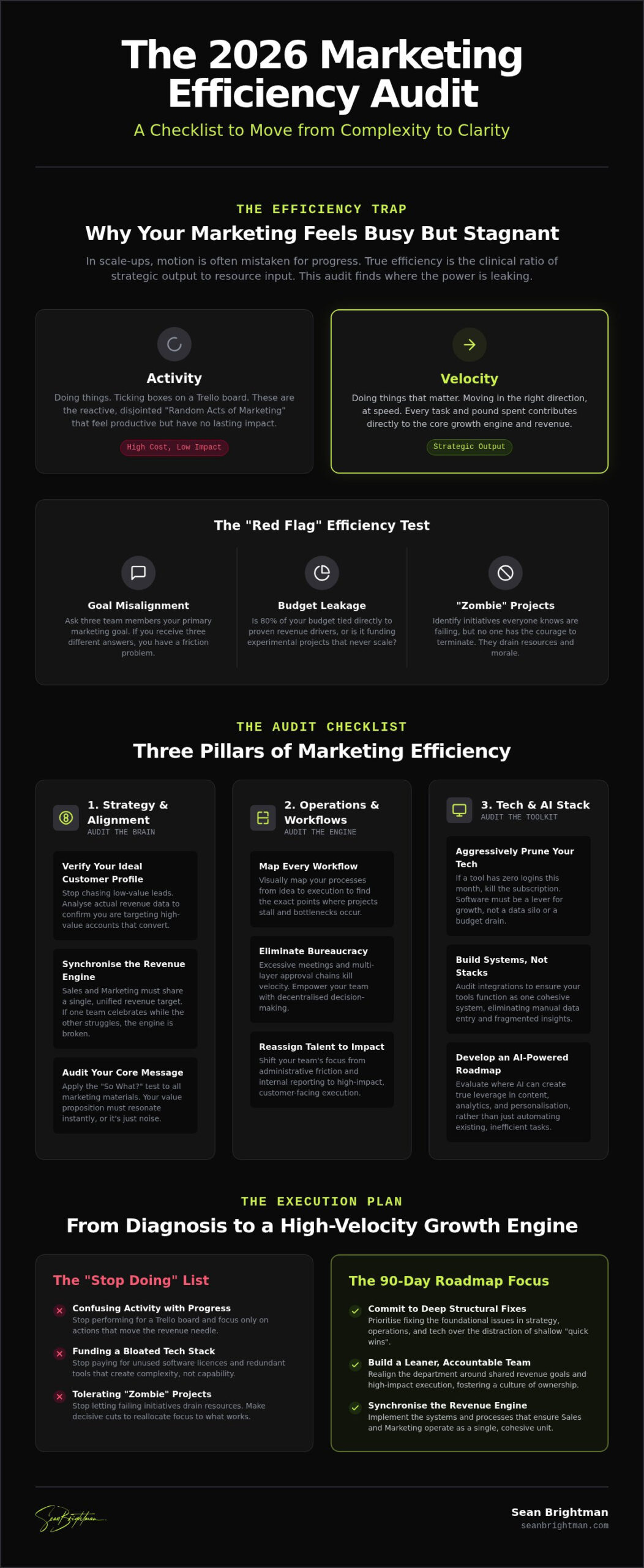
    Your team is exhausted. The Trello board is a sea of green tickets. Yet, the revenue line is flat. This is the efficiency trap. In high-growth scale-ups, we often mistake motion for progress. True marketing efficiency is the clinical ratio of strategic output to resource input. It’s the difference between spinning your wheels in the mud and actually moving the vehicle forward. A marketing efficiency audit isn’t a cosmetic exercise; it’s a mechanical teardown of your operations to see where the power is leaking.

    Activity is doing things. Velocity is doing things that matter, in the right direction, at speed. If a task doesn’t contribute to your core growth engine, it’s waste. Most departments are drowning in “Random Acts of Marketing.” These are the reactive, disjointed tactics born from panic or a lack of clear strategy. They feel productive in the moment but leave no lasting impact on marketing effectiveness. You’re paying for effort when you should be paying for outcomes.

    The “Red Flag” Efficiency Test

    Stop the next three people you see in the office. Ask them to define the department’s primary goal in under ten words. If you get three different answers, you have a friction problem. High-growth teams operate on singular focus, not vague aspirations. Check your ledger. Is 80% of your budget tied directly to proven revenue drivers? If it’s being nibbled away by experimental side-projects that never scale, you’re subsidising vanity. Finally, look for “zombie projects.” These are the initiatives that everyone knows are failing, but no one has the guts to kill. A proper marketing efficiency audit identifies these drains and plugs them immediately. We don’t fix zombies; we bury them.

    The Hidden Cost of Bureaucracy

    Bureaucracy is the silent killer of strategic velocity. Scale-ups often implement “process” that actually functions as a brake. Excessive internal meetings don’t foster collaboration; they drain your team’s creative and strategic capacity. Then there’s the “Approval Bottleneck.” If your best ideas are dying in a CEO’s inbox or waiting for a committee’s blessing, you’ve already lost to the competition. You need enough governance to prevent chaos, but not so much that it stifles speed. Efficiency requires decentralised decision-making. Trust your systems, not your calendar invites. Finding the balance between oversight and execution is what separates the market leaders from the also-rans.

    The Strategy and Alignment Checklist: Auditing the Brain

    If your strategy is flawed, every pound spent on execution is a pound set on fire. Most scale-ups are running on an outdated strategy that no longer fits the 2026 market. A marketing efficiency audit forces you to look at the “brain” of your operation. It’s about alignment, not just activity. If the brain is miswired, the limbs of your marketing department will only flail. You’re paying for movement, but you aren’t gaining ground.

    Are you still chasing the same leads you were eighteen months ago? Your market has moved. Your product has evolved. Chasing low-value leads is a high-cost mistake that drains your team’s energy and budget. You must verify your Ideal Customer Profile (ICP) against actual revenue data. Don’t rely on gut feel. Focus on the high-value accounts that actually convert. This isn’t about more leads. It’s about the right leads.

    Sales and marketing must work to the same revenue target. Period. If marketing is celebrating lead volume whilst sales is struggling with lead quality, your engine is broken. Efficiency requires a single, unified scoreboard. When both teams are incentivised by the same outcome, the friction disappears. This is how you build a leaner, more accountable department that actually moves the needle.

    The Core Message Audit

    Does your website copy actually differentiate you? Or does it sound like every other platform in your niche? Apply the “So What?” test to every outbound material. If a prospect can’t see the immediate value, they’ll bounce. Your brand voice must be consistent across every touchpoint. It should be as sharp on LinkedIn as it is in your sales decks. Resonance is the goal; noise is the enemy. Testing message resonance ensures your value proposition actually lands with buyers instead of being ignored.

    The Growth Roadmap Verification

    Tactics often overtake strategy in the heat of a scale-up. We call this strategic drift. Your marketing strategy roadmap must align with your exit or scale goals. If your current funnel doesn’t mirror actual buyer behaviour, it’s a fiction. Validate your assumptions with data. A comprehensive marketing efficiency audit ensures your roadmap leads to revenue, not just reports. If you need an outside perspective to cut through the complexity and realign your team, an advisory retainer can provide the clarity you need.

    Operational Efficiency: Auditing Your Team and Workflows

    Your team is your most expensive asset. If they’re misaligned, you’re bleeding cash. A marketing efficiency audit must dissect your human capital with the same clinical detachment as your tech stack. Are you overstaffed with coordinators who just manage agencies? Or are you under-resourced with makers who actually build the engine? In a scale-up, you need high-impact execution, not a hierarchy of middle management. You’re paying for talent. Make sure that talent is applied to the right problems.

    Workflow mapping is the diagnostic tool for your internal plumbing. You need to see where a project starts, where it stalls, and where it actually finishes. Most delays aren’t caused by a lack of effort; they’re caused by friction in the handover. If a campaign sits in “pending approval” for three days, that’s three days of lost market opportunity. Mapping these bottlenecks exposes the waste in your daily operations. It turns “we’re busy” into “we’re productive.”

    Then there’s the accountability audit. When a campaign fails, who owns the number? If the answer is “the team,” the answer is “no one.” Accountability requires clear, individual ownership of specific KPIs. You also need to look at the in-house versus agency balance. Are you paying an agency a 20% premium for services your team could handle with better internal systems? Stop overpaying for overhead and start paying for performance. A marketing efficiency audit identifies where you can reclaim margin by bringing core competencies back under your roof. Rather than hiring a full-time executive to oversee this process, many UK scale-ups are turning to professional marketing advisory services to secure senior-level direction at a fraction of the cost.

    Designing for Strategic Velocity

    Structure dictates behaviour. Your marketing team structure for scale-ups UK must be built for speed, not safety. Check for “Single Points of Failure.” If one person leaving brings your lead generation to a halt, your system is fragile. Transition from a “Manager” culture to a “Maker” culture. You want a team that builds assets, not one that just attends meetings. Efficiency is found in the doing, not the discussing.

    The Reporting and Data Audit

    If you can’t act on a stat, stop measuring it. Delete the vanity metrics. Your Board doesn’t care about “engagement rates” if those clicks don’t convert to pipeline. You need “One Version of the Truth” for your marketing data. If sales and marketing are looking at different dashboards, you’re flying blind whilst the competition gains ground. Reporting should drive decisions, not just fill up “FYI” emails. Every report should answer one question: what do we change tomorrow?

    Marketing Efficiency Audit: The 2026 Checklist for High-Growth Scale-ups

    The Tech Stack and AI Audit: Tools vs. Systems

    Your tech stack is likely a graveyard of good intentions. Most scale-ups pay for “solutions” that actually create problems. If no one logged into a platform this month, kill the subscription. It’s that simple. A marketing efficiency audit often reveals that up to 30% of software spend is wasted on overlapping features. One tool for email, another for automation, and a third for “analytics” that no one reads. This isn’t a stack; it’s a pile. It creates data silos that hide the truth about your customer journey. You’re paying for complexity whilst sacrificing clarity.

    Systems architecture is about connectivity, not just collection. Do your tools talk to each other? If your CRM doesn’t feed your automation engine in real-time, you’re losing leads to manual lag. In 2026, entry-level automation starts as low as £12 per month, yet enterprise solutions can exceed £3,300. The price doesn’t matter if the integration is broken. You need a cohesive machine where data flows without human intervention. Stop buying tools and start building systems. Every piece of software must justify its place on the balance sheet through measurable strategic velocity. A well-designed marketing systems architecture is the difference between a pile of expensive subscriptions and a centralised growth engine that demands performance from every penny spent.

    Building an AI-Powered Growth Engine

    AI is no longer a novelty; it is the standard. With 88% of digital marketers now using AI in their daily roles, the question isn’t whether to use it, but how to optimise it. A marketing efficiency audit identifies manual, low-value labour ripe for replacement. Think about agentic AI. It can automate entire workflows, not just generate text. In fact, 31% of organisational workflows are already automated using this technology. However, output quantity is a trap. Use AI to raise the bar on quality. If your team lacks the “AI Literacy” to prompt effectively, you’re just automating mediocrity. Focus on high-impact automation that saves the average 13 hours per week reported by industry leaders.

    The “Single Source of Truth” Test

    Data hygiene is the difference between a goldmine and a mess. If your marketing list is cluttered with dead leads and duplicates, your automation will fail. Your CRM must be the absolute source of truth. Seamless integration with your marketing automation is non-negotiable. Centralise your assets. If your team spends hours asking “where is that file?”, you have a structural failure. Efficiency is found in accessibility. If you want to strip away the bloat and build a high-performance machine, my AI consulting services provide the roadmap you need.

    Executing the Audit: From Diagnosis to Growth Engine

    A report is not a strategy. A diagnosis is not a cure. The most common failure in a marketing efficiency audit is letting the findings gather digital dust. Execution is where the value is created. You need a 90-Day Efficiency Roadmap that ruthlessly separates “Quick Wins” from “Deep Fixes.” Quick wins are the immediate technical patches; deep fixes are the structural overhauls that redefine how your team functions. If you don’t move from diagnosis to action within the first week, you’ve already lost momentum.

    The most critical outcome of any audit is the “Stop Doing” list. Most marketing leaders focus on what to add. They want more tools, more channels, more content. This is the path to bloat. Strategic velocity comes from deletion. Identify the campaigns that don’t convert. Kill the meetings that don’t end in a decision. Prune the tech stack. If you aren’t removing at least 20% of your current activity, you haven’t performed a real audit. You’ve just performed a headcount.

    Communicating these changes to your team requires clinical honesty. Frame the audit as a system review, not a performance review. It’s about fixing the machine, not blaming the operators. When you focus on efficiency, you’re giving your team permission to do their best work by removing the friction that holds them back. Clear, direct communication prevents revolt and builds a culture of accountability. You want a team that values impact over appearance.

    External Perspective and Accountability

    You cannot audit your own biases. Internal teams are too close to the “zombie projects” and legacy workflows to see them objectively. This is why a fractional cmo is the ideal partner for a marketing efficiency audit. They provide the senior leadership and clinical detachment needed to cut through internal politics. To ensure these efficiency gains stick, many CEOs use a marketing advisory retainer. It provides the external pressure required to maintain strategic velocity and prevents the department from sliding back into old, inefficient habits.

    Next Steps: The 24-Hour Action Plan

    Don’t wait for a quarterly review. Start the engine now. Within the next 24 hours, you should:

    • Identify the three biggest “time leaks” currently draining your department’s capacity.
    • Schedule a “Strategy vs. Activity” review with your marketing lead to audit their current priorities.
    • Book a strategic roadmapping session to reset your direction and align your team with 2026 revenue goals.

    The difference between a scale-up and a market leader is the speed of implementation. Use the audit to find the waste. Then, use your roadmap to build the growth engine. Clarity is your competitive advantage. Go get it.

    Rebuild Your Engine for Strategic Velocity

    A marketing efficiency audit is the difference between a department that burns cash and one that builds equity. You’ve seen the checklist. It starts with deleting the bloat in your tech stack and ends with a ruthless “Stop Doing” list. Efficiency isn’t about working harder; it’s about removing the friction that stops your best people from delivering results. You need a system that prioritises velocity over mere activity. This is about mechanical precision, not corporate politeness.

    Don’t let internal biases or legacy workflows stall your growth. As a battle-hardened Fractional CMO for UK scale-ups and an expert in AI-powered marketing systems, I provide the direct advice needed to fix the machine. We don’t do fluff. We do results. If you’re ready to strip away the noise and rebuild your operations for maximum impact, let’s get to work.

    Book a Strategic Roadmapping Session with Sean Brightman today. It’s time to stop guessing and start growing. You have the talent. Now, give them the engine they deserve.

    Frequently Asked Questions

    What is a marketing efficiency audit and why does my business need one?

    A marketing efficiency audit is a clinical teardown of your revenue engine. It identifies the friction between your spend and your actual results. You need it because most scale-ups accumulate “activity bloat” that masks a lack of real progress. It is about impact, not appearance. It forces you to look at the ratio of strategic output to resource input.

    How long does a typical marketing efficiency audit take to complete?

    A high-impact audit takes 14 to 30 days. We aren’t here to write a 100-page report that no one reads. We are here to provide a high-level briefing and an immediate action plan. Speed is a feature, not a bug. You want clarity in a concentrated timeframe so you can start executing the fixes immediately.

    Can I perform a marketing audit internally or do I need an external consultant?

    Internal audits usually fail to address the “elephants in the room.” You cannot audit your own biases or the projects you have championed. An external strategist brings clinical detachment. They cut through internal politics to tell you what is actually broken, not what is polite to fix. You need an independent eye to challenge the status quo.

    What are the most common inefficiencies found in marketing departments?

    The biggest drains are tool bloat, “Random Acts of Marketing,” and sales misalignment. Research shows many agencies have seen a 20-35% reduction in costs through AI, yet many in-house teams still waste 13 hours per week on manual labour. That is pure inefficiency. Most departments have 30% waste in their tech stack subscriptions alone.

    How does AI impact the results of a marketing efficiency audit in 2026?

    In 2026, AI is the standard, not the exception. A marketing efficiency audit identifies where agentic AI can automate entire workflows. It moves your team from “doing” to “directing.” If you aren’t using AI to raise output quality and strategic velocity, you are subsidising manual waste. AI is now the benchmark for operational performance.

    What should be the primary outcome of a marketing audit?

    The primary outcome is a ruthless “Stop Doing” list. You don’t need more tactics; you need more focus. The audit should deliver a 90-day roadmap that prioritises deep structural fixes over shallow quick wins. It is about building a growth engine, not a to-do list. You want a leaner, more accountable department.

    How often should a high-growth scale-up audit its marketing operations?

    Perform an audit every six months. Scale-ups evolve too quickly for annual reviews. Bi-annual checks prevent strategic drift and ensure your team structure stays lean whilst your tech stack remains a lever for growth, not a weight. Regular audits keep your operations synchronised with your rapidly evolving revenue goals.

  • Sean Brightman for CEOs: High-Impact Marketing Leadership Without the Overhead

    Sean Brightman for CEOs: High-Impact Marketing Leadership Without the Overhead

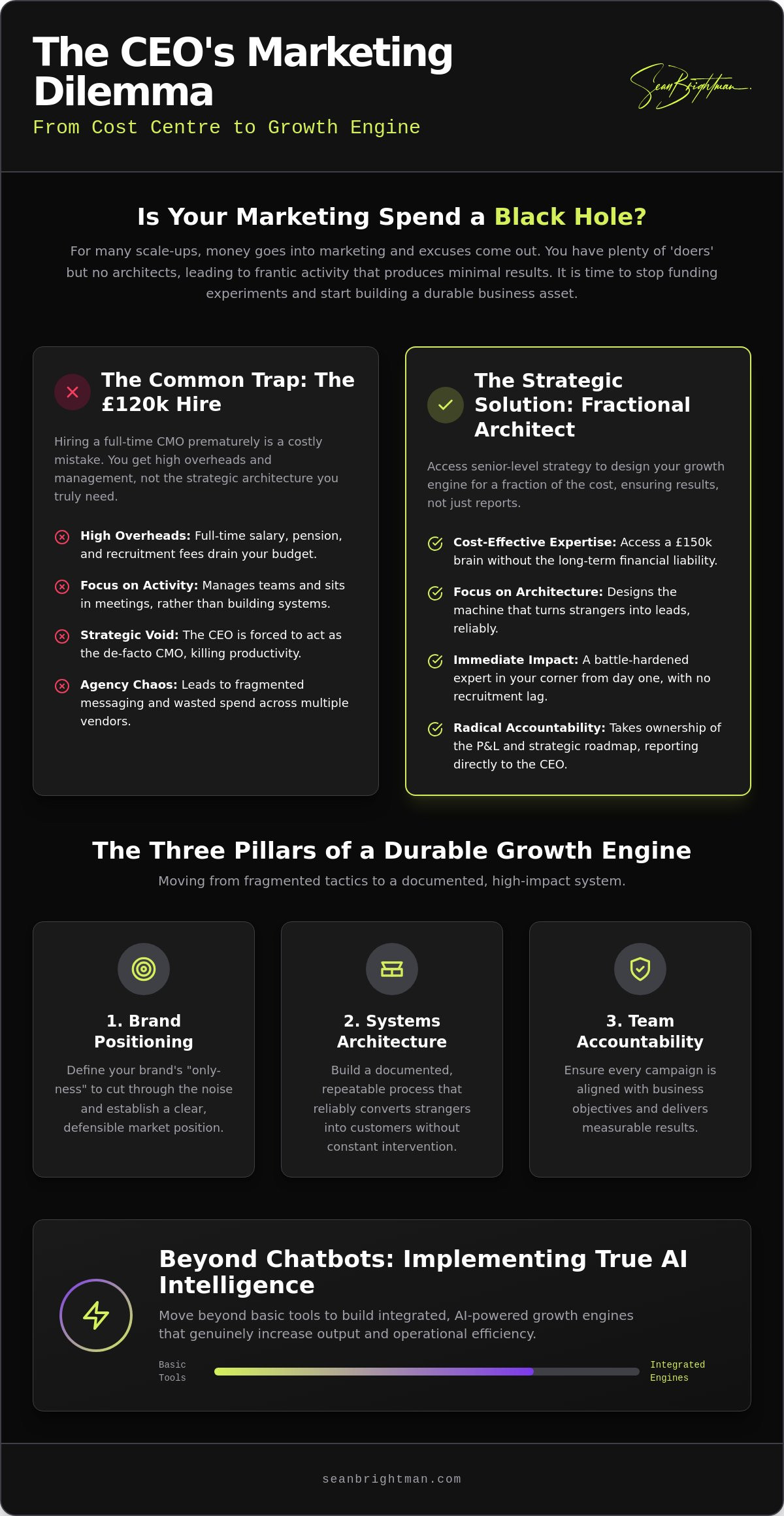
    Most CEOs treat marketing like a black hole; money goes in, and excuses come out. You’ve hired the agencies and listened to the fluff, yet the needle hasn’t moved. Sean Brightman for CEOs provides the antidote to this cycle by offering senior-level strategy that actually builds something durable. It’s about architecture, not just activity. It’s about results, not reports.

    You likely agree that your current marketing spend lacks the strategic accountability required for true scale. You deserve a growth engine that functions without your constant intervention whilst delivering a clear return on investment. This guide outlines how to move from fragmented tactics to a documented roadmap. We’ll explore how to integrate practical AI into your operations to improve efficiency and turn your marketing department into a high-impact asset rather than a cost centre.

    Key Takeaways

    • Avoid the £120k full-time hire trap by securing senior leadership that builds systems rather than just managing activity.
    • Discover why Sean Brightman for CEOs is the strategic choice for leaders who need a battle-hardened architect to fix a stalling scale-up.
    • Plug budget leaks and define your brand’s “only-ness” using a rigorous roadmapping process.
    • Move beyond basic chatbots to build integrated, AI-powered growth engines that increase output and operational efficiency.
    • Gain radical accountability. Use an Advisory Retainer to keep strategy on track without constant CEO intervention.

    The CEO Marketing Gap: Why Your Scale-up Is Stalling

    Marketing is often the most expensive experiment in a scale-up. You hire junior staff. You pay for ads. You wait for growth. It doesn’t come. This is the “Messy Middle”. It’s a state where you have plenty of doers but zero architects. You’re paying for activity, not results. Sean Brightman for CEOs solves this by installing a strategic foundation before you waste another penny on execution.

    Many SMEs believe a full-time CMO is the answer. They hunt for a £120k leader to fix marketing. It’s a premature mistake. At this stage, you don’t need a full-time executive sitting in meetings and managing a pension plan. You need a Fractional executive who can build the growth engine and then get out of the way. You need the high-level strategy without the heavy-duty overhead.

    Without a senior architect, marketing spend becomes a black hole. You see noise, not machinery. Activity is posting on LinkedIn because everyone does it. A system is a documented process that turns a stranger into a lead reliably. One is a hobby; the other is a business asset. If your team can’t show you the blueprint of how a pound becomes five pounds, you don’t have a department. You have a drain.

    The Problem with “Agency-First” Thinking

    Agencies are built to scale their own revenue, not yours. They want to spend your budget on the channels they manage. They rarely look at your internal business efficiency. Execution without an internal architect leads to fragmented messaging and wasted spend. You end up with five different agencies doing five different things, whilst your brand loses its soul. It’s a conflict of interest. Their retainer relies on you staying busy, not necessarily on you becoming more efficient. You need a partner who cares about the bottom line, not just the click-through rate.

    The Cost of Senior Leadership Indecision

    Scale-ups often stall whilst the CEO searches for a “perfect” full-time hire. This search takes months. During that time, the CEO becomes the de-facto CMO. It’s a disaster for productivity. You’re a visionary, not a campaign manager. Every hour you spend reviewing ad copy is an hour you aren’t leading the company. Sean Brightman for CEOs provides immediate senior leadership. It builds the foundation that makes your eventual full-time hire successful, rather than throwing them into a mess they can’t fix. Don’t wait for a unicorn when you can hire the architect today.

    What is a Fractional CMO for CEOs?

    A Fractional CMO is senior marketing leadership provided on a part-time, high-impact basis. It is expertise without the ego. It is leadership without the bloat. For a CEO, it means accessing a £150k brain for a fraction of the cost. You get the strategic depth of a veteran strategist without the long-term liability of a six-figure salary, pension contributions, and recruitment fees. This is about buying results, not just a person’s time.

    Sean Brightman for CEOs focuses on three core pillars: brand positioning, systems architecture, and team accountability. This isn’t about having someone to ‘run the marketing department’. It’s about having an architect to design the machine. The plug-and-play nature of fractional advisory means you get immediate impact. There is no recruitment lag. No three-month notice periods. You get a battle-hardened expert in your corner from day one. It is a surgical strike on marketing inefficiency.

    Accountability isn’t a dirty word; it’s a growth requirement. A fractional leader provides a second set of eyes on your team’s output, ensuring every campaign aligns with overarching business objectives. If you’re ready to stop guessing and start building, consider an Advisory Retainer to bring clinical clarity to your growth plans.

    Strategy, Not Just Management

    A true Fractional CMO doesn’t just manage people; they build the growth engine. They take ownership of the marketing P&L and the strategic roadmap. This creates radical transparency. You stop hearing about ‘brand awareness’ and start hearing about customer acquisition costs and lifetime value. This includes developing a robust AI marketing strategy that integrates with your existing operations to drive efficiency. Direct reporting to the CEO ensures there is nowhere for inefficiency to hide. Sean Brightman for CEOs ensures the strategy is documented, measurable, and repeatable.

    The Fractional Advantage for UK Scale-ups

    Scale-ups are volatile. Your leadership needs should reflect that. Hiring a full-time CMO too early often leads to ‘CMO burnout’ because the executive ends up doing junior tasks. A fractional model avoids this by focusing exclusively on high-leverage strategic moves. You have the flexibility to scale the engagement up or down based on your current growth phase. It’s about having the right tool for the job at the right time. You can learn more about this shift in my guide on why you should stop hiring full-time CMOs.

    Building Your Growth Engine: The Roadmapping Process

    A strategy that lives only in a slide deck is a fantasy. Most marketing plans fail because they are collections of disconnected tactics rather than integrated systems. Sean Brightman for CEOs provides a clinical, four-step roadmapping process designed to turn marketing from a cost centre into a predictable growth engine. We don’t start with creative ideas. We start with engineering.

    • Step 1: The Audit. We identify where your marketing machinery is leaking cash. This is a cold, hard look at your data to find the friction points in your funnel.
    • Step 2: Positioning. We define your “Only-ness”. In a crowded market, being “better” is a losing game. We find the angle that makes you the only logical choice for your ideal customer.
    • Step 3: Systems Design. We choose the right tools and team structure. This isn’t about adding more software; it’s about ensuring your existing tech stack actually communicates.
    • Step 4: Execution Plan. We build a 90-day sprint. This moves your team from reactive chaos to proactive clarity with documented tasks and clear ownership.

    From Chaos to Clarity in 90 Days

    Documented roadmaps beat “vibe-based” strategies every time. You need a plan that survives first contact with the market. This process focuses on setting KPIs that actually matter to the CEO. We ignore vanity metrics like “impressions” or “engagement” in favour of customer acquisition cost and lifetime value. As a marketing operations consultant, I focus on building the infrastructure that supports long-term scale. It’s about creating a repeatable process that delivers results whilst you focus on high-level leadership.

    Designing Your Business for Exit

    A scalable marketing system isn’t just good for growth; it’s essential for valuation. Buyers don’t want to buy a business that relies on the founder’s personal network or “gut feel” for leads. They want a turn-key department with documented systems and predictable returns. Sean Brightman for CEOs helps remove “Founder Dependency” from your lead generation. We build a functional, mechanical asset that increases your company’s attractiveness to investors. You aren’t just selling a product. You’re selling a machine that produces customers.

    Sean Brightman for CEOs: High-Impact Marketing Leadership Without the Overhead

    AI Consulting: Implementing Intelligence, Not Just Tools

    AI is the most misunderstood tool in your arsenal. Most teams are “playing” with generative tools to produce mediocre content. This is a waste of potential. It’s a distraction. Sean Brightman for CEOs treats AI as a functional component of your growth engine, not a novelty. We build systems where intelligence is baked into the process, increasing output whilst slashing the time spent on manual labour. It is about moving from “doing more” to “knowing more”.

    Implementing AI changes your cost structure. You stop paying for hours and start paying for outcomes. It reduces the need for bloated middle-management and junior “doers” who only follow templates. The CEO’s role is to lead this shift. You must foster an AI-first culture where efficiency is the standard, not an option. If you don’t drive this change, your competitors will use it to outpace you. Sean Brightman for CEOs ensures your leadership team understands how to wield this machinery effectively.

    The AI Growth Roadmap

    Strategic integration starts with a cold audit of your current tech stack. We identify high-leverage areas where AI can remove bottlenecks in your funnel. This isn’t about replacing humans; it’s about amplifying them. We automate mundane tasks, like lead scoring and data cleaning, to free up your team for high-level creative problem-solving. This roadmap ensures your organisation is future-proofed against rapid shifts in the digital landscape. If you’re ready to build a smarter department, explore my AI Consulting services to start the transformation.

    AI for Marketing Operations

    Intelligent automation reduces your headcount dependency. You can achieve the output of a ten-person team with three specialised operators and the right AI machinery. We use AI for deep market research and competitor analysis at scale, processing millions of data points in minutes. This provides a level of insight that was previously impossible for SMEs. Beyond efficiency, we establish strict AI governance and data privacy standards. Your brand’s reputation is too valuable to leave to unmanaged algorithms. We build the guardrails so your team can move fast without breaking the business.

    Working with Sean Brightman: Direct Advisory for Leaders

    Working with Sean Brightman for CEOs means inviting a straight-shooting strategist into your inner circle. It is a partnership defined by blunt honesty, not corporate platitudes. Most consultants are terrified of telling a CEO they are wrong. I am not. If your current marketing direction is a liability, we address it immediately. This isn’t about being difficult; it’s about being effective. You don’t pay for a “yes-man”. You pay for a battle-hardened perspective that cuts through the noise. This is leadership for those who value results over ego.

    Success in a scale-up requires pattern recognition. I have seen the same operational bottlenecks across dozens of high-growth businesses. I know which “trends” are expensive distractions and which systems actually drive revenue. This isn’t theoretical advice from a textbook. It is practical, visceral leadership from someone who remains active in the field. We skip the expensive mistakes and move directly to the high-impact actions that move the needle. Sean Brightman for CEOs provides the clinical clarity needed to navigate the “Messy Middle” of business growth.

    The Advisory Retainer Model

    The Advisory Retainer provides ongoing monthly direction and radical accountability. It is the bridge between a strategic roadmap and daily execution. We don’t just set a plan and walk away. We hold regular “get-your-hands-dirty” sessions to fix operational bottlenecks in real-time. I act as a clinical sounding board for the CEO on brand positioning, AI integration, and growth strategy. Whilst your team handles the doing, I ensure the doing aligns with the ultimate business objective. It is senior-level oversight without the full-time salary commitment. We focus on the machinery, not just the metrics.

    Take the First Step

    Your marketing is either an asset or a drain. There is no neutral state. If your current department feels like a black hole for capital, it’s time to organise the machinery. The first step is a discovery session to audit your “messy” marketing and identify where you are leaking cash. We move from fragmented tactics to a documented growth engine. Don’t wait for the next scale-up phase to expose the cracks in your foundation. Fix the architecture now so you can scale with confidence. To begin the process, Book a Strategy Session with Sean Brightman and get the clarity your business deserves.

    Stop Wasting Budget and Start Building Machinery

    Your marketing department shouldn’t be a source of stress; it should be a source of scale. We’ve explored how the “Messy Middle” stalls growth and why a £120k full-time hire is often a premature mistake. By choosing Sean Brightman for CEOs, you secure a published author on marketing strategy and an expert AI integration strategist who builds systems, not just campaigns. You move from fragmented tactics to a documented roadmap that increases company valuation and removes founder dependency. This is not about more activity; it’s about better machinery.

    As a fractional leader for UK scale-ups, I provide the radical accountability required to turn marketing spend into a predictable growth engine. It’s time to stop accepting agency excuses and start implementing practical AI that actually improves efficiency. This is about building a turn-key department that functions whilst you focus on high-level leadership. You provide the vision. I provide the strategic architecture.

    Build Your Growth Engine: Work with Sean Brightman

    Let’s turn your marketing into the high-impact asset your business deserves.

    Frequently Asked Questions

    What is the difference between a Fractional CMO and a marketing consultant?

    Consultants provide advice whilst Fractional CMOs provide leadership and ownership. A consultant tells you what is wrong and leaves you to fix it. A Fractional CMO integrates into your leadership team, manages the marketing P&L, and builds the actual growth engine. It is the difference between a spectator and an architect who stays on-site to ensure the building doesn’t fall down.

    How many days a month does a Fractional CMO typically work for a CEO?

    Most engagements range from two to eight days per month, depending on the complexity of your scale-up. The focus is on high-impact strategic shifts rather than clock-watching. You aren’t paying for hours; you’re paying for the clinical precision of a veteran strategist who can solve in four hours what a junior team would struggle with for forty.

    Can Sean Brightman help me hire my first full-time marketing manager?

    Yes, but only once the growth engine is designed. Hiring a manager into a messy department is a guaranteed way to waste a salary. Sean Brightman for CEOs involves building the roadmap first. Once the machine is functional, we define the exact technical skills required to run it, ensuring your first hire is a success rather than a search for a unicorn.

    Is AI consulting included in the Fractional CMO retainer?

    AI integration is a core component of the strategy, not a bolt-on extra. We build AI-powered systems to improve efficiency and increase output as standard. Modern marketing leadership requires an AI-first mindset to stay competitive. We don’t just “play” with tools; we bake intelligence into your operational DNA to reduce headcount dependency and speed up growth.

    Do I need a marketing strategy roadmap before hiring an agency?

    Hiring an agency without a roadmap is like buying fuel before you’ve built the car. You’ll spend a lot of money and go nowhere. You need an internal architect to define the strategy and set the KPIs. Without this, the agency will simply spend your budget on the services they find easiest to sell, rather than what your business actually needs to scale.

    How much does a Fractional CMO cost compared to a full-time hire in the UK?

    A Fractional CMO typically costs a fraction of a £150k full-time executive salary. You avoid the heavy-duty overhead of recruitment fees, pension contributions, and long-term notice periods. It is a strategic alternative that provides senior-level brainpower without the six-figure liability. You get the expertise you need for the phase you are in, with the flexibility to scale as you grow.

    What industries does Sean Brightman specialise in?

    The focus is on UK scale-ups and B2B organisations that are tired of marketing fluff. Whilst the “Only-ness” of every brand differs, the mechanical principles of a growth engine are universal. Whether you are in tech, professional services, or manufacturing, the requirement for documented systems and AI-powered efficiency remains the same. We focus on businesses ready for radical accountability.

    How quickly can I expect to see results from a marketing advisory retainer?

    Strategic clarity is immediate. You’ll stop feeling like you’re guessing within the first session. A fully documented roadmap is typically delivered within the first 90 days. We identify and fix budget leaks during the initial audit to provide quick wins, whilst simultaneously building the long-term machinery that removes founder dependency and drives predictable revenue.