Tag: strategic marketing

  • Why Is My Marketing Not Generating Leads? The Systemic Fix for 2026

    Why Is My Marketing Not Generating Leads? The Systemic Fix for 2026

    Your marketing team is busy, but your pipeline is empty. Activity is not achievement. You’re likely tired of seeing “green arrows” on activity reports whilst your revenue remains flat. You’ve spent thousands on ads that don’t convert and agencies that deliver “brand awareness” instead of buyers. You’re constantly asking yourself why is my marketing not generating leads when everyone seems so productive. It’s a common, expensive trap.

    This isn’t about minor tweaks or the latest social media hack. We’re here to stop you from chasing tactical ghosts. You’ll learn how to strip away the fluff and fix the strategic rot that is currently killing your lead flow. It’s about building a functional system that works, not just a department that spends. This is the difference between hope-based marketing and a predictable growth engine.

    We’ll break down the systemic failures in your marketing engine and show you how to build a high-accountability framework for 2026. It’s time for strategic clarity and a reliable pipeline, not more empty busywork.

    Key Takeaways

    • Activity is not achievement. Stop mistaking vanity metrics and “busy” marketing reports for the actual revenue-generating work that drives growth.
    • Identify the systemic rot by answering the core question: why is my marketing not generating leads? We’ll expose the positioning failures and high-friction buyer journeys killing your pipeline.
    • Ditch the tactical guesswork. Discover why you need a brutal diagnostic audit of your marketing machinery instead of simply “tweaking” your ad spend or changing agencies.
    • Master the growth engine. Learn how to implement a Strategic Brand Roadmap that turns generic messaging into a sharp, winning aspiration that converts.
    • Bridge the leadership gap. Understand how a Fractional CMO provides the senior-level architecture and accountability required to fix a lead drought without the overhead of a full-time hire.

    Why “Busy” Marketing Is Failing to Generate Leads in 2026

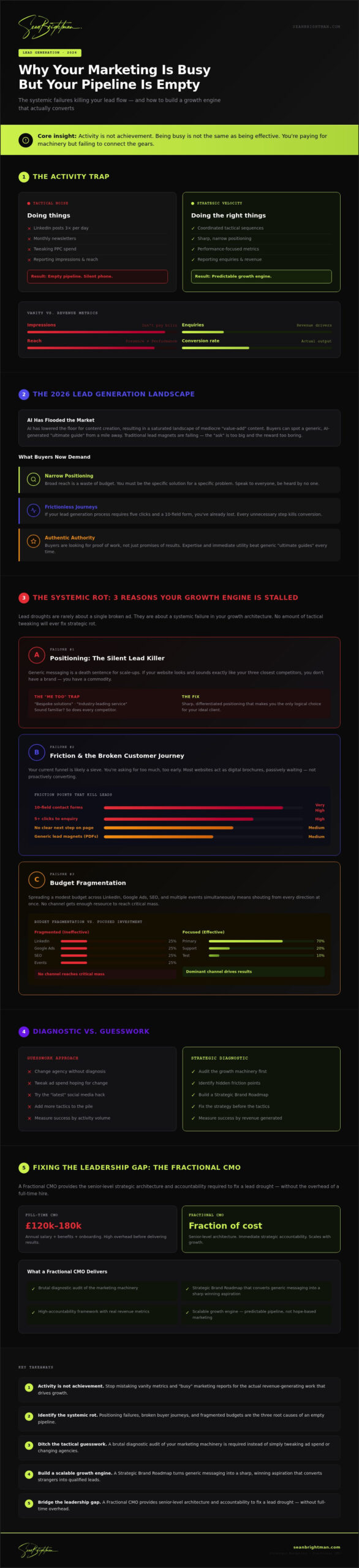
    Your marketing department is a hive of activity. They are posting on LinkedIn three times a day. They are tweaking the PPC spend. They are sending monthly newsletters. Yet, the phone is silent. This is the Activity Trap. It’s the dangerous assumption that being busy is the same as being effective. In reality, you are just making noise. Visibility is not a strategy; it’s a byproduct of one.

    If you’re constantly wondering why is my marketing not generating leads, the answer usually lies in the difference between tactical noise and strategic velocity. Noise is doing things. Velocity is doing the right things in a coordinated sequence that moves the needle. Most UK businesses are currently vibrating in place, spending money on “presence” whilst their competitors are focused on “performance.”

    The Activity vs. Results Paradox

    Metrics often lie. If your team is providing reports filled with “impressions” and “reach,” they are handing you a vanity project, not a revenue report. Impressions don’t pay the bills. Enquiries do. When marketing is uncoordinated, you end up with a collection of random acts of marketing. Each tactic might look good in isolation, but they don’t connect to form a functional growth engine.

    Business owners often confuse movement with progress. They see a social media feed full of content and assume the leads will follow. They won’t. Without a clear strategic backbone, your marketing is just a series of expensive experiments. You’re paying for the machinery but failing to connect the gears. This lack of coordination creates a messy, fragmented brand experience that confuses potential buyers rather than converting them.

    The 2026 Lead Generation Landscape

    The market has shifted. In 2026, AI has lowered the floor for content creation, resulting in a saturated landscape of mediocre “value-add” content. Consumer expectations have skyrocketed. They can spot a generic, AI-generated “ultimate guide” from a mile away. Traditional lead magnets are failing because the “ask” is often too big or too boring for the reward offered. People don’t want more PDFs; they want expertise and immediate utility.

    • Narrow Positioning: Broad reach is a waste of budget. You need to be the specific solution for a specific problem.
    • Frictionless Journeys: If your lead generation process requires five clicks and a 10-field form, you’ve already lost.
    • Authentic Authority: Buyers are looking for proof of work, not just promises of results.

    The shift from broad reach to narrow positioning is no longer optional. If you try to speak to everyone, you end up heard by no one. To fix a lead drought, you must stop shouting into the void and start engineering a precise path for your ideal customer to follow.

    The Systemic Rot: Three Reasons Your Growth Engine Is Stalled

    Lead droughts are rarely about a single broken ad. They are about a systemic failure in your growth architecture. If you are staring at a revenue flatline and asking why is my marketing not generating leads, you need to look at the machinery, not just the paint job. Most businesses are suffering from strategic rot that no amount of tactical tweaking will ever fix.

    Positioning: The Silent Lead Killer

    Generic messaging is a death sentence for scale-ups. If your website looks and sounds exactly like your three closest competitors, you don’t have a brand; you have a commodity. This is the “Me Too” trap that plagues British B2B marketing. You claim to provide “bespoke solutions” and “industry-leading service.” So does everyone else. Positioning is the foundation of the engine. If that foundation is soft, the entire structure will eventually collapse under the weight of your ad spend.

    Friction and the Broken Customer Journey

    Your current funnel is likely a sieve. You are asking for too much, too early. Most websites act as digital brochures, passively waiting for someone to find a “Contact Us” page. A brochure is a static document. A salesperson is a proactive closer. If your path from stranger to qualified lead isn’t mapped with precision, you are losing prospects at every turn. You need to identify where the friction is high and the motivation is low. Often, a strategic efficiency audit is the only way to diagnose these hidden disconnects before they drain your remaining budget.

    Fragmentation is the final nail. Spreading a modest budget across LinkedIn, Google Ads, SEO, and three different events means you are shouting in ten rooms but heard in none. You end up with a collection of weak signals rather than one dominant voice. Finally, there is the issue of accountability. If your marketing team is only responsible for “activity” and not “revenue,” they will keep providing activity reports whilst the business starves. You need a single point of failure. Someone must own the revenue target, not just the social media calendar. You end up asking why is my marketing not generating leads whilst your team celebrates a minor increase in vanity impressions.

    Diagnostic vs. Guesswork: Why Tactics Won’t Save You

    Changing your ad creative won’t fix a broken business model. Swapping your headline colour won’t save a product nobody wants. If you’re stuck wondering why is my marketing not generating leads, stop looking for a “magic button” in your Meta Ads Manager. Tactics are the fuel; strategy is the engine. If the engine is seized, adding more fuel just creates a puddle of expensive, flammable waste.

    Most UK businesses are trapped in a cycle of tactical guesswork. They jump from one “guru” advice to the next, hoping for a breakthrough. It’s an exhausting, expensive way to fail. You don’t need a new agency to try the same failed tactics with a different logo. You need a diagnostic audit to find out where the machinery is actually broken. Guessing is for amateurs; diagnostics are for leaders.

    The High Price of Tactical Guesswork

    Trial and error is the most expensive way to build a brand. Every “test” that lacks a strategic hypothesis is just gambling with your payroll. Agencies love it when you don’t have a strategy. It allows them to hide behind activity reports and vague promises of “long-term growth” whilst your bank balance drains. They get paid for the work; you only get paid for the results.

    There is a massive difference between a daily to-do list and a strategic brand roadmapping session. One is a list of chores. The other is a high-impact architectural plan. A roadmap defines the “why” and “how” before a single pound is spent on the “what.” It stops the “One More Tool” mentality where businesses buy expensive CRM software or AI bots to fix problems that are actually rooted in poor positioning.

    Finding the Real Bottleneck

    You need to know if you have a traffic problem or a conversion problem. They require completely different fixes. Throwing more traffic at a site that doesn’t convert is like pouring water into a bucket with no bottom. It’s a waste of resources. Senior leadership is about identifying these bottlenecks with clinical precision rather than guessing based on gut feeling. You need to look at the data, not the decorations.

    Senior oversight turns “I think” into “I know.” It moves marketing from a dark art into a predictable operation. By using data-led roadmaps, you can see exactly where prospects are dropping off. Is the messaging failing? Is the offer weak? Is the follow-up non-existent? When you stop guessing and start diagnosing, the question of why is my marketing not generating leads finally gets an actionable answer. You stop chasing ghosts and start building a growth engine that actually scales.

    Why Is My Marketing Not Generating Leads? The Systemic Fix for 2026

    Building a Scalable Growth Engine That Actually Converts

    Stop playing whack-a-mole with your tactics. You need a system that produces leads as a predictable output, not a lucky accident. The first move is to stop the bleeding. You must conduct a brutal marketing efficiency audit to identify where your budget is being incinerated. This isn’t a gentle review; it’s a forensic investigation into your spend versus your actual returns. It’s about finding the leak before you try to increase the pressure.

    Once you’ve cleared the debris, you must define your “Winning Aspiration.” This is your specific, high-stakes goal that separates you from the generic crowd. Then, integrate an AI consulting framework to handle the heavy lifting. In 2026, AI has fundamentally changed lead behaviour. Buyers expect instant, personalised responses and predictive content. If your system isn’t processing intent data in real time, you’ll continue asking why is my marketing not generating leads whilst your faster competitors mop up the market.

    Architecture Over Activity

    Marketing should be a machine, not a series of manual chores. You need to design systems that run without constant CEO intervention. In 2026, lead generation and nurturing are increasingly automated through intelligent workflows that adapt to user behaviour. However, tools must always follow strategy. If you buy a new CRM to fix a lack of leads without a strategy, you’ve just automated your failure. You need architecture, not more software subscriptions. Design the machine first; then choose the components.

    This shift requires a move from generic broad-reach tactics to high-precision engineering. You are no longer just “doing marketing.” You are building a functional component of your business’s revenue machinery. This machinery must be integrated, not siloed. When your sales and marketing data flow through a single, AI-enhanced centre, you gain the strategic velocity needed to outpace the market.

    The Power of Accountability

    Most marketing teams are busy doing things. You need them delivering results. This requires setting KPIs that actually matter to your bottom line, like cost per qualified lead and sales velocity, not just website clicks. This is where a marketing advisory retainer becomes essential. It provides the necessary external force to keep the engine running at high speed. It’s about moving from “doing” to “delivering.”

    Accountability is the difference between a department that spends and a department that earns. Without it, you are just funding a creative hobby. You need a partner who isn’t afraid to challenge the status quo and demand performance. To start building a high-impact system that actually scales, explore the senior leadership options available through Sean Brightman’s fractional advisory services.

    Fixing the Leadership Gap: The Fractional CMO Solution

    You don’t need a full-time executive to fix a temporary lead drought. You need a specialist who can diagnose the rot and rebuild the engine. Most UK scale-ups hire mid-level marketers and expect senior-level results. It’s a mismatch that leads to wasted budget and frustration. When you ask why is my marketing not generating leads, you are usually looking at a tactical symptom of a leadership void.

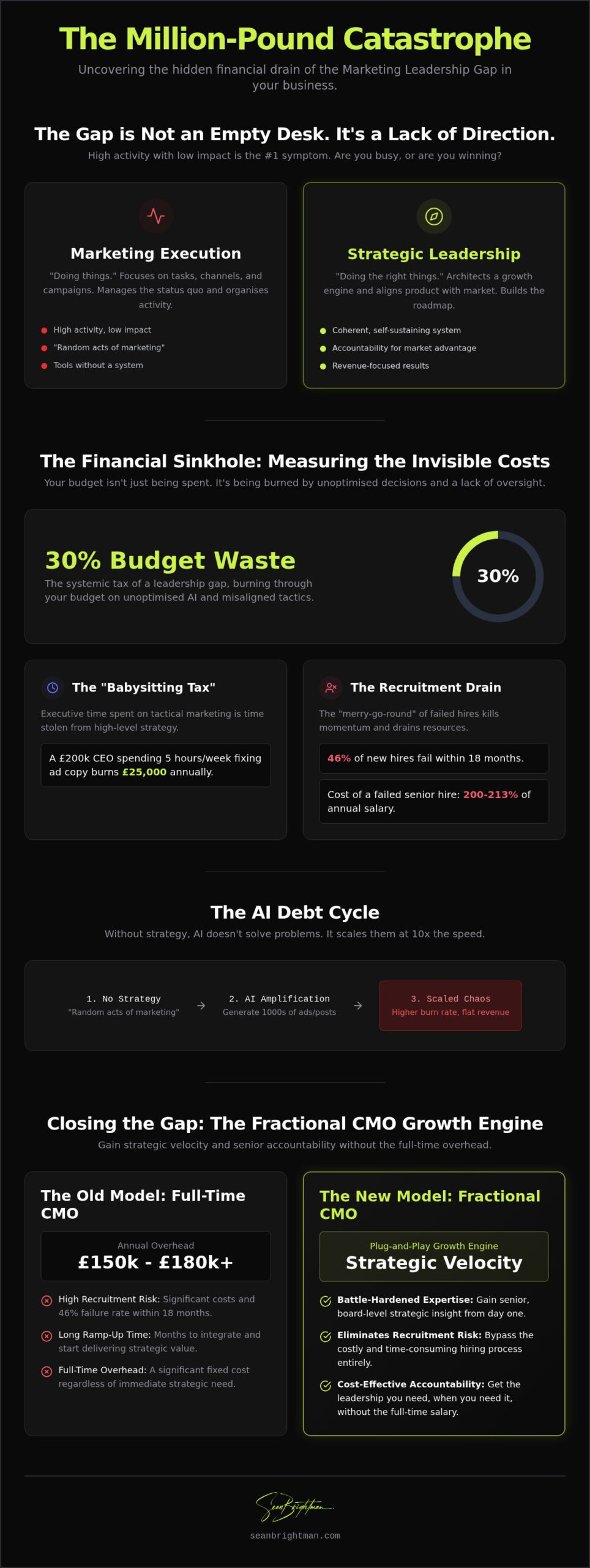
    A fractional CMO acts as a plug-and-play growth architect. You get the strategic heavy lifting of a seasoned professional without the £150k+ annual overhead of a full-time hire. It’s about buying the outcome, not the person’s full-time presence. You need a fixer, not a permanent resident. This approach allows you to inject senior-level direction exactly where it is needed most, right now.

    Senior Strategy, Fractional Commitment

    Mid-level hires often focus on the “how” before they’ve mastered the “why.” They are great at execution but struggle with high-level positioning and systemic integration. They manage the social media calendar whilst the pipeline starves. A battle-hardened expert, however, has seen your specific failure pattern dozens of times. They bring order to internal complexity by stripping away the fluff and focusing on the critical levers that drive revenue. They don’t need hand-holding; they provide the direction.

    Fractional leadership is designed for speed. There is no corporate politeness or ego to navigate. The focus is entirely on strategic velocity. We identify the bottlenecks, realign the team, and ensure every pound spent is an investment in a measurable lead. It’s about moving from a department that costs money to an asset that generates it.

    Your Next Move

    Is your business ready for this shift? If you have a product that works but a pipeline that doesn’t, you have a leadership gap. The first 30 days of a strategic turnaround focus on the forensic diagnostic audit. We identify the leaks, terminate the vanity projects, and realign the messaging with your winning aspiration. By day 60, we are testing the new architecture. By day 90, the engine is rebuilt and the leads are flowing consistently.

    Stop guessing and start growing. You’ve spent enough time chasing tactical ghosts and wondering why is my marketing not generating leads whilst your competitors take your market share. It’s time to install a professional growth engine that delivers predictable, scalable results. The fix is systemic. The leadership is fractional. The impact is total.

    Stop Guessing and Start Engineering Growth

    Activity reports are a smokescreen for strategic failure. If you’re still asking why is my marketing not generating leads, it’s time to stop looking at the ads and start looking at the architecture. A broken engine isn’t fixed with a fresh coat of paint. It requires a forensic audit, a sharp winning aspiration, and a high-accountability framework that delivers revenue. Tactics are the fuel, but without a functional engine, you’re just pouring money onto the pavement.

    With over 20 years of senior marketing leadership and a focus on AI-powered growth engines, I’ve seen these patterns across the UK market. As the author of “The Growth Engine,” I specialise in stripping away the fluff to build systems that work whilst others are still chasing vanity metrics. You don’t need more busywork; you need a predictable pipeline that scales with your ambition. It’s time to move from hope-based marketing to clinical execution.

    Ready to build a predictable pipeline? Book a Strategic Roadmap session to fix your lead flow. Your growth engine is waiting. Let’s get to work.

    Frequently Asked Questions

    Why is my Facebook/LinkedIn ad spend not resulting in leads?

    You’re likely treating a platform as a strategy. Ad spend fails when you run generic “me too” messaging without a specific winning aspiration. If your ads don’t address a narrow problem for a narrow audience, the algorithm can’t save you. You’re paying for impressions whilst ignoring the conversion architecture. Stop buying traffic for a destination that doesn’t work.

    How long does it take to fix a broken marketing strategy?

    You can stop the bleeding in 30 days and see a total turnaround in 90. The first month is forensic diagnostics to terminate vanity projects and realign positioning. By month two, we test the new architecture. By month three, the engine is rebuilt. It’s about strategic velocity and clinical execution, not endless tactical tweaking.

    What is the difference between a marketing agency and a fractional CMO?

    An agency sells services; a fractional CMO sells leadership. Agencies want to sell you more social posts, ad management, or SEO packages. A fractional CMO builds the growth architecture and holds the entire team accountable for revenue. One is a tactical vendor; the other is a battle-hardened strategist who owns the results.

    How much should I be spending on lead generation in the UK?

    Your spend should be dictated by your growth targets and customer acquisition costs, not a random industry average. Many UK scale-ups fail because they fragment a modest budget across too many channels. Instead of asking for a flat figure, ask what it costs to dominate your specific niche. Don’t spread yourself thin; concentrate your force to win.

    Can AI actually help with lead generation or is it just hype?

    AI is a functional component, not a magic button. In 2026, it’s essential for processing intent data and personalising buyer journeys in real time. It removes manual friction from your growth engine. However, if your strategy is rotten, AI just helps you fail faster. Use it for mechanical efficiency, but never for the core strategic thinking.

    Do I need to hire a full-time marketing manager to get leads?

    No, a mid-level hire often lacks the senior-level authority to fix systemic rot. They focus on the “how” whilst the “why” remains broken. A fractional CMO provides high-impact direction without the £150k+ overhead of a full-time executive. You need senior-level architecture and accountability to solve the problem of why is my marketing not generating leads.

    What are the most common friction points in a B2B sales funnel?

    The “ask” is almost always too big, too early. Most B2B funnels fail because they treat a first-time visitor like a buyer ready to close. Other friction points include slow response times, generic content, and complex forms. If your website acts as a static brochure rather than a proactive salesperson, your leads will continue to fall through the cracks.

    How do I know if my marketing team is the problem?

    Your team is the problem if they provide activity reports instead of revenue reports. If they celebrate “reach” and “engagement” whilst your pipeline is empty, there’s a fundamental lack of accountability. Often, the team isn’t incompetent; they are just leaderless. They are busy doing things, but nobody has told them which things actually drive the bottom line.

  • Strategic Marketing Direction: How to Stop the Noise and Build a Growth Engine

    Strategic Marketing Direction: How to Stop the Noise and Build a Growth Engine

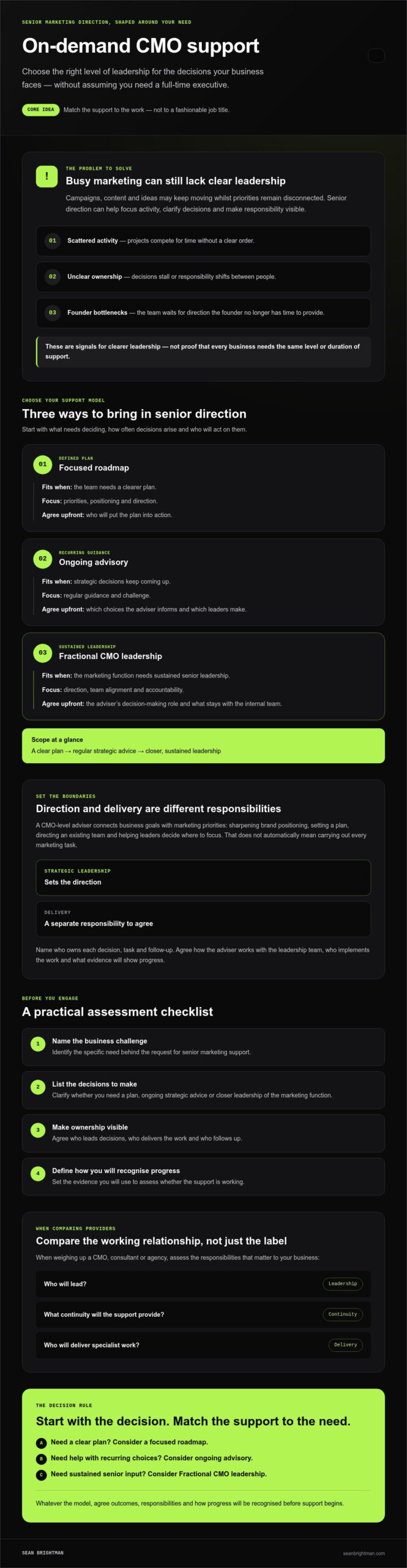
    Your marketing budget is leaking; you just don’t know where the holes are. Most CEOs are tired of funding a messy department that delivers plenty of activity but zero clarity on ROI. You don’t need more tactics. You need a strategic marketing direction that actually moves the needle. It’s the difference between throwing paint at a wall and building a precision-engineered growth engine.

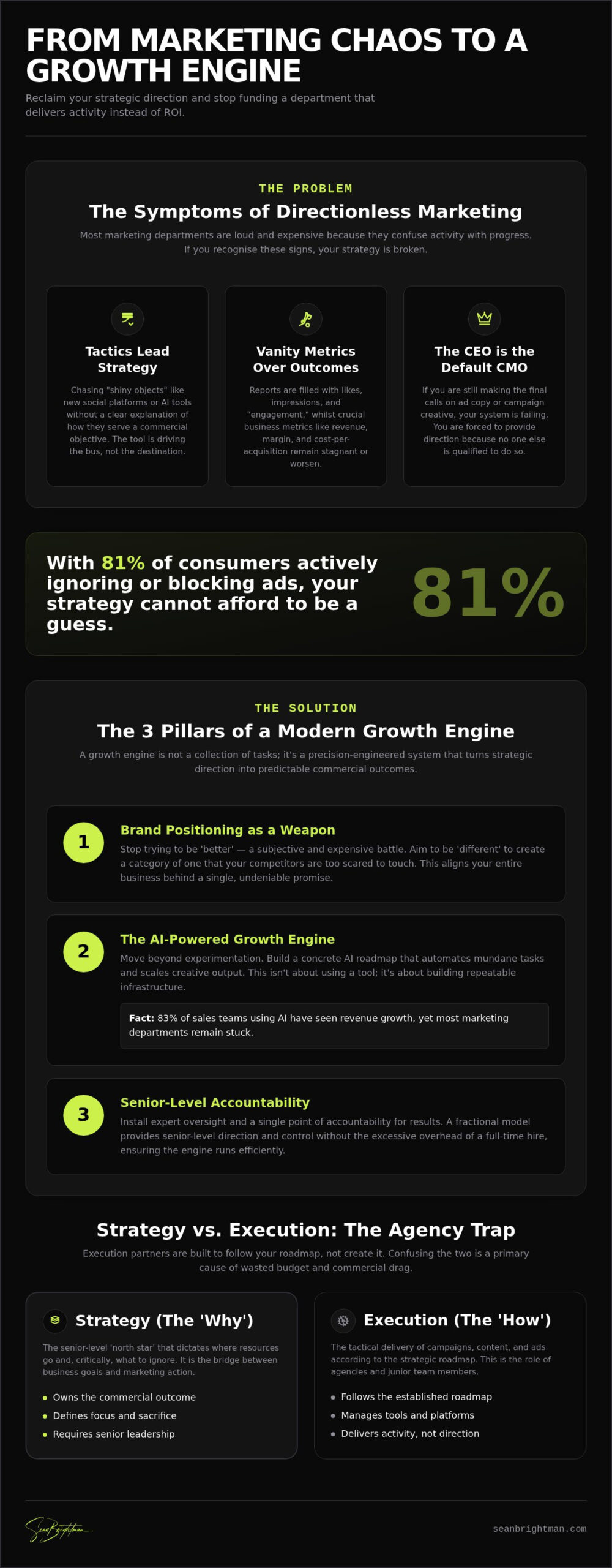
    You likely feel the weight of high spend paired with low visibility. It’s a common frustration. You want a system that runs like a machine, not a series of fires you have to put out. With research showing that 81% of consumers now actively ignore or block ads, your strategy can’t afford to be a guess. We’re going to fix that. You’ll learn how to transition from chaotic execution to a high-impact roadmap that drives measurable business value.

    We’ll explore the mechanics of building a scalable system. This includes how to organise your AI integration and secure expert oversight without the overhead of a full-time salary. It’s time to stop the noise and start the engine.

    Key Takeaways

    • Stop confusing activity with progress; establish a strategic marketing direction that dictates exactly where your resources go and what you must ignore.
    • Transform your marketing into a precision-engineered growth engine by implementing repeatable systems that scale without constant manual intervention.
    • Stop the “agency trap” by recognising that execution partners cannot lead your strategy; they are built to follow your roadmap, not create it.
    • Reclaim your commercial velocity through a brutal 90-day reset that audits existing noise and refocuses every pound on measurable results.
    • Secure senior-level accountability and expert oversight through a fractional model, avoiding the excessive overhead of a full-time hire.

    What is Strategic Marketing Direction? (And Why You Lack It)

    Most marketing departments are loud, expensive, and fundamentally lost. They produce a mountain of content and run dozens of campaigns, yet the needle barely moves. This happens because they lack a strategic marketing direction. It is not a 50-page document gathering dust on a server; it is the senior-level ‘north star’ that dictates exactly where your resources go and, more importantly, where they don’t. Strategic marketing direction is the bridge between business goals and tactical execution.

    True direction is the art of sacrifice. Whilst most businesses try to do everything at once, a real strategist understands that focus is your only leverage. If you don’t have the discipline to choose what not to do, you are just gambling with your budget. Without this filter, your marketing team is merely busy. They are not productive. They are generating noise instead of building a growth engine. Whilst a foundational Marketing strategy provides the theory, direction provides the command and control necessary to win in a crowded market.

    Activity vs. Progress: The CEO’s Dilemma

    CEOs often confuse motion with momentum. Buying more ads or producing more blog posts is not a strategy; it is just increased spending. This is the ‘messy’ marketing trap. When your department lacks senior leadership, you end up with wasted budgets and missed market windows. You see the activity, but you don’t see the commercial velocity. This environment is toxic for talent. A lack of clear direction leads to team burnout and high turnover because high performers hate running on a treadmill that leads nowhere. They want to see results, not just checklists.

    The Three Symptoms of Directionless Marketing

    If you aren’t sure if your direction is broken, look for these three red flags. They are the hallmarks of a system that has lost its way.

    • Tactics lead the strategy: You hear phrases like “we need a TikTok account” or “we should try AI influencers” before anyone explains how those tools serve a commercial objective. The tool is driving the bus, not the destination.
    • Vanity metrics over outcomes: Your reports are full of likes, impressions, and “engagement” whilst your cost per acquisition remains stagnant. If success isn’t measured in revenue and margin, it isn’t success.
    • The CEO is the default CMO: If you are still the one making final calls on ad copy or campaign creative, your system is failing. You are providing the direction because no one else is qualified to do so.

    You don’t need more hands on deck. You need a sharper mind at the helm to turn that tactical chaos into a repeatable machine.

    The 3 Pillars of a Modern Growth Engine in 2026

    A growth engine is the mechanical reality of your strategic marketing direction. It is not a collection of loosely related tasks; it is a precision-engineered system designed to produce a predictable commercial outcome. In 2026, the distance between a market leader and a struggling also-ran is defined by three structural pillars. These pillars turn your vision from an abstract theory into a functional, revenue-generating machine.

    Pillar 1: Brand Positioning as a Weapon

    Don’t aim to be better. Aim to be different. ‘Better’ is subjective, fragile, and incredibly expensive to prove. ‘Different’ creates a category of one. By engaging a marketing leadership consultant UK, you can identify the unique commercial angle that your competitors are too scared to touch. This level of clarity does more than just attract customers; it can support a business transformation by aligning every internal department behind a single, undeniable promise. When your culture matches your brand, you stop selling and start dominating.

    Pillar 2: The AI-Powered Growth Engine

    Stop playing with tools and start building infrastructure. Research from 2026 shows that 83% of sales teams using AI have seen revenue growth, yet most marketing departments are still stuck in the ‘experimentation’ phase. You need an AI roadmap that automates the mundane whilst scaling your creative output. This requires a marketing operations consultant mindset. You aren’t just using ChatGPT to write emails; you are building repeatable, automated processes that run without your constant supervision. With 63% of marketers already using generative AI, the competitive advantage is no longer the tool itself. It’s the integration of that tool into a strategic marketing direction that prioritises speed and precision.

    Pillar 3: Absolute Accountability

    A plan that isn’t measured is just a wish list. You need mechanisms that ensure every pound spent serves a commercial goal. This means moving beyond vanity metrics and focusing on the numbers that actually impact your balance sheet. Accountability is the ‘get-your-hands-dirty’ part of leadership. It’s about setting hard KPIs and having the guts to kill projects that aren’t performing. You need a department that values results over ego. If your current systems feel like they are held together with tape and spreadsheets, it might be time to look at an Advisory Retainer to install the necessary discipline and oversight.

    These pillars provide the stability your business needs to scale. When positioning, AI integration, and accountability work in harmony, marketing stops being a cost centre and becomes a predictable engine for growth.

    Strategy vs. Execution: Why Your Agency Can’t Fix Your Direction

    You cannot outsource your soul. Most CEOs make the mistake of hiring an agency and expecting them to provide a strategic marketing direction. It won’t happen. Agencies are built to execute. They are designed to scale their own billable hours by delivering assets, running campaigns, and managing platforms. They are vendors; they are not your business partners. If you don’t give them a roadmap, they will invent one that serves their bottom line, not yours.

    This is the ‘Agency Trap’. You pay for activity whilst the underlying strategy remains broken. An agency’s incentive is to sell you more services, more content, and more ad spend. They want to expand the scope. A B2B marketing advisor, however, is incentivised by your efficiency. One wants to sell you more machinery; the other wants to ensure the machine you have is actually pointing at the right target.

    The Difference Between an Advisor and an Agency

    Advisors provide the ‘What’ and the ‘Why’. Agencies provide the ‘How’. An advisor owns the ROI and the commercial outcome; the agency owns the deliverables and the deadlines. You wouldn’t hire a builder to architect your house, and you shouldn’t hire a social media agency to architect your market positioning. You need a battle-hardened strategist to manage your external partners. Without that oversight, you are just a client with a chequebook and no leverage. A strategist ensures that every tactical penny spent by your agency aligns with the broader business objectives.

    Why Execution Without Direction is a £120k Mistake

    Hiring a junior team and expecting senior-level results is a recipe for expensive failure. When you lack direction, you suffer from ‘tactical drift’. This is the slow erosion of your brand value as your marketing team tries every new trend without a cohesive plan. Over a year, between wasted ad spend and unproductive salaries, this drift easily becomes a £120k hole in your budget. It’s a high price to pay for ‘staying busy’. Agencies need a roadmap to follow, not a blank cheque to experiment with your capital. If you aren’t providing the strategic marketing direction, you are effectively letting your vendors decide your company’s future. That is a risk no CEO should be willing to take.

    Strategic Marketing Direction: How to Stop the Noise and Build a Growth Engine

    How to Reclaim Your Strategic Marketing Direction: A 5-Step Reset

    Stop tweaking the edges. If your marketing is a mess, you need a hard reset, not a new colour palette. Reclaiming your strategic marketing direction requires a clinical approach to your current activity. You have to be willing to kill what isn’t working to make room for what will. This is a five-step process designed to move you from tactical chaos to commercial velocity in 90 days.

    Step 1 & 2: Auditing the Chaos and Mapping the Future

    Start with Step 1: The Audit. This is about brutal honesty. Identify the ‘zombie’ campaigns that eat your budget whilst delivering nothing but vanity metrics. If a channel isn’t contributing to a commercial outcome, cut it. Don’t let sentimentality protect a failing ad account. Once the noise is gone, move to Step 2: The Roadmap. Set a ‘North Star’ metric that the entire business understands. This isn’t about clicks or impressions; it’s about revenue, margin, or market share. Your roadmap should be a 90-day sprint. Focus on high-impact, low-friction wins that prove the model and build immediate momentum for the team.

    Step 3 & 4: Building the Machinery

    Strategy is useless without a system to execute it. Step 3 is Systems Architecture. You need to define roles and responsibilities with surgical precision. Who owns the lead flow? Who owns the CRM data? By organising your tools and team around the roadmap, you move from a collection of individuals to a functional growth engine. This leads directly to Step 4: AI Implementation. Plug in automation to improve efficiency and output without increasing your full-time headcount. Use AI to handle the mundane, repetitive tasks, allowing your team to focus on high-level creative work. A machine-like system doesn’t just drive growth; it makes your business scalable and significantly more attractive for a potential exit.

    Finally, Step 5 is Ongoing Advisory. Direction is easily lost in the day-to-day grind. You need an external force to provide the accountability that keeps the engine on track. If you are ready to stop the guessing and start the building, it is time to secure a Marketing Advisory Retainer to define your path forward and ensure you stay the course.

    Securing Long-Term Direction: The Marketing Advisory Retainer

    Scaling a business is a high-stakes game. You don’t win by hiring more juniors or buying more software. You win by installing senior leadership that understands the machinery of growth. For most scale-ups, a full-time CMO is a luxury they don’t need. Instead, senior marketing leadership on demand provides the heavy-hitting strategy required to scale without the £150k overhead. It is about commercial results, not internal headcount.

    The Marketing Advisory Retainer is the mechanism for long-term consistency. It provides the ongoing strategic marketing direction that ensures your team stays focused on commercial outcomes rather than vanity metrics. Stop playing with tools. Start building a growth engine. A Fractional CMO doesn’t just give advice; they provide the leadership and accountability necessary to turn a roadmap into a revenue-generating reality.

    Why CEOs Choose an Advisory Retainer

    You can’t see the label when you’re inside the jar. Every CEO needs a second opinion from someone who isn’t buried in the daily grind of the business. An advisor provides that clinical, external perspective that internal teams often lack. Through monthly accountability sessions, your strategic marketing direction stays on track. You get the benefits of a seasoned pro without the recruitment risk or the equity demands of a full-time hire. It’s a plug-and-play solution for strategic velocity. You get the expertise you need, exactly when you need it.

    Taking the First Step: The Roadmap Session

    Clarity is your most valuable commercial asset. A single Roadmap Session can provide more direction than a year of agency status meetings. This isn’t a casual chat; it’s a high-impact strategic reset. You’ll exit the session with a clear understanding of your positioning, your AI integration plan, and your tactical priorities. You’ll know exactly what to do and, more importantly, what to stop doing. It’s time to stop the noise and start the engine. Get the strategic direction your business deserves.

    Build the Machine Your Business Deserves

    Activity is not growth. You don’t need more content or more ads; you need a system that delivers predictable commercial outcomes. True strategic marketing direction is about sacrifice. It is about choosing the high-impact paths and ignoring the tactical noise that drains your budget and burns out your team. You have the vision for your business, but without the right machinery, that vision stays stuck in the mud.

    I help CEOs move from chaos to clarity. As the author of ‘The Book’ on marketing strategy and a Fractional CMO for high-growth UK scale-ups, I’ve built these engines before. I specialise in AI integration that turns abstract theory into functional velocity. You don’t have to navigate the complexity of 2026 alone. You just need a battle-hardened strategist to point the way.

    Build your growth engine with a Strategic Marketing Roadmap. It’s time to stop guessing and start scaling. Your business is ready for the next level; let’s build the engine that takes it there.

    Frequently Asked Questions

    What is the difference between marketing strategy and strategic marketing direction?

    Marketing strategy is your theoretical plan. Strategic marketing direction is the active leadership that dictates where every pound and hour is spent. Think of it as the difference between a map and a driver. A strategy tells you where you could go; direction ensures you actually get there by making hard choices about what to ignore.

    Do I need a full-time CMO to get strategic direction?

    You don’t need a full-time hire to secure senior-level results. Most UK scale-ups are better served by a fractional model that avoids the £150k+ overhead of a permanent CMO. You get the same battle-hardened expertise and strategic oversight on a part-time basis. This allows you to invest the saved salary directly into your growth engine instead.

    How long does it take to see results from a strategic marketing reset?

    You should expect to see a shift in commercial velocity within 90 days. Whilst deep structural changes take longer, the noise can be cut instantly. A strategic reset identifies zombie campaigns and inefficient spend in the first few weeks. This immediate cleanup creates the breathing room needed for long-term systems to start producing measurable ROI.

    Can an agency provide my strategic marketing direction?

    Agencies are built to execute, not to lead. Their business model relies on selling you more services; they have a conflict of interest when it comes to cutting noise. An agency follows a roadmap; they don’t architect your business’s strategic marketing direction. You need an internal or fractional leader to manage those vendors and ensure they stay aligned with your commercial goals.

    How does AI fit into a strategic marketing roadmap?

    AI is the fuel for your growth machinery. It fits into a roadmap by automating repetitive operational tasks and scaling your content production without increasing headcount. In 2026, 83% of sales teams using AI report revenue growth. Your roadmap ensures you aren’t just playing with tools but building a precision-engineered system that integrates AI into your core workflows.

    What is a marketing advisory retainer and how does it work?

    It is a secret weapon for CEOs who need senior oversight without the full-time commitment. The retainer provides ongoing access to a strategist who ensures your roadmap stays on track. It involves monthly accountability sessions and strategic adjustments. This keeps your team focused on outcomes and prevents the tactical drift that usually erodes brand value over time.

    Is strategic marketing direction only for large corporations?

    Small businesses need direction more than anyone else. Large corporations can afford to waste budget on failed experiments; you can’t. Precision is your only advantage. Having a clear roadmap allows you to punch above your weight by ensuring every tactical move serves a specific commercial objective. It’s about efficiency, not just scale.

    How do I know if my current marketing lacks direction?

    If you are measuring success by likes rather than revenue, you lack direction. Other red flags include a marketing team that is always busy but never productive, or a CEO who is still making final calls on ad creative. When tactics drive the bus instead of business goals, your system is broken. You are paying for activity, not progress.