Tag: strategic planning

  • Marketing Strategy for Sustainable Competitive Advantage: Building the 2026 Growth Engine

    Marketing Strategy for Sustainable Competitive Advantage: Building the 2026 Growth Engine

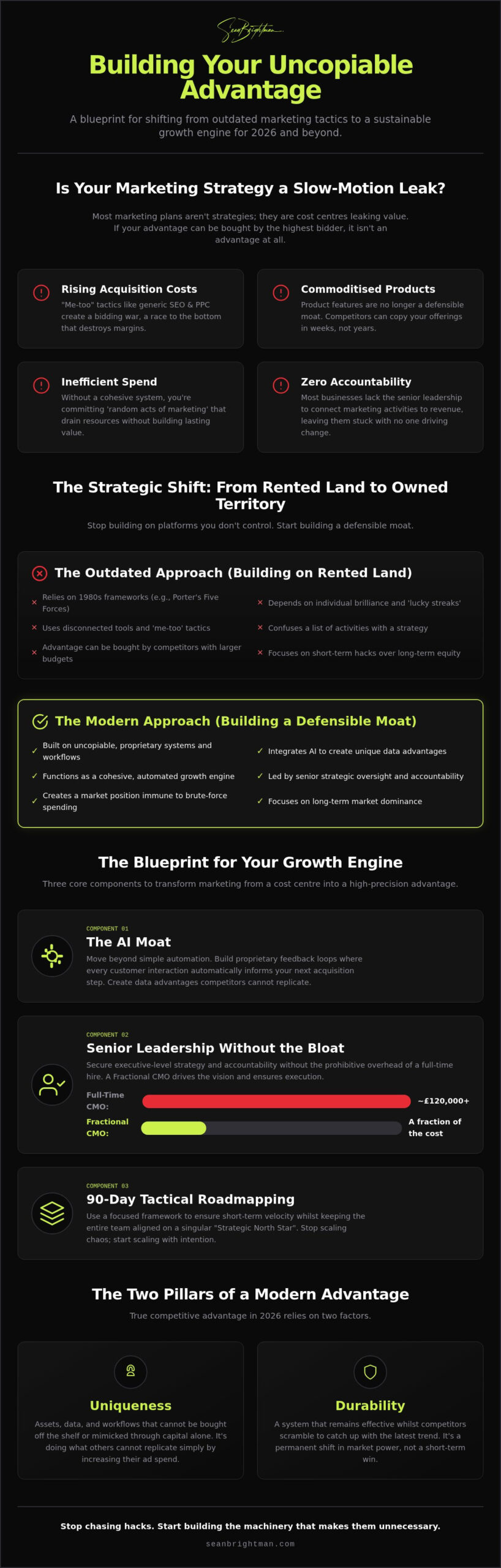
    Your current marketing plan isn’t a strategy; it’s a slow-motion leak in your balance sheet. You’re likely watching your products become commoditised whilst your customer acquisition costs climb. It’s a race to the bottom that nobody wins. To break the cycle, you need a marketing strategy for sustainable competitive advantage that relies on systems, not just slogans. Most businesses lack the senior leadership to drive this change, leaving them stuck with inefficient spend and zero accountability.

    You’ve probably realised that throwing more money at the same tired tactics won’t save you. You need a way to outpace the market without the £120,000 overhead of a full-time executive. This article provides the blueprint to build an uncopiable market position using AI-integrated operations and battle-hardened strategic oversight. We’ll examine how to transform your marketing from a cost centre into a high-precision growth engine. You’ll get a clear roadmap to market dominance, ensuring your business isn’t just surviving in 2026, but actually owning the space.

    Key Takeaways

    • Modernise your approach by ditching outdated frameworks for a marketing strategy for sustainable competitive advantage built on uncopiable systems.
    • Shift from buying disconnected tools to building a cohesive growth engine that acts as a defensible moat for your business.
    • Leverage AI consulting to move past simple automation and create proprietary data advantages that competitors cannot replicate.
    • Secure senior-level accountability and strategic direction without the £120,000 full-time salary trap by utilising a Fractional CMO.
    • Use a tactical 90-day roadmapping framework to ensure short-term velocity whilst keeping your team focused on a singular Strategic North Star.

    What is Sustainable Competitive Advantage in the 2026 Market?

    Sustainable competitive advantage isn’t a static trophy you win and keep. In the 2026 market, it’s a dynamic system of uncopiable assets that allow for long-term outperformance. Most UK businesses are still clinging to 1980s frameworks like Porter’s Five Forces. Those models were built for a world of physical moats and slow-moving competitors. Today, those moats are easily bridged by capital or software. A modern marketing strategy for sustainable competitive advantage requires shifting your focus from what you sell to how your growth engine actually functions.

    The game has changed. Product features are no longer a defensible moat; they are copied in weeks, not years. If your primary advantage is a specific tool or a slightly better widget, you’re vulnerable. Real power now lies in operational systems. It’s the difference between having a fast car and owning the only petrol station in town. You need to build a system that produces results that competitors cannot replicate, even if they have a larger budget.

    The Two Pillars of Modern SCA

    True advantage relies on two factors: uniqueness and durability. Uniqueness means doing what others cannot replicate simply by increasing their ad spend. It’s about proprietary data and specialised workflows. Durability ensures your position doesn’t evaporate the moment a new AI tool launches or a platform changes its algorithm. You aren’t looking for a quick win; you’re looking for a permanent shift in market power. Sustainable competitive advantage is the integration of proprietary data, AI-enhanced workflows, and senior leadership that creates a market position impossible to replicate through brute-force spending alone.

    • Uniqueness: Assets that cannot be bought off the shelf or mimicked through capital alone.
    • Durability: A system that remains effective whilst competitors scramble to catch up with the latest trend.

    Why Your Current Strategy is Probably Leaking

    Most UK scale-ups confuse a temporary edge with a sustainable advantage. If your strategy consists of ‘me-too’ marketing tactics like standard SEO or generic PPC, you’re building on rented land. Any competitor with a larger bank balance can buy those same results tomorrow. This tactical fatigue destroys long-term brand equity and drains your resources without building lasting value.

    A marketing plan is just a list of activities. A genuine strategy is a defensive system that makes those activities more effective over time. If your advantage can be bought by the highest bidder, it isn’t an advantage at all; it’s just an expense. You need to stop chasing the next hack and start building the machinery that makes hacks unnecessary. Without senior leadership to oversee this, you’re just throwing money at a leak and hoping for a flood.

    Building the Growth Engine: Moving from Tools to Systems

    Most businesses treat strategy like a PDF in a shared drive. It’s dead weight. A real marketing strategy for sustainable competitive advantage is a functioning machine. It’s the difference between a blueprint and the actual factory. You don’t need another document. You need an engine that produces predictable growth every single day. If your marketing relies on the individual brilliance of a single staff member or a lucky streak on LinkedIn, you don’t have a strategy. You have a gamble.

    Your marketing department probably has too many decorators and not enough architects. Decorators worry about the colour of a landing page or the flair of a social post. Architects build the scalable marketing systems that ensure those assets actually drive revenue. You must stop committing ‘random acts of marketing’ and start following a cohesive roadmap. Systems provide the defensible moat that tools alone cannot offer. Anyone can buy a subscription to a CRM, but not everyone can build a system that uses that CRM to out-manoeuvre the competition.

    Systems Architecture for Scale-ups

    Scale-ups often fail because they try to scale chaos. To build a moat, you must prioritise system design over creative execution. This starts by organising your data to create a proprietary feedback loop. Every interaction with a customer should inform the next step of your acquisition process automatically. When your systems learn from your market faster than your competitors can, you’ve won. Business owners must step back from the ‘doing’ and start designing the ‘how’. If you want to identify where your current engine is stalling, a Roadmapping session is the logical place to start.

    The Efficiency Trap

    Efficiency is doing things right. Effectiveness is doing the right things. You can be incredibly efficient at burning through your budget on the wrong channels. This is a fast track to failure. Sustainable profit isn’t driven by cutting costs on a broken process; it’s driven by making that process effective. You need to scrutinise your current marketing operations for hidden waste. Look for tasks that don’t contribute to the durability of your market position. If a process doesn’t add a brick to your moat, it’s just noise. Strip it out. Focus on the machinery that delivers long-term outperformance, not the minor tweaks that provide a temporary ego boost.

    The AI Moat: Integrating Intelligence into Your Strategy

    AI isn’t a shortcut for lazy writing; it’s a mechanical advantage for your growth engine. If you’re only using it to generate emails or social posts, you’re missing the point entirely. Everyone has access to the same basic tools. When everyone uses the same prompts, everyone gets the same average results. This is the AI Paradox: the more accessible the technology becomes, the less value it provides as a standalone tool. To build a marketing strategy for sustainable competitive advantage, you must move beyond the interface and into the integration.

    Real defensibility comes from how you connect these tools to your proprietary data. Generic AI use is a commodity. Bespoke AI implementation is an asset. Through specialized AI consulting, you can identify the unique data advantages within your business that competitors simply cannot see. You aren’t just buying a subscription; you’re building a smarter machine that learns from your specific market behaviour. This turns a generic tool into a proprietary engine that drives long-term outperformance.

    Traditional vs. AI-Powered SCA

    Traditional strategy relies on manual data analysis and static brand positioning. It’s slow. It’s reactive. By the time you’ve analysed last quarter’s performance, the market has already moved on. AI-powered strategy relies on real-time predictive growth engines. Instead of looking at what happened, you’re looking at what is about to happen. This allows for dynamic messaging that evolves as fast as your customers do. Static plans lead to ‘Tool Fatigue’ where you’re constantly chasing the next shiny object without ever building a foundation. AI-powered systems stop the chase by creating a self-optimising loop.

    • Manual Analysis: Looking in the rearview mirror to make future decisions.
    • Predictive Intelligence: Using real-time data to anticipate market shifts before they occur.
    • Static Messaging: One-size-fits-all content that ignores individual user behaviour.
    • Dynamic Optimisation: Bespoke messaging that adjusts based on proprietary data signals.

    Building Proprietary Intelligence

    The goal is to find market gaps that your competitors are too slow to recognise. AI can scan vast amounts of competitor data, customer feedback, and search trends to highlight opportunities in hours, not weeks. This speed is your primary weapon. When you align these internal AI roadmaps with your business exit goals, you create immense value for shareholders. You aren’t just a company with a marketing team; you’re a company with a proprietary intelligence system. The AI Moat is the fusion of proprietary data and operational speed that makes your market position impossible to replicate through human effort alone.

    Marketing Strategy for Sustainable Competitive Advantage: Building the 2026 Growth Engine

    Roadmapping Success: A Tactical Framework for CEOs

    Stop thinking about five-year plans. They’re works of fiction. By the time you’ve finished the document, the market has shifted, your competitors have pivoted, and your data is stale. You need a marketing strategy for sustainable competitive advantage that thrives on 90-day velocity. This isn’t about moving fast for the sake of it. It’s about moving toward a ‘Strategic North Star’ whilst ignoring the tactical noise. Most CEOs get distracted by shiny new platforms or trendy hacks. You must adopt a binary approach to resource allocation: invest in the growth engine, not the temporary exhaust. Invest in systems, not slogans.

    Success starts with a marketing strategy roadmap that prioritises three critical phases. This framework ensures your team isn’t just busy, but actually building equity. You need to move away from ‘hope-based’ marketing and toward a clinical, systematic approach to growth. If your current plan feels like a list of chores rather than a path to dominance, it’s time to tear it up and start again.

    The Roadmapping Methodology

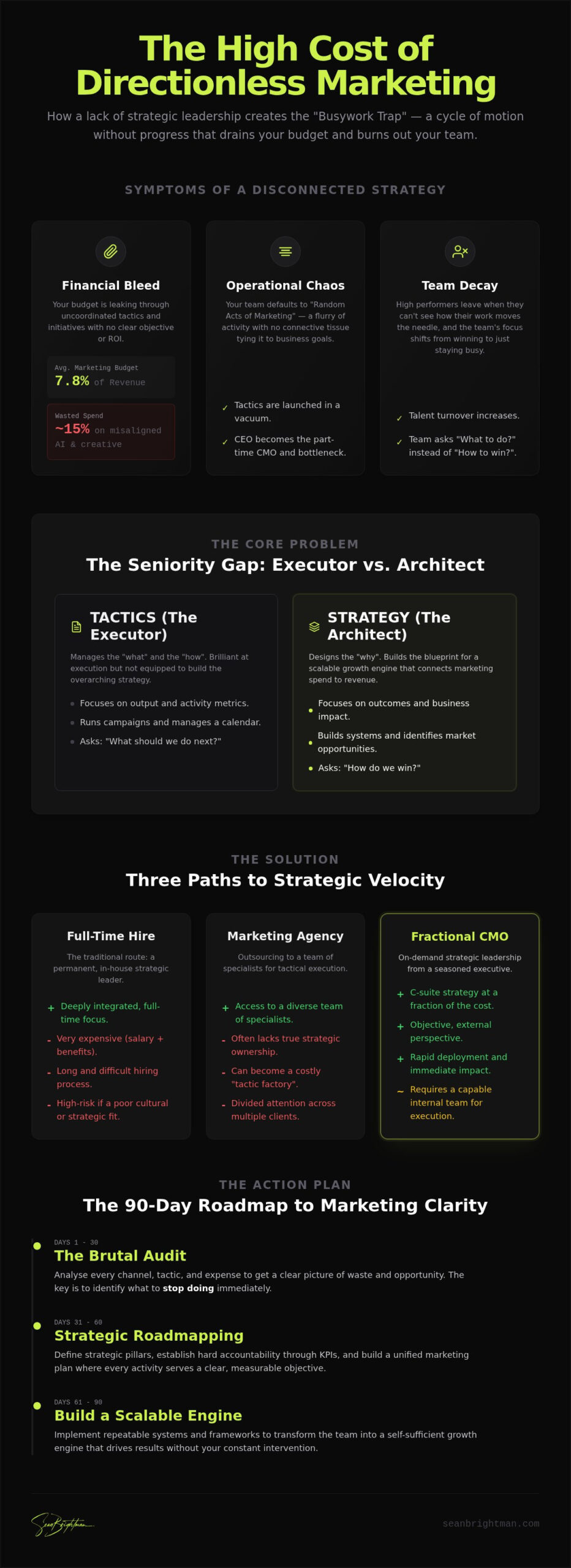
    The first step is the Brutal Audit. You must strip away every activity that doesn’t contribute to your moat. If it’s a ‘me-too’ tactic that anyone can buy, kill it immediately. It’s better to do three things exceptionally well than ten things with mediocre effort. Second is Positioning. You must define the uncopiable angle that makes price irrelevant. If you can’t explain why you’re different in one sentence, you aren’t. Finally, move to Systems Design. This is where you build the machinery to support the brand. It’s about creating a repeatable process that doesn’t break when you scale.

    Accountability: The Missing Ingredient

    Strategy doesn’t fail because the ideas are bad. It fails because implementation is hard. Most marketing teams are busy, but they aren’t necessarily productive. They focus on ‘activity’ because it’s easier to measure than ‘impact’. They’ll give you reports on clicks and impressions whilst the revenue stays flat. You need a senior external force to ensure the roadmap stays on track. A marketing advisory retainer acts as that external pressure. It provides the strategic velocity needed to turn a plan into a functioning growth engine. It’s about driving high-impact results, not just filling a calendar with tasks.

    If you’re ready to stop guessing and start building a defensible market position, book your Roadmapping session today and take the first step toward strategic clarity.

    The Fractional CMO: Senior Leadership Without the Bloat

    Hiring a full-time CMO in the UK is often a £120,000 mistake. That is a massive capital commitment for a scale-up to make before a single system has been built. Most businesses don’t need a full-time executive to sit in board meetings; they need senior leadership to build an uncopiable growth engine. A Fractional CMO provides the strategic depth you require without the corporate bloat. It’s about getting a high-level brain without the permanent overhead. You get the expertise of a battle-hardened strategist who has seen your specific problems before and knows the exact mechanical fix.

    This leadership is the final piece of your marketing strategy for sustainable competitive advantage. A fractional leader doesn’t just ‘do’ marketing. They build the systems that your future full-time hires will eventually inherit. They move you away from the recruitment headache and toward immediate tactical precision. You’re investing in an architect who designs the machine, ensuring every pound spent is an investment in your company’s long-term value, not just a temporary spike in traffic.

    Strategic Advisory vs. Agency Execution

    You need a strategist to manage your agencies, not another agency to manage your budget. Agencies are execution specialists, but they’re rarely objective about where your money should go. They’ll always recommend more of what they sell. A Fractional CMO offers a blunt, external perspective that cuts through the noise of traditional consulting. They aren’t there to be polite or protect the status quo. They’re there to drive results. Stop hiring a pair of hands for tactical chores and start hiring a brain to design your market dominance.

    Next Steps: Securing Your Advantage

    Building a defensible moat starts with clarity, not a long-term contract. The most efficient way to begin is with a one-off roadmapping session. This identifies your Strategic North Star and strips away the waste in your current operations. Once the roadmap is set, an advisory retainer provides the ongoing accountability needed to keep the engine running. It’s time to stop guessing and start building a functioning growth machine. Book a strategic roadmap session with Sean Brightman to secure your position for 2026 and beyond.

    Stop Chasing Hacks and Start Building Systems

    Your business doesn’t need more tactics. It needs a marketing strategy for sustainable competitive advantage that functions like a well-oiled machine. We’ve established that 1980s frameworks are dead. You’ve seen how AI and systems architecture create moats that capital alone cannot buy. Now, you have a choice. You can continue with random acts of marketing, or you can install a senior leader to build a defensible future.

    As the author of ‘The Book’ on marketing strategy, I provide the direct, battle-hardened advice that UK scale-ups need to dominate their space. I don’t offer corporate fluff; I offer a plug-and-play growth engine. It’s about moving from “hiring hands” to “hiring a brain” that understands how to scale operations without the permanent overhead of a full-time executive. You need an architect to design your dominance, not just a decorator to paint the windows.

    Build your uncopiable growth engine with a Fractional CMO. You have the roadmap. Now, you need the accountability to execute it. Let’s turn your marketing from a balance sheet leak into a lasting legacy. You’ve got the vision; let’s build the machinery to match it.

    Frequently Asked Questions

    What is the difference between a competitive advantage and a sustainable one?

    A competitive advantage is a temporary edge that can be bought, like a surge in ad spend or a seasonal trend. A sustainable one is a defensible system that competitors cannot easily replicate through capital alone. It’s the difference between having a fast car and owning the only petrol station in town. True sustainability comes from proprietary data, unique operational systems, and senior strategic leadership that keeps the engine running whilst others stall.

    How can a small UK business compete with larger firms using AI?

    Smaller UK firms compete by using AI for speed and precision rather than brute-force spending. Large corporations are often slowed down by bureaucracy and tool fatigue. A lean business can integrate AI into its core operations to identify market gaps faster. By building a marketing strategy for sustainable competitive advantage that uses bespoke AI engines, you can out-manoeuvre larger rivals who are still stuck in slow, manual cycles.

    Why do most marketing strategies fail to provide a long-term advantage?

    Most strategies fail because they are just lists of tactics disguised as a plan. They focus on random acts of marketing like social posts or generic SEO that any competitor can copy. Without a senior architect to design the growth engine, these efforts lack cohesion. They provide a temporary ego boost but fail to build a defensible moat, eventually leading to inefficient spend and the commoditisation of your products.

    Is a Fractional CMO better than a full-time hire for strategy?

    For a UK scale-up, a Fractional CMO is often the smarter play. You get a battle-hardened expert to design your systems without the £120,000 full-time salary overhead. Full-time hires often get bogged down in internal politics. A fractional leader remains objective, focusing entirely on strategic velocity and results. It’s about hiring a brain to build the machine, not just a pair of hands to manage the status quo.

    How long does it take to see results from a new marketing roadmap?

    You should see strategic clarity and operational improvements within a 90-day sprint. The goal of a roadmap is to create immediate velocity by stripping away what doesn’t work. Whilst a marketing strategy for sustainable competitive advantage takes time to fully mature, the shift from chaos to order happens quickly. By the end of the first quarter, your growth engine should be functioning with clear accountability and measurable impact.

    Can AI really create a sustainable moat for my business?

    AI only creates a moat if it’s integrated with your proprietary data. Simply using ChatGPT won’t save you because your competitors can do the same. The moat is built when you use AI to automate unique workflows or predict customer behaviour using your specific business insights. It’s the combination of speed and proprietary intelligence that makes your market position uncopiable, turning generic tools into bespoke strategic assets.

    What are the core components of a marketing growth engine?

    A growth engine requires three components: proprietary data, automated systems, and senior strategic oversight. Data provides the fuel, systems provide the machinery, and leadership ensures the engine is pointed at your Strategic North Star. Without all three, you just have a collection of expensive tools. A functioning engine produces predictable revenue and builds equity, ensuring your business outperforms the market regardless of tactical shifts or platform changes.

    How does brand positioning contribute to sustainable competitive advantage?

    Brand positioning is the psychological component of your moat. It defines the uncopiable angle that makes price irrelevant to your target audience. If you aren’t positioned correctly, you’re a commodity. Strong positioning ensures that even if a competitor copies your features, they cannot copy your identity. It’s the difference between being a choice and being the only logical solution for a specific customer problem.

  • How to Build a Marketing Strategy Roadmap That Actually Drives Exit-Ready Growth

    How to Build a Marketing Strategy Roadmap That Actually Drives Exit-Ready Growth

    Most marketing roadmaps are little more than expensive works of fiction designed to make stakeholders feel safe whilst the budget burns. You don’t need another colourful Gantt chart; you need a functional blueprint for a high-velocity growth engine. If your current marketing strategy roadmap feels like a list of disconnected tactics rather than a path to enterprise value, you aren’t alone.

    It’s exhausting to deal with tool fatigue and a lack of alignment whilst watching your marketing spend disappear into a black hole. You want a department that runs like a machine, delivering predictable lead generation instead of monthly surprises. We agree that marketing should be a profit centre, not a line-item expense.

    Stop drawing timelines and start building for an exit. This battle-tested guide shows you how to construct a 12-month strategy that actually drives growth. We will explore the exact steps to bridge the gap between business goals and daily activity, ensuring your marketing is ready for the scrutiny of any future buyer.

    Key Takeaways

    • Build systems, not just timelines. Treat your roadmap as the architectural blueprint for a growth engine rather than a simple list of tasks.
    • Shift to AI infrastructure. Map AI implementation across the customer journey to move from playing with tools to building a high-velocity machine.
    • Maximise enterprise value. A documented marketing strategy roadmap is a critical asset that proves your growth is repeatable and scalable for future buyers.
    • Audit the mess. Use our 5-step execution guide to strip away tactical noise and align every activity with your commercial North Star.
    • Bridge the accountability gap. Understand why senior advisory is the key to turning a static plan into a functional revenue engine.

    Beyond the Gantt Chart: What a Marketing Strategy Roadmap Really Is

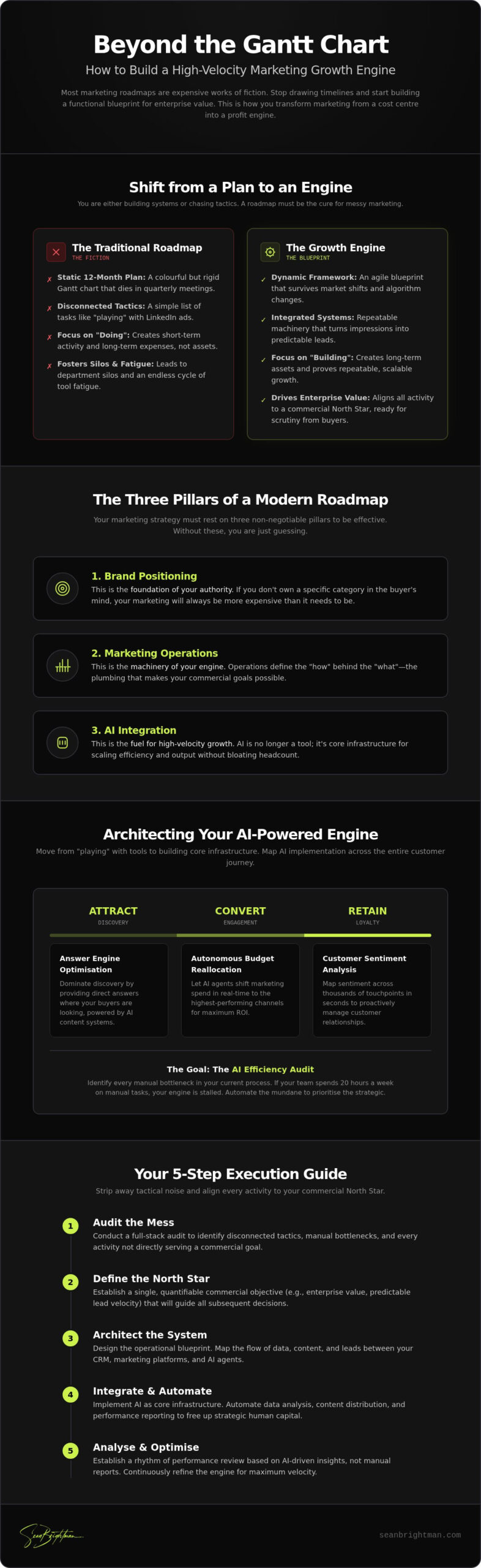
    Most roadmaps are decorative. They live in colourful spreadsheets and die in quarterly meetings. A real marketing strategy roadmap isn’t a schedule of events; it’s an architectural blueprint for a growth engine. It defines exactly how you will build enterprise value whilst your competitors are still arguing over font sizes.

    We work in a binary: you are either building systems or you are chasing tactics. Tactics are “playing” with LinkedIn ads. Systems are the integrated machinery that turns an impression into a predictable lead. A roadmap is the cure for messy marketing. It ends the department silos and stops the endless cycle of tool fatigue by forcing every activity to justify its existence against a commercial goal.

    Static 12-month plans are dead. In 2026, market shifts happen in weeks, not years. If your plan can’t survive a sudden algorithm change or an AI breakthrough, it’s a liability. You need a framework that is dynamic, precise, and focused on building a machine that runs without you.

    The Difference Between a Plan and an Engine

    A plan is a checklist of tasks. It’s passive. An engine is a repeatable process designed to produce a specific result. Most CEOs ask their teams “what are we doing this month?” That is a tactical trap. Instead, you should be asking “what are we building?”

    When you focus on building, you create assets. When you focus on doing, you only create expenses. You can read more about shifting from cost centres to growth engines in our guide on Strategic marketing for CEOs. A roadmap ensures that every pound spent is an investment in the engine’s long-term horsepower.

    The Three Pillars of a Modern Roadmap

    Your marketing strategy roadmap must rest on three non-negotiable pillars to be effective. Without these, you’re just guessing.

    • Brand Positioning: This is the foundation of your authority. If you don’t own a specific category in the buyer’s mind, your marketing will always be more expensive than it needs to be.
    • Marketing Operations: This is the machinery. Whilst a standard marketing plan might list goals, operations define the plumbing that makes those goals possible. It’s the “how” behind the “what.”
    • AI Integration: This is the fuel. In 2026, AI is no longer a set of separate tools. It is the core infrastructure that allows you to scale efficiency and output without bloating your headcount.

    When these pillars are aligned, your marketing department stops feeling like a black hole for cash. It starts feeling like a predictable, high-velocity asset that is ready for an exit at any moment.

    The Architecture of an AI-Powered Marketing Roadmap

    Most marketing teams are currently distracted by shiny objects. They collect AI tools like they’re trading cards but fail to integrate them into a functional system. This is a waste of time and capital. An effective marketing strategy roadmap treats AI as core infrastructure, not an accessory. AI Roadmapping is the strategic application of intelligence to marketing operations.

    Moving from “playing” with tools to building an engine requires an AI Efficiency Audit. You must identify every manual bottleneck in your current process. If your team spends twenty hours a week on manual data entry or basic content tweaks, your engine is stalled. You need to map implementation across the entire customer journey: Attract, Convert, and Retain. This ensures AI handles the volume whilst your people handle the strategy.

    In 2026, this isn’t just about chatbots. It involves Answer Engine Optimisation (AEO) for discovery and autonomous budget reallocation for performance. This is the transition from tool fatigue to scalable growth. You can explore how we manage this shift in our approach to AI consulting, where we focus on engines rather than individual platforms.

    Automating the Mundane to Prioritise the Strategic

    Data analysis is the first major win for an AI-powered roadmap. AI can map customer sentiment across thousands of touchpoints in seconds, a task that previously took weeks of manual labour. Your 2026 marketing strategy roadmap must include a dedicated “System Architecture” phase. This is where you build the pipes that allow data to flow between your CRM and your AI agents. When the machinery handles the mundane analysis, your team is free to focus on high-level creative and commercial positioning.

    The Human Element: Who Manages the AI?

    Who manages the machine? Many CEOs make the mistake of handing AI tasks to junior staff. This is backwards. Junior staff understand the “how,” but they lack the “why.” You need senior leadership to oversee the integration of these systems to ensure they align with business goals. It’s about redefining roles within the organisation to focus on oversight and strategic direction. If you want to stop guessing and start building a machine that drives value, it might be time to look at a professional AI-driven strategic reset for your department.

    Strategic Trade-offs: Mapping for Exit vs. Mapping for Scale

    Your destination dictates your design. Most leaders build for next month; smart leaders build for the buyer. If you’re aiming for a 24-month exit, your marketing strategy roadmap is no longer just a growth plan. It’s a due diligence document. You are building an asset that must prove its worth under the microscope of an acquisition team.

    Buyers don’t pay for your hard work or your “potential.” They pay for repeatable systems that function without the founder. A documented roadmap increases enterprise worth because it removes the “key man” risk. It proves that your lead generation is a deliberate choice, not a lucky streak. You can read more about the specific valuation drivers in our guide on marketing strategy for business exit.

    To be exit-ready, your marketing systems must pass a specific checklist:

    • Clean Data: Fully compliant, first-party data with a clear audit trail.
    • Documented SOPs: Standard Operating Procedures for every tactical move.
    • Scalable CAC: Proof that you can acquire customers at a predictable cost.
    • Independence: A marketing engine that runs whilst the CEO is out of the room.

    Scaling for Growth: The Aggressive Roadmap

    When you’re mapping for raw scale, market share is your primary target. You prioritise aggressive customer acquisition. Your Customer Acquisition Cost (CAC) might be higher as you push into new territories or block competitors. This is the “land grab” phase. You move from scrappy, founder-led experiments to systematic, high-volume growth. Every pound is spent on visibility and volume.

    Scaling for Exit: The Efficiency Roadmap

    Mapping for an exit requires a pivot toward margins. You focus on Lifetime Value (LTV) and operational efficiency. Buyers want to see a lean, high-output machine with minimal waste. You optimise the machinery you’ve built rather than just adding more fuel. This roadmap emphasises retention, upsells, and the automation of the customer journey. You are building a machine that works independently, making it a “plug-and-play” asset for a potential acquirer.

    How to Build a Marketing Strategy Roadmap That Actually Drives Exit-Ready Growth

    How to Build Your Growth Engine: A 5-Step Execution Guide

    Roadmapping isn’t about picking a template or a pretty colour scheme. It’s about engineering. Most roadmaps fail because they are built on assumptions rather than audits. A high-impact marketing strategy roadmap requires a clinical approach to your existing infrastructure before you ever touch a timeline. If you start by choosing a format, you’ve already lost.

    Step 1 & 2: The Strategic Foundation

    You can’t build a roadmap if you don’t know where the leaks are. Step 1 is the Diagnostic. You must audit your current “messy” marketing systems to see what’s actually converting and what’s just noise. Most SMEs discover that 80% of their activity is wasted effort. You need to find those gaps and close them before you add more fuel to the fire.

    Step 2 is Positioning. This isn’t about a new logo or a fresh coat of paint. It’s your North Star. Positioning defines exactly why you win in your category and why a buyer should care. Without it, your tactics are just expensive guesses. If you are struggling to define your edge, hiring a marketing strategy consultant can help you build a growth engine that actually scales instead of just a plan that sits on a shelf.

    Step 3 & 4: From Theory to Machinery

    Step 3 is Systems Design. You need a tech and AI stack that powers the engine, not a collection of tools that don’t talk to each other. Your “Marketing Stack” should be integrated, automated, and lean. Every tool must serve a specific purpose in the customer journey. If it doesn’t contribute to the machinery, get rid of it.

    Step 4 is the 90-Day Sprint. Planning in detail beyond three months is a fantasy. Market conditions shift too fast for static 12-month task lists. Use your marketing strategy roadmap to set the high-level direction, but execute in 90-day bursts of high-velocity action. This keeps your team focused on immediate results rather than abstract long-term goals. It forces a rhythm of delivery that prevents stagnation.

    Step 5 is the Feedback Loop. This is where most roadmaps die. You must build accountability and measurement into the process. This isn’t about being “agile” in the corporate sense; it’s about being effective. If a tactic isn’t driving the engine forward, kill it. If it is, double down. This loop ensures your strategy remains a living, breathing asset that builds enterprise value every single day.

    Stop guessing and start building your growth machine. Get a professional roadmapping reset to align your marketing with your business goals.

    From Roadmap to Revenue: The Accountability Gap

    A marketing strategy roadmap is just a document. It is not a result. The number one reason these plans fail is simple: no one is driving the bus. You can have the most sophisticated AI-powered growth engine in the UK, but without senior oversight, the machinery will seize up. Accountability is the bridge between a static plan and actual revenue.

    Most SMEs mistake activity for progress. They tick boxes but don’t move the needle. You need a mechanism that provides external perspective and blunt honesty. This is where a Marketing advisory retainer becomes essential. It’s about maintaining strategic velocity whilst your internal team handles the day-to-day execution.

    Why Your First Hire Shouldn’t Be a Full-Time CMO

    Hiring a full-time CMO too early is often a £120k mistake. You are paying for a high-level general when you don’t even have a functioning army or a proven system. It’s an expensive way to find out your foundation is cracked. A full-time hire often brings their own favourite tools and “corporate politeness,” which is exactly what a lean scale-up doesn’t need. You don’t need a manager; you need a builder.

    A fractional cmo is different. They build the marketing strategy roadmap and then build the team required to execute it. It’s about building the engine before you hire the full-time driver. You get senior-level authority and “get-your-hands-dirty” expertise without the overhead of a permanent C-suite salary. It is about impact, not attendance.

    Maintaining Strategic Velocity

    Strategy is not a “one and done” event. It’s a process of constant adjustment. Monthly reviews are the heartbeat of a successful roadmap. You need to look at real-world data and course-correct immediately. If the market shifts or a specific tactic fails, you pivot. You don’t wait for the next quarterly board meeting. Speed is useless if you are heading in the wrong direction.

    We operate with a “plug-and-play” mindset. This means high impact and low ceremony. We don’t care about long reports or bureaucratic sign-offs. We care about maximum ROI and building enterprise value. The goal is a marketing department that runs like a machine, delivering predictable growth that makes your business ready for an exit. Stop drawing timelines. Start driving revenue.

    Build the Engine, Don’t Just Draw the Map

    You’ve seen the difference between a static plan and a functional growth machine. A real marketing strategy roadmap is about engineering enterprise value, not just filling a calendar with tasks. By integrating AI as core infrastructure and shifting your focus from raw scale to exit-ready efficiency, you transform marketing from a cost centre into a high-velocity profit engine.

    Your roadmap is a due diligence document. It must prove that your growth is repeatable, scalable, and independent of the founder’s daily input. Without senior oversight to bridge the accountability gap, even the most sophisticated plan will eventually stall. You need a driver who understands the machinery and can provide direct, results-oriented advisory.

    Stop guessing and start building. Leverage senior Fractional CMO expertise and battle-hardened AI strategy to turn your marketing department into a genuine commercial asset. Build your growth engine: Book a strategic roadmapping session with Sean Brightman. It is time to stop chasing tactics and start building a legacy. You have the blueprint; now it’s time to execute.

    Frequently Asked Questions

    What should a marketing strategy roadmap include for a UK tech company?

    A roadmap for a UK tech firm must include brand positioning, marketing operations architecture, and a clear AI integration plan. It is about building an engine, not just a list of tasks. You need a system that handles lead generation whilst ensuring your data remains fully GDPR compliant and scalable for future acquisition.

    How long should a marketing roadmap be?

    Your roadmap should provide a 12-month strategic vision, but execution must happen in 90-day sprints. Planning in detail beyond three months is guesswork in a fast-moving market. A long-term vision keeps the business on course; short-term sprints keep your team moving at high velocity without getting bogged down in bureaucracy.

    What is the difference between a marketing plan and a marketing roadmap?

    A marketing plan is a checklist of activities; a marketing strategy roadmap is the architectural blueprint for your growth machinery. Plans focus on what you are doing. Roadmaps focus on what you are building. One is a list of expenses; the other is the design of a commercial asset.

    Do I need a Fractional CMO to create my marketing roadmap?

    You need a Fractional CMO if you want a roadmap that functions as a high-velocity growth engine. Junior staff can execute tactics, but they lack the senior authority to design complex systems. A Fractional CMO provides the battle-hardened expertise required to build a machine that runs without the founder’s constant input.

    How do I integrate AI into my existing marketing strategy?

    Stop collecting tools and start building infrastructure. Integrate AI by identifying manual bottlenecks in your customer journey and automating them. Your marketing strategy roadmap should treat AI as the core infrastructure of your operations, not a separate set of toys to play with in your spare time.

    How often should a marketing strategy roadmap be updated?

    Update your roadmap monthly to reflect real-world data and sudden market shifts. Static plans die because they cannot adapt to algorithm changes or competitor moves. Monthly course-corrections ensure your strategy remains relevant whilst maintaining the high-impact rhythm needed for scalable, exit-ready growth.

    Why do most marketing roadmaps fail to deliver ROI?

    Most roadmaps fail because there is no one driving the bus. They become decorative documents that lack accountability and clinical measurement. Without a clear owner and a focus on building systems over chasing the latest tactics, your marketing spend will continue to feel like a black hole for cash.

    Can a marketing strategy roadmap help with a business exit?

    A marketing strategy roadmap is a critical asset during a business exit. It serves as a due diligence document that proves your lead generation is a repeatable, scalable system. Buyers pay a premium for businesses where the growth engine is documented and doesn’t rely on the founder’s presence.

  • Strategic Brand Roadmapping: Building a High-Impact Growth Engine for 2026

    Strategic Brand Roadmapping: Building a High-Impact Growth Engine for 2026

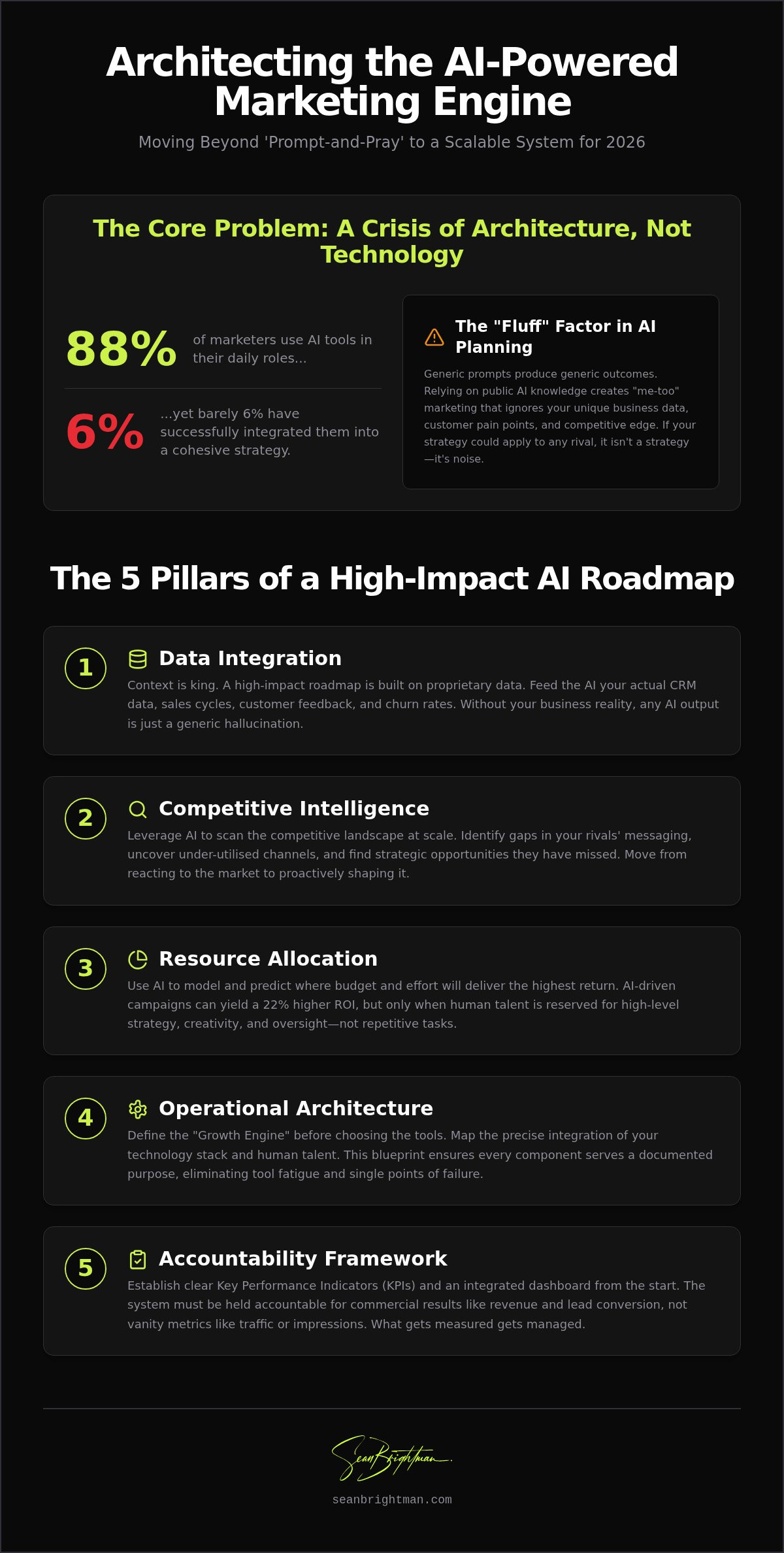
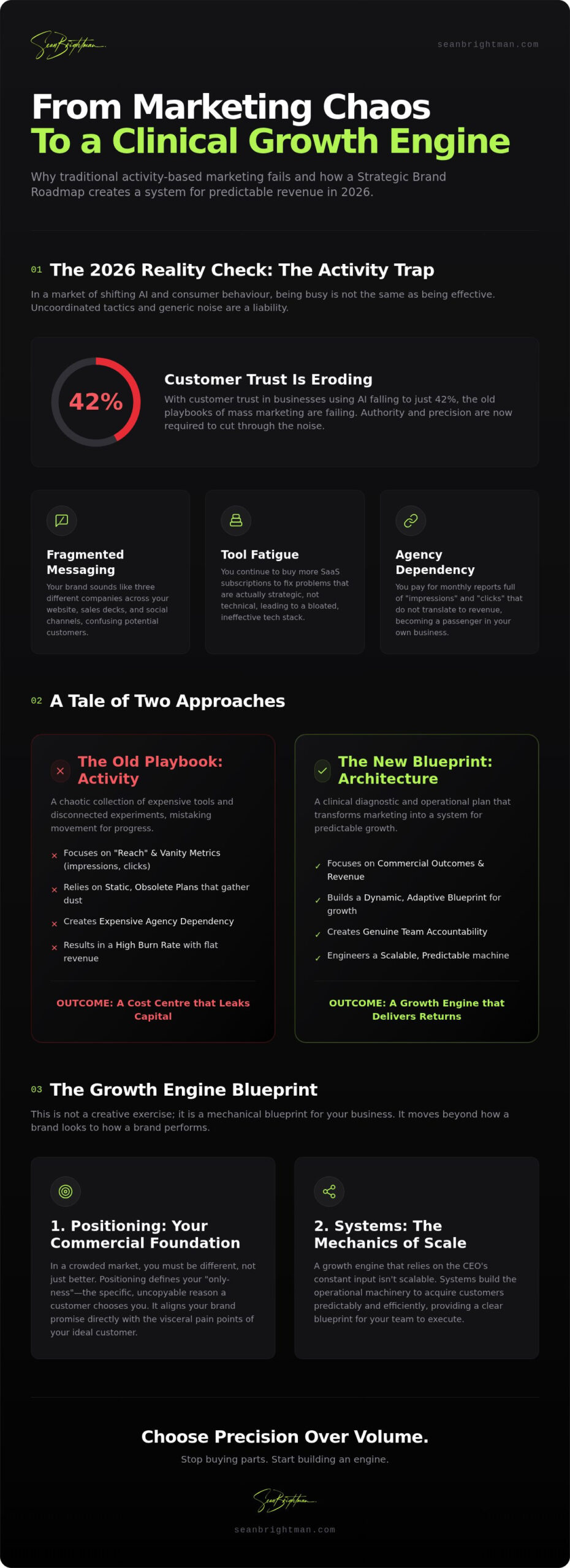
    Most marketing plans for 2026 are already obsolete because they focus on activity rather than architecture. You are likely exhausted by a marketing department that feels like a chaotic collection of expensive tools and agencies delivering “reach” reports instead of actual revenue. It is a frustrating reality. With customer trust in businesses using AI falling to 42% this year, the old playbooks of mass noise and uncoordinated tactics are failing. You need a system, not just a schedule.

    Strategic brand roadmapping is the process of transforming that messy marketing department into a clinical growth engine. You deserve a clear, executable plan that provides commercial accountability for your team and a scalable system that doesn’t require the CEO’s constant intervention. This isn’t about abstract theory; it’s about building a mechanical blueprint for your business. It is about choosing precision over volume.

    In this article, we will explore how to re-engineer your marketing function to navigate the 2026 regulatory landscape whilst ensuring every action translates into measurable growth. We will move beyond vanity metrics to focus on the high-impact strategies that build lasting brand equity and drive predictable results.

    Key Takeaways

    • Identify why your current marketing function feels chaotic and why static planning is a liability in the 2026 market.
    • Discover how Strategic brand roadmapping replaces messy activity with a clinical growth engine built on positioning and systems.
    • Learn to bin vanity metrics and align your team around a commercial North Star that creates genuine accountability.
    • Uncover the two-phase diagnostic process for auditing funnel leaks and realigning your brand with high-value market gaps.
    • Understand why senior-level advisory provides the strategic precision that standard agencies and full-time hires often lack.

    The Messy Marketing Trap: Why Traditional Planning Fails in 2026

    Your marketing team is exhausted. They are running faster than ever, yet your revenue line remains stubbornly flat. This is the “Activity Trap.” It is the result of mistaking movement for progress. In 2026, being busy is easy. Being effective is rare. Most businesses treat their marketing like a series of disconnected experiments. They throw money at social media, pay for PPC, and hope the dots eventually connect. They don’t. Without a unified system, you aren’t building an engine; you are just buying parts.

    Traditional planning is dead. Competitors might suggest a five year vision, but in a market where AI and consumer behaviour shift monthly, a long range static plan is just a very expensive piece of fiction. It is shelfware. It sits in a drawer gathering dust whilst your competitors eat your lunch. You don’t need a static map. You need a dynamic blueprint. Strategic brand roadmapping provides the clinical precision required to turn abstract goals into operational reality. It is about building a system that adapts, not a document that expires.

    The cost of hiring without this blueprint is staggering. Many CEOs rush to hire a senior marketing lead or a high priced agency before they have defined the machine those people are supposed to run. You spend six figures on a salary only to find the new hire spends six months “finding their feet” while your burn rate climbs. You are paying for leadership but receiving admin. You are subsidising their learning curve because you lacked a foundational strategy.

    The Symptoms of a Strategy-Free Business

    Look for the red flags in your current setup. Fragmented messaging is the first sign; your brand sounds like three different companies across your website, sales decks, and social channels. Then comes tool fatigue. You buy another SaaS subscription to fix a problem that is actually strategic, not technical. You have the latest stack but the same old results. Agency dependency is the final symptom. You are paying for monthly reports full of “impressions” and “clicks” that don’t pay the bills. If your agency owns the strategy, they own your growth. You become a passenger in your own business.

    The 2026 Commercial Reality

    In 2026, “good enough” marketing is a liability. Customer trust has eroded, and the market is deaf to generic noise. People don’t want more awareness; they want authority. They want to know you understand their specific pain better than they do. This requires a shift from shouting at everyone to solving for someone. Messy marketing is not a creative hurdle; it is a mechanical failure in your growth engine that leaks capital at every joint. Through strategic brand roadmapping, you stop the leaks and start the engine.

    What is Strategic Brand Roadmapping? The Growth Engine Blueprint

    A strategic brand roadmap is not a creative exercise. It is a clinical diagnostic and an operational plan for growth. Forget mood boards, colour palettes, and font choices. If your strategy doesn’t result in a mechanical blueprint for revenue, it’s just a hobby. Strategic brand roadmapping identifies the friction in your current model and builds the machinery to bypass it. It is the difference between hoping for growth and engineering it. We move beyond how a brand looks to how a brand performs.

    This process is diagnostic. You wouldn’t allow a surgeon to operate without an X-ray; you shouldn’t allow an agency to spend your budget without a roadmap. It provides the “why” before the “how,” ensuring every pound spent is an investment in a specific commercial outcome. This is about function and result. It is about transforming your marketing from a cost centre into a high-impact growth engine that delivers predictable returns.

    Positioning: Your Commercial Foundation

    In the crowded UK market, being “better” is a losing game. You must be different. Your positioning is your “only-ness.” It is the specific, uncopyable reason a customer chooses you over a cheaper, louder competitor. This isn’t about catchy slogans. It is about aligning your brand promise directly with the visceral pain points of your market. When your message hits a nerve, the sales cycle shrinks. If you are struggling to articulate this, working with a Brand Positioning Consultant UK can provide the external perspective needed to find your commercial edge.

    Systems: The Mechanics of Scale

    A growth engine that relies on the CEO’s constant input is a bottleneck, not a business. True scale requires systems that function independently. We design marketing operations that act as a self-sustaining machine. This involves integrating AI into the core of your machinery to handle high-volume analysis and execution tasks that previously drained your team’s time. You build for stability to protect your floor, whilst maintaining the agility to chase the ceiling. The goal is a system that produces results whether you are in the room or not.

    The final pillar is accountability. A roadmap defines who does what, when they do it, and what the commercial consequence of failure is. It replaces “we tried our best” with “we met the target.” If you are ready to stop the guesswork, a structured strategic brand roadmapping project is the fastest way to gain clarity. You can explore how this fits into a wider Fractional CMO engagement to ensure the strategy is actually executed.

    Commercial Outcomes vs. Meaningless Activity: The Strategic Shift

    Stop celebrating likes. Impressions don’t pay the payroll. If your marketing team is reporting on reach whilst your sales team is starving for leads, you have a structural failure in your strategy. Traditional KPIs are often vanity metrics that disguise a lack of direction. You need a North Star metric that aligns with your specific growth stage. Whether it is Customer Acquisition Cost (CAC) or Lifetime Value (LTV), every action must move that needle. Strategic brand roadmapping shifts the focus from what people are doing to what they are achieving. It identifies the specific levers that, when pulled, result in revenue.

    It is time to install a culture of ‘done’ over ‘doing’. It isn’t enough to be busy; you must be effective. This is where the ‘Fractional’ mindset becomes your greatest asset. By bringing in senior leadership through a fractional model, you introduce a level of commercial accountability that internal teams often lack. It is about seniority that gets its hands dirty, focusing entirely on the outcomes that drive valuation. You aren’t paying for hours. You are paying for the removal of obstacles. You are buying the result, not the attempt.

    Driving Team Accountability

    Setting outcomes your team actually owns requires a move away from the traditional task-list. A task-list is a set of chores; a strategic objective is a mission. Your team shouldn’t be proud of ‘posting three times a week’. They should be proud of ‘increasing inbound enquiries by 20%’. This shift is the core of Marketing Team Accountability: How to Drive Commercial Outcomes, Not Just Activity. It is the difference between managing a department and leading a growth engine. When everyone knows the score, the game changes.

    The ROI of Strategic Clarity

    Precision reduces waste. When your brand narrative is coherent, your sales cycle shrinks because the market already understands your value before the first call. You stop subsidising the platform owners with inefficient ad spend. You stop guessing. Strategic misalignment is a silent tax on your P&L; whilst companies leading in personalisation are three times more likely to exceed revenue goals, those with fragmented strategies remain trapped in a cycle of high spend and low trust. Through strategic brand roadmapping, you ensure every penny of your budget is working toward a clinical, commercial end. Clarity is the ultimate competitive advantage.

    Strategic Brand Roadmapping: Building a High-Impact Growth Engine for 2026

    The Roadmapping Process: From Diagnostic to Scalable Operations

    Execution without a diagnostic is just expensive guesswork. Strategic brand roadmapping is a five-phase engineering project designed to strip away the fluff and install a high-performance system. We don’t start with “vision”; we start with the pipes. Phase 1 is The Brutal Audit. We uncover the hidden leaks in your funnel where capital is escaping through poor conversion or misaligned messaging. We look at the data, not the intentions. Phase 2 follows with Market Realignment. This is where we find the commercial gap your competitors missed, ensuring your brand isn’t just better, but different.

    Phase 3 builds The AI-Powered Growth Engine. We identify the manual frictions that are slowing your team down and replace them with automated, scalable systems. In Phase 4, we move to Operational Design. We map the specific people, skills, and tools required to run the machine. Finally, Phase 5 delivers The Execution Roadmap. This is the transition from theory to reality, broken down into 90-day sprints for immediate, measurable impact. This is a blueprint for a business that runs itself.

    The 90-Day Sprint Framework

    Twelve-month plans are a liability for scale-ups. In a market that shifts every few weeks, a year-long strategy is usually wrong by month three. We work in 90-day cycles. This framework allows you to set “Big Rocks” for each quarter; the three or four critical objectives that actually move the needle. You maintain momentum whilst retaining the ability to course-correct based on real-world feedback. It is about being agile without being aimless. You get the speed of a startup with the discipline of a mature corporate.

    Integrating AI into the Roadmap

    AI is not a feature; it is the new standard for operational efficiency. We identify exactly where AI can replace manual friction in your content and lead-generation systems. With 63% of marketers currently using generative AI in their workflows, simply “using” the tools is no longer a competitive advantage. You must integrate them into the core of your machinery. This shift moves your team from being “creators” to being “editors” and “strategists.” If you are feeling overwhelmed by the options, our AI Consulting in 2026: From Tool Fatigue to Scalable Growth Engines provides the framework for selection. We build systems that scale your output without scaling your headcount.

    Stop managing chaos and start building a machine. If you are ready to install a clinical process for growth, you can book a roadmapping session to begin the audit of your current marketing function.

    Executing the Roadmap: Why Senior Advisory Beats Agency Execution

    Handing your budget to an agency before you have a roadmap is like hiring a construction crew without an architect. They will keep busy, but you won’t get a house. Most agencies are incentivised by activity, not outcomes. They want to sell you more content or campaigns because that is how their model scales. They aren’t there to challenge your business model or fix your internal silos. Strategic brand roadmapping solves this by creating the blueprint first. You define the machine; then you decide who operates the controls.

    Finding the “Goldilocks” zone of leadership is critical for scale-ups. A full-time CMO often carries a heavy salary and a desire to build a massive department you might not need yet. Conversely, junior hires lack the battle-hardened experience to navigate the 2026 market. A Fractional CMO provides the senior-level authority required to drive the roadmap without the long-term liability of a permanent executive hire. It is about precision leadership. You get the expertise you need for the phase you are in.

    This approach also secures your path to a successful exit. Investors don’t buy chaos. They buy predictable growth engines. A roadmap proves that your marketing isn’t dependent on the CEO’s intuition or a lucky streak. It demonstrates a documented, repeatable system for customer acquisition. It turns your brand from an abstract concept into a tangible asset. For founders planning ahead, a well-structured marketing strategy for business exit ensures that the growth engine you build today becomes the asset buyers compete to acquire tomorrow. An Advisory Retainer ensures this strategic velocity is maintained, preventing the team from sliding back into old, inefficient habits.

    Leadership Without the Overhead

    Scale-ups often face a dilemma: they need senior strategic thinking but cannot justify a £150k+ base salary plus benefits. You shouldn’t have to choose between growth and your runway. For a detailed breakdown of how these models compare, see our guide on Fractional CMO Pricing UK: The 2026 Guide to Senior Marketing Costs. An external advisor brings an objective perspective that internal teams lose. They see the bottlenecks you have grown used to. They provide the clinical distance needed to make hard commercial calls.

    Your Next Step: The Roadmapping Session

    The transition from “messy” to “methodical” happens in a single day. In a high-impact strategic brand roadmapping session, we strip your marketing function down to its core components. We audit your funnel, realign your positioning, and map out your next 90 days of execution. No fluff. No corporate politeness. Just a clear, executable plan that provides the accountability your business is currently missing. Stop guessing and start building.

    If you are ready to transform your marketing department into a clinical growth engine, book your Strategic Brand Roadmapping session with Sean Brightman today.

    Stop Managing Chaos. Start Engineering Growth.

    The marketing landscape of 2026 has no room for activity for activity’s sake. You have seen how traditional planning fails because it lacks the mechanical precision of a true growth engine. By shifting your focus from vanity metrics to clinical commercial outcomes, you reclaim control over your revenue. You don’t need more tools or more reports; you need a system that functions independently of your constant input. It is the difference between owning a business and owning a job.

    Strategic brand roadmapping is the foundational step that ensures every pound of your budget is an investment, not a gamble. As a published author on marketing strategy and a specialist in AI-powered growth engines, I have spent years re-engineering marketing departments for UK scale-ups. I provide the battle-hardened Fractional CMO expertise required to turn your messy marketing into a high-performance asset. It is time to stop subsidising agency learning curves and start building your own competitive advantage.

    Build Your Growth Engine: Book a Strategic Brand Roadmapping Session

    Your business deserves a blueprint that works as hard as you do. The clarity you need is only one session away. Let’s get to work.

    Frequently Asked Questions

    What is the difference between a brand roadmap and a marketing plan?

    A marketing plan is a schedule of tasks; a brand roadmap is the mechanical blueprint of your growth engine. Plans focus on what you’ll do next month, whilst strategic brand roadmapping defines the systems and positioning required to make those actions effective. One is a list of chores; the other is a clinical architecture for revenue.

    How long does a strategic brand roadmapping project take?

    A high-impact roadmapping project typically takes between two to four weeks from the initial audit to the final execution blueprint. We start with a clinical diagnostic session to identify funnel leaks and positioning gaps. This isn’t a drawn-out consulting engagement; it’s a rapid-fire delivery of a 90-day sprint plan designed for immediate momentum.

    Do I need a roadmap if I already have a marketing agency?

    You need a roadmap specifically because you have an agency. Agencies are execution specialists, but they shouldn’t own your strategy. Without a roadmap, you are paying for activity that might not align with your commercial goals. A roadmap provides the accountability framework your agency needs to deliver revenue instead of just “reach” reports.

    Can a strategic roadmap help me prepare for a business sale or exit?

    A strategic roadmap is essential for a successful exit because investors buy systems, not luck. It proves that your growth is predictable and documented rather than dependent on the CEO’s intuition. By showing a scalable, mechanical approach to customer acquisition, you significantly increase the valuation of your business and reduce the perceived risk for buyers. Learn how to build a marketing strategy for business exit that removes founder-dependency and maximises your valuation multiple.

    How often should a brand roadmap be updated?

    Your roadmap should be reviewed and adjusted every 90 days. Whilst the core positioning remains stable, the tactical execution must adapt to market shifts and performance data. We use 90-day sprints to maintain strategic velocity, ensuring the engine remains tuned for the current commercial environment and doesn’t slide into stagnation.

    Is strategic roadmapping suitable for small B2B businesses?

    Small B2B businesses benefit most from roadmapping because they cannot afford to waste budget on trial and error. When resources are tight, precision is your only competitive advantage. Strategic brand roadmapping ensures your limited spend is focused on the highest-impact levers for growth, preventing the “scattergun” approach that drains capital in smaller firms.

    What is the main benefit of a Fractional CMO leading the roadmapping process?

    The main benefit is gaining senior-level authority without the £150k+ salary overhead. You get a battle-hardened expert who has seen these problems before and knows exactly how to fix them. They provide the objective, external perspective needed to make difficult commercial calls that internal teams often avoid due to office politics or lack of experience.

    How does AI impact brand roadmapping in 2026?

    In 2026, AI is the mechanical core of the growth engine, handling high-volume tasks like data analysis and content scaling. It moves your team from manual execution to strategic oversight. We integrate AI into the roadmap to remove operational friction and ensure your systems can scale without a linear increase in headcount or cost.