
Tag: UK Scale-ups

  • Marketing Team Structure for Scale-ups UK: Designing for Strategic Velocity

    Marketing Team Structure for Scale-ups UK: Designing for Strategic Velocity

    You don’t have a hiring problem. You have a structural architecture problem. Most founders think adding three more juniors will fix their lead flow, but it usually just makes the chaos more expensive. If you are still the one signing off on every LinkedIn post, your current marketing team structure for scale-ups uk is failing you. You’re paying for a bloated headcount with a low ROI whilst your own time is being drained by strategic tasks you should have delegated months ago.

    Scaling requires a decisive shift from activity to impact. It’s about building a lean, AI-integrated engine that prioritises accountability over sheer volume. With 73% of marketers now piloting generative AI, the goal isn’t just to do more; it’s to do better with less. You need a functional machine, not a collection of individuals waiting for instructions. We agree that the “hire and hope” cycle is broken. It’s time to build a system that delivers strategic velocity instead of just more noise.

    This article provides a clear roadmap to build a marketing department that runs without founder intervention. You’ll learn how to design an org chart that actually works, leverage AI to reduce overhead by nearly 9%, and transition to a professionalised growth unit. We are stripping away the corporate fluff to focus on the specific architecture that moves the needle for UK scale-ups.

    Key Takeaways

    • Stop the “junior bloat” trap by designing a growth architecture that prioritises senior-level strategy over expensive, low-impact headcounts.
    • Master the Strategy-Systems-Specialists (SSS) framework to build an optimised marketing team structure for scale-ups uk that scales capability without adding noise.
    • Discover why a full-time CMO hire is often a £120k+ strategic error and how a Fractional leader delivers results in days rather than months.
    • Integrate AI as a core structural component to automate coordination tasks and build a lean, high-velocity marketing engine for 2026.
    • Follow a 90-day roadmap to audit existing chaos and activate a plug-and-play system through professional strategic roadmapping.

    The Scale-up Trap: Why Traditional Marketing Team Structures Fail

    Marketing organisational design is not a pretty chart with boxes and names. It is the architecture of your growth. Most UK scale-ups treat recruitment like a game of Tetris, trying to fill gaps with whatever talent is available. This is a mistake. You are building a machine, not a social club. If the blueprint is flawed, the machine will eventually seize up, regardless of how many people you throw at it.

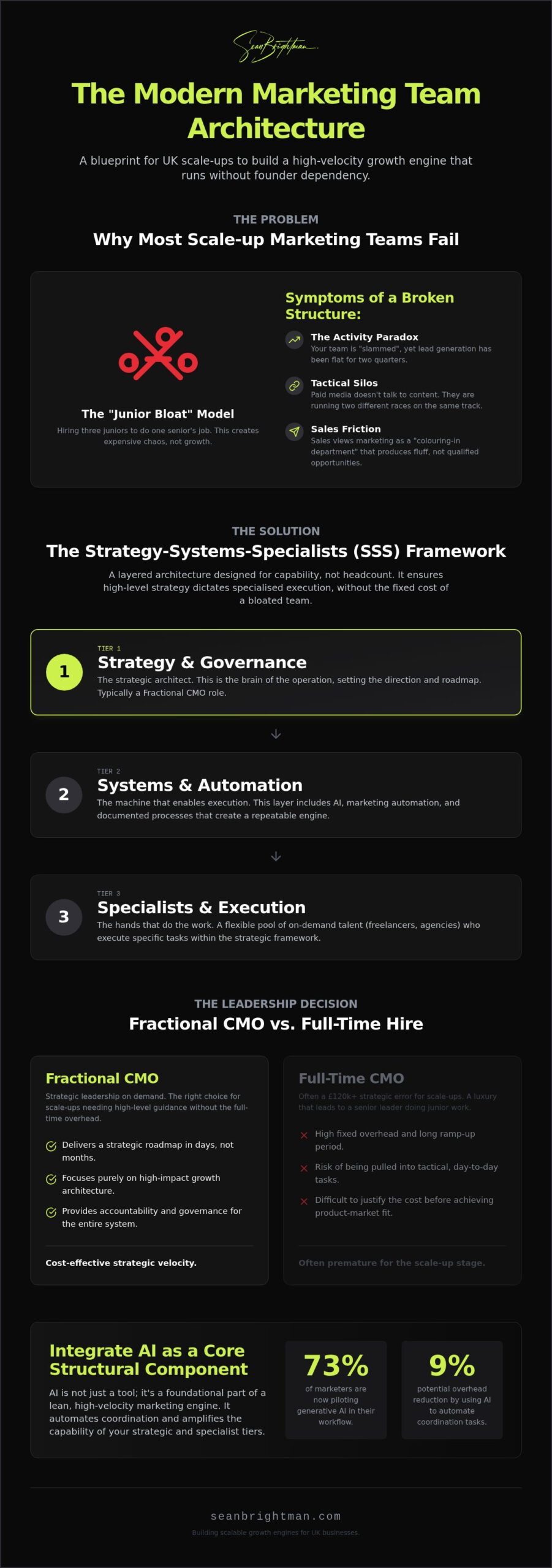
    The most common error is “junior bloat”. Founders often hire three juniors to do a senior strategist’s job. It looks cheaper on the balance sheet. In reality, it is a disaster. You end up with three people asking you what to do every morning. You haven’t bought growth; you’ve bought a management headache. Applying classic Marketing management principles requires a focus on strategy and control. Three entry-level coordinators cannot provide that level of oversight. They execute tasks whilst you are left to provide the brainpower.

    The result of a poor marketing team structure for scale-ups uk is “random acts of marketing”. You see high activity levels but zero accountability. Posts go up. Emails go out. Ad spend disappears. Yet, the lead needle remains stagnant. By 2026, the market is too crowded for this scattergun approach. Success requires a strategy-first design that remains lean by prioritising capability over headcount.

    The Symptoms of a Broken Structure

    How do you know if your structure is failing? Look at where the decisions are made. If you are still the de facto CMO, your structure is broken. You are the bottleneck. Other symptoms include:

    • The Activity Paradox: Your team is “slammed” and working late, yet lead generation has been flat for two quarters.
    • Tactical Silos: Your paid media specialist doesn’t talk to your content writer. They are running two different races on the same track.
    • Sales Friction: The sales team views marketing as a “colouring-in department” that produces fluff rather than qualified opportunities.

    Capability vs. Headcount: The Critical Distinction

    Scaling activity is a vanity metric for internal teams. Sending ten emails instead of five doesn’t matter if the underlying strategy is flawed. You don’t need more hands; you need better systems. In a high-velocity scale-up, you must hire for the capability to solve problems, not the capacity to perform tasks. You are building growth engines that function as a cohesive system rather than a collection of individual contributors.

    A scalable marketing engine is a high-performance system that converts strategic intent into repeatable revenue without requiring constant founder oversight.

    When you focus on headcount, you add complexity and cost. When you focus on capability, you add speed and precision. The goal for 2026 is a lean architecture where every role has a clear, data-backed reason for existing.

    The 3-Tier Architecture for UK Marketing Teams

    Forget the generic advice telling you to hire eight distinct specialists immediately. Most scale-ups don’t have the budget or the lead volume to justify a massive internal payroll. Instead, you need a Strategy-Systems-Specialists (SSS) framework. This is a layered approach to building your marketing team structure for scale-ups uk. It ensures you have the brainpower to lead, the machinery to execute, and the flexibility to scale without the fixed cost of a bloated headcount.

    This architecture stops you from making the “all-rounder” mistake. You don’t need one person who is average at everything. You need a system where high-level strategy dictates the work of specialised execution. By separating these layers, you maintain strategic velocity whilst keeping your burn rate under control.

    Tier 1: Strategic Leadership and Governance

    The top tier is your “Strategic Architect”. For most businesses at this stage, a full-time CMO is an expensive luxury that often results in a senior leader doing junior-level work. You need the roadmap, not the 40-hour-a-week presence. A Fractional CMO provides this leadership, setting the direction and ensuring every pound spent aligns with your commercial goals. They provide the governance layer that keeps the rest of the team accountable.

    Governance is about more than just checking boxes. It is about maintaining a rigorous focus on ROI. Many founders find that The Marketing Advisory Retainer: A CEO’s Guide to Strategic Velocity is the most efficient way to secure this senior oversight without the overhead of a permanent executive hire. This tier ensures that the “Why” and “How” are settled before you ever worry about the “Who”.

    Tier 2: Marketing Operations and AI Systems

    Tier 2 is the “Machine”. This is where you build the plumbing before you worry about the decorating. In 2026, this tier is heavily augmented by AI. You need a marketing team structure for scale-ups uk that prioritises systems over manual coordination. This layer handles lead routing, data attribution, and campaign automation. It ensures that when a lead comes in, the system knows exactly where it goes and how it’s measured.

    Without this layer, your specialists are just guessing. Working with a Marketing Operations Consultant: Building a Scalable Growth Engine for 2026 allows you to install these data-driven feedback loops early. It transforms marketing from a creative cost centre into a predictable revenue engine. Once the machine is built, you can plug in specialists to fuel it.

    Tier 3 is the “Specialist Execution”. These are the hands. Use agencies or freelancers for specific tasks like paid search, technical SEO, or high-end design. They are the tactical fuel for your Tier 2 engine. This approach prevents expensive hiring mistakes because you only bring expertise in-house once the demand is proven and the system is ready to support them. If you want to see how this architecture fits your specific business, a Strategic Roadmapping session can define the blueprint before you sign your next employment contract.

    Fractional CMO vs. Full-Time Hire: A Structural Comparison

    Hiring a full-time CMO is often the most expensive mistake a UK founder can make. In 2026, the average CMO salary in the UK sits at £187,500. When you factor in National Insurance at 13.8%, pension contributions, private healthcare, and equity, you are looking at a quarter-million-pound commitment before they have even opened their laptop. This is a massive weight to add to a marketing team structure for scale-ups uk that needs to stay agile and lean. You’re paying for a permanent desk when you actually need a strategic architect.

    The difference in speed to impact is staggering. A Fractional CMO is a plug-and-play component. They arrive with a proven playbook and start auditing your systems on day one. Conversely, a full-time hire involves a three-month recruitment cycle, a three-month notice period, and a further three months to “settle in”. Scale-ups don’t have nine months to wait for a strategy. You need results in days, not quarters. Advisory models favour results because their tenure depends on them. Full-time roles, unfortunately, often favour job security and the slow creep of corporate bureaucracy.

    The Economics of Senior Leadership

    The total cost of ownership for a senior executive in London or the wider UK is often hidden. Beyond the base salary, the “drag” of a full-time hire includes recruitment fees (typically 20-30% of salary) and the long-term friction of redundancy if the pivot doesn’t work. Contrast this with the advisory model. You get the same level of senior expertise without the terminal liability. It is a tactical exchange of high-level brainpower for specific, measurable outcomes. If you are still on the fence, read why you should Stop Hiring Full-Time CMOs: The Fractional Revolution in 2026.

    Flexibility for Fast-Growth Phases

    Scale-ups require “surge” leadership. You need a heavy lift to build the 3-tier architecture mentioned previously, but you might not need that same level of intensity once the machine is running. A Fractional leader builds the engine and then steps back into a governance role. This prevents the “Seniority Gap” common in mid-market UK firms, where companies have plenty of doers but nobody holding the map. You gain the ability to pivot your strategy instantly without the legal and emotional friction of restructuring a permanent executive team. Transition to a full-time hire only when your growth has stabilised and you need a caretaker for a mature system, not a builder for a new one.
    Marketing Team Structure for Scale-ups UK: Designing for Strategic Velocity

    Integrating AI into Your Marketing Organisational Design

    AI is not a fancy plugin for your browser. It is a structural component of the 2026 marketing team. If you are treating it as a tool for your juniors to write better emails, you are missing the point entirely. AI-powered systems are currently delivering an 8.9% reduction in marketing overhead whilst improving sales productivity. This is not about efficiency; it is about redesigning the marketing team structure for scale-ups uk to remove the need for manual coordination.

    The “junior coordinator” role is dead. Traditionally, scale-ups hired entry-level staff to move data between spreadsheets, schedule social posts, and chase approvals. AI handles these tasks with 100% accuracy and zero salary. This shift allows you to move away from hiring for volume. You don’t need a larger team. You need a more capable one. Moving from experimental tool-use to an integrated growth engine requires a clear AI roadmap. You are shifting from “doing” to “architecting.” Building a coherent marketing systems architecture is what separates businesses with a fragmented tech stack from those running a centralised, high-performance growth engine.

    Upskilling your existing team is more cost-effective than hiring “AI Specialists” who lack your industry context. 84% of UK marketers already use AI tools every day. Your job is to provide the structure that turns that individual usage into a collective system. It is about building a machine where AI handles the logistics and humans handle the strategic nuance.

    The AI-Augmented Workflow

    The role of a Content Marketer has fundamentally changed. They are no longer writers; they are editors, strategists, and system managers. They manage the output of AI agents rather than grinding out blog posts manually. Similarly, reporting and analytics are now automated. Your team should spend zero time building dashboards and 100% of their time interpreting data and making strategic pivots. This frees up the strategic time that founders usually end up filling themselves.

    Strategic AI Consulting

    Before you restructure, you need an AI roadmap session. You cannot design a modern team using a 2019 blueprint. A Fractional CMO acts as the lead architect here, identifying where AI can replace headcount and where it can amplify existing talent. The key metric is no longer just “cost per lead”; it is “output per head.” If your team size stays the same but your output triples, you have won. Focus on building systems that scale capability, not activity.

    Don’t guess your way through this transition. If you want to build a team that leverages 2026 technology to outpace your competition, book an AI Consulting session to design your growth engine properly.

    Building Your Roadmap: From Chaos to Scalable Engine

    You don’t need a static org chart. You need a 90-day transformation plan. Static diagrams are for HR departments; dynamic roadmaps are for growth. Transitioning your marketing team structure for scale-ups uk from a source of frustration to a scalable engine happens in three distinct phases: Audit, Architect, and Activate. This isn’t a slow-burn corporate realignment. It is a rapid-fire correction designed to stop the bleeding and start the building. We are moving from a collection of individuals to a high-performance system.

    Most founders wait too long to fix their architecture. They hope the next hire will be the “silver bullet” that solves the chaos. It never is. Structure must precede recruitment. By following a methodical roadmap, you ensure that every pound of salary and every hour of effort is directed toward a singular commercial outcome. This is about building a department that works for the business, not a business that works for the department.

    Audit: Finding the Hidden Profit

    Start by identifying the “activity traps” slowing down your business. These are tasks that feel like work but produce zero revenue. We review every channel, every tool, and every role against its actual impact on the bottom line. If a campaign isn’t performing, we kill it. If a role is redundant due to AI integration, we redesign it. This is the first step to un-messing the department. You cannot build a high-performance machine on top of a pile of waste. We find the hidden profit by stripping away the fluff and focusing on the 20% of activity that drives 80% of your results. A thorough marketing efficiency audit is the most reliable way to expose the hidden rot in your department and identify exactly which processes are draining your budget without moving the needle.

    Architect: Designing the Growth Engine

    Once the mess is cleared, we design the blueprint. This involves defining the KPIs that actually matter to a CEO, such as customer acquisition cost (CAC) and lifetime value (LTV), rather than vanity metrics like “engagement” or “impressions.” We then select the right mix of fractional leadership and specialist talent to fuel the machine. This is where the 3-tier architecture becomes a reality, ensuring you have strategic depth without the overhead of a bloated permanent staff. You are architecting for capability, not just capacity.

    Don’t leave your growth to chance. If you want to identify the bottlenecks in your current setup and design a custom architecture for your business, Book a Strategic Roadmapping Session with Sean Brightman today. We will find the mess and build the engine to fix it.

    Sustainability requires governance. Establishing an Advisory Retainer ensures long-term accountability and prevents the team from sliding back into old habits of “junior bloat.” A solid marketing team structure for scale-ups uk is the foundation of every successful exit. When a buyer looks at your business, they aren’t just buying your product. They are buying the engine that sells it. Make sure yours is built for speed and precision.

    Stop Hiring and Start Architecting for Growth

    The “hire and hope” cycle ends today. You’ve seen why bloated headcounts fail and how a 3-tier architecture outperforms a traditional org chart. Scaling isn’t about adding more hands to a broken wheel; it’s about building a better engine. By prioritising strategic leadership and AI-powered systems, you reclaim your time and ensure every marketing pound delivers a measurable return. The ideal marketing team structure for scale-ups uk isn’t a fixed payroll; it’s a flexible, high-velocity growth unit designed for impact.

    You now have the blueprint to move from chaos to a scalable engine. You know that a Fractional CMO provides the senior oversight you need without the quarter-million-pound liability of a permanent hire. You understand that AI is a structural necessity, not a tactical toy. Now, you need the roadmap to activate it. Stop guessing and start designing. Build a smarter marketing system with a Strategic Roadmapping session. Use battle-hardened strategic advice to install the engine your business deserves. Let’s get to work.

    Frequently Asked Questions

    What is the best marketing team structure for a UK scale-up?

    The best marketing team structure for scale-ups uk is a 3-tier architecture comprising Strategy, Systems, and Specialists. This model separates high-level strategic leadership from the operational “plumbing” and tactical execution. It ensures you have senior oversight to guide growth whilst remaining lean enough to pivot without the friction of a bloated permanent headcount.

    How much does it cost to hire a Fractional CMO in the UK?

    A Fractional CMO typically costs a fraction of a full-time executive salary, which averaged £187,500 in the UK in 2026. You are paying for high-impact strategic outcomes rather than 40 hours of desk time. This model eliminates the “drag” of National Insurance, pension contributions, and recruitment fees, making senior leadership accessible for fast-growth firms.

    When should a founder stop doing the marketing themselves?

    You must stop the moment you become the strategic bottleneck. If your time is consumed by signing off on social media posts or tweaking ad copy, you are draining your own ROI. Transition to a professionalised structure when your activity levels outpace your ability to maintain a cohesive growth roadmap or measure lead attribution accurately.

    Should I hire a marketing agency or an in-house team first?

    Secure your strategy and systems before hiring either. An agency is a tactical fuel source for specialist tasks like SEO or paid media, but they cannot build your internal growth architecture. Only hire in-house specialists once you have a proven, automated system that requires full-time management to maintain its velocity.

    What is the difference between a Marketing Manager and a CMO?

    A Marketing Manager is a tactical doer, whilst a CMO is a strategic architect. Managers focus on the “how” of execution and task management. A CMO defines the “why” and “what,” ensuring the marketing team structure for scale-ups uk aligns with commercial goals and delivers a clear, scalable roadmap for the CEO.

    How does AI affect the number of people I need in my marketing team?

    AI significantly reduces the need for junior “coordinators” who traditionally handled manual data movement and scheduling. With AI delivering an 8.9% reduction in marketing overhead in 2026, you can achieve higher output with a smaller, more capable team. You are shifting from hiring for volume to hiring for system management capability.

    Can a Fractional CMO help with recruitment?

    Yes, a Fractional CMO is vital for recruitment because they design the architecture before you hire the hands. They define the specific capabilities required for your growth engine, ensuring you don’t make the mistake of hiring juniors to solve senior-level strategic problems. They provide the technical vetting that founders often lack.

    What is a marketing advisory retainer?

    A marketing advisory retainer is a governance layer that provides ongoing strategic accountability. It acts as a “plug-and-play” engine for your business, offering consistent senior oversight without the commitment of a full-time hire. It ensures your team stays on the roadmap and adapts to market shifts with clinical precision.

  • Sean Brightman Book Review: A Strategic Guide to AI and Marketing Strategy in 2026

    Sean Brightman Book Review: A Strategic Guide to AI and Marketing Strategy in 2026

    Most business books are nothing more than glossy brochures for consultants who have never actually sat in the hot seat. You are likely exhausted by the endless cycle of wasted budgets and agencies that refuse to own the strategy. You want a manual, not a manifesto. This Sean Brightman book review provides a brutal, direct analysis of his “Roadmap” methodology to determine if it actually delivers growth or just adds to the noise.

    We agree that integrating AI shouldn’t feel like a guessing game. It is about mechanical precision, not abstract theory. You need a strategy that functions like a well-oiled machine, not a series of disconnected tactics. I promise to strip away the corporate politeness to see if this framework can truly organise a chaotic marketing department.

    We will examine the specific components of the Roadmapping process and whether his “get-your-hands-dirty” attitude translates into real-world results. By the end, you will know exactly how to apply these takeaways to improve your marketing efficiency immediately. This is about tactical execution, not just high-level thinking.

    Key Takeaways

    • Strip away corporate theory and learn to build a functional growth engine that treats marketing as machinery rather than a guessing game.
    • Discover how to integrate brand positioning with AI growth engines to build smarter systems that scale without burning through your budget.
    • This Sean Brightman book review exposes why the “Roadmap” methodology outperforms traditional consulting by delivering clear directions and accountability instead of just selling hours.
    • Identify the high-impact scenarios where UK scale-ups should deploy a fractional strategy before committing to a costly full-time senior hire.
    • Realise why the book is merely the entry point and how an Advisory Retainer provides the senior-level oversight needed to maintain strategic momentum.

    Beyond the Fluff: Why This Marketing Strategy Methodology Matters in 2026

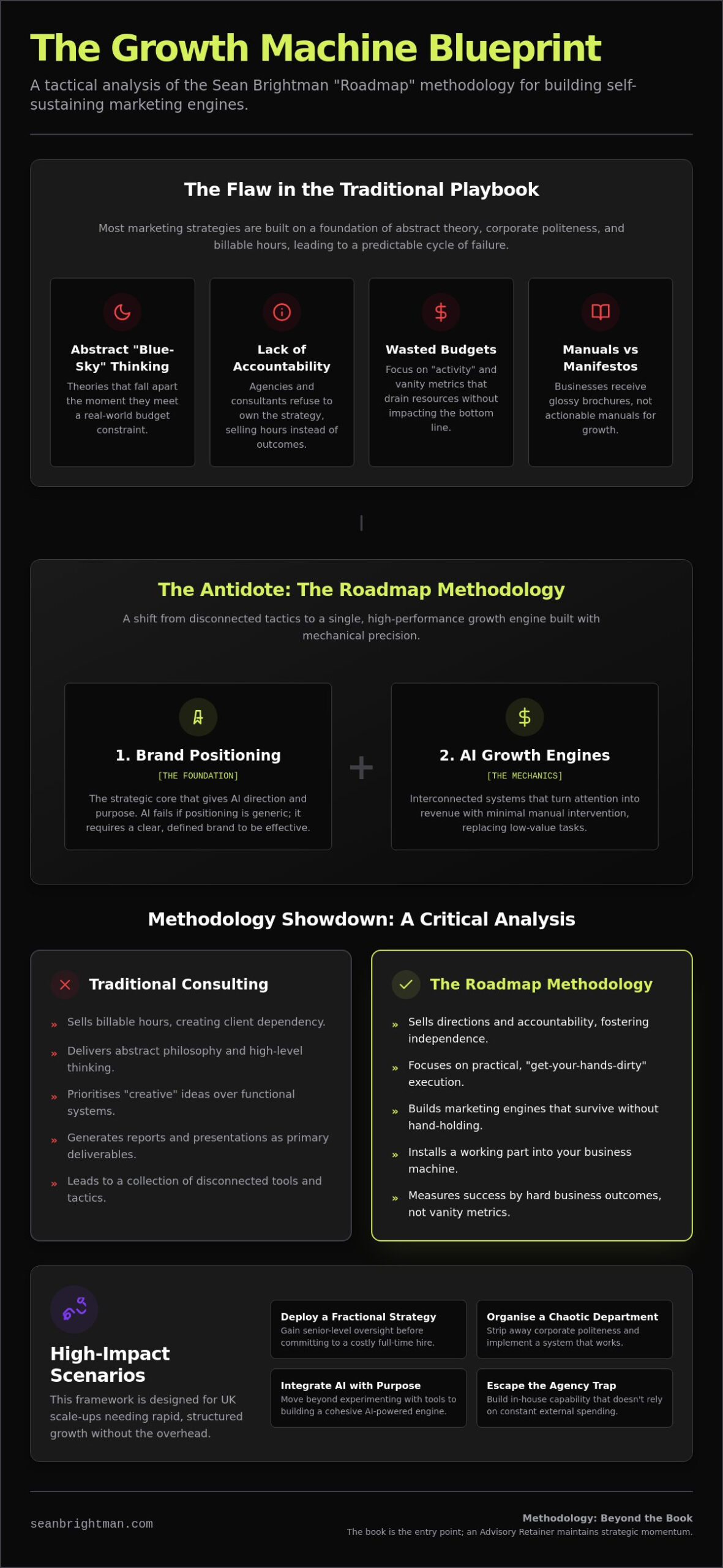
    Most marketing books are destined for the “unread” pile. They are usually filled with abstract theories and “blue-sky thinking” that falls apart the moment it hits a real-world budget. This Sean Brightman book review focuses on a different beast entirely. Brightman isn’t interested in your feelings about brand purpose; he’s interested in the machinery of growth. He builds systems, not just slogans.

    The 2026 business landscape has no room for fluff. We’ve moved past the experimental phase of Artificial intelligence in marketing. Now, it’s about deep integration. If your strategy doesn’t account for how AI actually moves the needle, it’s already obsolete. Brightman’s “battle-hardened” perspective comes from years spent as a Fractional CMO, fixing the messes left behind by agencies that overpromise and underdeliver. He knows where the bodies are buried because he’s usually the one called in to dig them up.

    His core promise is simple: build a marketing system that survives without constant hand-holding. It’s about creating a self-sustaining engine rather than a series of one-off campaigns. This methodology matters because it treats marketing as a functional component of the business, not an expensive hobby for the creative department. It’s about tactical precision and mechanical reliability.

    Stripping Away Corporate Politeness

    Corporate politeness is a cancer in modern marketing departments. It leads to “activity” for the sake of looking busy while the budget drains away. Brightman cuts through this with a bluntness that might bruise some egos but saves your bottom line. He shifts the focus from vanity metrics to hard business outcomes. If a tactic doesn’t contribute to the system’s efficiency, it’s discarded immediately. It’s a binary world: it works, or it’s waste. This Sean Brightman book review confirms that his writing mirrors his high-energy consulting style. It’s fast, direct, and focused on the win.

    The “Get-Your-Hands-Dirty” Attitude

    This isn’t an ivory tower approach. The chapters are built on practical execution rather than abstract philosophy. You won’t find vague suggestions here. Instead, you get a roadmap designed specifically for UK scale-ups that need to move fast without breaking their entire infrastructure. He moves beyond the traditional consultant model of selling hours. Instead, he sells directions and accountability.

    • Stop prioritising “creative” over functional systems.
    • Build marketing engines that don’t require a full-time senior hire to maintain daily operations.
    • Focus on the mechanical integration of AI tools to replace manual, low-value tasks.

    Traditional consultants love the billable hour because it keeps you dependent. Brightman’s methodology is designed to do the opposite. It provides the framework for a marketing engine that thrives without constant intervention. The goal isn’t just to read the book; it’s to install a working part into your business machine. It’s about results, not reports.

    The Core Framework: Integrating Brand Positioning with AI Growth Engines

    Marketing in 2026 isn’t a choice between human creativity and machine efficiency. It’s a mandatory integration. This Sean Brightman book review highlights a framework that treats brand positioning and AI as two halves of a single, high-performance engine. You cannot scale a brand that doesn’t stand for anything, and you cannot maintain a brand today without the mechanical leverage of AI. If you try to run one without the other, you’re just burning cash on friction.

    The book defines a “growth engine” as a series of interconnected systems that turn attention into revenue with minimal manual intervention. It’s not about running ads; it’s about building “smarter marketing systems”. Most companies have a collection of tools. Brightman argues you need a machine. This shift from “activity” to “machinery” is what separates scale-ups that explode from those that merely survive. If your current setup feels more like a collection of random tools than a cohesive strategy, a structured Roadmapping session can provide the clarity you’re missing.

    Brand Positioning as the Foundation

    AI fails if your positioning is generic. Generative tools are excellent at producing “average” content at scale. If your brand identity is weak, AI will simply help you be boring faster. Brightman insists on a “plug-and-play” mindset for brand identity. You define the core signal first. Only then do you use AI to amplify it. Standing out in a crowded market requires senior-level leadership that knows how to define a unique value proposition that an algorithm can’t just hallucinate.

    AI-Powered Growth Engines

    The goal is to automate the “noise” so your team can focus on the “signal”. This means moving beyond playing with ChatGPT and starting to execute a technical strategy. Practical application involves:

    • Building automated lead-scoring models that don’t require manual entry.
    • Deploying AI-driven content distribution that adapts to real-time user behaviour.
    • Using predictive analytics to allocate budget before a campaign fails, not after.

    This isn’t about replacing people. It’s about removing the low-value labour that keeps your best talent stuck in spreadsheets. It’s about tactical precision.

    The 90-Day Roadmap: A Tactical Timeline

    The book doesn’t just give you a theory; it gives you a schedule. The “Roadmap” approach is broken down into a 90-day execution cycle that moves from chaos to control.

    • Days 1-30: The Audit. Identify the leaks in your current funnel and strip away the “vanity” activities that don’t drive growth.
    • Days 31-60: The Build. Install the AI growth engine and integrate it with your brand’s core positioning.
    • Days 61-90: The Optimisation. Fine-tune the machinery for maximum output and establish the metrics that actually matter to the board.

    This Sean Brightman book review confirms that the timeline is aggressive but realistic for companies that have outgrown their “scrappy startup” phase and need professionalised systems.

    Critical Analysis: How the ‘Roadmap’ Approach Differs from Traditional Consulting

    Traditional consulting is a bloated industry built on the billable hour. It incentivises slow movement and endless slide decks that nobody actually reads. This Sean Brightman book review identifies a sharp departure from that old-school model. Brightman doesn’t sell hours; he sells directions and accountability. He isn’t interested in being a permanent fixture in your office. He wants to install the machinery and then ensure it stays running through a structured Advisory Retainer.

    The binary is clear. Traditional agencies sell you “activity”. Brightman sells you a “system”. One leads to a never-ending invoice; the other leads to a self-sustaining growth engine. This shift is critical for UK scale-ups that cannot afford the overhead of a full-time CMO but desperately need senior-level strategy. The Fractional CMO model provides that high-level thinking without the full-time baggage. It is about impact, not attendance.

    Efficiency Over Bureaucracy

    The “Roadmap” approach is designed to kill corporate red tape. It operates with a staccato rhythm that matches the pace of a high-growth tech company. You don’t have time for three-month discovery phases that yield nothing but generic advice. Brightman’s methodology relies on binary thinking: this leads to growth, or it leads to waste. If a channel isn’t performing, you don’t “optimise” it for six months. You cut it. You stop the bleed. You move the resource to where the machinery is actually humming. It is a clinical approach to growth.

    Accountability for CEOs

    For a CEO, this book is a secret weapon. It provides the vocabulary to hold a marketing department accountable. You won’t be blinded by jargon or “engagement” metrics that don’t pay the bills. The focus is on driving results, not just increasing activity levels. It moves the conversation from recruitment to strategic advisory. You don’t need another mid-level manager to “oversee” the chaos. You need a strategist who can fix the chaos and build a repeatable process.

    The Advisory Retainer model replaces the old billable hour with a focus on momentum. It ensures that the strategy doesn’t just sit in a PDF on a shared drive. It’s about the mechanical integration of marketing into the wider business machine. Your marketing should function like your finance or engineering departments: predictable, measurable, and scalable. This Sean Brightman book review confirms that his methodology provides the blueprint for that level of professionalisation. Anything less is just expensive guesswork.

    Sean Brightman Book Review: A Strategic Guide to AI and Marketing Strategy in 2026

    Is This Book for You? Identifying High-Impact Scenarios for Scale-ups

    If you are looking for a bedtime story about the “magic of marketing”, put this book back on the shelf. This Sean Brightman book review is for those who need to fix a machine that is currently leaking oil. The ideal reader is the founder of a UK scale-up or tech company who has reached a plateau. You have a team, but you don’t have a strategy. You have tools, but you don’t have a system. You are likely frustrated by the lack of clear ROI from your current activities.

    Timing is everything. Read this book before you commit to your first big marketing hire. Hiring a full-time CMO before you have a functional roadmap is a £120k mistake. You don’t need a six-figure salary sitting in a chair for 40 hours a week just to “oversee” a broken process. You need a blueprint first. This book acts as a diagnostic tool for your current department. It will show you exactly where your team is failing and whether the problem is the people or the process. It is about building the engine before you hire the driver.

    For the CEO Who Is “Stuck”

    Symptoms of a broken department are obvious: high churn, low lead quality, and a general sense of confusion. You feel stuck because you are losing control of your brand direction whilst firefighting daily operational fires. Use the book to regain that control. It provides the framework to get unstuck in 90 days. It is a binary choice: continue with the chaos or install a repeatable, mechanical process that produces predictable results. If your diagnostic reveals a deep-seated strategic gap, you can book AI Consulting to accelerate the fix.

    For the Marketing Leader Seeking AI Integration

    If you are already leading a team, this is your manual for AI integration. It is not about chasing the latest shiny tool. It is about building an AI-powered growth engine that actually functions. You will learn how to improve efficiency without sacrificing brand integrity. This shift allows you to transition from tactical execution to strategic leadership. You stop doing the work and start building the engine. This Sean Brightman book review confirms that the methodology is designed for those who want to lead with precision rather than guesswork.

    The 2026 landscape demands this level of technical strategy. You are either building a smarter system or you are being outpaced by those who are. There is no middle ground. This book is for the leaders who choose the former. It is about results, not activity. It is about machinery, not fluff.

    From Theory to Execution: Moving Beyond the Pages with an Advisory Retainer

    Reading a book won’t fix your business. It gives you the blueprint, but it doesn’t pick up the tools. This Sean Brightman book review has analysed the “Roadmap” methodology, but the real value lies in the tactical execution. You can’t just read about a growth engine; you have to install it. The transition from book-learner to client is where the maximum impact happens. It is the difference between knowing how a car works and actually driving it to your destination.

    Maintaining momentum is the hardest part of any strategic shift. Without consistent oversight, the old habits of a messy marketing department will creep back in. This is where an Advisory Retainer becomes essential. It provides the senior-level accountability needed to ensure the roadmap isn’t just a document gathering digital dust. Sean Brightman doesn’t just write about these systems; he provides the active leadership required to run them. He ensures the machinery stays oiled.

    The Fractional CMO Advantage

    You don’t need a full-time executive to get senior-level results. The “Fractional Revolution” is about accessing battle-hardened expertise on demand. This approach gives you the high-level strategy described in the book without the bloated overhead of a permanent hire. You get the brains without the bureaucracy. The principles outlined in the text are the same ones applied in real-world Fractional CMO services. It is about building a scalable engine with expert oversight that knows exactly when to pivot and when to push. It is senior leadership on your terms.

    Next Steps: Roadmapping Your Success

    Execution begins with a clear direction. A one-off roadmapping session is the fastest way to turn the book’s theory into your company’s reality. It identifies the specific mechanical failures in your current setup and provides a clinical plan to fix them. You stop guessing. You start building. This is about making your marketing strategy function like a predictable component of your business machine.

    • Audit your current brand positioning against 2026 AI capabilities.
    • Define the 90-day tactical timeline for your specific market.
    • Establish the metrics that actually matter to your board.

    The final verdict of this Sean Brightman book review is clear. This is a must-read for any CEO serious about growth. It is direct, brutal, and entirely necessary. It is not a book for the faint-hearted or those who love corporate fluff. It is a manual for leaders who want to build a marketing machine that actually functions. Stop reading about the revolution and start leading it.

    Install the Machinery of Growth

    Success in 2026 isn’t about the size of your budget; it’s about the precision of your systems. This Sean Brightman book review has highlighted the binary choice facing every scale-up founder: continue with expensive guesswork or install a battle-hardened roadmap. You now understand that brand positioning is the fuel and AI is the engine. One cannot function effectively without the other.

    Sean Brightman provides the senior-level authority of a Fractional CMO without the unnecessary corporate overhead. He is a specialised expert in building AI-powered marketing systems that deliver measurable results for UK tech companies. Stop playing with tools and start executing a strategy that actually owns the outcome. It’s time to move from theory to tactical execution. You need a partner who has seen the chaos and knows exactly how to fix it.

    Take the first step toward a functional marketing department. Book a Strategic AI Roadmapping Session with Sean today. You have the blueprint; now it’s time to build the machine that drives your business forward. Your growth engine is waiting for the right spark.

    Frequently Asked Questions

    Who is Sean Brightman and what is his background in marketing?

    Sean Brightman is a Fractional CMO and AI consultant with a high-value strategic consulting background. He specialises in helping scale-ups professionalise their marketing departments through mechanical precision rather than creative guesswork. His expertise is built on real-world experience fixing messy departments, making him a battle-hardened advisor for senior leadership who remains active in the field.

    What is the main thesis of Sean Brightman’s marketing strategy book?

    The main thesis is that marketing must function as a mechanical growth engine rather than a series of disconnected campaigns. It argues that you cannot have brand positioning without AI-driven leverage, and vice versa. The book teaches readers to stop focusing on vanity metrics and start building smarter marketing systems that deliver predictable business outcomes.

    How does the “Roadmap” approach help UK scale-ups grow?

    The “Roadmap” methodology provides a clinical 90-day timeline to move from chaos to control. It helps UK scale-ups by identifying funnel leaks, installing AI growth engines, and establishing metrics that actually matter to the board. It is about providing a clear direction that removes the need for constant hand-holding and expensive agency dependencies.

    Does the book provide practical AI implementation advice for 2026?

    Yes, the book offers a strategic manual for deep AI integration that goes beyond basic tool usage. It focuses on building automated lead-scoring models, predictive analytics, and adaptive content distribution. This Sean Brightman book review confirms that the advice is geared toward the technical demands of the 2026 business environment where AI is a functional component, not an experiment.

    Can I implement the strategies in the book without hiring a Fractional CMO?

    You can certainly use the book as a standalone diagnostic tool to evaluate your current team. However, reading the blueprint is only the first step in the process. Most founders find that an Advisory Retainer or Fractional CMO is necessary to maintain the momentum and senior leadership required for long-term strategic execution and accountability.

    How does Sean Brightman’s methodology differ from a standard marketing agency?

    Standard agencies often prioritise billable hours and creative activity over functional results. Sean’s methodology is built on binary thinking: a tactic either leads to growth or it leads to waste. He sells directions and accountability rather than just selling you more “busy work” from junior account managers who don’t own the strategy.

    Is the book suitable for small business owners or just large corporations?

    The book is specifically designed for founders of UK scale-ups and tech companies that have outgrown the “scrappy” startup phase. Whilst the principles of efficiency apply broadly, the “Roadmap” approach is most effective for businesses looking to professionalise. It is the perfect resource for those looking to avoid the £120k mistake of a premature full-time CMO hire.

    Where can I buy the book and find more Sean Brightman reviews?

    You can find the book through major online retailers or directly via Sean’s official website. For those seeking more than a standard Sean Brightman book review, his site offers deeper insights into the “Fractional Revolution” and how these strategic principles are applied in live consulting environments. It is the best starting point for leaders ready to fix their growth machinery.