
What if the fastest way to scale marketing is to stop adding more activity? If your work feels reactive, results depend on one person, or every new priority creates another process to manage, you’re not alone. Learning how to build a scalable marketing function starts with fixing the operating model, not piling on headcount, tools or campaigns.
It’s tempting to hire, outsource or automate your way out of the pressure. But without a clear link between marketing and commercial priorities, those choices can add cost and complexity without solving the real problem. You need a system that gives the team direction, clear ownership and room to grow.
This article sets out how to build that system. You’ll learn how to connect marketing priorities to business goals and customer needs, define responsibilities and repeatable processes, and choose useful measures of performance. We’ll also look at how to decide what to systemise, hire or outsource next, so capability grows at the pace the business needs. Scale the model first. Then scale the work.
Key Takeaways
- See the warning signs that your marketing function is under strain, from fragmented data to unclear ownership.
- Connect commercial priorities and customer decisions to the work your marketing team needs to do.
- Learn how to build a scalable marketing function by matching strategic leadership, team capacity and specialist support to the work required.
- Use a practical sequence to diagnose bottlenecks, assign owners, document workflows and review evidence.
- Turn your operating-model diagnosis into a prioritised roadmap, then use clear measures to refine it.
Why a marketing function breaks when the business starts to scale
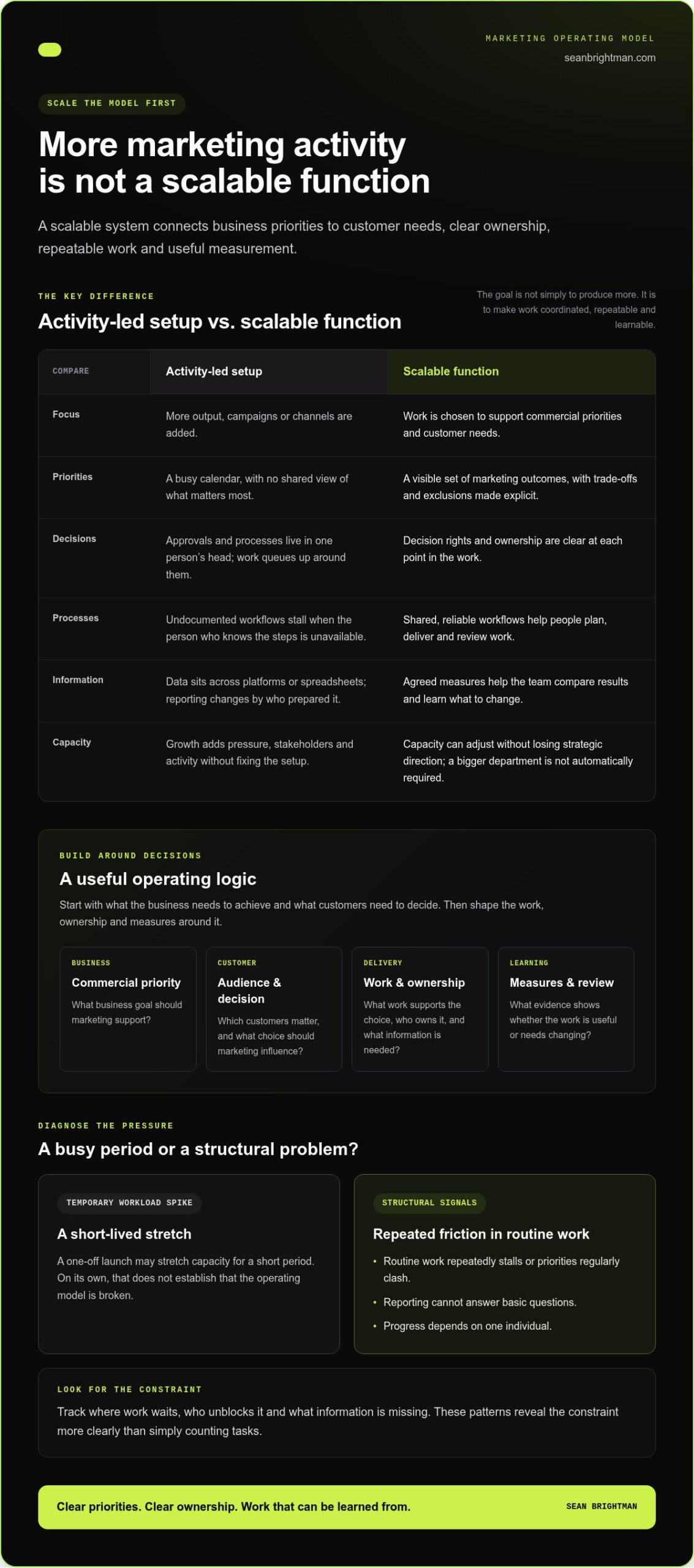
A marketing function is the connected strategy, people, processes, systems and measurement that turn customer understanding into coordinated marketing work. It’s not just the campaigns a team runs or the channels it uses. It’s the structure that helps people decide what to do, who owns it and how to learn from the results.
At an earlier stage, a founder or generalist might set priorities, write the brief, approve the work and report the outcome. Growth brings more audiences, activity and stakeholders. If the decisions and processes still live in one person’s head, work queues up around them. A campaign might launch, but no one can easily explain how it connects to a business priority or what the team should repeat.
That’s the difference between more marketing and a marketing function. More activity means producing more output. A functioning system makes the work repeatable and learnable: teams can use shared priorities, clear ownership and agreed measures to plan and review it. The aim isn’t to remove judgement. It’s to stop every task depending on improvised decisions.
Unclear priorities often show up as a busy calendar with no shared view of what matters most. Data may sit across separate platforms or spreadsheets, while reporting changes depending on who prepared it. Results become hard to compare, and knowledge disappears when one person is unavailable. These are connected symptoms. Fragmented information weakens decisions, while unclear decision rights make the work harder to coordinate.
What makes a marketing function scalable?
A scalable function can adjust its capacity without losing strategic direction. It understands which customers matter, what decisions marketing needs to influence and who owns the work at each point. Processes connect those choices to delivery, while measurement helps the team see what’s useful and what needs changing. Understanding Marketing Strategy helps explain why coordinated actions should serve wider business goals, rather than becoming a disconnected list of tasks.
Scalability doesn’t automatically mean a bigger department. It means the work can be supported by the right mix of people and processes as needs change. A small team with clear ownership and reliable workflows may be more adaptable than a larger one where every decision gets stuck.
How growth exposes weaknesses in the current setup
Informal approvals work until several people need a decision at once. Undocumented workflows create the same bottleneck: only the person who knows the steps can move the work forward. Disconnected campaigns also make performance difficult to interpret, because the team lacks a consistent way to link activity, customer response and commercial priorities.
Separate a temporary workload spike from a structural problem. A one-off launch may stretch capacity for a short period. If routine work repeatedly stalls, priorities regularly clash, reporting can’t answer basic questions or progress relies on one individual, the underlying setup needs attention. Track where work waits, who unblocks it and what information is missing. Those patterns reveal the constraint more clearly than simply counting tasks.
Design the marketing operating model around strategy and customers
Build the model around the decisions the business needs to make, not the channels it happens to use. Start with commercial priorities, the audiences that matter and the customer choices marketing needs to influence. Then decide what work supports those choices, who owns it and what information they need. That sequence keeps the operating model anchored to purpose rather than tool selection.
For example, if the priority is to increase repeat purchases, ask which customers are most likely to return, what might prompt their next purchase and how the business will recognise that behaviour. The answers shape the work. A new campaign or platform is only relevant if it helps address the priority.
Turn business goals into focused marketing priorities
Translate broad business objectives into a short set of marketing outcomes. “Grow revenue” needs more definition. Is the focus on reaching a particular audience, improving the quality of enquiries, helping customers understand a complex offer, or encouraging existing customers to return? Choose outcomes that marketing can influence and connect them to a commercial goal.
Then make the trade-offs explicit. Record which audiences, propositions and customer barriers come first, and what won’t be prioritised for now. These exclusions protect focus when requests compete. They also give the team a practical test: if a proposed task doesn’t support an agreed outcome or a necessary customer need, it shouldn’t automatically displace planned work.
A useful operating model makes those choices visible. The marketing operations growth engine explores how systems can support coordinated work, but systems should follow strategy. Buying a new tool before agreeing priorities and ownership risks adding another place for activity to fragment.
Map customer journeys to ownership and processes
Trace how customers discover the business, assess whether it fits their needs and decide whether to choose it. At each stage, note the question they need answered, the marketing work that can help and the information required to make a useful next decision. Keep the map grounded in actual customer behaviour, rather than building an elaborate diagram just to make the process look complete.
- Discover: Who owns reaching the relevant audience, and what evidence shows the message is reaching them?
- Assess: Who keeps the proposition and supporting information clear, accurate and useful?
- Choose: How does marketing hand over relevant context, and how will the team learn what helped or hindered the decision?
Assign an owner to each important decision and handover, even if one person holds several responsibilities. Specify what information passes between people, where it lives and what happens when a decision is delayed. A strategic brand roadmap can connect positioning to planned work, so customer-facing activity reinforces a coherent direction rather than pulling in competing directions.
Set a simple planning rhythm before adding more tools. Review priorities, upcoming work, capacity and evidence together, then capture decisions and changes in one shared place. Sean Brightman provides senior marketing guidance to help businesses turn strategy into clear ownership and a workable plan. Read more about senior marketing guidance.
Choose the right mix of leadership, team capacity and specialist support
Don’t treat every marketing gap as a hiring problem. First identify what’s missing: strategic direction, ongoing delivery capacity or a specific specialist skill. These needs call for different solutions. A channel specialist can deliver defined work, but shouldn’t be expected to set the company’s overall marketing direction. A senior leader can set priorities and create accountability, but won’t automatically provide the hands-on capacity to deliver every task.
A scalable function doesn’t need to start with a large permanent team. It needs clear ownership of the work, whether that ownership sits with an employee, a specialist partner or a fractional leader. The right mix can change as priorities and workload change, provided decisions remain connected to the business and someone internally stays accountable.
When does the business need a dedicated hire?
Consider an internal hire when a clearly defined body of work needs steady attention and close connection to the business. That might involve managing ongoing customer communications, coordinating activity across teams or maintaining essential marketing knowledge that changes as the organisation learns. An employee can build institutional knowledge, work closely with colleagues and provide continuity when priorities shift.
Look beyond a busy period. Ask whether the work is sustained, whether it needs daily collaboration, and whether its responsibilities can be clearly described. If the need is a short-term specialist task or an unresolved strategy problem, adding a permanent role may solve the wrong constraint. Don’t use a revenue milestone or assumed team size as a universal hiring trigger. The work itself should make the case.
When can fractional leadership or specialist support help?
Fractional leadership can provide senior direction without a full-time CMO hire. Sean Brightman’s Fractional CMO service helps businesses clarify priorities, shape the operating model and create accountability for putting decisions into practice. This addresses a leadership need, not necessarily a shortage of hands to execute campaigns. The Fractional CMO model offers more detail on this form of part-time senior leadership.
Specialist support fits a different gap. Use it when a defined requirement needs particular expertise or delivery capacity that the existing team doesn’t have. Specify the task, expected output, internal owner and how the work will connect with wider priorities. Clear boundaries stop specialist input becoming another disconnected activity.
External leadership can guide and challenge the work, but it shouldn’t remove internal decision ownership. Someone inside the business must set commercial priorities, provide customer and product context, make decisions and coordinate handovers. Without that counterpart, recommendations can stall or delivery can drift.
To decide what to add, write down the constraint and match it to the type of support it needs:
- Unclear direction: establish senior strategic leadership before adding more delivery activity.
- Recurring workload: assess whether steady internal ownership is needed.
- Defined skills gap: bring in specialist support for a specific capability or piece of work.
- Several connected gaps: clarify priorities and ownership first, then build the right mix around them.
That’s the practical answer to how to build a scalable marketing function: add capacity to a defined need, not to a vague sense that the team should be bigger. Sean Brightman’s roadmapping sessions and advisory retainers help businesses decide what to build internally and where external leadership fits. Learn more about senior marketing leadership support.
Build the function in stages, then measure whether it is working
Don’t try to rebuild everything at once. A useful operating plan starts with the constraint causing the most friction, puts a small change into practice and checks what happens. This gives the team evidence to improve the model before expanding it. It’s a practical way to approach how to build a scalable marketing function without creating more process than the work needs.
Work through the stages in order:
- Diagnose constraints. Find where work stalls, decisions wait, information gets lost or results are difficult to interpret. Look for the cause, not just the visible backlog.
- Choose priorities. Select a small number of outcomes the business needs marketing to support. Be clear about what sits outside the plan for now.
- Assign owners. Name who is accountable for each outcome, decision and handover. An owner can involve others, but accountability shouldn’t disappear between teams.
- Document workflows. Record the steps people need to repeat, the inputs they need and where decisions are made. Keep documentation usable, not ceremonial.
- Review evidence. Check whether the process supports the intended outcome. Keep what works, adjust what creates friction and stop work that no longer serves the priority.
Keep the first plan deliberately small. Choose one meaningful workflow or customer journey, agree what you expect to learn and give the people doing the work a way to flag problems. Set the review rhythm to match the pace of decisions and activity. A team managing fast-moving work may need frequent check-ins; a longer-term initiative may need less frequent reviews. The cadence is a management choice, not a universal rule.
What should a marketing function measure?
Choose measures that connect to an objective and help someone make a decision. Activity counts, such as emails sent or content published, show what the team did. On their own, they don’t show whether customers responded or a commercial outcome changed. Pair useful leading indicators, such as qualified enquiries or progress between customer stages, with relevant outcomes, such as sales or repeat business. Use attribution carefully: a metric can show an association or a trend, but one number rarely proves that a single marketing activity caused the result.
How can AI and automation support the operating model?
Start with repeatable tasks that consume effort or create avoidable inconsistency, such as preparing routine summaries, organising information or moving work between agreed steps. Check whether technology genuinely reduces friction before adding it to the process. Keep a named person responsible for quality, judgement and customer-facing decisions. Sean Brightman’s AI consulting focuses on practical ways to apply AI to marketing needs and improve efficiency and output, rather than collecting tools without a clear job for them.
Sean Brightman also provides strategic roadmapping to help businesses decide what to test, measure and improve. Build your marketing roadmap with senior guidance.
Get strategic direction to turn the marketing function into a growth engine
A scalable marketing function doesn’t come from adding more activity and hoping the pieces fit. It comes from understanding where work gets stuck, choosing priorities tied to customer and business needs, assigning ownership, and building processes the team can learn from. Then review the evidence and adjust the model.
That sequence helps reveal what the business needs next. Is the main constraint unclear positioning, competing priorities, an unowned handover or a lack of delivery capacity? Each calls for a different response. Senior strategic guidance can help leaders diagnose the real issue and agree what to tackle first, before they invest in another hire, process or platform.
What a strategic roadmap should make clear
A useful roadmap turns strategic choices into an actionable order of work. It should connect positioning and customer needs to clear priorities, show what needs to happen first, name owners and surface decisions that need leadership attention. It should also distinguish committed work from ideas that can wait. That gives the team direction without pretending every detail can be fixed in advance.
Keep the roadmap adaptable. As the team learns from customer responses and delivery, priorities may need to change. The point isn’t to defend a static plan. It’s to make changes deliberately, based on evidence and business priorities, rather than allowing every new request to reset the work.
Before approving an initiative, leaders can use the roadmap to ask:
- Which business priority and customer need does this support?
- Who owns the decision, delivery and handover?
- What needs to happen first, and what can wait?
- What evidence would prompt us to continue, change or stop?
How ongoing advisory supports implementation
A plan needs oversight as well as delivery. Sean Brightman’s monthly advisory retainer provides ongoing direction and accountability while the team does the work, helping leaders resolve competing priorities and revisit decisions when new evidence emerges. It complements internal ownership; it doesn’t replace the people responsible for execution or the business decisions behind it.
That’s where the practical answer to how to build a scalable marketing function becomes clearer: establish direction, turn it into a prioritised roadmap, assign ownership, then improve the model as you learn. Roadmapping creates structured direction for longer-term marketing and brand work. Advisory support helps maintain focus and accountability during implementation. Neither guarantees a particular business result. Both can help leaders make the next decision with greater clarity.
If you need clarity before expanding marketing capacity, discuss strategic marketing support and work out what the function needs next.
Make your next marketing decision deliberate
Growth will keep changing what the business needs from marketing. The useful question isn’t whether to build a bigger team by default. It’s whether the next investment solves the constraint that matters now and leaves the function better equipped to adapt later. That’s the practical mindset behind how to build a scalable marketing function.
You don’t need a perfect blueprint before taking action. You need enough direction to make the next move, learn from it and adjust without rebuilding everything from scratch. Start by naming the decision you’re delaying, the trade-off behind it and what would help you move forward with confidence. That turns a broad ambition to “scale marketing” into a real leadership choice.
Senior marketing support can help bring that perspective. Sean Brightman provides Fractional CMO services for part-time senior leadership, roadmapping for structured direction on longer-term marketing and brand work, and advisory retainers for ongoing direction and accountability. The right support should strengthen your team’s ability to act, not add another layer of activity.
Choose a next step that fits the challenge in front of you. Build a clearer marketing operating model with strategic support, and give your team a stronger foundation for what comes next.
Frequently Asked Questions
What is a scalable marketing function?
A scalable marketing function is a way of organising marketing so the business can adjust its capacity without losing sight of its goals or customers. For example, if a new customer need emerges, the team can decide whether to change existing work, bring in a specialist or build an internal capability. The useful test is whether people know who makes that decision and how the business will judge its value.
How do you build a marketing function from scratch?
Start by choosing a business goal and defining the marketing contribution that could support it. If the goal is to reach a new audience, for instance, identify what you need to learn about that audience before committing to a campaign. Agree who can approve changes, then set a simple way to capture customer feedback and review decisions. This gives you a working foundation before you invest in a larger structure. That’s how to build a scalable marketing function without copying another company’s chart.
When should a business hire its first marketing employee?
Hire when there’s sustained work that needs a clear internal owner and you can describe what that person will be responsible for. Draft the role around outcomes and recurring decisions, not a long wish list of channels. For example, if customer insight, planning and campaign coordination are all needed, decide which responsibilities genuinely belong together. If priorities are still changing weekly, clarify the direction first so the hire has a workable remit.
Can a small business build a scalable marketing function without a large team?
Yes. A small business can build a scalable function by keeping its priorities focused and making responsibilities clear, even when one person handles several areas. Use external specialists for discrete needs, such as a defined piece of research or technical work, while keeping key customer and commercial decisions close to the business. Review workload and results before expanding capacity. The goal is a setup that can adapt, not a large team for appearance’s sake.
Which marketing function should be built first: strategy, team or systems?
Set strategy first, because it gives people and systems a purpose. You don’t need a lengthy document: agree the customer group, business outcome and main decision marketing should influence. Then identify who needs to act and what information they need. For example, don’t automate a lead handover until you’ve agreed what makes a lead relevant and who follows up. This prevents technology from making an unclear process harder to change.
How can you tell whether a marketing function is ready to scale?
Look for evidence that current constraints are understood and that the proposed change addresses one of them. If work repeatedly waits for one person’s approval, for example, adding delivery capacity may not help until decision authority is clearer. Note what currently gets delayed, what a change should improve and what evidence you’ll review afterwards. Readiness isn’t a universal headcount or revenue threshold; it’s knowing what you’re changing and why.
What is the difference between a marketing function and a marketing department?
A marketing department is an organisational unit; a marketing function is the capability needed to plan, coordinate and learn from marketing work. In a smaller organisation, customer insight might come from sales, a business leader might set priorities and an external specialist might deliver a defined task. Those people can contribute to one function without belonging to one department. What matters is that responsibilities and decisions connect, rather than falling between teams.
Leave a Reply