Tag: business growth

  • The Hidden Cost of the Marketing Leadership Gap: Why Growth Stalls in 2026

    The Hidden Cost of the Marketing Leadership Gap: Why Growth Stalls in 2026

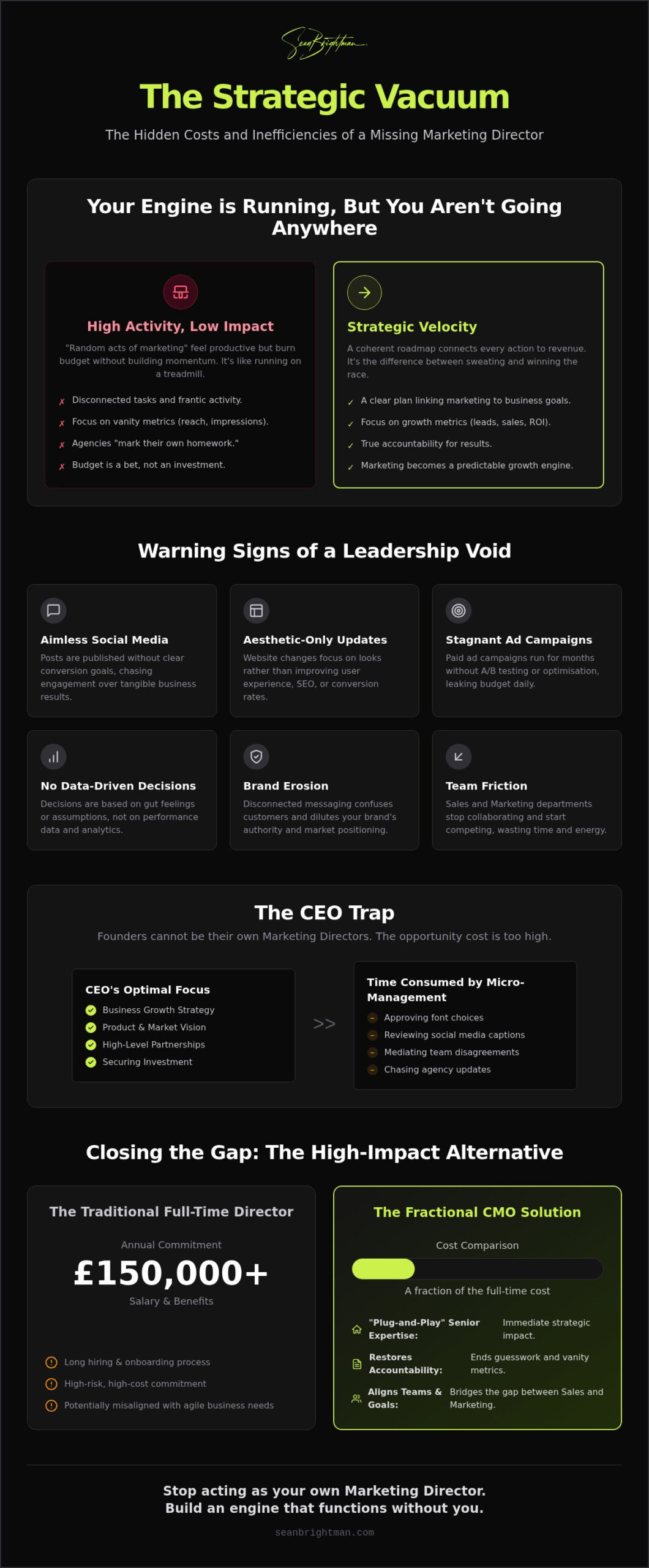
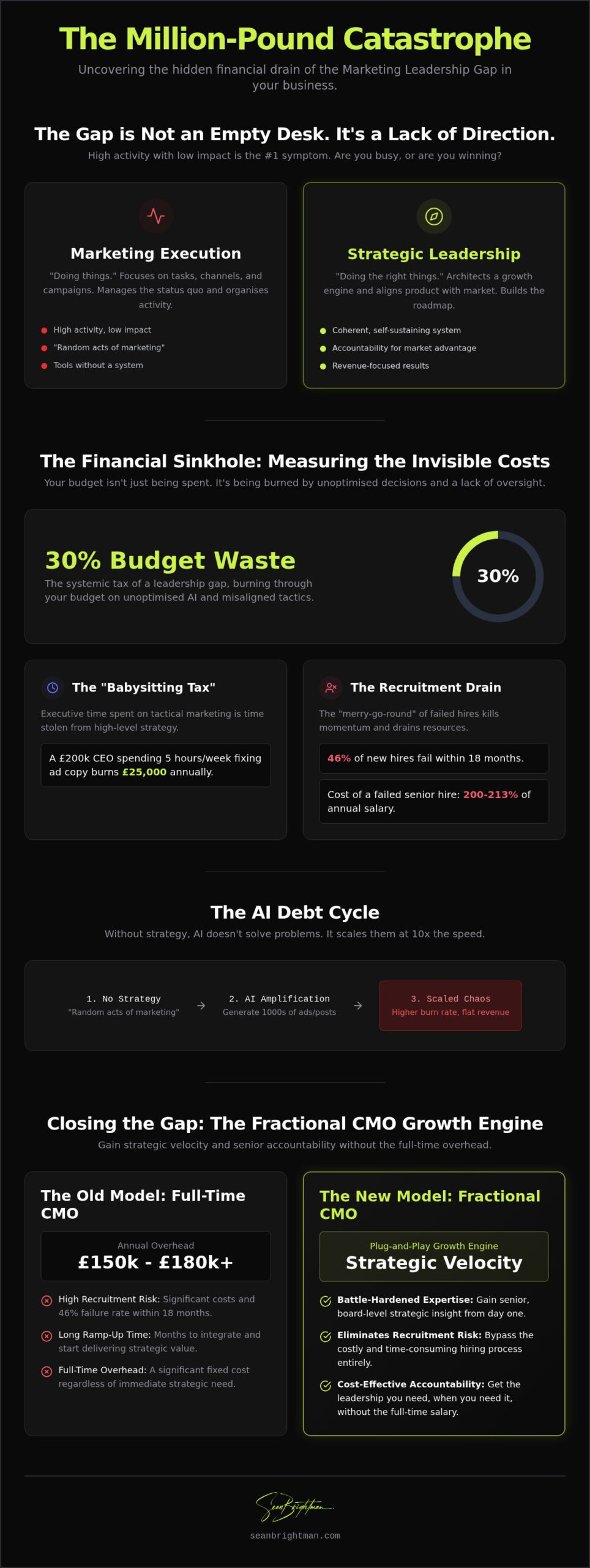
    Hiring the wrong person isn’t just a mistake. It’s a million-pound catastrophe. In 2026, the actual cost of marketing leadership gap issues is no longer a missed target or a messy spreadsheet. It’s a systemic tax. It burns through 30% of your budget on unoptimised AI and misaligned tactics while you’re left holding the bill.

    You see the symptoms daily. Your team is busy, the tools are expensive, and your burn rate is climbing. Revenue stays flat. You’re likely exhausted from founder-led marketing and tired of guessing which half of your budget is actually working. This is about systems, not just tools. You need a growth engine, not a collection of expensive subscriptions.

    I’ll show you how to plug these invisible financial leaks. You’ll discover how to build a marketing department that functions as a self-sustaining growth engine without the £150k overhead of a full-time hire. We will examine the mechanics of fractional leadership, the reality of AI-disrupted roles, and the exact roadmap to strategic clarity.

    Key Takeaways

    • Distinguish between marketing execution and strategic leadership to ensure your team is doing the right things, not just staying busy.
    • Calculate the invisible cost of marketing leadership gap problems, including wasted ad spend and the financial drain of the recruitment merry-go-round.
    • Stop the AI debt cycle by integrating tools into a coherent strategy rather than scaling bad processes at ten times the speed.
    • Recognise the warning signs of a leadership void, such as the CEO personally approving tactical details or tracking vanity metrics over revenue.
    • Implement a “plug-and-play” Fractional CMO solution to gain strategic velocity and senior accountability without the full-time salary overhead.

    What is the Marketing Leadership Gap?

    The gap isn’t an empty desk. It’s an absence of accountability for your market advantage. You have people. You have tools. You probably have a dozen active campaigns. But you don’t have a growth engine. You have a collection of parts that don’t fit together. This is the difference between marketing execution and marketing leadership.

    Execution is about doing things. Leadership is about doing the right things. Mid-market UK firms often fall into the “Tactical Trap” whilst scaling. They hire for skills but lack the vision to integrate those skills into a coherent system. The cost of marketing leadership gap issues shows up as high activity with low impact. You’re busy, but you aren’t winning.

    In 2026, the complexity of AI and fragmented channels has turned this gap into a canyon. AI allows you to generate a thousand ads in a minute. Without leadership, those thousand ads are just noise. You’re scaling chaos. You’re paying for speed when you should be paying for direction.

    The Manager vs. Leader Distinction

    Managers organise tasks. Leaders architect growth engines. If your Marketing Manager is spending their day debating font sizes or scheduling LinkedIn posts, they aren’t leading. They are managing the status quo. They cannot solve your positioning problem because they are too close to the machinery.

    True leadership requires an understanding of the core principles of marketing management to align your product with a shifting market. A manager follows the roadmap. A leader builds it. Relying on “bottom-up” strategy from junior staff is a recipe for expensive failure in a competitive market.

    Why Scale-ups Hit the Leadership Wall

    Founder-led marketing works until you hit £5M. At that stage, your intuition is enough. But as you push toward £20M, that intuition fails. You can’t be in every meeting. You can’t approve every headline. You hit the “Squeezed Middle”.

    This is where the cost of marketing leadership gap becomes a drag on your valuation. You are too big for a freelancer but too small for a full-time £180k CMO. The result is “random acts of marketing”. You try a bit of SEO. You dabble in PPC. You hire a content agency. None of it talks to each other. You have a team that needs babysitting instead of a department that generates revenue.

    The Financial Sinkhole: Measuring the Invisible Costs

    Your marketing budget is leaking. It isn’t a drip; it’s a flood. The cost of marketing leadership gap issues isn’t just a line item on a P&L; it’s the cumulative weight of unoptimised decisions. When you lack senior oversight, you pay a “Babysitting Tax”. If you are a CEO earning £200,000 and you spend five hours a week fixing LinkedIn posts or debating ad copy, you are burning £25,000 a year in executive time. That is time stolen from high-level strategy to do a job you’ve already paid someone else to perform.

    The drain extends to your ad spend. Running campaigns on a broken brand foundation is like pouring water into a sieve. Without a leader to enforce message market fit, your cost per acquisition climbs whilst your conversion rate stagnates. You aren’t building an asset. You are just renting expensive, low-quality attention. Mastering the challenge of measuring marketing ROI becomes impossible because the data is polluted by tactical noise. You can’t measure what you haven’t defined.

    The Cost of Misaligned Tactics

    Busy marketing teams are often your most expensive ones. High activity does not equal high impact. Spending £10,000 a month on SEO without a strategic brand roadmap is a vanity exercise. You might win the traffic game, but you’ll lose the revenue race. This misalignment compounds over 12 to 24 months. By the time you realise the direction was wrong, your competitors have already out-positioned you and captured the market’s trust. If you want to stop the bleed, you need to audit your marketing machinery before adding more fuel.

    The Retention and Recruitment Drain

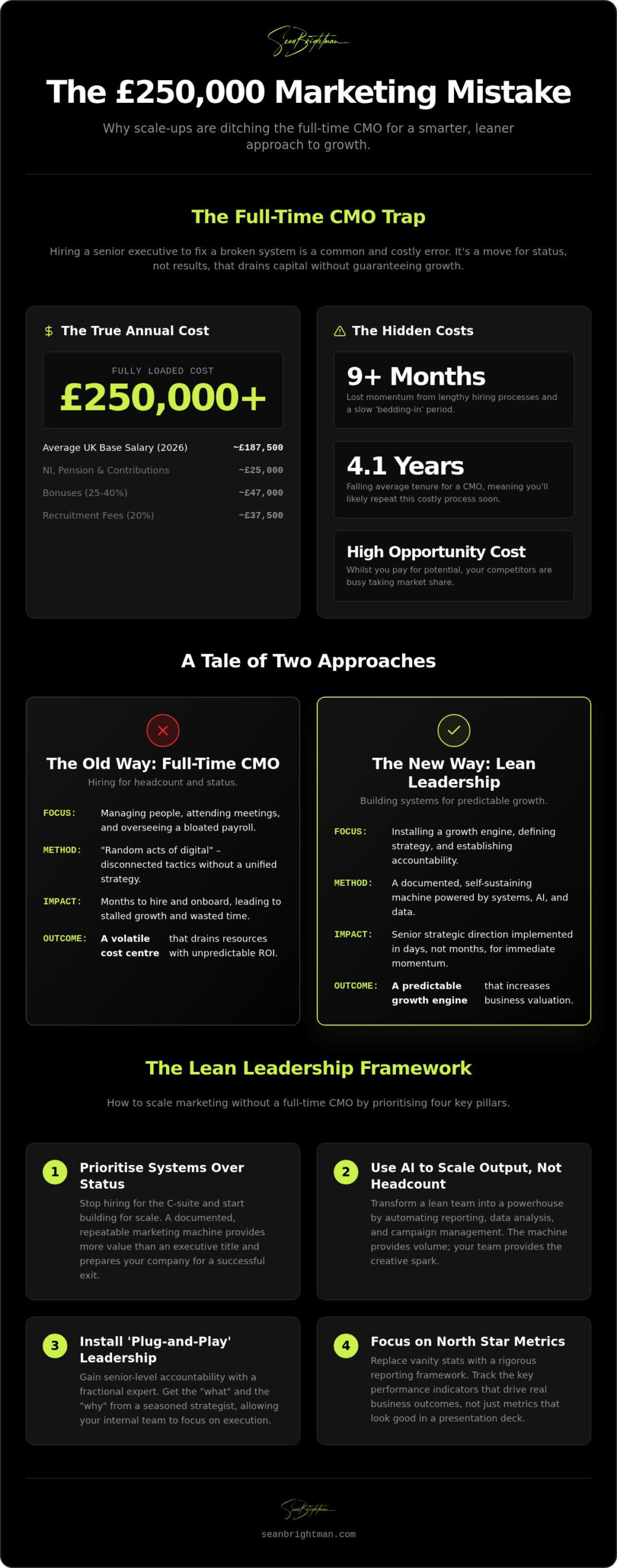
    The recruitment merry-go-round is a silent killer of growth. Research shows that 46% of new hires fail within 18 months. For a senior marketing role, the fully loaded cost of a failed hire can be between 200% and 213% of their annual salary. This includes recruitment fees, ramp-up time, and the devastating loss of momentum. Junior staff churn because they have no one to learn from; senior hires fail because they lack the systems to succeed. Choosing a Fractional CMO eliminates this risk. You get the battle-hardened expertise without the £180,000 overhead or the long-term recruitment gamble. It’s about buying results, not just filling a seat.

    The AI Debt: Why Tactics Without Strategy Burn Cash

    AI isn’t a silver bullet. It’s an accelerant. If your strategy is flawed, AI just makes you fail faster. Many UK firms are currently drowning in “AI Tool Fatigue”. They have 50 different subscriptions for copy, images, and video, but no integrated workflow. They are buying tools, not solutions. This is where the cost of marketing leadership gap issues become visible in your software budget. You are paying for capacity you don’t know how to use.

    The real danger is the “Garbage In, Garbage Out” problem. AI allows you to scale bad strategy at ten times the speed. Without senior oversight, your team is simply generating more noise. They are using ChatGPT to churn out generic blogs whilst your competitors are building automated, data-driven growth engines. This misalignment is often rooted in the structural failure of the marketing role itself. As noted in The Trouble with CMOs, when a role is poorly designed, it cannot possibly manage the complexity of modern technology. You don’t need more prompts. You need a framework.

    To move beyond this, your team requires a comprehensive AI consulting framework. This isn’t about learning how to write better emails. It’s about re-engineering your entire marketing machinery to function in a post-AI world. If you are still manually writing every piece of content whilst your rivals use AI-powered operations, you aren’t just falling behind. You are becoming obsolete.

    AI as a Tool vs. AI as a System

    Most marketing teams use AI as a tool for “content”. They use it to save ten minutes on a social post. True leadership treats AI as a system for “operations”. Research from Boston Consulting Group indicates that 90% of a marketing manager’s tasks are disrupted by AI from a skills perspective. If your leadership doesn’t understand this, they cannot re-engineer your processes. This creates an “Efficiency Gap”. You have a 2026 budget supporting a 2019 workflow. It’s expensive, slow, and strategically toothless.

    The Strategic AI Roadmap

    Moving from “playing with AI” to a scalable growth engine requires an owner. Senior leadership must own the AI implementation roadmap. It’s not a task to delegate to a junior executive. A strategic roadmap defines how AI integrates with your CRM, your lead scoring, and your customer journey. The ROI of automated marketing operations is found in the machinery, not the copy. Under expert guidance, you stop buying subscriptions and start building an integrated growth engine that runs itself. This is how you close the cost of marketing leadership gap and turn your marketing department into a profit centre.
    The Hidden Cost of the Marketing Leadership Gap: Why Growth Stalls in 2026

    Audit Your Gap: Three Signs You’re Babysitting Your Marketing

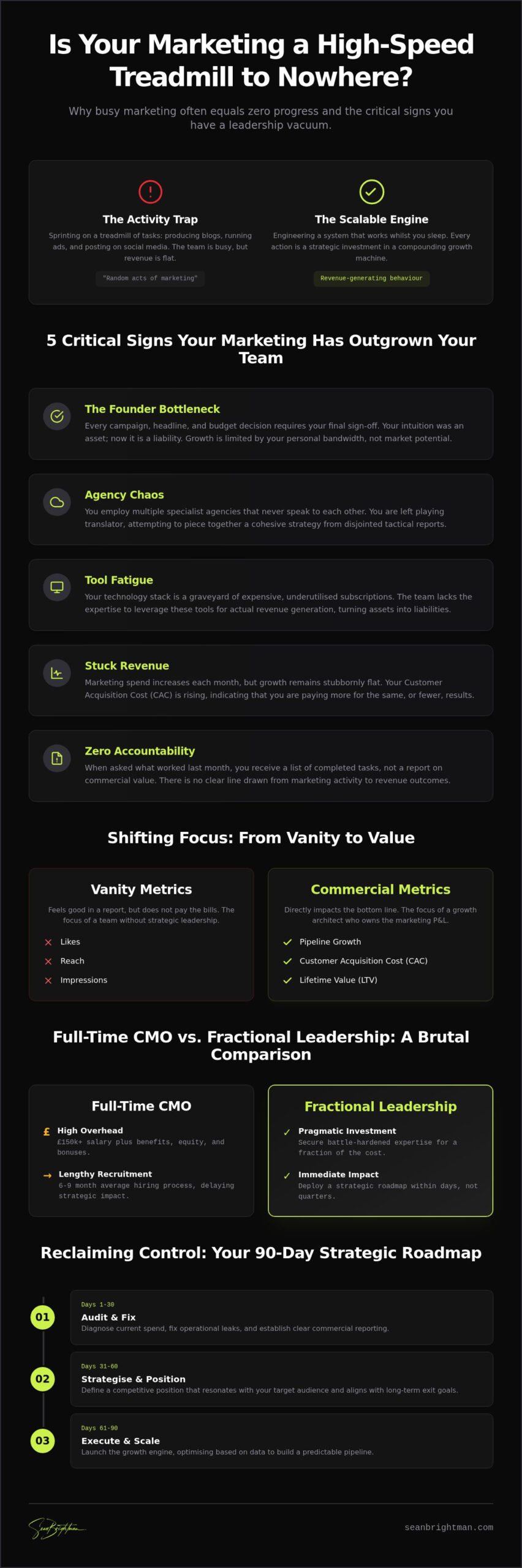
    Stop pretending your marketing department is an autonomous engine if you’re the one still turning the key every morning. If you’re correcting ad copy or debating the colour of a CTA button, you aren’t a CEO. You’re a high-priced editor. Whilst you might feel that staying involved ensures quality, you’re actually capping your company’s growth. You’ve hired a team, but you’re still doing the heavy lifting.

    Founder-led marketing is a stage, not a permanent state. If you are still the final word on every LinkedIn post and ad headline, your team hasn’t been empowered. Or worse, they aren’t capable. Either way, you’re the bottleneck. This isn’t leadership; it’s a lack of trust in your own systems. When you can’t step away from the tactical details, the cost of marketing leadership gap issues starts to paralyse your executive focus.

    Look at your last report. If it’s full of “vanity metrics” like follower growth or website traffic, you’re being fed fluff. Real leadership focuses on “revenue velocity.” It’s about how fast a lead turns into cash, not how many people liked a post. When your team reports on activities instead of outcomes, you’re witnessing the cost of marketing leadership gap in real-time. You’re paying for a list of chores, not a strategy.

    You likely have a marketing operations disaster hidden in your tech stack. If no one can tell you exactly which tool manages which part of the customer journey, you’re paying for a mess. Tools should talk to each other; your team shouldn’t be the manual bridge between them. Review your calendar for the last fortnight. If 20% of your time was spent on marketing “how-to” rather than “what’s next,” you have a leadership void that needs plugging.

    The Metric Test

    Can your team explain the CAC (Customer Acquisition Cost) to LTV (Lifetime Value) ratio? If they can’t, they aren’t managing a budget; they’re spending it. Your marketing reports should read like a financial statement, not a list of activity logs. Ask for a strategy pivot tomorrow. If it takes three months to change direction, your machinery is rusted and your leadership is missing.

    The Founder Dependency Audit

    What happens if you don’t attend the marketing meeting for a month? If the answer is “everything stops,” you don’t have a business. You have a job. The brand voice must be a documented system, not an extension of your personality. Founder-led marketing is a massive bottleneck to a business exit. No one wants to buy a company that breaks the moment the founder goes on holiday. You need to build a system that outlasts your daily involvement.

    If your marketing team needs a leader instead of a babysitter, book a strategic audit to find your growth engine.

    Closing the Gap: The Fractional CMO Growth Engine

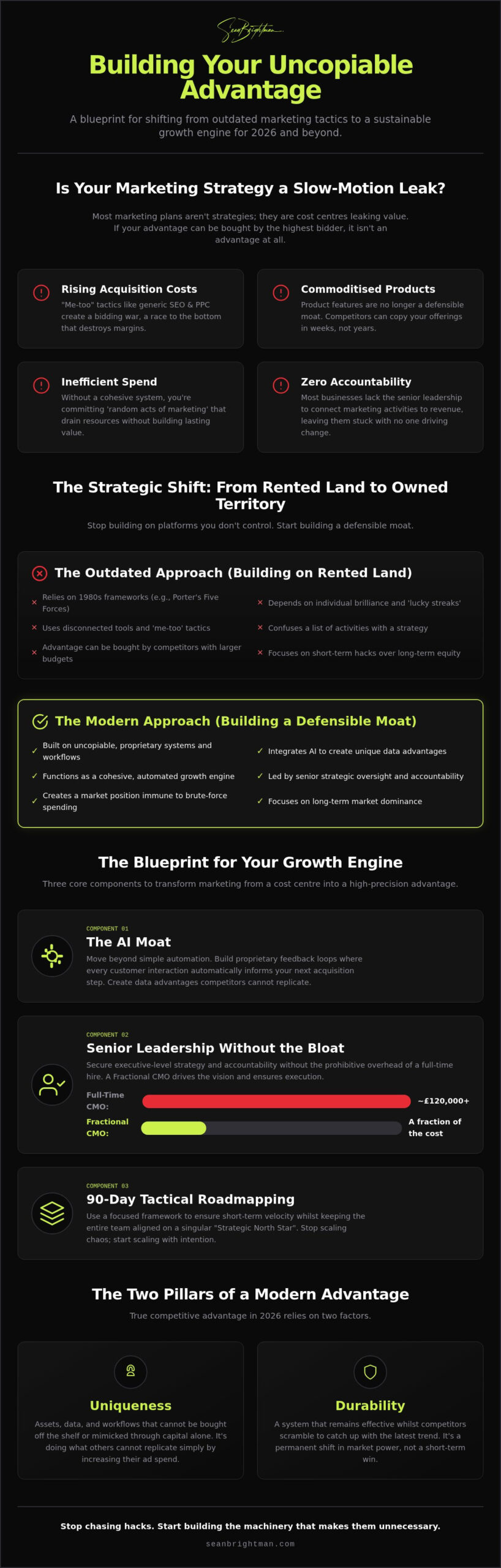
    You don’t need a full-time executive. You need an outcome. In 2026, the cost of marketing leadership gap issues is solved by buying results, not paying for presence. A Fractional CMO is the “Plug-and-Play” solution for UK scale-ups. It gives you senior-level authority to fix the machinery without the £180,000 overhead or the recruitment risk. You get the brain without the baggage.

    Think of it as senior brainpower at roughly 25% of the cost of a traditional hire. You aren’t paying for corporate politics or 40 hours of “busy work”. You’re paying for a growth engine that runs itself. This shift from a “Leadership Gap” to a Marketing Advisory Retainer moves the needle from tactical chaos to strategic velocity. It’s about high-impact intervention in a concentrated timeframe.

    The Strategic Roadmap First

    Don’t hire a single executioner until you have a map. Most firms hire a “Social Media Manager” or an “SEO Specialist” before they even know what they are selling or to whom. That is a waste of capital. A Fractional CMO starts with a 90-day Roadmap. We define the positioning, the systems, and the AI integration points first. We build the foundation before we hire the executioners.

    This roadmap sets the accountability framework for your existing team. It turns them from a group of people doing tasks into a department delivering revenue. We fix the brand foundation so your ad spend actually converts. We integrate AI into the workflow to bridge the efficiency gap. You get a blueprint. Then, and only then, do you build the team to run it. This sequence ensures you aren’t scaling chaos.

    The Long-term Advisory Model

    Strategic direction shouldn’t come with corporate baggage. An advisory model provides an external force of order. It brings a battle-hardened perspective that internal teams lack. You get a partner who isn’t afraid to be blunt or challenge the status quo. This is about providing the high-level thinking that keeps the engine running at peak efficiency whilst your internal team handles the daily output.

    This isn’t just about next month’s leads. It’s about building a marketing department that buyers covet. If you’re preparing for an exit, a system-led marketing engine adds significant value to your business. It proves that the brand isn’t dependent on the founder. It proves the growth is repeatable and scalable. Stop babysitting your marketing and start leading your business. It’s time to turn your marketing department into a profit centre.

    Stop Babysitting and Start Scaling

    Your marketing should be a self-sustaining growth engine, not a series of fires you have to put out. We’ve seen that the cost of marketing leadership gap issues is measured in wasted ad spend, CEO burnout, and stagnant revenue. You don’t need a full-time £180k hire to fix it; you need a system that works. Strategy must lead your tools, especially when integrating AI into your operations.

    I provide no-fluff, senior-level advisory for founders who are ready to step out of the tactical weeds. As an expert in AI-powered growth engines and the author of the definitive book on marketing strategy, I help you build the machinery that outlasts your daily involvement. It’s about clarity, accountability, and results.

    Ready to bridge the gap? Book a Strategic AI Roadmapping Session with Sean Brightman today. Let’s turn your marketing department into a high-impact profit centre. You’ve built the business; now build the engine to scale it.

    Frequently Asked Questions

    What is the true cost of a marketing leadership gap?

    The true cost is the sum of wasted ad spend, CEO time, and failed recruitment. Research indicates a bad senior hire can cost over 200% of their annual salary. The cost of marketing leadership gap issues also includes the “Babysitting Tax,” where founders lose hours to tactical management. This isn’t just money out of the bank. It’s the compounding loss of market position whilst competitors out-manoeuvre you.

    How do I know if I need a Fractional CMO or a Marketing Manager?

    Managers execute; CMOs architect. If you need someone to schedule posts and run basic campaigns, hire a manager. If you need a scalable growth engine, a positioning overhaul, or an integrated AI strategy, you need a Fractional CMO. You don’t hire a manager to solve a strategy problem. You hire a leader to build the system that the manager eventually operates.

    Can an agency fill the marketing leadership gap?

    Rarely. Agencies are built to sell services, not to own your business outcomes. They focus on their specific channel, whether that’s SEO or PPC, often ignoring the broader brand foundation. A Fractional CMO acts as an internal force, providing senior leadership that holds agencies accountable. You need an architect on your side of the table to ensure the builders are actually following a plan.

    What is the average salary of a full-time CMO in the UK in 2026?

    For a seasoned professional at a scale-up, you’re looking at £150,000 to £200,000 plus benefits and equity. This high overhead is why many mid-market firms hit a growth wall. They need the expertise but can’t justify the six-figure commitment. A Fractional CMO provides the same level of strategic velocity at a fraction of the cost, focusing on high-impact outcomes rather than full-time presence.

    How does a Fractional CMO integrate AI into my marketing?

    By building an operational system, not just writing prompts. We look at the entire customer journey to identify where AI can automate lead scoring, content distribution, or data analysis. The goal is to re-engineer your marketing machinery to be faster and leaner. It’s about moving from “playing with tools” to owning a data-driven growth engine that scales without adding headcount.

    Is a marketing leadership gap common in B2B scale-ups?

    It is almost universal between £5M and £20M turnover. Founders often reach the limit of their own marketing intuition but haven’t yet built a departmental system. This creates a vacuum where tactics become disconnected from revenue. Identifying the cost of marketing leadership gap early allows scale-ups to professionalise their marketing operations before the “Founder Bottleneck” causes a permanent stall in growth.

    What happens if I ignore the leadership gap for another year?

    You’ll burn another 30% of your budget on misaligned tactics and unoptimised tech subscriptions. Your competitors will gain a 12-month head start on AI-powered operations that you’ll struggle to match. Ignoring the gap doesn’t just stall growth; it builds “strategic debt.” The longer you wait to fix the foundation, the more expensive and painful the eventual reconstruction becomes.

    How long does it take to close the leadership gap with a Fractional CMO?

    The initial “plug-and-play” intervention usually takes 90 days. Within the first month, we audit the existing machinery and identify the leaks. By day 60, we’ve defined the strategic roadmap and AI integration points. By day 90, the accountability framework is in place and the team is running a documented system. You move from chaos to clarity in one fiscal quarter.

  • Fractional CMO for AI Integration: Building Your 2026 Growth Engine

    Fractional CMO for AI Integration: Building Your 2026 Growth Engine

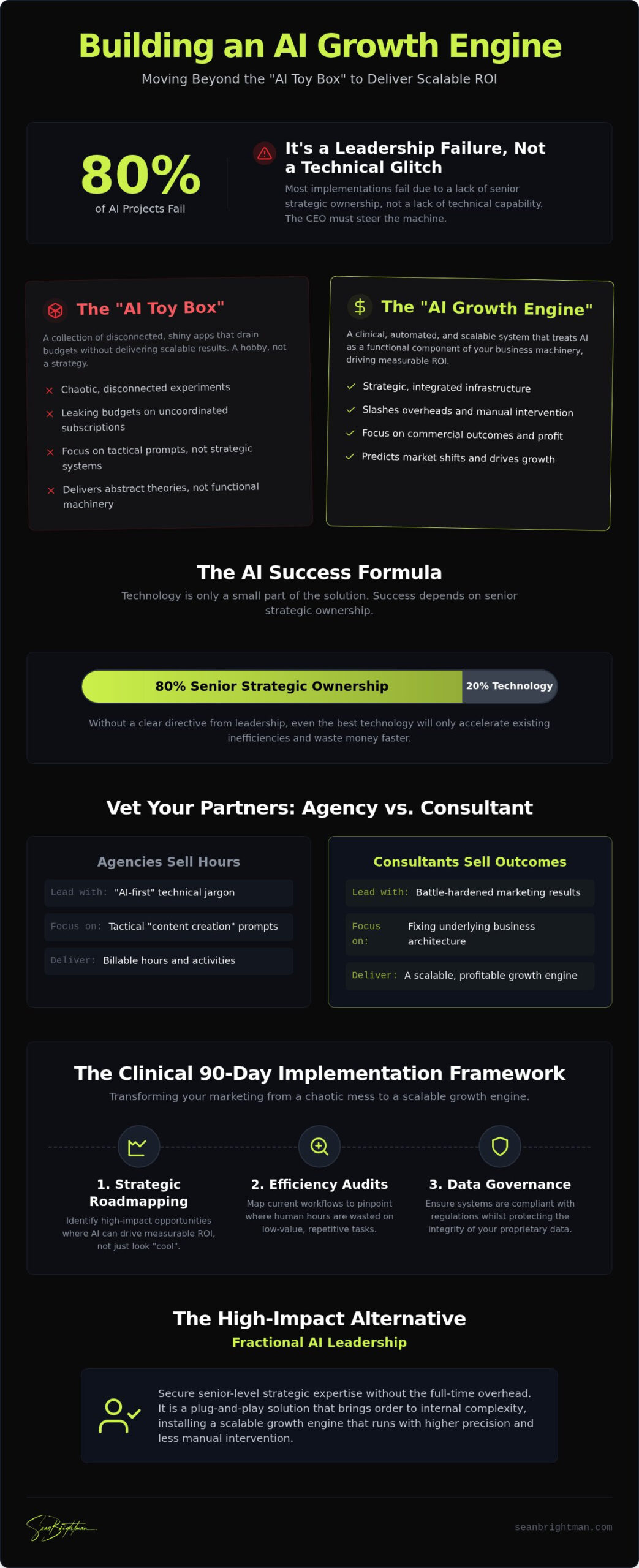
    Your current AI tech stack isn’t a strategy. It’s a graveyard of expensive subscriptions and half-baked automations that solve nothing. Most businesses are currently drowning in tool fatigue, throwing money at ‘revolutionary’ software whilst their actual growth remains stagnant. Securing a fractional cmo for ai integration is the only way to turn this chaotic noise into a high-precision growth engine.

    It’s a common frustration. You know AI is the future of your industry, yet you lack the senior leadership to actually organise the machinery into a functional system. This is about building a scalable architecture, not just buying more shiny objects. You need to stop the wasteful spending and start building for 2026.

    In this article, you’ll learn how to architect a clear marketing system that drives efficiency and reduces costs. We’ll explore the transition from tool-led distraction to strategy-led execution. You’ll see how senior-level accountability turns AI from a cost centre into a high-impact growth driver.

    Key Takeaways

    • Bridge the ‘AI Integration Gap’ by prioritising strategic systems architecture over the endless cycle of software subscriptions.
    • Discover how a fractional cmo for ai integration builds a scalable growth engine that turns tool fatigue into measurable profit.
    • Learn to distinguish between agency-led execution and senior strategic leadership to avoid the common pitfalls of the AI minefield.
    • Implement a 90-day roadmap that moves your marketing from operational chaos to a high-efficiency, AI-powered reality.
    • Secure senior-level accountability and strategic velocity without the burden of a £150k full-time executive salary.

    The AI Integration Gap: Why Tools Aren’t a Strategy

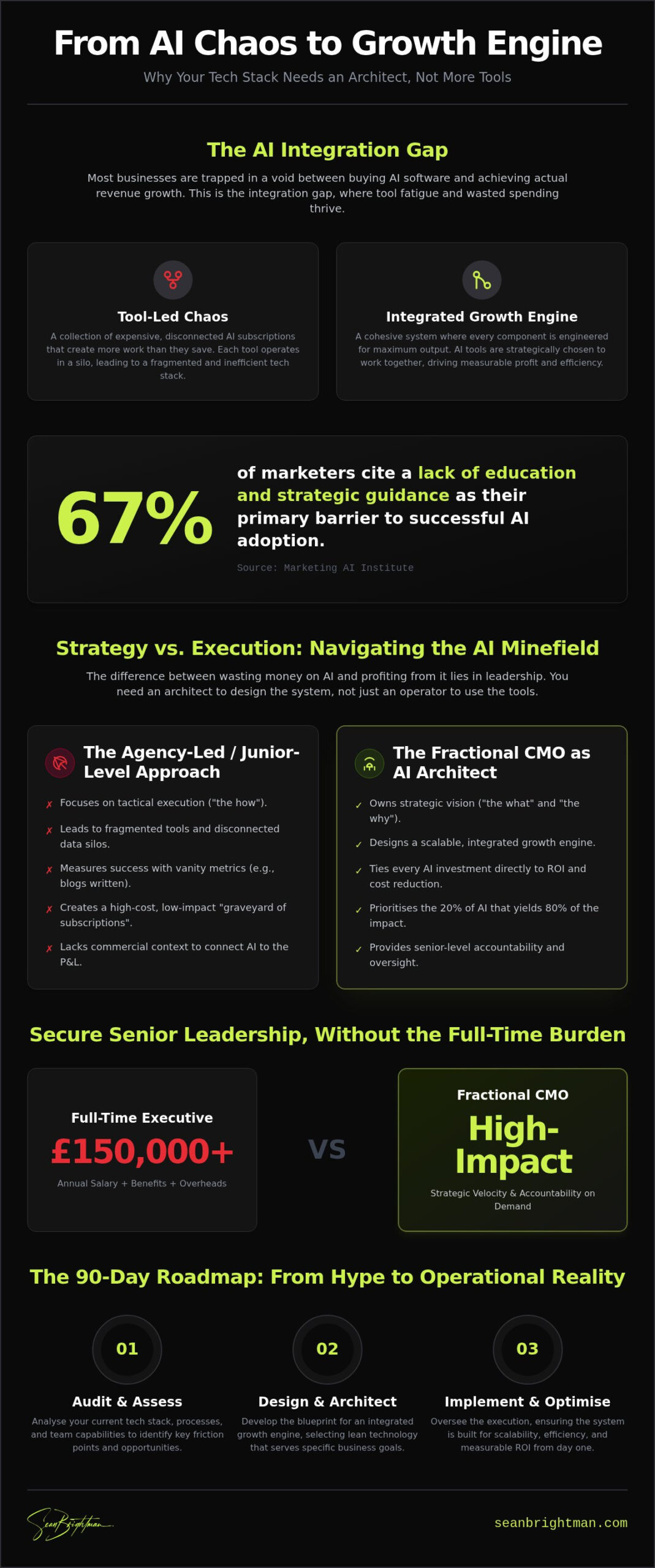
    Buying a tool is easy. Extracting ROI is where most businesses fail. This void is the AI Integration Gap. It’s the distance between your latest software subscription and actual revenue growth. Right now, your marketing department is likely a collection of disconnected silos. You have a CRM that doesn’t talk to your content tool, and a team that uses AI to draft emails but has no idea how it impacts the customer journey.

    According to the Marketing AI Institute, 67% of marketers cite a lack of education as their primary barrier to AI adoption. They aren’t lazy. They’re unguided. A ChatGPT Plus subscription is not a marketing strategy. It’s a tactical band-aid. True growth requires a fractional cmo for ai integration to treat marketing as a singular, cohesive machine. We call this the Growth Engine. It’s a system where every component, from lead gen to retention, is engineered for maximum output with minimum friction.

    The Tool Fatigue Trap

    SMEs are currently haemorrhaging cash on redundant AI subscriptions. Every department head buys a different “game-changer” tool, leading to a fragmented tech stack that creates more work than it saves. There’s a massive difference between playing with AI and integrating it. Playing is asking a bot to write a blog post. Integrating is hardwiring AI into your lead qualification process to double your conversion rate. Tool fatigue is the inevitable result of tactical execution without strategic architecture.

    The Need for Senior AI Oversight

    You cannot expect a junior executive to architect your entire AI infrastructure. They lack the commercial context to see how a prompt affects the P&L. Without senior oversight, you risk brand dilution and massive compliance failures. The foundational role of a Chief Marketing Officer is to provide high-level vision and strategic alignment, ensuring that technology serves the business goals rather than the other way around.

    A fractional cmo for ai integration acts as the “adult in the room” for tech adoption. They ensure that every piece of software serves the bottom line. They bring order to the chaos. This isn’t about being a consultant who drops a report and leaves. It’s about senior-level accountability that ensures your AI investments actually pay off. You need a leader who knows how to strip away the fluff and focus on the mechanics of growth.

    The Fractional CMO as AI Architect: Building Your Growth Engine

    A builder doesn’t start by buying a truckload of bricks. They start with a blueprint. Most marketing leaders are currently doing the opposite. They buy the bricks (the tools) and hope a house appears. A fractional cmo acts as your architect. They design the system before a single subscription is authorised. This mindset shift is the difference between a messy department and a high-impact growth engine.

    AI is only as good as the infrastructure it sits on. If your data is siloed and your processes are broken, AI will only help you fail faster. Top-performing leaders are succeeding in the AI era by focusing on insights and enterprise-wide integration rather than just task automation. You don’t need more tasks. You need a fractional cmo for ai integration who treats data as the fuel for your growth engine. It’s a binary choice: you either build a scalable machine or you continue managing a collection of expensive accidents.

    Designing the AI-Powered Marketing Stack

    Building a stack isn’t about following trends. It’s about mapping the customer journey to specific AI intervention points. Where does the friction exist? Where can AI reduce the time-to-value? A strategic architect selects tools based on interoperability. If your tools don’t talk to each other, they aren’t part of an engine; they’re just noise. We prioritise efficiency by identifying the 20% of AI applications that deliver 80% of the commercial impact. This ensures your tech stack remains lean, integrated, and focused on revenue.

    Accountability and Leadership

    Leadership in 2026 is about owning the “What” and the “Why”. Anyone can figure out the “How” with a YouTube tutorial. A fractional cmo for ai integration provides the senior-level accountability that CEOs actually care about. Instead of vanity metrics like “number of AI-generated emails,” we set KPIs tied to strategic velocity and cost reduction. The plug-and-play nature of this role means you get high-impact leadership without the £150k overhead. It’s about bringing order to internal complexity through a battle-hardened perspective. If you’re ready to stop guessing and start building, a marketing strategy audit is the logical first step.

    Strategy vs Execution: Navigating the AI Minefield

    Execution is a commodity. Strategy is the moat. Right now, most businesses are mistaking AI-generated output for marketing progress. It isn’t. It’s just noise. A fractional cmo for ai integration ensures that your technology serves a specific commercial objective rather than just populating a spreadsheet. You need a leader who understands that more activity does not equal more growth. This is the “this, not that” reality of 2026: you need a system that thinks, not just a system that does.

    The numbers don’t lie. Hiring a full-time senior executive is often a £120k mistake. You end up paying for forty hours of “management” when you actually only need ten hours of high-octane strategic architecture. It is a waste of capital. Fractional efficiency gives you the same battle-hardened expertise focused purely on the high-value tasks that AI cannot touch: vision, empathy, and complex problem-solving. It’s about buying the brain, not the body.

    The Agency Trap

    Most agencies are currently in a defensive crouch. Their business model relies on billable hours and manual execution. AI threatens to slash those hours by 80%, which creates a conflict of interest. They will sell you execution because that is what they are built to deliver. A Fractional CMO acts as an unbiased filter for agency performance. They don’t care about billable hours; they care about output. They help you build internal AI capability so you stop being held hostage by external partners who are incentivised to keep things slow and manual.

    Human-Led Brand Positioning

    AI is a world-class mimic, but it is a terrible innovator. It can follow a pattern, but it cannot “feel” your brand’s unique positioning amongst a sea of competitors. It cannot understand the nuance of a founder’s vision or the specific emotional triggers of your target audience. This is where the human strategist becomes indispensable. We use AI to amplify the message, but the message itself must be born from strategic brand roadmapping. This is how you win: use the machine for volume, but keep the human in charge of the value. AI should be the engine, but a human must always be the navigator.

    Fractional CMO for AI Integration: Building Your 2026 Growth Engine

    The 90-Day AI Roadmap: From Hype to Operational Reality

    Most AI strategies are just expensive wish lists. They lack a timeline, a budget, and a pulse. A real roadmap is a tactical sequence designed to strip away inefficiency and replace it with high-precision machinery. Securing a fractional cmo for ai integration provides the strategic velocity needed to move from concept to cashflow in under three months. This isn’t a five-year transformation. It’s a 90-day sprint to operational excellence.

    We follow a clinical five-step process to ensure your investment delivers a measurable return:

    • Step 1: The Marketing Efficiency Audit. We find the hidden profit buried under layers of manual labour.
    • Step 2: Architecture Design. We map the AI growth engine and define the data flows.
    • Step 3: Tool Selection. We consolidate the stack to ensure every component talks to the others.
    • Step 4: Team Upskilling. We build internal capability whilst establishing accountability frameworks.
    • Step 5: Rapid Execution. We launch, measure, and iterate at high speed.

    The Marketing Efficiency Audit

    Efficiency is the foundation of growth. You cannot build a high-performance engine on top of a leaky bucket. The Marketing Efficiency Audit is a clinical assessment of marketing waste. We identify the “busy work” that your team should have automated months ago. We find the leaks in your lead generation funnel where potential revenue is simply evaporating. It’s about stripping the department back to its most functional parts before adding the AI layer. If a task doesn’t contribute to the bottom line, we kill it or automate it.

    Building the Roadmap

    A static plan is a liability in a fast-moving market. You need a dynamic roadmap that evolves as the technology does. This process defines how to organise a marketing department for rapid growth by aligning human talent with machine efficiency. The 90-day vision focuses on immediate ROI, ensuring that every AI implementation justifies its existence within the first quarter. A fractional cmo for ai integration doesn’t just give you a PDF; they give you a functioning system. To start building your own 2026 growth engine, you should book a strategic roadmapping session today.

    Sean Brightman: Senior AI Marketing Leadership on Demand

    Sean Brightman doesn’t do corporate politeness. He builds engines. As a fractional cmo for ai integration, he strips away the fluff to reveal the raw mechanics of growth. You don’t need another consultant with a 50-page slide deck. You need a senior leader who remains active in the field. Sean specialises in “plug-and-play” systems architecture. He enters your business, identifies the friction, and installs the AI machinery required to win in 2026. His published book on marketing strategy serves as the foundational resource for this high-impact, no-nonsense approach.

    The current market is chaotic. Most business owners are drowning in tactical noise whilst their competitors are quietly building automated moats. Sean provides the senior-level authority required to cut through that noise. He isn’t interested in your internal bureaucracy or your favourite vanity metrics. He’s interested in the P&L. This is senior leadership on demand. It’s about high-level thinking combined with visceral, practical execution. It’s the expertise of a £150k executive delivered with fractional efficiency.

    The Advisory Retainer

    Direction is useless without accountability. The Marketing Advisory Retainer is designed for CEOs who are tired of being stuck. It provides a monthly cadence of strategic velocity. No fluff. No pointless updates. Just high-impact direction to ensure your AI strategies are actually moving from the roadmap into operational reality. Sean acts as the external force that brings order to your internal complexity. It’s the “adult in the room” oversight your team needs to stop playing with tools and start driving revenue.

    One-Off Roadmapping Sessions

    Sometimes you just need a reset before a major push. A single strategic roadmapping session provides the clarity that months of internal debate cannot reach. These sessions are perfect for businesses preparing for a major growth phase or positioning themselves for a successful exit. Securing a fractional cmo for ai integration for this session ensures your roadmap isn’t just a wish list. Potential buyers don’t want to buy a collection of tasks; they want to buy a functioning growth engine. By architecting your AI integration today, you create an asset that is scalable and highly covetable. You stop being the bottleneck and start being the owner of a machine.

    Architect Your 2026 Growth Engine Today

    The window for “playing” with AI is closed. You either build a high-precision marketing machine now or you get left behind by those who do. We’ve seen that the gap between tool fatigue and actual ROI is bridged by strategic architecture, not more subscriptions. You need a system that prioritises commercial impact over tactical noise.

    Securing a fractional cmo for ai integration gives you the senior-level accountability required to turn these concepts into operational reality. You get the expertise of a battle-hardened strategist and published author without the £150k+ overhead of a full-time hire. This is about building a functional asset that drives growth whilst reducing wasteful activity.

    Stop managing chaos and start building an engine. It’s time to install the leadership your business deserves to win in the next era of marketing. Book a Strategic AI Roadmapping Session with Sean Brightman and take control of your growth.

    Frequently Asked Questions

    What exactly does a Fractional CMO for AI integration do?

    A fractional cmo for ai integration acts as the architect of your marketing systems. They don’t just recommend tools; they design a cohesive growth engine where AI automates execution whilst humans drive strategy. This role involves auditing your current tech stack, mapping the customer journey to AI intervention points, and providing senior-level accountability. It’s about building a scalable machine that delivers measurable ROI rather than just managing a collection of disconnected software subscriptions.

    How much does a Fractional CMO cost compared to a full-time hire in the UK?

    A full-time CMO in the UK currently commands a salary often exceeding £150,000 per year plus benefits and bonuses. In contrast, a fractional retainer typically costs a fraction of that amount whilst delivering the same senior-level expertise. You pay for high-impact strategic direction rather than forty hours of administrative presence. It’s a binary choice between paying for a full-time body or investing in a battle-hardened brain that focuses purely on growth.

    Can our existing marketing team handle AI integration themselves?

    Most marketing teams lack the senior strategic context to architect a full AI infrastructure. Whilst they can certainly use tools like ChatGPT for specific tasks, they often struggle with interoperability and data consolidation. They are usually focused on execution, not the overarching systems architecture. Without senior oversight, you risk brand dilution and tool fatigue. A fractional leader provides the “adult in the room” perspective needed to ensure technology serves the business goals.

    How long does it take to see results from an AI marketing roadmap?

    You should expect to see measurable operational improvements within 90 days. The initial audit and architecture design happen in the first month, followed by rapid tool integration and team upskilling. By the third month, your growth engine should be operational, reducing manual “busy work” and improving lead generation efficiency. This isn’t a multi-year corporate transformation; it’s a tactical sprint designed to deliver strategic velocity and immediate commercial value to your P&L.

    Is AI integration only for large tech companies or can SMEs benefit?

    SMEs actually stand to benefit the most from AI integration because it levels the playing field. Large corporations are often slowed down by legacy systems and internal bureaucracy. Smaller businesses can move faster, using AI to achieve the output of a much larger team without the associated headcount costs. For an SME, AI is a force multiplier that turns a lean marketing department into a high-powered growth engine through sheer operational efficiency.

    What is the “£120k mistake” in marketing recruitment?

    The “£120k mistake” is hiring a full-time senior executive when you only need ten hours of high-level strategy per week. Most SMEs don’t have enough strategic work to occupy a £150k hire, so that person ends up doing junior-level tasks or creating unnecessary bureaucracy. You end up wasting over £120,000 on “management” that doesn’t drive growth. Fractional leadership solves this by providing the exact amount of senior direction required to win without the bloated overhead.

    Does Sean Brightman work with our existing marketing agency?

    Yes, Sean often acts as an unbiased filter for agency performance. Most agencies are incentivised to protect their billable hours, which can lead to a resistance to AI-driven efficiency. Sean provides the senior oversight to ensure your agency is actually delivering value rather than just billing for manual tasks that should be automated. He holds them accountable to the growth engine’s KPIs, ensuring your external partners align with your strategic 2026 vision.

    How do I know if my business is ready for a Fractional CMO?

    If you are experiencing tool fatigue, wasteful marketing spend, or a lack of clear strategic direction, you are ready. Common signs include a marketing team that is constantly “busy” but failing to hit revenue targets, or a CEO who feels they have to micromanage the marketing department. If you need senior-level accountability but cannot justify a £150k+ salary, a fractional cmo for ai integration is the logical next step for your growth.

  • The Fractional CMO Retainer Model UK: Strategic Leadership Without the Full-Time Overhead

    The Fractional CMO Retainer Model UK: Strategic Leadership Without the Full-Time Overhead

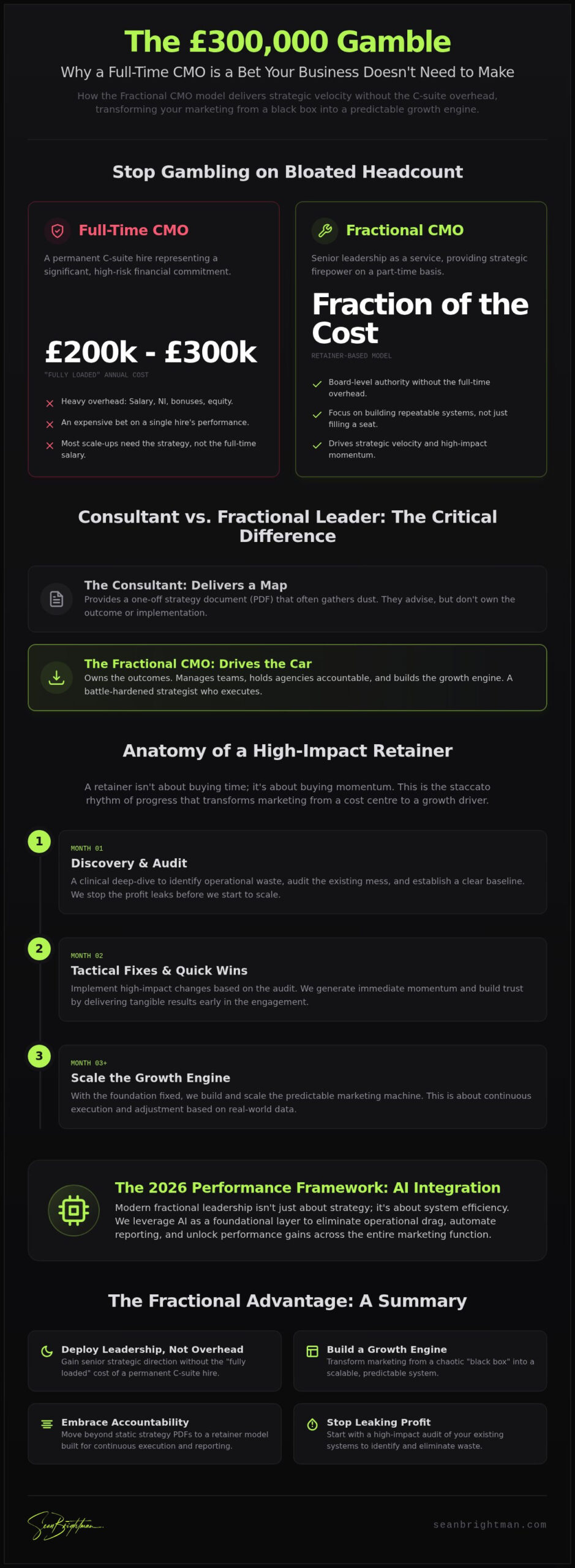
    A full-time CMO is a £300,000 gamble your balance sheet doesn’t need. It’s an expensive bet on a single hire when what you actually require is a repeatable system. You’ve got a solid product, but marketing feels like a black box. If you’re wondering what does a fractional cmo do month to month to fix this, the answer isn’t more meetings; it’s more momentum. You’re the founder. You’re the only salesperson. It’s a recipe for burnout.

    You need strategic velocity, not more headcount. This article explains how to deploy senior leadership through a fractional model to drive AI-powered growth. We’ll show you how to transform stalled results into an optimised engine. No corporate fluff. No ego. Just high-impact advisory. This is about senior-level authority combined with a get-your-hands-dirty attitude.

    We’ll look at how the retainer structure provides board-level reporting and clear strategic direction. You’ll discover how to install a plug-and-play leader who delivers results through tactical precision. It’s about building machinery that works, even when you’re not in the room. Expect a briefing on driving growth without the traditional overhead.

    Key Takeaways

    • Stop gambling on bloated full-time hires; learn how to deploy senior strategic leadership without the heavy “fully loaded” overhead.
    • Get a clear breakdown of what does a fractional cmo do month to month to transform your marketing from a black box into a scalable growth engine.
    • Discover how to leverage AI consulting as a foundational efficiency layer to eliminate operational drag across your entire marketing function.
    • Move beyond static strategy PDFs; embrace a high-accountability retainer model designed for continuous execution and board-level reporting.
    • Identify where you are leaking profit by starting with a high-impact Roadmapping session and a comprehensive audit of your existing systems.

    What is the Fractional CMO Retainer Model in the UK?

    The fractional model is a clinical solution to a messy problem. It’s senior leadership on a part-time, ongoing basis. Think of it as high-calibre strategic firepower on tap. This isn’t about hiring a pair of hands to execute ads. It’s about installing a brain to architect your entire growth engine.

    For UK scale-ups, the financial logic is undeniable. A full-time CMO in 2026 carries a “fully loaded” cost often exceeding £200,000. That includes salary, employer National Insurance, and hefty bonuses. Most mid-market firms don’t need that overhead. They need the results. By using a Fractional executive, you get the same board-level authority at a fraction of the price. It’s about strategic velocity, not just filling a seat.

    The core value lies in systems design and accountability. Founders often ask, what does a fractional cmo do month to month? they don’t just “check-in.” They define the roadmap, audit the operational waste, and ensure the team hits their KPIs. They turn marketing from a black box into a predictable machine. It is high-level thinking combined with a get-your-hands-dirty attitude.

    Fractional CMO vs Marketing Consultant: The Critical Difference

    Consultants give you a map and wish you luck. Fractional CMOs get in the car and drive. A consultant delivers a strategy PDF that usually gathers dust. A fractional leader owns the outcomes. They manage your internal team and external agencies. They are battle-hardened strategists who don’t need hand-holding. If you’re still spending CEO time managing marketing tactics, you haven’t hired a leader; you’ve hired a chore. This is about plug-and-play authority, not another meeting in your diary.

    The 2026 UK Market Context for Senior Marketing Hires

    The UK market has shifted. In 2026, smart businesses have stopped hiring for “activity” and started hiring for “strategy.” There’s a national demand for senior leadership that can navigate complex AI integration and tightening data regulations. The fractional model solves the “messy marketing department” syndrome. It provides a sharp-minded external force that brings order to internal complexity. You get high-level thinking combined with practical execution. It is the efficient choice for companies that have outgrown ad-hoc tactics but aren’t ready for a permanent C-suite salary.

    What Does a Fractional CMO Do Month to Month? The Anatomy of a High-Impact Retainer

    Retainers aren’t about buying a block of time. They’re about buying momentum. If you’re asking what does a fractional cmo do month to month, you’re looking for a rhythm, not a timesheet. It’s a methodical process of identifying waste and installing efficiency. The model is designed to provide senior-level authority exactly when it’s needed, without the bloat of a full-time salary.

    The retainer model creates a staccato rhythm of progress and reporting. Month one focuses on discovery and auditing the existing mess. Month two is about tactical fixes and quick wins. By month three, we’re scaling the growth engine. This ongoing commitment beats one-off project work because strategy is a living thing. It needs constant adjustment based on real-world data, not a static PDF that gathers dust on a hard drive.

    The Advisory Retainer: Direction and Accountability

    The Marketing advisory retainer is for the founder who needs a navigator, not just a map. It’s built for strategic velocity. I act as a sounding board for the CEO whilst driving the marketing team toward clear objectives. This isn’t about operational drag. It’s about clinical oversight. You get the expertise of a battle-hardened strategist to challenge your assumptions and keep your budget focused on what actually moves the needle. It’s high-level direction without the friction of a permanent hire.

    The Fractional CMO Engagement: Systems and Leadership

    When the engagement deepens into a full Fractional CMO role, the focus shifts to building the machinery. This is about deeper integration. I take ownership of the roadmap and manage your internal teams and external agencies to ensure total alignment. If your agencies are pulling in different directions, I’m the one who reins them in. The New Wave Of Fractional Leaders demonstrates that this model is about immediate expertise and tangible impact. I own the “Roadmap to Exit” strategy, ensuring every pound spent increases the business valuation. If your marketing feels like a black box, it’s time to install a Fractional CMO who knows how to fix the plumbing.

    This role is about accountability. I provide the board-level reporting you need to understand exactly where your growth is coming from. We don’t just look at vanity metrics; we look at commercial results. By managing the day-to-day strategic decisions, I free up the CEO to focus on the bigger picture. It’s a plug-and-play leadership solution that scales as your business grows.

    The Project Trap: Why Ongoing Retainers Outperform One-Off Strategy

    Buying a one-off strategy is often a polite way of wasting money. You receive a polished PDF, the consultant leaves, and the document gathers dust on a shared drive. Within three months, your team has drifted back to comfortable, low-impact habits. This is the project trap. It offers the illusion of progress without the machinery of execution. Real growth requires a living strategy that evolves with your data.

    When founders ask what does a fractional cmo do month to month, they are asking about the antidote to strategic drift. A retained leader provides the filter you lack. They stop “tool fatigue” by killing unnecessary SaaS subscriptions and focusing on high-leverage activities. It’s about strategic velocity, not just having a plan. This ongoing presence ensures that your marketing strategy for business exit remains a priority, not a secondary thought. Buyers don’t want to see a one-time spike; they want to see a repeatable, scalable engine.

    Accountability is the missing ingredient in most UK marketing departments. Without a senior leader to hold the line, “busy-ness” replaces results. The retainer model installs a battle-hardened expert who isn’t afraid to challenge the status quo. As noted in the Harvard Business Review regarding Part-Time Senior Leaders, this model allows businesses to fill critical talent gaps with high-level expertise that would otherwise be out of reach. It is a clinical approach to leadership that prioritises commercial outcomes over corporate politeness.

    Preventing Strategic Drift

    Market conditions in 2026 move too fast for static plans. With AI adoption hitting 75% amongst brands, your competitors are pivoting weekly. A one-off roadmap fails because it can’t account for volatility. The fractional retainer allows for monthly course correction. We look at what is working and double down. We look at what is failing and cut it. This isn’t about “checking in”; it’s about aggressive oversight. It builds a culture focused on results, ensuring your budget isn’t bled dry by ad-hoc tactics that don’t align with the core objective.

    Building Scalable Marketing Systems

    Tools are not a strategy. Architecture is. Most businesses have a mess of disconnected platforms that create operational drag. A Marketing operations consultant focuses on building the underlying architecture that allows for scale. The retainer model provides the space for this methodical systems building. We don’t just “do marketing”; we build the factory that produces it. This involves refining first-party data strategies and ensuring your tech stack actually talks to itself. It’s about mechanical integration that reduces human error and increases strategic output.

    The Fractional CMO Retainer Model UK: Strategic Leadership Without the Full-Time Overhead

    Integrating AI: The 2026 Fractional CMO Performance Framework

    AI is no longer a luxury or a side project. It is the fundamental engine of marketing efficiency. In 2026, approximately 75% of brands have integrated Generative AI into their core strategies. If your business is still “experimenting” with prompts, you are already behind. A fractional leader doesn’t just suggest tools; they engineer systems that strip away operational drag. This is about strategic velocity, not shiny objects.

    When founders ask what does a fractional cmo do month to month, a significant portion of that time is now dedicated to AI governance and workflow integration. We audit your existing tech stack to kill redundant subscriptions and replace them with automated, high-output machinery. We move from “playing with tools” to building scalable growth engines. This process involves a clinical assessment of where human intervention is slowing you down and where AI can accelerate your path to market.

    The AI-Powered Growth Engine

    Practical application beats theory every time. Most UK businesses suffer from tool fatigue. They have a collection of disconnected platforms that create more work than they solve. My approach to ai consulting is designed to fix this mess. We move beyond the hype to build actual engines. This involves using AI for hyper-personalisation. Since 71% of consumers now expect personalised interactions, this isn’t optional. It is a battle-hardened methodology that focuses on mechanical integration. We ensure your team isn’t just using AI to do the same work faster, but to do better work that was previously impossible.

    Performance Benchmarks and Reporting

    A CEO doesn’t care about “engagement” or “prompt engineering.” They care about commercial outcomes. My monthly board reports focus on the metrics that actually matter: efficiency gains and revenue growth. We measure how much operational drag we’ve eliminated and how that translates to the bottom line. With the transparency obligations of the EU AI Act taking effect in August 2026, we also ensure your AI usage is compliant and ethical. We don’t take risks with your brand reputation.

    Confidence in data is the bedrock of strategic decision-making. We don’t guess. We use AI to model outcomes and predict trends before we spend a single pound of your budget. This shift to “upstream” strategy means we are no longer just reacting to last month’s performance. We are engineering next month’s success. If you are ready to stop the guesswork and start scaling, enquire about a fractional engagement to see how we can rebuild your marketing function for 2026.

    Implementing the Model: How to Start Your Fractional Journey

    The transition to fractional leadership is a clinical process. It doesn’t start with a job interview; it starts with a high-impact Roadmapping session. This is the entry point where we define the path and identify hidden profit. We audit your existing systems to find operational waste and technical debt. This isn’t about adding more tasks to your list. It’s about reclaiming your time as CEO by installing a leader who owns the marketing function.

    Once the roadmap is set, we establish a retainer rhythm. This involves clear milestones, board-level reporting, and absolute accountability. You stop being the primary salesperson. You stop managing ad-hoc tactics. Instead, you get a plug-and-play strategist who brings order to internal complexity. This is how you move from a founder-led business to a scalable growth engine. It is about mechanical integration rather than abstract theory.

    The 90-Day Transformation

    The first three months of an engagement are designed for strategic velocity. In the first 30 days, the focus is on discovery and assessment. We look at what does a fractional cmo do month to month to ensure the foundation is solid. Days 31 to 60 are about strategy development and securing quick wins. We fix the obvious leaks in your funnel immediately. By day 90, we are in full implementation mode, developing your team and refining your AI-powered growth engine. This structured approach is part of the fractional cmo revolution that is currently transforming UK scale-ups. It prioritises long-term systems building over temporary fixes.

    Is Your Business Ready for a Fractional CMO?

    If growth has stalled despite having a good product, your marketing is likely a black box. If you are the only person who can sell the vision, your business isn’t scalable. These are the sharp signs you have outgrown your current setup. Many founders make the “£120k Mistake” by hiring a full-time CMO too early. Between recruitment fees, employer National Insurance, and a senior salary, you’ve burned a hole in your budget before the strategy is even proven. A fractional retainer allows you to prove the model first. It provides the senior leadership you need without the full-time overhead. The next step is simple. Book a strategic briefing to audit your current trajectory and see how a fractional leader can rebuild your growth engine for 2026.

    Reclaim Your Strategic Velocity

    The choice is simple. You can keep gambling on expensive full-time hires and ad-hoc tactics, or you can install a battle-hardened expert to build a repeatable growth engine. Fractional leadership isn’t about filling a seat; it’s about mechanical integration. It turns your marketing from a chaotic black box into a predictable, board-level asset. By avoiding the project trap, you ensure your strategy evolves with the market rather than gathering dust on a drive.

    Understanding what does a fractional cmo do month to month is the first step toward clinical execution. It’s about ongoing accountability, AI-powered efficiency, and strategic direction that actually sticks. As the author of the High-Impact Marketing Strategy book and an expert in AI-powered growth engines, I provide the direct, board-level advisory you need to scale without the bloat. We strip away the corporate fluff to focus on commercial results.

    Stop managing marketing and start leading your business. It’s time to reclaim your time and focus on the bigger picture. Book a Strategic Marketing Roadmap Session with Sean Brightman to audit your trajectory and define your path to growth. You have the product; now build the machinery to match it.

    Frequently Asked Questions

    What is the average fractional CMO retainer cost in the UK for 2026?

    Monthly retainers for fractional CMOs in the UK for 2026 typically range from £2,500 to £12,000. This depends on experience and the required time commitment. It usually represents about 10% to 20% of the cost of a full-time hire. You get the strategic firepower of a seasoned leader without the £300,000 fully loaded salary package. It is about buying expertise, not just hours. This model allows you to deploy senior leadership efficiently.

    How many days per month does a fractional CMO typically work?

    Most fractional CMOs work between one and three days per week. This equates to roughly four to twelve days per month. The focus is on high-impact strategic work rather than daily admin. When asking what does a fractional cmo do month to month, the value is in the outcome of those days. This includes setting the roadmap, auditing team performance, or integrating AI systems. It is about strategic velocity, not filling a chair.

    Can a fractional CMO manage my existing marketing agency?

    Yes. Managing external agencies is a primary responsibility. A fractional CMO acts as your internal filter to ensure agencies are aligned with your business goals. They stop the agency drift where providers focus on their own metrics rather than your bottom line. It’s about providing the technical oversight you don’t have time to manage yourself. They turn your agencies into a cohesive, results-oriented unit that actually delivers.

    What is the difference between an interim marketing director and a fractional CMO?

    Interim directors are usually full-time, short-term covers for a specific gap like maternity leave. A fractional CMO is a part-time, long-term strategic partner. Interims maintain the status quo; fractional leaders build and optimise the growth engine. It’s the difference between keeping the lights on and rewiring the house for scale. One fills a seat; the other builds a system. You need a strategist who stays to see the results through.

    How does the retainer model provide better ROI than a marketing agency?

    Agencies are often incentivised to sell you more services. A fractional CMO has no such conflict. They focus on commercial results and strategic velocity. The ROI comes from killing wasted spend and ensuring every pound works harder. You aren’t paying for a team of juniors to learn on your dime; you’re paying for a battle-hardened expert to drive outcomes. It is a clinical approach to budget management that prioritises profit.

    Is a fractional CMO suitable for a small business or just scale-ups?

    The sweet spot is typically businesses with revenue between £1 million and £25 million. Smaller firms often need doers to execute basic tactics. Scale-ups need the architect to design the systems. If your marketing feels like a black box or growth has stalled despite a good product, you’re ready for fractional leadership. It is about having senior-level authority when your internal complexity outgrows your current team’s ability to manage it.

    What happens if I need to increase or decrease the retainer scope?

    The model is built for flexibility. Retainers can be adjusted as your business reaches specific milestones or faces new challenges. If you are preparing for a business exit, you might increase the scope to harden your systems for buyers. Conversely, once a growth engine is stable, the retainer can scale back to an advisory level. It is a plug-and-play solution that adapts to your commercial reality without the friction of redundancy.

    How do you measure the success of a fractional marketing retainer?

    Success is measured through commercial KPIs, not vanity metrics. We look at pipeline velocity, customer acquisition costs, and overall ROI. When considering what does a fractional cmo do month to month, you should expect board-level reporting that provides clear strategic direction. Success means your marketing is a predictable revenue driver, not a cost centre. It requires a clinical focus on the numbers that actually move the needle for your business.

  • Cost of Fractional CMO vs Agency: The Brutal Truth for UK Scale-ups

    Cost of Fractional CMO vs Agency: The Brutal Truth for UK Scale-ups

    You think hiring an agency is the safe, cost-effective way to scale. It isn’t. It’s often the fastest way to burn cash on “activity” that lacks a soul. Most UK scale-ups obsess over the monthly invoice whilst ignoring the strategic debt piling up in the background.

    You’ve likely felt the frustration. You’re paying for “account managers” who need your constant oversight just to keep the lights on. You see reports filled with vanity metrics, but your bank balance doesn’t move. You want a growth engine; instead, you’re getting a list of tasks. When you weigh up the cost of fractional cmo vs agency, you shouldn’t just look at the bottom line of the quote. You need to look at who owns the outcome.

    The true cost of marketing isn’t the fee you pay. It’s the wasted spend caused by poor strategy. This article breaks down the brutal reality of both models. I’ll show you why clarity beats capacity every time and how to build a scalable system that doesn’t require the CEO to play part-time marketing director. We’re moving from managing people to owning results.

    Key Takeaways

    • Stop acting as an unpaid project manager for your own agency. Learn to reclaim the hours lost to micromanaging external teams that should be managing themselves.
    • Understand the real cost of fractional cmo vs agency models by looking at strategic value rather than just the monthly retainer. A fractional leader provides the senior accountability an agency lacks.
    • Shift your focus from buying “capacity” to buying “clarity.” Discover how to build a growth engine that runs on systems and AI rather than just uncoordinated, tactical activity.
    • Audit your marketing ROI by identifying “strategic debt.” Learn to spot uncoordinated tasks that feel like progress but fail to build long-term business value.

    The Invisible Cost of Agency-First Marketing

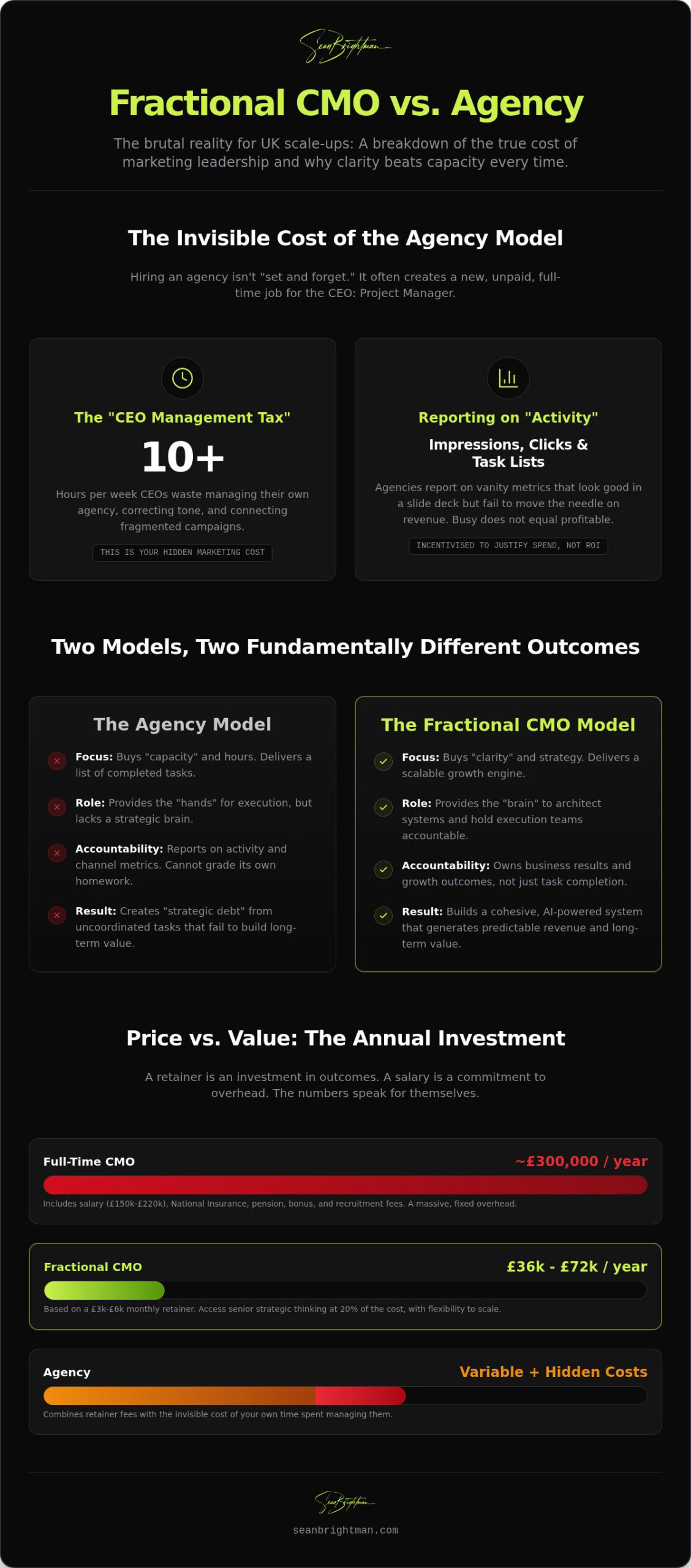
    Scale-ups often treat agencies like a “set and forget” solution. It is a myth. You don’t just pay an agency; you pay to manage them. Most founders realise too late that hiring an agency to “fix” marketing usually results in a new full-time job for the CEO. This is the hidden friction that kills growth and drains your most valuable resource: your time.

    Agencies sell capacity. They sell hours, clicks, and output. They are the hands of your marketing operation. But hands without a brain just flail. When you evaluate the cost of fractional cmo vs agency, you must account for the strategic vacuum left behind when you only hire “hands.” This vacuum creates strategic debt. It is the long-term cost of uncoordinated, tactical activity that fails to align with your business model.

    The CEO Management Tax

    If you’re spending 10 hours a week explaining your business model to an “account manager,” you’re failing. You’ve become a de facto Marketing Manager. This “outsourcing” actually increases your internal workload. You end up chasing deadlines, correcting tone, and trying to connect the dots between fragmented campaigns.

    Calculate your hourly rate. Multiply it by 40 hours a month. That is the invisible surcharge on your agency invoice. You aren’t paying for growth; you’re paying to be a supervisor. This activity feels like progress, but it rarely moves the needle on revenue. It just keeps the wheels spinning whilst you do the heavy lifting of strategic planning.

    Why Agencies Can’t Grade Their Own Homework

    An agency’s primary goal is to keep you spending. Their business model relies on retainers and ad spend percentages. This creates a fundamental conflict of interest. They cannot objectively audit their own performance because they are incentivised to justify their existence, not to keep your operation lean.

    They report on vanity metrics because vanity metrics look good in a slide deck. You get reports filled with impressions that don’t lead to intent and clicks that don’t convert. These numbers mask a lack of strategic direction. They show you are busy, not that you are profitable.

    You need a senior partner who owns the results, not just the tasks. The Fractional executive model places an architect in your business. This partner holds execution teams accountable. They don’t care about “activity.” They care about the growth engine. They ensure every pound spent is an investment, not just another cost of doing business. Agencies provide hands; a Fractional CMO provides the brain.

    Price vs Value: Decoding the Fractional CMO Model

    Scaling a business requires senior leadership. Most UK scale-ups think they only have two choices: hire a full-time heavyweight or dump the problem on an agency. Both are expensive mistakes. A full-time CMO in the UK carries a basic salary between £150,000 and £220,000. When you add National Insurance, private health, pension contributions, and bonuses, that seat costs you nearly £300,000 before they’ve even opened their laptop. That is a massive overhead for a business that needs to stay agile.

    The cost of fractional cmo vs agency models becomes clear when you look at the middle ground. Typical UK market rates for a Fractional CMO sit between £3,000 and £6,000 per month. You get the same calibre of strategic thinking as a full-time hire but at 20% of the cost. It’s a plug-and-play solution. You aren’t paying for their career development or office politics. You’re paying for their years of battle-hardened experience to be applied directly to your growth engine.

    The Retainer vs The Salary

    A retainer is an investment in outcomes. A salary is a commitment to overhead. By choosing the fractional model, you strip away the hidden costs of employment. There are no recruitment fees, no notice periods that paralyse your strategy, and no equipment costs. You gain the ability to scale the engagement up or down based on your business velocity. If you need a heavy push for a product launch, they’re there. If you need to stabilise, you dial back. This flexibility is essential for any business navigating the debate of in-house vs. outsourced marketing. A fractional leader isn’t an “outsourced” vendor; they are an internal partner with an external perspective.

    AI as a Force Multiplier

    The modern CMO isn’t just a brand-builder. They are a systems architect. By working with a Marketing operations consultant, you’re building a scalable engine that uses AI to replace bloated agency teams. AI consulting reduces the need for expensive, manual execution. We use AI to build “automated accountability” into your marketing systems. This ensures every pound is tracked and every channel is optimised without needing a dozen junior agency staff to “manage” the process. A modern CMO must be an AI-integrator. If they aren’t looking at how to make your marketing leaner through technology, they aren’t doing their job. If you want to see how these systems fit together, you can explore my advisory retainer services to see how we build these engines.

    Fractional CMO vs Agency: The Direct Comparison

    Agencies are external vendors. A Fractional CMO is an internal partner. This isn’t just a semantic difference; it is a fundamental shift in how your business functions. When you examine the cost of fractional cmo vs agency, you are comparing the price of “doing” against the value of “directing.” One adds to your to-do list. The other removes items from it.

    Agencies sell hours and output. They profit from the volume of work they perform. A Fractional CMO sells outcomes and strategy. They profit from the efficiency of your growth engine. If you want to understand why this shift is happening across the UK, read about why you should Stop Hiring Full-Time CMOs to see the full scope of the fractional revolution.

    Who Owns the Strategy?

    Agencies execute a brief. They are reactive by design. If your brief is poor, their results will be poor. They won’t challenge your assumptions because challenging the client puts the retainer at risk. A Fractional CMO writes the brief. They are proactive. They sit on your side of the table and ensure marketing strategy aligns with the CEO’s exit goals or long-term scaling plans.

    An agency-led strategy often looks like “more of the same.” They recommend the channels they are comfortable managing, not necessarily the ones your business needs. A senior partner doesn’t care about channel loyalty. They care about the machinery of growth. They provide the “this, not that” clarity that keeps you from wasting budget on tactical dead ends.

    Transparency and Mark-ups

    The “messy middle” of marketing spend is where profit goes to die. Agencies often hide their margins in media buying mark-ups or software “recommendations” that provide them with kickbacks. These are hidden costs that never appear on your main invoice but drain your ROI. They make the system complex to remain indispensable.

    A Fractional CMO provides total transparency. They audit the spend and cut the fat. They identify where an agency is overcharging for junior staff or marking up tools you could own directly. You get direct accountability. There is one throat to choke when things go wrong and one person responsible for ensuring every pound is working. You aren’t just buying capacity; you’re buying an insurance policy against marketing wastage.

    Cost of Fractional CMO vs Agency: The Brutal Truth for UK Scale-ups

    Calculating Your Real Marketing ROI

    Most scale-ups track the wrong numbers. They look at the monthly invoice and call it a day. That is lazy. To understand the true cost of fractional cmo vs agency models, you have to look at the leaks in your system. ROI isn’t just what you make; it’s what you stop losing. You need to calculate the total investment, not just the fees.

    • Step 1: Audit current spend. Identify the “wastage.” If a pound isn’t clearly attributed to a conversion or a strategic milestone, it is a donation to your agency’s office rent.
    • Step 2: Factor in your time. We’ve discussed the CEO management tax. Now, quantify it. If your time is worth £500 an hour and you spend five hours a week fixing agency mistakes, that is £10,000 a month in lost leadership value.
    • Step 3: Evaluate opportunity cost. How long does it take your agency to pivot? If they take three months to adjust to a market shift, you’ve lost a quarter of growth. A senior partner pivots in hours.
    • Step 4: Compare overheads. Contrast the cost of a Marketing advisory retainer against the combined total of your agency fees, your management time, and your wasted ad spend.

    The 90-Day Reset

    ROI starts with a Strategic brand roadmapping session. This isn’t a polite workshop. It is a tactical audit. We strip away the fluff. We kill the campaigns that feel good but do nothing. We set hard, non-negotiable KPIs. Your execution partners must meet these numbers to stay on the roster. We move from hoping it works to knowing it works.

    Efficiency over Activity

    Activity is a vanity metric. Efficiency is a business metric. I don’t care about a high volume of leads if your sales team thinks they are rubbish. We focus on pipeline quality. A Fractional CMO fixes the Sales-Marketing handoff. They build a clean, AI-powered marketing machine that prioritises conversion over clicks. This is how you build a scalable engine that doesn’t require constant CEO oversight. If you are ready to audit your current marketing engine, book a consultation to find your hidden ROI.

    The Sean Brightman Approach: Advisory over Activity

    I don’t sell activity. I sell direction. Most UK scale-ups are drowning in “stuff” but starving for strategy. My approach is built on battle-hardened expertise, not agency-style fluff. We focus on the architecture of your growth engine, not just the paint job. If your engine is broken, no amount of shiny new ads will fix it. You need a partner who knows how to fix the machinery, not just someone who can change the oil.

    We build for 2026, not 2016. That means deep AI integration. We use technology to automate the mundane and amplify the strategic. This isn’t about replacing people; it’s about making your team ten times more effective. When you evaluate the cost of fractional cmo vs agency, you have to consider the future-proofing of your business. An agency wants to keep you using their manual, billable processes. I want to build you a machine that runs without them. My Advisory Retainer provides the direction, accountability, and straight-talking partnership you need to move fast.

    Building Smarter Systems

    Tools aren’t a strategy. Having a CRM isn’t a strategy. Knowing how to organise those tools into a scalable, buyer-coveted engine is where the value lies. My methodology strips away corporate politeness. I provide blunt honesty about what is working and what is a waste of cash. We move from “messy marketing” to a clinical system. We organise your stack so that data flows, accountability is automated, and results are visible. We stop guessing and start measuring.

    Your Next Move

    Your first hire shouldn’t be a £200k full-time CMO. It’s too risky and too slow. You don’t need a career-focused executive yet; you need a plug-and-play strategist who has seen your problems before. The path to scaling is simple. We start with a roadmap to identify the gaps. We then move to an advisory retainer for ongoing direction and accountability. This is the ultimate tool for CEOs who want to reclaim their time and stop being the bottleneck.

    The cost of fractional cmo vs agency is ultimately measured in strategic velocity. You can keep paying for uncoordinated tasks, or you can invest in a partner who owns the outcome. Stop wasting spend on tactical noise. It’s time to build a system that scales. Contact me today to start building your growth engine.

    Own Your Growth Architecture

    The choice isn’t just about the invoice. It’s about who owns the number. Agencies provide the hands, but without a senior brain, you’re just paying for uncoordinated activity. By weighing up the cost of fractional cmo vs agency models, you’ve seen that the real expense is the strategic debt of “messy marketing.” You don’t need more reports. You need an engine that runs without you.

    I specialise in building “buyer-coveted” growth engines for UK founders who value blunt honesty over corporate fluff. As the author of the definitive guide to AI-powered marketing strategy, I help you integrate the systems that make your business scalable and attractive for exit. Stop acting as a part-time marketing manager. It’s time to install a senior partner who builds machinery, not just campaigns.

    Ready to find your hidden ROI? Book a Strategic Roadmapping Session with Sean Brightman to strip away the noise and start building a system that actually scales. Your growth engine is waiting for the right architect.

    Frequently Asked Questions

    How much does a Fractional CMO cost per day in the UK?

    UK day rates for a Fractional CMO typically range from £700 to £2,500. Senior specialists in high-growth sectors like fintech often sit at the top of that range. Outside London, rates usually start around the £700 mark. You aren’t just paying for time. You’re paying for a decade of senior leadership delivered in a concentrated burst. This model removes the overhead of a £200k full-time salary whilst retaining the same strategic calibre.

    Is a Fractional CMO better than a marketing agency for a startup?

    It depends on what you lack. If you have no hands to do the work, you need an agency. If you have plenty of activity but no revenue growth, you need a Fractional CMO. A startup often burns cash on uncoordinated agency tasks. A fractional leader builds the strategy first. They ensure your agency is actually delivering. One provides capacity; the other provides clarity. You need a brain before you hire hands.

    Can a Fractional CMO manage my existing marketing agency?

    Yes. This is often the primary reason scale-ups hire one. A Fractional CMO acts as your internal leader. They hold execution partners accountable. They stop agencies from grading their own homework with vanity metrics. They ensure the agency’s output aligns with your business goals. You stop acting as the middleman. They take over the technical management so you can focus on leading the company. They are the architect; the agency is the builder.

    What is the typical length of a Fractional CMO engagement?

    Engagements usually last between six and eighteen months. It isn’t a permanent fixture. The goal is to build a scalable growth engine and then either hand it over to a full-time hire or an internal team. Some founders prefer long-term advisory retainers to maintain strategic oversight without the full-time cost. It is a flexible, results-oriented partnership that scales with your business velocity. You buy the impact, not the person.

    Do I need a Fractional CMO if I already have a Marketing Manager?

    Probably. A Marketing Manager executes. A CMO strategises. If your manager is overwhelmed or lacks the senior experience to build a board-level growth plan, they need a mentor. A Fractional CMO provides the senior architecture that a mid-level manager can then implement. This combination is often the most cost-effective way to scale. You get senior leadership without the senior salary. It turns a tactical role into a strategic asset.

    What is the ROI of hiring a Fractional CMO vs an agency?

    The ROI of a Fractional CMO is measured in efficiency and strategic debt reduction. When calculating the cost of fractional cmo vs agency, look at the waste. A fractional leader can save over £150,000 annually compared to a full-time hire. They identify unattributed ad spend and kill underperforming campaigns. An agency’s ROI is tactical; a CMO’s ROI is structural. They fix the engine that generates the leads. They optimise the entire system.

    How does an Advisory Retainer differ from a Fractional CMO role?

    An Advisory Retainer is a “light” version of the fractional role. It focuses on high-level direction and accountability rather than day-to-day management. You might meet monthly for strategic resets and have on-call support for critical decisions. It is ideal for CEOs who have a competent team but need a battle-hardened strategist to keep them on track. It is about strategic velocity, not tactical execution. It provides a straight-talking partner without the management overhead.

    Will a Fractional CMO help me implement AI in my marketing?

    A modern one will. AI consulting is now a core part of the cost of fractional cmo vs agency debate. We use AI to build automated accountability and replace bloated manual processes. If your CMO isn’t an AI-integrator, they are obsolete. We build systems that use AI to handle the mundane tasks, allowing your team to focus on high-impact strategy. It makes your operation leaner, faster, and built for 2026.

  • Fractional CMO vs Head of Marketing: Bridging the Leadership Gap in 2026

    Fractional CMO vs Head of Marketing: Bridging the Leadership Gap in 2026

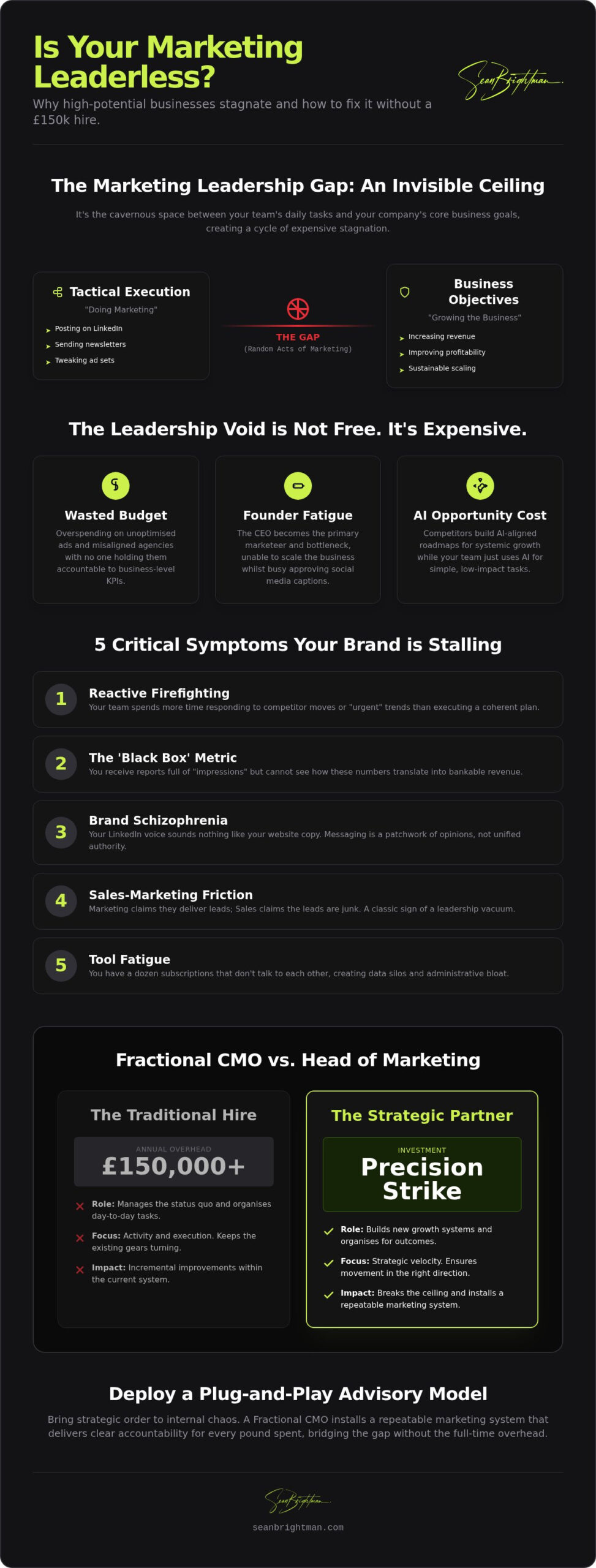
    Your marketing isn’t failing because your team is lazy. It’s failing because it’s leaderless. Most founders are currently trapped in a cycle of managing tactical execution whilst trying to run a business; a recipe for burnout and stagnating ROI. When you weigh up a fractional cmo vs head of marketing, the decision isn’t just about a job title. It’s about whether you want a permanent overhead or a precision strike on your growth bottlenecks.

    You know the feeling. The marketing spend is high, but the messaging is inconsistent and disconnected from your actual business goals. You’re exhausted from being the final word on every creative asset. It’s time to stop acting as the accidental marketing director. This article identifies the invisible leadership failures sabotaging your growth and reveals how to bridge the gap without a £150k salary commitment. We will explore the shift toward fractional leadership, the necessity of an AI-aligned roadmap, and how to install a repeatable marketing system that delivers clear accountability for every pound spent.

    Key Takeaways

    • Identify why your marketing feels like a “black box” by defining the gap between tactical execution and core business objectives.
    • Evaluate the financial and strategic impact of a fractional cmo vs head of marketing to bridge leadership gaps without the £150k annual overhead.
    • Spot the five critical symptoms of a stalling brand, from reactive firefighting to metrics that fail to translate into revenue.
    • Transition from basic tool usage to a comprehensive AI-aligned roadmap that builds scalable growth systems rather than just automating tasks.
    • Learn how to deploy a plug-and-play advisory model to bring strategic order to internal chaos and ensure clear accountability for every pound spent.

    What is a Marketing Leadership Gap? (The Invisible Ceiling)

    Most UK businesses hit a wall they cannot see. It is not a lack of effort. It is not a lack of staff. It is the marketing leadership gap. This gap is the cavernous space between tactical execution and your actual business objectives. Your team is “doing marketing,” but your business isn’t growing. This is the invisible ceiling that keeps high-potential companies stuck in a cycle of expensive stagnation.

    The gap usually appears during the transition from founder-led sales to a formal marketing team. You hire a few specialists. You might even hire a manager. But you still lack a lead engineer for your growth engine. You have people to turn the gears, but no one to design the machine. This is where the debate of fractional cmo vs head of marketing becomes critical. One manages the status quo; the other builds the system that breaks the ceiling.

    Activity vs Strategic Velocity

    Your team is likely exhausted. They are posting on LinkedIn, sending newsletters, and tweaking ad sets. They are busy. But “busy” is a vanity metric. Strategic velocity is about movement in the right direction, not just movement. If your marketing activity is disconnected from your revenue goals, you are just committing random acts of marketing.

    The difference lies in the level of thinking. A manager organises tasks. A CMO-level strategist organises outcomes. Without senior leadership, your team defaults to what is easy or trendy rather than what is effective. This is how Fractional executives provide value. They don’t just add more “doing” to the pile. They ensure the “doing” actually moves the needle.

    The Cost of the Leadership Void

    A leadership void is not free. It is incredibly expensive. You pay for it in three specific ways:

    • Wasted Budget: You are likely overspending on unoptimised ads or misaligned agencies because nobody is holding them accountable to business-level KPIs.
    • Founder Fatigue: If you are the CEO and you are still the primary marketeer, you are the bottleneck. You cannot scale a business whilst you are busy approving Instagram captions.
    • The AI Opportunity Cost: Whilst your competitors are building AI-aligned roadmaps, your leaderless team is likely just using ChatGPT to write better emails. You are missing the systemic shift.

    Choosing between a fractional cmo vs head of marketing is about resourcing for the future. You don’t need a £150k overhead to get senior-level clarity. You need a mechanic who knows where to hit the engine to make it roar.

    5 Critical Symptoms Your Brand is Stalling

    Stagnation is rarely quiet. It’s a cacophony of misaligned efforts and wasted capital. If your growth has plateaued, you don’t have a market problem. You have a leadership problem. Recognising these five symptoms is the first step toward reclaiming your momentum:

    • Reactive Firefighting: Your team spends more time responding to competitor moves or “urgent” trends than following a plan.
    • The Black Box Metric: You receive monthly reports filled with “engagement” and “impressions,” yet you cannot see how these numbers translate into bankable revenue.
    • Brand Schizophrenia: Your LinkedIn voice sounds nothing like your website copy. Your messaging is a patchwork of different opinions rather than a unified brand authority.
    • Sales-Marketing Friction: Marketing claims they’re delivering leads; Sales claims the leads are junk. This blame game is a classic sign of a leadership vacuum.
    • Tool Fatigue: You have a Frankenstein tech stack. A dozen subscriptions that don’t talk to each other, creating data silos and administrative bloat.

    The strategic role of a Chief Marketing Officer (CMO) is to eliminate these frictions. When weighing up a fractional cmo vs head of marketing, the goal is to find the leader who can dismantle these silos before they become permanent fixtures of your culture.

    The Reactive Trap: Why You Are Scrambling

    Panic is the default state of a leaderless marketing department. Without a senior strategist, the team suffers from “shiny object syndrome.” They chase the latest AI tool or social platform because they lack the conviction to say no. Strategic brand roadmapping replaces this panic with precision. It turns your marketing from a series of disjointed experiments into a repeatable growth machine. More content is rarely the answer. Better direction is.

    Sales and Marketing Misalignment

    If your departments are at war, you’re losing money. The blame game between lead generation and closing is a systemic failure. It happens because there is no unified revenue goal. A senior leader bridges this gap by aligning both teams under a single commercial roadmap. They ensure marketing isn’t just “generating noise” but is actively warming up the right prospects for the sales team to close. This level of oversight is why many UK firms now choose a fractional cmo vs head of marketing; they need the battle-hardened experience to fix the pipes, not just manage the flow. If your engine is misfiring, you might need a bespoke roadmapping session to find the leak.

    The AI Blind Spot: A Modern Symptom of Leadership Failure

    Most UK businesses are currently treating AI like a novelty. They are “playing” with ChatGPT. That is not a strategy; it’s a distraction. If your team is using AI to generate more noise without improving the signal, you have a leadership failure. The gap isn’t technical. It is strategic. You don’t need more prompts. You need a system.

    The core issue is that many teams use AI for tasks, not systems. They automate the writing of a mediocre newsletter whilst the overall growth engine remains broken. When you weigh up the fractional cmo vs head of marketing debate, you must ask who has the technical foresight to integrate AI into your core architecture. The traditional duties of a chief marketing officer have shifted. It is no longer just about brand and creative; it is about technical orchestration.

    AI as a Strategic Lever, Not a Toy

    AI should be a lever for operational efficiency. It should reduce your cost per acquisition and increase your speed to market. If it’s just making your team “busier,” it’s failing. The CEO should not be the one figuring out AI implementation. Your time is too valuable for prompt engineering. You need a leader who can build an AI roadmap aligned with your brand positioning, ensuring technology serves the business goals rather than just adding to the tool fatigue.

    Data Integrity and AI Readiness

    AI is only as good as the data it consumes. A common symptom of leadership failure is messy, siloed data that prevents AI adoption. A Fractional CMO doesn’t just look at the creative; they look at the plumbing. They organise your systems for future-proofing, ensuring your CRM and analytics are clean enough to power an automated growth engine. This is about building a machine that requires less human oversight over time.

    Ignoring this shift is a high-stakes gamble. Competitors who prioritise AI consulting and strategic integration will outpace you on every metric. They will have lower overheads and higher strategic velocity. You can’t bridge this gap with a junior hire. You need a battle-hardened expert who knows how to turn AI from a toy into a functional component of your revenue machine.

    Fractional CMO vs Head of Marketing: Bridging the Leadership Gap in 2026

    Audit vs Action: Closing the Gap Without a £150k Hire

    Stop assuming that senior results require a full-time seat at the table. It’s a common myth that keeps UK founders trapped in expensive hiring cycles. You don’t need more people; you need a better machine. When you compare a fractional cmo vs head of marketing, you’re choosing between a permanent overhead and a high-impact intervention. One is a long-term liability; the other is a strategic asset.

    A full-time Head of Marketing in the UK often demands a total compensation package exceeding £150k. That is a massive financial commitment before a single lead has been generated. By choosing a Fractional CMO, you access the same C-suite experience for a fraction of the cost. You bypass the recruitment fees, the pension contributions, and the six-month “onboarding” period. You get the diagnosis and the cure on day one.

    Why Agencies Are Not the Answer

    Many founders try to bridge the leadership gap by hiring more agencies. This is a mistake. Agencies are doers, not owners. They optimise within their specific lanes; SEO, PPC, or social; but they rarely look at your business holistically. They are incentivised to keep their retainers, not necessarily to grow your bottom line.

    This leads to supplier drift. Without senior internal leadership, who is holding your agencies accountable? Who is ensuring their work aligns with your 2026 revenue goals? A leader owns the strategy. An agency executes a brief. If your brief is broken, the agency will simply help you fail faster. You need someone on your side of the table who understands the mechanics of the whole engine.

    The 90-Day Marketing Transformation

    The solution isn’t a new hire. It’s a new system. A Roadmap First approach allows you to diagnose the machine before you commit to more headcount. Within 90 days, you can identify hidden profit in your existing systems and install a robust Marketing operations framework. This isn’t about fluff; it’s about establishing an operating rhythm that creates real accountability.

    We build the roadmap, clean the data, and align the team. This creates a repeatable growth engine that doesn’t rely on the founder’s intuition. If you’re ready to stop the hiring guesswork and start scaling with precision, you can book a strategic advisory session here to begin your audit.

    Fractional CMO: The Plug-and-Play Solution for Scale-ups

    Fractional CMOs are not consultants who drop a 50-page PDF and vanish. They are the external force that brings internal order. When you weigh up a fractional cmo vs head of marketing, the primary difference is the speed of impact. A full-time hire spends their first 90 days “learning the culture.” A fractional leader spends their first 90 days rebuilding the engine. It is strategic velocity over corporate ceremony.

    The Marketing advisory retainer is designed for CEOs who need high-level guidance without the bloat. It provides a direct line to senior expertise, ensuring your team stays aligned with the roadmap we’ve established. No more guessing. No more “trying things out.” Just senior-level accountability that keeps the needle moving whilst you focus on running the business.

    Leadership on Demand

    Traditional marketing leadership is often bogged down by bureaucracy and office politics. Fractional models strip that away. It is a get-your-hands-dirty approach that prioritises results over status. We don’t care about ladder-climbing; we care about the growth engine. UK scale-ups are increasingly moving toward this model because it offers senior-level accountability on demand. You get the brain of a seasoned CMO with the agility of a startup, bypassing the recruitment lag and the £150k price tag.

    This plug-and-play model allows you to scale your leadership as you scale your revenue. You don’t need a full-time executive to tell you your messaging is broken. You need an expert who has seen your specific chaos before and knows exactly how to fix it. It is about precision, not presence.

    Building for the Exit

    If you plan to sell your business, your marketing cannot be a personality-led black box. Buyers covet systems. They want to see a machine that produces predictable revenue regardless of who is sitting in the chair. Using a Marketing strategy for business exit ensures your brand is a tangible asset, not a liability. We build the growth engine that buyers fight over.

    Sean Brightman’s methodology focuses on creating these repeatable, scalable systems. We document the process, clean the data, and align the AI-powered roadmap to your commercial goals. Stop guessing and start leading with a battle-hardened expert. Your next step is to bridge the gap. Book a roadmapping session today to identify your bottlenecks and build a growth engine that actually delivers.

    Reclaim Your Strategic Velocity

    Stop letting your marketing be a black box that swallows your budget. You’ve seen the symptoms: reactive firefighting, messy data, and the high-priced myth of the full-time hire. The choice between a fractional cmo vs head of marketing isn’t just about headcount. It’s about whether you want a manager or a mechanic. You need a leader who has built growth engines for exit and understands the systemic shift toward AI. You don’t need a £150k overhead to get C-suite clarity; you need a plug-and-play system that works whilst you sleep.

    As a Fractional CMO for high-growth UK scale-ups and an AI-powered growth engine specialist, I help founders bridge the leadership gap with tactical precision. I am the author of the definitive guide to marketing strategy, and I focus on results, not corporate fluff. It is time to dismantle the invisible ceiling holding your brand back. Book a Strategic Roadmap session with Sean Brightman to stop the guesswork and start leading with senior-level accountability. Your growth engine is waiting to be built. Let’s get to work.

    Frequently Asked Questions

    What exactly is a marketing leadership gap?

    A marketing leadership gap is the disconnect between daily tactical activity and your overarching business objectives. It occurs when a team is busy executing tasks but lacks the strategic oversight to ensure those tasks drive revenue. You have the engine, but nobody is steering the car. This gap often surfaces during founder-to-team transitions, leaving the CEO stuck managing creative approvals instead of focusing on high-level growth.

    Can a marketing agency fill a leadership gap?

    No, agencies are execution partners, not strategic owners. They excel at optimising specific channels like SEO or PPC, but they rarely understand your entire commercial landscape. Agencies are incentivised to protect their retainers, which often leads to supplier drift where their work becomes misaligned with your evolving goals. You need an internal force to hold them accountable and ensure every agency partner is pulling in the same direction.

    How much does a Fractional CMO cost compared to a full-time hire?

    A full-time Head of Marketing in the UK often costs upwards of £150k once you include salary, bonuses, and benefits. In the fractional cmo vs head of marketing debate, the fractional model offers a massive cost advantage. You pay for high-impact strategic advisory without the permanent overhead of a C-suite salary. This allows you to deploy senior leadership on demand, scaling the investment as your revenue grows rather than committing to a massive liability.

    How do I know if my marketing team is underperforming or under-led?

    If your team is consistently busy but the needle isn’t moving, you have a leadership problem. Underperformance is a symptom of a broken system, not necessarily bad personnel. Look for black box reports filled with vanity metrics that don’t translate into bankable revenue. If you’re still the one making every creative decision as a founder, your team isn’t underperforming; they’re leaderless. They need a roadmap, not more management.

    Is AI consulting part of a Fractional CMO’s role?

    In 2026, AI consulting is a mandatory component of modern marketing leadership. It isn’t just about using ChatGPT to write emails; it’s about building AI-powered growth engines that improve operational efficiency. A Fractional CMO ensures your tech stack isn’t a Frankenstein of disconnected tools. They build an AI-aligned roadmap that organises your data integrity and future-proofs your systems, ensuring technology serves your commercial goals rather than creating more administrative bloat.

    What are the first steps to closing a marketing leadership gap?

    The first step isn’t a job advert; it’s a diagnostic audit. You must identify exactly where the pipes are leaking before you commit to new headcount. Start with a strategic roadmap to define your growth levers and clean up your data systems. This allows you to understand whether you need a permanent hire or a high-impact advisory retainer. Closing the gap requires clinical precision, not a desperate recruitment drive.

    How long does it take to see results from a Fractional CMO?

    You’ll see strategic clarity within the first few weeks. However, building a repeatable growth engine typically takes about 90 days. During this period, we dismantle the random acts of marketing and install a robust operating rhythm. You’ll notice an immediate shift in accountability and messaging consistency. By the end of the first quarter, the focus moves from reactive firefighting to scalable, data-driven execution that delivers predictable ROI.

    Does my business need a marketing strategy roadmap before hiring?

    Absolutely. Hiring without a roadmap is a high-stakes gamble. When comparing a fractional cmo vs head of marketing, the roadmap defines the role you actually need. Without one, you’ll likely hire a generalist who spends months trying to find their feet. A roadmap provides the blueprint for the machine you’re building, ensuring any future hires are brought in to execute a proven strategy rather than figuring it out on your dime.

  • Signs You Need a Senior Marketing Leader: Stop the Activity and Start the Growth

    Signs You Need a Senior Marketing Leader: Stop the Activity and Start the Growth

    Your marketing department is a high-speed treadmill that leads nowhere. You are burning through cash on “activity” whilst your revenue remains stubbornly flat. It is a common trap. You hire more agencies. You try new channels. You wait for a breakthrough that never arrives. The reality is blunt: you do not have a marketing problem; you have a leadership vacuum.

    It is exhausting to act as the primary decision-maker for every campaign whilst trying to scale a business. You likely see the signs you need a senior marketing leader every time you look at an opaque ROI report or a disjointed tactical plan that lacks a cohesive core. You want a system that works without your constant intervention. You need accountability that goes beyond vanity metrics and actually impacts the bottom line.

    This article identifies the critical symptoms of a broken marketing function and explains why senior strategic leadership is the only way to build a scalable growth engine. We will explore how to transition from chaotic execution to a disciplined strategy that aligns with your long-term growth or exit goals. It is time to stop managing tasks and start building an engine.

    Key Takeaways

    • Stop mistaking tactical noise for progress by distinguishing between superficial “activity” and a high-performance marketing architecture.
    • Identify the signs you need a senior marketing leader, starting with the “Founder Bottleneck” where growth stalls because you are still the primary decision-maker for every campaign.
    • Understand why agencies are designed to execute specific tactics but often lack the strategic authority to align your marketing with long-term business exit goals.
    • Evaluate the pragmatic benefits of fractional leadership to secure battle-hardened expertise without the £150k plus overhead of a full-time executive hire.
    • Deploy a 90-day strategic roadmap to audit your current spend, fix operational leaks, and define a competitive position that actually resonates amongst your target audience.

    The Activity Trap: Why Busy Marketing Often Equals Zero Progress

    Most marketing teams are sprinting. They produce blogs, run ads, and post on social media. They are incredibly busy. Yet, the revenue needle remains stubbornly fixed. This is the Activity Trap. It is the hallmark of a team that lacks a strategic rudder. If your revenue is flat whilst your Slack channels are buzzing with “completed tasks”, you are witnessing the first senior marketing leader signs. Activity is easy. Strategy is hard.

    In a competitive 2026 landscape, “random acts of marketing” are an expensive luxury you cannot afford. You do not need more “doing”. You need better “thinking”. When a team lacks a leader, they default to tactics because tactics feel like progress. They are not. Progress is measured in commercial movement, not just the volume of output. If you cannot draw a straight line from a marketing task to a revenue outcome, you are just burning cash.

    Activity vs. Commercial Impact

    Your current team likely reports on vanity metrics. Likes, reach, and impressions feel good in a monthly report. They do not pay the bills. A senior leader ignores the fluff. They focus on pipeline, Customer Acquisition Cost (CAC), and Lifetime Value (LTV). They reorient the team toward revenue-generating behaviour by asking the difficult questions that agencies often avoid.

    This is the difference between an Agency Manager and a Growth Architect. An Agency Manager checks if the work is done. A Growth Architect ensures the work is profitable. It is about commercial outcomes, not creative output. If you are currently managing tasks instead of systems, you have found one of the clear signs you need a senior marketing leader. You need someone to own the P&L of your marketing spend, not just the calendar.

    The Architecture of a Scalable Engine

    Marketing should be a machine, not a series of one-off projects. It needs to work whilst you sleep. Without a leader, your marketing is a collection of “decorators” painting a house that has no foundation. They make things look pretty, but the structure is weak. Senior leadership builds brand equity that compounds over time. They don’t just fill the funnel; they build the funnel.

    A marketing leader is the person who owns the “Why” and the “How”, not just the “What”. They integrate strategic roadmapping and AI consulting to drive efficiency. They ensure every pound spent is an investment in a scalable system rather than a one-time expense. They stop the noise and start the growth engine.

    5 Critical Signs Your Marketing Has Outgrown Your Current Team

    Growth does not just happen. It is engineered. If you feel constant friction in your marketing department, it is usually because your operational complexity has surpassed your internal capability. You are stuck in The Activity Trap because your team is executing without an architect. Recognising the signs you need a senior marketing leader is the first step toward reclaiming your time and your budget. Here are the five unmistakable signals that your current setup is failing:

    • The Founder Bottleneck: Every campaign, headline, and budget shift still requires your final sign-off.
    • Agency Chaos: You pay three different specialists who never speak to each other, leaving you to play the role of translator.
    • Tool Fatigue: Your tech stack is a graveyard of expensive subscriptions that no one knows how to leverage for revenue.
    • Stuck Revenue: You are spending more every month, but your customer acquisition cost (CAC) is rising whilst your growth remains flat.
    • Zero Accountability: When you ask what worked last month, you get a list of tasks completed, not a report on commercial value.

    The Founder as the De Facto CMO

    In the early days, your intuition was an asset. It got you to the first £1m. Now, that same intuition is a liability. You are the biggest blocker in your own growth. A CEO cannot be a part-time marketing leader whilst trying to scale an entire organisation. It is a recipe for half-baked strategies and missed opportunities. If you are still the primary marketing decision-maker, your business is limited by your personal bandwidth, not your market potential. You need a partner who provides strategic accountability so you can focus on the board level, not the ad level.

    AI and Systems Inefficiency

    Buying the tech is easy. Integrating it into a growth engine is where most scale-ups fail. It is a £50k mistake to invest in advanced software without a senior roadmap to run it. Junior teams often use AI for tactical shortcuts, like churning out mediocre content, rather than strategic efficiency. They see the tool, but they miss the system. Senior oversight in AI consulting ensures your tech stack actually drives margin. You don’t need more tools; you need a leader who knows how to wire them into a cohesive, scalable engine that produces results whilst you sleep.

    The Strategy Gap: Why Agencies Can’t Lead Your Brand

    Agencies are tactical partners. They sell services. They do not sell your growth. One of the clearest signs you need a senior marketing leader is when you realise your agencies are marking their own homework. They report on their own success whilst your bank balance tells a different story. An agency is incentivised to keep you spending. If a channel is failing, they will suggest “optimising” rather than “stopping”. They lack the objectivity to fire themselves from a failing project. You need an internal force that prioritises your margin over their retainer.

    Ownership of your strategic intelligence is non-negotiable. If your data and insights are locked inside agency dashboards, you do not own your marketing. You are renting it. A leader ensures that every piece of market intelligence remains a permanent asset of your business. They stop the leakage of knowledge and ensure your brand is built on an internal vision, not an outsourced one. You cannot outsource the soul of your company to a team that manages forty other clients.

    The Execution vs. Strategy Divide

    Agencies are “doers”. They are built to execute specific tasks. To succeed, they need a high-quality brief. If you are the one writing that brief, you are still the marketing leader. This is the briefing gap. A senior leader sits between you and the tactical partners, translating your business goals into precise instructions. They coordinate the specialists. They ensure the SEO agency is not fighting the PPC agency for the same budget. Without this coordination, you are paying for a choir where everyone is singing a different song.

    Preparing for Business Exit

    Potential buyers look for stability. An agency-only model is a red flag. It looks like a house of cards that collapses the moment a contract ends or a founder leaves. To build a marketing strategy for business exit, you must prove your growth engine is documented and repeatable. Investors want to see professionalisation. They want a leader who has built a system that functions independently of the CEO. A senior marketing leader transforms your marketing function from a chaotic cost centre into a transferable asset that buyers actually covet.

    Signs You Need a Senior Marketing Leader: Stop the Activity and Start the Growth

    Full-Time CMO vs. Fractional Leadership: A Brutal Comparison

    If you see the signs you need a senior marketing leader, your first instinct is likely to call a recruiter. That is often a six-figure mistake. Many scale-ups fall into the “Title Trap”. They hire a Marketing Manager for £60k and expect them to behave like a Chief Marketing Officer. It never works. A manager is an executor. They follow a brief; they do not write one. You end up with a high-salaried employee who still looks to you for every strategic decision.

    The math of a full-time executive hire is brutal. A seasoned CMO in 2026 commands a salary of £150k plus benefits, NI, and often equity. Add a 20% recruitment fee, and you have spent £180k before they even sit at their desk. Then comes the “ramp-up” period. Whilst a full-time hire spends their first ninety days navigating internal politics and learning the office layout, a fractional leader is already dismantling your failing campaigns. You pay for impact, not presence.

    When to Hire Full-Time

    There is a revenue threshold where a permanent CMO makes sense. Usually, this is when your marketing team exceeds ten people and your annual turnover is north of £15m. Hiring too early leads to high churn. A heavy-hitting strategist will become frustrated doing tactical work, and you will end up wasting equity on a role that hasn’t been properly defined. A “Plug-and-Play” strategist is the smarter move during this transition. They build the engine so that when you finally hire a permanent lead, they inherit a machine that actually works.

    The Fractional Advantage

    Fractional leadership is about results, not career ladders. These are battle-hardened experts who have seen your problems ten times before and know exactly how to fix them. They bring a “No Ego” approach that prioritises your P&L over their office status. By accessing senior marketing leadership on demand, you get the brain of a £200k executive for a fraction of the cost.

    • Focus on marketing operations and systems rather than increasing headcount.
    • Speed to value, with strategic audits completed in days, not months.
    • Flexibility to scale the engagement up or down based on your growth roadmap.

    You don’t need another expensive seat in the boardroom. You need a growth engine that produces predictable revenue. If you are ready to stop the activity and start the growth, book a strategic roadmap session to see how fractional leadership can fix your marketing function.

    Reclaiming Control: Your 90-Day Strategic Roadmap

    If you have identified the signs you need a senior marketing leader, the next ninety days are critical. You cannot fix a broken engine whilst it is still running at redline. You need a structured intervention. This roadmap is not a theoretical exercise. It is a tactical overhaul designed to move you from chaotic activity to predictable growth. We stop the guessing and start the building.

    • Step 1: The Audit. We find where the money is leaking. Most scale-ups waste significant portions of their budget on zombie campaigns that produce zero pipeline. We kill them immediately.
    • Step 2: The Positioning. We define why you win amongst competitors. If your value proposition is “we are better”, you have already lost. We find the specific angle that makes your brand the only logical choice.
    • Step 3: The Engine. We build the AI-powered systems for 2026. This is about mechanical efficiency. We automate the repetitive and augment the strategic. It is about doing more with less headcount.
    • Step 4: The Accountability. We set the metrics that actually matter. No more impressions. No more “brand awareness” fluff. We track revenue, CAC, and LTV.

    The Power of the Roadmap

    A strategic brand roadmapping session is the fastest way to get unstuck. It provides the “Why” behind every “What”. Most teams live in a state of “we should try this”. A roadmap moves you to “we are doing this because”. It creates a plan that the board can understand, support, and fund. It turns marketing from a black box into a transparent growth lever that delivers strategic velocity.

    Implementing an Advisory Retainer

    A strategy is useless if it sits in a PDF on your desktop. Order requires an external force. An advisory retainer provides the ongoing accountability needed to ensure the strategy is executed, not filed away. It is the tactical oversight that keeps your team focused on high-impact work whilst ignoring the shiny distractions that usually derail progress. You get senior-level authority without the full-time overhead.

    Stop the mess. It is time to professionalise your marketing function and build an engine that buyers covet. Book a strategic roadmapping session with Sean Brightman today and start the growth.

    Stop Managing Tasks and Start Building an Engine

    Busy marketing is a trap. If you are still the primary decision-maker for every campaign whilst your revenue remains flat, you have seen the signs you need a senior marketing leader. You don’t need more agencies or more tools; you need a growth architect. You need a system that functions independently of your personal bandwidth and aligns with your commercial exit goals.

    Sean Brightman provides the battle-hardened Fractional CMO expertise that UK scale-ups require to professionalise their marketing function. As the author of the definitive guide on strategic marketing, he offers a no-fluff, results-driven advisory that replaces chaotic activity with mechanical precision. It is time to reclaim your time and build a transferable asset that buyers actually covet.

    The next ninety days could define your trajectory for 2026. Stop the noise. Build your growth engine with Sean Brightman and move from the founder bottleneck to scalable velocity. Your growth engine is waiting.

    Frequently Asked Questions

    What is the difference between a Marketing Manager and a Senior Marketing Leader?

    Managers are executors who focus on the “what”. They manage task lists and follow a brief. A senior leader is an architect who owns the “why” and the “how”. They write the brief and align marketing activity with commercial business goals. Whilst a manager ensures the work is done, a leader ensures the work is profitable and builds a scalable system.

    How much does a Fractional CMO cost in the UK in 2026?

    Industry rates for fractional leadership are based on impact and strategic velocity rather than hours. It is a high-impact alternative to a full-time hire, which typically costs £120k plus recruitment fees and equity. You secure battle-hardened expertise for a fraction of that overhead. The focus is on delivering a return through strategic efficiency and revenue growth rather than just occupying a seat.

    Can an agency replace the need for a senior marketing leader?

    No. Agencies are tactical specialists who need a rudder. Without an internal leader, agencies often mark their own homework and default to activity that protects their retainer. You need a senior strategist to coordinate multiple partners and ensure every pound spent is an investment in a cohesive roadmap, not just a series of disconnected tactical acts.

    When is the right time for a scale-up to hire a Fractional CMO?

    The right time is when you hit the “Founder Bottleneck”. If every marketing decision still lands on the CEO’s desk, growth will inevitably stall. You should seek leadership when your marketing spend is increasing whilst your ROI becomes opaque. It is the moment you need a repeatable marketing engine that doesn’t rely on your constant intervention to function.

    What are the first signs that my marketing strategy is failing?

    Flat revenue despite high team activity is the primary signal. If your team is busy but your customer acquisition cost is rising, the strategy is broken. Other signs you need a senior marketing leader include disjointed messaging amongst different channels and a lack of clear, revenue-linked data. If you can’t see how a task leads to a sale, you are failing.

    How does AI consulting fit into senior marketing leadership?

    AI is a machinery upgrade for your growth engine. A senior leader uses AI consulting to build high-efficiency systems that automate workflows and improve data analysis. It isn’t about using tools for tactical shortcuts. It is about integrating technology into your operations to reduce overhead and increase the speed of your marketing execution whilst maintaining a lean internal team.

    Do I need a senior leader if I only have a small marketing team?

    Yes. A small team without leadership is just a group of people doing tasks. Leadership is about strategic direction, not headcount. A fractional leader provides the roadmap that ensures your small team is working on the highest-impact initiatives. They stop your staff from getting lost in tactical noise and keep them focused on activities that drive commercial value.

    How do I measure the ROI of a senior marketing consultant?

    Measure the ROI through commercial metrics rather than vanity stats. Look for a reduction in customer acquisition costs, an increase in pipeline velocity, and the creation of a documented, repeatable system. The value is found in the transition from chaotic activity to a predictable growth engine. If your marketing now functions without the CEO’s input, the ROI is clear.

  • The Strategic Vacuum: Navigating the Challenges of a Missing Marketing Director in 2026

    The Strategic Vacuum: Navigating the Challenges of a Missing Marketing Director in 2026

    Your marketing engine isn’t broken because the parts are faulty; it’s failing because there’s no one at the controls. Without leadership, marketing spend isn’t an investment. It’s a bet on a horse that hasn’t left the gate. You’re likely feeling the weight of the challenges of a missing marketing director every time you’re dragged into a meeting to approve a font choice or a social media caption. It’s exhausting. It’s inefficient. Most importantly, it’s expensive. When strategy disappears, frantic activity takes its place. Your team is busy, but they aren’t moving the needle.

    We agree that this strategic vacuum is unsustainable. You need high-level authority, not more micro-management. This guide identifies the hidden costs of your leadership void and demonstrates how to restore strategic velocity without a £150k salary commitment. We’ll strip away the corporate fluff to look at why your budget is leaking and how to install a plug-and-play solution that brings order to the chaos. Stop acting as your own Marketing Director. It’s time to build a growth engine that actually functions without you.

    Key Takeaways

    • Stop mistaking high activity for high impact. Learn why a leadership void leads to “random acts of marketing” that drain your budget without moving the needle.
    • Navigate the challenges of a missing marketing director by identifying how a lack of senior guidance forces CEOs into the trap of micro-management.
    • Move beyond basic AI tools and discover why a strategic roadmap is essential to prevent your team from simply creating more digital noise.
    • Understand why junior staff cannot self-organise towards complex KPIs and how to restore accountability to your marketing department.
    • Explore the Fractional CMO model as a plug-and-play solution that provides senior expertise without the £150k+ full-time salary commitment.

    Defining the Strategic Vacuum: Why a Missing Marketing Director Stalls Growth

    Marketing activity is not Marketing strategy. One is a series of disconnected tasks; the other is a coherent roadmap to revenue. When you lose your director, you lose the map. You are left with “random acts of marketing” that burn through your budget without building long term equity. It’s the difference between running on a treadmill and running a race. You’re sweating, but you aren’t actually going anywhere. The engine is running, but the gears aren’t engaged.

    Without a senior leader, accountability evaporates almost overnight. Agencies begin to mark their own homework. They report on vanity metrics like reach and impressions whilst ignoring the fact that your sales have plateaued. This is one of the most critical challenges of a missing marketing director. Without that senior filter, you’re essentially writing blank cheques to partners who have no skin in the game. You need a strategist who knows how to call out a report that looks pretty but says absolutely nothing about growth.

    Internal teams suffer too. Without direction, junior staff focus on what is easy rather than what is effective. They default to “keeping the lights on” because they lack the authority or the expertise to pivot. Common symptoms of this vacuum include:

    • Social media posts published without a clear conversion goal.
    • Website updates that focus on aesthetics rather than user experience or SEO.
    • Ad campaigns that haven’t been A/B tested or optimised in months.
    • A total lack of data-driven decision making.

    The Invisible Cost of Indecision

    A Strategic Vacuum is the gap between business goals and tactical execution. Indecision is a silent profit killer. Without a director, product launches stall. Market opportunities vanish whilst your team waits for a “green light” that never comes. Your ad spend becomes a gamble. Without senior oversight, you are likely paying for unoptimised campaigns that target the wrong audience with the wrong message. It’s a leak you cannot afford to ignore in a competitive market.

    Brand Erosion in the Absence of Leadership

    Your brand is your most valuable asset, but it’s fragile. Disconnected messaging confuses your favourite customers. It dilutes your authority. Whilst you are busy managing the day-to-day chaos, your competitors are busy stealing your market positioning. They are organised; you are reactive. A brand without a leader isn’t a brand at all. It’s just a collection of logos and fonts with no soul and no direction. Consistency is the first thing to go when the seat is empty.

    Operational Drift: How Your Marketing Team Loses Focus

    Your team is busy. They are likely exhausted. But are they actually effective? Activity is not an achievement. When the leadership seat is empty, your marketing department defaults to volume over value. They churn out social posts, send more emails, and tweak ad copy without a clear “why” behind the effort. This is the “Busy-ness Trap” in action. It feels like progress because everyone is working late, but your revenue remains stagnant.

    One of the primary challenges of a missing marketing director is the total breakdown of strategic filters. Without a senior leader to say “no” to distractions, every new idea becomes a priority. Your team starts chasing shiny objects. They focus on what is easy to execute rather than what is necessary to grow. You end up with a high-speed engine that isn’t connected to the wheels. You’re burning fuel, but you aren’t moving.

    Friction between Sales and Marketing becomes inevitable. Sales demands leads for today; Marketing wants to talk about “brand” for tomorrow. Without a director to mediate and align these goals, these departments stop collaborating and start competing. It is a waste of mental energy. You might even find yourself buying more software to fix the friction. Tool fatigue is a real risk. You don’t need a new CRM feature; you need a strategy that tells you how to use the tools you already have.

    The Junior Talent Ceiling

    Your marketing manager might be a tactical wizard, but they aren’t a director. Expecting a specialist to set a 2026 growth roadmap is unfair. It is also dangerous. They lack the senior experience to navigate complex market shifts or manage high-level budgets. This leadership gap kills morale. People want to be led, not just managed. Without a captain, your best talent will eventually look for a ship that has a destination. A dedicated leader brings a unique and valuable perspective that turns tactical specialists into a unified commercial force.

    Fragmented Marketing Systems

    Data silos are the natural byproduct of a leadership void. When no one owns the big picture, information gets trapped in individual tools. Your email data doesn’t talk to your sales team. Your ad spend doesn’t align with your customer lifetime value. You need a central architect to build a scalable growth engine. If your systems feel broken, it might be time to speak with a Marketing operations consultant to audit the mess. Before you commit to another expensive hire, a Fractional CMO can help reset your operational standards and restore focus.

    The CEO Trap: Why Founders Cannot Be Their Own Marketing Directors

    You are the CEO. You have the vision. You built the brand from nothing. That does not make you a Marketing Director. One of the most expensive challenges of a missing marketing director is the founder stepping into the breach. It feels like a solution. It is actually a bottleneck. When you take over marketing, you stop being a leader and start being an obstacle. Growth stalls whilst the team waits for your approval on a font choice or a social media caption.

    Your “gut feeling” is a powerful tool for starting a business. It is a liability for scaling one in 2026. Data-driven strategy requires a clinical, analytical approach that founders rarely possess for their own “baby”. You are too close to the product. You make emotional decisions instead of strategic ones. Strategy is a spreadsheet. Vision is a dream. Don’t confuse the two. Without a senior leader to translate your vision into a mechanical system, you are simply gambling with your marketing budget.

    The opportunity cost is staggering. Every hour you spend micro-managing a marketing campaign is an hour you aren’t spent on fundraising, high-level operations, or strategic partnerships. You are trading your high-value time for low-value tactical tinkering. It is a poor trade. Your business needs a CEO, not a part-time marketing manager with a founder’s title.

    The Myth of the “Marketing-Savvy” Founder

    Vision is the destination. Execution systems are the engine. You might know where the brand needs to go, but you likely lack the technical expertise to build the machinery that gets it there. Founders often suffer from “shiny object syndrome” in the absence of a director. You see a competitor doing something and demand your team copies it. It’s reactive, not proactive. This lack of focus makes you easy prey for agencies. Without a senior filter, you cannot hold them accountable for results. They will tell you what you want to hear whilst your budget evaporates.

    Restoring Executive Velocity

    You need to get back to the work that only you can do. Professional advisory restores your mental bandwidth and removes you from the tactical weeds. It allows you to shift from being a “doer” to a leader who oversees a self-sufficient growth engine. Implementing The Marketing Advisory Retainer provides the senior oversight your team craves. It stops the micro-management and restores speed to your execution. Stop being the bottleneck. Start being the CEO again.

    The Strategic Vacuum: Navigating the Challenges of a Missing Marketing Director in 2026

    The AI Integration Gap: The 2026 Risk of Falling Behind

    AI in 2026 is not a novelty. It is the engine. If your seat is empty, your team is likely playing with toys rather than building machinery. One of the most dangerous challenges of a missing marketing director is the total absence of an AI roadmap. Without senior guidance, your staff will use ChatGPT to produce more noise, not more value. They are using technology to do the wrong things faster. Speed without direction is just a quicker way to reach a dead end.

    The risk is not just about efficiency; it is about governance. Unguided AI adoption leads to data leaks, brand hallucinations, and inconsistent messaging. You don’t need a subscription to a new tool. You need a strategy that defines how AI integrates into your specific commercial goals. Competitors are using AI to automate the boring stuff so they can focus on high-level strategy. You are likely still manually churning out content that nobody wants to read. The gap between the leaders and the laggards is widening every day.

    Strategy Before Tools

    Buying software does not solve a leadership problem. You might have a dozen AI tools in your stack, but if they don’t talk to each other, you have a mess, not a system. A missing director means you are playing with AI rather than profiting from it. You need an AI consulting approach that builds scalable growth engines. This means creating systems that don’t rely on a single person’s prompts. It means building an institutional memory that survives staff turnover. Without this, your AI “strategy” is just a collection of bookmarks in a browser.

    Competitive Disadvantage

    Market leaders in 2026 are using AI to slash their Customer Acquisition Cost (CAC) by automating lead qualification and personalising outreach at scale. They are moving at a velocity you cannot match with a fragmented team. AI is the ultimate force multiplier, but it requires a skilled operator to ensure it multiplies your results rather than your mistakes. If you are still waiting for a full-time hire to figure this out, you’ve already lost. You need to book a Fractional CMO now to bridge the technology gap before your competitors become untouchable. Stop guessing with your tech stack. Start building a system that actually converts.

    Closing the Gap: The Fractional CMO as a High-Impact Alternative

    Stop waiting for a unicorn. The traditional six-month recruitment cycle is a slow-motion car crash for your business momentum. You don’t need a full-time hire to sit in an office; you need a strategic architect to fix the foundation. A Fractional CMO is the definitive plug-and-play solution. You gain senior-level authority and battle-hardened expertise without the £150k+ salary commitment. It is about outcome, not attendance. You pay for the results, not the overhead.

    An external leader brings a level of objectivity your internal team lacks. They aren’t bogged down by office politics or “the way we’ve always done it.” They see the rot in your systems and have the guts to cut it out. This objective perspective allows you to establish a strategic brand roadmap in weeks, not months. You move from a reactive state to a proactive offensive. This is how you solve the challenges of a missing marketing director whilst avoiding the risk of a bad full-time hire. You get the brains without the baggage.

    Immediate Accountability and Direction

    An advisory retainer acts as the strategic glue for your marketing department. It restores the chain of command. Your team stops guessing and starts executing against KPIs that actually align with your exit goals or growth targets. This is a shift from a “missing director” problem to a “smarter leadership model.” You aren’t just filling a gap. You are upgrading the engine. Accountability returns because there is finally someone qualified to mark the homework of your agencies and internal staff. No more fluff. Just performance.

    The Path Forward

    Assess your reality. Do you truly need a full-time executive to manage the day-to-day, or do you need a strategist to build the system? For most scaling firms in 2026, the latter is more valuable. You can start the recovery process immediately with a Strategic Brand Roadmapping session. This is the diagnostic phase that identifies exactly where your budget is leaking and how to organise your efforts for maximum impact. Stop the drift. Reclaim your strategy. The vacuum only exists because you haven’t decided to fill it yet.

    Reclaim Your Strategic Velocity

    A vacancy in your marketing leadership is a budget leak you cannot afford to ignore. We’ve established that the challenges of a missing marketing director go far beyond an empty seat. It is a strategic vacuum that forces CEOs into micro-management and turns tactical teams into reactive ones. You don’t need a six-month recruitment cycle to fix this. You need a plug-and-play solution that restores accountability and builds a functional growth engine today.

    Sean Brightman brings Fractional CMO expertise to UK scale-ups, acting as a battle-hardened expert who builds AI-powered growth engines. As the author of a published marketing strategy book, he specialises in stripping away corporate fluff to deliver pragmatic, high-impact results. Stop acting as your own marketing manager and get back to being a CEO. Your vision deserves a roadmap that actually works, not just a series of disconnected tactics.

    Stop the strategic drift and book a Roadmapping Session with Sean Brightman

    Your business has the potential for massive growth. It just needs the right architect to engage the gears. Let’s get to work.

    Frequently Asked Questions

    What are the first signs that my business is suffering from a missing marketing director?

    The most obvious sign is a marketing team that produces high volume with zero strategic impact. You’ll notice the CEO is pulled into minor tactical decisions like email copy or social media graphics. Strategy is replaced by “random acts of marketing” that don’t move the revenue needle. One of the primary challenges of a missing marketing director is this total loss of direction, where activity is high but commercial results are non-existent.

    Can an agency fill the gap left by a marketing director?

    No, an agency cannot lead your marketing strategy. Agencies are tactical partners; they are built to execute, not to own your commercial outcomes. Expecting an agency to fill a leadership void is like asking a builder to be the architect. They will often mark their own homework and focus on vanity metrics that make them look good, rather than the hard data that makes you money. You need internal leadership.

    How much does a missing marketing director actually cost a UK business?

    The cost is measured in wasted budget and missed opportunities. Without senior oversight, businesses often leak thousands in unoptimised ad spend and ineffective campaigns. There is also the “CEO tax,” where the founder’s time is diverted from high-value tasks to marketing micro-management. When you factor in brand erosion and lost market share to more organised competitors, the financial drain is far higher than the cost of professional leadership.

    Is a Fractional CMO a temporary fix or a long-term strategy?

    It is a scalable leadership model that fits both scenarios. Many firms use a Fractional CMO to navigate the challenges of a missing marketing director during a recruitment gap. Others realise they don’t actually need a £150k full-time hire and keep the fractional model as a permanent, lean leadership layer. It provides the senior authority you need without the long-term overhead and complex benefits packages of a full-time executive hire.

    How does a Fractional CMO manage an existing marketing team?

    They provide the “glue” and the “filter” for your department. A Fractional CMO sets clear KPIs, removes operational bottlenecks, and restores a functional chain of command. They coach junior staff to focus on high-impact work rather than busy-ness. By taking ownership of the roadmap, they free the CEO from the tactical weeds. The team gains a mentor who understands the mechanics of growth, which improves morale and productivity.

    What is the difference between a Marketing Consultant and a Fractional CMO?

    Ownership is the differentiator. A consultant delivers a report or a set of recommendations and then leaves you to figure out the execution. A Fractional CMO joins your leadership team and takes responsibility for the results. They don’t just tell you what is wrong; they install the systems to fix it. It is the difference between a mechanic giving you a manual and a mechanic actually fixing the engine.

    Will a Fractional CMO help us implement AI into our marketing?

    Yes, high-level AI Consulting is a core part of a modern fractional engagement. It isn’t about buying a ChatGPT subscription. It is about building an AI-powered growth engine that automates lead qualification and personalises outreach at scale. They ensure your team uses AI to produce more value, not just more noise. They also handle the governance and security risks that come with unguided or experimental technology adoption.

    How long does it take to see results from a Fractional CMO engagement?

    You will see strategic clarity within the first few weeks. A roadmapping session identifies immediate leaks and low-hanging fruit for quick wins. Structural changes to team performance and system integration typically take three to six months to fully mature. This isn’t a “magic wand” solution; it is a clinical process of stripping away what doesn’t work and building a scalable growth engine that delivers predictable, long-term revenue.

  • How to Scale Marketing Without a CMO: The Lean Leadership Framework

    How to Scale Marketing Without a CMO: The Lean Leadership Framework

    Hiring a full-time Chief Marketing Officer is often a £200,000 mistake you simply don’t need to make. Most scale-ups don’t actually need a permanent executive; they need a functioning system. You’re likely exhausted by “random acts of digital” that drain your budget without moving the needle. Your current team lacks senior-level accountability, and your agencies are busy marking their own homework whilst you wonder where the ROI went. It feels like chaos because it is.

    Learning how to scale marketing without a cmo isn’t about doing less. It’s about doing the right things with surgical precision. You can build a high-impact marketing engine and scale your business by leveraging senior strategic direction without the heavy overhead of a full-time hire. You want a roadmap to exit, not a bloated payroll. It’s about outcome, not headcount.

    This guide introduces the Lean Leadership Framework. We will explore how to install expert strategic direction at a fraction of the cost and turn your marketing from a volatile cost centre into a scalable, predictable machine. You’ll discover how to gain the clarity you need to stop guessing and start growing.

    Key Takeaways

    • Stop hiring for status and start hiring for systems. Discover how to scale marketing without a cmo by prioritising strategic direction over a £150k+ executive salary.
    • Transform marketing from a volatile cost centre into a predictable growth engine. Use AI and automated processes to scale your operations without the need for additional headcount.
    • Gain senior-level accountability through fractional leadership. Get the “plug-and-play” expertise of a seasoned strategist at a fraction of the cost of a full-time hire.
    • Replace “random acts of digital” with a rigorous reporting framework. Focus on “north star” metrics that drive real outcomes rather than vanity stats that only look good in a deck.
    • Maximise your valuation by building a documented, self-sustaining marketing machine. Create a growth engine that increases business value and prepares your company for a successful exit.

    The Full-Time CMO Trap: Why Scaling Doesn’t Require a £150k Salary

    Scaling isn’t a headcount problem; it’s a structural one. Many UK founders fall headfirst into the “CMO Trap.” They hire a senior executive to solve a broken marketing operation. It’s a move for status, not results. You don’t need another person in the C-suite to attend meetings and manage spreadsheets. You need a system that works. Knowing how to scale marketing without a cmo starts with admitting that a high-salary hire won’t fix a lack of direction. It’s about installing a growth engine, not just filling a seat.

    It’s a binary choice. You can opt for a high-salary executive or high-impact strategic direction. Most scale-ups choose the former and regret it six months later. The hidden costs are staggering. Beyond the base salary, you’re looking at equity, bonuses, and the inevitable “onboarding lag” where nothing happens for the first quarter. You’re paying for a leader to learn your business whilst your competitors are busy taking your market share.

    Strategy vs. Execution: Knowing the Difference

    Your team is likely busy, but the needle isn’t moving. This is the hallmark of “random acts of marketing.” Without a senior roadmap, your staff executes tactics in a vacuum. A Fractional CMO provides the “what” and the “why,” whilst your internal team focuses on the “how.” It’s about effective marketing management rather than just adding more management layers. You need a blueprint, not a babysitter. If your current team is drowning in “doing” but lacks a “why,” more management won’t save them; better strategy will.

    The True Cost of a Full-Time Marketing Executive in 2026

    In 2026, the average UK CMO salary sits at approximately £187,500. That is just the starting point. When you add National Insurance, pension contributions, and typical bonuses of 25% to 40%, the “fully loaded” cost often exceeds £250,000. Then there’s the recruitment fee, usually 20% of the base salary. It’s a massive capital commitment for a role with a falling average tenure of just 4.1 years.

    The real killer is the opportunity cost. It takes months to find the right person and another six months for them to “bed in.” You’re paying for potential whilst your growth stalls. Conversely, hiring a Fractional CMO offers a tactical advantage for lean organisations. You get the expertise of a battle-hardened strategist in days, not months. It is the most efficient way to learn how to scale marketing without a cmo whilst keeping your capital where it belongs: in your execution.

    Building a Self-Sustaining Marketing Engine with Systems and AI

    Stop treating marketing like a creative mystery. It’s a machine. It requires defined inputs, repeatable processes, and measurable outputs. Most founders struggle because they view marketing as a series of disconnected campaigns rather than an integrated system. This is how to scale marketing without a cmo: you replace executive “vibes” with mechanical precision. You don’t need a high-paid leader to tell you to “do more social media.” You need a blueprint that defines how capital and data turn into revenue.

    Tools are components, not strategy. Buying a subscription to HubSpot or Klaviyo won’t fix a broken funnel. Software-led growth is a trap that leads to “tool fatigue” and bloated monthly bills. You need a system where the tools serve the strategy, not the other way around. When the machine is built correctly, it generates a cadence of accountability that doesn’t require a full-time babysitter. The data tells the story, and the team manages the machine.

    AI-Powered Growth Engines: Scaling Output, Not Cost

    Most teams are drowning in manual labour. They write every email, analyse every spreadsheet, and manually adjust every ad bid. That’s a legacy mindset that limits your scale to your headcount. Effective AI consulting transforms your lean team into a content powerhouse by automating the repetitive tasks that kill momentum. AI handles the reporting, predictive data analysis, and basic campaign management. Your team provides the creative spark; the machine provides the volume. In 2026, a custom-built AI growth engine is the only competitive moat that protects your margins whilst your rivals over-hire.

    Marketing Operations: The Foundation of Scale

    If an agency leaves or a key staff member quits and your marketing stops, you don’t have a system; you have a hostage situation. You need a marketing operations consultant to audit your tech stack and build workflows that survive team turnover. Systems should be documented and resilient. A true marketing engine passes the binary test: it continues to generate leads whilst the founder is sleeping. If your current stack feels like a collection of expensive toys rather than a cohesive machine, a structured marketing roadmap can provide the clarity you’re missing.

    Accountability shouldn’t be a meeting. It should be a dashboard. When you establish automated reporting against “north star” metrics, you remove the need for constant management. The team knows if they’re winning or losing without a CMO standing over their shoulders. You move from “I think this is working” to “I know this is scaling.”

    The Fractional Framework: Senior Leadership Without the Overhead

    Leadership isn’t a desk in an office; it’s a brain in the business. A Fractional CMO is the “plug-and-play” solution for UK businesses that need to move fast without the C-suite baggage. They don’t just give advice; they own the results. They mentor your juniors, manage your vendors, and cut through the bureaucracy. This is the core of how to scale marketing without a cmo. You aren’t buying a person’s time. You’re buying their decade of hard-won experience so you don’t have to learn the hard way. One day of senior thought is worth more than a month of junior guesswork.

    Unlike a traditional consultant who drops a report and disappears, a fractional leader integrates with your existing structure. They provide the “what” and the “why” whilst your internal team handles the “how.” They act as the filter between your budget and the myriad of agencies trying to claim it. By removing the ego and the high fixed costs, you gain a partner who is focused solely on one thing: strategic velocity. It is leadership at scale, delivered on demand.

    Strategic Roadmapping: Setting the North Star

    Most companies are stuck because they lack a defined “North Star.” They’re busy, but they aren’t moving forward. A strategic brand roadmapping session clears the fog. It’s a 90-day sprint that defines your USP and brand positioning before you waste a single pound on Google Ads. This document becomes the business bible. It ensures every department is aligned, from sales to product. It’s the blueprint for the machine we discussed in the previous section. If you don’t have a map, you’re just wandering with an expensive team.

    The Advisory Retainer: Ongoing Direction and Accountability

    Strategy is useless if it gathers dust in a drawer. A marketing advisory retainer provides the ongoing accountability that founders often lack. It gives you a battle-hardened strategist on speed dial for critical decisions. No more being “managed” by your own team or agencies who mark their own homework. Monthly audits ensure the growth engine stays on track and adjusts to market shifts. It is about protecting your investment from strategic drift and ensuring your team remains focused on outcomes, not just activities.

    How to Scale Marketing Without a CMO: The Lean Leadership Framework

    Executing the Strategy: Managing Teams and Agencies

    Execution is where strategy goes to die or where it becomes a growth engine. Having a blueprint is useless if the builders don’t know which end of the hammer to hold. This is the operational reality of how to scale marketing without a cmo: you stop hiring “marketing managers” and start hiring specialists. You need people who can execute specific tasks with precision, not generalists who spend their day in “alignment” meetings. The system provides the alignment; the specialists provide the results.

    • Step 1: Hire for execution. Use specialists for SEO, PPC, or content. Don’t ask them for strategy; tell them what the strategy is.
    • Step 2: Track North Star metrics. Ignore vanity stats like “likes” or “impressions.” Focus on cost per acquisition (CPA) and customer lifetime value (CLV).
    • Step 3: Enforce agency accountability. Use your fractional leader to audit agency work. Don’t let them mark their own homework.
    • Step 4: Upskill through mentorship. Train your existing staff in AI tools and senior-level thinking. Turn your juniors into high-output assets.
    • Step 5: Audit the engine. Regularly identify bottlenecks. If a channel isn’t performing, kill it and reallocate the budget.

    Agency Management: Getting What You Paid For

    Agencies are great at execution but terrible at business strategy. It’s the “agency trap.” They won’t tell you your strategy is failing because they want to keep billing for the tactics. A senior advisor translates your CEO goals into briefs that agencies can’t ignore. It’s about cutting the fat. If a channel isn’t moving the needle, you stop funding it. You need a strategist who knows enough to call out underperformance before it drains your bank account. If you want to stop the budget leak, you need a Fractional CMO to hold the line.

    Team Accountability and Culture

    Building a culture of ownership is non-negotiable. Your marketing staff should own outcomes, not just tasks. Use a staccato rhythm of weekly check-ins to maintain pace. These aren’t long-winded updates; they are tactical briefings. Focus on what was achieved, what is blocked, and what is next. This transition from founder-led marketing to system-led growth is the final hurdle. When the system is the boss, the founder can finally step back. It moves the business from a person-dependent model to a process-driven machine.

    Scaling with Precision: Preparing for Exit or Expansion

    Stop viewing marketing as a lead generation tap. Start viewing it as enterprise value. When a buyer looks at your business, they aren’t just buying your revenue; they are buying the predictability of your growth. This is the ultimate goal of how to scale marketing without a cmo. You are building an asset that operates independently of any single individual. Documented systems and AI-powered engines are the hallmarks of a mature, acquirable company. If your growth relies on founder “magic” or a single executive’s intuition, your valuation will suffer.

    A robust marketing strategy for business exit focuses on the “Exit Test.” Ask yourself: can the business continue to grow if you walk away tomorrow? If the answer is no, you haven’t built a company; you’ve built a high-stress job. A Fractional CMO prepares your department for acquisition by institutionalising knowledge. They turn tribal wisdom into repeatable playbooks. They ensure the machine keeps humming through due diligence and beyond.

    Brand Positioning as a Competitive Moat

    Price-based competition is a race to the bottom. To scale with precision, you must move toward value-based authority. This is where your brand positioning becomes a competitive moat. By establishing market dominance through thought leadership and “The Book,” you stop chasing the market and start leading it. You become the prize, not the hunter. Strong brand positioning creates a gravitational pull that naturally lowers your customer acquisition cost by making your solution the obvious choice before a prospect even speaks to sales. It turns your marketing from a loud shout into a magnetic force.

    The Final Step: From Fractional to Scale

    There will come a point where hiring a full-time CMO makes financial sense. This usually happens when the systems are so stable and the volume so high that you need a permanent hand on the tiller 40 hours a week. However, you don’t do this to fix problems; you do it to manage success. Your Fractional CMO is the perfect architect for this transition. They help you define the role, filter the candidates, and onboard your permanent replacement. They ensure the new hire inherits a functioning engine rather than a pile of broken tools.

    Ready to stop playing with tools and start growing? Book a Strategic Roadmapping session with Sean Brightman and start building your growth engine today.

    Build a Growth Engine That Operates Without You

    Scaling isn’t about status; it’s about systems. You’ve discovered that a £200,000 executive salary isn’t a prerequisite for growth. It’s often a distraction. Real progress comes from installing a self-sustaining marketing engine powered by AI and senior strategic direction. Understanding how to scale marketing without a cmo allows you to reallocate capital into high-impact execution whilst maintaining absolute accountability.

    You now have the framework to move from “random acts of digital” to a documented, predictable machine. This is how you build a business that buyers covet. It’s how you gain clarity and velocity without the C-suite baggage. Stop managing people and start managing outcomes. The goal is a business that thrives on process, not on the intuition of a single hire.

    As a published author and specialist in AI-powered growth engines, Sean Brightman provides the battle-hardened expertise UK scale-ups need to win. The blueprint is ready. The machine is waiting to be built. It is time to stop guessing and start growing with precision.

    Book your Strategic Roadmapping session with Sean Brightman today.

    The future of your business is a system, not a person. Start building it.

    Frequently Asked Questions

    Is it really possible to scale without a full-time CMO?

    Yes, it’s entirely possible and often more efficient to scale without a permanent executive hire. Most scale-ups don’t need another person in the C-suite; they need a functioning growth engine and a documented strategy. By focusing on systems and fractional leadership, you avoid the heavy overhead and recruitment lag associated with senior hires. This approach prioritises strategic velocity over permanent management layers.

    How much does a Fractional CMO cost compared to a permanent hire?

    A fractional leader typically costs 40% to 60% less than a full-time equivalent. In the UK, a permanent CMO’s base salary averaged £187,500 in 2026, excluding National Insurance, pension contributions, and bonuses. Fractional rates allow you to access the same senior-level expertise on a part-time basis. You pay for the strategic brain and the results, not the desk space or the long-term liability.

    What is the difference between a marketing consultant and a Fractional CMO?

    Consultants give advice whilst Fractional CMOs take ownership. A consultant usually delivers a report or a specific project and then leaves. A fractional leader integrates with your team, manages your vendors, and owns the commercial outcomes. They are an active part of your leadership team rather than an external observer. It’s the difference between a one-off blueprint and a partner who helps build the machine.

    Can a Fractional CMO manage my existing marketing team?

    Yes, managing and mentoring internal staff is a core part of the fractional framework. They provide the senior-level accountability that juniors and mid-level managers often lack. By installing a rigorous reporting framework, they ensure your team focuses on “north star” metrics rather than vanity stats. They turn your existing staff from task-takers into outcome-owners through direct mentorship and strategic alignment.

    How long does it take to see results from a Fractional CMO engagement?

    You should expect strategic clarity within days and operational results within 90 days. The initial focus is usually a 90-day sprint to identify and fix immediate bottlenecks in your growth engine. Whilst a full-time hire might take six months to “bed in,” a fractional leader is designed to be “plug-and-play.” They arrive with pre-built frameworks designed to generate momentum from the first week.

    Do I need to have a marketing team in place before hiring a Fractional CMO?

    No, you don’t need an established team to begin the process. A fractional leader can audit your current needs and help you hire the right execution specialists or agencies. They ensure you don’t over-hire or recruit for the wrong roles early on. Learning how to scale marketing without a cmo often involves building a lean team of specialists directed by senior part-time leadership.

    How does AI consulting fit into a marketing scaling strategy?

    AI consulting is the force multiplier that allows a small team to produce enterprise-level output. It automates repetitive tasks like data analysis, basic reporting, and content distribution. This technology creates a competitive moat by protecting your margins whilst scaling volume. It’s a critical component of how to scale marketing without a cmo, as it replaces manual labour with automated, scalable precision.

    What happens if we need more than a few days of leadership a month?

    The engagement is flexible and scales up as your business complexity grows. If your requirements increase, you can expand the fractional commitment or move to an advisory retainer for ongoing support. Eventually, the fractional leader will help you transition to a full-time hire when the machine is stable enough to require permanent management. It’s a scalable solution that adapts to your current velocity.

  • Marketing Strategy for Sustainable Competitive Advantage: Building the 2026 Growth Engine

    Marketing Strategy for Sustainable Competitive Advantage: Building the 2026 Growth Engine

    Your current marketing plan isn’t a strategy; it’s a slow-motion leak in your balance sheet. You’re likely watching your products become commoditised whilst your customer acquisition costs climb. It’s a race to the bottom that nobody wins. To break the cycle, you need a marketing strategy for sustainable competitive advantage that relies on systems, not just slogans. Most businesses lack the senior leadership to drive this change, leaving them stuck with inefficient spend and zero accountability.

    You’ve probably realised that throwing more money at the same tired tactics won’t save you. You need a way to outpace the market without the £120,000 overhead of a full-time executive. This article provides the blueprint to build an uncopiable market position using AI-integrated operations and battle-hardened strategic oversight. We’ll examine how to transform your marketing from a cost centre into a high-precision growth engine. You’ll get a clear roadmap to market dominance, ensuring your business isn’t just surviving in 2026, but actually owning the space.

    Key Takeaways

    • Modernise your approach by ditching outdated frameworks for a marketing strategy for sustainable competitive advantage built on uncopiable systems.
    • Shift from buying disconnected tools to building a cohesive growth engine that acts as a defensible moat for your business.
    • Leverage AI consulting to move past simple automation and create proprietary data advantages that competitors cannot replicate.
    • Secure senior-level accountability and strategic direction without the £120,000 full-time salary trap by utilising a Fractional CMO.
    • Use a tactical 90-day roadmapping framework to ensure short-term velocity whilst keeping your team focused on a singular Strategic North Star.

    What is Sustainable Competitive Advantage in the 2026 Market?

    Sustainable competitive advantage isn’t a static trophy you win and keep. In the 2026 market, it’s a dynamic system of uncopiable assets that allow for long-term outperformance. Most UK businesses are still clinging to 1980s frameworks like Porter’s Five Forces. Those models were built for a world of physical moats and slow-moving competitors. Today, those moats are easily bridged by capital or software. A modern marketing strategy for sustainable competitive advantage requires shifting your focus from what you sell to how your growth engine actually functions.

    The game has changed. Product features are no longer a defensible moat; they are copied in weeks, not years. If your primary advantage is a specific tool or a slightly better widget, you’re vulnerable. Real power now lies in operational systems. It’s the difference between having a fast car and owning the only petrol station in town. You need to build a system that produces results that competitors cannot replicate, even if they have a larger budget.

    The Two Pillars of Modern SCA

    True advantage relies on two factors: uniqueness and durability. Uniqueness means doing what others cannot replicate simply by increasing their ad spend. It’s about proprietary data and specialised workflows. Durability ensures your position doesn’t evaporate the moment a new AI tool launches or a platform changes its algorithm. You aren’t looking for a quick win; you’re looking for a permanent shift in market power. Sustainable competitive advantage is the integration of proprietary data, AI-enhanced workflows, and senior leadership that creates a market position impossible to replicate through brute-force spending alone.

    • Uniqueness: Assets that cannot be bought off the shelf or mimicked through capital alone.
    • Durability: A system that remains effective whilst competitors scramble to catch up with the latest trend.

    Why Your Current Strategy is Probably Leaking

    Most UK scale-ups confuse a temporary edge with a sustainable advantage. If your strategy consists of ‘me-too’ marketing tactics like standard SEO or generic PPC, you’re building on rented land. Any competitor with a larger bank balance can buy those same results tomorrow. This tactical fatigue destroys long-term brand equity and drains your resources without building lasting value.

    A marketing plan is just a list of activities. A genuine strategy is a defensive system that makes those activities more effective over time. If your advantage can be bought by the highest bidder, it isn’t an advantage at all; it’s just an expense. You need to stop chasing the next hack and start building the machinery that makes hacks unnecessary. Without senior leadership to oversee this, you’re just throwing money at a leak and hoping for a flood.

    Building the Growth Engine: Moving from Tools to Systems

    Most businesses treat strategy like a PDF in a shared drive. It’s dead weight. A real marketing strategy for sustainable competitive advantage is a functioning machine. It’s the difference between a blueprint and the actual factory. You don’t need another document. You need an engine that produces predictable growth every single day. If your marketing relies on the individual brilliance of a single staff member or a lucky streak on LinkedIn, you don’t have a strategy. You have a gamble.

    Your marketing department probably has too many decorators and not enough architects. Decorators worry about the colour of a landing page or the flair of a social post. Architects build the scalable marketing systems that ensure those assets actually drive revenue. You must stop committing ‘random acts of marketing’ and start following a cohesive roadmap. Systems provide the defensible moat that tools alone cannot offer. Anyone can buy a subscription to a CRM, but not everyone can build a system that uses that CRM to out-manoeuvre the competition.

    Systems Architecture for Scale-ups

    Scale-ups often fail because they try to scale chaos. To build a moat, you must prioritise system design over creative execution. This starts by organising your data to create a proprietary feedback loop. Every interaction with a customer should inform the next step of your acquisition process automatically. When your systems learn from your market faster than your competitors can, you’ve won. Business owners must step back from the ‘doing’ and start designing the ‘how’. If you want to identify where your current engine is stalling, a Roadmapping session is the logical place to start.

    The Efficiency Trap

    Efficiency is doing things right. Effectiveness is doing the right things. You can be incredibly efficient at burning through your budget on the wrong channels. This is a fast track to failure. Sustainable profit isn’t driven by cutting costs on a broken process; it’s driven by making that process effective. You need to scrutinise your current marketing operations for hidden waste. Look for tasks that don’t contribute to the durability of your market position. If a process doesn’t add a brick to your moat, it’s just noise. Strip it out. Focus on the machinery that delivers long-term outperformance, not the minor tweaks that provide a temporary ego boost.

    The AI Moat: Integrating Intelligence into Your Strategy

    AI isn’t a shortcut for lazy writing; it’s a mechanical advantage for your growth engine. If you’re only using it to generate emails or social posts, you’re missing the point entirely. Everyone has access to the same basic tools. When everyone uses the same prompts, everyone gets the same average results. This is the AI Paradox: the more accessible the technology becomes, the less value it provides as a standalone tool. To build a marketing strategy for sustainable competitive advantage, you must move beyond the interface and into the integration.

    Real defensibility comes from how you connect these tools to your proprietary data. Generic AI use is a commodity. Bespoke AI implementation is an asset. Through specialized AI consulting, you can identify the unique data advantages within your business that competitors simply cannot see. You aren’t just buying a subscription; you’re building a smarter machine that learns from your specific market behaviour. This turns a generic tool into a proprietary engine that drives long-term outperformance.

    Traditional vs. AI-Powered SCA

    Traditional strategy relies on manual data analysis and static brand positioning. It’s slow. It’s reactive. By the time you’ve analysed last quarter’s performance, the market has already moved on. AI-powered strategy relies on real-time predictive growth engines. Instead of looking at what happened, you’re looking at what is about to happen. This allows for dynamic messaging that evolves as fast as your customers do. Static plans lead to ‘Tool Fatigue’ where you’re constantly chasing the next shiny object without ever building a foundation. AI-powered systems stop the chase by creating a self-optimising loop.

    • Manual Analysis: Looking in the rearview mirror to make future decisions.
    • Predictive Intelligence: Using real-time data to anticipate market shifts before they occur.
    • Static Messaging: One-size-fits-all content that ignores individual user behaviour.
    • Dynamic Optimisation: Bespoke messaging that adjusts based on proprietary data signals.

    Building Proprietary Intelligence

    The goal is to find market gaps that your competitors are too slow to recognise. AI can scan vast amounts of competitor data, customer feedback, and search trends to highlight opportunities in hours, not weeks. This speed is your primary weapon. When you align these internal AI roadmaps with your business exit goals, you create immense value for shareholders. You aren’t just a company with a marketing team; you’re a company with a proprietary intelligence system. The AI Moat is the fusion of proprietary data and operational speed that makes your market position impossible to replicate through human effort alone.

    Marketing Strategy for Sustainable Competitive Advantage: Building the 2026 Growth Engine

    Roadmapping Success: A Tactical Framework for CEOs

    Stop thinking about five-year plans. They’re works of fiction. By the time you’ve finished the document, the market has shifted, your competitors have pivoted, and your data is stale. You need a marketing strategy for sustainable competitive advantage that thrives on 90-day velocity. This isn’t about moving fast for the sake of it. It’s about moving toward a ‘Strategic North Star’ whilst ignoring the tactical noise. Most CEOs get distracted by shiny new platforms or trendy hacks. You must adopt a binary approach to resource allocation: invest in the growth engine, not the temporary exhaust. Invest in systems, not slogans.

    Success starts with a marketing strategy roadmap that prioritises three critical phases. This framework ensures your team isn’t just busy, but actually building equity. You need to move away from ‘hope-based’ marketing and toward a clinical, systematic approach to growth. If your current plan feels like a list of chores rather than a path to dominance, it’s time to tear it up and start again.

    The Roadmapping Methodology

    The first step is the Brutal Audit. You must strip away every activity that doesn’t contribute to your moat. If it’s a ‘me-too’ tactic that anyone can buy, kill it immediately. It’s better to do three things exceptionally well than ten things with mediocre effort. Second is Positioning. You must define the uncopiable angle that makes price irrelevant. If you can’t explain why you’re different in one sentence, you aren’t. Finally, move to Systems Design. This is where you build the machinery to support the brand. It’s about creating a repeatable process that doesn’t break when you scale.

    Accountability: The Missing Ingredient

    Strategy doesn’t fail because the ideas are bad. It fails because implementation is hard. Most marketing teams are busy, but they aren’t necessarily productive. They focus on ‘activity’ because it’s easier to measure than ‘impact’. They’ll give you reports on clicks and impressions whilst the revenue stays flat. You need a senior external force to ensure the roadmap stays on track. A marketing advisory retainer acts as that external pressure. It provides the strategic velocity needed to turn a plan into a functioning growth engine. It’s about driving high-impact results, not just filling a calendar with tasks.

    If you’re ready to stop guessing and start building a defensible market position, book your Roadmapping session today and take the first step toward strategic clarity.

    The Fractional CMO: Senior Leadership Without the Bloat

    Hiring a full-time CMO in the UK is often a £120,000 mistake. That is a massive capital commitment for a scale-up to make before a single system has been built. Most businesses don’t need a full-time executive to sit in board meetings; they need senior leadership to build an uncopiable growth engine. A Fractional CMO provides the strategic depth you require without the corporate bloat. It’s about getting a high-level brain without the permanent overhead. You get the expertise of a battle-hardened strategist who has seen your specific problems before and knows the exact mechanical fix.

    This leadership is the final piece of your marketing strategy for sustainable competitive advantage. A fractional leader doesn’t just ‘do’ marketing. They build the systems that your future full-time hires will eventually inherit. They move you away from the recruitment headache and toward immediate tactical precision. You’re investing in an architect who designs the machine, ensuring every pound spent is an investment in your company’s long-term value, not just a temporary spike in traffic.

    Strategic Advisory vs. Agency Execution

    You need a strategist to manage your agencies, not another agency to manage your budget. Agencies are execution specialists, but they’re rarely objective about where your money should go. They’ll always recommend more of what they sell. A Fractional CMO offers a blunt, external perspective that cuts through the noise of traditional consulting. They aren’t there to be polite or protect the status quo. They’re there to drive results. Stop hiring a pair of hands for tactical chores and start hiring a brain to design your market dominance.

    Next Steps: Securing Your Advantage

    Building a defensible moat starts with clarity, not a long-term contract. The most efficient way to begin is with a one-off roadmapping session. This identifies your Strategic North Star and strips away the waste in your current operations. Once the roadmap is set, an advisory retainer provides the ongoing accountability needed to keep the engine running. It’s time to stop guessing and start building a functioning growth machine. Book a strategic roadmap session with Sean Brightman to secure your position for 2026 and beyond.

    Stop Chasing Hacks and Start Building Systems

    Your business doesn’t need more tactics. It needs a marketing strategy for sustainable competitive advantage that functions like a well-oiled machine. We’ve established that 1980s frameworks are dead. You’ve seen how AI and systems architecture create moats that capital alone cannot buy. Now, you have a choice. You can continue with random acts of marketing, or you can install a senior leader to build a defensible future.

    As the author of ‘The Book’ on marketing strategy, I provide the direct, battle-hardened advice that UK scale-ups need to dominate their space. I don’t offer corporate fluff; I offer a plug-and-play growth engine. It’s about moving from “hiring hands” to “hiring a brain” that understands how to scale operations without the permanent overhead of a full-time executive. You need an architect to design your dominance, not just a decorator to paint the windows.

    Build your uncopiable growth engine with a Fractional CMO. You have the roadmap. Now, you need the accountability to execute it. Let’s turn your marketing from a balance sheet leak into a lasting legacy. You’ve got the vision; let’s build the machinery to match it.

    Frequently Asked Questions

    What is the difference between a competitive advantage and a sustainable one?

    A competitive advantage is a temporary edge that can be bought, like a surge in ad spend or a seasonal trend. A sustainable one is a defensible system that competitors cannot easily replicate through capital alone. It’s the difference between having a fast car and owning the only petrol station in town. True sustainability comes from proprietary data, unique operational systems, and senior strategic leadership that keeps the engine running whilst others stall.

    How can a small UK business compete with larger firms using AI?

    Smaller UK firms compete by using AI for speed and precision rather than brute-force spending. Large corporations are often slowed down by bureaucracy and tool fatigue. A lean business can integrate AI into its core operations to identify market gaps faster. By building a marketing strategy for sustainable competitive advantage that uses bespoke AI engines, you can out-manoeuvre larger rivals who are still stuck in slow, manual cycles.

    Why do most marketing strategies fail to provide a long-term advantage?

    Most strategies fail because they are just lists of tactics disguised as a plan. They focus on random acts of marketing like social posts or generic SEO that any competitor can copy. Without a senior architect to design the growth engine, these efforts lack cohesion. They provide a temporary ego boost but fail to build a defensible moat, eventually leading to inefficient spend and the commoditisation of your products.

    Is a Fractional CMO better than a full-time hire for strategy?

    For a UK scale-up, a Fractional CMO is often the smarter play. You get a battle-hardened expert to design your systems without the £120,000 full-time salary overhead. Full-time hires often get bogged down in internal politics. A fractional leader remains objective, focusing entirely on strategic velocity and results. It’s about hiring a brain to build the machine, not just a pair of hands to manage the status quo.

    How long does it take to see results from a new marketing roadmap?

    You should see strategic clarity and operational improvements within a 90-day sprint. The goal of a roadmap is to create immediate velocity by stripping away what doesn’t work. Whilst a marketing strategy for sustainable competitive advantage takes time to fully mature, the shift from chaos to order happens quickly. By the end of the first quarter, your growth engine should be functioning with clear accountability and measurable impact.

    Can AI really create a sustainable moat for my business?

    AI only creates a moat if it’s integrated with your proprietary data. Simply using ChatGPT won’t save you because your competitors can do the same. The moat is built when you use AI to automate unique workflows or predict customer behaviour using your specific business insights. It’s the combination of speed and proprietary intelligence that makes your market position uncopiable, turning generic tools into bespoke strategic assets.

    What are the core components of a marketing growth engine?

    A growth engine requires three components: proprietary data, automated systems, and senior strategic oversight. Data provides the fuel, systems provide the machinery, and leadership ensures the engine is pointed at your Strategic North Star. Without all three, you just have a collection of expensive tools. A functioning engine produces predictable revenue and builds equity, ensuring your business outperforms the market regardless of tactical shifts or platform changes.

    How does brand positioning contribute to sustainable competitive advantage?

    Brand positioning is the psychological component of your moat. It defines the uncopiable angle that makes price irrelevant to your target audience. If you aren’t positioned correctly, you’re a commodity. Strong positioning ensures that even if a competitor copies your features, they cannot copy your identity. It’s the difference between being a choice and being the only logical solution for a specific customer problem.

  • AI Consulting Services: A CEO’s Guide to Building Growth Engines in 2026

    AI Consulting Services: A CEO’s Guide to Building Growth Engines in 2026

    Eighty per cent of AI projects fail. This isn’t a technical glitch; it’s a leadership failure. Most CEOs are currently building “toy boxes” full of shiny apps rather than actual growth engines. You’ve likely felt the tool fatigue already. Your marketing department is a mess of disconnected prompts and your budget is leaking into experiments that don’t scale. You’re paying for ai consulting services that deliver abstract theories instead of functional machinery.

    It’s time to stop playing with tools and start building a scalable, AI-powered system that delivers actual ROI. You need a strategist, not a coder. This guide provides the blueprint to move from chaotic experiments to a clinical, automated growth engine that runs without you. We will break down the 2026 roadmap for fractional leadership, the shift towards agentic AI workflows, and how to slash overheads whilst your competitors are still stuck in the “prompt engineering” phase. We’re building a system, not a hobby.

    Key Takeaways

    • Stop collecting apps and start building infrastructure. Strategic AI integration prioritises functional systems over shiny new chatbots.
    • Senior leadership is the variable that determines success. Most implementations fail because they lack strategic ownership rather than technical capability.
    • Vet your partners based on marketing results, not technical jargon. Avoid firms that lead with “AI-first” but lack the battle-hardened experience to drive actual growth.
    • Deploy a clinical 90-day roadmap to transform your marketing department. Professional ai consulting services should audit your current mess and install a scalable growth engine.
    • Opt for fractional AI leadership to secure senior-level expertise without the full-time overhead. It is a plug-and-play solution that brings order to internal complexity.

    What are AI Consulting Services in 2026? Beyond the Chatbot Hype

    In 2026, the UK market is flooded with “AI experts” who are little more than prompt engineers in expensive suits. Real ai consulting services aren’t about teaching your team how to use a chatbot. They are about the strategic integration of intelligence into every gear of your business machinery. Think of it as the difference between buying a bag of random car parts and commissioning a high-performance engine. One is a technical capability; the other is a commercial outcome.

    Effective ai consulting services replace chaotic experimentation with clinical systems. Most CEOs are currently suffering from “toy box” syndrome. They have a collection of shiny apps that don’t talk to each other and don’t drive revenue. A strategy-first approach ignores the hype and focuses on the architecture. It treats Artificial intelligence as a functional component of your growth engine, not a magic wand. Ultimately, AI consulting is the bridge between raw technology and business profit.

    The Evolution of AI Advisory

    The phase of “let’s see what this does” is over. For serious UK businesses, experimentation has been replaced by the need for scalable growth engines. In 2021, you might have automated a few emails. In 2026, you’re using predictive engines to anticipate market shifts before they happen. This requires senior leadership. If the CEO isn’t steering the AI, the technology is just accelerating your existing inefficiencies. The “AI toy box” is a distraction; a growth engine is an asset.

    Core Components of Modern AI Consulting

    Professional advisory isn’t a vague chat over coffee. It is a clinical process designed to find the hidden profit in your current mess. It involves stripping away the fluff and installing components that actually move the needle. A modern framework focuses on three pillars:

    • Strategic Roadmapping: Identifying the high-impact opportunities where AI can actually drive ROI, rather than just looking “cool.”
    • Operational Efficiency Audits: Mapping your current marketing workflows to see where human hours are being wasted on low-value tasks.
    • Data Governance: Ensuring your systems are compliant with evolving regulations whilst maintaining the integrity of your proprietary data.

    This isn’t about adding more work to your plate. It’s about building a system that runs with less manual intervention and higher precision. You aren’t hiring a coder to build an app; you’re hiring a strategist to build a business that scales without you.

    The Strategic Gap: Why Most AI Implementations Fail

    Between 70% and 90% of enterprise AI projects fail to deliver their intended value. This isn’t a technical glitch or a coding error. It is a leadership vacuum. When you outsource your intelligence to a junior team or an external agency without a clear directive, you get a “toy box” of expensive gadgets rather than a commercial result. Professional ai consulting services recognise that technology is only 20% of the solution; the rest is senior strategic ownership. If the CEO isn’t steering the machine, the machine is just wasting money at a faster rate.

    CEOs are currently drowning in tool fatigue. Your marketing department is likely a bloated mess of disconnected subscriptions that don’t communicate with each other. This is the “plug-and-play” myth in action. True integration is mechanical. It requires stripping the engine down and rebuilding it around a central logic. An agency will happily bill you for “content creation” prompts. A consultant will tell you why your current process is broken and how to fix the underlying architecture. Agencies sell hours; consultants sell outcomes.

    The “Toy Box” vs. The “Growth Engine”

    Many UK businesses waste thousands of pounds every month on uncoordinated AI subscriptions. They have one tool for copy, another for images, and a third for data analysis, yet nothing is integrated. This is a hobby, not a business strategy. To survive 2026, you must stop playing with apps and start building a scalable growth engine. Whilst global initiatives like the National Artificial Intelligence Initiative focus on macro-level strategy, your focus must be on the micro-level architecture of your marketing operations. Professional ai consulting services move you from tactical prompts to strategic systems that protect your margins.

    Overcoming Internal Resistance

    Your staff are likely terrified. They see AI as a replacement for their livelihoods rather than an augmentation of their skills. This fear creates friction that can stall even the best implementation. You cannot install a high-performance system if your team is quietly sabotaging the gears. Overcoming this requires a culture of AI-powered accountability. They need to see that the machine handles the drudgery so they can handle the strategy. Before you buy a single new tool, you must establish a Marketing Strategy Roadmap. This provides the clarity your team needs to stop worrying about displacement and start focusing on high-value output.

    If you are tired of the fluff and ready for a clinical audit of your operations, it might be time for a Fractional CMO roadmapping session to identify your specific gaps.

    Evaluating AI Consulting Firms: Strategy Amongst the Fluff

    Most “AI consultants” are simply tech enthusiasts with a subscription and a LinkedIn premium account. They lead with tools because they don’t understand business. Choosing the right ai consulting services requires you to look past the technical jargon and focus on commercial experience. If a consultant cannot explain how their implementation protects your gross margin or shortens your sales cycle, they are a hobbyist, not a strategist. You need someone who understands Building an AI Business Strategy, not just someone who can write a clever prompt.

    A massive red flag is the “AI-first” agency with zero marketing background. These firms often suggest “60+ use cases” for AI in your business. This is a recipe for chaos. A battle-hardened expert knows that 57 of those use cases are distractions. You only need the three that drive revenue and lower overheads. This is why a Fractional CMO who owns the AI strategy is often more valuable than a dedicated technical firm. They prioritise brand positioning and customer behaviour whilst using AI as the mechanical lever to scale those efforts.

    Corporate Giants vs. Strategic Partners

    The “Big Four” firms offer safety and massive reports, but they move at a glacial pace. You’ll pay for a 200-page slide deck that is obsolete by the time it’s delivered. Boutique ai consulting services provide direct access to senior minds and rapid, clinical implementation. For a UK scale-up, the choice is clear. You don’t need a corporate safety net; you need a strategic partner who isn’t afraid to be blunt about your current inefficiencies and fix them in weeks, not years.

    The Interview Checklist for CEOs

    When interviewing potential partners, ignore their tech stack. Focus on their operational logic. Ask these questions to separate the theorists from the practitioners:

    • “How does this system integrate with our existing CRM without creating more manual data entry?”
    • “What is the projected ROI over the first 90 days, and how do we measure it?”
    • “Can you show me a growth engine you’ve built that runs without the founder’s daily input?”

    The wrong first question is “What tools do you use?” The right question is “How will this change our unit economics?” If they start talking about specific apps before they’ve audited your workflow, end the meeting. They are trying to sell you a tool, not a solution. You are looking for a architect who can design the machinery of your future growth.

    AI Consulting Services: A CEO’s Guide to Building Growth Engines in 2026

    The AI Roadmap: A 90-Day Implementation Framework

    Strategic transformation doesn’t happen by accident. It happens through clinical execution. Most ai consulting services fail because they lack a structured delivery model. You don’t need a year-long project plan; you need a 90-day sprint to replace manual friction with automated precision. This framework is designed to strip away the “toy box” mentality and install a functional growth engine that delivers measurable ROI. We move from audit to advisory in three distinct phases.

    Step 1: The 30-Day Audit

    The first month is about finding the hidden profit in your current mess. We map every marketing workflow to identify where your team is wasting hours on low-value drudgery. This isn’t a vague observation; it’s a mechanical teardown of your operations. We evaluate your existing tech stack for redundancy, often finding that businesses are paying for multiple subscriptions that perform the same task. By setting a baseline for AI-driven ROI early, we ensure every subsequent move is commercially justified. You aren’t just buying tech; you’re buying back time.

    Step 2: Building the Engine

    Once the audit is complete, we move into the AI implementation for marketing phase. This is the architectural design of your future growth. We integrate Large Language Models (LLMs) into your lead generation and customer journeys to create a seamless, automated experience. This involves developing custom GPTs or internal intelligence hubs that store your brand’s unique logic. Crucially, every output must align with strategic brand roadmapping. If the AI doesn’t sound like your brand, it’s a liability, not an asset.

    The final phases focus on tactical execution and ongoing advisory. We deploy high-impact tools with clear KPIs, ensuring your team knows exactly what success looks like in a post-AI landscape. This isn’t a “set and forget” solution. It requires iterative growth and senior-level accountability to ensure the system remains efficient as the market shifts. You need a partner who stays in the trenches with you, adjusting the gears as your business scales and the technology evolves. We don’t just hand over a manual; we manage the machine.

    If you’re ready to stop the budget leak and start building, book a Fractional CMO roadmapping session to begin your 30-day audit.

    Fractional AI Leadership: The High-Impact Alternative

    Hiring a full-time AI Director in 2026 is a commercial mistake for most UK scale-ups. You will likely pay upwards of £150,000 per year plus benefits for a role that might be obsolete in twenty-four months. This is the old way of thinking. High-impact ai consulting services now operate on a fractional basis. It is a plug-and-play model. You get senior-level strategic authority without the deadweight of a permanent executive salary. It is about precision, not presence. You are buying an outcome, not an employee.

    A fractional consultant acts as an external force for internal order. Your team is busy with the daily grind and lacks the headspace to re-engineer their own workflows. They need a strategist to step in, identify the bottlenecks, and enforce the new architecture. The Advisory Retainer is the ultimate accountability tool. It ensures the strategy doesn’t just sit in a slide deck. It ensures the engine actually gets built and remains efficient as the technology shifts.

    Why Fractional Leadership Wins in 2026

    Speed is the only currency that matters in a post-AI market. Fractional leadership allows you to fix the engine whilst it is running. You aren’t waiting for a six-month recruitment cycle or a three-month notice period. You get immediate access to battle-hardened expertise. This model focuses on strategic direction and team accountability. It is about moving the needle now, not eventually. You pay for results, not hours spent in meetings. It is a lean, clinical approach to business growth that scales with your needs.

    Getting Started with Sean Brightman

    Transformation doesn’t require a leap of faith. It starts with a one-off Roadmapping session. This is a low-risk entry point designed to audit your current mess and provide a clinical plan for ai consulting services. From there, the advisory retainer ensures the strategy actually sticks. You get direct, blunt honesty. I will tell you what you need to hear, not what you want to hear. If your current marketing operations are a bloated liability, we strip them back. If your team is resisting the shift, we address it. Order from chaos. Precision over fluff. Let’s build your growth engine.

    Stop Collecting Tools and Start Building Assets

    The “toy box” phase of AI is over. Successful UK scale-ups in 2026 don’t win by having the most apps; they win by having the most efficient machinery. You’ve seen why senior-level strategy is the only variable that prevents implementation failure. You know that a 90-day roadmap is the difference between a budget leak and a scalable asset. Professional ai consulting services should deliver order, not just more options.

    It’s time to move from tactical prompts to a clinical growth engine that runs without your daily input. As a Fractional CMO and author of “The Book” on marketing strategy, I specialise in building profit-driven systems for leaders who have no patience for bureaucracy. We strip away the fluff and install the components that actually drive revenue. We build engines, not hobbies.

    Don’t let your marketing operations remain a chaotic liability whilst your competitors automate their advantage. Book your AI Roadmapping session with Sean Brightman today and start building a system that scales. The future belongs to the architects, not the experimenters. Let’s get to work.

    Frequently Asked Questions

    What exactly do AI consulting services include for small to medium businesses?

    ai consulting services for SMEs focus on identifying high-impact automation opportunities and building custom internal intelligence hubs. It includes a clinical audit of your current marketing tech stack to eliminate redundancy. Instead of just suggesting tools, a consultant designs a bespoke architecture that connects your CRM, content production, and lead generation into a single, automated growth engine. It is about building functional machinery, not just offering advice.

    How much should a UK scale-up expect to pay for AI consulting?

    UK scale-ups can expect a wide range of pricing depending on the firm’s seniority. Boutique firms often charge between £150 and £300 per hour, whilst comprehensive diagnostic assessments can range from £8,000 to £20,000. Monthly retainers for fractional leadership usually fall between £2,000 and £7,000 depending on the complexity of the implementation. You are paying for strategic velocity and the avoidance of expensive project failures.

    What is the typical ROI timeframe for an AI marketing implementation?

    You should expect to see measurable efficiency gains within the first 30 to 60 days. This typically manifests as a significant reduction in manual human hours spent on drudgery like data entry or first-draft content creation. Full commercial ROI, including lower customer acquisition costs and higher lead conversion rates, usually takes 90 to 180 days as the system gathers data and the automated growth engine begins to reach peak performance.

    Do I need to hire an AI specialist internally if I have a consultant?

    No, you don’t need to hire a full-time specialist if your consultant builds the system correctly. The goal of professional ai consulting services is to create a “plug-and-play” infrastructure that your current marketing team can operate. A consultant provides the senior-level architecture and oversight, whilst your internal staff focus on high-value strategic output. This prevents the £150,000+ overhead of a permanent AI Director.

    Can AI consulting help with brand positioning or just automation?

    AI consulting is a powerful tool for brand positioning. Beyond simple automation, consultants use predictive engines and sentiment analysis to identify exactly where your brand sits in the market. This data allows you to refine your messaging with clinical precision. Automation then ensures that this refined positioning is deployed consistently across every touchpoint in the customer journey, from initial ad copy to long-form nurturing sequences.

    What is the difference between an AI agency and an AI consultant?

    An AI agency usually sells execution and billable hours for specific tasks like prompt engineering or video generation. An AI consultant sells strategy, architecture, and commercial outcomes. Agencies focus on doing the work; consultants focus on building the system so the work happens automatically. You hire an agency when you need a pair of hands; you hire a consultant when you need a brain to design the machine.

    How long does it take to see results from an AI marketing roadmap?

    You get immediate clarity from the moment the roadmapping session concludes. You will have a clinical list of exactly what is broken and how to fix it. Physical results, such as automated lead nurturing or predictive analytics, typically take 90 days to fully integrate and test. This timeframe ensures the system is robust, compliant with UK regulations, and aligned with your proprietary brand voice before it goes live.

    Is AI consulting suitable for B2B companies with long sales cycles?

    It is arguably more critical for B2B firms with long sales cycles. AI consulting helps these businesses implement sophisticated lead scoring and automated “always-on” nurturing sequences that stay in front of prospects for months without human intervention. This ensures no lead is dropped during a six-month decision process. It turns a manual, leaky sales funnel into a precise, automated pipeline that prioritises high-value accounts.