
Tag: executive hire

  • Interim Head of Marketing vs Fractional CMO: Which One Actually Fixes Your Growth?

    Interim Head of Marketing vs Fractional CMO: Which One Actually Fixes Your Growth?

    Hiring an Interim Head of Marketing to “keep the seat warm” is the fastest way to incinerate your budget whilst your competitors outpace you with AI. You are likely weighing up the pros and cons of an interim head of marketing vs fractional cmo because your current setup lacks accountability. It is a common frustration. You see the marketing spend disappearing into uncoordinated tactics, yet you aren’t ready to commit to a full-time executive salary that often exceeds £200,000. You need a fix, not a placeholder.

    This article clarifies the critical differences between maintenance leadership and strategic transformation. You will learn how to choose the senior hire that actually scales your business instead of just managing the status quo. We will preview the path to a clear growth roadmap, an AI-powered marketing system, and the senior-level accountability you’ve been missing. It is time to stop wasting money and start building a functional, high-impact marketing engine that delivers a real return on investment.

    Key Takeaways

    • Identify why your marketing feels messy. It is usually a lack of senior architecture, not a lack of effort from your executors.
    • Understand the structural difference between an interim head of marketing vs fractional cmo. One keeps the seat warm whilst the other rebuilds your growth engine for an exit.
    • Learn to distinguish between maintenance and transformation. Interims manage your people; Fractional CMOs build scalable, automated systems.
    • Use our binary decision framework to stop overthinking your next hire. Determine if your business requires a steady state or aggressive growth mode.
    • Discover why the modern marketing mandate requires more than just a title. You need a strategist who integrates AI to drive senior-level accountability.

    The Leadership Vacuum: Why Your Marketing Department Feels Messy

    Marketing departments don’t fail because people are lazy. They fail because they’re sprinting in different directions. Your team is likely working harder than ever, yet your growth has flatlined. This is the leadership vacuum. It’s the “Messy Middle” where you have plenty of executors but no architect to organise them. You’re paying for activity, not progress. Activity is easy; progress is hard. Progress requires a system that connects every penny spent to a pound earned.

    CEOs often get frustrated with “busy” teams. You see the social posts, the emails, and the ad spend, but the bank balance doesn’t reflect the effort. This confusion usually leads to a debate: do you need an interim head of marketing vs fractional cmo? One keeps things running; the other fixes the machine. If you don’t have a clear strategy, your team will default to “safe” tactics that produce mediocre results. They aren’t to blame. They simply lack the senior direction required to turn random acts of marketing into a scalable growth engine.

    The Symptoms of a Strategy Gap

    When strategy is absent, tools become the scapegoat. You buy a new CRM to fix a lead generation problem. You switch email platforms because you think the tech is the issue. It isn’t. It’s tactical tool fatigue. You’re buying software to solve strategic problems. Other symptoms include:

    • Uncoordinated campaigns that feel like noise rather than a cohesive growth engine.
    • KPIs that track vanity metrics like “impressions” instead of actual business revenue.
    • A team that asks “what should I do today?” instead of “how do we hit the quarterly target?”

    The Full-Time CMO Myth

    The traditional solution is to hire a full-time CMO. In the UK, a seasoned marketing leader costs between £120,000 and £150,000 plus benefits and equity. That is a massive overhead for a business that needs fixing, not just managing. Often, a full-time hire at this level is a waste during a “fixing” phase. You don’t need a permanent fixture yet; you need a builder.

    There is also the danger of the “big brand” hire. These executives are used to huge budgets and massive support teams. They won’t get their hands dirty. They’ll spend six months “learning the brand” whilst your cash burns. This is why the Fractional executive model has gained such traction amongst UK SMEs. You get the senior-level brain without the corporate baggage. When weighing up an interim head of marketing vs fractional cmo, you have to decide if you want a seat-warmer or a strategist who can actually build a scalable system.

    Defining the Roles: Interim Stability vs Fractional Strategy

    Stop confusing these two. One is a placeholder; the other is a catalyst. When you look at the choice between an interim head of marketing vs fractional cmo, you aren’t just comparing hours on a timesheet. You’re comparing business outcomes. One role is designed to stop the bleeding; the other is designed to build the muscle. Both are part-time or temporary, yet their impact on your business trajectory is fundamentally different. It’s the difference between a caretaker and an engineer.

    What is an Interim Head of Marketing?

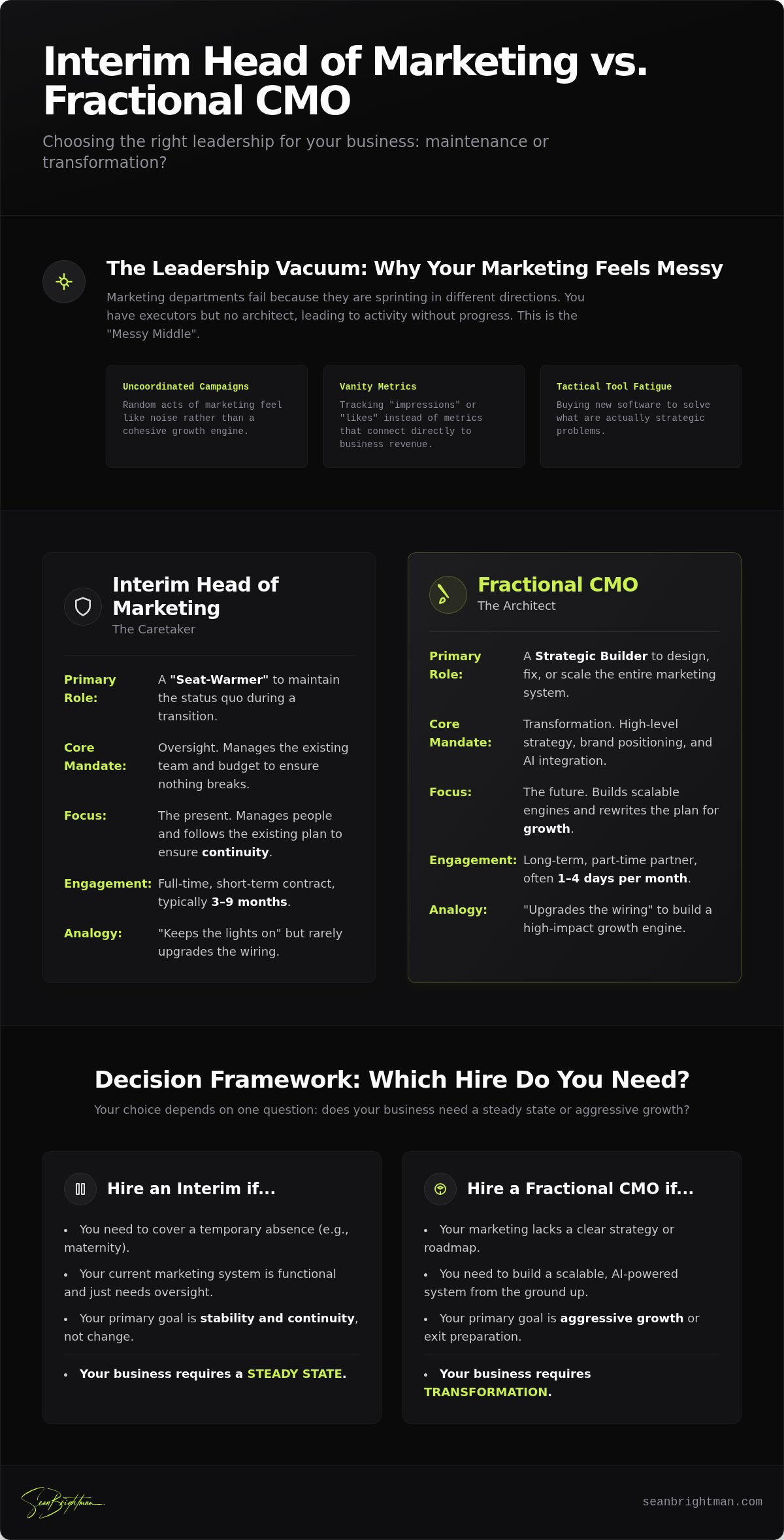
    An Interim Head of Marketing is a seat-warmer. They are hired to maintain the status quo during a transition. Typically, they work on a full-time, short-term contract lasting between 3 and 9 months. Their mandate is oversight. They manage the existing team, oversee the current budget, and ensure nothing breaks whilst you look for a permanent hire. They are perfect for maternity cover or filling a gap after a sudden departure. They ensure continuity, not change. They follow the existing plan; they don’t rewrite it. They keep the lights on, but they rarely upgrade the wiring.

    What is a Fractional CMO?

    A Fractional CMO is a strategic architect. They aren’t there to manage your daily social media posts or sit in every internal meeting. They are hired to build, fix, or scale your entire marketing system. They work as a long-term, part-time strategic partner, often contributing just 1 to 4 days per month. Their focus is high-level: brand positioning, AI integration, and creating scalable systems that work. This is for the CEO who needs senior-level brainpower but doesn’t need a full-time manager. If you need a clear marketing roadmap to drive growth or prepare for an exit, this is the hire that delivers.

    The distinction is simple. Interims manage people; Fractional CMOs build engines. Interims focus on the present. They keep the wheels turning whilst you search for a permanent replacement. Fractional CMOs focus on the future. They future-proof your business by installing high-level strategy and senior-level accountability. One preserves the value you already have; the other creates the value you’re currently missing. When you weigh up an interim head of marketing vs fractional cmo, ask yourself: do you need to survive the next six months, or do you need to scale for the next six years?

    Maintenance vs Transformation: The Structural Difference

    Interims manage people; Fractional CMOs build engines. This is the fundamental structural divide in the interim head of marketing vs fractional cmo debate. An interim hire often leads to more of the same because their mandate is to keep the existing team happy and the current processes ticking. They report on activity. They tell you how many emails went out or how many social posts were scheduled. A Fractional CMO reports on strategy. They don’t care about the volume of noise; they care about the efficiency of the machine.

    The Fractional CMO is a plug-and-play asset. They skip the three-month “culture fit” period and start stripping back the fluff immediately. They bring a battle-hardened perspective that identifies where your budget is leaking and where your team is stalling. It is about rapid impact, not corporate politeness. Whilst an interim hire ensures the team stays busy, the fractional leader ensures the team stays profitable. You’re moving from a model of reporting on activity to a model of delivering on strategy.

    Building the Growth Engine

    Before your team executes a single tactic, a Fractional CMO designs the architecture. They are the architect, not the foreman. This involves shifting from manual, uncoordinated marketing to a high-velocity, AI-powered system. By creating a marketing strategy roadmap, they ensure the business has a logical path to scale that survives long after the initial engagement. You aren’t buying their time; you’re buying a permanent upgrade to your business logic. Activity is noise. Strategy is signal.

    The Advisory Retainer Model

    One-off strategy sessions are useless if the execution falters three weeks later. Momentum is the only thing that matters in a growth phase. This is why the Marketing Advisory Retainer is the superior model for senior oversight. It provides a constant external force that maintains strategic velocity. It keeps your internal team aligned with long-term goals, whether that is a revenue jump or a clean business exit. Accountability isn’t a quarterly report. It is a monthly pulse check on the engine’s performance to ensure the internal team stays aligned with the mandate.
    Interim Head of Marketing vs Fractional CMO: Which One Actually Fixes Your Growth?

    Decision Framework: When to Hire an Interim vs a Fractional CMO

    Stop overthinking the recruitment process. The choice between an interim head of marketing vs fractional cmo is binary. It depends entirely on your current business stage and your intended destination. Are you in a steady state, or are you in growth mode? One requires a caretaker; the other requires a mechanic. You don’t need a three-month interview cycle to decide which one fits your board table.

    Consider the “Exit Test”. If you plan to sell your business in the next 24 months, which hire makes you more attractive to a buyer? A buyer doesn’t want to see a marketing department that relies on a single full-time manager’s tribal knowledge. They want to see a documented, automated, and scalable system. An interim hire preserves what you have. A fractional hire builds what a buyer wants to buy. It is the difference between keeping the seat warm and increasing the valuation of your company.

    Choose an Interim Head of Marketing if…

    Hiring an interim is a defensive move. It is about risk mitigation and maintaining continuity. You should choose this path if:

    • You already have a high-performing team that simply needs a manager for 6 months whilst a permanent leader is found.
    • Your marketing strategy is already perfect and you just need a senior pair of hands to sign the invoices and manage the budget.
    • You are currently in the middle of a recruitment process for a full-time CMO and need someone to bridge the gap without changing the direction.

    Choose a Fractional CMO if…

    Hiring a Fractional CMO is an offensive move. It is about strategic velocity and rebuilding the machine. This is the correct choice if:

    • Your marketing feels “messy” and you honestly don’t know how to fix the uncoordinated tactics.
    • You need to integrate AI consulting to stay competitive and automate your growth engine.
    • You want senior-level accountability and “battle-hardened” expertise without the bloated £150k salary and benefits package.

    Budgeting for these roles also follows a different logic. Interims usually command high daily rates for full-time availability, which can quickly drain your reserves. A Fractional CMO operates on an advisory model, providing maximum impact in a concentrated timeframe. You pay for the resolution, not the hours. If you are ready to stop the noise and start the growth, you can book a strategic consultation to determine your best move.

    Beyond the Title: Building a Scalable Growth Engine

    Titles are just labels. In the fight between an interim head of marketing vs fractional cmo, the label on the contract matters far less than the mandate you give them. If you hire a senior leader to manage your current mess, you’re just paying more for the same failure. You need a builder who views marketing as a profit driver, not an overhead. This shift requires moving away from “random acts of marketing” and towards a clinical, systematic approach to growth. You need someone who can rip out the plumbing that doesn’t work and install an engine that does.

    Most CEOs view marketing as a black hole for cash. It doesn’t have to be. When you choose the right leader in the interim head of marketing vs fractional cmo dilemma, you’re choosing to turn your marketing into a profit centre. This means every campaign, every automation, and every hire is measured against a commercial outcome. If a tactic doesn’t drive revenue or increase business value for a future exit, it gets cut. No excuses. No vanity metrics. Just hard results. Sean Brightman’s approach strips away the corporate fluff, combining high-level strategy with the “get-your-hands-dirty” execution that UK SMEs actually need.

    AI-Powered Marketing Systems

    Stop playing with shiny new tools. Start building intelligence into your operations. A modern marketing operations consultant doesn’t just recommend software; they rebuild your entire workflow to leverage AI. This creates a lean, high-velocity department that outpaces competitors who are still stuck in manual processes. This is your competitive advantage. It’s about doing more with less and doing it faster than the market expects. You aren’t just hiring a person; you’re installing a functional component into your business architecture that works whilst you sleep.

    Next Steps for the Decisive CEO

    Stop the bleeding first. Audit your current marketing mess and identify where the accountability has vanished. You cannot scale a department that doesn’t have a clear roadmap. A typical 90-day roadmap should deliver a clear strategic direction, an integrated AI workflow, and a measurable link between spend and revenue. If you want a senior-level briefing that cuts through the noise, contact Sean Brightman. It’s time to stop managing the status quo and start building an engine that scales. Be decisive. The “Messy Middle” is an expensive place to stay.

    Stop Managing the Mess and Start Scaling the Engine

    The choice between an interim head of marketing vs fractional cmo isn’t about hours; it’s about the mandate. You either hire a caretaker to preserve what you have or a strategist to build what you’re missing. If your current marketing feels uncoordinated and lacks accountability, a seat-warmer won’t fix it. You need a growth engine powered by AI and senior direction to turn your department into a profit driver.

    Sean Brightman provides the no-fluff, direct advisory that UK scale-ups need to stop the bleeding. As the author of the definitive guide to marketing strategy and an expert in AI-powered growth engines, he replaces corporate politeness with pragmatic execution. Stop settling for “busy” teams when you can have a scalable system designed for growth or a clean business exit.

    Book a Strategic Roadmap Session with Sean Brightman to define your path forward. It is time to stop the noise and start building a marketing machine that actually delivers. You have the vision; now get the battle-hardened architect to build it.

    Frequently Asked Questions

    What is the main difference between an interim and a fractional CMO?

    The primary distinction lies in the mandate. An interim hire focuses on continuity and stability, usually working full-time for a short period to fill a vacancy. A Fractional CMO is a strategic architect who works part-time on a long-term basis. When comparing an interim head of marketing vs fractional cmo, remember that interims keep the lights on whilst fractional leaders rebuild the engine for scale and future exit value.

    Is a fractional CMO more expensive than an interim hire?

    No, a Fractional CMO is typically more cost-effective for growth-minded businesses. Whilst an interim leader often requires a full-time day rate plus agency fees, a fractional executive works fewer days with higher strategic impact. You avoid the bloated £150,000 salary and benefits package of a permanent hire whilst gaining senior-level accountability. You are paying for the resolution of your growth problems, not just for a person to occupy a desk.

    Can a fractional CMO manage my existing marketing team?

    Yes, but the management style is different. They don’t micro-manage daily tasks or handle administrative holiday requests. Instead, they provide the senior direction and accountability your team is currently missing. They act as the architect, organising your executors into a cohesive unit. This ensures your staff are working on the right priorities that actually link marketing spend to business revenue instead of just staying busy with uncoordinated tactics.

    How long does a typical fractional CMO engagement last?

    Engagements vary based on the business stage, but they are generally long-term strategic partnerships. A typical starting point is a 90-day roadmap to audit the current mess and install a functional strategy. Following this, many CEOs transition to an Advisory Retainer model for ongoing direction. This ensures the momentum is maintained and the marketing system continues to evolve with your business goals rather than stalling after a one-off project.

    Do fractional CMOs actually execute the work or just give advice?

    They provide the strategy, architecture, and oversight, but they do not handle execution tasks like writing social posts or running ad campaigns. They are the “battle-hardened” strategists who design the growth engine. Your internal team or external agencies handle the physical labour of execution. This separation ensures the leader remains focused on high-level ROI and strategic velocity rather than getting bogged down in low-value tactical tasks.

    What happens if we need a full-time hire later on?

    A Fractional CMO makes your eventual full-time hire more successful. Instead of hiring a new CMO to “fix” a messy department, you hire one to take over a high-performing, documented system. The fractional leader builds the roadmap and installs the processes first. This ensures that when you do commit to a full-time executive salary, that person inherits a working machine with clear KPIs and a proven growth engine already in place.

    How does AI consulting fit into a fractional CMO role?

    AI is the modern CMO’s secret weapon for efficiency. In a fractional role, AI consulting involves building intelligence into your operations to automate workflows and outpace competitors. It is about shifting from manual marketing to a high-velocity system that does more with less. This integration ensures your marketing department remains lean and scalable, providing a significant competitive advantage in a market that is moving faster than traditional teams can handle.

    Will a fractional CMO care about my business as much as a full-time hire?

    They care about the results because their business model depends on delivering a measurable ROI. A fractional leader doesn’t have the luxury of corporate “seat-warming” or hiding behind bureaucracy. Their reputation is built on their ability to fix departments and drive growth. Because they are external, they provide the blunt honesty and objective perspective that internal hires often lack, making them more committed to the actual success of your strategy.

  • Stop Hiring Full-Time CMOs: The Fractional Revolution in 2026

    Stop Hiring Full-Time CMOs: The Fractional Revolution in 2026

    Hiring a full-time CMO in 2026 is a £120,000 mistake that stalls your business. Most founders think a permanent executive is the cure for stagnant growth. Usually, they just end up with expensive activity instead of a revenue engine. You see a team that’s busy but ineffective. You want results, not just a full calendar. It’s time to stop paying for corporate politeness and start investing in tactical precision.

    We agree that your marketing should be a functional machine, not a black hole for cash. You need clarity, not more confusion about how to implement AI strategically. This article shows you how a fractional cmo provides the strategic intervention necessary to build a scalable, AI-powered growth engine. You’ll discover how to get senior-level accountability without the executive overhead. We are moving from bloated payrolls to plug-and-play systems that deliver results and let the founder step back from the daily grind.

    Key Takeaways

    • Understand why hiring a senior leader into a broken marketing system is a guaranteed six-month exit strategy.
    • Learn how a fractional cmo provides board-level expertise and high-impact strategy without the weight of a full-time contract.
    • Discover why strategy ownership must sit inside your business rather than with an agency that prioritises its own execution.
    • Map out the transition from manual, disjointed marketing tasks to a data-driven, AI-powered growth engine.
    • Use advisory retainers to maintain high-level direction and finally stop the founder from being the primary bottleneck for growth.

    The Full-Time CMO Trap: Why Your First Hire Is Often a £120k Mistake

    Most SMEs hit a predictable wall. Growth stalls. The founder is exhausted from managing a junior marketing assistant who produces “content” but no revenue. The knee-jerk reaction is to find a heavy-hitter. You look for a full-time Chief Marketing Officer with a shiny CV and a £120,000 price tag. It is a massive mistake. You are hiring for seat filling whilst you should be hiring for system building.

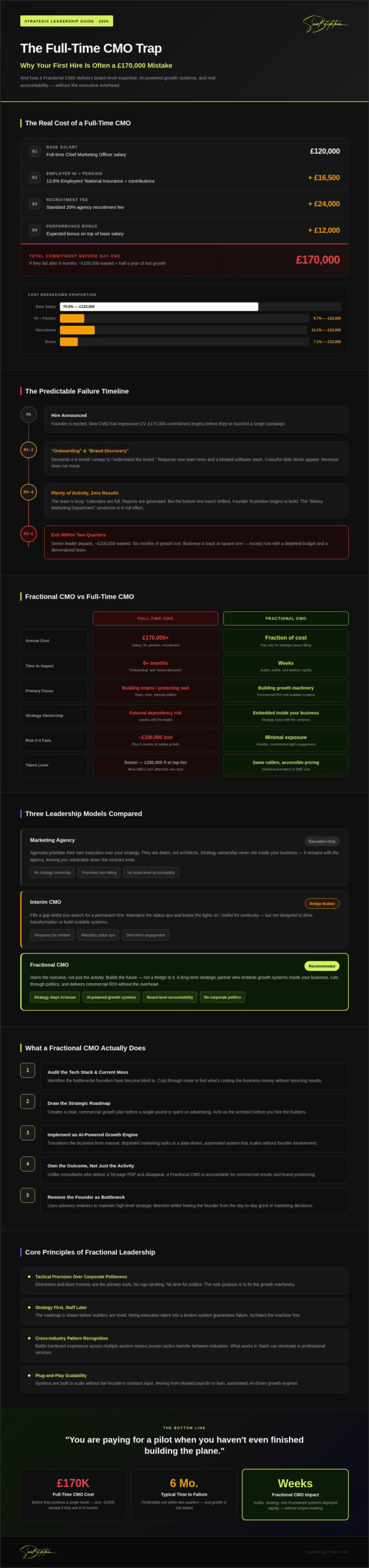
    A full-time executive often arrives with an “expectation of empire.” They don’t just want a desk; they want a team, a bloated software stack, and a six-month “onboarding” period to “understand the brand.” You end up with a high-salaried leader sitting on top of a broken engine. The result is the Messy Marketing Department syndrome. You see plenty of activity and colourful slide decks, but the bottom line hasn’t moved. This leads to a frustrated founder and a senior leader exit within two quarters.

    The Real Cost of Executive Failure

    Think £120,000 is the total cost? Think again. In the UK market, you must factor in 13.8% Employers’ National Insurance, pension contributions, and performance bonuses. Add a standard 20% recruitment fee and you are looking at a £170,000 commitment before they even start. If they fail and leave after six months, you’ve wasted nearly £100,000 and half a year of growth. SMEs often outgrow their first marketing manager but aren’t ready for the dead weight of a full-timer. You are paying for a pilot when you haven’t even finished building the plane. The opportunity cost of stagnant growth is the real killer.

    Strategy First, Staff Later

    You cannot delegate strategy to a junior team or a generalist agency. They are doers, not architects. A What is a Fractional Executive? model allows you to bring in the architect first. A fractional cmo doesn’t care about building an internal empire or protecting their seat. They care about the machinery of growth.

    This role acts as the strategic intervention your business needs. They draw the plans, audit the tech stack, and implement an AI-powered growth engine before you hire the builders. It is about tactical precision over corporate politeness. By choosing a fractional cmo, you get board-level leadership that focuses on results rather than bureaucracy. You get the roadmap first. You hire the executioners only when the system is ready to scale. Before committing to a permanent hire, it is worth reviewing a fractional CMO vs full time cost-benefit analysis to understand the true loaded cost of each path.

    What is a Fractional CMO? Leadership Without the Corporate Overhead

    A fractional cmo is not a part-time employee. They are a senior marketing executive providing board-level leadership on a concentrated, part-time basis. Think of it as high-octane fuel for your growth engine. You get the same calibre of talent that global brands pay £250,000 for, but you only pay for the strategic heavy lifting. This isn’t about filling a seat. It’s about deploying a “Plug-and-Play” leader who can audit your mess, fix the leaks, and build a scalable system in weeks, not years. If you want to understand exactly what is a fractional CMO and how senior marketing leadership actually works in 2026, it is worth stripping away the corporate fluff to see how this model delivers strategic accountability where most businesses currently have chaos.

    Unlike a consultant who drops a 50-page PDF and disappears, a fractional cmo owns the outcome. Consultants give advice. Fractionals provide execution and accountability. They focus on commercial ROI, brand positioning, and mechanical marketing systems that don’t rely on the founder’s intuition. If you need a clear path forward, a structured roadmapping session can help define that initial strategy before the first pound is spent on ads.

    Fractional CMO vs Interim CMO

    Interim leaders are bridge-builders. They fill a gap whilst you look for a permanent hire. They keep the lights on. A fractional leader builds the future. Whilst an interim role suggests a temporary fix, a fractional partnership is a long-term strategic commitment to growth. Choose an interim if you just need to maintain the status quo. Choose a fractional if you need to disrupt it. It is about driving strategic growth with a fractional CMO to ensure your business stage matches your leadership model.

    The “Battle-Hardened” Expert Persona

    The best leaders aren’t specialists in one narrow niche. They are experts in growth. A Fractional CMO brings a perspective forged in the fires of multiple industries. They aren’t blinded by “how we’ve always done it” in your specific sector. They see patterns. They know what works in SaaS that will crush it in professional services. They bring a “get-your-hands-dirty” attitude that corporate executives often lose.

    Their secret weapons are directness and blunt honesty. They don’t have time for corporate politics or ego-stroking. They are there to fix the machinery. This external perspective allows them to identify bottlenecks you’ve become blind to. They cut through the noise with tactical precision. You aren’t paying for their time. You are paying for the decades of mistakes they’ve already made and learned from elsewhere.

    Fractional CMO vs Marketing Agency: Who Actually Owns Your Strategy?

    Agencies are incentivised to sell you more work. It is a fundamental conflict of interest. If you hire an SEO agency, the solution to every problem is more content. If you hire a PPC agency, the answer is always more spend. They are built to sell execution, not to own your commercial outcomes. They provide the parts, but they don’t care if the machine actually runs.

    Agencies provide the labour. A fractional cmo provides the logic. One is a service provider; the other is a strategic partner who sits on your side of the table. The fractional leader doesn’t care which channel wins as long as the revenue engine works. They own the strategy, the budget, and the result. They ensure your marketing spend is an investment in scalable machinery, not just a recurring monthly expense that vanishes when the contract ends.

    The Execution Trap

    Many founders fall into the trap of starting with tactics. They jump into Facebook ads or LinkedIn outreach before they have a solid positioning strategy. This is just burning cash. Running ads without a roadmap is efficient waste. You are simply scaling confusion. A fractional cmo stops the bleeding by identifying which levers to pull amongst the noise. They build a growth engine that works across all channels, ensuring every pound of labour serves the strategic logic of the business. The underlying problem is almost always a systems failure — disconnected tools, siloed data, and decisions made on gut feeling rather than hard numbers, which is precisely what a dedicated marketing operations consultant is built to resolve.

    Accountability and Oversight

    Who marks the agency’s homework? Most CEOs don’t have the technical depth to know if their agency is performing or just hiding behind vanity metrics. You need senior oversight to keep them honest. Without it, you are at the mercy of colourful reports that don’t translate to bank balances. It’s about accountability, not just activity.

    The fractional leader bridges the gap between the CEO’s vision and the agency’s technical output. They translate high-level business goals into specific, measurable requirements. They integrate your internal team and external partners into a cohesive unit. This senior-level intervention ensures that every external partner is aligned with your long-term roadmap. You get the benefit of agency execution without the risk of strategic drift. You finally get someone who knows what “good” looks like and isn’t afraid to call out underperformance.

    Stop Hiring Full-Time CMOs: The Fractional Revolution in 2026

    Building the AI-Powered Growth Engine: A 2026 Roadmap

    By 2026, simply “using AI” isn’t a competitive advantage. It is the baseline. Most UK businesses are still playing with tools like hobbyists. They generate a few social posts or draft an email. This is not a strategy. It is a distraction. You need a growth engine, not a toy box. If your marketing department is just “playing with tools,” you are falling behind competitors who are building integrated machinery.

    A fractional cmo acts as the architect of this machinery. They move your team beyond experimentation into strategic implementation. The goal is tactical precision. We use AI to improve marketing efficiency and data-driven decision-making. It is about automating the mundane so your expensive human talent can focus on the creative logic that actually moves the needle. This is how you scale without ballooning your payroll.

    The AI Marketing Roadmap

    Building this engine requires a clinical approach. It doesn’t happen by accident. A fractional cmo provides the senior-level AI Consulting needed to ensure your tech stack delivers ROI rather than just adding complexity. We follow a three-step process to build your engine.

    • Step 1: System Audit. We check for AI readiness. Is your data siloed? Are your current workflows redundant? We strip away the fluff to find the functional core of your operations.
    • Step 2: High-Impact Use Cases. We focus on positioning, personalisation, and prediction. We use AI to analyse market gaps and personalise customer journeys at a scale that was previously impossible. This isn’t about more content; it’s about better conversion.
    • Step 3: Scalable Integration. We implement a growth engine that learns. This isn’t a static plan. It is a living system that adapts to market shifts in real-time, providing the strategic accountability you’ve been missing.

    Strategic Roadmapping Sessions

    Most marketing plans sit in a drawer. They are too long, too vague, and too polite. You need a clear, actionable roadmap that defines your brand direction without the corporate fluff. This starts with a one-off strategy session. We identify the bottlenecks and draw the blueprints for your growth engine. This is about getting the plans right before you hire the builders.

    Creating a clear plan ensures your marketing doesn’t rely on the founder’s intuition. It builds a system that works whilst you sleep. Learn more about Strategic Roadmapping to see how we turn chaos into a clinical plan of attack. If you are ready to stop burning cash on disjointed tactics, you can book a roadmapping session to build your engine today. Let’s stop playing with tools and start building the machinery of 2026.

    Implementing Fractional Leadership: From Chaos to Strategic Accountability

    Implementing a fractional cmo is the fastest way to shift from operational chaos to strategic accountability. You don’t need another manager to supervise the mess. You need a partner who owns the outcome. Most marketing departments produce activity. We produce results. It is about building a functional component of your business that operates with tactical precision.

    The Advisory Retainer is the mechanism that makes this possible. It provides ongoing direction and a direct line of accountability for the CEO. This isn’t about corporate hand-holding. It is about expert oversight. Advisory beats management because it focuses on high-level logic rather than getting bogged down in daily tasks. It is the secret weapon for founders who have outgrown their own marketing knowledge but aren’t ready for the dead weight of a full-time executive.

    Measuring success requires a clinical focus on KPIs that actually hit the bottom line. We ignore vanity metrics. We don’t care about “likes” or “brand awareness” unless they translate to revenue. We track Customer Acquisition Cost (CAC), Lifetime Value (LTV), and sales velocity. This is the difference between a marketing department that feels like an expense and one that functions as a growth engine. You finally get a clear marketing roadmap that doesn’t rely on the founder’s intuition.

    Eventually, your business will scale to a point where a full-time hire makes sense. This usually happens when your revenue hits the £25 million threshold and the machinery is so predictable that you simply need someone to maintain it. Until then, a fractional leader is the more efficient choice. You get the expertise without the £120,000 overhead. If you are still weighing up the numbers, the fractional CMO vs full time brutal cost-benefit analysis for 2026 breaks down the true total loaded cost of each model so you can make the decision with clarity.

    The Advisory Retainer Model

    High-growth founders are often the primary bottleneck. You make every strategic decision because you don’t trust the team to get it right. An advisory retainer removes that burden. It ensures your strategies are executed effectively with expert oversight. You get a mentor who has seen your specific problems before and knows the shortcut to the solution. It is about strategic accountability, not just filling a seat.

    Getting Started in 90 Days

    We don’t spend months “onboarding” or “finding our feet.” We hit the ground running with a clear 90-day plan.

    • The first 30 days: We audit current systems. We listen. We find the “mess” and identify the immediate leaks in your funnel.
    • The next 60 days: We build the foundation. We implement the AI-powered growth engine and align your existing team with the new roadmap.
    • The result: By day 90, you have a scalable, predictable marketing machine that doesn’t rely on the founder.

    Ready to turn your marketing into a functional machine? Book a Strategic Advisory session with Sean Brightman to start your 90-day transition today. Let’s stop the activity and start the growth.

    Stop Managing Chaos and Start Building Machinery

    Hiring for seat filling is a legacy move. You need a marketing system that delivers results without the £120k overhead. We have defined the difference between logic and labour. You now understand why a fractional cmo is the strategic intervention required to fix a broken engine. It is about tactical precision, not corporate politeness. You don’t need more activity; you need a revenue engine that scales.

    Sean Brightman, author of “The Strategy Book”, specialises in AI-powered marketing systems for UK scale-ups. He provides the high-impact advisory needed to turn your vision into a clinical roadmap. Stop being the bottleneck in your own business. It is time to implement the strategic accountability that moves the needle. You have the blueprint. Now you need the architect.

    Build your AI-powered growth engine with Sean Brightman.

    The future of your growth depends on the systems you build today. Let’s get to work and build something that lasts.

    Frequently Asked Questions

    What is the typical day rate for a Fractional CMO in the UK?

    UK day rates for senior marketing leadership usually range from £1,000 to £2,500 depending on the expert’s track record. You aren’t paying for a full-time salary; you are paying for concentrated strategic impact. This reflects the “fractional” nature of the role. It is a tactical investment in a battle-hardened leader who has already made the expensive mistakes elsewhere so you don’t have to.

    How many days a week does a Fractional CMO usually work?

    A fractional cmo typically commits between two and four days per month. This isn’t about clock-watching. It is about high-impact strategic interventions. Some businesses require one day a week for deep integration, whilst others prefer a concentrated burst of two days a month for board-level direction. The model is flexible. It scales based on the complexity of your growth engine and the speed of execution.

    What is the difference between a Marketing Consultant and a Fractional CMO?

    Consultants give you a map; a fractional cmo drives the car. Consultants produce reports and slide decks that often end up in a drawer. A fractional leader owns the commercial outcome, the team, and the budget. They are embedded in your leadership team. They don’t just tell you what’s wrong. They fix the machinery and stay to ensure the results actually hit your bank balance.

    Can a Fractional CMO help with AI implementation?

    Yes, they act as the architects of your AI-powered growth engine. Most teams play with AI tools like hobbyists without a clear plan. A fractional leader implements AI strategically to automate mundane tasks and improve data-driven decision-making. They ensure your tech stack isn’t just a collection of toys. It becomes a functional component of your machinery that learns and adapts to market shifts in real-time.

    Does a Fractional CMO manage my existing marketing team?

    They absolutely manage your internal team and external agencies. You need someone to mark the homework. Without senior oversight, marketing departments often produce “activity” instead of results. The fractional leader bridges the gap between the CEO’s vision and the team’s technical output. They provide the strategic logic that ensures every pound of labour serves a specific commercial goal. It is about accountability, not just management.

    When is a business ready for a Fractional CMO?

    You are ready when your revenue is between £2m and £10m and growth has stalled. If the founder is still the primary marketing bottleneck, you need an intervention. You have outgrown your junior “doers” but aren’t ready for the £120k overhead of a full-time executive. If your marketing feels like a black hole for cash rather than a predictable engine, it is time for fractional leadership.

    How long do Fractional CMO engagements typically last?

    Engagements usually last between six and eighteen months. This isn’t a temporary fix. It is a long-term strategic partnership. The goal is to build a scalable system and eventually hire a permanent team to maintain it. Some founders retain a fractional leader on an advisory basis for years to maintain high-level direction and accountability without the bloat of a permanent executive payroll.

    Will a Fractional CMO help me hire a permanent marketing team?

    Yes, they often help you hire your eventual full-time replacement. A fractional cmo builds the machinery first. Once the growth engine is predictable and the roadmap is clear, they help you find the right permanent lead to run it. This ensures you hire for system maintenance rather than system building. It prevents the common mistake of hiring a senior leader into a broken, messy department.