
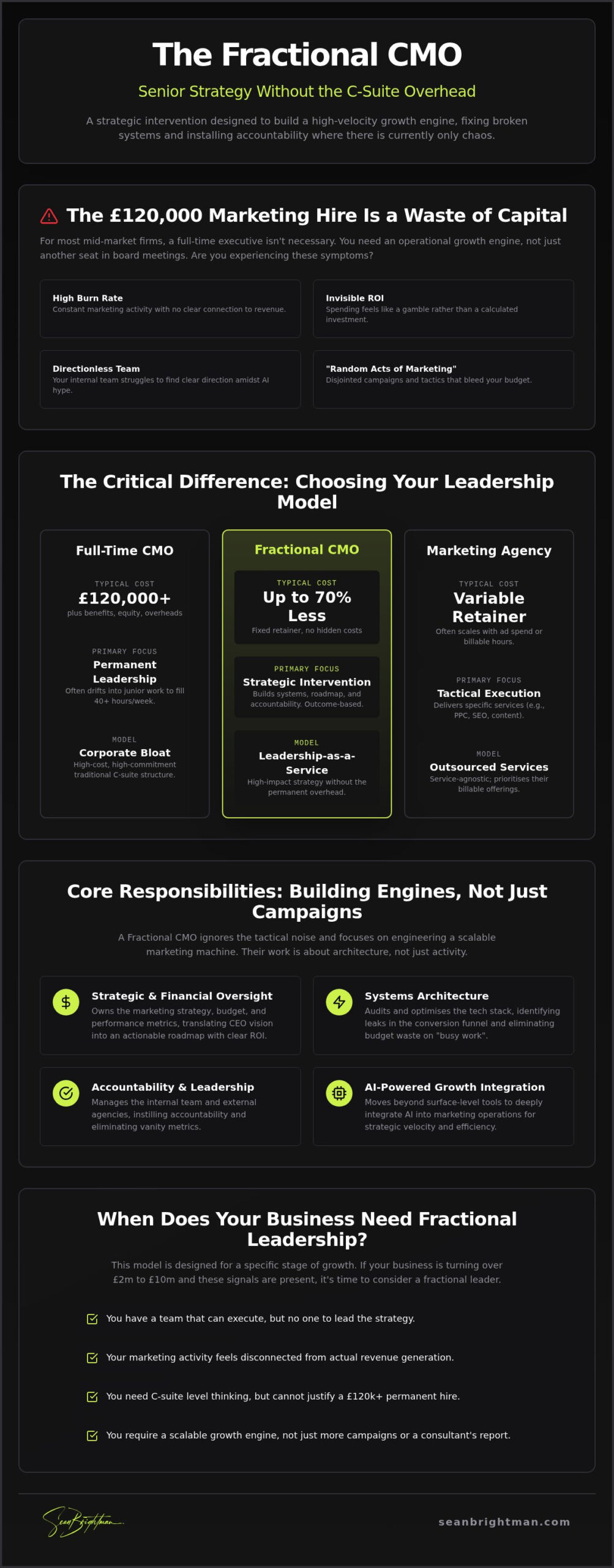
Your £120,000 marketing hire is probably a waste of capital. Most mid-market firms don’t need a full-time executive to sit in board meetings. They need a high-velocity growth engine that actually functions. So, what is a fractional CMO? It isn’t a part-time consultant with a fancy title. It’s a strategic intervention designed to fix your broken systems and install accountability where there is currently only chaos.
You’re likely exhausted by the constant disconnect between marketing activity and actual revenue. The burn rate is high. The ROI is invisible. You’re being shouted at by AI hype whilst your internal team struggles to find a clear direction. It feels like you’re paying for a Ferrari but getting the performance of a push-bike. You need senior leadership, but you don’t need the permanent overhead.
This article strips away the corporate fluff to reveal how a fractional leader delivers senior-level strategy and AI-powered growth at a fraction of the cost. You’ll discover how to build a scalable roadmap that works. We’ll examine the shift toward leadership-as-a-service and why the traditional C-suite model is failing in 2026.
Key Takeaways
- Understand exactly what is a fractional cmo and why it represents a high-velocity strategic intervention rather than a part-time consultancy role.
- Learn how to slash C-suite overhead by up to 70% whilst securing battle-hardened leadership to fix disconnected marketing activity.
- Discover the blueprint for building an AI-powered growth engine that moves beyond surface-level tools to deep operational integration.
- Identify the “random acts of marketing” currently bleeding your budget and replace them with a scalable roadmap and clear accountability.
- Distinguish between service-agnostic strategic advisory and agency models that prioritise their own billable services over your business outcomes.
Defining the Fractional CMO: Senior Strategy Without the Corporate Bloat
A fractional CMO is a battle-hardened marketing leader who works for your business on a part-time basis. They aren’t there to fill a seat or pad out a meeting. They are there to build a machine. When businesses ask what is a fractional cmo, they often mistake the role for a part-time marketing manager. That is a mistake that costs money. A fractional CMO is a strategic intervention. They provide the C-suite brain without the C-suite salary, benefits, or equity. It is about seniority, not hours. It is about strategy, not just “doing marketing stuff”.
The rise of Fractional executives across the UK is a direct response to a specific problem: the £120k overhead trap. Most mid-market firms are currently stuck. They have a team that can execute but no one to lead. They have activity but no direction. A fractional leader plugs that gap. They own the strategy whilst your internal team or agencies handle the tactical execution. It is a plug-and-play model designed for velocity.
The “Fractional” Logic: Why Hours Don’t Equal Impact
If your business is turning over £2m to £10m, you do not need 40 hours of strategy a week. That is a myth sold by recruitment agencies. Strategy is high-intensity but low-volume. You need ten hours of high-impact leadership and thirty hours of relentless execution. Hiring a full-time CMO at this stage results in a senior leader doing junior work just to look busy. It is a waste of capital. Fractional leadership focuses on outcome-based leadership rather than activity-based work. You pay for the resolution, not the residency.
Consultant vs Fractional CMO: Clearing the Confusion
The market is flooded with consultants. A consultant tells you what is wrong and hands you a slide deck. They deliver advice and then they leave. A fractional CMO takes accountability for the result. They stay to organise the chaos. They manage the team. They fix the broken conversion engine. One gives you a “to-do” list; the other builds the system that does it. It is the difference between a spectator and a captain. If you want a report, hire a consultant. If you want a scalable growth engine, hire a fractional CMO.
The Core Responsibilities: Building Engines, Not Just Managing Campaigns
Most businesses treat marketing like a series of disjointed events. It is a campaign here and a social post there. This is tactical noise. A fractional CMO ignores the noise and focuses on the machinery. Their primary job is building a marketing operations consultant system that scales. They don’t just “do” marketing. They engineer it. They look at your department and see a production line. If one part of that line is broken, the whole output fails.
They instill accountability amongst team members and third-party agencies. No more vanity metrics from your PPC agency. No more disconnected projects from your content team. The fractional CMO acts as the clinical translator of the CEO vision. They turn abstract goals into an actionable roadmap. The rise of the fractional CMO reflects a shift away from traditional, bloated leadership toward this agile, results-first model. It is about creating a predictable growth engine that doesn’t break when you scale.
Systems Architecture and Operational Excellence
Tools are not a strategy. A messy tech stack is just an expensive way to fail. When you ask what is a fractional cmo, you are asking for a systems architect. They start with an audit to find hidden profit in messy departments. They look at the plumbing. They identify where leads are leaking and where budget is being burnt on “busy work”. This requires a “get-your-hands-dirty” attitude. They don’t just point at the problem; they implement the fix. It’s about operational excellence, not just software subscriptions. If your current setup feels like a series of random acts, starting with a clear roadmapping session is the first step to operational clarity.
Brand Positioning: Standing Out in a Crowd
In 2026, being “good” is the baseline. It isn’t enough. Most brands are drowning in a sea of sameness. A fractional CMO uses pragmatically confident strategy to fix weak brand messaging. They move the conversation from “features” to “value”. They ensure your brand reflects senior-level authority. If your marketing feels like a commodity, your pricing will follow. Strategic positioning ensures you aren’t just another option. You become the only logical choice. They define the “this, not that” reality of your business. They make sure the market understands exactly why you exist and why they should care.
The Critical Difference: Fractional CMO vs Full-Time vs Agency
Choosing the wrong leadership structure is a terminal mistake for scale-ups. You either drown in overhead or starve of strategy. When founders ask what is a fractional cmo, they’re usually looking for a middle ground that traditional recruitment doesn’t offer. The reality is binary. Agencies execute. Fractional CMOs lead. Full-time hires often stagnate in mid-sized firms. The model of the Fractional executive provides the seniority of a C-suite veteran without the permanent weight on your balance sheet.
There is a fundamental difference in intent. An interim CMO is a placeholder whilst you find a permanent replacement; they fill a gap. A fractional CMO is a builder; they design the future. They aren’t service-biased. They don’t care if you use LinkedIn ads or direct mail, as long as the ROI is clinical. This service-agnostic approach is the only way to get an honest view of your growth engine.
The £120k Mistake: Why Full-Time is Often Overkill
Hiring a full-time CMO in a business doing £5m is often a vanity project. The hidden costs are staggering. Once you factor in NI, pension contributions, performance bonuses, and the “recruitment tax” of headhunter fees, that £120k salary quickly balloons. It’s a massive overhead for a role that, in a mid-market firm, only requires 20% strategy and 80% management. In the fractional CMO vs full-time battle, the fractional model wins on strategic velocity. You get an expert who has seen these problems ten times before in ten different industries. They don’t get bored. They don’t get comfortable. They just deliver.
Why an Agency Cannot Be Your CMO
Agencies are built to sell you their specific services. If you hire a PPC agency, they will tell you that you need more PPC. They are biased towards their favourite tools and channels because that is how they stay profitable. They lack internal accountability. An agency won’t tell you that your product-market fit is broken or that your sales team is dropping the ball. A fractional CMO acts as the essential buffer between the CEO and the agency noise. They manage the third parties, cut the waste, and ensure that every pound spent aligns with the overarching roadmap. They represent your interests, not the agency’s billable hours.
Identifying the Signal: When Your Business Needs Fractional Leadership
If you are a CEO still approving social media copy or tweaking ad headlines, your business is failing its leadership. This is the first signal. You have “random acts of marketing” but no cohesive strategy. You are pouring money into ads whilst your conversion engine is fundamentally broken. It is like trying to fill a bucket with holes. To understand what is a fractional cmo in a practical sense, look at your monthly burn. If you’re spending thousands on tactics but can’t trace a single pound back to a strategic objective, you’re just gambling. You need a marketing advisory retainer to stop the rot. This isn’t about more activity. It’s about strategic velocity.
The “Messy Department” Syndrome
Recognising the syndrome is simple. Activity is high. Results are flat. Your team is busy, yet the pipeline is dry. This creates an emotional state of deep frustration. Most CEOs in this position have lost trust in their marketing function. They suspect they are being “marketed to” by their own team or agencies. Fixing it yourself is the fastest way to burnout. You are a leader, not a marketing manager. You need a clinical, external force to audit the plumbing and install accountability amongst your staff. Stop managing the chaos. Start leading the resolution.
The Scale-up Ceiling: Moving Beyond Founder-Led Growth
Word of mouth is a fantastic start. It is a terrible way to scale. Every business hits a ceiling where founder-led growth plateaus. This is the moment you need a battle-hardened strategist to break through. You need systems that operate independently of your personal network. This becomes critical when preparing for an exit or a major investment round. Investors do not buy “hope” or “potential”. They buy predictable systems. They want to see a growth engine that is documented, measured, and scalable. If you cannot explain your customer acquisition cost (CAC) or your lifetime value (LTV) with clinical precision, you aren’t ready for the next level.
Your marketing should be a predictable revenue generator, not a black hole for capital. If the wheels feel like they are falling off, it is time to install a senior pilot. Explore how a fractional CMO brings order to internal complexity.
Strategic Velocity: Integrating AI and Accountability into Your Growth
In 2026, a CMO who isn’t an AI-native is an expensive dinosaur. Modern fractional leadership isn’t just about managing people; it’s about building AI-powered growth engines. When you strip away the noise and ask what is a fractional cmo in the current market, the answer is simple. It is a leader who moves your marketing from a cost centre to a high-performance machine. They don’t just manage your team; they transform how your team works. They ensure your department stops playing with AI tools and starts integrating them into your core operations. For a comprehensive breakdown of how to deploy these capabilities, the fractional CMO services guide for CEOs outlines exactly how senior marketing leadership translates into scalable, AI-powered architecture.
The goal is Strategic Velocity. This isn’t about doing more things. It is about doing the right things at a pace your competitors can’t match. By the time a full-time hire has finished their “onboarding” and “culture fit” meetings, a fractional leader has already identified your three biggest bottlenecks and started the implementation of a fix. It is about maximum impact in a concentrated timeframe. You can read more about this shift in the parent pillar: Stop Hiring Full-Time CMOs: The Fractional Revolution in 2026.
AI Consulting: Beyond the Hype
Most marketing teams are currently wasting hours on manual labour that could be automated in minutes. They use AI for “brainstorming” but fail to use it for operational scale. A fractional CMO provides the AI Consulting necessary to identify where technology can actually move the needle. This moves your output from manual labour to machine-assisted precision. AI integration is a functional component, not an abstract theory. It is a mechanical part of your growth engine that reduces your reliance on bloated headcounts whilst increasing your strategic output. If your team isn’t using AI to improve efficiency daily, you are overpaying for their time.
The Roadmapping Session: Your 90-Day Transformation
Every successful fractional engagement starts with a clinical Roadmapping session. You cannot fix a messy department with vague promises. You need a 90-day transformation plan that defines exactly what “success” looks like. In the first 30 days, the focus is on gaining clarity and stopping the capital leak. By day 60, we are installing the systems. By day 90, the engine is running. This methodical approach is what is a fractional cmo at their best: a straight-shooting strategist who brings order to internal complexity. You get unstuck. You gain a clear path forward. You stop guessing and start growing.
Stop Guessing and Start Engineering Your Growth
The choice for UK CEOs in 2026 is binary. You can continue subsidising a bloated, full-time C-suite or you can install strategic velocity. Understanding what is a fractional cmo means recognising that senior leadership is a functional component, not a permanent overhead. We have stripped away the noise to show how seniority beats hours and how systems beat campaigns. You don’t need more activity; you need a growth engine that runs on clinical accountability whilst integrating AI.
Sean Brightman, author of the strategic marketing book “The Book”, provides unapologetically direct advisory focused on building these high-impact machines. This isn’t abstract theory. It is a battle-hardened approach for leaders who have no patience for fluff or bureaucracy. It is time to move past the chaos of disconnected marketing and install a clinical roadmap that delivers measurable ROI.
Take the first step toward operational clarity and stop the capital leak. If you’re actively searching for a fractional CMO for hire, this guide outlines exactly how senior marketing leadership translates into a scalable growth engine built for a high-value exit. Book a Strategic Roadmapping Session with Sean Brightman and fix your broken marketing department today. Your business deserves a leader who prioritises results over residency.
Frequently Asked Questions
Is a fractional CMO just a part-time marketing manager?
No. A marketing manager focuses on the “how” of execution whilst a fractional CMO focuses on the “why” and “what” of strategy. One manages tasks; the other builds the engine. If you need someone to post on social media, hire a manager. If you need someone to fix your broken conversion funnel and align marketing with revenue, you need senior leadership.
How much does a fractional CMO cost in the UK in 2026?
Costs vary based on the complexity of your growth engine and the level of integration required. Whilst full-time C-suite hires carry massive overheads like NI and pensions, fractional models operate on a predictable retainer. This allows mid-market firms to access high-level strategy at a fraction of the cost of a full-time hire.
What is the difference between a fractional CMO and an interim CMO?
An interim CMO is a temporary placeholder hired to keep the seat warm whilst you recruit a permanent replacement. A fractional CMO is a strategic partner who builds long-term systems and stays to ensure they scale. One is about survival; the other is about transformation. One fills a gap; the other builds a future.
Can a fractional CMO manage my existing marketing team?
Absolutely. A key part of what is a fractional cmo involves providing senior-level accountability for your internal staff and third-party agencies. They act as the clinical buffer between the CEO and the tactical team. They ensure everyone is pulling in the same direction and hitting measurable targets without the CEO needing to micro-manage.
How many days a week does a fractional CMO typically work?
Most fractional leaders work between one and two days a week, but the focus is on outcomes rather than hours. You are paying for a decade of experience condensed into high-impact strategic interventions. It is about the velocity of the result, not the duration of the residency. Seniority is measured by impact, not clock-watching.
Do I need to sign a long-term contract for fractional CMO services?
Most engagements operate on an Advisory Retainer basis to ensure consistent momentum. This isn’t about being locked into a rigid, multi-year corporate deal. It is about maintaining a steady strategic pulse to keep your growth engine from stalling. It provides the flexibility of a consultant with the deep integration of an executive.
What results can I expect in the first 90 days of hiring a fractional leader?
In the first 90 days, you should expect a clinical audit of your current systems and a clear roadmap for the future. You will see broken funnels fixed, capital leaks plugged, and a shift from random acts of marketing to a cohesive growth engine. Accountability returns to the department as results start to replace excuses.
Does a fractional CMO help with AI implementation?
Yes. A modern fractional CMO specialises in building AI-powered growth engines. They move your team from manual labour to machine-assisted output. This involves identifying exactly where AI can move the needle in your operations and ensuring your team actually integrates these tools into their daily workflow. It is about functional integration, not abstract theory.
Leave a Reply