Tag: founder tips

  • Fractional CMO Day Rates UK 2026: The Brutal Reality of Senior Marketing Costs

    Fractional CMO Day Rates UK 2026: The Brutal Reality of Senior Marketing Costs

    Hiring for time is a legacy mistake that’s killing your margins. If you’re scanning the market for fractional cmo day rates uk 2026, you’re likely asking the wrong question. You don’t need a timesheet; you need a result. You’ve probably already wasted thousands on agencies that execute without owning the strategy. It’s a common trap. You get the activity, but you don’t get the accountability. You’re right to be frustrated.

    This breakdown provides a blunt, transparent look at what senior marketing leadership actually costs in the current UK market. I’ll show you why buying hours is a liability whilst buying strategic velocity is an investment. We’ll explore how AI has gutted old-school cost structures and why a full-time hire at £150,000 plus benefits is often the most expensive mistake a founder can make.

    I am going to give you the real numbers on retainers, the truth about day rates, and a roadmap to senior expertise without the heavy overhead of NI or equity. It’s time to build a growth engine that doesn’t rely on your constant input.

    Key Takeaways

    • Stop buying hours and start buying strategic velocity; the 2026 market prioritises outcomes over mere attendance.
    • Understand the current benchmarks for fractional cmo day rates uk 2026 to ensure you are paying for battle-hardened expertise rather than academic theory.
    • Avoid the “Hidden Tax” of full-time hires by bypassing the heavy overheads of NI, pensions, and the high cost of recruitment failure.
    • Leverage AI consulting to gut old-school cost structures and build a scalable growth engine that does not rely on the founder.
    • Shift from vague activity to measurable growth by initiating engagements with a clear marketing roadmap and defined 6-month KPIs.

    The UK Fractional CMO Landscape in 2026: Why Day Rates Matter

    A Fractional executive isn’t an extra pair of hands. They are a senior leader who provides the strategic architecture your business lacks. In 2026, the UK market has shifted. We’ve moved away from paying for “presence” and toward paying for outcomes. If you’re hiring based on fractional cmo day rates uk 2026 simply to fill a seat, you’re lighting money on fire. You don’t need another person in the room; you need a system that works whilst you sleep.

    The primary deliverable is a growth engine, not a set of slides. Most founders fall into the “busy-ness” trap. They want to see a CMO “working” for eight hours. Real senior leadership doesn’t work that way. High-impact strategy happens in the gaps between execution. You’re buying the ability to say “no” to the wrong channels and “yes” to the 20% of activities that drive 80% of your revenue. This is about strategic velocity, not just ticking boxes on a to-do list.

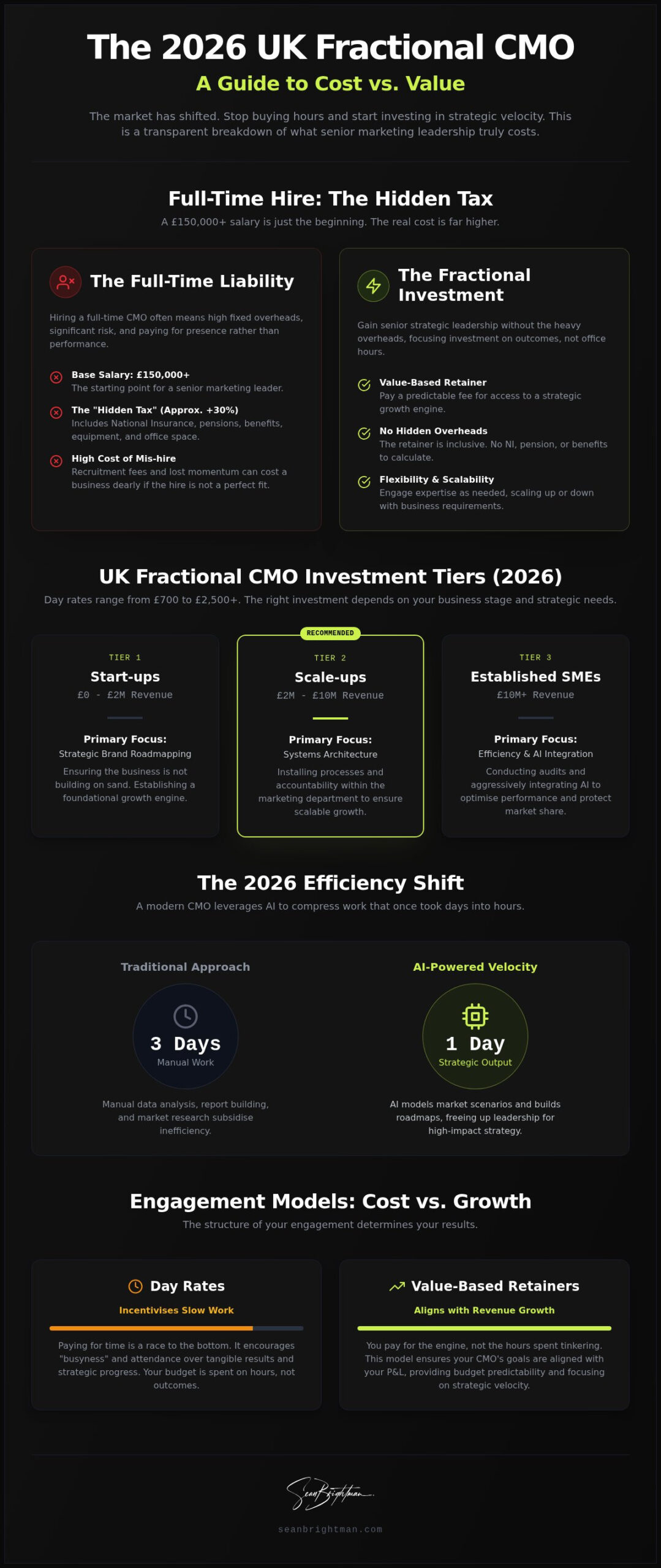
    When you look at fractional cmo day rates uk 2026, you’ll see a wild spread from £700 to over £2,500. This isn’t just about years on a CV. It’s about the depth of the growth engine being built. A lower rate often gets you a glorified project manager who executes your ideas. A higher rate buys you a partner who challenges your assumptions and owns the commercial roadmap. Choose the latter if you want to scale.

    Fractional vs Advisory: Choosing Your Level of Involvement

    Advisory is about direction. Fractional is about leadership. Many founders hire a “Head of Marketing” and expect CMO results. It’s a fundamental mismatch. A “Head of” manages the team’s output; a CMO manages the P&L. For those who already have a team but lack a compass, the marketing advisory retainer offers the highest strategic velocity. It provides the senior brain without the operational drag of a full-time executive.

    The 2026 Efficiency Shift: How AI Impacts CMO Pricing

    AI isn’t just a gimmick for your copywriters. It’s a tool for strategic compression. A modern CMO uses AI to model market scenarios, analyse customer data, and build roadmaps in hours, not weeks. If you’re paying for three days of work that can now be done in one, you’re subsidising inefficiency. The 2026 landscape demands a “get-your-hands-dirty” attitude combined with technical precision. You shouldn’t pay 2022 rates for 2026 technology. Efficiency is the new baseline. If your CMO isn’t faster because of AI, they are already obsolete.

    Benchmarking UK Fractional CMO Day Rates for 2026

    When benchmarking fractional cmo day rates uk 2026, remember that the UK market isn’t a monolith. You’ll find three main engagement tiers. Strategic Advisory focuses on the “what” and “why”. Embedded Leadership handles the “how” and the “who”. Project Sprints tackle specific launches with surgical precision. According to the UK Salary & Recruiting Trends 2026, the demand for flexible senior talent is outpacing traditional hires. This scarcity drives the “Seniority Premium”. An FCIM-qualified expert might cost 30% more per day, but they’ll solve in two hours what a junior takes two weeks to misunderstand.

    Typical Investment Tiers by Business Stage

    Your stage dictates your spend. A mismatch here leads to wasted budget and friction.

    • Start-ups (£0-£2m): You need strategic brand roadmapping to ensure you aren’t building on sand.
    • Scale-ups (£2m-£10m): The focus shifts to systems architecture. You need a leader who installs accountability in your marketing department.
    • Established SMEs (£10m+): Here, the value lies in efficiency audits and aggressive AI integration to protect market share.

    Don’t get seduced by “budget” options. A low fractional cmo day rates uk 2026 quote often signals an unemployed mid-level manager. They lack the battle scars of a true strategist. They will manage your team into stagnation whilst charging you for the privilege. True CMOs own the P&L; managers own the to-do list. You need someone who has seen the movie before and knows how it ends.

    Day Rates vs Value-Based Retainers

    Day rates are a race to the bottom. They incentivise slow work. A value-based retainer aligns your CMO’s goals with your revenue. You pay for the engine, not the hours spent tinkering with it. Fixed monthly retainers offer budget predictability. They ensure you are paying for strategic velocity, not just attendance at your Monday morning catch-up. If you want to see how this looks in practice, you might want to review a structured advisory model. Outcomes matter. Hours don’t.

    Fractional CMO vs Full-Time Hire: A Brutal Cost-Benefit Analysis

    A £150,000 salary is a lie. When you hire a full-time CMO, you aren’t just paying a base wage; you’re committing to a massive financial tail. Between Employer National Insurance, which saw thresholds drop to £5,000 in 2025, private healthcare, pension contributions, and performance bonuses, that £150k hire actually costs your business upwards of £220,000 in year one. This doesn’t even account for the 20% to 30% recruitment fee or the equity stake they’ll inevitably demand to “stay motivated”.

    Contrast this with hiring a fractional CMO. You get the same calibre of leadership without the structural bloat. Whilst fractional cmo day rates uk 2026 might look high on a spreadsheet, they represent a clean, all-in cost. There’s no NI. No pension. No “golden parachute” if the fit isn’t right. It’s a strategic hedge against market volatility. If the market dips, you scale back. If you need to pivot, you aren’t stuck with a six-month notice period and a toxic cultural fallout.

    The “Hidden Tax” of a full-time hire is the cost of failure. If an FTE CMO fails, it takes six months to realise it, three months to manage them out, and another six months to find a replacement. That’s eighteen months of strategic drift. A fractional expert is plug-and-play. They arrive with a proven playbook, execute with clinical precision, and can be swapped or scaled with 30 days’ notice. You’re buying strategic liquidity, not a fixed liability.

    The Total Cost of Ownership (TCO) Comparison

    Total Cost of Ownership (TCO) is the combined financial weight of base salary, statutory overheads, and the heavy opportunity cost of administrative drag. An FTE comes with a 30% overhead premium and a rigid contract. A fractional model offers a flat fee and zero overhead. You pay for the engine to run, not for the car to sit in the garage. It’s the difference between owning a depreciating asset and subscribing to a high-performance service.

    Impact Velocity: Getting Results in 90 Days

    Full-time hires often spend their first 90 days “onboarding”. They’re learning names, navigating office politics, and setting up their desk. A fractional CMO doesn’t have time for politics. They spend their first 90 days identifying funnel leaks and building the commercial roadmap. By integrating a marketing operations consultant to handle the technical plumbing, the fractional leader focuses entirely on high-impact wins. They are incentivised to deliver speed because their reputation relies on results, not tenure. When you benchmark fractional cmo day rates uk 2026, you’re paying for this compressed timeline. You’re paying to get to the “win” six months faster than a traditional hire ever could.
    Fractional CMO Day Rates UK 2026: The Brutal Reality of Senior Marketing Costs

    Factors That Drive Fractional CMO Costs Up (and Down)

    In 2026, where you are matters less than what you know. Legacy providers still try to bake geographic premiums into their fractional cmo day rates uk 2026, but the market has moved on. Location-agnostic experts are now the standard. What actually moves the needle on pricing is the level of “battle-hardening” an expert brings to the table. You’re paying for a history of scars, not a shelf of textbooks.

    Academic leaders will give you a 40-page slide deck. Battle-hardened leaders will give you a functioning growth engine. The former is a cost; the latter is an investment. The scope of the engagement also dictates the fee. A CMO who purely defines strategy costs less per month than one who manages your internal team and external agencies. However, the management tier often provides the highest ROI. It ensures your budget isn’t being bled dry by underperforming vendors or inefficient processes.

    The AI Premium: Why Smarter Costs More

    Implementing AI consulting isn’t about buying a tool. It’s about architecting a roadmap that removes manual friction from your business. An AI-savvy CMO commands a premium because they reduce your total marketing spend over time. They replace manual labour with automation. They replace guesswork with data models. Don’t confuse this with “playing with ChatGPT”. Real AI integration is a mechanical overhaul of your marketing department. It compresses strategic timelines from months to days. You pay more for the expertise that saves you more in the long run.

    The Accountability Factor

    You should pay more for a CMO who brings their own framework. If they’re asking you how to run the meeting, you’ve hired the wrong person. The value of an external strategist lies in their ability to be blunt with the CEO. They aren’t there to be liked; they’re there to provide order. The Advisory Retainer model is built for this. It ensures the strategy actually gets built rather than gathering dust in a folder. It provides a steady cadence of accountability that keeps the engine running.

    Short-term “rescue” missions often carry the highest fractional cmo day rates uk 2026 because they require immediate, high-intensity intervention. Long-term retainers offer more stability and lower day rates but demand a deeper commitment to the roadmap. If you’re ready to stop the bleeding and start building, you should book a strategic roadmapping session to define your path. Speed is a choice. Make it.

    How to Engage a Fractional CMO: Moving from Cost to Growth

    Stop thinking about the hire. Start thinking about the handover. If you’re obsessing over fractional cmo day rates uk 2026, you’re still treating marketing as an expense rather than a machine. Engagement shouldn’t begin with a recruitment process. It should begin with a clinical audit of your current failure points. Most founders are trapped in founder-led chaos. They’re the bottleneck. Engaging a fractional leader is about removing that bottleneck and installing a scalable system that operates without your constant intervention.

    The transition from “doing everything” to “overseeing the engine” is the most critical move a CEO can make. It requires a shift in mindset. You aren’t buying a staff member; you’re buying a blueprint. Success in six months looks like a department that runs on KPIs, not whims. You need to set clear markers: a reduced cost per acquisition, a shortened sales cycle, or a fully integrated AI stack. Without these, you’re just paying for senior-level chat. Establishing the rhythm early ensures accountability remains high whilst costs remain controlled.

    The Roadmapping First Approach

    You shouldn’t sign a 12-month contract without a 1-day roadmap. It’s that simple. A high-impact strategy session strips away the fluff and identifies the three levers that actually move the needle. This session becomes your North Star. If your goal is a marketing strategy for business exit, every decision must be viewed through the lens of enterprise value. Buyers don’t want to buy your “hustle”. They want to buy a growth engine that’s documented, automated, and predictable. The roadmap defines the rhythm. It tells you exactly how much oversight is needed to maintain strategic velocity without overpaying for mere attendance.

    Building Your Growth Engine with Sean Brightman

    I don’t do corporate politeness. I build smarter marketing systems for UK scale-ups that are tired of strategic drift. My approach is unapologetically direct and focused on high-velocity results. We don’t just manage what you have; we overhaul it using AI integration and battle-hardened frameworks. You get senior expertise and strategic accountability without the baggage of a full-time executive. When you benchmark fractional cmo day rates uk 2026, remember that the cheapest option is the one that actually delivers a return. Stop guessing. Start building. Book a strategy session to build your growth engine and take control of your commercial future.

    Stop Buying Hours and Start Building Velocity

    You’ve seen the reality of fractional cmo day rates uk 2026. Buying senior leadership is a calculated investment in commercial speed, not a way to fill a seat. The choice is simple. You can pay for the time it takes to do the work, or you can pay for the expertise that ensures the work actually delivers a result. Whilst others focus on billable hours, a true strategist focuses on building an engine that doesn’t need them to function forever.

    Sean Brightman offers direct, no-nonsense advisory for CEOs who are finished with agency fluff. As the author of the strategic marketing framework for scale-ups and an expert in AI-powered growth engines, he installs accountability into the heart of your business. It’s about removing the friction and installing a system that scales.

    Stop wasting budget and build a growth engine with Sean Brightman.

    Scale with confidence and leave the founder-led chaos behind. Your growth engine is waiting.

    Frequently Asked Questions

    What is the average fractional CMO day rate in the UK for 2026?

    Average fractional cmo day rates uk 2026 typically range from £700 to £2,500. The lower bracket represents marketing directors early in their fractional transition. The upper bracket is reserved for battle-hardened experts with sector-specific mastery or specialised AI consulting skills. You aren’t just paying for time; you’re paying for the elimination of strategic drift. Expect a premium for operators who manage delivery rather than just providing abstract theory.

    Is a fractional CMO cheaper than a full-time marketing director?

    Yes, a fractional CMO is significantly more cost-effective than a full-time hire. A full-time director commands a base salary between £110,000 and £184,000, but the total cost of ownership exceeds £220,000 once you include NI, pensions, and bonuses. A fractional leader at two days a week typically costs 30% to 40% of that total. You get the same senior brain without the heavy structural baggage or long-term equity commitments.

    How many days a month does a fractional CMO typically work?

    Most fractional CMOs work between four and twelve days per month. The exact rhythm depends on the complexity of your growth engine and the speed of your team. A common model is one or two days a week for ongoing leadership and strategic oversight. The focus is on impact velocity, not clock-watching. If the system is built correctly, a senior leader should achieve more in four days than a junior manager does in twenty.

    What is the difference between a marketing consultant and a fractional CMO?

    Consultants give advice; fractional CMOs provide leadership. A consultant delivers a report and walks away, leaving the execution to you. A fractional CMO joins your leadership team, takes ownership of the P&L, and manages the marketing department. They are responsible for the commercial outcome, not just the quality of the slides. It’s the difference between hiring a mechanic to look at the car and hiring a driver to win the race.

    Do fractional CMOs manage my existing marketing team?

    Yes, managing your internal team and external agencies is a core part of the role. They provide the accountability your department likely lacks. A fractional leader stops the “agency hop” by ensuring your partners are actually delivering against the roadmap. They mentor junior staff, install better systems, and remove the management burden from the founder. You stop being the marketing bottleneck and start being the CEO again. It’s about leadership, not just supervision.

    Can a fractional CMO help with AI implementation and automation?

    A modern fractional CMO must be an architect of AI-powered growth engines. They don’t just “use” AI; they integrate it into your marketing machinery to compress timelines and lower operational costs. This involves automating lead qualification, personalising customer journeys at scale, and using data models for predictive strategy. If your CMO isn’t using AI to gut your manual overheads in 2026, they are already delivering a legacy service. Efficiency is the new baseline.

    What happens if I only need a marketing strategy roadmap and not ongoing support?

    You should start with a roadmapping session rather than a long-term contract. This is a high-intensity, one-day deep dive that identifies your commercial levers and builds a functioning blueprint. It provides the clarity you need without the commitment of a monthly retainer. Many businesses use this roadmap to guide their internal team, only re-engaging the fractional leader for periodic advisory sprints or high-level accountability checks. You buy the direction, then choose the pace.

    How do I measure the ROI of a fractional CMO investment?

    Measure success through commercial velocity and growth metrics, not just activity. Look at your cost per acquisition (CPA), sales cycle length, and the scalability of your marketing system. A successful fractional engagement should result in a growth engine that does not rely on the founder’s input. If you aren’t seeing a clear improvement in your marketing efficiency and revenue within six months, the strategy is failing. Demand clinical accountability from day one.

  • Fractional CMO vs Head of Marketing: Bridging the Leadership Gap in 2026

    Fractional CMO vs Head of Marketing: Bridging the Leadership Gap in 2026

    Your marketing isn’t failing because your team is lazy. It’s failing because it’s leaderless. Most founders are currently trapped in a cycle of managing tactical execution whilst trying to run a business; a recipe for burnout and stagnating ROI. When you weigh up a fractional cmo vs head of marketing, the decision isn’t just about a job title. It’s about whether you want a permanent overhead or a precision strike on your growth bottlenecks.

    You know the feeling. The marketing spend is high, but the messaging is inconsistent and disconnected from your actual business goals. You’re exhausted from being the final word on every creative asset. It’s time to stop acting as the accidental marketing director. This article identifies the invisible leadership failures sabotaging your growth and reveals how to bridge the gap without a £150k salary commitment. We will explore the shift toward fractional leadership, the necessity of an AI-aligned roadmap, and how to install a repeatable marketing system that delivers clear accountability for every pound spent.

    Key Takeaways

    • Identify why your marketing feels like a “black box” by defining the gap between tactical execution and core business objectives.
    • Evaluate the financial and strategic impact of a fractional cmo vs head of marketing to bridge leadership gaps without the £150k annual overhead.
    • Spot the five critical symptoms of a stalling brand, from reactive firefighting to metrics that fail to translate into revenue.
    • Transition from basic tool usage to a comprehensive AI-aligned roadmap that builds scalable growth systems rather than just automating tasks.
    • Learn how to deploy a plug-and-play advisory model to bring strategic order to internal chaos and ensure clear accountability for every pound spent.

    What is a Marketing Leadership Gap? (The Invisible Ceiling)

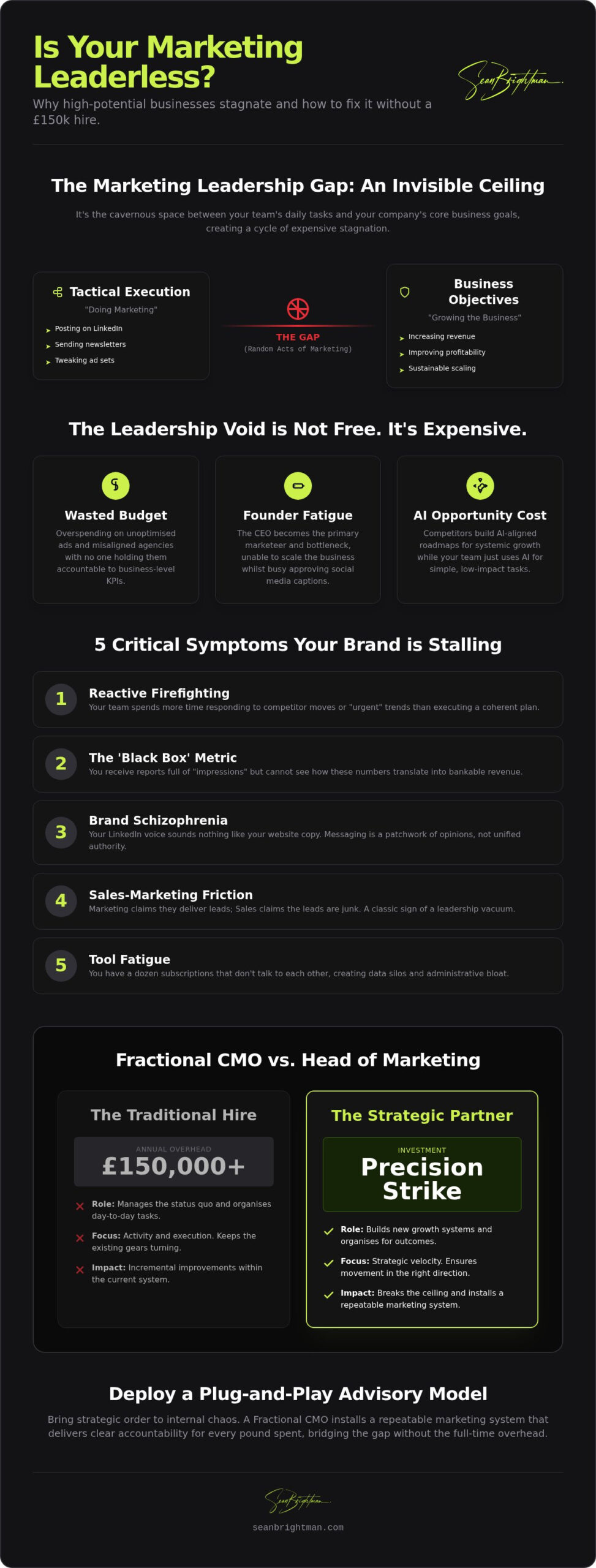
    Most UK businesses hit a wall they cannot see. It is not a lack of effort. It is not a lack of staff. It is the marketing leadership gap. This gap is the cavernous space between tactical execution and your actual business objectives. Your team is “doing marketing,” but your business isn’t growing. This is the invisible ceiling that keeps high-potential companies stuck in a cycle of expensive stagnation.

    The gap usually appears during the transition from founder-led sales to a formal marketing team. You hire a few specialists. You might even hire a manager. But you still lack a lead engineer for your growth engine. You have people to turn the gears, but no one to design the machine. This is where the debate of fractional cmo vs head of marketing becomes critical. One manages the status quo; the other builds the system that breaks the ceiling.

    Activity vs Strategic Velocity

    Your team is likely exhausted. They are posting on LinkedIn, sending newsletters, and tweaking ad sets. They are busy. But “busy” is a vanity metric. Strategic velocity is about movement in the right direction, not just movement. If your marketing activity is disconnected from your revenue goals, you are just committing random acts of marketing.

    The difference lies in the level of thinking. A manager organises tasks. A CMO-level strategist organises outcomes. Without senior leadership, your team defaults to what is easy or trendy rather than what is effective. This is how Fractional executives provide value. They don’t just add more “doing” to the pile. They ensure the “doing” actually moves the needle.

    The Cost of the Leadership Void

    A leadership void is not free. It is incredibly expensive. You pay for it in three specific ways:

    • Wasted Budget: You are likely overspending on unoptimised ads or misaligned agencies because nobody is holding them accountable to business-level KPIs.
    • Founder Fatigue: If you are the CEO and you are still the primary marketeer, you are the bottleneck. You cannot scale a business whilst you are busy approving Instagram captions.
    • The AI Opportunity Cost: Whilst your competitors are building AI-aligned roadmaps, your leaderless team is likely just using ChatGPT to write better emails. You are missing the systemic shift.

    Choosing between a fractional cmo vs head of marketing is about resourcing for the future. You don’t need a £150k overhead to get senior-level clarity. You need a mechanic who knows where to hit the engine to make it roar.

    5 Critical Symptoms Your Brand is Stalling

    Stagnation is rarely quiet. It’s a cacophony of misaligned efforts and wasted capital. If your growth has plateaued, you don’t have a market problem. You have a leadership problem. Recognising these five symptoms is the first step toward reclaiming your momentum:

    • Reactive Firefighting: Your team spends more time responding to competitor moves or “urgent” trends than following a plan.
    • The Black Box Metric: You receive monthly reports filled with “engagement” and “impressions,” yet you cannot see how these numbers translate into bankable revenue.
    • Brand Schizophrenia: Your LinkedIn voice sounds nothing like your website copy. Your messaging is a patchwork of different opinions rather than a unified brand authority.
    • Sales-Marketing Friction: Marketing claims they’re delivering leads; Sales claims the leads are junk. This blame game is a classic sign of a leadership vacuum.
    • Tool Fatigue: You have a Frankenstein tech stack. A dozen subscriptions that don’t talk to each other, creating data silos and administrative bloat.

    The strategic role of a Chief Marketing Officer (CMO) is to eliminate these frictions. When weighing up a fractional cmo vs head of marketing, the goal is to find the leader who can dismantle these silos before they become permanent fixtures of your culture.

    The Reactive Trap: Why You Are Scrambling

    Panic is the default state of a leaderless marketing department. Without a senior strategist, the team suffers from “shiny object syndrome.” They chase the latest AI tool or social platform because they lack the conviction to say no. Strategic brand roadmapping replaces this panic with precision. It turns your marketing from a series of disjointed experiments into a repeatable growth machine. More content is rarely the answer. Better direction is.

    Sales and Marketing Misalignment

    If your departments are at war, you’re losing money. The blame game between lead generation and closing is a systemic failure. It happens because there is no unified revenue goal. A senior leader bridges this gap by aligning both teams under a single commercial roadmap. They ensure marketing isn’t just “generating noise” but is actively warming up the right prospects for the sales team to close. This level of oversight is why many UK firms now choose a fractional cmo vs head of marketing; they need the battle-hardened experience to fix the pipes, not just manage the flow. If your engine is misfiring, you might need a bespoke roadmapping session to find the leak.

    The AI Blind Spot: A Modern Symptom of Leadership Failure

    Most UK businesses are currently treating AI like a novelty. They are “playing” with ChatGPT. That is not a strategy; it’s a distraction. If your team is using AI to generate more noise without improving the signal, you have a leadership failure. The gap isn’t technical. It is strategic. You don’t need more prompts. You need a system.

    The core issue is that many teams use AI for tasks, not systems. They automate the writing of a mediocre newsletter whilst the overall growth engine remains broken. When you weigh up the fractional cmo vs head of marketing debate, you must ask who has the technical foresight to integrate AI into your core architecture. The traditional duties of a chief marketing officer have shifted. It is no longer just about brand and creative; it is about technical orchestration.

    AI as a Strategic Lever, Not a Toy

    AI should be a lever for operational efficiency. It should reduce your cost per acquisition and increase your speed to market. If it’s just making your team “busier,” it’s failing. The CEO should not be the one figuring out AI implementation. Your time is too valuable for prompt engineering. You need a leader who can build an AI roadmap aligned with your brand positioning, ensuring technology serves the business goals rather than just adding to the tool fatigue.

    Data Integrity and AI Readiness

    AI is only as good as the data it consumes. A common symptom of leadership failure is messy, siloed data that prevents AI adoption. A Fractional CMO doesn’t just look at the creative; they look at the plumbing. They organise your systems for future-proofing, ensuring your CRM and analytics are clean enough to power an automated growth engine. This is about building a machine that requires less human oversight over time.

    Ignoring this shift is a high-stakes gamble. Competitors who prioritise AI consulting and strategic integration will outpace you on every metric. They will have lower overheads and higher strategic velocity. You can’t bridge this gap with a junior hire. You need a battle-hardened expert who knows how to turn AI from a toy into a functional component of your revenue machine.

    Fractional CMO vs Head of Marketing: Bridging the Leadership Gap in 2026

    Audit vs Action: Closing the Gap Without a £150k Hire

    Stop assuming that senior results require a full-time seat at the table. It’s a common myth that keeps UK founders trapped in expensive hiring cycles. You don’t need more people; you need a better machine. When you compare a fractional cmo vs head of marketing, you’re choosing between a permanent overhead and a high-impact intervention. One is a long-term liability; the other is a strategic asset.

    A full-time Head of Marketing in the UK often demands a total compensation package exceeding £150k. That is a massive financial commitment before a single lead has been generated. By choosing a Fractional CMO, you access the same C-suite experience for a fraction of the cost. You bypass the recruitment fees, the pension contributions, and the six-month “onboarding” period. You get the diagnosis and the cure on day one.

    Why Agencies Are Not the Answer

    Many founders try to bridge the leadership gap by hiring more agencies. This is a mistake. Agencies are doers, not owners. They optimise within their specific lanes; SEO, PPC, or social; but they rarely look at your business holistically. They are incentivised to keep their retainers, not necessarily to grow your bottom line.

    This leads to supplier drift. Without senior internal leadership, who is holding your agencies accountable? Who is ensuring their work aligns with your 2026 revenue goals? A leader owns the strategy. An agency executes a brief. If your brief is broken, the agency will simply help you fail faster. You need someone on your side of the table who understands the mechanics of the whole engine.

    The 90-Day Marketing Transformation

    The solution isn’t a new hire. It’s a new system. A Roadmap First approach allows you to diagnose the machine before you commit to more headcount. Within 90 days, you can identify hidden profit in your existing systems and install a robust Marketing operations framework. This isn’t about fluff; it’s about establishing an operating rhythm that creates real accountability.

    We build the roadmap, clean the data, and align the team. This creates a repeatable growth engine that doesn’t rely on the founder’s intuition. If you’re ready to stop the hiring guesswork and start scaling with precision, you can book a strategic advisory session here to begin your audit.

    Fractional CMO: The Plug-and-Play Solution for Scale-ups

    Fractional CMOs are not consultants who drop a 50-page PDF and vanish. They are the external force that brings internal order. When you weigh up a fractional cmo vs head of marketing, the primary difference is the speed of impact. A full-time hire spends their first 90 days “learning the culture.” A fractional leader spends their first 90 days rebuilding the engine. It is strategic velocity over corporate ceremony.

    The Marketing advisory retainer is designed for CEOs who need high-level guidance without the bloat. It provides a direct line to senior expertise, ensuring your team stays aligned with the roadmap we’ve established. No more guessing. No more “trying things out.” Just senior-level accountability that keeps the needle moving whilst you focus on running the business.

    Leadership on Demand

    Traditional marketing leadership is often bogged down by bureaucracy and office politics. Fractional models strip that away. It is a get-your-hands-dirty approach that prioritises results over status. We don’t care about ladder-climbing; we care about the growth engine. UK scale-ups are increasingly moving toward this model because it offers senior-level accountability on demand. You get the brain of a seasoned CMO with the agility of a startup, bypassing the recruitment lag and the £150k price tag.

    This plug-and-play model allows you to scale your leadership as you scale your revenue. You don’t need a full-time executive to tell you your messaging is broken. You need an expert who has seen your specific chaos before and knows exactly how to fix it. It is about precision, not presence.

    Building for the Exit

    If you plan to sell your business, your marketing cannot be a personality-led black box. Buyers covet systems. They want to see a machine that produces predictable revenue regardless of who is sitting in the chair. Using a Marketing strategy for business exit ensures your brand is a tangible asset, not a liability. We build the growth engine that buyers fight over.

    Sean Brightman’s methodology focuses on creating these repeatable, scalable systems. We document the process, clean the data, and align the AI-powered roadmap to your commercial goals. Stop guessing and start leading with a battle-hardened expert. Your next step is to bridge the gap. Book a roadmapping session today to identify your bottlenecks and build a growth engine that actually delivers.

    Reclaim Your Strategic Velocity

    Stop letting your marketing be a black box that swallows your budget. You’ve seen the symptoms: reactive firefighting, messy data, and the high-priced myth of the full-time hire. The choice between a fractional cmo vs head of marketing isn’t just about headcount. It’s about whether you want a manager or a mechanic. You need a leader who has built growth engines for exit and understands the systemic shift toward AI. You don’t need a £150k overhead to get C-suite clarity; you need a plug-and-play system that works whilst you sleep.

    As a Fractional CMO for high-growth UK scale-ups and an AI-powered growth engine specialist, I help founders bridge the leadership gap with tactical precision. I am the author of the definitive guide to marketing strategy, and I focus on results, not corporate fluff. It is time to dismantle the invisible ceiling holding your brand back. Book a Strategic Roadmap session with Sean Brightman to stop the guesswork and start leading with senior-level accountability. Your growth engine is waiting to be built. Let’s get to work.

    Frequently Asked Questions

    What exactly is a marketing leadership gap?

    A marketing leadership gap is the disconnect between daily tactical activity and your overarching business objectives. It occurs when a team is busy executing tasks but lacks the strategic oversight to ensure those tasks drive revenue. You have the engine, but nobody is steering the car. This gap often surfaces during founder-to-team transitions, leaving the CEO stuck managing creative approvals instead of focusing on high-level growth.

    Can a marketing agency fill a leadership gap?

    No, agencies are execution partners, not strategic owners. They excel at optimising specific channels like SEO or PPC, but they rarely understand your entire commercial landscape. Agencies are incentivised to protect their retainers, which often leads to supplier drift where their work becomes misaligned with your evolving goals. You need an internal force to hold them accountable and ensure every agency partner is pulling in the same direction.

    How much does a Fractional CMO cost compared to a full-time hire?

    A full-time Head of Marketing in the UK often costs upwards of £150k once you include salary, bonuses, and benefits. In the fractional cmo vs head of marketing debate, the fractional model offers a massive cost advantage. You pay for high-impact strategic advisory without the permanent overhead of a C-suite salary. This allows you to deploy senior leadership on demand, scaling the investment as your revenue grows rather than committing to a massive liability.

    How do I know if my marketing team is underperforming or under-led?

    If your team is consistently busy but the needle isn’t moving, you have a leadership problem. Underperformance is a symptom of a broken system, not necessarily bad personnel. Look for black box reports filled with vanity metrics that don’t translate into bankable revenue. If you’re still the one making every creative decision as a founder, your team isn’t underperforming; they’re leaderless. They need a roadmap, not more management.

    Is AI consulting part of a Fractional CMO’s role?

    In 2026, AI consulting is a mandatory component of modern marketing leadership. It isn’t just about using ChatGPT to write emails; it’s about building AI-powered growth engines that improve operational efficiency. A Fractional CMO ensures your tech stack isn’t a Frankenstein of disconnected tools. They build an AI-aligned roadmap that organises your data integrity and future-proofs your systems, ensuring technology serves your commercial goals rather than creating more administrative bloat.

    What are the first steps to closing a marketing leadership gap?

    The first step isn’t a job advert; it’s a diagnostic audit. You must identify exactly where the pipes are leaking before you commit to new headcount. Start with a strategic roadmap to define your growth levers and clean up your data systems. This allows you to understand whether you need a permanent hire or a high-impact advisory retainer. Closing the gap requires clinical precision, not a desperate recruitment drive.

    How long does it take to see results from a Fractional CMO?

    You’ll see strategic clarity within the first few weeks. However, building a repeatable growth engine typically takes about 90 days. During this period, we dismantle the random acts of marketing and install a robust operating rhythm. You’ll notice an immediate shift in accountability and messaging consistency. By the end of the first quarter, the focus moves from reactive firefighting to scalable, data-driven execution that delivers predictable ROI.

    Does my business need a marketing strategy roadmap before hiring?

    Absolutely. Hiring without a roadmap is a high-stakes gamble. When comparing a fractional cmo vs head of marketing, the roadmap defines the role you actually need. Without one, you’ll likely hire a generalist who spends months trying to find their feet. A roadmap provides the blueprint for the machine you’re building, ensuring any future hires are brought in to execute a proven strategy rather than figuring it out on your dime.

  • Part-Time Marketing Director UK: How to Hire Senior Leadership Without the £150k Overhead

    Part-Time Marketing Director UK: How to Hire Senior Leadership Without the £150k Overhead

    Your marketing department doesn’t need more hands; it needs a brain that isn’t yours. Most founders remain the ultimate bottleneck, trapped in a cycle of approving social posts whilst the actual growth strategy remains stagnant. You’re likely looking for a part-time marketing director uk to stop the bleeding without swallowing a £150,000 annual salary plus recruitment fees. It’s a logical step. However, if you hire for “part-time hours” instead of “fractional impact”, you’re simply buying a slower version of the same coordination chaos you have now.

    You’ve likely felt the sting of wasting budget on agencies that deliver colourful reports but zero actual revenue. It’s a common trap. I promise to show you how to secure senior leadership that builds AI-powered growth systems rather than just managing a tactical to-do list. We will cover how to find a battle-hardened expert who provides a clear 12-month roadmap, instils accountability in your existing team, and builds a scalable engine that functions perfectly without your constant input. It’s time to stop playing the role of accidental marketing manager and start leading your business again.

    Key Takeaways

    • Identify why your current marketing feels chaotic and how to stop being the bottleneck for every minor creative decision.
    • Learn how a part-time marketing director installs AI-driven systems that generate revenue without needing your constant supervision.
    • Compare the costs and impacts of part-time hires versus fractional CMOs to find the right fit for your business stage.
    • Master the evaluation process by focusing on outcomes over activities to avoid hiring another expensive manager of mediocrity.
    • Transition from messy execution to a clear 12-month roadmap that aligns your team and agencies with your bottom line.

    Why You Are Searching for a Part-Time Marketing Director (And What You Are Actually Missing)

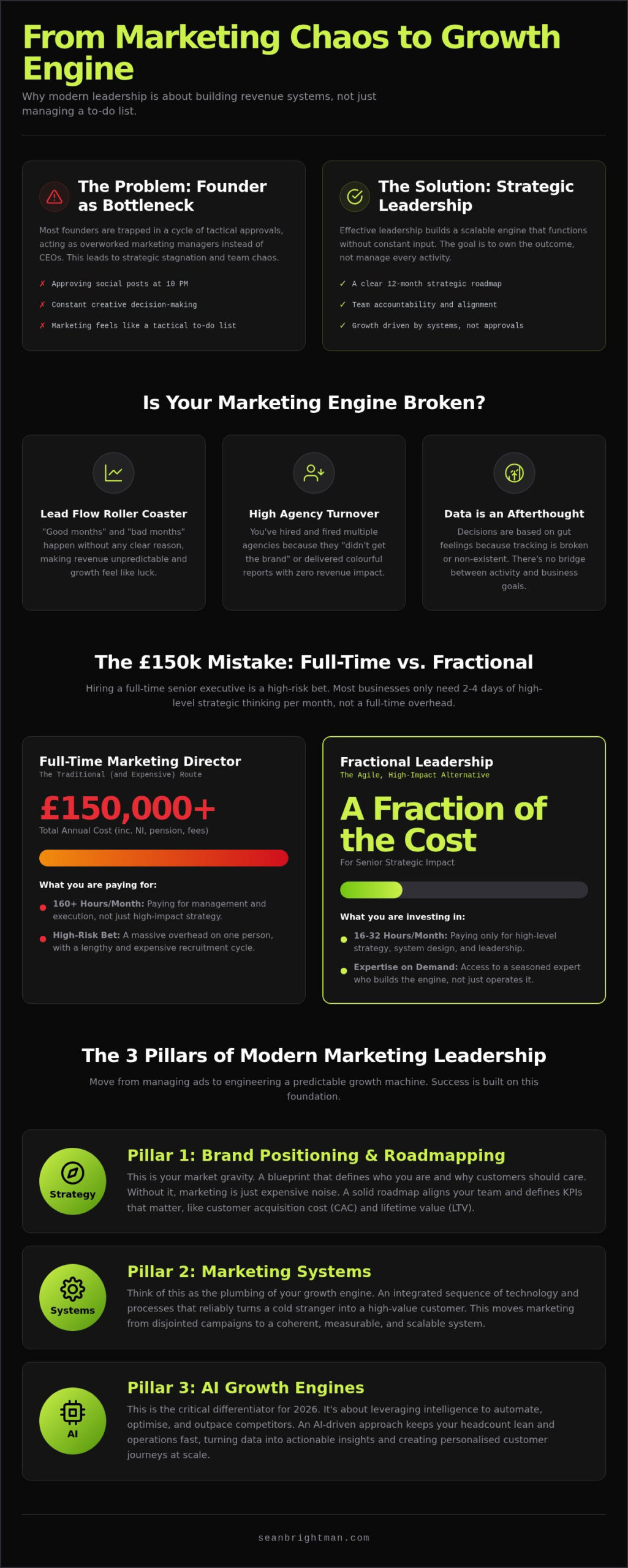
    You are likely tired of being the ultimate bottleneck. If you’re still approving social media posts at 10 PM, you aren’t acting as a CEO; you’re a micro-manager by necessity. You’ve started searching for a part-time marketing director uk because the current chaos is unsustainable. But here is the blunt truth: hiring a part-time employee often just adds another person to your management list. You don’t need someone to do the work. You need someone to own the outcome.

    Most businesses fall into the messy marketing trap. Your team is busy. They produce content, send emails, and tinker with ads. There is plenty of activity, but zero strategy. This is where professional Marketing management principles come into play. Without a senior leader to bridge the gap between business goals and tactical execution, your marketing budget is just an expensive experiment. In 2026, the difference between growth and stagnation is the ability to build systems, not just campaigns.

    The Symptoms of a Broken Marketing Engine

    How do you know your engine is failing? It’s rarely about a lack of effort. It’s about a lack of direction. Look for these red flags in your current setup:

    • Lead flow is a roller coaster. You have “good months” and “bad months” but no idea what caused either.
    • High agency turnover. You’ve fired multiple agencies because they “didn’t get the brand” or failed to deliver revenue.
    • Data is an afterthought. Decisions are based on gut feelings or “what feels right” because your tracking is broken or non-existent.

    These aren’t recruitment problems. These are structural failures. A tactical manager will keep the plates spinning. A strategic leader will build a machine that doesn’t need spinning in the first place.

    The £150k Mistake: Why Full-Time is Overkill

    Hiring a full-time senior executive is often a vanity play for SMEs. In 2026, a top-tier Marketing Director in the UK commands a salary between £100,000 and £170,000. When you factor in National Insurance, pension contributions, and benefits, you’re looking at a £150,000+ overhead. That is a massive, high-risk bet on one person.

    Most mid-sized firms only require two to four days of high-level strategic brainpower per month. Paying for the other 18 days is a waste of precious capital. Beyond the cost, the recruitment cycle for these roles is brutal. You’ll spend six months searching for a “perfect” candidate whilst your competitors use agile, fractional leadership to scale. You don’t need a full-time commitment. You need high-velocity strategic direction that builds a scalable growth engine.

    The Three Pillars of Modern Marketing Leadership: Strategy, Systems, and AI

    The role of a part-time marketing director uk has shifted. It is no longer about finding a manager to babysit an agency or approve social media graphics. It is about engineering. A modern director builds machines, not just ads. They design the strategic architecture that makes growth a predictable outcome rather than a lucky accident. This move toward flexible, high-level expertise is visible across all sectors, with even the public sector adopting senior job sharing roles to inject elite talent into complex projects without the full-time commitment.

    To move from chaos to a scalable growth engine, your leadership must focus on three core pillars:

    • Brand Positioning: This is your market gravity. It defines who you are so the market actually listens. Without it, your marketing is just expensive noise.
    • Marketing Systems: Think of this as the plumbing. It is the sequence of events and technology that turns a cold stranger into a high-value customer.
    • AI Growth Engines: This is the 2026 differentiator. It involves implementing intelligence to outpace competitors whilst keeping your headcount lean and your operations fast.

    Strategic Roadmapping: Your Exit-Ready Blueprint

    A year of “trying things” is a year of wasting capital. You need a blueprint that outlasts any single campaign. Strategic Brand Roadmapping creates immediate alignment between your business goals and your marketing execution. It defines the KPIs that actually matter to a CEO, such as customer acquisition cost and lifetime value, rather than vanity metrics like likes or impressions. This process builds an exit-ready business where the value resides in the system, not in the founder’s head. If you want to stop being the bottleneck, you need a map that the whole team can follow.

    Integrating AI into Your Growth Machinery

    Tool fatigue is a common symptom of a team without direction. Most departments use ChatGPT for basic emails and stop there. That is a missed opportunity. Your next director must act as an AI marketing consultant who understands how to bake predictive analytics and operational efficiency into your daily workflow. They automate the boring, repetitive tasks. This frees up your team for high-value creativity and strategic thinking. It isn’t just about speed; it is about precision. If your current marketing feels like a collection of disconnected tools, a professional Advisory Retainer can provide the oversight needed to integrate these technologies into a functional whole.

    Comparison: Part-Time Hire vs Fractional CMO vs Marketing Agency

    Job boards sell you roles. I sell you results. If you search for a part-time marketing director uk, you will likely find candidates looking for a stable 20-hour week. That is an employee mindset. High-growth scale-ups need a partner mindset. An employee requires management, training, and a pension plan. A fractional leader requires a goal and the autonomy to hit it. You must decide if you want to manage a person or manage an outcome.

    Marketing agencies are useful for tactical bandwidth. They have the hands to build the ads and manage the social channels. But they rarely own your bottom line. Their success metric is usually tied to their own internal process rather than your business growth. The Benefits Of Hiring A Fractional CMO include having a peer at the board table who challenges your assumptions rather than just executing your orders. For a UK business aiming to scale, the fractional model provides the strategic “brain” that an agency simply cannot offer.

    Who Owns the Strategy?

    Agencies own their process; a fractional leader owns your outcome. Letting an execution-only team set your strategic direction is a recipe for expensive failure. They will naturally steer you toward the services they happen to sell. If you are building a Marketing Strategy for Business Exit, you need an objective expert. You need someone who understands how to build enterprise value, not just high engagement scores on a LinkedIn post. Strategy is about what you choose not to do as much as what you do.

    Cost vs Impact: The Brutal Reality

    A part-time employee might appear cheaper on paper. Their day-rate is lower, but their “ramp-up” time is months. They need to be “onboarded”. A fractional director is plug-and-play. They arrive with a battle-tested toolkit and start stripping away the noise on day one. You aren’t paying for their time; you are paying for the years of mistakes they’ve already made on someone else’s dime. This speed of implementation is the hidden ROI of the fractional model. It is the fastest way to inject senior authority into a chaotic department without the friction of traditional recruitment.

    The Fractional CMO model is senior leadership without the overhead.

    Part-Time Marketing Director UK: How to Hire Senior Leadership Without the £150k Overhead

    The CEO’s Checklist for Evaluating a Part-Time Marketing Director

    Hiring a part-time marketing director uk is a high-stakes decision. You aren’t just looking for a CV; you are looking for a catalyst. Most candidates will talk about “activities”. They will list social media posts, email cadences, and brand refreshes. These are red flags. If they focus on social media likes rather than customer acquisition costs, they are a manager of tasks, not a leader of growth. You need a strategist who defines success through outcomes and revenue growth.

    Ask them if they have actually built a scalable growth engine from scratch. Managing an existing machine is easy. Building one whilst the plane is in the air is where the real skill lies. They must also demystify AI. If they hide behind corporate buzzwords or abstract theories, they don’t understand the tech. A true expert explains how AI reduces headcount or increases lead velocity in plain English. Finally, demand to see their methodology for team accountability. You need a reporting structure that shows you exactly where every pound is going and what it is returning.

    The Three Interview Questions That Reveal Everything

    Traditional interviews are theatre. To see the real person behind the professional mask, ask these three specific questions:

    • “Tell me about a marketing system you built that worked without you.” This tests their ability to create infrastructure rather than just being a hero who does everything manually.
    • “How would you integrate AI into our specific sales funnel in the first 90 days?” This separates the theorists from the practitioners who know how to drive efficiency.
    • “What is the #1 reason our current marketing is failing?” If they are too polite to tell you the truth, they will be too weak to lead your team. Look for blunt honesty.

    Vetting for Cultural Fit and Strategic Velocity

    You don’t need a corporate refugee looking for a quiet life. You need a battle-hardened expert who isn’t afraid to challenge your assumptions. In a part-time role, a “get-your-hands-dirty” attitude is non-negotiable. They must be able to switch from board-level strategy to fixing a broken automation in the same afternoon. They should provide strategic marketing direction from their first hour on the job. Velocity is the goal. If you are ready to stop the guesswork and start scaling, it is time to consider an Advisory Retainer that provides the accountability you have been missing.

    The Sean Brightman Approach: Senior Leadership via Advisory Retainer

    Stop searching for a person and start searching for a system. Hiring a part-time marketing director uk through traditional recruitment channels is a slow, expensive gamble. You spend months vetting candidates whilst your growth remains stagnant. My approach bypasses the HR bureaucracy entirely. I provide immediate strategic velocity. This isn’t about filling a seat; it’s about installing a growth machinery that functions with clinical precision.

    The Fractional CMO model is the missing piece in your leadership team. It provides the senior-level authority you need without the £150,000 commitment. I don’t just “manage” your existing chaos. I re-engineer it. We move away from recruitment headaches and into a phase of rapid implementation. This is high-level direction that focuses on your bottom line, not your social media engagement scores. It is the fastest way to turn a messy department into an exit-ready growth engine.

    Direct, High-Energy Leadership

    I have no patience for corporate fluff or endless meetings about meetings. My style is unapologetically direct. I bring a “get-your-hands-dirty” attitude to every engagement. You get results-oriented strategy, not abstract theory. I leverage a published methodology to organise your marketing chaos into a streamlined operation. It is about machinery, not just campaigns.

    The Advisory Retainer is the most efficient way to scale. It provides ongoing direction and, more importantly, accountability for the business owner. You need a partner who challenges your assumptions and keeps the team focused on high-impact wins. This is senior leadership as a functional component. It is plug-and-play expertise designed for the speed of the 2026 market.

    Ready to Fix Your Marketing?

    Stop playing with tools and start building a growth engine. You might have the latest AI subscriptions, but without a roadmap, they are just expensive toys. We need to move your department from messy execution to a predictable revenue stream. This starts with a clear, tactical plan that aligns your team and your agencies with your 12-month goals.

    The first step is a roadmapping session to define your 2026 strategy. We strip away the noise and identify the specific levers that will drive your growth. No more “random acts of marketing.” No more wasted budget. Just a clear path to a scalable business. If you are ready to stop being the bottleneck and start leading a high-performance machine, it’s time to act. Book a discovery call with Sean Brightman to discuss how we can fix your marketing engine today.

    Build a Growth Engine That Doesn’t Need You

    You don’t need another employee to manage; you need a system that delivers results. Most searches for a part-time marketing director uk end in frustration because founders hire for hours rather than impact. We’ve seen how the right fractional leader installs AI-powered machinery that turns interest into revenue whilst freeing you from the 10 PM social media approval loop. It’s about moving from messy execution to a scalable, exit-ready business.

    As the author of “The Book” on marketing strategy and a specialist in AI-powered growth engines, I don’t offer corporate fluff. I provide direct, battle-hardened advice that builds enterprise value. You can keep spinning plates, or you can install the senior brainpower your business deserves without the £150,000 overhead. It is time to stop playing the role of accidental marketing manager and start leading your company with clinical precision.

    Stop the marketing chaos-hire a Fractional CMO today. Your business is ready for the next level. Let’s build the machine that gets you there.

    Frequently Asked Questions

    What is the difference between a part-time marketing director and a fractional CMO?

    A part-time marketing director uk is often an employee-lite role focusing on managing existing tactics and team members. A Fractional CMO is a board-level strategist who builds the growth machinery from the ground up. One manages people; the other manages the bottom line. It is the difference between keeping the lights on and designing a new power grid for your business.

    How much does a part-time marketing director cost in the UK?

    Industry data for 2026 shows day rates for senior marketing leadership typically range between £600 and £1,400 depending on seniority and scope. This is significantly more efficient than a full-time hire who commands a median salary of £94,135 according to the ONS. You pay for high-impact brainpower without the dead weight of a permanent executive overhead or recruitment fees.

    Can a part-time director really manage my existing marketing team?

    Yes, they provide the missing accountability and strategic direction your staff are likely craving. Most internal teams are busy but uncoordinated. A fractional leader installs a clear roadmap and defines specific KPIs for your employees. They don’t need to be in the office five days a week to ensure your team is hitting their revenue targets and following the system.

    How long does it take to see results from a fractional marketing leader?

    You should see strategic clarity and a functional roadmap within the first 30 days. This involves identifying immediate leaks in your sales funnel and establishing a 12-month growth plan. Significant revenue shifts usually occur within three to six months as new AI-powered systems and growth engines are fully implemented and optimised for your specific market conditions.

    Do I need a part-time marketing director if I already have an agency?

    Agencies are execution partners; they are not your business strategists. An agency owns its process, but a director owns your outcome. A part-time marketing director uk acts as the bridge, ensuring your agency delivers actual ROI rather than just creative reports. They hold your external partners accountable to your business goals and stop the waste of your marketing budget.

    What industries do you specialise in for fractional leadership?

    My methodology is built for high-growth SMEs and scale-ups where marketing has become a bottleneck for the founder. Whilst I have deep experience in B2B tech and professional services, the core principles of building AI-powered growth engines remain universal. If you have a complex sales cycle and a messy marketing department, these systems will work for your business.

    How many days a month does a part-time marketing director typically work?

    Most fractional engagements range between two and four days per month. This isn’t about counting hours; it’s about strategic velocity. A battle-hardened expert can achieve more in one focused advisory session than a junior manager can in a full working week. You are buying the result and the years of experience, not a seat in your office.

    What happens if my business grows and I need a full-time CMO?

    A fractional leader builds the foundation for your eventual full-time hire. They document the systems, vet the agencies, and define the long-term role requirements. When you are ready for a permanent executive, you’ll have a turnkey department to hand over. This prevents the hero hire mistake where a new CMO spends six months just trying to find the keys.

  • Stop Hiring Full-Time CMOs: The Fractional Revolution in 2026

    Stop Hiring Full-Time CMOs: The Fractional Revolution in 2026

    Hiring a full-time CMO in 2026 is a £120,000 mistake that stalls your business. Most founders think a permanent executive is the cure for stagnant growth. Usually, they just end up with expensive activity instead of a revenue engine. You see a team that’s busy but ineffective. You want results, not just a full calendar. It’s time to stop paying for corporate politeness and start investing in tactical precision.

    We agree that your marketing should be a functional machine, not a black hole for cash. You need clarity, not more confusion about how to implement AI strategically. This article shows you how a fractional cmo provides the strategic intervention necessary to build a scalable, AI-powered growth engine. You’ll discover how to get senior-level accountability without the executive overhead. We are moving from bloated payrolls to plug-and-play systems that deliver results and let the founder step back from the daily grind.

    Key Takeaways

    • Understand why hiring a senior leader into a broken marketing system is a guaranteed six-month exit strategy.
    • Learn how a fractional cmo provides board-level expertise and high-impact strategy without the weight of a full-time contract.
    • Discover why strategy ownership must sit inside your business rather than with an agency that prioritises its own execution.
    • Map out the transition from manual, disjointed marketing tasks to a data-driven, AI-powered growth engine.
    • Use advisory retainers to maintain high-level direction and finally stop the founder from being the primary bottleneck for growth.

    The Full-Time CMO Trap: Why Your First Hire Is Often a £120k Mistake

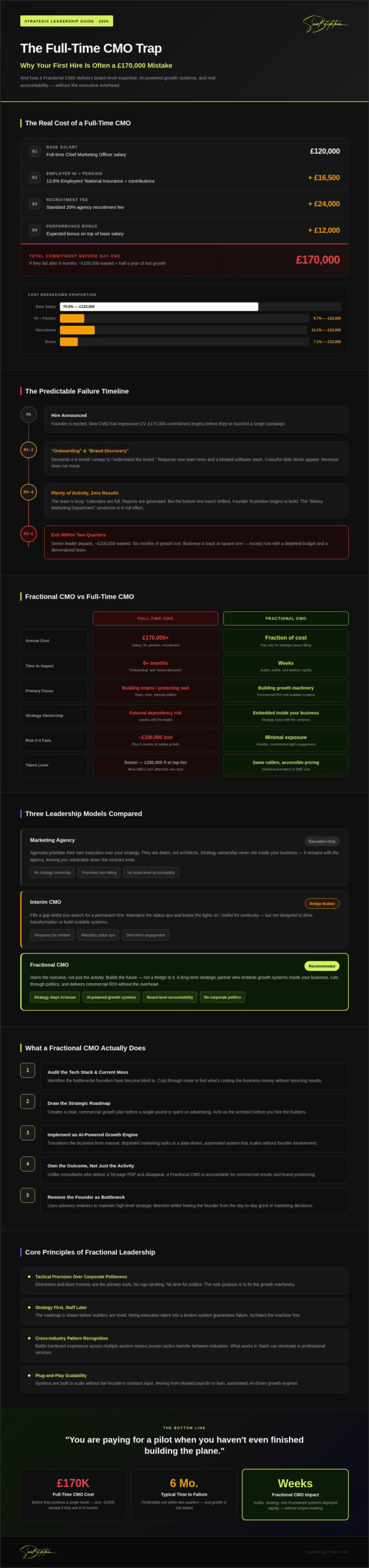
    Most SMEs hit a predictable wall. Growth stalls. The founder is exhausted from managing a junior marketing assistant who produces “content” but no revenue. The knee-jerk reaction is to find a heavy-hitter. You look for a full-time Chief Marketing Officer with a shiny CV and a £120,000 price tag. It is a massive mistake. You are hiring for seat filling whilst you should be hiring for system building.

    A full-time executive often arrives with an “expectation of empire.” They don’t just want a desk; they want a team, a bloated software stack, and a six-month “onboarding” period to “understand the brand.” You end up with a high-salaried leader sitting on top of a broken engine. The result is the Messy Marketing Department syndrome. You see plenty of activity and colourful slide decks, but the bottom line hasn’t moved. This leads to a frustrated founder and a senior leader exit within two quarters.

    The Real Cost of Executive Failure

    Think £120,000 is the total cost? Think again. In the UK market, you must factor in 13.8% Employers’ National Insurance, pension contributions, and performance bonuses. Add a standard 20% recruitment fee and you are looking at a £170,000 commitment before they even start. If they fail and leave after six months, you’ve wasted nearly £100,000 and half a year of growth. SMEs often outgrow their first marketing manager but aren’t ready for the dead weight of a full-timer. You are paying for a pilot when you haven’t even finished building the plane. The opportunity cost of stagnant growth is the real killer.

    Strategy First, Staff Later

    You cannot delegate strategy to a junior team or a generalist agency. They are doers, not architects. A What is a Fractional Executive? model allows you to bring in the architect first. A fractional cmo doesn’t care about building an internal empire or protecting their seat. They care about the machinery of growth.

    This role acts as the strategic intervention your business needs. They draw the plans, audit the tech stack, and implement an AI-powered growth engine before you hire the builders. It is about tactical precision over corporate politeness. By choosing a fractional cmo, you get board-level leadership that focuses on results rather than bureaucracy. You get the roadmap first. You hire the executioners only when the system is ready to scale. Before committing to a permanent hire, it is worth reviewing a fractional CMO vs full time cost-benefit analysis to understand the true loaded cost of each path.

    What is a Fractional CMO? Leadership Without the Corporate Overhead

    A fractional cmo is not a part-time employee. They are a senior marketing executive providing board-level leadership on a concentrated, part-time basis. Think of it as high-octane fuel for your growth engine. You get the same calibre of talent that global brands pay £250,000 for, but you only pay for the strategic heavy lifting. This isn’t about filling a seat. It’s about deploying a “Plug-and-Play” leader who can audit your mess, fix the leaks, and build a scalable system in weeks, not years. If you want to understand exactly what is a fractional CMO and how senior marketing leadership actually works in 2026, it is worth stripping away the corporate fluff to see how this model delivers strategic accountability where most businesses currently have chaos.

    Unlike a consultant who drops a 50-page PDF and disappears, a fractional cmo owns the outcome. Consultants give advice. Fractionals provide execution and accountability. They focus on commercial ROI, brand positioning, and mechanical marketing systems that don’t rely on the founder’s intuition. If you need a clear path forward, a structured roadmapping session can help define that initial strategy before the first pound is spent on ads.

    Fractional CMO vs Interim CMO

    Interim leaders are bridge-builders. They fill a gap whilst you look for a permanent hire. They keep the lights on. A fractional leader builds the future. Whilst an interim role suggests a temporary fix, a fractional partnership is a long-term strategic commitment to growth. Choose an interim if you just need to maintain the status quo. Choose a fractional if you need to disrupt it. It is about driving strategic growth with a fractional CMO to ensure your business stage matches your leadership model.

    The “Battle-Hardened” Expert Persona

    The best leaders aren’t specialists in one narrow niche. They are experts in growth. A Fractional CMO brings a perspective forged in the fires of multiple industries. They aren’t blinded by “how we’ve always done it” in your specific sector. They see patterns. They know what works in SaaS that will crush it in professional services. They bring a “get-your-hands-dirty” attitude that corporate executives often lose.

    Their secret weapons are directness and blunt honesty. They don’t have time for corporate politics or ego-stroking. They are there to fix the machinery. This external perspective allows them to identify bottlenecks you’ve become blind to. They cut through the noise with tactical precision. You aren’t paying for their time. You are paying for the decades of mistakes they’ve already made and learned from elsewhere.

    Fractional CMO vs Marketing Agency: Who Actually Owns Your Strategy?

    Agencies are incentivised to sell you more work. It is a fundamental conflict of interest. If you hire an SEO agency, the solution to every problem is more content. If you hire a PPC agency, the answer is always more spend. They are built to sell execution, not to own your commercial outcomes. They provide the parts, but they don’t care if the machine actually runs.

    Agencies provide the labour. A fractional cmo provides the logic. One is a service provider; the other is a strategic partner who sits on your side of the table. The fractional leader doesn’t care which channel wins as long as the revenue engine works. They own the strategy, the budget, and the result. They ensure your marketing spend is an investment in scalable machinery, not just a recurring monthly expense that vanishes when the contract ends.

    The Execution Trap

    Many founders fall into the trap of starting with tactics. They jump into Facebook ads or LinkedIn outreach before they have a solid positioning strategy. This is just burning cash. Running ads without a roadmap is efficient waste. You are simply scaling confusion. A fractional cmo stops the bleeding by identifying which levers to pull amongst the noise. They build a growth engine that works across all channels, ensuring every pound of labour serves the strategic logic of the business. The underlying problem is almost always a systems failure — disconnected tools, siloed data, and decisions made on gut feeling rather than hard numbers, which is precisely what a dedicated marketing operations consultant is built to resolve.

    Accountability and Oversight

    Who marks the agency’s homework? Most CEOs don’t have the technical depth to know if their agency is performing or just hiding behind vanity metrics. You need senior oversight to keep them honest. Without it, you are at the mercy of colourful reports that don’t translate to bank balances. It’s about accountability, not just activity.

    The fractional leader bridges the gap between the CEO’s vision and the agency’s technical output. They translate high-level business goals into specific, measurable requirements. They integrate your internal team and external partners into a cohesive unit. This senior-level intervention ensures that every external partner is aligned with your long-term roadmap. You get the benefit of agency execution without the risk of strategic drift. You finally get someone who knows what “good” looks like and isn’t afraid to call out underperformance.

    Stop Hiring Full-Time CMOs: The Fractional Revolution in 2026

    Building the AI-Powered Growth Engine: A 2026 Roadmap

    By 2026, simply “using AI” isn’t a competitive advantage. It is the baseline. Most UK businesses are still playing with tools like hobbyists. They generate a few social posts or draft an email. This is not a strategy. It is a distraction. You need a growth engine, not a toy box. If your marketing department is just “playing with tools,” you are falling behind competitors who are building integrated machinery.

    A fractional cmo acts as the architect of this machinery. They move your team beyond experimentation into strategic implementation. The goal is tactical precision. We use AI to improve marketing efficiency and data-driven decision-making. It is about automating the mundane so your expensive human talent can focus on the creative logic that actually moves the needle. This is how you scale without ballooning your payroll.

    The AI Marketing Roadmap

    Building this engine requires a clinical approach. It doesn’t happen by accident. A fractional cmo provides the senior-level AI Consulting needed to ensure your tech stack delivers ROI rather than just adding complexity. We follow a three-step process to build your engine.

    • Step 1: System Audit. We check for AI readiness. Is your data siloed? Are your current workflows redundant? We strip away the fluff to find the functional core of your operations.
    • Step 2: High-Impact Use Cases. We focus on positioning, personalisation, and prediction. We use AI to analyse market gaps and personalise customer journeys at a scale that was previously impossible. This isn’t about more content; it’s about better conversion.
    • Step 3: Scalable Integration. We implement a growth engine that learns. This isn’t a static plan. It is a living system that adapts to market shifts in real-time, providing the strategic accountability you’ve been missing.

    Strategic Roadmapping Sessions

    Most marketing plans sit in a drawer. They are too long, too vague, and too polite. You need a clear, actionable roadmap that defines your brand direction without the corporate fluff. This starts with a one-off strategy session. We identify the bottlenecks and draw the blueprints for your growth engine. This is about getting the plans right before you hire the builders.

    Creating a clear plan ensures your marketing doesn’t rely on the founder’s intuition. It builds a system that works whilst you sleep. Learn more about Strategic Roadmapping to see how we turn chaos into a clinical plan of attack. If you are ready to stop burning cash on disjointed tactics, you can book a roadmapping session to build your engine today. Let’s stop playing with tools and start building the machinery of 2026.

    Implementing Fractional Leadership: From Chaos to Strategic Accountability

    Implementing a fractional cmo is the fastest way to shift from operational chaos to strategic accountability. You don’t need another manager to supervise the mess. You need a partner who owns the outcome. Most marketing departments produce activity. We produce results. It is about building a functional component of your business that operates with tactical precision.

    The Advisory Retainer is the mechanism that makes this possible. It provides ongoing direction and a direct line of accountability for the CEO. This isn’t about corporate hand-holding. It is about expert oversight. Advisory beats management because it focuses on high-level logic rather than getting bogged down in daily tasks. It is the secret weapon for founders who have outgrown their own marketing knowledge but aren’t ready for the dead weight of a full-time executive.

    Measuring success requires a clinical focus on KPIs that actually hit the bottom line. We ignore vanity metrics. We don’t care about “likes” or “brand awareness” unless they translate to revenue. We track Customer Acquisition Cost (CAC), Lifetime Value (LTV), and sales velocity. This is the difference between a marketing department that feels like an expense and one that functions as a growth engine. You finally get a clear marketing roadmap that doesn’t rely on the founder’s intuition.

    Eventually, your business will scale to a point where a full-time hire makes sense. This usually happens when your revenue hits the £25 million threshold and the machinery is so predictable that you simply need someone to maintain it. Until then, a fractional leader is the more efficient choice. You get the expertise without the £120,000 overhead. If you are still weighing up the numbers, the fractional CMO vs full time brutal cost-benefit analysis for 2026 breaks down the true total loaded cost of each model so you can make the decision with clarity.

    The Advisory Retainer Model

    High-growth founders are often the primary bottleneck. You make every strategic decision because you don’t trust the team to get it right. An advisory retainer removes that burden. It ensures your strategies are executed effectively with expert oversight. You get a mentor who has seen your specific problems before and knows the shortcut to the solution. It is about strategic accountability, not just filling a seat.

    Getting Started in 90 Days

    We don’t spend months “onboarding” or “finding our feet.” We hit the ground running with a clear 90-day plan.

    • The first 30 days: We audit current systems. We listen. We find the “mess” and identify the immediate leaks in your funnel.
    • The next 60 days: We build the foundation. We implement the AI-powered growth engine and align your existing team with the new roadmap.
    • The result: By day 90, you have a scalable, predictable marketing machine that doesn’t rely on the founder.

    Ready to turn your marketing into a functional machine? Book a Strategic Advisory session with Sean Brightman to start your 90-day transition today. Let’s stop the activity and start the growth.

    Stop Managing Chaos and Start Building Machinery

    Hiring for seat filling is a legacy move. You need a marketing system that delivers results without the £120k overhead. We have defined the difference between logic and labour. You now understand why a fractional cmo is the strategic intervention required to fix a broken engine. It is about tactical precision, not corporate politeness. You don’t need more activity; you need a revenue engine that scales.

    Sean Brightman, author of “The Strategy Book”, specialises in AI-powered marketing systems for UK scale-ups. He provides the high-impact advisory needed to turn your vision into a clinical roadmap. Stop being the bottleneck in your own business. It is time to implement the strategic accountability that moves the needle. You have the blueprint. Now you need the architect.

    Build your AI-powered growth engine with Sean Brightman.

    The future of your growth depends on the systems you build today. Let’s get to work and build something that lasts.

    Frequently Asked Questions

    What is the typical day rate for a Fractional CMO in the UK?

    UK day rates for senior marketing leadership usually range from £1,000 to £2,500 depending on the expert’s track record. You aren’t paying for a full-time salary; you are paying for concentrated strategic impact. This reflects the “fractional” nature of the role. It is a tactical investment in a battle-hardened leader who has already made the expensive mistakes elsewhere so you don’t have to.

    How many days a week does a Fractional CMO usually work?

    A fractional cmo typically commits between two and four days per month. This isn’t about clock-watching. It is about high-impact strategic interventions. Some businesses require one day a week for deep integration, whilst others prefer a concentrated burst of two days a month for board-level direction. The model is flexible. It scales based on the complexity of your growth engine and the speed of execution.

    What is the difference between a Marketing Consultant and a Fractional CMO?

    Consultants give you a map; a fractional cmo drives the car. Consultants produce reports and slide decks that often end up in a drawer. A fractional leader owns the commercial outcome, the team, and the budget. They are embedded in your leadership team. They don’t just tell you what’s wrong. They fix the machinery and stay to ensure the results actually hit your bank balance.

    Can a Fractional CMO help with AI implementation?

    Yes, they act as the architects of your AI-powered growth engine. Most teams play with AI tools like hobbyists without a clear plan. A fractional leader implements AI strategically to automate mundane tasks and improve data-driven decision-making. They ensure your tech stack isn’t just a collection of toys. It becomes a functional component of your machinery that learns and adapts to market shifts in real-time.

    Does a Fractional CMO manage my existing marketing team?

    They absolutely manage your internal team and external agencies. You need someone to mark the homework. Without senior oversight, marketing departments often produce “activity” instead of results. The fractional leader bridges the gap between the CEO’s vision and the team’s technical output. They provide the strategic logic that ensures every pound of labour serves a specific commercial goal. It is about accountability, not just management.

    When is a business ready for a Fractional CMO?

    You are ready when your revenue is between £2m and £10m and growth has stalled. If the founder is still the primary marketing bottleneck, you need an intervention. You have outgrown your junior “doers” but aren’t ready for the £120k overhead of a full-time executive. If your marketing feels like a black hole for cash rather than a predictable engine, it is time for fractional leadership.

    How long do Fractional CMO engagements typically last?

    Engagements usually last between six and eighteen months. This isn’t a temporary fix. It is a long-term strategic partnership. The goal is to build a scalable system and eventually hire a permanent team to maintain it. Some founders retain a fractional leader on an advisory basis for years to maintain high-level direction and accountability without the bloat of a permanent executive payroll.

    Will a Fractional CMO help me hire a permanent marketing team?

    Yes, they often help you hire your eventual full-time replacement. A fractional cmo builds the machinery first. Once the growth engine is predictable and the roadmap is clear, they help you find the right permanent lead to run it. This ensures you hire for system maintenance rather than system building. It prevents the common mistake of hiring a senior leader into a broken, messy department.