
Marketing strategy rarely stalls for lack of ideas. It stalls when nobody can challenge the assumptions behind them. When your marketing manager needs a mentor, an experienced, independent perspective can help them test decisions, build confidence and connect marketing activity to business growth.
You’re right to expect more than encouragement. When your marketing manager needs a mentor, a useful one offers a confidential space to discuss difficult decisions, question familiar ways of working and identify a clear next step. That support draws on relevant experience; it is not simply a set of instructions or a promise of quick results.
This article explains how mentoring can support your marketing manager and strengthen strategic thinking, where an external perspective can help, and how a mentor differs from a coach. You’ll also see when the real need is broader growth strategy rather than individual development, so you can choose support that addresses the problem in front of you.
Key Takeaways
- Match mentoring to your marketing manager’s career stage and the skills or decisions they need to develop.
- Use an external perspective to challenge assumptions and work through sensitive strategic decisions with greater clarity.
- Choose mentoring, coaching or clear direction according to whether the need is experience, reflection or an immediate decision.
- Spot when repeated uncertainty, stalled development or difficulty connecting marketing activity to business goals calls for experienced support.
1. How can I support your business as a marketing mentor?
A marketing mentor helps a marketer understand why an approach works, not just how to execute it. Match the guidance to their career stage: an early-career executive may need help interpreting campaign results, while an experienced manager may want to sharpen leadership or strategic judgement. The right fit depends on relevant experience, the marketer’s goals and how they learn.
What benefits can a mentor provide to a marketing manager? They can offer practical feedback, challenge assumptions and turn development goals into next steps. For example, a manager preparing to present a new positioning strategy can rehearse the case, anticipate stakeholder concerns and identify gaps before the meeting. That reflection builds skills they can apply to future decisions.
Career development also means handling setbacks without losing direction. A mentor can help a marketer examine a campaign that missed its goal, distinguish controllable choices from external factors and decide what to test next. This process builds resilience and adaptability. It can also clarify a useful learning path, whether the priority is analytics, communication or leadership.
A mentor can support career growth beyond the current role. They might explain what different marketing specialisms involve, suggest ways to explore a new path and introduce relevant contacts. A marketer considering brand strategy, for instance, could discuss the skills the role requires and identify practical projects to build experience.
What questions should a marketing manager ask a potential mentor? Ask which marketing challenges they know well, how they give feedback and what they expect from the relationship. Then explain the specific career or skills goal you want to work on. Clear expectations help both people decide whether their experience, values and working styles are a good fit.
Mentoring can be reciprocal, too. A 22-year-old marketing executive might mentor a more experienced colleague on TikTok strategy, while receiving guidance on stakeholder management. That exchange recognises expertise at every career level and helps both marketers strengthen their network, skills and leadership practice.
2. External perspective and confidential support for marketing leaders
An in-house marketing leader can be too close to internal routines to see their effects. An external mentor brings a different perspective and helps the mentee test assumptions before they become decisions. In confidential conversations, a manager can raise concerns they may hesitate to discuss with colleagues, such as weak stakeholder alignment or an unclear case for investment.
During organisational transformation, that distance matters. If a business changes its structure, enters a new market or adopts AI tools, marketing priorities can shift quickly. A mentor can help the leader separate urgent operational questions from strategic ones, map affected stakeholders and explain marketing’s role clearly. The aim is more deliberate decision-making, not another layer of internal noise.
How much does marketing mentoring cost in the UK? Fees depend on the mentor’s experience, meeting frequency, level of support and work involved. Compare the scope and expected outcomes, not just the meeting format.
How often should mentoring sessions take place and how long should they last? Ongoing support can involve online meetings every week, with each conversation focused on a decision, goal or obstacle. Allow enough time to examine the issue and agree practical follow-up actions, then review the rhythm as priorities change.
Some marketing mentoring programmes offer high or medium support for 3-6 months. The right level depends on the complexity of the challenge and how much continuity the mentee needs. A focused decision may call for lighter support; an organisation-wide shift may need regular progress discussions.
What risks or boundaries should be considered in a mentoring relationship? Agree at the outset what stays confidential, what the mentee wants to achieve and where the mentor’s role ends. Mentoring supports professional development; it isn’t counselling or a substitute for decisions owned by the manager. For business-level direction alongside individual support, explore growth strategy support.
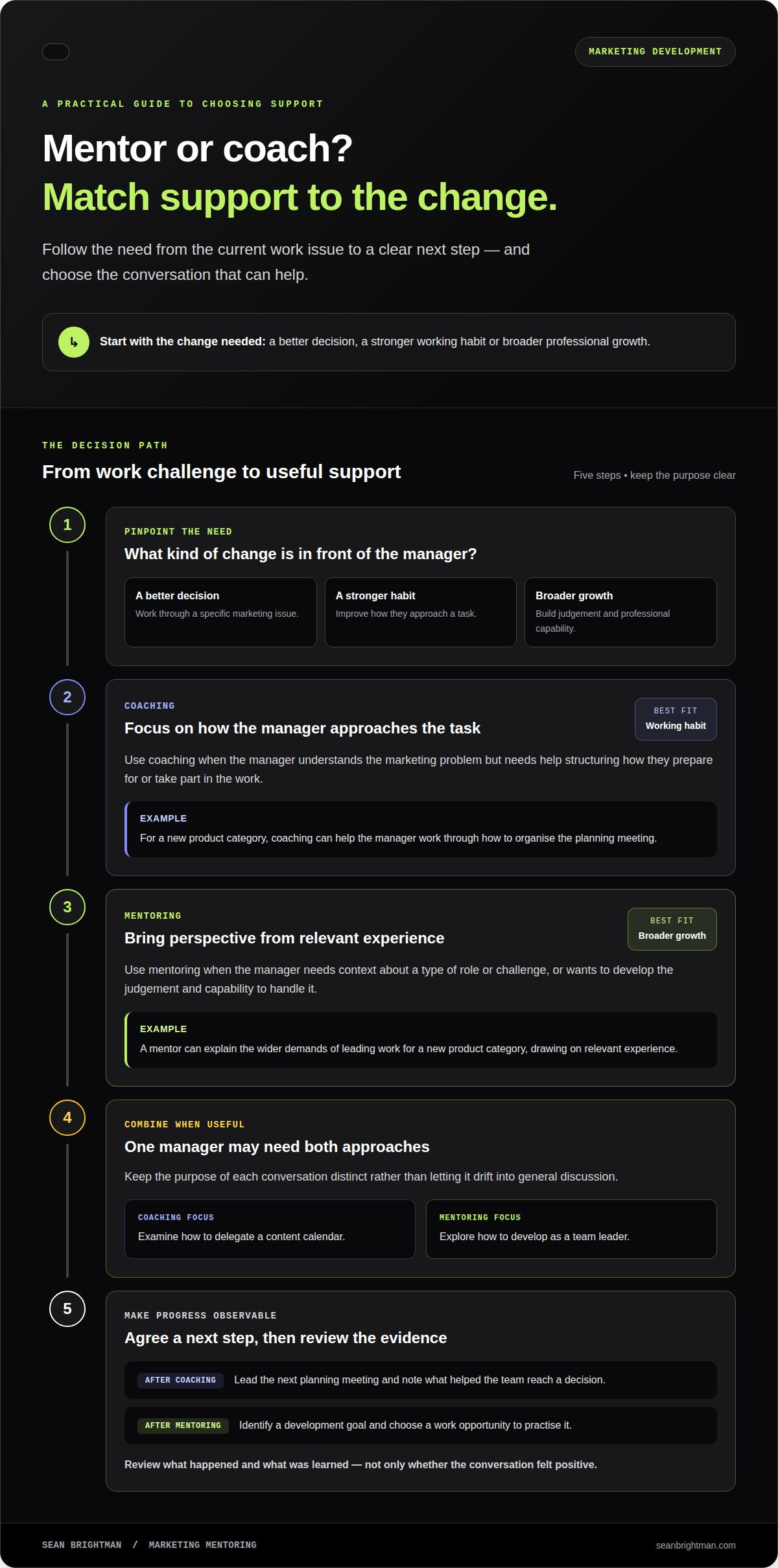
3. What is the difference between a mentor and a coach?
Choose support based on the change you need: a better decision, a stronger working habit or broader professional growth. Start with a current task. If the manager understands the marketing problem but struggles to structure a planning discussion, coaching can focus on how they prepare and participate. If they lack perspective on a type of role or challenge, mentoring may provide useful context.
For example, a manager preparing a team for a new product category could use coaching to work through how to organise the planning meeting. A mentor could help them understand the wider demands of leading that work, drawing on relevant experience. The distinction is practical: one conversation can focus on the manager’s approach to a task; another can explore the judgement and capability they want to build.
There’s no need to force every conversation into one method. A manager might use coaching to examine how they delegate a content calendar, then seek mentoring on how to develop as a team leader. Keep the purpose clear, so the conversation doesn’t drift into general discussion when a specific work issue needs attention.
Judge whether the approach is useful by agreeing an observable next step. After a coaching conversation, the manager might lead the next planning meeting and note what helped the team reach a decision. After mentoring, they might identify a development goal and choose a work opportunity to practise it. Review the evidence together instead of relying on whether the conversation felt positive.
When your marketing manager needs a mentor, identify a development question that experience can help answer. For a defined task, focus on the behaviour or decision the manager can change. If the need shifts, adjust the approach. That keeps the relationship focused on the work, rather than treating coaching and mentoring as fixed labels.
4. What signs show a marketing manager needs a mentor?
Look for repeated patterns, not one difficult week. A manager may need an outside perspective if they keep postponing strategic decisions, struggle to explain how campaigns support business goals or rely on senior colleagues to approve every move. For example, if quarterly planning meetings repeatedly end without clear priorities, the issue may be confidence or strategic judgement, not workload alone.
Another sign is activity without a clear link to outcomes. The manager may report social posts, events and email sends, yet struggle to explain which audience or business objective each serves. Ask them to connect a recent campaign to its intended audience, goal and learning. If they repeatedly struggle to explain that reasoning, mentoring can help uncover gaps in strategic thinking.
Watch how they respond to challenges. A manager who avoids stakeholder conversations, takes feedback as a personal setback or cannot adapt after a campaign underperforms may benefit from structured reflection. A mentor can help them examine a real decision, identify assumptions and consider a different response next time.
Career signals matter, too. If a capable manager feels stuck, cannot identify their next development step or is preparing for a broader leadership role, mentoring can clarify which skills to build. Separate an individual development need from a business problem: unclear ownership, shifting priorities or limited resources may require organisational action instead. A mentor can help distinguish between them.
Start with a focused conversation. Ask the manager to rate their confidence in a current challenge from 1 to 10, then discuss what would move it up one point. That makes the need specific and gives future conversations a practical reference. If the pattern points to unclear marketing direction, map a clearer marketing roadmap around the business goals and decisions that matter.
Sean Brightman
Sean Brightman is a practical next step when your marketing manager’s development needs sit alongside wider questions about business growth. If priorities are unclear or strategy isn’t translating into action, Roadmapping can bring direction to the decisions ahead. An Advisory Retainer provides ongoing strategic input as priorities evolve, while AI Consulting can support decisions about using AI in the business.
The right support depends on the problem. Individual mentoring can help a manager reflect and develop; business-level strategy support can connect marketing decisions to organisational goals. Sean Brightman’s work is relevant when you need to clarify that wider direction, rather than replace the manager’s role or promise a particular outcome.
If you’d like to discuss the strategic challenge, contact Sean Brightman.
Turn a development need into a clear next step
Recognising when your marketing manager needs a mentor is the start, not the strategy. First, separate the person’s development goal from the business decision behind it. Is the priority greater confidence in their role, clearer marketing direction or additional senior leadership capacity? Naming the actual need makes the next conversation more focused.
Sean Brightman can help address wider business challenges through Fractional CMO support, AI Consulting or Roadmapping. These services meet different needs, from marketing leadership capacity to decisions about AI or the direction of a growth plan. Choose a starting point based on the challenge you need to solve, not a service label.
Bring the decision that’s causing friction and the outcome you need to move towards. Contact Sean Brightman to discuss mentoring and identify a practical next step. A clearer direction gives your marketing manager more room to lead with purpose.
Frequently Asked Questions
An adviser or mentor?
Choose an adviser for help with business decisions; choose a mentor for a marketer’s professional development. A marketing director weighing investment across several channels may need strategic advice on priorities. A manager learning to influence senior stakeholders may benefit more from a mentor’s experience and feedback. Some situations call for both, but define the main need first to keep the support focused.
How can I support your business as a marketing mentor?
Help the manager connect a business priority to a practical marketing decision. For example, if the organisation wants stronger customer retention, discuss which customer behaviours the team needs to understand and what marketing could test. Ask the manager to explain their reasoning, then help them spot assumptions or missing evidence. That builds their judgement instead of making them dependent on someone else’s answer.
How do I find a mentor?
Start by naming the challenge the marketer wants to work on, such as stakeholder influence or a move into brand strategy. Look for someone with relevant experience through professional networks, colleagues or industry communities. Make a concise approach: describe the challenge, explain why their perspective matters and suggest an initial conversation. Agree on the purpose and expectations before arranging ongoing meetings.
What is the difference between a mentor and a coach?
A mentor draws on relevant experience, while a coach helps someone examine their thinking and choose actions. If a manager is preparing for a new product launch, a mentor might share lessons from similar work. A coach could help the manager explore launch risks and decide how to respond. Coaching may suit a defined performance goal; mentoring often supports broader development over time.
How can a marketing manager find a suitable mentor in the UK?
A marketing manager in the UK can look beyond their immediate reporting line, including professional networks and industry communities. Focus on the challenge, not job title alone: a marketer exploring digital channels may value hands-on experience in that area, whilst someone preparing for leadership may need guidance on influencing stakeholders. A good fit also depends on compatible values, learning preferences and career aims.
What should you look for when choosing a marketing mentor?
Look for relevant experience, thoughtful challenge and a working style the marketer can learn from. In an initial conversation, explain the development goal and ask how the mentor approaches feedback. Notice whether they listen carefully, offer specific examples and respect agreed boundaries. Set a clear purpose for the relationship, then review whether the conversations help the manager progress towards that goal.
Leave a Reply