
What if your marketing budget is funding familiar channels rather than the business priorities that matter now? That’s a common trap. The best marketing budget allocation best practices don’t start with inherited percentages or last year’s channel mix. They start with what the business needs to achieve.
When investment is scattered without a clear reason, it’s difficult to show leadership what’s working, what’s producing useful evidence and what should change. If every channel has a case for staying, deciding what to protect, pause or test can become guesswork.
This guide gives you a practical way to connect business goals to marketing investment, choose an allocation approach and review results without treating the first plan as permanent. It explains how a framework such as 70-20-10 can prompt a balance between proven activity, emerging opportunities and experiments, and how evidence can shape the next move. A clear roadmap turns priorities into direction, helping you explain decisions and put each pound to work with purpose.
Key Takeaways
- Use marketing budget allocation best practices to tie spend to business priorities, not last year’s channel mix.
- Start with the outcomes you need, then map each priority to an audience, customer journey need and intended commercial contribution.
- Compare top-down, objective-led and evidence-led allocation methods by their speed, flexibility and evidence requirements.
- Turn your chosen approach into a plan that names an owner, intended outcome, evidence source and review point for each investment.
- Use strategic leadership to resolve trade-offs and keep allocation decisions aligned as priorities, evidence and capacity change.
Why marketing budget allocation best practices start with business priorities
A budget can be fully spent and still fail to support the business. Often, the issue isn’t the size of the pot. It’s that channel, campaign and capability decisions were made before anyone agreed what marketing needs to achieve.
Marketing budget allocation is the decision about where, when and why marketing resources should support business priorities, guided by evidence about what the business needs and what its activity can deliver. That’s the difference between assigning money and making a strategic choice. Strong marketing budget allocation best practices connect each investment to a priority, while leaving room to learn and adjust.
What a marketing budget allocation decision actually covers
Separate the overall budget envelope from the choices made within it. The envelope sets the total resources available. Allocation determines how those resources are divided across work and when they’ll be committed.
That work may include media, campaign development, people’s time, tools, research or external strategic support. A plan that funds activity but ignores the capacity to deliver it is incomplete. So is one that buys tools without defining how they support a business outcome.
Accounting categories answer, “Where was the money recorded?” Strategic allocation answers, “Why are we investing here, and what should this help the business achieve?” Both views matter, but they’re not interchangeable.
Why fixed percentages rarely make the decision for you
Revenue-based benchmarks can provide context, not a ready-made answer. Gartner’s May 2026 survey of large enterprises reported marketing budgets at 7.8% of company revenue. The January 2026 CMO Survey, from Duke University, Deloitte and the American Marketing Association, reported 9.0% across a broader mix of company sizes. Different samples produce different benchmarks. Neither tells an individual business how to divide its budget.
Context changes the decision. A business building awareness may need a different mix from one focused on converting existing demand. A long sales cycle affects when evidence appears. Margins affect how much acquisition cost the business can sustain. Existing capability matters too: a team with strong customer data may be ready to use it, while another may need to build the foundations first.
- Growth stage: Is the immediate need to establish demand, enter a market or improve conversion?
- Sales cycle and margins: How long can the business wait for results, and what contribution makes an investment viable?
- Capacity: Can the team deliver and measure the work, or does another priority need attention first?
Don’t let a percentage make the case for you. Use it to prompt sharper questions about goals, economics and capability, then build the allocation around the answers. More spend doesn’t automatically mean stronger marketing. If the strategy is unclear or the team can’t execute, a larger budget may simply fund more activity without producing better evidence or outcomes.
Build a marketing budget allocation framework around outcomes and constraints
A useful framework stops channel preferences from getting ahead of the work. Start with the result the business needs, then decide what marketing can influence, what resources it will take and how you’ll judge progress. That sequence makes marketing budget allocation best practices practical, not just a set of principles.
Set allocation criteria from strategic goals before choosing channels. If someone proposes a channel before the priority and intended contribution are clear, it’s a tactic looking for a reason.
Turn business goals into ranked marketing priorities
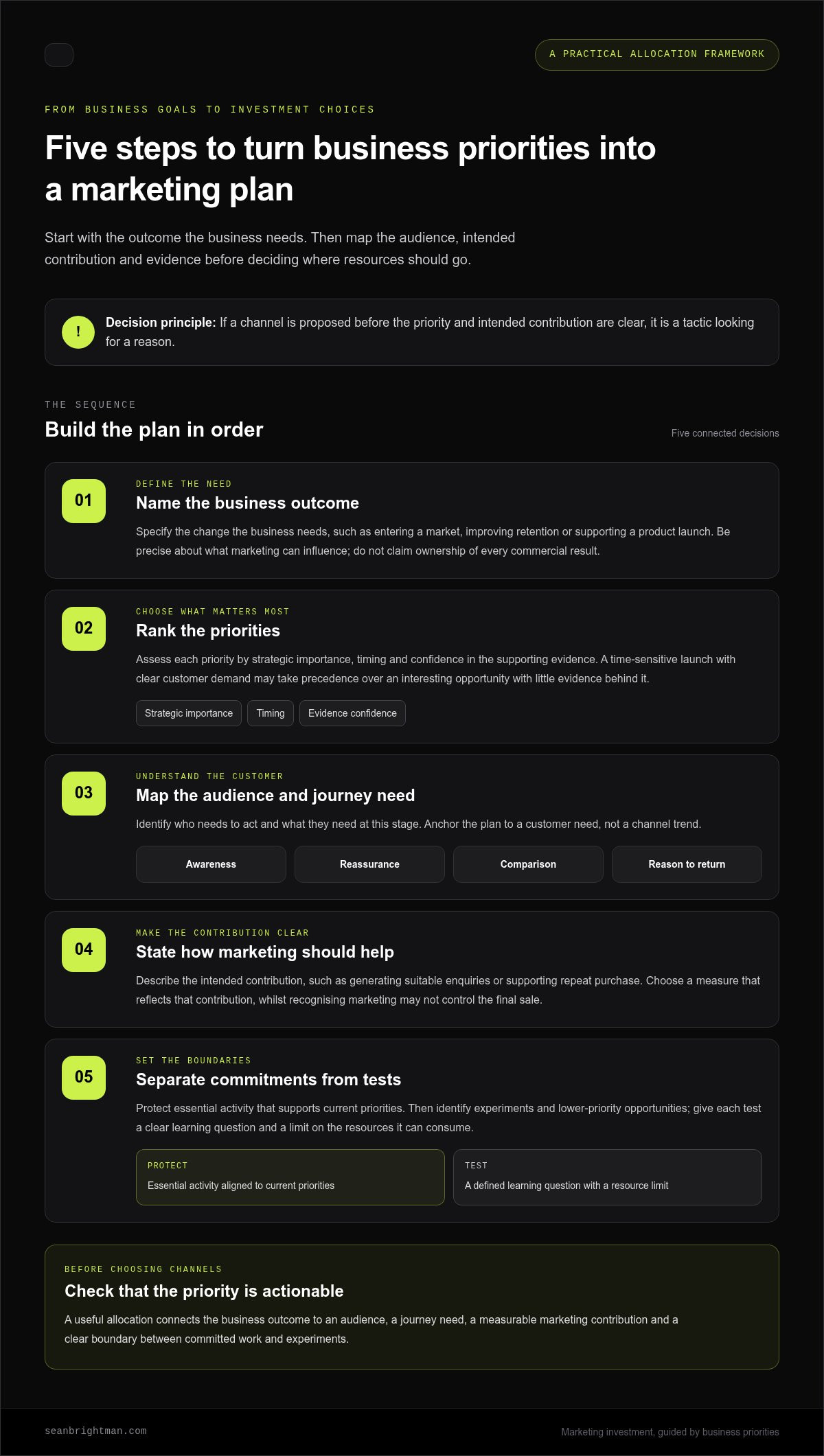
Translate broad ambitions into outcomes marketing can influence. “Grow the business” is too vague to guide investment. “Increase qualified enquiries from a specific customer group” gives the team a clearer audience, journey need and commercial contribution to plan around. Use this framework to work through the decision:
- Name the business outcome. Define the change the business needs, such as entering a market, improving retention or supporting a product launch. Be precise about what marketing can influence, rather than claiming ownership of every commercial result.
- Rank the priorities. Assess each by strategic importance, timing and confidence in the supporting evidence. A time-sensitive launch with clear customer demand may take precedence over an interesting opportunity with little evidence behind it.
- Map the audience and journey need. Identify who needs to act and what they need at this stage: awareness, reassurance, comparison or a reason to return. This keeps the plan tied to a customer need, not a channel trend.
- State the intended contribution. Describe how marketing should help, such as generating suitable enquiries or supporting repeat purchase. Choose a measure that reflects that contribution, while recognising that marketing may not control the final sale.
- Separate commitments from tests. Protect essential activity that supports current priorities, then identify experiments and lower-priority opportunities. Each test needs a clear learning question and a limit on the resources it can consume.
Account for capacity, timing and measurement limits
A priority belongs in the plan only if the business can support it. Check the people, expertise, systems and time required before committing resources. If the team can’t follow up enquiries, for example, adding demand-generation activity may create more work without addressing the bottleneck.
Timing matters too. A short review window may show early engagement but not the effect of a long sales cycle. Before judging performance, set expectations for what evidence should appear and when. Otherwise, a promising investment could be cut too early, or a weak one could continue without a clear reason.
- Capacity: Who will own delivery, follow-up and analysis?
- Cash flow: When will the investment be needed, and can spending be staged?
- Measurement: What data is available, and where are the gaps?
Record assumptions as well as measures. If attribution is incomplete, say so and use the strongest available evidence alongside customer and sales-team feedback. A strategic roadmap can turn these priorities and constraints into a structured direction. Strategic marketing roadmapping brings the decisions into one plan that can be reviewed as evidence develops.
Compare marketing budget allocation methods before choosing a channel mix
No single allocation method fits every business. The right choice depends on the decision you need to make, the evidence you have and how quickly you need to act. Treat the method as a tool, not a rulebook. You can combine approaches: set a leadership boundary, allocate against objectives, then adjust when the evidence supports a change.
Top-down, objective-led and evidence-led allocation
Use this comparison to choose a sensible starting point. None is a universal winner.
| Approach | How it works | Trade-offs and best fit |
|---|---|---|
| Top-down | Leadership sets the total budget or boundaries first, often in line with business plans and financial capacity. | Fast and useful when time or cash flow demands a clear limit. It can be rigid if the figure arrives without marketing priorities or delivery capacity. |
| Objective-led | Start with defined business priorities, then identify the activity and resources needed to support them. | Connects investment to intent and works when goals are clear. It takes planning, and estimates may need revising if costs or capacity change. |
| Evidence-led | Use reliable performance information to guide continued investment, cuts or tests. | Supports responsive decisions when measurement is credible. It’s less useful with incomplete data, short histories or long customer journeys where outcomes take time to appear. |
In practice, leadership can set a responsible envelope, objective-led planning can define what the investment must accomplish, and performance evidence can inform later adjustments. Don’t let that last step overrule everything else: a channel with immediate measurable returns isn’t automatically the right choice if it doesn’t serve the priority.
Choose channels because they fit the audience’s behaviour and the business objective, not because they’re fashionable or prominent in a competitor’s plan. Ask where the audience looks for information, what would help them move forward and whether your team can deliver consistently there. If the answers don’t support a channel, its popularity is irrelevant.
Balance short-term demand with longer-term brand and capability
Immediate-response activity can help capture existing demand. Longer-term brand-building can make the business more familiar and relevant before a customer is ready to act. Capability investments, such as improving customer insight or measurement, may not generate an instant return, but can make future decisions better informed. Cutting everything that lacks an immediate result can leave the business with little foundation for sustained growth.
The right balance depends on the sales cycle, audience and maturity of the business. A short buying journey may allow faster feedback; a complex decision may need sustained communication before a commercial outcome is visible. Consider:
- How quickly the business needs demand and when revenue can reasonably follow.
- Whether the audience already knows the offer or needs confidence and context first.
- Which activities have repeatable evidence, and which deserve a controlled test.
- What capability gaps could weaken current or future investment.
A 70-20-10 split can be a useful prompt to discuss how much resource goes to proven activity, emerging opportunities and experiments. Treat it as a starting point for that discussion, not a formula to apply regardless of your goals, evidence or capacity. Keep proven activity accountable, give tests a defined learning question, and assess longer-term investment against milestones suited to its purpose. The strongest marketing budget allocation best practices make the mix explainable, testable and responsive to the business, not to a fashionable formula.
Put marketing budget allocation best practices into a reviewable plan
A budget plan shouldn’t be a spreadsheet of channel names and figures. It should show why each investment exists, who owns it and what evidence will inform the next decision. That turns allocation from an annual guessing exercise into a process the team can manage.
Document assumptions and decision ownership
Build the plan in sequence. Keep it simple enough for a lean team to maintain, but specific enough that someone else can understand the reasoning behind each decision.
- Record the investment and its purpose. Name the activity, the business priority it supports and the outcome it is intended to influence.
- State the assumptions. Note what you believe about the audience, customer behaviour, timing or likely contribution. Distinguish what’s known from what’s still an expectation.
- Assign responsibility. Name the person accountable for delivery, who reviews the evidence and who can approve a material change. One person can hold several roles, but decision rights must be clear.
- Set the evidence source and review point. Choose the data or feedback that can inform the decision, then schedule a review that gives the activity enough time to produce a meaningful signal.
- Define the decision conditions. Agree what would justify protecting the investment, adjusting its approach or stopping it. Tie those conditions to the activity’s purpose, not a single unexpected result.
For example, if an investment is intended to improve consideration, early reach alone won’t prove it’s working. Record what further evidence would indicate progress, such as stronger engagement from the intended audience or useful feedback from sales conversations. If the team can’t collect that evidence, make the measurement gap visible rather than presenting an assumption as a result.
A compact budget view can keep financial commitments clear without elaborate software. Show three figures for each priority: planned spend, the amount assigned in the plan; committed spend, what is already contractually or operationally committed; and available flexibility, what remains uncommitted and can still move. Keep the view in pounds and update it when commitments change.
Set review signals without overreacting to early results
Match the signal to the job. A response-focused activity might be judged on qualified enquiries, while a longer-term brand investment needs indicators suited to awareness and consideration. Conversion delays, seasonal patterns and incomplete attribution can all distort short-term readings. Record these limits upfront.
At each planned review, compare actual evidence with the original purpose and assumptions. Maintain investment when the evidence remains consistent with the intended outcome. Adjust when a change could address a specific weakness. Reallocate or stop when the rationale no longer holds, or the opportunity cost is stronger elsewhere. Don’t confuse movement in a dashboard with a reason to act.
If your priorities, ownership and review decisions need a clearer through-line, discuss your strategic direction with Sean. A structured roadmap can keep investment aligned as the evidence changes.
Make budget allocation accountable with strategic leadership
A well-researched plan can still stall when priorities compete. One team wants to protect activity that’s producing leads. Another wants to invest in a new opportunity. Capacity is tight, and the evidence isn’t conclusive. Strategic leadership makes the trade-off explicit: which priority matters most, what the business can support and what evidence would change the decision.
When a business needs strategic oversight
Look for these warning signs:
- Several teams claim the same budget, but no one owns the decision.
- Spend continues because it’s familiar, not because its purpose is clear.
- Budgets are repeatedly reset before the team can assess results properly.
- Marketing priorities shift, but investment and accountability don’t follow.
Senior guidance can connect business objectives to allocation choices, clarify who makes the call and keep reviews focused on evidence rather than internal preferences. It can also help distinguish a genuine change in business direction from a reaction to one disappointing result. Where the issue extends beyond allocation into disconnected processes or unclear responsibilities, the marketing operations growth engine offers a useful lens on the wider operating model.
Strategic oversight doesn’t mean removing decisions from the team. It means giving people a clear framework for making them, with someone accountable for resolving conflicts and explaining why investment moves. This creates continuity: a decision made during planning still has an owner when priorities or evidence change.
Turn allocation decisions into sustained strategic direction
A roadmap makes the logic visible beyond the spreadsheet. It connects priorities to the intended direction, shows how investment supports that direction and gives the team a reference point when new requests compete for resources. A strategic brand roadmap can organise that direction while keeping the reasoning behind choices clear enough to revisit.
Strategic oversight also needs a rhythm. At each review, leadership can ask: has the business priority changed? Is the activity producing the evidence expected at this stage? Does the team have the capacity to continue? If the answers point to a change, document the reason and its implications for other commitments. If not, give the plan time to work.
Sean’s Fractional CMO leadership provides senior marketing direction on a part-time basis, while an ongoing marketing advisory retainer supports direction and accountability over time. This is strategic guidance, not advertising execution. The aim is to keep priorities, investment decisions and ownership aligned as the business evolves.
If your budget decisions need clearer ownership or a stronger link to business priorities, discuss your marketing direction with Sean.
Make your next budget decision with confidence
Your next move isn’t to add another channel. Make sure the next investment has a clear owner, a reason to exist and a decision point. That’s how marketing budget allocation best practices become part of how the business operates, rather than a one-off planning exercise.
If priorities keep shifting or budget choices lack a clear owner, experienced strategic support can bring decisions into focus. Sean’s Fractional CMO leadership provides senior marketing direction on a part-time basis. Roadmapping turns priorities into structured marketing and brand direction, while an advisory retainer provides ongoing direction and accountability. This is strategic guidance to help you decide where to focus, not advertising execution.
Bring your current priorities and investment questions into the conversation. Discuss your marketing direction with Sean and take the next step towards a budget that supports the business you’re building.
Frequently Asked Questions
What should a marketing budget include?
A marketing budget should include the resources needed to plan, deliver and assess marketing activity. Depending on the business, that may cover media, content production, research, events, software, staff time and external strategic support. Include recurring commitments as well as one-off projects, and distinguish costs already committed from those still under consideration. This gives leaders a more complete view of what the plan requires, not just visible campaign spend.
Should marketing salaries be included in the marketing budget?
Include marketing salaries when you want the budget to show the full resources devoted to marketing, even if your accounts record payroll elsewhere. You could show the whole team cost or estimate the share of time spent on a specific programme. Be consistent: if a team member’s time is already included in a project estimate, don’t count it again as a separate cost. Agree the reporting approach with finance so comparisons remain useful.
How often should a marketing budget be reviewed?
Review financial commitments monthly and assess strategic performance at a cadence that matches the activity. A monthly check can flag overspend, delayed invoices or commitments that have changed. A deeper quarterly review may suit activities where results take longer to emerge. Don’t change course just to create movement. Use each review to check whether assumptions still hold, delivery is on track and a material business change requires a decision.
How do you allocate a marketing budget when you have limited data?
Start with a modest, clearly bounded test rather than pretending you know the likely return. The marketing budget allocation best practices that matter here are disciplined learning: document what you expect, track a small set of useful signals and gather direct feedback from customers or sales conversations. Check that tracking works before launch. Set a decision date and a limit on further investment, then use what you learn to shape the next test.
Should marketing budget be allocated by channel or campaign?
Use campaigns to define the work and channels to show how it will reach people. For example, a customer retention campaign might use email and in-person events, with a shared objective but separate delivery costs. A channel-only view helps monitor commitments across the plan; a campaign view shows whether activity supports a coherent goal. Keep both views connected, and avoid counting the same production or staff cost twice.
What is a marketing budget reallocation trigger?
A reallocation trigger is a pre-agreed condition that prompts a formal review of whether investment should move. It could be a major change in business priorities, a delivery delay that makes planned activity impractical or repeated evidence that an initiative is reaching the wrong audience. A trigger doesn’t automatically mean cutting spend. It signals that the owner should check the facts, consider alternatives and record the reason for any change.
Leave a Reply